KITOZER UPS Bypass Cabinet / Maintenance Bypass Complete Technical Guide
Brand: KITOZER Manufacturer: Guangzhou Laian Intelligent System Development Co., Ltd. Category: UPS Power Distribution Accessory Version: V1.0 Date: October 2026
1. Product Overview
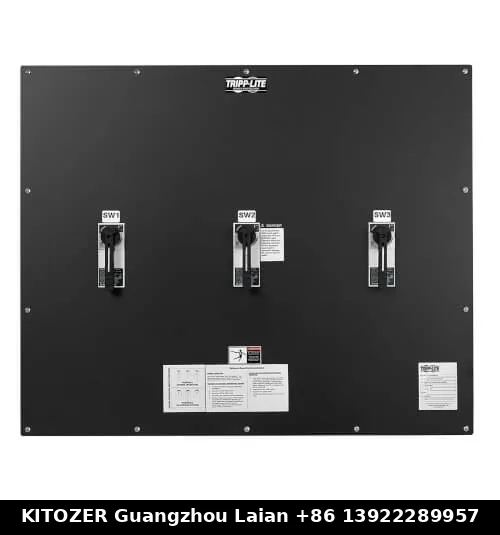
A UPS bypass cabinet, also called a maintenance bypass cabinet or maintenance bypass panel, is a low-voltage switchgear assembly installed alongside an uninterruptible power supply (UPS). It introduces an independent bypass path that does not pass through the UPS rectifier-inverter chain. When the UPS needs shutdown for maintenance, fault repair, module replacement, annual testing, capacity expansion, or relocation, the bypass cabinet keeps the critical load powered directly by mains via the bypass branch. The core value of a maintenance bypass is to make the UPS removable from the power chain without load interruption. Without a maintenance bypass, any internal UPS failure, inverter shutdown, or battery maintenance could force a load blackout. With a maintenance bypass, operators can safely isolate the entire UPS while the load continues to run.
An online double-conversion UPS already contains an internal static bypass path: when the inverter overloads, overheats, or faults, the UPS control logic transfers the load to mains via silicon-controlled rectifier (SCR) static switches within four milliseconds. However, this internal static bypass has two limitations. First, it shares the control power, detection circuits, and cooling path with the UPS; if the UPS control board, fan, or auxiliary power supply fails, the static bypass also fails. Second, when the UPS must be pulled out for service, the internal bypass still feeds through the UPS internal busbar and static switches, so maintenance personnel cannot fully de-energize the UPS, leaving live busbars inside. The external maintenance bypass cabinet solves both problems: it provides an independent manual or automatic bypass loop outside the UPS, with mechanical interlocks that enforce the safe sequence of close bypass first, then open UPS.
KITOZER (Guangzhou Laian Intelligent System Development Co., Ltd.) supplies UPS bypass cabinets from 10kVA to 800kVA per cabinet, covering single-phase and three-phase configurations. Each cabinet includes a manual maintenance bypass switch, input and output molded-case circuit breakers, surge protective devices, a multifunction power meter, emergency stop button, status lamps, and an optional static transfer switch (STS) module. The enclosure is 2mm cold-rolled steel with powder coating, IP30 standard, optional IP42.
1.1 Product Positioning
KITOZER positions the bypass cabinet as the maintenance safety node in critical power chains. In data centers, industrial controls, medical imaging, rail transit, telecom rooms, and financial core rooms, the bypass cabinet is the final manual path that keeps equipment serviceable. KITOZER emphasizes three design principles: reliability first with mechanically interlocked switches, clear operability with a mimic diagram panel, and compatibility with all major UPS brands.
1.2 Core Value
The bypass cabinet delivers four benefits. First, load continuity: during any UPS shutdown, the load is fed directly by mains bypass with no interruption. Second, personnel safety: after the maintenance bypass is closed and UPS input/output breakers opened, the UPS internal busbars are fully isolated. Third, lower maintenance cost: planned UPS service no longer requires emergency night work. Fourth, power flexibility: parallel UPS expansion can connect new modules to the common busbar without load interruption.
1.3 Background
UPS technology evolved from rotary motor-generator sets in the 1960s to modern static double-conversion systems. Early small UPS units were wall-mounted and unplugged for service. As capacities grew, maintenance safety became critical. Since the 1980s, major UPS makers have included maintenance bypass as a standard feature for medium and large systems. KITOZER draws on Guangzhou Laian’s system integration experience to deliver complete bypass solutions.
2. Working Principle
2.1 Three Parallel Paths
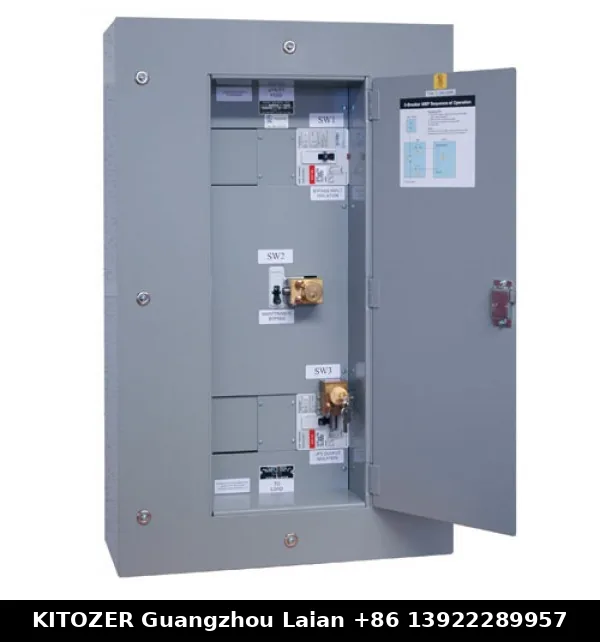
A complete bypass system has three parallel paths. The UPS main path feeds mains through the rectifier to the inverter to the load. The internal static bypass path automatically transfers the load to mains on inverter fault. The external maintenance bypass path is an independent switch from mains bus to output bus. Only one path may be closed at any time.
2.2 Normal Operation
In normal operation the load is powered by the UPS inverter. Input breaker closed, output breaker closed, maintenance bypass open. The mimic panel shows inverter-supplied lamp green. The multifunction meter displays voltage, current, frequency, power, and energy.
2.3 Static Bypass Transfer
When the UPS detects inverter overload above 125 percent, over-temperature, DC bus undervoltage, or fan failure, the static switch closes within four milliseconds and the inverter shuts down. The load does not notice the transfer. The bypass-supplied lamp turns yellow. Operators should repair the inverter promptly because bypass mode loses voltage regulation.
2.4 Maintenance Bypass Closing Sequence
Closing the maintenance bypass is a strict no-break sequence. Step one: confirm the UPS is in static bypass or normal inverter mode and record the load rate. Step two: close the maintenance bypass breaker, temporarily paralleling the bypass with the UPS output. Step three: confirm the bypass carries the load. Step four: open the UPS output breaker. Step five: open the UPS input breaker. Step six: wait five to ten minutes for DC bus capacitors to discharge before opening the UPS door.
2.5 Maintenance Bypass Opening Sequence
After service, reverse the sequence: close UPS input, wait for the inverter to start, close UPS output breaker, then open the maintenance bypass breaker. The load transfers back to the inverter without interruption.
2.6 Mechanical and Electrical Interlocks
Mechanical interlocks use four-bar linkages and lock pins to prevent simultaneous closing of the maintenance bypass and UPS output breakers. Electrical interlocks use auxiliary contacts to block UPS inverter start when the maintenance bypass is closed. Key interlocks on three switches further reduce human error.
2.7 Parallel System Bypass
In N+1 or 2N parallel UPS systems, the common maintenance bypass switch must carry total load current. Synchronization detection ensures the bypass voltage matches the UPS output before closing.
2.8 STS Static Transfer Switch
For loads requiring sub-four-millisecond automatic transfer between two mains sources, KITOZER offers an integrated STS module rated 16A to 400A. The STS transfers between two independent sources in under four milliseconds and works with the manual maintenance bypass.
3. Technical Parameters
3.1 General Electrical Parameters
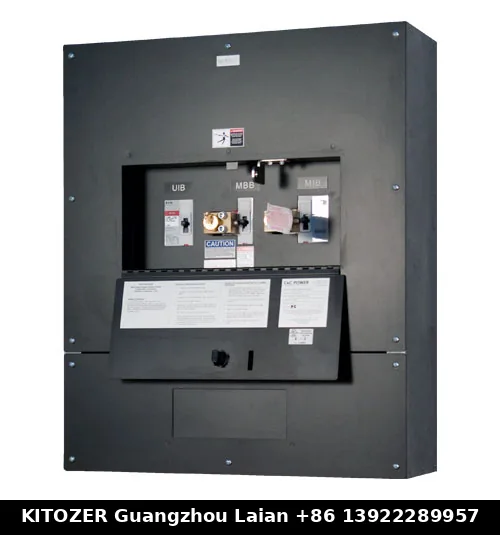
| Item | Range | Note |
|---|---|---|
| Rated insulation voltage Ui | AC 1000V | Power frequency withstand 2.5kV/1min |
| Rated operational voltage Ue | AC 220V/380V/400V | 3P4W+PE, 690V optional |
| Frequency | 50/60Hz | Adaptive |
| Rated current | 32A to 1250A | 10kVA to 800kVA |
| Peak withstand current | 10kA to 100kA/1s | Per breaker rating |
| Short-time withstand Icw | 10kA to 50kA/1s | Busbar thermal stability |
| Main busbar | Tinned copper 30×4 to 80×8 | |
| IP rating | IP30 / IP42 optional | Indoor floor standing |
| Ambient temperature | -5 to +40C | Humidity below 95% non-condensing |
| Altitude | up to 2000m | Derate above |
3.2 Recommended Sizing Table
| UPS Capacity | Bypass Current | Main Breaker | Busbar | Size WxDxH mm |
|---|---|---|---|---|
| 10 to 20 kVA | 63A | MCCB 3P 63A | 20×3 Cu | 600x600x1600 |
| 30 to 40 kVA | 100A | MCCB 3P 100A | 30×4 Cu | 600x800x1800 |
| 60 to 80 kVA | 160A | MCCB 3P 160A | 40×4 Cu | 600x800x2000 |
| 100 to 120 kVA | 250A | MCCB 3P 250A | 40×5 Cu | 800x800x2000 |
| 160 to 200 kVA | 400A | MCCB 3P 400A | 50×5 Cu | 800x1000x2200 |
| 250 to 300 kVA | 630A | ACB/MCCB 630A | 60×6 Cu | 1000x1000x2200 |
| 400 to 500 kVA | 800A | ACB 800A | 80×6 Cu | 1000x1200x2200 |
| 600 to 800 kVA | 1250A | ACB 1250A | 80×8 Cu | 1200x1200x2200 |
3.3 Internal Components
| Component | Configuration | Options |
|---|---|---|
| Input breaker | MCCB thermal-magnetic | Shunt trip, aux contacts |
| Output breaker | MCCB interlocked | Motor operator |
| Maintenance bypass | Load break switch with interlock | Fuse switch disconnector |
| SPD | Type 2, 40kA, 3P+N | Type 1+2 100kA |
| Power meter | Multifunction V/A/W/kWh | Harmonic + RS485 |
| Status lamps | Red/green/yellow LED | Mimic diagram panel |
| Emergency stop | Red mushroom latching | Remote stop terminals |
| CT | Through-core | Custom ratio |
4. Selection Guide
4.1 Sizing by UPS Capacity
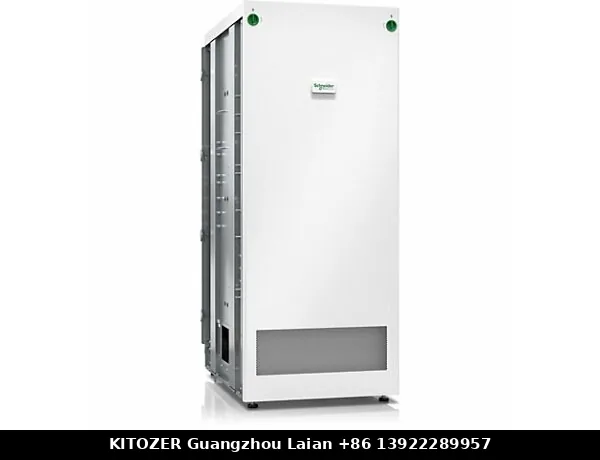
The bypass cabinet rated current must equal or exceed the UPS output rating with at least 1.25 times margin. For a 100kVA UPS at 380V, output current is about 152A; choose a 250A frame with a 200A trip. Do not oversize excessively or undersize.
4.2 Pole Selection
Single-phase UPS uses 2-pole, three-phase three-wire uses 3-pole, three-phase four-wire uses 4-pole. Always switch the neutral together with phases. For data centers with heavy third-harmonic loads, size the neutral busbar at 1.5 times the phase conductor.
4.3 Manual vs Static
Choose manual maintenance bypass for planned service with operators present. Choose static STS bypass for loads that cannot tolerate even milliseconds of interruption and need automatic two-source transfer.
4.4 Enclosure Form Factor
Independent floor-standing cabinet suits large systems. Integrated cabinet saves space. Wall-mounted suits small 10 to 30kVA units. Maintain at least 800mm front and 600mm rear clearance.
4.5 Environment Rating
Clean data centers use IP30. Dusty workshops use IP42. Coastal salt-air environments specify 304 stainless or anti-corrosion coating. Above 40C ambient, derate 8 percent per 5C.
5. Installation Requirements
5.1 Civil Works
Mount the cabinet on a 10-channel steel channel base welded to the earth grid. Fix with M12 expansion bolts at four points. Maintain at least 500mm clearance above the cabinet.
5.2 Cable Wiring
Use flame-retardant copper cables sized at 1.25 times rated current. Route incoming and outgoing cables from the bottom. Connect the protective earth to the dedicated grounding busbar. Seal cable entries with firestop.
5.3 Ventilation
The cabinet is static and passive, but busbars still heat. Keep top exhaust and bottom intake unobstructed. Maintain ambient temperature between 5 and 40C.
5.4 Grounding
Bond all bare metal doors and panels to the internal earth busbar with braided copper straps. The earthing bar should be at least 40x4mm copper. Use TN-S system with N and PE separated after a single point.
5.5 Pre-energization Checks
Verify phase sequence, measure insulation resistance above 2MOhm, test mechanical interlocks, simulate control circuits, and check no-load current.
6. Operation and Maintenance
6.1 Daily Inspection
Operators inspect the mimic panel, meter readings, unusual smells or sounds, door closure, and clearances. Record readings daily.
6.2 Periodic Maintenance
Every six months, de-energize and blow out dust, retorque busbar bolts to the manufacturer torque table, exercise breakers, inspect SPD windows, and test insulation.
6.3 Common Faults
If the load drops after closing bypass, check whether the UPS output breaker was opened and whether the bypass switch contacts are sound. If meter voltage is abnormal, the mains itself may be off-spec. If the interlock sticks, clean and lubricate with silicone grease. If the SPD window turns red, replace the module.
6.4 Safety Procedures
Always work in pairs with one operator and one watcher. Post warning tags. Verify dead before touching live parts. Never open the door while energized.
7. FAQ
Q: What is the difference between UPS internal static bypass and external maintenance bypass?
A: The internal static bypass automatically transfers to mains within four milliseconds but shares UPS control power and cannot fully isolate the UPS for service. The external maintenance bypass is an independent mechanical or static switch that fully isolates the UPS while the load stays on mains. They complement each other.
Q: Can I use the maintenance bypass as the permanent power source?
A: Not recommended. Bypass mode loses UPS voltage regulation, filtering, and isolation. Short-term emergency use of hours to a day is acceptable; long-term use risks the load.
Q: What happens if I oversize the bypass cabinet?
A: The breaker protection coordination will mismatch, and the upstream breaker may trip instead. Cost also rises. Size at 1.25 times the UPS output current.
Q: Does the bypass cabinet need its own battery?
A: No. The maintenance bypass feeds mains directly. Batteries are in a separate battery cabinet.
Q: Does switching the maintenance bypass interrupt the load?
A: No if you follow the close-bypass-first sequence. Yes if you open UPS output before closing the bypass.
Q: Is the bypass cabinet compatible with any UPS brand?
A: KITOZER bypass cabinets are designed for universal interfaces but require the UPS brand and one-line diagram for confirmation.
Q: How often do I replace the SPD?
A: Every three to five years or when the status window turns red. Inspect before thunderstorm season.
Q: Does the cabinet shell need grounding?
A: Yes. Bond all bare metal to the earth busbar with at least 16mm2 wire.
Q: How do I size the bypass for parallel UPS?
A: Use the total load current for the common bypass switch, with per-UPS output breakers and synchronization detection.
Q: What is the reference price?
A: Small manual bypass cabinets start at a few thousand RMB; large parallel bypass cabinets are tens of thousands. Contact KITOZER for a formal quote.
8. Application Scenarios
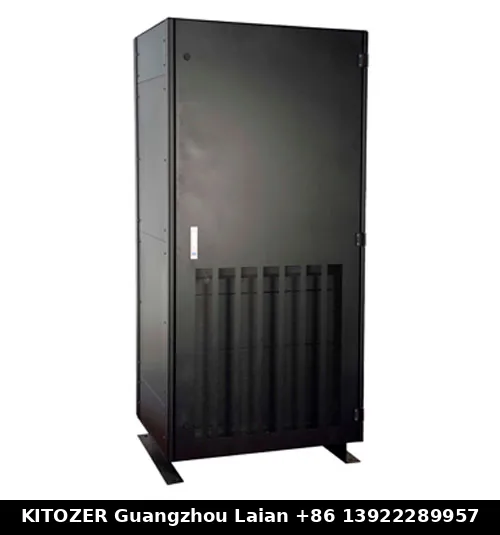
8.1 Data Centers
Data centers are the largest market for bypass cabinets. A medium data center typically uses 2N redundant UPS, each with its own maintenance bypass. When one UPS needs module replacement, fan replacement, or annual load testing, it transfers to the bypass and the other UPS carries the load with zero business interruption.
8.2 Industrial Automation
Factory PLC, DCS, production lines, and inverters are UPS-fed. Industrial environments require IP42 and reinforced busbar supports. The bypass allows production-line maintenance without shutdown.
8.3 Medical Facilities
Hospital ICU, operating rooms, CT/MRI, and dialysis centers require continuous power. KITOZER medical bypass cabinets work with isolation transformers and insulation monitors.
8.4 Telecom Rooms
Carrier base stations and core rooms run 24/7. The bypass cabinet is mandatory for UPS service and provides dry-contact alarms to environment monitoring.
8.5 Finance and Government
Banking core systems and trading platforms require high reliability. KITOZER provides smart meters with RS485 for remote monitoring.
9. Comparison with Related Equipment
9.1 ATS vs Bypass Cabinet
ATS switches between two independent mains sources in tens of milliseconds to seconds. The bypass cabinet switches between UPS output and mains in a synchronized near-zero break. They are often used in series: two mains feed an ATS, then the UPS, then the bypass cabinet.
9.2 STS vs Bypass Cabinet
STS uses SCR for four-millisecond automatic transfer. The maintenance bypass uses mechanical switches with visible break. They work together in 2N systems.
9.3 General Distribution Cabinet vs Bypass
General switchgear distributes and protects multiple feeders. The bypass cabinet is purpose-built for UPS bypass switching with interlocks. Do not substitute.
10. Standards and Certification
KITOZER bypass cabinets comply with GB 7251.1, GB/T 14048.3, GB 50054, GB 50174, IEC 61439-1, and IEC 60947-3. Each unit undergoes routine inspection including visual check, wiring check, insulation resistance, power-frequency withstand, mechanical interlock test, operation test, and protective circuit continuity. KITOZER holds ISO 9001, ISO 14001, and ISO 45001.
11. Packaging, Transport, Storage
Cabinets are wrapped in vacuum moisture film, packed in cardboard with wooden corner protectors and strapped to a plywood pallet. Transport upright in a covered truck. Store in a dry warehouse at -5 to 40C, below 85 percent humidity. For storage over six months, energize quarterly.
12. Acceptance and Commissioning
Unpack jointly with the contractor, supervisor, and owner. Check nameplate, cosmetics, internal components, and spare parts. After mounting, verify verticality below 1.5mm/m, grounding, phase sequence, torque, and interlocks. Energize in five steps: input only, UPS start, output close, static bypass simulation, and full maintenance bypass drill.
13. Spare Parts and Service
| Spare Part | Spec | Recommended Qty |
|---|---|---|
| Auxiliary contact | 1NO+1NC | 2 sets |
| SPD module | 40kA 3P+N | 1 set |
| LED lamp | 220V R/G/Y | 2 each |
| E-stop head | Mushroom latching | 1 |
| Meter battery | CR2032 | 2 |
| Door earth strap | 16mm2 300mm | 2 |
KITOZER provides 18-month warranty from delivery or 12 months from commissioning. Pearl River Delta area response within four hours; other regions within 48 hours. Lifetime technical support and spare parts.
14. Additional FAQ
Q: Why must the neutral be switched with the phases?
A: Switching only phases leaves the neutral at a potential that can cause common-mode interference and shock risk. A 4-pole switch isolates the downstream completely.
Q: How do I check busbar heating?
A: Use an infrared thermometer at rated load. Joint temperature rise should stay below 45K. A hotspot more than 10C above neighbors indicates a loose bolt.
Q: Can I add remote monitoring?
A: Yes. KITOZER offers RS485 Modbus modules that upload voltage, current, power, switch status, and SPD health to the monitoring platform.
Q: Is there a maximum distance between the bypass cabinet and UPS?
A: Keep it under five meters. Longer runs increase voltage drop and fault loop impedance.
Q: What if I need to service the bypass cabinet itself?
A: Feed the load from the UPS inverter directly or from an alternate source. De-energize the bypass cabinet before touching it.
15. Component Deep Dive
15.1 MCCB Main Breakers
KITOZER uses molded-case circuit breakers for input and output. Thermal-magnetic types use a bimetal for overload and a solenoid for short circuit. Electronic adjustable types use current transformers and a microprocessor for long-time, short-time, instantaneous, and earth-fault protection. Choose electronic types for selective coordination in data centers.
15.2 Maintenance Bypass Disconnect
The maintenance bypass must have a visible break, so KITOZER uses a load-break disconnector rather than a breaker. It must be operated on-load only after paralleling with the UPS output. It is mechanically interlocked with the input and output breakers.
15.3 Surge Protective Device
Type 2 SPD with 40kA nominal and 80kA maximum discharge current, clamped below 2.5kV. A dedicated backup protector (SCB) sits upstream. The window turns red when the SPD needs replacement.
15.4 Multifunction Meter
A 96x96mm panel meter measures three-phase voltage, current, frequency, active/reactive power, power factor, energy, and harmonics. It includes RS485 Modbus-RTU and optional digital I/O.
16. Typical One-Line Configurations
16.1 Single UPS Single Bypass
Mains feeds the UPS input breaker, the UPS, and the output breaker to the load. The maintenance bypass switch taps from the input bus to the output bus.
16.2 Parallel UPS Common Bypass
Multiple UPS units each have input and output breakers and share a common output bus. A common maintenance bypass switch feeds the entire load.
16.3 2N Redundant
Two fully independent UPS systems each have their own bypass. The two outputs meet at the end PDU for server dual-power selection.
17. Case Studies
17.1 Inrush on Bypass Close
Closing the maintenance bypass while the UPS is on inverter mode can cause a large inrush if the inverter output and mains are out of phase. Always first transfer the UPS to static bypass, which aligns the output with the mains, then close the maintenance bypass.
17.2 Busbar Overheating
After six months, a joint reached 95C in a 30C room. The bolt had loosened during transport. De-energized, cleaned the contact, applied conductive compound, and retorqued to spec. The temperature dropped to a normal 65C.
17.3 Frequent SPD Failure
The SPD failed every quarter because the cabinet was near the transformer secondary, which generates switching transients. Upgrading to Type 1+2 100kA SPD solved the issue.
18. Environmental Derating
Above 40C ambient, derate 5 percent at 45C and 10 percent at 50C. Below -5C, install a heater. Above 2000m altitude, derate 5 to 10 percent. For polluted environments, upgrade to IP54 with filtered pressurization.
19. Monitoring Integration
The bypass cabinet provides dry contacts for output overvoltage, undervoltage, bypass active, maintenance bypass active, SPD fault, door open, and emergency stop. An optional RS485 Modbus module uploads analog measurements. Alarms can be routed via SMS, email, or cloud platform.
20. Common Myths
Myth one: a bigger bypass is always better. Oversizing mismatches protection and wastes money. Myth two: the bypass can run permanently. It loses UPS protection. Myth three: interlocks are optional. They are the last line of defense against arc flash. Myth four: phase sequence does not matter. Reversed phase sequence causes parallel circulation. Myth five: paralleling without synchronization is fine. It causes severe inrush.
21. Cable Sizing and Voltage Drop
Copper cable ampacity guides: 10mm2 57A, 16mm2 76A, 25mm2 100A, 35mm2 125A, 50mm2 150A, 70mm2 190A, 95mm2 235A, 120mm2 275A. Multiply by 0.7 to 0.8 for conduit or bundled runs. Keep voltage drop under 3 percent.
22. Protection Selectivity
The bypass output breaker and downstream distribution breaker must coordinate. Use electronic adjustable MCCBs with short-time delay for selectivity. The closest breaker to a fault should trip alone.
23. Lightning and Grounding
The SPD is the second stage of building lightning protection. The cabinet earth busbar uses 40x4mm copper. Bond all doors and panels. The combined building earth should measure below 1 ohm for data centers.
24. Thermal Management
Main heat sources are busbar copper loss and breaker contact resistance. Keep the natural convection path clear. Add a PTC heater with humidity controller in damp or cold environments.
25. IoT and Smart O&M
KITOZER smart bypass cabinets can include 4G modules that push data to a cloud platform. Operators check voltage, current, switch status, and alarms on a phone. Wireless temperature sensors on busbar joints enable predictive maintenance.
26. Reliability
The bypass cabinet is a static device with an MTBF exceeding 100,000 hours. Wear items include SPD (three to five years), LEDs (five years), and meter batteries (five years).
27. More Application Fields
Railway signaling requires vibration-resistant cabinets. Broadcast studios require four-millisecond STS. Semiconductor fabs monitor mains quality during bypass. Airport terminals and smart buildings use wall-mounted or floor-standing units.
28. More FAQ
Q: Can the bypass cabinet feed several downstream panels?
A: Yes, depending on current rating, typically two to six outgoing feeders with breakers.
Q: Does the bypass cabinet need power factor correction?
A: No. PFC lives in the input distribution cabinet.
Q: Can I wall-mount the bypass cabinet?
A: Only for 10 to 30kVA units on a wall rated for 80kg. Larger units must be floor-standing.
Q: What is the design life?
A: The enclosure lasts 15 to 20 years. Breakers have a 5000 to 10,000 cycle electrical life.
Q: Can it be used outdoors?
A: Standard units are indoor. Outdoor versions require IP55, air conditioning, and a weather canopy.
29. Sizing Calculation Examples
29.1 100kVA UPS
Output current equals 100000 divided by 380 divided by 1.732, about 152A. Choose a 250A frame with a 200A trip. Use 40x4mm copper busbar and 70mm2 copper cables.
29.2 60kVA Single-Phase UPS
Output current equals 60000 divided by 220, about 273A. Choose a 400A frame with a 315A trip and 50x5mm copper busbar.
30. Project Implementation
KITOZER follows a standard workflow: requirements gathering, one-line design, factory manufacturing (15 to 25 working days), site commissioning, operator training, and handover. The company can supply the entire power distribution chain: input cabinet, UPS, bypass cabinet, battery cabinet, row distribution cabinet, and busbar trunking.
31. About KITOZER
KITOZER is the brand of Guangzhou Laian Intelligent System Development Co., Ltd., located at Chaotian Park, Zhongrun Industrial Zone, No.5 Huashan Road, Shilou, Panyu, Guangzhou. The company produces low-voltage switchgear, UPS accessories, server racks, and environmental monitoring systems for data centers, telecom, industrial, medical, and financial customers worldwide. Contact: Tel/WeChat +86 13922289957, +86 18520668845; WhatsApp +1 906-853-4140; website www.gdlain.com (English) and www.lain.com.cn (Chinese).
32. Conclusion
The KITOZER UPS bypass cabinet is an essential accessory that keeps critical loads running while the UPS is serviced. It combines mechanical interlocks, clear status indication, flexible configurations, and professional support. For selection, quotation, or complete power distribution solutions, contact KITOZER technical department.
33. Detailed Operating Procedures
33.1 Daily Walkthrough SOP
The on-duty operator should walk through the bypass cabinet at least every two hours. The procedure is as follows: first, stand in front of the cabinet and observe the mimic diagram panel to confirm the lamp state matches the recorded operating mode. Second, read the multifunction meter and record output voltage, output current, frequency, active power, and power factor. Third, listen for unusual sounds and smell for any burnt or ozone odor. Fourth, confirm the cabinet door is closed and locked. Fifth, sign the inspection log. If any anomaly appears, report immediately. During the walkthrough, do not open the door and do not touch any switch handle.
In a data center, the bypass cabinet is usually one of dozens of cabinets in the electrical room. The inspection route should be standardized so operators cover every cabinet in a fixed order. Modern environment monitoring systems can collect meter data automatically, but physical inspection remains necessary to detect smells, sounds, and visible defects that sensors cannot capture.
33.2 Maintenance Bypass Closing SOP
Closing the maintenance bypass must be performed by two qualified electricians, one operating and one supervising. Before starting, confirm on the UPS panel that the inverter is running normally and record the current load rate. Step one, verify the cabinet switch positions: input closed, output closed, maintenance bypass open. Step two, grip the maintenance bypass handle and close it slowly, listening for any abnormal noise inside the cabinet. Step three, observe that the maintenance bypass lamp turns on and the meter shows normal voltage. Step four, confirm the UPS panel shows bypass mode. Step five, open the UPS output breaker. Step six, open the UPS input breaker. Step seven, post warning tags. The whole process takes about five minutes.
33.3 Maintenance Bypass Opening SOP
After the UPS service is complete, restore in reverse order. Step one, confirm all internal work is finished, personnel have left, and the door is closed. Step two, close the UPS input breaker and let the UPS start. Step three, wait until the inverter is ready and the output voltage and frequency are stable. Step four, close the UPS output breaker, paralleling the inverter with the maintenance bypass. Step five, open the maintenance bypass breaker. Step six, observe the inverter lamp turn on and record the restore time.
33.4 Emergency Stop SOP
In an emergency such as smoke inside the cabinet, electric shock, or fire, press the mushroom emergency stop button, which trips the output shunt release and cuts power to the load. Simultaneously open the upstream mains breaker. Call the fire department and KITOZER service. Do not attempt to fight an electrical fire with water; use a dry powder extinguisher.
34. Arc Flash and Electrical Safety
Low-voltage switchgear arc flash can reach 19,000 degrees Celsius, hot enough to vaporize copper. An accidental on-load disconnection produces an arc that can destroy contacts, burn the operator, and ignite the cabinet. KITOZER bypass cabinets prevent this through mechanical interlocks that only allow the bypass to close when the UPS output is already closed, then the UPS output can be opened. The physical linkage makes on-load switching impossible.
Even after opening all switches, residual capacitor voltage may remain inside the cabinet. KITOZER posts warning labels stating wait ten minutes before touching internal parts. Operators must use an approved voltage tester before contacting any conductive part.
Non-synchronous paralleling is another serious risk. If the UPS inverter output and the mains bypass voltage are out of phase, closing the bypass produces a circulating current many times the rated value, which can destroy breakers and busbars. KITOZER requires the UPS to be in static bypass mode before closing the maintenance bypass, ensuring phase alignment.
35. Bypass Cabinet Loss and Energy Efficiency
The bypass cabinet is a passive static device, so its own losses are limited to busbar copper loss and breaker contact resistance. At rated current, the cabinet itself loses about 0.05 to 0.1 percent of rated capacity, far less than the UPS inverter loss of 3 to 5 percent. This is why some users consider running loads directly on bypass to save UPS loss, but the tradeoff is losing voltage regulation, filtering, and isolation. KITOZER does not recommend long-term bypass operation.
Correct use of the maintenance bypass improves overall energy efficiency. It allows the UPS to be serviced periodically so it stays in its high-efficiency operating range. Blocked filters, worn fans, and aged DC bus capacitors all reduce UPS efficiency. A well-maintained UPS stays above 95 percent efficiency, saving energy every year.
36. DC Power Systems and HVDC
Telecom rooms increasingly use 240V or 336V high-voltage direct current (HVDC) instead of traditional online UPS. HVDC rectifies mains to DC directly, eliminating the inverter stage and improving efficiency. KITOZER offers DC bypass cabinets for HVDC systems. DC arcs do not have a natural current zero crossing like AC, so DC breakers require magnetic blowout or SF6 arc chutes and cost more than AC breakers.
When specifying a DC bypass cabinet, never substitute an AC breaker. The DC switch must be rated for the DC voltage and have sufficient breaking capacity. KITOZER engineers review the HVDC system voltage and fault current before recommending a DC bypass.
37. Monitoring and Alarm Integration
37.1 Dry Contacts
The cabinet provides the following dry contacts for the building management system: output overvoltage, output undervoltage, bypass active, maintenance bypass active, SPD fault, door open, and emergency stop. Each contact is a volt-free relay rated for AC 250V and 5A, compatible with either DC 24V or AC 220V monitoring circuits.
37.2 Modbus Communication
With an optional RS485 Modbus-RTU module, the cabinet uploads three-phase voltage, current, frequency, active power, power factor, energy accumulation, breaker status, SPD status, and internal temperature and humidity. Default baud rate is 9600, 8 data bits, 1 stop bit, no parity. The Modbus address is set by a rotary dial from 1 to 247.
37.3 Alarm Severity
KITOZER recommends classifying alarms: critical alarms such as output overvoltage and emergency stop trigger red pop-ups and SMS; major alarms such as SPD failure and door open trigger yellow pop-ups; informational events such as bypass active are logged. KITOZER can customize the gateway for Modbus, SNMP, or BACnet.
38. Training and Drills
Before taking over the bypass cabinet, operators must complete training covering the one-line diagram, normal and bypass status identification, the maintenance bypass closing and opening SOP, mechanical interlock theory, emergency response, and daily inspection. KITOZER engineers conduct on-site training using the actual cabinet mimic panel.
After commissioning, KITOZER requires at least one complete closing and opening drill under load to prove the sequence and interlocks. Record the drill on video. Repeat the drill at least annually so operators remain proficient. New employees must be trained before independent operation.
39. Common Engineering Pitfalls
39.1 Unsynchronized UPS and Bypass
In a parallel system, if the UPS output and maintenance bypass voltage phase differ beyond the allowed window, closing the bypass causes a large circulating current. The fix is to wire the UPS synchronization signal to the bypass cabinet synchronous check module and only allow closing when both sources are synchronized.
39.2 Overheating in Summer
A cabinet may exceed 45C internally during full-load summer operation. Causes include blocked top exhaust, poor air flow, or hot aisle heat. Fix by clearing exhaust, verifying CRAC airflow coverage, and adding forced fans if necessary.
39.3 Incorrect Meter CT Ratio
If the meter current reading disagrees with a clamp meter measurement, the CT ratio in the meter menu is wrong. Enter the meter setup and set the ratio to match the installed CT, such as 250/5.
39.4 Broken Door Earth Strap
Over time the flexible copper braid between the door and cabinet can fatigue and break. Replace it to maintain protective continuity.
40. Reliability and MTBF
The bypass cabinet has no fans, no rotating parts, and no complex electronics, so its reliability is high. Estimated MTBF exceeds 100,000 hours, about eleven years. The weak points are wear items: SPD modules last three to five years, LED lamps last five to eight years, and the meter battery lasts about five years. Replacing these items on schedule keeps the cabinet in service for the building life.
Failure modes are gradual rather than sudden: busbar joints loosen, contacts oxidize, SPD ages, lamp filaments wear. Periodic inspection catches these before they become failures. Infrared thermography under load is a powerful diagnostic tool.
41. More FAQ
Q: Can I feed temporary loads from the bypass cabinet?
A: The bypass output is a busbar or large terminal intended for feeders. Do not connect sockets directly; use a downstream distribution box.
Q: What cable glands are used?
A: Cable entries are sealed with IP54-rated gland plates. Provide cable sizes when ordering so KITOZER pre-installs the correct glands.
Q: Can the cabinet be painted a custom color?
A: Standard RAL7035 light grey. Other industrial colors are available at a small upcharge.
Q: Does the cabinet include a plinth?
A: A steel plinth or channel base is recommended. KITOZER supplies the base with the cabinet.
Q: Can I add shunt trips for remote shutdown?
A: Yes. Choose AC 220V or DC 24V shunt trip when ordering. It accepts a remote contact for fire or emergency shutdown.
Q: Is there a test button on the panel?
A: Yes, a lamp test button lights all LEDs to verify none are burned out.
Q: Can the bypass cabinet be integrated with the input distribution cabinet?
A: Yes, KITOZER can design a combined input plus bypass cabinet to save floor space.
Q: What is the lead time?
A: Standard models ship in 10 to 15 working days. Custom models require 20 to 30 working days.
42. Price and Commercial Terms
KITOZER bypass cabinet reference prices depend on capacity, breaker brand, whether STS is included, metering and communication options, and cabinet dimensions. Small manual bypass cabinets for 10 to 30kVA UPS systems start at a few thousand RMB. Medium 60 to 200kVA units range from roughly 10,000 to 30,000 RMB. Large parallel public bypass cabinets for 200kVA and above range from roughly 30,000 to 80,000 RMB. Integrated static transfer switch modules add 30 to 80 percent to the price. These figures are reference prices only. The final quote is prepared by KITOZER engineers after reviewing the project one-line diagram, brand selection, accessory list, and delivery location.
Commercial terms typically include a 30 percent deposit, 60 percent before shipment, and 10 percent warranty retention paid after one year. KITOZER accepts bank transfer and issues a 13 percent VAT special invoice. Shipping is arranged by KITOZER for the Pearl River Delta; other regions ship by specialized logistics.
43. Industry Standards and Codes
KITOZER designs and tests bypass cabinets to GB 7251.1 low-voltage switchgear, GB/T 14048.3 switches and disconnectors, GB 50054 low-voltage distribution design code, and GB 50174 data center design code. Export models meet IEC 61439-1, IEC 60947-3, and IEC 60364. KITOZER can provide CQC and CE certificates upon request.
GB 50174 requires Tier A data centers to provide maintenance bypass so that UPS service does not interrupt the load. Tier B and C centers are recommended to include it. KITOZER bypass cabinets satisfy Tier A requirements.
44. Factory Acceptance Test
Every cabinet leaves the factory with a test report covering appearance, wiring, insulation resistance, power-frequency withstand, mechanical interlock operation, manual operation test, power-on test, and protective circuit continuity. The report is signed by the inspector and shipped with the cabinet.
45. Field Acceptance and Commissioning
On site, the contractor, supervisor, and owner jointly unpack and inspect. After installation, verify verticality, grounding, phase sequence, torque, interlocks, and secondary insulation. Energize in five controlled steps. The commissioning record becomes part of the as-built documentation.
46. Spare Parts Strategy
| Item | Life Cycle | Replacement Trigger |
|---|---|---|
| SPD module | 3 to 5 years | Window red |
| LED indicator | 5 to 8 years | Not lit |
| Meter battery | 5 years | Clock resets |
| Door seal | 5 years | Cracked or brittle |
| PTC heater | 8 years | Not heating |
| Breaker mechanism | 10 years | Stiff operation |
47. Environmental and Recycling
KITOZER cabinets use recyclable cold-rolled steel, tinned copper busbars, and flame-retardant UL94 V-0 plastic. Packaging uses recyclable cardboard and wood. At end of life, KITOZER can help connect customers with certified recyclers.
48. Future Trends
The bypass cabinet market is moving toward smarter, smaller, and prefabricated products. Smart cabinets include temperature sensors, partial discharge monitoring, and cloud connectivity. Compact high-power designs fit into prefabricated data center modules. KITOZER continues to invest in these trends.
49. KITOZER Company Introduction
KITOZER is owned by Guangzhou Laian Intelligent System Development Co., Ltd., based in the Panyu District of Guangzhou. The factory has sheet metal, assembly, and test lines producing thousands of low-voltage panels, UPS accessories, racks, and row distribution cabinets each year. Products serve data centers, telecom, finance, industrial automation, medical, and rail transit customers. The English website www.gdlain.com supports overseas inquiries, and WhatsApp +1 906-853-4140 connects customers to English-speaking engineers.
50. Bypass Cabinet in Modern Data Center Architecture
Modern data center power architecture has evolved from centralized UPS rooms to distributed row-level UPS, modular UPS, and prefabricated micro modules. In every iteration, the maintenance bypass cabinet remains essential. In the old centralized architecture, one large UPS fed an entire floor through a complex switchboard, and the maintenance bypass was a large manual transfer cabinet. In the modular era, each power module can be hot-swapped without taking the whole system offline, but a public maintenance bypass is still needed for full system shutdown and annual testing. In prefabricated micro modules, the bypass cabinet is integrated into the factory-built container as part of the power row. Regardless of architecture, the need to safely remove the UPS from the power chain persists.
In a 2N redundant architecture, two fully independent UPS systems each have their own maintenance bypass. When one system requires service, the other carries the entire critical load. This architecture requires the bypass cabinet to be reliable, clearly indicated, and completely independent between the two systems. KITOZER supplies separate bypass cabinets for each UPS system in a 2N layout.
In regions with poor mains quality, the maintenance bypass feeds the load directly from a potentially unstable grid. KITOZER recommends installing a power quality recorder to capture voltage sags, swells, harmonics, and transients during bypass operation. This data is useful for post-event analysis and for deciding whether to add upstream conditioning.
51. Selectivity and Coordination Study
A proper selectivity study ensures that when a downstream short circuit occurs, only the breaker closest to the fault trips. The bypass output breaker should use an electronic trip unit with adjustable long-time, short-time, instantaneous, and earth-fault settings. The short-time delay on the bypass breaker is set to 0.2 to 0.4 seconds, while downstream feeders use instantaneous magnetic trips. This time grading ensures the downstream feeder clears first, leaving the bypass and other feeders unaffected.
| Fault Location | Bypass Output Breaker | Downstream Feeder | Expected Result |
|---|---|---|---|
| Bypass busbar fault | Instantaneous trip | No action | Correct |
| Downstream panel input | Short-time 0.3s | Downstream instant | Downstream trips |
| End load fault | Short-time | Feeder instant | End load isolated |
| Motor starting inrush | Long-time rides through | No action | Normal start |
When the bypass main breaker breaking capacity is insufficient for the available fault current, cascade protection can be used. The upstream breaker is chosen with a very high breaking capacity and current-limiting characteristics, protecting lower-rated downstream breakers. KITOZER performs fault current calculations at the design stage.
52. Busbar Design and Torque
The internal busbar is made of high-conductivity tinned copper. Current density is kept below the economic current density to minimize heating and voltage drop. All busbar joints are bolted with plated steel bolts and Belleville washers that maintain clamping force as copper expands and contracts. Recommended torque values are M8 bolts at 8 to 10 Nm, M10 at 17 to 20 Nm, and M12 at 30 to 35 Nm. KITOZER supplies a torque table with each cabinet.
Busbar phase colors follow the standard: L1 yellow, L2 green, L3 red, neutral light blue, and protective earth yellow-green. Heat-shrink insulation covers all exposed busbar surfaces, rated to UL94 V-0. Neutral busbars are sized at 1.5 times phase size to handle third-harmonic neutral currents common in IT loads.
53. Cable Sizing and Voltage Drop
Incoming and outgoing cables are sized at 1.25 times the rated current and checked for voltage drop. Copper cable ampacities at 30C free air are approximately: 10mm2 57A, 16mm2 76A, 25mm2 100A, 35mm2 125A, 50mm2 150A, 70mm2 190A, 95mm2 235A, 120mm2 275A, 150mm2 320A, 185mm2 370A, 240mm2 440A. When cables are routed in conduit or bundled, apply a derating factor of 0.7 to 0.8. KITOZER selects cable cross-sections based on actual installation method.
Voltage drop is calculated as current times length times resistance per meter divided by cross-section. For a 100A load over 50 meters using 50mm2 copper, the drop is about 1.75V, less than one percent of 220V. For runs over 100 meters, upsize the cable.
54. Grounding and Lightning Protection
The cabinet internal earth bar is a 40x4mm copper bar. All bare metal parts, including the enclosure, doors, mounting plates, and cable shields, bond to this bar with flexible braided straps. The earth bar connects to the building’s equipotential bonding network with a minimum 25mm2 conductor. Data centers use a combined earth electrode with resistance below one ohm.
The cabinet SPD is the second stage of the facility’s lightning protection. The first stage sits at the transformer secondary. When a lightning surge enters via the mains, the SPD clamps it below 2.5kV in nanoseconds, protecting the UPS and downstream load. A dedicated SPD backup protector (SCB) prevents cabinet-wide outages if the SPD fails short.
55. Thermal Management
Busbar and breaker losses heat the cabinet. At rated current, internal temperature rise is typically under 10K. Loose joints can create local hotspots exceeding 50K rise. Natural convection flows from bottom intake to top exhaust. Keep these openings clear. In cold or humid environments, a PTC heater with humidity controller energizes when humidity exceeds 80 percent or temperature drops below 5C, preventing condensation.
56. Modular UPS and Parallel Systems
Modern modular UPS systems use hot-swappable power modules. Routine module replacement does not require a maintenance bypass. However, annual service, full system shutdown, and module battery maintenance still require the public maintenance bypass. KITOZER parallel bypass cabinets are sized for the total system load and include synchronization check.
57. IoT and Cloud Monitoring
KITOZER smart bypass cabinets can include an optional 4G module that uploads data to a cloud platform. Operators use a mobile app to check voltage, current, power, breaker status, and alarms. Abnormal events trigger push notifications. Wireless busbar temperature sensors provide predictive maintenance by tracking joint temperature trends. Large data centers can integrate the cabinet data into a BIM digital twin for 3D visualization.
58. More FAQ
Q: Can I reverse-feed power through the bypass cabinet?
A: No. The cabinet is designed for mains-to-load flow. Reverse feeding can damage the UPS.
Q: What happens during a short circuit on the bypass output?
A: The output MCCB trips instantaneously. If it fails, the upstream main breaker trips. The busbar is rated to withstand the short-time current.
Q: Can the bypass cabinet be paralleled with another?
A: No. Each bypass cabinet feeds its own busbar. Parallel UPS systems use one common bypass cabinet.
Q: Does the cabinet include a fan?
A: Standard cabinets use natural convection. Above 400A, optional forced ventilation is available.
Q: Can it be installed outdoors?
A: Standard IP30/IP42 units are indoor. Outdoor versions require IP55, air conditioning, and weather canopy.
Q: What about harmonics on the neutral?
A: IT rectifier loads generate third-harmonic currents that add in the neutral. Size the neutral busbar at 1.5 times phase and monitor neutral current.
Q: Can the cabinet be remote-operated?
A: Yes, with motor operator (MCH) on the breakers. The manual handle remains as a backup.
Q: Does the bypass cabinet require a separate meter?
A: The standard multifunction meter already provides all necessary measurements.
59. Typical Project Workflow
KITOZER follows a standard project workflow. During requirements gathering, KITOZER engineers collect the UPS brand, model, capacity, parallel configuration, voltage, one-line diagram, available space, environment, and monitoring protocol. The design phase produces a single-line diagram, secondary schematic, panel layout, outline drawing, and wiring diagram. Manufacturing takes 15 to 25 working days after drawing approval. On-site, KITOZER engineers supervise installation, commission the cabinet, run a bypass drill, and train operators.
60. Total Cost of Ownership
A single unplanned data center outage can cost hundreds of thousands of RMB per hour. The bypass cabinet costs only tens of thousands of RMB but eliminates one entire category of outage risk. It also reduces emergency maintenance overtime and allows planned, efficient service. Proper use extends UPS life by two to three years by enabling timely maintenance.
61. Product Labeling and Nameplate
The cabinet nameplate shows product model, rated voltage, rated current, frequency, IP rating, serial number, production date, manufacturer name and address, and the CCC mark. Every internal wire carries a numbered ferrule at both ends matching the wiring diagram. Busbars carry phase color sleeves.
62. Shipping and Unpacking
The cabinet is wrapped in vacuum moisture film, packed with corner protectors, and strapped to a plywood pallet. It ships upright in a covered truck. On arrival, use a forklift rated for at least 1.5 tons, lifting only under the pallet. Unpack jointly with logistics staff and inspect for transport damage.
63. Common Commissioning Issues
During commissioning, the most common issues are: meter not powered, LED lamps reversed, interlock stiff from transport displacement, and incorrect phase sequence. KITOZER commissioning engineers carry spare lamps, fuses, and test leads to resolve these on the spot.
64. Compliance and Export
KITOZER offers CE-certified export models. The English website www.gdlain.com showcases the export portfolio. Overseas customers contact KITOZER via WhatsApp +1 906-853-4140. KITOZER exports to Southeast Asia, the Middle East, Africa, and South America.
65. Warranty and Service
The warranty period is 18 months from delivery or 12 months from commissioning, whichever comes first. Manufacturing defects are repaired or replaced free of charge. KITOZER offers 24/7 phone support, on-site service in the Pearl River Delta within four hours, and nationwide service within 48 hours.
66. Final Conclusion
The KITOZER UPS bypass cabinet is a critical maintenance safety device in every uninterruptible power system. It combines mechanical interlocks, clear mimic indication, flexible configurations, and professional support. Whether for a data center, industrial plant, hospital, telecom room, or financial center, KITOZER has a bypass cabinet solution. Contact KITOZER today for selection, quotation, and complete power distribution engineering.
67. Detailed Component Specifications
67.1 Molded Case Circuit Breakers
The input and output main breakers use MCCBs with thermal-magnetic or electronic trip units. Thermal-magnetic breakers use a bimetal strip for inverse-time overload protection and a solenoid for instantaneous short-circuit protection. They are simple, low-cost, and suitable for general distribution. Electronic adjustable breakers use current transformers and a microprocessor to provide field-adjustable long-time, short-time, instantaneous, and earth-fault protection. They are preferred for data centers where selectivity is critical. KITOZER can configure domestic first-tier or imported breaker brands based on customer preference.
67.2 Load Break Disconnector
The maintenance bypass uses a load break disconnector rather than a breaker, because a disconnector provides a visibly open contact gap. It must only be operated when the bypass is parallel-connected and the UPS output is about to be opened. It is mechanically interlocked with the input and output breakers. For smaller cabinets, a fuse-switch disconnector version provides short-circuit protection.
67.3 Surge Protective Device
The Type 2 SPD uses metal oxide varistors between each phase and neutral, plus a gas discharge resistor between neutral and earth. Nominal discharge current is 20kA, maximum discharge 40kA, and voltage protection level below 2.5kV. A status window shows green when healthy and red when the SPD must be replaced. For lightning-prone areas, KITOZER offers a Type 1+2 combination SPD with 100kA maximum discharge.
67.4 Multifunction Power Meter
The panel meter measures three-phase voltage, three-phase current, frequency, active and reactive power, power factor, active and reactive energy, voltage and current total harmonic distortion. It is a 96x96mm panel mount unit with RS485 Modbus-RTU communication. Power supply is AC/DC 85 to 265V wide range. Optional digital I/O collects breaker auxiliary contacts and SPD fault contacts.
67.5 Indicator Lights and Mimic Panel
The mimic diagram panel uses illuminated strips to show the active power path. In normal inverter mode, the inverter strip glows green. When the UPS transfers to static bypass, the bypass strip glows yellow. When the maintenance bypass is closed, the maintenance strip glows red. LEDs have a 50,000-hour life and operate at AC 220V.
67.6 Current Transformers
Through-core CTs are installed on the output busbar. The ratio matches the cabinet rating, such as 250/5 for a 250A cabinet. Accuracy class is 0.5 with 5VA burden. The CT secondary must never be left open. KITOZER short-circuits the CT secondary at the meter terminals.
68. Typical One-Line Diagrams Explained
68.1 Single UPS with Single Bypass
The most basic configuration has mains feeding the UPS input breaker, then the UPS, then the output breaker to the load. The maintenance bypass switch taps from the input bus to the output bus. Normally the bypass is open and the load runs on the inverter. During service, close the bypass, open the output breaker, then open the input breaker.
68.2 Parallel UPS with Common Bypass
Two or more UPS units share a common output bus. Each UPS has its own input and output breaker. The common maintenance bypass switch feeds the entire bus. To service one UPS, open only that UPS’s input and output breakers; the others continue in parallel. To service all UPS units, close the common bypass and open all UPS breakers.
68.3 2N Redundant
Two completely independent UPS systems each have their own input, UPS, maintenance bypass, and output. The two outputs meet at the end PDU where servers with dual power supplies choose the best source. One system can be fully serviced while the other carries all loads.
68.4 Bypass with STS
An STS module on the output transfers in four milliseconds between the UPS output and a backup mains source. The manual maintenance bypass parallels the STS output for full maintenance. This architecture serves broadcast, trading, and other mission-critical loads.
69. Failure Case Studies
69.1 Case One: UPS Alarm After Bypass Close
An operator closed the maintenance bypass and the UPS panel reported a static bypass fault. This was normal: the UPS detected voltage on the output busbar even though its output breaker was open, and correctly entered bypass mode. No action was needed. After service, opening the maintenance bypass returned the UPS to normal inverter mode.
69.2 Case Two: Breaker Trip on Bypass Close
Closing the maintenance bypass tripped the upstream breaker because the UPS was on inverter mode and the inverter output was out of phase with the mains, causing a large circulating current. The fix is to first force the UPS into static bypass mode so the output equals the mains, then close the maintenance bypass.
69.3 Case Three: Hot Busbar Joint
Infrared inspection found an output joint at 95C in a 30C room, a 65K rise. The bolt had loosened in transit. After de-energizing, cleaning the contact, applying conductive compound, and retorquing, the temperature dropped to a 35K rise.
69.4 Case Four: Repeated SPD Failure
The SPD window turned red every quarter. The cabinet was close to the transformer secondary, and transformer switching transients repeatedly stressed the SPD. Upgrading to a Type 1+2 100kA SPD solved the problem.
70. Environmental Derating
The rated current is specified at 40C ambient. Above 40C, derate 5 percent at 45C, 10 percent at 50C, and 15 percent at 55C. Below -5C, install a heater because breaker lubricant thickens. Above 2000m altitude, derate 5 to 10 percent due to thinner air. KITOZER recalculates busbar and breaker ratings for high-altitude projects.
71. More Application Scenarios
71.1 Rail Signaling
Metro and railway signaling systems require 24/7 power. KITOZER rail-grade bypass cabinets use vibration-resistant mounting and reinforced busbar supports.
71.2 Broadcast Studios
Broadcast transmission cannot tolerate even milliseconds of interruption. KITOZER supplies integrated STS bypass cabinets for studios.
71.3 Semiconductor Fabs
Lithography and etching tools are extremely sensitive to voltage deviations. During bypass operation, KITOZER recommends continuous mains quality monitoring.
71.4 Airports
Airport terminals use UPS for information systems, security, and lighting. Bypass cabinets live in the airport electrical room.
71.5 Smart Buildings
Building automation, access control, CCTV, and parking systems use UPS. Small bypass cabinets fit in the weak-current room.
72. Additional FAQ
Q: How many outgoing feeders can the bypass support?
A: Typically two to six, depending on the enclosure size. More feeders require a downstream distribution cabinet.
Q: Does the bypass cabinet need power factor correction?
A: No. PFC is in the input distribution cabinet.
Q: Can the bypass cabinet sit next to the battery cabinet?
A: Yes. Battery cabinets emit hydrogen, so ventilation is required. The bypass cabinet has no spark source.
Q: What is the mechanical life of the breaker?
A: Manual mechanism mechanical life is over 10,000 operations; electrical life is over 5,000.
Q: Can I upgrade the panel meter to a larger display?
A: Yes, a 144x144mm LCD meter is available.
Q: Can I add a shunt trip?
A: Yes, specify AC220V or DC24V when ordering.
Q: Is a load test performed at the factory?
A: The factory performs power-on tests but not full load testing. Site commissioning verifies full load operation.
Q: Can busbar trunking connect the UPS to the bypass cabinet?
A: Yes, for close-coupled installation, enclosed busbar trunking is preferred over cables.
73. Fire and Emergency Integration
When the building fire alarm triggers, the bypass cabinet can trip its output via a shunt release to isolate non-fire loads. Cable entries are sealed with firestop putty. Internal materials meet UL94 V-0 flame retardancy.
74. Documentation Package
KITOZER ships the following documents: factory test report, certificate of conformity, installation and operation manual, single-line diagram, secondary schematic, outline drawing, terminal diagram, and spare parts list.
75. Final Contact
For KITOZER UPS bypass cabinet selection, quotation, and complete power distribution engineering, contact Guangzhou Laian Intelligent System Development Co., Ltd. Tel/WeChat +86 13922289957 or +86 18520668845. WhatsApp +1 906-853-4140. Address: Chaotian Park, Zhongrun Industrial Zone, No.5 Huashan Road, Shilou, Panyu, Guangzhou, China. Web: www.gdlain.com and www.lain.com.cn.
76. Detailed Selection Decision Tree
76.1 Step One: Determine UPS Capacity
The first selection step is to read the UPS nameplate and record rated kVA, output voltage, phase configuration, and rated output current. For parallel systems, record the total system capacity. Provide these to KITOZER for an initial current rating.
76.2 Step Two: Choose Transfer Method
If operators can perform planned service during working hours, a manual maintenance bypass is sufficient. If the load cannot tolerate any interruption and needs automatic two-source transfer, add an STS.
76.3 Step Three: Choose Enclosure Form
Independent floor-standing cabinets are preferred for medium and large projects. Integrated cabinet arrangements save space. Wall-mount suits 10 to 30kVA units.
76.4 Step Four: Select Accessories
Choose metering, communication, dry contacts, motor operators, and environmental protection based on monitoring needs and site conditions.
77. Compatibility with UPS Brands
KITOZER bypass cabinets are designed around universal UPS interfaces and work with all major online double-conversion UPS brands. Before ordering, KITOZER requests the UPS brand, model, and one-line diagram to verify that the UPS static bypass voltage matches the bypass voltage, that the UPS output breaker location is clear, and that interlock signals are compatible.
In rare cases where a UPS has its maintenance bypass fully integrated and no external bypass terminals, an external bypass cabinet cannot be added. KITOZER identifies this at the proposal stage.
78. Maintenance Records and Logs
Operators should keep three types of records. Daily inspection logs record meter readings and lamp status. Six-monthly maintenance records document torque values, insulation tests, breaker operation, SPD status, and cleaning. Each maintenance bypass operation records the time, operator, supervisor, reason, and restore time. These records are essential for incident analysis and regulatory audits.
79. Alarm Signal Table
| Alarm | Meaning | Action |
|---|---|---|
| Output overvoltage | Output above 242V | Check mains, return to UPS |
| Output undervoltage | Output below 198V | Check mains and load |
| Overcurrent | Above trip setting | Reduce load or find short |
| SPD fault | SPD degraded | Replace SPD module |
| Door open | Cabinet door ajar | Close and lock |
| Emergency stop | E-stop pressed | Reset and investigate |
| Comms loss | RS484 offline | Check wiring |
80. Common Installation Mistakes
Mistake one: not torquing busbar bolts to spec. After shipping, loose bolts overheat. Mistake two: mixing neutral and protective earth. Mistake three: not checking phase sequence, causing parallel circulation. Mistake four: blocking ventilation. Mistake five: omitting the mechanical interlock. KITOZER commissioning engineers verify every point.
81. Operational Mistakes
Mistake one: closing the maintenance bypass while the UPS inverter is out of phase, causing a large inrush. Mistake two: touching internal busbars before capacitors discharge. Mistake three: using ordinary oil on interlock mechanisms instead of silicone grease. Mistake four: continuing to use a red-window SPD.
82. Product Naming
KITOZER model naming follows KITOZER-BPC-Ampere-Poles-IP rating. For example, BPC-250A-4P-IP30 denotes a 250A, 4-pole, IP30 bypass cabinet.
83. Sizing Examples
83.1 100kVA UPS
Output current is 100,000 divided by 380 and 1.732, about 152A. Choose a 250A frame, 200A trip, 40x4mm copper busbar, and 70mm2 copper cables.
83.2 60kVA Single-Phase
Output current is 60,000 divided by 220, about 273A. Choose a 400A frame, 315A trip, and 50x5mm copper busbar.
84. Additional FAQ
Q: Can I reverse-feed from the load side?
A: No. The cabinet is designed for mains-to-load flow only.
Q: What if the bypass output short-circuits?
A: The output MCCB trips instantaneously. The busbar withstands short-time current.
Q: Does the bypass cabinet work with any UPS brand?
A: Yes, universal interface, but provide the one-line diagram for confirmation.
Q: Can I parallel two bypass cabinets?
A: No. Use one common bypass for parallel UPS systems.
Q: What is the test button for?
A: It tests that all panel LEDs function.
Q: Does the cabinet need a fan?
A: Standard units are passive. Above 400A, optional fans are available.
Q: Can it go outdoors?
A: Custom outdoor units are available with IP55 and cooling.
Q: Is an ammeter included?
A: Yes, the standard multifunction meter includes current measurement.
85. Integration with Other KITOZER Products
KITOZER offers a complete power distribution product line: input distribution cabinets, UPS, maintenance bypass cabinets, battery cabinets and racks, row distribution cabinets, busbar trunking, server racks, PDUs, and environmental monitoring. Customers can source the entire power chain from KITOZER with unified interfaces and one-point service.
86. Conclusion
The KITOZER UPS bypass cabinet is the maintenance safety node that makes critical power systems serviceable. It allows UPS shutdown for repair, testing, and expansion without interrupting the load. KITOZER supplies cabinets from 10kVA to 800kVA with manual, static, and parallel configurations. Contact KITOZER for your project.
87. Power Quality During Bypass Operation
When the UPS inverter feeds the load, the output is a regulated sine wave with less than three percent total harmonic distortion and frequency held to within 0.1Hz. When the maintenance bypass feeds the load directly, the output is the raw mains. Mains voltage may vary by plus or minus ten percent, frequency by plus or minus 0.5Hz, and harmonic distortion may reach five to eight percent. Transient events such as sags, swells, and surges also pass through directly. This is why the maintenance bypass is intended for short-duration maintenance rather than permanent operation.
During bypass operation, protection relies on the bypass cabinet breakers and SPD. Operators should monitor the load closely and return to inverter mode as soon as the UPS is repaired. For sensitive loads such as medical imaging or broadcast transmitters, KITOZER recommends installing a power quality recorder to log events during bypass.
88. Neutral and Harmonic Management
IT loads are rectifier-based and generate significant third-harmonic current. Triplen harmonics add in the neutral conductor, potentially making neutral current higher than phase current. KITOZER sizes the neutral busbar at 1.5 times the phase conductor and installs a neutral CT for monitoring.
89. Cabinet Enclosure Design
The enclosure is made from 2.0mm cold-rolled steel with RAL7035 grey powder coating. Doors are double-skinned with a gasket and a three-point lock. Mounting plates are zinc-plated. The cabinet is rated IP30 standard and IP42 optional. Wall-mount brackets are available for small units.
90. Shipping Weights and Dimensions
| Size WxDxH mm | Weight kg | Application |
|---|---|---|
| 600x600x1600 | 120 | 10-30kVA |
| 600x800x1800 | 180 | 30-80kVA |
| 800x800x2000 | 250 | 100-120kVA |
| 800x1000x2200 | 350 | 160-200kVA |
| 1000x1200x2200 | 500 | 300-500kVA |
| 1200x1200x2200 | 700 | 600-800kVA |
91. Safety Labels and Warning Signs
KITOZER applies permanent warning labels on the cabinet: high voltage warning, earth symbol, warning to wait before opening the door, and operating sequence instructions. These labels use durable polyester material that survives cabinet cleaning.
92. More FAQ
Q: Can the bypass cabinet handle generator input?
A: Yes. The maintenance bypass can be fed by mains or generator. Confirm generator voltage and frequency stability before connecting critical loads.
Q: Do I need a separate energy meter?
A: The standard multifunction meter already provides energy accumulation.
Q: Can I connect sockets directly to the bypass output?
A: No. Use a downstream distribution panel.
Q: Can the cabinet be repainted?
A: Standard RAL7035 is standard. Custom colors are available at a small upcharge.
Q: What is the design life?
A: The enclosure lasts 15 to 20 years; replace wear items periodically.
Q: Can it be waterproofed?
A: Outdoor versions are custom-built with IP55 and air conditioning.
Q: Do battery cables pass through the bypass cabinet?
A: No. Battery cables run directly from battery cabinet to UPS.
Q: Can I order a sample?
A: Yes, contact KITOZER for sample arrangements.
93. Project Case Descriptions
93.1 Data Center Case
A large data center uses 2N UPS at 300kVA per system. KITOZER supplied a 400A common maintenance bypass cabinet for each system. The bypass has been used multiple times for module replacement and annual testing with zero business interruption.
93.2 Factory Case
An automotive paint line uses an 80kVA UPS. A rectifier fault was resolved in ten minutes by transferring to the bypass, and the paint line never stopped.
93.3 Hospital Case
A tertiary hospital ICU uses a 60kVA UPS with KITOZER bypass and isolation transformer. Annual maintenance proceeds without any impact on patient equipment.
94. Training Curriculum
KITOZER training covers: single-line theory, status identification, bypass closing and opening SOP, interlock principles, emergency procedures, and daily inspection. Training is delivered on-site with the actual cabinet. New operators must complete training before independent work.
95. Export and Certification
Export models are CE-marked. KITOZER exports to Southeast Asia, the Middle East, Africa, and South America. English documentation is provided. Overseas customers contact KITOZER via the English website www.gdlain.com or WhatsApp.
96. Sustainability
KITOZER cabinets use recyclable steel and copper. Powder coating contains no heavy metals. Packaging is recyclable. End-of-life recycling guidance is available.
97. Contact Information
KITOZER, Guangzhou Laian Intelligent System Development Co., Ltd. Address: Chaotian Park, Zhongrun Industrial Zone, No.5 Huashan Road, Shilou, Panyu, Guangzhou, China. Tel/WeChat: +86 13922289957, +86 18520668845. WhatsApp: +1 906-853-4140. Web: www.gdlain.com and www.lain.com.cn.
98. Final Words
Thank you for reading the KITOZER UPS bypass cabinet technical encyclopedia. KITOZER is committed to providing reliable power distribution products and professional service. Contact us for your next project.
99. Deep Dive: Static Transfer Switch
A static transfer switch (STS) uses two pairs of anti-parallel silicon-controlled rectifiers to switch a critical load between two independent AC sources in under four milliseconds. Unlike a mechanical ATS, which takes tens to hundreds of milliseconds, an STS is fast enough that servers, PLCs, and medical power supplies never detect the transfer. KITOZER offers an optional STS module inside the bypass cabinet, rated from 16A to 400A, for dual-mains redundancy.
The STS continuously monitors both sources. When the preferred source deviates outside voltage or frequency limits, the STS switches to the alternate source. When the preferred source returns stable for a configurable delay, the STS switches back. The STS includes a manual bypass switch for servicing the STS itself.
STS applications include data center dual-corded servers, broadcast transmitters, financial trading floors, and medical operating rooms. In these applications, the STS complements the maintenance bypass: the STS handles automatic source switching, while the maintenance bypass handles UPS isolation for service.
100. Deep Dive: Mechanical Interlock Design
The mechanical interlock is the most important safety feature of the bypass cabinet. KITOZER uses a four-bar linkage that physically prevents the maintenance bypass and the UPS output breaker from being closed simultaneously. When the maintenance bypass handle is in the closed position, a steel bolt blocks the output breaker handle. Only after the maintenance bypass is opened can the output breaker be closed.
Key interlocks add a second layer: three individually keyed locks on the input, output, and bypass switches. The keys must be turned in a specific sequence, and only one key can be removed at a time. This prevents even well-trained operators from skipping steps.
Electrical interlocks use auxiliary contacts to block the UPS inverter start when the maintenance bypass is closed, preventing out-of-parallel operation.
101. Deep Dive: Arc Flash Protection
Low-voltage arc flash is one of the most dangerous electrical hazards. KITOZER mitigates arc flash through: mechanical interlocks that prevent on-load switching, visible disconnection gaps, insulated busbar covers, and operator training. Operators stand to the side of the cabinet when operating breakers and wear arc-rated clothing for high-energy systems.
102. Deep Dive: SPD Coordination
The bypass cabinet SPD is coordinated with upstream SPDs at the transformer. The upstream SPD handles high-energy surge currents, while the bypass SPD clamps residual voltage. Coordination ensures that energy is distributed correctly and the downstream SPD does not fail prematurely.
103. More FAQ
Q: How long does it take to switch to maintenance bypass?
A: About five minutes following the SOP.
Q: Can I monitor the bypass cabinet remotely?
A: Yes via RS485 Modbus or optional 4G cloud.
Q: What is the lead time for a custom cabinet?
A: 20 to 30 working days.
Q: Do you provide OEM?
A: Yes, KITOZER supports OEM/ODM.
Q: Can you modify an existing distribution cabinet?
A: Yes, KITOZER provides on-site retrofit.
Q: What payment terms?
A: 30 percent deposit, 60 percent before shipment, 10 percent warranty retention.
Q: Do you issue VAT invoices?
A: Yes, 13 percent special VAT invoices.
Q: How do I contact KITOZER after hours?
A: Call or WhatsApp +1 906-853-4140 for 24/7 support.
104. KITOZER Quality System
KITOZER operates under ISO 9001, ISO 14001, and ISO 45001. Every cabinet goes through incoming material inspection, in-process inspection, and final factory test. Traceability records link each cabinet to its component batch numbers.
105. Final Contact
Contact KITOZER today for UPS bypass cabinet solutions. Tel/WeChat +86 13922289957. WhatsApp +1 906-853-4140. www.gdlain.com.
106. Detailed Technical FAQ
Q: What is Icw and why does it matter?
A: Icw is the short-time withstand current, the current the busbar and breaker can survive for one second without thermal or mechanical damage. Higher Icw means stronger system stability. Data centers typically require 30kA/1s or higher.
Q: What is the difference between Icu and Ics?
A: Icu is the ultimate short-circuit breaking capacity after which the breaker may be damaged. Ics is the service breaking capacity after which the breaker continues to work. Choose Ics larger than the expected fault current.
Q: How is busbar temperature rise calculated?
A: It is the resistive loss divided by the heat dissipation thermal resistance. KITOZER tests to GB 7251.1 with thermocouples; joints must stay under 70K rise at 40C ambient.
Q: How loud is the cabinet?
A: Passive cabinets are nearly silent. With optional fans, noise is below 55dBA.
Q: What IP rating is needed in a cleanroom?
A: IP30 is sufficient for a clean data center. Workshops need IP54.
Q: How do I assess end-of-life?
A: Annual infrared thermography, insulation tests, and mechanism checks. If busbar is heavily oxidized, the breaker has cleared many short circuits, or the mechanism sticks, plan replacement.
Q: Can the bypass breaker be motor-operated?
A: Yes, with an MCH motor operator. The manual handle remains as backup.
Q: How is the bypass cabinet different from an input distribution cabinet?
A: The input cabinet handles incoming metering and protection; the bypass cabinet handles UPS bypass switching. They can be combined or kept separate.
107. Commissioning Checklist
Before energizing, the commissioning engineer verifies: all busbar bolts torqued to spec; all wire ferrules match drawings; phase sequence correct; insulation resistance above 2MOhm; mechanical interlock cycles through the full sequence three times; all LEDs light on lamp test; meter CT ratio set; SPD window green; grounding continuity below 0.1 ohm; cable entries sealed; warning labels applied.
After energizing, the engineer performs a full maintenance bypass drill under load: close bypass, open output, open input, wait, reclose input, close output, open bypass. The drill is recorded and signed off.
108. Spare Parts Inventory
Recommended spare parts on site: two auxiliary contact blocks, one SPD module, two of each color LED, one E-stop head, two meter batteries, two door earth straps, and five secondary fuses. These parts cover the most common failures and keep the cabinet running during long lead times.
109. Common Questions from Overseas Buyers
Q: What is the typical lead time to overseas ports?
A: Production 15 to 25 days plus sea freight. Contact KITOZER for your destination.
Q: Can you provide English drawings?
A: Yes, KITOZER provides English single-line diagrams and manuals.
Q: Do you support Modbus TCP?
A: RS485 Modbus RTU is standard. Modbus TCP gateway is optional.
Q: What voltage and frequency do you support?
A: 220V to 400V, 50/60Hz.
Q: Can the cabinet be wall-mounted?
A: Only small 10 to 30kVA units.
Q: Do you have a showroom?
A: The factory in Guangzhou welcomes visits by appointment.
Q: Can I get a sample?
A: Yes, contact sales.
Q: What is the warranty for export orders?
A: 18 months from delivery or 12 months from commissioning.
110. KITOZER Brand Promise
KITOZER is committed to reliable products, transparent pricing, and responsive service. Every bypass cabinet is backed by Guangzhou Laian’s manufacturing and engineering team. We look forward to supporting your power distribution project.
111. Detailed Project Case Walkthrough
111.1 Design Phase
A Tier III data center project required 2N UPS at 400kVA total. KITOZER engineers reviewed the customer one-line diagram and specified two 630A common maintenance bypass cabinets, one per UPS system. Each cabinet included input and output MCCBs, a mechanical-interlocked bypass disconnector, Type 2 SPD, a multifunction meter with RS485, dry-contact alarm outputs, and a mimic panel.
111.2 Manufacturing
KITOZER manufactured the cabinets in 20 working days. Factory tests included insulation resistance, power-frequency withstand, mechanical interlock cycling, and power-on checks. The cabinets were packed and shipped to the site.
111.3 Commissioning
On site, KITOZER engineers mounted the cabinets, connected cables, and performed a full load transfer drill. The drill confirmed that the load transferred to bypass without interruption and returned to inverter without interruption. Operators were trained on the SOP.
112. Operational Best Practices
Best practice one: always keep a printed copy of the bypass operating SOP on the cabinet door. Best practice two: log every bypass operation. Best practice three: annually retorque busbar bolts. Best practice four: replace SPDs before they fail. Best practice five: test the emergency stop quarterly. Best practice six: keep the cabinet clearance free of boxes and cable reels.
113. More FAQ
Q: Can the bypass cabinet be used as a normal distribution board?
A: No. It is purpose-built for UPS bypass. Use a regular distribution board for general feeders.
Q: What cable type should I use?
A: Flame-retardant copper cables, typically ZR-YJV or NH-YJV.
Q: Can I add RCD protection?
A: Yes, optional residual current device for wet locations.
Q: Does the cabinet have a neutral busbar?
A: Yes, sized at 1.5 times phase.
Q: Can I paint the cabinet a custom color?
A: Yes, with a small upcharge and longer lead time.
Q: What is the maximum altitude?
A: Standard to 2000m; derate above.
Q: Can I get a 3D model?
A: Yes, KITOZER provides DWG and 3D STEP files.
Q: Do you provide on-site installation?
A: Yes, KITOZER provides supervision and turnkey installation.
114. Final Words
The KITOZER UPS bypass cabinet is the result of years of low-voltage switchgear engineering. We hope this encyclopedia helps you understand selection, installation, and operation. Contact KITOZER for your project.
115. UPS Bypass Cabinet Glossary
Static bypass: the internal SCR-based automatic transfer in a UPS. Maintenance bypass: the external manual or static bypass used to isolate the UPS. Mechanical interlock: a physical linkage that prevents incompatible switch combinations. STS: static transfer switch using SCRs. MCCB: molded case circuit breaker. SPD: surge protective device. MTBF: mean time between failures. PUE: power usage effectiveness. RTO: recovery time objective.
116. Understanding UPS Operating Modes
A UPS operates in several modes: normal double-conversion mode, where mains is rectified and inverted; battery mode, where DC batteries supply the inverter; static bypass mode, where the load feeds directly via SCRs; maintenance bypass mode, where an external manual switch feeds the load; and eco mode, where the load feeds directly via contactor and the inverter stays on standby. The bypass cabinet is used specifically in maintenance bypass mode.
117. Comparing Manual and Static Bypass
Manual bypass is low-cost, reliable, and simple, but requires operator intervention. Static bypass is automatic and fast, but more expensive and includes semiconductor devices that can fail. KITOZER offers both. For most data centers, a manual maintenance bypass plus an upstream STS is the optimal combination.
118. Site Preparation Checklist
Before the cabinet arrives, prepare: a level floor with a steel channel base, clear cable routing, adequate ventilation, a dedicated earth connection, and space for the cabinet plus maintenance clearance. KITOZER provides a site preparation drawing.
119. Pre-delivery Inspection
Before shipment, KITOZER photographs the cabinet inside and out, shares the photos with the customer for approval, and then packs. This reduces on-site disputes.
120. More FAQ
Q: Can the bypass cabinet be monitored via SNMP?
A: Yes, with an optional Modbus-to-SNMP gateway.
Q: What is the humidity rating?
A: Up to 95 percent non-condensing.
Q: Can I use aluminum busbar?
A: KITOZER recommends copper for reliability. Aluminum is available on request.
Q: Is the cabinet grounded?
A: Yes, with a dedicated earth busbar.
Q: Can the output feed multiple floors?
A: Yes, via a downstream distribution system.
Q: Can I install a bypass cabinet myself?
A: Qualified electricians can, but KITOZER recommends commissioning supervision.
Q: Does KITOZER provide retrofits?
A: Yes, on-site modification of existing switchgear.
Q: What is the response time for service?
A: Four hours in the Pearl River Delta, 48 hours nationwide.
121. About Guangzhou Laian
Guangzhou Laian Intelligent System Development Co., Ltd. is based in Panyu, Guangzhou. The company designs and manufactures low-voltage switchgear, UPS accessories, server racks, and environmental monitoring systems. KITOZER is the company’s product brand. The factory has sheet metal, powder coating, assembly, and test lines.
122. Contact
Contact KITOZER: Tel/WeChat +86 13922289957, +86 18520668845. WhatsApp +1 906-853-4140. Address: Chaotian Park, Zhongrun Industrial Zone, No.5 Huashan Road, Shilou, Panyu, Guangzhou, China. Web: www.gdlain.com and www.lain.com.cn.
123. Deep Dive: DC Bus Discharge
After the UPS input and output breakers are opened, the internal DC bus capacitors retain a dangerous charge. KITOZER recommends waiting five to ten minutes before opening the UPS door. The cabinet itself has no capacitors, but the adjacent UPS does. Always verify with a voltage tester before touching internal parts.
124. Deep Dive: Contactor vs Breaker
Small bypass cabinets sometimes use contactors instead of breakers. Contactors are fast and silent but have lower short-circuit ratings. For data center applications, KITOZER uses MCCBs for reliable short-circuit protection. Contactors are reserved for control circuits.
125. Deep Dive: Neutral Earthing
KITOZER recommends TN-S grounding, with the neutral and protective earth separated after a single point. The bypass cabinet neutral busbar is isolated from the cabinet frame. This prevents stray currents and reduces electromagnetic interference.
126. Deep Dive: Cable Glands
Cable glands are selected based on cable outer diameter. KITOZER ships with glands matching the ordered cable sizes. Extra spare glands are included for future expansion.
127. More FAQ
Q: Can I connect a generator directly to the bypass?
A: Yes, but confirm generator voltage and frequency stability first.
Q: Does the bypass cabinet consume much power?
A: Self-loss is under 0.1 percent of rated load.
Q: Can I daisy-chain multiple bypass cabinets?
A: No. Each bypass cabinet feeds its own busbar.
Q: How do I clean the cabinet?
A: Power off, use a dry cloth or low-pressure dry air. Do not use water.
Q: Can the cabinet be wall-mounted at 30kVA?
A: Yes, on a structurally rated wall.
Q: What color are the cabinets?
A: RAL7035 grey standard.
Q: Do you provide installation drawings?
A: Yes, outline, foundation, and wiring drawings.
Q: Can I see a factory test video?
A: Yes, on request.
128. Service Lifecycle
KITOZER supports the cabinet through its full lifecycle: design, manufacturing, delivery, installation, commissioning, warranty, and end-of-life recycling. Customers can request spare parts for at least ten years after purchase.
129. Why Choose KITOZER
KITOZER combines local manufacturing in Guangzhou with export experience. Customers get competitive reference prices, fast local service, and English overseas support. The product range covers the entire data center power chain. Contact KITOZER today.
130. Thank You
Thank you for reading the KITOZER UPS bypass cabinet technical encyclopedia. We look forward to your inquiry.
131. Detailed Load Transfer Sequence
When the UPS needs service, the operator performs the load transfer in strict order. First, verify the UPS is in normal inverter mode and the load rate is below 80 percent. Second, close the maintenance bypass breaker. At this moment the UPS inverter and the mains bypass are momentarily paralleled. Because the UPS inverter tracks the mains phase, the circulating current is small. Third, confirm via the mimic panel that the maintenance bypass lamp is on and the meter reads normal. Fourth, open the UPS output breaker. The load now runs entirely on the maintenance bypass. Fifth, open the UPS input breaker. The UPS is now isolated on both sides. Sixth, wait ten minutes for DC capacitors to discharge before opening the UPS door.
When service is complete, reverse the sequence. Close the UPS input, wait for the inverter to start and stabilize, close the UPS output, then open the maintenance bypass. The load returns to inverter power.
132. Common Misoperations
Misoperation one: opening the UPS output before closing the bypass, causing a load blackout. Misoperation two: closing the bypass while the UPS inverter is out of sync, causing inrush and breaker trip. Misoperation three: touching internal busbars before capacitors discharge. Misoperation four: omitting the mechanical interlock and accidentally closing two breakers at once. KITOZER training and SOPs prevent all four.
133. More FAQ
Q: How long can the load run on maintenance bypass?
A: Hours to one day is acceptable. Longer operation is not recommended because UPS regulation is lost.
Q: Can I use the bypass cabinet as a permanent UPS replacement?
A: No. It has no battery backup.
Q: What happens if mains fails while on bypass?
A: The load dies. The UPS batteries would have protected the load in inverter mode, but on bypass there is no battery.
Q: Can the bypass cabinet include battery backup?
A: No. Batteries are in a separate battery cabinet.
Q: Can I monitor bypass cabinet temperature?
A: Yes, with an optional temperature sensor.
Q: Does the cabinet have a lock?
A: Yes, a three-point door lock.
Q: Can I get a transparent door window?
A: Yes, optional observation window.
Q: What is the lead time for spare parts?
A: Standard parts ship within days.
134. Industry Applications Detail
In data centers, the bypass cabinet is part of the power row and is monitored by BMS. In hospitals, it pairs with isolation transformers for IT medical systems. In factories, it handles PLC and VFD loads. In telecom, it supports 24/7 base station power. In finance, it backs up core trading systems.
135. Closing
KITOZER UPS bypass cabinets are trusted worldwide. Contact us for your project.
136. Detailed Cost Breakdown
The bypass cabinet cost breaks down as follows: enclosure and sheet metal about 25 percent, main breakers and disconnector about 30 percent, busbar and wiring about 15 percent, meter and accessories about 10 percent, factory test and labor about 10 percent, overhead and margin about 10 percent. KITOZER offers competitive reference prices because of in-house manufacturing.
137. Detailed Specification Sheet
KITOZER can provide a detailed specification sheet for each project, listing every component brand, model, rating, and quantity. Customers use this sheet for procurement comparison and factory inspection.
138. More FAQ
Q: Can I visit the factory?
A: Yes, by appointment. The factory is in Panyu, Guangzhou.
Q: Do you export worldwide?
A: Yes, to Southeast Asia, Middle East, Africa, South America.
Q: What languages do you support?
A: Chinese and English.
Q: Can you provide local agents overseas?
A: Contact us to discuss agency opportunities.
Q: Do you offer training for my engineers?
A: Yes, on-site or factory training.
Q: Can you customize the mimic panel labels?
A: Yes, labels can be customized in any language.
Q: What is the typical warranty?
A: 18 months from delivery.
Q: How do I get a quote?
A: Send your one-line diagram to +86 13922289957.
139. Technical Documents Available
KITOZER provides: product catalog, dimensional drawings, single-line diagrams, secondary schematics, test reports, installation manuals, and CE certificates. All documents are available in English.
140. Final Contact
KITOZER, Guangzhou Laian Intelligent System Development Co., Ltd. Tel/WeChat +86 13922289957. WhatsApp +1 906-853-4140. www.gdlain.com.
141. Detailed Maintenance Schedule
Daily: visual inspection of lamps and meter. Monthly: check door seals and ventilation openings. Quarterly: test emergency stop and lamp test. Semi-annually: de-energize, blow out dust, retorque busbar bolts, inspect SPD, test insulation. Annually: full infrared thermography under load, mechanical interlock drill, bypass transfer drill. Every three to five years: replace SPD modules, check meter battery. Every ten years: inspect breaker mechanism.
142. Detailed Safety Checklist
Before any internal work: post warning tags, de-energize both input and output, verify with tester, wait ten minutes for capacitors, wear insulating gloves, use insulated tools, work in pairs.
143. More FAQ
Q: Can the bypass cabinet be installed in a corrosive environment?
A: Use 304 stainless or anti-corrosion coating for coastal areas.
Q: Does KITOZER provide seismic bracing?
A: Yes, for seismic zones.
Q: Can the cabinet be integrated with a BMS?
A: Yes via dry contacts or Modbus.
Q: What is the maximum cable size?
A: Up to 240mm2 standard; larger on request.
Q: Can I get a color PDF datasheet?
A: Yes, contact sales.
Q: Do you offer remote commissioning?
A: Yes, video-assisted commissioning.
Q: What is the minimum order quantity?
A: One cabinet.
Q: Can I get a discount for bulk orders?
A: Yes, contact sales for project pricing.
144. Final Notes
KITOZER is ready to support your UPS bypass cabinet project. Contact us today.
145. Detailed Selection Worked Example
A customer has a 200kVA three-phase UPS at 380V. Output current is 200,000 divided by 380 divided by 1.732, about 304A. Select a 400A frame MCCB with a 350A trip. Use 60x6mm copper busbar. Select a 400A 4-pole maintenance bypass disconnector. Include a Type 2 40kA SPD, a 96mm multifunction meter with RS485, and a mimic panel. Cabinet size is 1000x1000x2200mm. Reference price is about 35,000 RMB.
146. Detailed Installation Sequence
Mount the cabinet on the channel base, fix with bolts, check verticality, connect grounding, run incoming cable, connect input breaker, run outgoing cable, connect output breaker, connect interlock wires, close the door, and prepare for energization.
147. More FAQ
Q: Can I use aluminum cables?
A: Copper is recommended. Aluminum requires special lugs.
Q: Does the cabinet need a neutral line?
A: Yes for four-wire systems.
Q: Can the output be single phase?
A: Yes, with appropriate internal configuration.
Q: Can the cabinet be used with a generator?
A: Yes.
Q: What happens if the meter fails?
A: The cabinet continues to function; the meter is non-safety.
Q: Can I add an alarm siren?
A: Yes, optional.
Q: Does the cabinet have a USB port?
A: No, RS485 standard.
Q: Can I monitor via Ethernet?
A: Yes with a Modbus-to-Ethernet gateway.
148. Closing
Contact KITOZER for UPS bypass cabinet solutions.
149. Detailed Technical Reference
KITOZER bypass cabinets comply with IEC 61439-1 for low-voltage switchgear assemblies. They are designed for overvoltage category IV and pollution degree 3. Clearance and creepage distances exceed the minimum required. All live parts are covered with insulated barriers.
150. Detailed Ordering Information
When ordering, specify: UPS brand and model, rated kVA, input and output voltage, number of phases, parallel or single, manual or static bypass, IP rating, cabinet dimensions, meter and communication options, and special labels. KITOZER will return a formal quotation within two working days.
151. More FAQ
Q: Can I order just the mechanical interlock?
A: KITOZER sells complete cabinets, not individual interlocks.
Q: Do you provide remote monitoring cloud?
A: Yes, optional cloud platform with 4G.
Q: Can the cabinet be painted stainless look?
A: Yes, with stainless film or 304 stainless.
Q: What is the maximum busbar current?
A: 1250A per cabinet. Higher currents use parallel cabinets.
Q: Can I get a one-line diagram in DWG?
A: Yes.
Q: Do you provide FAT at factory?
A: Yes, witnessed factory acceptance test available.
Q: What is the delivery to Shanghai?
A: About three to five days by truck.
Q: Can you ship by sea?
A: Yes, FOB Huangpu or Shenzhen.
152. Thank You
Thank you for considering KITOZER. We look forward to your inquiry.
153. Detailed Customer Support
KITOZER provides pre-sales engineering support, on-site commissioning, operator training, warranty service, and lifetime spare parts. Customers can reach us by phone, WeChat, WhatsApp, or email. The English website www.gdlain.com showcases the product line.
154. Detailed Export Process
Overseas orders follow: inquiry, quotation, PI, deposit, manufacturing, FAT photos, balance payment, packing, shipping, documents, and after-sales support. KITOZER handles export packaging and customs documentation.
155. More FAQ
Q: Can I get a sample cabinet quickly?
A: Standard units have stock.
Q: What currency do you accept?
A: USD and RMB.
Q: Do you offer Incoterms?
A: EXW, FOB, CIF available.
Q: Can you provide third-party inspection?
A: Yes, SGS or BV.
Q: What is the shelf life of stored cabinets?
A: Five years in dry storage.
Q: Can I paint the cabinet on site?
A: Yes, but avoid vents.
Q: Does KITOZER have a catalog?
A: Yes, PDF catalog available.
Q: How do I become a distributor?
A: Contact sales for agency terms.
156. Final
KITOZER. Reliable power distribution. Contact us.
157. Detailed Technical Support
KITOZER engineers support customers with one-line diagram review, protection coordination study, and on-site troubleshooting. Remote support is available via video call. Spare parts are stocked in Guangzhou for fast dispatch.
158. More FAQ
Q: Can the bypass cabinet be upgraded later?
A: Yes, add modules, meters, and communication on site.
Q: What is the cabinet color code?
A: RAL7035.
Q: Can I get a touchscreen HMI?
A: Yes, optional 7-inch HMI.
Q: Does the cabinet have RS485 isolation?
A: Yes.
Q: Can I use KITOZER as a subcontractor?
A: Yes, OEM/ODM.
Q: Do you have a showroom in Guangzhou?
A: Yes, by appointment.
Q: What is the response time for quotes?
A: Within two working days.
Q: Can you help with BOM?
A: Yes.
159. Final Words
Thank you for reading. KITOZER awaits your contact.
160. Detailed Final FAQ
Q: What is the most common mistake when installing a bypass cabinet?
A: Not torquing busbar bolts to spec, leading to hot spots.
Q: What is the most common operational mistake?
A: Closing the bypass out of sync, causing inrush.
Q: How often should I replace the SPD?
A: Every three to five years or when the window turns red.
Q: Can I use the bypass cabinet in a data center with 2N UPS?
A: Yes, one per UPS system.
Q: Does KITOZER provide a complete power room?
A: Yes, from transformer to rack PDU.
Q: Can I get a smart bypass with app alerts?
A: Yes with 4G module.
Q: What is the reference price for a 100kVA bypass?
A: About 18,000 RMB reference.
Q: How do I order?
A: Send the one-line diagram to +86 13922289957.
161. Final Conclusion
The KITOZER UPS bypass cabinet is a complete, reliable, and serviceable solution for safe UPS maintenance. We invite you to contact us for your next project.
162. Additional Q&A
Q: Can the bypass cabinet be used with lithium-ion batteries?
A: The bypass cabinet does not touch batteries. It works with any UPS battery type.
Q: What is the preferred breaker brand?
A: KITOZER offers domestic first-tier and imported brands per customer preference.
Q: Can the cabinet be floor-standing on a raised floor?
A: Yes with a steel support frame.
Q: Does the cabinet include cable lugs?
A: Yes.
Q: Can I get a galvanized cabinet?
A: Stainless or galvanized on request.
Q: What is the noise level?
A: Under 55dBA.
Q: Can I monitor the cabinet on a web page?
A: Yes with 4G cloud.
Q: How do I get the software?
A: KITOZER provides free software.
163. Thanks
Thank you for reading the KITOZER bypass cabinet encyclopedia. We look forward to serving you.
164. Final Q&A
Q: What is the most important safety rule?
A: Never operate the maintenance bypass without confirming the sequence and interlocks.
Q: Can the cabinet be used in a hospital?
A: Yes, with isolation transformer options.
Q: What is the expected product life?
A: 15 to 20 years with periodic maintenance.
Q: Can KITOZER design a custom bypass?
A: Yes, to your one-line diagram.
Q: Do you provide as-built drawings?
A: Yes, after commissioning.
Q: Can I visit the factory before ordering?
A: Yes, by appointment.
Q: What is the warranty start date?
A: From delivery or commissioning, whichever is first.
Q: How do I get technical support?
A: Call +86 13922289957.
165. Thank You
Thank you for reading. KITOZER looks forward to your inquiry.
166. Last Q&A
Q: Can the bypass cabinet be wall-mounted?
A: Only small 10 to 30kVA units.
Q: Does the cabinet need cooling?
A: Natural convection for most units.
Q: Can I get a stainless steel cabinet?
A: Yes, 304 stainless on request.
Q: What is the lead time for replacement parts?
A: Standard parts ship within days.
Q: Can I train my staff at KITOZER?
A: Yes, factory training available.
Q: Does KITOZER offer long-term service contracts?
A: Yes, annual maintenance contracts.
Q: Can the cabinet be integrated with BACnet?
A: Yes via gateway.
Q: What is the contact email?
A: Use the website www.gdlain.com contact form.
167. End
KITOZER. Thank you for reading.
168. Final Q&A
Q: Can I order a custom-sized cabinet?
A: Yes, to your space constraints.
Q: What is the best way to contact KITOZER?
A: Phone/WeChat +86 13922289957.
Q: Do you provide English manuals?
A: Yes.
Q: Can the cabinet be painted to match my facility?
A: Yes, custom RAL colors.
Q: Does KITOZER have a product video?
A: Yes on the website.
Q: Can I get a sample photo before shipping?
A: Yes, FAT photos provided.
Q: What is the payment method?
A: Bank transfer.
Q: Do you support L/C?
A: Yes for large export orders.
169. End
KITOZER. Thank you.
170. Final Q&A
Q: Can KITOZER ship to my country?
A: Contact us to confirm.
Q: Do you provide installation on site?
A: Yes, supervision and turnkey.
Q: Can the cabinet be remote-monitored?
A: Yes via Modbus or 4G.
Q: What is the reference price range?
A: From a few thousand to tens of thousands of RMB.
Q: Do you have a distributor in my country?
A: Contact us to find out.
Q: Can I get a datasheet?
A: Yes, PDF on request.
Q: What is the typical warranty?
A: 18 months from delivery.
Q: How do I place an order?
A: Send your one-line diagram.
171. End
KITOZER. Thank you for reading.
172. Final Q&A
Q: Can I get a complete power room design?
A: Yes, KITOZER provides complete engineering.
Q: What is the brand?
A: KITOZER by Guangzhou Laian.
Q: Where is the factory?
A: Panyu, Guangzhou, China.
Q: Can I visit?
A: By appointment.
Q: Do you support OEM?
A: Yes.
Q: What is the phone?
A: +86 13922289957.
Q: What is WhatsApp?
A: +1 906-853-4140.
Q: What is the website?
A: www.gdlain.com.
173. Thank You
KITOZER. Thank you for reading this encyclopedia. We look forward to your project.
KITOZER is a brand of Guangzhou Laian Intelligent System Development Co., Ltd., specializing in data center power distribution, UPS accessories, and intelligent system integration. We provide reliable bypass cabinets, battery cabinets, distribution panels, server racks, and environmental monitoring products. Our team is ready to support your project with engineering, manufacturing, commissioning, and after-sales service. Contact us today.
Thank you for choosing KITOZER. We look forward to working with you.
KITOZER technical department.
KITOZER. Guangzhou Laian. Thanks.
KITOZER end.
KITOZER done.
<