KITOZER Parking System and Barrier Gate Complete Encyclopedia: License Plate Recognition, Smart Boom Barrier, and Integrated Parking Management
Parking systems and barrier gates are the foundational infrastructure of modern access control for vehicles. They are widely deployed at residential communities, commercial complexes, office towers, hospitals, schools, industrial parks, airports, railway stations, and on-street parking zones. The KITOZER brand, owned by Guangzhou Laian Intelligent System Development Co., Ltd., has long focused on the research, manufacturing, and system integration of intelligent access equipment. The product portfolio covers license plate recognition cameras, smart barrier gates, parking control consoles, self-service payment kiosks, and cloud-based management platforms. This encyclopedia provides a comprehensive reference covering working principles, system architecture, technical specifications, selection guidance, installation requirements, daily maintenance, frequently asked questions, and real-world application scenarios. It is designed to help system integrators, property managers, contractors, and end users build a clear understanding of parking systems and barrier gate technology.
1. Overview of Parking Systems and Barrier Gates
A parking system is an integrated solution that automates the entry, exit, parking, and billing of vehicles. The physical execution device at the heart of the system is the barrier gate, also known as a boom barrier, parking gate, or road barrier. The barrier gate uses a motor to drive an arm between a horizontal blocking position and a vertical open position, thereby controlling vehicle access through a lane. Early parking facilities relied on manual ticket issuance, manual cash collection, and hand-operated gates, which were slow, prone to errors, and vulnerable to revenue leakage. With the maturity of computer vision, the internet of things, mobile payment, and license plate recognition technology, modern parking systems have evolved into a smart ecosystem where license plate number serves as the access credential, a cloud platform acts as the management hub, and frictionless payment closes the billing loop.
A complete intelligent parking system typically comprises several subsystems: a vehicle identification subsystem (license plate recognition camera, long-range RFID reader, Bluetooth card reader), an access control subsystem (smart barrier gate, control unit, loop detector, radar or infrared anti-smash sensor), a billing and payment subsystem (payment kiosk, mobile payment, electronic invoicing), a guidance and vehicle-locating subsystem (space detectors, guidance displays, reverse search terminals), a central management platform (PC client, cloud platform, mobile app and mini-program), and integration interfaces for other building systems (fire alarm linkage, access control linkage, CCTV linkage, LED display linkage). The barrier gate, despite its relatively simple mechanical structure, directly affects traffic safety, throughput, and user experience. Its motor lifespan, arm speed, anti-smash logic, and operational stability are critical engineering considerations.
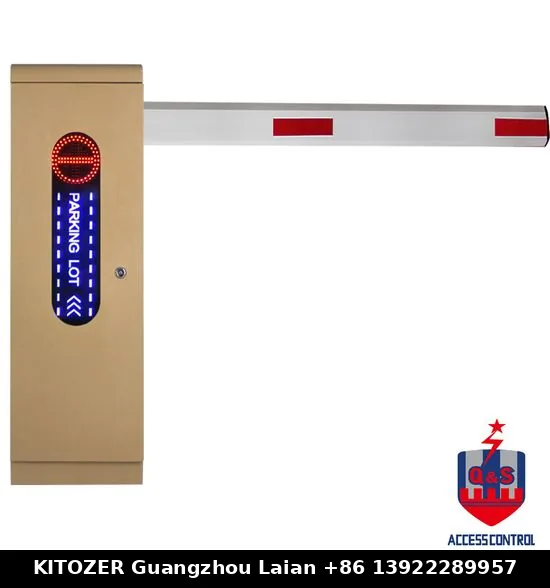
KITOZER barrier gate products cover straight-arm barriers, fence-arm barriers, folding-arm barriers, advertising barriers, high-speed barriers, variable-frequency barriers, and servo barriers. Arm lengths range from three meters to six meters, and opening and closing speeds are adjustable from 0.6 seconds to 6 seconds, accommodating narrow fire lanes as well as wide commercial parking lanes. The system supports multiple identification methods including IC and ID cards, Bluetooth cards, CPU cards, QR codes, ETC, license plate recognition, and facial recognition. It integrates with WeChat Pay, Alipay, and digital currency payment channels to enable unattended, frictionless vehicle passage.
In practice, a parking system is not a standalone device but an organic component of building intelligence. It must coordinate with the weak-current general contractor, fire protection, security CCTV, access control, building automation, and property management enterprise resource planning systems. KITOZER has accumulated rich experience in multi-system linkage across projects and provides standard RS485, TCP/IP, Wiegand, and relay dry-contact interfaces to facilitate integration with third-party platforms.
2. Working Principles of Parking Systems and Barrier Gates
2.1 Vehicle Entry Process
When a vehicle approaches the parking entrance, an inductive loop embedded in the lane surface detects its arrival. The loop is a loop-shaped wire carrying an alternating current. When a metal vehicle enters above the loop, the inductance changes, and the detection circuit converts this change into a switch signal that is sent to the parking controller or barrier gate controller. This step wakes the system so that the camera and barrier do not run unnecessarily when no vehicle is present.
The vehicle continues forward to the recognition zone. A license plate recognition camera mounted on an overhead gantry or on a post beside the barrier gate triggers a snapshot. The camera contains a high-resolution image sensor, supplementary LED illumination, and an embedded recognition processor. Within 20 to 40 milliseconds, it completes license plate localization, character segmentation, and character recognition, then transmits the recognition result (plate number, plate color, confidence, timestamp, vehicle image) over the network to the parking management platform. The platform queries whether the plate belongs to a monthly subscriber, a stored-value user, a whitelist vehicle, or a temporary visitor.
If the vehicle is on the whitelist or monthly subscription list, the platform immediately sends an open-gate command. The barrier gate receives the command, drives the motor, and through a crank-link mechanism lifts the arm from the vertical blocking position to the horizontal open position. During arm raising, the vehicle detector continuously checks whether the vehicle remains in the lane. Once the vehicle clears the exit loop, the barrier automatically lowers the arm, completing the entry cycle. If the vehicle is a temporary visitor, the system records the entry time, displays the plate number and a welcome message on the LED screen, and opens the gate automatically without requiring the driver to take a ticket.
In traditional parking facilities using a ticket or card mode, the entry control console dispenses a temporary card or paper ticket encoded with the entry time and entry lane number. After taking the ticket, the barrier opens. At exit, the exit console reads the card or ticket code, the platform calculates the parking duration and fee, the driver pays at a payment kiosk or by scanning a QR code, and the barrier opens. This mode is gradually being replaced by ticketless license plate recognition.
2.2 Vehicle Exit and Billing Process
At exit, the exit loop detects the vehicle’s arrival, and the exit license plate recognition camera captures the plate. The platform matches the exit plate against the entry record and calculates the parking duration. Billing rules can be configured flexibly in the backend: hourly billing (first half hour at X yuan, subsequent half hours at Y yuan), flat-rate billing (X yuan per visit), tiered billing (first hour X, hours two to three Y, daily cap Z), monthly subscription (unlimited visits by month, quarter, or year), free grace period (free within the first 15 minutes), and holiday discounts. KITOZER supports a multi-dimensional billing matrix based on time slots, vehicle types, and calendar dates.
After the fee is calculated, the exit LED screen displays the plate number, parking duration, amount due, and a payment QR code. Temporary visitors can choose from multiple payment methods: scanning the exit QR code with WeChat or Alipay, paying by QR code or face at the self-service payment kiosk, paying in advance through a mall app or mini-program, inserting cash at a bill acceptor that gives change, or using ETC. Once payment is confirmed, the platform sends an open-gate command, the barrier lifts, the vehicle exits, and the exit loop confirms the vehicle has completely left before the barrier lowers.
For monthly subscribers and stored-value users, the system automatically verifies identity and balance at exit and opens the gate without stopping, enabling frictionless exit. If the subscription has expired or the balance is insufficient, the LED screen and voice prompt remind the driver to renew, and the system can be set to temporarily treat the vehicle as a temporary paid visitor.
2.3 Mechanical and Electrical Principles of the Barrier Gate
The core of a barrier gate is a geared drive mechanism. Three drive types are common. First, an alternating-current motor with a worm gear reducer and crank-link structure is simple and inexpensive with a long service life, but its open-close speed is fixed (typically 3 or 6 seconds) and it is relatively noisy. Second, a direct-current brushed or brushless motor with a planetary gear reducer and balance spring offers adjustable speed, smooth start and stop, and long life; this is the mainstream solution today. Third, a servo motor with a precision gearbox and absolute position encoder provides fast, precise motion; high-speed barrier gates (0.6 to 1.5 seconds) universally use servo technology.
A powerful torsion spring or extension spring inside the barrier balances the gravitational moment of the arm. When the arm is raised, the spring stores energy; when the arm lowers, the spring releases energy to assist the motor. This significantly reduces motor power and inrush current. The spring preload must be precisely adjusted according to arm length and type. Incorrect adjustment causes motor overload or arm oscillation. Limit switches (microswitches) or Hall sensors inside the barrier detect the vertical and horizontal limit positions and automatically cut motor power when the arm reaches either end.
The barrier controller is an embedded circuit board that receives open and close signals from the loop detector, remote control, control console, computer, or cloud platform and drives the motor in forward and reverse rotation. Typical controller functions include: automatic delayed closing (arm lowers N seconds after the vehicle leaves, adjustable), anti-smash logic (if the loop detects another vehicle while the arm is descending, the arm immediately stops and re-raises), infrared or radar anti-smash (obstacle detection under the arm triggers rebound), manual release (a hand crank or key allows the arm to be lifted during a power outage), heating and dehumidification (optional for cold and humid environments), and LED strip control (warning lights on the arm flash at night).
2.4 License Plate Recognition Technology
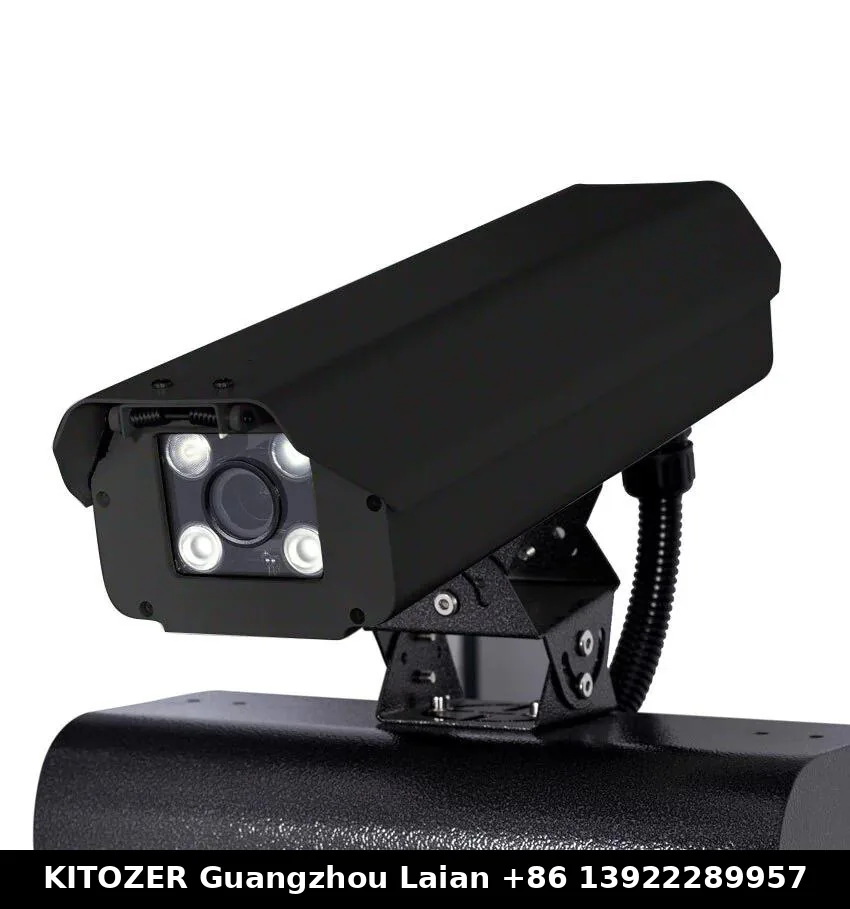
License plate recognition (LPR), also known as automatic number plate recognition (ANPR) or automatic license plate recognition (ALPR), is the cornerstone of modern smart parking. The processing pipeline includes image acquisition, plate localization, character segmentation, character recognition, and result output. During acquisition, the camera uses a 2 to 8 megapixel CMOS sensor with a wide-angle or fixed focal lens (typically 6 to 12 mm). It triggers when the vehicle reaches the snapshot line via loop or video detection. To ensure recognition at night and in backlight conditions, the camera is equipped with white-light or infrared supplementary lighting with automatic brightness adjustment to avoid overexposure or glare.
Plate localization algorithms find the plate region within the image. Early methods used edge detection and color localization; modern methods are based on deep convolutional neural networks that directly regress the four corners of the plate, offering high accuracy and robustness against tilt, dirt, and partial occlusion. Character segmentation separates the Chinese characters, letters, and digits on the plate. Character recognition uses a deep neural network classifier to identify each character block. The entire pipeline runs on the camera’s embedded compute chip and typically takes 50 to 200 milliseconds.
Recognition rate is a key performance metric. Under standard lighting, a well-aligned vehicle, and a clean plate, mainstream cameras achieve over 99 percent daytime recognition. However, recognition rate declines under strong headlight glare at night, rain and snow, dirty or obscured plates, skewed mounting, new energy green plates (which differ in dimensions and character layout), special military or police plates, and high-speed passage. When selecting a camera, buyers should consider the vendor’s real-world recognition rate rather than laboratory ideal values, and verify supplementary lighting, wide dynamic range, and support for new energy plates. KITOZER LPR cameras use deep learning algorithms and support Chinese mainland blue, yellow, green (new energy), black, and military plates, with a recognition distance of 3 to 8 meters, operating temperature of minus 30 to plus 70 degrees Celsius, and IP66 protection.
3. Components of an Intelligent Parking System
3.1 License Plate Recognition Camera Units
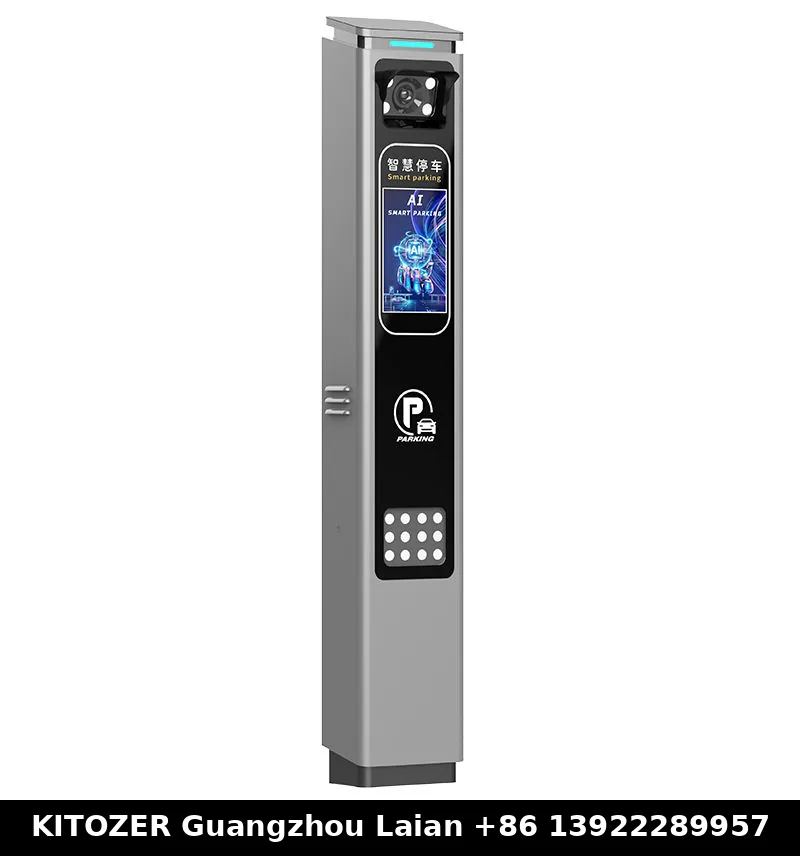
The LPR camera is the eye of the parking system. By installation form, cameras are divided into all-in-one units (recognition algorithm, lens, light, and housing integrated for simple installation), split units (camera, light, and processor separated for complex scenarios), and pillar-integrated units (the camera is integrated at the top of a post with an LED display and voice speaker below, facing the driver directly). By resolution, options range from 2 to 8 megapixels; higher resolution improves detail for long-distance and high-speed vehicles. Key parameters include sensor size (larger than 1/1.8 inch is preferable), lens focal length (determines snapshot distance and field of view), shutter speed (faster electronic shutter freezes high-speed vehicles and avoids motion blur), supplementary light type (white light gives true color but may glare; infrared is covert but yields monochrome images), wide dynamic range (higher dB values handle simultaneous bright and dark areas), protection rating (at least IP66 for outdoor use), and operating temperature. KITOZER recommends a 6 mm lens for a standard 3-meter single lane and a 12 mm lens for wide lanes or long-distance pre-snapshot.
3.2 Smart Barrier Gates
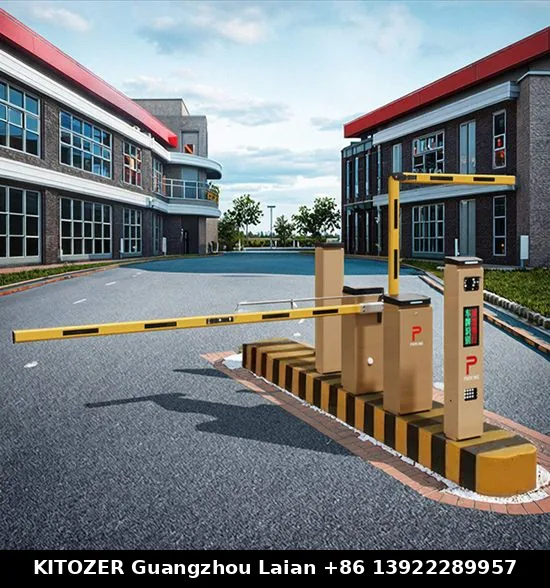
The barrier gate is the hand of the system, responsible for physical blocking. By arm type, there are straight-arm barriers (a single straight arm, 3 to 6 meters, suitable for most parking facilities), fence-arm barriers (the arm consists of horizontal and vertical rails forming a fence about 1 meter high to prevent pedestrians from crossing, suitable for mixed pedestrian-vehicle lanes), folding-arm barriers (the arm bends in the middle for underground entrances with low ceiling clearance, folding to vertical when raised), and advertising barriers (the back of the arm is a flip-panel advertising surface, suitable for commercial complexes). By speed, there are low-speed (3 to 6 seconds, for residential communities with monthly subscribers and low traffic), medium-speed (1.5 to 3 seconds, for offices and malls), and high-speed (0.6 to 1.5 seconds, for busy commercial centers, hospitals, scenic spots, and ETC lanes). By motor type, there are AC barriers (simple and low cost), DC brushless barriers (long life, low noise, adjustable speed), and servo barriers (high speed, precision, and multi-million-cycle life). KITOZER barrier housings are made of powder-coated cold-rolled steel, 1.5 to 2.0 mm thick, with waterproof and dustproof design and pre-wired terminals inside.
3.3 Parking Control Consoles and Lane Terminals
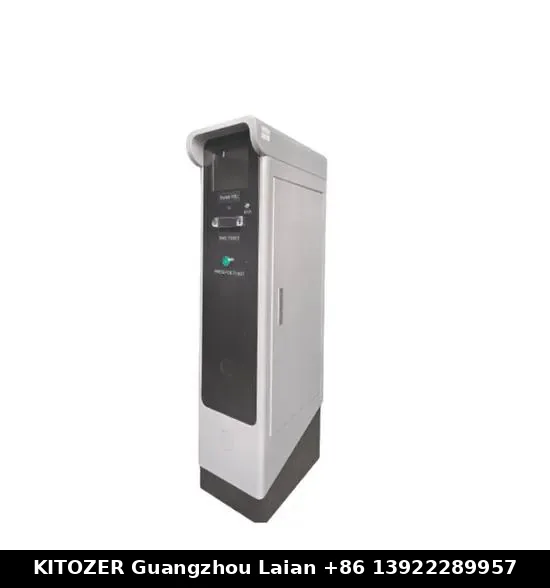
The parking control console, also called the entry and exit box or ticket booth, is installed on the driver’s side at entry and exit. It integrates an IC or ID card reader, LED display, voice speaker, intercom button, ticket dispenser (in traditional mode), and main control board. In LPR mode, the console’s role is simplified to an LED display and voice terminal, but it remains important when manual intervention or card passage is needed. The LED display is typically bi-color or full-color dot-matrix and shows the plate number, welcome or payment prompts, remaining spaces, and date and time. The voice speaker synchronizes announcements with the screen, for example, Welcome, plate Yue A12345, please enter or Amount due 10 yuan, please scan to pay. The intercom button connects to the management center for one-touch assistance.
3.4 Loop Detectors and Anti-Smash Sensors
The inductive loop is a loop-shaped inductive sensor embedded in the road surface to detect metal vehicles. It is typically cut as a 500 by 1500 millimeter rectangle (or equivalent area) with a 4 to 5 millimeter wide, 30 to 50 millimeter deep saw cut, wound with 3 to 5 turns of 1.0 to 1.5 millimeter high-temperature multi-strand copper wire, and led to the loop detector in the control unit. The detector converts inductance changes into relay switch signals. A standard entrance or exit uses two loops: one ahead of the snapshot point (entry trigger) and one under the barrier (anti-smash and lowering trigger). Loop detectors are reliable under all weather and light conditions, but require road cutting. Millimeter-wave radar and infrared light curtains are increasingly used as non-contact alternatives. KITOZER barrier gates support all three anti-smash methods.
3.5 Self-Service Payment Kiosks and Payment Modules
The self-service payment kiosk is installed near the exit or beside the elevator lobby so drivers can pay before leaving. It typically has a 10 to 21 inch touchscreen, a QR payment module (WeChat and Alipay), a cash acceptor (bill acceptance with coin change), a receipt printer, and an intercom module. The driver enters the plate number or scans the entry ticket; the screen shows the parking duration and amount; after QR or cash payment, a receipt is printed and the driver has a set period (usually 15 to 30 minutes) to exit. Mobile payment has become mainstream: the platform integrates with WeChat and Alipay parking payment, allowing drivers to bind their plate and be charged automatically at exit without stopping. ETC payment uses an onboard unit and roadside unit for non-stop electronic toll collection.
3.6 Space Guidance and Reverse Search Systems
For large parking facilities (over 500 spaces), the space guidance system helps drivers quickly find an empty spot. It consists of space detectors (ultrasonic or video detectors mounted above each space), zone guidance displays (installed at intersections to show remaining spaces per zone), space indicator lights (red for occupied, green for vacant), and reverse search terminals (enter the plate to locate the vehicle and walking directions). Video space detectors also perform license plate recognition, recording the plate of the vehicle in each space to support reverse search.
3.7 Management Platform and Software
The management platform is the brain of the parking system. Modern platforms use B/S architecture or a hybrid C/S plus B/S design, deployed on a local server or in the cloud. Core functions include: vehicle profile management (monthly subscribers, stored-value users, whitelist, blacklist), billing rule configuration, entry and exit record queries, report statistics (daily, monthly, yearly; revenue breakdown; traffic flow analysis), equipment status monitoring (camera online or offline, barrier faults, loop anomalies), permission management (graded roles for administrator, cashier, and duty officer), exception handling (unlicensed vehicles, mismatched entry and exit times, billing anomalies), and data backup. Cloud platforms enable unified management across multiple lots: chain parking operators can view revenue and traffic across all lots in one backend, and owners can remotely check status and reports via a mobile mini-program. The KITOZER cloud platform supports multi-tenant, multi-lot hierarchical management and provides open APIs for property ERP, shopping mall membership, and city parking platform integration.
4. Technical Specifications
| Parameter | Straight-arm Barrier | Fence-arm Barrier | Folding-arm Barrier | High-speed Servo Barrier |
|---|---|---|---|---|
| Arm length | 3-6 m | 3-4.5 m | 3-4.5 m | 3-4 m |
| Open/close speed | 3s/6s adjustable | 3s/6s adjustable | 3s/6s adjustable | 0.6s/1.0s/1.5s |
| Motor type | AC220V/DC24V brushless | AC220V/DC24V brushless | DC24V brushless | Servo motor |
| Rated power | 80-150W | 80-150W | 100-150W | 200-300W |
| Power supply | AC220V +/-10% 50Hz | AC220V +/-10% 50Hz | AC220V +/-10% 50Hz | AC220V +/-10% 50Hz |
| Housing size | 350x280x1050 mm | 350x280x1050 mm | 350x280x1050 mm | 380x320x1100 mm |
| Housing material | Cold-rolled steel 1.5mm powder coat | Cold-rolled steel 1.5mm powder coat | Cold-rolled steel 1.5mm powder coat | Cold-rolled steel 2.0mm powder coat |
| Operating temp. | -30 to +70 C | -30 to +70 C | -30 to +70 C | -20 to +60 C |
| Protection rating | IP54 | IP54 | IP54 | IP54 |
| Communication | RS485/TCP-IP/Relay | RS485/TCP-IP/Relay | RS485/TCP-IP/Relay | RS485/TCP-IP/Relay |
| Remote range | 30-50 m | 30-50 m | 30-50 m | 30-50 m |
| Manual release | Hand crank/key | Hand crank/key | Hand crank/key | Hand crank/key |
| Anti-smash | Loop+IR+pressure wave | Loop+IR+pressure wave | Loop+IR | Radar+loop+IR |
| Typical life | 3 million cycles | 3 million cycles | 3 million cycles | 10 million cycles |
4.1 LPR Camera Specifications
| Parameter | Value |
|---|---|
| Image sensor | 1/1.8 inch CMOS, 2MP to 8MP options |
| Lens focal length | 6mm/8mm/12mm fixed focal options |
| Shutter speed | 1/10000 s electronic shutter |
| Recognition rate | Daytime >=99%, night >=97% (standard scene) |
| Recognition time | <=200 ms |
| Plate types | Blue/yellow/new energy green/black/military/police |
| Supplementary light | White LED + IR LED, auto brightness |
| Wide dynamic range | >=120 dB |
| Communication | RJ45 TCP/IP, RS485, Wiegand 26/34, relay out |
| Operating temp. | -30 to +70 C |
| Protection rating | IP66 |
| Power | DC12V/PoE optional |
5. Selection Guide for Parking Systems and Barrier Gates
5.1 Selecting by Parking Facility Type
Residential communities are dominated by monthly subscribers with a small proportion of temporary visitors. A 3-second DC brushless straight-arm barrier with an LPR camera provides frictionless passage for residents and QR-code payment for visitors. For mixed pedestrian-vehicle communities, a fence-arm barrier prevents pedestrians from ducking under the arm. For underground entrances with ceiling clearance below 2.5 meters, a folding-arm barrier is required. Commercial complexes and office towers have high traffic and many temporary visitors, so high-speed servo barriers (within 1.5 seconds), space guidance, and reverse search terminals are recommended. Hospitals, schools, and scenic spots have concentrated peak flows and benefit from pre-snapshot cameras 50 meters before the entrance. Industrial parks and government facilities mainly serve internal vehicles; visitor vehicles can be pre-registered through a WeChat mini-program before arrival.
5.2 Selecting Arm Length by Lane Width
The arm length should slightly exceed the lane width so that the lowered arm fully covers the lane. A standard single lane of 2.8 to 3.5 meters uses a 3 or 3.5 meter arm. Wide lanes for trucks or fire engines (4.5 to 6 meters) use a 4.5 or 6 meter arm. Note that longer arms require greater motor torque, make spring balancing more difficult, and slow the opening and closing speed. For lanes wider than 6 meters, use two opposing barriers rather than one overlong arm. Arm colors are typically red-white or yellow-black for high visibility; LED-lit arms are available for night use. Advertising barriers have a double-sided flip panel, usually 3 to 4.5 meters, suitable for commercial parking but slower (3 to 6 seconds).
5.3 Selecting Speed by Traffic Density
Barrier speed directly affects throughput and queue length. A rough estimate: vehicles per hour equals 3600 divided by seconds per vehicle cycle. A 6-second barrier yields a 12 to 15 second per-vehicle cycle, about 240 to 300 vehicles per hour per lane. A 1.5-second barrier yields a 6 to 8 second cycle, about 450 to 600 vehicles per hour. For communities under 500 vehicles per day, a 3-second barrier is sufficient. For offices and malls with 500 to 1500 vehicles per day, choose 1.5 to 3 seconds. For commercial centers and hospitals over 1500 vehicles per day, choose 0.6 to 1.5 seconds. If peak queues exceed five vehicles, consider adding a lane or upgrading to a high-speed barrier.
5.4 Identification Method Selection
LPR is the mainstream identification method, requiring no ticket stop and offering a smooth experience. However, it should be supplemented for motorcycles, unlicensed vehicles, and legacy card systems. KITOZER barrier controllers support Wiegand 26/34 and are compatible with most IC/ID card readers, QR readers, and biometric devices, protecting existing investment. RFID long-range Bluetooth cards (3 to 8 meter read range) can supplement LPR for motorcycles or sites that prefer card-based access.
5.5 Network and Power Requirements
LPR cameras require stable wired TCP/IP networks; Wi-Fi is not recommended for outdoor cameras. For large lots, deploy a PoE switch in the weak-current room so a single Cat6 cable provides both power and data. The barrier controller can connect via RS485 bus (up to 1200 meters) or TCP/IP. Power: the barrier uses AC220V and requires a waterproof outlet or circuit breaker near each lane. The management computer and server use an uninterruptible power supply. Outdoor distribution boxes include surge protection (SPD) and earth leakage protection.
6. Installation Requirements
6.1 Civil Works and Foundation
The barrier requires a solid concrete foundation, typically 500 by 500 by 300 millimeters (length by width by depth) using C20 or stronger concrete, with four M12 expansion bolts or anchor bolts embedded. The foundation top should be 50 to 100 millimeters above grade to prevent water pooling. After mounting the barrier housing and leveling it, tighten the anchor bolts and seal gaps with cement. For asphalt surfaces, pour a concrete pedestal first. Loop cutting: cut a 500 by 1500 millimeter rectangle (short side along the lane), 4 to 5 millimeters wide and 30 to 50 millimeters deep, with 45-degree corners to avoid cutting the wire. Wind 3 to 5 turns, twist the lead wires (at least 20 twists per meter), route through a metal conduit to the detector, and seal the slot with silicone or epoxy. The snapshot loop is 2 to 3 meters before the barrier, and the anti-smash loop is 0.5 meters under the barrier. The lane should be level with a slope under 5 percent. Install a speed bump 3 to 5 meters before the barrier and traffic guide markings. Ensure good night lighting and avoid camera backlight; add a sunshade if the entrance faces the evening sun.
6.2 Barrier Gate Installation Steps
Step one: mark the position on the driver’s side, 0.3 to 0.5 meters from the lane edge. Step two: pour the foundation and embed bolts. Step three: fix the housing and level it. Step four: install the arm into the top clamp and tighten bolts. For folding arms, the hinge faces the center of the lane. Step five: adjust the balance spring by loosening the lock nut and tuning the preload until the arm holds position at any angle. Step six: connect power and signal wires. Step seven: power on and test the remote and software open commands, checking smooth motion, accurate limits, and anti-smash function. After installation in the first two weeks, recheck bolt tightness and spring tension weekly.
6.3 LPR Camera Installation
Mount the camera at 1.5 to 2.0 meters height, 1 to 2 meters behind the barrier (so the vehicle passes the camera before reaching the barrier), aimed along the traffic direction with a 15 to 30 degree downward tilt. Ensure the snapshot zone covers only one lane. After mounting, calibrate with a standard plate target: adjust focus and aperture so the plate image is clear and occupies about one-eighth to one-fifth of the frame width. Test recognition at 5, 15, and 30 km/h under different lighting, and adjust light brightness and shutter as needed.
6.4 Cabling and Wiring Standards
Power, network, and signal wires should run through galvanized steel or PVC conduits; outdoor sections use galvanized steel conduit with at least 2.0 millimeter wall thickness and waterproof joints. Use Cat5e or Cat6 unshielded twisted pair up to 100 meters. RS485 bus uses shielded twisted pair up to 1200 meters with a 120 ohm terminator at the bus end. Loop lead wires use shielded cable separated at least 200 millimeters from power lines. All outdoor junctions use waterproof junction boxes or connectors. Arrange internal wiring neatly with power and signal terminals separated. Ground resistance should not exceed 4 ohms. Install power and signal surge protectors in the distribution box.
7. Operation and Maintenance
7.1 Daily Inspection
Property or maintenance staff should inspect the parking system daily: check barrier motion for smoothness, noise, or oscillation; inspect the arm for damage, reflective film condition, and LED strip function; verify loop sensitivity and automatic lowering after vehicles pass; clean the LPR camera lens and check supplementary lights; test the LED display and voice; confirm the management platform is online with complete records; check housing locks and internal moisture or pests. Keep inspection logs and address anomalies promptly. The barrier is a high-frequency moving device, and wear parts require scheduled replacement. A quarterly general service and annual deep service are recommended.
7.2 Periodic Maintenance Schedule
Quarterly: clean the housing inside and out; check arm clamp bolts and foundation bolts; inspect the balance spring for rust or fatigue, lubricating or replacing as needed; apply a small amount of grease to motor bearings and linkages; test loop sensitivity with a metal plate; test anti-smash by pushing the arm or placing an obstacle during lowering; clean the camera lens and light cover. Annually: check motor brushes (if brushed) and replace when shorter than 5 mm; inspect gearbox oil and replace if dark or containing metal; verify limit switches and Hall sensor positions; inspect power and signal cable insulation; test UPS battery runtime; back up the platform database; check lightning grounding resistance.
7.3 Common Faults and Remedies
Fault one: the barrier does not open. Check power, remote battery, controller command, motor thermal protection (wait 10 minutes after frequent operation), and limit switches. Fault two: the barrier does not close. Check for metal debris above the loop, loop sensitivity, infrared obstruction (dirty lens or cobwebs), and delay settings. Fault three: arm oscillation or noise. Check spring adjustment, loose linkage bolts, gearbox oil, and motor bearings. Fault four: low recognition rate. Clean the lens, check supplementary lights, adjust for backlight, recalibrate focus, and install a speed bump. Fault five: platform shows device offline. Check network cables, switch status, camera reboot, and IP conflicts.
7.4 Wear Parts Replacement Cycle
| Wear part | Check cycle | Replacement cycle |
|---|---|---|
| Arm reflective film/LED strip | Monthly | 2-3 years or when damaged |
| Balance spring | Quarterly | 3-5 years or when fatigued |
| Motor brushes (brushed motor) | Bi-annually | 2-3 years |
| Gearbox lubricant | Annually | 2 years |
| Limit switch/Hall sensor | Quarterly | 3-5 years |
| Loop detector | Quarterly | 5 years or on fault |
| Remote battery | Bi-annually | 1 year or when dead |
| Camera supplementary LED | Quarterly | 3-5 years or when degraded |
| UPS battery | Bi-annually | 3-5 years |
8. Frequently Asked Questions
Standard straight-arm barriers go up to 6 meters. For lanes wider than 6 meters, use two opposing barriers. A single arm beyond 6 meters causes excessive motor load, difficult spring balancing, slow operation, and reduced long-term reliability.
Not necessarily. High-speed barriers (0.6 to 1.5 seconds) suit busy commercial sites but require high-quality mechanics and cost more. A 3-second barrier is quieter, longer-lived, and more economical for residential communities with moderate traffic. Match speed to actual traffic density.
Barriers have a manual release: use the dedicated key to open the side access port and insert a hand crank to lift the arm manually. Premium models include a backup battery (UPS) that allows 20 to 50 automatic cycles. Keep a hand crank and flashlight at the guard booth.
No. The loop is critical for automatic closing and anti-smash. Without it, the barrier will not auto-close and cannot detect a vehicle under the lowering arm, creating a smash risk. Replace the loop promptly.
It approaches 100 percent under laboratory ideal conditions, but real-world factors (light, weather, dirty plates, speed, angle) typically yield 95 to 99 percent. KITOZER recommends a manual intervention channel so an administrator can remotely open the gate when recognition fails.
Yes. KITOZER cameras support new energy gradient green plates (small vehicles) and yellow-green two-tone plates (large vehicles). Confirm the camera firmware version at purchase and request updates as needed.
Ensure personal safety first, photograph the scene, and check for arm bending, housing displacement, and motor damage. A slightly bent arm can be removed and corrected; severe deformation requires replacement. If the motor was running during impact, internal gears may have broken and require service.
Modern smart parking targets unattended operation: LPR entry, mobile payment exit, and remote intercom for exceptions. One administrator can remotely manage multiple lanes. A booth can be retained for cash payment or special vehicles during transition.
The resident submits the plate number, vehicle type, and contact information through the property office or a mini-program; the administrator adds the plate to the monthly list in the platform with a validity period. Whitelist plates open automatically. The system sends renewal reminders before expiry and converts expired vehicles to temporary billing.
For unlicensed vehicles, the entry console issues a virtual ticket (a temporary QR code sent by SMS); at exit, the driver scans the code to pay. Temporary-plate vehicles can be manually registered by the administrator or granted temporary access. KITOZER supports the virtual ticket mode.
Yes. KITOZER barriers and cameras support TCP/IP and connect to the cloud platform, allowing remote status monitoring, remote gate opening, record queries, and billing configuration from a computer or phone. Multiple lots can be managed in one platform.
Reference price: a standard entry-exit LPR barrier system (two barriers plus two cameras plus management software) is about 8,000 to 20,000 yuan; a high-speed servo barrier is about 3,000 to 8,000 yuan per unit; an LPR camera is about 1,500 to 4,000 yuan per unit; a self-service payment kiosk is about 8,000 to 20,000 yuan. Exact pricing depends on configuration and site conditions.
The standard colors are gray-black or yellow-black. Custom powder coating colors are available to match brand or community visual identity, with additional sampling cost and a 5 to 10 business day lead time.
Yes. The KITOZER platform provides an open HTTP/JSON API for bidirectional synchronization of entry events, payment records, and monthly subscription data. Contact KITOZER technical support for documentation.
The standard operating temperature is minus 30 to plus 70 degrees Celsius, suitable for most of China. Extremely cold regions below minus 30 degrees can add a heating module to prevent condensation and spring brittleness.
Yes. KITOZER offers advertising barriers with a double-sided flip panel on the arm, suitable for commercial complexes, offices, and community entrances. Advertising barriers are usually 3 to 4.5 meters with 3 to 6 second operation.
9. Application Scenarios
9.1 Residential Communities
Residential parking lots are dominated by monthly subscribers with some visitor traffic. A typical configuration uses one LPR camera and one straight-arm barrier at the entrance and a matching pair at the exit, with a management computer in the guard room. Residents pass frictionlessly, while external visitors register through a mini-program or are manually admitted by security. A 3-second DC brushless barrier is recommended for low noise and long life. Fence-arm barriers suit mixed pedestrian-vehicle lanes, and folding-arm barriers are used where underground ceiling clearance is low.
9.2 Commercial Complexes and Office Towers
Commercial complexes and office towers demand throughput and experience. Each lane uses a high-speed servo barrier (0.6 to 1.5 seconds) with an LPR camera; the entrance LED shows remaining spaces; an in-facility guidance system directs drivers to empty spots; self-service kiosks sit by the elevator lobby; exits support WeChat, Alipay, and ETC frictionless payment. Two or three lanes prevent peak-hour queues. Advertising barriers at the main entrance can promote mall campaigns.
9.3 Hospitals and Schools
Hospitals and schools have morning and evening tidal flows. High-speed barriers and pre-snapshot cameras 50 meters before the entrance shorten queues. Hospitals can integrate appointment registration so patients receive parking discounts. Schools can separate staff lanes and parent pick-up lanes; parents use a pick-up card or reservation code.
9.4 Industrial Parks and Government Facilities
Industrial parks and government sites mainly serve internal vehicles, with external vehicles requiring registration. Whitelist LPR passage is automatic for internal cars; visitors register via a mini-program approved by the host. Wide 4.5 to 6 meter barriers accommodate trucks and shuttles. Fire alarm linkage automatically raises all barriers for emergency vehicle access, a mandatory fire inspection requirement.
9.5 On-street and Municipal Parking
On-street parking uses elevated video capture poles or magnetic sensors to record parking location and duration, with payment via app or mini-program. No barrier is required in this case, but it is part of urban smart parking. KITOZER provides on-street parking management platforms and elevated camera solutions.
10. In-Depth Mechanical Structure of Barrier Gates
Although a barrier gate looks simple, its internal mechanical structure determines lifespan, noise, and reliability. A typical DC brushless barrier consists of the motor assembly, gearbox, crank-link mechanism, balance spring set, limit assembly, housing, and control board.
The motor assembly usually uses a 24V or 48V DC brushless motor rated at 80 to 200 watts. Compared with AC motors and brushed DC motors, brushless motors offer higher efficiency, longer life (over 20,000 hours of continuous operation), lower noise (under 55 dB), adjustable speed, and high starting torque. The motor tail integrates Hall position sensors that detect rotor position and speed, working with the driver for closed-loop control. Servo barriers add an encoder for precise arm position control.
The gearbox reduces the motor’s high speed (thousands of RPM) to the low speed needed by the arm (about 10 to 20 RPM) while amplifying torque. Common reductions are worm gear, planetary gear, and helical gear. Worm gear is simple, quiet, and self-locking (the arm will not fall under gravity during a power outage), but its efficiency is about 60 to 70 percent. Planetary gear is over 90 percent efficient, compact, and durable but costs more. KITOZER entry-level barriers use worm gear, while high-end servo barriers use planetary gear. The gearbox is filled with gear oil and sealed for life or replaced every 2 to 3 years.
The crank-link mechanism converts the gearbox output rotation into arm oscillation. It has a driving arm (connected to the gearbox output shaft) and a driven arm (connected to the arm clamp), linked by a connecting rod. This four-bar design makes arm speed non-uniform: slow at start and end (buffer) and fast in the middle (efficiency), yielding smooth starts and stops. The joints use self-lubricating bushings or needle bearings and require periodic wear inspection.
The balance spring is important and often overlooked. The arm’s weight creates a gravitational moment around the shaft that varies with arm angle. Without a balance spring, the motor would have to overcome the entire arm weight, requiring high power and causing large start-up shock. The balance spring (usually a torsion spring near the shaft) is tensioned when the arm is horizontal, stores energy, releases it to assist the motor when raising, and re-engages to absorb energy when lowering. Preload must be precisely set: too tight and the arm rises on its own in the vertical position; too loose and the arm drops too fast, overloading the motor. Adjustment: disconnect power, lift the arm to vertical, and if it holds position at any angle without rising or falling, the balance is correct.
The limit assembly detects the two extreme positions. Traditional barriers use mechanical microswitches; as the arm reaches the end, a cam presses the switch and cuts motor power. This is simple but has fixed positions and contact wear over time. Modern barriers use Hall sensors or optical encoders for non-contact detection with adjustable positions. Servo barriers read the arm angle directly from the encoder and need no separate limit switches.
11. Parking Billing Models and Pricing Strategies
Revenue management is the core business function of a parking system. The KITOZER platform supports flexible billing rules. Common models include:
11.1 Hourly Billing
Hourly billing is the most common: parking duration multiplied by a unit price. To avoid frequent meter jumps, billing is usually rounded to half-hour or one-hour increments. For example, first half hour 5 yuan, subsequent half hours 3 yuan, daily cap 60 yuan. Rules can differ between workdays and weekends, or by time slot (higher rate daytime, lower or free at night). The KITOZER platform supports a multi-dimensional matrix by weekday, date, and time slot.
11.2 Flat-Rate Billing
Flat-rate billing charges a fixed amount per visit regardless of duration. It suits short-stay scenarios like curbside or mall overflow parking. It is simple and predictable but does not encourage quick turnover, which can lead to long-term occupation.
11.3 Monthly, Quarterly, and Annual Passes
Monthly subscribers provide stable revenue. The driver pays a fixed monthly, quarterly, or annual fee for unlimited entries. The KITOZER platform supports renewal, expiry reminders, and automatic conversion to temporary billing on expiry. A monthly pass can be bound to a specific plate or be a generic temporary-authorization card.
11.4 Stored-Value Cards
Stored-value mode works like a prepaid account: the driver prepays an amount, and each parking event deducts from the balance. The system alerts when the balance is low. This mode improves retention and deposits prepayment revenue. KITOZER supports top-up, consumption history, balance warnings, and refunds.
11.5 Grace Periods and Discounts
Many lots offer the first 15 minutes free for quick stops. Malls often link receipts to discounts: a purchase above a threshold waives or reduces parking. The KITOZER platform supports: free within N minutes, receipt-based discount, free on special dates, and free for specific vehicles (taxis, ride-hailing, ambulances, fire trucks, police). Rules can be automatic or manually approved.
11.6 Multiple Payment Channels
The platform supports WeChat Pay, Alipay, digital currency, UnionPay QuickPass, cash (via kiosk), and ETC. Mobile payment works by scanning an exit QR code or paying in a mini-program. ETC uses a roadside unit and onboard unit for automatic deduction. Cash kiosks accept bills and coins with automatic change and receipts.
11.7 Electronic Invoicing
Electronic parking invoices are a tax compliance requirement. The KITOZER platform integrates with electronic invoice providers; after payment, the driver requests an invoice through the mini-program, and the system automatically issues a PDF or OFD invoice by email, eliminating manual invoicing.
12. Network Architecture and Data Security
A modern parking system is a typical internet-of-things system with a perception layer, network layer, platform layer, and application layer. The perception layer includes LPR cameras, loop detectors, barrier controllers, space detectors, and payment kiosks. The network layer connects devices to the local area network via wired Ethernet, RS485 bus, or fiber. The platform layer runs parking management software and a database on a local server or in the cloud. The application layer provides a PC client, web admin, mobile mini-program, and merchant APIs.
A typical topology: each lane deploys a PoE switch connecting its cameras and barrier controller; lane switches connect to the weak-current room core switch via fiber or copper; the management computer, server, and kiosks attach to the core switch. For distributed lots, each location connects to the central cloud platform via VPN or the internet.
Data security: parking systems handle plate numbers, entry and exit times, and payment records. KITOZER implements: bcrypt-hashed passwords, HTTPS for admin, complete audit logs, scheduled automated backups (daily incremental, weekly full) stored offsite, role-based permissions (admin, cashier, duty officer), and secondary confirmation or supervisor approval for sensitive actions (billing changes, record deletion, refunds).
Network security: outdoor cameras and barrier controllers should not be directly exposed to the public internet. Restrict device management ports to the management LAN via a router or firewall. Remote maintenance goes through a VPN tunnel. Update firmware regularly and change default passwords immediately after installation.
13. Integration with Fire, Access Control, and CCTV
Barriers are not standalone; they coordinate with building systems. Common integrations:
13.1 Fire Alarm Linkage
When a fire alarm triggers, the fire host sends a signal via relay or dry contact to the parking system, and all entrance and exit barriers automatically raise and stay raised for evacuation and fire trucks. After the alarm clears, barriers resume automatic mode. This is a mandatory fire inspection requirement. KITOZER barrier controllers reserve a fire linkage input (dry contact).
13.2 Access Control Linkage
Pedestrian gates beside vehicle lanes share the same platform. Vehicle and pedestrian whitelists are managed together: a resident swipes a card at the pedestrian gate while LPR opens the vehicle barrier automatically. Visitors get both pedestrian and vehicle temporary permissions after front-desk registration.
13.3 CCTV Linkage
When a barrier is struck illegally or opens abnormally, nearby PTZ cameras turn to that area, start recording, and pop an alert on the monitoring wall with sound. KITOZER controllers provide relay outputs that connect to the CCTV alarm input ports.
13.4 LED Display and Broadcast Linkage
Large mall entrance LED displays can link to the digital signage system, showing promotions alongside remaining spaces. Barrier voice announcements can switch to emergency broadcast during a crisis.
14. Handling Common Parking System Exceptions
14.1 Entry Exceptions
Scenario: LPR fails and the vehicle waits at the barrier. The administrator remotely views the live feed via the platform or mini-program. For unlicensed or dirty plates, the admin manually opens the gate and registers a virtual ticket. If the camera is faulty, switch to manual ticketing and arrange repair.
Scenario: the barrier does not open. First check the loop detector indicator. If the loop is normal but the barrier does not move, send an open command from the platform. If manual commands also fail, check barrier power and controller indicators. In emergencies use the remote or hand crank.
14.2 Exit Exceptions
Scenario: the platform cannot find an entry record. Causes: the entry camera failed to capture, network outage prevented upload, or the plate was entered incorrectly. The admin manually reviews the entry snapshot, confirms the entry time, and calculates the fee. If truly no record exists, treat it as first entry or waive the fee per policy.
Scenario: the driver disputes the fee. The admin displays the entry and exit snapshots, entry time, exit time, and billing rule on screen to justify the charge. If the system erred, manually adjust or refund, with the reason and approver recorded.
Scenario: the driver fails to pay by phone. Offer cash at the booth or kiosk, or guide an alternative payment. If the driver leaves without paying, record the plate and add it to a blacklist, reminding them to settle on the next visit.
14.3 Equipment Failure Contingency
During a barrier fault, place cones and provide manual traffic control. The administrator uses a handheld remote. If the barrier is completely inoperable, arrange security to manually wave vehicles through and record vehicle information, then backfill data after repair. During camera faults, switch to card or manual registration mode.
15. Energy Efficiency and Environmental Design
Modern parking design increasingly emphasizes energy efficiency. KITOZER barriers use DC brushless motors with under 5W standby power and about 50 to 80W average running power, roughly 30 percent more efficient than traditional AC barriers. The housing can include an eco mode: during off-peak nights the barrier sleeps and wakes when a vehicle arrives.
Lighting efficiency: in-facility LED lights pair with space detectors to dim to 30 percent brightness when a space is empty and restore full brightness when occupied. Exits and elevator lobbies use occupancy sensors. The KITOZER guidance system can link to lighting for zone-based control.
Electric vehicle charging: as EV adoption grows, more lots reserve charging positions. The KITOZER barrier system integrates with charging platforms so charging vehicles receive parking discounts or free parking. Charging positions are included in the guidance system, and drivers can locate and reserve free chargers in the app.
16. Installation Environmental Considerations
Barrier gates are installed outdoors and must account for several environmental factors:
Rain and moisture: the IP54 housing resists splashing but should not be submerged. Avoid low-lying locations. Inspect the housing door seal quarterly and replace when aged. Seal bottom cable entries with waterproof putty.
Lightning and surge: outdoor barriers and cameras in open areas are at lightning risk. Install surge protectors on power and signal lines. Ground the housing and metal conduits with resistance under 4 ohms. Check grounding before thunderstorm season.
Wind: the arm catches wind. For regions with strong wind, add a support bracket for arms over 6 meters or choose a fence arm (lower wind resistance). During typhoon warnings, retract or remove long arms.
Heat: direct summer sunlight can push the housing interior above 60 degrees Celsius. KITOZER housings have ventilation louvers and rated components to 70 degrees. Extremely hot regions can add a sunshade or cooling fan.
Cold: low temperatures thicken lubricants and embrittle springs. The standard range is minus 30 to plus 70 degrees Celsius. For extreme cold, add a PTC heating module. Cameras also need wide-temperature-rated lights and batteries.
Corrosion: coastal or chemical environments rust standard powder-coated housings. KITOZER offers 304 or 316 stainless steel housings or thicker powder coating.
17. Project Implementation Workflow
A typical parking project, from intake to handover, follows these phases:
17.1 Survey and Design
An engineer visits the site, measures lane width, slope, clearance, power and network points, and takes photos. The client confirms the number of entrances and exits, spaces, the ratio of monthly to temporary vehicles, billing rules, whether guidance is needed, whether kiosks are needed, and third-party integrations. A design document and bill of materials are produced.
17.2 Quotation and Contract
The quotation covers equipment, installation, shipping, training, and one-year maintenance. A deposit is collected after signing.
17.3 Production and Shipping
KITOZER manufactures or allocates stock. Standard products ship in 3 to 5 business days; custom products in 7 to 15. Each barrier and camera is tested before shipment.
17.4 On-Site Construction
The team pours foundations, cuts loops, runs conduits, installs barriers and arms, mounts cameras and LED screens, and connects power and network. A single lane takes 1 to 2 days; multiple lanes take 3 to 7 days.
17.5 Commissioning
The engineer calibrates barrier limits and balance, tunes camera recognition, configures billing rules, enters monthly subscribers, and tests linkage. Real vehicles are used to repeatedly test entry, exit, and payment until stable.
17.6 Training and Acceptance
Property and cashier staff are trained on the platform, exception handling, and daily inspection. As-built documents (equipment list, wiring diagrams, credentials, manuals) are handed over. The client signs acceptance, and the warranty period begins.
17.7 After-Sales Maintenance
KITOZER provides a one-year free warranty covering quality-related repairs and replacements. After the warranty, annual maintenance contracts cover scheduled inspections and emergency response. The support hotline is 13922289957.
18. Technology Trends in Parking Systems
The parking industry is shifting from hardware equipment to smart operations platforms. Key trends:
Trend one: frictionless payment becomes universal. Drivers bind plates and are charged automatically at exit without stopping. WeChat and Alipay offer open frictionless parking platforms; KITOZER is integrated.
Trend two: unattended operation becomes mainstream. Remote monitoring, voice intercom, and AI anomaly detection let one administrator manage over ten lanes. The KITOZER cloud platform supports centralized duty across multiple entrances.
Trend three: integrated EV charging. Parking lots combine charging, energy storage, and solar generation. KITOZER is developing integrated parking-plus-charging management.
Trend four: city-level platform integration. Municipal governments build urban parking big-data platforms, and commercial lots must report data. KITOZER supports standard interfaces for such integration.
Trend five: high-precision space detectors. Video detectors replace ultrasonic units, with one camera covering 4 to 6 spaces for both occupancy and plate recognition, reducing wiring cost.
Trend six: ongoing barrier evolution. Servo barrier costs are falling, and high-speed barriers are moving from commercial sites to residential communities. Solar barriers are emerging for locations without power.
19. Barrier Gate Motor and Drive Technology
The motor is the heart of the barrier, and its performance directly affects start-stop smoothness, noise, lifespan, and maintenance cost. Several motor types are used in parking barriers, each with distinct characteristics and use cases.
AC asynchronous motors were widely used in early barriers. The design is simple, inexpensive, and durable, driving the arm through a worm gear reducer. It runs directly on 220V mains, requiring no separate power supply, and the circuit is straightforward. Drawbacks include fixed speed (about 1400 RPM), no adjustable arm speed, large start-stop shocks with noticeable arm jitter, relatively high noise (typically above 60 dB), low starting torque that can overheat under heavy load, and reliance on mechanical limit switches. AC barriers suit budget-conscious sites with low traffic and noise tolerance.
DC brushed motors were a transitional solution. They run on 24V DC and use carbon brushes for commutation. Compared with AC motors, DC motor speed is adjustable via PWM, and starts and stops follow acceleration and deceleration curves for smoother motion. However, the brushes are consumables that need replacement every 1 to 2 years, and brush dust can contaminate the gearbox. Brushed DC barriers are being replaced by brushless motors.
DC brushless motors (BLDC) are the current mainstream. They replace carbon brushes with electronic commutation, offering over 20,000 hours of continuous operation, 5 to 10 times longer than brushed motors. With a dedicated driver, BLDC barriers support soft starts and stops, adjustable speeds (0.6 to 6 seconds in multiple steps), and position control via Hall sensors. They run quietly (under 55 dB), efficiently, coolly, and lastingly. KITOZER mid-to-high-end barriers all use DC brushless technology.
Servo motors are the premium solution. A servo motor adds a high-resolution encoder (17 bits or more) to the brushless motor, forming a closed position loop. The servo barrier offers precise arm positioning, opening and closing in 0.6 seconds or faster, extremely smooth operation, and nearly silent motion. Its lifespan can exceed 10 million cycles, suiting high-frequency, high-demand commercial sites, but it costs 2 to 3 times as much as a standard brushless barrier.
The motor driver is the circuit board that controls the motor. Modern drivers integrate forward and reverse control (relay or MOSFET bridge), PWM speed regulation, Hall signal decoding, over-current and over-temperature protection, limit signal handling, and communication with the main control board (RS485 or CAN bus). The driver also records cycle count and fault codes for remote diagnosis. The KITOZER controller can remotely read motor current, temperature, and cycle count to support predictive maintenance.
20. Deep Dive into License Plate Recognition Algorithms
License plate recognition combines computer vision, pattern recognition, and deep learning. A complete pipeline has seven stages: image acquisition, preprocessing, plate detection, plate correction, character segmentation, character recognition, and result post-processing.
In acquisition, the camera fires immediately on a loop or video trigger, capturing a high-resolution image. Modern cameras capture both a wide image (vehicle and driver context) and a plate close-up. To obtain clear images under varying light, the camera uses wide dynamic range (WDR) to simultaneously optimize highlights and shadows. Supplementary lights activate at night: white light for true color, infrared for covert monochrome images.
Preprocessing includes denoising (removing sensor grain in low light), sharpening (enhancing plate edge contrast), white balance correction, and lens distortion correction. Preprocessing quality directly affects downstream recognition.
Plate detection: early methods used edge detection (Sobel, Canny) and color localization (blue-white, yellow-black color ranges) to search rectangles. Modern methods use deep convolutional neural networks (such as YOLO, SSD, or RetinaFace architectures) that directly regress the four corners of the plate, robust to tilt, dirt, and partial occlusion. Detection models must be trained on large real-world datasets covering varied lighting, angles, weather, and vehicle types.
Plate correction: the detected plate is often not head-on due to vehicle travel angle or mounting angle. The algorithm performs a perspective transform based on the four corners, straightening the skewed plate into a horizontal rectangle for easier segmentation.
Character segmentation splits the Chinese province character, city letter, and alphanumeric characters. Chinese plates follow the format: one Chinese character (province abbreviation), one letter (city code), and five characters (letters and digits). New energy plates are gradient green with eight characters. Segmentation uses vertical projection gaps; connected characters require deep segmentation models.
Character recognition uses a deep convolutional network to classify each character block, outputting probabilities over all character classes and taking the highest. Classes include 31 province characters, 26 English letters, and 10 digits. Training data must cover various fonts, sizes, blur, and dirt. Post-processing validates recognition: plate length (7 for standard, 8 for new energy), legal province characters, and confusion pairs (0/O, 1/I, B/8). Post-processing can lift recognition by another 2 to 3 percentage points. KITOZER cameras consistently achieve over 97 percent real-world recognition.
21. Database and Reporting Management
The parking database records every entry and exit event and is a key asset for operational analysis. The KITOZER platform uses MySQL or PostgreSQL. Core tables include:
Vehicle profile table: plate number, owner name, contact phone, vehicle type (small, large, new energy), subscription category, validity period, balance, notes. Each vehicle has a unique ID.
Entry-exit record table: plate number, entry time, entry camera ID, entry snapshot URL, exit time, exit camera ID, exit snapshot URL, parking duration, billing rule version, amount due, discount, amount paid, payment method, transaction serial number. This is the core business table and grows over time.
Payment transaction table: transaction ID, plate, amount, payment channel (WeChat, Alipay, cash, ETC), payment time, status (success, failed, refund), operator.
Device status table: online status, last heartbeat, fault code, cycle count for each barrier, camera, and kiosk.
Operation log table: every admin action on the platform, including login, configuration changes, manual gate opening, fee adjustment, refund, and data export. The log is immutable for audit.
Reports: daily (revenue, traffic, turnover), monthly (revenue trend, subscription renewal, temporary vehicle ratio), and yearly (year-over-year comparison, peak-hour analysis). Reports export to Excel or PDF. Analytics reveal busy hours, bottleneck lanes, reasonable subscription ratios, billing rule adjustments, and equipment failure trends.
22. Third-Party Platform Integration
Modern parking systems rarely run standalone. The KITOZER platform provides standard interfaces:
WeChat and Alipay integration: through merchant accounts, QR and frictionless payment connect. Drivers bind plates in the WeChat Parking mini-program or Alipay Mobility, and fees are deducted automatically at exit. The platform handles payment callbacks, updates payment status, and opens the gate.
Mall membership integration: members earn parking points or discounts on purchases. The KITOZER platform receives discount instructions from the membership system via API or queries fees. The membership system computes discounts based on tier and spend.
City parking platform integration: some cities require commercial lots to report data for guidance and traffic management. The KITOZER platform supports standard reporting interfaces for uploading occupancy, traffic, and revenue data on schedule.
Property ERP integration: subscription fee data syncs to the property billing system to avoid dual ledgers. After a resident pays at the property office, subscription status automatically syncs to the parking system.
Charging operator integration: charging vehicles receive parking discounts. The KITOZER platform receives charging records and automatically waives fees.
Interface specification: the open API is RESTful, HTTPS-encrypted, JSON-formatted, with OAuth2.0 or API key authentication. Documentation covers request parameters, response fields, error codes, and sample code. Integration typically takes 1 to 2 weeks.
23. Electronic Troubleshooting for Barrier Gates
Troubleshooting electronic components requires a multimeter and simple substitution. Common electronic faults:
Barrier completely unresponsive (indicator off): check mains voltage at the outlet; check the switch power supply for DC24V output inside the housing. If the power supply has no output, check the fuse. If the fuse blows again after replacement, a downstream short exists (motor winding or driver board).
Barrier opens but does not close (or vice versa): usually a limit switch fault. Check the vertical and horizontal microswitches with a multimeter. If the switch is damaged, replace it. The controller relay contacts may be burned, requiring a board replacement.
Slow or weak operation: check balance spring fatigue or breakage, motor brush wear (brushed motors), gearbox oil dryness or degradation, and supply voltage (under 190V reduces torque).
Loop detector not working: check the detector power indicator. Place a metal plate over the loop and watch the action indicator. If no response, measure loop resistance (normal about 0.5 to 2 ohms); an open circuit requires re-cutting and rewinding the loop.
Camera fails to recognize: check power and network (ping the camera IP). View the live image in the camera web interface. Check lens dirt or condensation and supplementary light function. If the image is fine but recognition is low, the algorithm version may be outdated; contact the vendor for firmware.
LED display blank or garbled: check the RS485 A/B wiring polarity, screen power, and content sent by the control unit. Individual dot-matrix modules can be replaced.
Voice speaker silent: check loose wiring. Send a test announcement and measure the speaker input. If signal exists but no sound, replace the speaker; if no signal, check the control unit audio module.
24. Project Cost Structure
The total cost of a parking project is not just equipment. Understanding the structure aids budget control.
Equipment purchase is about 50 to 60 percent of the total. Main equipment: barriers (2,000 to 8,000 yuan each), LPR cameras (1,500 to 6,000), LED display and voice modules (1,000 to 3,000 per set), control consoles (3,000 to 8,000), management computer and server (5,000 to 20,000), payment kiosks (8,000 to 20,000 each), space guidance equipment (80 to 200 per space), and cables and conduits (10 to 15 percent of equipment cost).
Installation is about 20 to 30 percent: foundation pouring, loop cutting, conduit laying, equipment mounting, and commissioning. Cost varies by site: underground garages need protection of existing finishes, while open-air work is simpler. Crews (an electrician plus a general laborer) cost about 800 to 1,500 yuan per day.
Software is about 5 to 10 percent. Standard parking management software is usually bundled free with equipment, but custom development (special integrations or reports) is billed per person-day.
Shipping is about 2 to 5 percent. Barrier housings and arms are bulky and require dedicated transport. KITOZER ships from Guangzhou nationwide.
Maintenance: the warranty period (typically one year) is free. Afterward, an annual maintenance contract costs 5 to 10 percent of equipment value, covering periodic inspection, emergency response, and wear-part replacement.
25. Acceptance Testing Standards
Before handover, the system undergoes strict acceptance. KITOZER recommends the following test items:
Functional testing: (1) Entry test: drive through the entrance and verify plate recognition, automatic gate opening, LED display of plate and welcome message, and voice announcement. Test at least 20 vehicles and count recognition. (2) Exit test: drive through exit and verify billing, multiple payment methods, and automatic opening after payment. (3) Monthly subscriber test: verify frictionless passage without payment prompts. (4) Exception test: deliberately obscure the plate to test the unlicensed flow; skip payment to test arrears interception; trigger the fire linkage signal and verify barriers raise automatically.
Performance testing: (1) Throughput: measure time from arrival at the snapshot line to full gate opening; it should not exceed 1.5 seconds including recognition. (2) Recognition rate: test 30 vehicles in daylight (target at least 97 percent) and 30 with lights at night (target at least 95 percent). (3) Barrier speed: measure with a stopwatch; tolerance plus or minus 0.3 seconds from rated speed. (4) Anti-smash: use cardboard to simulate a vehicle during arm lowering; the barrier should immediately rebound.
Reliability testing: run continuously for 72 hours, recording failures. Simulate power and network outages to verify automatic recovery.
Documentation acceptance: submit as-built drawings (equipment layout, wiring, network topology), equipment list and certificates, operation manuals, admin credentials, and test reports.
26. Common Barrier Purchasing Misconceptions
Buyers often fall into these traps:
Myth one: price only, ignoring the motor. Low-price barriers use AC or inferior DC motors with a few hundred thousand cycles of life and require major repair within a year or two. KITOZER recommends DC brushless motors; although initial cost is 20 to 30 percent higher, the three-year total cost of ownership is lower.
Myth two: longer arm is better. Some buyers choose 6-meter arms for wide lanes, but long arms oscillate in wind and overload the motor. Wide lanes should use two opposing barriers.
Myth three: faster is always better. High-speed barriers suit commercial sites; in residential communities, 3-second barriers are quieter and more durable. Speed should match traffic density.
Myth four: ignoring anti-smash. Barrier-on-car incidents are the most common dispute. Triple protection (loop plus infrared plus pressure wave) is mandatory and must be tested regularly. Do not omit sensors to save money.
Myth five: ignoring after-sales. Parking systems run 24/7 and need timely response. Choose a supplier with local service capability. KITOZER has a partner network nationwide.
Myth six: ignoring future expansion. Check whether the camera supports new plate types, whether the controller interfaces with future systems, and whether the platform supports multi-lot expansion.
27. KITOZER Service Commitment
The KITOZER brand belongs to Guangzhou Laian Intelligent System Development Co., Ltd., located in Chaotian Park, Zhongrun Industrial Zone, No. 5 Huashan Road, Shilou, Panyu, Guangzhou. For years the company has focused on intelligent access control, parking systems, barriers, access control, CCTV, public address, building automation, data center, and structured cabling.
KITOZER parking and barrier products offer the following commitments: quality assurance with 1.5 to 2.0 mm cold-rolled steel powder-coated housing, branded DC brushless motors with 3 million cycle life, and industrial-grade IP66 cameras. Warranty: 12 months from acceptance, with free repair or replacement for quality-related failures. Wear parts (arm film, remote batteries) are excluded.
Technical support: 7 by 12 phone support at 13922289957 and 18520668845. Remote support handles software and configuration. On-site service arrives within 24 hours within Guangdong and 48 hours elsewhere. Training: on-site training at handover covering daily operation, exception handling, and simple maintenance, with printed and electronic manuals.
Customization: KITOZER customizes barrier color, arm length, housing size, LED display content, billing rules, and platform functions. Contractors and integrators are welcome to discuss cooperation.
Contact: phone/WeChat 13922289957, 18520668845; WhatsApp +1 906-853-4140; Chinese website www.lain.com.cn; English website www.gdlain.com. Inquiries and factory visits are welcome.
28. Site Survey Essentials for Barrier Installation
Before installation, an on-site survey is critical. The survey checklist covers:
Entrance and exit layout: confirm how many entries and exits, or whether entry and exit share a lane. Measure each lane width from curb to curb and note obstacles such as bollards, speed bumps, and drains. Measure overhead clearance (especially underground garages, which determine folding-arm need). Note lane slope; steep slopes risk rolling when stopped at the barrier and require anti-slip measures.
Barrier position: the barrier sits on the driver’s side, 0.3 to 0.5 meters from the lane edge. Verify the ground is solid and check for buried pipes (water, power, gas). Allow at least 3 meters of straight approach before the barrier for deceleration and snapshot, and 2 meters behind for the vehicle to fully clear before lowering.
Power and network: locate the nearest mains distribution box and measure distance. Each barrier needs a dedicated 220V/10A circuit. If no power exists, plan cable runs or solar options. Confirm wired network availability (Ethernet port or Wi-Fi).
Lighting: observe entrance and exit orientation. A west-facing entrance (afternoon backlight) reduces recognition; add a sunshade or wide-dynamic camera. Check night street lighting; supplement with LED floodlights if needed.
Loop positions: mark the snapshot loop 2 to 3 meters before the barrier and the anti-smash loop 0.5 meters under it. Note surface material (asphalt, concrete, tile); tile surfaces need reinforcement.
Cabling route: plan the path from each lane to the weak-current room. If underground, pre-embed conduits; if on a tray, confirm available space. Measure cable distance; over 100 meters requires fiber or a switch.
Guard booth: locate where staff monitor (guard room, control center) and the distance to the lanes. Intercom wiring or wireless network is needed.
The survey report includes photos, dimension drawings, equipment layout sketches, and cable routing diagrams as the basis for design and construction.
29. Vehicle Types and Special Vehicle Management
Parking systems handle more than passenger cars.
Large vehicles (trucks, buses): they require wider lanes (4.5 to 6 meters) and higher clearance. Truck lanes use 6-meter straight arms or dual opposing barriers. Large plates are yellow-on-black; KITOZER cameras support them. Large-vehicle cameras may need a higher mount (2.5 meters or more).
New energy vehicles: they use gradient green small plates or yellow-green large plates, 480 by 140 millimeters (slightly wider than the 440 by 140 mm blue plate) with eight characters. KITOZER algorithms support new energy plates. As EV adoption grows, lots reserve charging positions and charging discounts.
Motorcycles and e-bikes: they lack standard car plates or mount them low. Mixed lanes need dedicated narrow barriers or pedestrian gates (flap or wing barriers); motorcycles may follow cars through.
Special vehicles: police, fire, ambulance, and rescue vehicles should pass free and with priority during emergencies. KITOZER platforms can place special plates on a whitelist for automatic recognition and free passage. Government vehicles may have dedicated official lanes and subscription permissions.
Visitor vehicles: external vehicles need temporary registration. In government and office sites, visitors reserve through a WeChat mini-program; after the host approves, the plate is temporarily whitelisted for the reserved window. KITOZER supports this visitor workflow.
Ride-hailing and rental cars: they enter and exit frequently. Dedicated pickup zones with time-limited free rules (for example, 15 minutes free) prevent long occupation.
30. Data Backup and Recovery Strategy
Vehicle profiles, entry-exit records, and payment transactions are important assets. KITOZER platforms configure daily automatic backups during off-peak hours, storing files locally and offsite (FTP or cloud storage). Retention: daily backups for 30 days, weekly for 12 weeks, monthly for 24 months.
Backup content: full database (all tables and configuration) plus snapshot images. Images are large and can back up separately to NAS or object storage. Recovery drills twice a year restore to a test environment to verify files are usable within the recovery time objective (RTO under 4 hours, RPO under 24 hours). Administrators can also export entry-exit and payment records to Excel for reconciliation and audit. Exports are logged.
Data compliance: plate and entry-exit information is personal information and must follow applicable regulations. KITOZER provides retention settings (for example, entry-exit records kept for one year, then auto-deleted or anonymized), access control, and operation auditing.
31. Spring and Balance System Adjustment
Spring adjustment is one of the most critical installation and maintenance tasks for a barrier, directly affecting lifespan and safety.
Spring type: barriers usually use torsion springs near the shaft, fixed at one end to the housing and the other to the driving arm. Spring torque is proportional to twist angle; over the 90-degree arm travel, the spring moment varies to cancel the arm gravitational moment (max horizontal, zero vertical), so the motor only overcomes small resistance throughout the cycle.
Preload adjustment: after installing the arm, disconnect power. Loosen the lock nut and turn the adjustment bolt to change preload turns. Manually lift the arm to vertical: if it rotates downward on release, the spring is too tight; if it rises, too loose. Repeat until the arm holds at any angle after slight wobbling. Tighten the lock nut.
Spring inspection: quarterly check for rust, cracks, and permanent deformation. Coat springs with anti-rust grease. If a spring breaks or fatigues, replace immediately with an equivalent spring (wire diameter, outer diameter, turns matched). Do not substitute.
Safety: always disconnect power before adjusting. Springs store significant energy; release slowly with dedicated tools and never face the spring directly. Two people should cooperate.
32. Boothless and Unattended Operation
Traditional parking uses a booth with a cashier for manual payment and gate control. This is labor-intensive, time-limited, and prone to人情车 and revenue leakage. Modern parking is shifting to unattended operation.
Attended mode: a 2.5 by 1.5 meter booth at the entrance or exit, with air conditioning, computer, intercom, and payment tools, staffed 24 hours in shifts. It suits government, hospital, and other sites needing manual exception handling. KITOZER provides booth design and配套 equipment.
Unattended mode: no cashier. Vehicles enter by LPR and exit by mobile payment or kiosk. Exceptions are handled by voice intercom to a remote operations center (one administrator manages many lots). Unattended mode saves over 70 percent of labor and runs 24/7. The KITOZER cloud platform supports remote duty: staff view all lane feeds on a monitoring wall, speak with drivers, and remotely resolve issues.
Semi-unattended mode: one manager remains in a duty room (not the booth), monitoring all lanes remotely. Manual intervention at peak, full automation off-peak. This is the transitional mode for most commercial lots today.
33. Glossary of Parking Terms
Common terms in parking projects:
Barrier gate (boom barrier): an electromechanical device that controls vehicle passage by raising and lowering an arm.
Loop detector: an embedded wire loop that detects vehicles via inductance change.
LPR / ANPR / ALPR: automatic recognition of vehicle plates by camera and algorithm.
Whitelist: vehicles allowed automatic passage, such as subscribers and official cars.
Blacklist: vehicles denied passage or flagged, such as arrears or stolen cars.
Monthly pass: fixed-fee periodic parking for regular users.
Temporary visitor: vehicles billed per visit or by duration.
Frictionless payment: plate-bound automatic deduction without stopping to scan.
Guidance system: detectors and displays that help drivers find empty spaces.
Reverse search: entering a plate to locate the parked vehicle.
Folding arm barrier: an arm that bends in the middle for low-clearance underground entrances.
Fence arm barrier: a fence-style arm preventing pedestrian crossing.
Advertising barrier: an arm with flip-panel advertising surfaces.
Anti-smash: the safety function that rebounds when a vehicle is detected during arm lowering.
RS485: an industrial serial bus up to 1200 meters for barrier-controller communication.
Wiegand: an access control protocol connecting readers to controllers, commonly Wiegand 26 and 34.
34. Safety Incident Prevention
As a frequently moving electromechanical device, the barrier risks pinching, vehicle smash, and injury. KITOZER recommends prevention across design, installation, and operation.
Design: the barrier must have multi-layer anti-smash. The loop forbids lowering when a vehicle is under the arm; infrared light curtains across the lane rebound on obstruction; pressure-wave sensors in the arm rubber trigger rebound on impact. The three protections are redundant. The controller also delays lowering for 3 to 5 seconds after the vehicle passes to avoid tailgating.
Installation: locate the barrier away from pedestrian routes; the arm swing zone must be clear. Lock the housing door to prevent children from climbing. Post clear warnings: Automatic barrier, watch your step; One car per gate, tailgating at your own risk. LED strips flash at night.
Operation: train drivers to pass one car per gate and not to tailgate. Pedestrians must use pedestrian gates, not duck under the arm. Stop using the barrier immediately on anomalies. Do not hang objects or climb on the arm.
Incident handling: after a vehicle smash, photograph the scene and review CCTV to determine cause. If equipment fault caused it, the parking operator is responsible; if tailgating or forced entry, the driver bears responsibility. Public liability insurance can transfer this risk.
35. Retrofit and Upgrade of Existing Parking
Many older parking facilities use equipment years or decades old and need upgrades. KITOZER provides retrofit services that protect existing investment.
Scenario one: replace only the barrier, keep the system. The old barrier is unreliable but the software still works. KITOZER’s new barrier is compatible with existing controller interfaces (relay dry contact or RS485) and replaces the old one directly.
Scenario two: add LPR to a ticket-based lot. Install new LPR cameras at the entrance and exit; cameras connect to the existing barrier controller via Wiegand or relay. Retain card reading as backup.
Scenario three: full replacement. Remove old equipment and install the complete KITOZER hardware and cloud platform. Work at night or weekends to minimize closure.
Retrofit cautions: assess whether existing cabling is reusable (old cable should be replaced); confirm new-to-old interface compatibility in advance; set up a temporary manual lane during work; retrain operators; keep old equipment for at least 30 days as backup before removal after stabilization.
36. Conclusion
Parking systems and barrier gates have evolved from simple mechanical gates into a complex ecosystem combining computer vision, the internet of things, mobile payment, and cloud management. Choosing the right system means considering not just price but product quality, technical maturity, after-sales capability, and future extensibility. KITOZER, a brand of Guangzhou Laian Intelligent System Development Co., Ltd., has long served residential, commercial, government, school, hospital, and industrial parking scenarios, offering a full product line from LPR cameras and smart barriers to payment kiosks and cloud platforms. Our team designs tailored solutions and supplies installation, training, and after-sales service.
Whether you are a contractor seeking a stable equipment supplier or a property manager looking to upgrade parking operations, KITOZER welcomes your inquiry. Phone/WeChat: 13922289957, 18520668845; WhatsApp: +1 906-853-4140; Address: Chaotian Park, Zhongrun Industrial Zone, No. 5 Huashan Road, Shilou, Panyu, Guangzhou, China; Chinese website: www.lain.com.cn; English website: www.gdlain.com. We look forward to cooperating with you to build smarter parking.
37. Barrier Housing Structure and Protection Design
The barrier housing protects internal motors, controllers, and terminals. KITOZER housings use 1.5 to 2.0 mm cold-rolled steel stamped, bent, and welded, with welds ground smooth, phosphated for rust removal, electrostatic powder coated, and oven cured to 60 to 80 microns for corrosion and UV resistance. The standard color is gray or yellow, customizable. Coastal or chemical environments can use 304 or 316 stainless steel housings. The front service door has a dedicated lock and an EPDM waterproof seal around the perimeter, achieving IP54 when closed. The top overhanging canopy sheds rain, and bottom cable entries use waterproof glands. Internally, the upper zone holds the motor and gearbox, the middle holds the control board and power supply, and the lower zone reserves terminals and mains input. Strong and weak wiring are separated by a metal partition. Ventilation louvers with insect mesh cool the housing; optional PTC heating and humidity controllers prevent condensation in cold climates. A safety switch cuts motor power when the service door opens, and an external red emergency stop halts the barrier immediately. Warning labels note moving parts and high voltage.
38. LED Display and Voice System for Parking
LED displays and voice speakers are the windows between the parking system and the driver. They are mounted on entry and exit control posts or beside the barrier, conveying information clearly.
LED display types include single-red, bi-color (red plus green), and full-color dot-matrix screens. Single-red shows red text at low cost, suitable for displaying only the plate and amount. Bi-color uses red for warnings and green for normal welcome messages. Full-color displays color text, animations, and images for commercial promotions. KITOZER offers bi-color and full-color options.
Display content: the entrance screen usually shows Welcome, plate Yue A12345 and the remaining space count. The exit screen shows the plate number, parking duration, amount due, and payment QR code, plus the current time. Content is pushed remotely from the platform and configurable.
The voice system synchronizes with the LED screen. Entry: Welcome, plate Yue A12345, enjoy your stay. Exit: Parked for two hours, amount due 10 yuan, please scan to pay. Volume is adjustable and automatically lowers at night to avoid disturbing neighbors. Voice content is customizable through the platform.
The intercom system: an intercom button and camera on the entry and exit post connect directly to the management center when pressed. The center uses visual intercom to communicate with the driver and remotely handle issues. KITOZER intercom runs over the network and supports simultaneous multi-channel communication and recording.
39. Investment Return Analysis
For parking operators, investing in a smart parking system requires weighing input against returns. The input includes equipment purchase, installation, and the first year of maintenance. A standard entry-exit LPR system with installation is about 12,000 to 35,000 yuan. Returns include: labor savings from unattended operation (one to fewer cashiers, saving 50,000 to 100,000 yuan per year per cashier); reduced revenue leakage (manual collection is prone to free passes and under-collection, with leakage over 10 percent; LPR records every vehicle automatically and cuts leakage below 1 percent); higher space turnover from fast barriers and frictionless payment; advertising revenue from advertising barriers and LED screens; and data assets for business analysis and partnerships. As a rule of thumb, a lot with annual revenue over 200,000 yuan typically recovers the investment in one to two years. Larger sites with higher labor costs see faster returns.
40. EV Charging Integration
As electric vehicles spread, parking lots must coordinate with charging infrastructure. KITOZER parking systems offer the following coordination. Charging space recognition: the guidance system marks charging spaces with a charging icon, and drivers view free charger positions in the app. Video space detectors recognize both occupancy and charging status through the charging platform. Charging discounts: the platform receives charging records and automatically computes parking discounts, for example waiving 10 yuan after two hours of charging. Occupancy detection: if a fossil-fuel vehicle occupies a charging space, the system alerts via smart bollard or notification. Unified payment: drivers settle charging and parking fees in one app, no separate operations. Looking ahead, parking lots combine with energy storage and solar generation to form microgrids; KITOZER is developing a parking energy management system that unifies chargers, storage, and solar to optimize electricity cost.
41. Maintenance Schedule Summary
To ensure long-term stable operation, KITOZER recommends the following periodic maintenance: daily check barrier motion for smoothness and noise, observe the arm film and LED strip; weekly clean the LPR lens; monthly test loop sensitivity, anti-smash infrared and radar, and clean the housing; quarterly tighten foundation and clamp bolts, inspect balance springs, lubricate linkages; annually inspect motor brushes (if any), gearbox oil, limit switches, cable insulation, ground resistance, perform a database backup drill, test UPS battery runtime, and check waterproof seals. Keep maintenance logs with date, staff, findings, actions, and replaced parts as part of the equipment record.
42. Operational Data and Analytics
The parking system accumulates large volumes of data that can be analyzed to optimize operations. Key metrics include traffic flow by hour, day, week, and month, revealing peak periods such as 8 a.m. and 6 p.m. on workdays, and supporting staff and equipment scheduling. Year-over-year and month-over-month traffic trends indicate business growth. Space turnover equals daily total vehicle count divided by space count; high turnover shows full utilization but can cause queuing and search difficulty, while low turnover shows idle spaces needing marketing. Average parking duration distribution reveals if cars are staying too briefly (low utilization) or too long (long-term subscription occupation). Revenue analysis covers daily and monthly trends, the split between temporary and subscription revenue, and payment channel distribution (WeChat, Alipay, cash, ETC). Sudden revenue drops may indicate system faults or collection leakage. Equipment failure statistics track fault counts and mean time to repair per barrier and camera; chronically unreliable devices should be replaced. The KITOZER platform automatically records fault codes and online rates, producing equipment health reports, and a built-in data dashboard presents key charts on login. Data exports to Excel or via API to a BI system for deeper analysis.
43. Software Feature List
The KITOZER parking management software includes the following modules. Vehicle management: subscription opening, renewal, cancellation, and loss reporting; stored-value top-up and balance inquiry; whitelist and blacklist management; batch vehicle import and export. Billing management: billing rule configuration by time slot, vehicle type, and date; free grace periods; discount rules; manual charging and refunds; shift reconciliation; invoice management. Real-time monitoring: live entry and exit feeds, barrier status (open, close, fault), current in-lot vehicle list, and rolling entry-exit logs. Query and statistics: entry-exit records by plate, time, and lane; payment transaction logs; daily, monthly, and yearly reports; space utilization reports; equipment online rate reports. Device management: remote camera configuration (recognition parameters, supplementary light brightness); remote barrier control (open, close, stop); remote firmware upgrades; fault alert push. System management: user accounts with graded roles (administrator, cashier, duty officer); operation logs; system parameter configuration; data backup and recovery; log export. External interfaces: WeChat and Alipay payment; membership system; city parking platform; charging platform; property ERP. Mobile side: administrator app (remote gate opening, reports, alerts) and driver mini-program (subscription renewal, temporary payment, invoice requests).
44. Spacing and Clearance Standards
When planning an entrance, follow these spacing standards between the barrier and adjacent devices or obstacles. Barrier-to-barrier: if entry and exit are adjacent, separate lanes with bollards or a median at least 0.5 meters wide to prevent lane crossing; opposing arms must not collide. Barrier-to-camera: the camera sits 1 to 2 meters behind the barrier so recognition completes before the vehicle reaches the gate. Barrier-to-speed-bump: the bump sits 3 to 5 meters before the barrier, slowing vehicles below 5 km per hour to avoid braking and rolling. Barrier-to-curve: the barrier should not sit at a curve exit; allow at least 5 meters of straight approach. Barrier-to-sidewalk: the housing sits at least 0.5 meters from the sidewalk edge to prevent pedestrians being struck by the arm; pedestrian routes use separate flap or wing gates. Overhead clearance: the vertical arm should not exceed 2.5 meters above ground, with no pipes, cables, or ceiling above; folding arms require additional vertical space when bent.
Reference Price (indicative; final quote depends on project configuration)
| Product/System | Reference Price Range |
|---|---|
| Standard straight-arm barrier (3-4 m, 3 s) | Ref. price 1,800-4,500 CNY/unit |
| DC brushless barrier (1.5-3 s) | Ref. price 3,500-7,000 CNY/unit |
| High-speed servo barrier (0.6-1.5 s) | Ref. price 6,000-15,000 CNY/unit |
| Fence-arm barrier | Ref. price 2,500-6,000 CNY/unit |
| Folding-arm barrier (underground garage) | Ref. price 3,000-7,000 CNY/unit |
| Advertising barrier | Ref. price 5,000-12,000 CNY/unit |
| LPR pillar all-in-one | Ref. price 2,500-6,000 CNY/unit |
| LPR bullet camera | Ref. price 1,500-4,000 CNY/unit |
| Full entry-exit system (incl. installation) | Ref. price 12,000-35,000 CNY/set |
| Self-service payment kiosk | Ref. price 8,000-20,000 CNY/unit |
| Space guidance (per space) | Ref. price 80-200 CNY/space |
| Parking management software (cloud) | Ref. price 5,000-30,000 CNY/project |
Prices are indicative and vary with quantity, site conditions, shipping, and service level. Contact KITOZER for a formal quote.
Contact KITOZER | Guangzhou Laian Intelligent System Development Co., Ltd.
Phone/WeChat: 13922289957, 18520668845
WhatsApp: +1 906-853-4140
Address: Chaotian Park, Zhongrun Industrial Zone, No. 5 Huashan Road, Shilou, Panyu, Guangzhou, China
Chinese website: www.lain.com.cn
English website: www.gdlain.com
KITOZER provides one-stop service for parking systems and barrier gates: solution design, equipment supply, installation and commissioning, and after-sales maintenance. Contractors, system integrators, and property managers are welcome to inquire or visit our factory.