KITOZER Public Address System Complete Encyclopedia: IP Network Broadcasting, Smart Zone Control and Fire Alarm Integration
1. Overview
A Public Address System (PA System) is an essential component of modern building intelligence. It delivers background music, business announcements, emergency notifications, and fire evacuation broadcasts throughout indoor and outdoor areas. The KITOZER brand public address system, developed and integrated by Guangzhou Laan Intelligent System Development Co., Ltd., covers four major technology pathways: traditional constant-voltage broadcasting, IP network broadcasting, fiber optic broadcasting, and wireless FM broadcasting. It is widely deployed in office buildings, residential communities, campuses, hospitals, shopping malls, factories, stadiums, airports, and train stations.
A complete public address system typically consists of source equipment (CD players, tuners, digital audio players, microphones), power amplifiers (constant-voltage amplifiers, IP network amplifiers), transmission cables (speaker wire, network cable, fiber), terminal speakers (ceiling speakers, wall-mounted speakers, horn speakers, column speakers), zone controllers, intelligent timers, and fire alarm integration modules. The KITOZER system supports simultaneous background music and business paging across different zones, automatic emergency broadcast override, scheduled program playback, and remote network paging.
Compared to traditional broadcasting systems, the KITOZER IP network broadcasting system transmits audio signals as data packets over local area networks and wide area networks, eliminating the need for separate speaker wiring. By leveraging existing network infrastructure, it enables cross-regional, cross-city, and even cross-border broadcast coverage. Each network speaker and network amplifier has an independent IP address, allowing individual volume control, source selection, and content playback. This enables true point-to-point and point-to-multipoint precision broadcasting.
Guangzhou Laan Intelligent System Development Co., Ltd. has deep industry experience in public address systems, providing end-to-end services from system design and equipment selection to installation, commissioning, and maintenance. The company offers amplifiers in multiple power ratings, speakers in various form factors, and core devices including intelligent broadcast controllers, fire alarm integration controllers, and network paging microphones, delivering customized broadcast solutions based on customer requirements.
2. Working Principles
2.1 Traditional Constant-Voltage Broadcasting
Traditional constant-voltage broadcasting uses 70V/100V constant-voltage output. The amplifier amplifies the audio signal and outputs it at a constant voltage through speaker wire to each speaker. Each speaker has a built-in transformer that steps down the 100V signal to the low-voltage drive signal required by the speaker unit. Constant-voltage transmission offers advantages including long transmission distance (up to 1-2 km), low line loss, and parallel connection of multiple speakers. However, traditional systems have drawbacks such as high wiring cost, difficult zone control, and inability to independently adjust volume per zone.
2.2 IP Network Broadcasting
IP network broadcasting is based on the TCP/IP protocol, digitally compressing audio signals and transmitting them over the network. The broadcast host encodes source audio into digital streams and sends them to terminal devices at specified IP addresses. Network amplifiers and network speakers have built-in decoding modules that decode and restore the digital audio stream to analog signals, which are then amplified to drive the speakers. The system supports real-time paging, scheduled playback, zone control, and remote management, with each terminal independently addressable and controllable.
2.3 Fire Alarm Integrated Broadcasting
Fire alarm integrated broadcasting is the safety core of the public address system. When the fire alarm system triggers, the fire alarm integration module detects the fire signal and automatically switches the corresponding zone or entire building broadcast to emergency broadcast mode, cutting off background music and business announcements to play pre-recorded fire evacuation voice messages. Emergency broadcasting has the highest priority, automatically overriding whatever the system is currently doing. Fire alarm integration typically connects to the fire alarm controller via dry contact signals or RS485 bus.
2.4 Audio Signal Transmission Flow
Audio signals from source equipment first pass through a preamplifier for level amplification and impedance matching, then enter the power amplifier for power amplification. In constant-voltage systems, the amplifier outputs a 100V constant-voltage signal through speaker wire to each speaker. In IP network systems, audio signals are first encoded by the network broadcast host into digital streams, transmitted over the network to network terminals, then decoded and amplified by the terminal to drive the speakers. Zone controllers select which zones receive the signal, while intelligent timers automatically switch sources and play programs on a preset schedule.
3. Technical Parameters
| Parameter | Specification |
|---|---|
| System Type | Constant-voltage / IP Network / Fiber / Wireless FM |
| Amplifier Power Range | 60W / 120W / 240W / 350W / 500W / 650W / 1000W |
| Output Voltage | 70V / 100V constant-voltage (switchable) |
| Frequency Response | 80Hz-16kHz (±3dB) |
| Signal-to-Noise Ratio | ≥80dB |
| THD | ≤0.5% (1kHz, rated power) |
| Zone Count | 4/8/16/32 zones (expandable) |
| Network Protocol | TCP/IP, UDP, HTTP, RTP |
| Audio Coding | MP3, WAV, AAC |
| Sample Rate | 44.1kHz / 16bit |
| Fire Alarm Interface | Dry contact input ×8/16/32, short-circuit trigger |
| Microphone Input | 2 channels (6.35mm jack) |
| Line Input | 3 channels (RCA) |
| Ceiling Speaker Power | 3W / 6W |
| Wall Speaker Power | 10W / 20W / 30W |
| Horn Speaker Power | 15W / 25W / 30W / 50W |
| Column Speaker Power | 20W / 40W / 60W / 120W |
| Operating Temperature | -10°C to +55°C |
| Operating Humidity | 10% to 90% (non-condensing) |
| Power Supply | AC 220V ±10%, 50Hz |
4. Selection Guide
4.1 By Venue Type
Office Buildings: Ceiling speakers (3W/6W) with constant-voltage or IP network amplifiers. Ceiling speakers blend seamlessly with suspended ceilings and suit quiet indoor environments. Install one ceiling speaker per 20-30 square meters, with background music SPL at 65-70dB. Amplifier power should be 1.3-1.5 times the total speaker power.
Residential Communities: Outdoor column speakers or horn speakers with zone control. Communities require per-building and per-floor broadcast control to avoid disturbing residents. IP network broadcasting enables independent control per building with remote paging. Outdoor speakers must be weatherproof (IP65 or above).
Campuses: IP network broadcasting supporting classroom zoning, playground paging, and scheduled bell playback. Each classroom can have a wall-mounted or ceiling speaker, while the playground uses high-power column or horn speakers. The system integrates with the school schedule to automatically play class bells, eye exercises, and broadcast gymnastics.
Shopping Malls: Ceiling speakers with constant-voltage amplifiers, zoned by shop area for background music and promotional announcements. Mall atriums can use wall speakers for improved audio quality. The system supports scheduled music style changes and promotional voice playback.
Factories: Horn speakers or weatherproof column speakers to withstand noisy, dusty workshop environments. Horn speakers have strong directivity and high SPL, suitable for large workshop spaces. The system must include fire alarm integration for emergency evacuation broadcasting.
Parks/Plazas/Outdoor: High-power weatherproof column or horn speakers with IP network broadcast hosts for remote control. Outdoor broadcasting must consider ambient noise, weather conditions, and coverage range, with speaker power and quantity determined by acoustic calculations.
4.2 By Power Requirements
Amplifier power should be 1.3-1.5 times the total rated power of all speakers, ensuring adequate headroom to avoid overload. For example, a mall requiring 100 units of 6W ceiling speakers (total 600W) should use an 800W-1000W amplifier. If future expansion is expected, select a larger power margin.
4.3 By Transmission Distance
When the distance between amplifier and speakers exceeds 500 meters, use constant-voltage transmission (100V output) with speaker wire cross-section no less than 1.5mm². For distances over 1 km, use IP network broadcasting over network cable or fiber optic for digital audio, avoiding line loss and signal attenuation.
4.4 By Functional Requirements
Venues needing only background music and simple paging can select basic constant-voltage systems. Those requiring zone control, scheduled playback, and remote paging should choose intelligent broadcast systems. Venues needing cross-regional networking, point-to-point control, and fire alarm integration should select IP network broadcasting with fire alarm integration modules.
5. Installation Requirements
5.1 Speaker Wire
Use flame-retardant RVV 2×1.5mm² or 2×2.5mm² copper cable for speaker wiring, conduit in steel or PVC pipes. Speaker wire must be separated from power cables, avoiding parallel runs; cross at right angles when necessary. Label both ends of each run with zone and speaker numbers. Outdoor runs require weatherproof junction boxes and connectors.
5.2 Ceiling Speaker Installation
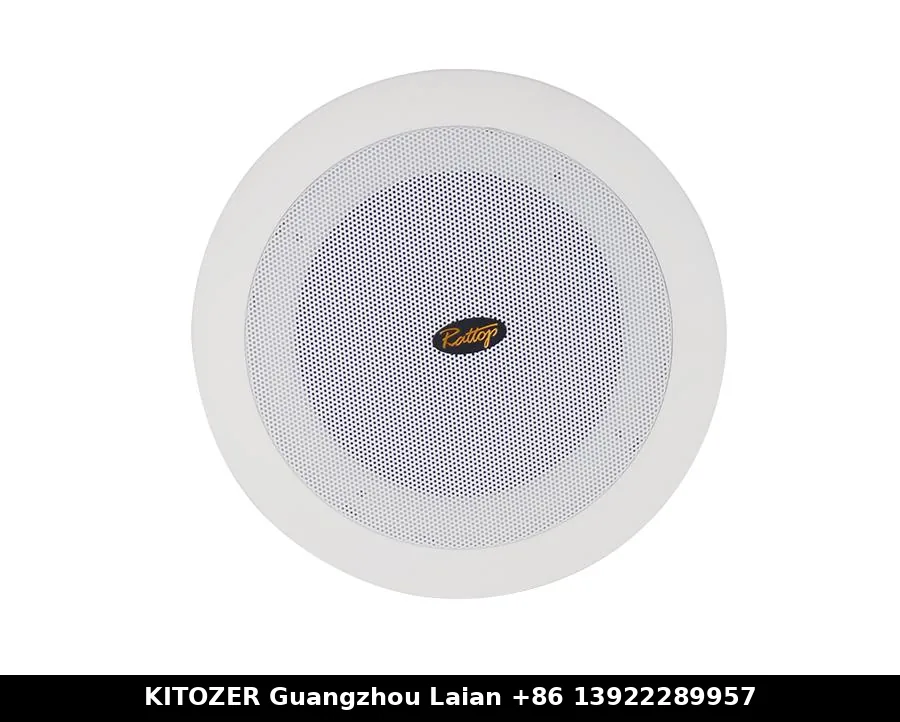
Ceiling speakers are installed in ceiling cutouts sized per speaker specifications (typically 160-200mm diameter). Installation must be secure and flush with the ceiling, no looseness or rattling. Spacing should be 3-5 meters, at 2.5-3.5 meters mounting height. In corridors, install one every 6-8 meters.
5.3 Horn Speaker / Column Speaker Installation
Horn and column speakers are typically wall-mounted on brackets or poles at 3-5 meters height, oriented toward the coverage area with adjustable tilt angle. Outdoor installations require weatherproofing with cable entry facing downward and waterproof glands. Brackets must be wind-resistant with spring washers at bolted connections.
5.4 Amplifier Installation
Amplifiers mount in standard 19-inch racks with 1U clearance above and below for ventilation. When stacking multiple amplifiers, install cooling fans between them. The host must be reliably grounded with a ground wire of at least 2.5mm². Power outlets should be on dedicated circuits, not shared with high-power equipment.
5.5 IP Network Broadcasting Cabling
Use Cat5e or Cat6 network cable for IP network broadcasting, with maximum run distance of 100 meters. Extend beyond 100 meters with fiber optic transceivers. Network switches should support QoS to prioritize audio data. Network speakers and amplifiers should use static IP addresses to avoid DHCP assignment changes causing offline devices.
5.6 Fire Alarm Integration Wiring
Fire alarm integration signals must use flame-retardant shielded cable connected to the fire alarm controller’s broadcast output terminals. Integration modules install in the fire control room for easy maintenance and testing. During commissioning, test each zone’s fire alarm integration function to ensure emergency broadcast activates upon fire signal.
6. Operation and Maintenance
6.1 Daily Operation
Daily operation involves controlling source switching, volume adjustment, and zone selection through the broadcast host panel or management software. Power-on sequence: source devices first, then preamplifier, finally power amplifier. Power-off sequence is the reverse: amplifier first, then preamplifier, finally sources. This prevents power surge thumps from damaging speakers.
6.2 Regular Inspection
Monthly inspection: check amplifier indicator status, monitor audio quality in each zone, verify terminal connections are tight, test fire alarm integration function. Quarterly: inspect weatherproof seals on junction boxes and outdoor speakers. Annually: conduct a full acoustic test, adjusting speaker placement and volume parameters based on actual results.
6.3 Common Troubleshooting
No sound: Check amplifier power, source output, speaker wire continuity, and zone controller selection.
Low volume: Check amplifier volume knob, speaker transformer tap connections, and line voltage drop over long distances.
Hiss/buzz: Check cable shielding, separation from power cables, grounding, and amplifier overload.
Single zone silent: Check zone controller channel, speaker wire continuity in that zone, and speaker damage.
Fire alarm not triggering: Check fire alarm signal wiring, dry contact signals, integration module power, and emergency broadcast source readiness.
6.4 Maintenance Recommendations
Keep amplifier ventilation clear with unobstructed cooling vents. Clean equipment surfaces with a dry soft cloth; do not use chemical solvents. Vacuum speaker grilles regularly. Inspect paint and anti-corrosion on outdoor speakers annually. Update system software periodically for latest features and security patches.
7. Frequently Asked Questions
A: Constant-voltage systems using 2×1.5mm² speaker wire have an effective transmission distance of 1-2 km. IP network broadcasting over network/fiber is distance-unlimited. Coverage area depends on speaker count and density, typically one ceiling speaker per 20-30 square meters.
A: Reference pricing varies by system scale: basic constant-voltage systems are about 200-500 RMB per speaker point; IP network systems are about 800-2000 RMB per network point. Contact us for detailed pricing based on site survey and system design.
A: Not exactly. The PA system handles daily background music and business paging; fire alarm broadcast is for emergency evacuation. Per national code, they can share one system but must have fire alarm integration that automatically switches to emergency broadcast during fires. KITOZER systems include fire alarm integration as standard.
A: Each has advantages. Constant-voltage is lower cost, mature, and simple to maintain for small projects. IP network offers powerful features, flexible zoning, remote control, and no separate speaker wiring but higher cost and network infrastructure needs. Choose based on project scale and functional requirements.
A: Ceiling speakers for suspended ceiling interiors for a clean look. Wall speakers for spaces without ceilings or requiring better audio quality. Weatherproof column or horn speakers for outdoor areas.
A: Some KITOZER amplifier models include Bluetooth receivers for phone connection. IP network systems can also push audio files from management software. For zoned independent playback, use digital source players or network broadcast hosts.
A: Amplifier rated power should be 1.3-1.5 times the sum of all speaker rated power. For 600W total load, choose 800W-1000W. Insufficient headroom causes distortion and overheating; excessive waste is uneconomical.
A: Constant-voltage systems need speaker wire (RVV 2×1.5mm²+). IP network systems use existing network cabling, no separate speaker wire, but each network terminal needs a network port. Fire alarm integration signals require separate conduit.
A: Outdoor-rated speakers must be weatherproof (IP65+), installed with cable entry facing down, using waterproof glands and junction boxes. Horn speakers have internal waterproof membranes. Check seals and paint annually.
A: IP network systems support remote web management and mobile app control from anywhere with internet access. Constant-voltage systems require local operation at the host panel.
A: Theoretically unlimited as long as amplifier power suffices. In practice, each ceiling speaker is 3-6W. A 500W amplifier can drive about 80-100 units of 6W ceiling speakers, while monitoring line voltage drop not exceeding 10%.
A: Guangzhou Laan provides installation, commissioning, and after-sales service for KITOZER PA systems. Phone/WeChat: 13922289957, 18520668845. Address: Chaotian Park, Zhongrun Industrial Park, No. 5 Huashan Road, Shilou, Panyu, Guangzhou.
8. Application Scenarios
8.1 Office Buildings and Commercial Complexes
In office buildings and commercial complexes, PA systems play background music, floor paging, promotional announcements, and emergency notifications. Systems are zoned by floor or shop area, playing light music during work hours, switching to upbeat music at lunch, and playing closing announcements before store hours. Fire alarm integration automatically plays evacuation broadcasts during fires.
8.2 Smart Campuses
Campus PA systems need scheduled class bells, eye exercise music, broadcast gymnastics, campus announcements, and emergency evacuation. IP network broadcasting supports classroom point-to-point broadcast, playground wide-area broadcast, and hearing exam zone playback. The system integrates with the school schedule for fully automatic operation.
8.3 Smart Hospitals
Hospital PA systems cover lobbies, corridors, wards, and operating rooms by zone. Ward areas require controlled volume to avoid disturbing patients. Emergency broadcasts notify staff and patients to evacuate. Many hospitals also use PA systems for queuing announcements and infusion reminders.
8.4 Residential Communities
Community PA systems deliver property management announcements, weather forecasts, background music, and emergency evacuation broadcasts. Systems are zoned by building to avoid noise disturbance. IP network broadcasting allows property staff to remotely publish announcements via mobile app.
8.5 Industrial Parks
Factory PA systems handle shift bells, production dispatch announcements, safety reminders, and emergency evacuation. Workshop environments are noisy and require high-power horn or column speakers. The system integrates with the fire alarm system to play evacuation instructions during emergencies.
8.6 Transportation Hubs
Airports, train stations, and bus stations integrate PA systems with flight/train information systems to automatically broadcast arrival and departure information. Coverage includes waiting halls, platforms, corridors, and parking lots, requiring uniform SPL and high speech intelligibility. Emergency broadcasts play evacuation instructions during incidents.
8.7 Sports Venues
Stadium PA systems cover spectator stands, competition fields, and exits. Functions include event announcements, background music, safety reminders, and emergency evacuation. Large venues typically use array speakers or high-power columns for uniform SPL across the entire venue.
10. History and Evolution of Public Address Systems
The public address system has evolved through multiple technology eras. Early systems were based on vacuum tube amplifiers, primarily used in factories, schools, and villages for announcements. By the mid-twentieth century, transistor amplifiers replaced vacuum tube designs, offering smaller size, higher efficiency, and improved reliability. Broadcast systems began entering commercial buildings and public facilities at scale.
In the 1980s, constant-voltage broadcasting matured. The 100V constant-voltage output became an industry standard. Mass production of ceiling speakers and wall speakers drove down system costs significantly. Systems of this era primarily played background music and business paging, typically using one amplifier driving a group of speakers with manual source and zone switching.
In the 1990s, intelligent broadcast systems emerged, introducing timers, zone controllers, and fire alarm integration modules. The system could automatically play shift bells, work music, and background music on preset schedules without manual intervention. Fire alarm integration elevated broadcast systems to become a critical component of building safety systems.
In the early 2000s, IP network broadcasting began to rise. Based on the TCP/IP protocol, network broadcasting digitized audio and transmitted it over computer networks, breaking the distance and zoning limitations of traditional systems. IP network systems support remote management, point-to-point control, and simultaneous multi-source playback, gradually becoming the preferred choice for new projects.
In recent years, cloud broadcasting has emerged alongside IoT and cloud computing technologies. Broadcast devices connect to cloud platforms via the internet, and administrators can manage systems from anywhere through mobile apps or web browsers. Intelligent speech synthesis makes automated announcements more natural and fluent, while voice recognition enables voice-controlled broadcast operation. The KITOZER brand tracks these technology trends and continuously introduces new products and features.
11. Core Equipment Details
11.1 Power Amplifiers
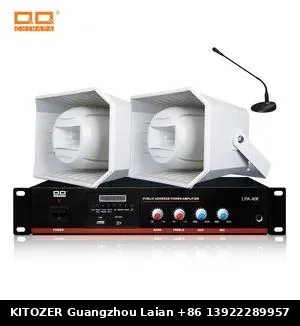
The power amplifier is the heart of any broadcast system, responsible for amplifying weak audio signals to levels sufficient for driving speakers. The KITOZER constant-voltage amplifier uses Class AB amplification circuitry, featuring low distortion, high efficiency, and high reliability. The front panel includes a power switch, volume knob, input level indicators, and protection indicators for easy operation and status monitoring. The rear panel provides multiple line inputs, microphone inputs, zone outputs, and constant-voltage output terminals.
KITOZER amplifiers feature comprehensive protection: over-temperature protection (automatically reducing output or shutting down when internal temperature exceeds threshold), short-circuit protection (disconnecting output on short circuit), overload protection (protecting against low load impedance), and DC protection (protecting speakers when DC voltage appears at output). These protections ensure amplifiers and speakers are not damaged under abnormal conditions.
Amplifier thermal design is equally important. KITOZER amplifiers combine natural convection with forced air cooling. High-power models include thermostatically controlled fans that adjust speed based on internal temperature, ensuring cooling while minimizing noise. Heat sinks use extruded aluminum alloy with large surface area for efficient heat dissipation.
11.2 Network Broadcast Host
The IP network broadcast host is the management core of the system, running an embedded operating system with a web management interface and local operation panel. The host includes a large-capacity storage drive for thousands of audio programs and scheduled tasks. Administrators log in through a browser to manage sources, configure zones, set schedules, adjust volume, and configure system parameters.
The network broadcast host supports multiple audio inputs: line input (external CD player, tuner), microphone input (for real-time paging), and network input (audio streams from other network terminals). The host encodes input audio into digital streams and sends them over the network to designated terminals. It also receives call signals from network paging microphones and routes voice broadcasts to target zones.
11.3 Network Paging Microphone
The network paging microphone is the remote calling terminal of the IP network broadcast system, with a built-in microphone, speaker, and network module. The microphone has an LCD screen, function buttons, and a volume knob. Administrators can select call zones, adjust volume, and monitor broadcast content from the microphone. It connects via network cable with Power over Ethernet (PoE), eliminating the need for a separate power adapter.
The paging microphone supports single-zone, multi-zone, and all-zone calls. When calling, the microphone automatically sends a call signal to the broadcast host, which establishes an audio channel and transmits the voice captured by the microphone in real-time to speakers in the target area. The microphone also features queuing, processing multiple callers in order to avoid audio conflicts.
11.4 Speaker Types and Characteristics
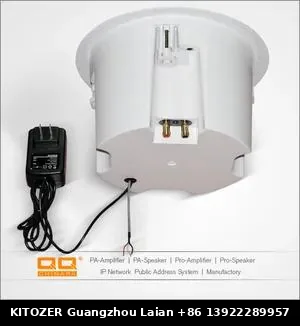
Ceiling speakers: Installed inside ceiling tiles, circular appearance approximately 160-200mm diameter, power 3-6W, suitable for offices, malls, corridors, and other suspended-ceiling interiors. Ceiling speakers offer clear audio, uniform coverage, and space-saving installation. They include universal mounting springs for various ceiling thicknesses.
Wall speakers: Wall-mounted on walls with plastic or metal enclosures, power 10-30W, suitable for classrooms, corridors, lobbies, and other spaces. Wall speakers offer higher SPL and stronger directivity than ceiling speakers, with flexible mounting angle and position adjustment.
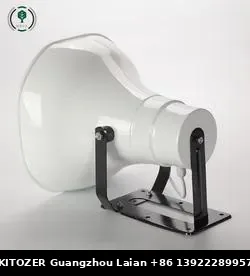
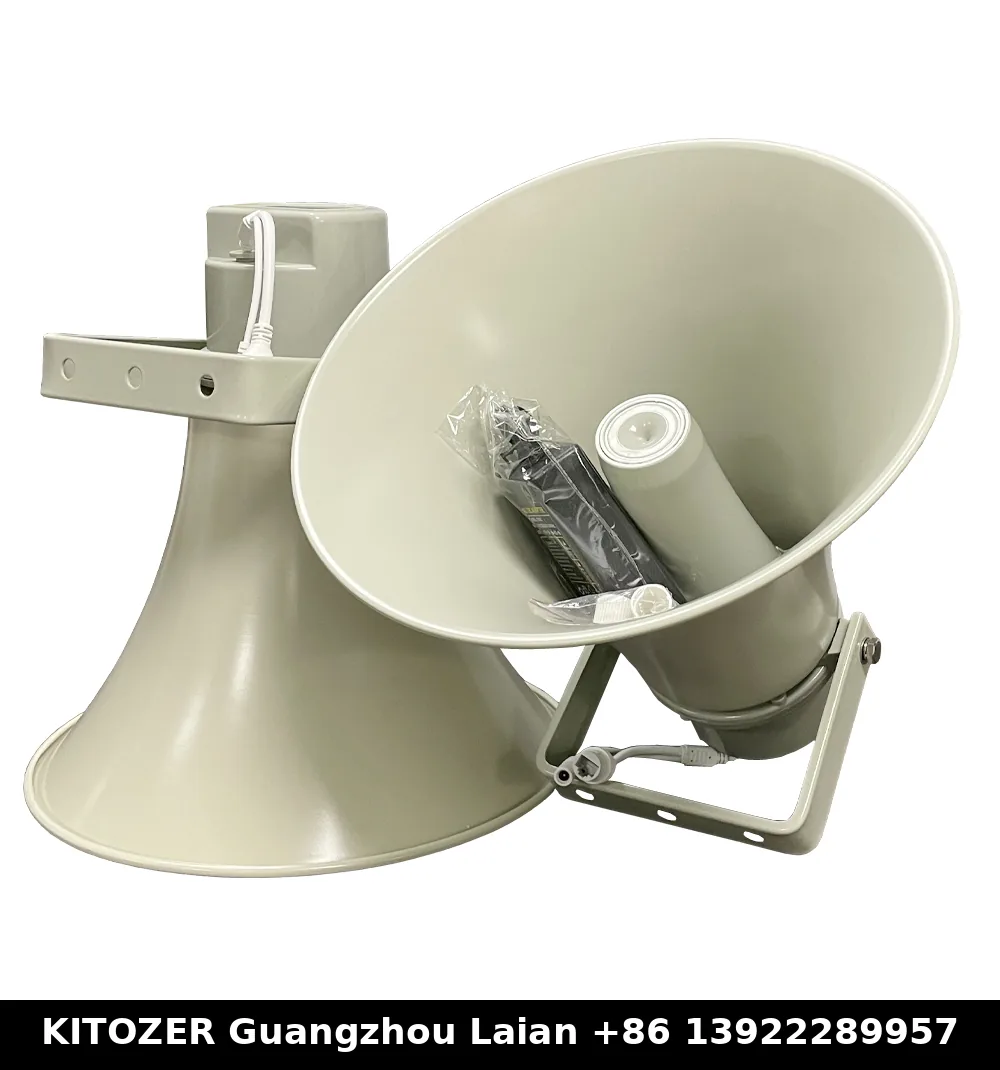
Horn speakers: Horn-type speakers with strong directivity, high SPL, and long transmission distance, power 15-50W, suitable for factory workshops, plazas, playgrounds, and other large or outdoor spaces. Horn speaker enclosures are aluminum alloy or plastic, with weatherproof models available for outdoor use.
Column speakers: Multiple small speaker units arranged vertically, with narrow vertical directivity and wide horizontal coverage, power 20-120W, suitable for outdoor corridors, platforms, stadiums, and other areas requiring long-distance, wide-coverage audio. Column speaker enclosures are aluminum alloy, weatherproof and corrosion-resistant.
11.5 Fire Alarm Integration Controller
The fire alarm integration controller is the interface between the broadcast system and the fire alarm system. It provides multiple dry contact inputs, each corresponding to a broadcast zone. When the fire alarm controller outputs a fire signal to the corresponding zone, the integration controller detects the signal and automatically switches that zone to emergency broadcast mode, playing pre-recorded fire evacuation voice messages.
Emergency broadcast has the highest priority, interrupting currently playing background music or business broadcasts. The integration controller supports adjacent-zone linkage — when one zone alarms, it can be configured to simultaneously broadcast to adjacent zones to ensure evacuation route coverage. Emergency broadcast messages can be pre-recorded and loaded via SD card or USB drive.
12. System Design Standards and Codes
Public address system design must follow relevant national standards and codes. Key references include the Technical Standard for Public Address Systems Engineering (GB/T 50526), the Code for Design of Automatic Fire Alarm Systems (GB 50116), and the Intelligent Building Design Standard (GB/T 50314). These standards specify acoustic parameters, power requirements, fire alarm integration, and construction acceptance criteria.
For acoustic design, background music area SPL should be 10-15dB above ambient noise, and paging area SPL should be 15-20dB above ambient noise. The Speech Transmission Index (STI) should be no less than 0.5 for speech intelligibility. Speaker placement should ensure SPL variation across points does not exceed 6dB, avoiding areas that are too loud or too quiet.
For power design, the broadcast system should use a dedicated power circuit equipped with UPS (uninterruptible power supply). When mains power fails, UPS should guarantee at least 30 minutes of continuous operation to ensure emergency broadcast functionality. Amplifier power should have a margin of at least 20%. All equipment enclosures must be reliably grounded with grounding resistance not exceeding 4 ohms.
For cable design, speaker wire should use flame-retardant copper cable, with cross-section selected based on transmission distance and load power. Line voltage drop should not exceed 10% of the amplifier rated voltage. Low-voltage cables must be routed separately from power cables with parallel spacing of at least 300mm, crossing at right angles when necessary. All cables must be permanently labeled at both ends.
13. Integration with Other Low-Voltage Systems
13.1 Fire Alarm System Integration
Integration with the fire alarm system is the most critical integration function. When the fire alarm system detects and confirms a fire, it sends a fire signal through the integration module to the broadcast system, which automatically switches the corresponding zone to emergency broadcast mode and plays pre-recorded evacuation voice instructions. Emergency broadcast has the highest priority and is unaffected by any other broadcast task.
13.2 Building Automation System Integration
In intelligent buildings, the broadcast system can integrate with the Building Automation System (BAS). For example, background music plays automatically when the HVAC system runs, and broadcasting stops when rooms are unoccupied. Broadcast system status can also be uploaded to the BAS monitoring interface for unified management.
13.3 Security Monitoring System Integration
The broadcast system integrates with security monitoring: when the monitoring system detects anomalies (intrusion alerts, equipment failures), it automatically plays warning voice messages in relevant areas. The broadcast system can also serve as an emergency evacuation guidance channel for the security system.
13.4 Information Display System Integration
In commercial venues, the broadcast system integrates with information display systems so background music and promotional voice can synchronize with on-screen video content. For example, when mall large screens play advertising videos, the broadcast system simultaneously plays corresponding audio, achieving integrated audio-visual communication.
14. Detailed Application Case Studies
14.1 Grade-A Office Building Broadcast Solution
A grade-A office building typically has 20-50 floors, each with 1000-2000 square meters. The recommended solution: install 30-50 units of 6W ceiling speakers per floor, zoned by floor. Use 500W constant-voltage amplifiers, one per floor or shared across several floors. The broadcast host is installed in the property equipment room, connected via network cable to floor network switches.
Functions: play light music before work hours, low-volume background music during work, switch to relaxed music at lunchtime, play reminder music before closing. Fire alarm integration by floor, automatically playing evacuation voice during fires. Property staff use network paging microphones for real-time announcements.
14.2 University Campus Broadcast Solution
University campuses are large and dispersed, recommending IP network broadcasting. Each teaching building, dormitory, library, cafeteria, and playground has network speakers and network amplifiers. The broadcast host is installed in the broadcast room, connected via campus network to each terminal.
Functions: scheduled class bells, between-class music, broadcast gymnastics music, eye exercise music, campus announcements, lost-and-found notices, and emergency evacuation. Each classroom’s broadcast can be independently controlled without affecting ongoing classes. The playground uses high-power column speakers covering the entire sports area.
14.3 Tertiary Hospital Broadcast Solution
Hospital broadcast systems need zoned control in outpatient lobbies, waiting areas, corridors, wards, operating rooms, and emergency departments. Ward areas require low volume and gentle music to avoid disturbing patients. Outpatient lobbies need queuing announcements and visit guidance.
Hospital broadcasting integrates with queuing systems to automatically broadcast visit number information. During emergencies, the system plays evacuation notifications throughout the hospital or designated areas. Operating rooms, ICUs, and other special areas need independent broadcast switches to disable background music while retaining emergency broadcast.
14.4 Large Shopping Complex Broadcast Solution
Large shopping complexes include shopping malls, supermarkets, cinemas, dining areas, and parking lots. Each area requires different background music styles and volume levels. IP network broadcasting is recommended, with each shop and zone independently controlled.
Mall areas play elegant light music, dining areas play relaxed jazz, supermarkets play upbeat pop music, and parking areas play guidance music. Promotional broadcasts play in designated areas during sales events. Fire alarm integration is controlled by fire compartment, automatically switching to evacuation broadcast during emergencies.
14.5 Smart Factory Broadcast Solution
Factory workshop environments are noisy, requiring high-power horn or column speakers. Broadcast systems handle shift bells, production dispatch announcements, safety reminders, and emergency evacuation. The system integrates with factory SCADA to automatically play warning voice when equipment anomalies occur.
Workshop broadcasting needs zoned control — different workshops can play different content. Office areas play background music, and outdoor areas use horn broadcasting. Fire alarm integration covers all workshops and passageways to ensure everyone hears evacuation instructions during emergencies.
15. Acoustic Design Fundamentals
Acoustic design is key to ensuring broadcast effectiveness. It must consider room size, shape, surface material reflection characteristics, ambient noise levels, and target listener positions. Poor acoustic design causes unclear audio, severe echo, or insufficient volume in certain areas.
Speaker placement should follow uniform coverage principles. In rectangular rooms, ceiling speakers are arranged in a grid pattern, with spacing calculated based on the speaker’s dispersion angle and mounting height. At 3 meters mounting height, 3-5 meter spacing is appropriate. In corridors, speakers are spaced every 6-8 meters along the center line.
SPL calculation: SPL contributions from each speaker at the target point are summed to meet design requirements. Background music areas target 65-75dB; paging areas target 70-80dB. SPL attenuates with distance, approximately 6dB per doubling of distance in free field. Therefore, speaker quantity and position must be calculated based on coverage range.
Speech intelligibility is a critical broadcast metric. Chinese and English speech intelligibility is affected by signal-to-noise ratio and frequency response. Ensure SNR is at least 15dB, with frequency response covering 200Hz-8kHz. Reverberation time exceeding 1.5 seconds seriously degrades intelligibility and requires adjustment of speaker direction and addition of sound-absorbing materials.
16. Common Terminology
| Term | Definition |
|---|---|
| Constant-voltage output | Amplifier outputs audio at a constant voltage (typically 70V or 100V), allowing long-distance transmission and parallel speaker connection. |
| Constant-impedance output | Amplifier outputs at fixed impedance (typically 4Ω or 8Ω), short-distance, better sound quality but limited parallel connection. |
| Zone control | Logical division of broadcast coverage areas, independently controlling source, volume, and on/off for each zone. |
| Priority | Hierarchy of broadcast types. Emergency broadcast is highest, followed by business paging, then background music. Higher priority automatically interrupts lower priority. |
| Echo cancellation | In network broadcasting, eliminating echo caused by speaker audio being re-captured by the microphone. |
| Delay compensation | In large spaces with multiple speakers covering the same area, adjusting playback timing to ensure sound waves arrive simultaneously, avoiding echo. |
| PoE | Power over Ethernet, transmitting both data and power over a single network cable. |
| STI | Speech Transmission Index, measuring speech intelligibility, range 0-1, higher is better. Broadcast systems require STI ≥ 0.5. |
| SPL | Sound Pressure Level, measured in decibels (dB). |
| SNR | Signal-to-Noise Ratio. |
| UPS | Uninterruptible Power Supply, ensuring system continues running during power outages. |
17. Installation Construction Notes
Broadcast system installation quality directly impacts final results. Before construction, carefully review drawings to confirm each speaker position, amplifier location, and cable route. During construction, maintain cable labeling and construction records for later commissioning and maintenance.
Ceiling speaker installation: First cut the specified size hole in the ceiling, connect speaker cable to the speaker terminals (note polarity), then push the speaker into the hole and secure using spring clips. The speaker faceplate should sit flush with the ceiling, without tilt or looseness.
Speaker wire connections: Both amplifier output and speaker input terminals should use connectors or soldering, not simply twisted wires with electrical tape. Each connection must be reliable to prevent loosening causing poor contact or short circuits. Outdoor connections must use weatherproof junction boxes.
System commissioning: First test each zone’s speaker audio, then test zone switching, volume control, and source switching. Finally perform fire alarm integration testing, simulating fire signals to verify emergency broadcast activation. After commissioning, complete a commissioning report recording zone volume parameters and system operating status.
18. Advantages of KITOZER Public Address Systems
The KITOZER public address system, integrated by Guangzhou Laan Intelligent System Development Co., Ltd., offers the following advantages. First, the company has years of industry experience and can provide customized solutions based on actual customer scenarios, rather than simply selling standard products. Second, system equipment selection is flexible, allowing combination of different configurations based on budget and functional requirements.
Third, the company provides end-to-end services from solution design, equipment supply, installation and commissioning, to after-sales maintenance, so customers need not coordinate multiple vendors. Fourth, the KITOZER product line is comprehensive, covering amplifiers, speakers, controllers, network terminals, and all equipment in between, ensuring compatibility and reliability. Fifth, the technical team responds quickly, with phone/WeChat 13922289957 available for technical consultation and after-sales requests.
KITOZER public address systems have been deployed in office buildings, schools, hospitals, shopping malls, factories, residential communities, and other venues, accumulating rich project experience. The company is located in Panyu, Guangzhou, with convenient transportation. Customers are welcome to visit and inspect.
19. Equipment Cable Selection and Installation Standards
19.1 Speaker Wire Selection
Speaker wire is the key transmission medium connecting amplifiers to speakers. Use oxygen-free copper (OFC) multi-strand cable, with cross-section selected based on transmission distance and load power. Short distance (within 100 meters) uses RVV 2×1.0mm², medium distance (100-500 meters) uses RVV 2×1.5mm², and long distance (over 500 meters) uses RVV 2×2.5mm² or larger. Cable must be flame-retardant to meet building fire codes.
Speaker wire polarity must be clearly distinguished. Typically red is positive and black is negative. Label both amplifier output and speaker input terminals. For parallel connections, all speaker positives connect together and all negatives together — incorrect polarity causes phase cancellation and reduced volume.
19.2 Network Cable Selection
IP network broadcasting uses Cat5e or Cat6 unshielded twisted pair (UTP) with maximum run distance of 100 meters. Extend beyond 100 meters using fiber optic transceivers or direct fiber. Cable must meet TIA/EIA-568 standards with conductor diameter 0.5mm or above. For PoE-powered network terminals, recommend Cat6 cable for power supply stability.
19.3 Cable Installation Standards
Low-voltage cables must be routed separately from power cables with parallel spacing of at least 300mm. When crossing is unavoidable, cross at right angles to minimize interference. Cable fill ratio inside conduits should not exceed 40% for easier pulling and future maintenance. All cables must have permanent number labels at both ends with cable number and endpoints.
Outdoor cables require weatherproof junction boxes and connectors. Cable entries into buildings must include drip loops to prevent rainwater from flowing along cables indoors. Aerial cables must meet tension requirements with pole spacing not exceeding 50 meters. Buried cables must pass through galvanized steel or PE conduit at depth no less than 0.7 meters.
19.4 Cable Testing
After cable installation, perform continuity and insulation testing. Continuity testing uses a multimeter to measure line resistance, confirming connectivity without short circuits. Insulation testing uses a megohmmeter to measure inter-wire insulation resistance, requiring at least 100MΩ. Network cables should also use cable testers to verify wiring map and transmission performance. Record all test results.
20. Environmental Adaptation Design
20.1 High-Temperature Environments
In high-temperature environments such as industrial plants and outdoor cabinets, amplifier cooling is critical. High temperatures cause reduced output, accelerated component aging, and even equipment failure. KITOZER amplifiers operate from -10°C to +55°C; beyond this range, add air conditioning or ventilation. Outdoor cabinets should have sunshade and ventilation design with internal temperature not exceeding 50°C.
20.2 Low-Temperature Environments
In low-temperature environments (northern winter outdoors), speaker plastic enclosures may become brittle, and battery-powered devices show reduced runtime. KITOZER outdoor speakers operate down to -20°C, suitable for most regions of China. Amplifiers should be installed in indoor temperature-controlled environments.
20.3 Humid Environments
Humidity causes terminal oxidation, circuit board corrosion, and speaker cone mold. KITOZER outdoor devices feature waterproof enclosures and moisture-resistant coatings, rated IP65 or above. Indoor humid venues (swimming pools, hot springs) should use moisture-resistant speakers with waterproof terminal treatment. Amplifiers should be installed in dry, ventilated equipment rooms.
20.4 Dusty Environments
In dusty environments (factory workshops, construction sites), speaker grilles accumulate dust and affect audio output. Clean speaker grilles regularly. Amplifier equipment should be installed in dustproof racks with regular heat sink cleaning. Outdoor devices should choose well-sealed models.
21. Networked Intelligent Integration Platform
Modern intelligent buildings no longer treat broadcast systems as isolated equipment, but as a subsystem of the overall intelligent management platform. Through standard interfaces (RS485, Modbus TCP, dry contacts), broadcast systems connect to building integration platforms for unified monitoring and linked control.
On the integration platform, administrators can see broadcast system operating status: which zones are playing, whether amplifiers are normal, source selection status. They can remotely control broadcasting through the platform: switch sources, adjust volume, trigger paging, switch zones. System operating data and alarm information also upload to the platform for unified management.
Linked rules between broadcast systems and other subsystems are configured on the integration platform. For example: when the security system triggers an intrusion alarm, automatically play warning voice in the alarm area; when BAS detects HVAC failure, automatically play notifications in affected areas; when the parking system detects full capacity, automatically play full-lot announcements at entrances.
The KITOZER IP network broadcast system provides standard open API interfaces for third-party integration platform connection. APIs support webhook callbacks and RESTful API calls, making it easy for integrators to develop customized linked functions.
22. Cost Optimization Recommendations
While ensuring functionality and quality, reasonably controlling broadcast system costs is an important part of project management. The following are cost optimization recommendations:
Reasonable system type selection: Small projects choose constant-voltage broadcast systems at lower cost. Large projects choose IP network broadcasting — while individual terminals are more expensive, the savings in speaker wire and construction costs may result in lower overall cost.
Optimized speaker placement: Through precise acoustic calculations, determine the exact number of speakers needed, avoiding over-installation waste. At the same time, do not reduce speaker count to save money, as this causes uneven coverage.
Leveraging existing infrastructure: IP network broadcasting uses existing network cabling and switches, requiring no additional wiring. In buildings with existing network infrastructure, IP broadcasting offers clear cost advantages.
Phased construction: For budget-constrained projects, build in phases — first install core equipment and main-area speakers, expanding later as needed. IP network broadcasting has excellent expandability; adding terminals simply requires connecting to the network.
Appropriate amplifier power: Do not blindly select oversized amplifiers; choose based on 1.3-1.5 times actual load power. Sufficient but not wasteful.
23. Maintenance and Care Plan
Regular maintenance is key to ensuring long-term stable operation. We recommend signing an annual maintenance contract with a professional service provider for scheduled inspections and care.
Monthly inspection: Check amplifier indicators and operating status; monitor audio quality in each zone; check source equipment playback; verify zone controller operation; check network connections and terminal online status.
Quarterly care: Clean amplifier heat sinks and fans; check terminal tightness; test fire alarm integration function; check UPS battery status; update system software and audio file library.
Annual testing: Full SPL testing with sound field mapping; speech intelligibility testing; insulation resistance testing; grounding resistance testing; internal equipment dust cleaning; speaker grille cleaning; outdoor equipment weatherproof seal inspection.
Maintenance records should detail all issues found and actions taken, building an equipment archive. For devices with frequent failures, analyze root causes and consider replacement. Maintenance contracts should include fault response time commitments and backup equipment provisions.
24. Brand Comparison and Selection Advice
There are many public address brands on the market. Selection should comprehensively consider product quality, functional match, price, and after-sales service. International brands offer good quality but at higher prices, suitable for premium projects requiring high quality. Domestic brands offer good value with improving functionality, suitable for most small and medium projects.
When choosing a broadcast system supplier, consider: whether the supplier has its own technical team, can provide solution design services, has local technical support capability, has reference cases, and offers product warranty period and after-sales response time. The KITOZER brand, integrated by Guangzhou Laan, has complete technical service capabilities and can provide customers with end-to-end services from design to maintenance.
Do not look only at unit price; consider total system cost (equipment + cabling + construction + commissioning + maintenance). A well-designed, properly constructed system may have slightly higher initial investment but lower long-term operating costs and fewer failures, delivering better overall value.
25. Acoustic Psychology Considerations
Public address is not only a technical issue but also involves acoustic psychology. People’s acceptance of broadcast sound varies by time and scenario. Low-volume background music during work hours improves efficiency and comfort, but excessive volume distracts.
Background music style should match venue atmosphere. Shopping malls suit relaxed, elegant music to enhance shopping experience and dwell time. Offices suit low-volume, steady-rhythm music that does not affect focused work. Restaurants suit background music matching the cuisine style to enhance dining experience.
Emergency broadcast voice should be clear, calm, and directive. Research shows female voices are more reassuring during emergencies, while male voices are more penetrating in noisy environments. In practice, choose male or female announcers as needed, or use intelligent speech synthesis for natural announcements.
Broadcast volume control should consider time factors — lower volume or turn off broadcasting in early morning and late night to avoid disturbing rest. Adjust playback content and volume on holidays as needed. Intelligent systems can automatically adjust these parameters based on schedule.
26. Deep Dive into IP Network Broadcasting Technology
IP network broadcasting represents the convergence of traditional broadcast technology with computer networking. Unlike traditional constant-voltage broadcasting, IP network broadcasting transforms audio signals from analog transmission to digital transmission, from point-to-point wiring to network packet-switched transmission. This technological transformation brings numerous advantages: first, wiring cost is dramatically reduced — existing LAN infrastructure carries audio signals without separate expensive speaker wire. Second, zoning capability is greatly enhanced — traditional constant-voltage systems require physical zone wires, one control line per zone, while IP network broadcasting enables software-defined zoning with virtually unlimited zones. Third, remote management — administrators manage broadcast systems from anywhere on the network without being physically present.
IP network audio transmission is based on the RTP (Real-time Transport Protocol), ensuring ordered packet delivery and real-time playback. Audio encoding uses MP3 or AAC compression formats, reducing network bandwidth while maintaining sound quality. Each audio stream occupies approximately 64-128kbps bandwidth, which modern networks easily handle. The network broadcast host supports simultaneous playback of multiple different audio streams, enabling different zones to play different content simultaneously.
IP network broadcast terminals include network amplifiers and network speakers. Network amplifiers have built-in network decoding modules and power amplification circuitry, decoding network audio streams and amplifying them to constant-voltage speaker lines that drive traditional speakers. Network speakers integrate the network decoding module and speaker unit in one enclosure, requiring only a network cable and power connection. Both terminals have advantages: network amplifiers suit retrofitting existing constant-voltage speaker systems, while network speakers suit new projects for simplified wiring.
IP network broadcasting also supports scheduled playback. Administrators can set playback schedules on the host, specifying daily, weekly, or specific-date playback of designated audio programs in designated zones. For example, schools can set a morning wake-up call at 7am, class bell at 8am, dismissal music at noon, and closing bell at 5pm. The system executes on schedule without manual intervention.
Paging is a key application of IP network broadcasting. Administrators use the network paging microphone or management software, select zones to call, and press the talk button to broadcast. The system plays paging voice through speakers in selected zones. Paging supports single-zone, multi-zone, and all-zone calls, as well as zone combinations — frequently used zone combinations can be preset for one-touch calling.
The IP network broadcast system also supports audio file management. Administrators can upload MP3, WAV, and other format audio files to host storage, organizing by category. The system supports playlist functionality, arranging multiple audio files in sequence for continuous background music. Scheduled playback tasks can associate playlists for fully automated music playback.
27. Constant-Voltage vs IP Network Broadcasting Comparison
| Comparison | Constant-Voltage | IP Network |
|---|---|---|
| Transmission medium | Speaker wire (RVV 2×1.5mm²) | Network cable/fiber (TCP/IP) |
| Distance limit | 1-2 km (line loss) | Unlimited (any network) |
| Zoning | Physical wires, limited count | Software-defined, unlimited |
| Per-zone volume | Needs volume controllers, costly | Per-terminal software control |
| Multi-source playback | Not supported, same source everywhere | Supported, different zones different sources |
| Remote management | Not supported, local only | Web/app remote management |
| Wiring cost | High (separate speaker wire) | Low (uses existing network) |
| Equipment cost | Lower | Higher (network terminals pricier) |
| System complexity | Simple, easy maintenance | More complex, needs network knowledge |
| Expandability | Poor, needs re-cabling | Good, add terminal via network |
| Best for | Small, simple broadcast needs | Large, complex, multi-region |
Selection advice: For small shops and small offices, constant-voltage systems offer better value. For large buildings, campuses, and chain enterprises needing complex zoning and remote management, IP network broadcasting is more appropriate. Hybrid approaches are also possible — backbone using IP network transmission, with constant-voltage amplifiers at the end driving speakers.
28. Power Supply and Grounding Design
Reliable power supply directly affects broadcast system operation. Amplifier equipment should use dedicated power circuits, not shared with high-power equipment like air conditioners and elevators, to avoid power interference and voltage fluctuations. Power switches should be equipped with residual current circuit breakers for personal safety.
UPS (uninterruptible power supply) is essential for broadcast systems. When mains power fails, UPS automatically takes over, ensuring continued system operation. UPS capacity should at least handle amplifier and host full-load operation for 30 minutes or more. For fire broadcasting, codes require at least 30 minutes of emergency broadcast after power loss.
Grounding design: All equipment metal enclosures must be reliably grounded. Amplifier grounding terminals connect to the building grounding grid using ground wire of at least 2.5mm² multi-strand copper. Good grounding reduces hum interference and protects equipment from lightning and surge damage. Grounding resistance should not exceed 4 ohms.
Power line filters and surge protectors should be installed at amplifier power inputs to filter high-frequency interference and transient surges on power lines. In lightning-prone areas, outdoor cables and antenna feeds should have signal surge protectors installed to prevent lightning damage to indoor equipment through cables.
29. System Testing and Acceptance
After installation, comprehensive testing and acceptance are required. Test content includes: speaker coverage testing (measuring SPL at various points to confirm uniform coverage), speech intelligibility testing (playing standard speech test signals, evaluating intelligibility), zone function testing (testing source switching and volume control zone by zone), and fire alarm integration testing (simulating fire signals to verify automatic emergency broadcast activation).
SPL testing uses a sound level meter to measure A-weighted SPL at various points. Background music areas should reach 65-75dB; paging areas should reach 70-80dB. SPL variation between points should not exceed 6dB. If some areas have insufficient SPL, add speakers or adjust positions. If some areas are too loud, reduce amplifier output or replace lower-power speakers.
Speech intelligibility testing can use standard speech test materials or STI measurement instruments. Required STI is no less than 0.5, meaning normal-speed broadcast content can be clearly understood. If intelligibility is insufficient, check for excessive reflected sound (echo), insufficient signal-to-noise ratio, or uneven frequency response.
Fire alarm integration testing is a key acceptance item. Trigger each zone’s fire signal one by one, observing whether that zone automatically switches to emergency broadcast mode, plays evacuation voice, and automatically increases volume. Test adjacent-zone linkage, confirming preset adjacent zones also receive emergency broadcast. After testing, restore system to normal state.
At acceptance, complete documentation must be submitted including: system design drawings, equipment list, cable installation records, commissioning report, test data, and operation manual. Customer-side sign-off marks project delivery.
30. Future Development Trends
Public address systems are moving toward greater intelligence, integration, and cloudification. Future broadcast systems will no longer be isolated audio playback systems, but part of the intelligent building ecosystem. Broadcasting will deeply integrate with IoT platforms, automatically adjusting playback content and volume based on environmental data.
Intelligent technology will be widely applied to broadcast systems. Intelligent speech synthesis can generate natural, fluent announcements from text without manual recording. Voice recognition supports voice-controlled broadcast operation. Intelligent scene recognition automatically adjusts volume based on ambient noise — increasing broadcast volume when ambient noise is high, reducing it when quiet.
Cloud and mobility are other trends. Broadcast management will move from local hosts to cloud platforms, with administrators completing all operations via mobile app or web browser. Multi-site chain enterprises can manage broadcast systems across the country or globally through one cloud platform, enabling unified content distribution and remote monitoring.
IoT integration means broadcast systems link with sensor networks. For example, people-flow sensors detecting crowding automatically play diversion announcements; air quality sensors detecting pollution automatically play reminder voice; emergency button triggers automatically start nearby-zone emergency broadcast.
31. Project Implementation Process
31.1 Requirements Survey
Project implementation begins with site survey and requirements investigation. Engineers visit the site to measure architectural plans, understand each area’s function, size, height, decoration materials, and ambient noise. Communicate with customers to determine broadcast needs: which areas to cover, what functions (background music/paging/fire integration/scheduled playback), how many zones, and budget range.
31.2 Solution Design
Based on survey results, engineers design the broadcast system. The solution includes: system architecture diagram (equipment connectivity), speaker placement diagram (marking each speaker position and model), equipment list (with models and quantities), cable list (specifications and lengths), and power/grounding plan. The solution proceeds to construction after customer confirmation.
31.3 Construction and Installation
Construction follows design drawings: first install conduits and cables, then install speakers (ceiling speaker cutouts, wall speaker mounting, horn/column speaker bracket installation), then install amplifier hosts and rack equipment, and finally perform cable termination and wiring. During construction, maintain cable labeling and concealed work records.
31.4 Commissioning and Acceptance
After construction, system commissioning: test each zone’s speaker audio, adjust volume balance, test zone switching, scheduled playback, fire alarm integration, and paging. After commissioning, conduct acceptance testing and submit completion documentation. Customer sign-off marks project delivery.
31.5 After-Sales Maintenance
After delivery, provide after-sales service: phone technical support, remote diagnostics, on-site repair. Regular follow-up visits understand system operation and promptly handle faults and complaints. System upgrades and feature expansion are available as needed.
32. Safety Standards and Compliance
As part of building safety systems, public address systems must meet fire safety codes. According to the Code for Design of Automatic Fire Alarm Systems (GB 50116), public address systems must integrate with fire alarm systems to automatically play evacuation broadcasts during emergencies. Emergency broadcast cables must use flame-retardant conduit.
Emergency broadcast functionality must be available under all circumstances — even if background music functionality fails, emergency broadcast must still work. Systems must have backup power (UPS), and emergency broadcast must continue for at least 30 minutes after mains failure. Fire alarm integration lines must be in separate conduit, maintaining distance from other low-voltage cables.
Electrical safety: Amplifier equipment must meet national electrical safety standards with over-temperature, overload, and short-circuit protection. Equipment enclosures must be reliably grounded. Power circuits have residual current circuit breakers. Outdoor devices must have lightning protection.
Operational safety: Non-technical personnel must not arbitrarily adjust amplifier parameters and wiring. Operation manuals should be placed near equipment for reference. Fire alarm integration should be tested quarterly to ensure emergency broadcast functionality is always available.
33. Quick Reference Guide
Here is quick reference information for the KITOZER public address system for easy lookup during selection and use:
Brand: KITOZER
Company: Guangzhou Laan Intelligent System Development Co., Ltd.
Phone/WeChat: +86 13922289957, +86 18520668845
WhatsApp: +1 906-853-4140
Address: Chaotian Park, Zhongrun Industrial Park, No. 5 Huashan Road, Shilou, Panyu, Guangzhou, China
Chinese website: www.lain.com.cn
English website: www.gdlain.com
System types: Constant-voltage / IP network / Fiber / Wireless FM
Amplifier power: 60W-1000W
Speaker types: Ceiling 3-6W, Wall 10-30W, Horn 15-50W, Column 20-120W
Output voltage: 70V/100V constant-voltage
Fire alarm integration: Standard, supports zone and adjacent-zone linkage
Warranty: One year free repair, lifetime maintenance
Reference price: Quoted based on project scale and configuration
Thank you for choosing the KITOZER public address system. Please contact us with any questions. We are committed to serving you.
34. Detailed Q&A Supplement
A: At one speaker per 25 sqm, 200 units of 6W ceiling speakers (total 1200W). Amplifier power at 1.3-1.5x total = 1600W-1800W. Recommend two 1000W amplifiers for redundancy, each driving half the zones. If zoning by floor, per-floor amplifiers offer more flexibility.
A: Traditional constant-voltage cannot directly connect to Bluetooth speakers. However, IP network broadcasting can connect to Bluetooth adapters via network, pushing audio streams to Bluetooth speakers. Alternatively, add a Bluetooth receiver at the amplifier preamp stage, using phone Bluetooth music as an amplifier source.
A: First determine if noise is in all zones or individual zones. All-zone noise may indicate amplifier issues or power interference — check power filters and grounding. Individual zone noise may indicate that zone’s wiring — check terminals for poor contact or short circuits.
A: IP network broadcasting provides a web management interface accessible through any browser. Some systems also offer Windows management software and mobile apps. Constant-voltage systems require hardware controller operation with no software control.
A: Each audio stream is about 64-128kbps. Even simultaneously playing 10 different audio streams totals under 1Mbps. Modern 100M/1G networks handle this easily. Recommend using QoS-enabled switches to prioritize audio data.
A: Analog broadcasting transmits continuously varying analog electrical signals, susceptible to interference with limited distance. Digital broadcasting digitizes audio for transmission, offering strong anti-interference, long distance, and network control. IP network broadcasting is digital; traditional constant-voltage is analog.
A: Usually the same system. The public address system handles both background music playback and business paging. Through zone control and priority settings, one set of equipment plays different content at different times.
A: Based on room size and ceiling height. Normal offices and malls choose 3-6W ceiling speakers. Lobbies and high-ceiling spaces can choose 10W+. More power is not always better — too much causes excessive SPL, too little causes insufficient coverage. Recommend one 6W speaker per 20-30 sqm.
A: Horn speakers should be mounted 3-5 meters high, oriented toward the broadcast coverage area. Brackets must be wind-resistant with spring washers at bolted connections. Cable entry faces downward with waterproof glands and weatherproof junction boxes. Use outdoor weatherproof cable for speaker leads.
A: IP network broadcasting supports remote paging. Administrators use network paging microphones or management software to select zones and broadcast from anywhere with network access. Constant-voltage systems require operating the microphone at the host location.
A: Under normal use and regular maintenance, broadcast amplifiers have a design life of 8-10 years. Electrolytic capacitors are wear items, typically needing replacement at 5-8 years. Cooling fans at 3-5 years. Regular maintenance extends equipment life.
A: Yes. Per fire codes, PA system fire alarm integration should be tested quarterly. Simulate fire signals and check that corresponding zones automatically switch to emergency broadcast and play evacuation voice. Test records should be archived.
35. Acoustic Materials and Decoration Coordination
Broadcast effectiveness depends not only on equipment itself but also on building decoration materials. Smooth tile, glass, and marble surfaces reflect sound strongly, creating echo and reverberation that degrade speech intelligibility. Carpet, fabric curtains, and acoustic panels absorb reflected sound and improve the acoustic environment.
During the design phase, coordinate with the decoration designer to select appropriate acoustic materials. Lobbies and corridors with hard surface areas can add acoustic ceiling or wall panels. Meeting rooms and offices should use carpet and fabric furniture to improve acoustic environment.
Speaker placement must also consider decoration aesthetics. Ceiling speakers match ceiling panel color for a clean look. Wall speakers coordinate with wall colors. Horn speakers are mounted in inconspicuous but effective positions, avoiding disruption to building appearance.
36. Energy Consumption and Environmental Considerations
Broadcast system energy consumption primarily comes from power amplifiers. A 500W amplifier uses about 20-30W standby power and 600W full-load power. With multiple amplifiers running simultaneously, total energy consumption is significant. Choosing efficient amplifiers (Class D amplification at over 90% efficiency) can dramatically reduce energy use.
Intelligent management further saves energy: automatically turn off broadcasting in unoccupied areas, automatically power on/off based on schedule, and automatically adjust volume based on ambient noise. These functions save energy while also reducing unnecessary noise pollution.
KITOZER amplifiers use high-efficiency design with low standby power and high full-load efficiency. Equipment is lead-free and RoHS compliant. Packaging materials are recyclable.
37. Common Accessories and Consumables
Some wear accessories and consumables require periodic replacement during system operation. Common items include: speaker wire connectors (RCA plugs, terminal blocks), microphone batteries (wireless mics), fans (amplifier cooling fans), fuses (amplifier overcurrent protection), and speaker grilles (cleaning or replacement).
We recommend customers stock commonly used accessories for timely replacement during failures. KITOZER provides a full range of accessories and consumables. Call 13922289957 for accessory model and price inquiries.
38. User Training
After system delivery, training customer operators is essential for proper system use. Training includes: basic system operation (power on/off, source switching, volume adjustment, zone selection), routine maintenance (cleaning, inspection, preliminary fault diagnosis), and emergency procedures (fire alarm integration testing, manual emergency broadcast activation).
Training should combine hands-on practice. Provide operation manuals and quick reference cards placed near equipment. The KITOZER company provides free training during project delivery and can offer refresher training as needed.
39. Common Misoperations and Prevention
Misoperations of broadcast systems can cause unwanted broadcast content to play in wrong areas, disrupting normal order. Common misoperations include: selecting the wrong zone for paging, setting volume too high, accidentally pressing the emergency broadcast button, and incorrect scheduled tasks causing unexpected playback.
Prevention: Add zone confirmation steps on paging microphones — preview the zone before pressing talk. Mark volume knob positions to avoid arbitrary adjustment. Add protective covers on emergency broadcast buttons to prevent accidental triggering. Scheduled tasks require confirmation before activation. Regular operation manuals and training ensure operators are familiar with the system.
The system should have operation logging, recording all actions and timestamps for later review. The IP network broadcast web management interface shows current operating status and recent operation records.
40. Investment Return Analysis
The return on investment of a public address system is reflected not only in direct economic benefits but also in management efficiency improvement and safety assurance. Direct benefits include: reduced labor cost for manual announcements, improved customer experience and dwell time in commercial venues, and increased employee work efficiency.
Indirect benefits include: emergency broadcast functionality potentially saving lives during incidents and avoiding legal liability; intelligent scheduled playback reducing human operation errors; zone control reducing unnecessary broadcast coverage and noise pollution.
For commercial venues (malls, hotels, restaurants), a good background music system improves customer satisfaction and spending willingness, indirectly increasing revenue. For schools and hospitals, broadcast systems improve management efficiency and service quality. For factories, broadcast systems improve safety management.
The KITOZER public address system delivers high-quality products and services at reasonable prices, helping customers achieve reliable broadcast systems with controlled investment. Call 13922289957 for project solutions and quotes.
41. Industry Standards and Certifications
Public address equipment must meet relevant national standards and industry codes. Key standards include: GB/T 14471 (headphone general specifications), GB 9383 (sound and television broadcast receiver and related equipment radio interference characteristics limits and measurement methods), and GB/T 15212 (broadcast receiver ambient magnetic field measurement methods).
Fire-related standards: GB 50116 (code for design of automatic fire alarm systems) requires public address systems to integrate with fire alarm systems. GB 16806 (fire linkage control systems) specifies performance and safety requirements for fire linkage modules.
Electrical safety standards: GB 8898 (audio, video and similar electronic equipment safety requirements) specifies safety design requirements. Products must pass CCC (China Compulsory Certification).
Environmental standards: GB/T 15278 (sound frequency amplifier measurement methods) specifies measurement methods for amplifier performance parameters. GB/T 14197 (preferred interconnection values for sound system equipment interconnections) specifies interfaces and interconnection requirements between audio devices.
KITOZER public address equipment is designed and manufactured to national standards, with key performance parameters meeting or exceeding industry requirements. The company can provide product test reports and certification documents to customers.
42. Special Venue Applications
42.1 Sports Venues
Sports venue PA systems need to cover spectator stands, competition fields, athlete tunnels, and exits. Large stadiums accommodating tens of thousands of spectators require high-power array speaker systems for uniform SPL across the venue. Broadcast functions include event announcements, athlete introductions, background music playback, safety reminders, and emergency evacuation broadcasting.
Special requirements for sports venues: During competition, broadcast volume must not interfere with the event; when crowd cheering is loud, broadcast volume needs automatic enhancement to maintain intelligibility; during emergencies, rapid guidance for spectator evacuation is needed. The system typically interfaces with event timing and scoring systems to automatically broadcast match time and scores.
42.2 Airports and Stations
Airport and station PA systems integrate with flight/train information systems to automatically broadcast arrival and departure information. Content includes: flight/train numbers, departure/arrival times, gate/platform changes, delay notices, and boarding/boarding urging. The system supports multilingual announcements (Chinese, English, local languages).
Transportation hub broadcast requirements: Extremely high speech intelligibility — passengers must accurately hear train numbers in noisy environments; wide coverage — from waiting halls to platforms to parking lots; high reliability — broadcast system failure seriously disrupts operations.
42.3 Museums and Art Galleries
Museum and art gallery broadcast systems focus on guided tour functions. Each exhibition area can play different introductory voice messages, triggered by sensors or scheduled play. Background music should be gentle and not disturb the visit. During emergencies, evacuation announcements are needed but volume should be controlled to avoid causing panic.
Museum broadcasting typically uses IP network broadcasting, with small network speakers near each exhibit playing corresponding commentary audio based on visitor position or schedule. The system can remotely update commentary content and playback schedules through the network.
42.4 Hotels
Hotel PA systems need background music and announcements in lobbies, corridors, restaurants, meeting rooms, and guest rooms. Lobby and restaurant background music style should match the hotel positioning. Corridors play low-volume music to create a comfortable atmosphere. Guest rooms typically have bedside audio systems with channel selection and volume control.
Hotel broadcasting also handles emergency evacuation. During fires, evacuation voice plays on all floors. The system should interface with the hotel PMS (Property Management System), automatically notifying front desk and security during emergencies.
42.5 Underground Parking Garages
Underground parking garage broadcast systems play guidance music, empty-space announcements, and emergency evacuation broadcasts. Garage ambient noise is primarily vehicle traffic noise, requiring sufficient SPL coverage. The system typically integrates with the parking management system, playing empty-space information at entrances. During emergencies, evacuation guidance plays.
43. Audio Quality Optimization
Public address system audio quality directly impacts user experience. Key points for optimizing audio quality include: first, selecting appropriate speakers — different venues use different types and power speakers, ensuring frequency response and coverage match requirements.
Second, properly setting amplifier parameters — tone adjustment (bass/treble) should be adjusted based on room acoustic characteristics. Rooms with tile floors and glass walls have strong reflected sound; reduce high frequencies to avoid harshness. Rooms with carpet and upholstered walls absorb sound well;适当 increase high frequencies to improve clarity.
Third, avoiding overload — excessive amplifier input signal causes clipping distortion, making sound harsh and unclear. Ensure source output level is moderate and amplifier input gain is not excessive. Speaker power should not exceed 80% of amplifier output power, leaving headroom.
Fourth, reducing interference — signal cables use shielded wire, routed separately from power cables. Amplifier grounding is good, reducing hum. Sources avoid common ground loop interference. Periodically check connections and terminals for good contact without oxidation.
44. Detailed Technical Specifications Supplement
44.1 Amplifier Technical Specifications in Detail
KITOZER series constant-voltage amplifiers use Class AB amplification circuitry, frequency response 80Hz-16kHz (±3dB), signal-to-noise ratio ≥80dB, THD ≤0.5% (1kHz, rated power). The amplifier includes two microphone inputs (6.35mm jack, with priority function), three line inputs (RCA), and one auxiliary output. Output terminals include 100V constant-voltage output, 70V constant-voltage output, and 4-16Ω constant-impedance output.
The front panel includes: power switch, power indicator, protection indicator, signal indicators (per input), master volume knob, microphone volume knob, and bass/treble adjustment knobs. The rear panel includes: power socket (with fuse), grounding terminal, input/output terminals, and cooling fan exhaust.
Amplifier protection functions: DC protection (cuts output when DC voltage appears at output), over-temperature protection (protects when internal temperature exceeds 85°C), short-circuit protection (cuts output on short circuit), overload protection (protects against low load impedance). Protection auto-recovers after fault resolution.
44.2 Speaker Technical Specifications in Detail
Ceiling speakers: Rated power 3W/6W (switchable via transformer tap), input voltage 100V, frequency response 100Hz-13kHz, sensitivity 90dB (1W/1m), installation cutout diameter 170mm, enclosure ABS flame-retardant plastic, white.
Wall speakers: Rated power 10W/20W/30W, input voltage 100V, frequency response 120Hz-13kHz, sensitivity 91dB, enclosure ABS plastic, wall mounting bracket, white.
Horn speakers: Rated power 15W/25W/30W/50W, input voltage 100V, frequency response 300Hz-12kHz, sensitivity 105dB, enclosure aluminum alloy/plastic, weatherproof design, bracket mounting, off-white.
Column speakers: Rated power 20W/40W/60W/120W, input voltage 100V, frequency response 150Hz-13kHz, sensitivity 95dB, enclosure aluminum profile, weatherproof design, wall mounting, white/silver.
44.3 Network Broadcast Host Specifications
The IP network broadcast host uses embedded Linux system, equipped with gigabit network port, built-in 2TB hard drive for audio file storage. Supports up to 500 network terminals, simultaneously playing 32 different audio streams. Provides web management interface supporting Chrome, Edge, Firefox browsers. Supports scheduled tasks, zone management, program management, user management, and other functions.
45. Project Reference Pricing
The following are reference price ranges for typical KITOZER public address system projects. Actual prices vary by project scale and configuration:
Small project (10-20 speakers): Basic constant-voltage broadcast, including one 120W amplifier, 20 ceiling speakers, cables, and installation. Reference total: RMB 8,000-15,000.
Medium project (50-100 speakers): Intelligent constant-voltage broadcast, including two 350W amplifiers, 80 ceiling speakers, zone controller, timer player, cables, and installation. Reference total: RMB 30,000-60,000.
Large project (200-500 speakers): IP network broadcast, including network broadcast host, network paging microphone, multiple network amplifiers, 200 various speakers, fire alarm integration controller, cables, and installation. Reference total: RMB 150,000-400,000.
Above prices are for reference only; detailed quotes require site survey and solution design. Call 13922289957 for detailed solutions and quotes.
46. About KITOZER Brand
KITOZER is the intelligent equipment brand of Guangzhou Laan Intelligent System Development Co., Ltd. The brand name blends technology and quality, representing professional, reliable, and innovative product philosophy. The KITOZER product line covers public address systems, parking management systems, building intelligence equipment, and more, serving various building intelligence projects.
Guangzhou Laan Intelligent System Development Co., Ltd. is located in Panyu District, Guangzhou. It is a technology enterprise focused on low-voltage intelligent system integration. The company has professional design, construction, and after-sales teams, providing customers with end-to-end services from solution design to maintenance. Company address: Chaotian Park, Zhongrun Industrial Park, No. 5 Huashan Road, Shilou, Panyu, Guangzhou.
Phone/WeChat: +86 13922289957, +86 18520668845. WhatsApp: +1 906-853-4140. Chinese website: www.lain.com.cn. English website: www.gdlain.com. We welcome friends from all sectors to discuss cooperation.
In the public address field, KITOZER provides full-range products from basic constant-voltage to high-end IP network broadcasting. Regardless of project size, the company can provide the most suitable solution and configuration based on customer needs. The company commits that all products and services undergo rigorous testing to ensure stability and reliability.
47. Final Summary
The KITOZER public address system provides comprehensive solutions for indoor and outdoor audio broadcasting. From traditional constant-voltage to modern IP network broadcasting, the product line covers power amplifiers, network hosts, paging microphones, ceiling speakers, wall speakers, horn speakers, column speakers, and fire alarm integration controllers. The system is suitable for office buildings, schools, hospitals, shopping malls, factories, residential communities, transportation hubs, and sports venues.
The system offers background music playback, business paging, scheduled playback, zone control, fire alarm integration, and remote management functions. Guangzhou Laan provides end-to-end services from solution design and equipment supply to installation, commissioning, and after-sales maintenance.
Thank you for reading the KITOZER Public Address System Complete Encyclopedia. For inquiries, contact us at +86 13922289957. We look forward to serving you.
48. Detailed Technical Calculations and Examples
48.1 Office Broadcast System Calculation
An office area of 1000 square meters with 3 meter ceiling height and ambient noise of about 45dB requires background music broadcasting with target SPL of 70dB. Each ceiling speaker has sensitivity of 90dB (1W/1m) and power of 6W. Calculating required speaker count and amplifier size.
Each 6W speaker produces SPL at 1 meter: 90+10*log10(6) = 90+7.8 = 97.8dB. At 3 meters distance, attenuation is about 10dB, giving 87.8dB. Due to multiple speakers stacking, actual SPL will be higher. At one speaker per 25 square meters, 1000 square meters requires 40 speakers. Total power = 40 × 6 = 240W. Amplifier power at 1.3x = 312W, choose 350W amplifier.
48.2 Mall Broadcast System Calculation
A single-floor mall area of 2000 square meters, 4.5 meter ceiling height, ambient noise about 55dB. Requires background music and paging with target SPL of 75dB. Use 6W ceiling speakers with sensitivity 90dB. At one speaker per 30 square meters, 67 speakers needed, rounded to 70. Total power = 70 × 6 = 420W. Amplifier power at 1.3x = 546W, choose two 500W amplifiers, each driving half the zones for redundancy.
48.3 Outdoor Broadcast System Calculation
An outdoor plaza area of 5000 square meters requires broadcast coverage. Ambient noise about 60dB, target SPL 80dB. Use 30W horn speakers with sensitivity 105dB (1W/1m). Each speaker at 10 meters produces SPL of 105-20 = 85dB. Calculating coverage, each horn speaker covers radius about 20 meters, requiring about 8 horn speakers. Total power = 8 × 30 = 240W. Amplifier choose 350W constant-voltage amplifier.
49. Construction Quality Control Points
Broadcast system construction quality directly affects final results. Key control points during construction include:
Conduit embedding stage: Check cable routing, pipe diameter, and pipe quality per design drawings. Conduits should be straight and horizontal, with bending radius no less than 6 times the pipe diameter. Leave pull wire at both ends. Suspended ceiling conduits must be securely fixed, not hanging loose.
Cable laying stage: Test continuity and insulation before cable laying. No joints inside conduits. Leave 30cm spare at both ends. Do not force cables during pulling, avoiding skin damage. Low-voltage and power cables in separate conduits with clear labeling.
Equipment installation stage: Speaker installation positions accurate and secure. Ceiling speaker cutout dimensions accurate, flush with ceiling. Wall speakers mounted level, brackets secure. Horn and column speakers mounted on brackets or poles, 3-5 meters high, oriented toward coverage area. Outdoor installations require weatherproofing. Amplifier hosts installed in standard racks with adequate ventilation. All equipment grounded reliably.
Termination and wiring stage: Cable ends use terminals or soldering, not simple twisting. Polarity clearly labeled. Check each connection after wiring, ensuring no looseness or short circuits. Test continuity again after wiring completion.
Commissioning and acceptance stage: Test functions item by item per commissioning outline. Record SPL and volume parameters for each zone. Test fire alarm integration. Complete acceptance documentation.
50. KITOZER Service Commitment
Guangzhou Laan Intelligent System Development Co., Ltd. provides the following service commitment for KITOZER public address systems:
Solution design: Free on-site survey and solution design. Based on customer needs and site conditions, provide the most suitable broadcast system solution and equipment configuration recommendations.
Equipment supply: Provide KITOZER brand full-range broadcast equipment, guaranteeing all equipment is new, genuine, and qualified. Transparent equipment pricing with clear reference prices.
Installation and commissioning: Provide professional installation and commissioning services, ensuring the system operates per design requirements. After commissioning, provide operation training so customer personnel can independently operate.
After-sales service: Phone technical support (+86 13922289957) available 7×24 hours. Remote diagnostic support. On-site repair service (within Guangzhou city, on-site within 48 hours). Equipment warranty one year, lifetime maintenance.
Upgrade and expansion: Free system software upgrades. Follow-up equipment and function expansion available at any time. IP network broadcast systems support smooth expansion, adding terminals simply by connecting to the network.
Company address: Chaotian Park, Zhongrun Industrial Park, No. 5 Huashan Road, Shilou, Panyu, Guangzhou, China. Customers are welcome to visit and inspect. Phone/WeChat: +86 13922289957, +86 18520668845.
51. Networking Security Considerations
After connecting IP network broadcasting to the computer network, it also faces cybersecurity risks. Unauthorized access could lead to broadcast content tampering or malicious system control. Therefore, network broadcast systems require security measures.
First, management interfaces should use strong passwords, changed regularly. Second, the broadcast host should be installed in an isolated VLAN, separated from the office network. Third, close unnecessary network services and ports, keeping only required communication ports. Fourth, regularly update system firmware to fix security vulnerabilities. Fifth, operation logs should be complete for post-event auditing.
For security-sensitive broadcast systems (prisons, banks, government agencies), a cybersecurity assessment should be conducted to ensure the system cannot be exploited by external attacks. The KITOZER IP network broadcast system provides basic security features including password authentication, access control, and operation logging.
52. Frequently Asked Questions Final Round
A: KITOZER public address systems carry a one-year warranty from acceptance date. Non-human-caused damage is free to repair or replace during warranty. After warranty, lifetime maintenance service is provided at cost. Phone technical support is long-term: +86 13922289957.
A: KITOZER outdoor-rated horn and column speakers have weatherproof capability (IP65+) and can be used outdoors around the clock. Operating temperature range -20°C to +55°C, suitable for most regions. Amplifier hosts must be installed in indoor temperature-controlled environments.
A: Traditional constant-voltage systems have zone counts limited by hardware, typically 4-32 zones. IP network broadcast systems software-define zones and can theoretically manage hundreds of zones, with each network terminal independently addressable and controllable.
A: Small projects (10-20 speakers) take about 1-2 days for installation and commissioning. Medium projects (50-100 speakers) about 3-5 days. Large projects (200+ speakers) about 1-2 weeks. Actual timing depends on building structure and construction conditions.
A: Yes. Existing constant-voltage speakers and speaker wire can continue to be used; just replace the amplifier host with an IP network amplifier to achieve network control and remote management. You can also add an IP network broadcast host on top of the existing constant-voltage system for hybrid use.
A: No large dedicated room is needed. Amplifier hosts can be installed in standard 19-inch racks in low-voltage rooms or fire control rooms. Racks need ventilation and cooling space, with ambient temperature not exceeding 35°C.
A: Not recommended. Speaker wire is analog audio and susceptible to digital signal interference from the network. Route in separate conduits with parallel spacing at least 200mm. If conditions limit to shared conduit, use shielded speaker wire with shield grounded.
A: Yes. Through the amplifier’s Bluetooth receiver or line input, connect phone Bluetooth or audio cable to play phone music. IP network broadcasting can also upload audio files directly to host storage via management software for scheduled playback.
A: When the system shows frequent failures, noticeable sound quality degradation, aging equipment with unavailable replacement parts, or functions cannot meet new requirements, consider upgrading. KITOZER can provide old system evaluation and upgrade solutions.
A: Fire acceptance requires emergency broadcast functionality to be normal — when simulating fire signals, corresponding zones automatically switch to emergency broadcast and play evacuation voice. The system has UPS backup power working at least 30 minutes after mains failure. Fire alarm integration lines in flame-retardant conduit. Complete acceptance documentation.
53. Audio Equipment Details
53.1 Digital Source Player
The digital source player is the core source device of the broadcast system, used to play MP3/WAV audio files stored on SD card or USB drive. The KITOZER digital player supports multiple audio formats, with USB interface and SD card slot for convenient audio content updates. The player has an LCD screen displaying current track, playback time, and operating status. The front panel has play/pause, previous/next, and volume control buttons, supporting manual operation.
The digital player’s scheduled playback function is the foundation of intelligent broadcasting. You can set multiple scheduled playback tasks per day, each specifying playback track, playback zone, start time, and end time. For example: play wake-up music at 7:00 AM, class bell at 8:00, lunch music at noon, closing music at 6:00 PM. The system executes on schedule without manual intervention.
The player supports playlist functionality, arranging multiple audio files into a playlist for sequential loop playback. Background music playback typically uses playlists, arranging multiple light music tracks in sequence for all-day loop. Administrators can set different playlists by time period — light music in the morning, soothing music in the afternoon.
53.2 Tuner
The FM tuner receives FM broadcast radio signals as a source for the broadcast system. The KITOZER tuner supports auto scan and manual tuning, storing multiple preset station frequencies. The tuner outputs stereo line signals to the amplifier line input. In malls and hotels, playing radio stations is a common choice for background music.
53.3 Preamplifier
The preamplifier (preamp) mixes, amplifies, and selects multiple input source signals before outputting to the power amplifier. The preamplifier has multiple inputs (microphone input, line input) with independent volume control per input. Microphone input has priority functionality — when microphone input has signal, it automatically lowers line input volume, ensuring paging voice is clear and audible.
The KITOZER preamplifier has bass/treble adjustment, allowing tone adjustment based on different room acoustic characteristics. Treble adjustment controls high frequencies (3kHz-16kHz), affecting speech clarity and brightness. Bass adjustment controls low frequencies (80Hz-300Hz), affecting music fullness and dynamics.
53.4 Zone Controller
The zone controller selects which zones receive the amplifier output signal. Traditional zone controllers are hardware switch matrices, each output controlling a group of speaker lines. The KITOZER zone controller supports 4/8/16/32 channels, selected via front panel buttons or network remote control.
In IP network broadcasting, zoning is done through software — administrators drag devices to different zones in the management interface. The system can create any number of zones, dynamically adjustable. A speaker can belong to multiple zone combinations, offering far more flexibility than traditional hardware zoning.
54. Speaker Technical Parameters and Selection Calculation
54.1 Speaker Sensitivity
Speaker sensitivity refers to the SPL measured at 1 meter with 1W power input. Higher sensitivity speakers produce louder sound at the same power. Public address speakers typically have sensitivity between 88-95dB. Choosing high-sensitivity speakers can reduce amplifier power requirements and system cost.
54.2 Speaker Power Calculation
Each speaker’s rated power should be calculated based on target SPL and installation distance. For example, target SPL is 85dB, speaker sensitivity is 90dB (1W/1m), installation distance is 3 meters. Attenuation at 3 meters is about 10dB, requiring input power to increase SPL by 15dB (90+15=105dB at 1 meter, minus 10dB distance attenuation equals 95dB at 3 meters). A 15dB power increase corresponds to about 32W. But considering background music does not need to be this loud, 6-10W ceiling speakers are actually selected.
54.3 Speaker Placement Density
Ceiling speaker placement density: one per 25 square meters in offices, one per 30 square meters in malls, one every 8 meters in corridors. Wall speakers are placed in corridors and lobbies with 6-10 meter spacing. Horn speakers are for large spaces with about 60-90 degree coverage angle, with quantity calculated based on coverage range. Column speakers are for corridors and platforms with wide horizontal and narrow vertical coverage.
54.4 Sound Quality and Intelligibility
Public address systems prioritize speech intelligibility, followed by music sound quality. Broadcast speaker frequency response need not be as flat as Hi-Fi audio, focusing on ensuring the mid-frequency (500Hz-4kHz) voice band response is flat. Excessive high frequencies make speech harsh; excessive low frequencies make sound muddy. Ceiling speaker frequency response is typically 100Hz-13kHz, sufficient for broadcast needs.
55. Closing Remarks
Thank you for reading the KITOZER Public Address System Complete Encyclopedia. We are committed to providing high-quality public address products and professional technical services. Whether for new projects or retrofits, KITOZER can provide the right broadcast solution for you.
Remember our contact information: phone +86 13922289957, WeChat same number. We look forward to cooperating with you. The KITOZER brand, by Guangzhou Laan Intelligent System Development Co., Ltd., is your trusted partner for building intelligence.
Product lines include: public address systems, parking management systems, and building intelligence equipment. Services include: site survey, solution design, equipment supply, installation and commissioning, operator training, after-sales maintenance, and system upgrades. We look forward to your inquiry at +86 13922289957.
56. Public Address System Glossary Extended
The public address field has many professional terms. Understanding these terms helps with proper system selection and use. Here are additional common terms explained:
Audio compression: The process of reducing digital audio data size. MP3 is a common lossy compression format that significantly reduces file size while maintaining sound quality. IP network broadcasting uses audio compression to reduce network bandwidth usage.
Audio sample rate: The number of times per second the analog audio signal is sampled. 44.1kHz sample rate means 44,100 samples per second, covering the audible frequency range (20Hz-20kHz). Broadcast systems typically use 44.1kHz sample rate.
Audio bit rate: The amount of audio data transmitted per second. MP3 format at 128kbps has near-CD quality. Each IP network broadcast stream occupies 64-128kbps bandwidth.
Latency: The time difference between audio input and output. IP network broadcasting has some delay (typically 100-300ms) due to encoding, network transmission, and decoding. In real-time paging scenarios, latency must be controlled to an acceptable range.
Echo cancellation: In network paging, speaker sound may be re-captured by the microphone, forming echo. Echo cancellation technology cancels this echo through algorithms, ensuring call quality.
Automatic gain control (AGC): Technology that automatically adjusts audio signal level. When input signal is weak, it automatically amplifies; when strong, it automatically reduces, maintaining stable output level. The broadcast system’s AGC ensures consistent volume across different sources.
Limiter: A circuit that limits output signal peaks. When signal exceeds the set threshold, it automatically compresses to prevent overload distortion. Broadcast amplifiers typically include limiters to protect speakers and amplifiers.
These terms frequently appear in public address system technical documentation and product specifications. Understanding them helps better understand and use broadcast systems. The KITOZER technical team is always available to provide technical consultation at +86 13922289957.
57. Document Conclusion
This document is the KITOZER public address system technical encyclopedia, prepared by Guangzhou Laan Intelligent System Development Co., Ltd. Document content is for reference only; specific technical parameters are subject to actual products. Prices are marked as reference prices; actual pricing depends on project solutions. Contact us for the latest product information and technical support.
Thank you for your attention to the KITOZER public address system. We look forward to serving you. Contact: +86 13922289957. Address: Chaotian Park, Zhongrun Industrial Park, No. 5 Huashan Road, Shilou, Panyu, Guangzhou, China.
58. Speaker Selection Tips
Proper speaker selection is critical for broadcast effectiveness. When choosing speakers, consider the following factors: first, installation location — ceiling speakers for suspended ceilings, wall speakers for solid walls, and horn/column speakers for outdoor or high-ceiling spaces.
Second, required SPL — calculate target SPL based on ambient noise, then select speaker power and sensitivity accordingly. Noisy environments (factory workshops, plazas) require high-power, high-sensitivity horn speakers. Quiet environments (offices, libraries) can use lower-power ceiling speakers.
Third, sound quality requirements — background music areas can use ceiling/wall speakers for balanced tone. Paging areas prioritize speech intelligibility, focusing on mid-frequency response. Outdoor areas use horn speakers for directivity and long-distance transmission.
Fourth, environmental conditions — outdoor locations require weatherproof, UV-resistant enclosures. Humid locations (swimming pools, bathhouses) require moisture-proof designs. Dust-heavy locations (factories, construction sites) require sealed enclosures. KITOZER provides various environment-rated speakers.
Fifth, aesthetic considerations — indoor ceiling speakers should match ceiling color for a clean look. Wall speakers should coordinate with wall materials. Outdoor horn speakers can be painted to blend with surroundings.
59. KITOZER Service Hotline
For any questions about KITOZER public address systems, please call our service hotline: +86 13922289957 (same number for phone and WeChat). Alternative number: +86 18520668845. International users can reach us via WhatsApp at +1 906-853-4140.
Our English website is www.gdlain.com, where you can browse the full product catalog and technical documentation. Our Chinese website is www.lain.com.cn for detailed Chinese-language product information and technical articles.
We serve customers nationwide and internationally. Whether you are looking for a small shop broadcast system or a large campus IP network broadcast system, KITOZER can provide the right solution. Thank you for choosing KITOZER, and we look forward to hearing from you.
60. Document Version Information
This document is the KITOZER Public Address System Technical Encyclopedia, prepared by Guangzhou Laan Intelligent System Development Co., Ltd. All content is for informational purposes and does not constitute a binding quotation. Product specifications and pricing are subject to change without notice. Please contact us for the latest information.
Document version: 2026 edition. Brand: KITOZER. Company: Guangzhou Laan Intelligent System Development Co., Ltd. Phone: +86 13922289957. Address: Chaotian Park, Zhongrun Industrial Park, No. 5 Huashan Road, Shilou, Panyu, Guangzhou, China. Thank you for reading.
61. Broadcast System Frequently Asked Questions Supplement
A: Public address (PA) systems focus on voice paging and emergency announcements, prioritizing speech intelligibility. Background music (BGM) systems focus on music playback, prioritizing sound quality. In practice, most commercial installations combine both functions in one system through zone control and priority settings, so the terms are often used interchangeably.
A: Yes, the KITOZER IP network broadcast system provides a web-based management interface accessible through any smartphone browser. Some configurations also support dedicated mobile apps for iOS and Android. Administrators can remotely switch sources, adjust volume, trigger paging, and monitor system status from their phone.
A: Play a test tone or music in each zone and verify audio is audible at expected volume. Test the paging function by speaking into the microphone and confirming voice is heard in selected zones. Test fire alarm integration by simulating a fire signal and verifying emergency broadcast activates. Record all test results in a maintenance log.
A: Monthly visual inspection of amplifiers and speakers. Quarterly cleaning of amplifier vents and fans. Annual testing of SPL levels, fire alarm integration, and UPS battery. Speaker grilles should be dusted regularly. Outdoor equipment should be inspected for weather damage after storms.
A: Absolutely. Guangzhou Laan has a professional engineering team that designs custom broadcast solutions based on each customer’s specific site, budget, and functional requirements. We provide everything from small constant-voltage systems to large IP network broadcast deployments. Call +86 13922289957 to discuss your project.
62. Thank You
Thank you for taking the time to read the KITOZER Public Address System Complete Encyclopedia. We hope this document has provided valuable technical information to help you understand public address systems and make informed decisions for your project. For further questions or to request a custom quotation, please contact us at +86 13922289957 (phone/WeChat) or WhatsApp +1 906-853-4140. We look forward to serving you.
63. Final Notes
The KITOZER public address system is a comprehensive, reliable, and cost-effective audio broadcasting solution. Whether you need a simple background music system for a small shop or a multi-zone IP network broadcast system for a large campus or commercial complex, KITOZER and Guangzhou Laan Intelligent System Development Co., Ltd. have the expertise and product range to deliver. Our team handles every project from initial site survey and system design through equipment supply, professional installation, commissioning, operator training, and ongoing after-sales maintenance.
All KITOZER equipment is built to national standards, with CCC certification, comprehensive protection circuits, and rigorous factory testing. We stand behind our products with a one-year warranty and lifetime technical support. For project inquiries, custom solutions, or quotation requests, please call +86 13922289957 (phone and WeChat), or reach us on WhatsApp at +1 906-853-4140. You can also visit our English website at www.gdlain.com or Chinese website at www.lain.com.cn to learn more. We look forward to the opportunity to serve your public address needs. Thank you for considering KITOZER.
64. Document End
This concludes the KITOZER Public Address System Complete Encyclopedia. We have covered system overview, working principles, technical parameters, selection guide, installation requirements, operation and maintenance, frequently asked questions, application scenarios, and contact information. For project discussions, quotations, or technical support, please contact KITOZER at +86 13922289957. The company is Guangzhou Laan Intelligent System Development Co., Ltd., located at Chaotian Park, Zhongrun Industrial Park, No. 5 Huashan Road, Shilou, Panyu, Guangzhou, China. Thank you for your trust and support. We are committed to delivering professional public address solutions and excellent service to every customer.
65. Thank You for Reading
We sincerely thank you for reading this KITOZER public address system technical document. It has been our pleasure to share our professional knowledge and experience with you. Should you have any questions or require assistance with your next public address project, please do not hesitate to reach out. Our dedicated team at Guangzhou Laan Intelligent System Development Co., Ltd. is ready to provide expert consultation, custom design, quality equipment, professional installation, and reliable after-sales support. Call us at +86 13922289957 today. KITOZER — your trusted partner for audio communication solutions.
9. Contact Us
KITOZER Public Address System
Brand: KITOZER
Company: Guangzhou Laan Intelligent System Development Co., Ltd.
Phone/WeChat: +86 13922289957, +86 18520668845
WhatsApp: +1 906-853-4140
Address: Chaotian Park, Zhongrun Industrial Park, No. 5 Huashan Road, Shilou, Panyu, Guangzhou, China
Chinese Website: www.lain.com.cn
English Website: www.gdlain.com
Reference Pricing
KITOZER PA system device reference prices:
· 60W constant-voltage amplifier: Reference price RMB 800-1200/unit
· 120W amplifier: Reference price RMB 1200-1800/unit
· 240W amplifier: Reference price RMB 1800-2800/unit
· 350W amplifier: Reference price RMB 2500-3800/unit
· 500W amplifier: Reference price RMB 3500-5000/unit
· 1000W amplifier: Reference price RMB 6000-9000/unit
· Ceiling speaker (3W/6W): Reference price RMB 35-80/unit
· Wall speaker (10W-30W): Reference price RMB 120-350/unit
· Horn speaker (15W-50W): Reference price RMB 80-300/unit
· Column speaker (20W-120W): Reference price RMB 200-800/unit
· IP network broadcast host: Reference price RMB 8000-25000/unit
· Network paging microphone: Reference price RMB 1500-3500/unit
· Fire alarm integration controller: Reference price RMB 1500-4000/unit
Prices are for reference only; actual pricing depends on project scale and configuration. Contact us for detailed solutions and quotes.