Data Center Grounding Copper Bar | KITOZER
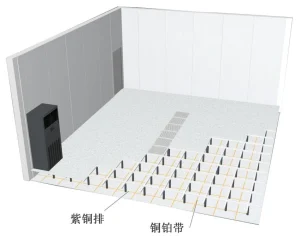
The copper busbar installed in the computer room serves as the common connection point for the grounding wires of all equipment.

Lightning Protection Grounding System for Computer Room
(1) Lightning Receiving Device: A metal rod (lightning arrester) that directly or indirectly receives lightning, such as lightning rods, lightning protection strips (nets), overhead ground wires, and surge arresters.
(2) Down Conductor: A conductor used to conduct lightning current from the lightning arrester to the grounding device.
(3) Grounding Wire: A non-current-carrying metal conductor used to connect the grounding terminal of electrical equipment or towers to the grounding electrode or neutral wire.
(4) Grounding Electrode: A metal conductor buried in the soil and in direct contact with the earth. It is divided into vertical grounding electrodes and horizontal grounding electrodes.
(5) Grounding Device: The general term for grounding wires and grounding electrodes.
(6) Grounding Grid: A mesh-like grounding device composed of vertical and horizontal grounding electrodes, with functions of current discharge and voltage equalization.
(7) Grounding resistance: The sum of the resistances of the grounding body or natural grounding body to the ground is called the grounding resistance of the grounding device. Its value is equal to the ratio of the grounding device voltage to the ground to the current flowing into the ground through the grounding body.
Method for Constructing the Grounding Grid for the Computer Room
At a distance of 1.5–3.0m from the building, excavate a trench 2.5m wide and 2.5–3m deep, centered on a 6m*3m rectangular frame. The trench should be continuous along the middle of both long sides. Using 2.5m long L5 (5*50*50) galvanized angle steel, drive one steel rod vertically into the trench at each intersection, for a total of 6–20 rods, as vertical grounding electrodes. Then, weld six angle steel rods together using No. 4 (4*40) galvanized flat steel to form a horizontal grounding electrode. Next, weld No. 4 galvanized flat steel to the middle of the grounding grid frame and extend it to the corner of the computer room’s outer wall, 0.3m above the ground, as the PE grounding terminal. Finally, extend a 16–50 mm² or larger sheathed grounding wire from this grounding terminal, passing through the wall and into the room, connecting to the equipotential grounding busbar inside the computer room.
Related Products
| Brand | KITOZER |
|---|---|
| Product Type | Grounding copper bar |
| Material | Copper |
| Application | Data centers |
Only logged in customers who have purchased this product may leave a review.

Reviews
There are no reviews yet.