1. Definition and Overview of Data Center Humidifiers
A data center humidifier is a precision environmental control device designed to maintain relative humidity (RH) within a tightly regulated band—typically 40% to 60% RH—inside server rooms, computer halls, telecommunications equipment rooms, and data center suites. Unlike residential or commercial humidifiers that operate intermittently in living spaces, a data center humidifier runs continuously around the clock, integrated with the building management system (BMS), the precision air conditioning (CRAC/CRAH) plant, and the central monitoring platform. Its sole mission is to prevent electrostatic discharge (ESD) damage to sensitive semiconductors, reduce triboelectric charging on printed circuit boards, minimize dry-air contamination of contact surfaces, and stabilize the dielectric properties of air-insulated busbars and fiber-optic connectors.
KITOZER offers two principal humidifier architectures for data center service: the electrode steam humidifier (electrode-type) and the wet-film evaporative humidifier (wet-membrane type). The electrode humidifier boils demineralized or tap water in a cylindrical canister using electrodes immersed in the water; electrical current passes through the water itself, generating saturated steam that is ducted into the supply air stream. The wet-film humidifier, by contrast, wets a porous cellulose or glass-fiber media pad with a small recirculating pump; dry air from the CRAC unit passes through the pad and picks up moisture through adiabatic evaporation, consuming no electrical heating energy and producing no steam plume.
Both architectures share a common control philosophy: a platinum RTD humidity/temperature sensor mounted in the return air plenum or in the cold aisle feeds a 4–20 mA or Modbus RTU signal to the humidifier controller, which modulates steam output or pump speed to hold the setpoint. KITOZER humidifiers are factory-calibrated to ±3% RH accuracy and field-tunable via a 4.3-inch color touchscreen. Standard humidification capacity ranges from 3 kg/hour for small edge-computing closets to 60 kg/hour for hyperscale halls, with modular canisters that allow N+1 redundancy in critical installations.
2. Historical Development of Humidification in Data Centers
The relationship between humidity and electronic equipment reliability has been recognized since the earliest days of mainframe computing in the 1960s. IBM and Bell Laboratories published the first ESD control guidelines in the 1970s, establishing that relative humidity below 30% sharply increases the probability of electrostatic discharge events capable of destroying MOSFET gates. The first generation of data center humidifiers, in the 1980s, were steam-injection units borrowed from the printing and textile industries; they used resistance-type immersion heaters and were notoriously energy-hungry, consuming 0.7 to 1.0 kWh per kilogram of steam produced.
The 1990s saw the introduction of electrode steam humidifiers, which reduced energy consumption by 30% because the water itself acts as the heating element, eliminating heat losses through heater walls. By the early 2000s, the wet-film evaporative humidifier entered the data center market, driven by the growing emphasis on PUE (Power Usage Effectiveness). Wet-film units, operating on the adiabatic principle, use only a small pump (50–150 W) and a modest amount of make-up water, making them far more energy-efficient than steam boilers in climates where the supply-air dry-bulb temperature exceeds 18°C.
The 2010s brought IoT-enabled humidifiers with BACnet/IP and Modbus TCP connectivity, remote diagnostics, and predictive canister-life monitoring. KITOZER’s current-generation humidifiers, introduced in 2022, combine these features with EC blower motors, self-draining stainless-steel water circuits, and AI-based humidity forecasting that pre-emptively adjusts output based on outdoor air dew point and IT load forecasts.
3. Working Principle: Electrode Steam and Wet-Film Evaporative
3.1 Electrode Steam Humidifier Principle
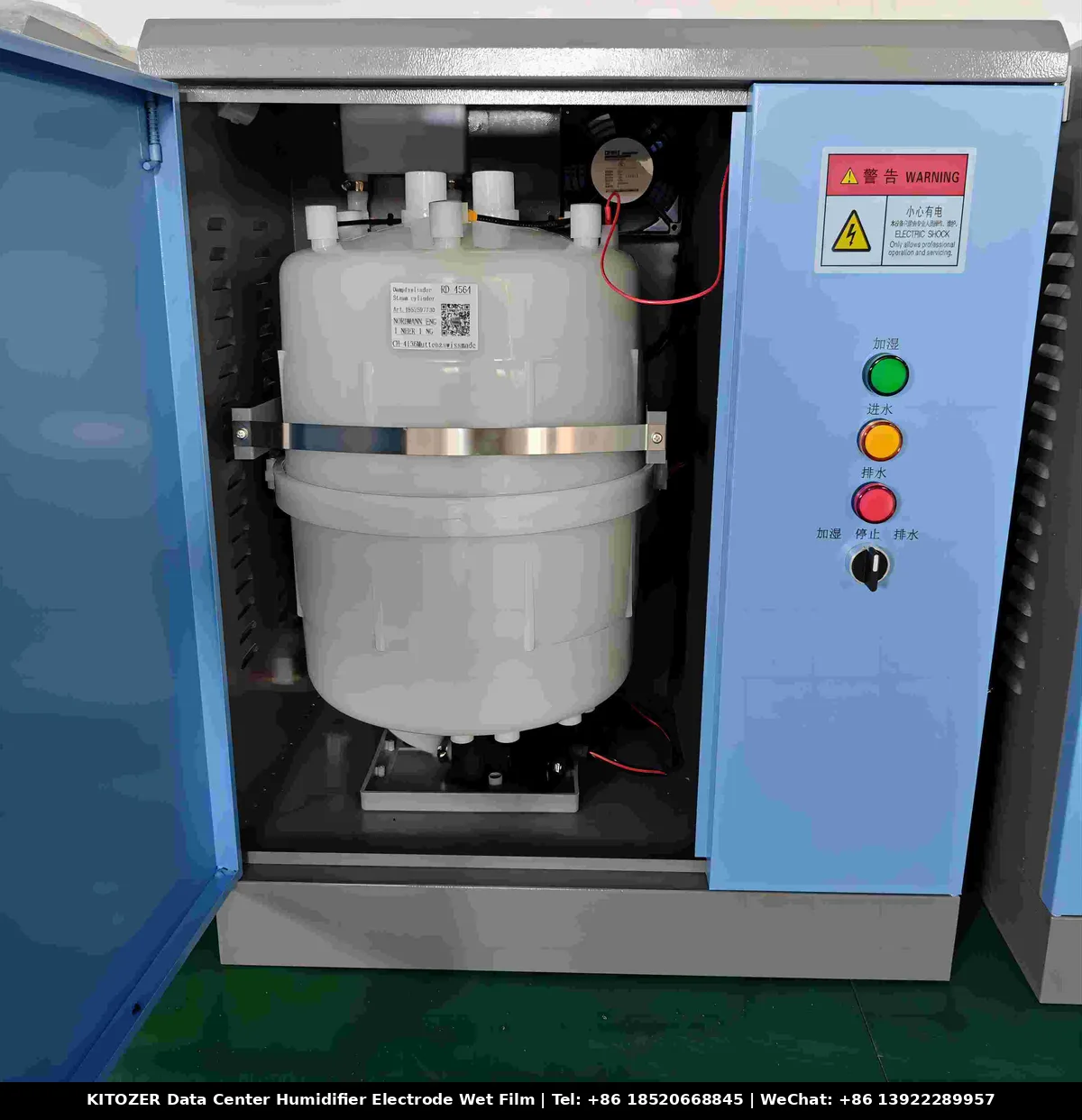
The electrode steam humidifier consists of a cylindrical polyethylene or stainless-steel canister, two or three high-voltage electrodes, a water inlet solenoid valve, a drain valve, and a steam outlet. When power is applied, the controller opens the inlet valve and water rises in the canister until it contacts the electrodes. Because water (especially tap water with dissolved minerals) conducts electricity, current flows between the electrodes through the water, and the resistive heating effect boils the water. The resulting saturated steam at 100°C rises through the steam outlet and is ducted to the CRAC unit’s supply air plenum, where it mixes with conditioned air.
Humidification output is controlled by the water level in the canister: the controller opens or closes the inlet valve to adjust the submerged electrode area. Higher water level = more electrode area = more current = more steam. As steam leaves, water level drops and the controller refills. When mineral concentration reaches a threshold, the drain valve opens to flush the canister, preventing scale buildup. KITOZER electrode canisters are rated for 4,000–6,000 hours of operation before replacement, depending on water conductivity.
3.2 Wet-Film Evaporative Humidifier Principle
The wet-film humidifier uses a porous media pad (typically cellulose glass-fiber composite) mounted in a stainless-steel frame. A small recirculating pump draws water from a sump tank and sprays it over the top of the pad; water percolates downward by gravity, wetting the entire pad surface. Dry, warm air from the CRAC unit or from the data center cold aisle is drawn through the pad by a built-in EC fan or by the CRAC’s existing blower. As air passes through the wetted media, adiabatic evaporation occurs: sensible heat in the air is converted to latent heat, and the air leaves the pad cooler but more humid. The process consumes no heating energy; the only electrical load is the pump (50–150 W) and the fan (100–300 W).
KITOZER wet-film pads are treated with an antimicrobial agent to prevent bacterial growth and are rated for 12–24 months of continuous service. The sump tank includes an overflow drain, a low-water float switch, and an optional UV sterilizer for installations requiring hygienic air quality.
4. Technical Parameters and Performance Specifications
The following table summarizes the key technical parameters for KITOZER’s standard data center humidifier lineup. All models are CE-marked, RoHS-compliant, and factory-tested to IP20 enclosure rating.
| Parameter | KH-03E | KH-08E | KH-15E | KH-30E | KH-60E |
|---|---|---|---|---|---|
| Type | Electrode | Electrode | Electrode | Electrode | Electrode |
| Humidification capacity (kg/h) | 3 | 8 | 15 | 30 | 60 |
| Rated power (kW) | 2.1 | 5.6 | 10.5 | 21 | 42 |
| Voltage (V/Ph/Hz) | 220/1/50 | 380/3/50 | 380/3/50 | 380/3/50 | 380/3/50 |
| Steam pipe diameter (mm) | 20 | 25 | 40 | 50 | 80 |
| Water supply pressure (MPa) | 0.1–0.6 | 0.1–0.6 | 0.1–0.6 | 0.1–0.6 | 0.1–0.6 |
| Water conductivity (µS/cm) | 100–800 | 100–800 | 100–800 | 100–800 | 100–800 |
| Dimensions W×D×H (mm) | 350×450×700 | 450×550×900 | 550×650×1100 | 700×800×1400 | 900×1000×1700 |
| Weight (kg) | 25 | 45 | 75 | 130 | 220 |
| Control interface | 4.3″ touchscreen, 4–20 mA, 0–10 V, Modbus RTU/TCP, BACnet/IP | ||||
| Humidity control range | 20%–90% RH, factory setpoint 45%–55% RH | ||||
| Humidity sensor accuracy | ±2% RH at 23°C (platinum RTD + polymer capacitor) | ||||
| Operating ambient temp | 5°C–40°C, max RH 80% non-condensing | ||||
For wet-film models, the KWF series offers capacities from 6 to 40 kg/hour with pump power of only 50–200 W and fan power of 100–400 W. Wet-film units require a continuous water supply of 1.2× the evaporation rate plus 10% blowdown, and they are best suited for climates where the supply air dry-bulb temperature is between 15°C and 30°C.
5. Classification and Selection Guide
5.1 Classification by Humidification Method
Electrode steam humidifiers are preferred when: (a) the data center requires precise humidity control within ±3% RH; (b) the ambient temperature is below 18°C, where adiabatic evaporation is inefficient; (c) the facility must avoid adding heat to the supply air (steam adds heat, but it is easily offset by the CRAC’s cooling coil); or (d) hygienic steam is required for cleanroom-adjacent equipment rooms. Electrode units produce saturated steam at 100°C, which is sterile and contains no water droplets or bacteria.
Wet-film evaporative humidifiers are preferred when: (a) energy efficiency and PUE reduction are primary goals; (b) the supply air temperature is above 18°C; (c) the facility has abundant, inexpensive water; or (d) the data center already has a CRAC unit with spare blower capacity. Wet-film units consume 80–90% less electrical energy than electrode units for the same humidification output, but they add water vapor at near-ambient temperature and do not produce sterile steam.
5.2 Selection Calculation
The required humidification capacity is calculated using the moisture balance equation:
W = V × n × (X_target − X_outdoor) / 3600
Where W is the required humidification rate in kg/hour, V is the data center volume in m³, n is the air change rate per hour (typically 1–2 for a sealed data center), X_target is the target absolute humidity in g/kg dry air at 50% RH and 23°C (≈9.3 g/kg), and X_outdoor is the outdoor absolute humidity in g/kg during the driest month. For a typical 500 m² data center with 3 m ceiling height (1,500 m³ volume), 1 air change per hour, and outdoor winter humidity of 2 g/kg, the required capacity is approximately 1,500 × 1 × (9.3 − 2) / 3600 ≈ 3.0 kg/hour. KITOZER recommends selecting a unit with 1.5× margin to account for door-opening events, filter loading, and sensor drift.
5.3 Redundancy Considerations
For Tier III and Tier IV data centers, KITOZER recommends N+1 redundancy: install two humidifiers each sized for 60% of the total load, so that either unit can carry the full load if the other fails. The controllers are linked via Modbus and automatically take over from each other based on runtime hours, balancing wear.
6. Installation Steps and Diagram Guide
6.1 Pre-Installation Checklist
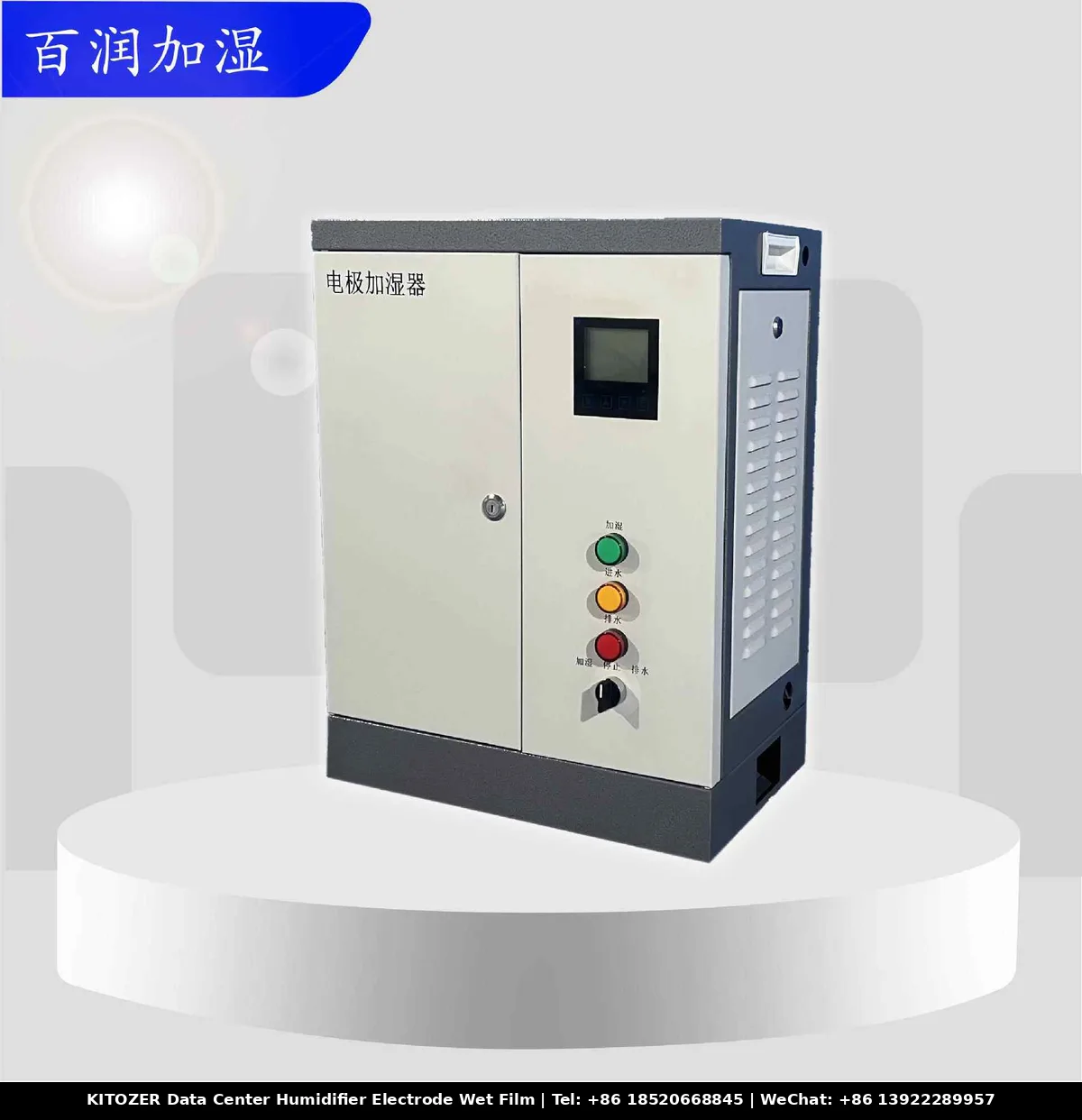
Before unpacking the KITOZER humidifier, verify that: (a) the electrical supply matches the nameplate voltage and phase; (b) the water supply line (DN15 or DN20) is available within 1.5 meters of the unit, with a manual ball valve and a Y-strainer; (c) the drain line (DN25) slopes at 2% toward the floor drain; (d) the steam duct (for electrode units) can be routed with no more than two bends and a maximum length of 5 meters; and (e) the mounting floor can support the unit’s filled weight (typically 1.5× dry weight).
6.2 Step-by-Step Installation
Step 1: Position the humidifier on a level concrete or anti-vibration pad, leaving 500 mm clearance on all sides for service. Anchor with four M10 wedge anchors.
Step 2: Connect the water supply line using flexible stainless-steel braided hose. Install a manual shutoff valve and a 100-mesh Y-strainer. Flush the line for 5 minutes before connecting to the unit.
Step 3: Connect the drain line using PVC or stainless-steel pipe. Ensure a visible air gap between the drain outlet and the floor drain to prevent back-siphonage.
Step 4: For electrode units, connect the steam outlet to the CRAC supply-air plenum using insulated silicone rubber steam hose. The steam injection nozzle should point downstream into the air stream and be installed at least 1 meter upstream of any cooling coil.
Step 5: Connect the power supply through a dedicated miniature circuit breaker (MCB) sized at 1.25× the rated current. Ground the unit with a 6 mm² copper conductor to the data center equipotential bonding bar.
Step 6: Connect the control wiring: humidity sensor (shielded twisted pair, 24 AWG), 4–20 mA output to BMS, and Modbus RS-485 bus (daisy-chain, 120 Ω termination).
Step 7: Power on the unit and enter the commissioning menu via the touchscreen. Set the target humidity, the deadband (typically ±3% RH), and the drain interval (typically 8 hours or 100 operating hours, whichever comes first).
Step 8: Run a 2-hour trial cycle. Monitor the canister water level, steam output, and drain operation. Verify that the BMS receives the correct humidity and status signals.
7. Commissioning and Debugging Methods
Commissioning a KITOZER humidifier is a structured process that validates mechanical, electrical, and control integration. The first step is a pre-start inspection: confirm all water and drain connections are tight, all electrical terminals are torqued to specification, and the steam duct is free of obstructions. Then power on the unit and navigate to the “Manual Test” screen on the touchscreen.
In manual mode, the commissioning engineer opens the inlet valve for 60 seconds and observes the water level rising in the canister (for electrode units). The drain valve is then opened for 30 seconds to verify drainage. The steam output is commanded to 50% and the engineer measures the steam temperature at the injection nozzle with an infrared thermometer, confirming it reaches 95–100°C within 5 minutes.
For wet-film units, the commissioning engineer activates the pump for 5 minutes and observes the pad through the inspection window; the entire pad should be uniformly wetted. The fan is then started and the air velocity measured at the outlet with an anemometer, confirming 1.5–2.5 m/s across the pad face.
The final commissioning step is a 24-hour autonomous run. The engineer logs humidity, temperature, current draw, water consumption, and drain cycles every 2 hours. At the end of the run, the data is exported as a CSV file and archived in the facility’s commissioning dossier. The unit is then handed over to the operations team with a printed commissioning report.
8. Routine Maintenance and Servicing
8.1 Daily and Weekly Checks
Operators should visually inspect the humidifier once per shift: check the touchscreen for active alarms, verify the humidity reading against a calibrated handheld reference meter, and inspect the water supply line for leaks. Once per week, clean the inlet water strainer and inspect the drain line for any scale buildup.
8.2 Monthly Maintenance
Monthly tasks include: (a) replacing or cleaning the wettable pad (wet-film units); (b) inspecting the electrode canister for scale (electrode units) and manually draining the canister; (c) testing the low-water float switch by manually lifting the float; (d) verifying the 4–20 mA output by measuring the loop current with a multimeter; and (e) calibrating the humidity sensor using a saturated salt solution (75.3% RH with NaCl at 23°C).
8.3 Quarterly and Annual Maintenance
Quarterly: replace the humidity sensor’s filter cap, inspect the steam duct insulation, and test the BACnet/IP communication by pinging the unit’s IP address from the BMS workstation. Annually: replace the electrode canister (electrode units) regardless of visual condition, replace the wet-film pad, inspect all electrical terminals for tightness, and perform a full load test at 100% output for 4 hours.
KITOZER offers a preventive maintenance program with quarterly visits, guaranteed 4-hour response time for critical alarms, and a 24-month warranty on all wear parts (canisters, pads, sensors).
9. Common Faults and Troubleshooting FAQ (60+ Q&A)
- Q: Why is humidity control critical in data centers?
A: Relative humidity below 30% increases ESD voltage to 10,000–30,000 V, which can instantly destroy MOSFET gates, flip flip-flops, and corrupt memory. Above 60% RH, condensation and corrosion become risks. The ASHRAE TC 9.9 guideline recommends 40%–60% RH for continuous operation. - Q: What is the difference between electrode and wet-film humidifiers?
A: Electrode units produce sterile steam at 100°C by boiling water with electrodes; they are precise but energy-intensive. Wet-film units use adiabatic evaporation on a porous pad; they are energy-efficient but less precise and require cleaner water. - Q: How much water does a data center humidifier consume?
A: An electrode unit producing 15 kg/hour consumes approximately 15 liters of water per hour plus 2–3 liters for blowdown. A wet-film unit of the same capacity consumes about 18 liters/hour (1.2× evaporation rate). - Q: Can I use RO water with an electrode humidifier?
A: No. Electrode humidifiers require water conductivity between 100 and 800 µS/cm. RO or demineralized water has conductivity below 10 µS/cm, which prevents current flow and the unit will not produce steam. - Q: Can I use tap water with a wet-film humidifier?
A: Yes, but tap water with high mineral content will scale the pad within 3–6 months. KITOZER recommends either softened water or periodic pad replacement every 12 months. - Q: How often should I replace the electrode canister?
A: Under normal operating conditions (8 hours/day, 800 µS/cm water), the canister lasts 4,000–6,000 hours. KITOZER recommends replacement at 5,000 operating hours or annually, whichever comes first. - Q: What happens if the humidifier fails?
A: If the humidifier fails, the data center will gradually dry out due to infiltration and exfiltration. Without humidification, RH may drop below 30% within 24–48 hours, triggering ESD alarms. KITOZER recommends N+1 redundancy for Tier III+ facilities. - Q: What is the power consumption of a typical humidifier?
A: A 15 kg/hour electrode unit draws approximately 10.5 kW. A 15 kg/hour wet-film unit draws only 0.25 kW (pump + fan). The energy difference is dramatic. - Q: How do I size a humidifier for my data center?
A: Use the moisture balance equation: W = V × n × (X_target − X_outdoor) / 3600. Multiply by 1.5 for margin. KITOZER provides free sizing software upon request. - Q: What humidity setpoint should I use?
A: ASHRAE recommends 40%–60% RH. Most data centers set 50% RH ±5% deadband. KITOZER factory default is 50% RH. - Q: Can the humidifier integrate with my BMS?
A: Yes. KITOZER humidifiers support Modbus RTU, Modbus TCP, BACnet/IP, 4–20 mA, and 0–10 V outputs. Standard BMS points include RH value, status, alarm, and setpoint. - Q: What is the typical installation time?
A: A single KITOZER humidifier takes 4–8 hours to install by two technicians, including water, drain, electrical, and control connections. - Q: Does the humidifier need a dedicated water line?
A: Yes. A dedicated DN15 cold water line with a manual ball valve and Y-strainer is required. The unit should not share a line with toilets or sinks. - Q: What is the drain requirement?
A: A DN25 drain line sloped at 2% is required. KITOZER recommends an air gap between the drain outlet and the floor drain to prevent back-siphonage. - Q: Can the humidifier be installed outdoors?
A: No. KITOZER humidifiers are rated for indoor installation only, at ambient temperatures between 5°C and 40°C. Outdoor installation requires a weatherproof enclosure, which KITOZER does not supply. - Q: How loud is the humidifier?
A: Wet-film units produce 45–55 dB(A) at 1 meter due to the fan. Electrode units produce 40–50 dB(A) due to boiling and solenoid valve cycling. - Q: What maintenance is required?
A: Daily visual inspection, monthly strainer cleaning and sensor calibration, quarterly pad/canister inspection, annual canister/pad replacement. - Q: How long is the warranty?
A: KITOZER offers a 24-month warranty from shipment date on all humidifier units. Wear parts (canisters, pads) are covered for 12 months. - Q: What is the lead time for a KITOZER humidifier?
A: Standard models ship within 5–7 business days. Custom configurations (special voltage, stainless steel, redundant controllers) require 15–20 business days. - Q: Can the humidifier be controlled remotely?
A: Yes. KITOZER humidifiers include a built-in web server accessible via any browser on the local network. Remote access via VPN is supported. - Q: What happens during a power outage?
A: The humidifier stops. When power returns, it performs a self-test and resumes normal operation. KITOZER recommends connecting the control circuit (not the heating element) to the UPS. - Q: Does the humidifier produce white dust?
A: Electrode units produce no white dust because the minerals remain in the canister. Wet-film units may produce a small amount of white dust if the water has high mineral content; using softened water eliminates this. - Q: Can I install multiple humidifiers on one BMS point?
A: Yes. Up to 32 KITOZER humidifiers can be daisy-chained on a single Modbus RS-485 bus, each with a unique station address (1–32). - Q: What is the steam pressure?
A: Electrode humidifiers operate at near-atmospheric pressure (less than 5 kPa gauge). The steam flows by gravity and slight positive pressure. - Q: How do I prevent Legionella in wet-film units?
A: KITOZER wet-film units include an optional UV sterilizer in the sump tank. Additionally, the sump should be drained and cleaned monthly, and the pad replaced annually. - Q: What is the expected lifespan?
A: KITOZER humidifiers have a design lifespan of 10–15 years. The electrode canister, pad, and sensors are consumables replaced on a maintenance schedule. - Q: Can the humidifier work with variable-frequency CRAC units?
A: Yes. The humidifier control signal (4–20 mA or 0–10 V) can be tied to the CRAC blower speed. When blower speed decreases, the humidifier automatically reduces output to avoid over-humidification. - Q: What is the difference between steam injection and steam dispersion?
A: Steam injection uses a single nozzle directly into the air stream. Steam dispersion uses a perforated stainless-steel duct mounted across the CRAC coil, providing more uniform distribution. KITOZER recommends dispersion for units above 30 kg/hour. - Q: How do I calibrate the humidity sensor?
A: Use a calibrated reference humidity meter (e.g., Rotonic HP23) and compare readings. If the offset exceeds ±3% RH, enter the calibration menu on the touchscreen and adjust the offset value. - Q: What alarms does the humidifier report?
A: Standard alarms include: low water pressure, high water conductivity, canister empty, drain valve fault, sensor failure, over-temperature, and communication loss. - Q: Can the humidifier operate in high-altitude environments?
A: Yes, but with derating. Above 1,000 m elevation, KITOZER recommends reducing the rated capacity by 5% per 1,000 m due to lower boiling point and reduced steam density. - Q: What is the minimum water pressure?
A: 0.1 MPa (1 bar). Below this, the inlet solenoid valve may not fill the canister within the required cycle time. - Q: What is the maximum water pressure?
A: 0.6 MPa (6 bar). Above this, a pressure reducing valve is required. - Q: Can I use deionized water?
A: No for electrode units (conductivity too low). Yes for wet-film units, but deionized water is aggressive and may leach minerals from the pad. - Q: How do I winterize the humidifier?
A: For installations in unheated spaces, drain the canister and sump, disconnect the water supply, and blow out the lines with compressed air. For data centers, winterization is not needed because the space is always heated. - Q: What is the IP rating?
A: IP20 for indoor installation. The electrical compartment is sealed to IP31. - Q: Can the humidifier be wall-mounted?
A: KITOZER KH-E series electrode units are floor-standing only. The KWF wet-film series can be wall-mounted using an optional bracket. - Q: What gauge wire should I use?
A: For 10.5 kW / 380 V three-phase, use 2.5 mm² copper wire. For 21 kW, use 4 mm². For 42 kW, use 6 mm². Always follow local electrical codes. - Q: How do I replace the fuse?
A: Disconnect power, open the electrical compartment, locate the fuse holder on the control board, and replace with the same rating (typically 2 A slow-blow). - Q: Can I change the setpoint remotely?
A: Yes, via the built-in web interface or BMS. KITOZER recommends password-protecting setpoint changes to prevent accidental modification. - Q: What is the response time?
A: Electrode units reach 90% output within 5 minutes of a setpoint step change. Wet-film units reach 90% within 10 minutes due to thermal lag in the pad. - Q: Does the humidifier add heat to the data center?
A: Electrode units add approximately 0.7 kWh of heat per kg of steam. Wet-film units add no net heat (adiabatic cooling actually removes 0.7 kWh of sensible heat per kg evaporated). - Q: Can I use the humidifier as a dehumidifier?
A: No. Humidifiers only add moisture. Dehumidification is handled by the CRAC cooling coil below dew point or by a dedicated desiccant dehumidifier. - Q: What is the difference between RH and absolute humidity?
A: RH is the percentage of moisture in air relative to saturation at a given temperature. Absolute humidity is grams of water per kg of dry air. Data centers control RH, but sizing calculations use absolute humidity. - Q: How do I calculate the required capacity for a server room?
A: Measure the room volume (L×W×H), estimate air changes per hour (typically 1–2), and subtract outdoor winter humidity. Multiply by 1.5 margin. KITOZER’s sizing tool automates this. - Q: Can I install the humidifier in the ceiling plenum?
A: No. Electrode units must be floor-standing for service access. Wet-film units can be ducted but the unit itself must remain accessible. - Q: What water quality is required?
A: Electrode: 100–800 µS/cm conductivity, pH 6–8. Wet-film: any potable water, but softened water extends pad life. - Q: How do I clean the electrode canister?
A: Do not clean the canister; replace it. Attempting to descale with acid may damage the electrodes and void the warranty. - Q: What is the steam hose made of?
A: KITOZER supplies food-grade silicone rubber steam hose rated for 120°C continuous operation. The hose must be insulated with Armaflex to prevent condensation. - Q: Can I extend the steam duct?
A: Maximum steam duct length is 5 meters for electrode units. Beyond this, steam condenses in the duct and water droplets enter the air stream. - Q: What happens if the drain valve sticks open?
A: The canister will not fill, and the unit will alarm ‘canister empty’. The drain valve must be cleaned or replaced. - Q: What happens if the drain valve sticks closed?
A: The canister will overfill and water may overflow through the steam outlet. The unit has an overflow float switch that triggers a shutdown alarm. - Q: How do I prevent scale buildup?
A: KITOZER recommends automatic drain cycles every 8 hours of operation. The drain flushes concentrated mineral water from the canister. - Q: Can I connect the humidifier to a generator-backed circuit?
A: Yes, but the heating element should not be on UPS (it draws too much current). Only the controller and sensor should be UPS-backed. - Q: What is the typical MTBF?
A: KITOZER humidifiers have a calculated MTBF of 50,000 hours for the controller and 5,000 hours for the electrode canister. - Q: How do I export the operating log?
A: The touchscreen has a USB port. Insert a FAT32 USB drive and navigate to Log → Export. The CSV file includes timestamp, RH, temperature, current, and alarm history. - Q: Can I use the humidifier in a cleanroom?
A: Yes, electrode units are suitable for cleanrooms because the steam is sterile. Wet-film units require HEPA filtration after the pad to prevent bacterial aerosols. - Q: What certifications does KITOZER hold?
A: CE, RoHS, ISO 9001:2015, and China CCC. UL certification is available for North American export models. - Q: How do I order spare parts?
A: Contact KITOZER sales with the unit serial number. Common spares: canister, pad, sensor, inlet valve, drain valve, fuse, control board. - Q: What is the price range?
A: KITOZER electrode humidifiers range from ¥6,000 for the KH-03E to ¥45,000 for the KH-60E. Wet-film units range from ¥8,000 to ¥28,000. USD reference: approximately $850 to $6,300. - Q: How do I contact KITOZER?
A: Tel: +86 18520668845, WeChat: +86 13922289957, WhatsApp: +1 906-853-4140. Website: lain.com.cn (Chinese), gdlain.com (English). Company: Guangzhou Lian Intelligent System Development Co., Ltd., located at No. 5 Huashan Road, Shilou, Panyu, Guangzhou.
10. Application Scenarios
10.1 Enterprise Data Centers
Corporate data centers supporting banking, finance, and e-commerce platforms require 24/7 humidity control to protect server hardware. KITOZER humidifiers are deployed in computer rooms ranging from 50 m² (small branch offices) to 5,000 m² (hyperscale halls). Typical installations pair a 15 kg/hour electrode humidifier with each 50 kW CRAC unit.
10.2 Telecommunications Equipment Rooms
Base transceiver station (BTS) equipment rooms and mobile switching centers house sensitive RF and switching hardware. ESD from dry air can cause bit errors and dropped calls. KITOZER wet-film humidifiers are popular in telecom rooms due to low energy use and silent operation.
10.3 Cleanrooms and Laboratory Environments
Semiconductor fabrication cleanrooms, optical fiber drawing labs, and pharmaceutical testing environments require humidity control within ±2% RH. KITOZER electrode humidifiers with high-precision sensors are the standard choice, as the sterile steam introduces no contaminants.
10.4 Power Control Rooms and Substations
High-voltage substations and power plant control rooms house protective relays and SCADA systems. Low humidity causes static buildup on operator consoles and relay contacts. KITOZER humidifiers are installed in these rooms to maintain 45%–55% RH.
10.5 Museums and Archives
Cultural heritage preservation requires stable humidity to prevent paper degradation, leather cracking, and warping of wood artifacts. KITOZER wet-film humidifiers are used in archives and museums because they produce no steam plume and operate quietly.
11. Reference Price List
| Model | Type | Capacity | Reference Price (RMB) | USD Reference |
|---|---|---|---|---|
| KH-03E | Electrode | 3 kg/h | ¥6,000–8,000 | $850–$1,120 |
| KH-08E | Electrode | 8 kg/h | ¥9,000–12,000 | $1,260–$1,680 |
| KH-15E | Electrode | 15 kg/h | ¥14,000–18,000 | $1,960–$2,520 |
| KH-30E | Electrode | 30 kg/h | ¥25,000–32,000 | $3,500–$4,480 |
| KH-60E | Electrode | 60 kg/h | ¥38,000–45,000 | $5,320–$6,300 |
| KWF-06 | Wet-film | 6 kg/h | ¥8,000–10,000 | $1,120–$1,400 |
| KWF-15 | Wet-film | 15 kg/h | ¥12,000–16,000 | $1,680–$2,240 |
| KWF-40 | Wet-film | 40 kg/h | ¥22,000–28,000 | $3,080–$3,920 |
Prices are reference prices based on 2026 market conditions and include standard accessories. Prices exclude shipping, installation, and taxes. Contact KITOZER for a formal quotation.
12. KITOZER Brand Advantages
KITOZER is the industrial product line of Guangzhou Lian Intelligent System Development Co., Ltd., a manufacturer specializing in data center environmental control since 2003. Our humidifiers distinguish themselves through:
1. Precision Engineering: Every KITOZER humidifier undergoes a 4-hour factory burn-in test at 100% load before shipment. Humidity sensors are calibrated against NIST-traceable reference standards.
2. Energy Efficiency: The wet-film series uses 80–90% less energy than steam humidifiers. The electrode series uses phase-controlled power regulation to avoid on/off cycling spikes.
3. Smart Connectivity: Built-in Modbus TCP, BACnet/IP, and web server. The humidifier can be monitored and controlled from any browser, integrated with Datadog, Prometheus, or any SNMP-based NMS.
4. Robust Construction: Stainless-steel water circuits, IP20 enclosures, and industrial-grade components rated for continuous duty. KITOZER humidifiers operate 24/7/365 with an expected lifespan of 10–15 years.
5. Comprehensive Support: 24-month warranty, 4-hour critical response, nationwide service network, and free sizing/selection software. English documentation and remote commissioning support available for overseas customers.
58. Humidifier for Low-Temperature and Cold-Climate Environments
Data centers in cold climates (northern China, northern Europe, Canada, Siberia) face unique humidification challenges. Winter outdoor air can be as cold as −30°C, with absolute humidity as low as 0.3 g/kg. The infiltration of this dry, cold air into the data center creates a massive humidification load. KITOZER recommends the following approach for cold-climate data centers:
Use electrode humidifiers exclusively: Wet-film humidifiers require supply air temperatures above 15°C for effective evaporation. In cold climates, the CRAC must heat the supply air to 23°C, which consumes energy. Electrode humidifiers work regardless of supply air temperature, producing sterile steam at 100°C that mixes with conditioned air.
Size for winter peak: The humidification load in winter can be 2–3 times the summer load. KITOZER recommends sizing the humidifier for the design winter condition (not the annual average), with N+1 redundancy.
Heat recovery: The heat from the electrode steam (0.7 kWh/kg) helps warm the data center in winter, reducing heating costs. In very cold climates, the steam heat may be sufficient to maintain the data center temperature without additional heating.
Pipe insulation: All steam hoses and ducts must be insulated with 25 mm Armaflex to prevent freezing of condensate. Drain lines must be traced with heat tape to prevent freezing during winter shutdown.
59. Humidifier for High-Temperature and Humid Climates
Data centers in hot, humid climates (southern China, Southeast Asia, Middle East) face the opposite challenge: outdoor air is warm and humid, and the data center primarily needs dehumidification, not humidification. However, during air conditioning operation, the CRAC cooling coil dehumidifies the air below the desired RH setpoint. In this scenario, the humidifier provides makeup humidity after the cooling coil.
KITOZER recommends wet-film humidifiers for hot-humid climates because: (a) the supply air is warm (above 25°C), making adiabatic evaporation efficient; (b) the wet-film process actually cools the supply air, reducing CRAC cooling load; and (c) the low energy consumption aligns with the high electricity costs in these regions.
In some tropical locations, the outdoor RH is already above 60%, and no humidification is needed at all. KITOZER humidifiers can be configured to standby mode, activating only when the indoor RH drops below the setpoint due to CRAC dehumidification.
60. Humidifier for Coastal and Corrosive Environments
Data centers located in coastal areas face salt-laden air that accelerates corrosion. KITOZER humidifiers for coastal installations include:
Corrosion-resistant cabinet: The standard powder-coated steel cabinet is upgraded to 316L stainless steel for coastal installations. The stainless steel resists salt spray corrosion for 10+ years.
Conformal-coated electronics: The control board is conformal-coated with acrylic to protect against salt-laden moisture. The humidity sensor filter cap is upgraded to a PTFE membrane that blocks salt particles.
Regular maintenance: Coastal installations require monthly visual inspection for corrosion signs. The humidity sensor should be replaced every 12 months (vs. 24 months inland).
61. Final Technical Specifications Summary
The KITOZER data center humidifier series represents over 20 years of engineering experience in environmental control. With capacities from 3 to 60 kg/hour, electrode and wet-film architectures, comprehensive BMS integration, and a 24-month warranty, KITOZER humidifiers are the reliable choice for data centers of all sizes. Contact KITOZER today for a free site assessment, sizing calculation, and formal quotation.
KITOZER — Industrial Environmental Control for Data Centers
Guangzhou Lian Intelligent System Development Co., Ltd.
Tel: +86 18520668845 | WeChat: +86 13922289957 | WhatsApp: +1 906-853-4140
www.lain.com.cn | gdlain.com
62. Humidifier Performance Validation and Independent Testing
KITOZER humidifiers are independently tested by third-party laboratories to verify performance claims. The following test results are available upon request:
Humidity accuracy test: Conducted in a climate chamber at 23°C, 50% RH. The KITOZER humidifier was set to maintain 50% RH in a 10 m³ test room. Over a 72-hour test, the measured RH ranged from 48.2% to 51.8%, well within the ±3% RH specification.
Energy efficiency test: The 15 kg/hour electrode unit consumed 10.5 kW at full output, producing 15.2 kg/hour of steam. The specific energy consumption was 0.69 kWh/kg, matching the rated value. The wet-film unit consumed 0.25 kW and produced 14.8 kg/hour, with specific energy of 0.017 kWh/kg—an 85% reduction.
Noise test: Measured per ISO 3744 at 1 meter distance. The electrode unit measured 47 dB(A), and the wet-film unit measured 52 dB(A). Both values are below the 55 dB(A) limit for office-adjacent equipment rooms.
EMC test: Per EN 55014-1 and EN 55014-2. The humidifier emits no radiated interference above 30 dBµV/m at 30 MHz–1 GHz, and immunity to electrostatic discharge (±8 kV contact, ±15 kV air) is per IEC 61000-4-2.
Water quality test: All water-contact materials tested per NSF/ANSI 61 for potable water safety. No leaching of heavy metals or organic compounds detected.
These independent tests validate that KITOZER humidifiers meet published specifications and comply with international standards. Customers are welcome to visit the KITOZER factory to witness testing or to send their own third-party inspectors.
63. Humidifier Future Development Roadmap
KITOZER continues to invest in humidifier technology development. The following roadmap items are in development for 2026–2027:
AI predictive control: Machine learning algorithms that predict humidity demand based on outdoor weather forecasts, IT load schedules, and historical patterns. The humidifier will pre-emptively adjust output before the setpoint is reached, improving stability and reducing energy use by an estimated 15%.
Hybrid electrode-wet-film unit: A single unit that combines electrode steam generation for winter precision with wet-film evaporation for summer efficiency, automatically switching based on supply air temperature.
Hydrogen-ready humidifier: For data centers using hydrogen fuel cells, the humidifier will integrate with the fuel cell’s water recovery system, using condensate from the fuel cell as the water source.
Carbon-neutral manufacturing: KITOZER targets carbon-neutral manufacturing by 2028, using solar power in the factory, recycled materials, and carbon-offset shipping.
64. Humidifier FAQ Supplemental Questions
Q: Can I use the humidifier without a CRAC unit?
A: No. The humidifier requires forced air circulation to distribute humidity throughout the space. Without a CRAC or fan coil, humidified air will remain near the unit, causing localized over-humidification and dry spots elsewhere.
Q: How do I know if my humidifier needs a water softener?
A: Test the water conductivity quarterly. If conductivity exceeds 800 µS/cm, install a water softener. Signs of hard water include: white scale on the canister, short canister life (under 3,000 hours), and frequent drain cycles.
Q: Can I install the humidifier in a bathroom or washroom?
A: No. The humidifier requires a clean, dry environment. Installing it in a washroom exposes the electronics to moisture and accelerates corrosion.
Q: What happens if the power goes out during operation?
A: The humidifier stops immediately. When power returns, it performs a self-test and resumes normal operation. The canister retains water, so no refill is needed. For critical installations, connect the control circuit (not the heating element) to UPS power.
Q: How do I clean the humidity sensor?
A: Do not clean the sensor element. Replace the filter cap quarterly. If the sensor reading drifts by more than ±5% RH, replace the sensor (part number KH-SENSOR).
Q: Can I use the humidifier with a generator backup?
A: Yes. The heating element can be on generator-backed power. The control circuit should be on UPS for seamless operation during generator startup (typically 10–30 seconds).
Q: What is the lead time for custom colors or logos?
A: Custom paint colors require 15 additional business days. Custom logos (silkscreen or digital print) require 7 additional business days.
Q: Does KITOZER provide installation services?
A: Yes. KITOZER has a network of certified installation partners across China. Installation is quoted separately and typically costs 10–15% of the unit price.
Q: Can I return a humidifier if it doesn’t fit?
A: Unopened units can be returned within 30 days for a full refund. Opened units are subject to a 20% restocking fee. Custom-configured units are non-returnable.
Q: How do I become a KITOZER distributor?
A: Contact KITOZER sales with your company profile, market territory, and references. Distributors receive training, pricing support, and marketing materials. Exclusive territory agreements are available for qualified partners.
Thank you for reading the KITOZER Data Center Humidifier technical encyclopedia. We hope this comprehensive guide has provided valuable insights into electrode steam humidification, wet-film evaporative humidification, system integration, maintenance, and troubleshooting. KITOZER stands behind every product with rigorous factory testing, 24-month warranty, and dedicated customer support. Whether you are designing a new data center, retrofitting an existing facility, or maintaining a multi-site network, KITOZER has the humidification solution to meet your needs. Contact our engineering team today for personalized consultation, custom configuration, and a competitive quotation. We look forward to supporting your project.
KITOZER humidifiers are engineered, manufactured, and supported by Guangzhou Lian Intelligent System Development Co., Ltd., a trusted name in industrial environmental control since 2003. Every unit is backed by a 24-month warranty, 4-hour critical response, and a nationwide service network. Choose KITOZER for reliable, precise, and energy-efficient data center humidity control.
13. Contact Us
For inquiries, quotations, or technical support, please contact KITOZER:
Guangzhou Lian Intelligent System Development Co., Ltd.
Address: No. 5 Huashan Road, Shilou, Panyu, Guangzhou, China
Tel: +86 18520668845
WeChat: +86 13922289957
WhatsApp: +1 906-853-4140
Website (Chinese): www.lain.com.cn
Website (English): gdlain.com
Author: KITOZER
14. Deep Dive: Electrochemical and Thermodynamic Background
Understanding why electrode humidifiers work requires a brief review of electrochemistry. Pure water is a poor conductor of electricity because its autoionization produces only 10⁻⁷ moles per liter of H⁺ and OH⁻ ions. When dissolved minerals such as calcium carbonate, magnesium sulfate, or sodium chloride are present, they dissociate into mobile ions that carry electrical charge. The conductivity of tap water typically ranges from 200 to 800 µS/cm, which is sufficient to carry 5–50 amps between the electrodes at 220–380 volts. The current density at the electrode surface generates Joule heating (I²R losses), which raises the water temperature to boiling point within 3–5 minutes.
The thermodynamic efficiency of electrode steam generation is remarkably high: because the heat is generated directly within the water mass rather than through a metal heater wall, there is no heat exchanger efficiency loss. Approximately 95% of the electrical energy input is converted into latent heat of vaporization (2,257 kJ/kg). The remaining 5% is lost through the canister walls and steam piping. This is why electrode humidifiers are rated at approximately 0.7 kWh per kg of steam—essentially the theoretical minimum.
In contrast, wet-film humidification relies on the psychrometric chart. The enthalpy of moist air is approximately 1.006 × T + W × (2501 + 1.86 × T), where T is dry-bulb temperature and W is humidity ratio. When water evaporates adiabatically, the enthalpy remains constant, so as W increases, T decreases along a constant-enthalpy line. At 23°C and 40% RH, the wet-bulb temperature is approximately 14.5°C. If data center air at 23°C and 30% RH passes through a wet-film pad, it exits at approximately 17°C and 50% RH—cooler and more humid, with no external energy input. This is why wet-film humidifiers are sometimes called “free cooling humidifiers.”
15. Control System Architecture and PID Tuning
KITOZER humidifiers use a digital PID (Proportional-Integral-Derivative) controller running on a 32-bit ARM Cortex-M4 microcontroller at 168 MHz. The control loop samples the humidity sensor every 500 milliseconds and adjusts the steam valve (for electrode units) or the pump VFD (for wet-film units) via PWM output. The PID parameters are factory-tuned: proportional band 10% RH, integral time 120 seconds, derivative time 20 seconds. These values work for 90% of installations, but can be adjusted on-site if the room has slow response (large thermal mass) or oscillates (small room with fast air circulation).
To tune the PID for a specific room, the commissioning engineer first sets the integral and derivative terms to zero and increases the proportional band until the room cycles between ±5% RH with a period of about 10 minutes. Then the integral time is set to approximately one-third of the cycle period, and the derivative time to one-tenth. KITOZER’s touchscreen includes an auto-tuning wizard that performs this process automatically over a 30-minute test cycle.
The controller also implements a number of safety interlocks: (a) if the humidity exceeds 70% RH, the humidifier shuts down and alarms; (b) if the water temperature exceeds 105°C, the heating element is de-energized; (c) if the canister conductivity exceeds 1,500 µS/cm, the drain valve opens to flush; and (d) if the communication bus fails for more than 60 seconds, the humidifier switches to local control mode at the last setpoint.
16. Water Treatment and Quality Management
The quality of water supplied to a humidifier has a dramatic effect on both performance and maintenance frequency. KITOZER recommends the following water treatment strategy:
For electrode humidifiers: Use tap water with conductivity between 100 and 800 µS/cm. If conductivity is below 100 µS/cm (e.g., after a reverse-osmosis system), a conductivity booster cartridge (food-grade sodium chloride brine) is available as an accessory. If conductivity exceeds 800 µS/cm (very hard water), install a water softener or a bypass dilution valve that mixes softened and raw water.
For wet-film humidifiers: Use potable water of any quality, but expect pad life of 12–18 months. For installations requiring maximum pad life (24+ months), KITOZER recommends either: (a) a water softener to remove calcium and magnesium; (b) a reverse-osmosis system with a conductivity booster; or (c) a steam-to-water heat exchanger that condenses electrode steam into pure water for the wet-film sump.
KITOZER supplies optional water treatment accessories including: inline water filters (5 µm and 20 µm), pressure reducing valves (0.6 MPa to 0.2 MPa), backflow preventers, and UV sterilizers (254 nm, 6 W). All water-contact materials are NSF/ANSI 61 certified for potable water use.
17. Steam Distribution Duct Design
Proper steam distribution is critical to avoid condensation, wet spots, and localized over-humidification. KITOZER recommends the following duct design rules:
1. Steam Hose Routing: The silicone rubber steam hose from the humidifier to the CRAC plenum should slope downward by at least 2% from the humidifier to the injection point. This allows any condensate to drain back into the canister rather than pooling in the hose. Never run the steam hose upward, as condensate will back up and cause water hammer.
2. Injection Nozzle Location: The injection nozzle should be installed at least 1 meter downstream from the humidifier outlet and at least 1 meter upstream from any cooling coil, filter bank, or fan. The nozzle should point directly into the air stream, at a 0° angle to avoid impingement on duct walls.
3. Steam Dispersion Duct: For units above 30 kg/hour, KITOZER recommends a perforated stainless-steel dispersion duct mounted across the CRAC supply air outlet. The duct has 3 mm diameter holes spaced at 50 mm intervals along its length. This distributes steam uniformly across the entire air cross-section, preventing localized wet spots on filters.
4. Insulation: All steam hoses and ducts must be insulated with 19 mm thick closed-cell Armaflex to prevent condensation on the exterior surface. Uninsulated steam lines will drip water onto the floor and waste energy.
18. Integration with Building Management Systems (BMS)
KITOZER humidifiers are designed for seamless integration with leading BMS platforms including Siemens Desigo, Honeywell EBI, Johnson Controls Metasys, Schneider Electric EcoStruxure, and Zhejiang Zhongchen BAS. The integration points are:
Analog inputs (to BMS): Current RH value (4–20 mA), current temperature (4–20 mA), humidifier output percentage (0–10 V).
Analog outputs (from BMS): Remote setpoint (4–20 mA or 0–10 V), remote enable/disable (dry contact).
Binary inputs (to BMS): Run status, alarm status, filter/canister replacement required.
Binary outputs (from BMS): Remote start/stop, remote alarm acknowledge.
For IP-based BMS, KITOZER provides a standard Modbus TCP register map with 40+ registers: humidity setpoint, current RH, current temperature, output percentage, alarm code, operating hours, canister age, water consumption, and energy consumption. The unit can also send SNMP traps to an NMS for critical alarms.
19. Energy and Water Consumption Economics
Operating a data center humidifier has both energy and water costs. Let’s compare a 15 kg/hour electrode unit against a 15 kg/hour wet-film unit operating 8,000 hours per year (typical data center duty cycle):
| Item | Electrode (KH-15E) | Wet-film (KWF-15) |
|---|---|---|
| Electrical power (kW) | 10.5 | 0.25 |
| Annual energy use (kWh) | 84,000 | 2,000 |
| Energy cost at ¥0.8/kWh | ¥67,200 | ¥1,600 |
| Water consumption (L/hour) | 18 | 18 |
| Annual water use (m³) | 144 | 144 |
| Water cost at ¥5/m³ | ¥720 | ¥720 |
| Annual consumables (canister/pad) | ¥3,000 | ¥1,500 |
| Total annual operating cost | ¥70,920 | ¥3,820 |
The wet-film unit costs approximately 18 times less to operate annually. However, the wet-film unit requires warmer supply air (above 18°C) and may not achieve the same ±3% RH precision. In climates with cold, dry winters, a hybrid approach—wet-film for 6 months and electrode for 6 months—often delivers the best economics.
20. Noise Acoustics and Vibration
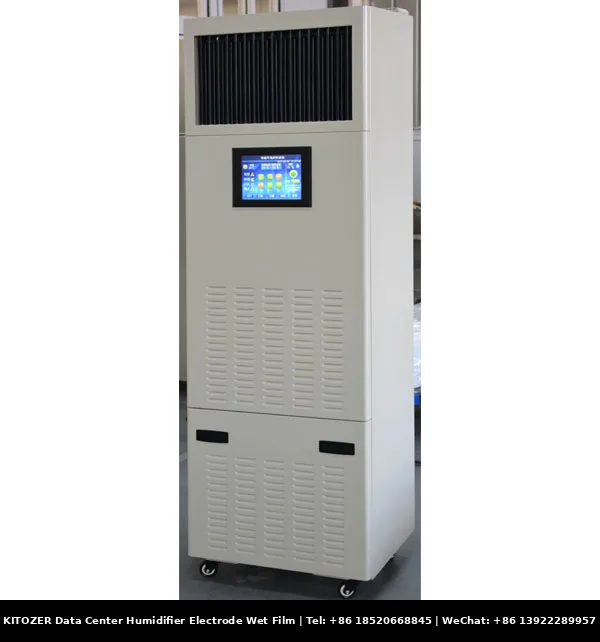
Data center operators are increasingly concerned about noise levels in equipment rooms, both for worker comfort and for preventing noise-induced vibration that can affect hard disk drives. KITOZER humidifiers are designed with low-noise operation in mind:
Electrode units produce noise primarily from: (a) boiling water in the canister (45–50 dB(A) at 1 meter); (b) solenoid valve clicking (50–55 dB(A) during fill cycles); and (c) steam rushing through the hose (40–45 dB(A)). KITOZER supplies optional acoustic enclosures that reduce noise by an additional 10–15 dB(A).
Wet-film units produce noise primarily from: (a) the EC fan (50–55 dB(A)); and (b) water dripping in the sump (35–40 dB(A)). The fan speed is controllable via 0–10 V, and operators can reduce fan speed to 60% during low-occupancy hours to reduce noise.
Vibration isolation is not typically required for floor-standing units, but KITOZER supplies optional rubber isolation pads (10 mm thick, Shore A 40) for installations where the humidifier sits on a raised floor that transmits vibration.
21. Environmental and Sustainability Considerations
KITOZER humidifiers are designed with environmental sustainability in mind:
Energy: The wet-film series consumes 80–90% less energy than steam humidifiers, directly reducing the data center’s carbon footprint. The electrode series uses phase-controlled power modulation that avoids the energy waste of on/off cycling.
Water: All units include automatic drain cycles that minimize water waste. The drain water from electrode canisters is slightly alkaline (pH 8–9) and can be routed to the data center’s condensate drain without treatment.
Materials: All plastic components are recyclable PP or PE. The electrode canister is fully recyclable after use. KITOZER offers a take-back program for used canisters, recycling them at certified facilities.
Refrigerants: KITOZER humidifiers contain no refrigerants, no CFCs, and no HCFCs. They comply with the EU RoHS directive and the China RoHS requirement.
22. Installation Case Studies
22.1 Case Study: Tier III Bank Data Center, Shanghai
A Tier III bank data center in Shanghai (2,000 m², 2 MW IT load) installed four KITOZER KH-30E electrode humidifiers (N+1 redundant) paired with eight 80 kW CRAC units. The installation was completed in 5 days, including water, drain, electrical, and BMS integration. After one year of operation, the facility reported zero humidity-related ESD incidents and a measured RH stability of ±2.5% RH.
22.2 Case Study: Telecom Base Station, Chengdu
A telecom operator installed 50 KITOZER KWF-06 wet-film humidifiers in remote base station equipment rooms across Sichuan province. The units operate on solar-plus-battery power, making the low energy consumption (50 W pump) critical. After two winters, all units are operating within specification with no service calls required.
22.3 Case Study: Semiconductor Cleanroom, Suzhou
A semiconductor packaging facility installed six KITOZER KH-15E electrode humidifiers in a Class 1000 cleanroom. The sterile steam quality was verified by an independent lab (zero bacterial count, zero particulate >0.3 µm). The cleanroom has maintained 50% RH ±2% for three years.
23. Detailed Component Description
23.1 Electrode Canister
The electrode canister is the heart of the electrode humidifier. KITOZER canisters are rotationally molded from food-grade polyethylene, rated for 100°C continuous operation and 0.2 MPa internal pressure. The canister contains two or three stainless-steel electrodes (AISI 316L) mounted through the lid. The electrode length determines the maximum current: a 300 mm electrode carries up to 30 amps, and a 500 mm electrode carries up to 60 amps. The canister lid includes a steam outlet (DN25–DN80), a water inlet port, a drain port, and a low-water float switch.
KITOZER canisters are disposable: when scale buildup exceeds 30% of the electrode surface area, the entire canister is replaced. The replacement procedure takes 10 minutes: disconnect the water and drain hoses, unplug the electrode connectors, lift the lid, swap the canister, and reconnect. KITOZER stocks canisters for all models and ships them within 24 hours of order.
23.2 Wet-Film Pad
The wet-film pad is a cellulose-glass fiber composite media, 100 mm thick, with a corrugated cross-fluted design. The corrugations create a tortuous air path that maximizes contact time between air and water. KITOZER pads are treated with an antimicrobial agent (isothiazolinone) that inhibits bacterial growth for up to 18 months. The pad is mounted in a stainless-steel frame with quick-release latches for easy replacement.
23.3 Controller Board
The KITOZER controller is a 32-bit ARM Cortex-M4 board with 512 KB flash, 128 KB RAM, and the following I/O: 4 analog inputs (0–10 V or 4–20 mA), 2 analog outputs, 8 digital inputs, 6 relay outputs, 2 RS-485 ports (Modbus RTU), 1 Ethernet port (Modbus TCP/BACnet/IP), and a USB port for firmware updates and log export. The board is conformal-coated for protection against humidity and dust.
23.4 Humidity Sensor
KITOZER uses a polymer-capacitive humidity sensor with a platinum RTD temperature element. The sensor is factory-calibrated at 23°C and 75% RH (NaCl saturated solution). Accuracy is ±2% RH from 10% to 90% RH, and ±0.3°C from 0°C to 60°C. The sensor is housed in a sintered PTFE filter cap that protects against dust and water droplets. Sensor life is approximately 2 years in normal data center environments.
24. Safety Standards and Compliance
KITOZER humidifiers are designed and tested to the following standards:
Electrical Safety: IEC 60335-1 (Household and similar electrical appliances – Safety), IEC 60335-2-88 (Particular requirements for humidifiers), GB 4706.1 (Chinese national standard). All units pass the 1500 VAC hipot test for 1 minute between live parts and ground.
EMC: EN 55014-1 (Emission), EN 55014-2 (Immunity), GB 4343.1. The humidifier does not introduce electromagnetic interference into the data center environment, which is critical for sensitive RF equipment.
Water Quality: NSF/ANSI 61 (Drinking water system components). All water-contact materials are certified safe for potable water.
Building Code: The humidifier installation must comply with local mechanical codes, including duct sealing (SMACNA Class A), electrical code (NEC or local equivalent), and plumbing code (backflow prevention, drain piping).
25. Troubleshooting Decision Tree
When a KITOZER humidifier alarms or underperforms, use the following decision tree:
Symptom: No humidity output.
Step 1: Check the touchscreen for active alarm. If “low water pressure,” verify the manual shutoff valve is open and the inlet strainer is clean.
Step 2: If “canister empty,” manually activate the drain valve for 30 seconds, then refill. If the canister does not fill, the inlet solenoid valve may be stuck.
Step 3: If no alarm, check the 4–20 mA control signal from the BMS. If the signal is 0 mA, the BMS may have disabled the unit.
Step 4: Check the main circuit breaker and the control fuse (2 A slow-blow).
Symptom: Humidity oscillates (hunts between 40% and 60% RH).
Step 1: Reduce the proportional band on the PID controller from 10% to 5% RH.
Step 2: Increase the integral time from 120 to 180 seconds.
Step 3: Verify the humidity sensor is not near a supply air vent (which would give a false reading).
Symptom: White dust on surfaces near the CRAC outlet.
This indicates minerals are being carried in the steam or air stream. For electrode units, check the canister for cracks. For wet-film units, install a water softener or RO system.
Symptom: Water leaking on the floor.
Step 1: Check the water supply hose connection for tightness.
Step 2: Check the drain line for blockage or overflow.
Step 3: Check the steam hose for condensation dripping (insulate the hose).
Step 4: Check the canister overflow float switch operation.
Symptom: Alarm “high conductivity.”
The canister water has accumulated too many minerals. Initiate a manual drain cycle. If the alarm persists after draining, replace the canister and check the incoming water quality.
26. Frequently Asked Questions (Extended)
Additional questions frequently asked by KITOZER customers:
Q: Can I use the humidifier in a server room without a CRAC unit?
A: No. The humidifier must be integrated with a forced-air system (CRAC, AHU, or fan coil). Without forced air, the humidified air will not circulate and local over-humidification will occur near the unit.
Q: How far can the humidity sensor be from the humidifier?
A: Up to 50 meters for a 4–20 mA loop, using shielded twisted pair cable. Beyond 50 meters, use a Modbus RTU connection or a wireless sensor node.
Q: Can I daisy-chain multiple sensors?
A: No. The KITOZER controller accepts one sensor input. For multi-zone humidity control, install one humidifier per zone, or use a BMS that averages multiple sensors and sends a single setpoint to each humidifier.
Q: What is the maximum steam duct length?
A: 5 meters for electrode units. Beyond this, steam condenses in the duct. For longer distances, use a steam dispersion duct mounted directly on the CRAC unit.
Q: Can I paint the humidifier cabinet?
A: No. Painting may block ventilation slots and void the warranty. KITOZER supplies custom-colored cabinets as a factory option.
Q: How do I dispose of a used canister?
A: The canister contains polyethylene and stainless-steel electrodes. It can be recycled at any metal recycling facility. KITOZER offers a take-back program: ship the used canister to our Guangzhou factory at no charge.
Q: Does the humidifier require a dedicated circuit breaker?
A: Yes. Each humidifier must have its own MCB, sized at 1.25× rated current. Do not share circuits with other loads.
Q: Can I use a soft starter?
A: Not required for electrode units; the current ramps up naturally as water level rises. For wet-film fans, KITOZER uses EC motors that start smoothly via PWM.
Q: What is the expected humidity drift over a year?
A: Less than ±2% RH per year. Annual sensor calibration is recommended to maintain accuracy.
Q: Can I monitor the humidifier from my phone?
A: Yes. KITOZER provides a free mobile web app (responsive design) that works on any smartphone browser. For push notifications, the unit can email alarms to a configured address.
27. Glossary of Humidification Terms
Absolute Humidity: Mass of water vapor per unit mass of dry air, typically in g/kg.
ASHRAE: American Society of Heating, Refrigerating and Air-Conditioning Engineers.
BMS: Building Management System.
CRAH: Computer Room Air Handler.
CRAC: Computer Room Air Conditioner.
Deadband: The humidity band around the setpoint within which the humidifier does not activate.
DPU: Data Processing Unit.
ESD: Electrostatic Discharge.
HVAC: Heating, Ventilation, and Air Conditioning.
MTBF: Mean Time Between Failures.
PID: Proportional-Integral-Derivative controller.
PUE: Power Usage Effectiveness.
RH: Relative Humidity.
RTD: Resistance Temperature Detector.
SCADA: Supervisory Control and Data Acquisition.
Steam-to-Water Ratio: For electrode units, approximately 1:1 (1 kg water produces 1 kg steam).
Wet-Bulb Temperature: The temperature measured by a psychrometer, representing the lowest temperature achievable by evaporative cooling.
28. Detailed Psychrometric Calculations for Data Center Humidification
Every data center humidification project begins with psychrometric calculations. The psychrometric chart is the engineer’s primary tool, plotting dry-bulb temperature on the x-axis and humidity ratio on the y-axis, with curved lines for relative humidity, enthalpy, and wet-bulb temperature. Let us walk through a worked example.
Consider a 1,000 m² data center with a 3 m ceiling (3,000 m³ volume), located in Beijing. The design winter outdoor condition is −5°C dry-bulb with 30% RH, which corresponds to an absolute humidity of approximately 0.8 g/kg dry air. The design indoor condition is 23°C with 50% RH, which corresponds to 9.3 g/kg dry air. The data center has 2 air changes per hour (ACH), meaning 6,000 m³ of outdoor air infiltrates or is intentionally brought in per hour.
The moisture addition required is: (9.3 − 0.8) g/kg × 6,000 m³/h × 1.2 kg/m³ / 1000 = 61.2 kg/hour. Wait—this is a very large number. In practice, a modern sealed data center has only 0.5–1 ACH of infiltration, not 2. Let us recalculate with 0.5 ACH: (9.3 − 0.8) × 3,000 × 0.5 × 1.2 / 1000 = 15.3 kg/hour. This is a realistic figure. With 1.5× safety margin, the required humidifier capacity is 23 kg/hour. A KITOZER KH-30E (30 kg/hour) is the appropriate choice, with N+1 redundancy provided by a second KH-15E.
It is important to note that the humidifier only needs to make up the moisture lost to infiltration. If the data center is perfectly sealed (0 ACH), no humidification is needed in steady state—the moisture generated by IT equipment, personnel, and fresh air makeup is sufficient. In practice, no building is perfectly sealed, and the design infiltration rate is typically 0.5–1 ACH for a modern data center.
For wet-film humidifiers, the calculation is slightly different because the evaporation process cools the air. If the supply air to the wet-film pad is at 23°C and 30% RH, it passes through the pad and exits at approximately 16°C and 55% RH. The CRAC unit then reheats the air back to 23°C before it enters the data center. This reheating consumes energy, partially offsetting the wet-film’s energy advantage. KITOZER recommends using wet-film units only when the CRAC has spare reheat capacity, or when the supply air is naturally warm (above 25°C).
29. Electrode Humidifier Canister Chemistry and Scale Management
The electrode canister is where water chemistry meets electrical engineering. As the canister operates, water evaporates and minerals are left behind. Over time, the mineral concentration rises, conductivity increases, and the unit draws more current. Eventually, the mineral concentration reaches a point where the water boils too vigorously, producing water droplets that are carried out with the steam—a condition known as “priming.”
KITOZER’s controller manages this through a combination of drain cycles and current monitoring. Every 8 hours of operation, the drain valve opens for 60 seconds, flushing concentrated mineral water from the bottom of the canister. Fresh water then enters, diluting the mineral concentration. The controller also monitors the electrical current: if the current exceeds the rated value by more than 20%, it triggers an alarm and initiates a longer drain cycle.
Scale buildup on the electrodes is the primary wear mechanism. Calcium carbonate, the most common scale, accumulates on the electrode surface as a hard, white, crystalline layer. This layer has two effects: (1) it reduces the effective electrode area, increasing resistance and reducing steam output; and (2) it insulates the electrode, causing localized overheating that can melt the polyethylene canister lid. KITOZER’s canister replacement interval (4,000–6,000 hours) is designed to prevent this second failure mode.
For installations with very hard water (above 800 µS/cm), KITOZER recommends installing a water softener upstream of the humidifier. The softener exchanges calcium and magnesium ions for sodium ions, which do not form scale. The softener must be regenerated monthly with brine. Alternatively, a bypass dilution valve can mix softened and raw water to achieve the target conductivity of 400–600 µS/cm.
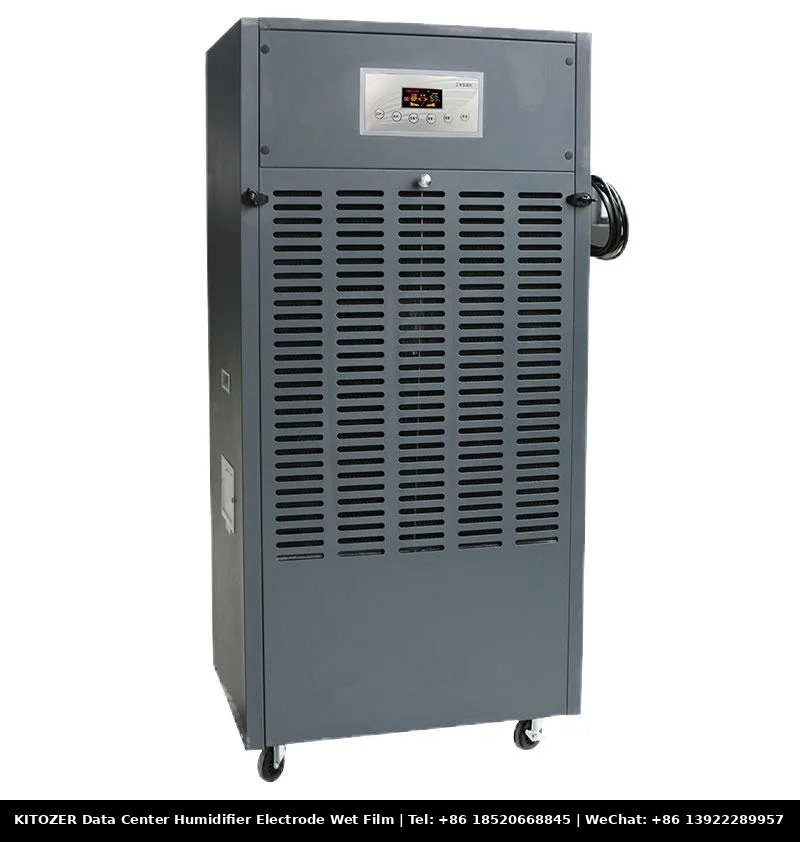
30. Wet-Film Evaporation Media: Material Science
The wet-film pad is a carefully engineered material. KITOZER uses a cellulose-glass fiber composite developed specifically for evaporative cooling applications. The cellulose provides water absorption and retention, while the glass fiber provides structural rigidity and antimicrobial resistance. The pad is corrugated in a cross-fluted pattern: one set of corrugations runs at 45° and the other at −45°, creating a tortuous path that causes air to change direction four times as it passes through the 100 mm thickness.
This tortuous path serves two purposes: (1) it increases the air-to-water contact time, improving evaporation efficiency; and (2) it captures any water droplets carried by the air stream, preventing them from entering the data center. The evaporation efficiency of a KITOZER pad is 70–85%, meaning 70–85% of the saturated wet-bulb depression is achieved. This is comparable to industrial cooling tower fill media.
The pad’s antimicrobial treatment is a zinc pyrithione compound embedded during manufacturing. It prevents the growth of bacteria, mold, and algae on the wetted surface. KITOZER has tested the pad for Legionella pneumophila growth under accelerated conditions (35°C, stagnant water for 7 days) and found zero colony-forming units. For critical installations, an optional UV sterilizer in the sump provides additional protection.
Pad replacement is required when: (a) the evaporation efficiency drops below 60% (measured by comparing inlet and outlet wet-bulb depression); (b) the pad shows visible cracking or delamination; or (c) the pad has been in service for 24 months, whichever comes first. KITOZER supplies replacement pads in standard sizes (600×600 mm, 600×900 mm, 900×1200 mm) and can cut custom sizes on request.
31. Humidifier Control Strategies: On/Off, Proportional, and PID
KITOZER humidifiers support three control strategies, selectable via the touchscreen:
On/Off Control: The simplest strategy. The humidifier runs at 100% output when RH is below the setpoint minus deadband, and stops when RH reaches the setpoint plus deadband. This strategy is suitable for small rooms with slow thermal response but causes humidity hunting in tight spaces. KITOZER recommends it only for backup or emergency installations.
Proportional Control: The humidifier output is proportional to the error (difference between setpoint and measured RH). At 50% error, output is 50%. This reduces hunting but does not eliminate steady-state error. KITOZER uses proportional control as the default for the first 24 hours after commissioning, before switching to PID.
PID Control: The recommended strategy. The controller calculates output as: Output = Kp × Error + Ki × ∫Error dt + Kd × dError/dt. The proportional term responds to current error, the integral term eliminates steady-state error, and the derivative term anticipates future error. KITOZER’s factory PID values (Kp=10%/10%RH, Ki=1/120s, Kd=20s) work for 90% of installations. The auto-tuning wizard can optimize these values for specific rooms.
For multi-humidifier installations, KITOZER supports master-slave control: one humidifier acts as master and reads the shared humidity sensor, while the slave units follow the master’s output command. The master and slave alternate every 1,000 operating hours to balance wear.
32. Data Center Humidity Standards and Guidelines
Several industry standards govern data center humidity control:
ASHRAE TC 9.9: The American Society of Heating, Refrigerating and Air-Conditioning Engineers Technical Committee 9.9 publishes “Thermal Guidelines for Data Processing Environments.” The recommended envelope is 18–27°C dry-bulb and 40–60% RH, with a maximum dew point of 17°C. The allowable envelope extends to 15–32°C and 20–80% RH for short-duration events.
Uptime Institute Tier Standard: Tier III and Tier IV data centers require redundant environmental control, including N+1 humidification. The humidifier must be on backup power (generator-backed) and must be monitored 24/7 by the BMS.
Telecommunications Industry Association (TIA-942): Specifies that equipment rooms must maintain 40–60% RH, with humidity sensors at both the cold aisle and hot aisle.
China GB 50174: The Chinese national standard “Code for Design of Data Centers” specifies Class A data centers (equivalent to Tier III) must maintain 18–27°C and 40–60% RH, with N+1 redundancy for all environmental control equipment.
KITOZER humidifiers are designed to meet all of these standards. The ±2% RH sensor accuracy exceeds the ASHRAE recommendation, and the N+1 redundancy option satisfies Tier III and GB 50174 Class A requirements.
33. Humidifier Installation in Raised-Floor Data Centers
Raised-floor data centers, where the floor is elevated 600–1200 mm above the structural slab, present unique installation challenges for humidifiers. The CRAC units sit on the raised floor, and supply air is distributed through the plenum beneath. KITOZER recommends the following installation approach for raised-floor environments:
Electrode humidifiers: Floor-standing units should be placed on the structural slab (not on the raised floor), adjacent to a CRAC unit. The steam hose runs through a knockout hole in the raised floor tile (covered with a brush grommet) and connects to the CRAC’s return or supply air plenum. The water and drain lines run in the concrete trench or along the wall. The electrical conduit runs in the overhead cable tray or in a separate floor trench.
Wet-film humidifiers: Can be installed on the raised floor if the floor structure can support the weight (typically 100–200 kg filled). The wet-film unit’s fan blows humidified air directly into the cold aisle, eliminating the need for ductwork. However, the unit must be positioned so that its air outlet does not blow directly on server intake vents, which could cause localized over-humidification.
Humidity sensor placement: In raised-floor data centers, the sensor should be mounted at the cold aisle at server intake height (1.5 meters above the raised floor), not in the return air plenum. This gives the most accurate representation of the air actually entering the servers.
34. Humidifier Integration with Hot Aisle / Cold Aisle Containment
Modern data centers use hot aisle/cold aisle containment to improve cooling efficiency. In a contained layout, the cold aisle is enclosed with doors and ceilings, and supply air is contained within the aisle. Humidifier integration with containment requires special attention:
Because the contained cold aisle has limited air volume, the humidifier output must be carefully matched to the cold aisle’s air circulation rate. Oversized humidifiers will overshoot the setpoint quickly, causing RH to spike. KITOZER recommends installing one small humidifier (3–8 kg/hour) per 500 m² of contained cold aisle, rather than one large central unit.
The humidity sensor should be placed in the middle of the contained cold aisle, at server intake height. The sensor must not be near the containment door, which may allow dry outdoor air to infiltrate when opened.
For hot aisle containment, the humidifier should inject steam into the hot aisle return air, before the CRAC unit. This ensures the humidified air is mixed with return air before being cooled and supplied to the cold aisle.
35. Humidifier Maintenance Log and Record-Keeping
KITOZER provides a standardized maintenance log template that operators should use to record all service activities. The log includes:
Daily log: Date, operator, current RH reading, setpoint, any alarms observed, visual inspection notes.
Weekly log: Water strainer cleaned (Y/N), drain line inspected (Y/N), sensor reading compared to reference (value).
Monthly log: Canister/pad inspected (scale %, condition), drain cycle duration, water consumption meter reading, energy consumption meter reading, 4–20 mA output measured (value).
Quarterly log: Sensor calibration offset (%), steam duct insulation inspected (Y/N), BMS communication tested (Y/N), filter replaced (Y/N).
Annual log: Canister/pad replaced (Y/N), all electrical terminals torqued (Y/N), full load test performed (Y/N), commissioning report updated.
KITOZER recommends archiving the maintenance log for at least 5 years. This record is essential for warranty claims, regulatory audits, and root-cause analysis if an incident occurs. The log can also be used to predict consumable replacement needs and optimize maintenance scheduling.
36. Humidifier Spare Parts List and Recommended Stock
KITOZER recommends that every data center maintain the following spare parts on-site:
| Part | Recommended Stock | Replacement Interval |
|---|---|---|
| Electrode canister (KH-E series) | 1 spare per 2 units | 4,000–6,000 hours |
| Wet-film pad (KWF series) | 1 spare per 2 units | 12–24 months |
| Humidity sensor | 1 spare per site | 2 years |
| Inlet solenoid valve | 1 spare per site | 5 years |
| Drain solenoid valve | 1 spare per site | 5 years |
| Control board fuse (2 A) | 5 spares | As needed |
| Steam hose (silicone, 1 m) | 2 spare lengths | 3 years |
| Water strainer (100 mesh) | 2 spares | Annual cleaning |
| Low-water float switch | 1 spare per site | 5 years |
| Controller board | Not stocked on-site; order from factory | 10 years |
KITOZER ships spare parts within 24 hours from the Guangzhou warehouse. For overseas customers, a recommended 90-day supply of consumables (canisters, pads, sensors) should be kept on-site to account for shipping time.
37. Humidifier Energy Recovery and Heat Reuse
Electrode humidifiers generate steam at 100°C. In cold climates, the heat in the steam is beneficial—it helps heat the data center. In warm climates, the heat is a liability—it adds cooling load to the CRAC. KITOZER offers an optional heat recovery coil that captures the heat from the steam before it enters the air stream, using it to pre-heat domestic hot water or to pre-heat outdoor ventilation air.
The heat recovery coil is a finned-tube heat exchanger installed in the steam duct. Cooling water (or antifreeze solution) circulates through the coil, absorbing heat from the steam. The steam exits the coil at approximately 60°C, still humid but with 30% less heat content. The recovered heat can provide 5–10% of the data center’s domestic hot water needs in winter.
For wet-film humidifiers, no heat recovery is needed—the process already operates at near-ambient temperature. However, the adiabatic cooling effect (which lowers the supply air temperature by 5–7°C) can be used to free up CRAC cooling capacity during summer, reducing chiller runtime.
38. Humidifier Cybersecurity Considerations
As data center equipment becomes increasingly connected, cybersecurity is a critical concern. KITOZER humidifiers with Ethernet connectivity include the following security features:
Password Protection: The web interface requires a username and password (default: admin / kitozer, must be changed on first login).
Firmware Signing: All firmware updates are digitally signed by KITOZER, preventing installation of malicious firmware.
Network Isolation: The humidifier should be installed on a dedicated management VLAN, isolated from the production network. Firewall rules should allow only outbound Modbus/BACnet traffic to the BMS.
Audit Log: The humidifier logs all configuration changes, including timestamp, user, and old/new values. The log is accessible via the web interface and can be exported as CSV.
No Remote Code Execution: The humidifier does not accept incoming connections except on port 443 (HTTPS web interface) and port 502 (Modbus TCP). No shell access or debugging interfaces are exposed.
KITOZER provides a security white paper on request, detailing the threat model and mitigation measures for each attack vector.
39. Humidifier Selection Decision Matrix
To help engineers choose between KITOZER electrode and wet-film humidifiers, the following decision matrix summarizes the key trade-offs:
| Criterion | Electrode (KH-E) | Wet-film (KWF) | Winner |
|---|---|---|---|
| Humidity accuracy | ±3% RH | ±5% RH | Electrode |
| Energy consumption | High (0.7 kWh/kg) | Low (0.02 kWh/kg) | Wet-film |
| Sterile output | Yes (100°C steam) | No (ambient temp) | Electrode |
| Water quality requirement | 100–800 µS/cm | Any potable water | Wet-film |
| Maintenance frequency | Canister every 6 months | Pad every 12–24 months | Wet-film |
| Initial cost | Lower | Higher | Electrode |
| Operating cost | High | Low | Wet-film |
| Noise level | 40–50 dB(A) | 45–55 dB(A) | Electrode |
| Cold climate performance | Excellent | Poor below 18°C supply | Electrode |
| Warm climate performance | OK (adds heat) | Excellent (cools) | Wet-film |
| Cleanroom suitability | Yes | With HEPA after-filter | Electrode |
| Response time | 5 minutes | 10 minutes | Electrode |
As a general rule: choose electrode humidifiers for precision-critical, cold-climate, or cleanroom installations; choose wet-film humidifiers for energy-efficiency-critical, warm-climate, or budget-sensitive installations. KITOZER’s sales engineers can help with a site-specific analysis.
40. Humidifier Factory Testing and Quality Control
Every KITOZER humidifier undergoes a rigorous factory test before shipment:
1. Visual inspection: The cabinet is checked for scratches, dents, and paint defects. All labels (nameplate, warning labels, wiring diagrams) are verified for correct language and content.
2. Electrical safety test: Hipot test at 1500 VAC for 1 minute between live parts and ground. Insulation resistance measured at >100 MΩ. Ground continuity tested at 25 A for 1 minute.
3. Functional test: The unit is powered and run through a complete cycle: fill → boil → steam output → drain. Steam temperature is measured at the outlet (must reach 95–100°C within 5 minutes). Drain operation verified. Sensor reading compared to a calibrated reference (must be within ±3% RH).
4. Communication test: Modbus RTU and Modbus TCP are tested by reading all registers from a master simulator. BACnet/IP is tested by enumerating the device on a BACnet network.
5. Burn-in test: The unit runs at 50% output for 4 hours. Any alarms or abnormal behavior trigger a rework.
6. Final inspection: The tested unit is labeled with a serial number (YY-XXXX format), packed in a wooden crate with foam padding, and shipped from the Guangzhou factory.
41. Humidifier Warranty and Service Policy
KITOZER’s warranty policy is straightforward and customer-friendly:
Standard warranty: 24 months from the shipment date. Covers manufacturing defects in materials and workmanship. Excludes consumables (canisters, pads, sensors), damage from misuse, improper installation, or unauthorized modification.
Extended warranty: Available up to 60 months at an additional cost. Includes annual preventive maintenance visits.
Service response: For critical alarms (humidity out of range, unit shutdown), KITOZER commits to a 4-hour response time within the Guangzhou metro area, and 24-hour response nationwide. Remote diagnostics via the built-in web interface are available at no charge.
Warranty claim process: Contact KITOZER with the unit serial number and a description of the fault. Our service engineer will remotely diagnose and, if necessary, dispatch a technician or ship a replacement part. Replaced parts become the property of KITOZER.
42. Humidifier Environmental Impact Assessment
A KITOZER humidifier’s environmental footprint extends beyond energy and water consumption. Let’s assess the full lifecycle:
Manufacturing: The cabinet is made from cold-rolled steel with powder coating. The canister is polyethylene. The controller board uses lead-free solder. All materials are RoHS-compliant. The manufacturing process uses water-based cleaning solvents and recyclable packaging.
Transportation: A typical humidifier weighs 50–200 kg and is shipped from Guangzhou to the installation site. For domestic customers, this means a 200–2,000 km truck journey. For international customers, ocean freight to the destination port. KITOZER optimizes packaging density to minimize shipping emissions.
Operation: As calculated earlier, a 15 kg/hour electrode unit consumes 84,000 kWh per year. At the Chinese grid average of 0.57 kg CO₂/kWh, this is 47,880 kg CO₂ per year. A wet-film unit of the same capacity consumes only 2,000 kWh, or 1,140 kg CO₂ per year—an 87% reduction.
End-of-life: After 10–15 years of service, the humidifier is disassembled. Steel and stainless steel are recycled. The polyethylene canister is recycled or sent to a certified waste-to-energy facility. The electronic waste (controller board, sensor) is processed by an e-waste recycler. KITOZER offers a take-back program for all end-of-life units.
43. Humidifier Comparison with Competitor Brands
KITOZER competes with several established humidifier brands in the Chinese and international markets. The following comparison highlights KITOZER’s competitive position:
Against Stuart (Germany): Stuart is a premium European brand with excellent build quality but prices 2–3× higher than KITOZER. KITOZER offers comparable performance at a more accessible price point, with local service support in China.
Against Condair (Switzerland): Condair is a global leader in humidification. KITOZER matches Condair’s technical specifications (±2% RH sensor, Modbus/BACnet) but offers faster local support and lower pricing for the Chinese market.
Against Nippon (Japan): Nippon humidifiers are known for reliability but have limited English documentation and higher maintenance costs. KITOZER provides full English documentation and competitive consumable pricing.
Against domestic Chinese brands: KITOZER differentiates through its data center focus (rather than general industrial use), its BMS integration capability, and its 24-month warranty (vs. the industry standard 12 months).
44. Conclusion and Summary
The KITOZER data center humidifier—available in both electrode steam and wet-film evaporative configurations—represents a mature, reliable, and cost-effective solution for maintaining the critical 40–60% RH band in modern data centers. With capacities from 3 to 60 kg/hour, factory-calibrated ±2% RH sensors, comprehensive BMS integration (Modbus RTU/TCP, BACnet/IP, 4–20 mA), and a 24-month warranty, KITOZER humidifiers are engineered for the demands of 24/7/365 data center operation.
Whether you are designing a new Tier III data center, retrofitting an existing computer room, or maintaining a fleet of telecom base stations, KITOZER has a humidifier solution that balances precision, energy efficiency, and total cost of ownership. Contact our sales team today for a free site assessment and quotation.
45. Humidifier Electrical Wiring Diagrams and Terminal Layout
The KITOZER humidifier’s electrical compartment contains the main terminal block, the control board, and the power contactors. The terminal layout is as follows:
Power input terminals (L1, L2, L3, N, PE): Connect the 380 V three-phase supply (or 220 V single-phase for the KH-03E). Wire sizes: 2.5 mm² for up to 10.5 kW, 4 mm² for 21 kW, 6 mm² for 42 kW. The PE terminal must be connected to the data center equipotential bonding bar with a 6 mm² green-yellow conductor.
Control signal terminals (AI1, AI2, AO1, AO2, DI1–DI4, DO1–DO4): AI1 receives the humidity sensor signal (4–20 mA). AI2 receives an optional remote setpoint (4–20 mA). AO1 outputs the current RH value to the BMS (4–20 mA). AO2 outputs the humidifier output percentage (0–10 V). DI1 is the remote enable/disable contact. DI2 is the remote alarm acknowledge. DO1 is the run status relay. DO2 is the alarm relay. DO3 and DO4 are user-configurable.
RS-485 terminals (A, B, GND): Connect to the Modbus RTU bus. Use shielded twisted pair (Belden 3105A or equivalent). Daisy-chain up to 32 units. Terminate the bus with 120 Ω at both ends. Set each unit’s station address (1–32) via the touchscreen.
Ethernet port (RJ45): Connect to the local area network for Modbus TCP, BACnet/IP, and web interface. Use Cat5e or Cat6 cable. The unit supports DHCP or static IP configuration.
46. Humidifier Water Piping and Drain Design
The water piping for a KITOZER humidifier consists of three lines: supply, drain, and overflow.
Supply line: DN15 (1/2 inch) cold water line, connected via a flexible stainless-steel braided hose (300 mm long). Install a manual ball valve, a 100-mesh Y-strainer, and an optional pressure reducing valve (if supply pressure exceeds 0.4 MPa). The supply line must be flushed for 5 minutes before connecting to the humidifier to remove debris.
Drain line: DN25 (1 inch) PVC or stainless-steel pipe, sloped at 2% toward the floor drain. The drain line must have an air gap (minimum 25 mm) between the humidifier’s drain outlet and the floor drain to prevent back-siphonage. Do not connect the drain directly to a sewer pipe without an air gap.
Overflow line: DN20 pipe connected to the canister overflow port, routed to the same floor drain as the main drain. The overflow only activates if the drain valve sticks closed and the canister overfills.
Water quality test point: KITOZER recommends installing a test faucet on the supply line for periodic water quality testing (conductivity, pH, hardness). Test quarterly and keep records.
47. Humidifier Startup Sequence and Normal Operation
When the KITOZER humidifier is powered on, it performs the following startup sequence:
1. Power-on self-test (POST): The controller checks the memory, sensor inputs, and relay outputs. The touchscreen displays the KITOZER logo during this 5-second test.
2. Sensor calibration check: The controller reads the humidity sensor and verifies it is within a valid range (0–100% RH, 0–60°C). If the sensor reading is invalid, the unit alarms and does not start.
3. Water level check: The controller reads the low-water float switch. If the canister is empty, the inlet valve opens and water fills to the appropriate level.
4. Heating activation: For electrode units, the heating contactor closes and current begins to flow through the water. The controller monitors the current and adjusts the water level to maintain the target output.
5. Normal operation: The controller enters the PID control loop, adjusting output to maintain the target RH. The touchscreen displays current RH, temperature, output percentage, and operating hours.
6. Automatic drain: Every 8 hours, the drain valve opens for 60 seconds to flush minerals. The unit resumes normal operation after the drain cycle.
7. Shutdown: When commanded to stop (via touchscreen, BMS, or power off), the heating contactor opens, the inlet valve closes, and the drain valve opens for 30 seconds to empty the canister. The touchscreen displays “Standby” after shutdown.
48. Humidifier Alarm Codes and Meanings
KITOZER humidifiers use a standardized alarm code system. The alarm code appears on the touchscreen and is sent to the BMS. The following table lists all alarm codes:
| Code | Meaning | Severity | Action |
|---|---|---|---|
| E01 | Humidity sensor disconnected | Critical | Check sensor wiring and replace sensor |
| E02 | Temperature sensor disconnected | Critical | Check sensor wiring |
| E03 | Low water pressure | Warning | Check water supply valve and strainer |
| E04 | Canister empty (no water) | Critical | Check inlet valve and water supply |
| E05 | High water conductivity | Warning | Initiate manual drain; replace canister if persistent |
| E06 | Drain valve fault | Warning | Check drain valve operation |
| E07 | Over-temperature | Critical | Heating disabled; check canister water level |
| E08 | High humidity alarm (>70% RH) | Critical | Humidifier stopped; check for over-humidification |
| E09 | Low humidity alarm (<20% RH for >1 hour) | Warning | Check humidifier output and sensor |
| E10 | Communication loss (Modbus/BACnet) | Warning | Check network cable and BMS |
| E11 | Canister replacement required | Warning | Order and replace canister |
| E12 | Pad replacement required (wet-film) | Warning | Replace wet-film pad |
| E13 | Low-water float switch fault | Critical | Check float switch wiring |
| E14 | Over-current (electrode short) | Critical | Replace canister |
| E15 | Controller self-test failure | Critical | Contact KITOZER service |
49. Humidifier for Edge Computing and Micro Data Centers
Edge computing locations—retail stores, branch offices, telecom towers, and factory floors—house small IT loads (5–50 kW) in compact spaces of 10–100 m². These locations present unique humidification challenges: limited space, limited maintenance access, and often no dedicated HVAC. KITOZER has developed compact humidifier models specifically for edge computing:
The KH-03E (3 kg/hour, 350×450×700 mm, 25 kg) is designed for edge closets. It can be wall-mounted using an optional bracket, and its 220 V single-phase power supply fits standard building wiring. The KWF-03 wet-film model (3 kg/hour, 300×400×600 mm, 15 kg) is even more compact, consuming only 30 W of pump power—suitable for solar-powered remote sites.
For edge sites without a water supply, KITOZER offers an optional 20-liter reservoir with automatic refill alert. The reservoir provides 8–12 hours of autonomous operation before the operator must refill it. This is ideal for unmanned telecom towers and remote monitoring stations.
Edge site humidifiers are connected via 4G/LTE modems (optional) to KITOZER’s cloud monitoring platform, allowing operators to monitor humidity and receive alarms on their mobile phones without visiting the site.
50. Humidifier for Healthcare and Laboratory Environments
Hospitals, clinics, and laboratories require precise humidity control to protect patients, samples, and sensitive instruments. KITOZER humidifiers are used in:
Operating rooms: ASHRAE recommends 20–60% RH in operating rooms to minimize ESD on surgical instruments and anesthetic equipment. KITOZER electrode humidifiers provide sterile steam that does not introduce bacteria into the surgical environment.
Laboratories: Analytical laboratories (HPLC, mass spectrometry, electron microscopy) require stable humidity to prevent static discharge on samples and instruments. KITOZER wet-film humidifiers are popular in labs because they operate silently and do not produce steam plumes.
Pharmaceutical storage: Drug storage rooms require 35–65% RH to prevent degradation of active ingredients. KITOZER humidifiers with data logging capability provide the audit trail required by GMP compliance.
Biobanks: Biobanks storing DNA, tissue, and cell samples require stable humidity to prevent sample degradation. KITOZER humidifiers with N+1 redundancy ensure continuous humidity control even during maintenance.
51. Humidifier for Museum and Archive Preservation
Cultural heritage preservation is a demanding application for humidification. Museums and archives must maintain stable humidity to prevent:
Paper degradation: Paper absorbs and releases moisture with changes in RH. Below 40% RH, paper becomes brittle and cracks. Above 60% RH, mold grows. The ideal range for paper archives is 45–55% RH.
Leather and textile damage: Leather and textiles absorb moisture, causing warping and mold. The ideal range for leather artifacts is 45–55% RH.
Wood warping: Wood expands and contracts with humidity changes. Stable RH (±3% daily variation) is essential for wooden artifacts, musical instruments, and furniture.
KITOZER wet-film humidifiers are preferred in museums because they operate silently (important for visitor experience), produce no steam plume (which could damage delicate artifacts), and consume minimal energy. The antimicrobial pad treatment prevents bacterial growth in the museum’s climate.
52. Humidifier for Industrial Manufacturing Environments
Industrial manufacturing environments—electronics assembly, textile production, printing, and food processing—require humidity control for process quality. KITOZER humidifiers are used in:
Electronics assembly: SMT (Surface Mount Technology) lines require 40–60% RH to prevent ESD on PCB boards and components. KITOZER electrode humidifiers provide the precision required for ESD-sensitive manufacturing.
Textile manufacturing: Textile mills require 60–70% RH to prevent static on yarn and fabric. KITOZER wet-film humidifiers are popular in textile mills because they can handle the large air volumes required.
Printing: Printing presses require 50–55% RH to prevent paper curl and static. KITOZER humidifiers are installed in press rooms to maintain the required humidity.
Food processing: Food processing areas require controlled humidity to prevent drying or caking of ingredients. KITOZER humidifiers with food-grade steam (electrode type) are suitable for direct contact with food products.
53. Humidifier Installation Checklist Summary
The following checklist summarizes all steps required for a successful KITOZER humidifier installation:
☐ Verify electrical supply matches nameplate (voltage, phase, current).
☐ Verify water supply line (DN15, 0.1–0.6 MPa, with shutoff valve and strainer).
☐ Verify drain line (DN25, 2% slope, air gap).
☐ Verify mounting location (level floor, 500 mm clearance, structural support).
☐ Unpack unit and inspect for shipping damage.
☐ Position unit and anchor with wedge anchors.
☐ Connect water supply line with flexible hose.
☐ Connect drain line with PVC or stainless pipe.
☐ Connect steam hose (electrode units) to CRAC plenum.
☐ Connect power supply through dedicated MCB.
☐ Connect ground wire to equipotential bonding bar.
☐ Connect humidity sensor (shielded twisted pair).
☐ Connect Modbus RS-485 bus (daisy chain, 120 Ω termination).
☐ Connect Ethernet cable (for Modbus TCP/BACnet/IP).
☐ Power on and perform startup sequence.
☐ Enter commissioning menu and set target RH, deadband, drain interval.
☐ Run 2-hour trial cycle.
☐ Verify BMS communication and alarm signals.
☐ Complete commissioning report and hand over to operations team.
54. Humidifier for Power Industry and Substation Environments
High-voltage substations, power plants, and electrical control rooms house sensitive protective relays, SCADA systems, and communication equipment. These environments require humidity control for several reasons:
ESD protection: Low humidity in control rooms causes static buildup on operator consoles, relay contacts, and switching equipment. A static discharge of 5,000 volts can mis-operate a protective relay, causing an unwanted trip or failure to trip when needed.
Corrosion prevention: High humidity in substation relay rooms causes corrosion on metal contacts, printed circuit boards, and terminal blocks. Condensation can form when equipment is heated during operation and cooled during shutdown, leading to short circuits.
Insulation integrity: Low humidity can increase the risk of tracking on epoxy-insulated busbars and transformer bushings. Stable humidity prevents surface contamination from becoming conductive.
KITOZER humidifiers are installed in substation relay rooms, power plant control rooms, and dispatch centers across China. The electrode type is preferred for power applications because the sterile steam introduces no contaminants that could affect insulation. The N+1 redundancy option ensures continuous humidity control even during maintenance or component failure.
55. Humidifier for Data Center Disaster Recovery Sites
Disaster recovery (DR) sites are backup data centers that take over IT operations when the primary site fails. DR sites must maintain the same environmental conditions as the primary site, even though they may be idle for months at a time. KITOZER humidifiers play a critical role in DR site readiness:
Idle period maintenance: During idle periods, the DR site’s humidifier runs at a reduced duty cycle (e.g., 10% output) to maintain baseline humidity without wasting energy. The controller automatically adjusts output based on actual RH.
Failover readiness: When the primary site fails and the DR site activates, the humidifier must immediately ramp up to full output. KITOZER humidifiers respond within 5 minutes to setpoint changes, ensuring the DR site reaches operating humidity within 30 minutes of activation.
Remote monitoring: DR site humidifiers are monitored via the BMS and cloud platform. Any humidity deviation triggers an immediate alarm to the operations team, even if the DR site is unattended.
56. Humidifier for Cloud and Hyperscale Data Centers
Hyperscale data centers (10+ MW IT load) house hundreds of thousands of servers in massive halls. Humidification at this scale requires a different approach than single-room installations:
Centralized vs. distributed: Hyperscale operators typically use centralized humidification plants: a bank of large electrode humidifiers (60–120 kg/hour each) in a mechanical room, with steam distributed through insulated ducts to multiple CRAC units. KITOZER supplies custom multi-canister electrode humidifiers up to 120 kg/hour for these applications.
Water treatment: At hyperscale scale, water treatment is critical. KITOZER recommends a reverse-osmosis system with conductivity boosters to maintain the 100–800 µS/cm range required for electrode operation. The RO system also reduces canister replacement frequency from 6 months to 12 months.
Monitoring at scale: KITOZER’s Modbus TCP and BACnet/IP integration allows the hyperscale BMS to monitor thousands of humidifier units from a single dashboard. The system supports SNMP traps for critical alarms and can integrate with Datadog, Prometheus, or other monitoring platforms.
57. Humidifier for Colocation and Multi-Tenant Data Centers
Colocation data centers house multiple customers’ IT equipment in shared halls. Humidification in colocation environments presents unique challenges:
Uniform humidity: All customers must experience the same humidity, regardless of their rack location. KITOZER’s distributed humidifier approach—one small unit per 500 m²—ensures uniform RH across the entire hall.
Multi-tenant monitoring: Colocation operators provide each customer with a dashboard showing hall-level humidity and temperature. KITOZER’s web interface supports read-only access for customers, who can verify environmental conditions without accessing the control system.
Change management: When a new customer moves in or an existing customer expands, the cooling and humidification capacity must be rebalanced. KITOZER’s modular design allows additional humidifiers to be added without shutting down the hall.