KITOZER Outdoor Waterproof Electrical Distribution Box: IP55 / IP65 Weather-Protected Cabinet Encyclopedia
The KITOZER Outdoor Waterproof Distribution Box is a weather-protected electrical enclosure engineered to house low-voltage circuit breakers, residual current devices (RCD), surge protective devices (SPD), terminal blocks, metering instruments, PLC IO modules, and small transformers in exposed locations where rain, dust, salt fog, direct sunlight, and ambient temperature swings would otherwise destroy unprotected switchgear. Manufactured by Guangzhou Laian Intelligent System Development Co., Ltd. under the KITOZER brand, the cabinet line is available in cold-rolled steel with polyester powder coating, 304 stainless steel, and 316L stainless steel, with ingress protection ratings from IP54 up to IP66, and is supplied for wall mounting, pole mounting, floor standing, and plinth-mount applications. Typical deployed scenarios include roadside lighting and surveillance power distribution, outdoor parking lots, public stadiums, charging stations, renewable energy combiner boxes, substation auxiliary supplies, water treatment plants, mining sites, port and quay installations, and coastal infrastructure.
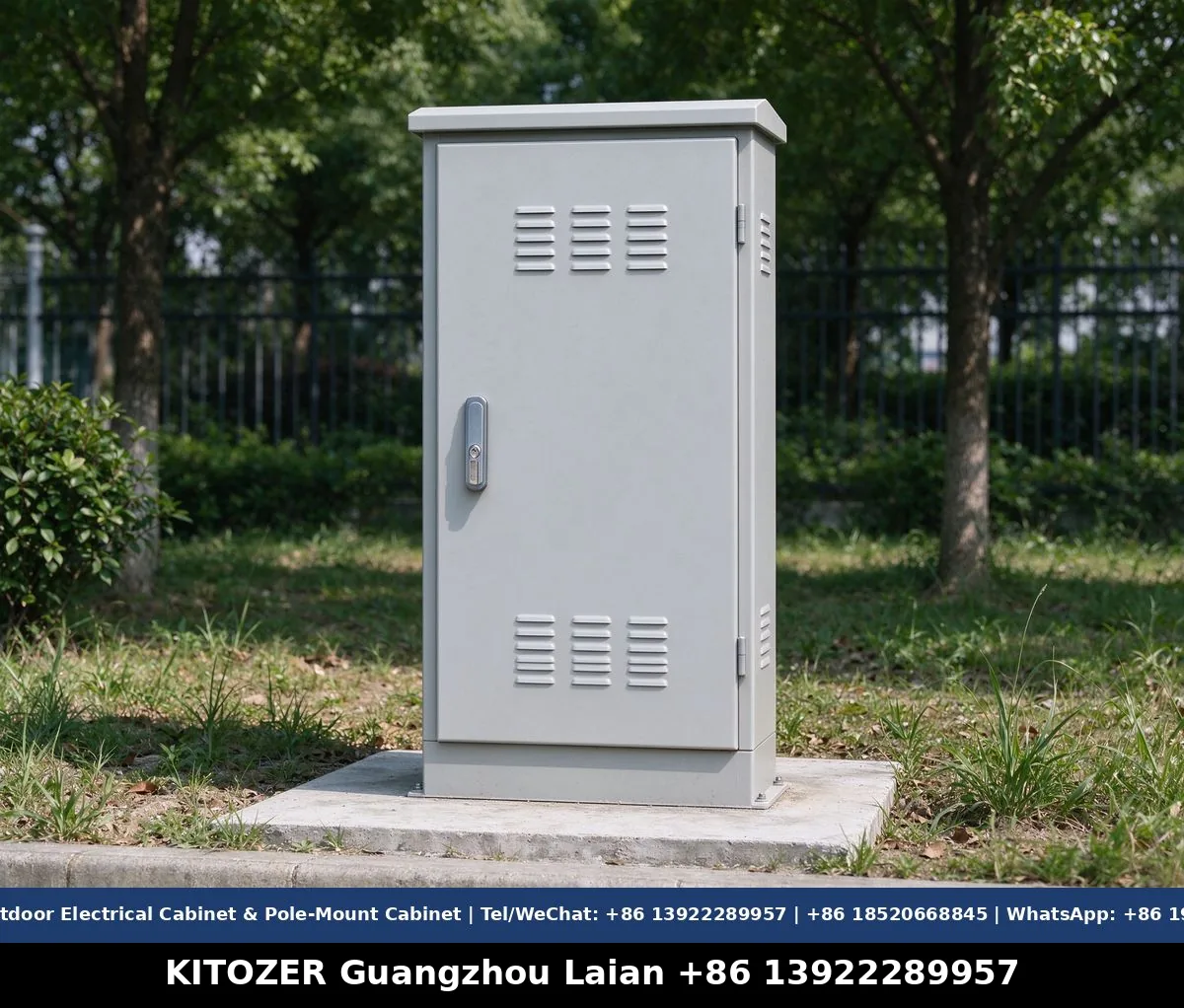
This encyclopedia-style guide is organized to support a complete technical evaluation: product overview and working principle, a dedicated IP rating comparison table covering IP54, IP55, IP65, and IP66, body material options (cold-rolled steel versus 304 versus 316L stainless steel), a full dimensional and electrical specification table, thermal management options (natural convection, filtered fan, and compressor air conditioner), mounting methods (pole, wall, floor, plinth), internal accessory kits (MCB, MCCB, RCD/RCBO, SPD, terminal blocks, DIN rail), a step-by-step selection guide, corrosion and salt-spray protection philosophy, twelve frequently asked questions, application case studies, reference price band, and contact information. Whether you are a procurement engineer sizing a roadside cabinet for a municipal CCTV project, an EPC contractor comparing weatherproof box manufacturers, an export buyer sourcing OEM enclosures from China, or a facilities engineer maintaining an existing outdoor switchgear fleet, the sections below are intended to let you converge quickly on the correct KITOZER model.
1. Product Overview
1.1 What Is an Outdoor Waterproof Distribution Box?
An outdoor waterproof distribution box — also referred to as a weatherproof electrical enclosure, outdoor switch box, waterproof junction cabinet, weather-resistant power distribution cabinet, or IP-rated outdoor electrical box — is a steel or stainless-steel cabinet whose door, gasket, cable entries, and mounting flanges are engineered to prevent the ingress of rain, sprinkler water, dust, and conductive contaminants while keeping the internal switching and protection devices within their rated temperature and humidity envelope. Unlike an indoor distribution board, which only needs to prevent accidental finger contact (IP2X), an outdoor box must survive direct rainfall, hose spray, dust storms, coastal salt fog, solar irradiation, and winter condensation cycles, often over a 15–20 year service life.
Functionally, the box performs four roles simultaneously: (1) it is the enclosure that physically contains the low-voltage switching and protection apparatus; (2) it is the environmental barrier that keeps out water and dust; (3) it is the thermal interface between internal heat-generating devices (breakers, transformers, inverters) and ambient weather; and (4) it is the mounting interface to the pole, wall, plinth, or floor that carries the weight and resists wind load. A poorly designed box fails any one of these four roles: a thin-gauge door warps in sun, a single foam gasket hardens after three winters, unventilated condensation corrodes copper busbars, or a pole bracket bends under typhoon wind load.
1.2 The KITOZER Product Range at a Glance
KITOZER outdoor waterproof cabinets are organized into four structural families that cover the majority of outdoor low-voltage distribution needs:
| Family | Body style | Typical size (W×H×D mm) | IP rating | Typical use |
|---|---|---|---|---|
| KW-Series small box | Single-door wall box, fold-bent body | 200×300×150 up to 600×800×300 | IP55 / IP65 | Roadside lighting, single CCTV camera, small gate barrier |
| KV-Series vertical cabinet | Freestanding double-door, 1.5–2.2 m tall | 600×1600×400 up to 1200×2200×600 | IP55 / IP65 | Park/stadium distribution, charging station, water plant |
| KP-Series pole box | Clamp-on pole mount with integral bracket | 400×500×250 up to 600×800×300 | IP55 | Streetlight pole, traffic signal pole, CCTV pole |
| KS-Series stainless cabinet | 304 or 316L stainless, brushed finish | 300×400×200 up to 1000×2000×500 | IP65 / IP66 | Coastal, wastewater, food & beverage, quay, desalination |
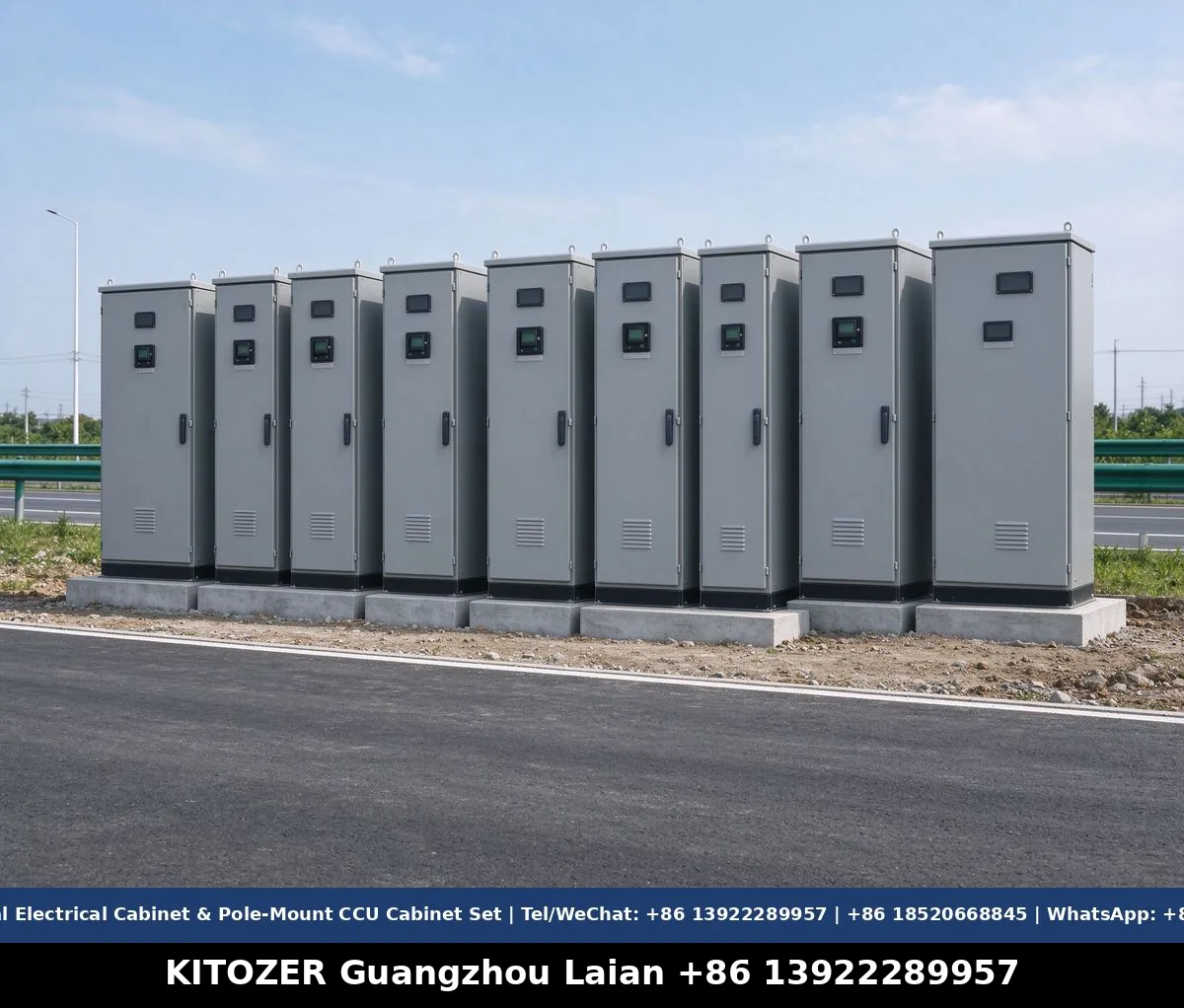
1.3 How an Outdoor Waterproof Cabinet Works
The cabinet achieves weather protection through a layered sealing strategy rather than a single gasket. The door is flanged and folded inward; a continuous EPDM (ethylene propylene diene monomer) foam gasket, bonded into a machined groove around the door perimeter, is compressed by a three-point or single-point cam lock to a compression ratio of 25–35%. Compression is critical: an under-compressed gasket leaks in rain; an over-compressed gasket sets permanently and loses elasticity after a few years. Cable entries use IP-rated cable glands (PG or metric thread) rather than open knockouts; unused knockouts are sealed with metal or plastic blanks with O-rings. A Gore-Tex style ePTFE breather valve is fitted near the top of the cabinet to equalize internal air pressure during temperature swings without letting liquid water in — this is the single most effective countermeasure against condensation, which is the leading failure mode of sealed outdoor enclosures.
Inside, DIN rails (35 mm top-hat rail) carry the MCBs, RCDs, contactors, and terminal blocks; a copper or galvanized steel busbar connects the main incoming breaker to the branch circuits; a protective earth (PE) bar bonded to the cabinet frame provides the equipotential reference. Earth leakage protection (RCD / RCBO at 30 mA) is mandatory on any circuit serving human-accessible outlets or lighting fixtures; surge protection (Type 2 SPD, 20 kA nominal / 40 kA 8/20 µs) is fitted on the incoming side to absorb lightning-induced transients on overhead power lines.
1.4 Core Value Proposition
- Engineering-grade sealing. EPDM gasket, three-point cam lock, ePTFE breather, IP-rated glands — the cabinet survives tropical monsoon, desert dust, and coastal salt fog.
- Material choice. Cold-rolled steel with 80–120 µm polyester powder coat for inland; 304 stainless for humid indoor/outdoor; 316L stainless for coastal and industrial corrosion.
- Thermal design. Natural convection baseline; filtered fan with thermostat for medium loads; 1000–3000 W compressor air conditioner for inverters, VFDs, and battery cabinets.
- Pre-engineered electrical. Options include main MCCB up to 400 A, up to 36 branch MCBs, 30 mA RCD, Type 2 SPD, kWh meter, and PLC IO — shipped wired and tested.
- Fast deployment. Wall and pole kits are pre-attached; floor models ship on adjustable plinths. Two technicians can install, terminate, and energize a typical cabinet in half a day.
- Export-ready. CE-compliant construction, English labeling, optional IEC 60439-1 type-tested assemblies (TTA) certification support, and OEM/ODM private labeling available.
2. Ingress Protection (IP) Ratings Explained
2.1 What IP Codes Mean
The IP code (IEC 60529) is a two-digit classification. The first digit (0–6) rates protection against solid objects and dust; the second digit (0–8) rates protection against water. For outdoor electrical cabinets, the ratings that matter are IP54, IP55, IP65, and IP66 — IP54 is a minimum for covered outdoor use, IP55 is the standard for most exposed locations, IP65 is required for dust-storm and washdown environments, and IP66 is required for direct hose spray and coastal surf zones.
| IP code | First digit (solids/dust) | Second digit (water) | Typical outdoor environment | KITOZER application |
|---|---|---|---|---|
| IP54 | 5: dust-protected (no harmful dust deposit) | 4: splashing water from any direction | Covered balcony, under-eaves, sheltered parking structure | Indoor/outdoor lobby box, covered walkway |
| IP55 | 5: dust-protected | 5: water jets (6.3 mm nozzle, 12.5 L/min, 3 m distance) | Direct rain, roadside, park, parking lot | Roadside CCTV, streetlight pole box, parking lot distribution |
| IP65 | 6: dust-tight (no dust ingress at all) | 5: water jets as above | Dust storm, agricultural dust, construction site, washdown | Substation auxiliary, water plant, food & beverage washdown |
| IP66 | 6: dust-tight | 6: powerful water jets (12.5 mm nozzle, 100 L/min, 3 m distance) | Coastal surf, hose-down, heavy monsoon, industrial washdown | Quay crane, desalination, wastewater, offshore-adjacent |
2.2 IP55 versus IP65 versus IP66: Practical Differences
Customers often ask why they should pay more for IP65 or IP66 when IP55 already passes a water-jet test. The practical distinction is as follows. IP55 cabinets are dust-protected, not dust-tight: a small amount of fine dust can enter over years of operation, which is acceptable if internal devices are rated for that environment and a breather filter is fitted. In a construction site, cement dust, grain dust, coal dust, or desert sand will gradually accumulate inside an IP55 cabinet, bridging terminals and reducing insulation resistance. For those sites, IP65 is the minimum. IP66, in turn, adds protection against powerful jets: a garden hose, a fire hose, or coastal wave splash must not drive water past the gasket. IP66 typically requires a double-gasket door, heavier lock compression, and sealed cable glands rated IP66, and is about 15–25% more expensive than an equivalent IP55 cabinet.
2.3 Common Misconceptions About IP Ratings
- “IP65 means waterproof.” IP65 means protected against water jets; it does not mean submersible. Submersible enclosures are IP67 (temporary immersion) or IP68 (continuous immersion). KITOZER does not market IP65 cabinets as submersible.
- “IP is a lifetime guarantee.” IP rating is verified at the factory at the time of manufacture. Gaskets age, locks wear, and cable glands can be reinstalled incorrectly by site electricians. Annual inspection of gasket compression and gland tightness is recommended.
- “Higher IP is always better.” A fully sealed IP66 cabinet with no breather valve will accumulate condensation internally because temperature swings pump moist air in and out through imperfect seals. For heat-generating equipment, IP55 with a filtered fan is often better thermally than a sealed IP66.
- “IP rating covers the whole cabinet.” The rating applies to the enclosure as shipped. Once a site electrician drills a new hole for a sensor cable, the rating is only as good as the gland used. KITOZER supplies spare glands and gland blanks to preserve the rating.
3. Body Materials: Cold-Rolled Steel, 304 and 316L Stainless
3.1 Cold-Rolled Steel (SPCC / Q235) with Polyester Powder Coating
The default KITOZER outdoor body is 1.5–2.0 mm cold-rolled steel sheet (Q235B / SPCC), degreased, phosphated, and powder-coated with polyester powder to a dry film thickness of 80–120 µm in RAL 7035 (light gray) or RAL 9005 (black) as standard, with custom RAL colors on request. The powder coat is the primary corrosion barrier: a properly applied polyester coat withstands 500–720 hours of salt-spray testing per ASTM B117 without red rust, which corresponds to roughly 8–12 years of outdoor exposure in an inland temperate climate. Cold-rolled steel is the most economical choice, is easily welded and modified on site, and accepts drilling for additional entries. Its weakness is that once the paint is scratched down to bare steel, rust spreads under the film; coastal and industrial environments therefore call for stainless steel.
3.2 304 Stainless Steel (AISI 304 / SUS304 / 1.4301)
304 stainless steel contains 18% chromium and 8% nickel. It is chosen for humid environments where powder-coated steel would rust in 2–4 years: wastewater treatment plants, indoor swimming pools, breweries, kitchens, pulp and paper mills, and urban outdoor cabinets near sprinklers. 304 has excellent corrosion resistance to fresh water, mild alkalis, and most food-grade chemicals. It is available in brushed (no. 4) or satin finish. The thickness is typically 1.5–2.0 mm. 304 is not recommended for direct coastal exposure within 500 m of salt water, where chlorides will cause pitting.
3.3 316L Stainless Steel (AISI 316L / SUS316L / 1.4404)
316L adds 2–2.5% molybdenum to the 304 composition, which dramatically improves pitting resistance against chlorides. The “L” denotes low carbon (below 0.03%), which preserves corrosion resistance after welding. 316L is the standard material for coastal cabinets, quay and crane installations, desalination plants, offshore-adjacent substations, fish processing, and chemical washdown areas. It is about 2.0–2.5× the cost of powder-coated steel and 1.3–1.5× the cost of 304. KITOZER 316L cabinets are passivated after fabrication to restore the chromium-oxide protective layer and are tested to 1000+ hours salt spray.
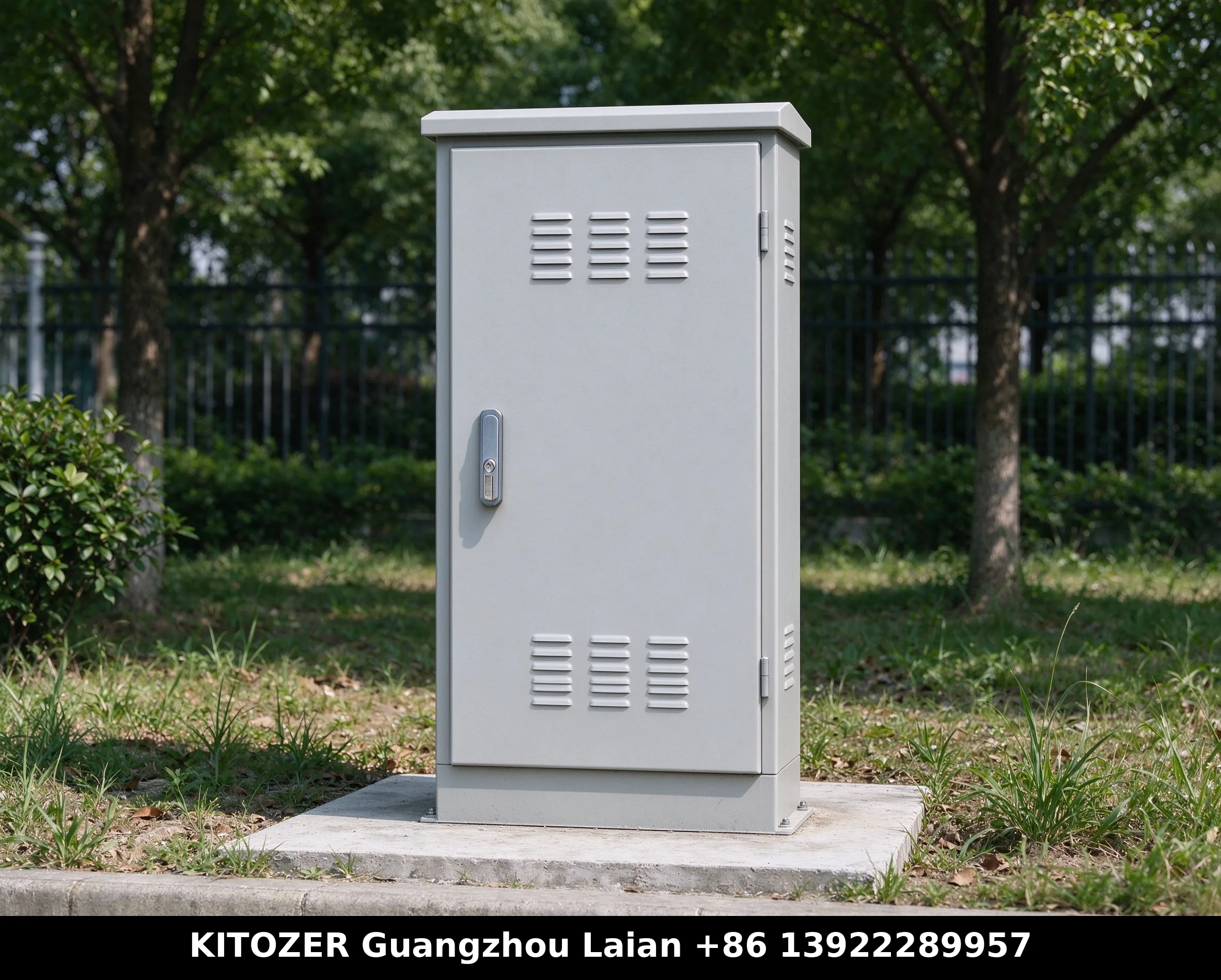
3.4 Material Selection Matrix
| Environment | Recommended body | Typical service life | Relative cost |
|---|---|---|---|
| Inland urban, sheltered | Cold-rolled steel, polyester powder | 10–15 years | 1.0× |
| Inland rural, dust, rain | Cold-rolled steel, polyester powder | 8–12 years | 1.0× |
| Humid industrial, freshwater spray | 304 stainless, brushed | 15–20 years | 1.6× |
| Coastal > 1 km from sea | 304 stainless, passivated | 10–15 years | 1.6× |
| Coastal < 1 km, surf zone | 316L stainless, passivated | 20+ years | 2.4× |
| Chemical washdown, chlorides | 316L stainless, plastic gasket | 15+ years | 2.4× |
| High-UV desert | Cold-rolled steel, RAL 9005 or light color, UV-stable powder | 8–10 years | 1.1× |
3.5 Gasket and Fastener Materials
The gasket is as important as the body. KITOZER uses EPDM foam (closed-cell, 60±5 Shore A) as standard, which withstands −40 °C to +120 °C and resists ozone and UV. For chemical environments, silicone foam is available; for food-grade areas, white FDA-grade silicone. Door screws, latch hardware, and cable glands are 304 stainless on steel-bodied cabinets and 316 stainless on stainless-bodied cabinets; zinc-plated steel screws are avoided outdoors because they white-rust within a year.
4. Technical Specifications
4.1 Dimensional Range
KITOZER outdoor waterproof cabinets are supplied in a wide range of standard sizes and are fully customizable. The table below lists the standard vertical-cabinet dimensions; wall and pole boxes are listed separately in the mounting section.
| Model | W (mm) | H (mm) | D (mm) | Body thickness (mm) | Weight (kg) | Typical branch circuits |
|---|---|---|---|---|---|---|
| KV-6040 | 600 | 400 | 250 | 1.5 | 22 | 4–6 MCB |
| KV-8060 | 800 | 600 | 300 | 1.5 | 35 | 8–12 MCB |
| KV-1080 | 1000 | 800 | 350 | 2.0 | 55 | 12–18 MCB |
| KV-1210 | 1200 | 1000 | 400 | 2.0 | 78 | 18–24 MCB |
| KV-1612 | 1200 | 1600 | 400 | 2.0 | 110 | 24–36 MCB |
| KV-2012 | 1200 | 2000 | 600 | 2.5 | 165 | up to 36 MCB + meter + PLC |
| KV-2210 | 1000 | 2200 | 600 | 2.5 | 150 | dual mains, bus-tie |
4.2 Electrical Ratings
| Parameter | Standard value | Optional / range |
|---|---|---|
| Rated insulation voltage Ui | 690 V AC | up to 1000 V AC |
| Rated operational voltage Ue | 230 / 400 V AC, 50/60 Hz | 120/208 V, 240/415 V, 380/660 V |
| Main incoming breaker | MCCB 100 A 3P/4P | MCCB up to 400 A; ACB for larger |
| Branch breakers | MCB 63 A 1P/2P | Type B/C/D curve; up to 36 ways |
| RCD / RCCD | 100 A 4P 300 mA type AC | 30 mA for human-accessible circuits; type A/F/S optional |
| Surge protector (SPD) | Type 2, 20 kA In / 40 kA Imax 8/20 µs | Type 1+2 for exposed overhead lines |
| Metering | Single-phase kWh DIN meter | three-phase multifunction meter with RS485 Modbus |
| Busbar rating | 160 A copper | up to 630 A |
| Protection class | Class I (PE terminal) | Class II double-insulated option |
4.3 Environmental and Mechanical Specifications
| Parameter | Value |
|---|---|
| Operating ambient temperature | −25 °C to +55 °C standard; −40 °C to +70 °C cold-climate / hot-climate variants |
| Relative humidity | up to 95% non-condensing (with breather valve) |
| Ingress protection | IP55 / IP65 / IP66 per IEC 60529 |
| IK impact rating | IK10 (20 J) standard; higher optional |
| Wind load resistance | up to 60 m/s (typhoon class) when properly anchored |
| Seismic | Zone 4 compliant on request |
| Color | RAL 7035 light gray / RAL 9005 black standard; custom RAL optional |
| Salt spray resistance | 500–720 h (powder-coated steel); 1000+ h (316L) |
| Mounting options | Wall, pole, floor, plinth, embedded |
| Standards | IEC 60529, IEC 61439-1/2, IEC 60947, GB 7251, EN 62208 |
5. Thermal Management: Natural Convection, Filtered Fan, and Air Conditioner
5.1 Why Outdoor Cabinets Need Active Cooling
The interior of a sealed cabinet in direct sun can reach 60–70 °C even when the ambient is only 35 °C, because the dark steel door absorbs solar radiation and the heat cannot escape. Electronic devices (PLC, inverters, meters, communication modules) are typically rated 0–55 °C; breakers derate above 40 °C. Without thermal management, devices overheat, electrolytic capacitors dry out, and breaker contacts oxidize. KITOZER offers three thermal strategies, selected by internal heat load and ambient temperature.
5.2 Natural Convection (No Fan)
For cabinets whose internal heat load is below 100 W (pure breaker panels, junction boxes, small lighting distribution), natural convection through top and bottom vent louvers is sufficient. KITOZER IP55 natural-vented cabinets use downward-facing louvers with insect screens, so rain cannot enter but air can circulate. This is the lowest-cost and lowest-maintenance option. For IP65 cabinets, natural convection is not possible — those are sealed and rely on thermal mass (the steel body) to shed heat, and are therefore limited to low heat loads.
5.3 Filtered Fan Unit (Thermostat-Controlled)
For heat loads of 100–800 W (MCB panels with PLC, small inverters, communication gear), a roof- or side-mounted filtered fan unit is the standard solution. KITOZER fits a 120×120 mm or 172×172 mm fan with a G4 polyester filter mat, controlled by a thermostat set to turn on at +35 °C and off at +30 °C. The filtered air is drawn in through the lower side and exhausted through the upper side, creating a slight positive pressure that keeps dust out. The filter mat should be cleaned or replaced every 6–12 months depending on dust load. The fan unit itself is IP54; with the filter and ducting, the cabinet maintains IP55.
5.4 Compressor Air Conditioner
For heat loads above 800 W (VFDs, inverters, battery cabinets, telecom rectifiers), and for any cabinet that must keep internal temperature below ambient (battery cabinets in desert climates), a compressor air conditioner is required. KITOZER offers side-mounted or roof-mounted units in 500 W, 1000 W, 1500 W, 2000 W, and 3000 W cooling capacities, with a closed-loop internal circuit (no external air mixes with internal air) that preserves IP55/IP65. The AC unit is thermostatically controlled (set point typically +30 °C), has a condensate evaporator so no drain pipe is needed, and draws 230 V AC from the cabinet itself. Maintenance is annual: clean the condenser coil, check refrigerant charge, and inspect the fan filter.
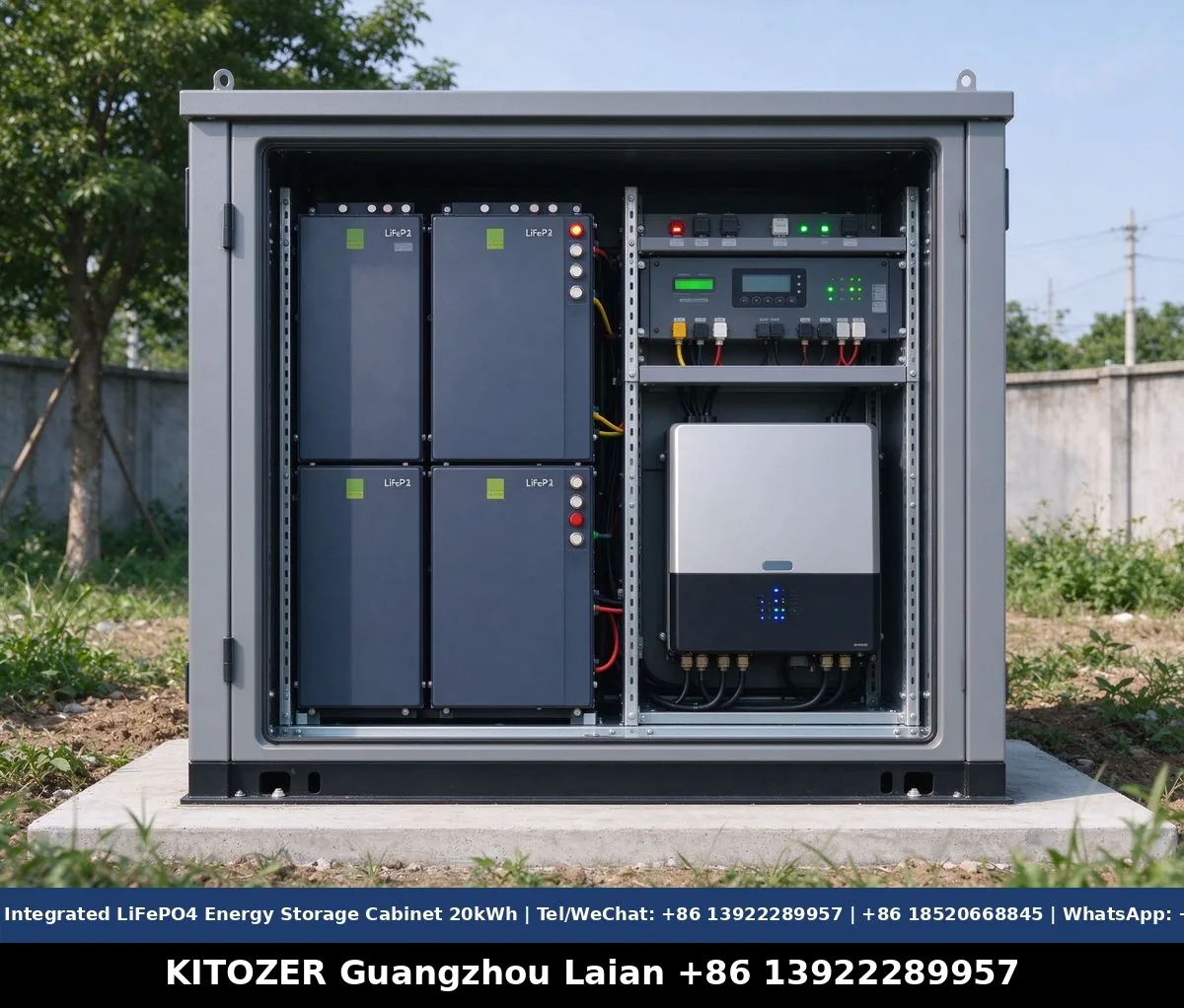
5.5 Cooling Selection Guide
| Internal heat load | Ambient peak | Recommended cooling | Typical devices |
|---|---|---|---|
| < 100 W | < 40 °C | Natural convection (vent louvers) | MCB panel, junction box, lighting DB |
| 100–300 W | < 45 °C | Filtered fan, thermostat | PLC + IO, meter, small switch |
| 300–800 W | < 50 °C | Filtered fan (2× fan) or heat exchanger | Inverter, VFD, telecom rectifier |
| 800–1500 W | any | 1000–1500 W compressor AC | Multiple VFDs, battery rack |
| 1500–3000 W | any | 2000–3000 W compressor AC | Energy storage PCS, charging pile |
6. Mounting Methods: Pole, Wall, Floor, and Plinth
6.1 Pole Mounting
Pole-mounted distribution boxes are the standard for streetlight poles, traffic signal poles, CCTV poles, and electric vehicle charging poles. KITOZER supplies a universal clamp bracket fabricated from 3.0 mm galvanized steel, with two stainless-steel bands that fit poles from 100 mm to 200 mm diameter (larger on request). The bracket is welded or bolted to the rear of the cabinet at the factory; on site, the electrician simply slides the cabinet onto the pole, tightens the bands, and connects cables through the bottom gland. Pole boxes should be mounted with the bottom at least 500 mm above ground to avoid flood and splash; in flood zones, 1000 mm or higher. The cabinet weight (typically 20–50 kg) plus wind load must be verified against the pole’s cantilever capacity; for heavy cabinets, a secondary support arm is recommended.
6.2 Wall Mounting
Wall-mounted cabinets are fixed to concrete, brick, or steel column surfaces using four expansion bolts (M10 or M12) through the rear mounting flange. KITOZER wall boxes have a 25–50 mm stand-off gap between the cabinet back and the wall to allow air circulation and prevent wall moisture from wicking into the paint. The wall must be structurally adequate: a 100 kg cabinet on a hollow gypsum wall without reinforcing plywood will pull out. For masonry walls, M10 expansion bolts in 80 mm deep holes are standard. The wall mounting kit includes bolts, wall plugs, and a drilling template.
6.3 Floor Standing and Plinth Mounting
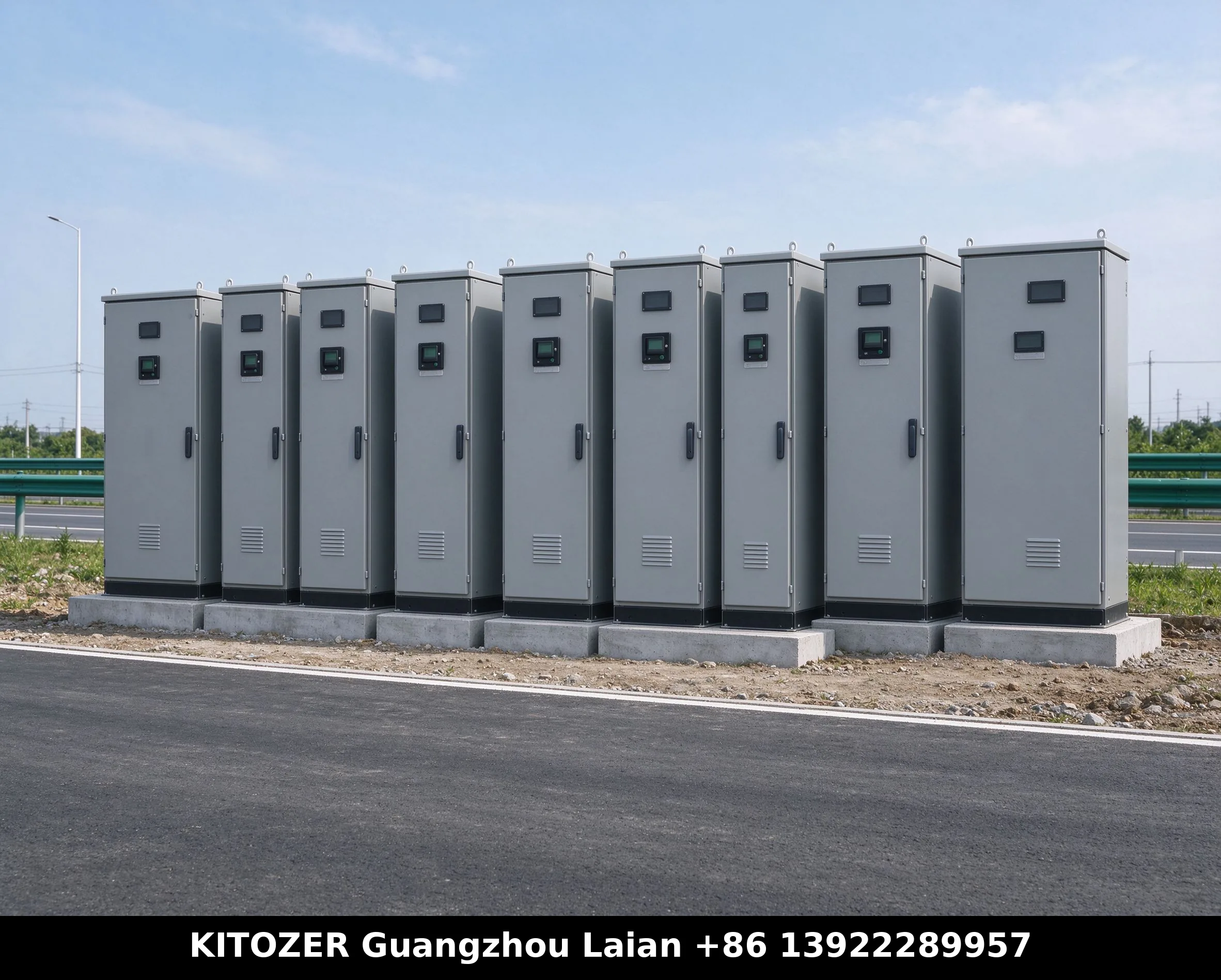
Tall vertical cabinets (above 1200 mm) are floor-standing. KITOZER ships them on a 100–200 mm galvanized steel plinth (skid) that both elevates the cabinet above flood and splash, and provides a rigid base to anchor to a concrete foundation. The foundation is typically 150 mm thick reinforced concrete with four M12 anchor bolts; cable entries come up through the plinth into the bottom gland plate. For heavy cabinets (above 100 kg), two-point door support and a top restraint cable in seismic zones are recommended.
6.4 Embedded / Recessed Mounting
For architectural projects where the cabinet must be flush with a facade, KITOZER offers a recessed frame: the cabinet body fits into a wall opening, and a decorative flange covers the gap. This is less common for outdoor switchgear because maintenance becomes harder and sealing around the recess is difficult.
| Mounting type | Typical cabinet size | Minimum elevation | Hardware |
|---|---|---|---|
| Pole | up to 600×800×300 mm | 500 mm above ground | 2× stainless bands, universal bracket |
| Wall | up to 1000×1000×350 mm | 300 mm above floor | 4× M10 expansion bolts, stand-off |
| Floor / plinth | 1200×2000×600 mm and larger | 100–200 mm plinth | 4× M12 anchor bolts to concrete |
| Embedded | custom | n/a | decorative flange, recess frame |
7. Internal Accessories and Electrical Components
7.1 Miniature Circuit Breakers (MCB)
Branch circuits are protected by MCBs, 6 kA or 10 kA breaking capacity, Type B (domestic), Type C (general commercial, motors), or Type D (high inrush, transformers, welders). KITOZER uses well-known DIN-rail brands (Schneider, ABB, Siemens, Chint, Delixi) or OEM equivalents; the customer can specify the brand. Standard branch sizes are 6 A, 10 A, 16 A, 20 A, 25 A, 32 A, 40 A, and 63 A.
7.2 Molded Case Circuit Breakers (MCCB)
The main incoming protection is an MCCB, typically 100 A, 160 A, 250 A, or 400 A, 3P or 4P, with thermal-magnetic trip. For larger installations, an air circuit breaker (ACB) up to 1600 A is used. The MCCB is mounted on the main DIN rail or on a busbar support, with the incoming cable lug clamped to the line side and the outgoing busbar to the load side.
7.3 Residual Current Devices (RCD / RCBO)
An RCD (residual current device) or RCBO (RCD + MCB combined) detects imbalance between line and neutral — indicating current leaking to earth through a person’s body or damaged insulation — and trips within 30 ms. For outdoor circuits serving human-accessible outlets or lighting, a 30 mA type A or F RCD is mandatory. For distribution main protection, a 100–300 mA time-delayed RCD provides discrimination (so the branch RCD trips before the main RCD).
7.4 Surge Protective Devices (SPD)
Outdoor overhead power lines are lightning-attractive. A Type 2 SPD (20 kA nominal, 40 kA 8/20 µs) clamps transient over-voltages to below 2.5 kV, protecting downstream breakers, meters, and electronic devices. For cabinets fed by long overhead lines or in high-lightning-density regions, a Type 1+2 combination SPD (12.5 kA 10/350 µs) is recommended. The SPD has a visual failure indicator and a remote-signaling contact for building management.
7.5 Terminal Blocks and DIN Rail
Cable terminations use screw-type or spring-cage terminal blocks (Phoenix, Weidmuller, or equivalent), organized by circuit on a labeled DIN rail. PE (protective earth) and N (neutral) bars are dedicated, color-coded, and sized to the main current. A removable terminal block for the incoming supply simplifies installation: the electrician terminates on the block rather than on the breaker lugs.
7.6 Other Accessories
- LED cabinet light with door-activated switch for evening maintenance.
- Heater (50–200 W PTC) with thermostat for cold-climate cabinets to prevent condensation.
- Hygrostat (humidity controller) that runs the heater or fan when RH exceeds 60%.
- Emergency stop button on the door for machinery-adjacent cabinets.
- Combination lock / electronic lock with remote access log for unmanned sites.
- Communication module (4G/LTE, RS485 Modbus) for remote monitoring of voltage, current, power, door status, and temperature.
- Cable gland kit (IP68 brass or nylon, metric or PG thread) sized to each cable.
- Insulated busbar cover for live parts to meet arc-flash safety.
8. Step-by-Step Selection Guide
Selecting the right KITOZER outdoor distribution box is a matter of answering eight questions in order. Work through them with your electrical designer or with a KITOZER sales engineer.
8.1 Step 1: Determine the Electrical Load
List every circuit the cabinet must serve: lighting, outlets, CCTV cameras, network switches, traffic signals, chargers, motors, inverters. For each, note the voltage (single-phase 230 V or three-phase 400 V), the full-load current, and the inrush current. Sum the branch currents and add 20% future margin to size the main incoming breaker. A typical roadside CCTV cabinet, for example, serves 4 cameras (each 60 W PoE), 1 NVR (60 W), 1 switch (30 W), and 1 emergency light (100 W): total 430 W, about 2.3 A at 230 V — a 32 A main breaker is ample.
8.2 Step 2: Count the Branch Ways and Metering
Each branch circuit occupies one or two MCB positions (1P or 2P). Add positions for the main breaker, the RCD, and the SPD. A typical 8-circuit CCTV cabinet uses: 1 main 2P 32 A, 1 RCD 2P 40 A 30 mA, 8 branch 1P 10 A, 1 SPD, 1 meter — about 15 DIN modules. Multiply by 18 mm per module = 270 mm of DIN rail, which fits in a 600×800×300 mm cabinet.
8.3 Step 3: Choose the IP Rating
Consult the IP table in section 2.2. If the cabinet is directly exposed to rain and dust, choose IP55 as minimum; if it is in a dust-storm zone or washdown area, choose IP65; if it faces hose spray or coastal surf, choose IP66.
8.4 Step 4: Choose the Body Material
Consult the material matrix in section 3.4. Inland urban = powder-coated cold-rolled steel. Humid/freshwater = 304. Coastal/chloride = 316L.
8.5 Step 5: Size the Cooling
Sum the internal heat load (breakers, inverters, electronics). Compare to the cooling table in section 5.5. Remember that solar load on a dark cabinet can add 100–200 W equivalent; choose a light RAL color (7035) for sun-exposed cabinets.
8.6 Step 6: Choose the Mounting Method
Pole if it is on a utility pole; wall if there is a structurally adequate wall; floor/plinth if the cabinet is above 1.2 m tall or above 100 kg.
8.7 Step 7: Specify Brands and Certification
Choose breaker brand (Schneider / ABB / Siemens / Chint / Delixi), terminal brand (Phoenix / Weidmuller / Degson), and required certifications (CE, UL, CCC, IEC 61439 TTA). Export customers typically request CE and English labeling.
8.8 Step 8: Request a Quotation
Send the completed selection worksheet to KITOZER. A typical quotation turnaround is 1–2 working days; standard lead time for in-stock models is 7–10 working days, for custom-built wired-and-tested panels 15–25 working days.
9. Corrosion and Salt-Spray Protection
9.1 The Real Enemy: Condensation and Chlorides
Most outdoor cabinet failures are not caused by water leaking through the door — they are caused by internal condensation. A sealed cabinet heats up during the day and cools at night; the contracting internal air draws humid outside air through imperfect seals; the moisture condenses on cold internal surfaces, dripping onto busbars and terminals. Over a few years, this causes copper oxide, green corrosion on aluminum, and steel rust on the mounting plate. KITOZER counters condensation with three measures: (1) an ePTFE breather valve that equalizes pressure without admitting liquid water; (2) a PTC heater with hygrostat in cold/humid climates; (3) filtered positive-pressure ventilation where heat load allows.
9.2 Salt-Spray (Salt Fog) Protection
Coastal installations face chloride-laden air, which attacks steel and even 304 stainless (pitting). KITOZER’s corrosion protection strategy depends on the material:
- Powder-coated steel: the polyester coat, when intact, blocks chlorides. The critical detail is edge coverage — cut edges and drilled holes must be touched up with zinc-rich paint after installation. Standard powder coat survives 500 h salt spray; KITOZER offers a marine-grade epoxy primer + polyester topcoat system for 1000 h+.
- 304 stainless: suitable for coastal areas more than 1 km from the surf. After fabrication, KITOZER passivates the cabinets in citric or nitric acid to restore the chromium-oxide layer, and tests with a ferroxyl solution to confirm free iron is removed.
- 316L stainless: the default for coastal installations. The molybdenum content (2–2.5%) raises the pitting resistance equivalent (PREN) above 24, which resists chloride pitting. Welds are pickled and passivated; fasteners are 316; gaskets are EPDM or silicone.
9.3 Long-Term Maintenance
Even a well-built cabinet needs annual inspection: (1) check gasket compression and replace if cracked or hardened; (2) inspect the paint for scratches and touch up; (3) clean or replace the fan filter; (4) verify the breather valve is not clogged; (5) check all cable glands for tightness; (6) inspect busbars and terminals for discoloration or corrosion; (7) verify RCD operation with the test button. A 30-minute annual inspection typically extends cabinet life by 5–10 years.
10. Frequently Asked Questions (FAQ)
Q1: What is the difference between IP55 and IP65?
The first digit distinguishes them. IP55 is dust-protected (a small amount of fine dust may enter but cannot cause harmful deposition); IP65 is dust-tight (no dust ingress at all). The second digit is the same (water jets). For most urban and roadside applications IP55 is adequate; for dusty industrial, agricultural, or construction sites, specify IP65.
Q2: Can I install an IP65 cabinet underground?
No. IP65 is for vertical outdoor exposure; it is not submersible. Underground or buried enclosures need IP67 (temporary immersion) or IP68 (continuous immersion), plus specialized ducting and ventilation. KITOZER does not recommend burying standard IP65 cabinets.
Q3: What is the typical delivery time?
Standard off-the-shelf cabinets (unwired body only) ship in 5–7 working days. Pre-wired and tested panels with breakers, RCD, SPD, and meter take 15–25 working days depending on complexity. Export orders add 7–15 days for sea freight.
Q4: Do you provide OEM / private label?
Yes. KITOZER offers OEM and ODM services: your logo on the door, your wiring diagram, your terminal labels, and English or local-language documentation. Minimum order quantity typically starts at 10 units per model.
Q5: What breaker brands do you use?
Standard brands include Schneider Electric, ABB, Siemens, Chint, and Delixi. We can also fit customer-specified brands. The price varies by brand; customer-supplied breakers are accepted with prior arrangement.
Q6: Can the cabinet be modified after delivery?
The body is welded and sealed. Field drilling of new cable entries is possible but must be done with IP-rated glands and the paint touched up with zinc-rich primer. We strongly recommend that cable entry positions be specified at order time rather than drilled on site.
Q7: What is the warranty?
KITOZER provides a 2-year warranty on the cabinet body and coating, and 1 year on fitted accessories (breakers, fans, AC units) per the component manufacturer’s warranty. Extended warranties are available on request.
Q8: Can you supply a fully wired and tested panel?
Yes. Most KITOZER outdoor cabinets are shipped fully wired, with a wiring diagram, an internal component layout, and a factory test report (insulation resistance, RCD trip test, breaker operation). The customer only needs to terminate the incoming supply and outgoing circuits on the terminal blocks.
Q9: How does the breather valve prevent condensation?
An ePTFE (expanded polytetrafluoroethylene) membrane is gas-permeable but water-impermeable. It lets air move in and out as temperature changes, equalizing pressure without drawing in moist air or letting rain in. This eliminates the pumping effect that causes most internal condensation.
Q10: What is the price range?
A small IP55 wall box (300×400×200 mm, empty body) starts at roughly USD 45–70 ex-works. A fully wired IP55 vertical cabinet (800×1200×400 mm, main MCCB + 12 MCB + RCD + SPD + meter) is typically USD 350–600. A 316L coastal cabinet with air conditioner can range USD 1500–5000 depending on size and electrical configuration. These are reference prices; please contact us for a firm quotation.
Q11: Can you ship to my country?
Yes. KITOZER exports worldwide by sea (FCL/LCL) and by air for urgent orders. We handle export packing (plywood cases with foam), commercial invoice, packing list, and CE/FCC documentation. Common destination regions include Southeast Asia, the Middle East, Africa, South America, and Eastern Europe.
Q12: Do you provide installation support?
We provide detailed installation manuals, dimensional drawings, and wiring diagrams by email. For larger projects, KITOZER engineers can travel to site for supervision, commissioning, and training (at cost). Remote video support is free for the first year.
11. Application Scenarios
11.1 Roadside and Streetlight Distribution
Roadside cabinets serve as the electrical heart of municipal streetlighting, traffic signal, and CCTV systems. Each cabinet typically contains a main breaker, a time-clock or astronomical controller, individual branch breakers for each lighting or camera circuit, an SPD, and a 30 mA RCD. The cabinet is pole-mounted or wall-mounted on the back of the pole, with a communication module (4G/NB-IoT) reporting lamp status to a central management platform. KITOZER pole boxes for this application are typically 400×500×250 mm IP55, powder-coated steel, with a galvanized clamp bracket.
11.2 Outdoor Parking Lots
Open-air parking lots need distribution for lighting (high-mast or LED pole fixtures), EV chargers, CCTV, access control, and payment kiosks. A typical parking lot cabinet is a floor-standing 800×1600×400 mm IP55 unit with a 100 A main, 6–12 branch circuits, a kWh meter for cost allocation, and a filtered fan. EV charger circuits require a dedicated 30 mA RCD type A or B, and Type 2 SPD.
11.3 Public Stadiums and Arenas
Stadiums have extensive outdoor distribution for floodlights (high-power metal-halide or LED pitch lighting), scoreboard power, advertising hoardings, CCTV, and emergency lighting. Because stadiums are occupied by large crowds, reliability and fire safety are paramount: breakers are type-tested to IEC 61439-2, RCDs provide 30 mA protection on accessible circuits, and a bus-tie arrangement allows dual-mains redundancy. KITOZER supplies double-door IP55 cabinets with a metering compartment separate from the protection compartment.
11.4 Substation Auxiliary Supply
Within a high-voltage substation, outdoor auxiliary cabinets serve as the low-voltage distribution point for switchyard lighting, heater circuits, pump motors, battery chargers, and SCADA IO. These cabinets are typically IP55/IP65, 304 stainless (due to the corrosive substation environment), with a heater to prevent condensation in winter and an internal lighting for maintenance. They often include a remote monitoring package reporting temperature, door status, breaker position, and insulation resistance to the SCADA system.
11.5 Water and Wastewater Treatment Plants
Water treatment plants have numerous pump motors, blower motors, valve actuators, and instrumentation distributed across the site. The environment is humid, chemically aggressive (chlorine, ozone), and requires frequent washdown. KITOZER 316L stainless IP66 cabinets with silicone gaskets and 316 fasteners are the standard; VFD-driven pump cabinets include a side-mounted air conditioner because the VFD generates 300–800 W of heat.
11.6 Charging Stations and Renewable Energy
EV charging stations and solar/wind farms require outdoor combiner and distribution cabinets. PV combiner cabinets string together DC inputs from solar arrays, with DC fuses, DC SPD, and monitoring; the AC side then feeds a distribution cabinet with inverter output, meter, and breaker. KITOZER supplies both DC combiner and AC distribution cabinets, typically 1000×2000×600 mm IP55 with air conditioning for the inverter-side cabinet.
11.7 Mining, Quarry, and Heavy Industry
Mine sites are dusty, vibration-prone, and often in remote locations. IP65 dust-tight cabinets with filtered positive-pressure ventilation, reinforced mounting, and vibration-resistant breakers are required. KITOZER offers heavy-gauge (2.5 mm) bodies, IK10 impact resistance, and seismic-qualified busbar supports for these environments.
20. Deep Dive: Door, Gasket, and Locking System Design
20.1 Door Construction
The door is the most heavily loaded part of an outdoor cabinet. It must resist wind pressure (up to 60 m/s typhoon), keep the gasket compressed evenly, and not warp over 15–20 years of thermal cycling. KITOZER doors are fabricated from 1.5–2.5 mm sheet steel, folded on three sides to form a structural flange, and reinforced with vertical and horizontal stiffeners (welded or spot-folded) on the inside. A flat door without stiffeners bows under differential pressure: a 1 m² door at 60 m/s wind sees about 1.8 kPa of pressure, which deflects an unreinforced 1.5 mm sheet by several millimeters — enough to break the gasket seal at the center of the door edge. The KITOZER door stiffening pattern distributes the locking forces so that gasket compression remains within 25–35% along the entire perimeter even under typhoon load.
For double-door cabinets (above 1000 mm wide), the inactive door (left side) is held closed by a spring-loaded three-point rod that engages top, bottom, and center; the active door (right side) has the lock and drives the rod through a cam mechanism. This is the same principle used in industrial control cabinets worldwide: it avoids the need for a center mullion that would reduce usable width, and it gives even compression.
20.2 Gasket Material and Geometry
The gasket is the heart of the IP seal. KITOZER uses closed-cell EPDM foam (ethylene propylene diene monomer), 6 mm × 8 mm cross-section, bonded into a machined groove that is 5 mm deep. The choice of EPDM over neoprene or silicone is deliberate: EPDM resists ozone and UV (the primary aging mechanisms for outdoor gaskets), remains elastic from −40 °C to +120 °C, and has a compression set below 20% after 70 hours at 100 °C. Neoprene hardens in sunlight within 2–3 years; silicone is more expensive and tears more easily. The gasket is applied as a continuous extruded loop with the joint glued at one corner (never a mitered butt joint, which leaks).
The groove geometry is important: the gasket is 6 mm thick, the door closes to a 4 mm gap, so the compression ratio is 33% — the design target. Too little compression (below 20%) leaves leaks; too much (above 40%) causes permanent set and shortens gasket life. KITOZER cabinets are jig-assembled so that the door gap is controlled to ±0.5 mm across the entire perimeter.
20.3 Locking Systems
Three lock types are offered: (1) a single-point cam lock with a 5 mm quarter-turn key (standard on small boxes up to 600×800 mm); (2) a three-point rod lock with a 12 mm quarter-turn handle (standard on vertical cabinets above 800 mm tall); (3) an electronic lock with RFID keypad for unmanned sites where key control is required. The lock is die-cast zinc or stainless, with a weatherproof cap over the keyhole to prevent rain and dust from entering. For coastal installations, the lock cylinder is 316 stainless to prevent seizure from salt corrosion.
21. Deep Dive: Cable Entries and Glands
21.1 Why Knockouts Are Not Enough
Budget enclosures come with punched knockouts that the site electrician opens with a hammer; the cable is then pushed through the hole with no gland, and the gap is sealed with silicone. This approach fails within a year: the silicone cracks in UV, water runs down the cable into the cabinet, and insects build nests in the gap. KITOZER cable entry plates are pre-drilled and tapped with metric or PG threads, and fitted with IP-rated compression glands. Each gland has an elastomeric seal that compresses around the cable jacket when the gland nut is tightened, and an O-ring that seals against the entry plate. Unused holes are closed with threaded metal blanks with O-rings, not silicone.
21.2 Gland Types
| Gland type | Material | Cable range | IP rating | Use |
|---|---|---|---|---|
| PG7 / PG9 / PG11 / PG13.5 / PG16 / PG21 / PG29 | Nylon or brass | 3–21 mm | IP68 | Standard signal and power cables |
| M20 / M25 / M32 / M40 / M50 / M63 | Nylon or brass | 6–42 mm | IP68 | Metric-thread international standard |
| Multi-cable gland plate | Brass or stainless | up to 24 cables | IP54 | Pre-punched plate with brushes |
| Cable gland with EMI shielding | Brass with O-ring | per size | IP68 + EMC | EMC-sensitive installations |
21.3 Entry Plate Design
KITOZER cabinets have a removable bottom entry plate bolted to the plinth. The plate is 2.5 mm steel, drilled with a pattern of threaded holes that the customer selects at order time; spare holes are blanked. The removable plate is a serviceability feature: if the site electrician needs a new cable entry after installation, the plate can be removed, drilled, and refitted with a gland, without modifying the cabinet body itself. The plate is sealed to the plinth with a continuous foam gasket.
22. Deep Dive: Busbar, Short-Circuit, and Arc-Flash Safety
22.1 Busbar Construction
The internal busbar distributes the main incoming current to the branch breakers. KITOZER uses tin-plated copper busbar (99.9% Cu, 3×20 mm for 100 A, 4×30 mm for 160 A, 5×40 mm for 250 A, 6×50 mm for 400 A), supported by glass-fiber reinforced polyester (DMC) insulators at 100 mm spacing. The busbar is sized for continuous current with a 1.3× margin, so it does not overheat in enclosed ambient. Bare busbar is covered with opaque insulated shrouds (PC or ABS) to prevent accidental contact during maintenance, per IEC 61439.
22.2 Short-Circuit Withstand
The assembly is rated for short-time withstand current (Icw) of 10–30 kA for 1 second, verified by type testing. The busbar and supports must not distort, open, or cause a phase-to-phase short during a fault. The main MCCB clears a bolted fault within 30–100 ms, so the busbar sees only the peak let-through current, not the full prospective fault. For installations with high prospective fault current (above 30 kA), KITOZER recommends a current-limiting MCCB or an ACB with short-time delay.
22.3 Arc-Flash Considerations
When a fault occurs inside a cabinet, an electric arc can release energy that melts steel and causes pressure buildup. KITOZER cabinets are designed to contain an internal arc fault for 1 second (per IEC 61640 or IEC 61439 Annex), with pressure-relief flaps on the top that vent arc products upward rather than toward the door. For high-energy installations, the door is interlocked so it cannot be opened while the main breaker is closed. Maintenance personnel are required to wear arc-flash PPE and use insulated tools.
23. Deep Dive: Condensation, Heaters, and Hygrostats
23.1 The Condensation Problem in Detail
Consider a sealed cabinet in a temperate climate. At 3 p.m. on a sunny day, the cabinet interior reaches 55 °C and the air inside holds 12% moisture by volume. At 3 a.m., the cabinet cools to 15 °C; the same air can now hold only 4% moisture, so 8% condenses on the coldest surface — typically the door interior or the bottom plate. Over a year, this cycle repeats 365 times, producing hundreds of milliliters of water. If the cabinet is perfectly sealed, the water has nowhere to go and causes rust. If the cabinet breathes through imperfect seals, each cooling cycle draws in moist outside air, worsening the problem. The KITOZER ePTFE breather solves this by equalizing pressure without drawing in liquid water, but it does not remove moisture already inside.
23.2 PTC Heaters
A PTC (positive temperature coefficient) heater is a semiconductor heating element whose resistance rises automatically as it heats up, so it self-regulates to a surface temperature of 60–80 °C. KITOZER fits 50 W, 100 W, or 200 W PTC heaters (DIN-rail mounted) at the bottom of the cabinet, controlled by a hygrostat that turns the heater on when relative humidity exceeds 60% and off when it drops below 50%. The heater warms the internal air by 5–10 °C, dropping relative humidity below the dew point and preventing condensation. Heaters are mandatory for cabinets in climates where the daily temperature swing crosses the dew point, and for cabinets in unheated locations in winter.
23.3 Hygrostat Setting
The hygrostat is factory-set to 60% RH. For very humid tropical climates, some customers set it to 70% to reduce heater run time; for cold winter climates, 50% is recommended to prevent ice formation on contacts. The hygrostat is a small DIN-rail device with a calibration screw; it should be checked annually with a calibrated humidity meter.
24. Deep Dive: Solar Radiation and UV Protection
24.1 Solar Load Calculation
A dark-colored cabinet (RAL 9005 black) in direct sun absorbs about 850 W/m² of solar irradiance. A 1 m² door thus receives 850 W of heat, of which roughly 60% penetrates the painted surface into the interior. This is equivalent to a 500 W internal heater running all day. Choosing a light color (RAL 7035 light gray) reduces absorption to about 30%, cutting solar load by two-thirds. KITOZER recommends light colors for sun-exposed cabinets, and offers a white reflector hood as an option for desert installations.
24.2 UV Degradation of Gaskets and Paint
UV radiation from sunlight ages EPDM gaskets and fades paint. EPDM is inherently UV-resistant, but after 10–15 years it becomes brittle and cracks. Polyester powder coating is UV-stable for 8–10 years; beyond that, it chalks (a white powdery surface) but continues to protect the steel. For desert installations with high UV, KITOZER offers a fluoropolymer topcoat (PVDF) that retains color and gloss for 20 years, at about 20% premium over standard polyester.
25. Comparison with Alternative Enclosure Technologies
25.1 KITOZER Steel Cabinet vs. FRP / GRP Plastic Cabinet
Fiberglass-reinforced polyester (FRP/GRP) cabinets are popular for coastal and chemical environments because they never rust. However, they are more brittle, crack under impact, are not easily drilled or modified, and have poor heat dissipation (no thermal mass). KITOZER stainless steel cabinets match FRP on corrosion, while offering superior impact resistance, heat dissipation, and modifiability. FRP is competitive on price for small boxes; stainless wins above 800×1200 mm.
25.2 KITOZER Cabinet vs. Concrete Kiosk
A concrete kiosk is heavier, more expensive, and slower to install, but it is vandal-proof and provides thermal mass. For high-security urban installations, concrete kiosks are sometimes specified; KITOZER supplies a steel cabinet inside a concrete outer kiosk as a hybrid option.
25.3 KITOZER vs. Generic Import Cabinet
Generic imported cabinets often use 1.0 mm sheet, foam gaskets that are not bonded, zinc-plated screws, and no breather valve. They look the same on day one but fail within 2–3 years. KITOZER’s differentiators are: 1.5–2.5 mm body thickness, bonded EPDM gasket, stainless hardware, ePTFE breather, factory wiring with test report, and 2-year warranty.
26. Project Reference Scenarios (Descriptive)
26.1 Municipal Roadside CCTV Rollout
A city surveillance program deploys 500 pole-mounted cabinets along urban roads, each serving 4–8 cameras with PoE switch, NVR, and 4G backhaul. KITOZER supplied 400×500×250 mm IP55 pole boxes with clamp brackets, pre-wired with a 32 A main, 30 mA RCD, Type 2 SPD, and 8 branch MCBs. The cabinets are powder-coated RAL 7035, with a galvanized band bracket for 140 mm poles. The project was delivered in 25 working days, with English labeling and a CE declaration.
26.2 Coastal Wastewater Plant
A wastewater treatment plant on the coast required 30 outdoor distribution cabinets for pump motors, blower VFDs, and valve actuators. The environment included salt spray, chlorine, and washdown. KITOZER supplied 316L stainless IP66 cabinets, 800×1600×400 mm, with silicone gaskets, 316 fasteners, side-mounted 1500 W air conditioners for VFD heat, and internal PTC heaters. All cabinets were passivated and tested to 1000 hours salt spray.
26.3 Stadium Floodlight Distribution
A 40,000-seat stadium required 12 double-door IP55 cabinets for high-mast floodlight circuits, scoreboard power, and emergency lighting. KITOZER supplied 1200×2000×600 mm cabinets with 250 A main MCCB, 24 branch ways, Type 1+2 SPD, three-phase multifunction meters, and a bus-tie arrangement for dual-mains redundancy. Each cabinet was type-tested to IEC 61439-2 and delivered with a factory test report.
26.4 Solar Farm DC Combiner
A 50 MW solar farm required 120 DC combiner cabinets to string 12 input circuits per cabinet, with DC fuses, DC SPD, and string current monitoring. KITOZER supplied IP55 powder-coated cabinets, 800×1200×400 mm, with 1500 V DC busbar, 15 A DC fuses per string, Type 2 DC SPD, and RS485 string monitoring. The cabinets were delivered to site in 30 working days and commissioned by the EPC contractor.
27. Typical Wiring Configurations
27.1 Single-Phase Lighting Distribution Box
The simplest KITOZER outdoor box is a single-phase lighting distribution panel. The incoming 230 V supply enters through a 2P main breaker (32–63 A), passes through a 2P 30 mA RCD, and branches into 4–12 single-pole MCBs (6–16 A) each serving a lighting circuit. A Type 2 SPD is connected between L and N on the load side of the main breaker. A DIN-rail mounted astronomical time switch controls the main contactor that energizes the lighting circuits at dusk and de-energizes at dawn. This configuration is typical for parking lot lighting, road lighting, and perimeter lighting. The cabinet is usually 400×500×250 mm IP55, wall- or pole-mounted.
27.2 Three-Phase Motor Control Box
For pump and blower motor circuits, the cabinet contains a 3P MCCB main (matching motor full-load current plus 25%), a 3P contactor, an overload relay (setting to motor rated current), a 3P branch MCB for control circuit protection, and a 3-phase multifunction meter. If the motor is VFD-controlled, the VFD itself is mounted in the cabinet, with a side-mounted air conditioner to remove VFD heat. Stop/start buttons and a selector switch (hand/off/auto) are mounted on the door. This configuration is typical for water treatment plants, HVAC rooftop units, and industrial process pumps. The cabinet is typically 800×1200×400 mm IP55 with filtered fan or AC.
27.3 EV Charging Station Distribution Cabinet
An EV charging station distribution cabinet receives a three-phase 400 V supply at 100–250 A, metered by a three-phase kWh meter, and branches into dedicated circuits for each charger. Each charger circuit has a 3P MCCB (rated to the charger input), a 30 mA type B RCD (mandatory for DC fast chargers because of DC leakage), and a Type 2 SPD. A PLC or energy management controller monitors each charger’s output and balances load across phases. The cabinet is 1000×2000×600 mm IP55, floor-mounted on a plinth, with a 1500 W air conditioner for the controller and metering electronics.
27.4 PV Combiner Box
A photovoltaic combiner box combines multiple DC strings from solar panels into one DC output to the inverter. Each string enters through a DC fuse (10–30 A, 1000 V DC), passes through a string monitoring unit (hall-effect current sensor per string), and joins on a DC busbar. A Type 2 DC SPD (1000 V DC, 20 kA) protects against lightning transients on the exposed DC cables. The combiner is IP65, powder-coated steel, with a PTC heater to prevent condensation in desert nights. No AC breakers are inside; the AC side is handled by the inverter.
28. Remote Monitoring and Smart Cabinet Options
28.1 Why Remote Monitoring Matters
Outdoor cabinets in unmanned locations (roadsides, parking lots, substations, solar farms) are often visited only on failure. A smart cabinet reports its status continuously, so maintenance is scheduled proactively rather than reactively. KITOZER offers an optional remote monitoring package: a DIN-rail-mounted 4G/LTE communication module, a digital input module for door status and breaker auxiliary contacts, a current transformer per branch, a temperature/humidity sensor, and a cloud platform. The customer views voltage, current, power, door open/closed, temperature, humidity, and breaker status on a web dashboard or mobile app. Alarm events (over-current, door open, high temperature, RCD trip) are pushed by SMS, email, or WeChat.
28.2 BMS and SCADA Integration
For building management and SCADA integration, KITOZER cabinets can be fitted with a Modbus RTU (RS485) or Modbus TCP (Ethernet) communication module. The module exposes register maps for voltage, current, power, energy, and alarms, which the BMS/SCADA system polls. This is standard for stadiums, water plants, and industrial sites. The customer provides the register map requirements; KITOZER configures the module to match.
28.3 Smart Energy Management
For EV charging and solar self-consumption applications, KITOZER can supply an energy management controller that dynamically balances load across phases, sheds non-critical circuits when total load exceeds the supply capacity, and optimizes self-consumption of on-site solar. The controller is a small DIN-rail PLC with a touchscreen HMI on the door, and communicates to the cloud for tariff-based optimization.
29. Climate-Specific Design Variants
29.1 Tropical Variant
Tropical climates (Southeast Asia, South Asia, Central America) combine high temperature (up to 45 °C), high humidity (up to 95%), heavy monsoon rain, and high lightning density. KITOZER tropical variant: IP65 gasket, ePTFE breather, PTC heater + hygrostat, Type 1+2 SPD, UV-stable polyester powder, filtered fan with insect screen, and a rain hood over the fan outlet. The cabinet is derated so that internal temperature stays below 50 °C even at 45 °C ambient.
29.2 Desert Variant
Desert climates (Middle East, North Africa, Australian outback) combine extreme heat (up to 55 °C), large diurnal swings (20 °C night to 50 °C day), intense solar radiation, and dust storms. KITOZER desert variant: light RAL 7035 or white powder coat, 1000–2000 W compressor air conditioner, IP65 dust-tight gasket, dust filter with positive pressure, and internal thermal insulation. The AC unit is sized to maintain 30 °C internal even at 55 °C ambient.
29.3 Cold Climate Variant
Cold climates (Northern Europe, Canada, northern China) combine low temperature (down to −40 °C), ice formation, and heavy snow. KITOZER cold variant: low-temperature EPDM gasket (down to −40 °C), PTC heater sized for −40 °C cold-start, door with snow-shedding sloped top, and snow load tested to 1.5 kN/m². Breakers are rated for −40 °C operation.
29.4 Coastal Variant
Coastal climates (within 1 km of surf) combine salt fog, high humidity, and chloride deposition. KITOZER coastal variant: 316L stainless body, passivated, 316 fasteners, silicone gasket, ePTFE breather, and no exposed steel brackets. The cabinet is tested to 1000+ hours salt spray.
30. FAQ Extension (Additional Questions)
Q13: Can I paint the cabinet a custom color?
Yes. KITOZER offers any RAL color at a small upcharge, with a minimum order quantity of 5 units. Common custom colors are RAL 5015 (blue), RAL 6011 (green), RAL 9005 (black), and RAL 3000 (red). Paint is polyester powder, UV-stable. Lead time adds 3–5 working days for custom colors.
Q14: How do I calculate the heat load for cooling sizing?
Sum the heat dissipation of every internal device: breakers dissipate about 1–2 W per pole at rated current, inverters/VFDs dissipate 2–5% of rated output, PLCs and switches 5–20 W each, meters 2–5 W. Add 100–200 W solar load for a dark cabinet in direct sun. The cooling unit must remove this heat plus maintain an internal temperature 10–15 °C below the maximum device rating. As a rule of thumb, size the AC to 1.3× the total heat load.
Q15: What is the difference between type AC, type A, and type B RCD?
Type AC RCDs detect only sinusoidal AC residual current. Type A adds detection of pulsating DC residual current (common with single-phase rectifiers). Type B detects smooth DC residual current as well, which is mandatory for EV DC fast chargers, VFDs, and photovoltaic inverters. For most lighting and outlet circuits, type AC or A is sufficient; for EV charging and VFD circuits, specify type B.
Q16: Can KITOZER cabinets be stacked or side-by-side?
Yes. Multiple cabinets can be bolted side-by-side on a common plinth, with shared busbar between them if required. The side panels between adjacent cabinets are removed to form a combined enclosure. For stacked cabinets (rare), the lower cabinet must support the upper cabinet’s weight; KITOZER provides a steel frame for this purpose.
Q17: How do I prevent insects and rodents from entering?
The IP-rated glands and gasket prevent most insect entry. For ventilation louvers, KITOZER fits a stainless steel insect screen (1 mm mesh) behind the louver. For rodent prevention, cable entries must be fully glanded (no open gaps), and the cabinet should be mounted at least 500 mm above ground. If rodents are a serious problem, a steel wool stuffing inside the conduit before the gland provides additional blocking.
Q18: What is the lead time for a replacement spare part?
Common spare parts (gaskets, locks, fans, thermostats, breakers) are stocked in Guangzhou and ship within 2 working days by DHL/FedEx. Custom parts (cut-to-size busbar, special-sized cabinets) take 10–15 working days. We recommend customers keep a spare gasket set and a spare fan for their cabinet model in their maintenance store.
31. Quality Control and Factory Testing
Every KITOZER outdoor cabinet passes through a defined quality-control process before shipment:
- Incoming material inspection. Steel sheet thickness measured with a caliper; stainless steel verified with a positive material identification (PMI) tester; breaker brand and rating verified against the order.
- Welding and fabrication inspection. Welds are visually inspected; dimensions checked against the drawing with a tape measure and feeler gauge.
- Powder coating inspection. Dry film thickness measured with an eddy-current gauge (target 80–120 µm); adhesion tested by cross-hatch; color matched to RAL swatch.
- Gasket and door fit. Door gap measured with feeler gauges at 8 points; gasket compression verified by closing the door on a thin paper strip.
- Wiring inspection. Wiring checked against the approved schematic; lug torques checked with a torque screwdriver; cable labels verified.
- Electrical test. Insulation resistance (500 V DC megger, >500 MΩ); RCD trip test; breaker operation test; SPD visual indicator green.
- Water spray test (sample). A sample from each production batch is sprayed with a hose per IEC 60529 IPx5 to verify no internal water.
- Final packing. Cabinet wiped, VCI film applied, foam corners, carton, pallet, strapped. Packing list, test report, wiring diagram, and manual included.
32. After-Sales and Technical Support
KITOZER provides the following after-sales support:
- Documentation. Dimensional drawings (DWG/PDF), wiring diagrams, component datasheets, test reports, and CE declarations are provided with every order.
- Remote support. Email, WeChat, and WhatsApp support for technical questions, free for the first year after delivery. Typical response time within 4 working hours.
- On-site support. For large projects, KITOZER engineers can travel to site for installation supervision, commissioning, and operator training (travel and accommodation at cost).
- Spare parts. Spare gaskets, locks, fans, breakers, and glands available for the product’s 15-year service life.
- Warranty. 2-year body and coating warranty; 1-year accessory warranty per component manufacturer. Extended warranty up to 5 years available on request.
33. Ordering Information
To request a quotation, provide the following information:
- Application (lighting, motor, EV charger, solar, etc.).
- Main incoming voltage and current (e.g., 400 V 3P 100 A).
- Number and rating of branch circuits (e.g., 8×16 A 1P, 2×32 A 2P).
- RCD requirement (30 mA for human-accessible, 300 mA for distribution main; type AC/A/B).
- SPD requirement (Type 2 standard; Type 1+2 for exposed overhead lines).
- Metering requirement (none, single-phase kWh, three-phase multifunction).
- IP rating (IP55 standard; IP65 for dust; IP66 for hose/coastal).
- Body material (powder-coated steel standard; 304 or 316L for corrosion).
- Mounting (wall, pole, floor/plinth).
- Cooling (natural, filtered fan, compressor AC).
- Required certifications (CE, UL, CCC, IEC 61439 TTA).
- Quantity and destination port.
Send the list to KITOZER sales by email, WeChat, or WhatsApp. A model recommendation and reference quotation will be returned within 1–2 working days.
34. Deep Dive: Thermal Calculation Worked Example
To illustrate how KITOZER engineers size cooling, consider a representative outdoor distribution cabinet for a parking lot EV charging station. The cabinet is 1000×2000×600 mm IP55, powder-coated steel, RAL 7035, floor-mounted on a 150 mm plinth in a southern-China climate where the peak ambient is 42 °C and the cabinet faces west sun in the afternoon. Internal devices: a 250 A main MCCB (dissipates about 25 W at 60% load), a 3-phase multifunction meter (3 W), a 4G communication module (5 W), a PLC energy controller (10 W), four 32 A branch MCBs for four 30 kW DC fast chargers (each MCB dissipates about 4 W, total 16 W), and a small 24 V DC power supply for the PLC (8 W). Total internal electrical heat = 25 + 3 + 5 + 10 + 16 + 8 = 67 W. Solar load on a light-colored west-facing cabinet at peak sun: roughly 250 W/m² absorbed, on a door area of 2 m² = 500 W, of which about 40% penetrates to interior = 200 W. Total heat to be removed = 67 + 200 = 267 W.
With natural convection, the cabinet interior would stabilize at roughly 42 °C ambient + 25 °C rise = 67 °C, which exceeds the 55 °C rating of the PLC and meter. A filtered fan with 50 W airflow reduces the rise to about 12 °C, giving internal 54 °C — still marginal. KITOZER therefore specifies a 1000 W side-mounted compressor air conditioner, set to maintain +30 °C internal. The AC unit cycles on when internal reaches +35 °C and off at +30 °C, running about 40% of the time in peak summer. This keeps all devices well within rating and extends capacitor life. This worked example is typical: the cooling choice is driven by solar load more than by internal electrical heat.
35. Deep Dive: Short-Circuit Coordination
Selecting breakers is not just about current rating; the upstream and downstream breakers must coordinate so that the closest breaker to the fault clears first, without the upstream breaker tripping. This is called discrimination or selectivity. KITOZER engineers coordinate the protection chain as follows: the main MCCB at the incoming supply has a short-time delay of 0.2–0.4 seconds; the branch MCBs are instantaneous (trip in 10 ms). For a fault on a branch circuit, the branch MCB clears in 10 ms; the main MCCB, with its 0.2 s delay, does not trip. This isolates the fault to one branch without shutting down the whole cabinet. For larger installations, time-current curves (TCC) are plotted on a log-log graph to verify coordination across 3–4 levels of breakers. KITOZER provides TCC plots with wired-and-tested panels for critical installations.
36. Deep Dive: Earthing and Bonding
Every outdoor cabinet must be reliably earthed. The PE (protective earth) terminal inside the cabinet is bonded to the cabinet frame by a copper braid, which is bolted to a dedicated earth stud on the plinth. The site earth electrode (a 2.5 m copper-clad steel rod driven into the ground) is connected to this stud with a 16–25 mm² green-yellow copper cable. Earth resistance must be below 4 Ω (below 1 Ω for sensitive electronics). The cabinet door is bonded to the frame by a flexible copper braid so that the door, when opened, does not become live under a fault. All metal components (plinth, mounting bracket, fan unit) are bonded to PE. KITOZER marks the PE point with a green-yellow label and the earth symbol.
37. Deep Dive: Electromagnetic Compatibility (EMC)
Outdoor cabinets often house sensitive electronics (PLCs, communication modules, meters) next to high-current switching devices (contactors, VFDs). Poor EMC design causes communication errors, meter drift, and PLC resets. KITOZER’s EMC measures: (1) signal cables (RS485, Ethernet, analog) are routed in separate trunking from power cables, separated by at least 100 mm; (2) signal cables are shielded, with the shield bonded at one end to PE; (3) VFD output cables are shielded or armored, with ferrite rings; (4) contactor coils have snubber (RC) suppressors across the contacts; (5) the cabinet itself is a Faraday cage, with gaskets providing electrical continuity between door and frame (the gasket is electrically conductive, or a separate grounding braid is fitted). For radio-frequency sensitive sites, KITOZER offers a fully welded cabinet with no ventilation openings (sealed IP66) and an air conditioner for thermal management.
38. Comparison Table: KITOZER Models for Common Applications
| Application | Recommended model | IP | Material | Mounting | Cooling | Reference price |
|---|---|---|---|---|---|---|
| Single CCTV camera pole box | KW-3040 pole | IP55 | Steel powder | Pole clamp | Natural | $60–$90 |
| Roadside 8-camera cabinet | KV-6040 | IP55 | Steel powder | Wall/pole | Natural | $200–$350 wired |
| Parking lot lighting DB | KV-8060 | IP55 | Steel powder | Plinth | Filtered fan | $350–$500 wired |
| EV charger distribution | KV-1020 | IP55 | Steel powder | Plinth | 1000 W AC | $1,500–$2,800 wired |
| Coastal pump station | KS-812 316L | IP66 | 316L stainless | Plinth | 1500 W AC | $3,000–$5,000 wired |
| Substation auxiliary | KS-1016 304 | IP55 | 304 stainless | Plinth | Filtered fan + heater | $800–$1,500 wired |
| PV combiner 12 strings | KV-812 DC | IP65 | Steel powder | Plinth | Natural + heater | $400–$700 |
| Stadium floodlight DB | KV-1220 double | IP55 | Steel powder | Plinth | Filtered fan | $2,500–$4,500 wired |
39. Frequently Asked Questions: Final Round
Q19: Can KITOZER provide a sample order before bulk purchase?
Yes. A sample order of 1–5 units is welcome, typically at unit price plus a small setup fee. Most customers order one sample to verify fit, finish, and wiring before committing to bulk. The sample lead time is the same as bulk (15–25 working days for wired panels). Sample cost is deductible from bulk orders above 50 units.
Q20: Do you provide 3D models (STEP / SolidWorks) for layout?
Yes. KITOZER provides 2D dimensional drawings in DWG and PDF, and 3D models in STEP format for standard models. Custom models can be modeled on request. The drawings include mounting hole positions, cable entry positions, and door swing direction.
Q21: What door swing direction is standard?
Standard is right-hand hinge (door opens to the right, hinge on left), viewed from the front. Left-hand hinge is available on request. For double-door cabinets, the inactive door is on the left. KITOZER can also supply removable hinge pins so that door swing can be reversed on site.
Q22: Can the cabinet be supplied without wiring (empty body)?
Yes. About 30% of KITOZER orders are empty bodies, where the customer does their own wiring. The empty body includes the cabinet, door, gasket, lock, mounting plate, DIN rail brackets, and gland plate. It does not include breakers, terminal blocks, or busbar. Empty body lead time is 5–7 working days.
Q23: What is the difference between IP55 with a filtered fan and a sealed IP66?
An IP55 cabinet with a filtered fan is dust-protected but not dust-tight; filtered air flows through, carrying small dust particles that are trapped by the filter. It is thermally efficient. A sealed IP66 cabinet has no air flow; it relies on the steel body to radiate heat. For heat-generating equipment, IP55+fan is usually the better engineering choice; IP66 is reserved for washdown, coastal surf, or extremely dusty environments where filtered air cannot be cleaned often enough.
40. Summary
The KITOZER Outdoor Waterproof Distribution Box is a complete engineered system: a sealed steel or stainless enclosure, a bonded EPDM gasket with three-point cam lock, an ePTFE breather valve, IP-rated cable glands, a DIN-rail internal layout with MCB/MCCB/RCD/SPD/meter, a thermal management solution matched to internal heat and solar load, and a mounting interface for pole, wall, or plinth. Available in IP55, IP65, and IP66; in cold-rolled steel powder coat, 304, and 316L stainless; from small pole boxes to tall vertical floor cabinets; with natural, filtered-fan, or compressor-air-conditioner cooling. Every wired panel is factory-tested with a documented test report. Whether the application is roadside CCTV, parking lot distribution, stadium floodlights, substation auxiliaries, wastewater pumps, EV charging, or solar combiner, KITOZER engineers will size the correct model and deliver it within 15–25 working days, with CE documentation and export packing. Contact KITOZER at +86 139-2228-9957 or via www.gdlain.com for a quotation.
41. Deep Dive: Paint and Coating Process
The powder-coating process is as important as the paint itself. KITOZER follows a seven-stage pretreatment line: (1) alkaline degreasing to remove oil and stamping fluid; (2) water rinse; (3) acid pickling to remove oxide scale; (4) water rinse; (5) zinc phosphate conversion coating, which forms a crystalline layer that anchors the paint; (6) water rinse; (7) deionized water rinse and drying. Without this pretreatment, powder coat peels within months. The powder is applied by electrostatic spray guns in a down-draft booth, at 60–80 kV, to a dry film thickness of 80–120 µm. The coated cabinet is then cured in an oven at 190–200 °C for 15–20 minutes. The result is a hard, UV-stable, corrosion-resistant finish that passes 500+ hours salt spray.
Stainless steel cabinets are not powder-coated (unless the customer requests a colored finish). Instead, they are degreased, passivated in citric acid at 50°C for 30 minutes, rinsed, and dried. Passivation removes free iron from the surface and restores the chromium-oxide layer that gives stainless its corrosion resistance. After passivation, a ferroxyl test (a solution that turns blue in the presence of free iron) confirms the surface is clean.
42. Deep Dive: Door Hinges and Adjustment
Door hinges are typically the most-abused mechanical component on an outdoor cabinet. A 50 kg door, opened 100 times per year for 15 years, sees 1500 opening cycles — not many in absolute terms, but in a humid outdoor environment, unprotected steel hinges seize. KITOZER uses die-cast zinc hinges with stainless steel pins, and each hinge has two adjustment screws that allow the door to be aligned in three dimensions (up/down, left/right, in/out). This is essential because a misaligned door causes uneven gasket compression, which is the most common cause of water ingress. Hinges are greased at the factory with a lithium-based grease rated for −30 °C to +120 °C; the customer should regrease annually.
43. Deep Dive: Plinth, Levelling, and Foundation
The plinth (also called a skid or base frame) is a welded steel frame, 100–200 mm tall, that supports the cabinet above flood level and provides a rigid interface to the concrete foundation. KITOZER plinths are fabricated from 4–5 mm channel steel, hot-dip galvanized after welding, and bolted to the cabinet bottom with M10 stainless bolts. The plinth has four anchor bolt holes (M12) positioned 100 mm in from each corner. On site, the concrete foundation is poured with embedded anchor bolts; the plinth is lowered onto the bolts, levelled with shim plates, and torqued. Cable entries enter through the plinth into the bottom gland plate. In flood zones, the plinth height can be increased to 300–500 mm.
44. Sustainability and Lifecycle
KITOZER cabinets are designed for a 15–20 year service life. At end of life, the steel body is 100% recyclable; the stainless body is especially valuable as scrap. The internal copper busbar and copper cables are recovered and recycled. Gaskets, fans, and filters are disposed of as general waste. KITOZER does not use asbestos, PCB, or other restricted substances, and complies with RoHS and REACH. Powder coating is a solvent-free process; the pretreatment wastewater is treated on site to neutral pH before discharge.
45. Final Selection Checklist
Before placing an order, confirm the following with your electrical designer:
- Main incoming voltage, frequency, and available fault current.
- Main breaker rating and brand.
- Branch circuit list: each circuit’s voltage, current, type (outlet, lighting, motor, charger), and RCD requirement.
- IP rating matched to the exposure level (IP55 / IP65 / IP66).
- Body material matched to the corrosion environment (powder-coated steel / 304 / 316L).
- Cooling matched to internal heat + solar load (natural / filtered fan / compressor AC).
- Mounting method (pole / wall / plinth) and available space.
- Cable entry positions and gland sizes.
- Required certifications (CE / UL / CCC / IEC 61439 TTA).
- Custom labeling language (English, Chinese, or local language).
- Spare parts order (gasket set, spare fan, spare breaker) alongside the main order.
Send this completed checklist to KITOZER sales. A model drawing, wiring diagram, and reference quotation will follow within 1–2 working days. KITOZER looks forward to supporting your next outdoor distribution project.
46. Deep Dive: Vent Louvers and Filtered Fan Units
Natural-vented KITOZER cabinets use downward-facing louvers rather than open holes. Each louver is formed from the sheet itself, folded into a downward-sloping channel with a 45-degree baffle. Rain entering the louver hits the baffle, runs down the channel, and drips off the lower lip; air, being less dense, turns upward into the cabinet. Behind the louver, a stainless steel insect screen (1 mm mesh) blocks insects and leaves. This design provides IP24 (splashing) when the door is closed; for IP55 natural-vented cabinets, the louvers are ducted so that water jets cannot reach the internal air path.
Filtered fan units are mounted on the lower side (intake) and upper side (exhaust) of the cabinet. The intake unit includes a G4 polyester filter mat (5 mm thick, 90% arrestance on 5 µm particles), a 120×120 mm or 172×172 mm DC fan, and a thermostat. The exhaust unit is a matching filter without a fan. The fan draws outside air through the filter, pushes it into the cabinet, and the positive pressure forces internal air out through the exhaust filter. This positive-pressure design ensures that any leak path pushes air out rather than drawing unfiltered air in. The thermostat is set to turn the fan on at +35 °C and off at +30 °C; a hygrostat can be added to run the fan when humidity exceeds 70% to dry the cabinet.
Filter maintenance is the most overlooked outdoor cabinet task. A clogged filter reduces airflow by 50% or more, causing the cabinet to overheat. KITOZER recommends inspecting the filter every 3 months in normal environments, monthly in dusty environments. The filter mat slides out of the fan unit without tools; it can be vacuumed or replaced (spare mats are inexpensive, about USD 2–5 each). Replacement is recommended annually regardless of visual condition.
47. Deep Dive: Compressor Air Conditioner Installation
KITOZER side-mounted air conditioners are sealed units, 230 V AC, 50/60 Hz, with a closed-loop internal circuit. They are installed in a cutout on the side of the cabinet, sealed with a foam gasket, and bolted from the inside. The internal evaporator coil circulates cabinet air; the external condenser coil blows outside air. No air is exchanged between inside and outside, so the cabinet maintains its IP rating. The unit includes a condensate evaporator tray: water that condenses on the cold evaporator coil drips into a tray heated by the hot condenser exhaust, evaporating it back into the outside air. No drain pipe is needed. The AC unit is controlled by a digital thermostat mounted inside the cabinet, set to +30 °C on, +27 °C off. Power for the AC is taken from the cabinet’s own supply, downstream of the main breaker but upstream of the branch breakers, so that the AC runs even when branches are off.
Maintenance of the AC unit is annual: clean the external condenser coil with a brush, check refrigerant pressure (hermetic units usually do not need recharge), inspect the fan filter, and verify the thermostat calibration. A well-maintained unit lasts 8–10 years. The compressor is the most expensive component; KITOZER stocks spare units for common models.
48. Closing Note
Outdoor electrical distribution is a quiet but essential part of modern infrastructure. Every streetlight, every parking lot, every stadium, every substation, every wastewater pump, every EV charger, and every solar array depends on a weatherproof cabinet that keeps its breakers, meters, and electronics dry and cool for decades. KITOZER has been building these cabinets for more than twenty years, and the accumulated design lessons — gasket compression, breather valve placement, solar load sizing, corrosion passivation, short-circuit coordination — are baked into every unit. We welcome technical inquiries, sample orders, and long-term supply partnerships. Contact KITOZER at +86 139-2228-9957, by WhatsApp at +1 906-853-4140, or through www.gdlain.com to discuss your project.
49. Deep Dive: Door Interlock and Safety Disconnect
For cabinets that contain hazardous live parts, KITOZER offers a door-operated auxiliary contact that trips the main breaker when the door is opened. This is required by IEC 61439 for cabinets above a certain power rating, and is good practice for any cabinet serving human-accessible circuits. The interlock is a small microswitch mounted on the door frame, wired in series with the shunt-trip or undervoltage release of the main MCCB. When the door opens, the release de-energizes the breaker, isolating all live parts before maintenance begins. The interlock can be bypassed with a key for commissioning, but this requires a deliberate action and leaves a visible flag.
For high-power installations above 250 A, KITOZER recommends a visible disconnect (fused disconnector) on the incoming side, with a handle that can be padlocked in the OFF position for lockout/tagout (LOTO) maintenance. This ensures that even if the breaker fails to trip, the disconnect provides a visible break in the circuit. The disconnect is rated for the full short-time withstand current and is interlocked with the door so that it cannot be opened under load.
50. Deep Dive: Labeling and Documentation
Every KITOZER cabinet is supplied with a complete documentation package: (1) a nameplate riveted to the door interior, showing model, serial number, rating, IP, manufacturer, and date; (2) a wiring diagram laminated and fixed to the inside of the door, showing the incoming supply, main breaker, branch circuits, RCD, SPD, and metering; (3) a component layout drawing showing where each device is mounted; (4) a factory test report with insulation resistance, RCD trip time, and breaker operation results; (5) a CE declaration of conformity; (6) a user manual in English (or the customer’s language) covering installation, operation, maintenance, and troubleshooting. Internal labels: each breaker is labeled with its circuit number and load description (e.g., “L1 – Parking Light West”), each terminal block is numbered, and PE/N bars are clearly marked. Labels are printed on industrial-grade polyester film that withstands UV and temperature cycling.
51. Deep Dive: Customs, Tariff, and Export Documentation
KITOZER export cabinets ship under HS code 8537.10 (electrical control panels for voltage under 1000 V). Different destination countries apply different tariff rates: Southeast Asian ASEAN members often have 0–5% under ACFTA; the Middle East typically applies 5–10%; the European Union applies 2.7% MFN plus VAT on import; Africa applies 10–25%. KITOZER provides a commercial invoice, packing list, bill of lading, and CE declaration. For customers who need certificates of origin (FORM E for ASEAN, FORM FTA for specific trade agreements), KITOZER applies for them at the Guangzhou commerce bureau on request, typically adding 3–5 working days.
Incoterms: KITOZER offers EXW (ex-works Guangzhou), FOB Huangpu or Nansha, CIF major destination port, and DAP door delivery. Most export customers choose FOB or CIF. Payment terms: 30% T/T deposit, 70% T/T before shipment; for long-term customers, L/C at sight is accepted. Massive project orders can be structured with milestone payments (30% deposit, 40% during production, 30% before shipment).
52. Deep Dive: Why Cheap Cabinets Fail
Buyers comparing outdoor cabinets often see a 50% price difference between a KITOZER cabinet and a no-name import. The difference is not in the paint color or the label; it is in the details that only become visible after two years outdoors. Cheap cabinets use 1.0 mm sheet that warps in sun, foam gaskets that are not bonded into a groove but glued on with double-sided tape, zinc-plated screws that white-rust within a year, no breather valve so condensation pools at the bottom, un-torqued lugs that overheat and cause fires, and no factory test so the customer discovers a mis-wired circuit on energization. KITOZER cabinets cost more up front but avoid the hidden costs: repeat site visits, premature replacement, insurance claims, and safety incidents. Over a 15-year lifecycle, the total cost of ownership of a KITOZER cabinet is typically lower than a cheap cabinet replaced twice.
53. Final Invitation
If you have read this far, you now have a complete understanding of how KITOZER outdoor waterproof distribution boxes are designed, specified, built, installed, and maintained. The next step is simple: send KITOZER your one-line requirements — application, number of circuits, IP rating, material, mounting, and quantity — and receive a model recommendation, dimensional drawing, wiring diagram, and reference quotation within one working day. Whether you need one spare pole box for a roadside CCTV project or two hundred cabinets for a municipal stadium rollout, KITOZER treats every inquiry with the same engineering care. We look forward to hearing from you.
KITOZER contact details are repeated here for convenience: English website www.gdlain.com, phone and WeChat +86 139-2228-9957, WhatsApp +1 906-853-4140, address in Panyu District, Guangzhou, China. Our sales engineers reply in English, Mandarin, and basic Spanish. We accept inquiries by email, WeChat, WhatsApp, and the contact form on the website. Standard response time during Guangzhou working hours (Monday to Saturday, 9 a.m. to 6 p.m. UTC+8) is within four working hours.
Thank you for reading this KITOZER outdoor waterproof distribution box encyclopedia. We hope it has been useful for your engineering evaluation.
14. Installation Procedure
14.1 Site Preparation
Before the cabinet arrives, the site engineer must prepare the mounting surface, the cable routes, and the power supply. For a floor-standing cabinet, a reinforced concrete foundation 150 mm thick, 100 mm larger on each side than the cabinet plinth, should be poured and cured for at least 7 days. Embedded anchor bolts (M12, 300 mm long, with a hooked end) are set in the foundation at the exact positions of the cabinet’s plinth holes; a paper template supplied with the cabinet is used to position them. For wall-mounted cabinets, the wall must be inspected for structural capacity: a solid concrete or brick wall carries the load; a hollow gypsum wall requires reinforcing plywood backing and wall studs. For pole-mounted cabinets, the pole diameter, wall thickness, and cantilever capacity must be verified; a typical 6 m steel streetlight pole with 4 mm wall can support a 50 kg cabinet at 3 m height under 60 m/s wind.
Cable routes should be prepared in advance: underground HDPE conduit, galvanized steel trunking, or overhead cable tray. The conduit should slope away from the cabinet to prevent water from running down the cable into the gland. For underground entries, a U-shaped water-stop loop in the conduit inside the plinth is recommended to prevent groundwater from wicking up the conduit. The incoming supply cable should be sized by the full-load current with 20% margin, and its earth continuity tested before connection.
14.2 Unboxing and Inspection
When the cabinet arrives, inspect the packaging for transport damage. KITOZER cabinets are packed in a corrugated carton with foam corner protectors, and strapped to a plywood pallet. Remove the carton, lift the cabinet off the pallet with a forklift or two-person lifting straps, and inspect the paint, gasket, door lock, and internal wiring. Check that all components specified on the packing list are present: breakers, RCD, SPD, meter, terminal blocks, glands, mounting hardware, and documentation. Any damage or shortage must be reported within 7 days of delivery.
14.3 Mounting
Floor-standing: lower the cabinet onto the anchor bolts, level it with shim plates, and torque the nuts to 40 N·m. Wall-mounted: hold the cabinet against the wall, mark the four hole positions, drill 12 mm holes 80 mm deep, insert expansion bolts, and tighten. Pole-mounted: slide the clamp bracket over the pole, insert the stainless bands, tighten with a torque wrench to 25 N·m. In all cases, leave a 25–50 mm stand-off between the cabinet back and the mounting surface to allow air circulation.
14.4 Cable Termination
Open the door, remove the gland plate, fit the correct-size IP-rated glands for each cable, and route cables through the glands into the cabinet. Terminate the incoming supply on the main breaker line side (L1, L2, L3, N, PE), and terminate outgoing circuits on the branch breakers and terminal blocks. Dress cables neatly in trunking, label each circuit with a printed label, and torque all lugs to the manufacturer’s specification. For copper cables above 25 mm², use bootlace ferrules or copper lugs crimped with a hydraulic crimping tool.
14.5 Commissioning and Testing
Before energizing, perform insulation resistance testing (500 V DC megger) between line and earth, line and neutral, and neutral and earth; minimum 500 MΩ. Verify RCD operation with the built-in test button; it must trip within 30 ms at 30 mA. Verify the SPD visual indicator is green. Energize the cabinet, measure incoming voltage at each branch breaker, and verify each outgoing circuit. Record all measurements in the commissioning report, sign it, and hand over to the customer.
15. Maintenance and Troubleshooting
15.1 Routine Maintenance Schedule
| Interval | Task |
|---|---|
| Monthly (visual) | Check door closes and seals; check for water inside; check door lock. |
| Quarterly | Clean fan filter; check thermostat operation; inspect gasket for cracking. |
| Annually | Insulation resistance test; RCD trip test; tighten all lugs; touch up paint scratches; clean breather valve. |
| Every 5 years | Replace door gasket; replace fan bearings; inspect breaker contacts; spray-protection test. |
15.2 Common Troubleshooting
- Water inside the cabinet. Check the door gasket for compression (close a thin strip of paper around the door; it should be held firm all around). Check cable glands are tightened. Check the breather valve is not missing. If water enters only in rain from above, check the roof louver orientation and add a rain hood.
- Condensation on internal surfaces. Increase heater power; check hygrostat setting; verify breather valve is fitted; ensure cabinet is not over-ventilated with humid air.
- Breaker trips repeatedly. Measure actual load current against breaker rating; check for short circuit on outgoing circuit; check for earth leakage with an RCD tester; verify breaker is not derated by high internal temperature.
- Fan not running. Check thermostat setting; check fan power supply; check fan filter for clogging; replace fan if bearings seized.
- SPD indicator red. The SPD has reached end-of-life and must be replaced. Order an identical SPD module from KITOZER or the component manufacturer.
- Door lock stiff. Lubricate latch points with silicone spray (not oil, which attracts dust); check hinge alignment; replace lock cylinder if key is worn.
16. Compliance and Standards
KITOZER outdoor distribution cabinets are designed and tested against the following international and Chinese standards:
- IEC 60529 / EN 60529: Degrees of protection for enclosures (IP code).
- IEC 61439-1 / IEC 61439-2: Low-voltage switchgear and controlgear assemblies — general rules and power assemblies.
- IEC 60947-1 / -2 / -3 / -4 / -5: Low-voltage switchgear and controlgear (breakers, disconnectors, contactors, control devices).
- IEC 61000 series: Electromagnetic compatibility for electrical apparatus.
- IEC 61643-11: Surge protective devices connected to low-voltage power systems.
- GB 7251.1 / GB 7251.3: Chinese equivalent of IEC 61439; mandatory for the domestic Chinese market.
- EN 62208: Empty enclosures for low-voltage switchgear assemblies.
- ASTM B117: Salt-spray testing for corrosion resistance.
- ISO 9223: Corrosivity classification of atmospheres (C1–C5-M).
For export customers, KITOZER provides CE declaration of conformity, test reports from CNAS-accredited laboratories, and material certificates for stainless steel (3.1 mill certs on request). UL listing is available for selected models on request for the North American market.
17. Packaging, Shipping, and Lead Time
KITOZER standard export packing is: foam corner protectors, anti-rust VCI film inside the cabinet, corrugated carton, strapped to a fumigated plywood pallet. For sea freight, cabinets are loaded into 20′ or 40′ containers with strapping and dunnage. A typical 20′ container holds about 40 standard vertical cabinets (800×1200×400 mm) or 200 small wall boxes. Lead time: empty bodies 5–7 working days; wired-and-tested panels 15–25 working days; air conditioner-equipped and energy-storage cabinets 25–35 working days. Sea freight to Southeast Asia is 5–7 days, to the Middle East 18–22 days, to Europe 30–35 days, to East Africa 25–30 days, to South America 35–45 days.
18. Glossary
| Term | Definition |
|---|---|
| IP code | Ingress Protection rating per IEC 60529; two digits for solids and water. |
| MCB | Miniature Circuit Breaker; over-current protection up to 63 A. |
| MCCB | Molded Case Circuit Breaker; over-current protection 100–1600 A. |
| RCD / RCCB | Residual Current Device; earth-leakage protection, typically 30 mA or 300 mA. |
| RCBO | MCB + RCD combined in one DIN module. |
| SPD | Surge Protective Device; clamps lightning transients. |
| Type 1 / 2 / 3 SPD | Class of SPD by discharge current: 1 (direct lightning), 2 (induced), 3 (near loads). |
| EPDM | Ethylene Propylene Diene Monomer; synthetic rubber used for gaskets. |
| ePTFE breather | Expanded PTFE membrane that lets air through but blocks water. |
| PTC heater | Positive Temperature Coefficient semiconductor heater; self-regulating. |
| DIN rail | 35 mm top-hat standard rail for mounting breakers and terminal blocks. |
| TTA | Type-Tested Assembly per IEC 61439-2. |
| PREN | Pitting Resistance Equivalent Number; for stainless steels. |
| PE / N busbar | Protective Earth and Neutral terminal bars. |
| IK rating | Impact resistance rating per IEC 62262; IK10 = 20 J. |
19. Why KITOZER
KITOZER outdoor waterproof distribution cabinets are designed and manufactured in Guangzhou, China, by a team with more than two decades of experience in electrical enclosures, security system integration, and intelligent building solutions. The brand ships to more than 40 countries, with reference projects in municipal lighting, public safety, water treatment, transportation, and renewable energy. Three differentiators explain why repeat customers choose KITOZER: (1) the cabinets are designed as engineered systems — body, gasket, cooling, and electrical components are selected together, not bolted together from off-the-shelf parts; (2) every wired panel is factory-tested with a documented test report before shipment; (3) the sales team is electrical-engineer-led, not sales-clerk-led, so customers get correct technical guidance from the first inquiry. Whether you need a single spare pole box or a 200-cabinet stadium rollout, KITOZER treats the order with the same engineering rigor.
12. Price Reference
Reference price band (ex-works Guangzhou, USD, for guidance only):
| Model / configuration | Reference price (USD) |
|---|---|
| Small IP55 wall box 300×400×200 mm, empty body | $45 – $70 |
| Pole box 400×500×250 mm, with bracket and glands, empty | $80 – $130 |
| IP55 vertical cabinet 800×1200×400 mm, empty body | $180 – $280 |
| Same cabinet fully wired (main MCCB + 12 MCB + RCD + SPD + meter) | $350 – $600 |
| IP65 dust-tight cabinet with filtered fan unit | $400 – $700 wired |
| 304 stainless cabinet 1000×1600×400 mm, empty | $450 – $700 |
| 316L coastal cabinet with air conditioner (1000 W) | $1,500 – $3,000 |
| Custom energy-storage combiner cabinet with BMS and AC | $3,000 – $8,000 |
Final pricing depends on size, material, breaker brand, accessories, wiring complexity, certification, quantity, and shipping terms. Please contact KITOZER sales for a firm quotation within 1–2 working days. All prices are reference prices for budget planning only.
13. Contact KITOZER
KITOZER is a brand of Guangzhou Laian Intelligent System Development Co., Ltd.
- English website: www.gdlain.com
- Chinese website: www.lain.com.cn
- Phone / WeChat: +86 139-2228-9957 / +86 185-2066-8845
- WhatsApp: +1 906-853-4140
- Address: Chitian Industrial Park, Zhongrun, No. 5 Huashan Road, Shilou Town, Panyu District, Guangzhou, China
Send us your one-line description (application, number of circuits, IP rating, material, mounting) and we will reply with a model recommendation and reference quotation within one working day. OEM / ODM / private-label orders are welcome.