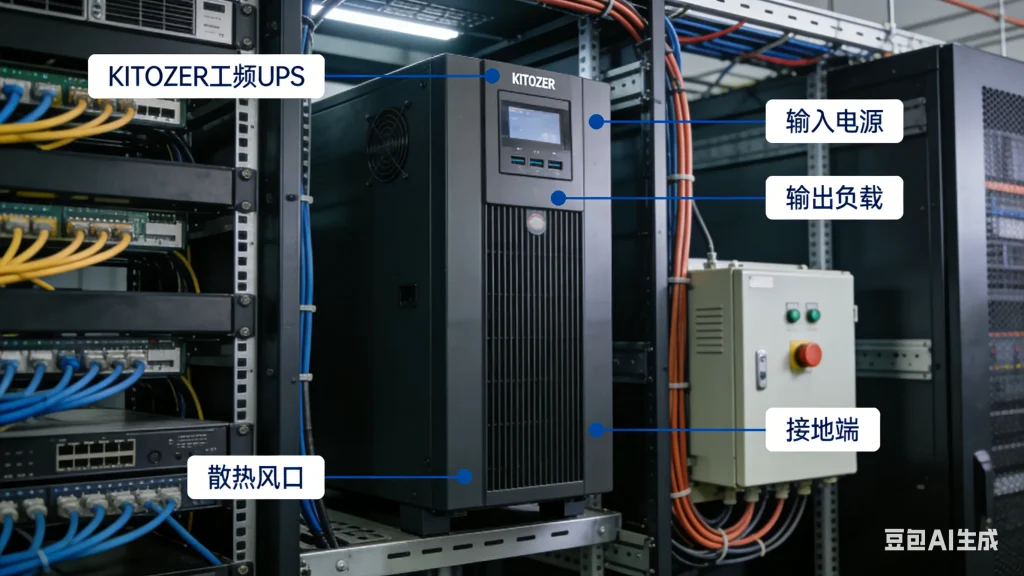
1. System Introduction
1.1 Definition of Industrial Frequency UPS
Industrial Frequency UPS (also known as line-frequency UPS) is an online uninterruptible power supply that adopts industrial frequency transformers as core components, with both rectifier and transformer operating at 50Hz (Chinese standard). Its core structure consists of SCR thyristor rectifier, IGBT inverter, static bypass, maintenance bypass and line-frequency step-up isolation transformer. Adopting double-conversion online topology, it delivers continuous, stable and pure power supply for loads.
1.2 Working Principle of Industrial Frequency UPS
The industrial frequency UPS operates in double-conversion online mode to realize two conversions of electric energy:
- Normal mains power: Mains power is converted into DC power by the rectifier. Part of the DC power charges the battery bank, and the rest is inverted into high-quality AC power via the inverter, then output to loads through the line-frequency transformer.
- Abnormal mains power: The system switches to battery power supply within milliseconds while the inverter keeps running to ensure uninterrupted operation of loads.
- Mains power recovery: The system automatically switches back to mains mode and recharges the batteries simultaneously.
- Overload/Fault condition: The static bypass switches rapidly to guarantee continuous power supply for loads. The maintenance bypass allows power-off maintenance of the UPS.
1.3 Core Differences between Industrial Frequency UPS and High-Frequency UPS
| Comparison Items | Industrial Frequency UPS | High-Frequency UPS |
|---|---|---|
| Core Component | Built-in line-frequency isolation transformer | No output isolation transformer |
| Rectification Mode | SCR thyristor line-frequency rectification (50Hz) | IGBT high-frequency rectification (kHz level) |
| Impact Resistance | Excellent (withstands 5-7 times rated current surge) | General |
| Electrical Isolation | Complete isolation with strong anti-interference capability | No isolation or external transformer equipped |
| Applicable Loads | Inductive loads, non-linear loads, impact loads | Pure resistive loads, general loads |
| Reliability | Extremely high, suitable for long-term continuous operation | High, for general applications |
| Size & Weight | Larger and heavier | Compact and lightweight |
| Efficiency | 93% – 96% at full load | 95% – 98% at full load |
2. System Composition
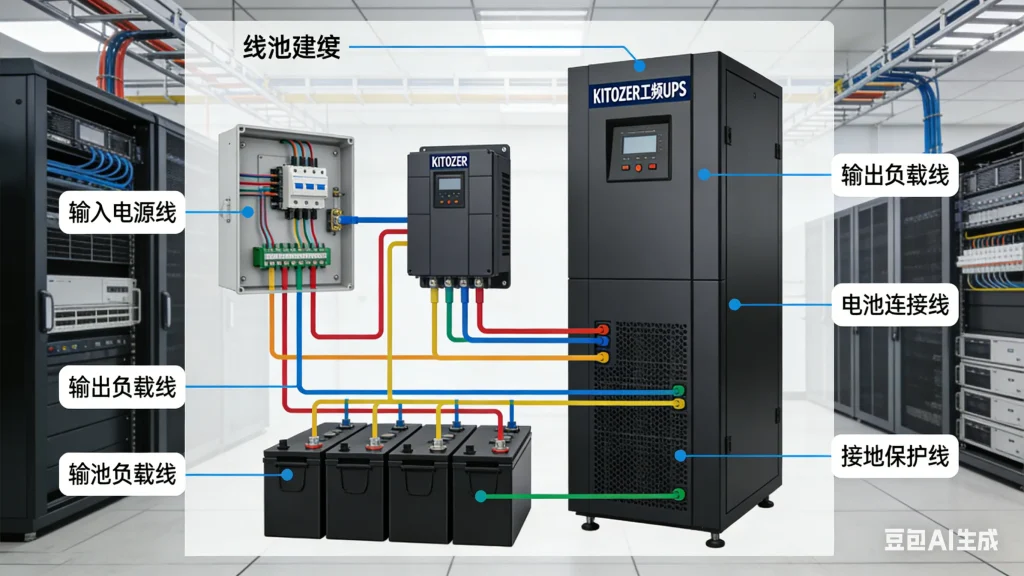
KITOZER industrial frequency UPS system is composed of the following core components to ensure high efficiency, stability and reliability of power conversion.
2.1 Core Power Modules
- SCR Thyristor Rectifier: Converts mains power to DC power. Featuring high voltage resistance, large current tolerance and strong surge resistance, it supports 6-pulse and 12-pulse rectification.
- IGBT Inverter: Converts DC power into pure AC power with total harmonic distortion (THD) less than 3%, ensuring superior power quality for loads.
- Line-Frequency Step-Up Isolation Transformer: Realizes electrical isolation, suppresses common-mode interference, boosts output voltage and enhances system surge resistance.
- Battery Bank: Provides DC power when mains fails. Configurable with voltages from 192V to 480V to match different power ratings.
2.2 Control & Protection Modules
- Intelligent Control System: Equipped with 32-bit DSP processor for real-time monitoring, logic control and fault diagnosis, with response time less than 10ms.
- Static Bypass Switch: Adopts high-power thyristors and completes switching within ≤4ms to ensure uninterrupted power supply.
- Maintenance Bypass Switch: Supports manual and automatic switching, enabling UPS maintenance without powering off and affecting load operation.
- Protection System: Integrates multiple protection functions including overvoltage, undervoltage, overcurrent, short circuit, overload, overheating and battery undervoltage. It triggers automatic alarms and protective actions once faults occur.
2.3 Monitoring & Communication Modules
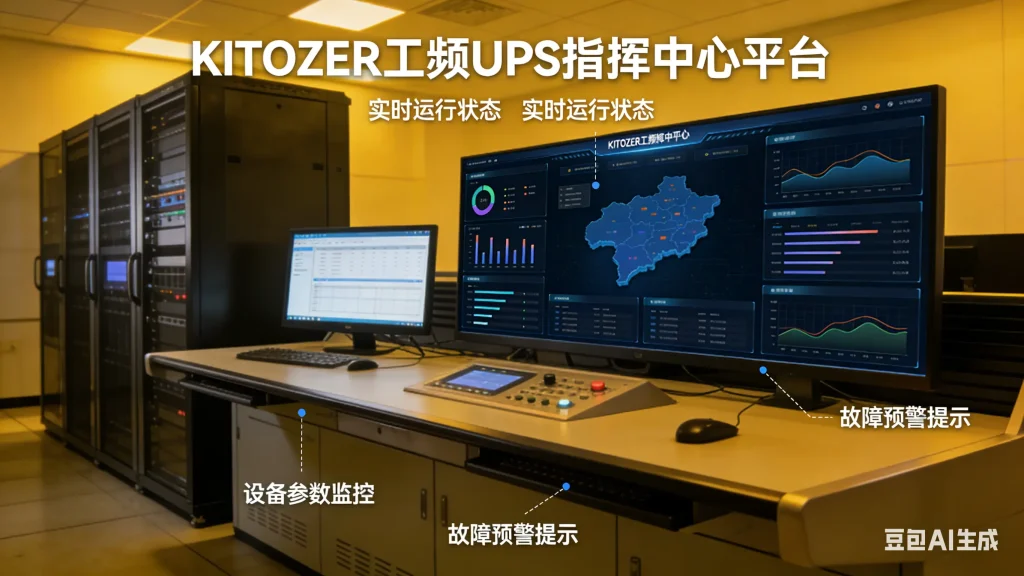
- LCD/LED Display Panel: Displays real-time operating parameters, working status and fault information of the system.
- Intelligent Monitoring Card: Supports multiple communication protocols including RS232/RS485, dry contact, SNMP and Modbus for remote monitoring and management.
- Battery Management System (BMS): Monitors battery voltage, current and temperature in real time, realizes intelligent charge and discharge control and extends battery service life.
- Remote Monitoring Software: Compatible with Web, APP and centralized monitoring platforms to achieve unified management and early fault warning for multiple devices.
3. System Classification
3.1 Classification by Power Rating
| Power Rating | Model Series | Application Scenarios |
|---|---|---|
| Low Power | 10kVA – 30kVA | Small computer rooms, laboratories, medical equipment, miniature industrial control systems |
| Medium Power | 40kVA – 100kVA | Medium-sized data centers, industrial production lines, power automation systems |
| High Power | 120kVA – 200kVA | Large data centers, IDC computer rooms, substations, metallurgy and chemical industries |
| Extra High Power | Above 200kVA | Large-scale industrial projects, power grid dispatching centers, nuclear power facilities |
3.2 Classification by Rectification Mode
- 6-Pulse Industrial Frequency UPS: Adopts three-phase six-tube thyristor rectifier circuit. With simple structure and moderate cost, it is applicable to general industrial scenarios.
- 12-Pulse Industrial Frequency UPS: Based on 6-pulse design, it is equipped with an additional input phase-shift isolation transformer. Two sets of 6-pulse rectifier bridges work in phase superposition, generating 12 current pulses per power frequency cycle. Its harmonic content is lower than 5%, ideal for sites requiring high grid power quality.
3.3 Classification by Redundancy Mode
- Standalone Operation: Single UPS works independently, for scenarios with general reliability requirements.
- N+1 Redundancy: N main UPS units plus 1 standby unit to improve system reliability, suitable for critical loads.
- Parallel Redundancy: Multiple UPS units operate in parallel with load sharing and online capacity expansion available, applied to large data centers and industrial projects.
- Dual-Bus Redundancy: Two independent UPS power supply systems work as mutual backups, for occasions demanding ultra-high reliability such as finance and military industries.
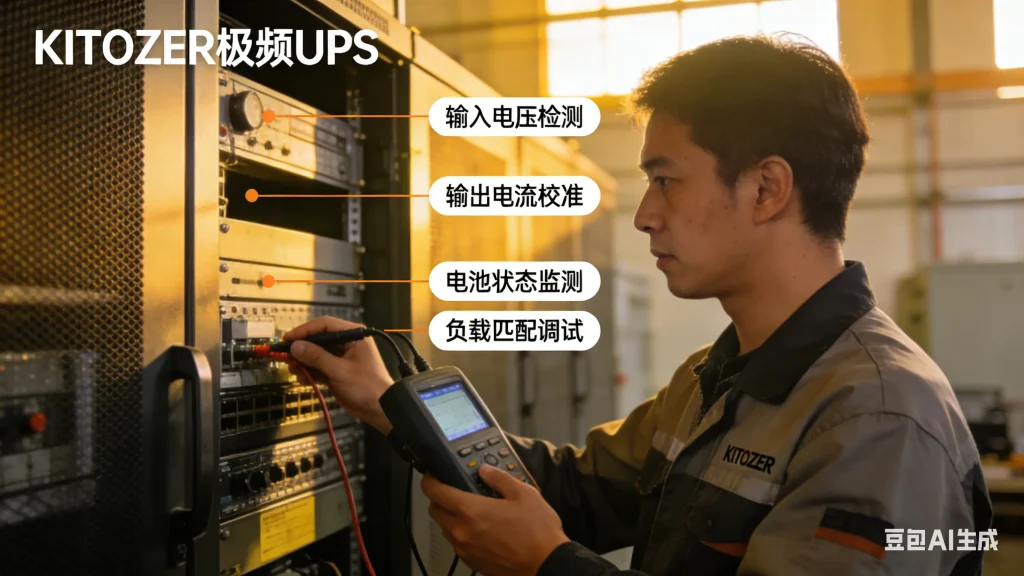
4. System Configuration List (KITOZER Brand)
4.1 Standard Configuration List
| Equipment Name | Model | Specifications | Quantity | Remarks |
|---|---|---|---|---|
| Industrial Frequency UPS Main Unit | KITOZER-GF10K~200K | 10kVA-200kVA, 3-phase 3-wire output, online line-frequency type | 1 Set | Built-in SCR rectifier, IGBT inverter and line-frequency transformer |
| Battery Bank | KITOZER-BAT12V100Ah~200Ah | 12V/100Ah-200Ah, valve-regulated lead-acid maintenance-free battery | 1 Set | Quantity configured according to backup time |
| Battery Cabinet | KITOZER-BC-01~04 | Matches different battery quantities | 1 Set | Equipped with battery connecting cables and circuit breakers |
| Input Power Distribution Cabinet | KITOZER-PDU-IN | 3-phase 5-wire, with circuit breaker and surge protector | 1 Set | Matches UPS input current |
| Output Power Distribution Cabinet | KITOZER-PDU-OUT | 3-phase 5-wire, with branch circuit breakers and monitoring meters | 1 Set | Matches load current |
| Static Bypass Cabinet | KITOZER-BYPASS | Matches UPS power rating | 1 Set | Optional, enhances system reliability |
| Maintenance Bypass Cabinet | KITOZER-MB | Matches UPS power rating | 1 Set | Optional, supports online maintenance |
| Monitoring System | KITOZER-MON-01 | Including monitoring card, software and communication cables | 1 Set | Supports remote monitoring and management |
| Battery Management Module | KITOZER-BMS-01 | Monitors parameters of single battery cell | 1 Set | Optional, extends battery service life |
| Connecting Cables | Custom | Copper core cable, flame retardant class B1 | 1 Batch | Including input, output and battery cables |
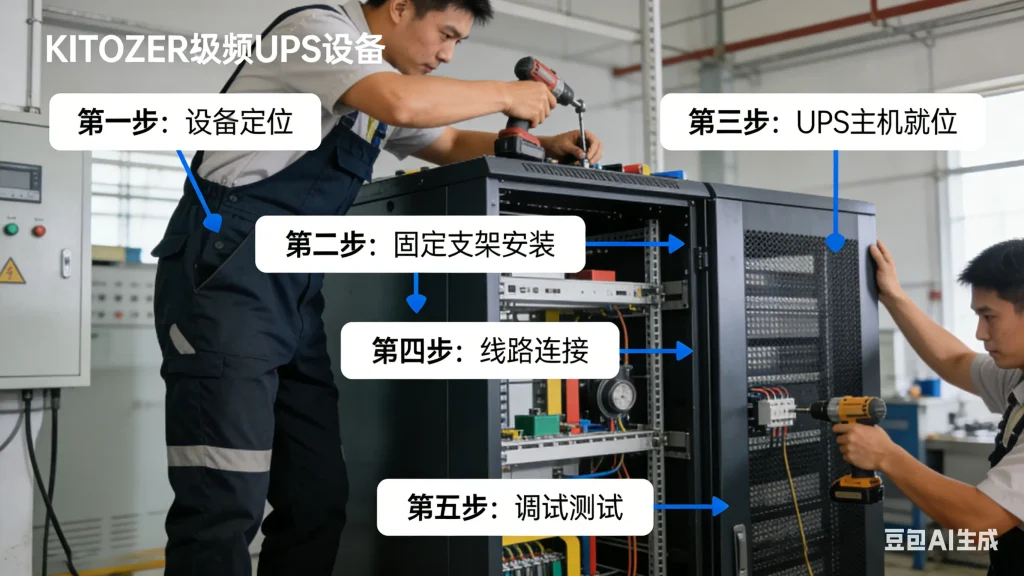
| Installation Accessories | Custom | Including fixing brackets, screws and insulating materials | 1 Set | For equipment fixing and installation |
4.2 N+1 Redundancy Configuration List
| Equipment Name | Model | Specifications | Quantity | Remarks |
|---|---|---|---|---|
| Industrial Frequency UPS Main Unit | KITOZER-GF10K~200K | 10kVA-200kVA, 3-phase 3-wire output, online line-frequency type | N+1 Sets | Supports parallel operation and load sharing |
| Shared Battery Bank | KITOZER-BAT12V100Ah~200Ah | 12V/100Ah-200Ah, valve-regulated lead-acid maintenance-free battery | 1 Set | Shared by multiple units to save investment |
| Battery Cabinet | KITOZER-BC-01~08 | Matches different battery quantities | 1-2 Sets | Equipped with battery connecting cables and circuit breakers |
| Input Power Distribution Cabinet | KITOZER-PDU-IN | 3-phase 5-wire, with circuit breaker and surge protector | 1 Set | Matches total input current |
| Output Power Distribution Cabinet | KITOZER-PDU-OUT | 3-phase 5-wire, with branch circuit breakers and monitoring meters | 1 Set | Matches total load current |
| Parallel Control Module | KITOZER-PARALLEL | Supports multi-unit parallel control | 1 Set | Ensures load sharing and synchronous operation |
| Monitoring System | KITOZER-MON-02 | Including centralized monitoring software and communication gateway | 1 Set | Realizes unified management of multiple devices |
| Other Accessories | Custom | Connecting cables and installation accessories | 1 Batch | Same as standard configuration |
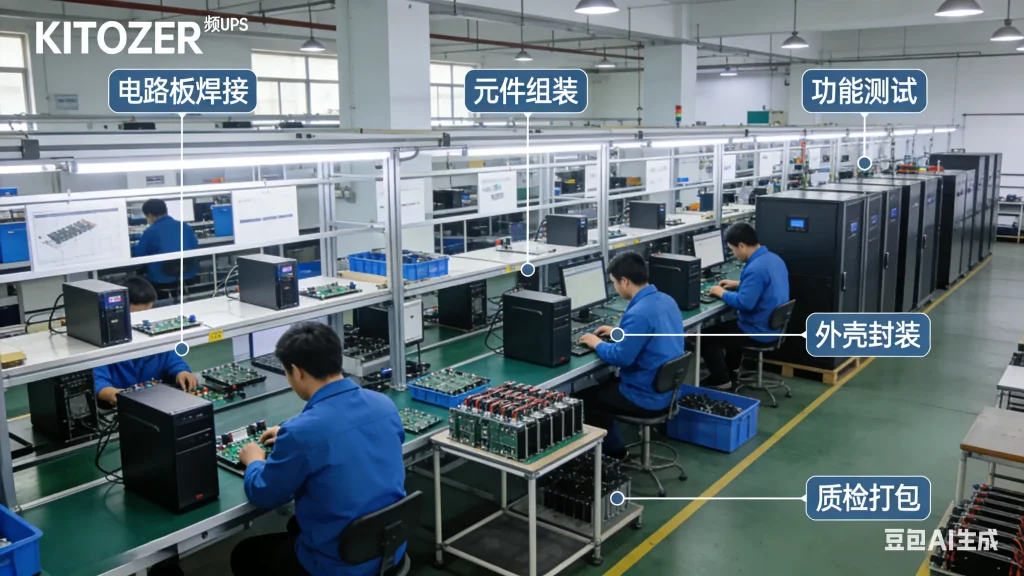
5. System Schematic Diagram
5.1 Basic Topology of Industrial Frequency UPS
Mains Input (3-phase 5-wire) → Input Circuit Breaker → Surge Protector → SCR Rectifier → DC Bus → IGBT Inverter → Line-Frequency Isolation Transformer → Output Circuit Breaker → Load