I. System Introduction
1.1 Technical Background
With the rapid development of data centers, cloud computing and artificial intelligence, computer room equipment has raised increasingly stringent requirements for power supply continuity and stability. Traditional lead-acid batteries applied in UPS systems have obvious drawbacks including large size, heavy weight, short service life, high maintenance costs and severe environmental pressure, which can no longer meet the efficient operation needs of modern computer rooms.
As a new type of green energy storage technology, Lithium Iron Phosphate (LiFePO₄) batteries feature high safety, long service life, high energy density, rapid charge-discharge capability and environmental friendliness. They have gradually become the preferred energy storage solution for computer room UPS systems, facilitating the transformation of data centers from cost centers to efficiency centers.
1.2 System Definition
This UPS lithium iron phosphate battery solution is a complete energy storage system integrating KITOZER lithium iron phosphate battery packs, intelligent Battery Management System (BMS), battery cabinets/racks and supporting electrical equipment. Specially designed for Uninterruptible Power Supplies (UPS), it delivers reliable, efficient and long-life backup power to ensure seamless switching and continuous operation of critical computer room equipment during mains power failures.
Adopting a modular design, the system supports flexible expansion and can be customized according to different power ratings and backup duration requirements.
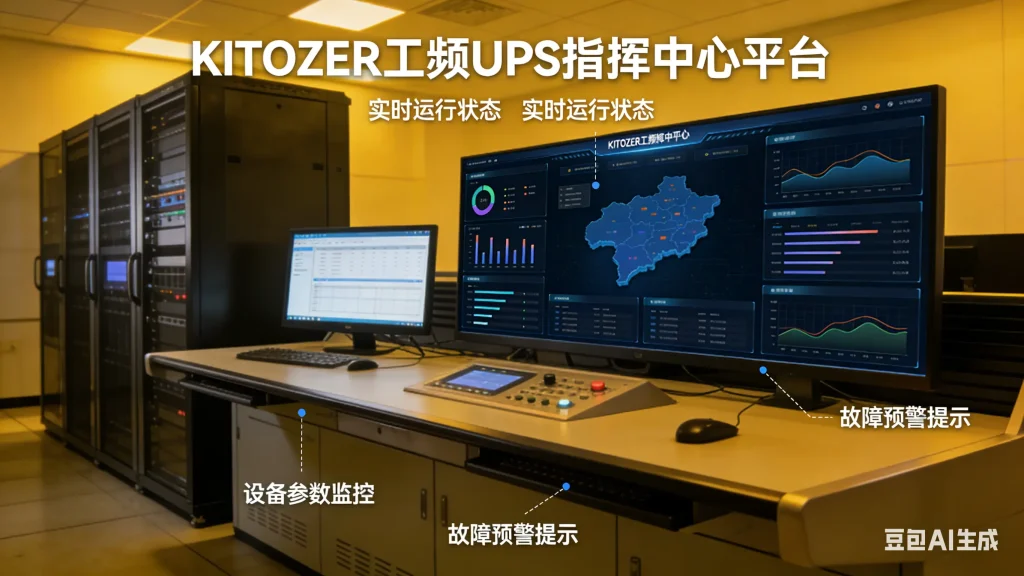
1.3 Working Principle
- Normal mains power: The UPS inverter converts mains power into stable alternating current to supply loads. Meanwhile, the charger performs float charging on the lithium iron phosphate battery packs to keep them fully charged.
- Mains power failure or abnormality: The UPS instantly switches to battery mode. KITOZER lithium iron phosphate battery packs deliver high-quality AC power to loads via the inverter to achieve zero-interruption operation.
- Mains power recovery: The UPS automatically switches back to mains mode, resuming power supply for loads and recharging the batteries.
The intelligent BMS real-timely monitors battery parameters such as voltage, current, temperature, State of Charge (SOC) and State of Health (SOH). It provides multiple protections against overcharging, over-discharging, over-current, short circuit and over-temperature to guarantee safe and stable system operation.
II. System Composition
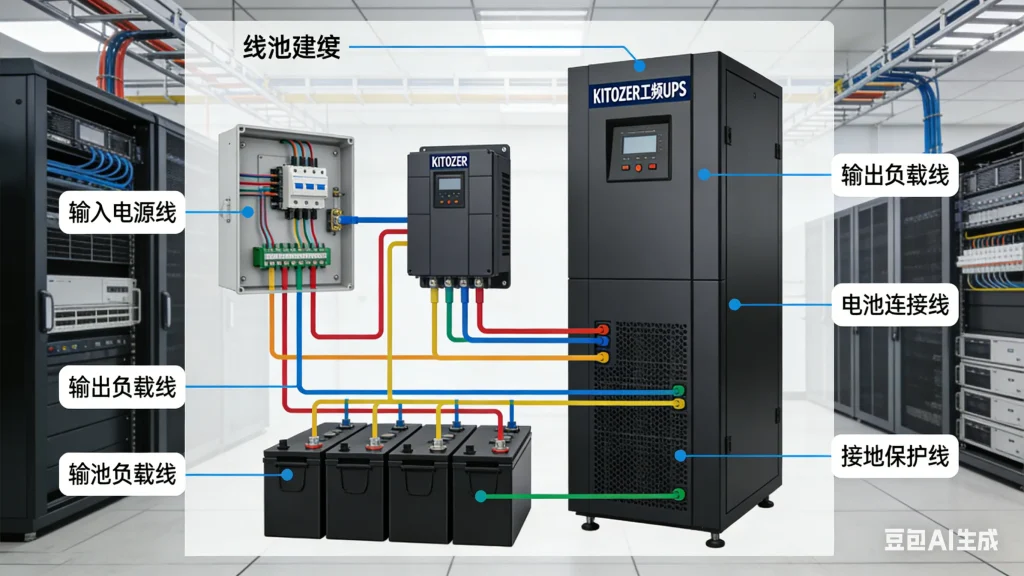
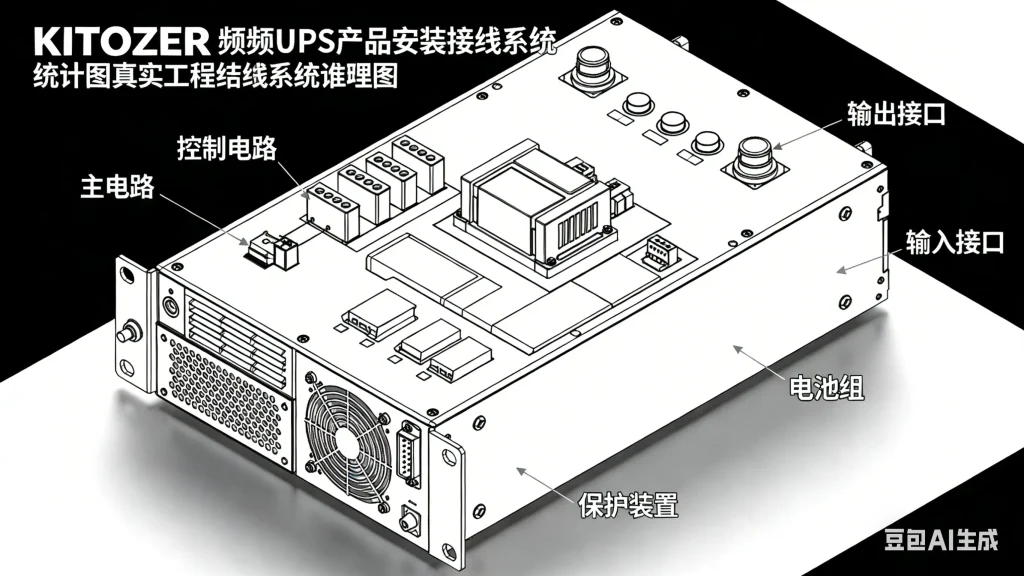
The UPS lithium iron phosphate battery system consists of the following core components, which work collaboratively to ensure stable and efficient operation:
| No. | Component Name | Function Description | Core Role |
|---|---|---|---|
| 1 | KITOZER Lithium Iron Phosphate Cell | Made of high-purity LiFePO₄ materials with advanced production techniques; features high safety, long cycle life and high-rate discharge capability | Core energy storage unit that provides stable DC power |
| 2 | Battery Management System (BMS) | Real-time monitoring of battery parameters; realizes battery balancing, charge-discharge control, fault diagnosis and protection | Ensure battery safety, extend service life and optimize performance |
| 3 | Battery Module / Battery Pack | Cells connected in series and parallel; equipped with dedicated enclosures, copper bars, connectors and insulating materials | Standardized design for easy installation, maintenance and expansion |
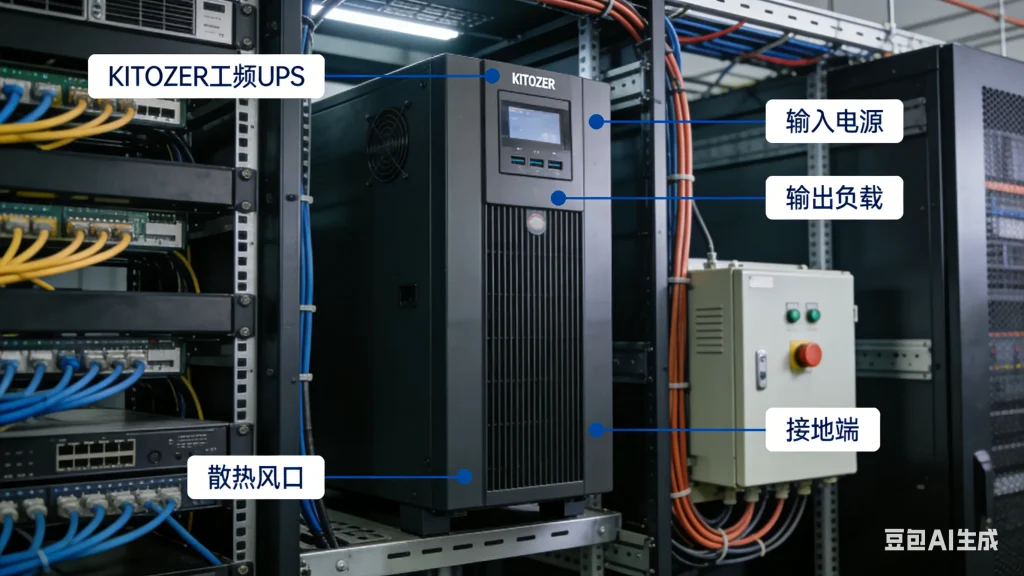
| 4 | Battery Cabinet / Rack | 19-inch standard rack or customized cabinet with ventilation, heat dissipation, fire prevention, dustproof and shockproof functions | Provide a safe installation environment and save computer room space |
| 5 | DC Circuit Breaker / Fuse | Offer overload and short-circuit protection for circuits; facilitate system maintenance and fault isolation | Ensure electrical safety and prevent fault propagation |
| 6 | Contactor / Relay | Control electrical connection and disconnection between battery packs and UPS host | Ensure reliable system switching and equipment safety |
| 7 | Heat Dissipation System | Including fans, heat sinks and air duct design; automatically adjust heat dissipation intensity based on battery temperature | Maintain optimal operating temperature of batteries and improve system stability |
| 8 | Monitoring & Communication Module | Support multiple communication interfaces such as RS485, CAN and Ethernet; accessible to computer room monitoring systems | Realize remote monitoring, data collection and fault alarm |
| 9 | Insulation Monitoring Device | Real-time detection of insulation status of the battery system to prevent electric leakage and electric shock accidents | Protect personnel and equipment safety |
| 10 | Supporting Cables & Connectors | Low-impedance, high-temperature resistant and flame-retardant cables and dedicated connectors | Reduce power loss and ensure reliable electrical connection |
III. System Classification
Classified by application scenarios and configuration modes:
3.1 Classification by Installation Mode
| Type | Features | Application Scenarios |
|---|---|---|
| Rack-mounted | Adopt 19-inch standard rack design (2U/3U/4U height); directly installed in server cabinets, space-saving and easy for centralized management | Small & medium-sized computer rooms, server cabinets, edge computing nodes, distributed data centers |
| Tower / Vertical | Independent cabinet with large capacity; suitable for high-power UPS systems with complete heat dissipation and protection functions | Large data centers, IDC rooms, cloud computing centers, enterprise-level computer rooms |
| Containerized | Integrated container design with built-in battery packs, BMS, heat dissipation and fire protection systems; rapid deployment | Expansion of large data centers, temporary computer rooms, outdoor data centers, remote computer rooms |
3.2 Classification by Capacity Configuration
| Type | Capacity Range | Typical Application |
|---|---|---|
| Small | Below 5 kWh | 1–10 kVA UPS systems, backup duration: 0.5–2 hours; for small computer rooms, network cabinets and laboratories |
| Medium | 5–50 kWh | 10–100 kVA UPS systems, backup duration: 1–4 hours; for small & medium-sized data centers, enterprise and communication computer rooms |
| Large | Above 50 kWh | UPS systems over 100 kVA, backup duration: 2–8 hours; for large data centers, cloud computing centers and supercomputing centers |
3.3 Classification by Redundancy Mode
| Type | Configuration | Reliability Level | Application Scenarios |
|---|---|---|---|
| Non-redundant | Single battery pack | Standard | Non-critical loads, small computer rooms with limited budget |
| N+1 Redundancy | Multiple parallel battery packs with one standby unit | High reliability | Computer rooms for core businesses, medium-sized data centers |
| 2N Redundancy | Two independent battery systems serving as mutual backups | Highest reliability | Financial data centers, medical systems, government core computer rooms |
IV. System Configuration List (Brand: KITOZER)
Standard configurations of KITOZER lithium iron phosphate batteries for UPS systems of different power ratings. Capacity and backup duration can be adjusted on demand.
4.1 Configuration List for Small UPS Systems (1–10 kVA)
| Equipment Name | Model | Specifications | Quantity | Remarks |
|---|---|---|---|---|
| Lithium Iron Phosphate Cell | KT-LFP-3.2V-100Ah | Nominal voltage: 3.2 V, Rated capacity: 100 Ah, Cycle life: ≥ 6000 cycles | 64 pcs | For 192 V system |
| Battery Module | KT-LFP-192V-100Ah | Nominal voltage: 192 V, Rated capacity: 100 Ah, Dimension: 600×800×200 mm | 1 set | 16S4P combination |
| BMS | KT-BMS-192V-100A | Support 16-series cell monitoring, Max. current: 100 A, Interface: RS485/CAN | 1 set | With active balancing function |
| Rack-mounted Battery Cabinet | KT-RACK-600 | Standard 19-inch, 42U height, equipped with cooling fans, guide rails and circuit breaker | 1 pc | Compatible with 19-inch server cabinets |
| DC Circuit Breaker | KT-DCB-100A | Rated voltage: DC 250 V, Rated current: 100 A | 1 pc | Over-current protection for battery packs |
| Contactor | KT-CONT-200A | Rated voltage: DC 250 V, Rated current: 200 A | 1 pc | On-off control for battery packs |
| Battery Monitoring Module | KT-MON-01 | Real-time monitoring of voltage, current and temperature; support remote communication | 1 set | Connected to computer room monitoring system |
| Connecting Cable | KT-CABLE-192V | Copper cable, Cross-section: 50 mm², Length: 3 m | 2 pcs | Connection between battery pack and UPS |
4.2 Configuration List for Medium UPS Systems (10–100 kVA)
| Equipment Name | Model | Specifications | Quantity | Remarks |
|---|---|---|---|---|
| Lithium Iron Phosphate Cell | KT-LFP-3.2V-200Ah | Nominal voltage: 3.2 V, Rated capacity: 200 Ah, Cycle life: ≥ 6000 cycles | 128 pcs | For 384 V system |
| Battery Module | KT-LFP-384V-200Ah | Nominal voltage: 384 V, Rated capacity: 200 Ah, Dimension: 800×1000×250 mm | 2 sets | 16S8P combination, parallel connection |
| BMS | KT-BMS-384V-200A | Support 32-series cell monitoring, Max. current: 200 A, Interface: RS485/CAN/Ethernet | 1 set | Master-slave control, support parallel expansion |
| Vertical Battery Cabinet | KT-CAB-800 | Dimension: 800×1000×2000 mm, with heat dissipation, fire protection interface and door lock | 2 pcs | Independent installation for easy maintenance |
| DC Circuit Breaker | KT-DCB-250A | Rated voltage: DC 400 V, Rated current: 250 A | 2 pcs | Independent protection for each battery pack |
| Contactor | KT-CONT-400A | Rated voltage: DC 400 V, Rated current: 400 A | 2 pcs | Independent control for each battery pack |
| Battery Monitoring System | KT-MON-02 | Multi-channel monitoring, Web access and historical data storage | 1 set | Centralized monitoring for multiple battery packs |
| Insulation Monitoring Device | KT-IMD-01 | Insulation resistance monitoring, Alarm threshold: 500 kΩ | 1 set | Prevent electric leakage |
| Connecting Cable | KT-CABLE-384V | Copper cable, Cross-section: 95 mm², Length: 5 m | 4 pcs | Connection between battery pack and UPS |
4.3 Configuration List for Large UPS Systems (Above 100 kVA)
| Equipment Name | Model | Specifications | Quantity | Remarks |
|---|---|---|---|---|
| Lithium Iron Phosphate Cell | KT-LFP-3.2V-300Ah | Nominal voltage: 3.2 V, Rated capacity: 300 Ah, Cycle life: ≥ 6000 cycles | 256 pcs | 384 V system, two groups in parallel |
| Battery Module | KT-LFP-384V-300Ah | Nominal voltage: 384 V, Rated capacity: 300 Ah, Dimension: 800×1000×300 mm | 4 sets | 16S10P combination, two groups in parallel |
| Master-Slave BMS | KT-BMS-384V-300A-M | Master & slave BMS, support 64-series cell monitoring, Max. current: 300 A | 1 set | With active balancing, support multi-group parallel connection |
| Containerized Battery Cabinet | KT-CON-20FT | 20-foot standard container, equipped with air conditioner, fire protection and monitoring system | 1 pc | Integrated design for rapid deployment |
| DC Circuit Breaker | KT-DCB-400A | Rated voltage: DC 500 V, Rated current: 400 A | 4 pcs | Independent protection for each battery pack |
| Contactor | KT-CONT-630A | Rated voltage: DC 500 V, Rated current: 630 A | 4 pcs | On-off control for battery packs |
| Intelligent Monitoring System | KT-MON-03 | Centralized monitoring for multiple battery packs, Web & APP remote access | 1 set | Real-time data collection and analysis |
| Insulation Monitoring Device | KT-IMD-02 | Multi-channel insulation monitoring, Alarm threshold: 1000 kΩ | 1 set | Prevent electric leakage |
| Fire Protection System | KT-FIRE-01 | Perfluorohexanone fire extinguisher with automatic detection and fire suppression | 1 set | Fire protection for battery packs |
| Connecting Cable | KT-CABLE-384V-120 | Copper cable, Cross-section: 120 mm², Length: 5 m | 8 pcs | Connection between battery pack and UPS |
V. System Schematic Diagram
5.1 Block Diagram of UPS Lithium Iron Phosphate Battery System
Mains Input ──┬── Rectifier ──┬── Inverter ──┬── Output Load
│ │ │
│ └── Static Switch ──┘
│
└── Charger ──┬── KITOZER Battery Pack ──┬── Inverter
│ │
└── BMS ────────────────────┘
│
└── Computer Room Monitoring System
5.2 System Operation Process
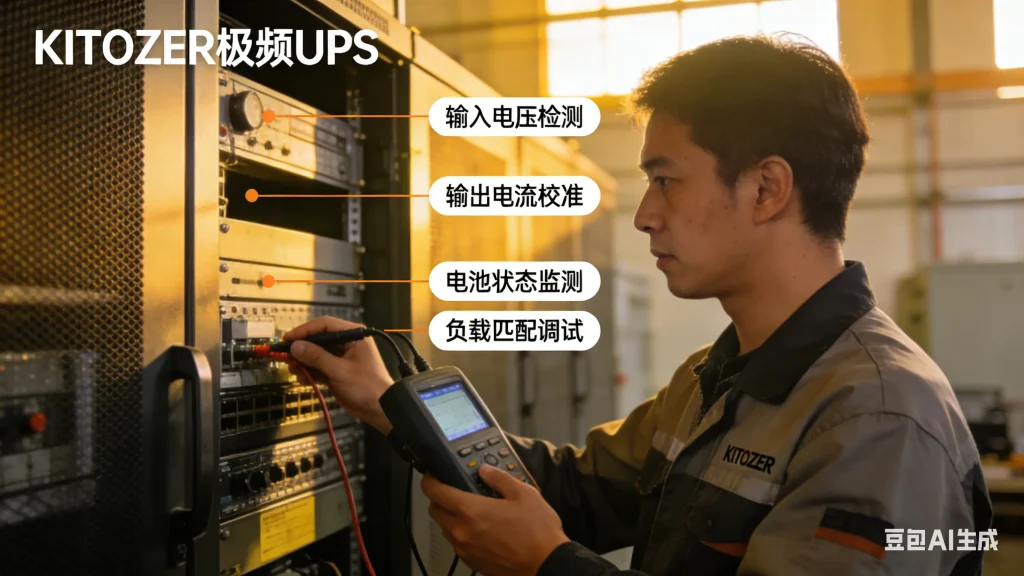
- Normal Mains Mode Mains power is converted into DC by the rectifier. Part of the power is inverted into stable AC to supply loads; the rest charges the battery packs via the charger. BMS monitors battery status to ensure safe charging.
- Mains Failure Mode The UPS switches to battery mode instantly with the static switch completing switching within ≤2 ms. The battery packs supply AC power to loads through the inverter. BMS monitors discharge status to avoid over-discharging.
- Mains Recovery Mode The UPS returns to mains mode automatically. The charger recharges batteries to full capacity, and BMS adjusts charging parameters to maintain battery health.
- Fault Protection Mode Once BMS detects abnormalities such as over-voltage, under-voltage, over-current or over-temperature, it disconnects the battery pack from the UPS and sends alarm signals to the UPS and monitoring system to contain faults.
VI. Product Technical Parameters
6.1 Parameters of KITOZER Lithium Iron Phosphate Cell
| Parameter | Specification | Description |
|---|---|---|
| Battery Type | Lithium Iron Phosphate (LiFePO₄) | High safety; Thermal runaway temperature > 500 ℃ |
| Nominal Voltage | 3.2 V | Standard voltage of single cell |
| Rated Capacity | 100 Ah / 200 Ah / 300 Ah | Multiple options available |
| Charge Cut-off Voltage | 3.65 V | Maximum charging voltage |
| Discharge Cut-off Voltage | 2.5 V | Minimum discharge voltage |
| Max. Charging Current | 1C | Fast charging capability |
| Max. Discharging Current | 3C | High-rate discharge for instantaneous large current demand of UPS |
| Cycle Life | ≥ 6000 cycles @ 80% DOD | 3–5 times longer than traditional lead-acid batteries |
| Operating Temperature | -20 ℃ ~ 60 ℃ | Wide temperature adaptability for computer room environment |
| Storage Temperature | -30 ℃ ~ 60 ℃ | Excellent long-term storage stability |
| Energy Density | ≥ 150 Wh/kg | High energy density to save space |
| Internal Resistance | ≤ 0.5 mΩ | Ultra-low internal resistance for superior high-current discharge performance |
| Safety Protection | Overcharge, overdischarge, overcurrent, short circuit & over-temperature protection | Multiple safeguards against thermal runaway |
6.2 Parameters of KITOZER Battery Module
| Parameter | Specification | Description |
|---|---|---|
| Nominal Voltage | 48 V / 96 V / 192 V / 384 V | Compatible with UPS of different power ratings |
| Rated Capacity | 50 Ah / 100 Ah / 200 Ah / 300 Ah | Multiple options available |
| Combination Mode | 16S / 32S / 64S | Series connection to meet UPS voltage requirements |
| Dimension | 600×800×200 mm / 800×1000×300 mm | Standard rack-mounted or vertical design |
| Weight | 50 kg / 100 kg / 200 kg | 40%–60% lighter than lead-acid batteries |
| Ingress Protection | IP20 / IP30 | Dustproof and electric shock prevention for computer rooms |
| Cooling Mode | Natural cooling / Forced air cooling | Ensure batteries work at optimal temperature |
| Communication Interface | RS485 / CAN / Ethernet | Support remote monitoring and management |
| Balancing Mode | Active balancing | Improve battery consistency and extend service life |
| Service Life | ≥ 10 years | Reduce replacement frequency and total cost of ownership |
6.3 Parameters of KITOZER BMS
| Parameter | Specification | Description |
|---|---|---|
| Monitoring Channels | 16 / 32 / 64 series | Compatible with different battery packs |
| Measurement Accuracy | Voltage: ±0.5%, Current: ±1%, Temperature: ±1 ℃ | High-precision monitoring |
| Balancing Current | 5 A / 10 A | Active balancing for better battery consistency |
| Communication Protocol | Modbus-RTU / CANopen | Compatible with mainstream monitoring systems |
| Protection Functions | Overcharge, overdischarge, overcurrent, short circuit, over-temperature & insulation monitoring | Full-range battery protection |
| Operating Voltage | DC 24 V / DC 48 V | Adapt to different power supply systems |
| Operating Temperature | -10 ℃ ~ 50 ℃ | Suitable for computer room environment |
| Storage Temperature | -20 ℃ ~ 60 ℃ | Stable for long-term storage |
| Communication Interface | RS485 / CAN / Ethernet / Wi-Fi | Diverse interfaces for remote monitoring |
| Data Storage | ≥ 1000 historical records | For fault analysis and traceability |
| Alarm Function | Audible & visual alarm, remote alarm | Timely fault detection and handling |
VII. Application Scope
This solution is applicable to various computer rooms and data centers:
7.1 Data Centers & IDC Rooms
- Large cloud computing data centers: High-reliability long-life backup power; peak load shifting to cut operational costs
- Small & medium-sized IDC rooms: Space-saving, higher space utilization and lower maintenance costs
- Edge computing nodes: Modular design for rapid and distributed deployment
7.2 Enterprise & Government Computer Rooms
- Financial institutions: Ensure continuous operation of trading systems and avoid economic losses from power outages
- Government departments: Guarantee stable operation of government service systems
- Medical institutions: Keep medical equipment running continuously to safeguard life safety
- Education & research institutes: Protect research data and support uninterrupted scientific work
7.3 Communication & Network Computer Rooms
- Telecom operator rooms: Ensure continuous network operation and service quality
- Internet enterprise rooms: Maintain stable operation of server clusters
- IoT platform rooms: Guarantee uninterrupted data collection and transmission
7.4 Industrial & Energy Computer Rooms
- Intelligent manufacturing workshops: Protect PLC control systems and avoid production line shutdown
- Power system rooms: Ensure stable power dispatch and grid safety
- Petrochemical rooms: Keep production control systems running for safe production
7.5 Special Environment Computer Rooms
- Outdoor data centers: Adapt to harsh environments with reliable backup power
- Vehicle-mounted computer rooms: Modular design for mobile scenarios
- Military computer rooms: High safety for special operating conditions
VIII. Product Advantages
Compared with traditional lead-acid batteries:
8.1 High Safety & Low Risks
- Inherent safety: LiFePO₄ material with thermal runaway temperature over 500 ℃; only fumes instead of explosion even under extreme puncture
- Full-range protection: BMS provides multi-level protection against abnormal working conditions
- Optional perfluorohexanone fire suppression system for automatic fire detection and extinguishing
- Real-time insulation monitoring to eliminate electric leakage risks
8.2 Long Service Life & Lower Total Cost of Ownership
- Cycle life ≥ 6000 cycles (80% DOD), 3–5 times longer than lead-acid batteries
- Overall service life ≥ 10 years, reducing equipment replacement frequency
- Maintenance-free design, no regular water addition or equalizing charging required
- High residual value for battery recycling after service life, lowering environmental disposal costs
8.3 High Efficiency & Higher Room Benefits
- Energy density over twice that of lead-acid batteries, saving 50%–70% space
- 60% lighter weight, lowering building load-bearing requirements and construction costs
- Charge-discharge efficiency ≥ 95%, 5%–10% higher than lead-acid batteries for power saving
- Support peak load shifting to cut electricity expenses and transform cost centers into profit centers
8.4 Flexible Expansion & Strong Compatibility
- Modular design with parallel connection support for flexible capacity expansion
- Multiple voltage specifications compatible with UPS of all power levels
- Diversified installation modes: rack-mounted, tower and containerized
- Seamless compatibility with mainstream UPS brands including Huawei, Santak, Eaton and Kehua
8.5 Intelligent Management & Easy Operation & Maintenance
- BMS intelligent monitoring for early fault warning and reduced maintenance difficulty
- Web & APP remote access for real-time status check without on-site patrol
- Historical data recording for fault traceability and parameter optimization
- Audible, visual and remote alarms for timely fault handling
8.6 Eco-Friendly & Policy-Compliant
- Free of heavy metals such as lead and cadmium, compliant with RoHS standards
- Recyclable battery materials to reduce environmental pressure
- High energy efficiency cuts energy waste and PUE value
- Align with national dual-carbon goals and green data center construction policies
IX. Bidding Technical Parameters
9.1 Core Bidding Parameters
| Parameter | Bidding Requirement | Explanation |
|---|---|---|
| Battery Type | Must be lithium iron phosphate (LiFePO₄); ternary lithium and other types are prohibited | Ensure system safety |
| Cell Brand | Original KITOZER products; original certification documents required | Guarantee product quality and after-sales service |
| Cycle Life | ≥ 6000 cycles @ 80% DOD; third-party test report required | Long service life and low total cost |
| Energy Density | ≥ 150 Wh/kg; third-party test report required | High energy density for space saving |
| Operating Temperature | -20 ℃ ~ 60 ℃; third-party test report required | Adapt to computer room environment |
| BMS Function | Equipped with active balancing function; balancing current ≥ 5 A | Improve battery consistency and service life |
| Protection Functions | Equipped with overcharge, overdischarge, overcurrent, short circuit, over-temperature and insulation monitoring | Ensure system reliability |
| Communication Interface | Support RS485/CAN/Ethernet and Modbus-RTU protocol | Accessible to computer room monitoring systems |
| Service Life | ≥ 10 years; warranty commitment required | Reduce replacement frequency |
| Certifications | Pass CE, UL, RoHS certifications; certificates required | Comply with international standards |
9.2 System Bidding Parameters
| Parameter | Bidding Requirement | Explanation |
|---|---|---|
| Module Voltage | Matched with UPS system; tolerance ≤ ±1% | Ensure compatibility |
| Module Capacity | Meet required backup duration; tolerance ≤ ±2% | Satisfy power backup demand |
| Charging Efficiency | ≥ 98%; third-party test report required | High energy efficiency |
| Discharging Efficiency | ≥ 95%; third-party test report required | Stable power supply |
| Switching Time | UPS switching to battery mode ≤ 2 ms | Zero interruption for loads |
| Ingress Protection | Cabinet protection grade ≥ IP20 | Ensure on-site safety |
| Heat Dissipation | Intelligent heat dissipation with automatic adjustment by temperature | Maintain optimal battery temperature |
| Monitoring Function | Remote monitoring supported with Web & APP access | Convenient O&M |
| Compatibility | Compatible with mainstream UPS brands | Smooth system integration |
| Warranty | Battery pack ≥ 5 years; BMS ≥ 3 years | Reliable after-sales service |
9.3 Safety Bidding Parameters
| Parameter | Bidding Requirement | Explanation |
|---|---|---|
| Thermal Runaway Temperature | ≥ 500 ℃; third-party test report required | Inherent system safety |
| Short Circuit Protection | Short circuit protection enabled; short-circuit current ≤ 10 times rated current | Prevent battery damage and fire risks |
| Overcharge Protection | Charge cut-off voltage ≤ 3.65 V per cell | Avoid overcharge damage |
| Overdischarge Protection | Discharge cut-off voltage ≥ 2.5 V per cell | Avoid overdischarge damage |
| Over-temperature Protection | Protection triggered ≤ 60 ℃ | Prevent thermal runaway |
| Insulation Monitoring | Insulation resistance ≥ 1000 kΩ | Prevent electric leakage |
| Fire Protection | Optional perfluorohexanone automatic fire suppression system | Improve overall safety |
| Standard Compliance | Comply with GB/T 31467.3-2015 | Meet national safety standards |
X. Dedicated Solutions
10.1 Solution for Small Computer Room UPS
Application Scenarios
1–10 kVA UPS systems, backup duration 0.5–2 hours; small enterprise rooms, network cabinets, edge computing nodes and laboratories.
Features
- Adopt 192V/100Ah lithium iron phosphate modules with standard 19-inch rack design for space saving
- Integrated intelligent BMS for real-time monitoring and protection
- Plug-and-play design for low deployment cost
- Fully compatible with mainstream small UPS brands
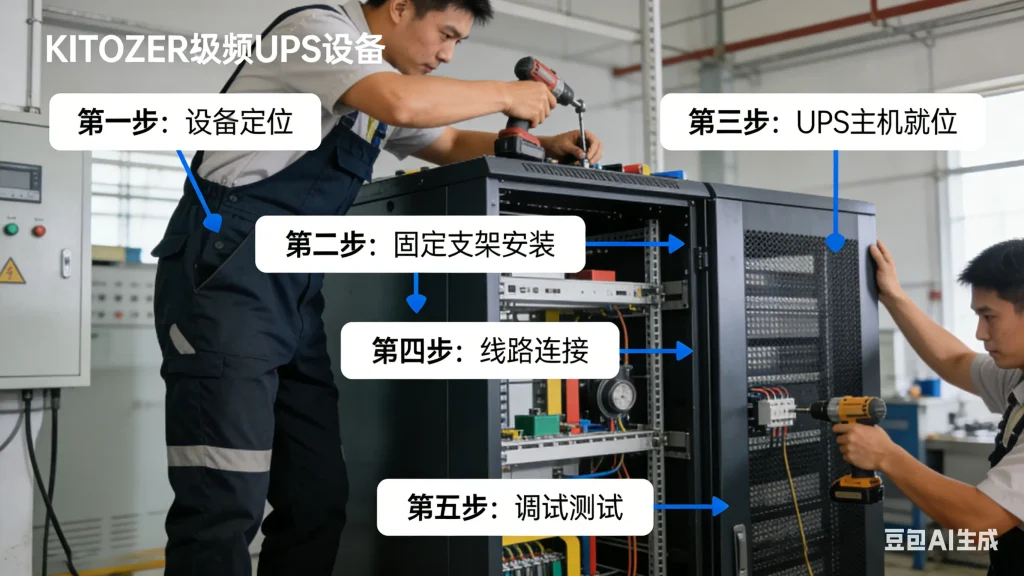
Implementation Steps
- Evaluate load and backup duration to confirm battery capacity
- Select matched KITOZER battery modules
- Install modules into 19-inch server cabinets
- Complete wiring and system commissioning
- Connect to computer room monitoring system for remote management
10.2 Solution for Medium Computer Room UPS
Application Scenarios
10–100 kVA UPS systems, backup duration 1–4 hours; small & medium-sized data centers, enterprise and communication rooms.
Features
- 384V/200Ah tower-type battery modules with large capacity and high reliability
- Master-slave BMS supporting parallel connection for N+1 redundancy
- Built-in heat dissipation and fire protection systems
- Support peak load shifting to cut operational costs
Implementation Steps
- Evaluate load, backup duration and redundancy requirements
- Configure 384V/200Ah modules with N+1 redundancy
- Install cabinets, heat dissipation and fire protection devices
- Complete wiring, commissioning and linkage test
- Deploy intelligent monitoring system for remote management and data analysis
10.3 Solution for Large Data Center UPS
Application Scenarios
UPS above 100 kVA, backup duration 2–8 hours; large data centers, cloud computing centers and supercomputing centers.
Features
- 384V/300Ah modules with containerized design for rapid deployment
- Multi-level BMS supporting parallel connection for 2N redundancy
- Integrated air conditioning, fire protection and monitoring for all-in-one management
- Solar-storage integration supported to improve energy efficiency and reduce PUE
Implementation Steps
- Comprehensive assessment of load, backup duration, redundancy and energy strategy
- Design battery system with 2N redundancy, peak load shifting and solar-storage integration
- Deploy containerized cabinets with supporting auxiliary systems
- Complete joint commissioning with UPS, photovoltaic and power grid systems
- Deploy big data analysis platform for operation optimization
10.4 Retrofit Solution for Traditional Lead-Acid Battery Systems
Application Scenarios
Renovation of existing lead-acid battery UPS systems; computer rooms requiring higher reliability, longer service life and lower maintenance costs.
Features
- Direct replacement of lead-acid batteries without modifying original UPS equipment
- Dedicated adapters for existing battery racks to reduce renovation costs
- Integrated BMS for intelligent management and improved safety
- 3–5 times longer service life and over 70% lower maintenance costs
Implementation Steps
- Assess existing UPS and racks to formulate replacement plan
- Select matched lithium iron phosphate modules and adapters
- Remove old lead-acid batteries and install new modules
- Complete wiring and system commissioning
- Deploy monitoring system for real-time and remote management
XI. Application Cases
11.1 Case 1: UPS Renovation for a Financial Data Center
Project Background
A large bank’s data center originally used lead-acid batteries, which suffered from large size, heavy weight, short life and high maintenance costs. The room had limited space for expansion, so KITOZER lithium iron phosphate solution was adopted for upgrading.
Configuration
- UPS: 4 sets of 200 kVA UPS with 2N redundancy
- Battery system: 4 sets of 384V/300Ah modules with 2N redundancy
- Backup duration: 3 hours at full load
- Function: Peak load shifting
Effect
- Space reduced by 60%, weight reduced by 50%, supporting server expansion
- Service life extended from 3 years to 10 years
- Maintenance costs cut by over 70%
- System availability increased from 99.99% to 99.999%
- Annual electricity cost saved by about 2 million RMB via peak load shifting
11.2 Case 2: New Cloud Computing Center Project
Project Background
A cloud computing company built a new data center requiring high reliability, long service life, low PUE and rapid deployment. The solar-storage integrated KITOZER solution was applied.
Configuration
- UPS: 8 sets of 500 kVA UPS with 2N redundancy
- Battery system: 16 sets of 384V/300Ah containerized modules with 2N redundancy
- Photovoltaic system: 1 MW solar power generation system
- Backup duration: 4 hours at full load
- PUE controlled below 1.2
Effect
- Containerized design shortened construction period by 50% (completed in 30 days)
- PUE dropped from 1.5 to 1.18, saving about 8 million RMB on electricity annually
- System availability reached 99.9999%
- Annual carbon emission reduced by about 4,500 tons
11.3 Case 3: New Government Computer Room Project
Project Background
A government department built a government cloud computer room with requirements for high safety, long service life, maintenance-free operation and environmental compliance.
Configuration
- UPS: 2 sets of 50 kVA UPS with N+1 redundancy
- Battery system: 2 sets of 384V/200Ah modules with N+1 redundancy
- Backup duration: 2 hours at full load
Effect
- Inherently safe lithium iron phosphate with multi-protection to eliminate fire risks
- Annual maintenance cost saved by about 100,000 RMB
- Heavy-metal free, fully compliant with green government procurement policies
- N+1 redundancy ensures stable operation of government services
11.4 Case 4: Edge Computing Node UPS Project
Project Background
An internet company deployed edge computing nodes in remote areas, requiring compact size, light weight, high reliability and easy maintenance under harsh environments.
Configuration
- UPS: 1 set of 10 kVA UPS (standalone)
- Battery system: 1 set of 192V/100Ah rack-mounted module
- Backup duration: 1 hour at full load
Effect
- Rack-mounted design saved 60% room space
- Plug-and-play for fast deployment and low construction cost
- Stable operation within -20 ℃ ~ 60 ℃
- Remote monitoring eliminated on-site patrol work
XII. Search Keywords, SEO & Tags
12.1 Search Keywords
- Lithium Iron Phosphate Battery Solution for Computer Room UPS
- KITOZER Lithium Iron Phosphate Battery
- Lithium Battery for Data Center UPS
- UPS Battery Renovation for Computer Room
- UPS System with Lithium Iron Phosphate Battery
- Energy Storage Solution for Green Data Center
- Bidding Parameters for Computer Room UPS Battery
- Lead-Acid Battery Replacement Solution
- High-Reliability UPS Battery System
- Long-Life UPS Battery Solution
12.2 SEO Keywords
- Computer Room UPS Lithium Iron Phosphate Battery
- KITOZER UPS Battery
- Lithium Iron Phosphate Battery for Data Center
- UPS Lithium Battery Solution
- Computer Room UPS Battery
- Application of Lithium Iron Phosphate Battery
- Green Data Center UPS
- UPS Battery Bidding Parameters
- Lead-Acid Battery Renovation
- Computer Room UPS System
12.3 Tags
#ComputerRoomUPS #LithiumIronPhosphateBattery #KITOZER #DataCenter #EnergyStorageSystem #UPSSolution #GreenDataCenter #BatteryRenovation #BiddingParameters #ApplicationCase #BMS #IntelligentManagement #MaintenanceFree #HighReliability #EcoFriendly #LongServiceLife #EdgeComputing #PeakLoadShifting #SolarStorageIntegration #DualCarbonGoal