KITOZER Perimeter Intrusion Alarm System: Active Infrared Beam, Microwave Barrier, Vibration Cable and Leaky Coaxial Fence Detection
The KITOZER perimeter intrusion alarm system is an integrated electronic security platform designed to detect, verify and report unauthorized crossing, climbing, cutting or approaching of an outer boundary before an intruder reaches a building, plant, storage yard, runway, cell block or equipment enclosure. Supplied and engineered by Guangzhou Laian Intelligent System Development Co., Ltd. under the KITOZER brand, the platform combines several complementary detection technologies – active infrared beam detectors, microwave barriers, vibration-sensing cable, leaky coaxial cable fence detection, electric fence tension detection and dual-technology video verification – with a central control panel, network alarm host, monitoring software, outdoor siren and strobe, and integration to existing CCTV, access control, VMS and building management systems. This page explains how each technology works, what detection distance and beam count each model offers, how the components fit together, how the system is selected, installed, commissioned and maintained, where it is deployed, how false alarms are reduced, and what a reference price range looks like. It is written for security consultants, system integrators, facility managers, end-user procurement teams and engineers who need a complete technical and commercial reference for a multi-technology perimeter protection project.
Figure 1: KITOZER active infrared beam detector pair mounted on a perimeter wall, with the transmitter on one pillar and the receiver on the opposite pillar, forming an invisible detection plane across the wall coping.
1. Product Overview
1.1 What a perimeter intrusion alarm system does
A perimeter intrusion alarm system is the outermost layer of an electronic security design. Its job is to raise an alert at the boundary line – the fence, wall, gate, ditch, riverbank, roadside or runway edge – rather than waiting for an intruder to reach the front door, the server room or the switchgear. Early warning gives security staff minutes, not seconds, to observe the event, dispatch a guard, check the live camera and decide whether the alert is a real intrusion, an animal, a blowing object, a branch in the wind, or a technical fault. The KITOZER system is built around this principle: detect at the fence, verify with video, report to the platform, record the event, and store the evidence. The platform does not replace the guard force; it extends the guard’s attention across every meter of a long, dark, remote boundary that a human patrol can only walk past occasionally.
The KITOZER portfolio also includes the associated hardware that a perimeter project needs: the galvanised steel posts and adjustable brackets, the weatherproof pole-mount and wall-mount control cabinets, the DC UPS and surge protection, the outdoor siren and LED strobe, the long-range PTZ and thermal cameras, the white-light floodlights, the 4G router and fibre switch, and the monitoring software with a web dashboard and a phone app. The system is supplied as a complete package rather than as separate components, which means the customer works with one accountable supplier for design, supply, installation guidance, commissioning, training and after-sales support. This page is written as a technical and commercial reference: it explains the detection technologies, the specifications, the components, the integration, the selection logic, the installation layout, the false-alarm measures, the applications, the maintenance, the frequently asked questions and the reference price, so that a buyer can prepare a procurement decision and an integrator can prepare a design.
The core output of the system is a structured alarm event that carries a zone name, a sensor type, a timestamp, a priority level, a linked camera preset, a recording segment and a push notification to the guard phone or control-room workstation. That event is what allows an organization to move from reactive alarm handling to planned response. The KITOZER perimeter host accepts wired (RS-485, TCP/IP, dry contact), wireless (4G/LoRa) and bus (KNX, Modbus) connections from detectors, performs local logic, and forwards events to the central software over Ethernet or 4G. The same event can trigger a PTZ camera preset, switch on a floodlight, sound a siren, close a gate arm, or write a record to a database for later compliance review.
1.2 Why multiple technologies are used together
No single perimeter sensor is perfect for every environment. Active infrared beams are cheap, easy to align and work in straight corridors, but they can be defeated by crawling under the lowest beam and are disturbed by rain, fog, falling leaves and small animals. Microwave barriers see through obstacles and cover a volumetric corridor, but they can be affected by moving vegetation, traffic vibration and metal objects. Vibration cable picks up cutting, climbing and hammering on a fence or wall, but it does not detect someone walking across open ground. Leaky coaxial cable creates an invisible detection field buried along a fence or laid in a ditch, but it is more expensive to install. Electric fence and tension wire deterrence stops climbing in its tracks but requires high-voltage design and local regulation. The KITOZER approach is to combine two or more technologies on the same boundary, so that an intrusion must defeat every layer at once to go unnoticed, and so that a fault in one sensor does not leave a blind gap. Typical layered designs are: outer microwave volumetric corridor plus inner IR beam on the wall, or fence-mounted vibration cable plus buried leaky coax plus CCTV verification.
1.3 System architecture at a glance
A typical KITOZER perimeter installation has four tiers. The sensing tier is made up of detector pairs or sensor cables distributed along the boundary, each in an IP65/IP67 outdoor enclosure. The transmission tier runs RS-485 bus, Ethernet, fibre or 4G back to a local junction box or pole-mount control cabinet. The local logic tier is an outdoor alarm host or network control panel that monitors tamper switches, supervises sensor line integrity, powers the detectors, and makes instant alarm decisions. The management tier is the central monitoring software running on a workstation or server, which shows a site map, receives events, controls PTZ presets, plays back recordings, manages users, and exports reports. Sirens, strobes, floodlights, gate controllers and push notification phones are the output tier that closes the response loop. The KITOZER pole-mount cabinet (shown later in this page) is the field junction that hosts the local power supply, surge protection, alarm host, 4G router and fibre switch in a single weatherproof box.
2. Detection Technologies
2.1 Active infrared beam detector
The active infrared (IR) beam detector is the most widely used perimeter sensor in the KITOZER portfolio. It consists of a transmitter unit that emits one or more pulsed infrared beams and a matching receiver unit that sits opposite. When a beam is interrupted – when a person, animal or object crosses the line between transmitter and receiver – the receiver detects the loss of modulated light and closes an alarm relay. Modern KITOZER IR beams use pulsed, modulated infrared at a wavelength around 940 nm, automatic gain control, digital signal processing and multi-beam stacking (2, 3 or 4 beams) so that a bird, a falling leaf or a blade of grass does not cut all beams at the same height and trigger a false alarm. The beams are stacked vertically at fixed intervals, typically 100 mm, 150 mm or 200 mm apart, so that a human body must interrupt at least two beams to produce an alarm. This multi-beam logic is the main reason active IR is preferred over a single-beam photo cell for security use.
KITOZER offers active IR beams with outdoor detection ranges from 20 m up to 300 m, in 2-beam, 3-beam and 4-beam configurations. The indoor range is longer than the outdoor range, because outdoor atmosphere absorbs and scatters the beam. Weather performance is specified as working in light rain, fog and snow, but heavy fog or a sandstorm can attenuate the beam enough to cause a trouble signal; the receiver reports a low-signal or trouble condition rather than a false intrusion alarm, so the control panel can log it as a supervision fault. Housing is usually ABS engineering plastic or aluminium with a polycarbonate window, rated IP55 or IP65, with an operating temperature range from -25 degC to +55 degC and adjustable mounting brackets. Alignment is done with the included sighting tool or laser pointer: the installer aims the transmitter at the receiver, watches the signal-strength LED, and tightens the bracket once the signal is maximum. Alignment is the single most important installation task; a poorly aligned beam that sits at 60 percent signal margin will drift into trouble the first time the wall expands in summer heat.
Active IR beams are typically mounted on the wall coping, on top of a fence post, on a dedicated steel post, or across a gate opening. They are used to protect straight runs, gate openings, driveway approaches, roof edges, window lines and the edge of a loading dock. They are not recommended for long curved boundaries, for sites where vegetation will grow across the beam, or for sites where small animals have free access at beam height. In those cases a microwave barrier or a buried leaky coax is a better primary sensor, with IR beams used as a secondary line.
2.2 Microwave barrier (radar fence)
The microwave barrier is a pair of units – a transmitter and a receiver – that establish a continuous radio-frequency beam in the K-band or X-band, typically around 10.525 GHz or 24 GHz. The transmitter radiates a focused microwave beam; the receiver measures the received energy. When a moving object enters the beam corridor, it changes the received energy by reflection and Doppler shift, and the detector triggers. Unlike infrared, microwaves pass through light rain, fog, snow, dust, foliage and non-metallic obstacles, so the barrier works in conditions that would blind an IR beam. The detection corridor is volumetric: it has a defined width and height, and it can be tuned to ignore objects below a certain size or moving at a certain speed. KITOZER microwave barriers are available with outdoor ranges from 20 m to 150 m and are used on straight fence lines, along a perimeter road, around a compound, across a river crossing and along a runway edge.
The main weakness of microwave is its sensitivity to moving vegetation, traffic vibration, swaying signs and metal objects in the background. A microwave barrier aimed at a hedge that blows in the wind will alarm. A barrier mounted too close to a public road will alarm at passing trucks. Good installation practice is to keep the beam at least 1 m away from any moving vegetation, to avoid aiming at a road or a railway, to use the built-in sensitivity and pulse-count tuning, and to combine the microwave with a second technology (IR beam or vibration cable) on an alarm-and logic so that both must agree before a full alarm is raised. The KITOZER control panel supports this two-out-of-two or two-out-of-three logic in software, which is the single most effective false-alarm-reduction measure on a microwave site.
2.3 Vibration-sensing cable
The vibration-sensing cable is a coaxial sensor cable that is clipped or tied directly onto a chain-link fence, welded mesh fence, concrete wall, gate or barbed-wire support. The cable contains a piezoelectric or electromechanical sensing element that converts mechanical vibration – from cutting, climbing, hammering, sawing, leaning, jumping on, or from a person walking on a wall – into an electrical signal. The signal is processed by a local analyser that distinguishes the vibration signature of a human attack from environmental vibration such as wind, hail, a passing vehicle, a bird landing, or a heavy gate slamming. KITOZER vibration cable is supplied in reels of up to 100 m or 200 m per analyser channel, with a tamper-proof stainless-steel tie and UV-stabilised clips. The analyser offers sensitivity tuning, pulse-count, and a selection of filter curves for chain-link, welded mesh, solid wall, wooden fence and gate.
Vibration cable is the sensor of choice for fence-mounted perimeter protection because it covers the entire fence surface, not just a line across it. An intruder who climbs the fence, cuts a diamond out of the mesh, or crawls under the bottom rail will generate a vibration that the cable picks up. It does not require a straight sight line, it works around corners, and it can be retrofitted to an existing fence without rebuilding the boundary. The main installation rules are: clip the cable at regular intervals (typically every 10 cm on chain-link, every 20 cm on welded mesh), do not tension it like a wire, keep it away from the gate hinge and the gate closer (use a separate gate loop), and earth the analyser correctly to avoid ground-loop noise. Vibration cable is often combined with an IR beam on top of the fence or a microwave corridor outside the fence to create a three-layer design.
2.4 Leaky coaxial cable (buried fence detection)
The leaky coaxial cable (leaky coax) is a radiating cable that is buried in a shallow trench along the boundary, laid in a ditch, suspended on a fence, or fixed to a wall. The cable has periodic slots that leak a controlled radio field into the surrounding earth and air. A balanced pair of cables, one transmit and one receive, creates an invisible volumetric detection field in a band roughly 1 m to 3 m wide and 0.5 m to 1.5 m tall around the cable. Any moving person or large object that enters the field disturbs the coupling between the two cables and triggers an alarm. KITOZER leaky coax systems use a UHF or VHF carrier, analyser units that cover up to 200 m or 400 m per channel, and adjustable sensitivity to ignore small animals and crawling insects. The cable is UV-stabilised, gel-filled and rated for direct burial.
Leaky coax is the preferred technology for borders, airports, prisons, ammunition depots, power stations and other sites where a physical fence is not enough, where an intruder may crawl through grass or cross open ground, or where the boundary follows a curved, irregular or vegetated line. It is invisible, it cannot be defeated by going under or over a beam, and it works in weather that stops IR. Its drawbacks are installation cost (trenching), and sensitivity to changes in the ground (a digging animal, a leaking pipe, a new underground cable) that must be tuned out during commissioning. It is almost always paired with CCTV and lighting, because the alarm itself gives no visual information.
2.5 Electric fence and tension-wire detection
Although this page focuses on active IR, microwave, vibration and leaky coax, the KITOZER perimeter portfolio also includes electrified security fence and tension-wire detection. The electric fence is a deterrent: it delivers a short, high-voltage, low-energy pulse that repels a climber without causing permanent injury, and the fence controller reports a short, open or earth fault as an alarm. Tension-wire detection uses strain gauges on horizontal wires that detect climbing, cutting or lifting of the wire. Both are used on prisons, detention centres, military compounds and high-value storage yards. They are often layered with a KITOZER IR beam on the outside and a CCTV camera on the inside, so that the fence both deters and reports.
3. Technical Specifications
3.1 Active infrared beam detector specification table
| Model series | Beams | Outdoor range | Beam spacing | IP rating | Power | Operating temp | Alarm output |
|---|---|---|---|---|---|---|---|
| KITOZER ABH-20 | 2 | 20 m | 100 mm | IP55 | DC 12 V | -25 to +55 degC | NC/NO relay |
| KITOZER ABH-40 | 2 | 40 m | 100 mm | IP55 | DC 12 V | -25 to +55 degC | NC/NO relay |
| KITOZER ABM-60 | 2 | 60 m | 150 mm | IP65 | DC 12 V | -25 to +60 degC | NC/NO + tamper |
| KITOZER ABM-80 | 3 | 80 m | 150 mm | IP65 | DC 12 V | -25 to +60 degC | NC/NO + tamper |
| KITOZER ABH-100 | 3 | 100 m | 150 mm | IP65 | DC 12 V | -25 to +60 degC | NC/NO + tamper |
| KITOZER ABL-150 | 3 | 150 m | 200 mm | IP66 | DC 12 V | -30 to +60 degC | NC/NO + tamper |
| KITOZER ABX-200 | 4 | 200 m | 200 mm | IP66 | DC 12 V | -30 to +60 degC | NC/NO + tamper |
| KITOZER ABX-300 | 4 | 300 m | 200 mm | IP66 | DC 12 V | -30 to +60 degC | NC/NO + tamper |
The table gives typical outdoor detection ranges. The indoor range is typically 1.5 to 2 times the outdoor range. Beam spacing is the vertical gap between adjacent beams; a 2-beam unit covers roughly 250 mm of vertical height, a 4-beam unit covers roughly 700 mm, which is enough to detect a standing or crawling adult. All units include a supervised power input, a relay output for alarm, a separate relay for tamper and a separate relay for fault (low signal). The signal margin LED on the receiver should read at least 70 percent after installation and after seasonal temperature change; if it drops below 40 percent, realign the unit.
3.2 Microwave barrier specification table
| Model | Frequency | Outdoor range | Beam width | IP rating | Power | Pulse count |
|---|---|---|---|---|---|---|
| KITOZER MWB-20 | 10.525 GHz | 20 m | 0.5 to 2 m | IP65 | DC 12 V | 1 to 3 adjustable |
| KITOZER MWB-40 | 10.525 GHz | 40 m | 0.5 to 2 m | IP65 | DC 12 V | 1 to 3 adjustable |
| KITOZER MWB-60 | 24 GHz | 60 m | 0.5 to 3 m | IP65 | DC 12 V | 1 to 3 adjustable |
| KITOZER MWB-100 | 24 GHz | 100 m | 0.5 to 3 m | IP66 | DC 12 V | 1 to 3 adjustable |
| KITOZER MWB-150 | 24 GHz | 150 m | 0.5 to 3 m | IP66 | DC 12 V | 1 to 3 adjustable |
3.3 Vibration cable and leaky coax specification table
| Item | Vibration cable | Leaky coaxial cable |
|---|---|---|
| Sensing principle | Piezoelectric vibration | RF field coupling |
| Reel length per channel | 100 m / 200 m | 200 m / 400 m |
| Mounting | Tied to fence/wall | Buried, suspended or wall-fixed |
| Detection zone width | Contact surface | 1 to 3 m |
| Detection zone height | Contact surface | 0.5 to 1.5 m |
| IP rating of analyser | IP54 indoor / IP65 outdoor | IP54 indoor / IP65 outdoor |
| Operating temp | -25 to +60 degC | -25 to +60 degC |
| Power | DC 12 V / 24 V | DC 12 V / 24 V |
| Typical use | Chain-link, welded mesh, wall, gate | Border, airport, prison, depot |
3.4 Central alarm host and control panel specification
| Parameter | KITOZER PIS-4 | KITOZER PIS-8 | KITOZER PIS-16 | KITOZER PIS-32 |
|---|---|---|---|---|
| Wired zones | 4 | 8 | 16 | 32 expandable to 128 |
| Bus zones (RS-485) | 64 | 128 | 256 | 512 |
| Network | Ethernet 10/100 | Ethernet + 4G | Ethernet + 4G | Dual Ethernet + 4G |
| Alarm outputs | 2 relay | 4 relay | 8 relay | 16 relay |
| Telephone dialer | Optional | Optional | Built-in | Built-in |
| SMS / push | 4G module | 4G module | 4G module | 4G module |
| Tamper supervision | Yes | Yes | Yes | Yes |
| Backup battery | DC 12 V 7 Ah | DC 12 V 12 Ah | DC 12 V 24 Ah | DC 24 V 38 Ah |
| Enclosure | Indoor plastic | Indoor steel | Outdoor IP55 | Outdoor IP55 |
The host monitors every zone in a closed-loop (EOL resistor) configuration. If a detector is opened, the cable is cut, or the short-circuit plug is removed, the panel reports a tamper or line-fault event, not an intrusion. This supervision is what allows a perimeter system to be trusted in a compliant audit: an attacker cannot silence the system by cutting the wire, because the cut itself is an alarm.
4. System Components
4.1 Detectors and sensor cables
The detector is the front-end device that turns a physical event into an electrical signal. In the KITOZER range the detectors are: active IR beam pairs (transmitter and receiver), microwave barrier pairs, vibration cable analysers, leaky coax analysers, electric fence energisers and tension-wire detectors. Each detector is weatherproof, tamper-protected, and supervised. Detectors are installed on galvanised steel posts, aluminium wall brackets, stainless-steel straps or UV-stabilised plastic clips, with the cable gland facing down to stop water running into the enclosure. The detector’s relay output is wired to a zone on the local host or to a remote input module. Power is distributed from the local pole-mount cabinet through a regulated 12 V or 24 V DC supply, with a separate surge protector for each pair.
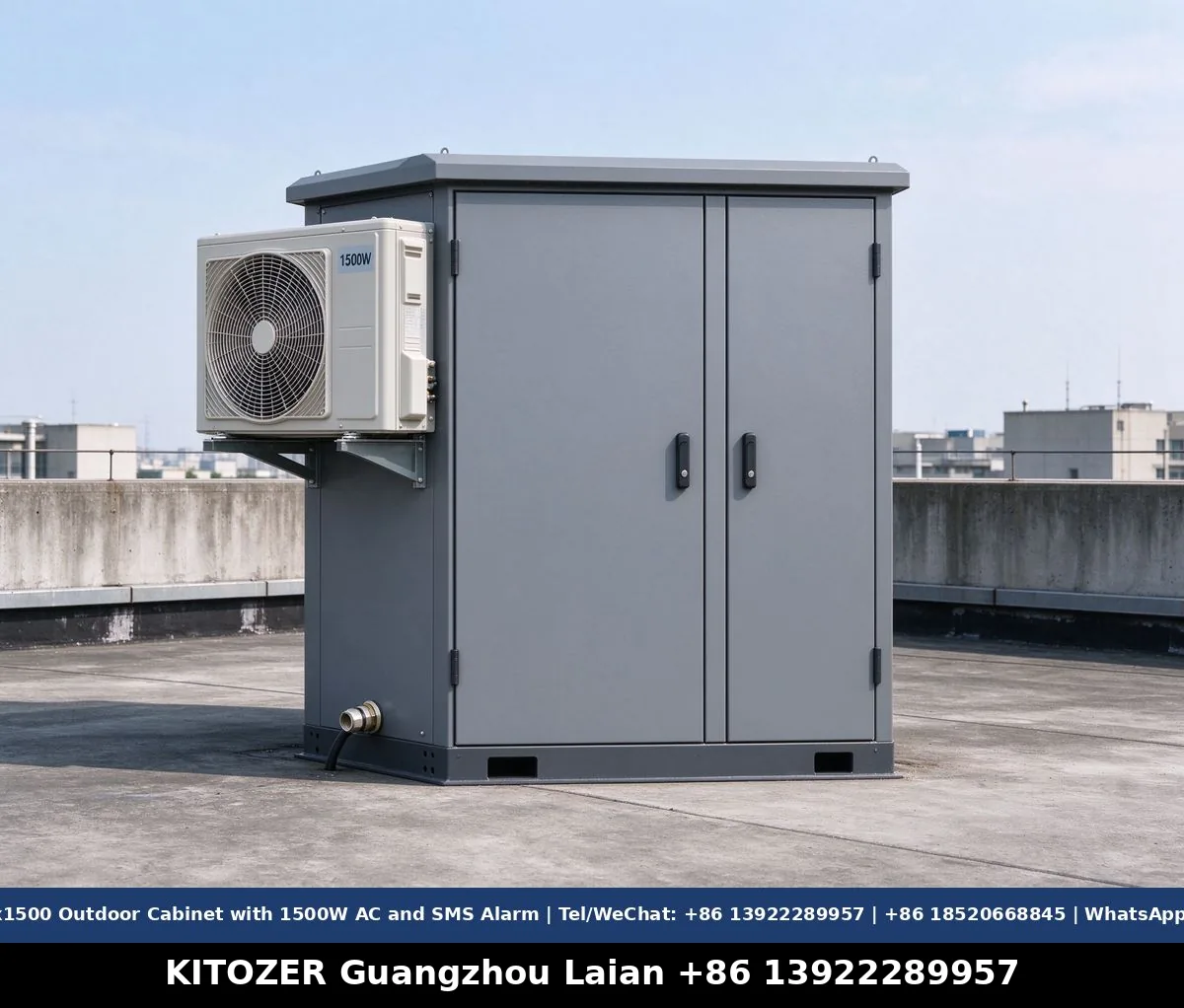
Figure 2: KITOZER outdoor network alarm host with 4G SMS reporting, supervised zone inputs, relay outputs and backup battery, used as the local logic unit on a remote perimeter.
4.2 Control panel and network alarm host
The control panel is the brain of the local segment. It powers the detectors, reads the zone inputs, runs the alarm logic, manages the user code, controls the siren and strobe, and communicates with the central software. The KITOZER PIS series hosts support up to 128 bus zones, dual Ethernet, optional 4G, local SMS reporting, a built-in dialer, and a web interface for configuration. The host can work in standalone mode (with its own keypad and siren) or in networked mode (slave to the central software). In a large perimeter the hosts are chained on an RS-485 bus or a TCP/IP network, so that a site with several kilometres of fence is served by several local cabinets, each supervising its own segment, and all reporting to the same central workstation.
4.3 Monitoring software and platform
The KITOZER monitoring software runs on a Windows workstation or on a Linux server and shows a live site map with every detector as a numbered icon. When an alarm arrives, the icon flashes, a pop-up appears, the linked PTZ camera jumps to the preset, the recording is flagged, and an event is written to the database. The software supports user accounts with roles (operator, supervisor, administrator), event filtering by zone, type and time, playback of linked video, export of reports to CSV or PDF, and integration to third-party VMS (video management systems) via HTTP, ONVIF or SDK. For remote sites the software can be cloud-hosted, so that a single control room can monitor many sites spread across different cities. The KITOZER cloud option uses an encrypted VPN tunnel and role-based access, and it sends push notifications to guard phones when an alarm occurs.
4.4 Siren, strobe and floodlight output
The siren and strobe are the immediate deterrent and local attention mechanism. KITOZER supplies outdoor 110 dB electronic sirens, LED strobes, and combined siren-strobe units in IP65 enclosures. On a remote site the alarm output from the host switches a relay that activates the siren and strobe, and also switches on a 30 W or 50 W LED floodlight aimed at the detection zone. This light-on-alarm design serves two purposes: it illuminates the intruder for the CCTV camera, and it creates a psychological deterrent because the intruder realises he is lit up and visible. The siren is usually set to a short pulse (a few seconds) rather than continuous, so that local residents are not disturbed; the strobe and floodlight stay on until the operator resets the alarm.
4.5 Pole-mount and wall-mount control cabinet
The field cabinet is the weatherproof enclosure that hosts the local power supply, surge protection, alarm host, 4G router, fibre switch and terminal blocks. KITOZER supplies wall-mount and pole-mount cabinets in sheet steel with a polyester powder coat, IP54 or IP55, with a hinged door, a tamper switch, a rain hood, and a bottom cable gland. The cabinet is anchored to a concrete plinth or to a galvanised pole, and it is earthed with a 4 mm2 earth conductor to the local earth rod. Inside, a DIN rail carries the 12 V/24 V DC UPS, the surge protection, the alarm host and the network switch; a separate terminal row distributes power and signal to the detectors. The cabinet is the field service point: a technician opens it once, reads the panel LEDs, tests the relays, and closes it, without walking the whole fence.
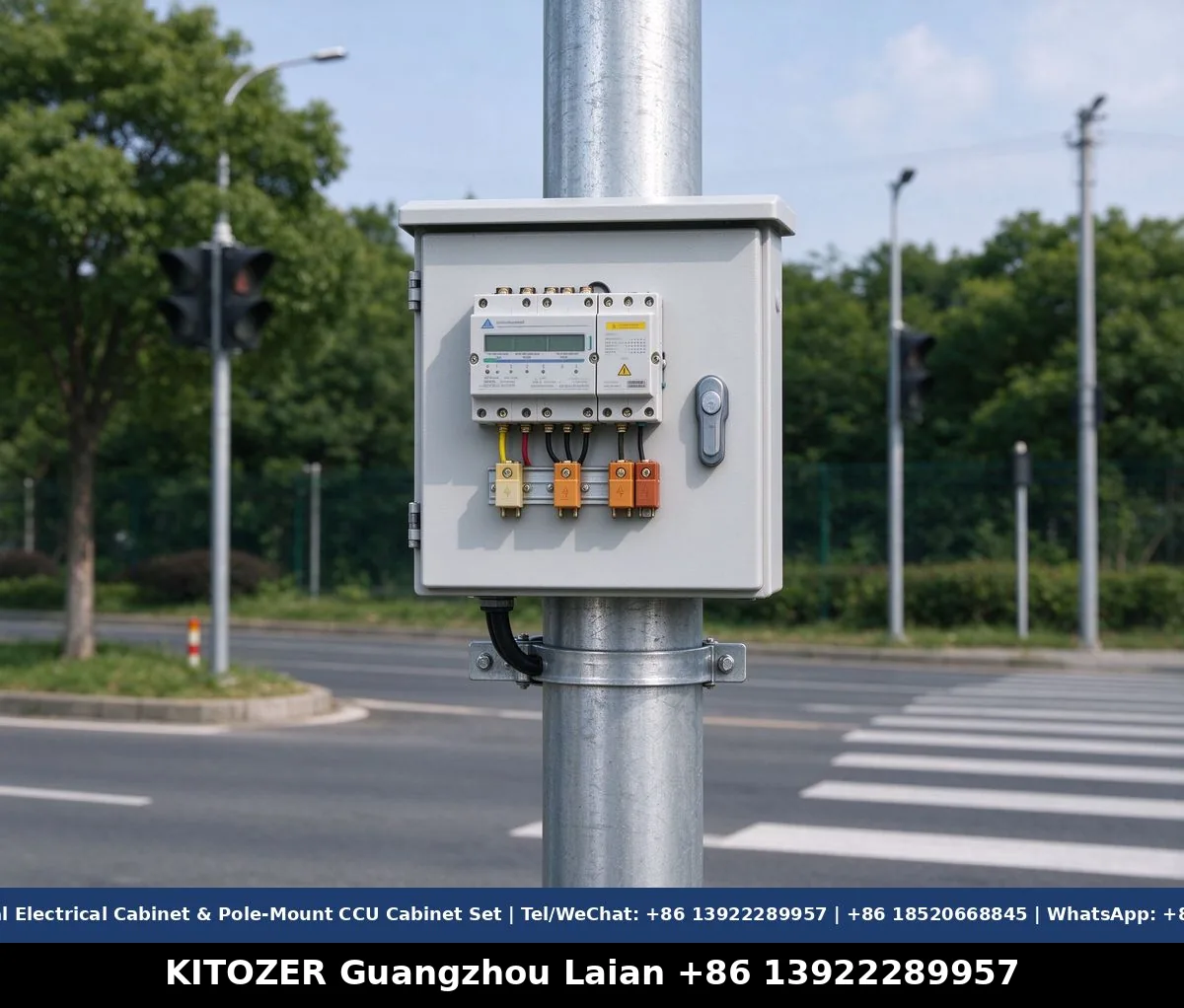
Figure 3: KITOZER pole-mount control cabinet installed on a boundary pole, hosting the local alarm host, 4G router, DC UPS and surge protection for a perimeter segment.
4.6 Accessories: posts, brackets, cables, EOL resistors, surge protectors
A complete KITOZER perimeter delivery includes the mechanical and electrical accessories that make the system installable: galvanised steel posts with adjustable IR beam brackets, stainless-steel straps, UV-stabilised cable, shielded twisted-pair signal cable, outdoor-rated power cable, EOL end-of-line resistors, gas-discharge surge protectors on every detector pair, lightning arrestors on the mains input, earth bars, junction boxes, labels, and a spare-parts kit. These accessories are specified in the bill of quantities and are part of the reference price in this page, because a detector alone on a wall without a post, a bracket, a surge protector and an earth bar is not a working system.
5. Integration with CCTV and Access Control
5.1 Why video verification is mandatory
A perimeter sensor alarm is not, by itself, proof of an intrusion. An IR beam can be interrupted by a bird, a microwave corridor by a swaying tree, a vibration cable by a hail shower. Sending a guard out to every raw sensor alarm across a multi-kilometre fence leads to alarm fatigue, wasted patrols and eventually to alarms being ignored. The KITOZER design rule is that every perimeter zone must have a linked camera. When the zone alarms, the camera jumps to the corresponding preset, the light comes on, the recording starts, and the operator looks at the live picture before dispatching anyone. Video verification turns a raw sensor alarm into a confirmed event within seconds, which is the difference between a working security system and an expensive nuisance.
5.2 How the integration works
The integration is done either by hard-wired relay, by network protocol, or by both. Hard-wired: the alarm host’s relay output is wired to a camera’s alarm input, which triggers the camera to go to a preset and start recording. Network: the alarm host sends an HTTP or ONVIF event to the VMS, which maps the zone to a PTZ preset and pops the video on the monitor. The KITOZER host supports both: on the local cabinet it has dry-contact relay outputs that go to nearby cameras, and over the network it sends structured JSON events to the central VMS. The VMS can in turn send a command back to the host to reset the alarm, to bypass a zone during maintenance, or to switch the system from arm to disarm at the start of a working shift.
5.3 Camera selection for perimeter use
The camera paired with a perimeter sensor should be a long-range PTZ or a fixed long-license-ratio bullet, with infrared or white-light illumination, weatherproof housing, and a frame rate of at least 25 fps. A typical 100 m to 200 m fence segment is covered by one PTZ camera with a 25x or 32x zoom, mounted on a 6 m to 8 m pole, with the IR beam or microwave corridor falling in the camera’s wide-angle view. For a border or an airport, the cameras are thermal, because the event may occur at night in total darkness; a thermal camera sees a person in the dark that a normal IR camera cannot. The KITOZER design pairs each sensor zone with a camera preset that is stored in both the VMS and the alarm host, so that the preset number is part of the zone configuration.
5.4 Access control and gate interaction
At a gate, the perimeter sensor and the access control system must cooperate. The IR beam across a gate opening is bypassed while the gate is legitimately opened by an authorised cardholder, and re-armed a few seconds after the gate closes. The KITOZER host receives a relay from the access controller: when the gate is requested open, the corresponding IR zone is bypassed; when the gate closes and the open timer expires, the zone is re-armed. If the gate is forced open (a relay state that does not match the access decision), the host raises a gate-forced alarm, which is a higher-priority event than a normal beam cut. This logic is configured in the host’s zone attributes and is tested during commissioning with a sequence of authorised and forced gate operations.
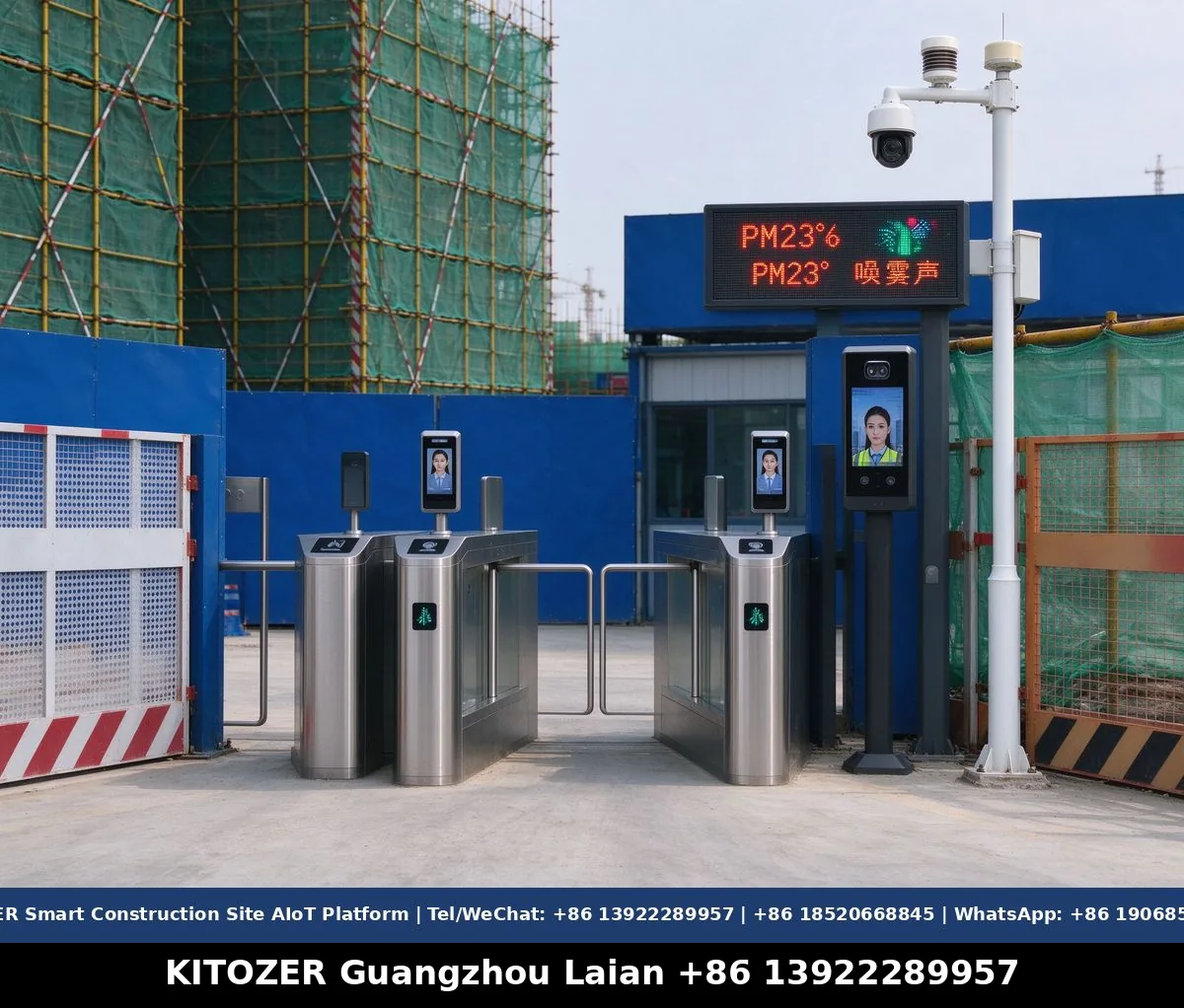
Figure 4: KITOZER smart site entrance gate with integrated access control, active IR beam across the opening, CCTV camera and pole-mount control cabinet.
6. Selection Guide
6.1 Matching technology to site condition
The first selection question is the boundary geometry and environment. A straight wall or fence line with clean sight distance is best served by active IR beams. A straight line with vegetation, fog or dust is better served by a microwave barrier. A fence that an intruder may climb or cut is best served by vibration cable. A curved, irregular, vegetated or buried boundary, or a border, airport or prison, is best served by leaky coax. A site where a visible deterrent matters as much as detection is best served by an electric fence or tension-wire. In practice most KITOZER projects use two technologies: a primary sensor on the boundary and a secondary sensor as confirmation, plus a camera for video verification. The selection table below summarises the typical matching.
| Site condition | Primary sensor | Secondary sensor | Verification |
|---|---|---|---|
| Straight wall, clean sight, low budget | Active IR beam | None or siren | Fixed bullet camera |
| Straight fence, vegetation, fog | Microwave barrier | IR beam on fence top | PTZ camera |
| Chain-link fence, climbing risk | Vibration cable | IR beam outside fence | PTZ camera + light |
| Buried / irregular / border | Leaky coax | Vibration cable on fence | Thermal PTZ camera |
| Prison / detention / military | Electric fence + tension wire | Leaky coax outside | Thermal PTZ + VMS |
| Airport perimeter | Leaky coax + microwave | Radar on runway | Thermal long-range camera |
| Industrial park, mixed boundary | IR beam + vibration cable | Gate loop + CCTV | PTZ + floodlight |
6.2 Sizing the detector count
The number of detectors is set by the boundary length and the maximum range of the chosen model. For active IR beams, divide the straight run length by the rated outdoor range and add 10 percent overlap; for example, a 200 m straight wall needs two ABH-100 pairs (each rated 100 m) rather than one ABX-200, because the overlap and the corner transition are more reliable with two shorter pairs. For vibration cable, divide the fence length by the reel length per analyser channel (100 m or 200 m), and add a separate channel for every gate. For leaky coax, divide by 200 m or 400 m per channel, and add a separate channel for corners and transitions. For microwave barriers, use the rated range and keep a 10 percent margin at each end. The bill of quantities lists every detector, every post, every bracket, every surge protector and every meter of cable, and the installer walks the boundary before ordering to confirm the run lengths.
6.3 Choosing the host size
The host size is chosen from the number of zones, the number of detectors, the required redundancy and the communication method. A small site (up to 8 zones, single building) uses a PIS-4 or PIS-8. A medium site (up to 32 zones) uses a PIS-16. A large perimeter (up to several hundred zones) uses a PIS-32 host repeated along the fence, chained on the RS-485 bus or the TCP/IP network, and supervised from one central workstation. The host must have enough relay outputs to drive the sirens, strobes, lights and gate controls on that segment; if it does not, an expansion relay module is added. The host must have a 4G or fibre back-up if the primary network is unreliable, and it must have a backup battery that lasts at least 12 hours of standby and one hour of alarm on mains failure.
6.4 Environmental and regulatory considerations
Outdoor detectors must be rated for the local climate: IP65 or IP66 in dusty or coastal sites, -30 degC rating in cold climates, and UV-stabilised cable and brackets in tropical sun. Coastal sites require 316 stainless hardware or powder-coated steel with anti-corrosion treatment. High-voltage electric fences are subject to local electrical and public-safety regulations; the KITOZER energiser is rated to the relevant standard and installed with a warning sign, a fence-line indicator, and a cut-off contact for authorised gate openings. Lightning protection is mandatory in thunderstorm-prone regions: every detector pair gets a gas-discharge surge protector, every cabinet gets a mains arrestor, and the earth resistance is measured below 4 ohm.
7. Installation Layout and Wiring
7.1 Site survey and layout drawing
Before installation, a KITOZER engineer walks the boundary with a measuring wheel and a compass, marks the detector positions, the cabinet positions, the camera positions, the earth rod positions and the cable routes. The output of the survey is a layout drawing that shows the fence line, the detector pairs, the posts, the cabinets, the camera pole positions, the cable routes (aerial, trenched or pole-mounted), and the zone numbering. The drawing is the reference for the bill of quantities, the cable schedule, and the commissioning test sheet. The survey also notes the background conditions that affect sensor choice: nearby roads, trees that will grow, drainage ditches, existing underground services, and the local lightning ground resistance.
7.2 Detector mounting positions
Active IR beam pairs are mounted on rigid posts or wall brackets, with the transmitter on one side and the receiver on the other, at a height chosen so that the lowest beam is 150 mm to 300 mm above the coping or the fence top. The posts are set in concrete or anchored to the wall with chemical anchors; they must not flex in the wind. The bracket allows fine horizontal and vertical adjustment, and once aligned it is locked and sealed. Microwave barriers are mounted at 0.5 m to 1.2 m height, parallel to the fence, at least 1 m away from any moving object. Vibration cable is clipped to the fence at regular intervals, with a loop at every corner and a separate gate loop. Leaky coax is buried at 20 cm to 40 cm depth in a 30 cm wide trench, in a band parallel to the fence, with a warning marker tape above it.
7.3 Cable routing and earthing
Signal cable from the detector to the cabinet is shielded twisted pair, run in a separate galvanised conduit or a UV-stabilised duct, at least 20 cm away from any mains power cable to avoid induced noise. Power cable is a separate 2-core outdoor-rated cable. Every detector pair has its own surge protector at the cabinet end. The cabinet is earthed to a local earth rod with a 4 mm2 green-yellow conductor, and the earth resistance is measured with a ground tester; a reading above 10 ohm requires an additional earth rod. At the boundary, the cable is brought into the cabinet through a bottom gland with a drip loop, so that water runs down the cable and away from the gland.
7.4 Alignment and commissioning
Alignment is the most detailed part of the installation. For IR beams, the installer aims the transmitter at the receiver, watches the signal-strength LED, adjusts the bracket until the signal is maximum and at least 70 percent of the scale, then locks the bracket. The installer then walks across the beam at different speeds and heights to confirm that the alarm triggers consistently. For microwave, the installer tunes the sensitivity and pulse count, then walks across the corridor, runs a small animal (if accessible) through, and confirms that the human triggers and the small animal does not. For vibration cable, the analyser filter is chosen for the fence type, and the sensitivity is set so that a light hammer tap triggers but wind rustle does not. For leaky coax, the sensitivity is set so that a 70 kg walking test target triggers at any point across the band, while a cat or a blown plastic bag does not. Every test is recorded on the commissioning sheet and signed off by the customer representative.
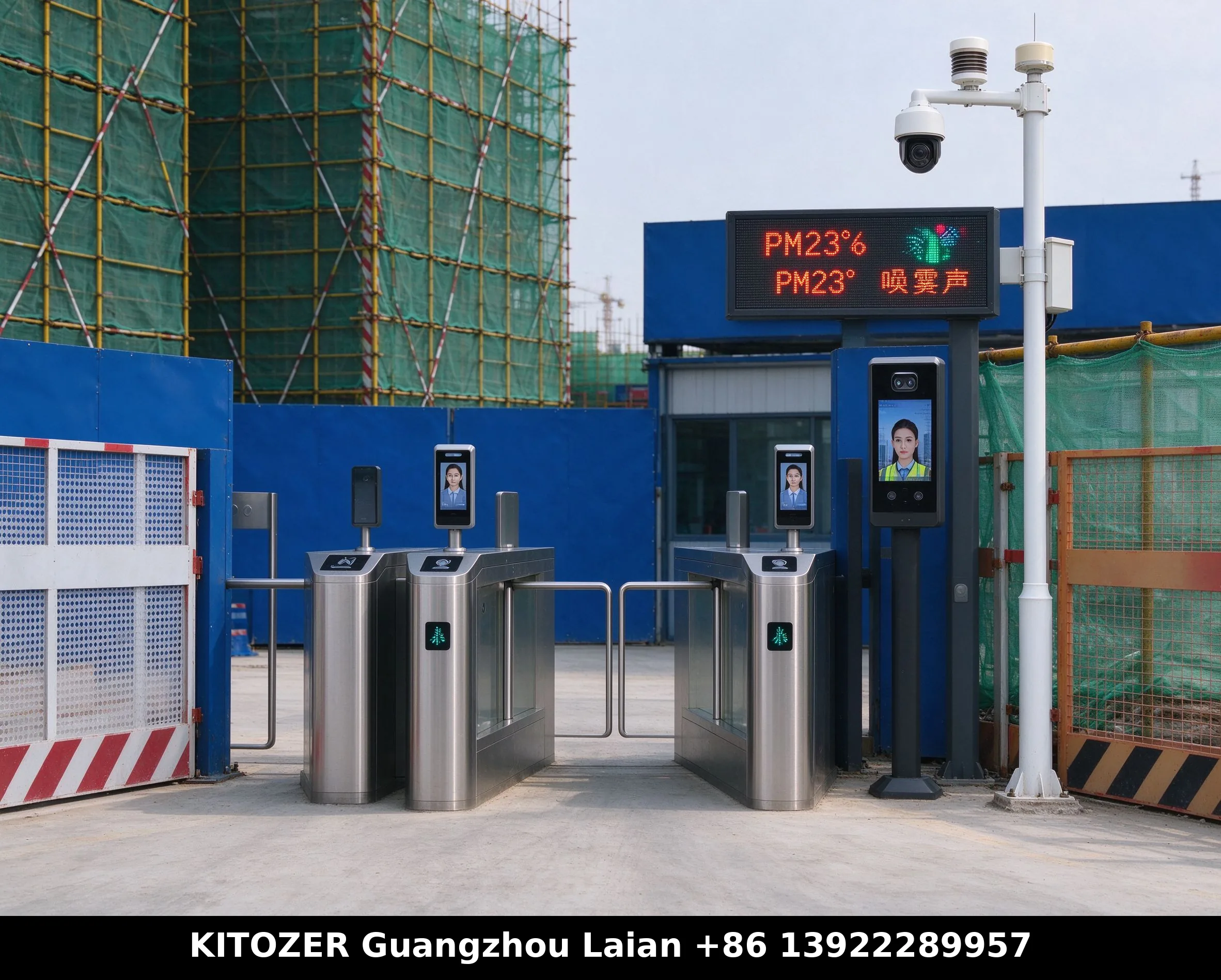
Figure 5: KITOZER perimeter gate with electric fence, tension wire, vibration cable and active IR beam layered on the same boundary.
8. False Alarm Reduction
8.1 The false-alarm problem
The single reason perimeter systems fail in practice is not that they miss intruders; it is that they alarm too often on non-events. A site that alarms 20 times a night on cats, branches, rain and small birds trains the operator to ignore alarms, and the first real intrusion that comes through is treated as just another nuisance. The KITOZER engineering process treats false alarm reduction as a first-class design objective, not an after-sales tuning exercise. The measures are chosen during the survey, built into the bill of quantities, tested during commissioning, and reviewed after the first three months of operation.
8.2 Sensor-level measures
At the sensor level, the measures are: multi-beam IR (2, 3 or 4 beams) so that a small animal or a leaf cannot cut all beams; automatic gain control on the IR receiver so that seasonal sunlight and fog do not cause trouble; pulse-count tuning on the microwave (require 2 or 3 pulses before alarm); filter curves on the vibration analyser that match the fence type; sensitivity tuning on the leaky coax that ignores small targets; and proper alignment with a 70 percent signal margin so that seasonal drift does not cause nuisance trouble. All of these are configured during commissioning and locked behind a technician password so that site staff cannot accidentally raise the sensitivity.
8.3 Logic-level measures
At the logic level, the strongest measure is cross-zoning: require two sensors on the same boundary to alarm within a short window (typically 3 to 5 seconds) before a full alarm is raised. An IR beam and a microwave barrier on the same segment, or a vibration cable and an IR beam on the same fence, are wired as a two-out-of-two logic. A bird interrupting the IR beam will not also trigger the microwave, so no alarm is raised; a real intruder crossing both will. The KITOZER host and software support this cross-zone logic natively. Additional logic includes: alarm counting in a zone (a zone that has alarmed three times in an hour is automatically marked as a suspect zone and the operator reviews it), walk-test mode (during the day, alarms are logged but not pushed to the phone), and maintenance bypass (a zone can be temporarily bypassed with a scheduled expiry so that it cannot be left bypassed permanently).
8.4 Environmental and mechanical measures
Many false alarms come from poor mechanical installation, not from the sensor. A post that flexes in the wind will move the IR beam out of alignment. A cable that is tied too tight will transfer gate slamming vibration to the analyser. A hedge that grows into a microwave corridor will alarm every gust. A drain pipe that drips onto the fence will alarm the vibration cable. The KITOZER installation checklist requires: posts set in concrete with no flex, cable clipped with a drip loop, gate loops separated from the fence loop, vegetation cleared 1 m around every sensor, drainage away from the fence, and a yearly realignment check. These mechanical habits prevent more false alarms than any tuning change.
8.5 Performance metrics and review
After the system is live, the KITOZER software produces a monthly false-alarm report: how many alarms per zone, how many were verified as real, how many were animals, how many were weather, how many were technical faults. The site team reviews the report, identifies the persistent nuisance zones, and adjusts the sensor or the mechanical installation. A well-tuned KITOZER perimeter site typically runs at less than one false alarm per zone per month, and more than 90 percent of alarms are confirmed within seconds by the linked camera. This performance is what allows the security manager to trust the system and to reduce the physical patrol frequency, which is the economic case for the investment.
9. Applications
9.1 Border and customs protection
On a national or regional border, the perimeter is long, remote, dark and often vegetated. The KITOZER design for border use is a layered combination of buried leaky coax along the fence line, a microwave barrier on a straight clear corridor, a thermal PTZ camera every 200 m, and a 4G backhaul to a remote control room. The system alarms on foot traffic, vehicle approach and fence cutting, and the thermal camera verifies the event in total darkness. Solar-powered pole-mount cabinets with battery backup support segments where mains power is unavailable. The KITOZER platform aggregates events from many kilometres of fence into a single map, so that border staff see a developing situation in context rather than as isolated alarms.
9.2 Prison and detention centre
In a prison, the perimeter fence is the last line before the outside world. The KITOZER design uses an electrified security fence with tension-wire detection on the inside, a vibration cable on the chain-link mesh, an IR beam above the fence, a buried leaky coax outside the fence, and a high-resolution PTZ camera on every corner. The host monitors every fence wire, every IR beam and every camera preset, and it locks down the whole perimeter instantly when any layer alarms. The system integrates with the prison’s access control and roll-call system, so that an alarm at the fence triggers an immediate inmate headcount in the nearest wing. Maintenance is scheduled around the prison regime, and the system is tested daily by a guard in a supervised walk-test.
9.3 Airport and airfield
An airfield perimeter runs for many kilometres along the runway, taxiway and boundary road. The KITOZER design uses leaky coax buried along the fence, microwave barriers on straight approaches, long-range thermal cameras on masts, and an integration with the airfield’s existing A-SMGCS and CCTV. The system must not alarm on birds, rabbits, or the routine movement of airfield vehicles; this is achieved with cross-zoning logic, sensitivity tuning and camera verification. The KITOZER host also receives a signal from the airfield’s ground movement radar, so that a confirmed ground vehicle inside the fence is a higher-priority event than a small animal. The output goes to the airfield operations centre, which decides whether to pause a take-off, dispatch a patrol, or raise an alert to the control tower.
9.4 Industrial park and manufacturing plant
An industrial park typically has a 2 m to 2.5 m concrete wall or a chain-link fence around several buildings, a goods gate, a pedestrian gate, and a yard that stores high-value materials. The KITOZER design uses active IR beams on the wall coping, vibration cable on the fence, a pole-mount control cabinet at each segment, PTZ cameras with white-light illumination, and an integration to the existing access control and VMS. At night the system is fully armed; during the working day the goods-gate zones are bypassed through the access control logic, while the rest of the boundary stays armed. The KITOZER cloud platform lets the site security manager see the park from a phone, receive push alarms, and review the recorded video from any event.
9.5 Data centre, substation and critical infrastructure
A data centre or a high-voltage substation is a small but critical perimeter: a 2.5 m wall, a gate, and a small compound. The KITOZER design uses multi-beam IR on the wall, a microwave barrier outside the wall, a vibration cable on the gate, a PTZ camera with white light, and a pole-mount cabinet with dual-network backhaul (fibre plus 4G). The system is fully supervised, tamper-protected, and integrated to the data centre’s BMS and access control. Because the site is unmanned at night, every alarm is immediately pushed to the security operations centre and to a guard on call, and the camera automatically records and stores the event for 90 days as required by compliance.
9.6 Warehouse, depot and oil & gas site
Remote depots and oil & gas well sites have no on-site guard, no mains power and no fibre. The KITOZER design uses solar-powered pole-mount cabinets with battery backup, 4G backhaul, IR beams across the gate, vibration cable on the fence, and a rugged bullet camera with IR illumination. The system wakes on alarm, lights up the site, records the video, pushes the event to the cloud, and sends a phone push to the on-call security team. The same design is used on pipeline pump stations, electrical substations in remote areas, and telecom tower compounds.
10. Maintenance, Testing and Spare Parts
10.1 Preventive maintenance schedule
A perimeter alarm system is only as good as its last test. The KITOZER maintenance schedule defines daily, monthly, quarterly and annual tasks. Daily: the control-room operator reviews the event log for any trouble or tamper signals. Monthly: a technician walks the boundary, visually checks every detector, bracket, cable and cabinet, and confirms that the signal-strength LEDs on every IR receiver are still in the green. Quarterly: the technician walks-test every zone, triggers every alarm, confirms the siren, strobe, light, camera preset and push notification, and checks the backup battery voltage. Annually: a full commissioning re-test, including earth resistance, surge protector condition, battery load test, cable insulation test, and firmware upgrade on the host and cameras. The schedule is stored in the KITOZER software, which sends a reminder when a task is due and records the result against the site record.
10.2 Common faults and remedies
| Fault | Symptom | Likely cause | Remedy |
|---|---|---|---|
| IR beam trouble | Low signal LED, trouble relay | Dirty window, misalignment, seasonal drift | Clean window, realign, check post for flex |
| IR beam false alarm | Random alarm, no camera picture | Bird, leaf, rain, spider on window | Multi-beam check, window guard, sensitivity |
| Microwave false alarm | Alarm on windy days | Vegetation in corridor, road traffic | Clear vegetation, retune, cross-zone logic |
| Vibration cable alarm | Alarm on hail, gate slam | Wrong filter, gate loop shared | Change filter curve, separate gate loop |
| Leaky coax alarm | Alarm after rain | Ground water, cable too shallow | Deepen cable, improve drainage, retune |
| Host offline | No event, 4G fault | SIM expired, antenna loose, fibre cut | Check SIM, reseat antenna, switch to 4G |
| Backup battery low | Battery fault LED | Battery end of life, charger fault | Replace battery, test charger |
| Camera no preset | Alarm but wrong camera view | Preset number mismatch | Re-map preset in VMS and host |
10.3 Spare parts strategy
The recommended spare-parts kit for a KITOZER perimeter site includes: one spare IR beam pair per model used, one spare microwave barrier per 20 pairs, one spare vibration analyser, one spare leaky coax analyser, one spare power supply, one spare 4G module, one spare relay module, a box of EOL resistors, surge protectors, brackets, UV clips and a length of spare signal cable. The spare parts are stored in the main control room cabinet, labelled and logged. The KITOZER warranty covers the detectors and hosts for two years from commissioning, with extended service contracts available for critical sites. Guangzhou Laian supports the supply of spare parts and the dispatch of an engineer on a call-out basis for projects that need guaranteed response times.
10.4 Firmware and software updates
The KITOZER host and cameras receive periodic firmware updates that improve false-alarm filtering, add protocol support and patch security issues. The software platform receives updates on a scheduled release cycle. Updates are applied in a maintenance window, backed up before upgrade, and tested on a non-critical zone first. The system keeps a configuration backup so that a failed upgrade can be rolled back. For sites with a strict change-control process, the KITOZER service team provides the update note, the rollback plan and the test record as part of the change package.
11. Design Methodology and Project Workflow
11.1 The layered protection model
Professional perimeter design follows a layered protection model rather than a single-sensor approach. The outer layer is a detection corridor set back from the fence, often implemented with a microwave barrier or a buried leaky coax, designed to detect an intruder while he is still in the open ground and before he reaches the fence. The middle layer is the fence itself, protected by vibration cable, tension wire or an electric fence, which detects climbing, cutting or touching. The inner layer is the wall coping or gate opening, protected by active IR beams, which detects crossing over the wall or through the gate. The verification layer is the camera and light, which confirms the event. The response layer is the siren, strobe, gate lock and guard dispatch. The KITOZER project team maps every zone to one of these layers during the design, so that a gap in one layer is covered by another, and so that the operator understands which layer has alarmed. A single-layer design is acceptable for a low-risk site such as a small retail compound, but for a critical infrastructure site a three-layer design with cross-zoning is the expected baseline.
11.2 Risk assessment and threat definition
Before choosing sensors, the KITOZER consultant works with the customer to define the threat. Threats range from a casual trespasser walking across a field, to an opportunist thief cutting a fence at night, to an organised intruder with bolt cutters, a ladder and a planned route. The threat defines the required detection probability, the required reaction time, the required deterrent level and the required evidence standard. A casual trespasser is stopped by a wall and a siren; an opportunist thief is stopped by vibration cable and IR beams; an organised intruder requires a layered design with electric fence, thermal cameras and a 24-hour control room. The risk assessment also values the assets inside the perimeter, the consequence of a breach, and the budget available, so that the design is proportionate rather than over-engineered. The output of the assessment is a one-page threat matrix that the rest of the design follows.
11.3 The KITOZER delivery phases
A typical KITOZER perimeter project is delivered in five phases. Phase one is the site survey and design: the engineer walks the boundary, takes measurements, notes conditions, and produces a layout drawing, a sensor selection and a bill of quantities. Phase two is the supply: the detectors, hosts, cabinets, cameras, cable and accessories are ordered, tested and factory-inspected before shipment. Phase three is the installation: the civil works (posts, concrete, trenching), the mechanical mounting, the cable pulling and the cabinet assembly are done by a trained installation crew. Phase four is the commissioning: alignment, walk-test, sensitivity tuning, logic configuration, camera preset mapping and integration to the VMS and access control. Phase five is the handover and training: the customer team is trained on the software, the alarm handling, the daily checks and the maintenance schedule, and the as-built drawings, test records and user manuals are delivered. The KITOZER project manager coordinates all five phases and is the single point of contact for the customer.
11.4 Documentation set
A complete KITOZER delivery includes a documentation set that the customer keeps as the system record. The set contains: the as-built layout drawing with detector positions and zone numbers, the wiring diagram of each cabinet, the bill of quantities with serial numbers of every detector and host, the commissioning test sheet signed off for every zone, the camera preset map, the user account list, the maintenance schedule, the spare-parts list, the warranty certificate and the user manual. This documentation is what allows the customer to service the system in future, to respond to an audit, and to expand the perimeter without re-surveying the whole site. The KITOZER software also stores the configuration digitally, so that a backup can be restored after a hardware failure.
12. Standards, Compliance and Safety
12.1 Relevant standards
Perimeter alarm systems are designed and installed to commonly referenced electronic security standards that cover installation practices, environmental ratings, electromagnetic compatibility, lightning protection and documentation. The KITOZER design follows the principles of these standards: detectors are mounted rigidly, cable is separated from power, earthing is done to a low resistance, surge protection is fitted on every external cable, tamper supervision is mandatory, and the system is documented and tested. The exact standard applicable to a given project depends on the customer’s industry and local regulation; the KITOZER team advises on the applicable standard during the design phase and adapts the deliverables accordingly.
12.2 Electrical and lightning safety
Outdoor perimeter systems run long cable runs between detectors and cabinets, which makes them prone to induced surges from lightning. The KITOZER installation uses a three-stage surge protection: an arrestor on the mains input to the cabinet, a gas-discharge protector on each signal pair at the cabinet, and a protector at the detector end where the run is long. The cabinet is earthed to a local earth rod, and the earth resistance is measured below 4 ohm. All outdoor cable is shielded, and the shield is earthed at one end to avoid ground loops. These measures protect the detectors and the host from surge damage, which is the most common cause of outdoor field failure in thunderstorm-prone regions.
12.3 Data privacy and evidence handling
A perimeter system with cameras records video of the boundary and the immediate surroundings. The KITOZER design respects applicable data protection rules: cameras are aimed at the boundary and the site, not at neighbouring private property; recordings are stored for a defined retention period; access to recordings is role-controlled and logged; and the cloud platform uses encrypted transport and encrypted storage. The customer is responsible for the public signage that informs visitors they are under surveillance, and for the internal procedure that governs how an alarm recording is used in an incident review or a police report. The KITOZER software supports these requirements with role-based access, event logging and export controls.
13. Deeper Technology Notes
13.1 How active IR modulation defeats sunlight and reflections
An unmodulated infrared beam would be blinded by sunlight, which also emits infrared. The KITOZER active IR transmitter pulses the beam at a specific frequency (typically a few kHz) and the receiver is tuned to recognise only that modulated signal. Sunlight, lamp light and reflections do not carry the modulation, so the receiver ignores them. Automatic gain control further adjusts the receiver sensitivity to the current signal level, so that seasonal changes in atmospheric absorption do not cause trouble. This is why a modern multi-beam KITOZER IR pair works reliably in full sunlight, at night and through light fog, where a simple photo cell would fail.
13.2 How microwave Doppler and pulse-count work
The microwave barrier emits a continuous low-power radio beam. A stationary object reflects a constant amount of energy; a moving object changes the reflection, and the change over time is detected by the receiver. The pulse-count function requires the receiver to see a certain number of consecutive changes before it raises an alarm, so that a brief flicker from a gust of wind or a passing bird does not trigger. The KITOZER microwave units allow the installer to set the pulse count from 1 to 3 and the sensitivity across a range, and to choose a filter curve tuned to human walking speed. Tuning these two knobs during commissioning is what separates a nuisance microwave from a reliable one.
13.3 How vibration analysers recognise a human attack signature
A vibration cable produces a different electrical signature for different events: a saw cut on chain-link has a rapid, repeating high-frequency vibration; a climber’s boot on the mesh has a slower, heavier, lower-frequency vibration; a hail shower has a dense, short, random burst; wind has a low, slow sway. The KITOZER vibration analyser uses digital signal processing to classify the incoming signal against these signatures and to decide whether it is an attack. The installer selects a filter curve that matches the fence type, because a concrete wall has a different signature than a chain-link fence. The analyser also counts the number of vibration events in a window, so that a single tap from a bird landing does not alarm but a sustained sawing does.
13.4 How leaky coax creates a balanced invisible field
A leaky coax cable is a coaxial cable with periodic slots in the outer shield, so that a controlled amount of radio energy leaks out and couples to a second parallel cable. The transmitter feeds one cable, the receiver listens on the other, and the coupling between the two creates an invisible ellipsoidal detection field around the cable pair. When a moving person enters the field, he absorbs and reflects some of the energy, changing the coupling and triggering the analyser. The KITOZER leaky coax analyser balances the two cables so that small animals and crawling insects below a target weight do not trigger, while a 70 kg walking target does. Because the field is invisible and buried, the intruder does not know where the detection zone is, which is a major tactical advantage for border and prison sites.
14. Training, Handover and User Roles
14.1 Operator training
After commissioning, the KITOZER team trains the customer’s control-room operators on the daily use of the system: how to arm and disarm partitions, how to respond to an alarm, how to verify with the linked camera, how to acknowledge and classify an event, how to search the event log, and how to use the walk-test mode for maintenance. The training is hands-on, on the live system, and includes a set of realistic drill scenarios: a beam cut at the wall, a gate forced open, a camera offline, a mains failure. Operators who complete the drill can handle a real event without panic, which is what converts the investment into effective protection.
14.2 Supervisor and administrator roles
The KITOZER software defines three roles. The operator sees the live map, acknowledges alarms and views live video, but cannot change configuration. The supervisor can bypass zones for maintenance, generate reports and manage user codes. The administrator can change sensor settings, update firmware, configure cameras and back up the system. This role separation ensures that a front-line operator cannot accidentally disable a zone, and that configuration changes are made only by trained and authorised staff. The KITOZER team sets up the initial user accounts and hands over the administrator credentials to the customer’s security manager.
14.3 Handover checklist
The handover checklist confirms that every zone is commissioned, every camera preset works, every alarm triggers the siren and the light, the 4G and network paths are tested, the backup battery holds a charge, the documentation set is complete, and the customer team has completed the training drills. The customer representative signs the checklist, and the KITOZER warranty period starts from that date. The checklist is stored as part of the project record and is the reference for any future service visit.
15.1 Technology Comparison and Decision Matrix
15.1.1 Side-by-side comparison
Choosing between active IR, microwave, vibration cable, leaky coax and electric fence is easier when each technology is scored against the same set of criteria. The table below compares the five KITOZER technologies on range, weather immunity, vegetation sensitivity, installation complexity, deterrent effect, evidence quality and typical cost per metre of boundary. The scores are qualitative, intended as a design aid, not as a laboratory measurement.
| Criterion | Active IR beam | Microwave barrier | Vibration cable | Leaky coax | Electric / tension fence |
|---|---|---|---|---|---|
| Typical outdoor range | 20 to 300 m | 20 to 150 m | 100 to 200 m per channel | 200 to 400 m per channel | Full fence length |
| Weather immunity | Medium (fog attenuates) | High (through rain/fog) | High (contact-based) | High (buried) | High |
| Vegetation sensitivity | High (must keep clear) | Medium to high | Low (clipped to fence) | Medium (ground changes) | Low |
| Curved / irregular boundary | Poor (straight line only) | Medium (straight line) | Good (follows fence) | Good (follows fence) | Good (follows fence) |
| Installation complexity | Low to medium | Medium | Medium (clipping labour) | High (trenching) | Medium (high-voltage rules) |
| Deterrent effect | Low (invisible) | Low (invisible) | Low to medium | Low (invisible) | High (visible shock) |
| Evidence requirement | Camera needed | Camera needed | Camera needed | Camera required | Camera needed |
| Relative cost per metre | Low | Medium | Medium | High | Medium |
| Best for | Straight walls, gates | Straight foggy lines | Fence climbing/cutting | Border, airport, prison | Visible deterrent |
15.1.2 How to read the matrix
A low-risk, straight wall around a small yard is well served by active IR beams alone: they are cheap, simple and reliable in clean air. A straight line in a foggy or dusty region is better served by microwave, because the beam will not be attenuated. A chain-link fence that the customer is worried about being climbed or cut is best served by vibration cable, because it covers the whole fence surface and follows the corners. A border or an airport, where an intruder may approach across open ground rather than through a gate, is best served by buried leaky coax, because it is invisible and cannot be defeated by going around a post. A prison or a military compound, where a visible deterrent is part of the policy, uses an electric or tension fence as the outer layer, with vibration cable and IR as the detection layers. Most KITOZER projects combine two rows from this table, so that the strengths of one cover the weaknesses of the other.
15.1.3 Common design combinations
The KITOZER portfolio has several proven combinations that are used repeatedly across projects. The wall-and-beam combination is an active IR pair on the wall coping plus a fixed bullet camera; it is the standard for a small compound. The fence-and-vibration combination is a vibration cable on the chain-link fence plus an IR beam above the fence plus a PTZ camera; it is the standard for an industrial park. The layered border combination is a buried leaky coax plus a microwave corridor plus a thermal PTZ camera every 200 m plus a solar cabinet; it is the standard for a remote border. The prison combination is an electrified fence plus tension wire plus vibration cable plus an IR beam outside plus a thermal camera; it is the standard for a detention centre. The KITOZER design team selects one of these proven combinations as a starting point and tailors it to the specific boundary length, budget and threat level.
15.2 Typical Project Walkthroughs
15.2.1 Small industrial compound, 300 m wall
A typical small industrial compound has a 2.5 m concrete wall around 300 m of perimeter, one vehicular gate and one pedestrian gate. The KITOZER design uses four ABH-100 active IR pairs along the wall, one IR pair across the vehicular gate, one PIR / IR pair across the pedestrian gate, a PIS-8 host in a wall-mount cabinet in the gate house, two fixed bullet cameras at the corners and one PTZ camera on the gate. The host is connected to the customer’s LAN and reports to a workstation in the gate house. At night the system is fully armed; during the day the gate zones are bypassed through the access control. The reference price for this scope is in the low thousands of US dollars, and installation and commissioning take two days. The customer gets a system that alarms on any wall crossing or gate opening, verifies with a camera, and logs every event for review.
15.2.2 Warehouse park, 2 km fence, remote site
A remote warehouse park has 2 km of chain-link fence around several storage yards, no on-site guard at night, and only 4G communication. The KITOZER design uses vibration cable clipped to the whole fence (10 channels of 200 m), active IR beams on the gate openings, four pole-mount cabinets every 500 m, each with a PIS-16 host, a 4G router, a DC UPS and a surge protector, four PTZ cameras with white-light illumination on 6 m poles, and a cloud-hosted monitoring platform. The system wakes on alarm, lights up the fence segment, records the camera, pushes the event to the security manager’s phone, and stores the event in the cloud for 90 days. The reference price for this scope is in the tens of thousands of US dollars, and installation takes about four weeks including the cable pulling and the cabinet mounting. The customer gets a system that watches the fence 24 hours a day, even though the site is unmanned.
15.2.3 Critical infrastructure, multi-layer border-grade design
A high-security critical infrastructure site has a 1 km double fence, a guard house, a vehicle sally port and a requirement for video verification of every alarm. The KITOZER design uses a buried leaky coax along the outer fence (5 channels of 200 m), a vibration cable on the inner chain-link fence, active IR beams on the wall coping, a microwave barrier on the outer approach, an electrified fence on the inner side, eight thermal PTZ cameras on 8 m poles, two PIS-32 hosts in IP55 cabinets, dual-fibre plus 4G backhaul, and a central VMS in the control room. Cross-zoning logic requires the leaky coax and the vibration cable to agree before a full alarm, which suppresses the small-animal and vegetation nuisance. The system is fully supervised, tamper-protected, and integrated to the site’s access control and BMS. The reference price for this scope is in the hundreds of thousands of US dollars, and the project takes several months from survey to handover, including the civil works for the trenching and the pole foundations.
15.3 Additional Design Notes
15.3.1 Lighting design
A perimeter camera at night needs light. The KITOZER design pairs each detection zone with a white-light floodlight that switches on alarm, so that the intruder is illuminated for the camera and the psychological deterrent works. The floodlights are LED, 30 W to 50 W, pole-mounted, and driven by a relay from the alarm host. For sites where constant light is required (such as a prison yard), permanent lighting is installed on a separate circuit, and the alarm lighting adds a brighter pulse on event. Lighting design is part of the electrical layout and is coordinated with the cable routes and the power supply sizing.
15.3.2 Power supply sizing
The DC power supply in the cabinet is sized to carry the steady current of all detectors on that segment plus the relay coils plus the camera heaters and fans, plus a 50 percent margin for future expansion. The backup battery is sized for 12 hours standby and one hour of alarm on mains failure. For solar-powered remote cabinets, the solar panel is sized to charge the battery fully on an average sunny day, and the battery bank is sized for three to five days of autonomy without sun. The KITOZER electrical design sheet lists the steady current, the alarm current, the battery capacity and the solar panel wattage for each cabinet, so that the customer can verify the supply before installation.
15.3.3 Cable schedule and conduits
The cable schedule lists every cable run: from each detector to the nearest cabinet, from each cabinet to the control room, from each camera to the nearest network switch, and from each siren and strobe to the relay. The schedule specifies the cable type (shielded twisted pair for signal, outdoor-rated 2-core for power, fibre for long network runs), the conduit (galvanised steel for exposed runs, UV-stabilised duct for buried runs), and the gland size. The schedule is what the installation crew uses to pull and label the cables, and it is the reference for the as-built documentation. Good cable discipline is what makes the system serviceable: when a fault occurs, the technician can read the label, trace the cable on the drawing, and replace the correct detector without walking the whole fence.
15.3.4 Testing and acceptance
Acceptance testing is a structured walk-through of the whole system. The customer representative, the KITOZER engineer and the installation crew walk the boundary together. At each zone, the engineer triggers the alarm (by walking across the IR beam, by tapping the fence with a hammer, by walking across the leaky coax), and the group confirms that the host alarms, the correct zone name appears on the screen, the correct camera jumps to the preset, the light comes on, the siren sounds, the push notification arrives on the phone, and the event is logged. Every zone is tested twice. The result is recorded on the acceptance test sheet, signed by all parties, and the project is accepted. This structured test is what converts a pile of equipment into a trusted system.
16.1 Alarm Handling and Response Workflow
16.1.1 The alarm chain
When a perimeter sensor triggers, a defined chain of events runs automatically, without waiting for a human decision. The detector closes its relay, the host reads the zone, the host runs the logic (cross-zone, pulse count, alarm counting), the host switches the relay outputs (siren, strobe, floodlight, gate lock), the host sends an event to the central software over the network, the software maps the zone to a camera preset and pops the live video on the operator screen, the VMS starts recording and flags the segment, and the cloud platform sends a push notification to the on-call guard’s phone. This whole chain runs in under two seconds from the detector closing its relay to the camera jumping to the preset. The operator then looks at the video and decides whether to dispatch a guard, ignore the event as a nuisance, or raise a higher-level alert. The chain is what makes the system fast; the operator decision is what makes it accurate.
16.1.2 Alarm priority and classification
Not every alarm is equal. The KITOZER host and software classify alarms by priority. A cross-zoned intrusion that has been video-verified is a priority-one event. A single-zone alarm without a second sensor agreeing is a priority-two event, requiring operator attention but not immediate dispatch. A tamper or line-fault event is a priority-three event, indicating a technical fault that needs a maintenance visit. A scheduled maintenance bypass is a logged event but not an alarm. The priority determines what happens next: priority-one goes to the phone push and the site manager; priority-two goes to the control-room screen only; priority-three goes to the maintenance queue. This classification prevents the control room from being swamped by low-priority events and ensures that real intrusions get the fastest response.
16.1.3 Night and day partitioning
Most sites arm the perimeter differently at day and at night. During the working day, the gate zones and the pedestrian entrance zones are bypassed through the access control, while the wall and fence zones stay armed. At night, the whole perimeter is fully armed, and the gate zones are locked. The KITOZER host supports scheduled partitions: the arming schedule is programmed so that the system switches from day mode to night mode automatically at a set time, and back again in the morning. The schedule is also adjusted for public holidays and special events. The operator can override the schedule manually, and the override is logged. This partitioning is what allows the system to be useful during the working day without alarming on every authorised movement, while still being fully protective at night.
16.1.4 Event logging and reporting
Every event that the system sees is logged with a timestamp, a zone name, an event type, a priority, an operator acknowledgement and a linked video clip. The KITOZER software can filter the log by zone, by type, by time range and by operator, and export it to a CSV or PDF report. The monthly report shows: total alarms, confirmed intrusions, nuisance alarms by cause (animal, weather, technical), zone uptime, battery health, and maintenance tasks completed. The report is the evidence that the system is working as designed, and it is what the customer presents in an audit or an insurance review. The event history is stored on the local server and optionally backed up to the cloud, so that a server failure does not lose the record.
16.2 Network, Cybersecurity and Remote Access
16.2.1 Network architecture
A networked KITOZER perimeter system uses a hierarchical network. The detectors connect to the local host on a short RS-485 or dry-contact link. The host connects to the local cabinet switch on Ethernet. The cabinet switch connects to the site backbone on fibre (for long runs) or Ethernet (for short runs). The backbone connects to the control-room server and to the VMS. For remote sites, the host uses a 4G router to connect to the cloud platform over an encrypted VPN. The network is designed so that a break in one segment does not bring down the whole system: the local host keeps working on its own, alarms the local siren and strobe, and buffers events until the network recovers. This local autonomy is essential for a perimeter system, because a network outage must not leave the site unprotected.
16.2.2 Access control for the system itself
The perimeter system is itself a security device, and it must be protected against unauthorised access. The KITOZER design uses role-based user accounts, strong passwords, encrypted transport (HTTPS / TLS), and a closed VPN for remote access. The administrator account is protected by a second factor where required. The software logs every configuration change and every login, so that an unauthorised change can be traced. Remote access to the cloud platform is from authorised devices only, and the customer can disable remote access entirely if the site policy requires it. These measures protect the system from being used as an entry point into the customer’s wider network, which is a real concern for any IP-based security device.
16.2.3 Firmware and configuration backup
The KITOZER host and cameras keep their configuration in non-volatile memory, and the software keeps a backup of every configuration. Before a firmware update, the configuration is exported to a file; after the update, it is restored and verified. If a host fails in the field, a replacement host can be loaded with the saved configuration in minutes, which minimises the downtime of the protected segment. The backup file is stored on the control-room server and optionally on the cloud, so that it survives a local disk failure. This backup practice is part of the maintenance contract and is tested at least once a year by restoring a configuration to a spare host.
16.3 Logistics, Spare Parts and Project Support
16.3.1 Lead times and shipping
KITOZER detectors, hosts and cabinets are stocked for standard models, with typical lead times of one to two weeks for small orders and four to eight weeks for large or custom orders. Custom cabinets, special colours, extended temperature ranges and non-standard cable lengths add to the lead time. The KITOZER project manager confirms the lead time in the order acknowledgement and tracks the shipment to site. Shipping is by sea for large consignments, by air for urgent spares, and by express courier for small parts. The customer is responsible for import duties and local taxes, and the KITOZER team provides the commercial invoice and packing list needed for customs clearance.
16.3.2 Spare parts stocking
For critical sites, the KITOZER service agreement includes a local spare-parts stock. The stock contains the items most likely to fail in the field: a spare IR pair per model, a spare power supply, a spare 4G module, a spare relay module, a spare battery, a set of surge protectors, brackets and EOL resistors. The stock is held in the customer’s control room cabinet, labelled and logged, and the KITOZER team replenishes it after a part is used. The stocking level is reviewed at the annual service visit and adjusted to the actual failure history. This local stock is what allows a field fault to be fixed the same day, instead of waiting for a part to be shipped from the factory.
16.3.3 On-site support and remote diagnostics
The KITOZER host has a web interface and a diagnostic port that allows the service team to read the detector status, the signal strength, the battery voltage, the network state and the event log remotely over the VPN. Most faults can be diagnosed remotely: a low-signal detector, a battery fault, a communication error, a misconfigured zone. The technician guides the customer’s on-site staff through the fix, or dispatches an engineer if the fault requires physical access. For critical sites, the service agreement guarantees a response time (for example, four hours remote response and 48 hours on-site dispatch), and the customer pays a fixed annual fee for the cover. This support model keeps the system available over its life, not just at commissioning.
17. Frequently Asked Questions
Q1. What is the difference between an active infrared beam and a passive infrared detector for perimeter use?
A passive infrared (PIR) detector senses heat movement in a room and is designed for indoor use; it does not work reliably outdoors because sunlight, wind, rain and temperature changes create false heat signals. An active IR beam is a transmitter-receiver pair that projects a modulated light beam across an outdoor opening and alarms when the beam is cut. It is purpose-built for outdoor perimeter use and is the standard sensor for walls, gates and fence tops.
Q2. How far can a KITOZER active IR beam reach outdoors?
The outdoor range runs from 20 m in the short-range ABH-20 model up to 300 m in the long-range ABX-300 model. The indoor range is typically 1.5 to 2 times the outdoor range. For a given boundary length, the bill of quantities uses pairs with some overlap rather than one very long pair, because alignment margin and corner transition are more reliable with shorter units.
Q3. Will rain, fog or snow cause false alarms?
Light rain, fog and snow are tolerated by the modulated multi-beam design, and the receiver reports a trouble signal rather than a false intrusion alarm when the beam attenuates. Heavy fog or a sandstorm may cause a trouble condition that the operator sees as a supervision fault. In sites with frequent heavy fog, a microwave barrier or a leaky coax is recommended as the primary sensor, with the IR beam as secondary.
Q4. Can a cat, dog or small animal trigger the system?
A small animal is unlikely to trigger a properly tuned multi-beam IR, because it cannot cut two beams at the correct height. It may trigger a single-beam PIR, which is why KITOZER does not recommend single-beam photo cells for outdoor security. On a microwave or leaky coax, the sensitivity is tuned during commissioning so that a small animal does not trigger but a 70 kg walking target does. Cross-zoning with a second sensor further reduces the animal false alarm.
Q5. How is the system powered and what happens during a mains outage?
The system is powered by a regulated 12 V or 24 V DC UPS in the pole-mount or wall-mount cabinet. The backup battery is sized to keep the host and the detectors running for at least 12 hours on standby and one hour of alarm on mains failure. Remote solar sites use a solar panel and a larger battery bank, sized for the local sun hours and autonomy requirement.
Q6. How does the system communicate to the control room?
The host communicates over Ethernet, fibre, RS-485 bus or 4G, depending on the site. On a wired site, the host sits on the local LAN and sends events to the central software over TCP/IP. On a remote site, the host uses 4G to send events to the cloud platform, which delivers them to the workstation and to guard phones as push notifications. Dual-network sites use fibre as primary and 4G as automatic failover.
Q7. Can the system integrate with our existing CCTV and VMS?
Yes. The KITOZER host supports dry-contact relay outputs to camera alarm inputs, and network integration over HTTP, ONVIF and SDK to most mainstream VMS platforms. When a zone alarms, the linked camera jumps to its preset, the light switches on, and the recording starts. The VMS can also send commands back to the host to bypass or reset a zone.
Q8. Is the system tamper-proof and supervised?
Yes. Every detector has a tamper switch, every cabinet has a tamper switch, and every zone is wired with an end-of-line (EOL) resistor. If the detector is opened, the cabinet is opened, or the cable is cut or shorted, the host reports a tamper or line-fault event to the control room. An attacker cannot silence the system by cutting the wire, because the cut itself raises the alarm.
Q9. How long does installation take for a typical site?
A small site of a few hundred metres with a single host and a few IR pairs is installed and commissioned in one to two days. A multi-kilometre perimeter with multiple cabinets, leaky coax trenching, cameras and a central software rollout takes several weeks, depending on the civil works (concrete posts, trenching, cable ducting). The KITOZER project team provides a schedule with the survey and the bill of quantities.
Q10. What is the IP rating of the outdoor detectors and cabinets?
The active IR beams are IP55 or IP65, the microwave barriers are IP65 or IP66, the vibration analysers are IP54 indoors or IP65 outdoors, and the pole-mount cabinets are IP54 or IP55. Coastal and high-dust sites are supplied with 316 stainless hardware and an anti-corrosion powder coat. All outdoor cable is UV-stabilised and rated for direct burial or aerial use as applicable.
Q11. How do we prevent the IR beam from being defeated by crawling underneath?
Use a multi-beam unit (3 or 4 beams) with the lowest beam set at 150 mm to 300 mm above the coping, and add a second layer: a microwave barrier outside the wall, or a vibration cable on the fence, or a buried leaky coax. The cross-zoning logic requires both layers to alarm before a full event is raised, so crawling under one layer must still cross the other.
Q12. Can we monitor the system from a phone?
Yes. The KITOZER cloud platform provides a web dashboard and a phone app for authorised users. When an alarm occurs, the app receives a push notification with the zone name, the linked camera snapshot and a one-touch call to the on-call guard. User roles control what each user can see and do, and all events are logged.
Q13. What is the warranty and after-sales support?
The KITOZER detectors and hosts carry a two-year warranty from commissioning, with extended service contracts available. Guangzhou Laian supplies spare parts, remote diagnostics and on-call engineer dispatch. The cloud software is supported under a maintenance agreement that includes updates, backups and a helpdesk contact.
Q14. How much does a KITOZER perimeter system cost?
The cost depends on the boundary length, the chosen technologies, the number of cameras, the civil works and the communication method. A small wall-mounted IR installation starts at a reference price in the low thousands of US dollars; a multi-kilometre layered border or airport system runs into the tens of thousands of US dollars. The reference price box on this page gives indicative ranges; a firm quotation is prepared after the site survey and the bill of quantities. Contact KITOZER with the boundary drawing and the site condition for a tailored offer.
Q15. Can the system be expanded later if the perimeter grows?
Yes. The KITOZER architecture is modular. The host supports additional bus zones up to its capacity, and additional hosts can be chained on the RS-485 bus or the TCP/IP network. New detectors, cameras and cabinets are added as new zones, and the central software maps them on the same site map. The customer does not need to replace the existing host or software; the expansion is a matter of adding hardware, running cable, and configuring the new zones. The KITOZER design leaves spare capacity in the host, the cabinet and the network switch so that future expansion is straightforward.
Q16. What happens if a detector fails or is damaged?
A failed detector shows up as a tamper or line-fault event on the host, because the closed-loop EOL supervision detects the open circuit. The operator sees the fault immediately, the zone is marked as not protected, and the maintenance team is dispatched. A spare detector from the on-site stock is installed, realigned and walk-tested, and the zone is restored. The event log records the fault, the repair and the downtime, which is part of the system’s availability reporting.
Q17. Is the system suitable for coastal or corrosive environments?
Yes. For coastal, industrial or corrosive environments, KITOZER supplies detectors and cabinets with 316 stainless-steel hardware, an anti-corrosion polyester powder coat, UV-stabilised cable and sealed glands. The IP rating is raised to IP66, and the earth connection uses corrosion-resistant fittings. Vibration cable and leaky coax are gel-filled for direct burial. The KITOZER design specifies the corrosion protection level based on the site environment survey, and the spare-parts stock includes the coastal-grade replacements.
Q18. Can the system work without mains power on a remote site?
Yes. Remote sites such as border posts, pipeline stations, telecom towers and depots use a solar-powered pole-mount cabinet: a solar panel on a pole, a battery bank in the cabinet, a charge controller, the alarm host, the 4G router and the detectors. The system is sized for the local sun hours and a required autonomy of three to five days without sun. It alarms locally, reports over 4G, and stays available even when there is no mains grid. The KITOZER solar design sheet lists the panel wattage, the battery capacity and the estimated autonomy for each remote cabinet.
16.4 Summary
The KITOZER perimeter intrusion alarm system is a multi-technology, multi-layered platform that combines active infrared beams, microwave barriers, vibration-sensing cable, leaky coaxial fence detection, electric and tension-wire deterrence, a central control panel, network and 4G reporting, monitoring software, outdoor siren and strobe, and pole-mount control cabinets. It is designed to detect an intrusion at the outer boundary, verify it with a linked camera, report it to the control room and to a phone, and record the evidence for later review. It is selected, installed, commissioned and maintained through a structured process that includes a site survey, a layered design, cross-zoning logic to reduce false alarms, video verification, scheduled maintenance and a spare-parts strategy. Whether the site is a small industrial compound, a warehouse park, a prison, an airport, a border or a critical infrastructure facility, the KITOZER portfolio has a proven combination of sensors, hosts, cameras and software that fits the threat, the boundary and the budget. Contact KITOZER with the boundary drawing and the site condition for a tailored design and reference price.
Key takeaways
- Use active IR beams for straight walls and gates; use microwave for foggy or dusty straight lines; use vibration cable for fence climbing and cutting; use leaky coax for buried, curved or border-grade boundaries.
- Combine at least two technologies per boundary segment and use cross-zoning logic so that a bird, a branch or an animal cannot raise a full alarm on its own.
- Link every perimeter zone to a camera preset and a floodlight so that the operator verifies the event in seconds before dispatching a guard.
- Supervise every detector, cabinet and cable with EOL resistors and tamper switches, so that cutting the wire itself raises an alarm.
- Size the backup battery for at least 12 hours standby and one hour of alarm; for remote sites, use solar panels with three to five days of autonomy.
- Commission the system with a structured walk-test of every zone, and run a monthly false-alarm review to tune the sensors and the mechanical installation.
- Keep a local spare-parts stock for the most common field-replaceable items, and use remote diagnostics to fix most faults the same day.
18. Price Reference
Reference price guide (indicative only)
The following prices are reference ranges for planning purposes only and are not a formal quotation. The final price depends on the boundary length, sensor selection, camera count, civil works, communication method, warranty term and project location. Please contact KITOZER for a firm offer after the site survey.
| Item | Reference price range (USD) | Note |
|---|---|---|
| Active IR beam pair (2-beam, 20 to 60 m) | 60 to 150 per pair | Excludes post and bracket |
| Active IR beam pair (3 to 4-beam, 80 to 300 m) | 150 to 450 per pair | Long-range, IP66 |
| Microwave barrier pair (20 to 150 m) | 300 to 900 per pair | 24 GHz, IP66 |
| Vibration cable per 100 m channel + analyser | 400 to 800 per channel | Includes clips and ties |
| Leaky coax per 200 m channel + analyser | 1,500 to 3,500 per channel | Includes trenching extra |
| PIS-4 / PIS-8 alarm host | 200 to 500 | Indoor |
| PIS-16 / PIS-32 network host with 4G | 600 to 1,500 | Outdoor cabinet |
| Pole-mount control cabinet with UPS and surge | 400 to 1,200 per cabinet | Sheet steel, IP55 |
| Outdoor siren + strobe | 40 to 100 per unit | IP65 |
| PTZ long-range camera with 30x zoom | 600 to 1,800 per camera | IR or white light |
| Thermal PTZ camera (border / airport) | 3,000 to 8,000 per camera | Long range |
| Monitoring software (server licence) | 1,000 to 5,000 per site | User and zone based |
| Cloud platform annual subscription | 500 to 2,000 per year per site | Hosting and push |
| Installation and commissioning labour | 15 to 35 percent of hardware | Per project |
For a typical industrial park of 1 km wall with IR beams, one host, two PTZ cameras, a pole-mount cabinet and the monitoring software, the reference total is in the range of USD 8,000 to USD 18,000, including installation. For a border or airport project with several kilometres of leaky coax, microwave barriers, thermal cameras and a central VMS, the reference total is typically USD 50,000 to USD 200,000 or more, depending on the scope. All prices are reference prices in US dollars and exclude taxes, duties, freight and the customer’s civil works unless explicitly stated.
19. Contact KITOZER
Get a tailored quotation
Guangzhou Laian Intelligent System Development Co., Ltd. designs and supplies the KITOZER perimeter intrusion alarm system for walls, fences, borders, prisons, airports, industrial parks, substations, data centres and remote depots. Send us the boundary drawing, the site condition, the required detection technologies and the camera count, and we will return a tailored design, bill of quantities and reference price.
KITOZER has supplied perimeter systems to industrial parks, logistics depots, power substations, water plants, data centres, warehouse compounds and remote communication sites. The supply chain covers the detectors, hosts, pole-mount cabinets, cameras, cable, accessories, monitoring software and cloud platform as a single integrated package, so that the customer deals with one accountable supplier rather than assembling a system from separate vendors. The engineering team supports system integrators with design drawings, commissioning guidance, training and after-sales spare parts, and the service team provides remote diagnostics and on-call support for critical sites. Whether the project is a new build or an upgrade of an existing fence and CCTV, the KITOZER team starts from the boundary survey, proposes a layered design that matches the threat and the budget, supplies the tested hardware, and stays involved through commissioning, training and the annual service cycle.
- Brand: KITOZER
- Company: Guangzhou Laian Intelligent System Development Co., Ltd.
- Phone / WeChat: +86 139 2228 9957 / +86 185 2066 8845
- WhatsApp: +1 906-853-4140
- English website: www.gdlain.com
- Chinese website: www.lain.com.cn
We supply the detectors, hosts, cabinets, cameras, software and accessories as a complete package, and we support system integrators with technical drawings, commissioning guidance and after-sales spare parts.