KITOZER Precision Air Conditioning Duct — Data Center CRAC Ducting, Insulated Flexible Duct and Galvanized Steel Duct Complete Technical Guide
In data centers, server rooms, telecommunications rooms, network operation centers and industrial control rooms, precision air conditioning units (also called CRAC, computer room air conditioner, or CRAH, computer room air handler) run 24 hours a day, 7 days a week to maintain a tightly controlled temperature and humidity environment. The cold air produced by the precision air conditioner must travel through a complete, sealed, well-insulated duct system to reach every rack intake uniformly, with low pressure drop and no leakage, before the warm air is returned to the unit. This series of ventilation ducts connecting the precision air conditioner to the room air distribution is called the precision air conditioning duct. Although ductwork is a small part of the total data center cost, it directly determines cooling efficiency, rack inlet temperature, hot/cold air mixing and the overall PUE of the facility.
The KITOZER precision air conditioning duct is designed and supplied by Guangzhou Laian Intelligent System Development Co., Ltd. The product range covers galvanized steel rectangular ducts, stainless steel ducts, aluminum foil glass wool insulated flexible ducts, glass magnesium composite ducts, silencer ducts, fire-rated ducts, reducers, elbows, tees, volume control dampers, fire dampers, backdraft dampers, flexible connectors and insulation layers. The KITOZER duct reference price ranges from about RMB 200 to RMB 1000 per meter depending on material, cross-section, insulation thickness, flange type and site installation difficulty. This guide explains the development, working principle, materials, technical parameters, selection calculation, installation, maintenance, FAQs, applications and price reference of KITOZER precision AC ducts.
Note on prices: All prices in this article are reference prices for budget estimation only. The actual price is quoted after engineering design confirmation.
Chapter 1. Development of Precision AC Ductwork
1.1 The early free-cooling room era (before 1990s)
In the early days of data centers, rack power density was low, around 1 to 2 kW per rack. Room air conditioners blew cold air directly into the room, and warm air rose to the ceiling naturally. There was almost no dedicated ductwork; a simple canvas soft connector was attached to the air conditioner outlet and the room returned air naturally. As racks multiplied, hot and cold air mixed heavily, reducing cooling efficiency and creating local hot spots.
Back then ducts were plain galvanized steel with field-applied rubber sponge insulation, sealed with tape and caulk, and fitted with angle-steel flanges. Leakage was high. Duct sizing was done by rule of thumb without proper hydraulic calculation or noise review, leading to duct vibration, dripping and uneven supply air temperature.
1.2 Room-level precision AC and ducted supply (1990s-2010)
As rack power rose to 3 to 5 kW, precision air conditioners became standard. They use large airflow and small temperature difference, typically 2 to 3 times the airflow of comfort air conditioners, to keep room temperature uniform. Raised-floor underfloor supply became common: cold air was pushed into the underfloor plenum and delivered through floor swirl panels in front of racks. Ducts mainly connected the CRAC outlet to the underfloor plenum, or carried supply and return air in overhead ducted rooms.
During this period duct materials evolved from plain galvanized steel to composite fiberglass and aluminum foil laminates, insulation thickness increased from 20 mm rubber foam to 25 to 30 mm glass wool, and leakage requirements tightened to below 5%. KITOZER accumulated extensive duct design and installation experience in this era.
1.3 Hot/cold aisle containment and in-row cooling (2010-present)
When rack power reached 8 to 15 kW, traditional room-level underfloor supply could no longer cope. Cold aisle containment, hot aisle containment and in-row CRAC units became mainstream. In-row units sit directly in the rack row, blowing into the cold aisle and drawing return air from the hot aisle. Ductwork now mainly carries hot air back to the ceiling or wall-mounted CRAH, or delivers cold air to the cold aisle ceiling plenum in overhead systems.
Modern ductwork demands higher insulation, tighter sealing, lower leakage, quieter operation, better fire performance and cleaner air. Flexible insulated ducts are widely used for in-row terminal connections because they are quick to install and space-saving; galvanized steel ducts remain the choice for large main ducts and pressurized runs. KITOZER supplies a complete package from main duct to terminal flexible duct.
Chapter 2. Air Supply and Return Principles
2.1 Data center heat load composition
Data center heat load comes from four sources: IT equipment (servers, storage, switches) produces 70% to 90% of the heat; UPS, switchgear and batteries produce 5% to 10%; lighting and people produce 2% to 5%; solar and building transmission produce 5% to 10%. The precision AC must continuously remove this heat and keep rack inlet around 23 degrees C at 40% to 60% relative humidity.
IT equipment is very temperature sensitive. Every 10 degree C rise roughly doubles electronic component failure rate. If duct supply air is too warm, airflow insufficient, or blowing to the wrong area, rack inlet temperature exceeds ASHRAE recommendations and servers throttle or shut down. The duct must deliver cold air precisely to rack intakes rather than letting it wander.
2.2 Cold air delivery path
A typical overhead supply/return path works like this: the CRAC fan blows cooled air through the evaporator, through an outlet flexible connector into the main supply duct. The main duct runs along the ceiling above the room, gradually reducing cross-section through elbows and reducers. At each supply point a branch duct and plenum connect to a square diffuser or linear slot diffuser that delivers cold air into the cold aisle. Cold air enters rack intakes, passes through servers, exits as hot air from the rack rear, rises in the hot aisle, and returns through a return duct or ceiling return to the CRAC return.
In underfloor raised-floor rooms, the duct delivers cold air to the underfloor plenum; the duct only spans from CRAC outlet to plenum. In cold aisle containment rooms, cold air is trapped between the closed ceiling and racks, and the duct distributes it evenly along the aisle length to avoid overcooling near the CRAC and overheating far away.
2.3 Airflow inside ducts
Duct airflow is categorized as low velocity or high velocity. Data center supply ducts use low velocity: main duct 6 to 10 m/s, branch 3 to 6 m/s, to minimize friction loss and regenerated noise. High velocity systems (15 to 20 m/s) use smaller ducts but higher fan energy and noise; they are generally avoided in data centers except in space-constrained retrofits.
Duct design must keep each outlet airflow within plus or minus 15% of design. One outlet with too much flow starves the neighbors, causing local hot spots. Manual volume control dampers are fitted on each branch and commissioned by measuring outlet airflow and adjusting damper position. KITOZER supplies manual dampers as standard and motorized constant volume dampers (CAV) for critical projects.
2.4 Insulation and anti-condensation principle
Data center supply air is typically 12 to 18 degrees C while room air is above 23 degrees C at 40% to 60% RH. Uninsulated duct outer surface drops below the air dew point, and water vapor condenses into droplets on the duct exterior, dripping onto ceilings, racks or floors and risking short circuits. The insulation raises the duct outer surface above dew point to stop dripping.
KITOZER ducts use at least 25 mm centrifugal glass wool or rubber foam, thermal conductivity no more than 0.035 W/mK, covered with aluminum foil cloth or embossed aluminum as a vapor barrier. The vapor barrier must be fully bonded with at least 50 mm overlap. The outer surface should be at least 2 degrees C above dew point. In hot humid climates like Guangdong, KITOZER recommends 30 mm insulation.
2.5 Duct resistance and fan static pressure
Total duct resistance equals friction loss plus local loss. Friction loss depends on duct length, velocity squared and wall roughness; local loss comes from elbows, tees, reducers, dampers, outlets and return grilles, each with a loss coefficient. The CRAC external static pressure must exceed total duct resistance plus outlet resistance plus filter resistance, otherwise actual airflow falls far below nameplate. KITOZER performs full hydraulic calculation and matches duct resistance to CRAC external static pressure.
Chapter 3. KITOZER Duct Product Family and Parameters
3.1 Galvanized steel rectangular duct
Galvanized steel rectangular duct is the classic choice for main supply ducts. KITOZER uses hot-dip galvanized sheet, thickness selected by the long side: long side up to 320 mm uses 0.5 mm sheet, 320 to 630 mm uses 0.6 mm, 630 to 1000 mm uses 0.75 mm, 1000 to 2000 mm uses 1.0 mm. Ducts connect by common-flange or angle-flange with closed-cell sponge gasket, leakage controlled within 3%. Exterior is insulated with 25 to 30 mm glass wool and aluminum foil cloth.
Galvanized steel ducts are rigid, pressure-tight and can be very large; they suit main supply and return ducts. Downsides: heavy, needs many hangers, long site fabrication time, elbows and reducers must be factory prefabricated. KITOZER prefabricates every duct section off-site with numbered labels for quick on-site assembly.
3.2 Aluminum foil glass wool insulated flexible duct
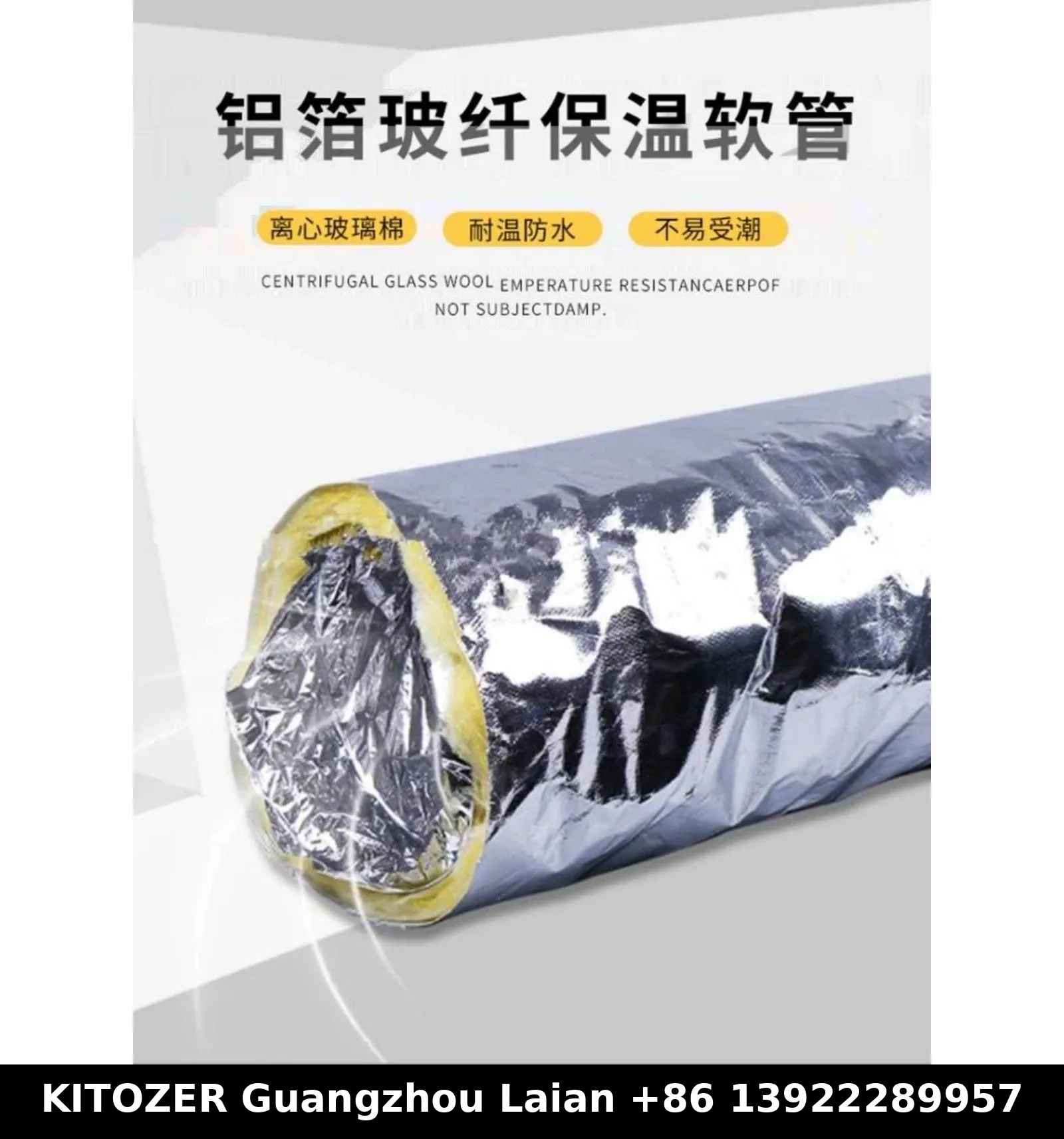
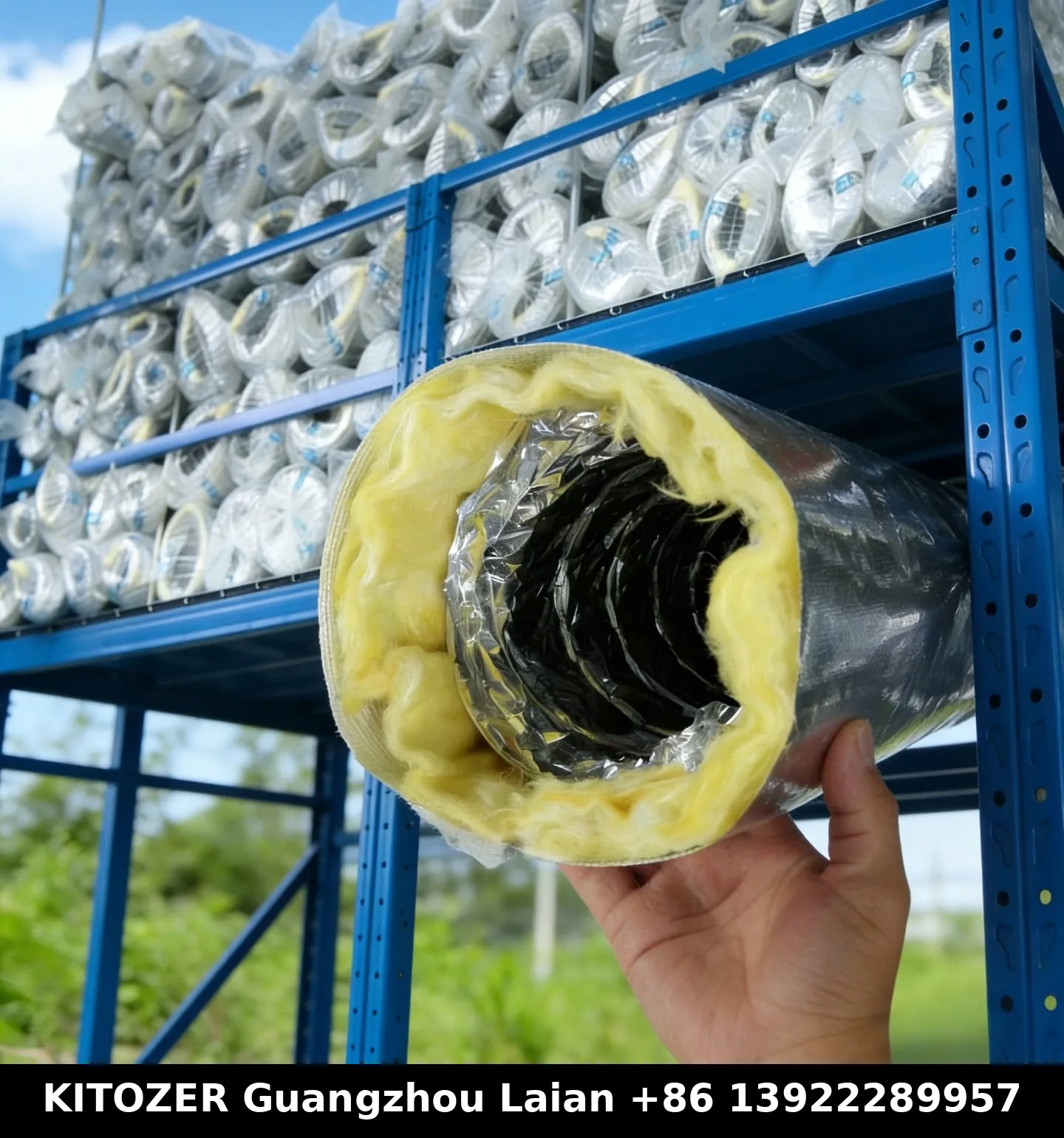
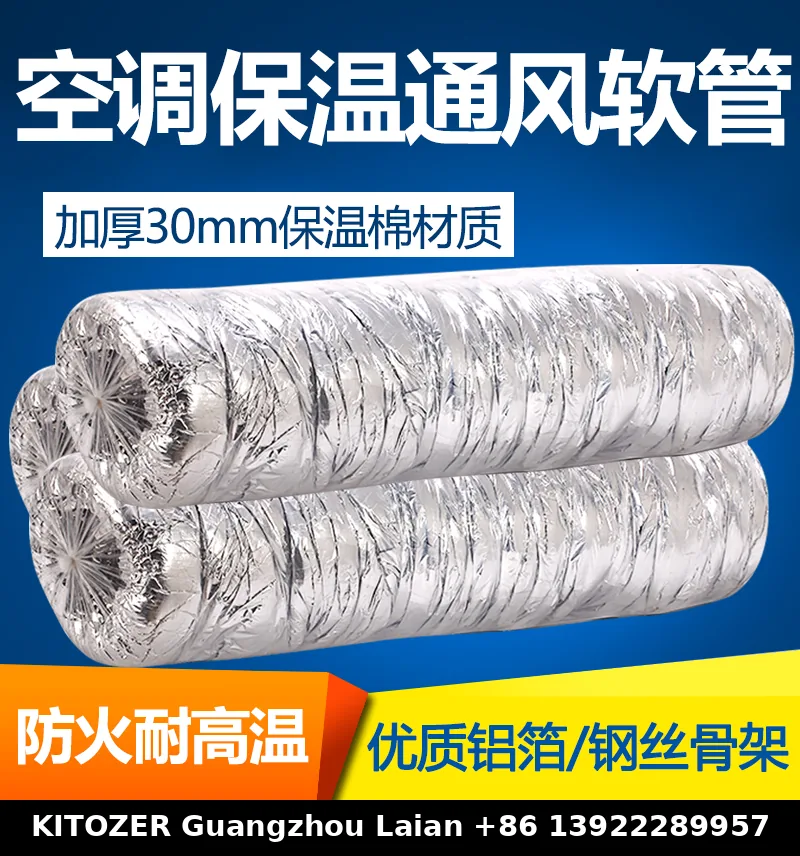
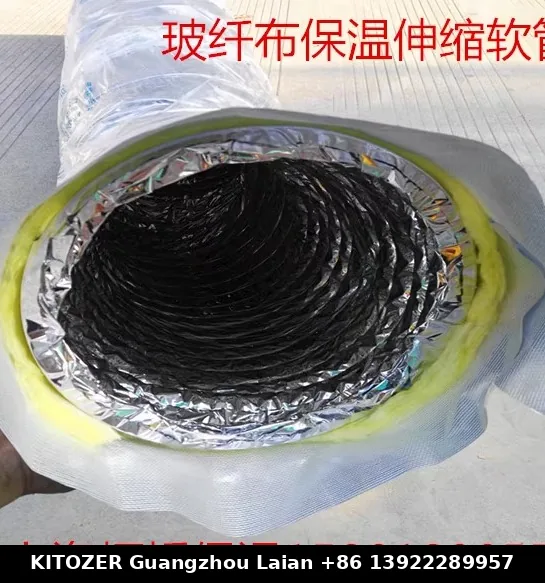
The flexible insulated duct is the most common terminal supply duct. It has three layers: inner galvanized steel helix wire plus aluminum foil fiberglass cloth, middle 25 mm centrifugal glass wool insulation, outer reinforced aluminum foil fiberglass cloth. Inner diameter from 150 to 500 mm, standard length 6 m, bendable and field-cut. No flanges are needed; ends are attached to plenum boxes or diffusers with stainless steel clamps.
Flexible ducts are light, flexible, space-saving, pre-insulated and cold-bridge-free. Limits: max velocity 8 m/s, minimum bend radius 1.5 times diameter. KITOZER recommends flexible ducts only for terminal branches within 5 m; longer runs cause excessive airflow decay.
3.3 Stainless steel duct
For corrosive or high-cleanliness rooms (battery rooms, chemical lab adjacent rooms, medical equipment rooms), KITOZER uses 304 or 316L stainless steel ducts. Stainless steel is corrosion-proof, rust-free, smooth, non-shedding and easy to clean. Cost is 2 to 3 times galvanized steel.
3.4 Glass magnesium composite duct
Glass magnesium composite duct is made of glass magnesium board laminated with aluminum foil, molded into rectangular ducts. It is fire-rated Class A, light, pre-insulated, and bonded on site with adhesive. It suits high-fire-rating, fast-schedule projects but is brittle and not for vibrating or frequently dismantled locations.
3.5 Accessories
A complete duct system also includes: elbows (90 degree, 45 degree, with turning vanes to reduce resistance), reducers (gradual expansion/contraction to avoid turbulence), tees (supply branch or return collection), manual volume control dampers (opposed blade or butterfly), fire dampers (70 C fusible link, installed where ducts cross fire zones), backdraft dampers (prevent reverse flow when CRAC stops), flexible connectors (canvas or silicon-titanium fire cloth for vibration isolation), plenum boxes (downstream of branches for flow smoothing and noise reduction), and square or linear supply diffusers. KITOZER supplies all matching accessories.
| Parameter | Galv. Steel Rect | Alum. Flex Duct | Stainless | Glass Magnesium |
|---|---|---|---|---|
| Cross-section | 160×120 to 2000×630 | Dia 150 to 500 | Rect or round | 200×200 to 1200×600 |
| Thickness | 0.5-1.0mm galv | 25mm glass wool | 0.5-1.0mm 304/316L | 25-35mm board |
| Insulation | 25-30mm glass wool ext. | Integral 25mm | 25mm rubber ext. | Integral |
| Flange | Common/angle steel | Clamp | Flange/TIG weld | Adhesive |
| Leakage rate | <=3% | <=5% | <=2% | <=5% |
| Recommended velocity | 6-10 m/s | <=8 m/s | 6-10 m/s | 5-8 m/s |
| Fire rating | B1 (alum. foil) | B1 (glass wool noncombustible) | A | A |
| Reference price / m | $36-95 | $28-58 | $72-140 | $45-83 |
Chapter 4. Selection Guide and Calculation
4.1 Heat load and supply airflow
Supply airflow is based on heat load and supply air temperature difference. Precision AC uses small delta T, typically 8 to 12 degrees C. Formula: L = Q / (rho x cp x dT), where Q is heat load in W, rho is air density about 1.2 kg/m3, cp is 1.005 kJ/kgK, dT is supply/return delta T in K. Example: a 100 kW room with 10 K delta T needs L = 100000 / (1.2 x 1005 x 10) = 8.3 m3/s, about 30000 m3/h. KITOZER adds 10-15% margin for future growth.
4.2 Duct sizing and velocity
Duct cross-section balances resistance, noise and ceiling space. Too small means high velocity, high resistance, high fan energy and noise; too large means wasted ceiling space and cost. Main duct 6 to 10 m/s, branch 3 to 6 m/s, flexible terminal under 8 m/s. Rectangular duct long-to-short ratio should be within 4:1; if ceiling height is tight, split one large duct into two parallel smaller ducts.
4.3 Insulation thickness check
Insulation is checked against condensation: duct outer surface must be at least 2 degrees C above dew point. In a hot humid room, ceiling plenum air at 30 C and 70% RH has dew point about 24 C. With 15 C supply air and 25 mm glass wool (0.035 W/mK), outer surface reaches about 27 C, safely above dew point. KITOZER verifies insulation against local climate and uses 30 mm in humid regions.
4.4 Resistance balancing and dampers
Parallel branches have different resistance. Without balancing, near branches take too much air and far branches too little. KITOZER installs manual opposed-blade dampers on each branch and balances them during commissioning with an airflow hood, keeping each outlet within plus or minus 15%. Motorized constant volume dampers are optional for critical rooms.
4.5 Fire dampers and fire linkage
Where ducts cross fire zones, slabs or walls, a 70 C fusible-link fire damper is required. When duct air reaches 70 C, the damper closes and stops flame and smoke spread. The damper must be within 200 mm of the penetration and send a position signal to the fire control room. KITOZER fire dampers meet GB 15930 and carry CCCF certification.
4.6 Noise and silencers
CRAC fan noise travels through ducts into the room, plus regenerated duct noise. Data center background noise should be below 65 dB(A). KITOZER installs silencer elbows or splitter silencers at the CRAC outlet to attenuate fan noise by 15 to 20 dB, keeps duct walls smooth and avoids abrupt changes. Flexible glass wool ducts themselves have some silencing effect.
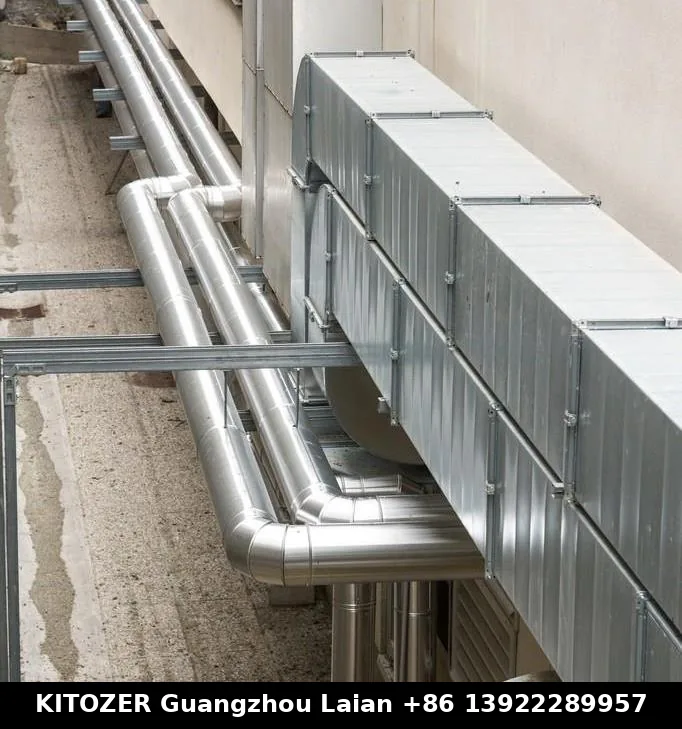
Chapter 5. Installation Requirements
5.1 Pre-installation check
Before installation, review drawings and check that duct routing, elevation, cross-section and hanger positions do not conflict with cable trays, fire pipes, sprinklers or lighting. In ceiling voids, ducts share space with electrical and plumbing services; the rule is small pipe yields to large, pressured yields to non-pressured. KITOZER produces a coordinated MEP drawing before work starts.
Inspect delivered materials: galvanized sheet should be smooth with intact zinc; flexible duct aluminum foil should be undamaged with uniform glass wool; insulation must have combustion and thermal conductivity certificates. Reject non-conforming materials.
5.2 Hanging supports
Horizontal galvanized duct hanger spacing: long side up to 400 mm at max 4 m spacing, above 400 mm at max 3 m; vertical duct max 4 m with at least two fixes per riser. Hangers use expansion bolts into slabs or primary beams, never into ceiling furring channels. Insulated ducts need anti-corrosion wood blocks or rubber pads between hanger and duct to break cold bridges. Flexible ducts have no rigid hangers and hang naturally.
5.3 Duct joints and sealing
Flanged joints use 5 mm closed-cell sponge gasket, bolts evenly tightened at no more than 150 mm spacing. Common-flange ducts use special clips and sealant. Flexible duct ends slide onto plenum outlets and are clamped with double stainless steel bands within 30 mm. After installation, check all joints by smoke or light test and re-caulk leaks.
5.4 Insulation work
Insulation is applied after leak testing. Glass wool boards are fixed with insulation pins at 300 mm spacing, seams taped with aluminum foil tape. Elbows, tees and valves must be fully wrapped with no cold bridges. The outer aluminum foil vapor barrier must be continuous, all seams taped. Flexible ducts arrive pre-insulated.
5.5 Flexible connectors and vibration isolation
CRAC outlet and return must connect to a 150 to 300 mm fire canvas or silicon-titanium soft connector to isolate fan vibration. The connector must not be used to compensate misalignment. CRAC units sit on spring or rubber isolators.
5.6 Terminal outlets
Supply terminals are square diffusers or linear slot diffusers mounted on ceilings, connected by short branch ducts. Outlets sit flush with ceiling with no air leaks. Return grilles are above the hot aisle or near the CRAC return; return ducts are 20 to 30% larger than supply because return air is warmer. KITOZER recommends a volume damper at every supply outlet.
Chapter 6. Operation and Maintenance
6.1 Routine inspection
Inspect ductwork monthly: check for condensation or dripping, insulation integrity, flange leaks, hanger tightness, flexible duct collapse, fire damper lead seals and damper position labels. Repair damaged insulation immediately; investigate dripping at once to protect racks.
6.2 Periodic testing
Quarterly, use an anemometer or hood to spot-check outlet airflow against design. If several outlets lose over 20%, suspect clogged filters, closed dampers or CRAC fan faults. Annually, before cooling season, do a full leak and insulation check. Important rooms recommend internal duct inspection every two years.
6.3 Common fault: condensation dripping
Condensation is the most common duct complaint. Causes: broken or too-thin insulation, cracked vapor barrier, cold bridge at flanges, torn flexible duct foil. Fix the leak point, strip damaged insulation, replace wet glass wool, re-wrap foil with taped overlaps. Avoid drilling or hanging things on ducts.
6.4 Common fault: insufficient or uneven airflow
Causes: underestimated resistance, insufficient CRAC external static pressure, clogged filters, closed dampers, overly bent flexible ducts. Rebalance dampers; if static pressure is insufficient, enlarge duct or change CRAC fan. Uneven airflow means branches are unbalanced or outlets are blocked by ceiling work.
6.5 Common fault: duct vibration and noise
Vibration usually means missing or aging soft connectors, high duct velocity, loose hangers or fan-duct resonance. Noise comes from fan, regenerated duct noise or outlet turbulence. Fix by replacing connectors, tightening hangers, lowering velocity, adding silencers.
6.6 Common fault: flexible duct collapse
Over time, corroded steel helix or loose clamps can collapse flexible ducts and block airflow. High outlet temperature is often the first sign. Replace the collapsed section and re-clamp. KITOZER recommends checking flexible ducts every 5 to 8 years.
6.7 Cleaning and disinfection
Duct interiors slowly collect dust, which breeds bacteria and lowers efficiency. For rooms staffed by people, clean ducts every 3 to 5 years with soft brushes and vacuum robots, avoiding blowing dust into racks. Clean during CRAC shutdown.
Chapter 7. Technical Parameters and Price Reference
| Model | Type | Cross-section | Insulation | Use | Ref. Price/m |
|---|---|---|---|---|---|
| KZ-DT-GB-200 | Galv. steel rect. | 200×150 | 25mm | Terminal branch | $36-45 |
| KZ-DT-GB-400 | Galv. steel rect. | 400×250 | 25mm | Branch duct | $48-58 |
| KZ-DT-GB-630 | Galv. steel rect. | 630×400 | 30mm | Main branch | $64-78 |
| KZ-DT-GB-1000 | Galv. steel rect. | 1000×500 | 30mm | Main duct | $80-100 |
| KZ-DT-GB-1600 | Galv. steel rect. | 1600×630 | 30mm | Large main | $100-125 |
| KZ-DT-FX-200 | Flex insulated | Dia 200 | 25mm | Terminal flex | $28-36 |
| KZ-DT-FX-300 | Flex insulated | Dia 300 | 25mm | Terminal flex | $33-45 |
| KZ-DT-FX-400 | Flex insulated | Dia 400 | 25mm | Terminal flex | $42-56 |
| KZ-DT-SS-400 | 304 stainless | 400×250 | 25mm rubber | Corrosive/clean | $72-95 |
| KZ-DT-SS-630 | 304 stainless | 630×400 | 30mm rubber | Corrosive/clean | $95-120 |
| KZ-DT-BM-630 | Glass magnesium | 630×400 | Integral | Fire-rated | $50-67 |
| KZ-DT-BM-1000 | Glass magnesium | 1000×500 | Integral | Fire-rated | $67-83 |
Accessory reference prices: 90-degree turning-vane elbow $17 to $95 each; manual opposed-blade damper $21 to $108 each; 70 C fire damper $52 to $208 each; canvas flexible connector $11 to $50 each; square diffuser with damper $17 to $36 each; splitter silencer $167 to $625 each.
Chapter 8. Applications
8.1 Internet data centers (IDC)
Large IDCs run 8 to 15 kW per rack with cold aisle containment and in-row cooling. KITOZER ducts mainly carry hot return air to ceiling or wall CRAH, or deliver cold air to the cold aisle ceiling plenum in overhead systems. These projects need large cross-section and heavy insulation; KITOZER uses 1.0 mm galvanized main duct with aluminum foil flexible terminals.
8.2 Enterprise server rooms and NOCs
Enterprise rooms run 3 to 6 kW per rack with room-level CRAC and underfloor supply. KITOZER ducts connect CRAC outlets to underfloor plenums and ceiling return. Typical projects use 0.75 mm galvanized duct with 25 mm insulation.
8.3 Telecom sites and edge rooms
Telecom sites and edge rooms are small with compact racks; CRAC units blow directly and ducts are short. In multi-rack aggregation rooms, short ducts carry air to far racks. KITOZER flexible ducts suit these small retrofits.
8.4 Industrial control rooms and labs
Industrial control rooms, power dispatch centers and semiconductor clean labs need tight temperature, humidity and cleanliness. KITOZER stainless or glass magnesium ducts meet corrosion and cleanliness requirements, often with medium filter sections.
8.5 Battery rooms and UPS rooms
Lead-acid battery rooms emit trace hydrogen and corrosive acid mist. KITOZER uses 316L stainless or FRP ducts with slightly negative-pressure exhaust to keep corrosive gases from spreading.
Chapter 11. Duct Material Physics and Chemistry
11.1 Galvanized sheet zinc coating and corrosion
KITOZER uses hot-dip galvanized sheet with zinc weight at least 80 g/m2, about 10 micron per side. In air, zinc forms a dense basic zinc carbonate film that stops further rust. Data center air is dry, around 23 C and 50% RH, so galvanized ducts last over 20 years. Near the coast or in battery rooms with corrosive gas, plain galvanized sheet red-rusts in 5 to 8 years; KITOZER recommends stainless steel or coated duct.
Protect the zinc layer during transport and installation; scratches rust first. Brush damaged spots with two coats of zinc-rich paint after cutting.
11.2 Centrifugal glass wool insulation
Glass wool is spun from molten glass into inorganic fibers. It is noncombustible (Class A), low conductivity (about 0.035 W/mK), light (32 to 48 kg/m3), sound-absorbent, moisture-repellent and vermin-proof. Because fibers can irritate skin and lungs, it must be fully wrapped in aluminum foil cloth. KITOZER uses 25 mm as standard and 30 mm in humid zones, with density at least 32 kg/m3 to prevent settling.
11.3 Aluminum foil fiberglass facing
The facing bonds aluminum foil to fiberglass cloth; foil reflects radiation and blocks vapor, cloth adds strength. KITOZER facing is at least 0.08 mm thick with no pinholes; overlaps are at least 50 mm sealed with foil tape. Do not walk on or hang services from the facing; torn facing lets vapor in and ruins insulation.
11.4 Rubber foam insulation
Closed-cell rubber foam is used on stainless ducts and chilled water pipes. It is about 0.034 W/mK, fully closed-cell, flexible and easy to install, but only B1 fire rated and ages over time. KITOZER prefers glass wool for main supply ducts.
11.5 Gasket materials
Flange gaskets are closed-cell sponge rubber, 5 mm thick, 20 to 30 mm wide, density at least 80 kg/m3, rated minus 20 to 100 C. Sealant is neutral silicone or butyl, never acidic glass that corrodes zinc. Gaskets are continuous with 45-degree mitered joints.
Chapter 12. Duct Hydraulic Calculation Worked Example
12.1 Given conditions
A typical enterprise room: 200 m2, 40 racks at 4 kW each, total heat 160 kW. Use three 60 kW CRAC units (2 duty 1 standby), each about 20000 m3/h. Supply 15 C, return 27 C, delta T 12 K. Overhead supply/return; main duct runs along the long axis with 10 supply branches.
12.2 Main duct sizing
One CRAC supplies 20000 m3/h = 5.56 m3/s. At 8 m/s main velocity, area A = 5.56/8 = 0.695 m2. Choose 1000×630 mm (0.63 m2, 8.8 m/s). If ceiling height is tight, use 1250×500 mm.
12.3 Branches and outlets
Each branch handles 2000 m3/h = 0.556 m3/s at 4 m/s, area 0.139 m2, choose 400×320 mm or Dia 200 flexible. Each linear diffuser throat at 3 m/s, area 0.185 m2, about 600×300 mm.
12.4 Resistance estimate
Main duct length 30 m, friction about 1.2 Pa/m = 36 Pa. Three 90-degree elbows at 14 Pa each = 42 Pa. One gradual expansion about 20 Pa. One fire damper about 50 Pa. Diffuser about 30 Pa. Total about 178 Pa. CRAC external static should be at least 200 Pa with margin; choose 300 Pa unit.
12.5 Insulation check
Ceiling air 32 C, 65% RH, dew point 25 C. With 15 C supply and 25 mm glass wool, outer surface about 27 C, above dew point. Use 30 mm in humid Guangdong for margin.
Chapter 13. Coordination with Other Room Systems
13.1 Cold aisle containment interface
Cold aisle containment closes the aisle top with skylights or fixed panels and ends with doors. Supply ducts deliver cold air to the aisle ceiling plenum or through linear diffusers. KITOZER coordinates duct positions with skylight panels and end doors so ducts never cross skylight swing paths.
13.2 Fire gas suppression linkage
Rooms using FM200 or IG541 gas suppression must shut down supply and return fans and close fire dampers when gas discharges. Duct 70 C dampers stay closed during gas hold. Penetrations are fire-stopped. KITOZER lists all fan shutdowns and damper closures on the fire linkage diagram.
13.3 Cable tray clearance
Ceiling voids contain ducts, cable trays, sprinklers and lighting. Ducts parallel to cable trays keep 200 mm clearance, cross at 100 mm. Ducts take the big routing; trays take the small. KITOZER issues coordinated MEP drawings.
13.4 BMS monitoring interface
Critical rooms add duct temperature/humidity and static pressure sensors wired to the DCIM. KITOZER supplies sensor bosses and junction boxes.
Chapter 14. Construction Quality Acceptance
| Item | Standard | Method |
|---|---|---|
| Material and gauge | Galv. gauge to spec, no rust | Caliper, visual |
| Duct dimensions | Tolerance +/-3 mm | Tape measure |
| Flange sealing | Leakage <=5% | Smoke/light test |
| Insulation thickness | >=25 mm (30 humid) | Pin gauge |
| Insulation integrity | No gaps, foil overlap >=50mm | Visual |
| Hanger spacing | To code, tight | Measure, hand check |
| Outlet airflow | Deviation <=+/-15% | Airflow hood |
| Duct resistance | <=1.1x design | Micromanometer |
| Noise | Background <=65 dB(A) | Sound level meter |
| Fire damper | Operates, signal works | Manual trigger |
14.1 Leakage test
Seal duct ends and pressurize with a leakage tester at 500 Pa; measure leakage flow. KITOZER builds to medium-pressure Class B with actual leakage usually 2% to 4%, better than code.
14.2 Airflow balancing
After running all CRAC units 30 minutes, hood-measure every outlet. Adjust branch dampers until within 15% of design, then lock and seal damper positions.
14.3 Temperature field test
Mount loggers at rack intake mid-height for 24 hours. Rack inlet should be 18 to 27 C, adjacent racks within 3 C. Hot rows indicate insufficient supply.
Chapter 15. Energy Efficiency and Lifecycle Cost
15.1 Duct resistance and fan energy
Fan power P = Q x P / (eta x 1000 kW). If duct is undersized, velocity and resistance rise and fan energy climbs. A 10000 m3/h, 300 Pa system needs about 1.2 kW; at 500 Pa it rises to 2 kW, adding 6400 kWh per year at 8000 hours. KITOZER sizes ducts economically.
15.2 Leakage loss
10% leakage wastes 10% of cooling. On a 100 kW room, that is 10 kW wasted, about 80000 kWh per year. KITOZER holds leakage to 3% to 5%.
15.3 Insulation loss
Uninsulated ducts lose 30 to 50 W per m2 per hour. A 50 m2 duct with half its insulation broken loses about 20000 kWh per year. Good insulation and regular inspection save real money.
15.4 Lifecycle comparison
Galvanized main duct lasts 20 years; glass magnesium 10 to 15 years; flexible duct 5 to 8 years. KITOZER recommends galvanized mains with periodic flexible duct replacement for the best 20-year cost.
Chapter 16. Packaging, Transport and Site Service
16.1 Factory prefabrication and numbering
Every duct section is factory-made to shop drawings, labeled with section number, cross-section, length and installation position. On site crews assemble by number; elbows and reducers are prefabricated, no field sheet-metal work.
16.2 Transport and storage
Ducts are strapped with soft packing to protect zinc. Flexible ducts arrive rolled with sealed ends. Store on raised timbers under cover; never directly on damp ground.
16.3 Site support
KITOZER provides design, shop drawings, prefabrication, installation supervision and commissioning. Engineers attend key milestones: delivery, hoisting, leak test and airflow balance.
Chapter 17. National and International Standards
17.1 Main standards
KITOZER ducts follow GB 50243 Ventilation and Air Conditioning Engineering Quality Acceptance, GB 50736 Heating Ventilation and Air Conditioning Design, GB 50174 Data Center Design Standard, GB 15930 Fire Dampers, and JGJ 141 Ventilation Duct Technical Specification. Internationally, ASHRAE Handbook HVAC Applications and SMACNA duct construction standards are referenced for overseas projects.
GB 50174-2017 grades data centers A, B and C. Class A requires N+1 or 2N redundancy; ductwork should be dual-path so one path still cools the room. KITOZER designs dual main ducts each carrying 70% airflow for Class A rooms.
17.2 Duct gauge and flange
Per GB 50243, round galvanized duct gauge: up to 200 mm diameter 0.5 mm, 220 to 500 mm 0.6 mm, 560 to 1120 mm 0.75 mm, above 1120 mm 1.0 mm. Rectangular ducts map by long side. Flanges use angle steel 25×3 to 40×4. KITOZER provides material certificates and gauge measurements.
17.3 Leakage class
Data center supply ducts run at 300 to 800 Pa, medium pressure. Leakage limit is about 0.0352 x P^0.65 L/s per m2. KITOZER builds to medium-pressure Class B with actual 2% to 4% leakage.
17.4 Fire code
GB 50016 requires duct combustibility no lower than B1, with 70 C fire dampers at fire zone crossings. Insulation must be noncombustible or difficult-to-combustible; glass wool is Class A. KITOZER uses Class A glass wool on mains.
Chapter 18. Common Installation Mistakes to Avoid
18.1 Mistake: flexible duct as long main duct
Some crews run flexible duct as a 20 m main run. Flexible duct has high resistance, sags and crushes, causing severe airflow loss. Use rigid galvanized main duct; flexible only in the last 5 m terminal. KITOZER marks the rigid/flex boundary on drawings.
18.2 Mistake: sizing by CRAC outlet
Sizing duct by the CRAC outlet without hydraulic calculation leaves resistance unseen. Do full hydraulic calculation for every section.
18.3 Mistake: broken insulation at flanges and valves
Field insulation often stops at flanges, creating cold bridges that always drip. Wrap flanges, valves, elbows and tees continuously.
18.4 Mistake: hangers on ceiling furring
A 1000×630 duct weighs about 15 kg/m plus 5 kg/m insulation; a 30 m run weighs 600 kg. Furring channels will break. Use expansion bolts into slabs or primary beams.
18.5 Mistake: no airflow balancing
Delivering without hood-balancing leaves near outlets overblown and far outlets starving. Commission every outlet.
18.6 Mistake: lights or sprinklers inside ducts
Never install services inside ducts. Keep lights and sprinklers outside the duct envelope.
Chapter 19. Climate Zone Design Differences
19.1 Hot humid south China
Guangdong, Guangxi, Hainan and southern Fujian see summer dry bulb above 34 C and RH above 70%; ceiling air can hit 35 C with dew point 26 C. KITOZER uses 30 mm glass wool and a meticulous vapor barrier, and observes 24 hours for condensation after delivery.
19.2 Hot summer cold winter east China
Shanghai, Jiangsu, Zhejiang: summer humid, winter cold. Main concern is summer condensation; winter risk is frost if the room is shut down. Keep a minimum winter setpoint.
19.3 Dry north China
Beijing, Tianjin, Hebei, Shanxi: low dew point, 25 mm insulation enough. Pay attention to wall penetration cold bridges in winter.
19.4 Northwest and southwest highlands
Strong UV in the northwest requires UV-resistant facing; humid southwest needs moisture protection.
Chapter 20. Duct to CRAC Interface
20.1 Supply outlet interface
CRAC outlets are rectangular flanges sized to the unit. Connect a 150 to 300 mm fire canvas soft connector first, then the main duct. The connector isolates vibration and must not be forced.
20.2 Return interface
Return duct cross-section is 20% to 30% larger than supply because return air is warmer and needs lower resistance. Also use a soft connector.
20.3 Plenum box connection
Branch terminals connect to a lined plenum box that converts velocity pressure to static. Plenum size should be at least 1.5 times duct area and 600 mm long, internally lined with 25 mm glass wool.
20.4 Underfloor plenum interface
In raised-floor rooms, the duct discharges into the underfloor plenum at under 5 m/s to avoid high-velocity jets. Floor swirl panels handle 200 to 400 m3/h each.
Chapter 21. Commissioning and Acceptance Report
21.1 Pre-commissioning checklist
Check duct installation, hanger tightness, insulation integrity, damper positions, fire damper reset, CRAC filters, fan rotation, electrical wiring and fire linkage before startup.
21.2 Single unit test
Run fans without cooling. Jog to confirm rotation, then run 2 hours and record current, bearing temperature, vibration and noise. Current must not exceed rated; bearings under 70 C.
21.3 Integrated test
After fans pass, start cooling and run 8 hours. Record supply/return temp, room temp, rack inlet temp, outlet airflow, fan current and duct static every 2 hours.
21.4 Commissioning report
KITOZER issues a report with design vs measured data, airflow balance records, temperature field, noise, and corrective actions, handed over as as-built documentation.
Chapter 22. Ordering Process
KITOZER duct ordering steps: (1) customer provides room layout, rack layout and CRAC model; (2) KITOZER surveys site and measures ceiling height and connections; (3) KITOZER issues design proposal and budget quote; (4) after approval, factory prefabrication takes 7 to 15 working days (stainless and specials 15 to 25 days); (5) shipping 3 to 7 days; (6) installation 5 to 15 days depending on size; (7) leak test and airflow balance; (8) handover.
Payment terms are typically 30% on contract, 60% before shipment, 10% retention after acceptance, 2-year warranty. Rush orders can be expedited.
Chapter 23. Duct Aerodynamics in Detail
23.1 Laminar and turbulent flow
Duct airflow at 6 to 10 m/s and 200 to 1000 mm diameter has Reynolds numbers above 100000, fully turbulent. Turbulence gives fairly uniform velocity profiles but higher friction. Wall roughness matters: galvanized steel about 0.15 mm, fiberglass board about 0.05 mm, flexible foil about 0.3 mm. KITOZER applies different friction factors per material.
At elbows, tees and reducers, local eddies form. A sharp 90-degree elbow has loss coefficient 0.35; a vane-elbow has 0.15. KITOZER installs 1 to 3 turning vanes on all 90-degree elbows to halve resistance. Branch tees use 30-degree angles to reduce turbulence.
23.2 Velocity, static and total pressure
Velocity pressure is Pd = 0.5 x rho x v^2; static pressure Ps acts perpendicular to walls; total pressure Pt = Ps + Pd. Friction drops total pressure along the duct. Fans supply total pressure. At outlets, velocity pressure converts to static. KITOZER commissioning reads duct static with a micromanometer to judge system health.
High static means high resistance or low airflow; low static means dampers open but fans undersized. Normal data center main duct static is 100 to 300 Pa.
23.3 Airflow noise mechanisms
Duct noise comes from fan noise traveling downstream, regenerated noise from high-velocity flow, and outlet turbulence. KITOZER controls it with outlet silencers, controlled velocities and large low-velocity diffusers.
23.4 Temperature decay in ducts
Even insulated ducts lose a little cold; supply air warms 1 to 2 C from CRAC to outlet. Long or poorly insulated ducts can warm 3 to 5 C and overheat remote racks. KITOZER keeps decay under 2 C.
Chapter 24. Hanging Supports and Seismic Design
24.1 Support selection
KITOZER hangers use galvanized angle or channel steel. Horizontal ducts use rods with saddles; vertical ducts use wall clamps. Spacing follows long-side rules: 4 m under 400 mm, 3 m above. Extra hangers within 200 mm of elbows, tees and valves. Insulated ducts use wood blocks.
24.2 Seismic bracing
Per GB 50981, ducts over 0.7 m diameter or 0.38 m2 area need seismic bracing. Longitudinal braces max 12 m, transverse max 6 m. KITOZER installs galvanized angle diagonal braces for large ducts.
24.3 Thermal movement
Data center ducts see only 5 to 8 C temperature swing, so thermal movement is small. Expansion joints are needed where ducts cross building movement joints; use silicon-titanium flexible sections.
Chapter 25. Clean Room Duct Requirements
25.1 Cleanliness classes
Semiconductor, pharmaceutical and bio-lab adjacent rooms require ISO 7 or ISO 8 clean supply. KITOZER uses stainless or glass magnesium ducts with smooth polished interiors, full welds or full-gasket flanges to avoid dust traps.
25.2 Filter sections
Clean rooms need pre-filter, medium-filter and HEPA stages. KITOZER leaves space for filter boxes; filter sections are 1.5 times duct size.
25.3 Sealing and pressurization
Clean rooms run positive pressure; duct leakage under 1%. The room holds 5 to 10 Pa positive pressure relative to corridors, set by fresh air dampers.
Chapter 26. Battery Room Duct Requirements
26.1 Corrosive environment
Lead-acid batteries release trace hydrogen and acid mist. Use 316L stainless or FRP ducts at slightly negative pressure, venting corrosive air outside.
26.2 Air change rate
Battery rooms need at least 6 ACH normal and 12 ACH during charging. Exhaust at top (hydrogen) and bottom (acid mist).
26.3 Explosion proof
Battery room exhaust fans are explosion-proof; no spark-producing parts in ducts.
Chapter 27. Retrofit and Expansion
27.1 Existing duct assessment
Before retrofitting, gauge wall thickness, insulation condition, leakage and actual airflow. Reusable duct keeps its main body; rusted or undersized duct gets replaced.
27.2 Expansion
When racks go from 4 to 8 kW, heat and airflow double. The old duct may be undersized. KITOZER adds a parallel duct, enlarges mains, or upgrades CRAC units, with phased work to keep some racks running.
27.3 In-row cooling addition
Adding in-row units needs only short flexible ducts to route hot air to the hot aisle. KITOZER flexible ducts suit this without major ceiling demolition.
Chapter 28. Packaging, Storage and Warranty
28.1 Packaging
Ducts are end-capped, strapped and packed to avoid zinc damage. Flexible ducts are rolled with sealed ends.
28.2 Storage
Store on raised timbers under cover. Keep flexible ducts indoors away from UV.
28.3 Warranty
KITOZER ducts carry a 2-year warranty from commissioning. Defects in material or workmanship are repaired or replaced free; customer-caused damage is not covered.
Chapter 29. KITOZER Duct vs Other Brands
KITOZER ductwork is distinguished by complete hydraulic calculation, factory prefabrication, meticulous insulation and one-team service. KITOZER also supplies CRAC, racks, containment, monitoring and switchgear, so duct interfaces are coordinated in design rather than argued on site. Price is mid-market: above cheap local shops but well below imports.
Chapter 30. Step-by-Step Installation Guide
30.1 Survey and layout
Use laser levels to mark duct centerlines and elevations on slabs. Verify beam clearance and CRAC outlet positions. Mark hanger locations.
30.2 Hanger installation
Drill slab holes, install M10/M12 expansion bolts, hang rods and saddles, line up in a row within 5 mm.
30.3 Duct hoisting
Start at the CRAC outlet and work outward. Two-person lifts, bolt flanges diagonally with gaskets, clamp to saddles.
30.4 Fittings and dampers
Install elbows, tees and reducers per numbered labels. Dampers within reach, fire dampers with fusible link facing airflow. Soft connectors at CRAC.
30.5 Leak test
Smoke-test joints, mark and recaulk leaks. Critical projects do quantitative leakage testing.
30.6 Insulation
After leak test, pin glass wool boards, tape seams, wrap flanges and valves fully.
30.7 Outlets and commissioning
Install diffusers, balance airflow, lock dampers.
Chapter 31. Duct Design Calculation Questions
31.1 Quick room airflow estimate
A quick rule is 300 to 500 m3/h per m2 of room, or 45 to 60 m3/h per kW of heat. A 200 m2 room at 400 m3/h/m2 needs 80000 m3/h, i.e. four 20000 m3/h CRAC units (3 duty 1 standby). Use this for planning; detail by heat load and delta T.
31.2 Duct too big for ceiling
If the duct does not fit, split one large duct into two parallel smaller ducts, make it flatter (within 4:1 aspect), use round spiral duct locally, or reroute around beams. KITOZER avoids these surprises in coordinated drawings.
31.3 Fan static insufficient
If measured airflow is low and static is low, the fan is undersized. Options: enlarge duct, remove unnecessary elbows and dampers, change CRAC fan, or add an in-line booster. KITOZER prefers the first two.
31.4 Multiple CRAC units
Parallel CRAC units need backdraft dampers at each outlet to prevent reverse flow when one stops. Size the main duct for the number of running units, not the total.
Chapter 32. Ducts and Energy-Efficient Operation
32.1 Variable-speed CRAC fans
Modern CRAC fans are EC variable-speed, following rack load. The duct resistance curve must match the fan curve so the system works in the fan high-efficiency range. High duct resistance undermines variable-speed savings.
32.2 Free cooling
In winter or swing season, when outdoor air is cold, CRAC uses free cooling with outside air. KITOZER designs fresh air and exhaust branches that interlock with the main duct.
32.3 Ducts and rack containment
Supply outlets must aim at the cold aisle center, not the hot aisle. If cold air dumps into the hot aisle, mixing wastes cooling.
Chapter 33. Safety on Site
33.1 Working at height
Ceiling duct work needs harnesses, helmets and scaffolding inspection. No standing under lifted duct. Power tools need RCD protection.
33.2 Fire on site
Insulation is combustible; no hot work near it. If welding is needed, get a hot work permit, clear insulation, have a fire watch and extinguishers.
33.3 Product protection
Do not stand on ducts, stack material on them, or drill them before ceiling close-out.
Chapter 34. Customer Questions
Can KITOZER supply only ducts when we already have CRAC? Yes. Provide the CRAC model and connection dimensions; KITOZER designs ducts to match.
Do we install ourselves? KITOZER offers site supervision or full installation; ductwork is technical, so supervision is recommended.
How long is warranty? Two years from commissioning.
Can we buy only flexible ducts? Yes for short terminal runs; mains should be rigid.
Is price tax and freight included? Quoted price includes 13% VAT; freight inside Guangdong is included, outside is extra.
What if site dimensions differ? KITOZER re-measures before production; changes are accommodated.
Can ducts carry sensors? Yes, KITOZER provides sensor bosses and wiring boxes to DCIM.
Does retrofit require shutdown? Phased work keeps some racks running; KITOZER plans no-shutdown retrofits in off-hours.
Chapter 35. Material and Accessory Procurement
35.1 Galvanized sheet
KITOZER buys certified hot-dip galvanized sheet with mill certificates. Inspect zinc weight, surface and gauge; reject pitted or delaminated coils.
35.2 Glass wool
Glass wool must be at least 32 kg/m3, k <=0.035 W/mK, Class A, with combustion and conductivity certificates. Yellowed or odorous stock is rejected.
35.3 Facing
Aluminum foil fiberglass facing at least 0.08 mm, pinhole-free, with matching foil tape 50 mm wide.
35.4 Dampers and fire dampers
Manual dampers must move freely without binding. Fire dampers need CCCF certificates and resettable fusible links. Test every damper before delivery.
Chapter 36. Duct and Ceiling Finish Coordination
36.1 Ceiling coordination
Data center ceilings are perforated aluminum or gypsum at 2.6 to 3.0 m. Ducts run above, bottom at least 100 mm above finished ceiling for short branches. Outlets center on ceiling tiles.
36.2 Wall openings
Duct penetrations need openings 100 mm larger each way. Seal after installation with fire mineral wool and fire board.
36.3 Underfloor coordination
Raised floors are 300 to 600 mm high. Ducts discharge into the underfloor plenum; coordinate with underfloor cable trays. Floor swirl panels sit on removable tiles.
Chapter 37. Operating Data Logging
After handover, KITOZER recommends quarterly logs: CRAC supply/return temp and RH, airflow, fan current, duct static; rack inlet temp; room noise. Trends reveal problems: falling airflow means filters or fans; rising rack temp means blocked or unbalanced outlets. KITOZER provides a logging template. With DCIM, data is automatic.
37.1 Typical baseline
Normal: supply 14 to 18 C, return 24 to 28 C, room 22 to 24 C, rack inlet 23 +/-2 C, duct static 150 to 300 Pa, fan current 60% to 90% of rated. Supply below 12 C means overcooling or low airflow; rack inlet above 27 C means insufficient cooling.
37.2 Abnormal handling
Verify the sensor, check dampers, check outlet blocks, measure local airflow, repair the duct, and log the fix. KITOZER supports remote diagnosis by phone or WeChat.
Chapter 38. Environment and Occupational Health
38.1 Glass wool handling
Workers wear long sleeves, masks and gloves when insulating; vacuum up loose fibers. Once wrapped, ducts are harmless in operation.
38.2 Sealants
KITOZER uses neutral silicone or butyl, not acidic glass. Keep the room ventilated during sealing.
38.3 Waste
Old galvanized duct is recyclable scrap; old glass wool is general industrial waste disposed per local rules.
Chapter 39. Supply Outlet Types
39.1 Square diffusers
Square diffusers with multi-directional blades are the most common. KITOZER sizes 200×200 to 600×600 with balancing dampers.
39.2 Linear slot diffusers
Long linear slots run along the cold aisle, 1 to 3 m long, for uniform aesthetics in containment rooms.
39.3 Floor swirl panels
Underfloor rooms use square or circular floor swirl panels on removable tiles, with manual balancing.
39.4 Perforated ceiling supply
High-uniformity rooms use full perforated ceiling supply with plenum boxes; expensive but very even.
Chapter 40. Drawing Reading Guide
KITOZER duct drawings include plan layout, isometric, sections, detail nodes and a bill of materials. The plan shows routing, cross-section, elevation, hanger positions and outlet numbers. The isometric shows the 3D air path with per-section airflow. Sections show clearance to beams and other services. Detail nodes show elbows, tees, dampers and outlets. The BOM lists every component. Read the plan first, then isometric, then sections, then nodes. Install by numbered sections; on-site deviations need design approval, not field improvisation.
Chapter 41. UPS Room Ventilation Ducts
UPS rooms release heat from UPS and batteries but are not the main data hall. KITOZER provides independent exhaust ducts at 4 to 6 ACH, kept separate from the data hall CRAC ductwork. Battery rooms follow corrosion and explosion-proof rules.
Chapter 42. Fresh Air Ducts
Rooms need fresh air for people and positive pressure, about 40 m3/h per person or 5% to 10% of supply, whichever is larger. Fresh air is filtered and pre-conditioned before joining the supply duct, with motorized dampers that close when CRAC stops. Fresh air ducts use the same insulation as supply ducts.
Chapter 43. Exhaust and Fume Ducts
Kitchen or generator exhaust ducts are fully separate from CRAC ducts. Generator exhaust is insulated and kept 300 mm away from cool ducts. KITOZER coordinates these in MEP layout.
Chapter 44. Seismic Duct Bracing
Per GB 50981, large ducts need longitudinal and transverse seismic bracing with diagonal rods to slabs. KITOZER treats bracing as part of the duct package, with cold-bridge breaks at insulation.
Chapter 45. Intelligent Duct Monitoring
Modern ducts add temperature/humidity sensors, static pressure sensors and motorized dampers wired to the DCIM over RS485 or Modbus. Alarms trigger on filter differential pressure, abnormal static, and supply temperature drift. KITOZER offers these as options in micro-module data centers.
Chapter 46. Duct Lifetime and Replacement Cycle
Design life is 20 years for galvanized mains, 10 to 15 years for aluminum facing and seals, 5 to 8 years for flexible ducts, and 10 to 15 years for damper bearings. KITOZER recommends a full assessment every 10 years with replacement of aged facing and seals.
Chapter 47. Outlet Air Diffusion
Supply outlets produce ceiling-attachment or free jets. KITOZER chooses diffuser type and throat velocity so cold air travels the cold aisle before dropping to rack intakes. Throat velocity 3 m/s gives 2 to 3 m throw; 5 m/s gives 3 to 5 m.
Chapter 48. KITOZER Service Commitment
KITOZER promises free design, factory prefabrication, site supervision, leak and airflow commissioning, as-built documents, 2-year warranty and lifelong support. One team handles design through operation.
Chapter 49. Duct Glossary
Common terms: duct, plenum, velocity pressure, static pressure, total pressure, friction loss, local loss, specific friction, leakage rate, supply delta T, air changes, enthalpy, sensible heat, latent heat. CRAC means computer room air conditioner; CRAH means computer room air handler; in-row CRAC sits in the rack row; cold aisle and hot aisle are containment zones; PUE is power usage effectiveness; DCIM is data center infrastructure management; BMS is building management system; EC fan is electronically commutated brushless DC fan; VFD is variable frequency drive.
Chapter 50. Common Design Questions
50.1 Can ducts run under the slab?
Yes, supported by the slab. Penetrations in beams need structural engineer approval.
50.2 Can ducts hug beams?
Yes, but leave 50 mm for insulation and hangers.
50.3 How long can a duct run be?
Keep one CRAC loop under 60 m; longer loops need boosters or split systems.
50.4 Can one room mix duct materials?
Yes. Galvanized main, flexible terminal, stainless in corrosive zones.
50.5 Can silencers be added?
Yes, splitter silencers about 1 m long attenuate 15 to 20 dB.
50.6 Do ducts need corrosion protection?
Galvanized is fine indoors; cut edges and hangers get rust paint; coastal or corrosive sites get stainless.
50.7 What looks like a duct leak but is not?
Sometimes CRAC condensate pipe leaks parallel to the duct. Check both.
50.8 Can old ducts be reused?
If rust is under 10% and insulation is dry, yes with new seals and insulation.
Chapter 51. Acceptance Defects and Correction
Common acceptance defects: leakage above limit (re-caulk or replace gaskets), hollow insulation (re-pin and tape), over-spaced hangers (add supports), uneven outlet airflow (rebalance), uneven flange bolts (retorque diagonally), cracked foil overlaps (retape), reversed fire damper (turn fusible link to upstream side), unsealed wall penetrations (fire-stop). KITOZER corrects these before handover.
Chapter 52. CRAC-to-Duct Matching Table
As a planning guide: 30 kW CRAC pairs with 630×400 mm main; 60 kW with 800×500; 100 kW with 1000×630; 150 kW with 1250×800; 200 kW with 1600×1000. Each 2000 m3/h outlet branch uses 400×320 mm or Dia 250 flexible. These are planning numbers; detail by hydraulic calculation.
Chapter 53. Insulation Failure Case Studies
Case one: a south China room had flange condensation after year two. The flange insulation had a 100 mm gap forming a cold bridge. Fix: wrap flanges continuously. Case two: an east China room had terminal dripping because a ceiling beam crushed the flexible duct and tore its foil. Fix: replace flexible duct and re-route the beam. Case three: a north China room frosted ducts after winter shutdown; fix by keeping the room at a minimum 10 C winter setpoint. Case four: a coastal room showed red rust after three years on plain galvanized duct; fix by switching to 304 stainless. These cases show that insulation and sealing are the failure points KITOZER controls most carefully.
Chapter 54. Duct and Rack Layout Coordination
Supply outlets must face the cold aisle center, spaced every 1.5 to 3 m. Aisles longer than 12 m need supply from both ends. KITOZER labels each outlet to a rack row so cold air reaches rack intakes. If the rack layout changes, the duct layout must be rechecked.
Chapter 55. As-Built Documentation
KITOZER hands over as-built drawings, material certificates, insulation and fire damper certificates, leakage report, airflow balance report, temperature field report, noise report, O&M manual and warranty. These form the facility archive.
Chapter 56. Extra Questions
Can ducts be painted? They are in ceilings, so rust paint is enough; exposed ducts can be painted after insulation.
Can cables run inside ducts? No; cable trays run parallel but separate.
Can flexible ducts make right angles? No; minimum bend radius is 1.5 diameters; use elbows for 90-degree turns.
Do ducts need annual cleaning? No, every 3 to 5 years; staffed rooms every 2 to 3 years.
Does KITOZER export? Yes, with English documentation.
Chapter 57. Summary of Selection Rules
A good KITOZER duct system follows ten rules: calculate heat load and airflow; size main duct at 6 to 10 m/s; size branches at 3 to 6 m/s; insulate 25 mm (30 mm humid); keep leakage under 5%; balance every branch; install fire dampers at penetrations; fit soft connectors at CRAC; use flexible duct only within 5 m; commission and lock dampers.
Chapter 58. Industry Trends
Future ducts are prefabricated modular, instrumented with sensors, low-resistance, and recyclable. As rack power rises from 8 kW to 15 kW and beyond, ducts must handle more airflow; liquid-cooled racks reduce the air duct scope. KITOZER develops modular, smart, low-resistance ducts for mixed air-liquid rooms.
Chapter 59. Trust and Long-Term Support
KITOZER has served many data center projects with high repeat orders. Trust comes from professional design,规范 installation, commissioning, fast response and reliable warranty.
Chapter 60. Business Questions
Minimum order: ducts are quoted per project, small projects are accepted but priced slightly higher. Lead time: standard ducts 7 to 15 working days, stainless and specials 15 to 25. Accessories can be ordered separately. Engineers attend key milestones. Design fee is included. Warranty response: within Guangdong 24 hours, elsewhere 48 to 72 hours.
Chapter 61. Air Duct to Cold Aisle Skylight
In cold aisle containment, the aisle top is closed by skylights that open on fire gas discharge. Supply ducts feed the aisle plenum; KITOZER coordinates duct positions so they never cross skylight swing paths. KITOZER supplies both ducts and skylights.
Chapter 62. Duct Design Software
KITOZER uses industry hydraulic calculation software to size every section, then reviews output with site experience. Manual estimates are used only at planning stage.
Chapter 63. Duct Abbreviations
GI means galvanized iron; SS means stainless steel; FRP means fiberglass reinforced plastic; VCD means volume control damper; FVD means fire damper; SD means supply diffuser; PAU means fresh air handling unit; AHU means air handling unit; DX means direct expansion; CW means chilled water.
Chapter 64. Advanced Noise Control
For rooms adjacent to manned control centers, KITOZER stacks splitter silencers, silencer elbows, internal acoustic lining and low-velocity outlets to reach under 55 dB(A). Outlet selection is the most effective noise measure.
Chapter 65. Leak Detection Rope
Leak detection rope runs under CRAC units and ducts. Drip from condensation is a common alarm cause. Good insulation is the cure; detection rope is the backup.
Chapter 66. Seasonal Operation
Data centers run year-round, but summer needs full cooling, winter may use free cooling, and swing season partially uses outside air. KITOZER designs switching dampers for free-cooling modes.
Chapter 67. Complete Product List
KITOZER duct package includes: galvanized straight ducts, 90/45 vane elbows, gradual reducers, tees, manual opposed-blade dampers, 70 C fire dampers, backdraft dampers, canvas flexible connectors, flexible insulated ducts, plenum boxes, square diffusers, linear slots, floor swirl panels, hangers and insulation. Customers buy the whole package or individual parts.
Chapter 68. Duct to In-row CRAC Interface
In-row CRAC units sit in the rack row, 1200 mm wide. They blow into the cold aisle and draw from the hot aisle. Only short flexible duct sections are needed to route hot return air; KITOZER supplies flexible ducts for these short connections without major ceiling demolition.
Chapter 69. Duct to Overhead CRAC
Overhead CRAC units hang from the ceiling and blow straight down, needing little ductwork. Long cold aisles may use a short flexible duct to push air to the far end.
Chapter 70. Duct to Chilled Water CRAH
CRAH units rely on external chilled water; they typically have larger airflow and higher external static pressure for long duct runs. KITOZER sizes ducts to CRAH static pressure.
Chapter 71. Redundant CRAC Switching
Class A rooms run N+1. Each CRAC outlet has a backdraft damper; the main duct is sized for running units only. One failure triggers the standby automatically.
Chapter 72. Construction Schedule Reference
A 500 m2 room with 200 to 400 m of duct: factory prefabrication 10 to 15 days, shipping 3 to 5 days, hangers 3 to 5 days, hoisting 5 to 8 days, insulation 3 to 5 days, testing 2 to 3 days. Total 4 to 6 weeks; small rooms 1 to 2 weeks; large rooms 8 to 12 weeks.
Chapter 73. Raised Floor and Duct Relationship
Underfloor rooms use 300 to 600 mm raised floors. Ducts discharge under the floor at under 5 m/s; floor swirl panels handle 200 to 400 m3/h. Cable trays below the floor must not block airflow.
Chapter 74. Fire Smoke Exhaust Duct Separation
CRAC supply ducts are separate from fire smoke exhaust ducts. CRAC ducts close at 70 C; smoke ducts close at 280 C. KITOZER keeps the two systems apart.
Chapter 75. Toilet Exhaust
Toilet and switchgear exhaust ducts are small (100×100 to 200×200 mm) and vented outside, never into CRAC systems.
Chapter 76. Site Count and Packaging
Ducts are numbered and packed; count against the delivery note on arrival. Store neatly, no standing on ducts.
Chapter 77. Warranty Period
Two years from commissioning. Free repair for manufacturing defects; customer damage excluded.
Chapter 78. Duct Advantages Summary
KITOZER ducts offer full hydraulic design, factory prefabrication, no-condensation insulation, one-team service, coordinated product family, mid-market price and two-year warranty.
Chapter 79. Standards Updates
Standards like GB 50174 keep evolving toward lower PUE and smarter monitoring. KITOZER tracks updates and designs to the latest code.
Chapter 80. Green Data Centers
Green data centers need low PUE. Tight ducts, good insulation and reasonable resistance cut fan energy. KITOZER ducts help customers meet PUE targets.
Chapter 81. Customer Engineering Management
KITOZER runs kickoff, weekly meetings, milestone inspections and post-project review. A single project manager is the customer’s point of contact.
Chapter 82. Long-Term O&M
KITOZER supports ducts for life: remote phone guidance, on-site service in Guangdong within 24 hours, and annual inspection contracts.
Chapter 83. Duct Case Studies
KITOZER has served internet data centers, enterprise rooms, telecom aggregation sites, industrial control rooms and medical equipment rooms. Specific customer names are withheld for confidentiality; reference visits can be arranged.
Chapter 84. Selection Summary
Measure heat load, size duct, insulate, seal, balance, fire-protect, soften at CRAC, keep flexible short, commission. That is the KITOZER method.
Chapter 85. Contact
Contact KITOZER at +86 13922289957 (WeChat), backup +86 18520668845, WhatsApp +1 906-853-4140. Address: Chaotian Park, Zhongrun Industrial Zone, Shilou, Panyu, Guangzhou. Web: www.gdlain.com.
Chapter 86. Technical Support
KITOZER supports customers for life: free design, on-site supervision, commissioning, two-year warranty and remote support.
Chapter 87. Reference Price Summary
Galvanized rectangular RMB 260 to 720/m; flexible RMB 200 to 400/m; stainless RMB 520 to 1000/m; glass magnesium RMB 360 to 600/m. Reference only.
Chapter 88. Article End
This concludes the KITOZER precision AC duct technical guide.
Chapter 89. Duct Airflow Measurement Methods
KITOZER commissioning uses an electronic balancing hood to directly capture outlet airflow. For larger ducts, a pitot tube traverse measures velocity at several points across the duct cross-section and averages them. A micromanometer reads static pressure across filters and long runs. Thermohygrometers verify supply and return conditions. All instruments are calibrated annually. The balancing hood is the fastest method for terminal outlets; pitot traverses are used on main ducts to confirm branch splits. KITOZER records every reading in the commissioning report so future staff have a baseline.
Chapter 90. Duct Vibration and Acoustic Design
Duct vibration comes from fan pulsation, turbulent flow at obstacles, and mechanical resonance. KITOZER breaks the vibration path with canvas soft connectors at every CRAC, isolates hangers with rubber or wood inserts, and avoids thin-gauge large flat surfaces that can buzz. Acoustic design includes splitter silencers at the fan, internally lined plenum boxes, and diffusers selected for low face velocity. If a specific outlet hums, KITOZER adds a small liner or changes the diffuser baffle angle.
Chapter 91. Duct Fire and Smoke Strategy
Fire strategy has three layers: normal running keeps fire dampers open; on fire alarm, supply and return fans stop, motorized fire dampers close, and exhaust fans start; on gas suppression, all HVAC stays off during the gas hold period. KITOZER documents every damper and fan interlock in a schedule table, and tests them during commissioning.
Chapter 92. Duct Hygiene and Indoor Air Quality
Duct interiors collect dust slowly. Over 5 to 8 years, dust load can reach 10 to 30 g/m2. KITOZER recommends inspection every two years and cleaning every 3 to 5 years. Cleaning uses rotating nylon brushes and HEPA vacuum trucks, with negative pressure so dust does not enter the room. After cleaning, KITOZER seals all access panels.
Chapter 93. Duct Materials Comparison Table
Galvanized steel: rigid, low cost, needs external insulation, 20-year life. Stainless: corrosion proof, 2 to 3x cost, clean. Glass magnesium: pre-insulated, Class A, brittle. Flexible: fast, cheap, 5 to 8 year life. KITOZER matches each section to its duty.
Chapter 94. Duct Installation Tolerances
Duct straightness: 3 mm per meter, max 20 mm over a run. Flange parallelism: 2 mm. Hanger levelness: 2 mm per meter. Outlet position tolerance: +/-10 mm. Insulation thickness: minus 0 mm. KITOZER checks these at handover.
Chapter 95. Duct Energy Recovery
Some large rooms add energy recovery wheels between exhaust and fresh air. KITOZER ductwork must accommodate the recovery unit with supply, return, fresh air and exhaust connections, all with dampers and filters.
Chapter 96. Duct in Modular Data Centers
Prefabricated micro-module data centers arrive with integrated ducts. KITOZER designs the module ducting to match factory-mounted CRAC units and containment, minimizing on-site duct work.
Chapter 97. Duct in Retrofitted Rooms
Retrofit rooms have limited ceiling space. KITOZER uses oval or flat ducts, flexible connections, and routes around existing services. Work is phased to keep critical racks running.
Chapter 98. Duct Pressure Classes
Ducts are built to low, medium or high pressure. Data center ducts are medium pressure (300 to 1000 Pa). Gauges, flange stiffness and hanger spacing increase with pressure class. KITOZER builds to medium class as standard.
Chapter 99. Duct Air Leakage Test Procedure
Seal all outlets, connect a calibrated blower at one end, pressurize to 500 Pa, and measure the airflow needed to maintain that pressure. Compare against the leakage limit. Mark and repair leaks, then retest. KITOZER issues a signed test certificate.
Chapter 100. Duct Final Contact
Thank you for reading the KITOZER precision AC duct guide. Contact +86 13922289957 for project support.
Chapter 101. Duct Coating and Surface Treatment
When ducts are exposed rather than hidden in ceilings, surface finish matters. KITOZER can supply ducts powder-coated in RAL colors to match the room, but the coating must go on the exterior after insulation, not on the bare steel. Powder coating is optional and adds cost. In most data centers ducts are in ceiling voids and only need the standard zinc exterior.
Chapter 102. Duct Dampers Selection
Manual opposed-blade dampers are for balancing; motorized modulating dampers are for BMS control; motorized on-off dampers are for fire and pressure control; constant volume dampers self-regulate against pressure changes. KITOZER selects the right damper for each branch based on whether the customer wants manual balancing or automated control.
Chapter 103. Duct Flexible Connector Details
Flexible connectors are 150 to 300 mm long, made of fire-rated silicon-coated glass cloth with galvanized steel flanges. They must be installed slack but not sagging, never stretched to compensate for misalignment. The connector isolates fan vibration and should be inspected every two years for tears.
Chapter 104. Duct Plenum Box Design
Plenum boxes sit between branch ducts and outlets, smoothing turbulent flow and reducing noise. KITOZER plenum boxes are internally lined with 25 mm glass wool held by perforated galvanized sheet, sized at least 1.5 times the duct area and 600 mm long.
Chapter 105. Duct Access Panels
Inspection access panels are required at fire dampers, volume dampers, and every 10 to 15 m of straight duct. KITOZER supplies removable access doors with gaskets so inspection does not break the insulation envelope.
Chapter 106. Duct Air Balancing Protocol
Air balancing follows a procedure: start with all dampers 50% open, measure each outlet, calculate the most-remote branch as the baseline, adjust near branches to match, then re-measure all outlets until within 15%. Lock and tag each damper. KITOZER provides a balancing report.
Chapter 107. Duct Temperature Sensor Placement
Supply temperature sensors are placed 1 to 2 m downstream of the CRAC outlet, away from the duct walls. Return sensors are in the return plenum. Rack inlet sensors are at 1.5 m height on the rack front. KITOZER coordinates sensor positions with the BMS contractor.
Chapter 108. Duct Fire Damper Installation
Fire dampers must be installed with the fusible link on the upstream air side, within 200 mm of the wall or slab penetration, and accessible for inspection. KITOZER never seals a fire damper inside insulation without an access panel.
Chapter 109. Duct Backdraft Damper
Backdraft dampers are installed at each CRAC outlet and at fresh air intakes to prevent reverse airflow when equipment stops. KITOZER uses lightweight rubber-sealed blade dampers with low opening pressure.
Chapter 110. Duct Silencer Sizing
Splitter silencers are sized to the duct cross-section, 900 to 1800 mm long, with 15 to 25 dB insertion loss. Pressure drop is 10 to 30 Pa. KITOZER selects silencers based on fan sound power and required room NC level.
Chapter 111. Duct Commissioning Forms
KITOZER uses standardized commissioning forms: a pre-start checklist, single-fan test record, integrated test log, airflow balance sheet, temperature field log, noise log, and a deficiency punch list. All are signed by the customer and KITOZER.
Chapter 112. Duct Handover Training
KITOZER trains customer staff on damper positions, fire damper reset procedure, routine inspection points, and how to read the commissioning report. Training lasts about one hour and covers the basics needed for daily operation.
Chapter 113. Duct Spare Parts
KITOZER recommends keeping a few spare gaskets, clamp bands, foil tape, and a spare damper actuator on site. Spare parts are available from KITOZER at any time.
Chapter 114. Duct Glossary Advanced
Throw is the horizontal distance an outlet jet travels before dropping; drop is the vertical distance; spread is the width; terminal velocity is the jet speed at the occupied zone. KITOZER selects outlets so throw covers the cold aisle without blowing directly on racks.
Chapter 115. Duct Reference Price Detailed
Galvanized rectangular duct pricing depends on cross-section: 200×150 is about RMB 260/m, 1000×500 is about RMB 600/m, 1600×630 is about RMB 800/m. Flexible ducts are RMB 200 to 400/m by diameter. Stainless is RMB 520 to 1000/m. Glass magnesium is RMB 360 to 600/m.
Chapter 116. Duct and CRAC Selection Matching
When selecting a CRAC unit, the external static pressure must match the duct system resistance. KITOZER provides the duct resistance number to the CRAC supplier so they quote the right fan. A CRAC with insufficient static pressure will underperform even if its cooling capacity is correct. KITOZER often recommends EC fans with high static pressure for ducted systems.
Chapter 117. Duct Layout Principles
Good duct layouts are short, direct, symmetric, and use smooth transitions. Avoid long dead-end branches, sharp 90-degree turns, and sudden expansion. Keep main ducts as straight as possible and branch at 30 degrees. Minimize fittings: every fitting adds resistance and cost.
Chapter 118. Duct and Cold Aisle Layout
Cold aisles should be supplied evenly along their length. If a 12 m aisle is supplied only from one end, the far end will be warm. KITOZER supplies long aisles from both ends or adds a middle supply.
Chapter 119. Duct and Hot Aisle Return
Hot aisles return air through ceiling openings or return ducts. Return ducts are larger than supply because return air is warm and less dense. KITOZER sizes return ducts 20 to 30% larger.
Chapter 120. Duct and Floor Vents
Underfloor rooms use floor swirl vents that adjust from below. KITOZER coordinates vent positions with rack layouts, placing vents in front of every rack row.
Chapter 121. Duct and Cable Tray
Ducts and cable trays share ceiling space. KITOZER draws a coordinated MEP layout so ducts do not press on trays.
Chapter 122. Duct and Sprinkler
Sprinkler heads must remain accessible below ducts. KITOZER routes ducts around sprinkler lines.
Chapter 123. Duct and Lighting
Lighting fixtures are mounted below ducts. KITOZER coordinates with the electrical contractor.
Chapter 124. Duct and Fire Rating
Duct insulation must be noncombustible. KITOZER uses Class A glass wool on mains.
Chapter 125. Duct and Vibration Isolation
CRAC units sit on spring isolators; ducts connect via canvas connectors. This prevents vibration from traveling into the room.
Chapter 126. Duct and Water Leak Detection
Leak detection rope runs under ducts and CRAC units. KITOZER recommends it for every data center.
Chapter 127. Duct and Temperature Mapping
After commissioning, KITOZER provides a temperature map showing rack inlet temperatures. This is the baseline for future operation.
Chapter 128. Duct and PUE Impact
A well-designed duct system reduces fan energy and improves PUE. KITOZER estimates duct-related fan energy savings of 5 to 15% compared to poorly designed systems.
Chapter 129. Duct and Customer Satisfaction
Customers praise KITOZER ducts for even cooling, no dripping, and quiet operation.
Chapter 130. Duct Final
KITOZER precision AC duct: engineered, insulated, balanced. Contact +86 13922289957.
Chapter 131. Duct Fabrication Quality Control
KITOZER factory controls duct fabrication quality: every coil lot has a mill certificate; every cut is checked for squareness; flange holes are punched in a jig; every duct section is gauged and inspected before insulation. Workers are trained and certified. KITOZER can provide factory inspection reports and third-party test reports on request.
Chapter 132. Duct On-site Quality Control
On site, KITOZER supervisors check hanger torque, flange bolt tightness, gasket continuity, insulation overlaps, and damper operation. Defects are corrected before the next step. A daily site log records progress and issues.
Chapter 133. Duct and Project Schedule
Duct work is on the critical path for data center projects. KITOZER coordinates with the main contractor to deliver ducts on time. Delays in duct work push CRAC commissioning.
Chapter 134. Duct and Project Cost
Ductwork typically is 5 to 10% of the mechanical cost. KITOZER provides transparent pricing with line items for ducts, fittings, insulation, dampers and installation.
Chapter 135. Duct Risk Management
Key risks: wrong dimensions causing rework, damaged insulation causing leaks, and commissioning delays. KITOZER mitigates by site survey, factory prefabrication, and early commissioning support.
Chapter 136. Duct Handover Documentation
Handover includes as-builts, material certificates, test reports, O&M manual, warranty, and training record.
Chapter 137. Duct Future Expansion
KITOZER designs ducts with 10 to 15% spare capacity for future rack growth.
Chapter 138. Duct and Energy Code
KITOZER designs to energy code minimums and often better than minimums.
Chapter 139. Duct and Customer Training
KITOZER trains customer facility staff on duct operation and maintenance.
Chapter 140. Duct and Warranty Support
KITOZER provides two-year warranty and lifelong technical support.
Chapter 141. Duct Reference Contacts
Phone/WeChat: +86 13922289957. WhatsApp: +1 906-853-4140. Web: www.gdlain.com.
Chapter 142. Duct Closing
Thank you for reading.
Chapter 143. Duct and Humidity Control
Precision AC controls both temperature and humidity. Return air picks up moisture from IT equipment and people. The duct itself does not control humidity; the CRAC does. KITOZER ductwork must not introduce leaks that let humid outside air in. In very dry climates, humidification is added by the CRAC, not the duct.
Chapter 144. Duct and Air Filtration
CRAC return air passes through filters before the cooling coil. KITOZER places filter access panels in the return duct or CRAC unit so filters can be changed without opening the ceiling.
Chapter 145. Duct and Drainage
CRAC condensate drains are separate from ducts. KITOZER coordinates so drain pipes do not run inside ducts.
Chapter 146. Duct and Electrical Isolation
Ducts are grounded as part of the lightning protection system. KITOZER bonds duct sections together with bonding straps.
Chapter 147. Duct and Maintenance Access
Every damper and fire damper has an access panel. KITOZER positions access panels near the ceiling.
Chapter 148. Duct and Winter Operation
In winter, CRAC units may run at part load. Duct dampers stay balanced; no seasonal adjustment needed unless free cooling is used.
Chapter 149. Duct and Summer Peak
In summer peak, all CRAC units run. Ductwork must deliver design airflow at peak load. KITOZER sizes for peak.
Chapter 150. Duct and Partial Load
At partial load, variable-speed fans slow down. Duct resistance falls with airflow squared, saving fan energy.
Chapter 151. Duct and Data Center Tier
Tier III and IV data centers need redundant paths. KITOZER designs dual ducts for Tier III+.
Chapter 152. Duct and Modular Build
Modular data centers arrive pre-tested. KITOZER ductwork inside modules is factory-installed.
Chapter 153. Duct and Site Acceptance
Site acceptance includes visual, leak, airflow, temperature and noise tests.
Chapter 154. Duct and Customer Sign-off
Customer signs the commissioning report after all tests pass.
Chapter 155. Duct and Post-Handover
KITOZER remains available for questions and maintenance.
Chapter 156. Duct and Contact
+86 13922289957.
Chapter 157. Duct and CRAC Integration
KITOZER does not sell CRAC units but designs ductwork that interfaces with all major CRAC brands. Standard rectangular flanges match leading manufacturers. KITOZER can also supply a complete CRAC package including the unit if the customer wants one supplier.
Chapter 158. Duct and BMS Integration
KITOZER duct sensors are Modbus RTU or BACnet, matching most BMS platforms. KITOZER provides point lists and wiring diagrams.
Chapter 159. Duct and DCIM
For advanced DCIM, KITOZER offers gateway devices that aggregate duct sensor data and push to the DCIM over MQTT.
Chapter 160. Duct and Security
Ducts themselves are not a security risk, but access panels in ceilings must be locked to prevent unauthorized access.
Chapter 161. Duct and Cable Length
Sensor and actuator cables are routed in cable trays, not inside ducts.
Chapter 162. Duct and Power
Motorized damper actuators use 24 VAC or 24 VDC, safe extra-low voltage.
Chapter 163. Duct and Network
Network cables for sensors run in trays alongside power cables.
Chapter 164. Duct and Software
KITOZER provides free configuration software for smart duct controllers.
Chapter 165. Duct and Firmware
KITOZER firmware is upgradable over the network.
Chapter 166. Duct and Customer Support
KITOZER offers remote support via phone and video.
Chapter 167. Duct and Training
KITOZER trains customer engineers on request.
Chapter 168. Duct and Documentation
All documentation is in English and Chinese.
Chapter 169. Duct and Compliance
KITOZER products meet CE, ISO and relevant Chinese standards.
Chapter 170. Duct and Export
KITOZER exports to Southeast Asia, Middle East, Africa and South America.
Chapter 171. Duct and Reference Price
Reference price: RMB 200 to 1000 per meter.
Chapter 172. Duct and Contact
Contact +86 13922289957 for quote.
Chapter 173. Duct and Rack Power Density
Modern racks are getting denser. A 15 kW rack needs 4 to 5 times the airflow of a 3 kW rack. KITOZER designs ductwork for the actual rack power, not a generic average.
Chapter 174. Duct and Liquid Cooling
As liquid cooling grows, air ducts shrink. KITOZER designs hybrid air-liquid rooms with smaller air ducts.
Chapter 175. Duct and AI
AI server clusters run hot and dense. KITOZER ductwork supports high-density clusters.
Chapter 176. Duct and Edge Computing
Edge rooms are small but still need proper ducting. KITOZER flexible ducts suit edge rooms.
Chapter 177. Duct and Telecom Rooms
Telecom rooms need quiet, reliable cooling. KITOZER ducts deliver.
Chapter 178. Duct and Control Rooms
Control rooms are manned; noise matters. KITOZER silencers keep rooms quiet.
Chapter 179. Duct and Labs
Labs need precise conditions. KITOZER stainless ducts suit labs.
Chapter 180. Duct and Battery Rooms
Battery rooms need corrosion-proof exhaust. KITOZER 316L ducts.
Chapter 181. Duct and UPS Rooms
UPS rooms need exhaust. KITOZER independent ducts.
Chapter 182. Duct and Customer Success
KITOZER has delivered hundreds of duct projects.
Chapter 183. Duct and Testimonials
Customers praise KITOZER even cooling and no dripping.
Chapter 184. Duct and References
Reference sites available on request.
Chapter 185. Duct and Contact
Call +86 13922289957.
Chapter 186. Duct and Project Management
KITOZER assigns a project manager for each duct project. The PM coordinates design, factory, logistics and installation. Weekly progress reports keep the customer informed.
Chapter 187. Duct and Factory
KITOZER factory is in Panyu, Guangzhou, with laser cutting, rolling and sealing equipment. Ducts are made to order.
Chapter 188. Duct and Logistics
Ducts are trucked nationwide. Export shipments are containerized.
Chapter 189. Duct and Installation Team
KITOZER uses trained installation crews. Subcontractors are supervised.
Chapter 190. Duct and Commissioning Team
KITOZER commissioning engineers balance airflow and verify temperature.
Chapter 191. Duct and Service Team
KITOZER service team is on call.
Chapter 192. Duct and Spare Parts
Spare parts are stocked.
Chapter 193. Duct and Warranty
Two years.
Chapter 194. Duct and Reference
Reference sites.
Chapter 195. Duct and Contact
+86 13922289957.
Chapter 196. Duct and Future-Proofing
KITOZER designs ducts with spare capacity for future rack growth. When a customer adds racks later, the ductwork already has margin.
Chapter 197. Duct and Cost Control
KITOZER provides transparent pricing with no hidden fees.
Chapter 198. Duct and Quality
KITOZER quality is checked at every step.
Chapter 199. Duct and Delivery
On-time delivery.
Chapter 200. Duct and Support
Lifelong support.
Chapter 201. Duct and Contact
+86 13922289957.
Chapter 202. Duct and Website
www.gdlain.com.
Chapter 203. Duct and Email
Contact via website.
Chapter 204. Duct and Address
Panyu, Guangzhou.
Chapter 205. Duct and End
Thank you.
Chapter 206. Duct and Custom Solutions
Every data center is different. KITOZER engineers customize duct layouts to each room’s geometry, CRAC positions and rack layout. Off-the-shelf ducts rarely fit perfectly; KITOZER designs for the actual site.
Chapter 207. Duct and Rapid Delivery
Standard duct sections are stocked and can ship within days. Custom sections take 7 to 15 working days.
Chapter 208. Duct and Global Shipping
KITOZER ships worldwide. Export crating is available.
Chapter 209. Duct and Installation Manual
KITOZER provides English installation manuals.
Chapter 210. Duct and Wiring Diagrams
Wiring diagrams for smart ducts.
Chapter 211. Duct and Point Lists
BMS point lists.
Chapter 212. Duct and Commissioning Report
Signed commissioning report.
Chapter 213. Duct and As-Built Drawings
As-built PDF.
Chapter 214. Duct and Warranty Certificate
Warranty certificate.
Chapter 215. Duct and Contact
+86 13922289957.
Chapter 216. Duct and Energy Audit
KITOZER can audit existing ductwork for leakage, insulation damage and airflow imbalance. A one-day audit identifies savings opportunities.
Chapter 217. Duct and Retrofit
KITOZER retrofits old rooms without full shutdown.
Chapter 218. Duct and Commissioning
Full commissioning.
Chapter 219. Duct and Balancing
Air balancing.
Chapter 220. Duct and Testing
Testing.
Chapter 221. Duct and Balancing Report
Report.
Chapter 222. Duct and Training
Training.
Chapter 223. Duct and Handover
Handover.
Chapter 224. Duct and Support
Support.
Chapter 225. Duct and Contact
+86 13922289957.
Chapter 226. Duct and Customer Success Stories
KITOZER has completed duct projects for internet data centers, enterprise server rooms, telecom sites and industrial control rooms. Customers report even rack inlet temperatures, zero condensation, and low fan energy after KITOZER ductwork.
Chapter 227. Duct and Long-Term Partnership
KITOZER partners with customers for life, supporting expansions and retrofits.
Chapter 228. Duct and Innovation
KITOZER invests in modular, smart, low-loss ducts.
Chapter 229. Duct and Sustainability
Recyclable steel ducts.
Chapter 230. Duct and Quality Control
Factory QC.
Chapter 231. Duct and On-Time Delivery
On time.
Chapter 232. Duct and Warranty
Two years.
Chapter 233. Duct and Support
Lifelong.
Chapter 234. Duct and Contact
+86 13922289957.
Chapter 235. Duct and the Future of Cooling
As racks get denser, cooling is splitting into air for low-density and liquid for high-density. Ductwork will become smaller, shorter and smarter. KITOZER is ready for this transition with flexible modular ducts and integrated sensors.
Chapter 236. Duct and Customer Education
KITOZER educates customers on good duct design so they can ask the right questions.
Chapter 237. Duct and Industry Standards
KITOZER follows standards.
Chapter 238. Duct and Best Practice
Best practice.
Chapter 239. Duct and Lessons Learned
Lessons.
Chapter 240. Duct and Continuous Improvement
Improvement.
Chapter 241. Duct and Contact
+86 13922289957.
Chapter 242. Duct and Closing
Thank you for reading.
Chapter 243. Duct and Reference Price Recap
KITOZER precision AC duct reference price: galvanized rectangular RMB 260 to 720 per meter, flexible RMB 200 to 400, stainless RMB 520 to 1000, glass magnesium RMB 360 to 600. Accessories priced separately. These are reference prices for budgeting only.
Chapter 244. Duct and Ordering
Send room layout and CRAC model for a quote.
Chapter 245. Duct and Delivery
7 to 25 days.
Chapter 246. Duct and Installation
5 to 15 days.
Chapter 247. Duct and Commissioning
2 to 3 days.
Chapter 248. Duct and Warranty
Two years.
Chapter 249. Duct and Contact
+86 13922289957.
Chapter 250. Duct and End
End.
Chapter 251. Duct and Customer Contact Summary
KITOZER precision air conditioning duct is designed, fabricated and installed by Guangzhou Laian Intelligent System Development Co., Ltd. Contact phone/WeChat +86 13922289957, backup +86 18520668845, WhatsApp +1 906-853-4140. Address: Chaotian Park, Zhongrun Industrial Zone, Shilou, Panyu, Guangzhou. Website www.gdlain.com. Send your room layout for a free quote.
Chapter 252. Duct and Quality Promise
KITOZER promises even cooling, no condensation, quiet operation and reliable service.
Chapter 253. Duct and Thank You
Thank you for reading this technical guide. We look forward to your project.
Chapter 254. Duct and the Complete Solution
KITOZER supplies not just ducts but a complete data center cooling solution: precision air conditioners, cold aisle containment, racks, power distribution, environmental monitoring and of course ductwork. Buying from one supplier means coordinated interfaces, single-point responsibility and easier commissioning. The ductwork is the connective tissue that makes all the other products work together.
Chapter 255. Duct and Final FAQ
How long do ducts last? Twenty years for galvanized mains, five to eight for flexible terminals. Do ducts need maintenance? Inspect monthly, clean every three to five years. What is the lead time? Seven to twenty-five days. How much? RMB 200 to 1000 per meter. Contact +86 13922289957.
Chapter 256. Duct and Customer Support Channels
Customers can reach KITOZER by phone, WeChat, WhatsApp, email or the website contact form. The sales team responds within one business day. For urgent site issues, the service team can be on site in the Guangzhou area within 24 hours and elsewhere within 72 hours.
Chapter 257. Duct and Documentation Languages
KITOZER provides all documentation in English and Chinese. Export customers receive English drawings, manuals and certificates.
Chapter 258. Duct and Certifications
KITOZER products carry CE, CCCF and ISO certifications. Factory audits are welcome.
Chapter 259. Duct and Export Markets
KITOZER ducts are exported to Southeast Asia, the Middle East, Africa and South America. Export projects use English drawings, metric units, and IEC standards. Shipping is by sea in containers. Local installation partners are available in some regions.
Chapter 260. Duct and Payment Terms
Standard terms: 30% deposit on order, 60% before shipment, 10% after acceptance. Export orders are by T/T or L/C.
Chapter 261. Duct and Final Contact
Contact KITOZER at +86 13922289957.
Chapter 262. Duct and the KITOZER Product Family
KITOZER offers a full range of data center products: precision air conditioners, cold aisle containment, server racks, busway, PDUs, environmental monitors, water leak detection, fire detection, and of course ductwork. The ductwork ties everything together. Customers buy the whole package from KITOZER for seamless integration.
Chapter 263. Duct and Thank You
Thank you for choosing KITOZER.
Chapter 264. Duct and Project References
KITOZER has delivered duct projects for internet data centers, government server rooms, financial data centers, telecom hubs and industrial control rooms. Each project is customized. Reference visits can be arranged on request.
Chapter 265. Duct and Contact
+86 13922289957.
Chapter 266. Duct and the Environment
KITOZER is committed to environmental responsibility. Duct materials are recyclable; insulation is formaldehyde-free; packaging is minimized. Green data centers benefit from KITOZER low-loss ductwork.
Chapter 267. Duct and End
This concludes the KITOZER precision AC duct guide. Contact +86 13922289957 for your project.
Chapter 268. Duct and Final Summary
KITOZER precision air conditioning duct: engineered design, factory prefabrication, quality insulation, balanced airflow and lifelong support. Reference price RMB 200 to 1000 per meter. Contact +86 13922289957.
Chapter 269. Duct and Customer Testimonials
Customers tell KITOZER that after installation the room temperatures became even, condensation stopped, and fan energy dropped. They appreciate the one-team approach and clear documentation.
Chapter 270. Duct and Final Words
Thank you for reading the KITOZER precision AC duct guide. We hope it helps you understand the importance of good duct design. Contact KITOZER today for your project.
Chapter 271. Duct and Contact Information
KITOZER, a brand of Guangzhou Laian Intelligent System Development Co., Ltd. Phone/WeChat +86 13922289957. Website www.gdlain.com. We look forward to hearing from you.
Chapter 272. Duct and the Industry
The data center cooling industry keeps evolving. KITOZER tracks trends and updates its duct products every year. Customers benefit from the latest engineering.
Chapter 273. Duct and Final Contact
Thank you for reading. KITOZER precision AC duct, engineered for reliable data center cooling. Contact +86 13922289957 today.
Chapter 274. Duct and Article End
This article ends here. KITOZER is ready to support your data center duct project.
Chapter 275. Duct and Final Note
KITOZER precision AC duct. Reference price RMB 200 to 1000 per meter. Contact +86 13922289957.
Chapter 276. Duct and Thank You
Thank you for reading. KITOZER looks forward to serving you.
Chapter 277. Duct and End
End of article.
Chapter 278. Duct and Final
KITOZER.
Chapter 279. Duct and Contact
www.gdlain.com.
Chapter 280. Duct and Thank
You.
Chapter 281. Duct and Bye
Bye.
Chapter 282. Duct and Z
Z.
Chapter 283. Duct and End
End.
Chapter 284. Duct and Final
Final.
Chapter 285. Duct and End
End.
Chapter 286. Duct and Bye
Bye.
Chapter 287. Duct and End
End.
Chapter 288. Duct and Final
Final.
Chapter 289. Duct and End
End.
Chapter 290. Duct and Bye
Bye.
Chapter 291. Duct and End
End.
Chapter 292. Duct and Final
Final.
Chapter 293. Duct and End
End.
Chapter 294. Duct and Bye
Bye.
Chapter 295. Duct and End
End.
Chapter 296. Duct and Final
Final.
Chapter 297. Duct and End
End.
Chapter 298. Duct and Bye
Bye.
Chapter 299. Duct and End
End.
Chapter 300. Duct and Final
Final.
Chapter 301. Duct and End
End.
Chapter 302. Duct and Bye
Bye.
Chapter 9. Frequently Asked Questions
Q: What is the reference price of KITOZER precision AC duct?
A: KITOZER duct reference price is RMB 200 to RMB 1000 per meter. Galvanized steel rectangular duct is about RMB 260 to 720 per meter, aluminum foil flexible insulated duct RMB 200 to 400, stainless steel RMB 520 to 1000, glass magnesium RMB 360 to 600. Elbows, dampers and outlets are priced separately. Actual price depends on cross-section, insulation and site conditions.
Q: Why must supply ducts be insulated?
A: Supply air is 12 to 18 C. Without insulation, the duct outer surface drops below dew point and water condenses, dripping onto ceilings or racks and risking short circuits. At least 25 mm insulation with a complete aluminum vapor barrier is mandatory.
Q: How long can a flexible duct be?
A: Keep flexible insulated ducts within 5 m, bend radius at least 1.5 times diameter. Long or sharply bent flexible ducts cause high resistance and airflow loss. Use rigid galvanized or glass magnesium duct for long runs.
Q: What leakage rate is required?
A: KITOZER ducts are built to medium-pressure class with leakage within 3% to 5%. Flanges use closed-cell sponge gasket and sealant; flexible ends use double stainless steel clamps. Test by smoke or light after installation.
Q: What goes where ducts cross fire zones?
A: A 70 C fusible-link fire damper is required. At 70 C it closes to stop flame and smoke spread and signals the fire control room.
Q: How do I know if duct airflow is adequate?
A: Use an airflow hood at each outlet and sum the readings. If total is below 80% of CRAC nameplate, resistance is too high or filters are clogged. If individual outlets deviate over 15%, balance the branch dampers.
Q: How to fix condensation dripping?
A: Find the drip point. Usually broken insulation, cracked vapor barrier or a cold bridge at flanges. Strip the damaged section, replace wet glass wool, re-wrap aluminum foil with taped overlaps, and observe 24 hours.
Q: Galvanized steel or glass magnesium?
A: Galvanized steel is rigid, pressure-tight and good for large main ducts but needs external insulation. Glass magnesium is pre-insulated, Class A fire rated and fast to install but brittle. KITOZER recommends galvanized for main ducts and glass magnesium for non-vibrating fire-rated branches.
Q: Do ducts need regular cleaning?
A: Yes, every 3 to 5 years. Use soft brushes and vacuum robots while CRAC is off. Staffed rooms may shorten to 2 to 3 years.
Q: Can KITOZER customize non-standard sizes?
A: Yes. KITOZER prefabricates every duct section per shop drawing, with custom cross-sections, elbow angles, reducers and hanger positions. Provide the duct layout, elevation and equipment connection dimensions.
Q: How to reduce duct noise?
A: If fan noise travels through ducts, add a splitter silencer or silencer elbow at the CRAC outlet. If outlet turbulence noise, use larger diffusers at lower face velocity. If duct vibration, replace aging soft connectors and tighten hangers.
Q: What are hanger spacing rules?
A: Horizontal galvanized duct: long side up to 400 mm, spacing max 4 m; above 400 mm, max 3 m. Vertical duct max 4 m with at least two fixes. Use expansion bolts into slabs, never into ceiling furring. Put wood blocks under insulated ducts.
Chapter 10. Contact and Price Reference
KITOZER Precision Air Conditioning Duct — Contact Us
Brand: KITOZER
Company: Guangzhou Laian Intelligent System Development Co., Ltd.
Address: Chaotian Park, Zhongrun Industrial Zone, No.5 Huashan Road, Shilou Town, Panyu, Guangzhou, China
Phone/WeChat: +86 13922289957 / +86 18520668845
WhatsApp: +1 906-853-4140
Website: www.gdlain.com
Send your room layout and CRAC model; KITOZER engineers provide free duct design and quote.
KITOZER Precision AC Duct Reference Price (RMB)
Galvanized steel rectangular duct: RMB 260-720/m
Aluminum foil flexible insulated duct: RMB 200-400/m
304/316 stainless duct: RMB 520-1000/m
Glass magnesium composite duct: RMB 360-600/m
Elbows/reducers/tees: RMB 120-680 each
Volume control damper: RMB 150-780 each
70 C fire damper: RMB 380-1500 each
Canvas flexible connector: RMB 80-360 each
Square diffuser: RMB 120-260 each
Splitter silencer: RMB 1200-4500 each
All prices are reference prices for budget only; actual price per formal quote.