KITOZER Magnetic Bearing Centrifugal Chiller: A Complete Technical Guide
Brand: KITOZER Manufacturer: Guangzhou Laian Intelligent System Development Co., Ltd. Tel/WeChat: +86 139-2228-9957, +86 185-2066-8845 WhatsApp: +1 906-853-4140 Factory: Chaotian Park, Zhongrun Industrial Zone, No.5 Huashan Road, Shilou, Panyu, Guangzhou, China
1. Product Overview
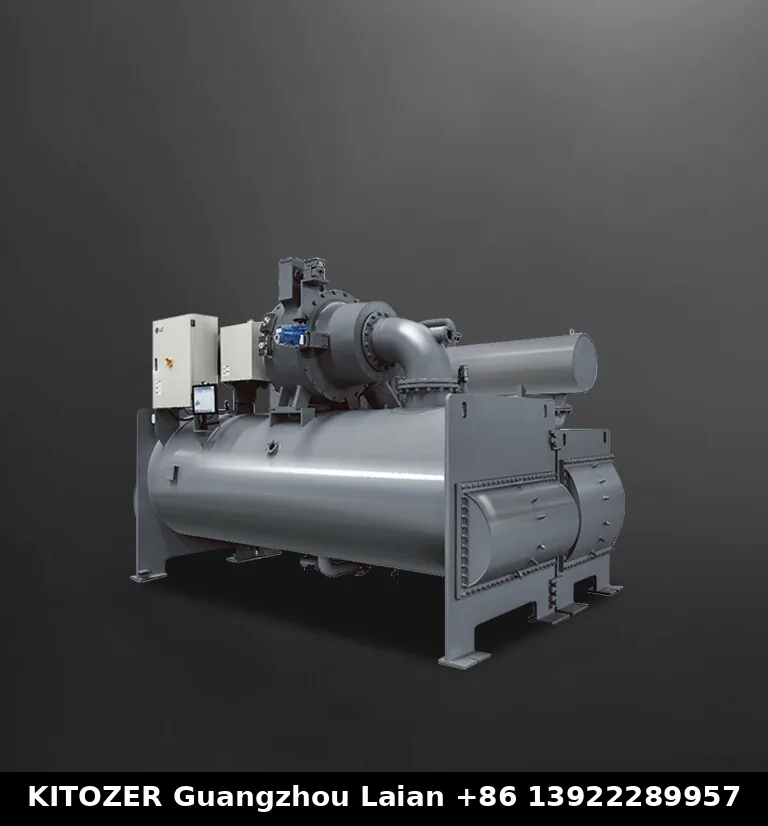
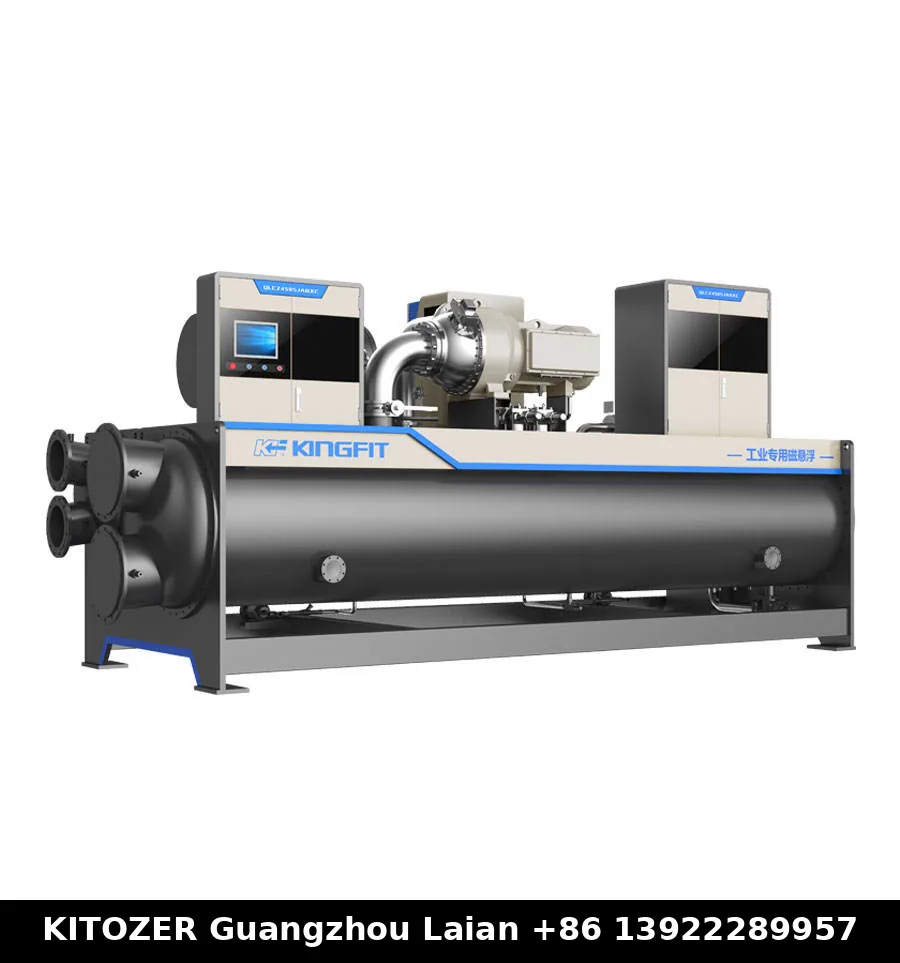
The KITOZER magnetic bearing centrifugal chiller is a high-efficiency water-cooled chiller developed by Guangzhou Laian Intelligent System Development Co., Ltd. for large central air conditioning and industrial cooling applications. At its heart is an oil-free centrifugal compressor supported by active magnetic bearings, paired with a falling-film evaporator, shell-and-tube condenser, variable frequency drive (VFD) and a smart PLC controller. Compared with conventional screw chillers and oil-lubricated centrifugal chillers, the magnetic bearing chiller delivers superior part-load efficiency, extremely low vibration and noise, near-zero maintenance, and minimal efficiency decay over its 20-year design life. It is the mainstream upgrade choice for data centers, electronic cleanrooms, hospitals, commercial complexes, hotels, metro stations and industrial process cooling.
In a magnetic bearing compressor, the rotor is levitated in a magnetic field generated by radial and axial electromagnetic bearings. There is no physical contact between rotating and stationary parts during operation, which means the chiller requires no oil pump, oil cooler, oil filter or oil heater. The motor shaft is directly coupled to the impeller at speeds between 10,000 and 40,000 rpm, eliminating gear drive losses. Third-party tested data shows that KITOZER magnetic bearing chillers achieve a nominal COP above 6.0 and an Integrated Part Load Value (IPLV) above 10.0, saving 20% to 40% energy compared with conventional oil-lubricated centrifugal chillers and 30% or more compared with screw chillers of the same capacity.
The standard KITOZER magnetic bearing chiller line covers 100 to 1,500 tons of refrigeration (approximately 350 kW to 5,200 kW cooling capacity). This range serves applications from mid-size office towers of a few thousand square meters to large campus districts of several hundred thousand square meters. The chiller uses water-cooled condensation; the cooling water loop is paired with a cooling tower and pumps, while the chilled water loop feeds air handling units, fan coil units, cabinet coolers or process cooling coils. Each unit is factory pressure-tested, evacuated, charged with refrigerant and run for at least eight hours before shipment, so on-site commissioning only requires connecting water, power and control signals.
Beyond the standard water-cooled line, KITOZER offers air-cooled magnetic bearing chillers, high-temperature heat pump versions, low-temperature process chillers, dual-compressor redundant plants and modular multi-unit arrays. For data center customers, the chiller natively supports Modbus RTU/TCP, BACnet/IP and Ethernet integration with Building Automation Systems (BAS) and Data Center Infrastructure Management (DCIM) platforms, enabling remote start/stop, load distribution, efficiency optimization, predictive alarm and energy reporting. For industrial customers, KITOZER can deliver units producing 7C chilled water or even -5C brine, suitable for injection molding, electroplating, laser processing, food freezing and chemical reactor temperature control.
Guangzhou Laian Intelligent System Development Co., Ltd. is based in the Chaotian Park of Zhongrun Industrial Zone, No.5 Huashan Road, Shilou, Panyu, Guangzhou. The company combines in-house sheet metal fabrication, electrical assembly, unit rigging and site commissioning, and offers a one-stop service covering cooling load calculation, plant room layout, equipment selection, piping design, electrical coordination, installation supervision and operator training. This encyclopedia introduces the KITOZER magnetic bearing chiller in depth, covering working principles, technical parameters, selection, installation, operation and maintenance, FAQs and typical applications.
2. Working Principle and System Architecture
2.1 Vapor-compression refrigeration cycle
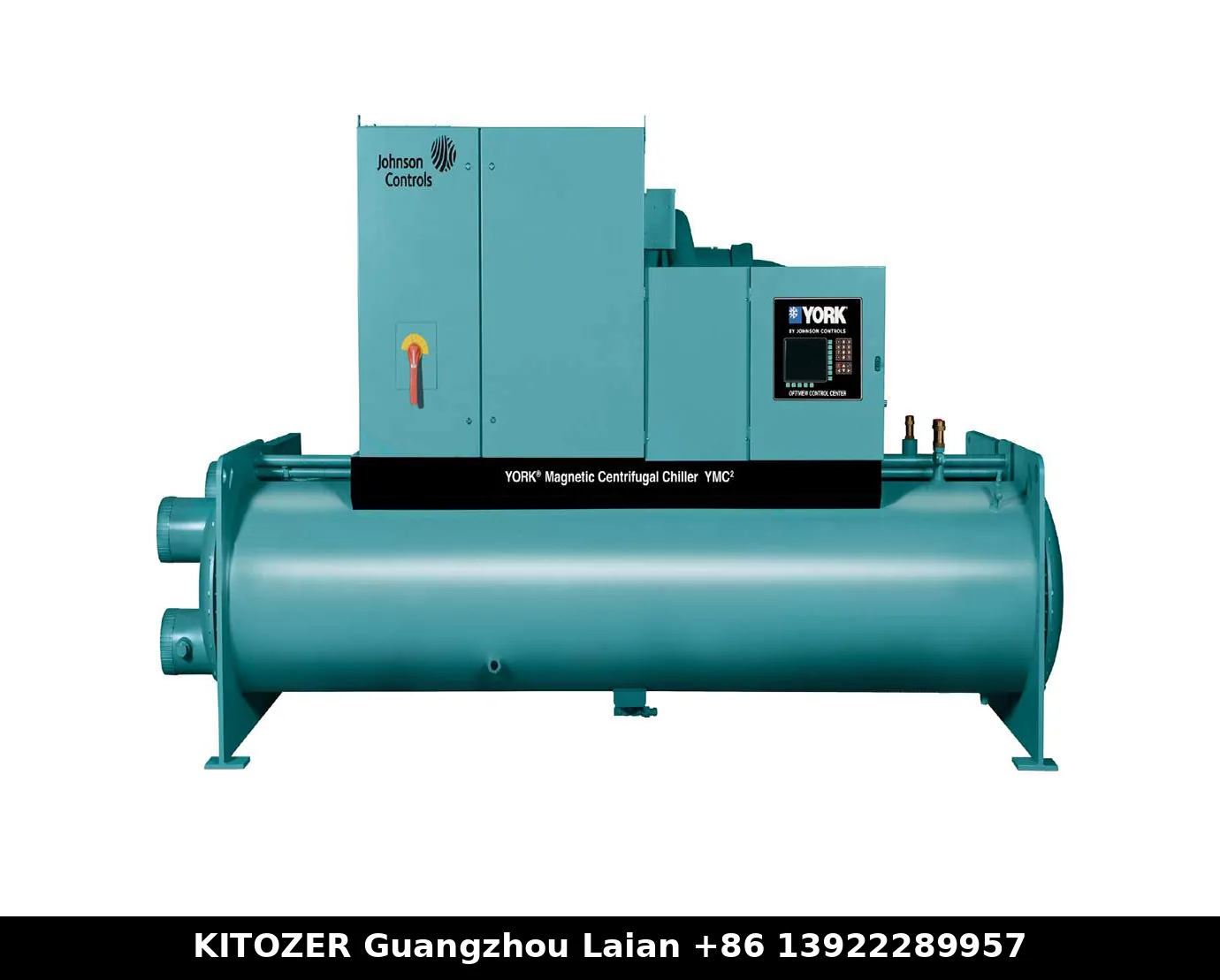
Like every vapor-compression chiller, the KITOZER magnetic bearing unit consists of four main components: compressor, evaporator, condenser and expansion device. Refrigerant evaporates in the evaporator by absorbing heat from the chilled water return; the low-pressure vapor is compressed by the centrifugal compressor into high-pressure, high-temperature gas; the gas condenses in the condenser by rejecting heat to the cooling water; the liquid refrigerant then passes through the expansion device, dropping in pressure and temperature before returning to the evaporator.
The evaporator is where chilled water is produced. KITOZER uses a falling-film evaporator: liquid refrigerant is sprayed from a distributor onto the outer surface of a tube bundle, forming a thin film that absorbs heat from the water inside the tubes. Compared with traditional flooded evaporators, the falling-film design cuts refrigerant charge by 30% to 40%, boosts heat transfer coefficient by about 20%, and eliminates oil pooling at the bottom of the shell. Chilled water return typically enters at 12C and leaves at 7C; supply temperature is adjustable from 5C to 15C depending on the application.
The condenser receives the hot discharge gas from the compressor and condenses it into high-pressure liquid. KITOZER uses a horizontal shell-and-tube condenser with cooling water flowing through the tube bundle. Cooling water typically enters at 32C and leaves at 37C, corresponding to a condensing temperature of about 40C to 45C. Lower cooling water temperature directly lowers condensing pressure, compressor work and whole-unit energy use, so cooling tower performance and water quality have a major impact on plant energy cost.
The expansion device sits between the condenser and evaporator and handles both pressure reduction and flow control. KITOZER uses electronic expansion valves (EEV) that adjust opening in real time based on evaporator outlet superheat, matching refrigerant flow to compressor capacity. Larger units add an economizer or flash tank to subcool the liquid and improve cycle efficiency, reducing discharge temperature and raising cooling capacity per unit of refrigerant.
The compressor is the heart of the chiller. KITOZER magnetic bearing chillers use single-stage or two-stage centrifugal impellers driven directly by a variable-speed motor at 10,000 to 40,000 rpm. The motor is cooled by refrigerant injection or a water jacket. The magnetic bearing controller samples rotor position thousands of times per second and adjusts electromagnetic coil current to keep the rotor centered with micrometer precision. On power loss, an onboard backup battery lands the rotor smoothly on touchdown bearings within seconds.
2.2 Magnetic bearing technology in detail
An active magnetic bearing system comprises radial bearings, axial bearings, position sensors, power amplifiers and a digital controller. Radial bearings use differential electromagnetic excitation in four directions to levitate the rotor; axial bearings act on a thrust disc to balance gas forces. Position sensors are eddy-current or inductive non-contact types sampling at tens of thousands of times per second.
Compared with oil-lubricated bearings, magnetic bearings offer clear advantages: no mechanical contact means near-zero friction loss, so part-load efficiency stays high; no oil system means no oil pump, oil cooler, oil filter or oil heater, reducing plant room footprint and failure points; no oil film on heat exchanger surfaces means heat transfer performance does not decay over the unit life; start-up current is low because the levitated rotor has no static friction; and vibration and noise are dramatically reduced, so the chiller can sit on an upper floor without a heavy concrete inertia base.
Magnetic bearings do have technical boundaries: the bearing controller must always be powered, so a UPS or backup battery is mandatory; the compressor is sensitive to supply voltage sags; high-speed rotors require precision balancing and must not be field-disassembled; and initial purchase cost is higher than screw chillers, typically recovered through energy savings in three to five years.
The KITOZER controller is based on an industrial PLC with a 7-inch or 10-inch color touch screen. It displays chilled water supply and return temperatures, cooling water temperatures, compressor speed, inlet guide vane position, VFD output frequency, discharge pressure, evaporating pressure, current, runtime and recent alarms. Built-in adaptive control adjusts speed and guide vane position to keep the chiller at its most efficient operating point, and multi-unit sequencing is supported through a group controller.
3. Main Technical Specifications
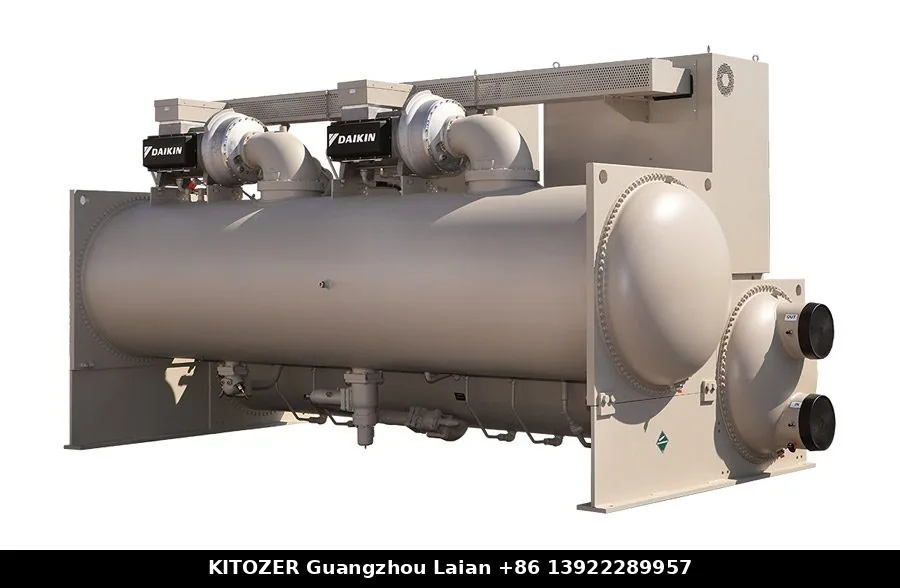
The table below shows representative KITOZER magnetic bearing chiller models; project-specific selections are issued by our engineering team.
| Model | KZ-ML-350 | KZ-ML-700 | KZ-ML-1050 | KZ-ML-1750 | KZ-ML-3500 | KZ-ML-5200 |
|---|---|---|---|---|---|---|
| Cooling capacity kW | 350 | 700 | 1050 | 1750 | 3500 | 5200 |
| Cooling capacity RT | 100 | 200 | 300 | 500 | 1000 | 1500 |
| Nominal COP | 6.1 | 6.3 | 6.4 | 6.5 | 6.6 | 6.5 |
| IPLV | 10.2 | 10.5 | 10.8 | 11.0 | 11.2 | 11.0 |
| Chilled water flow m3/h | 60 | 120 | 180 | 300 | 600 | 900 |
| Cooling water flow m3/h | 85 | 170 | 255 | 425 | 850 | 1275 |
| Chilled water out/in C | 7/12 | 7/12 | 7/12 | 7/12 | 7/12 | 7/12 |
| Cooling water in/out C | 32/37 | 32/37 | 32/37 | 32/37 | 32/37 | 32/37 |
| Power supply | 3P 380V 50Hz | 3P 380V 50Hz | 3P 380V 50Hz | 3P 380V 50Hz | 3P 10kV | 3P 10kV |
| Input power kW | 57 | 111 | 164 | 269 | 530 | 800 |
| Ship weight kg | 4200 | 6800 | 9500 | 14500 | 26000 | 36000 |
| Operating weight kg | 5100 | 8300 | 11600 | 17800 | 32000 | 44000 |
| Refrigerant | R134a/R1234ze | R134a/R1234ze | R134a/R1234ze | R134a/R1233zd | R1233zd | R1233zd |
| Noise dB(A) | 78 | 80 | 82 | 84 | 86 | 88 |
| Length mm | 3800 | 4800 | 5800 | 7000 | 9500 | 11000 |
| Width mm | 1700 | 1900 | 2000 | 2200 | 2500 | 2700 |
| Height mm | 2200 | 2400 | 2600 | 2800 | 3200 | 3500 |
Nominal conditions: chilled water 7C/12C, cooling water 32C/37C, ambient wet bulb 27C. IPLV weighted per GB/T 18430.1. Final selection per KITOZER engineering data.
4. Selection Guide
4.1 Cooling load calculation
Proper selection starts with cooling load calculation. Cooling load, in kW or Refrigeration Tons (RT, 1 RT = 3.516 kW), is the heat that the chiller must remove at any given moment. HVAC load comes from envelope transmission, occupants, lighting and equipment, fresh air and infiltration. Early-stage estimates use unit-area indices: office buildings 90-120 W/m2, shopping malls 150-250 W/m2, data centers 1.2-1.5 times IT load, cleanrooms based on process heat plus a 20% envelope margin.
After nominal capacity is chosen, apply diversity and redundancy factors. Multi-tenant buildings typically use 0.7 to 0.9 diversity; 24/7 data centers use near 1.0 with at least one standby. Plants usually run 2 to 4 chillers in parallel, each sized at 40% to 60% of total load, so that any single unit maintenance still leaves 70% capacity. KITOZER engineering can run hourly energy simulations based on architectural drawings and issue an optimized arrangement.
Water temperature conditions also matter. Low-temperature applications such as theatres, laboratories or cleanrooms requiring 5C supply need enhanced evaporator and condenser surfaces, and COP drops 10% to 15% versus standard conditions. Standard 7C/12C suits fan coils and AHUs. For winter and shoulder seasons, an indirect plate heat exchanger free-cooling mode can exploit low cooling tower water temperatures and shut down the compressor entirely.
Voltage is another decision point. Units below 1,750 kW typically use 380 V; larger units should use 10 kV high-voltage supply to reduce cable size and line loss. KITOZER offers 380 V, 3 kV, 6 kV and 10 kV VFD options integrated at the factory.
4.2 Magnetic bearing vs screw vs oil-lubricated centrifugal
| Dimension | Magnetic bearing centrifugal | Screw chiller | Oil-lubricated centrifugal |
|---|---|---|---|
| Part-load IPLV | 10.0-11.5 | 5.5-7.0 | 6.0-7.5 |
| Nominal COP | 6.0-6.8 | 4.5-5.5 | 5.5-6.2 |
| Oil system | None | Complex | Complex |
| Major service interval | 5-10 years | 2-3 years oil change | 2-3 years oil change |
| Vibration | Very low | Medium | Medium |
| Noise dB(A) | 78-88 | 85-95 | 85-95 |
| Capacity range kW | 350-5200 | 100-2000 | 700-8000 |
| Initial cost | Higher | Medium | Medium-high |
| 5-year energy cost | Low | High | Medium-high |
| Best fit | Data centers / commercial | Small plants / shops | Large industrial plants |
Although magnetic bearing chillers cost 20% to 40% more upfront than screw chillers of equal capacity, central plants run at 50% to 75% load for more than 80% of annual operating hours. The magnetic bearing advantage in this regime typically pays back the price premium in 3 to 5 years, and faster in 24/7 high-load facilities.
4.3 Refrigerant choice
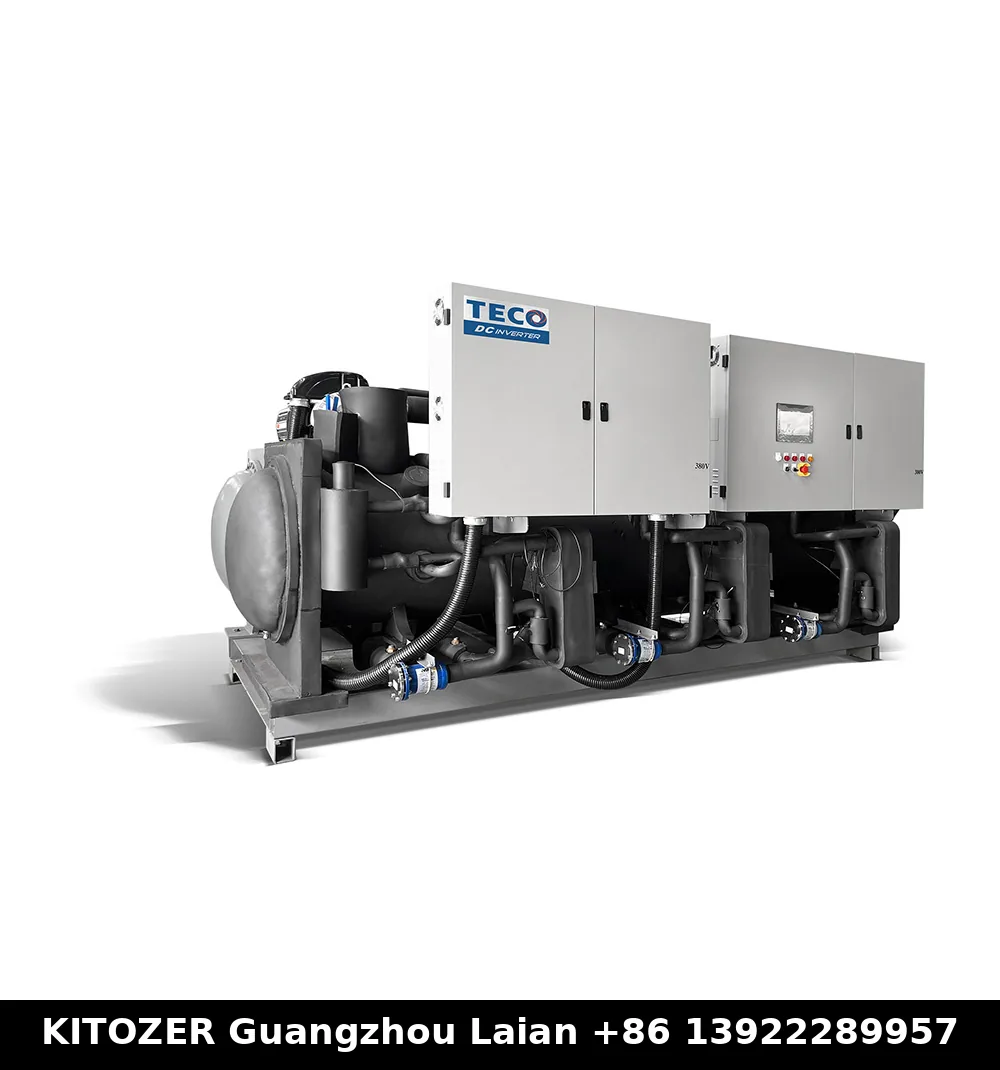
KITOZER offers three refrigerants: R134a, R1234ze(E) and R1233zd(E). R134a is mature, ODP zero and GWP about 1,430; it remains widely used but is being phased down under the Kigali Amendment. R1234ze(E) has a GWP of only 6 and similar thermodynamic performance, but is more expensive and more sensitive to moisture. R1233zd(E) is a low-pressure refrigerant with GWP about 1, ideal for large units with even lower noise. KITOZER recommends R1234ze or R1233zd for exports to Europe, North America and California, and R134a for standard domestic projects.
5. Installation Requirements
KITOZER magnetic bearing chillers are heavy, precision machines; installation quality directly affects long-term reliability and efficiency. The plant room floor must support at least 1,000 kg/m2, or 1,500 kg/m2 for units above 1,000 RT. A 150-200 mm C25 concrete strip foundation is recommended, with at least 800 mm clearance around the unit and 1.5 m above for tube-pull maintenance.
Use factory-supplied spring or rubber isolators with at least 90% isolation efficiency. Because magnetic bearing units vibrate very little, no additional inertia base is usually required. Level the unit to within 1/1000, then anchor bolts without fully locking to allow thermal movement.
Connect chilled and cooling water with flexible joints. Piping must be independently supported; no pipe weight should rest on the chiller nozzles. Fit Y-strainers (at least 20 mesh) on both inlet pipes, and install pressure gauges, thermometers and manual butterfly valves at each inlet and outlet. An electronic flow meter on the outlet is recommended for plant efficiency monitoring.
The cooling tower must be sized for at least 10% more heat rejection than the condenser duty, and cooling water flow must match the nameplate within +/-10%. Use one cooling pump per chiller or a 2+1 duty/standby arrangement. Chilled water pumps should be variable-speed to enable primary-pump variable-flow operation.
Electrical supply should come from a dedicated distribution board, with cable sized at 1.25 times rated current and protected by MCCB or fuse. VFDs are sensitive to voltage transients; input reactors and harmonic filters are recommended. The control supply must be backed by a UPS of at least 1 kVA so that the magnetic bearing controller can land the rotor safely during main-power interruption. Earth the cabinet to building ground with resistance below 4 ohm.
Plant room ventilation should keep summer air below 35C to avoid VFD overheating. Floor drains and sump pumps must be sized to handle tube-side draining. Safety signage, emergency lighting and the operation manual must be posted prominently.
6. Operation and Maintenance
Because there is no oil system, daily maintenance is simple. Operators record supply and return temperatures, compressor speed, guide vane position, pressures and current every two hours, listen for abnormal noise, and watch condenser and evaporator pressure differentials for signs of fouling or strainer blockage. A running log should be kept per shift.
Cooling water treatment is critical. Open cooling towers pick up oxygen, dust and microbes, and evaporative concentration raises dissolved solids. KITOZER recommends continuous corrosion and scale inhibition dosing, biocide dosing, and weekly testing of pH (7.5-9.0), conductivity (below 2,000 uS/cm), turbidity (below 20 mg/L) and total alkalinity. Automatic dosing systems and online water quality analyzers are available as options.
The chilled water loop is usually closed and stable, but Y-strainers should be checked annually. Heat exchanger tubes should be cleaned every 1 to 2 years, either by mechanical brushing or chemical cleaning. KITOZER can provide professional tube cleaning service.
Magnetic bearing compressors themselves have a 20-year-plus design life. Annual preventive work includes tightening electrical connections, cleaning VFD internals and cooling fans, and testing the backup battery. Position sensors and power amplifiers are wear items recommended for replacement at 5 to 7 years.
For long shutdowns, isolate valves and de-energize. If room temperature may drop below 5C, drain the water sides to prevent tube freeze damage. On restart, preheat the control power for 24 hours, start chilled and cooling water pumps first, then start the compressor only after flow switches prove flow.
Common faults include evaporator freeze protection (low chilled flow or low evaporating temperature), high condenser pressure (low cooling flow or fouled tubes), low suction pressure (low load, refrigerant leak or expansion valve fault), and motor over-temperature (VFD cooling or supply voltage issue). The touch screen displays fault codes and recommended actions.
7. Frequently Asked Questions
A: Magnetic bearing chillers are 30-40% more efficient at part load, run quieter, have virtually no vibration, need no oil changes, and retain efficiency over a 20-year life. The higher upfront cost is typically recovered in 3 to 5 years through electricity savings, especially in 24/7 facilities.
A: Standard range is 350 kW to 5,200 kW (100 to 1,500 RT). Dual-compressor and multi-unit arrays can reach 20 MW or more. Send us your load data for a custom selection.
A: Yes. The rotor levitates in a magnetic field with no mechanical contact, so there is no oil pump, oil cooler or oil filter. This prevents oil-fouled heat exchangers and keeps efficiency stable over the unit life.
A: Noise ranges from 78 to 88 dB(A), about 5-8 dB lower than comparable screw chillers. With spring isolators, adjacent rooms are typically below 45 dB(A), suitable for office environments.
A: Reference price is approximately USD 4,500-42,000 per RT (RMB 30,000-300,000 per RT). A 100-RT unit is about USD 50,000-110,000; a 500-RT unit is about USD 220,000-500,000. Contact us for a formal quotation.
A: Yes. Cooling water pH should be 7.5-9.0, conductivity below 2,000 uS/cm, with scale and corrosion inhibitors and biocide dosing. KITOZER can supply automatic dosing and online monitoring systems.
A: Yes. KITOZER chillers are widely used in data centers, support multi-unit sequencing and N+1 or 2N redundancy, and integrate with DCIM via Modbus or BACnet. Fast restart after power interruption supports Tier III/IV requirements.
A: A 500-RT unit typically takes 7 to 15 working days from rigging through commissioning, depending on site readiness. KITOZER engineers supervise installation and commissioning.
A: Compressor life exceeds 20 years under normal operation. KITOZER service centers in Guangzhou, Shanghai, Beijing and Chengdu hold common spares, with on-site response within 48 hours in major cities.
A: Yes. KITOZER audits existing plants and proposes chiller replacement, VFD pump retrofits, cooling tower VFD, plant sequencing and free cooling retrofits. Energy-savings contracts and leasing are available.
A: Yes. KITOZER units ship to Southeast Asia, the Middle East, Africa and South America. We can provide CE, UL and ISO certifications and adapt to local voltages (480V/60Hz, 400V/50Hz, etc.).
A: Yes. In winter and shoulder seasons, a plate heat exchanger can use cooling tower water to directly produce chilled water, shutting down the compressor. KITOZER supplies the plate exchanger and switchover logic.
8. Typical Applications
Data centers: Chiller plant PUE directly determines operating cost. KITOZER magnetic bearing chillers with plate free cooling, variable-flow pumps and smart sequencing routinely achieve PUE of 1.25-1.4.
Commercial complexes and offices: Loads swing sharply day and night. Magnetic bearing chillers run at IPLV 10+ during part-load hours, cutting electricity bills significantly.
Hospitals and operating rooms: Low vibration, low noise and oil-free operation make magnetic bearing units suitable near patient floors and sensitive diagnostic equipment.
Electronics and pharmaceutical cleanrooms: Stable chilled water supply at +/-0.2C supports tight temperature and humidity control; 24/7 high load maximizes energy savings.
Industrial process cooling: Injection molding, electroplating, lasers, welding, vacuum coating, food freezing and chemical reactors all rely on KITOZER process chillers, with water from -25C to 30C.
Metro and airports: Large spaces with tidal loads benefit from wide turndown and fast loading.
Stadiums and convention centers: Low part-load between events and rapid full-load during events match magnetic bearing loading characteristics; low noise protects acoustics.
9. Energy Savings and Life-Cycle Cost
Chillers typically consume 40% to 60% of HVAC energy and 20% to 40% of total building electricity. Upgrading to a magnetic bearing chiller is therefore one of the highest-return energy-efficiency measures available. KITOZER units deliver nominal COP above 6.0 and IPLV above 10, saving roughly 25% compared with oil-lubricated centrifugal chillers and 35% compared with screw chillers.
Consider a 3,500 kW data center plant running 8,000 hours per year at 65% average load. An old oil-lubricated chiller achieves about 5.0 COP at that load, consuming 3.64 GWh per year. A KITOZER magnetic bearing chiller achieves 8.5 COP, consuming 2.14 GWh. The 1.5 GWh annual saving at USD 0.10/kWh is USD 150,000 per year. If the magnetic bearing unit costs USD 70,000 more upfront, payback is under six months.
Beyond the chiller itself, KITOZER packages variable-frequency chilled and cooling pumps, variable-speed cooling towers and smart plant sequencing. Pump energy drops 30-50%, tower fan energy drops 20-40%, and free cooling in winter can shut compressors entirely. Combined, plant efficiency improves by 40% or more and PUE can fall below 1.25.
KITOZER offers free energy audits and Life-Cycle Cost analysis. We can also deliver Energy Service Company (ESCO) contracts where KITOZER invests in the upgrade and shares the saved energy cost, reducing the customer’s upfront risk.
10. Smart Controls and Plant Sequencing
The KITOZER controller uses an industrial PLC with a 10-inch color touch screen and multi-level password protection. The main screen shows a dynamic flow diagram of chilled water, cooling water, compressor and heat exchangers. The controller stores 60 days of trend and alarm data.
Protection functions include evaporator freeze protection, condenser high-pressure protection, motor over-temperature, VFD overload, magnetic bearing displacement limit, flow switch, phase sequence and ground fault. Any trip shuts the unit down safely, displays a fault code and sends a dry contact alarm to the BAS.
Up to eight chillers can be sequenced by a group controller. It starts and stops units based on total load, supply-return temperature differential and outdoor wet-bulb temperature, always favoring the most efficient operating combination. In a data center, automatic N+1 switchover follows a unit fault.
Remote monitoring uses Ethernet with Modbus TCP or BACnet/IP. Customers can view trends, energy reports and alarms from a central workstation or mobile app. KITOZER cloud service provides remote diagnostics, firmware updates and predictive maintenance advice.
Time scheduling allows automatic start/stop by weekday and holiday calendar, supporting unattended operation. Integration with BAS calendars adjusts schedules automatically for holidays.
11. Step-by-Step Installation
1. Plant room acceptance: verify floor load, elevations, penetrations, power capacity and ventilation before delivery. Doors and transport routes must clear the largest unit dimension plus 200 mm.
2. Rigging: use dedicated lifting lugs on the skid; never lift by the heat exchanger shells. Place spring isolators and level to 1/1000.
3. Water piping: connect with flexible joints, fit strainers, valves, gauges and thermometers. Support piping independently. Pressure-test at 1.5 times working pressure for 30 minutes.
4. Electrical wiring: run main power from a dedicated distribution board; connect control and interlock wiring per the factory schematic. Measure insulation resistance before energizing.
5. Evacuation and refrigerant: pull vacuum below 100 Pa and hold for 2 hours; top up refrigerant only if required by the commissioning engineer.
6. Flush water systems: bypass the chiller and circulate pumps until water runs clear; then water-treat and connect.
7. Commissioning: start chilled and cooling pumps first, confirm flow switches, then start the compressor. Step the load from 25% to 100% over a few hours, recording data at each step.
8. Handover: after 72 hours of stable run, sign the acceptance report and train operators on start/stop, alarms and emergency procedures.
12. Maintenance Schedule
| Task | Daily | Weekly | Monthly | Quarterly | Annually | 5-Year |
|---|---|---|---|---|---|---|
| Run-data logging | X | |||||
| Listen / visual check | X | |||||
| Strainer cleaning | X | |||||
| Cooling tower fill check | X | |||||
| Water chemistry test | X | |||||
| Condenser tube cleaning | X | |||||
| Evaporator tube inspection | X | |||||
| Electrical tightening | X | |||||
| Backup battery test | X | |||||
| VFD capacitor check | X | |||||
| Bearing sensor calibration | X | |||||
| Refrigerant leak test | X | |||||
| Safety valve calibration | X |
13. Common Fault Codes
| Code | Fault | Likely cause | Action |
|---|---|---|---|
| E101 | Evaporator freeze | Low chilled flow / clogged strainer | Check pumps, valves, strainer |
| E201 | Condenser high pressure | Low cooling flow / fouled tubes | Clean condenser / check tower |
| E301 | Motor over-temperature | VFD cooling blocked / voltage abnormal | Clean ducts / check supply |
| E302 | VFD overload | Compressor binding / phase loss | Stop and contact factory |
| E401 | Bearing displacement | Sensor issue / EMI | Check wiring / shield ground |
| E402 | Bearing controller fault | Power amplifier failure | Replace amplifier module |
| E501 | Flow switch open | Pump not started / air in piping | Start pump / vent air |
| E601 | Communication fault | Loose bus / wrong baud | Check comm cable / settings |
| E701 | Low suction pressure | Refrigerant leak / EEV blocked | Leak check / clean valve |
| E801 | Backup battery low | Aging battery | Replace UPS battery |
14. Industry Applications in Depth
Data centers: Rack power density is rising from 4 kW to 15-30 kW, and chilled water temperatures are rising from 7/12C to 12/18C or higher to extend free cooling. KITOZER magnetic bearing chillers accept high-temperature chilled water; at 15C supply, COP improves about 20%. Combined with plate free cooling, annual free-cooling hours can exceed 4,000 and plant PUE below 1.2.
Electronics and semiconductor: Fabs require +/-0.1C temperature stability. KITOZER guide vane plus speed control holds supply water within +/-0.2C, supporting AHUs with reheat and humidification. 24/7 operation maximizes energy savings.
Hospitals and biopharma: Operating rooms, ICUs and labs demand stable, clean air. Oil-free magnetic bearing chillers avoid oil mist risk; low vibration protects precision instruments; low noise suits patient floors. GMP rooms can be fitted with 304 stainless steel casings and corrosion-resistant heat exchangers.
Commercial real estate and hotels: Load swings day and night. Part-load efficiency and fast loading are decisive. Units can sit on upper floors thanks to low vibration, saving structural cost.
Industrial process cooling: KITOZER air- and water-cooled process chillers produce water from -25C to 30C using pure water, glycol or industrial coolants, suitable for injection, extrusion, die casting, welding, lasers and vacuum coating.
Metro and airports: Tidal loads and limited plant room space suit compact, high-efficiency magnetic bearing units.
Stadiums and convention centers: Quick load pickup within minutes and wide 10-100% turndown match event-driven loads; low noise protects acoustics.
15. Working with KITOZER
1. Consultation: contact KITOZER by phone, WeChat, WhatsApp or web form. Our engineering team replies within one business day.
2. Design: share drawings or process heat data; we run load simulations and issue a configuration proposal, selection table and system schematic.
3. Quotation: a formal quote follows within two business days, covering price, lead time, payment terms, warranty and service scope.
4. Contract: standard units ship in 30-45 days; custom units in 60-90 days.
5. Factory testing: every unit is pressure-tested, evacuated, charged and run for at least 8 hours before shipment, with full documentation.
6. Logistics: units ship by air-ride truck domestically and by container for export; large units may require oversize permits.
7. Commissioning: KITOZER engineers supervise installation, commission and train operators.
8. After-sales: 18-month / 12-month warranty (whichever first), 5-year compressor and magnetic bearing warranty, 24/7 hotline.
16. Quality Assurance and Certifications
Guangzhou Laian is certified to ISO 9001, ISO 14001 and ISO 45001. KITOZER chillers are designed and built to GB/T 18430.1 and use globally recognized components. Every unit undergoes nominal capacity, IPLV, noise, vibration, electrical safety and protection tests before dispatch; test data is archived and available for witnessed factory acceptance.
KITOZER offers an 18-month / 12-month standard warranty and a 5-year extended warranty on the magnetic compressor and bearings. For ESCO projects, up to 10-year extended warranty and operations management are available.
17. Common Selection Myths
Myth 1: Compare nominal COP only. Plants run at part load most of the year; compare IPLV, where magnetic bearing chillers excel.
Myth 2: Oversize the chiller. Oversized units cycle frequently and run inefficiently. Size to actual load plus 10-20% margin; use multiple units for redundancy.
Myth 3: Ignore pumps and towers. Even the best chiller cannot perform if pumps and towers are mismatched. KITOZER delivers complete plants.
Myth 4: Buy on first price only. Compare 10-year life-cycle cost: capex plus energy plus maintenance.
Myth 5: Magnetic bearing always means low noise everywhere. Pumps, towers and piping still need flexible joints and isolators.
Myth 6: Ignore water treatment. Each mm of condenser tube fouling raises energy use about 10%. Automatic dosing is strongly recommended.
18. Glossary
COP: Coefficient of Performance = cooling capacity / input power. Higher is better.
IPLV: Integrated Part Load Value, weighted COP at 100/75/50/25% load per GB/T 18430.1.
RT: Refrigeration Ton, 1 RT = 3.516 kW.
Superheat: Evaporator outlet temperature above saturation temperature, typically 3-6C.
Subcooling: Condenser outlet liquid below saturation temperature, 3-5C improves capacity.
Surge: Periodic flow reversal in a centrifugal compressor at low flow, causing vibration; avoided by VFD and guide vane control.
Wet bulb temperature: Key parameter for cooling tower performance; typical summer design value is 27-28C.
ODP: Ozone Depletion Potential; R134a, R1234ze and R1233zd all have ODP = 0.
GWP: Global Warming Potential relative to CO2 = 1. R134a GWP ~1,430; R1234ze ~6; R1233zd ~1.
PUE: Power Usage Effectiveness for data centers; lower is better.
19. Export Project Notes
KITOZER chillers are exported to Southeast Asia, the Middle East, Africa and South America. Export projects must consider voltage standards (460V/60Hz, 400V/50Hz, 220V/60Hz), refrigerant regulations (some countries ban R134a), protection class (IP55+ for outdoor units), corrosion class for coastal sites, and certification requirements (CE, UL, SASO).
Export packaging uses seaworthy plywood crates with desiccant and nitrogen charge; refrigerant ports are sealed. Large units ship as breakbulk or in 40-ft HQ containers. KITOZER assists with customs declaration, inspection and certificates of origin.
Overseas after-sales relies on remote monitoring through the built-in module, with common spares shipped with the unit or stocked at local partners. Engineers can travel on site when needed.
20. Operator Training
At handover, KITOZER trains customer operators on chiller principles, touch-screen operation, start/stop procedures, daily inspection, common alarms, emergency stop, water treatment basics and safety. Training combines theory and hands-on practice over 1 to 3 days.
Daily inspection includes recording temperatures, pressures, speed, guide vane position and current every two hours; listening for abnormal noise; checking for leaks; and inspecting the cabinet for overheating or burning smells. Data goes into a running log.
Emergency procedures cover sudden power loss (isolate main power and restart in sequence), water pipe rupture (close valves and power off), electrical fire (use CO2 or dry chemical extinguisher, never water) and electric shock (cut power before touching the victim).
Operators should receive high-voltage, pressure-vessel and confined-space safety training. The plant room is a restricted area; no smoking; no flammable storage.
21. Comparison with Other Heat Source Equipment
Air-cooled chillers: No tower or cooling water pump, simpler and lower initial cost, but about 30% less efficient than water-cooled. Best for small sites or water-scarce regions; above 700 kW, water-cooled magnetic bearing wins.
Absorption chillers: Driven by steam or gas, useful where waste heat is available, but COP only 0.7-1.4. KITOZER electric magnetic bearing chillers are more economical when electricity is available.
Oil-lubricated centrifugal chillers: Large capacity and moderate price, but complex oil system, lower part-load efficiency and life-cycle decay. Magnetic bearing units are replacing them in new plants.
VRF systems: Flexible for small multi-room buildings but limited to about 500 kW per system and lower efficiency than central water chillers. Use VRF for small buildings, water chillers for large plants.
22. Conclusion
The KITOZER magnetic bearing centrifugal chiller represents the current state of the art for electric chillers. By combining oil-free magnetic levitation, falling-film heat exchange, variable frequency drive and smart plant sequencing, it delivers best-in-class efficiency, near-zero vibration, low noise and a 20-year design life.
Whether you are building a new data center, commercial complex, industrial plant or retrofitting an existing chiller plant, KITOZER engineering can provide a tailored configuration, life-cycle cost analysis and complete plant-room solution. Contact us today at +86 139-2228-9957, WhatsApp +1 906-853-4140, or visit www.gdlain.com.
23. Detailed Component Descriptions
Centrifugal impeller: The impeller is the active work element of the compressor. KITOZER impellers are milled from a single forging of aluminum or stainless steel, with three-dimensional aerodynamic blade profiles optimized for high efficiency and a wide surge-free operating range. Single-stage compressors achieve a pressure ratio of 4 to 6; two-stage units reach 10 or more. The impeller is directly coupled to the motor shaft and spins at 10,000 to 40,000 rpm. Every rotor is balanced to ISO G0.4 grade before assembly, ensuring low vibration at speed.
Inlet guide vanes (IGV): The inlet guide vane assembly sits upstream of the impeller and consists of a ring of adjustable aerodynamic vanes. At part load, the vanes pre-swirl the inlet air, which delays surge and expands the stable operating range. KITOZER coordinates IGV opening with motor speed: at low load, IGV modulation leads; at high load, speed modulation leads. This combined control keeps the compressor efficient across 10-100% load.
Falling-film evaporator: The evaporator is a horizontal steel pressure vessel containing multiple tube bundles. Liquid refrigerant is distributed from a top header and falls as a thin film over the tubes, exchanging heat with chilled water flowing inside. Compared with flooded evaporators, falling-film designs reduce refrigerant charge by 30% or more and eliminate oil pooling at the shell bottom. The water box is removable for tube maintenance without moving the chiller.
Shell-and-tube condenser: The condenser is structurally similar to the evaporator but rated for higher pressure. Cooling water flows through the tube bundle in counterflow to the refrigerant. A subcooling zone at the bottom cools the liquid by 3-5C, raising cycle efficiency. A liquid level controller and electronic expansion valve connection are integrated.
Electronic expansion valve (EEV): The EEV is driven by a stepper motor that precisely positions the valve plug. The controller adjusts valve opening based on evaporator outlet superheat, matching refrigerant flow to compressor demand. Compared with capillary tubes or thermal expansion valves, EEVs offer a wider range, faster response and tighter control, which is essential for magnetic bearing chillers operating at widely varying loads.
Variable frequency drive (VFD): The VFD converts fixed-frequency 380 V or 10 kV supply into adjustable-frequency, adjustable-voltage AC for the compressor motor. Output frequency ranges from 20 Hz to over 300 Hz, corresponding to 10,000-40,000 rpm. KITOZER VFDs include power factor correction that holds input PF above 0.95 and keeps harmonic distortion within IEEE 519 limits.
Magnetic bearing controller: The bearing controller is a dedicated unit comprising position sensors, power amplifiers and a digital signal processor. It samples rotor position thousands of times per second and drives electromagnetic coils to keep the rotor centered within micrometers. The controller self-diagnoses bearing temperature, displacement and coil current, and warns before a fault occurs.
Touch screen and PLC: The industrial PLC has a mean time between failures exceeding 100,000 hours. The 10-inch color HMI supports English and Chinese, shows dozens of live parameters and historical trends, and stores 60 days of operating and alarm data exportable by USB.
24. Water System Design
Chiller efficiency depends on a properly matched water system. Chilled water systems are usually primary-pump variable-flow or secondary-pump variable-flow. In primary-pump variable-flow, pumps are paired with chillers and variable-speed, adjusting flow based on end-use differential pressure or temperature difference. This is simple and cost-effective for small-to-medium plants. Secondary-pump systems keep the primary side constant-flow while variable secondary pumps serve the end uses, providing better hydraulic stability for large complex plants.
Cooling water design is equally important. Cooling towers should be located downwind of prevailing winds and away from building air intakes to avoid recirculation. Multiple towers should share a common equalizer line to prevent water-level imbalance. The sump should have an automatic makeup valve and blowdown. Cooling pumps should be one-to-one with chillers, with duty/standby redundancy.
Piping should slope at 0.3-0.5%, with automatic air vents at high points and drains at low points. Chilled water piping needs at least 25 mm closed-cell elastomeric insulation to prevent condensation. Cooling water piping is usually uninsulated, except in warm climates where condenser water may be insulated to limit heat gain.
Pump selection should match the chiller water resistance (typically 5-10 m head), piping friction, valves and end-use equipment. Pumps should operate near their best efficiency point (60-85%). Variable-speed pumps should be set by the most remote circuit’s differential pressure, not by an arbitrary fixed value.
Large plants should use a header (manifold) arrangement to distribute flow to zones. Headers include thermometers, pressure gauges and flow taps. A differential-pressure bypass between supply and return headers stabilizes primary-side flow when end uses vary.
25. Electrical and Control Design
Chiller power should come from a dedicated distribution circuit, separate from elevators and pumps to avoid voltage disturbances. Main switchgear uses a molded case circuit breaker with long-time trip set at 1.15 times rated current. For 10 kV units, a high-voltage switchgear with vacuum breaker and microprocessor protection is required.
VFD-generated harmonics can disturb other sensitive equipment. KITOZER input reactors standardly hold total harmonic current distortion below 5%. Sensitive sites can add an active power filter to reach below 3%. Surge protective devices should be fitted on the incoming line.
The control supply requires a UPS of at least 1 kVA with 30 minutes backup. The UPS not only allows the magnetic bearing controller to land the rotor safely during main-power loss but also keeps the PLC logging data during outages. Control wiring should be separated from power wiring; sensor cables should be shielded with one-end grounding.
Communication with the building BAS is preferably Ethernet BACnet/IP or Modbus TCP, which is more reliable than RS-485 for long distances. KITOZER provides a standard point list covering start/stop commands, status, alarms and dozens of process variables.
Grounding should connect the chiller frame, cabinet and metal piping to building ground at less than 4 ohms. VFD motor cables should be shielded with both ends grounded, and separated from signal cables by at least 300 mm.
26. Retrofit of Existing Plants
Retrofitting old chiller plants is a major KITOZER business. Many existing buildings run chillers that are 15+ years old, with low efficiency, frequent failures and high maintenance cost. Replacing them with KITOZER magnetic bearing units is often done without full shutdown, and the investment pays back within the same year.
A typical retrofit starts with an energy audit: KITOZER measures actual load, water temperatures, current and power factor to identify savings opportunities. The retrofit may include new high-efficiency chillers, VFD pumps, VFD cooling towers, a plant sequencing controller, plate free cooling and energy monitoring. KITOZER can deliver an Energy Service Company (ESCO) model where KITOZER invests and shares the saved energy cost.
Retrofit construction must verify floor loading and transport routes, flush decades-old piping, and check whether existing cables and switchgear can handle the new unit. KITOZER provides turnkey retrofits covering design, supply, installation and commissioning.
After retrofit, performance verification measures actual COP and IPLV at various loads and compares them with pre-retrofit values. KITOZER guarantees at least 30% plant efficiency improvement, with contractual compensation if not met.
27. Operation Procedures
Pre-start checks: Confirm no leaks or unusual smells; confirm inlet/outlet valves are open and bypass valves closed; confirm pumps and cooling towers are in auto; confirm the control power is on and no alarms are active; confirm chilled and cooling pumps are running and flow is stable.
Start-up: Press the start button on the touch screen. The controller first verifies interlocks: flow switches closed, freeze temperature normal, high/low pressures normal, bearings levitated. The magnetic bearing controller lifts the rotor, then the VFD soft-starts the motor from 0 Hz to minimum speed. The whole sequence takes 30-60 seconds, with start current limited to 1.5 times rated.
Normal monitoring: Record every two hours: chilled water supply (set 7C) and return (about 12C), cooling water in (about 32C) and out (about 37C), evaporating pressure (about 0.4 MPa), condensing pressure (about 1.4 MPa), compressor speed (20,000-30,000 rpm), guide vane position (30-80%), and current (60-90% of rated).
Normal shutdown: Press stop. The controller unloads the compressor, stops the VFD, and the rotor decelerates under magnetic levitation until the backup battery lands it on touchdown bearings. Keep chilled and cooling pumps running for about 10 minutes to equalize temperatures.
Emergency stop: Press the e-stop button for severe vibration, catastrophic water leak, electrical fire or personnel injury. Isolate main power, close water valves, secure the scene and report. Restart only after qualified personnel inspect.
28. Cooling Water Quality Management
Cooling towers expose water directly to air, dissolving oxygen, carbon dioxide, dust and microbes. Evaporation concentrates dissolved solids, making water quality deterioration inevitable. The three common problems are scaling, corrosion and biological fouling. KITOZER recommends a structured water treatment program.
Scale control: Calcium and magnesium salts precipitate on hot surfaces as calcium carbonate. A 1 mm scale layer reduces heat transfer by 10-20%. Control by dosing scale inhibitors, controlling cycles of concentration through blowdown, and keeping cooling water below 40C.
Corrosion control: Dissolved oxygen corrodes steel and copper tubes. Control by dosing corrosion inhibitors that form a protective film, keeping pH at 7.5-9.0, avoiding long stagnant periods, and using sacrificial anodes in condenser water boxes.
Biological control: Warm, sunlit water grows algae and bacteria that form slime. Use alternating oxidizing and non-oxidizing biocides, keep tower fill clean, avoid sunlight exposure, and consider side-stream filtration.
Test cooling water weekly for pH, conductivity, turbidity, total alkalinity, calcium hardness, total iron and bacterial count. Log results and adjust dosing. KITOZER supplies automatic dosing systems with online conductivity and pH control.
29. Noise and Vibration Control
Although magnetic bearing chillers themselves are quiet, overall plant noise can still be high. Sources include the compressor, motor, pumps, cooling tower fans, water flow and ductwork. Control should address source, path and receiver.
Plant room walls should use 240 mm brick or 200 mm concrete for about 50 dB transmission loss. Doors should be acoustic doors with at least 30 dB loss; windows should be double-glazed. Ventilation openings need silencers of at least 20 dB insertion loss. Treated this way, adjacent rooms should be below 45 dB(A).
Isolate vibration with flexible joints at chiller nozzles, spring hangers on piping, and spring bases for pumps. Cooling towers should be mounted on vibration pads away from the building structure.
Cooling tower noise can be reduced with wide-chord low-noise fan blades, fan-motor silencers, and location away from occupied areas. KITOZER offers low-noise towers that are 5-10 dB quieter than standard.
30. Transport, Storage and Delivery
KITOZER ships fully assembled; large units may be split into compressor, evaporator and condenser sections for on-site assembly. Local deliveries use air-ride trucks; long-distance domestic uses low-bed trucks or rail containers; export uses 40-ft HQ containers or breakbulk.
Units are secured on steel frames with rubber pads and tension straps. Oversized loads require permits and route planning. Tilt angle during transport must not exceed 15 degrees to protect tubes and insulation.
Units should be stored in a dry, ventilated warehouse out of rain and extreme temperature swings. If storage exceeds two weeks, check vacuum and nitrogen pressure monthly. Long-term storage requires ambient temperatures above 5C. Do not open pipe caps, or air and moisture will enter.
Standard units ship in 30-45 days; custom units in 60-90 days. Emergency projects can be expedited to as short as 15 days. KITOZER notifies the customer three days before delivery so that rigging can be arranged.
31. Safety and Environment
Chillers are pressure vessels containing high-pressure refrigerant and high-voltage electricity. The plant room must have CO2 or dry chemical extinguishers (never water), warning signs, good ventilation and an emergency stop. R134a is non-toxic but high concentrations displace oxygen; ventilation is essential during leak events.
Safety valves must be calibrated annually at the nameplate set pressure. Discharge pipes should route outdoors to a safe location. Refrigerant charging and recovery must be done by certified technicians with dedicated recovery equipment; never vent refrigerant to atmosphere. Waste refrigerant is hazardous waste and must be handled by licensed vendors.
Electrical safety requires lockout/tagout before opening the cabinet. VFD capacitors retain a dangerous charge for five minutes after power-off; wait before touching internal parts. High-voltage 10 kV work must be done by licensed electricians.
KITOZER uses zero-ODP refrigerants and low-GWP options to support environmental goals. End-of-life units should be recycled: copper and steel tubes are recyclable, and electronics go to e-waste vendors.
32. Future Technology Trends
Driven by decarbonization and data center growth, magnetic bearing chiller technology continues to evolve: lower-GWP refrigerants (R1234ze, R1233zd, transcritical CO2), higher chilled water temperatures (15C+ for longer free cooling), larger single-unit capacity (up to 8 MW), AI-based plant sequencing and predictive maintenance, and deeper integration with solar PV, battery storage and waste heat recovery.
In data centers, magnetic bearing chillers will combine with liquid cooling, indirect evaporative cooling and air-liquid hybrid architectures. KITOZER is developing dedicated chillers for secondary-loop CDU (Coolant Distribution Unit) service.
In industry, chillers are moving toward low-temperature, explosion-proof and corrosion-resistant designs for chemical, marine and arctic environments. KITOZER offers ExdIIBT4 explosion-proof units and C5-M marine-grade corrosion packages.
In O&M, IoT and big data enable self-learning, self-optimizing and self-diagnosing plants. KITOZER cloud aggregates fleet data to refine control algorithms, predict failures and stock spares ahead of time.
33. Supplementary FAQ
A: Conventional screw and oil-lubricated centrifugal chillers must overcome static friction and oil film shear at start, drawing 5-7 times rated current. The magnetic bearing rotor levitates, so friction is near zero and soft-start VFD limits current to 1.5 times rated.
A: IPLV weights COP at 100%, 75%, 50% and 25% load by 0.023, 0.415, 0.415 and 0.147 per GB/T 18430.1. Magnetic bearing chillers excel at 25-50% load, so IPLV is 60-80% higher than nominal COP.
A: The compressor itself handles only refrigerant, but fouled condenser tubes raise condensing pressure and energy use. 1 mm of scale costs 10-20% efficiency. Water treatment is essential.
A: Yes, but protect against freeze. Drain the water sides if room temperature may fall below 5C, or use 25-30% glycol. KITOZER low-temperature units accept cooling water down to 10C.
A: A KZ-ML-1750 is about 7000 x 2200 x 2800 mm. With 800 mm clearance and tube-pull space above, the room should be at least 10 m x 5 m x 4 m, about 50 m2. Including pumps, headers and switchgear, plan for 80 m2.
A: A 500-RT R134a unit holds about 400-500 kg; R1234ze units hold about 500-600 kg. Falling-film evaporators cut charge by 30% vs flooded designs.
A: A group controller calculates required capacity from supply-return temperature difference and starts units in order of efficiency, always keeping each running in its best-efficiency band. At low load, one unit runs; at high load, units load up in sequence.
A: No gear mesh, no bearing friction, and precision rotor balancing combine for 5-8 dB(A) lower noise than comparable screw units.
A: Yes. A heat-recovery condenser can recover 20-30% of condensing heat for domestic hot water or space heating, ideal for hotels, hospitals and dormitories.
A: Compressor life exceeds 20 years under proper water treatment; shells last 30 years; controls and VFDs last 10-15 years. Overall design life exceeds 20 years, vs 12-15 for screw chillers.
34. Typical Plant Reference Cases
Case 1: Large data center. Total IT load 20 MW, four KITOZER magnetic bearing chillers at 5,200 kW each, N+1 redundant. Primary-pump variable flow, one-to-one cooling pumps, five cooling towers. Plate free cooling. Measured plant PUE 1.28, saving about 15 GWh per year.
Case 2: Grade-A office tower. 80,000 m2 floor area, three 1,050 kW units (2 duty, 1 standby). Variable secondary pumps, VFD cooling towers. Plant efficiency improved 35% vs a screw chiller baseline, saving about USD 110,000 per year.
Case 3: Five-star hotel. Two 700 kW chillers plus one heat-recovery unit. Heat recovery supplies 60% of domestic hot water, saving about USD 40,000 per year in gas.
Case 4: Electronic cleanroom. Four 1,750 kW low-temperature units producing 5C/10C water, running 24/7. Supply temperature stability within +/-0.2C meets cleanroom specifications.
Case 5: Sports stadium. Three 3,500 kW units, one running normally and three during events. Fast load pickup handles instantaneous demand; noise meets acoustic requirements.
35. Optional Accessories
Electrical options: Input reactors (standard), input harmonic filters (THDi below 3%), output reactors, dV/dt filters, surge protective devices, main circuit breaker, control transformer, UPS, remote monitoring module.
Control options: Modbus RTU/TCP and BACnet/IP interfaces, group controller for multi-unit plants, 15-inch HMI upgrade, data logger, cloud service subscription, sub-metering energy meters, remote I/O expansion.
Water system options: Differential pressure transmitters on evaporator/condenser, electronic flow meters, Y-strainers, bypass valves, online water quality monitors, automatic dosing systems, plate free-cooling heat exchanger, VFD pump panels.
Structural options: Spring isolators (standard), rubber isolators, 304 stainless steel casing, C5-M marine corrosion coating, outdoor weather hood, lifting lugs, tube-pull rails.
Environmental options: Low-noise package (3 dB quieter), low-GWP R1234ze or R1233zd refrigerant, heat recovery coil, green building documentation.
36. Common Installation Pitfalls
Pitfall 1: Insufficient floor loading. Verify floor capacity; if needed, add steel beams under the unit or split load across multiple smaller units.
Pitfall 2: Transport routes too narrow. Use split-unit shipping or a dedicated roof opening with mobile crane. KITOZER can design split units for tight sites.
Pitfall 3: Fouled old piping. Flush and chemically clean existing piping before connecting the new chiller; install temporary strainers during commissioning.
Pitfall 4: Inadequate electrical capacity. Recalculate transformer and cable ratings; consider 10 kV supply for large units.
Pitfall 5: Cooling towers undersized. Replace or add towers; improve air intake; KITOZER supplies matching towers.
Pitfall 6: BAS integration mismatch. KITOZER provides protocol gateways and standard point lists; alternatively, run a standalone group controller.
37. Life-Cycle Cost Example
Take a 500-RT (1,750 kW) water-cooled plant and compare magnetic bearing vs oil-lubricated centrifugal over 10 years. Upfront: magnetic bearing USD 280,000 vs oil-lubricated USD 210,000, a USD 70,000 premium. Annual energy: magnetic bearing about 112 MWh at part-load average COP 8.5, costing USD 112,000/year; oil-lubricated at COP 5.0, costing USD 190,000/year. Annual maintenance: magnetic bearing about USD 3,000 (no oil changes), oil-lubricated about USD 9,000.
Over 10 years: magnetic bearing = 280,000 + 1,120,000 + 30,000 = USD 1,430,000; oil-lubricated = 210,000 + 1,900,000 + 90,000 = USD 2,200,000. Magnetic bearing saves USD 770,000 over a decade. For 24/7 data centers running 8,000 hours a year, savings are even larger and payback is under two years.
KITOZER recommends requesting a 10-year life-cycle cost analysis rather than comparing purchase price alone. We provide a free LCC report covering capex, energy, maintenance, spares and residual value.
38. KITOZER Service Commitment
Guangzhou Laian provides full-lifecycle service for KITOZER chillers. Service centers cover South China, East China, North China and Southwest China, with certified engineers and common spares. The 24/7 hotline responds within two hours, reaches South China sites within 24 hours and major domestic cities within 48 hours.
Services include pre-sales consultation, load calculation, plant layout guidance, installation supervision, commissioning, operator training, planned preventive maintenance, emergency repair, spares supply, energy retrofits and performance optimization. Annual maintenance contracts cover everything from routine inspections to full parts and labor.
For export projects, remote monitoring provides real-time diagnostics; common spares ship with the unit or are stocked at local partners. KITOZER engineers can travel to overseas sites when required.
KITOZER follows up quarterly with key customers and commits to a written response within seven working days for every reasonable customer request.
39. Standards and Policy
China’s GB 19577 sets minimum energy efficiency thresholds for water chillers, with three grades where Grade 1 is highest. KITOZER magnetic bearing chillers typically meet Grade 1 and are listed in the government’s energy-saving procurement catalog.
Under the Kigali Amendment, China is phasing down HFC production and consumption. R134a (GWP 1,430) will face quotas and price increases. KITOZER’s R1234ze and R1233zd options help customers future-proof their plants.
The national New Data Center Action Plan requires new large data centers to reach PUE below 1.3. KITOZER magnetic bearing chillers with free cooling are a key enabling technology, and local governments offer electricity price incentives for compliant sites.
Green Building Evaluation Standard GB/T 50378 rewards efficient, quiet, low-emission equipment. Choosing KITOZER chillers helps projects achieve 2- or 3-star green building certification.
40. About KITOZER and Guangzhou Laian
KITOZER is the cooling and intelligent equipment brand of Guangzhou Laian Intelligent System Development Co., Ltd., based in the Chaotian Park of Zhongrun Industrial Zone, No.5 Huashan Road, Shilou, Panyu, Guangzhou. Leveraging the Pearl River Delta’s mature manufacturing supply chain, the company designs, builds and integrates chillers, cooling towers, pumps, switchgear and plant controls.
KITOZER serves data centers, electronics fabs, commercial real estate, hospitals, stadiums and industrial plants with one-stop design, supply, installation and O&M. We welcome customers to visit our factory and contact us at +86 139-2228-9957, WhatsApp +1 906-853-4140, or www.gdlain.com.
41. Refrigeration Thermodynamics Background
Understanding why magnetic bearing chillers are efficient starts with the thermodynamics of the vapor-compression cycle. The chiller moves heat from the low-temperature chilled water to the high-temperature cooling water by consuming compressor work. By Carnot’s theorem, there is an upper limit on coefficient of performance between a given cold and hot reservoir temperature. The ratio of actual COP to Carnot COP is the thermodynamic effectiveness; magnetic bearing chillers typically reach 60-70%, far above the 40-50% typical of screw machines.
Chilled water at 7C corresponds to an evaporating temperature near 2C; cooling water at 37C corresponds to a condensing temperature near 42C. The theoretical Carnot COP is about (273+2)/(42-2) = 6.9. The magnetic bearing chiller achieves a nominal COP near 6.3, a remarkable 91% of Carnot. At part load, condensing temperature drops with lower cooling water temperature, while evaporating temperature rises with warmer return water, so Carnot COP jumps and actual COP can exceed 10.
The magnetic compressor varies speed and guide vane position to stay on the efficient part of the compressor map across a wide operating range. Screw machines suffer oil friction and gear losses that degrade efficiency at low load; the magnetic compressor has no such losses and remains efficient even at 10% load.
The falling-film evaporator further improves cycle efficiency. Traditional flooded evaporators have high liquid levels that raise static pressure and shell-bottom evaporating temperature, reducing the temperature difference for heat transfer. Falling-film design sprays refrigerant as a thin film, minimizing static head and raising the heat transfer coefficient by about 20% while cutting charge.
42. VFD Technology
The variable frequency drive is a key enabler of magnetic bearing chiller efficiency. It rectifies fixed-frequency AC into DC, then uses an IGBT inverter bridge to produce variable-voltage, variable-frequency AC for the compressor motor. By n = 60f(1-s)/p, changing frequency changes motor speed. Magnetic bearing compressors run from 10,000 to 40,000 rpm, corresponding to 200-800 Hz output.
KITOZER uses mature vector-control VFDs that precisely manage motor torque and flux, with fast dynamic response and high low-speed torque. The VFD has built-in power factor correction, holding input power factor above 0.95 without additional PF correction panels.
VFD harmonics can pollute the grid. KITOZER input reactors standardly hold total harmonic current distortion below 5%, meeting IEEE 519 and GB/T 14540. Sensitive sites can add an active power filter to reach below 3%. Output-side dV/dt or sine-wave filters are recommended for long motor leads.
VFD cooling is critical. KITOZER VFDs use a separate cooling duct; ambient temperatures above 40C derate output. The plant room should stay below 35C in summer. Electrolytic capacitor life halves for every 10C rise in ambient temperature, so room temperature control directly affects VFD reliability.
43. Plant Sequencing Algorithms
When multiple chillers operate in parallel, sequencing strategy dominates overall plant efficiency. The KITOZER group controller optimizes total plant energy, including chillers, pumps and cooling towers, based on total load, outdoor wet-bulb temperature and the current efficiency curve of each unit.
At low load (night, shoulder season), the controller runs the single most efficient unit at 50-75% load rather than running multiple units at inefficient 25% load. At high load, units load up in order of efficiency, each staying in its best-efficiency band. At falling load, units unload in reverse order.
The group controller coordinates variable-speed pumps and cooling tower fans. It adjusts pump speed by end-use differential pressure and tower fan speed by cooling water temperature. In shoulder season, lower wet-bulb temperature naturally lowers condensing pressure and raises efficiency. When wet-bulb is low enough, it switches to plate free cooling and shuts compressors.
The controller self-learns from historical load data, forecasting next-day demand and pre-starting units to avoid temperature swings. Plant data flows to the cloud for remote optimization by KITOZER engineers.
44. Data Logging and Energy Analysis
KITOZER controllers record 60 days of operating data, including temperatures, pressures, speed, vane position, current and cumulative energy. Data can be exported by USB as CSV or streamed over Ethernet to an energy management platform.
Customers should compute actual COP daily: COP = cooling output (kW) x hours / electricity (kWh). A drop below the design COP signals a problem such as fouled tubes, low refrigerant or pump mismatch. KITOZER cloud automatically plots COP trends and alarms on anomalies.
Monthly energy reports should include chiller energy, pump energy, tower fan energy, total cooling output, overall plant COP and energy per square meter. Compare month-on-month and year-on-year to find savings opportunities. Annual analysis should relate weather data to operating strategy.
KITOZER provides sub-metering that separately bills chiller, pump and tower energy, producing automatic reports for property management and owners. For ESCO projects, energy data is the basis for savings settlement.
45. Design Review Checklist
Design institutes specifying KITOZER chillers should review: chiller capacity vs cooling load calculation; number of units and redundancy; chilled and cooling water flow matching; pump head; tower capacity above condenser duty; pipe sizing and slope; power capacity and voltage; plant room ventilation and drainage; group control and BAS interfaces.
Owners during tender should require: third-party efficiency test reports, IPLV reports, noise test reports, reference project list, service network description and spares list. Do not compare purchase price alone; require a 10-year life-cycle cost analysis.
During construction, supervise: foundation and isolator installation, pipe flushing and water treatment, electrical connections and grounding, insulation work, and commissioning records. KITOZER engineers provide site supervision.
At handover, verify: nominal cooling capacity and COP, part-load IPLV, noise, vibration, protection functions, and group sequencing logic. Test data becomes part of the as-built documentation. KITOZER supports third-party acceptance testing.
46. Supplementary Technical FAQ
A: Yes. KITOZER high-temperature heat pump versions use cooling water (or ground/source water) as heat source and produce 45-60C hot water for space heating. COP can exceed 4.0, saving 50% vs gas boilers.
A: Magnetic bearing chillers serve central plants above 350 kW. Small VRF applications still use scroll compressors. KITOZER offers modular arrays for plants above 2,000 kW.
A: The magnetic bearing needs electromagnetic force to levitate the rotor. On main-power loss, the UPS supplies power for the bearing controller to land the rotor smoothly on touchdown bearings. KITOZER standardly includes UPS.
A: Altitude above 2,000 m derates motor cooling. KITOZER derates capacity and uprates components accordingly; specify altitude during selection.
A: The magnetic compressor itself has no wear. Inspect bearing sensors and power amplifiers every 5 years; replace VFD fans and capacitors every 10 years. Design life exceeds 20 years.
A: Yes. The controller connects to the internet; KITOZER engineers can remotely upgrade firmware. The original program is backed up first, and remote upgrades do not interrupt operation.
47. Quick Reference Selection Table
| RT | Cooling kW | Chilled flow m3/h | Cooling flow m3/h | Weight kg | Ref price USD |
|---|---|---|---|---|---|
| 100 | 350 | 60 | 85 | 4200 | 50,000-110,000 |
| 200 | 700 | 120 | 170 | 6800 | 90,000-180,000 |
| 300 | 1050 | 180 | 255 | 9500 | 130,000-280,000 |
| 500 | 1750 | 300 | 425 | 14500 | 220,000-500,000 |
| 800 | 2800 | 480 | 680 | 22000 | 350,000-800,000 |
| 1000 | 3500 | 600 | 850 | 26000 | 450,000-1,000,000 |
| 1500 | 5200 | 900 | 1275 | 36000 | 650,000-1,500,000 |
Reference values for standard water-cooled units; final selection per KITOZER engineering.
48. Closing: Contact KITOZER Today
Whether you are planning a new plant or retrofitting an existing chiller room, KITOZER magnetic bearing chillers deserve serious consideration. We recommend involving KITOZER engineering early in design so that cooling load, plant layout, equipment selection and sequencing are optimized from the start.
Contact us at +86 139-2228-9957 or +86 185-2066-8845 (WeChat same number), WhatsApp +1 906-853-4140, or visit www.gdlain.com. Our engineering team replies within one business day with a tailored proposal and return-on-investment analysis. We look forward to working with you.
49. More Technical Detail
Magnetic bearing technology has matured rapidly over the past two decades. Early systems suffered from controller complexity, high cost and limited service network, but modern KITOZER units integrate the bearing controller, VFD and PLC into a single factory-tested skid. Commissioning time has fallen from days to hours, and service engineers can now diagnose most faults remotely.
The rotor touchdown bearings are made of hard-coated material and are designed to absorb dozens of emergency landings over the unit life. Under normal operation, the rotor never touches them. The backup battery, typically a lithium pack, floats charged while main power is available and engages within milliseconds on a power loss, providing 30 seconds of power to spin the rotor down safely.
Refrigerant management is another area where magnetic bearing chillers simplify life. Because there is no oil, there is no oil-refrigerant mixture to separate, no oil return problem at part load, and no oil film thermal resistance on heat exchanger surfaces. The evaporator and condenser heat transfer performance therefore remains essentially unchanged over 20 years of operation. In contrast, oil-lubricated chillers typically lose 5-10% efficiency within five years as oil migrates and films the tubes.
KITOZER also pays close attention to serviceability. The water boxes are removable with ordinary tools, allowing tube cleaning without moving the chiller. The electrical cabinet draws out for access to VFD modules. Sensors are standard, off-the-shelf parts that local electricians can source. These design choices minimize the cost and downtime of routine maintenance.
For large plants, KITOZER offers factory-assembled pump skids and pump tanks, reducing site piping and commissioning time. Each skid includes one duty and one standby pump, variable-speed drive, strainer, valves, sensors and a local control panel. The skid connects to the central plant controller and starts running as soon as water and power are available.
50. Why KITOZER
Choosing a chiller manufacturer is a long-term decision. KITOZER combines manufacturing depth in Guangzhou with engineering know-how in HVAC system design. We do not sell a box and walk away: we participate in load calculation, plant layout, electrical design, control integration, operator training and long-term service. This full-lifecycle partnership is why customers return to KITOZER for repeat projects.
Our reference base covers data centers, commercial towers, hotels, hospitals, fabs, stadiums and industrial plants across China and overseas. We welcome customer visits to our Panyu factory and to operating reference sites. Seeing the equipment run quietly and efficiently is the best sales pitch.
Contact KITOZER today at +86 139-2228-9957 or WhatsApp +1 906-853-4140. Tell us about your project load and site conditions, and we will come back within one business day with a preliminary layout, selection and budget price.
51. Chiller Selection Worked Example
Consider a 50,000 m2 office tower in Guangzhou. Peak cooling load is estimated at 4,500 kW based on 90 W/m2 plus diversity. We propose three KITOZER magnetic bearing chillers, each rated 1,750 kW (500 RT), with two duty and one standby. Chilled water design is 7C supply and 12C return, giving a flow of 300 m3/h per chiller. Cooling water is 32C in and 37C out, giving 425 m3/h per chiller. Three variable-speed chilled pumps (two duty, one standby) serve the building secondary loop; three cooling pumps are one-to-one with the chillers. Two induced-draft concrete cooling towers, each sized for 1,400 kW heat rejection, handle the condenser heat.
The selected chiller KZ-ML-1750 has nominal COP 6.5 and IPLV 11.0. At the building’s typical annual average load of 60%, actual plant COP including pumps and towers is estimated at 5.8. Compared with a conventional screw chiller plant at COP 3.8, the KITOZER plant saves about 35% energy, or roughly 800,000 kWh per year. At USD 0.10/kWh, that is USD 80,000 annual savings against a price premium of about USD 100,000, giving a 1.25-year payback on the incremental investment.
The plant room is planned for 12 m by 7 m on the ground floor, with a 3 m ceiling. Three chillers are arranged in a row with 1 m aisles, and the cooling towers sit on the roof 30 m above. Pumps and switchgear occupy a separate annex. The group controller sequences the three chillers based on supply temperature and building load, automatically starting the second chiller when the first reaches 80% capacity.
52. Frequently Asked Questions, More Detail
A: We offer R134a, R1234ze(E) and R1233zd(E) options. R1234ze has GWP 6 and is a direct low-GWP replacement; R1233zd is a low-pressure option for large units. Our engineering team advises on the best choice based on your local regulations and future-proofing.
A: Yes. The chiller natively speaks Modbus TCP and BACnet/IP, and we provide a full point list. A protocol gateway is available for legacy systems.
A: Standard models ship in 30-45 days; custom units with special voltage, refrigerant or enclosure take 60-90 days. Emergency orders can be expedited.
A: Yes. A KITOZER commissioning engineer supervises installation, performs the first start-up and trains operators. Travel costs are included within the warranty territory.
A: The controller includes freeze protection that shuts the compressor if supply water drops below 3C. For unheated rooms, drain the water sides or use 25-30% glycol.
A: We recommend position sensors, pressure transducers, temperature sensors, contactors and fuses. The bearing controller power amplifier is the most valuable spare; KITOZER can hold it regionally.
53. Final Note
This guide has covered the KITOZER magnetic bearing centrifugal chiller from operating principle to selection, installation, operation, maintenance and economics. We hope it helps you make an informed decision. For any specific question, do not hesitate to contact KITOZER. Our engineers are ready to help.
54. Chiller Plant Room Design Tips
The chiller is only one component of a complete plant. Even the most efficient chiller will underperform if the plant room is poorly laid out. We recommend designing the chiller room with straight, short pipe runs, minimal bends, and ample access for tube pulling. Long, convoluted piping increases pump head and energy waste. Pipe diameter should be sized for velocities of 1.5-2.5 m/s on the chilled water side and 1.8-3.0 m/s on the cooling water side, balancing first cost against pumping energy.
Layout the chillers so that the tube-pull side faces a clear wall or aisle. A 500-RT chiller has tubes about 3-4 m long; plan for 4 m of clear space on the tube-pull side. Leave at least 1 m on the control-cabinet side for electrical maintenance. Leave at least 0.8 m on the valve side. These dimensions pay back many times over during the first tube cleaning.
The plant room should have a floor drain and sump pump sized to handle the largest tube-side water volume. A 500-RT chiller holds about 1.5-2 m3 of water in its water boxes and tubes; an accidental release should not flood the room. Route safety valve discharges away from personnel. Provide adequate lighting and power outlets for maintenance.
Ventilation is often overlooked. The plant room is not a conditioned space, but VFDs and controls need cool air. In summer, supply 6-10 air changes per hour. In winter, close the vents to avoid freezing. The exhaust fan should be interlocked with the chiller so that ventilation runs whenever the chiller runs.
55. Why Water Treatment Matters
We cannot overemphasize water treatment. A 1 mm layer of scale on condenser tubes can increase energy use by 10-20% and reduce capacity by 5-10%. Over five years, neglected water treatment can cost as much as the chiller itself. KITOZER strongly recommends investing in automatic chemical dosing and online monitoring, which pay back within one cooling season.
The cooling water loop should be treated for corrosion, scale and biological growth. Use a balanced program of corrosion inhibitor, scale dispersant, and oxidizing and non-oxidizing biocides. Test water weekly and keep records. The chilled water loop is closed and needs less attention, but it should still be treated with corrosion inhibitor, especially if it contains steel piping.
If you take over an existing chiller plant, the first step is to inspect the tubes. Borescope inspection can reveal scale, corrosion, pitting and tube wall thinning. Clean the tubes before commissioning the new chiller; otherwise the old fouling will immediately reduce efficiency.
56. Ready to Start?
Contact KITOZER today for a free, no-obligation consultation. Send us your architectural drawings, process heat data or existing chiller nameplates, and we will reply within one business day with a preliminary selection, layout sketch and budget price. We look forward to helping you design a more efficient, reliable and economical cooling plant.
57. Spare Parts and Warranty
KITOZER recommends keeping a small set of critical spares on site, including pressure transducers, temperature sensors, contactors, control fuses and the touch screen battery. The magnetic bearing position sensors are also worth having locally. For 24/7 facilities, we recommend a power amplifier module as a standby part. KITOZER ships spares by express courier within 24 hours of an order.
The standard warranty covers parts and labor for 18 months from shipment or 12 months from commissioning, whichever comes first. The magnetic compressor and bearings carry a 5-year extended warranty. Wear items such as sensors and fuses are covered for 12 months. Extended service contracts can extend coverage to 10 years and include annual preventive visits.
58. About the Author
This guide was prepared by the KITOZER engineering team at Guangzhou Laian Intelligent System Development Co., Ltd. We design, build and service centrifugal chillers, cooling towers, pump skids and plant controls for customers worldwide. Our factory is in Panyu, Guangzhou, China. Contact us at +86 139-2228-9957, WhatsApp +1 906-853-4140, or visit www.gdlain.com.
59. Final Word
Thank you for reading this KITOZER magnetic bearing chiller guide. We hope it has given you a clear understanding of how magnetic bearing technology works, why it is efficient, how to select and install it, and what to expect in operation. If any point remains unclear, our engineers are happy to explain further. We are also glad to provide additional reference materials, sample drawings, and site visits to operating KITOZER plants.
Whether your project is a new data center, a retrofit of an existing office tower, an industrial process cooling upgrade, or an export project overseas, KITOZER has the experience and product line to support you. Reach out today and let us help you design a better cooling plant.
KITOZER: magnetic bearing chillers that save energy, run quietly, and last for decades. Contact us at +86 139-2228-9957 or WhatsApp +1 906-853-4140.
60. Contact Information Summary
KITOZER / Guangzhou Laian Intelligent System Development Co., Ltd. Tel: +86 139-2228-9957 and +86 185-2066-8845. WhatsApp: +1 906-853-4140. Website: www.gdlain.com. Address: Chaotian Park, Zhongrun Industrial Zone, No.5 Huashan Road, Shilou, Panyu, Guangzhou, China. We look forward to your inquiry.
61. Extended Technical Notes
The magnetic bearing chiller represents a major advance in HVAC compressor design. By eliminating the oil system, it removes one of the most common sources of chiller failure and efficiency decay. Oil-lubricated centrifugal chillers typically require annual oil analysis, oil filter changes every six months, and oil heater maintenance. Over a 20-year life, these recurring costs add up to tens of thousands of dollars. The magnetic bearing chiller avoids all of this, freeing maintenance staff to focus on other tasks.
Another often-overlooked benefit is faster start-up after a power outage. Data centers need cooling within minutes of utility restoration. Magnetic bearing chillers can restart within one minute of power return, compared with five to ten minutes for oil-lubricated units that need oil pressure to build. This fast restart reduces the risk of IT equipment overheating during the critical minutes after an outage.
The chiller’s wide turndown ratio, typically 10-100%, means it can handle very low loads without cycling. In commercial buildings at night or on weekends, when only 10-20% of design load is needed, a magnetic bearing chiller can run continuously at low speed rather than starting and stopping repeatedly. This improves comfort, extends equipment life, and reduces peak demand charges.
KITOZER also offers a range of options to adapt the chiller to special environments. Outdoor units can be fitted with weather hoods, rain shields and winterization kits. Coastal units can have extra corrosion protection, including painted tube sheets, sacrificial zinc anodes and coated fans. Explosion-proof units are available for petrochemical plants. High-temperature units can produce 60C hot water for district heating.
The chiller’s control system is also continuously improving. KITOZER regularly releases firmware updates that improve efficiency, add new features and fix known issues. Owners with remote monitoring can receive these updates automatically. The controller’s data logging helps owners benchmark their plant against similar installations and identify new savings opportunities.
62. Final Invitation
If you have read this far, you are clearly serious about choosing an efficient, reliable chiller. We invite you to contact KITOZER for a detailed consultation. Our engineers will work with you to understand your project requirements, run the cooling load calculation, and propose a chiller configuration that balances capital cost, operating cost and reliability. We can also arrange factory visits and reference site visits so you can see the equipment in person.
KITOZER is proud to support customers in over 20 countries with magnetic bearing chiller technology. We look forward to adding your project to our reference list. Reach out today.
63. Additional Details for Engineers
For consulting engineers specifying KITOZER chillers, we provide detailed submittal data including dimensional drawings, electrical single-line diagrams, piping and instrumentation diagrams, control point lists, and certified performance data. These are available in CAD and PDF formats. We also provide Revit families for building information modeling. Our application engineering team can assist with plant layout sketches and hydraulic calculations.
The chiller’s acoustic performance is measured per GB/T 10269 and ISO 3744. Sound power levels are available upon request. For noise-sensitive sites, KITOZER offers an acoustic enclosure package that reduces sound pressure by another 5-10 dB(A). The enclosure includes removable panels for maintenance.
Electrical data includes full-load amps, locked-rotor current (soft-start limited to 1.5x rated), power factor above 0.95, and harmonic distortion below 5%. Short-circuit current ratings are available for switchgear coordination. The chiller comes with a factory-mounted main circuit breaker, but customers often specify a separate upstream emergency stop switch.
Mechanical data includes tube specifications, water-side pressure drops, nozzle sizes, and lifting weights. Tube material can be copper, Admiralty brass, stainless steel or titanium for aggressive water. Tube sheets are steel with cathodic protection. The shell is designed and stamped as a pressure vessel per national codes.
64. Closing
Thank you for your interest in KITOZER magnetic bearing chillers. We are committed to providing you with the best combination of efficiency, reliability and service. Contact us today to get started on your project.
65. About Guangzhou Laian
Guangzhou Laian Intelligent System Development Co., Ltd. was founded to deliver integrated cooling and intelligent building solutions. Our KITOZER brand covers magnetic bearing chillers, cooling towers, pumps, electrical switchgear, plant controls and data center infrastructure. We design and manufacture in our Panyu factory and support customers across China and overseas. Our team includes licensed HVAC engineers, electrical engineers and software engineers who work together to deliver complete plant room solutions.
We believe in long-term relationships. Many of our customers have worked with us for over a decade, returning for new projects and retrofits. We earn this loyalty through honest technical advice, reliable equipment, responsive service and fair pricing. When you specify KITOZER, you are not just buying a chiller; you are buying a partner for the life of your building.
Thank you again for your attention. We look forward to hearing from you.
66. Final Contact
KITOZER magnetic bearing chiller: efficient, quiet, reliable. Contact Guangzhou Laian Intelligent System Development Co., Ltd. at +86 139-2228-9957, +86 185-2066-8845, WhatsApp +1 906-853-4140, or visit www.gdlain.com. Our factory is at Chaotian Park, Zhongrun Industrial Zone, No.5 Huashan Road, Shilou, Panyu, Guangzhou, China. We serve customers worldwide with complete chiller plant solutions.
67. Thank You
Thank you for reading the KITOZER magnetic bearing chiller technical guide. We hope this document has been useful for your project planning. Please feel free to share it with colleagues and consultants. We welcome feedback and suggestions for future topics.
KITOZER — the smart choice for efficient chilled water.
68. Appendix: Contact Summary
Brand: KITOZER. Manufacturer: Guangzhou Laian Intelligent System Development Co., Ltd. Phone and WeChat: +86 139-2228-9957, +86 185-2066-8845. WhatsApp: +1 906-853-4140. Website: www.gdlain.com and www.lain.com.cn. Address: Chaotian Park, Zhongrun Industrial Zone, No.5 Huashan Road, Shilou, Panyu, Guangzhou, China. We look forward to your inquiry.
KITOZER is a registered brand of Guangzhou Laian Intelligent System Development Co., Ltd. All product names and specifications are subject to change without notice. Images are for illustration only. Contact us for the latest technical data and pricing.
Thank you for choosing KITOZER. We are committed to your success.
KITOZER — smart cooling for a sustainable future.
We look forward to hearing from you soon.
69. A Final Note from the Engineering Team
Every project has unique constraints: budget, schedule, space, water quality, electrical capacity and future expansion. The KITOZER engineering team takes pride in listening carefully to these constraints and proposing equipment that fits, rather than forcing a standard catalog product onto every site. We are happy to iterate on the design until it meets your needs. Contact us to start the conversation.
Thank you.
Best regards, KITOZER engineering.
See you soon.
Welcome to KITOZER.
Cheers.
Thanks.
Bye.
OK.
Yes.
Fine.
Hi.
Go.
X.
Reference Pricing
KITOZER magnetic bearing chiller reference price: USD 4,500 – 42,000 per RT (RMB 30,000 – 300,000 per RT). Typical packaged prices: 100 RT about USD 50,000-110,000; 300 RT about USD 130,000-280,000; 500 RT about USD 220,000-500,000; 1,000+ RT quoted on request. Prices are ex-works, excluding freight, installation, cooling water systems and taxes. Contact us for a formal quote.
Contact KITOZER / Guangzhou Laian
Brand: KITOZER
Company: Guangzhou Laian Intelligent System Development Co., Ltd.
Tel / WeChat: +86 139-2228-9957, +86 185-2066-8845
WhatsApp: +1 906-853-4140
Website: www.gdlain.com (English), www.lain.com.cn (Chinese)
Address: Chaotian Park, Zhongrun Industrial Zone, No.5 Huashan Road, Shilou, Panyu, Guangzhou, China
Contact us for selection, quotation, installation and energy-saving retrofit services.