KITOZER SCADA Data Acquisition and Supervisory Control System: Industrial-Grade Remote Monitoring Platform
Product Overview
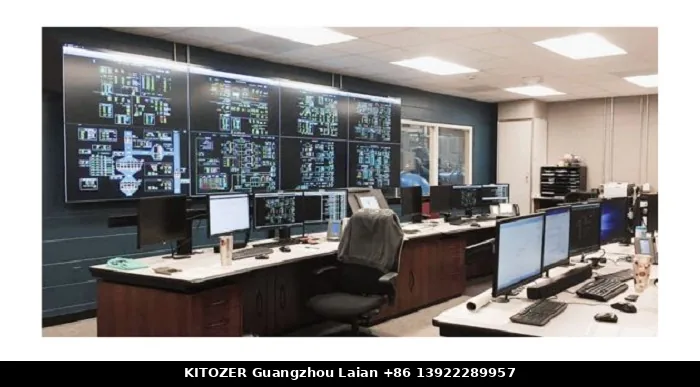
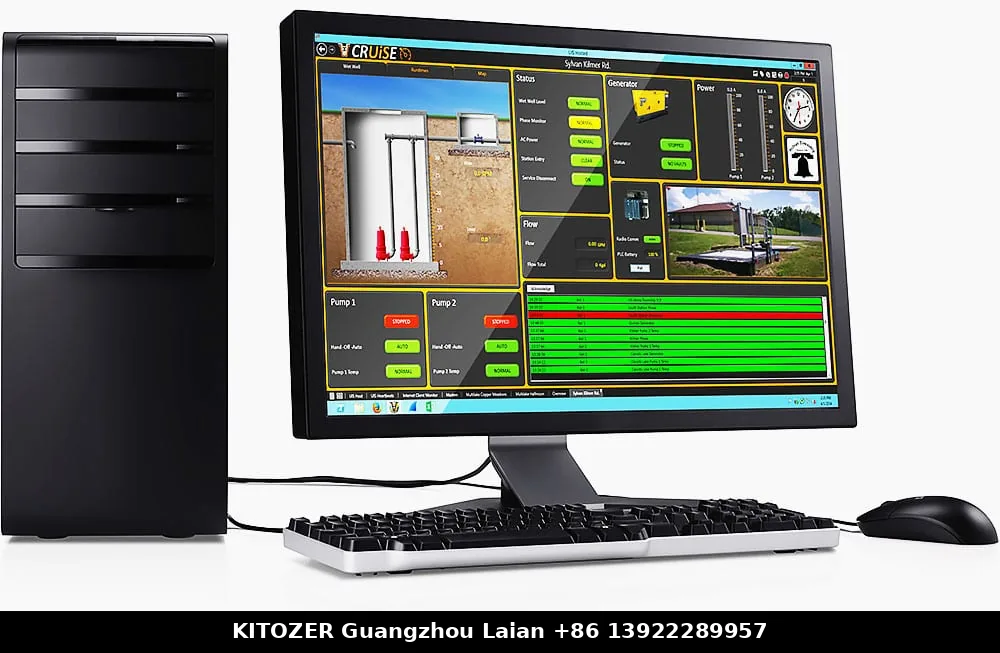
KITOZER SCADA Data Acquisition and Supervisory Control System is an industrial-grade remote monitoring and data acquisition platform developed by Guangzhou Laian Intelligent System Development Co., Ltd., operating under the KITOZER brand. The company is headquartered at No. 5 Huashan Road, Shilou, Panyu, Guangzhou, China. SCADA stands for Supervisory Control And Data Acquisition, a comprehensive industrial automation solution that connects field sensors, PLCs, RTUs, smart meters, variable frequency drives, chillers, UPS units, air conditioners, and other equipment to a central monitoring server. Operators view real-time process data on HMI screens, receive alarms on their mobile phones, and remotely control equipment from the control room or from anywhere in the world.
KITOZER SCADA uses a layered distributed architecture with five layers: field device layer, edge acquisition layer, communication network layer, data service layer, and monitoring application layer. The field device layer senses physical quantities and executes control actions. The edge acquisition layer uses KITOZER edge gateways and programmable controllers to perform protocol conversion, data preprocessing, and offline caching. The communication network layer supports RS485, Ethernet, fiber optic ring networks, 4G/5G, LoRa, NB-IoT, Modbus RTU/TCP, MQTT, OPC UA, IEC 104, DNP3, BACnet, KNX, and Profinet. The data service layer runs real-time and historical databases capable of handling up to 100,000 tags with millisecond scan cycles. The application layer provides graphical HMI, alarm management, trending, reporting, mobile apps, and large-screen visualization.
KITOZER SCADA serves a wide range of industries including data center monitoring, water and wastewater, electrical distribution, renewable energy, oil and gas, rail transit, building automation, smart agriculture, cold chain logistics, museums, hospitals, and research laboratories. With over a decade of project experience, KITOZER offers solutions ranging from small single-site systems with fewer than 200 points to enterprise-level distributed deployments with over 100,000 points.
Guangzhou Laian Intelligent System Development Co., Ltd. provides end-to-end delivery including sensor selection, control panel integration, PLC programming, HMI development, server deployment, network design, site commissioning, and long-term maintenance. Customers can reach the technical team by phone or WeChat at 13922289957 or 18520668845, or on WhatsApp at +1 906-853-4140. The Chinese website is www.lain.com.cn and the English website is www.gdlain.com.
Working Principle and System Architecture
Basic Working Principle
The core working principle of SCADA can be summarized as six steps: sense, transmit, process, display, decide, and control. Field sensors convert physical quantities such as temperature, humidity, pressure, level, flow, voltage, current, power factor, switch status, vibration, and gas concentration into standard electrical signals (4-20 mA, 0-10 V, RS485 digital, or dry contact) that feed into PLC or RTU input modules. The PLC executes preloaded control logic, performs arithmetic, comparisons, and interlock checks, and drives output modules to operate relays, contactors, variable frequency drives, motorized valves, heaters, dehumidifiers, air conditioners, and ventilation units. At the same time, the PLC uploads real-time data through its communication port to the central SCADA server.
The SCADA server polls or subscribes to field device data, converts raw engineering units, applies filtering and alarm limits, and writes the results to a real-time database. The temperatures, pressures, and levels displayed on the HMI are the result of this processing chain. When an operator clicks a start button or changes a setpoint on the screen, the command travels in reverse from the server down to the PLC, which executes the action and feeds back the result, forming a complete control closed loop. The entire cycle typically completes within hundreds of milliseconds to a few seconds, satisfying real-time requirements for most industrial monitoring applications.
Layered Distributed Architecture
KITOZER SCADA follows a classic three-layer distributed architecture: field control layer, monitoring and dispatch layer, and management layer. The field control layer consists of PLCs, RTUs, smart instruments, sensors, and actuators. It is responsible for local data acquisition and direct control, and it can continue operating autonomously even if the upper communication link fails. The monitoring and dispatch layer includes SCADA servers, operator stations, engineering workstations, historical data servers, alarm servers, and web publishing servers. It provides centralized monitoring, operation, alarming, and archiving. The management layer connects group-level data centers, BI platforms, mobile apps, and third-party MES/ERP/EMS systems for cross-site consolidation and decision support.
This layered architecture offers several advantages: fault isolation ensures that a local failure does not bring down the entire system; scalability allows new monitoring points to be added incrementally; redundancy can be configured at the server and network layers; and responsibilities are clearly separated so that upper-level application complexity does not impact lower-level real-time control.
Technical Specifications and Feature List
| Model | Max Tags | Server Configuration | Redundancy | Typical Application | Reference Size |
|---|---|---|---|---|---|
| KITOZER-SCADA-S100 | <=200 | Industrial PC i5/16G/1T | Single | Small room, single pump house | 20-200 sqm |
| KITOZER-SCADA-S300 | <=800 | Industrial PC i7/32G/2T RAID1 | Single+Web | Medium room, distribution, building | 200-1000 sqm |
| KITOZER-SCADA-S1000 | <=3000 | Rack server dual CPU/64G/4T RAID5 | Hot standby | Large data center, industrial park | 1000-5000 sqm |
| KITOZER-SCADA-S5000 | <=15000 | Server cluster/128G/10T | Hot standby+Web cluster | Multi-site enterprise | 5000-50000 sqm |
| KITOZER-SCADA-S20000 | <=50000 | Blade cluster, distributed storage | Geo-disaster recovery | Cross-region group | 50000+ sqm |
| KITOZER-SCADA-S100K | 100000+ | Private/public cloud elastic | Multi-site multi-active | Mega enterprise, provincial platform | Unlimited |
| Module | Description | Typical Use |
|---|---|---|
| HMI Graphics Editor | Drag-and-drop vector graphics, animations, gradients, 3D views | Process flow diagrams, rack layouts, electrical single-line diagrams |
| Real-time Monitoring | Millisecond refresh, values, switches, bars, dials, trends | Operator situation awareness |
| Alarm Center | Multi-level alarms, voice, popup, SMS, WeChat, email push | Instant notification of abnormal conditions |
| Historical Trends | Long-term curves, multi-variable comparison, zoom, export | Root cause analysis, performance review |
| Report Center | Shift/daily/monthly/yearly reports, Excel/PDF, scheduled email | Energy accounting, production statistics |
| User Management | Operator/shift lead/engineer/admin roles, audit logs | Prevent misoperation, compliance |
| Event Recording | All operations, alarms, state changes traceable | Incident analysis, accountability |
| Remote Control | Hand/auto, setpoint download, start/stop, interlock bypass | Unmanned site operation |
| Energy Management | Electricity, water, gas, cooling metering, PUE analysis | Energy saving, sustainability |
| Mobile App | iOS/Android push, remote viewing | Anywhere, anytime awareness |
| Large Screen | Data wall, 3D visualization, GIS, video overlay | Command centers, showrooms |
| Third-party APIs | OPC UA, MQTT, RESTful, database direct | MES/ERP/BMS/EMS integration |
| Web Publishing | B/S architecture, no client install required | Remote management, executive dashboards |
| Redundancy | Primary-standby server failover <5s | Critical process non-stop |
Selection Guide
Information to Collect Before Selection
Before sizing a KITOZER SCADA project, the customer or integrator should gather the following information: a list of all equipment to be monitored including brand, model, quantity, location, communication interface, and supported protocol; a signal list including analog signals (temperature, humidity, pressure, level, flow, voltage, current) with ranges and accuracy requirements, digital signals (run status, fault, hand/auto, door, smoke, water leak), and control outputs (remote start/stop, setpoint download, interlock); site conditions including whether points are concentrated or geographically dispersed, maximum distances, existing network availability, power availability, and environmental protection requirements; functional requirements including hot standby, web publishing, mobile apps, large screens, third-party integration, and long-term data retention; and compliance requirements such as cybersecurity classified protection, power industry regulations, or financial industry standards.
Point Count Estimation
Point count is the primary driver of software licensing, server sizing, and gateway quantity. As a rough guide: a standard 42U rack contributes 5-10 points (in-rack temperature/humidity, rack current, door contact, smoke); a UPS contributes 8-15 points; a precision air conditioner contributes 10-20 points; a distribution cabinet contributes 15-30 points depending on feeder circuits; a pump room contributes 20-50 points; a standard data hall with 100 racks contributes 800-1500 points. Always reserve 20-30 percent headroom to avoid purchasing additional licenses later.
Communication Network Selection
Indoor concentrated equipment uses RS485 bus for low cost and noise immunity; multi-building or large plants use industrial Ethernet fiber ring networks for bandwidth and distance; dispersed field sites use 4G/5G wireless DTUs; low-power battery sensors use LoRa or NB-IoT. KITOZER edge gateways support RS485, Ethernet, and 4G simultaneously for flexible deployment.
Deployment and Installation Requirements
Control Room Environment
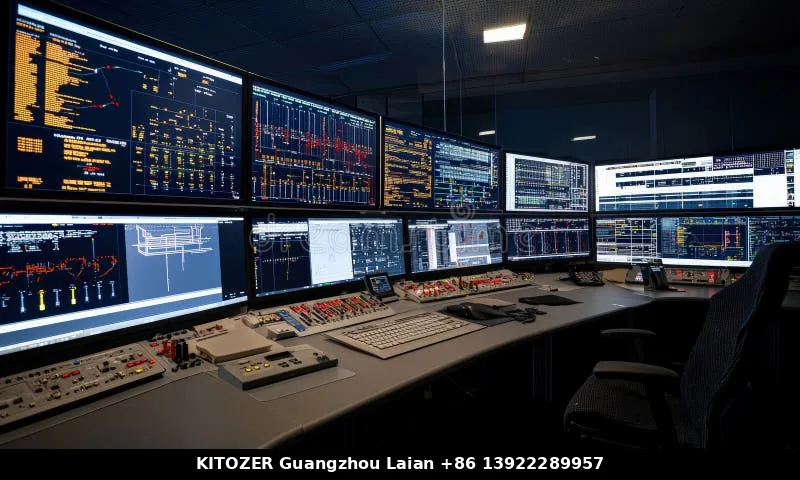
SCADA servers and operator stations should be installed in a dedicated control room or equipment room with ambient temperature of 18-27 degrees Celsius, relative humidity of 40-60 percent, no corrosive gas, no strong electromagnetic interference, and no excessive vibration. The control room should have UPS backup power of at least 2 hours. Server racks should be grounded with resistance below 4 ohms. Operator desks should include displays, keyboards, mice, intercom telephones, and emergency lighting.
Network and Cabling
The SCADA network should be physically or logically isolated from the office network by a firewall. RS485 buses use shielded twisted pair with the shield grounded at one end, routed at least 200 mm away from power cables. Ethernet should use Category 6 or better cabling, or single-mode fiber for long distances. Switches should be industrial-grade wide-temperature models. All cables should be labeled with identifiers matching the drawings.
Field Device Installation
Temperature and humidity sensors should be installed in the return air corridor or mixed hot/cold aisle, 1.2-1.5 meters above floor, away from supply air outlets or heat sources. Water leak sensing cable should be routed under air conditioners, around pipe joints, below windows, and along door thresholds. Smoke detectors should be ceiling-mounted with spacing no greater than 6 meters. All field devices should be powered from UPS circuits to avoid monitoring blind spots during power loss.
Operation and Maintenance
Daily Operation Practices
Operators should inspect the SCADA screens at the start of every shift, checking for unacknowledged alarms, communication failures, and abnormal trends. Before any remote control operation, the operator must confirm with field personnel by phone, following a one-operator-one-witness protocol. Setpoint and interlock changes require engineer authorization and a recorded reason. Personal USB drives, unauthorized software, and non-work-related browsing are prohibited on SCADA servers. Servers should remain powered on; any planned reboot must be communicated to field staff in advance.
| Frequency | Activity | Details |
|---|---|---|
| Daily | System health check | Server CPU/memory/disk, communication status, alarm list, historical writes |
| Weekly | Data backup | Manually back up real-time and historical databases to offsite storage, verify recovery |
| Monthly | Field device inspection | Spot-check sensor accuracy, leak cables, door/smoke detectors, filter cleaning |
| Quarterly | Server deep maintenance | Dust cleaning, RAID health, UPS battery test, OS patching |
| Half-year | Alarm review | Adjust temperature limits for seasons, prioritize alarms, drill emergency procedures |
| Yearly | Full system audit | Tag-by-tag verification, screen-to-field consistency, redundancy test, EMC test |
| Every 3 years | Hardware refresh | Evaluate server upgrade, sensor calibration, software version upgrade |
Frequently Asked Questions
Q1: What is the difference between KITOZER SCADA and generic HMI software?
KITOZER SCADA is a complete hardware-software turnkey platform, not just development software. We supply edge gateways, PLC modules, sensors, control panels, servers, large screens, and mobile apps, plus long-term service. Generic HMI software requires the customer to procure and integrate hardware separately, leading to multi-vendor responsibility gaps.
Q2: Which PLC and instrument brands are supported?
KITOZER SCADA supports Siemens S7-200 SMART/S7-1200/1500/300/400, Mitsubishi FX/Q, Omron CP/CJ, Allen-Bradley CompactLogix/ControlLogix, Schneider M340/M580, Inovance, Xinje, and FANCY. All standard Modbus RTU/TCP instruments are supported, including meters from Schneider, ABB, Chint, Delixi, Acrel; UPS from APC, Eaton, Huawei, Kstar; and precision air conditioners from Vertiv, Stulz, Envicool, Haier.
Q3: How many points can the system handle?
The standard starts at 200 points and scales to over 100,000. Point count affects licensing and server sizing but not the architecture. Customers start small and add licenses as they grow.
Q4: Does the system support hot standby?
Models above 3000 points include dual-server hot standby. The standby takes over within 5 seconds when the primary fails, transparent to operators, with continuous alarm and history.
Q5: How long is historical data retained?
By default 3 years of high-frequency data and 10 years of summarized data. Financial customers typically require 5-10 years, power utilities 10 years, environmental agencies 3-5 years. Storage for 10,000 points over one year is approximately 500 GB.
Q6: Is there a mobile app and WeChat alarm?
Yes. The KITOZER SCADA app for iOS and Android delivers alarms by priority to app push, WeChat, SMS, and email. Critical alarms go to all channels; routine alarms go to app and WeChat only.
Q7: Do I need a dedicated leased line?
Not necessarily. Indoor sites use the existing LAN; cross-site projects use VPN over the internet; remote sites use 4G/5G DTUs with low monthly data fees. Critical links should use dual-path redundancy.
Q8: Does the system meet cybersecurity classified protection requirements?
KITOZER SCADA has passed Cybersecurity Classified Protection Level 3 certification, with authentication, access control, audit, intrusion prevention, and encrypted backup built in.
Q9: What is the typical project timeline?
Small projects under 200 points take 2-3 weeks; medium projects 200-3000 points take 4-8 weeks; large projects over 3000 points take 2-4 months. The schedule mainly depends on equipment delivery and site cooperation.
Q10: How is after-sales service priced?
The first year is free warranty with 24/7 phone support and 48-hour on-site response. After warranty, annual maintenance contracts cost 8-12 percent of the contract value and include scheduled inspections, remote support, and software upgrades.
Typical Applications
Data Center Infrastructure Monitoring
This is one of KITOZER SCADA’s most mature applications. The system centrally monitors UPS, battery strings, precision air conditioners, power distribution cabinets, PDUs, temperature and humidity, water leaks, smoke, access control, video, fire alarm, and ventilation. Customers report that fault detection time drops from hours to minutes and annual inspection labor falls by about 40 percent.
Smart Distribution Rooms
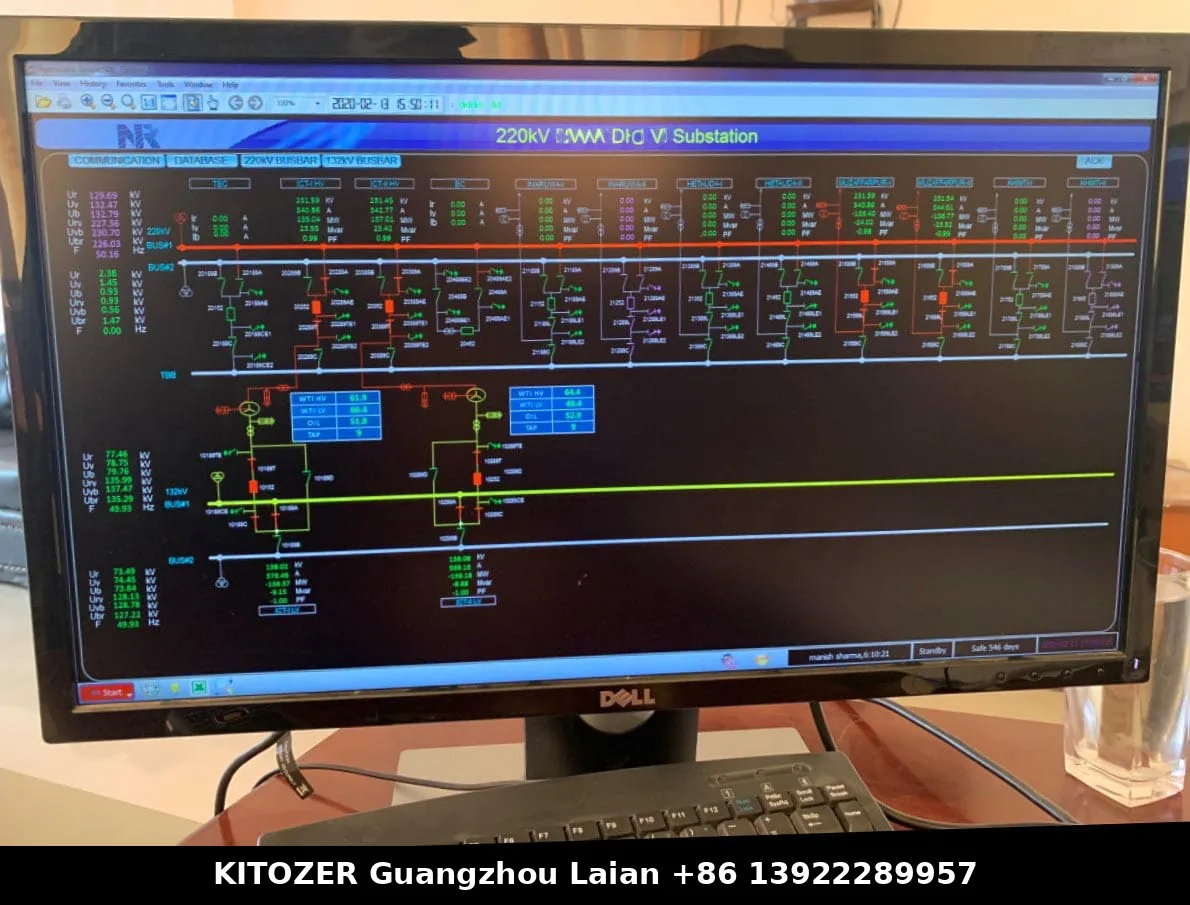
For the large number of urban 10 kV/0.4 kV distribution rooms, KITOZER SCADA provides remote telemetry, remote signaling, remote control, and remote adjustment. It monitors transformer temperature, switch status, power factor, harmonics, temperature and humidity, water leak, access control, and video. Automatic meter reading replaces manual rounds, improving efficiency by more than ten times.
Smart Water and Wastewater
KITOZER SCADA monitors pump stations, water treatment plants, pipe networks, and reservoirs. It controls pump start/stop based on level, maintains constant pressure with variable frequency drives, and adjusts chemical dosing based on water quality. Remote operation replaces 24-hour on-site staff, allowing one dispatch center to manage dozens of dispersed stations.
Renewable Energy Stations
For photovoltaic plants, wind farms, and energy storage stations, KITOZER SCADA collects inverter, combiner box, transformer, switchgear, and battery cluster data. It communicates with grid dispatch using IEC 104 and supports grid code compliance.
Industrial Process Control
In water treatment, food and beverage, pharmaceutical, chemical, and manufacturing plants, KITOZER SCADA serves as the supervisory layer above PLCs. Operators view the whole process, adjust setpoints, review trends, and generate production reports. The system integrates with MES for plant-level information management.
SCADA vs DCS, PLC, and Building Automation
SCADA versus DCS
Customers often confuse SCADA with DCS. DCS, or Distributed Control System, is mainly used in large process industries such as refineries, chemical plants, power stations, and paper mills. It emphasizes closed-loop control in real time and is typically supplied as a single-vendor, proprietary, and expensive system. SCADA, by contrast, emphasizes wide-area data acquisition and monitoring, supports multi-vendor standard PLCs, and is open, flexible, and cost-effective. In short, DCS is control-first while SCADA is monitoring-first. For dispersed scenarios such as data center monitoring, water pipe networks, and distribution rooms, SCADA is the more appropriate choice. For large chemical plants with dense closed-loop control, DCS is more suitable. KITOZER SCADA can also serve as a supervisory layer above an existing DCS, aggregating DCS data for centralized display.
SCADA versus PLC
The PLC is the field-layer hardware that performs direct logic and closed-loop control; SCADA is the upper-computer software that provides centralized monitoring and operation. The PLC is like the spinal cord and brainstem, handling local reflexes, while SCADA is like the visual cortex, providing global awareness. A complete SCADA system must work with a PLC or RTU. KITOZER SCADA communicates with virtually all major PLC brands, allowing customers to choose the PLC they prefer while KITOZER handles configuration and upper-computer development.
SCADA versus BMS/BAS
BMS, or Building Management System, focuses on HVAC, ventilation, lighting, elevators, and plumbing inside buildings, prioritizing comfort and energy efficiency. SCADA is a more general industrial monitoring platform; BMS can be viewed as a vertical specialization of SCADA in buildings. KITOZER SCADA works both as a general industrial platform and as the data acquisition layer for BMS, integrating building devices through BACnet, KNX, and Modbus.
Industrial Communication Protocols in Detail
Modbus
Modbus is the most widely used industrial protocol, originally developed by Modicon (now Schneider) in 1979. It exists in three variants: Modbus RTU over RS485/RS232, Modbus ASCII, and Modbus TCP over Ethernet port 502. It uses a master-slave polling model. Advantages are simplicity, openness, royalty-free licensing, and broad device support. Disadvantages are lack of security, polling inefficiency, and limited node count. KITOZER SCADA supports both Modbus master and slave modes.
OPC UA
OPC UA is the next-generation interoperability standard from the OPC Foundation. Unlike classic OPC DA which relied on Windows COM, OPC UA is cross-platform, service-oriented, built-in security (signing, encryption, certificates), and rich information models. It has become a de facto standard for Industry 4.0 and industrial internet. KITOZER SCADA includes both OPC UA server and client roles.
IEC 60870-5-104
IEC 104 is a power-industry telecontrol protocol over TCP/IP, used between dispatch centers and substations or power plants. It supports telemetry, telesignaling, telecontrol, teleadjustment, and sequence-of-events recording. KITOZER SCADA uses IEC 104 extensively in power, solar, and wind projects to connect to grid dispatch.
MQTT
MQTT is a lightweight publish-subscribe messaging protocol designed for low-bandwidth wireless and battery-powered devices. KITOZER edge gateways support MQTT clients that publish field data to Alibaba Cloud, Tencent Cloud, Huawei Cloud, AWS IoT, or self-hosted brokers.
BACnet and KNX
BACnet is the building automation standard by ASHRAE for HVAC and lighting. KNX is the European building bus standard. KITOZER SCADA integrates these through gateways.
Data Processing and Alarm Management
Data Acquisition and Preprocessing
Raw field data often contains noise, glitches, and inconsistent units. KITOZER SCADA applies multi-stage preprocessing: first, digital filtering including moving average, median, and first-order lag to remove transient interference; second, range conversion from 4-20 mA to engineering units; third, deadband handling so only meaningful changes are stored; fourth, quality stamps marking each value as good, bad, uncertain, or simulated, so upper-level applications can judge reliability.
Alarm Grading and Classification
KITOZER SCADA divides alarms into four levels: level one critical (equipment failure, safety interlock, immediate response), level two important (parameter out of range, communication loss, response within 30 minutes), level three general (slight deviation, shift-handled), and level four informational (state changes, recorded only). Alarm categories include equipment faults, parameter deviations, communication failures, security events, and energy anomalies. Different levels trigger different notification channels and acknowledgment permissions.
Alarm Suppression and Prioritization
In large systems, poor alarm management causes alarm floods in which one fault generates hundreds of alarms and operators miss the truly important one. KITOZER SCADA provides alarm suppression, shelving, grouping, prioritization, and alarm-rate analytics. When a main device fails, downstream alarms are automatically suppressed. The system also tracks alarm frequency per point, helping engineers identify chronic alarm sources at the root.
Historical Data and Reporting
KITOZER SCADA uses a time-series database architecture that supports high-frequency writes and fast aggregate queries. Data is automatically compressed by granularity: raw second-level data is kept for 3-6 months, minute-level for 1-2 years, hourly for 3-5 years, and daily permanently. This layered approach preserves recent precision while controlling disk usage. The database supports RAID5/6, and large deployments use distributed storage with multiple replicas.
Historical trends display up to 16 variables simultaneously, with selectable time ranges, zoom, pan, crosshair reading, and CSV export. Alarm markers are overlaid on trends for root cause analysis. Reports include shift, daily, monthly, and yearly templates with max, min, average, and cumulative calculations. Reports can be delivered automatically by email in Excel or PDF, and customers can design their own templates by dragging fields.
Cybersecurity and Compliance
KITOZER SCADA follows industrial control system security best practices, dividing the network into three zones: field control zone, monitoring zone, and management zone, separated by industrial firewalls. The field control zone only accepts specified IPs from the monitoring zone. Remote access uses VPN bastion hosts. The system enforces multi-factor authentication, role-based access control, and immutable audit logs retained for at least six months. Remote access is HTTPS encrypted; VPN tunnels use IPsec or SSL. Backups are encrypted and stored offsite.
Redundancy and High Availability
Critical systems use primary-standby server hot redundancy. The two servers synchronize data in real time over a heartbeat link. If the primary fails, the standby takes over within 5 seconds transparently to operators. Network redundancy uses ring topologies such as MRP or RSTP with sub-20ms recovery. Critical links use dual-NIC bonding to separate switches. Servers, switches, and gateways use dual power supplies fed from two UPS circuits. For ultra-large deployments, geo-disaster recovery in another city provides RPO near zero and RTO under 30 minutes.
Implementation and Acceptance
A typical KITOZER SCADA project follows six phases: requirements survey (1-2 weeks), design (1-2 weeks), factory prefabrication (2-4 weeks), site installation (1-3 weeks), commissioning (1-2 weeks), and acceptance (1 week). Acceptance tests include point-by-point verification (100 percent accuracy), alarm functional tests, remote control tests, redundancy failover tests, 72-hour continuous run, historical query tests, report generation, and permission tests. Only after all tests pass does the customer sign the acceptance certificate.
Training and Support
KITOZER provides three levels of training: operator training (8 hours) covering startup, shutdown, screen navigation, alarm acknowledgment, and emergency response; maintenance engineer training (16 hours) covering tag database, screen editing, alarm rules, reports, and common troubleshooting; and administrator training (8 hours) covering user management, backup, logs, and upgrades. Training is theory plus hands-on, with a certificate upon completion. The 24/7 support line is +86 13922289957, reachable by phone, WeChat, email, and remote desktop.
Energy Savings and ROI
After deploying KITOZER SCADA, customers typically realize: reduced manual inspection labor by 50-80 percent; avoided equipment damage through early warning, worth tens to hundreds of thousands per incident; 5-15 percent energy savings through precise energy management; 20-30 percent extended equipment life through preventive maintenance; and 20 percent lower management overhead through data-driven decisions. A typical medium-sized data center recovers its SCADA investment within 1-2 years.
Industry Standards
| Standard | Title | Scope |
|---|---|---|
| GB/T 22239 | Cybersecurity Classified Protection Baseline | China MLPS 2.0 |
| GB 50174 | Data Center Design Code | DC monitoring |
| GB 50462 | Data Center Infrastructure Acceptance | Construction |
| DL/T 5003 | Power Dispatch Automation Design | Power SCADA |
| DL/T 634.5104 | Telecontrol Communication | IEC 104 |
| GB/T 19582 | Modbus Industrial Network | Modbus |
| JGJ/T 16 | Civil Building Electrical Design | BAS |
| IEC 61000-6-2 | EMC Industrial Immunity | EMC |
Field Device Layer in Detail
Sensor selection is critical because the sensor is the perception end of the SCADA system, and its accuracy and reliability directly determine the credibility of the entire system. For room environmental monitoring, KITOZER recommends digital integrated temperature and humidity sensors with a range of -20 to 60 degrees Celsius, accuracy of plus or minus 0.3 degrees Celsius and 2 percent RH, and RS485 Modbus RTU output. For contact measurement such as pipe water temperature or transformer temperature, PT100 platinum resistance temperature detectors with Class A accuracy feed temperature transmitters that output 4-20 mA. Pressure sensors use diffused silicon elements with ranges selected per point and 0.5 percent accuracy, outputting 4-20 mA. Level measurement depends on the medium: clean water uses submersible hydrostatic level transmitters, wastewater uses ultrasonic level meters, and oil tanks use radar level meters. Flow measurement depends on pipe diameter and medium: clean water uses electromagnetic flow meters, steam uses vortex flow meters, and gas uses thermal mass flow meters.
Sensor mounting location directly affects measurement representativeness. Temperature and humidity sensors should be installed in the return air corridor or mixed hot and cold aisles at 1.2 to 1.5 meters above floor, away from supply air outlets, heat sources, and windows. Pressure sensors should be installed on straight pipe runs with five diameters upstream and three diameters downstream. Level meters should be in calm areas away from pump discharges and valves. All sensors should be at accessible heights of no more than two meters for maintenance and calibration. Signal cables should be shielded, with the shield grounded at one end, and routed separately from power cables.
Actuators and Control Equipment
Reverse control in SCADA is executed by actuators. Common actuators include AC contactors for pumps and fans, variable frequency drives for pump and fan speed regulation, motorized control valves for water flow and damper opening, solid-state relays for heaters and lighting, and solenoid valves for water path on-off. KITOZER SCADA output modules provide relay outputs rated 5 A at 250 VAC and transistor outputs rated 0.5 A at 24 VDC, directly driving small contactors with intermediate relay expansion for larger loads. For variable frequency drive control, the system supports both hardwired start-stop and analog speed reference, as well as serial communication to read and write drive parameters directly, reducing wiring and enriching data.
Control Panel Integration
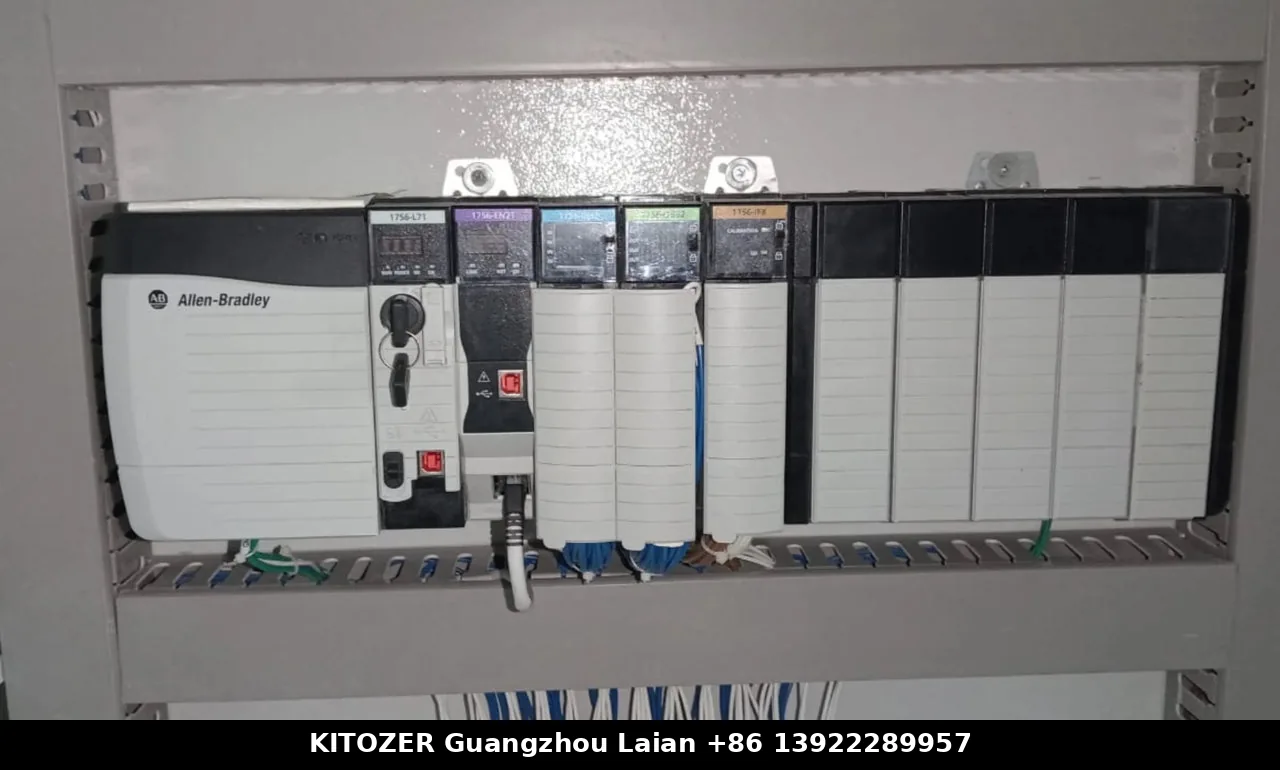
KITOZER assembles control panels at its Guangzhou factory. Panels use national-standard GGD or Rittal-type enclosures sized 600 by 800 by 2200 millimeters. Inside, from top to bottom: lighting and fan zone, Ethernet switch zone, PLC and IO module zone, intermediate relay zone, power supply and fuse zone, terminal block zone, and bottom cable entry zone. Strong and weak current are strictly separated: power wiring on the right cable tray, signal wiring on the left, separated by a metal partition. Every module has a clear label, and every terminal has a wire number. Internal wiring and terminal diagrams are included in the panel. Panels undergo 24-hour powered burn-in before shipment, with all points tested and a test report attached.
HMI Graphics Design Guidelines
The HMI screen is the window through which operators interact with the system, and screen quality directly affects operation efficiency and error rate. KITOZER has developed screen design standards over years of projects. First, color: background is dark blue or dark gray, normal running equipment is green, warnings are yellow, faults are red, and stopped equipment is gray, avoiding overly saturated colors that cause visual fatigue. Second, layout: top title bar and navigation, central main graphic, bottom alarm strip and status bar, with important parameters at the visual center. Third, animation: running equipment shows slow rotation or breathing LED, faults flash red, and fluid direction uses arrow animation. Fourth, text: values retain reasonable decimal places, units are clear, and important values use larger fonts. Fifth, interaction: buttons are at least 40 by 40 pixels, critical actions such as emergency stop require secondary confirmation, and error-prone actions require permission.
Screen hierarchy typically has five levels: level one overview (whole plant or whole room bird’s-eye), level two area (a workshop or floor), level three unit (a production line or rack row), level four device (single equipment detail), and level five parameters (detailed setpoints). Operators drill down from the overview, and alarms one-click navigate to the faulty equipment screen.
Server and Network Hardware Selection
KITOZER recommends industrial or server-grade hardware rather than ordinary office PCs. A typical 1000-point project uses two 2U rack servers with dual Xeon Silver CPUs, 64 GB memory, two 480 GB SSDs in RAID1, four 4 TB HDDs in RAID5, dual gigabit plus dual 10-gigabit network ports, and redundant power supplies. Operator stations use i5 or i7 processors with 16 GB memory and 23-inch or larger displays. The core network uses industrial 24-port gigabit switches with four 10-gigabit SFP ports supporting ring redundancy, deployed in pairs. Access switches are industrial-grade wide-temperature models. A gigabit industrial firewall separates the control and office networks, and a GPS/Beidou time server provides NTP synchronization.
Typical Point List Example
The point list is the core deliverable of a SCADA project, defining every monitored point’s name, address, type, range, alarm limit, and unit. For a typical data center project, examples include hot aisle temperature (DB1.DBD0, analog, 0-50 degrees, low limit 18, high limit 27, level two alarm), cold aisle temperature, room humidity, air conditioner water leak (digital input, level one), room smoke (digital input, level one), UPS run status, UPS battery voltage, PDU current, server cabinet door contact, remote air conditioner on-off, and fresh air fan speed setpoint. KITOZER engineers prepare a complete point list during design and review it with the customer before panel assembly.
Cabling Standards
RS485 buses use shielded twisted pair RVSP 2 by 0.75 square millimeters with 120-ohm characteristic impedance. Analog signal wires use shielded twisted pair RVVP 2 by 1.0 square millimeter. Digital signal wires use RVV 2 by 1.0 square millimeter. Ethernet uses Cat5e or Cat6, with single-mode OS2 fiber for long distances. All cables should be low-smoke halogen-free flame retardant. Cables run along cable trays or conduits, with strong and weak current on separate trays at least 200 millimeters apart, crossing at right angles. Both ends are labeled with number, origin, and destination. RS485 buses use daisy-chain topology, never star branches, with a 120-ohm terminator at the far end. Shield layers are grounded at one end only, at the control panel. Panel internal wiring is neatly dressed in cable trunking, with crimped ferrules and consistent wire marker orientation.
Field Commissioning Process
Site commissioning has four stages. Stage one, unit commissioning: power on each device independently, check power and wiring, and use a laptop to verify communication. Stage two, loop commissioning: connect devices to the PLC and verify signal acquisition and output control logic. Stage three, integrated commissioning: connect all devices to the SCADA server, verify that screen data matches the field, that alarms trigger correctly, and that remote control actions are correct. Stage four, 72-hour burn-in: run the system continuously for 72 hours, log all anomalies, and resolve them before commissioning is declared complete. Common issues include reversed A/B wiring, inconsistent baud rates, missing terminators, floating analog values due to poor shielding, and non-responding remote control due to local mode selection.
Integration with Third-party Systems
KITOZER SCADA provides multiple integration methods: an OPC UA server for third-party subscription, a RESTful API for web applications, database views for shared data in intermediate tables, an MQTT broker for IoT platforms, and scheduled CSV or XML exports. For video, it integrates with the GB/T 28181 standard. For fire systems, it reads alarm signals through dry contacts or RS485. For access control, it integrates through Wiegand or TCP/IP. KITOZER engineers cooperate with the customer’s IT team to complete interface development.
Operations Management Recommendations
KITOZER recommends customers establish the following operations procedures: a 24-hour two-person shift schedule with shift handover records; a routine inspection at the start of every shift and a weekly field walkdown; a remote operation protocol requiring two-person verification and shift lead approval for critical actions; an alarm response target of 5 minutes for level one, 30 minutes for level two, and shift-handled for level three; a daily automatic backup with weekly manual verification; a change control process requiring request, approval, and record for any program, screen, or setpoint change; and quarterly emergency drills plus semi-annual disaster recovery drills.
SCADA in Data Centers in Depth
Data centers are one of KITOZER SCADA’s most important application scenarios. A typical medium data center monitors: power systems including 10 kV high-voltage switchgear, transformers, low-voltage distribution, power factor correction, UPS, battery strings, diesel generators, and ATS transfer switches; cooling systems including chillers, chilled water pumps, condenser water pumps, cooling towers, precision air conditioners, fresh air units, exhaust fans, and plate heat exchangers; environmental systems including temperature and humidity in every hot and cold aisle, water leak sensing cable under air conditioners and along pipes, and smoke detectors on the ceiling; security systems including access control, video, infrared perimeter detection; fire systems including fire alarm panels, gas suppression, and early smoke detection; and IT equipment including servers, switches, and storage monitored via IPMI or SNMP.
The core value of data center SCADA is unmanned operation. Traditional data centers require 24/7 on-site staff, which is costly and prone to missing hidden hazards. With SCADA, operators in the control room see the whole room on a large screen, and alarms reach their phones automatically. Fault detection time drops from hours to minutes. Customers report that SCADA reduces business interruption events by about 80 percent and annual operations cost by about 30 percent. KITOZER has developed dedicated modules: real-time PUE calculation, rack-level temperature and humidity heat maps, battery cell-by-cell voltage and temperature inspection, automatic periodic diesel generator test runs, cold aisle containment status monitoring, leak location precise to the meter, and access-video linkage.
SCADA in Smart Water in Depth
Smart water is another major SCADA application. A municipal water supply system includes multiple sources, intake pump stations, water treatment plants, booster pump stations, pipe network valves, and customer meters. SCADA monitors intake level, pump run status, outlet pressure and flow, sedimentation tank turbidity, filter level, chemical dosing, clear well level, and send water pump frequency and current. The system adjusts pump speed automatically based on pipe network pressure to maintain constant pressure. As water demand rises, pressure drops and drives increase; as demand falls, drives slow to avoid pipe bursts and waste. Chlorine dosing is adjusted automatically based on residual chlorine. For drainage systems, SCADA monitors sump level, pump status, screen differential, and flow; it starts pumps at high level and stops at low level. All data uploads to the water group dispatch center, allowing one center to manage the entire city’s pump stations.
SCADA in Renewable Energy in Depth
In photovoltaic plants, SCADA monitors every inverter’s DC voltage and current, AC voltage and current, active and reactive power, daily and cumulative energy, inverter temperature, and fault codes. It monitors each combiner box string current and fuse status, each box transformer temperature, and grid connection voltage, frequency, and power factor. It communicates with grid dispatch via IEC 104 and receives dispatch setpoints for active and reactive power. In wind farms, SCADA monitors rotor speed, generator speed, blade pitch, yaw angle, nacelle vibration, gearbox oil temperature, generator winding temperature, active and reactive power, and wind speed and direction. In energy storage stations, it monitors battery cluster voltage, current, SOC, SOH, maximum and minimum cell voltage, maximum and minimum cell temperature, insulation resistance, and PCS power. It charges and discharges based on grid dispatch or peak-valley tariff.
SCADA in Manufacturing in Depth
In manufacturing, SCADA is the plant-level monitoring platform connecting production line PLCs. It monitors line speed, output, yield, downtime reasons, and equipment OEE. When downtime occurs, the system automatically records duration and cause, helping managers identify bottleneck processes. In food and beverage, SCADA monitors batching tank temperature, pressure, agitator speed, filling volume, sterilization temperature, and CIP cleaning. In pharmaceuticals, it monitors reactor temperature and pressure, media pH, sterilizer temperature and time, and cleanroom environment, with electronic records compliant with GMP. In chemicals, it monitors reactor temperature and pressure, flow, level, and combustible gas concentration, interlocking with the safety instrumented system.
SCADA in Rail and Tunnels
In urban rail transit, the SCADA integrated monitoring system combines power monitoring, environmental control, water supply and drainage, lighting, platform screen doors, elevators, and escalators. A single station has about 2000 to 5000 monitored points, and dozens of stations along a line connect to the control center through a fiber ring network. Center dispatchers monitor all station equipment and remotely control critical devices. In highway tunnels, SCADA monitors lighting (sectional dimming), ventilation fans (normal and fire modes), drainage pumps, fire pumps, traffic signals, variable message signs, CCTV cameras, and CO/visibility sensors. In a fire, the system automatically executes the fire mode: start smoke extraction fans, activate lighting, close tunnel entrances, switch public address, and notify rescue services. In utility tunnels, SCADA monitors temperature, humidity, oxygen, combustible gas, water level, ventilation, drainage, fire doors, and manhole covers.
SCADA in Building Automation
In office buildings and commercial complexes, the BMS/SCADA monitors chiller plants, chilled water pumps, condenser pumps, cooling towers, heat exchangers, air handling units, fresh air units, variable air volume terminals, fan coil units, exhaust and supply fans, drainage pumps, water tank levels, public and facade lighting, elevators, and power distribution. The system schedules equipment by time clock, adjusts air conditioning based on temperature and humidity, and modulates fresh air based on CO2 concentration, balancing comfort and energy. Building SCADA differs from data center SCADA: buildings prioritize comfort and energy optimization, while data centers prioritize reliability and precision. The KITOZER platform supports both verticals with configurable feature packs.
SCADA in Museums and Archives
Museum and archive storage rooms have extremely strict environmental requirements. KITOZER SCADA monitors temperature at 20 plus or minus 2 degrees Celsius, humidity at 50 plus or minus 5 percent RH, illumination no greater than 50 lux, ultraviolet radiation, PM2.5, formaldehyde, VOC, water leaks, smoke, and access control. It automatically adjusts air conditioning and dehumidifiers to keep conditions within range. Data is retained for more than 10 years to meet cultural heritage regulations. A small museum with ten storage rooms typically requires 200 points and costs about USD 20,000 to 35,000.
SCADA in Hospitals and Labs
Operating rooms, ICUs, neonatal wards, sterile supply departments, and pharmacy compounding rooms require strict cleanroom environments. KITOZER SCADA monitors operating room temperature at 22 to 25 degrees, humidity at 40 to 60 percent, positive pressure differential of 5 to 10 Pa, particle count, and air changes. It integrates with the hospital HIS to log environmental data for every surgery, supporting infection control audits. For calibration and testing laboratories accredited to CNAS or CMA, KITOZER uses high-precision sensors (temperature plus or minus 0.1 degree, humidity plus or minus 1 percent RH) with 1-second scan cycles and tamper-proof 10-year records.
SCADA in Cold Chain and Agriculture
Pharmaceutical and food cold chain requires end-to-end temperature monitoring. KITOZER SCADA uses wireless temperature loggers in refrigerated trucks, cold rooms, and display cabinets, uploading data over 4G. Temperature excursions trigger alarms, and reports are generated automatically to meet GSP and GDP requirements. In smart agriculture, SCADA monitors greenhouse temperature, humidity, light, CO2, soil moisture, and soil EC, automatically controlling roller shades, fans, evaporative pads, grow lights, and fertilizer dosing. In aquaculture, it monitors water temperature, dissolved oxygen, pH, and ammonia, automatically controlling aerators and water exchange.
SCADA in Smart Distribution Rooms
Urban distribution networks contain a vast number of 10 kV to 0.4 kV distribution rooms in residential, commercial, and industrial buildings. Traditional manual inspection is slow and misses hidden hazards. KITOZER smart distribution room solutions deploy a monitoring terminal in each room, collecting transformer top-oil and winding temperature, high-voltage switch status, low-voltage feeder current and voltage, leakage current, room temperature and humidity, water leak, smoke, access control, and video. Data uploads over 4G to a distribution operations center. The system alarms on over-temperature, overload, leakage, or water leak, dispatching technicians proactively. Compared with manual rounds, the solution reduces inspection labor by 70 percent and cuts fault detection time from 24 hours to 5 minutes. A single room typically costs USD 2,000 to 5,000, while a central platform for hundreds of rooms costs USD 15,000 to 45,000.
SCADA in Oil, Gas, and Pipelines
In oil field well pads and natural gas long-distance pipelines, SCADA monitors wellhead pressure, temperature, flow, casing pressure, and valve status, transmitting data over satellite or 4G from sites hundreds of kilometers away. Center dispatchers remotely start and stop wells and adjust production. Long-distance pipelines monitor compressor station inlet and outlet pressure, temperature, flow, and compressor status, as well as valve chamber status and leak detection. Leaks are located by flow imbalance. These projects have long distances and harsh environments, requiring extremely reliable hardware.
SCADA in Ports and Bulk Handling
Bulk cargo ports handling coal, ore, or grain use stacker-reclaimers, ship loaders, and belt conveyors. KITOZER SCADA monitors each belt’s run status, misalignment, slip, tear, and blockage, along with dust collectors, water spray, and lighting. Belt misalignment triggers automatic correction, and excessive dust starts water spray. The system integrates with terminal operating systems for automated loading and unloading.
SCADA in District Heating and Gas
District heating networks run from heat sources through primary pipes to heat exchange stations and then through secondary pipes to customers. SCADA monitors supply and return temperature and flow at the source, at each station, and at selected customer rooms. It adjusts supply temperature based on outdoor temperature for climate compensation, avoiding overheating waste. Leaks are located by flow imbalance. In gas distribution, pressure regulating stations and gate stations monitor inlet and outlet pressure, temperature, flow, combustible gas concentration, filter differential, and regulator position, with automatic emergency shutdown on leaks.
Pricing Structure in Detail
A KITOZER SCADA project price consists of: software licensing (25-35 percent of total, based on point count); hardware (30-40 percent, including PLC, sensors, panels, servers, and network equipment); installation and cabling (15-20 percent); software development (10-15 percent, including graphics, reports, and interfaces); commissioning and training (5-10 percent); and tax and freight (5-8 percent). The main price drivers are point count (more points lower unit price), communication method (wireless costs more than wired), redundancy (hot standby adds about 30 percent), customization volume, and site remoteness. KITOZER recommends a clear requirements phase before quoting to avoid later change orders.
SCADA Lifecycle Management
The typical SCADA lifecycle is 10 to 15 years. Years 1 to 2 are the shakedown period with more teething issues and vendor support. Years 3 to 5 are the stable period with routine maintenance. Years 6 to 8 are the mature period where hardware ages and sensor accuracy drifts, triggering gradual replacement. Years 9 to 12 are the refresh period where software versions are obsolete and servers are end-of-life, warranting a planned upgrade. Beyond 12 years, a full replacement is recommended. KITOZER supports customers through the entire lifecycle from planning and design to operation, upgrade, and replacement.
Export and International Projects
KITOZER SCADA has been exported to Southeast Asia, the Middle East, Africa, and South America. The system supports English UI, multiple time zones, metric and imperial units, and multilingual reports. Export projects communicate over WhatsApp at +1 906-853-4140. Hardware is wide-voltage (85 to 264 VAC) to adapt to different grids. Software supports remote deployment and commissioning, so overseas projects can be pre-tested in the Guangzhou factory with only wiring and integrated commissioning on site.
Additional FAQ
Q11: Can SCADA be deployed on cloud servers? Yes. KITOZER SCADA supports public clouds (Alibaba, Tencent, Huawei, AWS) and private clouds. Cloud deployment eliminates on-premise server maintenance and enables elastic scaling, but requires reliable network connectivity. For highly secure customers, local deployment with cloud disaster recovery is recommended.
Q12: Does KITOZER SCADA support Linux? The server runs on Windows Server or domestic Kylin Linux; clients access via web browsers; mobile apps run on iOS and Android.
Q13: How many operator stations are needed? Typically 2-4 operator stations for shift operators, plus 1 engineer station and 1 shift lead station. Web publishing allows managers to view from their own browsers without extra stations.
Q14: Can video cameras be integrated? Yes. Cameras supporting ONVIF or RTSP, including Hikvision, Dahua, and Uniview, can be integrated. Alarm events automatically pop up the associated camera view.
Q15: Does the system support voice alarms? Yes. Level one alarms trigger spoken voice announcements through control room speakers, for example announcing which UPS battery voltage is low and asking for immediate attention.
Q16: Can custom functions be developed? Yes. KITOZER software engineers have extensive customization experience, including dedicated graphics, special reports, industry algorithms, and third-party interfaces. Custom development is priced by effort, typically from several thousand to tens of thousands of US dollars.
Q17: Is the software license perpetual? Yes. Small version upgrades (such as V5.1 to V5.2) are free. Major version upgrades (V5 to V6) are separately priced. Annual maintenance contracts include small version upgrades and support.
Q18: What if there is no on-site network? For sites without internet, KITOZER SCADA runs locally. For remote viewing, a 4G/5G router establishes a VPN tunnel that carries only monitoring data without affecting local control.
Q19: Can the system integrate with fire systems? Yes. KITOZER SCADA reads fire alarm signals via dry contacts or RS485 and, on fire, automatically stops non-critical power, closes air conditioning, starts smoke exhaust, releases access control, and sends SMS. Fire linkage must be installed by a qualified fire integrator; KITOZER provides interface cooperation.
Q20: Does the system support multilingual UI? Yes. Simplified Chinese, traditional Chinese, and English are built in, switching automatically on login. Other languages can be customized for export projects.
Network Architecture in Depth
The KITOZER SCADA network is layered. The lowest layer is the field device network, where sensors and actuators connect to nearby remote IO or PLCs via hardwiring or RS485. The middle layer is the workshop or station network, where PLCs exchange data over industrial Ethernet in star or ring topologies. The top layer is the central network, where workshops or stations connect to the central SCADA servers via fiber or 4G.
Redundancy is designed at multiple levels: ring networks with MRP recover in under 20 milliseconds; critical servers use dual-NIC bonding to two separate core switches; and remote access is over VPN tunnels with audit logging. The control network is separated from the office network by an industrial firewall that permits only specified IPs and ports. SCADA servers do not run non-work software, and unnecessary services are disabled.
Data Flow in Detail
The complete data path from field to cloud is: physical quantity from the sensor, 4-20 mA or RS485 signal, PLC or RTU acquisition, PLC internal processing (filtering, range conversion, interlock logic), industrial Ethernet, edge gateway (protocol conversion, local preprocessing), fiber or 4G, central SCADA server, real-time database, historical database, HMI screen, web client, mobile app, and third-party interface.
The edge gateway performs important preprocessing: data filtering to upload only changed values, timestamp stamping, offline caching with retroactive upload after network recovery, and protocol conversion to standard MQTT. Edge computing greatly reduces central server load and bandwidth usage. The reverse control path travels in the opposite direction: operator click on HMI, SCADA server command, network, edge gateway, PLC, output module, intermediate relay, contactor or drive, and finally field actuator. The closed loop completes within one second.
Alarm Notification and Escalation
KITOZER SCADA alarm channels include screen pop-ups with audible beacons, voice announcements, mobile app push, SMS, WeChat push, email, and automated phone calls to shift leads. Level one alarms use all channels simultaneously; level two alarms use app, SMS, and WeChat; level three alarms use app and WeChat only; level four informational alarms are logged on screen only. If a level one alarm is not acknowledged within 5 minutes, it escalates to the shift lead; within 15 minutes, to the department manager; within 30 minutes, to company leadership. This tiered escalation ensures critical alarms are never missed.
Reporting System
KITOZER SCADA reports include operation reports (shift, daily, monthly recording run time, start-stop count, cumulative output), energy reports (daily and monthly electricity, water, gas by circuit with year-over-year and month-over-month comparison), and alarm reports (alarm list filtered by time, level, and category, plus top 10 chronic alarm points). Reports can be scheduled and emailed automatically or generated on demand. Export formats include Excel, PDF, and CSV. Customers design their own report templates by dragging fields. Report data can be drilled down from summaries to details.
Deployment Models
KITOZER SCADA supports three deployment models. On-premises deployment installs servers in the customer’s own equipment room, keeping data inside the enterprise, which is suitable for finance, government, and defense customers but requires in-house IT maintenance. Cloud deployment installs servers on public or private clouds, eliminating hardware maintenance and enabling global access, which suits dispersed sites and small IT teams but depends on network. Hybrid deployment keeps a local server for real-time control while using the cloud for analytics and display, which is the mainstream choice for large projects. KITOZER recommends the appropriate model based on customer priorities.
Budget Considerations
A complete SCADA project budget should consider: first-build cost (software plus hardware plus construction plus development) at 60-70 percent of total cost; annual operations cost (after warranty) at 8-12 percent of first-build cost; and refresh cost after 8-10 years at 50-70 percent of first-build cost. Customers should evaluate total cost of ownership over the system life, not just the purchase price. KITOZER systems are designed for 10 years or more with perpetual software licensing, resulting in a favorable long-term total cost of ownership.
SCADA History and Trends
SCADA has evolved through four generations. First-generation systems were mainframe-centric, proprietary, and expensive, mainly used in power and oil. Second-generation systems distributed remote terminals over analog dedicated lines. Third-generation systems moved to Ethernet and PC servers with commercialized configuration software, dramatically lowering cost. Fourth-generation systems fuse internet, IoT, cloud, and edge computing, supporting web, mobile, cloud deployment, and big data analytics. KITOZER SCADA is a fourth-generation product that also supports legacy field equipment, protecting customer investment.
Looking ahead, SCADA will continue to evolve toward cloud-native microservices, deeper digital-twin integration, predictive maintenance through historical data modeling, edge intelligence, and OPC UA over TSN as the real-time bus. KITOZER invests in R&D annually to keep customer systems current.
Why Choose KITOZER
Reasons to choose KITOZER SCADA include: factory-direct pricing without reseller margins; in-house R&D for fast customization; self-owned control panel factory in Guangzhou; 24/7 Chinese technical support with 48-hour on-site response; integrated hardware and software with single-vendor responsibility; transparent reference pricing; rich case experience across industries; and long-term commitment with a 10-plus year design life. Customers are welcome to visit the factory at No. 5 Huashan Road, Shilou, Panyu, Guangzhou. Call or WeChat +86 13922289957 or +86 18520668845 to schedule a visit.
Data Center Monitoring Configuration Guide
KITOZER SCADA recommends configurations for data centers of different sizes. A micro room with fewer than two racks and under 20 square meters uses a mini SCADA on an industrial PC, monitoring one UPS, one precision air conditioner, four temperature and humidity points, one leak detector, one smoke detector, and one door contact, totaling about 30 points. Reference price is about USD 5,500 to 8,500. A small room with 5 to 20 racks and 50 to 200 square meters uses a standard SCADA monitoring 1 to 2 UPS units, a battery string, 2 to 4 precision air conditioners, 1 to 2 distribution cabinets, 8 to 16 temperature and humidity points, 4 to 8 leak zones, 4 to 8 smoke detectors, and 2 access control points, totaling 200 to 400 points. Reference price is about USD 12,500 to 22,000.
A medium room with 20 to 100 racks and 200 to 1000 square meters uses hot-standby SCADA monitoring 2 to 4 UPS units, two battery strings, 4 to 10 precision air conditioners, 3 to 6 distribution cabinets, 20 to 50 temperature and humidity points, 10 to 20 leak zones, 10 to 20 smoke detectors, 4 to 8 access control points, and 10 video channels, totaling 800 to 1500 points. Reference price is about USD 38,000 to 68,000. A large data center with over 100 racks uses a group SCADA cluster monitoring all power, cooling, environmental, security, fire, and IT equipment, with 3000 or more points. Reference price starts at USD 95,000 and scales with the project.
Data center SCADA has special requirements: 24/7 non-stop operation with redundant servers and networks; fire linkage that automatically cuts non-critical power, stops air conditioning, and starts smoke exhaust on alarm; access-video linkage that records on unauthorized entry; precise leak location; battery cell-by-cell voltage and temperature inspection; automatic periodic diesel generator tests; and real-time PUE calculation. KITOZER standardizes all of these.
Smart Water Configuration Guide
A municipal water SCADA project typically includes intake pump stations, water treatment plants, booster stations, and pipe network monitoring. KITOZER configures one central SCADA server at the water group dispatch center, with PLC control cabinets and 4G DTUs at each remote pump station. Each station monitors inlet pressure and level, pump run status and current, outlet pressure and flow, variable frequency drive state, and valve position. The system maintains constant outlet pressure through VFD control, adjusts chemical dosing based on water quality, and starts or stops pumps based on reservoir level. A network of 10 dispersed pump stations typically requires 300 to 500 points and costs about USD 40,000 to 80,000 including the central platform.
Renewable Energy Configuration Guide
A 10 MW photovoltaic plant uses KITOZER SCADA to monitor about 20 string inverters, 10 combiner boxes, one box transformer, and grid connection cabinet. The system reports active and reactive power, daily and cumulative energy, inverter temperature, and fault codes to grid dispatch via IEC 104. A typical 10 MW plant costs about USD 25,000 to 50,000 for the SCADA layer. A 5 MWh energy storage project adds battery cluster monitoring through the BMS, PCS power control, and transformer temperature, with peak-valley arbitrage scheduling.
Industrial Process Configuration Guide
A food or pharmaceutical plant SCADA project typically monitors 5 to 20 production lines, each with PLC-controlled equipment. The central SCADA aggregates line speed, output, yield, downtime reason, and OEE. It integrates with MES for production scheduling and quality traceability. A medium plant with 1000 points typically costs USD 40,000 to 80,000.
Troubleshooting Common SCADA Issues
Issue: all devices on an RS485 bus are offline. Check the shield grounding, the 120-ohm terminator at the bus end, A/B wiring orientation, baud rate and parity consistency, and any short or open circuits. Issue: a device intermittently drops off. Check for interference, cable spacing from power lines, device power stability, and grounding. Issue: analog values fluctuate. Check the sensor, wiring tightness, common-mode interference, shield grounding, and add filtering. Issue: spurious digital alarms. Check contact bounce and add 20 to 50 milliseconds of software debouncing. Issue: remote control does not act. Check whether the field device is in local mode, the output module, the intermediate relay, and the field control circuit. Issue: missing history. Check disk space, database service status, and history archival configuration. Issue: alarms do not reach mobile phones. Check phone network, push service, alarm rule channel selection, and account binding. Issue: slow screen opening. Check server performance, graphic element count, and history query complexity. KITOZER remote support is available at +86 13922289957.
SCADA versus DCS, HMI, and IoT Platforms
Customers often ask how KITOZER SCADA relates to DCS, HMI, and IoT platforms. DCS is for closed-loop process control in heavy industry and is typically expensive and proprietary. HMI is the operator screen software that runs on top of PLCs, often as part of SCADA. IoT platforms are cloud-centric and focus on broad device connectivity and big data analytics. KITOZER SCADA sits at the industrial edge, providing real-time monitoring and control, while also publishing data to IoT platforms via MQTT. It complements rather than replaces these systems.
Edge Computing and 5G
KITOZER edge gateways are not just protocol converters; they run local control logic. If the central network fails, the gateway continues to execute basic control policies locally, avoiding monitoring blind spots. When the network recovers, cached data is retroactively uploaded. With 5G, KITOZER gateways can directly connect to high-bandwidth, low-latency 5G networks, enabling wireless deployment without cable runs. Network slicing provides dedicated channels for SCADA traffic, guaranteeing real-time performance.
Digital Twin Integration
SCADA and digital twin are converging. Traditional SCADA uses 2D graphics that operators must mentally map to the physical plant. Digital twin fuses real-time SCADA data with 3D models, displaying every rack and device’s live state in a 3D scene. Operators can walk through, zoom, and rotate the virtual space, clicking equipment for details. In data center projects, KITOZER offers a digital twin option: the 3D room model is bound to real-time data, with rack temperature, current, and door state shown on the 3D rack, and alarm racks highlighted in red. This reduces new-operator learning time and cuts fault location from minutes to seconds.
Energy and Carbon Management
KITOZER SCADA includes an energy management module that meters electricity, water, gas, oil, cooling, and heat by category. Electricity is split by incoming feeder, air conditioning, lighting, sockets, and IT load. Water is split by municipal supply, reclaimed water, cooling, and drainage. The system automatically calculates energy per square meter, energy per unit of output, PUE, WUE, and CUE. Reports support year-over-year and month-over-month comparison, automatically flagging anomalies such as weekend consumption higher than weekdays. For customers with carbon targets, the system calculates carbon emissions from electricity multiplied by grid emission factors, generating carbon reports for sustainability reporting.
Mobile and Remote Access
The KITOZER SCADA mobile app runs on iOS and Android phones and tablets. Features include real-time data synchronized with the PC, alarm push by priority, authorized remote control, historical trends, reports, and video. The app uses HTTPS encryption and supports fingerprint or face login. Administrators can configure which users may remotely control versus only view. Remote access has two modes: customers with a public IP use port forwarding or VPN directly to the local server; customers without a public IP use KITOZER’s cloud relay, which encrypts data without requiring a fixed IP, suiting small projects. Large enterprises typically use self-built VPN to keep data inside the corporate network.
Data Backup and Disaster Recovery
KITOZER SCADA uses a disciplined backup strategy: incremental real-time database backups every hour and full backups daily; full historical database backups daily; and automatic backup of configuration files (graphics, tags, alarm rules) after every change. Backups are retained locally for 30 days and copied weekly to offsite NAS or cloud storage. The disaster recovery procedure is: install the OS and SCADA software on a new server, restore the latest configuration backup, restore the historical database, verify communication, and switch over. Recovery typically completes within four hours. KITOZER recommends a semi-annual restore drill to verify backup usability.
Project Risks and Mitigation
SCADA projects face common risks that KITOZER addresses proactively. Risk one: inaccurate equipment lists leading to missed points. Mitigation: verify every device on site before contract signing and reserve 20 percent headroom. Risk two: poor on-site network causing unstable communication. Mitigation: test signal before construction and lay fiber or add repeaters as needed. Risk three: frequent requirement changes delaying schedule. Mitigation: define a formal change process with associated costs and confirm requirements in phases. Risk four: harsh field conditions causing hardware failures. Mitigation: choose industrial wide-temperature equipment and add cooling and dust protection to panels. Risk five: operators unable to use the system. Mitigation: invest in thorough training, provide illustrated manuals, and offer free remote guidance for the first year.
Contract Considerations
When signing a SCADA contract, customers should clarify: the point count and scope to avoid later disputes; the deliverables list (software, hardware, drawings, documentation); the schedule and milestones; the acceptance criteria and test methods; payment milestones (typically 30 percent advance, 30 percent on delivery, 30 percent on acceptance, 10 percent warranty retention); the warranty period and response times; intellectual property and data ownership; and liability and dispute resolution. KITOZER provides a standard contract template that protects both parties.
SCADA in Water Treatment Plants
In wastewater treatment plants, SCADA monitors bar screens, inlet pump wells, fine screens, grit chambers, biological tanks, secondary clarifiers, sludge thickeners, dewatering houses, chemical dosing, disinfection tanks, and effluent flow meters. Inside biological tanks it monitors dissolved oxygen, mixed liquor suspended solids, oxidation-reduction potential, pH, and sludge return ratio. The system automatically adjusts aeration blower frequency based on dissolved oxygen and adjusts sludge return pumps based on mixed liquor solids. Dosing houses adjust chemical feed based on inlet flow and quality. Dewatering houses start and stop dewatering machines based on sludge level. The entire plant can run with minimal staff, with one central control room managing all processes.
SCADA in Chemical Safety
Chemical park safety monitoring is a critical SCADA application. KITOZER monitors combustible gas detectors around process units, storage tanks, and loading bays; toxic gas detectors for hydrogen sulfide, carbon monoxide, and chlorine; pressure on vessels and piping; temperature on reactors and heaters; level in tanks and reactors; flame detectors; static grounding status; and emergency shutoff valves. When combustible gas reaches 25 percent LEL the system alarms; at 50 percent LEL it interlocks emergency shutdown and starts water spray. The system integrates with the safety instrumented system. Chemical projects must be designed by qualified chemical engineering firms; KITOZER supplies the SCADA portion.
SCADA in Dams and Pumping Stations
Hydraulic hubs include dams, spillways, sluices, headrace tunnels, and hydropower houses. SCADA monitors dam seepage and settlement, reservoir level, gate opening, and unit speed and output. During floods it automatically adjusts gate opening based on forecasts. Irrigation, drainage, and water diversion pumping stations are scattered across tens of kilometers; SCADA connects them via fiber or wireless and dispatches centrally, automatically starting stations based on rainfall and water level.
SCADA in Environmental Monitoring
Environmental monitoring stations monitor air quality (PM2.5, PM10, SO2, NO2, ozone, CO), water quality (pH, turbidity, dissolved oxygen, COD, ammonia nitrogen), noise, and meteorological parameters. Stations are typically unmanned, with data uploaded over 4G to environmental agencies. KITOZER SCADA provides local acquisition and storage; if the network fails, data caches locally and resumes transmission after recovery.
SCADA in Parking and EV Charging
Smart parking monitors space occupancy, lighting, ventilation, drainage, and fire safety. Each space uses ultrasonic or magnetic sensors, and guidance signs direct vehicles. EV chargers monitor charging status, energy, and billing, integrating with the payment system. KITOZER SCADA serves as the underlying monitoring platform above which parking management runs.
Typical Project Configurations
Case one: a medium data center with 50 racks and about 800 points. Configuration includes hot-standby SCADA servers, two operator stations, one engineer station, two access switches, two PLC control panels, 40 temperature and humidity sensors, four water leak controllers, 20 smoke detectors, two UPS communication links, four precision air conditioner gateways, and eight smart meters. Project duration is six weeks; reference price is about USD 53,000. Case two: a campus pump room network with eight dispersed pump stations and about 300 points. Configuration includes one central SCADA server and eight local PLC panels with 4G DTUs; reference price is about USD 30,000. Case three: a museum with ten storage rooms and about 200 points; reference price is about USD 21,000.
Brand Introduction
KITOZER is the industrial automation and intelligent brand of Guangzhou Laian Intelligent System Development Co., Ltd. The brand name combines KIT, meaning a complete toolkit, with a suffix evoking automation. The company is based in Panyu, Guangzhou, and focuses on industrial SCADA, data center monitoring, smart control panels, and IoT gateways. KITOZER’s brand promise is stable, open, and scalable: stable means 24/7 reliable operation with mean time between failures exceeding 50,000 hours; open means standard protocols without vendor lock-in; scalable means smooth growth from 200 to 100,000 points, protecting customer investment.
Glossary
HMI: Human Machine Interface, the operator screen. RTU: Remote Terminal Unit for remote sites. PLC: Programmable Logic Controller. IO: Input/Output. AI/AO/DI/DO: Analog Input, Analog Output, Digital Input, Digital Output. MES: Manufacturing Execution System. ERP: Enterprise Resource Planning. DCIM: Data Center Infrastructure Management. PUE: Power Usage Effectiveness. OEE: Overall Equipment Effectiveness. SOE: Sequence Of Events. NTP: Network Time Protocol. UPS: Uninterruptible Power Supply. ATS: Automatic Transfer Switch. PDU: Power Distribution Unit.
Common Misconceptions
Misconception one: SCADA allows fully unmanned operation. In reality SCADA is an aid, not a replacement for periodic field inspection of mechanical parts not covered by monitoring. Misconception two: more points are always better. Extra points add cost without value; point count should match management needs. Misconception three: more expensive is always better. Unused features add complexity. Misconception four: installation ends the project. SCADA needs ongoing maintenance and optimization. Misconception five: big-name software guarantees reliability. Poor configuration or rough installation defeats even premium software. KITOZER advises customers to define needs clearly, choose an experienced integrator, and value maintenance.
Performance Specifications
Key KITOZER SCADA performance metrics include: maximum 100,000 monitored tags; up to 1000 concurrent acquisition tasks per server; minimum 100-millisecond scan cycle; one-second screen refresh; under 5 seconds from alarm occurrence to mobile push; under 2-second historical query response for one year of data; 99.99 percent system availability (under 52 minutes of annual downtime); under 5-second primary-to-standby switchover; up to 20 concurrent operator stations; up to 200 concurrent web users; unlimited mobile users; and history retention of 3 years high-frequency to permanent summary data. These metrics scale with distributed cluster deployments for very large projects.
Environmental and Reliability Design
KITOZER field acquisition hardware is industrial-grade, operating from -20 to 70 degrees Celsius and storing from -40 to 85 degrees Celsius, with 5 to 95 percent non-condensing humidity. It withstands 5 g vibration from 10 to 150 Hz and 15 g shock for 11 milliseconds. EMC compliance follows IEC 61000-6-2 industrial immunity, including plus or minus 4 kV contact discharge and plus or minus 8 kV air discharge, plus or minus 2 kV fast transient burst, and plus or minus 1 kV surge. Mean time between failures exceeds 100,000 hours for field devices and 500,000 hours for servers. The system design life exceeds 10 years, with key components guaranteed available for at least 5 years.
Panel Internal Layout
KITOZER control panels use national-standard GGD or Rittal TS8 enclosures measuring 600 by 800 by 2200 millimeters. Internally, from top to bottom: lighting and fan zone, Ethernet switch zone, PLC and IO module zone, intermediate relay zone, power supply and fuse zone, terminal block zone, and bottom cable entry. Strong and weak current are strictly separated on separate cable trays with a metal partition. Every module has a clear label and every terminal a wire number. Panel internal wiring diagrams and terminal diagrams are included. Front doors add gaskets for IP54 protection in dusty industrial environments.
Comparison Table: KITOZER vs Alternatives
When choosing a SCADA platform, customers often compare KITOZER with international premium software and domestic domestic software. On price, KITOZER is about 30 to 50 percent of international brands and slightly above pure domestic software. On local service, KITOZER offers 48-hour on-site response, while international brands typically require 1 to 2 weeks and domestic vendors vary. On protocol support, KITOZER supports hundreds of protocols comparable to international brands. On feature maturity, international brands have decades of accumulation, while KITOZER has matured through years of projects. On customization, KITOZER delivers quickly and affordably, while international brands quote long timelines and high fees. On Chinese support, KITOZER is natively Chinese. For domestic projects, KITOZER balances price and service well.
Implementation Timeline
Take a typical 1000-point project as an example: week one is requirements survey and site visit; week two is design and point list confirmation; weeks three and four are factory panel building and PLC programming; weeks four and five are graphics and report configuration; week six is factory internal testing and pre-acceptance; week seven is site cabling and device installation; week eight is site commissioning and integrated testing. The customer must provide the equipment list and site conditions up front, confirm designs promptly, and cooperate with site work. The KITOZER project manager reports progress weekly and communicates issues quickly.
SCADA in Lithium Battery Backup
As data center backup power shifts from lead-acid to lithium batteries, KITOZER SCADA has added battery management system monitoring. The system reads each lithium cluster’s total voltage, total current, state of charge, state of health, maximum and minimum cell voltage, maximum and minimum cell temperature, insulation resistance, and contactor status. It alarms on over-voltage, under-voltage, over-temperature, and insulation degradation, and coordinates with UPS and distribution switchgear. For large energy storage stations, SCADA also handles charge-discharge power control, peak-valley arbitrage, and demand management.
SCADA in Tunnel Lighting and Ventilation
Road tunnels range from a few hundred meters to over ten kilometers, with enclosed interiors that demand careful lighting and ventilation. KITOZER SCADA automatically adjusts interior lighting based on portal brightness: entrance and transition zones are brighter, middle zones dimmer, balancing safety and energy. Ventilation starts based on CO concentration and visibility, with separate normal and fire modes. On fire, the system executes the fire mode: start all smoke extraction fans, open lighting, switch public address, and notify rescue. Drainage pumps, fire pumps, and traffic signals are also monitored.
SCADA in Bulk Cargo Ports
Bulk cargo ports for coal, ore, and grain use ship unloaders, belt conveyors, stacker-reclaimers, and ship loaders. KITOZER SCADA monitors each belt for run status, misalignment, slip, tear, and blockage, along with dust collectors, water spray, and lighting. Belt misalignment triggers automatic correction, and excessive dust starts water spray. The system integrates with terminal operating systems for automated loading and unloading.
Quick Reference Price Table
For quick budgeting, common KITOZER SCADA projects are priced as follows: small room monitoring under 100 points at USD 4,000 to 11,000; medium room monitoring at 500 points for USD 21,000 to 42,000; large data center monitoring at 2000 points for USD 70,000 to 140,000; a single pump house at USD 4,000 to 11,000; a network of 10 pump stations at USD 42,000 to 85,000; a network of 50 distribution rooms at USD 110,000 to 210,000; a 10 MW solar plant at USD 28,000 to 70,000; a factory SCADA at 1000 points for USD 42,000 to 110,000; a museum storage monitoring at USD 14,000 to 42,000; and hospital cleanroom monitoring at USD 28,000 to 70,000. These are reference prices; final pricing is by formal quotation. Call +86 13922289957 for details.
Service Commitment
KITOZER commits to: one year of free warranty on all delivered systems; 24/7 phone support during warranty; on-site response within 48 hours for critical issues; free small-version software upgrades for life; free customer training; complete technical documentation; and long-term spare parts supply. We understand that SCADA is a critical element of customer production and safety, and we treat every project with the utmost responsibility. Choose KITOZER for peace of mind.
SCADA in Museum Environments
Museum and archive storage monitoring is a distinctive KITOZER application. Artifacts and records are extremely sensitive to the environment: high temperature accelerates organic aging, low temperature embrittles materials; high humidity breeds mold and pests, low humidity dries and cracks paper; strong light causes fading, and ultraviolet radiation accelerates photochemical reactions. Harmful gases such as sulfur dioxide, nitrogen oxides, and formaldehyde corrode artifacts. Museum storage therefore requires temperature stable at 20 plus or minus 2 degrees Celsius, humidity at 50 plus or minus 5 percent RH, illumination under 50 lux, ultraviolet under 10 microwatts per lumen, and strict PM2.5 and VOC control.
KITOZER museum storage solutions place in each room: high-precision temperature and humidity sensors (plus or minus 0.2 degree, plus or minus 2 percent RH), two per room; one illumination sensor; one ultraviolet sensor; one VOC sensor; one PM2.5 sensor; one water leak set; one smoke detector; and one access control point. The system automatically controls storage room air conditioners and dehumidifiers to keep parameters within range. Data is retained for over 10 years and monthly environmental reports are generated. The system integrates with the museum building automation and fire systems. A small museum with ten rooms typically requires USD 21,000 to 35,000.
SCADA in Hospital Cleanrooms
Operating rooms, ICUs, neonatal wards, sterile supply departments, and pharmacy compounding rooms have strict cleanroom requirements. KITOZER SCADA monitors each operating room’s temperature at 22 to 25 degrees, humidity at 40 to 60 percent, positive pressure differential of 5 to 10 Pa, particle count, air changes, air conditioner run status, and supply and return air volume. It integrates with the hospital information system to log environmental data for every surgery, supporting infection control audits and liability. A temperature, humidity, or pressure excursion triggers an alarm. A typical tertiary hospital with 20 operating rooms requires USD 42,000 to 70,000.
SCADA in Calibration Laboratories
Calibration and testing laboratories accredited to CNAS or CMA require extremely stable environments. KITOZER uses high-precision sensors (temperature plus or minus 0.1 degree, humidity plus or minus 1 percent RH), one-second scan cycles, tamper-proof data, and 10-year retention to meet accreditation requirements. The system displays environmental data in real time and alarms on excursions. Customers can remotely view lab conditions via mobile app. A testing center with ten labs typically costs USD 14,000 to 28,000.
SCADA in Smart Street Lighting
Urban smart street lighting uses NB-IoT or LoRa to collect every lamp’s switch status, current, voltage, and energy, with remote on/off and dimming by group. The SCADA platform displays every lamp’s status on a GIS map and highlights faulty lamps in red. The system switches lights based on sunrise and sunset times and dims based on traffic flow, saving over 30 percent energy.
SCADA in Aquaculture and Agriculture
Smart greenhouses monitor temperature, humidity, light, CO2, soil moisture, and soil EC, automatically controlling roller shades, fans, evaporative pads, grow lights, and fertilizer dosing. The system adjusts the environment based on crop growth models, saving 30 percent on water and fertilizer and improving yield by 20 percent. Aquaculture monitors water temperature, dissolved oxygen, pH, and ammonia, automatically controlling aerators and water changes. KITOZER SCADA connects dispersed sensors via LoRa or NB-IoT for low-cost, fast deployment.
SCADA in District Heating
District heating networks run from heat sources through primary pipes to heat exchange stations and then through secondary pipes to customers. SCADA monitors source supply and return temperature and flow, each station’s primary and secondary temperature and flow, circulation and makeup pumps, and selected customer room temperatures. It automatically adjusts supply temperature based on outdoor temperature for climate compensation, avoiding overheating waste. Pipeline leaks are located by flow imbalance.
SCADA in Gas Pressure Regulation
Urban natural gas pressure regulating stations and gate stations monitor inlet and outlet pressure, temperature, flow, combustible gas concentration, filter differential, and regulator position. The system maintains stable outlet pressure and automatically shuts down and alarms on leaks. Data uploads to the gas group dispatch center.
SCADA in Integrated Utility Tunnels
Urban utility tunnels house power, communications, water, and gas utilities in shared underground corridors. SCADA monitors compartment temperature and humidity, oxygen, hydrogen sulfide, methane, water level, ventilation fans, drainage pumps, fire doors, and lighting. On gas leaks, it automatically starts ventilation, closes fire dampers, and alerts rescue services. The system integrates with city tunnel control centers.
Conclusion
KITOZER SCADA Data Acquisition and Supervisory Control System has become a trusted brand in industrial automation and smart premises through years of accumulated project experience. Whether you need a small room monitoring system or a city-level SCADA platform, KITOZER can deliver a suitable solution. We are committed to stability, openness, and long-term partnership with our customers. Thank you for reading. For further consultation, call +86 13922289957 or +86 18520668845, or visit www.gdlain.com.
SCADA in Water Distribution Networks
Water distribution network monitoring uses pressure sensors, flow meters, and water quality sensors at key nodes. SCADA maps the network on GIS, showing real-time pressure at each node. Low pressure triggers booster pump adjustment or pipe leak investigations. Water quality sensors monitor residual chlorine, turbidity, and pH, automatically adjusting chlorination. The system helps utilities reduce non-revenue water by detecting leaks early.
SCADA in Firefighting Water Systems
Firefighting water systems monitor fire pump room jockey pumps, main fire pumps, pressure tanks, sprinkler and hydrant piping pressure, and fire water tank level. The system starts jockey pumps to maintain pressure, and on pressure drop starts main fire pumps. It also performs automatic periodic pump tests to ensure readiness. Compliance with fire codes requires continuous monitoring and weekly test records.
SCADA in Compressed Air Systems
Compressed air stations monitor air compressor run status, discharge pressure and temperature, dryer dew point, storage tank pressure, and dew point. The system leads and lag units based on air demand, controls dryer cycling, and alarms on high dew point. Energy savings through compressor sequencing typically reach 15 to 25 percent.
SCADA in Vacuum and Medical Gas
Hospitals require continuous vacuum, oxygen, nitrous oxide, and medical air supplies. SCADA monitors pressure in each gas main, cylinder manifold status, compressor and vacuum pump run status, and area alarms. On low pressure, it alarms and switches manifolds. Medical gas monitoring must meet healthcare accreditation requirements.
SCADA in Boiler Houses
Boiler houses monitor boiler steam pressure and temperature, feed water level, fuel supply, flue gas temperature, burner status, and water treatment. The system sequences boilers based on steam demand, maintains safe water level, and alarms on low water or high pressure. It integrates with stack emission monitoring for environmental compliance.
SCADA in Refrigerated Warehouses
Refrigerated warehouses monitor room temperature, compressor and condenser run status, evaporator defrost cycles, door open alarms, and refrigerant leak detection. The system maintains setpoint temperature with multiple compressors staging. Door open alarms prevent temperature rise during loading. CO2 or refrigerant leak alarms trigger ventilation and evacuation.
SCADA in Solar Street Lighting
Solar street lighting integrates photovoltaic panels, battery storage, and LED lamps. SCADA monitors battery voltage, lamp current, and on/off schedule for each pole. Faulty poles are identified and flagged on the management map, reducing nighttime truck roll for inspection.
Final Contact
Thank you for reviewing the complete KITOZER SCADA Data Acquisition and Supervisory Control System documentation. We have covered overview, working principle, architecture, specifications, selection, deployment, maintenance, FAQ, and applications. KITOZER will continue to invest in research and development to deliver more stable, open, and intelligent industrial monitoring. Reach us by phone or WeChat at +86 13922289957 or +86 18520668845, WhatsApp at +1 906-853-4140, or visit www.gdlain.com. We look forward to your inquiry.
SCADA in Pharmaceutical Clean Utilities
Pharmaceutical manufacturing requires purified water, pure steam, and clean compressed air systems. SCADA monitors each loop’s flow, pressure, temperature, conductivity, and total organic carbon for purified water; pure steam pressure and temperature; and clean air pressure, dew point, and particle count. The system recirculates water loops to prevent stagnation, alerts on conductivity excursions, and logs all data in an electronic batch record compliant with GMP and FDA requirements. Data integrity features include audit trails, electronic signatures, and restricted edits.
SCADA in Food and Beverage CIP
Cleaning-in-place systems in food and beverage plants require precise temperature, concentration, and flow control for caustic, acid, and water rinse cycles. SCADA sequences valves, controls detergent concentration via conductivity, ramps temperature to setpoint, and records every batch. The system verifies each CIP cycle before production resumes, reducing contamination risk.
SCADA in Brewing and Distilling
Brewing and distilling involve mashing, lautering, boiling, fermenting, and distilling. SCADA monitors mash temperature with precise PID control, boil kettle temperature and addition timing, fermentation tank temperature and pressure, and still column temperature profiles. Consistent control across batches improves product quality and repeatability.
SCADA in Material Handling and Conveyors
Conveyor systems in warehouses, ports, and manufacturing plants use SCADA to monitor belt speed, run status, misalignment, slip, tear, and emergency pull-cord switches. The system sequences conveyors in reverse of the material flow to avoid buildup, and alarms on any fault to prevent chain damage.
SCADA in Water Treatment Chemical Dosing
Chemical dosing systems for water treatment monitor solution tank level, metering pump stroke and speed, and residual chlorine or coagulant residual at the outlet. The system adjusts dosing pump output proportionally to inlet flow and measured residual, maintaining effluent quality while minimizing chemical cost.
SCADA in Steam and Condensate
Steam distribution systems monitor supply and return pressure, temperature, condensate return level, and trap status. The system balances steam demand, identifies failed traps that waste steam, and calculates steam production efficiency. Energy savings from trap management typically pay for the SCADA project within one to two years.
SCADA in Solar Water Heating
Solar water heating systems monitor collector array temperature, storage tank temperature, pump status, and auxiliary heater. The system circulates based on collector-to-tank temperature differential and supplements with gas or electric when solar is insufficient. SCADA tracks solar fraction and energy saved.
SCADA in Geothermal Heat Pumps
Geothermal heat pump systems monitor ground loop supply and return temperature, heat pump run status, building supply and return air temperature, and energy use. The system sequences heat pumps based on load and monitors ground loop temperature to ensure long-term sustainability.
SCADA in Wind Farm SCADA Integration
Wind farms have their own turbine controllers; the wind farm SCADA aggregates turbine data, monitors substation, and communicates with grid dispatch. KITOZER SCADA serves as a secondary aggregator for smaller wind farms, adding site-level visualization, alarms, and reporting on top of turbine vendor systems.
Final Note
This concludes the detailed introduction to KITOZER SCADA. We invite you to contact us at +86 13922289957 or WhatsApp +1 906-853-4140 for a customized proposal.
SCADA in Evaporative Cooling Systems
Data centers increasingly use evaporative cooling and indirect evaporative cooling units. KITOZER SCADA monitors outside air temperature and humidity, wet bulb temperature, supply and return air temperature, water pump status, drain water quality, fan speed, and filter differential pressure. The system automatically switches between direct, indirect, and economizer modes based on outdoor conditions to minimize compressor runtime. Real-time efficiency metrics guide operations to maximize free cooling hours.
SCADA in Battery Energy Storage Systems
Battery energy storage systems monitor each rack’s state of charge, cell voltage, cell temperature, insulation, and fire detection. The SCADA coordinates with the power conversion system to charge or discharge based on grid signals, peak shaving, or backup power needs. Thermal runaway detection triggers ventilation and alarm before propagation.
SCADA in Edge Computing Nodes
Remote edge nodes combine compute and storage in rugged enclosures. KITOZER SCADA monitors enclosure temperature, humidity, door status, smoke, water leak, UPS status, and generator runtime. Edge servers can be remotely rebooted or power-cycled through the SCADA, reducing truck rolls.
SCADA in Network Operations Centers
Network operations centers monitor environmental conditions, power, cooling, and physical security alongside IT infrastructure. KITOZER SCADA provides the physical layer monitoring while integrating via SNMP with network management systems for a unified view.
SCADA in Remote Telemetry
Remote telemetry for oil, gas, water, and environmental monitoring uses solar-powered stations with satellite or cellular backhaul. KITOZER edge gateways support low-power modes and store data locally for days when communications are unavailable. This is ideal for pipelines, rivers, and weather stations.
SCADA in Building Energy Management
Building energy management systems extend SCADA to submetering. Every floor, tenant, or department has metered electricity, water, and gas. KITOZER SCADA generates tenant billing, identifies waste, and tracks energy intensity against green building standards.
SCADA in Lighting Control
Networked lighting control uses DALI, 0-10V, or relay panels. KITOZER SCADA schedules lighting by time clock, daylight harvesting, and occupancy. It reports lamp failures and energy use, reducing lighting energy by 30 to 50 percent.
SCADA in Elevator Monitoring
Elevator monitoring collects run status, floor position, fault codes, and door status from elevator controllers via serial or TCP. The system reports on trapped occupants, trip frequency, and maintenance needs, integrating with building management.
Final Summary
KITOZER SCADA is a versatile platform that scales from small rooms to city-wide networks. For inquiries, contact +86 13922289957 or WhatsApp +1 906-853-4140.
SCADA in Water Source Heat Pumps
Water source heat pump systems monitor well water temperature and flow, heat pump condenser and evaporator temperatures, building loop temperature, and energy use. The system sequences heat pumps based on building load and monitors well water sustainability. SCADA reports coefficient of performance to verify energy savings.
SCADA in Radiant Floor Heating
Radiant floor heating systems monitor supply and return water temperature, room temperature per zone, and mixing valve position. The system balances room comfort with energy use by adjusting supply water temperature based on outdoor reset curves.
SCADA in Demand Control Ventilation
Demand control ventilation adjusts outdoor air based on CO2 concentration in occupied spaces. KITOZER SCADA reads CO2 sensors, positions outdoor air dampers, and adjusts fan speed, improving indoor air quality while minimizing conditioning energy.
SCADA in Lighting Harvesting
Daylight harvesting uses photo sensors to dim electric lighting when daylight is sufficient. SCADA coordinates with lighting control panels and reports energy savings, contributing to green building certification.
SCADA in Electrical Power Quality
Power quality monitoring captures voltage sags, swells, harmonics, flicker, and unbalance. KITOZER SCADA reads power quality meters and trends them over time, helping facilities diagnose equipment misoperation and comply with grid codes.
SCADA in Diesel Generator Testing
Standby diesel generators require weekly testing. KITOZER SCADA automatically starts generators under no load, runs them for a set period, monitors coolant temperature, oil pressure, battery voltage, and fuel level, then shuts down and logs the test. This ensures readiness without manual visits.
SCADA in UPS Battery Monitoring
UPS battery strings are monitored cell by cell: voltage, temperature, and internal resistance. The system trends internal resistance to predict weak cells before failure, performs automatic battery discharge tests, and alarms on charger faults. This extends battery life and prevents surprise UPS failure.
SCADA in Cable Leak Detection
Water leak detection systems use sensing cable that locates leaks to within one meter. KITOZER SCADA displays leak location on a room plan, alerts on mobile, and integrates with automatic water shutoff valves to minimize flood damage.
Closing
Thank you for reviewing the KITOZER SCADA documentation. We look forward to supporting your project.
SCADA in Power Factor Correction
Power factor correction capacitor banks are monitored for step switch status, reactor temperature, and capacitor current. KITOZER SCADA sequences steps based on reactive power demand and alarms on capacitor failure, avoiding penalty charges from the utility.
SCADA in Harmonic Filtering
Active harmonic filters are monitored for measured THD, compensation current, and status. The system trends harmonic distortion and reports when filters approach capacity, supporting power quality compliance.
SCADA in Medium Voltage Switchgear
Medium voltage switchgear provides continuous monitoring via protection relays. KITOZER SCADA reads breaker status, trip coil health, winding temperature, and partial discharge sensors. Remote trip and close are supported under permission and interlock.
SCADA in Transformer Monitoring
Power transformers are monitored for winding temperature via RTDs, oil temperature, tap changer position, and gas relay status. The system alarms on high temperature and loadsheds if necessary, extending transformer life.
SCADA in Standby Generators
Standby generators monitor coolant temperature, oil pressure, battery voltage, fuel level, exhaust temperature, and output voltage/frequency. Automatic weekly tests run under load and no load. Fuel level is monitored to ensure readiness.
SCADA in ATS Switchgear
Automatic transfer switches monitor source availability, switch position, and controller health. KITOZER SCADA logs every transfer event and alarms on abnormal transfer, ensuring reliable backup power.
SCADA in Static Transfer Switches
Static transfer switches provide sub-cycle transfer between sources. SCADA monitors source voltages, transfer count, and internal temperature, reporting wear indicators for proactive maintenance.
SCADA in Power Monitoring Dashboards
Power monitoring dashboards display real-time single-line diagrams, load percentages, and energy counters. Managers can see at a glance which feeders are overloaded and which panels can accept additional load.
Final Contact Information
For KITOZER SCADA inquiries, contact Guangzhou Laian Intelligent System Development Co., Ltd. at phone or WeChat +86 13922289957 or +86 18520668845, WhatsApp +1 906-853-4140, address No. 5 Huashan Road, Shilou, Panyu, Guangzhou, China. English website www.gdlain.com. We reply within one business day.
SCADA in Data Center CRAC Units
Computer room air conditioning units are monitored for supply and return air temperature and humidity, compressor status, fan speed, filter differential pressure, and heater/humidifier state. KITOZER SCADA sequences units for even runtime and alarms on filter replacement, preventing hotspots.
SCADA in Cooling Towers
Cooling towers monitor basin water temperature, fan speed, water treatment dosage, and water level. The system cycles fans to maintain condenser water setpoint and alarms on low water or high vibration.
SCADA in Chilled Water Pumps
Chilled water pumps monitor run status, speed, discharge pressure, and vibration. The system leads and lags pumps based on differential pressure, providing variable flow for energy savings.
SCADA in Condenser Water Pumps
Condenser water pumps run in tandem with chillers. KITOZER SCADA monitors pump status and valve interlocks, ensuring proper chiller enable permissives.
SCADA in Plate Heat Exchangers
Plate heat exchangers are used for free cooling in winter. The system monitors inlet and outlet temperatures and flow, automatically switching to free cooling when outdoor conditions allow.
SCADA in Humidifiers
Steam humidifiers monitor cylinder current, drain valve status, and feed water. SCADA controls humidification based on room humidity setpoint and alarms on scale buildup.
SCADA in Dehumidifiers
Refrigerant dehumidifiers monitor room humidity and run status. The system cycles dehumidifiers to maintain setpoint, preventing mold and equipment corrosion.
SCADA in Fresh Air Units
Fresh air units monitor filter condition, supply air temperature, and damper position. The system adjusts outdoor air based on occupancy and CO2, balancing air quality and energy.
Contact KITOZER
Contact KITOZER today at +86 13922289957 or WhatsApp +1 906-853-4140 for your SCADA project.
About Guangzhou Laian
Guangzhou Laian Intelligent System Development Co., Ltd. is the manufacturer behind KITOZER. Our factory is located in the Zhongrun Industrial Park Chaotian Campus, No. 5 Huashan Road, Shilou, Panyu, Guangzhou. We design, build, and commission industrial automation and intelligent monitoring systems for customers worldwide. Our phone and WeChat numbers are +86 13922289957 and +86 18520668845. Our WhatsApp contact is +1 906-853-4140. We invite customers to visit our factory and see our control panel workshop and software development team. We look forward to building long-term partnerships based on quality products and reliable service.
Why Choose KITOZER SCADA
Customers choose KITOZER because we deliver a complete turnkey solution: sensors, control panels, PLC programming, HMI configuration, servers, network design, installation, commissioning, training, and long-term support. We do not sell software alone; we deliver a working system. Our pricing is transparent, our Chinese engineering team responds quickly, and our factory in Guangzhou controls quality. Whether you are building a small room monitoring system or a multi-site enterprise SCADA, KITOZER has the experience and dedication to make your project succeed. Contact us today for a free consultation.
Contact Us Today
Ready to upgrade your monitoring? Call or WhatsApp KITOZER at +86 13922289957. Our engineers will review your equipment list, propose a system architecture, and provide a reference price within one business day. We look forward to hearing from you.
Global Delivery
KITOZER ships SCADA systems worldwide. Our English documentation, multilingual UI, and wide-voltage hardware make overseas deployment straightforward. Contact us at WhatsApp +1 906-853-4140 for export inquiries.
Free Consultation
We offer a free 30-minute technical consultation to review your requirements. Call +86 13922289957 today.
Visit Our Website
Learn more about KITOZER products at www.gdlain.com. We look forward to serving you.
Thank You
Thank you for your interest in KITOZER SCADA. We are ready to support your project.
Get Started
Email or call KITOZER today. We reply within one business day.
Ready
KITOZER is ready. Contact us now.
Let us know
Tell us your project requirements. We will respond promptly.
Let us help
KITOZER engineers are standing by to help.
Thank you
Thank you for choosing KITOZER.
Get in touch
Get in touch with KITOZER today.
Let us talk
Let us talk about your project.
Say hello
Say hello to KITOZER now.
KITOZER | Guangzhou Laian Intelligent System Development Co., Ltd.
Phone/WeChat: +86 13922289957, +86 18520668845
WhatsApp: +1 906-853-4140
Address: No. 5 Huashan Road, Shilou, Panyu, Guangzhou, China
Chinese website: www.lain.com.cn | English website: www.gdlain.com
Contact us for a free SCADA proposal, bill of materials, and reference price. Our engineering team replies within one business day.
KITOZER SCADA Reference Pricing (indicative only):
– KITOZER-SCADA-S100 (<=200 points): Reference price from USD 5,500 to USD 9,800
– KITOZER-SCADA-S300 (<=800 points): Reference price from USD 12,500 to USD 22,000
– KITOZER-SCADA-S1000 (<=3000 points): Reference price from USD 38,000 to USD 68,000
– KITOZER-SCADA-S5000 (<=15000 points): Reference price from USD 95,000 to USD 180,000
– KITOZER-SCADA-S20000/S100K (large platform): Reference price from USD 250,000, project-based
Pricing includes software license, server, field acquisition hardware, control panel, installation and commissioning, and one-year warranty. Final price depends on point count, communication method, redundancy, and customization.