KITOZER Active Infrared Beam Detector (Perimeter Intrusion Sensor)
1. Product Overview
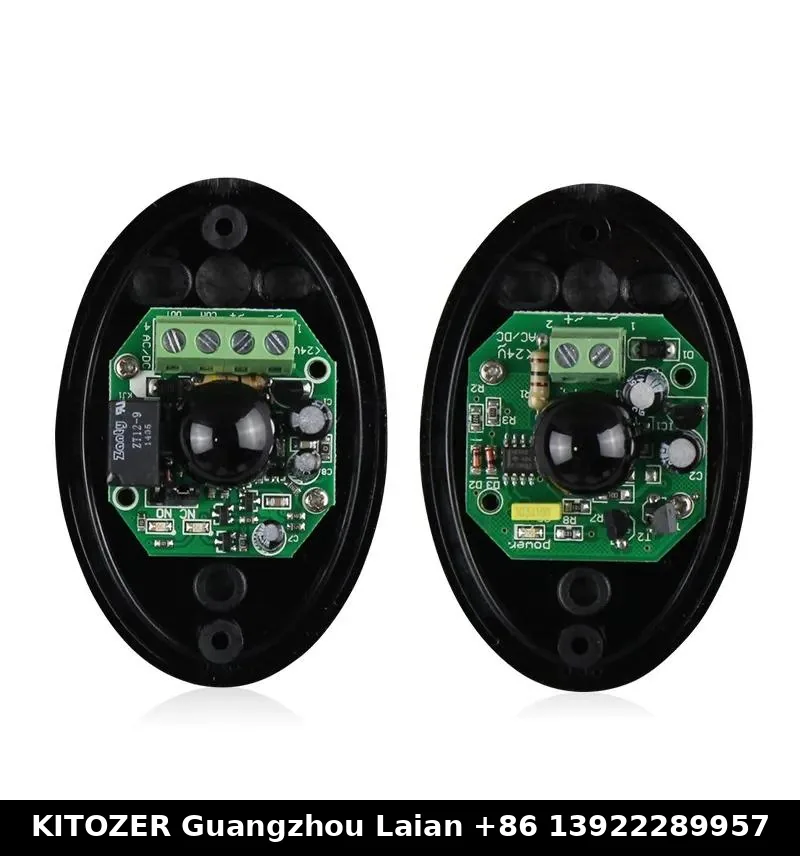
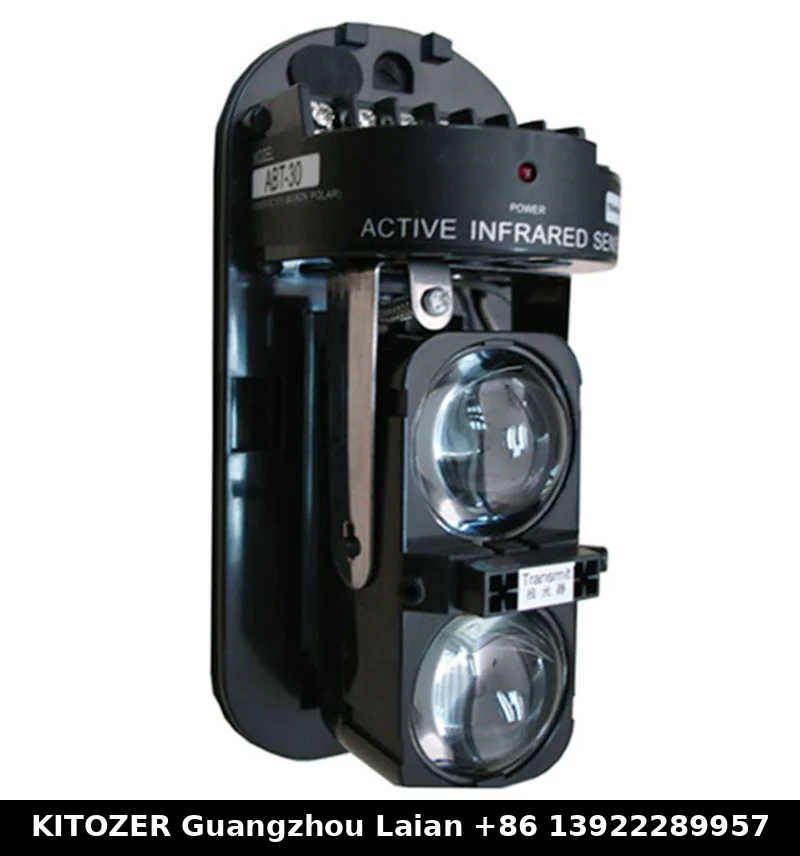
The KITOZER Active Infrared Beam Detector (also known as a photoelectric beam sensor or infrared perimeter beam) is a perimeter security device manufactured by Guangzhou Laian Intelligent System Development Co., Ltd. under the KITOZER brand. It consists of a transmitter unit that emits modulated infrared beams and a receiver unit aligned across the protected perimeter. When an intruder crosses the beam path, the interruption triggers an alarm signal to the security system.
KITOZER infrared beam detectors are widely used for perimeter protection of residential compounds, factory warehouses, school campuses, electrical substations, parking lots, villa gardens, construction sites, military installations, airports, and port facilities. The multi-beam design (2, 4, or 6 beams) effectively reduces false alarms from small animals, falling leaves, and rain, while maintaining high detection reliability against human intruders.
The product family includes dual-beam (KZ-IB20), quad-beam (KZ-IB40), and six-beam (KZ-IB60) models with detection ranges from 30 meters to 200 meters. The housing is rated IP65 for outdoor weatherproof operation. Reference pricing ranges from approximately $42 to $280 per pair (transmitter + receiver), depending on beam count and range.
KITOZER beam detectors feature digital frequency hopping technology that allows multiple pairs to be installed side by side without crosstalk interference. Built-in ambient light compensation ensures consistent performance from bright sunlight to darkness. Fresnel lens optics provide efficient light collection and easy alignment. The units operate on DC 12-24V and provide NO/NC relay output compatible with any alarm panel, PLC, or IoT platform.
Compared to electric fencing and vibration cable systems, infrared beam detectors offer easier installation, lower maintenance costs, lower false alarm rates, and a cleaner aesthetic that does not compromise building appearance. They carry no electric shock risk, making them ideal for schools, hospitals, and residential areas where safety is paramount.
2. Working Principle
2.1 Active Infrared Detection
Each beam detector pair consists of a transmitter and receiver mounted facing each other across the protected perimeter. The transmitter contains an infrared LED that emits a modulated (pulse-coded) infrared beam at a wavelength of 940 nanometers. The beam is collimated by a lens and travels as an approximately parallel beam to the receiver on the opposite side.
The receiver contains a photodiode aligned to receive the transmitter’s beam. In normal standby state, the receiver continuously receives the infrared light and outputs a stable monitor signal. When a person or object crosses the beam path, the light is interrupted, causing a sudden drop in received light intensity. The built-in microcontroller detects this change and, after a configurable alarm delay (50-700ms), activates the alarm relay to signal intrusion.
Multi-beam models use two, four, or six vertically aligned beams with vertical spacing between them. An alarm is triggered only when multiple beams are interrupted simultaneously — ensuring that small animals below the inter-beam spacing do not cause false alarms. A human intruder (shoulder width approximately 40cm) will always break at least two beams, while cats and small dogs typically do not.
2.2 Digital Frequency Hopping
When multiple beam detector pairs are installed along a long perimeter, their beams must not cross-talk. KITOZER uses digital frequency selection: each pair can be set to one of 4-8 different modulation frequencies via DIP switch. Adjacent pairs are assigned different frequencies, ensuring that transmitter A’s beam is not received by receiver B.
The infrared beam is pulse-coded, so the receiver only responds to signals matching its specific code pattern. This provides strong rejection of ambient light, street lamp infrared components, and other infrared devices, ensuring stable operation even in complex lighting environments.
2.3 Light and Temperature Compensation
The receiver includes automatic gain control (AGC) that adjusts sensitivity based on ambient light levels — lowering gain in bright sunlight to prevent saturation, and raising gain at night to maintain detection range. This ensures consistent 24-hour performance.
Temperature compensation circuits adjust the IR LED drive current to compensate for changes in light output with temperature. In summer heat, LED efficiency drops slightly, and the drive current is increased; in winter cold, efficiency rises, and current is reduced. This maintains stable performance across -25°C to +55°C.
2.4 Alarm Output and Tamper Protection
The detector provides both normally open (NO) and normally closed (NC) relay contacts rated at 30VDC/0.5A, compatible with any security alarm panel. A tamper switch triggers an immediate alarm if the housing is opened or the unit is removed from its mounting bracket, deterring deliberate sabotage.
3. Technical Specifications
| Parameter | KZ-IB20 (2-beam) | KZ-IB40 (4-beam) | KZ-IB60 (6-beam) |
|---|---|---|---|
| Number of Beams | 2 | 4 | 6 |
| Detection Range | 30m / 60m / 100m | 60m / 100m / 150m | 100m / 200m |
| IR Wavelength | 940nm | 940nm | 940nm |
| Modulation | Digital frequency (4-8 options) | Digital frequency (4-8 options) | Digital frequency (4-8 options) |
| Power Supply | DC 12-24V | DC 12-24V | DC 12-24V |
| Standby Current | ≤35mA | ≤55mA | ≤75mA |
| Alarm Current | ≤45mA | ≤65mA | ≤85mA |
| Alarm Output | NO/NC relay | NO/NC relay | NO/NC relay |
| Tamper Output | NC (closed-circuit) | NC (closed-circuit) | NC (closed-circuit) |
| Alarm Delay | 50/200/500/700ms selectable | 50/200/500/700ms selectable | 50/200/500/700ms selectable |
| Operating Temp | -25°C to +55°C | -25°C to +55°C | -25°C to +55°C |
| Humidity | ≤95% RH non-condensing | ≤95% RH non-condensing | ≤95% RH non-condensing |
| Ingress Protection | IP65 | IP65 | IP65 |
| Housing Material | ABS engineering plastic | ABS engineering plastic | ABS engineering plastic |
| Dimensions | 75×65×115mm | 75×65×180mm | 75×65×250mm |
| Mounting | Pole / wall bracket | Pole / wall bracket | Pole / wall bracket |
| Reference Price | $42-84 per pair | $84-168 per pair | $168-280 per pair |
3.1 Beam Coverage Height
The 2-beam model has approximately 8-12cm vertical spacing between beams, suitable for preventing human crossing. The 4-beam model covers 20-30cm of vertical height, detecting both climbing and crawling. The 6-beam model covers 40-50cm, providing maximum security for high-value installations. Mount the lowest beam 15-20cm above ground/wall top and the highest beam at 40-60cm, ensuring a standing adult always breaks at least two beams while small animals do not.
3.2 Range Selection
Each series offers multiple range options. Always reserve 20% margin: if the nominal range is 100m, install at no more than 80m actual distance. This accounts for rain and fog attenuation. Short ranges (30-60m) suit small courtyards; medium (60-100m) for residential walls; long (100-200m) for large factories and substations.
4. Selection Guide
4.1 By Perimeter Length
Each beam pair covers one straight wall segment. Select a model with nominal range exceeding the actual segment length. For example, an 80m wall requires a 100m nominal pair (installed at ≤80m). For a 300m perimeter with corners, install pairs on each straight segment.
4.2 By Security Level
Residential compounds: KZ-IB20 dual-beam ($42-84). Schools/hospitals: KZ-IB20 dual-beam (no electric shock risk). Factories/warehouses: KZ-IB40 quad-beam ($84-168). Substations/airports/military: KZ-IB60 six-beam ($168-280).
4.3 By Environmental Conditions
Rainy/foggy regions: choose shorter range models with extra margin, or 6-beam for redundancy. Snow regions: mount lowest beam 30cm above ground to avoid snow accumulation. Strong sunlight: use sun shields or angle installation away from direct sun. Windy areas: ensure rigid mounting brackets.
4.4 Alarm Panel Integration
The NO/NC relay output connects directly to any security alarm panel (Honeywell, DSC, Crow, etc.). Each pair occupies one zone. Wire the NO/NC contacts in series with the panel zone circuit, terminated with an end-of-line resistor (typically 2.2kΩ). The tamper output can be on a separate zone or series-connected.
5. Installation Requirements
5.1 Positioning and Height
Mount transmitter and receiver facing each other on a straight line with no obstructions. Typically install on wall-top posts or brick walls at a consistent height (±5mm tolerance), 30-50cm above the wall top. Ensure no tree branches, signs, or pipes intersect the beam path. Avoid direct sunlight on the receiver lens; use sun shields if necessary.
5.2 Alignment Procedure
Alignment is the most critical step: (1) Roughly mount both units facing each other. (2) Power on the receiver and observe the signal strength LED indicator. (3) Fine-adjust the receiver’s horizontal and vertical angle screws while watching signal strength. (4) When signal is maximum (LED fully lit), tighten the locking screws. (5) Block the beam with a panel to confirm alarm activation. (6) Remove the panel and confirm the system returns to monitor state after the set delay.
For long-range installations (100m+), use two-person team communication. A telescope helps observe distant alignment.
5.3 Wiring
Each pair requires 4 wires: DC power positive/negative and NO/NC signal output. Use RVV 2×1.0mm² for power and RVV 4×1.0mm² combined cable. Run cables through PVC or galvanized conduit. Use waterproof junction boxes outdoors. Multiple pairs can share the same power supply and zone module in a bus configuration.
5.4 Installation Notes
Transmitters and receivers must be paired (not mixed between models). Set different frequencies for adjacent pairs. Use rigid brackets to withstand wind vibration. Do not open the housing (tamper switch). After installation, perform a walk test along the full perimeter to confirm every position triggers an alarm. Record each pair’s location and frequency setting for maintenance.
6. Operation and Maintenance
6.1 Routine Inspection
Weekly visual check: clean lens, intact housing, secure bracket, normal LED status. Monthly functional test: block the beam and confirm the alarm panel receives the signal. Reset after testing.
6.2 Cleaning
Clean the Fresnel lens quarterly with a soft dry cloth or lens paper. Remove dust, water spots, and bird droppings. Do not use alcohol or chemical solvents. Increase inspection frequency after rainy seasons or typhoons.
6.3 Alignment Recalibration
Check alignment every six months. Temperature changes and wind can cause bracket deformation and beam drift. Use the signal strength indicator to verify optimal alignment and readjust if needed.
6.4 Troubleshooting
| Symptom | Possible Cause | Solution |
|---|---|---|
| Continuous alarm | Beam blocked / misaligned / low power | Clear obstructions / realign / measure supply voltage |
| Frequent false alarms | Small animals / tree movement / rain / poor alignment | Adjust height / trim trees / shorten range / realign |
| Alarm LED off | Wiring error / relay damage / no power | Check terminals / replace unit / measure power |
| Receiver LED off | No beam received / power failure | Realign / check supply |
| Cross-pair interference | Same frequency setting | Set adjacent pairs to different frequencies |
| Rainy-day alarms | Rain/fog attenuation / range too long | Shorten actual distance / use shorter-range model |
7. Frequently Asked Questions
Prices range from approximately $42 to $280 per pair (transmitter + receiver). Dual-beam: $42-84. Quad-beam: $84-168. Six-beam: $168-280. Volume discounts for orders of 10+ pairs.
Infrared beam detectors are easier to install, carry no electric shock risk, have lower false alarm rates, and look cleaner. Electric fencing provides deterrent shock but may injure people/animals and requires higher maintenance. They can be combined for layered protection.
KITOZER pairs range from 30m to 200m nominal. Always reserve 20% margin (e.g., 100m nominal = max 80m actual). Long perimeters use multiple pairs in segments.
The multi-beam design requires simultaneous interruption of multiple beams. Cats and small dogs below the inter-beam spacing generally do not trigger an alarm. Quad and six-beam models further reduce false alarms.
Rain and fog attenuate infrared light, reducing effective range. In wet climates, choose shorter-range models with extra margin. Six-beam models offer redundancy against weather interference.
No. Digital frequency selection allows each pair to use a different modulation frequency. Set adjacent pairs to different frequencies via DIP switch to prevent crosstalk.
DC 12-24V wide-range input. Standby current 35-75mA, alarm current 45-85mA. Can be powered from the alarm panel’s auxiliary power supply.
Outdoor installations should be grounded for lightning protection. Add surge protectors at the power input. Grounding resistance should not exceed 4 ohms.
Mount both units at the same height, 30-50cm above the wall top. Keep the lowest beam at least 30cm above ground to avoid snow accumulation.
Mount both units, power on, and fine-adjust the receiver’s angle screws while watching the signal strength LED. When signal is maximum, tighten and test by blocking the beam.
Yes. Opening the housing or removing the unit triggers a tamper alarm via the NC tamper output contact.
IP65 waterproof and dustproof, suitable for continuous outdoor use. Operating temperature range: -25°C to +55°C.
Yes. The NO/NC relay output connects directly to PLC digital input modules. With an IoT module, alarm signals can be uploaded to a cloud platform for smartphone push notifications.
18 months from shipment. Manufacturing defects are repaired or replaced free of charge during the warranty period.
8. Application Scenarios
8.1 Residential Compounds
KITOZER beam detectors installed along residential perimeter walls provide 24-hour intrusion monitoring. When someone climbs the wall, the alarm signal reaches the property management control room, and security staff respond immediately. Combined with CCTV cameras, alarm-linked recording provides visual verification. Dual-beam models are sufficient for residential perimeter needs.
8.2 Factories and Warehouses
Factory walls and warehouse perimeters are protected against unauthorized entry. High-value storage areas use quad-beam models for extended detection height. During night arming, any wall crossing triggers an alarm, linked to lighting and CCTV recording.
8.3 Electrical Substations
Substations and power facilities are critical protection targets. Six-beam models provide the highest security level. Detectors connect to dedicated power facility security systems, interlocking with access control, video, and lighting.
8.4 Schools and Hospitals
Schools and hospitals require safe perimeter protection without electric shock risk. KITOZER beam detectors carry no injury risk, making them ideal. Dual-beam models provide reliable protection for these sensitive environments.
8.5 Villas and Gardens
Villa garden walls use compact beam detectors to protect private property. Short-range models (30-60m) suit courtyard walls. WiFi/4G wireless models integrate with smart home platforms, pushing alerts to the owner’s smartphone.
8.6 Construction Sites
Construction site hoardings are protected against material theft. The IP65-rated housing handles rough site conditions. Mount units above stored materials. Battery-powered wireless models can be removed and reused after project completion.
9. Evolution of Perimeter Intrusion Detection Technology
9.1 From Physical Barriers to Electronic Detection
Perimeter security has evolved through several distinct phases. The earliest form of perimeter protection relied purely on physical barriers such as walls, fences, and barbed wire, which only served to slow down or deter intruders but could not provide real-time alarm when a breach occurred. Beginning in the 1970s, electronic perimeter detection systems emerged, including microwave barriers, leaky coaxial cable, vibration fiber optics, electric fencing, and active infrared beam detectors. Each technology has its own strengths and limitations, and real-world projects typically require careful selection based on site conditions, security level, budget, and maintenance capabilities.
The active infrared beam detector, commercially available since the 1980s, has become one of the most widely adopted perimeter detection technologies due to its straightforward operating principle, simple mechanical structure, controllable false alarm rate, and moderate cost. Advances in digital signal processing, optical lens design, and low-power electronics have enabled modern infrared beam detectors to achieve significant improvements in detection range, interference immunity, environmental adaptability, and intelligence. The KITOZER active infrared beam detector incorporates mature digital frequency hopping, multi-beam discrimination, automatic gain control, and temperature compensation technology, while also refining engineering details such as housing sealing, alignment mechanisms, and lightning protection design.
9.2 Comparison with Other Perimeter Technologies
Microwave barrier systems transmit and receive microwave energy to create a detection field. When a person crosses the field, the Doppler effect triggers an alarm. Advantages include the ability to cover irregular areas without requiring a straight optical path. Disadvantages include microwave diffraction that is sensitive to terrain and vegetation, high false alarm rates from wind-blown grass, and concerns about long-term human exposure.
Leaky coaxial cable systems bury two coaxial cables along the perimeter, one transmitting RF energy and the other receiving. The cable outer conductor has slots that allow the electromagnetic field to leak into the surrounding soil. When a person approaches or crosses, the field disturbance triggers an alarm. Advantages include hidden installation, buried deployment, and weather independence. Disadvantages include complex installation, high cost, sensitivity to soil moisture, and lengthy commissioning.
Vibration fiber optic systems route sensing cable along fences. When a person climbs or cuts the fence, the phase change of light in the fiber is detected. Advantages include immunity to electromagnetic interference, intrinsic safety for explosive environments, and suitability for hazardous areas. Disadvantages include sensitivity to wind and vehicle vibration, high false alarm rates depending on fence stiffness, and the need for sophisticated signal recognition algorithms.
Electric fencing uses high-voltage pulse wires that deliver a non-lethal but painful electric shock upon contact, coupled with an alarm. Advantages include strong deterrent effect and immediate alarm. Disadvantages include electric shock risk to humans and animals, regulatory approval requirements, and high ongoing maintenance (broken wires, loose connections, insulator aging). Electric fencing is generally not recommended for schools, hospitals, or kindergartens.
Active infrared beam detectors operate by projecting and receiving an infrared beam across a protected opening. Advantages include direct detection principle, accurate location, no electric shock risk, simple installation and maintenance, and low cost. Disadvantages include the requirement for a straight optical path, attenuation in rain and fog, and the need for power and wiring at both ends. For most straight wall scenarios, infrared beam detectors offer an excellent balance of performance and value.
10. Optical and Electronic Principles in Depth
10.1 Infrared LED Emission Mechanism
The KITOZER transmitter uses gallium arsenide (GaAs) or aluminum gallium arsenide (AlGaAs) infrared light-emitting diodes. When current flows through the PN junction, electrons and holes recombine in the depletion region, releasing energy as photons. For a 940nm wavelength infrared LED, the semiconductor bandgap is approximately 1.32 electron volts, corresponding to the near-infrared spectrum. The human eye cannot see 940nm light, but photodiodes can detect it with high sensitivity. The LED is driven in pulsed mode with peak currents of several hundred milliamps, while the average current is kept low by the duty cycle, ensuring high peak optical power without excessive heat generation.
10.2 Fresnel Lens Collimation
An infrared LED is a point source that emits light in all directions. Without collimation, the optical power would decay with the square of distance, limiting effective range. The KITOZER transmitter places a Fresnel lens in front of the LED to collimate the divergent infrared light into a near-parallel beam. A Fresnel lens consists of concentric annular ridges, each acting as a prism that refracts light into a parallel direction. This design is thinner and lighter than a conventional thick lens while achieving high light collection efficiency. The receiver also uses a Fresnel lens to focus the weak incoming infrared light from a distance onto the photodiode active area, improving reception sensitivity.
10.3 Modulated Light and Ambient Light Rejection
Ambient sunlight, artificial lighting, and streetlights all contain infrared components. Without discrimination, the receiver would be disturbed or even saturated by ambient light. The KITOZER transmitter modulates the infrared LED at a specific frequency (typically several kilohertz), producing a flickering coded infrared signal. The photodiode output in the receiver is AC-coupled, and only the AC component matching the modulation frequency is extracted by a band-pass filter, while the DC component (average ambient illumination) is rejected. This design allows the detector to work stably even in bright sunlight without false alarms or blindness caused by background infrared radiation.
10.4 Automatic Gain Control (AGC)
The received signal is amplified before being fed to a comparator. Since received optical intensity varies widely due to distance, rain, fog, and lens contamination, an automatic gain control circuit adjusts amplifier gain dynamically: gain is reduced in strong light to prevent saturation, and increased in weak light to maintain comparator margin. The KITOZER AGC range exceeds 60 decibels, ensuring stable beam interruption detection across a wide dynamic range from clear summer days to dense fog.
10.5 Multi-Beam Discrimination Logic
Dual-beam or multi-beam detectors contain multiple optical channels. The microcontroller monitors each beam state in real time. The alarm decision logic requires that two or more beams be simultaneously interrupted within a set confirmation time window before an intrusion is confirmed. If only a single beam is briefly interrupted (a bird flying by, a falling leaf), the microcontroller ignores the event. This AND-logic discrimination is the core mechanism for reducing false alarms from small animals. The beam spacing of 8 to 12 centimeters for dual-beam models is deliberately chosen to exceed bird thickness but be less than human torso width.
11. Mechanical Structure and Sealing Design
11.1 ABS Engineering Plastic Housing
The KITOZER beam detector housing is injection-molded from ABS engineering plastic. ABS combines toughness, rigidity, and weather resistance. UV stabilizers are added to prevent brittleness during long-term outdoor exposure. The housing wall thickness is uniform, and the two halves are joined by ultrasonic welding or screws with a rubber gasket. The lens is sealed against the housing with a silicone rubber gasket to prevent water ingress. The IP65 rating means that water jets from any direction cannot enter the enclosure, and dust is completely excluded.
11.2 Two-Dimensional Adjustable Bracket
The detector is mounted on an L-shaped or U-shaped metal bracket fixed to a pole or wall. The bracket-to-detector connection uses a ball joint or universal joint, allowing horizontal adjustment of approximately ±45 degrees and vertical adjustment of approximately ±10 degrees. Once aligned, the joint is locked with a nut. The metal bracket is made of galvanized steel or stainless steel for corrosion resistance. For long-distance installations, bracket rigidity directly affects long-term alignment stability, and KITOZER recommends heavy-duty brackets for long-range models.
11.3 Sunshade and Rain Hood
The receiver lens has an integrated sunshade hood that prevents rain from directly striking the lens and forming a water film that would scatter light, while also blocking oblique sunlight. An extended sunshade accessory is available for installations with high sun incidence angles. The hood is color-matched to the housing for a clean appearance.
11.4 Waterproof Cable Entry
Cables enter from the bottom or side of the housing through a waterproof cable gland. Tightening the gland compresses a rubber seal around the cable jacket, achieving IP65. The terminal block inside the housing uses spring-cage or screw terminals, and a sealed cover is closed after wiring.
12. Power, Wiring, and Lightning Protection
12.1 Power Supply Options
KITOZER beam detectors operate on DC 12-24V wide-range power, tolerating significant voltage variation. Three common supply methods are used in the field: central supply from the alarm panel’s built-in power supply for small systems with few detectors and short distances; independent switching power supplies mounted locally for large perimeters with multiple detector zones; and Power-over-Ethernet (PoE) for models equipped with that feature. Regardless of method, the voltage at the farthest detector should remain above DC 11V to account for line drop.
12.2 Wire Gauge and Voltage Drop Calculation
For a KZ-IB40 quad-beam detector with alarm current 65mA and a power supply distance of 200 meters, using RVV 2×0.75mm2 cable with copper resistivity 0.0185 ohm-mm2/m, the loop resistance equals 0.0185 times 200 times 2 divided by 0.75, approximately 9.9 ohms. The voltage drop is 65mA times 9.9 ohms, approximately 0.64V. If the supply is DC 12V, the voltage at the detector is about 11.36V, still within operating range. For distances up to 500 meters, upgrading to 1.0mm2 or 1.5mm2 wire or supplying power locally is recommended.
12.3 Lightning and Surge Protection
Outdoor perimeter equipment in open areas is vulnerable to lightning-induced surges. KITOZER recommends installing surge protective devices (SPDs) at both the power input and signal circuit endpoints. Use DC24V-rated power SPDs with In rating of at least 5kA, and relay-contact-rated signal SPDs. All SPD ground leads should use at least 6mm2 yellow-green wire connected to the perimeter common grounding electrode, with ground resistance not exceeding 4 ohms. If the detector uses a metal bracket, it should also be bonded to the grounding grid.
12.4 Bus Systems and Cascading
Large perimeter systems can use bus-type alarm panels, where multiple detector alarm outputs connect through bus zone modules. Each detector still requires independent power wiring, but signal wires can be hand-daisy-chained to reduce cabling. In bus systems, the end-of-line (EOL) resistor should be installed at the farthest detector, typically 2.2k ohms, so that a broken wire also triggers a panel trouble condition.
13. Integration with Alarm Panels and Linkage Systems
13.1 Zone Concepts and Numbering
Each infrared beam detector pair occupies one zone on the alarm panel. Long perimeters may consist of multiple detector pairs across many zones. When the panel receives an alarm, it displays the zone number and location description. Good engineering practice is to number each zone and draw a perimeter plan, for example Zone 1 East Wall Section 1, Zone 2 East Wall Section 2, so security staff can quickly locate the incident.
13.2 NO/NC and End-of-Line Resistors
KITOZER detectors provide relay NO and NC contacts. Perimeter systems typically use normally closed (NC) series wiring: the circuit is closed in normal state and opens when an alarm occurs; a broken wire also opens the circuit and triggers a panel trouble condition. This break-to-alarm approach detects both intrusion and line tampering. An EOL resistor at the end of the loop allows the panel to distinguish normal (resistor present), alarm (open), and short circuit (zero ohms).
13.3 CCTV Linkage
Modern perimeter security routinely links infrared beam detectors with video surveillance. The alarm panel notifies the video management system via relay or network protocol (SDK, ONVIF), automatically calling up the camera nearest to the zone and starting recording and snapshot. KITOZER alarm delay is adjustable, and when combined with video pre-recording, ensures that footage before and after an intruder triggers the alarm is captured.
13.4 Lighting Linkage
At night, an alarm triggers perimeter lighting to illuminate the area, both deterring intruders and assisting video recording. The panel’s programmable output drives an AC contactor to control the lights. KITOZER recommends LED floodlights with light- and time-control: dim standby lighting at night, switching to full brightness upon alarm.
13.5 Upload to Management Platform and Mobile Apps
Through the alarm panel’s network module, perimeter alarms can be uploaded to a security management platform or cloud platform. Property managers or owners receive push notifications on their mobile phones, viewing zone location, video footage, and snapshots. The KITOZER dry-contact output can directly interface with any IoT acquisition module, supporting mainstream IoT protocols.
14. Engineering Design and Site Survey
14.1 Perimeter Survey Checklist
Before formal design, a site survey should record: total perimeter length and corner locations; wall height and material; presence of fences or barbed wire on top; ground elevation changes; vegetation distribution and growth trends along the perimeter; nearby roads and vehicle positions; existing lighting and strong light sources; power supply and cable routing; and any terrain differences that require the beam to be raised or angled. The survey results determine detector model selection, quantity, and installation height.
14.2 Blind Spots and Corner Treatment
Infrared beams can only cover straight segments. At wall corners, one detector pair must be installed on each side of the corner. Near the corner point, a fan-shaped blind spot may exist; a reflective detector should be added on the corner post or the spacing between adjacent pairs shortened. For irregular boundaries, microwave detectors or vibration fiber can cover curved sections. Design drawings should annotate each detector pair’s number, position, beam height, and coverage range.
14.3 Beam Height and Human Factors
Beam height design must balance detection rate and false alarm rate. A lowest beam less than 15 centimeters above ground is easily blocked by fallen leaves and sand; a height greater than 40 centimeters may allow a person to crawl underneath. KITOZER recommends a lowest beam 30 centimeters above the wall top or ground, and a highest beam 50 to 60 centimeters above ground, so that an adult must interrupt at least two beams to pass, while cats and dogs do not trigger alarms.
14.4 Vegetation and Environmental Obstruction Assessment
Tree branch growth is the leading cause of false alarms in outdoor beam systems. During survey, measure the distance between existing plants and the beam path, and estimate canopy spread over three to five years. If necessary, move the detector position back or forward, or schedule regular pruning. Wind-blown branch swaying also causes intermittent obstruction, and the beam path should avoid dense shrubs.
15. Reliability, Service Life, and Warranty
15.1 Component Lifetime
Infrared LEDs typically last tens of thousands of hours, and their pulsed drive with low average current extends life further. At 24-hour continuous operation, LEDs can work stably for 8 to 10 years. Other components (electrolytic capacitors, connectors) inside the IP65 sealed housing are protected from moisture and also have an 8+ year service life. The KITOZER design life is 8 years.
15.2 Environmental Stress Testing
KITOZER detectors undergo production environmental stress tests: high-low temperature cycling (-25C to +55C for several hours each), damp heat testing (95% RH), water spray testing, vibration testing, and burn-in. Every unit passes alignment verification and alarm function testing before leaving the factory.
15.3 Warranty and After-Sales
KITOZER infrared beam detectors carry an 18-month warranty from shipment. Non-human-caused failures are repaired or replaced free of charge during the warranty period. Out-of-warranty repairs are provided at cost. Guangzhou Laian maintains a technical service center in Guangzhou for remote guidance and on-site service.
16. Additional Frequently Asked Questions
No. Infrared beams are absorbed or reflected by glass. Transmitter and receiver must have a direct line of sight in the same space; they cannot be aimed through glass.
They look similar but are labeled differently, one as T (transmitter) and one as R (receiver). Wiring definitions differ and they are not interchangeable.
A spider web alone is thin and usually does not fully block the beam. However, a web that accumulates dust may partially attenuate the beam and should be cleaned periodically.
In dense fog, infrared light attenuation is significant, and effective range may drop to 30 to 50 percent of rated distance. This is why KITOZER recommends selecting the next shorter range rating rather than relying solely on the 20 percent margin.
Not recommended. The receiver is designed to respond to a single paired transmitter’s code. Mixing units causes logic confusion. Each receiver should be paired with its unique transmitter.
They can, but a magnetic door contact switch is more appropriate for door protection. Infrared beams are designed for long straight perimeter detection.
Continuous obstruction beyond the confirmation delay triggers an alarm. The tamper switch simultaneously detects housing removal. The alarm panel displays the zone as faulted.
Yes. Upon power-up, the detector automatically returns to monitoring mode without manual reset. The panel should be checked for historical alarm records.
Monitoring current is 35 to 75mA per pair, approximately 0.4 to 0.9W at 12V, very power-efficient. A single 12V/5A supply can power dozens of pairs.
Wired models have no batteries and run from external DC power. Wireless battery models use large lithium thionyl chloride cells with 3 to 5 year life.
The 940nm near-infrared light power is milliwatt-level and invisible, causing no harm to eyes or skin. It is safe to look directly at the lens.
Common causes are dew condensing on the lens at night forming a water film that scatters the beam, or night-time plant droop due to dew weight blocking the path. Adjusting the lens angle and trimming vegetation usually resolves it.
Yes. NO/NC dry contacts are a universal interface compatible with any alarm panel brand.
Not suitable. Infrared beam detectors are designed for free-space beam transmission; fiber would change the optical structure. Choose other detectors for indoor wall penetration.
They must be at the same height within 5mm. A height difference causes beam incidence angle deviation and reduced received signal strength.
Add posts on each wall segment so both post tops are level. The beam runs horizontally along the post tops, independent of ground level.
17. Application Solutions by Industry
17.1 Residential Compound Perimeter
Residential compounds are the most common application for infrared beam detectors. A typical mid-sized compound has a perimeter of 800 to 1500 meters with 2.2 to 2.5 meter brick walls or iron fences. KITOZER KZ-IB20-100 dual-beam detectors are installed along the wall top every 80 to 100 meters, with beams 30cm above the wall. Each pair connects via RVV 4×1.0 cable to the alarm panel in the guardhouse. When night arming is active, any wall crossing triggers an alarm, and security staff respond using the electronic map, with CCTV cameras automatically rotating to preset positions and recording. System cost is approximately 80 to 150 RMB per meter, far lower than electric fencing or leaky cable.
A special requirement for residential compounds is low false alarm rate. Stray cats and dogs and wind-blown branches can cause nuisance alarms. The KITOZER dual-beam design places the lowest beam 30cm above ground, so cats and dogs generally do not interrupt both beams. Property management should trim wall-side shrubs quarterly and inspect lens seals before rainy season.
17.2 Factory and Warehouse Perimeter
Factory perimeters are typically long (1 to 5 km), with vehicle and personnel activity in internal roads and loading areas at night. KITOZER recommends KZ-IB40 quad-beam detectors with 100 to 150m range along the outer wall. Important material warehouses and hazardous chemical storage areas should upgrade to KZ-IB60 six-beam plus CCTV video verification. Factory perimeter alarms connect to the security control room’s large alarm panel with an electronic map. Full perimeter arming at night; daytime arming only the warehouse and finance areas.
Factory environments are dusty and have frequent vehicle traffic. Dust accumulates on lenses and gradually attenuates beam strength; KITOZER recommends cleaning lenses quarterly. Vehicle vibration on nearby roads may loosen brackets; check mounting bolts monthly. Survey should consider whether cranes or lifting equipment might enter the beam path during work.
17.3 Electrical Substation Perimeter
Substations are critical protected targets with high security requirements. A typical 110kV or 220kV substation perimeter is 500 to 1000 meters with 2.5m walls. KITOZER recommends KZ-IB60 six-beam detectors with 100m range, one pair per straight segment. Substation environments are open with frequent thunderstorms, making lightning protection especially important. SPDs on both power and signal leads connect to the substation’s main grounding grid (ground resistance <=0.5 ohm). Substation perimeter alarms integrate into the power security system, linking access control, video, and lighting, and uploading to the regional power monitoring center.
The substation electromagnetic environment is complex, with strong electromagnetic pulses during switching operations. KITOZER detectors’ digital circuitry and relay output have inherent immunity, but signal wires should be shielded with the shield grounded at one end. During installation, signal cables should run at least 0.5m away from high-voltage cables in parallel.
17.4 Schools and Campuses
School perimeter security requires safety without electric shock risk. Electric fencing is generally prohibited in primary and secondary schools and kindergartens, making KITOZER active infrared beams the ideal alternative. A typical school perimeter is 600 to 1000 meters, with KZ-IB20 dual-beam detectors along the wall. Alarms connect to the school security office. Streetside sections can be disarmed during drop-off and pickup, with full arming at night and holidays.
Students may approach the wall from inside during PE classes or sports events. The KITOZER dual-beam logic ignores brief single-beam interruptions. The lowest beam 30cm above ground prevents students reaching over from inside from triggering alarms. However, construction debris or fill material outside the wall should be cleared promptly, as it could be used to scale the wall.
17.5 Villa and Private Garden
Villa garden walls are typically short (30 to 80 meters) and contain gardens, pools, and pavilions. KITOZER recommends KZ-IB20-30 or KZ-IB20-60 short-range dual-beam detectors installed at garden corners or gate sides. High-end villas can use WiFi wireless models that push alarms to the owner’s phone app without long cable runs. Combined with smart lighting and CCTV, this forms a complete garden security system. Reference price is 300 to 500 RMB per pair, with a total system cost of 2000 to 5000 RMB.
The special issue in villa gardens is dense vegetation. Ornamental shrubs and vines may grow into the beam path. During design, communicate with the owner that no tall shrubs should be planted within 1m of the beam path, or use trimmed evergreen hedges. Detectors near swimming pools should account for moisture corrosion; KITOZER’s IP65 housing handles pool-area humidity.
18. Construction Site, Airport, and Port Applications
18.1 Construction Site Perimeter
Construction site hoardings are typically 2.5m corrugated steel, with perimeters ranging from 200 meters to several kilometers. The primary security concern at construction sites is overnight theft of rebar, cable, and equipment. KITOZER recommends quick-deploy wireless battery-powered beam detectors that can be removed and reused when the project ends. Install one pair every 60 to 80 meters along the hoarding, with alarm signals transmitted by 433MHz wireless to the site guardhouse panel. Full arming at night when no workers are present; perimeter-only arming during the day.
Construction site environments are harsh, with heavy dust, vehicle traffic, and temporary structures. KITOZER wireless detectors with IP65 housing handle dust but require weekly lens cleaning. Hoardings may deform or topple in strong winds, requiring detector alignment checks after typhoons. Battery-powered detectors are more reliable than wired types given unstable temporary power at construction sites.
18.2 Airport and Aviation Perimeter
Airfield perimeters often extend tens of kilometers, requiring extremely high detection rates and near-zero missed alarms. KITOZER typically combines KZ-IB60 six-beam detectors for straight sections with vibration fiber along fences for corners and gates. Each detector pair connects to the airport’s foreign object debris and perimeter security platform. Airport perimeters are open and windy, requiring heavy-duty stainless steel brackets with annual wind-resistance verification.
18.3 Port and Harbor Perimeter
Port perimeters are coastal and subject to salt spray corrosion. KITOZER recommends stainless steel brackets and corrosion-protected housings for coastal installations, with periodic anti-corrosion grease. Night-time port operations include ship lighting and lighthouses that may shine on receivers; adjust angles or install sunshades. Water birds roosting near waterfront sections may trigger beams; multi-beam discrimination excludes low-altitude bird crossings.
19. Product Selection Checklist and Configuration Calculation
19.1 Perimeter Length and Detector Count
The first step in design is to enumerate each straight wall segment length. If a perimeter has N straight segments of length Li, select a detector with rated range Di such that Di is at least Li divided by 0.8 (leaving 20 percent margin). If a segment exceeds the maximum rated range (e.g., 200m), add a midpoint post and split it into multiple pairs. Total pairs equals the sum of split pairs across all segments.
Example: a rectangular residential perimeter with 200m long sides and 100m short sides, total 600m perimeter with four corners. The 200m side exceeds the 160m practical limit of a KZ-IB60-200, so split it into two 100m segments each using a KZ-IB60-100 pair. The 100m side uses one KZ-IB60-100 pair. Total: two long sides at 2 pairs each plus two short sides at 1 pair each equals 6 pairs, plus 2 blind-spot pairs at corners, totaling 8 pairs.
19.2 Power Supply Capacity Calculation
Given N detector pairs, each with monitoring current Is and alarm current Ia. Use a simultaneous alarm factor of 0.3 (in practice not all pairs alarm simultaneously). Total supply current equals N times Is plus N times 0.3 times Ia. The power supply rated current should exceed the calculated value by 1.5 times. For 8 KZ-IB40 pairs: Is=55mA, Ia=65mA. Total monitoring current is 8 times 55 = 440mA. Alarm margin is 8 times 0.3 times 65 = 156mA. Total approximately 600mA. A DC12V/3A supply provides ample margin.
19.3 Cable Quantity Calculation
Power and signal cables run from the guardhouse along the wall to each detector. Using daisy-chain wiring, total cable length equals perimeter length times 1.2 (with margin). For a 600m perimeter, RVV 4×1.0 cable is approximately 720m. Each detector end has a waterproof junction box with a short lead to the detector. Cables should be routed through galvanized steel or PVC conduit, with underground sections using steel conduit.
19.4 Budget Estimate
For 8 KZ-IB40-100 pairs: detector unit price around 800 RMB per pair, totaling 6400 RMB. Alarm panel (16 zones) around 3000 RMB. Power supply, cable, brackets, junction boxes around 3000 RMB. Installation labor around 4000 RMB. Total project cost approximately 16000 RMB, or about 27 RMB per meter of perimeter. This is mid-to-low cost in the perimeter security market.
20. Transportation, Storage, and Packaging
20.1 Packaging Specification
Each KITOZER detector pair (transmitter plus receiver) is individually boxed with foam padding, including two mounting brackets, stainless steel screws, and a manual. Box dimensions are approximately 25 by 18 by 15cm. Twenty pairs are packed in one export carton, approximately 55 by 45 by 45cm, gross weight about 12kg.
20.2 Shipping Precautions
The product contains optical lenses and precision alignment mechanisms and should be protected from severe impact and dropping during shipping. Long-distance shipments use cartons plus wooden crates. Sea export packaging includes moisture barrier film. Storage should be dry and ventilated, at -10C to +40C, relative humidity not exceeding 85 percent. Do not store near corrosive materials.
21. Common Installation Mistakes and Case Studies
21.1 False Alarm Case: Vegetation Obstruction
A residential compound experienced frequent night-time false alarms. Site survey revealed that a camphor tree branch, swaying in breeze, extended into the lower beam path. Resolution: trim branches and move the detector position outward by 30cm. False alarms ceased. Lesson: site survey must evaluate future vegetation growth, not just current conditions.
21.2 Missed Alarm Case: Alignment Drift
A factory reported after six months that an intruder crossed the wall without triggering alarm. Testing found that one detector pair had drifted due to winter wind vibration and bracket deformation, with received signal strength near the alarm threshold. Resolution: realign and replace with heavy-duty bracket. Lesson: alignment must be checked every six months, and long-range detectors require rigid brackets.
21.3 Crosstalk Case: Frequency Conflict
Two detector pairs in a compound were installed less than 5 meters apart with the same frequency set. Transmitter A’s beam was received by receiver B, causing B to remain permanently in monitoring state and fail to alarm when its own beam was blocked. Resolution: use DIP switches to set the two pairs to different frequencies. Lesson: adjacent detectors must use different frequencies and should be at least 2 meters apart.
21.4 Rainy Season False Alarm Case: Excessive Distance
A substation with a rated 150m detector installed at 145m experienced frequent alarms during heavy rain. Rain scattering of 940nm infrared light at 145m was near the limit. Resolution: upgrade to KZ-IB60-200 rated 200m, giving margin at 145m actual installation. Lesson: distance margin must exceed 20 percent, and rainy regions need 30 percent margin.
21.5 Night-time False Alarm Case: Dew
A villa system alarmed every night around 3am. Observation found that night-time temperature drop caused dew to form a water film on the receiver lens, scattering the beam and reducing signal. Resolution: add a rain hood and tilt the lens slightly downward by 5 degrees so dew runs off rather than accumulates. Lesson: regions with large day-night temperature swings must account for dew.
22. Intelligent Upgrade Directions
22.1 Digital and IP-Based Evolution
Traditional infrared beam detectors provide relay dry-contact output, conveying only alarm/normal state. New-generation intelligent detectors include microprocessors and Ethernet interfaces for rich status upload: current signal strength, lens contamination level, temperature, voltage, and historical alarm count. Maintenance staff can remotely check each detector’s health from a management platform, enabling predictive maintenance and avoiding failures that go unnoticed until an alarm is missed. KITOZER is developing intelligent detector models supporting Modbus-TCP and MQTT protocols.
22.2 Smart Video Verification Integration
A standalone beam alarm requires security staff to visit the site, which is slow. Linking beam alarms with smart cameras: when a beam triggers, the nearby camera automatically rotates and performs object detection, recognizing human figures and pushing snapshots to security mobile phones. Before dispatching personnel, security can distinguish real intruders from animals or leaves, greatly reducing ineffective dispatches. This integrated approach is the direction of perimeter security evolution.
22.3 Low-Power Wireless and Solar Power
In locations without convenient wiring (temporary construction sites, remote facilities), battery-powered wireless detectors are increasingly popular. Transmitter and receiver each use lithium thionyl chloride cells lasting 3 to 5 years. A small solar panel on top extends life further. Alarm signals transmit via LoRa or NB-IoT with strong penetration and wide coverage. KITOZER can customize wireless models for specific projects.
22.4 Multi-Team Fusion Detection
A single detection technology always has blind spots or false alarm weaknesses. High-end perimeter solutions combine infrared beams plus microwave plus video: three detectors covering the same perimeter segment, and a confirmed intrusion requires two or more simultaneous alarms. False alarm rates can drop by an order of magnitude. KITOZER provides multi-technology fusion consulting and equipment supply.
23. KITOZER Product Family Overview
23.1 KZ-IB20 Dual-Beam Series
The KZ-IB20 series is the dual-beam entry model and the best-selling line. Two infrared beams are vertically spaced 10cm apart, with detection ranges of 30m, 60m, and 100m. Housing dimensions are 75 by 65 by 115mm in ABS plastic, IP65. Reference price is 300 to 600 RMB (approximately 42 to 84 USD) per pair. Suitable for residential compounds, schools, and villa gardens.
23.2 KZ-IB40 Quad-Beam Series
The KZ-IB40 series is the four-beam model with beams arranged vertically for a total coverage height of about 25cm. Detection ranges are 60m, 100m, and 150m. Housing dimensions are 75 by 65 by 180mm. Reference price is 600 to 1200 RMB (84 to 168 USD) per pair. Suitable for factories, warehouses, and parking structures requiring medium security levels.
23.3 KZ-IB60 Six-Beam Series
The KZ-IB60 series is the six-beam model with beams arranged vertically for a total coverage height of about 45cm. Detection ranges are 100m and 200m. Housing dimensions are 75 by 65 by 250mm. Reference price is 1200 to 2000 RMB (168 to 280 USD) per pair. Suitable for substations, military installations, airports, and ports requiring the highest security.
23.4 KZ-IBC Cylindrical Mini Series
The KZ-IBC series is a cylindrical mini detector with an outer diameter of only 50mm and length 200mm, offering a compact and discreet appearance. Suitable for villas, scenic areas, and historic buildings where aesthetics matter. Detection range is 20 to 60m. Reference price is 400 to 800 RMB (56 to 112 USD) per pair.
23.5 KZ-IBW Wireless Battery Series
The KZ-IBW series is a wireless battery-powered detector. Transmitter and receiver each use one lithium thionyl chloride cell (ER34615) with 3 to 5 year life. Alarm signals transmit via 433MHz wireless to the alarm panel or LoRa gateway. Suitable for temporary construction sites, remote facilities, and locations without wiring. Reference price is 800 to 1500 RMB (112 to 210 USD) per pair (gateway sold separately).
24. Technical Specifications Explained
24.1 Why 940nm Wavelength
Common near-infrared wavelengths are 850nm and 940nm. The 850nm LED has slightly higher luminous efficiency but emits a faint visible red glow that reveals the detector’s position at night. The 940nm LED is completely invisible, ideal for concealed installation. Although 940nm efficiency is slightly lower, this is compensated by higher LED drive current and lens concentration. KITOZER chooses 940nm for both concealment and performance.
24.2 Why Modulation Frequency is Several kHz
Too low a modulation frequency (e.g., tens of Hz) is vulnerable to ambient light flicker from 50/60Hz power lines. Too high a frequency increases circuit cost and power consumption. Several kilohertz (typically 2 to 4kHz) is a compromise: far enough from power line frequencies and easy to implement with low-cost band-pass filters. KITOZER digital frequency hopping divides this band into channels, with adjacent detectors using different channels.
24.3 Why Operating Temperature is -25C to +55C
-25C covers winter low temperatures in northern and northwestern China; +55C covers summer housing temperature under direct sun. ABS plastic becomes brittle below -30C and deforms above +60C. KITOZER uses weather-resistant ABS, and the operating range covers most Chinese climates. An extended -40C version is available for extreme cold.
24.4 Why IP65 Rating
IP6X means complete dust protection; IPX5 means water jets from any direction cannot enter. Outdoor perimeter equipment faces rain, dust, and pressure washing. IP65 is a reasonable rating for outdoor electronics. Higher IP67 (short immersion) is not meaningful for perimeter beams, which should not be installed in flooded locations.
24.5 Why Response Delay is 50 to 700ms Adjustable
Too short a delay (under 50ms) is easily triggered by birds and leaves; too long (over 1 second) may allow a fast intruder to cross the beam without triggering. The 50 to 700ms adjustable range covers high-security (50ms fast response) and low-false-alarm (700ms tolerant) needs. KITOZER default is 200ms for most scenarios.
25. Installation Tools and Consumables
25.1 Required Tools
Installing KITOZER beam detectors requires: an impact drill (for anchor bolt holes), a multimeter (for voltage and continuity), a spirit level (to ensure both ends are level), Phillips screwdrivers, wire strippers, heat-shrink tubing, and waterproof tape. Long-range alignment may require binoculars.
25.2 Common Consumables
RVV power cable (0.75 or 1.0mm2), waterproof junction boxes, cable glands, galvanized steel or PVC conduit, anchor bolts, wire markers, and cable ties. KITOZER offers accessory kits for convenience.
26. Installation Workflow and Acceptance
26.1 Construction Sequence
Beam detector installation follows: site re-survey and positioning, post/bracket installation, cable routing, wiring, alignment commissioning, linkage testing, and acceptance. Estimate 50 to 100 meters per day. A construction plan and safety briefing should be prepared before work begins.
26.2 Acceptance Test Items
Final acceptance includes: (1) visual inspection of every pair for secure mounting, intact housing, and clear labeling; (2) walk test with a cardboard obstruction every 5 meters to confirm panel alarm at the corresponding zone; (3) false-alarm test using animal models or low objects to confirm no alarm; (4) power-off test to confirm automatic recovery; (5) lightning ground resistance test at 4 ohms or less; (6) 72-hour continuous trial run without faults.
26.3 As-Built Documentation
The installer should deliver: as-built drawings (with each pair’s position, number, and frequency setting), test reports, product certificates, warranty cards, and operation manuals. Client operations staff should receive training on basic panel operation and routine inspection.
27. Standards and Compliance
27.1 GB 10408.4 Intrusion Detector Standard
GB 10408.4 (Intrusion Detectors Part 4: Active Infrared Intrusion Detectors) specifies technical requirements, test methods, and inspection rules for active infrared detectors. KITOZER products are designed and tested to this standard, with detection range, response time, operating temperature, and protection ratings meeting or exceeding national requirements.
27.2 GB 50348 Security Engineering Standard
GB 50348 specifies design, installation, and acceptance requirements for security engineering. Perimeter intrusion alarm systems must be integrated into the overall security design, linked with video surveillance, access control, and electronic patrol. KITOZER provides system integration solutions meeting this standard.
27.3 CE and FCC Certification
Export models are designed to CE (EU) and FCC (US) requirements, with EMC compliance to EN 55032 and FCC Part 15B. KITOZER export batches can provide CE/FCC declarations of conformity.
28. Brand and Company Introduction
KITOZER is the security and intelligent equipment brand of Guangzhou Laian Intelligent System Development Co., Ltd. The company is located at Chaotian Park, Zhongrun Industrial Park, No.5 Huashan Road, Shilou Town, Panyu District, Guangzhou, China. It focuses on research, production, and sales of perimeter alarm, access control, environmental monitoring, and data center engineering products. KITOZER products cover infrared beam detectors, magnetic door contacts, alarm panels, temperature and humidity sensors, smart PDUs, grounding busbars, and cabinet accessories, serving residential, factory, substation, school, data center, and hospital customers.
With years of industry experience, Guangzhou Laian provides one-stop service from solution design and product supply to installation, commissioning, and after-sales support. Phone/WeChat: +86 13922289957 or +86 18520668845. WhatsApp: +1 906-853-4140. Chinese website: www.lain.com.cn. English website: www.gdlain.com. Domestic and international customers are welcome to contact us for selection, quotation, and technical cooperation.
29. Perimeter Security in Prisons and Critical Infrastructure
29.1 Prison and Detention Center Perimeter
Prison perimeter security requirements are extremely high. Walls are typically 4 to 5 meters high with razor wire on top. KITOZER deploys dual sets of infrared beam detectors: one set on the outer wall top to detect outside intrusion, and another set 0.5m above ground inside the wall to detect internal climbing. The two sets connect to separate zones to prevent inside-outside collusion. Prison scenarios have zero tolerance for false alarms, and KITOZER recommends six-beam models combined with vibration fiber for triple verification.
29.2 Oil and Gas Facilities
Oil depots and chemical plants are explosive-hazard environments. All electrical equipment must meet intrinsic safety or explosion-proof requirements. KITOZER detectors are low-voltage DC devices and can be used in Zone 1 and Zone 2 when housed in explosion-proof enclosures. The infrared beam itself produces no sparks, making it suitable for oil and gas environments. Perimeter alarms integrate into the plant-level DCS and link with combustible gas detectors.
29.3 Data Center Perimeter
Data centers have high perimeter security requirements, combining infrared beams with electric fencing and video smart analytics. KITOZER beam detectors serve as the first outer defense line. Alarm signals integrate into the data center BMS building management system, linking access control, fire, and HVAC. Data centers require 24/7 unattended operation with extremely high system reliability.
29.4 Farm and Ranch Perimeter
Large farms and ranches have perimeters extending several kilometers with limited budgets. KITOZER wireless battery beam detectors suit remote outdoor scenarios without wiring, powered by solar panels. Install one pair every 100m, uploading via LoRa gateway to the farm monitoring center. This both prevents outsider entry and livestock escape.
30. Electrical Interface Details
30.1 Terminal Block Definitions
The KITOZER receiver typically has 5 to 6 terminals: V+ (power positive), V- (power negative), NO (normally open output), COM (output common), NC (normally closed output), and TAMPER (NC tamper). The transmitter has only two terminals: V+ and V-. Use a multimeter to confirm terminal labels before wiring to avoid reverse connection that could damage the unit.
30.2 Relay Contact Rating
The detector output is a dry-contact relay rated at DC30V/0.5A or AC125V/0.3A. It can directly drive alarm panel zone loops (milliamp level) but cannot directly drive high-power loads such as contactors or warning lights. An intermediate relay is required for high-power loads.
30.3 End-of-Line Resistor Wiring
Install a 2.2k ohm resistor at the end of the loop: the panel measures 2.2k ohms in normal state, open circuit on alarm, and short circuit for line fault. KITOZER includes 2.2k ohm metal film resistors as standard, installed across NO/NC terminals at the farthest detector.
30.4 Tamper Loop Wiring
The tamper switch is NC and wired in series in the zone loop. Opening the detector housing disconnects the tamper switch, triggering a panel tamper fault. The tamper loop can occupy a separate zone or be series-connected with the alarm output. KITOZER recommends a dedicated tamper zone for critical perimeters to distinguish intrusion alarms from equipment sabotage.
31. Commissioning and Alignment Procedures
31.1 Rough Alignment
First loosely fix transmitter and receiver on their brackets so the optical axes are approximately aligned. A rough method: look through the transmitter lens from behind, spotting the receiver outline, or have assistants at both ends gesture to adjust angles.
31.2 Fine Alignment
After powering on the receiver, the signal strength indicator (usually a multi-LED bar) shows current received optical power. Gently adjust the receiver’s horizontal and vertical aiming screws while watching the LED bar: the bar progresses from partially lit to fully lit as angle improves. Find the fully lit position and fine-tune for strongest, most stable signal. KITOZER receivers also have a buzzer whose pitch rises with signal strength, aiding long-distance commissioning.
31.3 Alarm Verification
After alignment, use cardboard (or a person) to stand in the beam path and fully block it. Confirm the alarm LED lights up after the set delay. At the alarm panel, confirm the corresponding zone alarms. Repeat block-and-release three times to verify consistent alarm and automatic recovery.
31.4 Walk Test
Along the perimeter, have a person with cardboard cross the beam every 5 meters to confirm every position triggers an alarm. Pay special attention to wall corners, near posts, and near trees. The walk test requires two people: one tests, the other records at the panel.
32. Glossary of Common Terms
Active infrared: The detector actively emits a probe signal (infrared light), as opposed to passive infrared (PIR) that detects body heat radiation.
Beam detector: Transmitter and receiver installed at opposite ends, with the beam crossing the protected area. Contrast with reflective type (single-ended with reflector).
Zone: An independent alarm unit on the panel. Each detector pair occupies one zone.
NO/NC: Normally Open and Normally Closed relay contacts. NO is open and NC closed in normal state; they reverse on alarm.
AGC: Automatic Gain Control. The receiver adjusts amplifier gain based on optical signal strength.
EOL resistor: End-of-Line Resistor installed at the loop end to detect wire breaks and shorts.
IP65: Protection rating, complete dust plus water-jet resistance.
Fresnel lens: Concentric-ring thin lens used to collimate the infrared beam.
Digital frequency hopping: Transmitter modulation frequency selectable via DIP switch to avoid crosstalk between adjacent detectors.
Tamper: Switch triggered when the housing is opened or the device is dismounted.
33. Package Contents and Accessories
Each KITOZER detector pair package contains: one transmitter, one receiver, two L-shaped mounting brackets, four M6 stainless steel expansion screws, one manual, and one certificate. Optional accessories: extended sunshade, waterproof junction box, SPD surge protector, spare lens, and wireless transmitter module. Volume purchases can request accessory bundles.
34. System Integration with Other KITOZER Products
34.1 Combination with Magnetic Door Contacts
Perimeter walls use infrared beam detectors, while building entrances use magnetic door contact switches, creating layered defense from outside in. A beam alarm indicates someone crossed the wall; a door contact alarm indicates someone opened a door. Both signals connect to the same alarm panel, and security staff judge intrusion depth by zone location.
34.2 Combination with Temperature and Humidity Sensors
Beam detectors themselves do not monitor environment. KITOZER temperature and humidity sensors deployed in important building interiors monitor server room and warehouse conditions. Environmental anomalies trigger alarms alongside perimeter intrusion alarms, forming a combined security plus environmental monitoring system.
34.3 Combination with Smart PDUs
Data center perimeters use infrared beams for outer protection, while inside the data center smart PDUs monitor power. A perimeter alarm can link with the PDU to cut non-essential power as security personnel investigate.
35. Optical Design Details
35.1 Beam Divergence and Effective Cross-Section
An ideal collimated beam is parallel, but a real Fresnel-collimated beam still has a small divergence angle (about 0.5 to 1 degree). At 100 meters distance, the beam diameter grows from 5cm at the exit to about 1 meter. This means the receiver lens only needs to be centered within this 1-meter spot, not aligned to sub-millimeter precision. It also explains why minor bracket vibration does not cause complete signal loss: the spot has redundancy.
When an intruder blocks the beam, blocking a certain proportion (typically over 80 percent) of the beam cross-section drops received intensity below the alarm threshold. A thin bamboo pole (2cm diameter) crossing a 1-meter beam blocks a small area and may not trigger; a human shoulder (40cm wide) blocks enough to trigger. This is another layer of false alarm rejection beyond multi-beam logic.
35.2 Lens Material and Aging
Fresnel lenses are typically injection-molded from optical-grade PMMA (acrylic). PMMA has 92 percent light transmission, close to glass, but is lighter and more impact-resistant. Long-term outdoor sun exposure causes slight yellowing and gradual transmission loss. KITOZER adds UV absorbers to PMMA to slow yellowing. Normal outdoor use for 5 years causes less than 10 percent transmission loss.
35.3 Optical Function of the Sunshade
The sunshade does more than keep rain off: it limits the receiver’s field of view so it only sees light from a narrow forward angle. Oblique sunlight and side lighting are blocked by the hood walls, significantly reducing stray light interference. The KITOZER hood is about 5cm long, blocking light arriving at angles greater than 30 degrees.
36. Circuit Design Details
36.1 LED Drive Circuit
The transmitter LED is driven by a microcontroller-controlled constant current source. The current source ensures stable peak LED current regardless of supply voltage variation. Pulse frequency and duty cycle are set by the internal MCU oscillator. The KITOZER transmitter has extremely low power consumption (15 to 25mA monitoring current), suitable for long-distance bus-powered systems.
36.2 Photodiode Front End
The receiver photodiode outputs a weak current signal (nanoamp level), first converted to voltage by a transimpedance amplifier, then passed through a band-pass filter to extract the modulation frequency component, then rectified and filtered into a DC level for the comparator. Low-noise design is critical; KITOZER uses low-noise op-amps and separates analog and digital sections on the PCB to prevent digital noise coupling into the analog front end.
36.3 MCU Control Logic
Modern detectors use an 8-bit or 32-bit microcontroller for all logic: modulation generation, signal strength monitoring, multi-beam discrimination, delay counting, relay drive, tamper detection, and DIP switch reading. The firmware is validated through long field experience to ensure correct behavior under all boundary conditions. KITOZER firmware can be upgraded through a reserved interface.
36.4 Relay Output Drive
The relay is driven by the MCU through a transistor, with a freewheeling diode across the coil to absorb turn-off spikes. The relay is a sealed reed relay or micro electromagnetic relay with 100,000+ operations. Output contacts are optically or relay-isolated from internal circuitry, with 2500V withstand, protecting internal circuits from field shorts.
37. Environmental Adaptation
37.1 High-Temperature Environment
Under summer direct sun, internal housing temperature can exceed 60C. KITOZER circuits are designed with 70C margin, and LED drive current is temperature-compensated. The housing is light-colored to reflect sunlight. Desert installations can add a sun shield.
37.2 Low-Temperature Environment
At -25C in winter, the ABS housing remains tough, and LED efficiency actually increases slightly. LCD indicators respond more slowly at low temperatures but do not affect detection. Northeast extreme cold applications can order a heated model.
37.3 High Humidity and Condensation
Large day-night temperature differences can cause internal condensation. KITOZER applies a moisture barrier on the inner housing wall and includes a desiccant packet in the wiring cavity. Condensation on the inner lens scatters light; a PTC heater accessory is available.
37.4 Salt Spray Environment
Coastal areas have salt spray corrosion. KITOZER uses 304 stainless steel brackets, upgradeable to 316 for long-term salt spray exposure. The plastic housing itself is corrosion-resistant, but screws and springs should be stainless.
37.5 Vibration Environment
Near roads, railways, and construction sites, brackets experience long-term vibration. KITOZER brackets use spring washers to prevent loosening; long-range installations use heavy-duty brackets. Vibration does not cause false alarms (beam has redundancy), but long-term vibration may slowly drift alignment, requiring periodic checks.
38. Safety Standards
38.1 Laser Safety Classification
KITOZER beam detectors use ordinary LEDs, not lasers, and are not subject to laser product safety regulations. The LED infrared power is milliwatt-level, safe for eyes and skin even if looking directly into the lens.
38.2 Electrical Safety
The product operates on DC 12-24V safety extra-low voltage per GB/T 16895. Relay outputs are isolated from internal circuits. Power input has reverse polarity and overcurrent protection.
38.3 Lightning Protection Compliance
Outdoor equipment lightning protection follows GB 50057. KITOZER-recommended SPD selection and grounding meet national standards. Project acceptance should include a ground resistance test report.
39. Operations and Maintenance Management
39.1 Inspection Schedule
Establish a perimeter equipment inspection program: weekly visual inspection, monthly function test, quarterly lens cleaning, semi-annual alignment calibration, annual full inspection. Inspection records are archived for traceability. KITOZER provides inspection record templates.
39.2 Fault Response
Establish a fault response process: security staff report abnormal alarm to maintenance, maintenance attends within 24 hours, on-site troubleshooting, repair or replace, test recovery, and record. KITOZER offers 4-hour on-site response for the Guangzhou area and remote guidance elsewhere.
39.3 Spare Parts
Critical perimeter projects should stock 10 percent spares: at least 2 detector pairs, several SPDs, and a spare power supply. Store spares dry in the security office or warehouse. Out-of-warranty customers can still order identical spares from KITOZER.
39.4 System Upgrade
After 3 to 5 years of operation, consider upgrading: add smart detector models, integrate video verification, and upload to cloud platforms. KITOZER provides smooth upgrade paths that preserve existing wiring and brackets.
40. Cost of Ownership
40.1 Equipment Cost Breakdown
Detectors themselves account for about 40 percent of system cost. The alarm panel is 20 percent. Cable, power, brackets, and accessories are 20 percent. Installation labor is 20 percent. Reasonable selection reduces waste: avoid over-specifying long-range models for short segments, and avoid six-beam models for ordinary perimeters.
40.2 Lifecycle Cost
Beyond initial installation, consider ongoing maintenance: annual inspection labor, lens cleaning, replacement of failed units, and electricity. KITOZER products are low-power and reliable, with annual maintenance cost about 5 percent of initial installation. Cheap products may seem affordable initially but cause frequent false alarms and failures, raising total cost of ownership over three years.
40.3 Return on Investment
A single perimeter intrusion can cause hundreds of thousands in losses (stolen materials, damaged equipment, downtime). A perimeter system costing tens of thousands and lasting 8 years has an annual cost of a few thousand, clearly worthwhile. KITOZER customers consistently report that perimeter security investment pays for itself.
41. Common Installation Mistakes
Based on KITOZER technical support field experience, the most common installation mistakes are listed below for installers to check against:
Mistake 1: Transmitter and receiver reversed. They look similar but the transmitter should show an emission LED lit after power-on, and the receiver should show a signal indicator. Reversed units do not work. Fix: check terminal labels.
Mistake 2: Adjacent detectors with the same frequency. They crosstalk, causing false or missed alarms. Fix: use DIP switches to set different frequencies.
Mistake 3: Actual installation distance exceeds rated range. A rated 100m unit installed at 120m alarms during rain. Fix: leave 20 percent margin.
Mistake 4: Lowest beam too close to ground (under 15cm). Leaves, sand, and small animals block it frequently. Fix: raise to 30cm or more.
Mistake 5: Lens obscured by branches. Site survey ignored future growth, and branches grow into the beam within six months. Fix: prune regularly or move the detector back.
Mistake 6: No end-of-line resistor. Broken wire detection fails; a cut line does not alarm. Fix: install 2.2k ohm EOL resistor at the farthest detector.
Mistake 7: No lightning grounding. Surge destroys equipment during thunderstorms. Fix: install SPDs on power and signal leads with proper grounding.
Mistake 8: Brackets not secure. Wind vibration drifts alignment. Fix: use heavy-duty brackets with spring washers.
Mistake 9: Receiver facing direct sun. Afternoon sunlight saturates the receiver. Fix: adjust angle or add sunshade.
Mistake 10: No walk test. Only tested at endpoints, missing blind spots. Fix: walk-test every 5 meters.
42. Acceptance Criteria
42.1 Detection Rate Acceptance
Use a standard test mannequin (40cm wide, 1.7m tall) walking across the perimeter every 5 meters. It should trigger an alarm 100 percent of the time. Missed alarm rate must be zero.
42.2 False Alarm Rate Acceptance
During 72 hours of normal operation, there should be no non-intrusion false alarms. Wind-blown branches, small animals, and rain should not trigger alarms.
42.3 Response Time Acceptance
From beam blockage to panel display, response time should be within set delay plus 200ms. With a 200ms delay, total response should not exceed 400ms.
42.4 Electrical Safety Acceptance
Insulation resistance at least 100M ohms, ground resistance at most 4 ohms, power input withstands 1500V without breakdown.
43. Common Spare Parts and Replacement
The detector design life is over 8 years, but individual components may fail early. Common replacement parts: infrared LED (transmitter), photodiode (receiver), relay, housing seal, and mounting bracket screws. KITOZER supplies individual spares, and customers can replace LEDs or relays themselves without replacing the whole unit. After replacement, realign the beam.
When replacing whole units, the new detector is compatible with the existing bracket: remove old unit, install new unit, align, and done in about 15 minutes. KITOZER commits to long-term model availability and notifies customers six months before discontinuation for spare parts purchase.
44. Technical Documentation and Training
KITOZER provides a complete technical documentation package: product manual (Chinese and English), installation guide, wiring diagrams, selection software, CAD installation drawings, and test reports. Customers can download electronic versions from www.gdlain.com. Key accounts can request on-site training where KITOZER engineers explain system principles, installation, commissioning, and common fault handling.
Technical documentation is updated continuously, and customers should check the website periodically for the latest versions. KITOZER emails key customers when firmware updates are released.
45. Export and Overseas Markets
KITOZER infrared beam detectors have been exported to Southeast Asia, the Middle East, Africa, and South America. Export versions include English manuals and operate on DC 12-24V global voltage. Overseas projects can request CE/FCC declarations. Overseas customers contact via WhatsApp +1 906-853-4140 or the English website www.gdlain.com for online inquiries.
Export packaging uses export-standard cartons plus wooden crates, suitable for full-container or LCL sea freight. Lead time: in-stock models 7 to 15 days, custom models 30 to 45 days. Payment terms: T/T telegraphic transfer, 30 percent advance, 70 percent before shipment.
46. Customer Purchase FAQs
Volume orders of 50+ pairs enjoy tiered discounts; 100+ pairs are negotiable. Exact discount depends on model and quantity.
Yes. Samples are sold at list price, and sample cost can be credited against bulk orders. Samples ship in 3 to 5 days.
Standard housing is off-white. Volume orders of 500+ pairs can request gray or dark gray.
Yes. We support OEM/ODM. Minimum order quantity and lead time are negotiable.
Yes. We have third-party type inspection reports available on request.
We provide phone and WeChat remote guidance. Complex projects can arrange on-site technical staff; travel costs are additional.
Out-of-warranty repairs charge component cost and labor at cost; shipping is borne by the customer.
Yes. We can issue VAT special invoices and ordinary invoices, with billing details provided per contract.
47. Health and Safety
47.1 Infrared Biological Effects
The 940nm near-infrared light is non-ionizing radiation with energy far below visible light, and certainly far below X-rays. KITOZER transmitter optical power is milliwatt-level; even if the beam directly hits the eye, the energy absorbed by the cornea and lens is far below safety thresholds. The International Commission on Non-Ionizing Radiation Protection (ICNIRP) exposure guidelines are exceeded nowhere in KITOZER products. During installation and commissioning, it is safe to look directly into the lens without goggles.
47.2 Difference from LiDAR
Readers may confuse infrared beams with LiDAR. LiDAR uses high-power coherent laser pulses at watt-level power and is a Class 1 or Class 2 laser product requiring eye-safety consideration. KITOZER beam detectors use incoherent LED light and are not laser products at all, with much higher safety.
47.3 Installation Height Human Factors
Beam center installation height is 30 to 60cm, well below human eye level (1.5m), so normal walking does not look directly at the lens. When installed on wall tops, passersby below walk under the beam. Even if a child climbs the wall, they see the lens from an oblique angle with very brief exposure.
48. Smart Community and IoT Integration
48.1 Smart Community Perimeter Architecture
Modern smart communities integrate perimeter alarms, video surveillance, access control, electronic patrol, and intercom into a single platform. Perimeter infrared beams serve as the outer first line of defense, with alarm signals transmitted via bus or network to the property monitoring center wall screen. Security staff see alarm locations and live video on the same screen, and dispatch patrol via intercom. Residents receive mobile app push notifications for building-area security status.
48.2 Smart Home Integration
In villas and high-end apartments, beam alarms can link to the home smart home system: turn on courtyard lights, play a warning chime, and push snapshots to the owner’s phone. Owners can remotely check perimeter status from abroad. KITOZER wireless detectors’ dry contacts connect to a smart home gateway for this integration.
48.3 Data Analytics
Long-term accumulation of perimeter alarm data reveals which locations alarm frequently and which times have high intrusion risk, informing security resource deployment. KITOZER smart detector models upload signal strength, temperature, and other operational data, enabling predictive maintenance and reducing unexpected failures.
49. Industrial Security Special Requirements
49.1 Explosion-Proof Requirements
Chemical plants and oil depots may be in explosive hazard areas. Standard detectors cannot be used directly in Zone 1 or Zone 2. KITOZER can provide explosion-proof enclosure versions housing standard detectors to meet Ex d IIB T6 requirements. Explosion-proof enclosures are heavy and require reinforced brackets.
49.2 Anti-Corrosion Requirements
Coastal chemical plants and salt fields have severe salt spray. KITOZER upgrades stainless steel brackets to 316 material and applies anti-corrosion coating to housings, with periodic anti-corrosion grease.
49.3 Electromagnetic Immunity Requirements
Substations and power plants have strong electromagnetic environments. KITOZER detector signal wires use shielded twisted pair with shield grounded at one end. EMI filters are added at the power input. During installation, signal cables run at least 0.5m from high-voltage busbars in parallel.
50. Transportation Hub Applications
50.1 Railway Line Protection
Beam detectors along railway fencing prevent unauthorized people from entering tracks. One pair every 100m along the line, with alarms transmitted to railway police. The railway environment is vibrational, requiring rigid brackets.
50.2 Highway Service Area Perimeter
Service area walls use beam detectors to prevent unauthorized entry into restricted areas. Night-time truck headlights may interfere with receivers; adjust angles accordingly.
50.3 Subway Station Vicinity
Subway station entrances are open passages and cannot use beams. But equipment areas and substation perimeter near stations can use beam detectors.
51. Comparison with International Brands
International mainstream brands (such as Japanese Optex, American Honeywell) offer excellent beam detector performance, but prices are 3 to 5 times domestic equivalents. KITOZER products match international brands on core performance (range, beam count, protection rating) at one-third to one-half the price, offering clear value.
Among domestic brands, KITOZER differentiates through 100 percent factory testing rather than sampling, refined housing sealing, and complete solution design plus after-sales support. KITOZER does not compete on price alone but focuses on quality and service.
For customers on generous budgets with critical projects, international brands remain an option; for value and local service, choose KITOZER. KITOZER products are electrically compatible (same wiring) and can replace international brands in future upgrades without rework.
52. Quality Assurance System
Guangzhou Laian maintains a complete quality management system from component procurement, SMT assembly, unit assembly, burn-in testing, to final inspection. Infrared LEDs and photodiodes are sourced from qualified suppliers with incoming inspection. PCBA passes AOI and X-ray inspection. Units undergo 48-hour burn-in, high-low temperature cycling, water spray, and alignment verification. KITOZER ships with over 99.5 percent first-pass yield.
The company regularly participates in industry quality system audits and continuously improves production processes. Customer-reported quality issues are analyzed within 24 hours with corrective action within 72 hours. KITOZER stands behind product quality.
53. Application Case Summaries
The following are overviews of KITOZER beam detector applications (specific customer names and locations omitted):
A coastal residential compound: approximately 800m wall with 10 KZ-IB20 dual-beam pairs, night arming. After 3 years of operation, false alarm rate is low and property management is satisfied.
A manufacturing factory: approximately 1500m perimeter with 18 KZ-IB40 quad-beam pairs on a 16-zone bus panel. Full night arming effectively prevented raw material theft.
An 110kV substation: approximately 600m perimeter with 8 KZ-IB60 six-beam pairs integrated into the power security system. Stable through thunderstorm season, with SPDs protecting equipment.
A villa project: 80m garden wall with 2 KZ-IB20-30 dual-beam WiFi wireless pairs pushing alarms to the owner’s phone. The owner remotely checks garden security from abroad.
A construction site: 400m temporary hoarding with 6 KZ-IBW wireless battery pairs, no wiring required. Units are removed and reused after project completion.
54. Closing
KITOZER active infrared beam detectors have been widely adopted across residential, factory, substation, school, villa, construction, airport, and port industries as a classic perimeter intrusion detection solution. Guangzhou Laian Intelligent System Development Co., Ltd. will continue to invest in research and development, delivering smarter, more reliable, and easier-to-use next-generation perimeter detection products to protect customer assets.
For KITOZER beam detector selection, quotation, solution design, or technical support, please contact Guangzhou Laian: phone/WeChat +86 13922289957 or +86 18520668845; WhatsApp +1 906-853-4140; Chinese website www.lain.com.cn; English website www.gdlain.com. KITOZER looks forward to working with you.
55. Seasonal Maintenance Schedule
55.1 Spring Maintenance
Spring brings new plant growth that may quickly extend into the beam path. Trim new shoots within 1m of the beam path. Check lens seals and junction box waterproofing after spring rains.
55.2 Summer Maintenance
Summer heat stresses the housing. Verify sunshades are intact. Reinforce brackets before typhoon season and plan post-typhoon emergency inspections. Test ground resistance after thunderstorm season.
55.3 Autumn Maintenance
Autumn leaves accumulate. Clear leaves from wall tops and around detectors. Autumn fog is common; test whether alarm range remains adequate in fog.
55.4 Winter Maintenance
Winter snow can block low beams. Confirm the lowest beam is 40cm above ground. Frozen regions check bracket bolts for thermal expansion loosening. Animal activity decreases but strays may still approach.
56. Frequently Asked Questions (Continued)
They are sold as pairs. If one end fails, you can purchase the same model and frequency, but confirm DIP switch frequency matches the surviving unit.
LED optical power slowly declines, and detection range gradually shortens. When effective range drops below actual installation distance, frequent alarms begin. At that point replace the unit.
IP65 rated, rain does not affect operation. Do not submerge in water. Cable entry should face down or to the side, never upward.
Install anti-bird spikes or a slanted baffle above the detector. Inspect and clean periodically.
Do not cover the lens or beam path. Stickers on the side do not affect function, but avoid peelable stickers.
Yes. Panel output can connect to the access controller to lock relevant doors on alarm, but perimeter alarms usually link to lighting and video rather than directly locking doors.
Some models support remote transmitter power via the signal wires, reducing cable runs. Contact technical support for details.
Yes. Remove the bracket and remount, then realign. After moving, perform a walk test to confirm.
57. Perimeter Spacing Standards
57.1 Distance from High-Voltage Lines
Signal cables should run at least 0.5m from high-voltage cables in parallel, and at least 0.2m when crossing. Inside substations, use shielded twisted pair with single-end shield grounding. Avoid installing detectors directly under high-voltage lines due to lightning induction risk.
57.2 Distance from Lighting
No lighting should shine directly into the receiver within 2m. Night streetlight infrared components may interfere. Install lights on the side or below detector posts, shining down at the ground rather than at the receiver.
57.3 Distance from CCTV Cameras
Cameras should avoid the beam path, especially night IR illumination that might hit the receiver. Cameras on detector posts should point perpendicular or at an angle to the beam, never directly at the receiver.
58. Technical Support Contact
KITOZER provides complete technical support: free pre-sales solution design and selection; technical briefing and installation guidance during delivery; 18-month warranty and 24/7 phone support after sales. The technical team has over a decade of perimeter security experience and handles complex field issues. Reach us at +86 13922289957 (phone/WeChat). For large projects, KITOZER can dispatch engineers for site survey, installation guidance, and commissioning. We respond within 24 hours and deliver solutions within 48 hours.
59. About KITOZER and Guangzhou Laian
KITOZER is the security equipment brand of Guangzhou Laian Intelligent System Development Co., Ltd., located at Chaotian Park, Zhongrun Industrial Park, No.5 Huashan Road, Shilou Town, Panyu District, Guangzhou, China. The company specializes in perimeter alarm, access control, environmental monitoring, and data center engineering products. Product lines include infrared beam detectors, magnetic door contacts, alarm panels, temperature and humidity sensors, smart PDUs, grounding busbars, and cabinet accessories. We serve residential, factory, substation, school, data center, and hospital customers across China and overseas.
Phone/WeChat: +86 13922289957 or +86 18520668845. WhatsApp: +1 906-853-4140. Chinese website: www.lain.com.cn. English website: www.gdlain.com. We welcome domestic and international customers to visit, consult, and partner with us.
60. Frequently Asked Questions (Final Set)
Winter low temperature causes metal brackets to contract slightly, potentially shifting alignment. Winter leaf drop exposes the beam path, and small animal activity increases. Recommend realigning before winter.
Yes, but maintain sufficient spacing to avoid electric fence pulse electromagnetic interference. Recommend at least 0.3m spacing and shielded signal wires.
Yes. Use a relay expansion board to split one output into two, connecting to two panel zones. But usually unnecessary; one pair per zone suffices.
When the beam is restored, the detector automatically returns to monitoring. The panel may require a reset key press to clear the display; some panels support auto-reset.
Yes. Wire multiple NC contacts in series; any pair triggers the zone. The disadvantage is inability to identify which pair alarmed. Critical perimeters should use one zone per pair.
Export models carry CE declarations. Domestic sales follow national standards inspection.
Use a clean soft cotton cloth or lens paper. Do not use alcohol, gasoline, or solvents that may damage the lens anti-reflective coating.
Paint covering the lens severely attenuates the beam. Gently remove with lens cleaner and soft cloth without scratching the lens. After cleaning, realign the detector.
61. Conclusion
Thank you for reading the KITOZER Active Infrared Beam Detector complete technical guide. This document covers product principles, selection, installation, maintenance, and applications. For further product details, custom solutions, or quotations, please contact Guangzhou Laian Intelligent System Development Co., Ltd. The KITOZER team is ready to serve you with reliable perimeter detection equipment and technical support for your security projects. We look forward to building a long-term partnership with you.
KITOZER reference price range is 300 to 2000 RMB (approximately 42 to 280 USD) per pair, depending on beam count and range. Volume orders over 50 pairs qualify for tiered discounts. The product carries an 18-month warranty. Call +86 13922289957 for selection and quotation.
62. Final Notes
The KITOZER active infrared beam detector is a proven, reliable, and cost-effective perimeter intrusion detection device suitable for residential compounds, factories, substations, schools, villas, construction sites, airports, and ports. The KZ-IB20 dual-beam, KZ-IB40 quad-beam, KZ-IB60 six-beam, and KZ-IBC cylindrical mini series cover detection ranges from 20 to 200 meters, meeting diverse perimeter lengths and security levels. KITOZER products feature digital frequency hopping, multi-beam discrimination, IP65 weatherproofing, DC 12-24V operation, and NO/NC relay output compatible with all major alarm panels.
Guangzhou Laian Intelligent System Development Co., Ltd. is committed to providing professional and timely product support. Contact us for selection, quotation, or technical support. We welcome domestic and international customers to contact KITOZER for all security equipment needs.
63. Technical Specifications Quick Reference
| Item | KZ-IB20 | KZ-IB40 | KZ-IB60 |
|---|---|---|---|
| Beam count | 2 | 4 | 6 |
| Coverage height | 10cm | 25cm | 45cm |
| Range | 30-100m | 60-150m | 100-200m |
| Wavelength | 940nm | 940nm | 940nm |
| Voltage | DC 12-24V | DC 12-24V | DC 12-24V |
| Monitoring current | 35mA | 55mA | 75mA |
| Alarm output | NO/NC relay | NO/NC relay | NO/NC relay |
| Operating temp | -25 to +55C | -25 to +55C | -25 to +55C |
| Protection | IP65 | IP65 | IP65 |
| Reference price | $42-84 | $84-168 | $168-280 |
64. Ordering Information
To place an order or request a quotation, please provide: perimeter straight-segment lengths; wall height and material; security level requirements; site photos or floor plan; installation location city; quantity and required delivery date. The KITOZER engineering team will respond within 24 hours with a selection proposal and reference pricing.
Quotations include: model specifications, quantity, unit price, subtotal, lead time, warranty, and payment terms. After customer confirmation, a sales contract is signed, an advance payment is made, and production or shipment is arranged. KITOZER supports both small sample orders and large volume orders.
65. Quality Commitment
Guangzhou Laian Intelligent System Development Co., Ltd. commits that KITOZER active infrared beam detectors are manufactured to national and enterprise standards with 100 percent factory inspection. The product carries an 18-month warranty, and non-human-caused failures are repaired or replaced free of charge during the warranty period. Customers with quality concerns receive a response within 48 hours. KITOZER focuses on quality and continuous improvement to provide reliable perimeter security products.
Company address: Chaotian Park, Zhongrun Industrial Park, No.5 Huashan Road, Shilou Town, Panyu District, Guangzhou, China. Phone: +86 13922289957, +86 18520668845 (WeChat same numbers). WhatsApp: +1 906-853-4140. Chinese website: www.lain.com.cn. English website: www.gdlain.com. Customers and partners are welcome to visit and discuss cooperation.
66. Frequently Asked Questions (More)
Samples ship within 3 to 5 days from stock. Custom configurations require 15 to 30 days.
We can arrange partner installation teams; installation fees are quoted separately based on project size and location.
Unopened stock products can be returned within 7 days. Installed products are not returnable. Defective products are replaced under warranty.
T/T bank transfer for orders. PayPal for small sample orders. WeChat Pay and Alipay for domestic customers.
We are actively expanding our distributor network. Contact us to check if a local distributor exists in your country.
Distributor agreements are negotiable based on territory and volume. We provide technical training, marketing materials, and after-sales support.
67. Closing Remarks
We appreciate your interest in the KITOZER Active Infrared Beam Detector. This guide covers the product in detail, from operating principles to installation, maintenance, and applications. KITOZER is committed to delivering reliable perimeter security equipment backed by professional technical support. Contact us today for your project requirements. We look forward to serving you.
KITOZER active infrared beam detectors are available in dual-beam, quad-beam, six-beam, and cylindrical mini models, with detection ranges from 20 meters to 200 meters. Reference pricing starts at 42 US dollars per pair. Contact Guangzhou Laian Intelligent System Development Co., Ltd. for current quotations and technical support. We respond to inquiries within 24 hours.
The KITOZER product family is backed by an 18-month warranty, technical support, and global shipping. Whether you are protecting a residential compound, a factory, a substation, or a port facility, KITOZER has the right beam detector for your perimeter security needs. We look forward to hearing from you.
KITOZER: reliable perimeter security. Contact us today.
Thank you for choosing KITOZER. We are a professional manufacturer of perimeter security sensors with years of experience serving customers worldwide. Our products are certified, tested, and backed by a comprehensive warranty. We invite you to browse our other security products on gdlain.com and lain.com.cn. We look forward to establishing a long and successful business relationship with you.
KITOZER infrared beam detector. Contact: plus 86 13922289957. Guangzhou Laian Intelligent System Development Co., Ltd.
Reference prices are in US dollars and RMB. Volume discounts available. We support OEM and ODM. We welcome distributors and system integrators.
Visit gdlain.com for more products.
KITOZER perimeter security products.
Thank you for reading. We look forward to your inquiry.
KITOZER. Guangzhou Laian.
Perimeter beam detector.
Contact us today.
Best regards. KITOZER team.
KITOZER.
Thank you.
End.
OK.
Reference Price List
| Model | Beams | Range | Price per Pair |
|---|---|---|---|
| KZ-IB20-30 | 2 | 30m | $42-56 |
| KZ-IB20-60 | 2 | 60m | $56-70 |
| KZ-IB20-100 | 2 | 100m | $70-84 |
| KZ-IB40-60 | 4 | 60m | $84-112 |
| KZ-IB40-100 | 4 | 100m | $112-140 |
| KZ-IB40-150 | 4 | 150m | $140-168 |
| KZ-IB60-100 | 6 | 100m | $168-210 |
| KZ-IB60-200 | 6 | 200m | $210-280 |
Ex-works reference prices excluding tax. Each pair includes one transmitter and one receiver. Volume discounts for 10+ pairs.
Contact Us
Brand: KITOZER
Company: Guangzhou Laian Intelligent System Development Co., Ltd.
Address: Chasha Industrial Park, No. 5 Huashan Road, Shilou Town, Panyu District, Guangzhou, China
Tel/WeChat: +86 13922289957 / +86 18520668845
WhatsApp: +1 906-853-4140
English Website: www.gdlain.com
Chinese Website: www.lain.com.cn
For KITOZER infrared beam detector selection, pricing, or technical support, please contact us.