KITOZER Cable Management Rack – 19-inch Horizontal Cable Manager, Vertical Cable Duct, D-Ring Cable Organizer Reference Price Guide
In data centers, network closets, telecommunication rooms and industrial control rooms, a standard 19-inch rack cabinet houses servers, switches, routers, PDUs, UPS units, patch panels, optical terminals and monitoring hosts. Every device has dozens of patch cords, fiber jumpers, power leads and control cables exiting its front or rear panel. If these cables are left loose, tangled, or draped across the equipment air-intake grilles, a series of problems arise: blocked airflow causing local hot spots, cable weight pulling on RJ45 plugs, optical modules and power connectors, making maintenance extremely difficult and risking accidental disconnection of running services during troubleshooting.
A cable management rack, also called a cable manager or cable organizer, is a rack accessory mounted on the 19-inch cabinet square-hole rail that guides and supports patch cords in an orderly path using D-rings, finger ducts, comb guides and tie-down points. KITOZER KZ-CM series cable managers, manufactured by Guangzhou Laian Intelligent System Development Co., Ltd., cover 1U/2U horizontal D-ring managers, covered cable managers, full-height vertical cable ducts (12U to 42U), brush pass-through panels and cable guide combs. The reference price range is approximately RMB 50 to RMB 500, making cable managers one of the highest-volume rack accessories.
Price note: All prices listed in this article are reference prices for budget estimation only. Actual pricing is subject to the formal quotation after engineering design confirmation.
Chapter 1: Development of Cable Management Technology
1.1 The Ad-Hoc Tying Era (before 1990s)
In early equipment rooms, patch cords were simply bundled with cable ties to the rack posts or device ears. Power, data and fiber cables were mixed together, with no control over bend radius. This rough approach was acceptable when device density was low, but once 24-port and 48-port switches became standard, the number of jumpers per cabinet jumped from dozens to hundreds, and ad-hoc tying became unmanageable.
1.2 The Horizontal Cable Manager Era (1990s-2005)
As the 19-inch standard cabinet became mainstream, horizontal cable managers were standardized. Early units used metal U-rings or plastic rings mounted above and below patch panels to support jumpers. These early managers provided only horizontal support without covers, and cables could easily jump out of the rings.
1.3 Covered Managers and Vertical Ducts (2005-2015)
After 2005, high-density patch panels and blade servers drove cable management in two directions: covered horizontal managers with removable plastic lids that fully enclose cables, and full-height vertical finger ducts installed on the left and right cabinet posts, allowing jumpers to bend from horizontal managers into vertical runs.
1.4 The Smart Cabling Era (2015-present)
Modern cable management integrates label slots, QR-code tags, fiber-specific large-radius D-rings, separate power/data channels and intelligent electronic patch panels. KITOZER KZ-CM series offers fiber-specific D-rings (50mm radius), dual-zone managers and brush panels for high-density cabling.
Chapter 2: Working Principles and Structure
2.1 Horizontal Cable Routing
A horizontal cable manager is mounted at the same U-height as patch panels or switches. Patch cords exit the device port, bend naturally within the D-ring, eliminating weight pull on the RJ45 plug. The minimum bend radius for Cat6 copper is four times cable diameter (about 25-30mm), and for fiber it is 10-15 times diameter (30-50mm). KITOZER D-rings are designed with 32mm inner radius for copper and 50mm for fiber.
2.2 D-Ring Structure
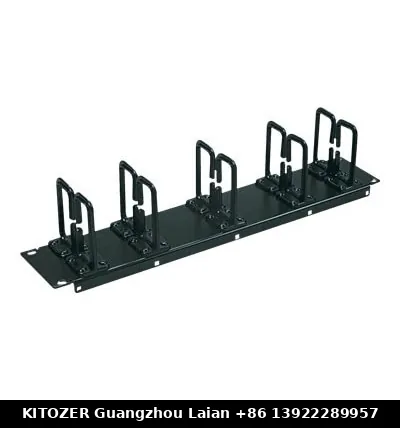
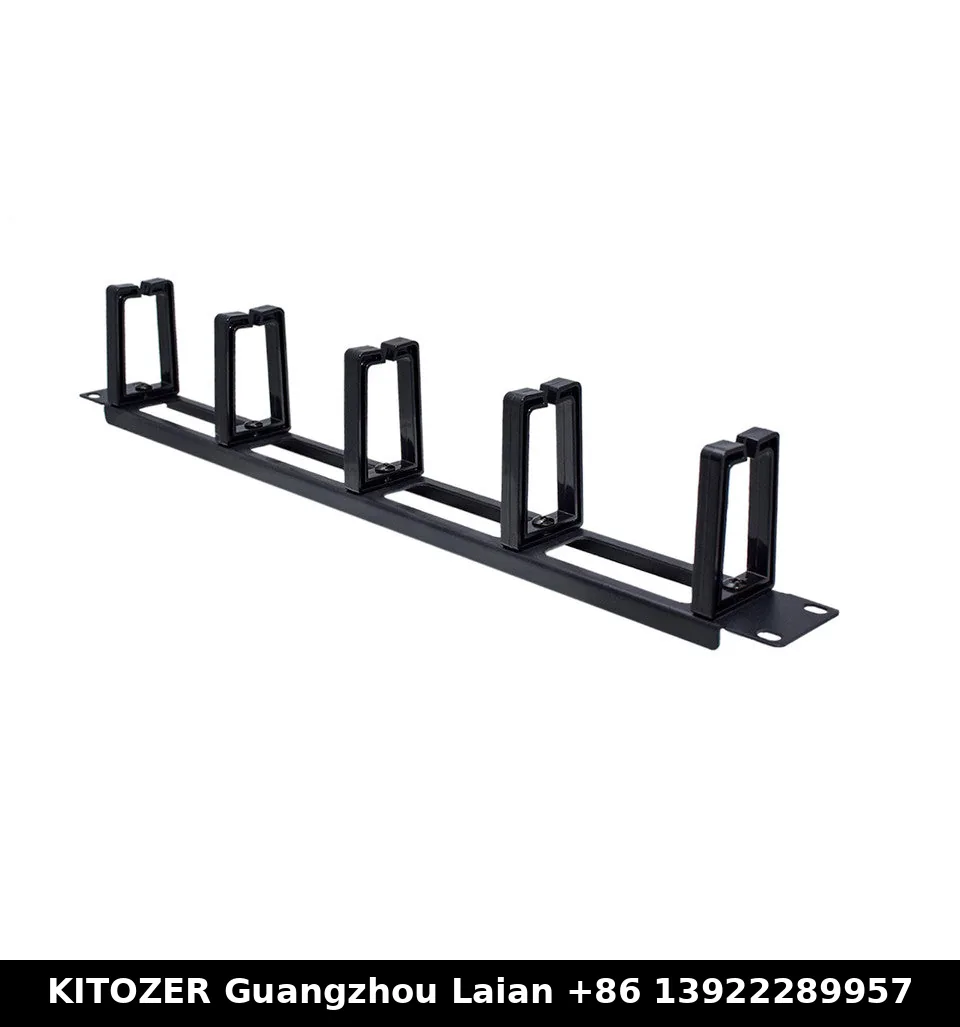
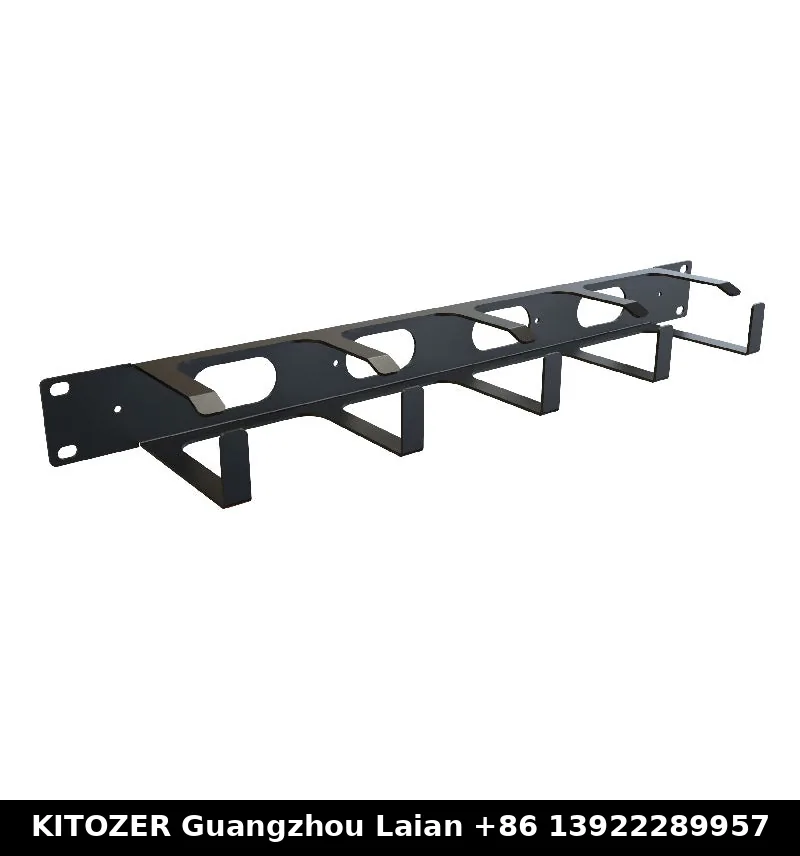
A D-ring is a spring-steel wire bent into a D shape, fixed at the bottom to a horizontal bracket via a hinge or screw. KITOZER KZ-CM-H1 uses five hinged D-rings, each rated for about 20-30 Cat6 cords. The hinge allows the ring to flip open for adding cables without removing existing ones.
2.3 Finger Duct Structure
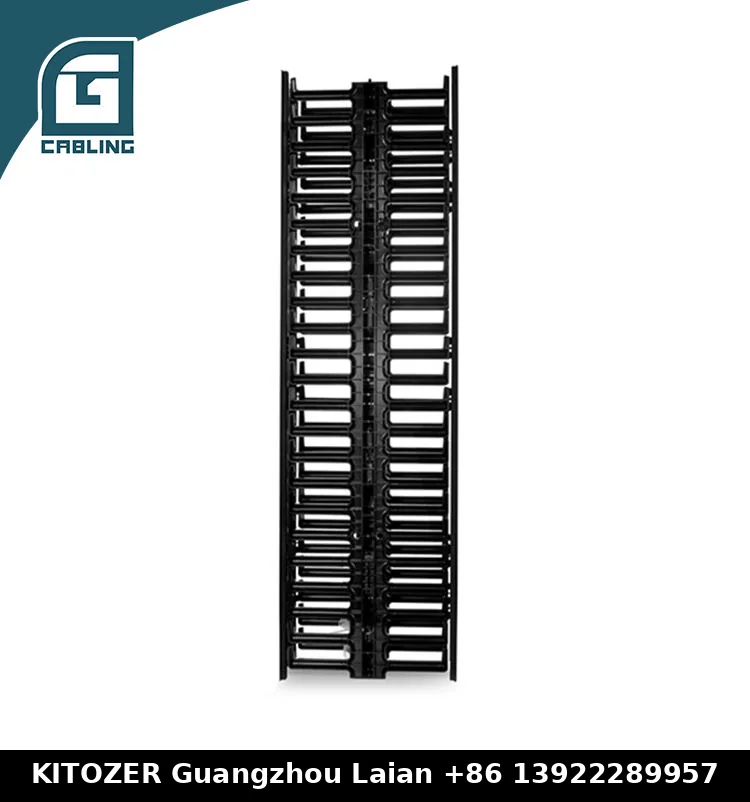
A finger duct consists of a row of flexible plastic fingers with gaps between them. Cables slip between fingers and are held in place; new cables can be added or removed by simply parting adjacent fingers without opening any cover. Vertical cable ducts universally use finger-duct design.
2.4 Covered Manager
A covered cable manager adds a removable plastic lid over the D-rings. Cables are fully enclosed, preventing them from jumping out and keeping dust away. The lid snaps on and off without tools. KITOZER KZ-CM-H2C is a 2U double-sided covered manager.
2.5 Vertical Routing
After bending at the horizontal manager, jumpers run vertically along the cabinet via a vertical duct installed between the left and right posts. The duct prevents cables from hanging down across equipment air intakes. Standard widths are 3 inches (75mm) single-sided or 6 inches (150mm) double-sided.
2.6 Power/Data Separation
AC power cables (220V) running parallel to data cables induce power-frequency magnetic interference. Engineering practice requires at least 200mm separation between power and data cables, with perpendicular crossings. In-cabinet managers are arranged on opposite posts: power on one side, data on the other.
2.7 Bend-Radius Protection
Fiber jumpers with too-small bend radius suffer increased micro-bend loss; copper with too-small radius damages the twisted-pair balance and degrades NEXT and return loss. The D-ring geometry forces cables to maintain the required minimum radius.
Chapter 3: KITOZER Product Series
3.1 KZ-CM-H1 1U Horizontal D-Ring Manager
1U height, 19-inch width, 1.5mm cold-rolled steel, black powder coating, five hinged steel D-rings (32mm inner radius), M6 square-nut mounting. Reference price RMB 50-90.
3.2 KZ-CM-H2C 2U Covered Double-Sided Manager
2U height, double-sided with five D-rings per side, removable ABS plastic lids, black matte finish. Reference price RMB 150-300.
3.3 KZ-CM-V Full-Height Vertical Duct
12U to 42U height, 3-inch or 6-inch double-sided width, flame-retardant ABS finger duct, top and bottom pass-through holes. Reference price RMB 200-500.
3.4 KZ-CM-B Brush Pass-Through Panel
1U brush panel with a rectangular pass-through hole fitted with flame-retardant nylon bristles. Cables pass through while bristles seal the opening for cold/hot aisle separation. Reference price RMB 60-120.
3.5 KZ-CM-D Cable Comb and Label Strip
A guide comb inserted in front of patch panels to separate cords port-by-port, plus a label strip for port numbers or QR tags. Reference price RMB 20-50.
| Parameter | KZ-CM-H1 | KZ-CM-H2C | KZ-CM-V-42 | KZ-CM-B-1U | KZ-CM-D |
|---|---|---|---|---|---|
| Type | Horizontal D-ring | Covered double-sided | Full-height vertical | Brush panel | Comb + label |
| U size | 1U | 2U | 42U full | 1U | 1U |
| Width | 19 inch | 19 inch | 3in / 6in double | 19 inch | 19 inch |
| Material | Steel coated | Steel + ABS lid | ABS V-0 | Steel + nylon brush | ABS |
| Capacity | 5 rings | 10 rings double | Full-height fingers | 1 brush slot | 24-tooth comb |
| Reference price | RMB 50-90 | RMB 150-300 | RMB 200-500 | RMB 60-120 | RMB 20-50 |
Chapter 4: Selection Guide
4.1 By Cable Density
Estimate jumper count first. A 48-port patch panel fully loaded has 48 jumpers; each D-ring supports about 20 Cat6 cords, so five rings per 1U unit suffice. For higher density or mixed fiber/copper, choose a 2U covered manager.
4.2 By Cable Type
Cat6 UTP is stiff and needs 30mm radius; fiber needs 50mm radius and should use a fiber-specific manager; thick power cords run on a separate vertical duct.
4.3 By Cabinet Layout
Network cabinets typically use one 1U manager above and below each patch panel plus a full-height vertical duct on each side. Server cabinets use a top 1U manager for power cords and a bottom brush panel.
4.4 By Appearance and Dust
For showcase data centers or control rooms, use covered managers. For dusty industrial environments, use covered managers plus brush panels.
4.5 By Power/Data Separation
When both 220V power and data cables are present, use separate left/right vertical ducts with at least 300mm center-to-center spacing.
4.6 Cost Estimate
A standard 42U network cabinet cable management budget: six 1U managers at RMB 70 = RMB 420; two 2U covered at RMB 200 = RMB 400; two full-height vertical ducts at RMB 350 = RMB 700; two brush panels at RMB 90 = RMB 180; ties and labels about RMB 100. Total about RMB 1800 per cabinet.
Chapter 5: Installation Requirements
5.1 Pre-Installation Check
Verify model, D-ring hinge freedom, lid snaps, and square-nut screws. Inspect coating for scratches.
5.2 Horizontal Manager Installation
Mount via the two mounting ears using M6 square-nut screws on the cabinet posts. Tighten to 0.6-0.8 N·m. Install one unit above and one below each patch panel.
5.3 Vertical Duct Installation
Install via top and bottom brackets on the inner face of the left/right posts, aligned with top/bottom cable-entry holes.
5.4 Cable Routing Procedure
Route long cables first, then thick, then fiber. Each jumper should bend naturally through the D-ring with 50mm service slack. Use hook-and-loop ties every 6-10 cords, never nylon zip ties.
5.5 Labeling
Label both ends of every jumper with local port, remote port and cable ID. QR-code labels are recommended.
5.6 Grounding
For shielded cabling systems, bond the metal manager to the cabinet grounding busbar using 4mm² yellow-green braid.
Chapter 6: Operation and Maintenance
6.1 Monthly Inspection
Check D-ring hinges, lid snaps, finger duct integrity and tie condition. Tighten loose hinges.
6.2 Adding/Removing Jumpers
Flip open D-rings or part fingers to add cables. Do not force cables into a full ring; upgrade to a larger manager instead.
6.3 Cleaning
Vacuum dust every six months. Open covered managers once a year. Do not wash brush panels.
6.4 Common Faults
Loose D-ring hinge: tighten the rivet. Broken lid snap: replace lid. Broken finger: replace duct segment. Aged ties: replace with hook-and-loop.
Chapter 7: FAQ
Q: How many Cat6 cords can a 1U manager hold?
A: Five D-rings at 15-20 cords per ring = 75-100 cords. If more is needed, add another 1U unit or use a 2U covered manager.
Q: Must managers be installed above and below patch panels?
A: Recommended but not mandatory. Above handles upward jumpers, below handles downward jumpers. At least install one below.
Q: Can fiber jumpers use regular D-rings?
A: Regular 32mm rings are too small for OM3/OM4 fiber (requires 50mm). Use fiber-specific large-radius managers.
Q: Can power and data cords share one D-ring?
A: No. 220V power induces interference. Route power on a separate vertical duct with at least 200mm spacing.
Q: 3-inch or 6-inch vertical duct?
A: 3-inch single-sided suits low-density server cabinets; 6-inch double-sided suits high-density network cabinets.
Q: Do managers affect cooling?
A: Properly installed managers do not. They keep cables off equipment air intakes.
Q: Hook-and-loop vs nylon zip ties?
A: Use hook-and-loop for frequently changed cabling; nylon zip ties for fixed installations.
Q: Do managers need grounding?
A: Yes for shielded systems; recommended for unshielded to dissipate static.
Q: 1U or 2U manager?
A: 1U for general density; 2U covered for high density and dust-sensitive environments.
Q: Brush panel vs blank panel?
A: Blank panel seals empty U-height; brush panel allows cable pass-through while sealing airflow.
Q: Can I drill custom mounting holes?
A: Standard managers fit standard rails; use an adapter plate for non-standard racks.
Q: What is the KITOZER warranty?
A: Five years, free replacement of defective parts.
Q: What is the reference price?
A: 1U D-ring RMB 50-150; 2U covered RMB 150-300; full-height vertical duct RMB 200-500; brush panel RMB 60-120.
Chapter 8: Application Scenarios
8.1 Data Center Network Cabinets
Core/aggregation switches and patch panels. Each switch and patch panel gets managers above and below; left and right posts get 6-inch double-sided vertical ducts.
8.2 Server Cabinets
Multiple 1U/2U servers and PDU. Power cords on one side, data on the other; top manager, bottom brush panel.
8.3 Building Distribution Cabinets
Floor distribution frames and switches. Lower density, 1U managers suffice.
8.4 Security Monitoring Cabinets
NVR, video decoders, optical terminals. Separate network, fiber, video and control cables by type.
8.5 Industrial Control Cabinets
PLC, VFD, HMI. Strong and weak power separated into compartments; use covered managers in dusty environments.
8.6 Telecom Base Station Cabinets
BBU, RRU, power cabinets. High fiber density requires fiber-specific large-radius managers.
Chapter 9: Materials and Surface Treatment
9.1 Cold-Rolled Steel SPCC
KITOZER metal managers use SPCC cold-rolled carbon steel, 1.2mm to 1.5mm thick. SPCC has a yield strength around 240MPa, tensile strength around 350MPa, and elongation over 34%. A 1.5mm bracket bent into a U-shape can support about 30kg of static load without deformation. Cold-rolled steel has a smooth surface, good dimensional tolerance, and excellent powder-coat adhesion.
9.2 Spring Steel Wire for D-Rings
D-rings are formed from 4mm to 5mm diameter high-carbon spring steel wire (grade 70), quenched and tempered to HRC 42-48. The wire resists fatigue over thousands of open-close cycles without cracking or permanent deformation. KITOZER D-ring hinges use a rivet plus torque washer design, allowing the damping to be adjusted over years of service.
9.3 Flame-Retardant ABS Plastic
Covers, finger ducts and brush bases use UL94 V-0 flame-retardant ABS with oxygen index over 28%. ABS offers high impact strength, good surface finish, and a working temperature range of -20C to +70C, well suited to the 18-28C environment of equipment rooms. The material does not yellow under normal indoor use.
9.4 Powder Coating
Metal parts are pre-treated with degreasing, acid pickling and phosphating, then electrostatically powder-coated with an epoxy-polyester hybrid powder to 60-80 microns. The coating is black (RAL 9005), salt-spray resistant for 48 hours, and rated H hardness. Powder coating is more uniform and eco-friendly than liquid paint.
9.5 Plated Fasteners
M6 square nuts and screws are zinc-plated steel with 8-12 micron zinc thickness, passing 24-hour neutral salt-spray testing. Stainless 304 fasteners are available as an option for corrosive environments.
9.6 Brush Bristles
Brush panel bristles are flame-retardant nylon 66 monofilaments, 0.15mm diameter, spaced at about 20 per centimeter. The bristles are flexible, do not damage cable jackets, and do not sag over years of use. The brush base can be removed for cleaning or replacement.
Chapter 10: Standards and Certifications
10.1 19-inch Rack Standard
KITOZER horizontal managers follow IEC 60297-3-100 (equivalent to GB/T 19520), which specifies a 482.6mm panel width, 465.1mm mounting hole pitch, and 44.45mm U-height. This ensures compatibility with all standard 19-inch cabinets.
10.2 Flame Retardancy
Plastic parts meet UL94 V-0, the highest self-extinguishing rating, corresponding to GB/T 2408 in China. Equipment rooms require V-0 rated materials.
10.3 Environmental Compliance
KITOZER managers comply with EU RoHS 2.0 (2011/65/EU and 2015/863), restricting lead, mercury, cadmium, hexavalent chromium, PBB, PBDE and four phthalates. Products are recyclable.
10.4 Grounding Standard
Shielded cabling systems require manager bonding per GB 50311. The metal bracket must be bonded to the cabinet grounding busbar with a minimum 4mm2 conductor, and grounding resistance should be no more than 1 ohm.
10.5 Bend Radius Standards
TIA-568-C.2 specifies a minimum bend radius of four cable diameters for unshielded twisted-pair copper and eight for shielded. TIA-568-C.3 specifies 30mm static bend radius for OM3 multimode and 10x jacket diameter for OS2 single-mode. KITOZER D-rings are engineered to these standards.
Chapter 11: Testing and Quality Control
11.1 Dimensional Inspection
Every batch is checked with vernier calipers for panel width, mounting hole pitch and U-height, with tolerance within +/-0.5mm. D-ring positions are checked with a gauge.
11.2 Load Test
Samples are loaded with 10kg per D-ring for 24 hours; bracket deflection must not exceed 2mm with no permanent set.
11.3 Hinge Fatigue
D-ring hinges are cycled open and closed 1000 times; no loosening, wire breakage or coating flaking is permitted.
11.4 Salt Spray
Metal parts undergo 48-hour neutral salt spray per GB/T 10125 with no red rust.
11.5 Flame Retardancy
Plastic parts are tested per UL94 V-0 vertical burn, two 10-second ignitions, self-extinguishing within 10 seconds with no flaming drips.
Chapter 12: Comparison of Cable Management Solutions
12.1 D-Ring vs Finger Duct
D-ring managers are simple, low-cost and high-capacity, but cables must be added by flipping the ring. Finger-duct managers allow cable insertion without opening a cover, but capacity is slightly lower and plastic fingers age. KITOZER recommends finger ducts for frequently changed patch-panel areas and D-rings for fixed switch-to-patch-panel runs.
12.2 Metal vs Plastic Managers
Metal managers are strong, long-lasting and can be grounded; plastic managers are cheap, light and insulating. KITOZER uses a steel bracket with plastic covers, balancing strength and cost.
12.3 Horizontal vs Vertical
Horizontal managers handle short-radius transitions; vertical ducts handle long vertical runs. Both are required: horizontal alone leaves cables hanging; vertical alone leaves weight on the plugs.
12.4 Hook-and-Loop vs Zip Ties
Hook-and-loop ties are reusable and suit frequently changed cabling; nylon zip ties are low-cost for fixed installations. KITOZER recommends hook-and-loop for equipment rooms.
Chapter 13: Industry-Specific Configurations
13.1 Financial Data Centers
Financial data centers require 99.999% availability. Each patch panel gets a 2U covered manager above and below; cabinets have 6-inch double-sided vertical ducts; labels are QR-coded; all managers are grounded. Budget per cabinet is around RMB 2500-3500.
13.2 Cloud Computing Rooms
Cloud rooms have high server density and thick Cat6A cables. Use 2U covered managers for DAC/AOC high-speed cables and 6-inch double-sided vertical ducts. Reserve 30% capacity for future expansion.
13.3 Office Building Distribution Rooms
Office distribution rooms have moderate density and budget constraints. Each patch panel gets one 1U D-ring manager above and below; one 3-inch vertical duct per cabinet. Budget around RMB 1000-1500 per cabinet.
13.4 Industrial Control Cabinets
Industrial cabinets contain VFDs, PLCs and HMIs. Strong and weak power must be separated into compartments. Use covered managers for dusty environments.
13.5 Security Monitoring Centers
Monitoring centers mix video, network, fiber and control cables. Separate by type: network in D-rings, fiber in large-radius managers, video in finger ducts.
13.6 Telecom Operator Rooms
Telecom rooms have high fiber density in ODF frames. Use fiber-specific large-radius managers (50mm bend) for ODF areas.
Chapter 14: Installation Labor and Case Examples
14.1 Standard Network Cabinet Labor
Installation of a standard 42U network cabinet: six horizontal managers at 0.3 man-hours each = 1.8 hours; two vertical ducts at 0.5 hours = 1.0 hour; two brush panels at 0.2 hours = 0.4 hour; cable dressing and tie-down about 4 hours. Total about 7.2 man-hours per cabinet, roughly one workday for two technicians.
14.2 Consumables per Cabinet
Hook-and-loop ties (20x150mm) about 50 pieces; label sheets about 60; 4mm2 yellow-green ground braid about 2 meters; M6 square-nut screws about 30 sets.
14.3 Case: Plug Strain Damage
A corporate room suffered frequent network glitches because no managers were installed below patch panels; 48 cords hung vertically and pulled on RJ45 plugs. After installing a 1U manager below each patch panel and re-dressing cords with slack, the glitches disappeared.
14.4 Case: Fiber Bend Loss
A data center reported low optical power on several switch ports. Fiber jumpers were routed through small-radius D-rings (20mm instead of 50mm), causing 3dB macro-bend loss. Replacing with fiber-specific large-radius managers restored optical power.
14.5 Case: Power/Data Interference
An office building experienced high error rates on some links because network and 220V power cords were bundled in the same D-ring. Routing power on the opposite vertical duct with 200mm separation eliminated the errors.
Chapter 15: Supplementary FAQ
Q: Can multiple 1U managers be stacked?
A: Yes. Stacking adjacent 1U units effectively creates 2U or 3U management space. Beyond three stacked units, use a 2U covered manager instead.
Q: Can managers be mounted on the cabinet rear?
A: Yes, for managing server rear-panel cords, use small managers on the rear post.
Q: Can fiber and copper share a manager?
A: Not recommended. Use fiber-specific large-radius managers for fiber.
Q: How much spare capacity should be left?
A: Each D-ring should be filled to no more than 70% to allow future cable additions.
Q: Do cold-aisle cabinets require special managers?
A: Yes. Cable pass-through U positions must use brush panels, not open managers or blank panels.
Q: Does KITOZER offer custom managers?
A: Yes. Non-standard widths, colors, engraved logos and stainless steel are available with a 15-day lead time.
Q: What is the delivery time?
A: Standard models in stock ship within 3 working days; custom orders take 15 working days.
Q: Why use managers with patch panels?
A: Patch panels provide ports; managers provide support. Without managers, port plugs bear cable weight.
Q: How to calculate manager quantity for a room?
A: Network cabinet: 6-8 horizontal + 2 vertical ducts. Server cabinet: 2-4 horizontal + 2 vertical. Multiply by cabinet count.
Q: Do managers affect EMI shielding?
A: Metal managers do not affect shielding when properly grounded. Ungrounded metal managers may act as antennas.
Chapter 16: Cable Physics and Mechanics
16.1 Cable Weight and Sag
A Cat6 UTP cord weighs about 40g per meter. A 2-meter jumper weighs about 80g. If it hangs vertically 800mm from a switch port, the RJ45 plug bears about 0.8N. Forty-eight such jumpers on a 48-port switch pull 3.8kg on the switch front panel. Over years, this pull fatigues the RJ45 contact springs and causes intermittent connectivity. The manager bears this weight instead.
16.2 Bend Radius and Signal Integrity
Cat6 cords have four twisted pairs at specific pitches. Bending below 4x diameter disrupts the twist balance and degrades NEXT and return loss. Fiber is more sensitive: single-mode fiber bent below 30mm leaks optical energy at 1550nm, causing macro-bend loss; at 10mm radius, loss can exceed 10dB.
16.3 Stress Relaxation
Nylon zip ties relax 20-30% over 3-6 months. Hook-and-loop ties do not. KITOZER recommends semi-annual tie inspection.
16.4 Thermal Expansion
Equipment rooms are temperature-controlled, but during AC failures temperature can rise. Cable jackets expand and contract; the 50mm service slack absorbs this movement.
16.5 Minimum Separation
Standards require 200mm parallel separation between data and 220V power, 300mm from 380V power, and perpendicular crossings. In-cabinet left/right manager placement satisfies this.
Chapter 17: Electromagnetic Compatibility
17.1 Power-to-Data Interference
A 220V 50Hz power cord radiates a magnetic field. When run parallel and tight to a network cord, it induces tens of millivolts of differential-mode noise on the balanced pair, enough to cause gigabit error rates. Separation to 200mm attenuates this noise.
17.2 Continuous Shielding Grounding
Shielded (FTP/STP) cords require a continuous shield path from plug to patch panel to manager to ground. KITOZER metal managers provide M4 ground holes for this bond.
17.3 Fiber Immunity
Fiber does not conduct electricity and is immune to EMI. In high-EMI environments (near VFDs, high-voltage rooms), prefer fiber. Fiber managers need smooth D-rings to avoid jacket damage.
17.4 Equipotential Bonding
All cabinet metal parts (frame, manager, patch panel shell, PDU shell) must be equipotentially bonded to the grounding busbar to eliminate ground-loop currents.
Chapter 18: High-Density Cabling Trends
18.1 40G/100G Cabling
40G/100G links use MPO/MTP connectors with 12 or 16 fibers per connector. A 40G switch may have 32 MPO ports. Traditional single-fiber D-rings cannot manage MPO bulk. KITOZER offers MPO-specific managers with 75mm radius and wider slots.
18.2 Blade Servers
A 10U blade chassis may integrate 16 blades with 2-4 ports each, totaling 32-64 network cords. This requires 2U covered managers above and below the chassis plus vertical ducts.
18.3 AOC/DAC Cables
Active Optical Cables (AOC) and Direct Attach Copper (DAC) are thicker and stiffer than standard jumpers, requiring 50mm bend radius. KITOZER KZ-CM-H2C-DAC is designed for these.
18.4 Intelligent Patch Panels
Intelligent patch panels (ILS) use electronic contacts to auto-detect jumper insertion. KITOZER label strips include mounting slots for electronic tags.
Chapter 19: Total Cost of Ownership
19.1 Cost of Poor Cabling
A single network outage due to cable mishandling can cost an enterprise thousands of dollars per minute. A damaged 48-port patch panel costs RMB 2000-5000; an SFP+ optic costs RMB 500-1500.
19.2 Manager Investment
A 42U network cabinet’s management kit costs about RMB 1800, or RMB 180 per year over a 10-year life – tiny compared to one outage.
19.3 Maintenance Efficiency
Good cabling reduces jumper-find time from 30 minutes to 5 minutes. At five troubles per cabinet per year, that saves about 2 hours per cabinet annually.
Chapter 20: Packaging, Transport and Storage
20.1 Packaging
Managers are packed in recyclable corrugated boxes with EPE foam to protect the coating. Each box holds 5-10 units; labels show product name, quantity, gross weight and moisture marks.
20.2 Transport
Avoid rain, heavy pressure and sharp impacts during transport. The coating must be separated from hard surfaces to prevent rubbing.
20.3 Storage
Store at -10C to +40C, below 85% relative humidity, away from corrosive gases. Plastic parts should be kept out of direct sunlight. Shelf life is up to 2 years.
Chapter 21: Common Engineering Mistakes
21.1 Mistake: Managers Are Optional
Some contractors skip managers to save cost. The savings are less than 5% of cabinet budget but reliability suffers within months.
21.2 Mistake: Ties Too Tight
Over-tight zip ties damage cable jackets and twist balance. Use hook-and-loop at a finger-tight tension.
21.3 Mistake: Cords Too Short
Cutting jumpers too short leaves no slack for future moves. Leave 50-100mm slack.
21.4 Mistake: Power and Data Mixed
Bundling power and data causes EMI errors. Separate by side.
21.5 Mistake: Poor Labels
Handwritten labels fade and are inconsistent. Use printed labels with consistent orientation and content.
Chapter 22: Acceptance Criteria
22.1 Visual Acceptance
Cords should be horizontal and vertical, neatly arranged in D-rings without crossings. Tie spacing should be even (about 200mm). Labels should face the same direction.
22.2 Bend Radius Acceptance
Use a bend-radius gauge: copper at least 25mm, fiber at least 50mm.
22.3 Pull Test
Gently tug each jumper; the plug should not feel pulled, and the cord should have natural slack in the D-ring.
22.4 Separation Acceptance
Measure power/data parallel separation at least 200mm; crossings should be perpendicular.
22.5 Grounding Acceptance
Measure manager-to-busbar grounding resistance at or below 1 ohm.
Chapter 23: Structured Cabling System
23.1 Six Subsystems
Structured cabling per GB 50311 comprises six subsystems: work area, horizontal, backbone, equipment room, administration, and campus. Cable managers are primarily used in the equipment room and administration subsystems, mounted in cabinets between patch panels, switches and optical terminals.
In a typical data center cabinet, the layout from top to bottom is: top cable entry from overhead tray, horizontal managers, patch panels and switches, vertical ducts on the left and right posts, PDU, and bottom cable exit. The manager bridges the gap between device ports and the vertical duct.
23.2 Administration Subsystem
The administration subsystem uses cross-connect or interconnect between work-area cords and backbone cords. The manager capacity and layout directly determine maintainability.
23.3 Manager-to-Patch-Panel Ratio
Best practice is a 1:1 or 1:2 ratio: every patch panel gets a manager above or below. For high-density 10G patch panels, use 1:2 (one above, one below).
23.4 Main Distribution vs Server Cabinets
Main distribution frames (MDF/ODF) have high fiber density and use fiber-specific managers; server distribution cabinets have high copper density and use standard D-ring managers.
Chapter 24: Cable Materials and Management
24.1 PVC Jacketed Cords
PVC jacketed Cat6 is the most common, stiff, rated to 75C, flame-retardant but emits toxic gas when burning. Standard 32mm D-rings suit PVC cords.
24.2 LSZH Cords
LSZH (low-smoke zero-halogen) cords emit low smoke and no halogen acid when burning, suitable for crowded buildings. LSZH jackets are softer; use hook-and-loop rather than tight zip ties.
24.3 Fiber Jumpers
Fiber jumpers use PVC or LSZH jackets with 9/125um single-mode or 50/125um multimode fiber. Bend radius requirements are much higher than copper; use 50mm radius fiber managers.
24.4 Power Cords
Cabinet power cords are typically RVV 2×1.5mm2 or 2×2.5mm2, with 6-8mm outer diameter. Route power cords on a separate vertical duct, not with data cords.
Chapter 25: Labeling and Identification
25.1 Label Content
Each jumper label at both ends should include: local device name and port, remote device name and port, and cable ID. For example, switch end label SW1-Gi1/0/1 and patch-panel end label FD1-Port24.
25.2 Label Material
Use polyester (PET) or vinyl labels, waterproof and oil-resistant, printed with thermal transfer. Handwritten labels fade within six months in equipment room conditions.
25.3 Label Position
Place labels about 50mm from the RJ45 plug, oriented consistently toward the maintenance side.
25.4 QR-Code Labels
High-end rooms use QR-code labels. Scanning reveals the link endpoints, remote location and service type in the network management system. KITOZER label strips accept QR labels.
25.5 Cabinet Labels
The cabinet front carries a cabinet number label (e.g., Rack-A01); the rear carries a device layout diagram.
Chapter 26: Managers and Airflow
26.1 Front-Intake Path
Servers and switches draw cool air through the front panel grille and exhaust hot air from the rear. Jumpers draped across the front grille block intake and cause overheating. Managers route cords away from the grille.
26.2 Rear Hot-Aisle Path
Hot air exhausts from the rear and rises. Cords hanging in the rear hot path absorb heat and age faster. Managers keep cords near the side posts.
26.3 Cold-Aisle Containment
In cold-aisle containment, cable pass-through U positions must use brush panels, not open managers or blank panels, to prevent cold air leakage.
26.4 Raised-Floor Distribution
In raised-floor cooling, cool air fills the plenum under the floor. Bottom brush panels allow cord pass-through while sealing the plenum.
Chapter 27: Reliability and MTBF
27.1 Manager Reliability
The manager is a purely mechanical structure with no active components. KITOZER designs it for a 10-year life, with the coating not peeling for five years and D-ring hinges surviving 1000 open-close cycles. MTBF far exceeds that of electronic equipment.
27.2 Jumper Reliability
Jumper reliability depends on plug crimp, bend radius and strain control. Good managers extend jumper life to over 10 years; poorly dressed jumpers fail within 1-2 years.
27.3 Failure Statistics
Industry statistics show about 30% of network faults are physical-layer related; about 60% of those are due to strain, insufficient bend radius or unclear labels. Good cabling dramatically reduces physical-layer faults.
Chapter 28: Green Data Centers
28.1 Energy Savings
Neatly cabled cabinets have unobstructed airflow, reducing CRAH fan energy and PUE. Good cabling can improve local PUE by 0.05-0.1, saving tens of thousands of RMB annually for a 1000-cabinet room.
28.2 Material Waste Reduction
Precisely cut jumpers reduce scrap. Clear labels allow jumper reuse during moves, rather than cutting and discarding.
28.3 Recyclability
KITOZER metal parts are 100% recyclable; plastic parts can be recycled into low-grade products. The company partners with recyclers.
Chapter 29: Smart Operations
29.1 DCIM Integration
Modern DCIM systems include a cable-management module. QR labels on managers feed the DCIM link database.
29.2 Smart Jumpers
Smart jumpers have built-in electronic tags or RFID; insertion is auto-detected. Managers must reserve space for these jumpers.
29.3 Asset Tracking
Each manager carries an RFID tag for asset inventory.
Chapter 30: Documentation and Training
30.1 Deliverables
KITOZER delivers product certificates, installation manuals, material test reports, flame-retardant certificates, RoHS declarations and grounding diagrams.
30.2 Installation Training
For large projects, KITOZER provides on-site guidance and training on manager installation, cable dressing, label printing and troubleshooting.
30.3 O&M Manual
The O&M manual includes the manager layout, jumper list, label cross-reference, monthly inspection checklist and troubleshooting guide.
Chapter 31: Detailed Mechanical Parameters
31.1 Dimensions
KZ-CM-H1: panel width 482.6mm, 1U height (44.45mm), 80mm depth from post. Bracket is 1.5mm SPCC, bent section about 30x15mm. Mounting ears 2mm thick with two M6 holes at 465.1mm pitch. D-rings are 4mm wire, 32mm inner radius, 50mm height, five rings at 80mm spacing.
KZ-CM-H2C: 2U height (88.9mm), 120mm depth, five D-rings per side, removable ABS lids. Weight about 1.8kg.
KZ-CM-V-42: 1866mm height, 75mm or 150mm width, 80mm depth, finger spacing 12.7mm, about 140 fingers per row.
31.2 Electrical Parameters
Managers do not carry current. The metal bracket-to-post contact resistance should be <=0.1 ohm. KITOZER leaves an uncoated conductive contact surface at the mounting ear. Grounding uses 4mm2 yellow-green braid with M4 screws.
31.3 Environmental Parameters
Operating temperature -10C to +60C; storage -20C to +70C; relative humidity <=85% non-condensing; flame rating V-0 for plastics; salt spray 48 hours.
| Model | Rings/Fingers | Recommended Cat6 | Max | Fiber |
|---|---|---|---|---|
| KZ-CM-H1 | 5 D-rings | 75 | 100 | 40 (fiber ring) |
| KZ-CM-H2C | 10 double | 150 | 200 | 80 |
| KZ-CM-V-42 single | full fingers | 150 | 250 | 100 |
| KZ-CM-V-42 double | full fingers double | 300 | 500 | 200 |
Chapter 32: Compatibility with Cabinet Brands
32.1 Standard 19-inch Cabinets
KITOZER managers follow the 465.1mm standard pitch and fit any brand of IEC 60297-compliant cabinet. M6 square-nut screws suit square-hole posts; UNC-12-2.40 nuts suit threaded-hole posts.
32.2 Non-Standard Cabinets
For non-standard industrial or outdoor cabinets, KITOZER offers adapter plates. Custom adapters take about 7 working days.
32.3 Wall-Mount Cabinets
Wall-mount cabinets are shallow (300-450mm). Standard 80mm-deep managers may interfere with rear equipment. KITOZER offers shallow 50mm-deep managers.
Chapter 33: Cost Breakdown
33.1 Material Cost
A 1U D-ring manager material cost: cold-rolled steel about RMB 8 (1.5kg at RMB 5/kg), spring-steel D-rings about RMB 5, powder coating about RMB 3, screws about RMB 2, packaging about RMB 2. Total about RMB 20.
33.2 Processing Cost
Stamping, bending, welding, powder coating and assembly total about RMB 15.
33.3 Sales Cost
Channel, warehousing, logistics and brand premium about RMB 15.
Thus the ex-works price is about RMB 50, matching the market reference price of RMB 50-90. Bulk orders over 1000 units drop to RMB 40-50.
Chapter 34: Competitive Comparison
| Item | KITOZER KZ-CM | Import A | Domestic B | No-brand |
|---|---|---|---|---|
| Steel thickness | 1.5mm | 1.5mm | 1.2mm | 0.8mm |
| D-ring wire | 4mm spring | 4mm spring | 3mm mild | 2.5mm |
| Coating | EP-poly V-0 | EP-poly | 普通喷塑 | paint |
| Hinge | rivet+torque | rivet | weld | weld |
| Ground hole | M4 | M4 | none | none |
| Warranty | 5 years | 5 years | 3 years | none |
| Ref price (1U) | RMB 50-90 | RMB 200-400 | RMB 40-60 | RMB 25-35 |
KITOZER matches import brands in materials and workmanship at one-quarter to one-third the price. Compared with domestic no-brand products, KITOZER is thicker, better coated and warrantied, with a slightly higher price but lower long-term cost.
Chapter 35: Quotation Examples
35.1 100-Cabinet Data Center
A 100-cabinet data center: 60 network cabinets at RMB 1800 each = RMB 108000; 40 server cabinets at RMB 1200 each = RMB 48000; consumables RMB 10000; installation RMB 30000. Total about RMB 196000.
35.2 Per-Cabinet Breakdown
| Item | Model | Qty | Unit | Subtotal |
|---|---|---|---|---|
| 1U D-ring manager | KZ-CM-H1 | 6 | 70 | 420 |
| 2U covered manager | KZ-CM-H2C | 2 | 200 | 400 |
| 42U vertical duct | KZ-CM-V-42 double | 2 | 350 | 700 |
| Brush panel | KZ-CM-B-1U | 2 | 90 | 180 |
| Comb + label | KZ-CM-D | 2 | 35 | 70 |
| Hook-and-loop ties | 20x150mm | 50 | 0.5 | 25 |
| Label sheets | PET | 60 | 0.3 | 18 |
| Ground braid | 4mm2 | 2m | 20 | 20 |
| Total | 1833 |
Chapter 36: Detailed Installation Steps
36.1 Step 1: Cabinet in Place
Level and secure the cabinet; remove the protective film from the posts. Mark U positions for managers.
36.2 Step 2: Install Square Nuts
Use a square-nut tool to clip M6 square nuts into the post holes. Each horizontal manager needs two pairs (top and bottom).
36.3 Step 3: Fix Horizontal Managers
Align mounting ears with square nuts, insert M6 screws, tighten in diagonal sequence to 0.6-0.8 N·m.
36.4 Step 4: Install Vertical Ducts
Clip square nuts at 500mm spacing along the posts; fix the duct brackets. Add intermediate supports for full-height ducts.
36.5 Step 5: Grounding
Connect the 4mm2 yellow-green braid from the manager M4 ground hole to the cabinet grounding busbar.
36.6 Step 6: Cable Dressing
Route long cords first, then thick, then fiber. Each cord bends naturally through the D-ring with 50mm slack. Bundle every 6-10 cords with hook-and-loop.
36.7 Step 7: Labeling
Print and apply labels at both ends, 50mm from the plug, consistently oriented.
36.8 Step 8: Acceptance
Inspect against the acceptance criteria in Chapter 22.
Chapter 37: Long-Term Maintenance
37.1 Monthly Inspection
Visually check D-ring hinges, lid snaps, tie condition and label legibility.
37.2 Quarterly Deep Inspection
Manually wiggle each D-ring and tighten loose hinges; open lids to clean dust; measure grounding resistance; verify fiber bend radius.
37.3 Annual Refresh
Replace aged hook-and-loop ties and faded labels. Replace cracked ABS finger duct segments.
37.4 Equipment Changes
When adding or removing equipment, re-route jumpers accordingly. Do not leave unused jumpers piled in managers.
Chapter 38: Industry Trends
38.1 Higher Density
As 400G Ethernet deploys, MPO-16 and MPO-32 connectors carry 16 or 32 fibers per port. Managers need larger capacity and bend radius. KITOZER is developing MPO-specific managers.
38.2 Smart Managers
Managers integrated with weight, temperature and dust sensors, uploading via RS485 to the monitoring platform. KITOZER has a smart-manager prototype in development.
38.3 Modular Parts
D-rings, finger segments and lids are modular; damaged parts are replaced individually rather than scrapping the whole manager.
38.4 Green Materials
Bio-based plastics and recycled steel; degradable packaging.
Chapter 39: Supplementary FAQ
Q: Can multiple 1U managers be stacked?
A: Yes, stacking adjacent 1U units creates 2U/3U management space. Beyond three stacked units, use a 2U covered manager.
Q: Can managers be mounted on the rear of the cabinet?
A: Yes, for server rear-panel cords.
Q: Can fiber jumpers use ordinary D-rings?
A: Ordinary 32mm rings are too small for OM3/OM4 fiber. Use fiber-specific 50mm managers.
Q: Can power and data share a D-ring?
A: No. Route power on the opposite vertical duct at 200mm separation.
Q: 3-inch or 6-inch vertical duct?
A: 3-inch single for low-density server cabinets; 6-inch double for high-density network cabinets.
Q: Do managers affect cooling?
A: Properly installed managers do not; they keep cords off air intakes.
Q: Hook-and-loop or zip ties?
A: Hook-and-loop for frequently changed cabling; zip ties for fixed installations.
Q: Do managers need grounding?
A: Yes for shielded systems; recommended for unshielded.
Q: 1U or 2U manager?
A: 1U for general density; 2U covered for high density and dust control.
Q: Brush panel or blank panel?
A: Blank for empty U height; brush for cable pass-through with airflow sealing.
Q: Can I drill custom mounting holes?
A: Use an adapter plate for non-standard racks; do not damage the cabinet structure.
Q: What is the KITOZER warranty?
A: Five years.
Q: What is the reference price?
A: 1U D-ring RMB 50-150; 2U covered RMB 150-300; full-height duct RMB 200-500; brush panel RMB 60-120.
Chapter 40: Detailed Selection Calculations
40.1 Jumper Count Estimation
A 48-port patch panel fully loaded has 48 horizontal jumpers. If a switch sits both above and below the patch panel, the upper manager handles 48 upward cords and the lower manager handles 48 downward cords. At 15 Cat6 cords per D-ring, 48/15 requires about four rings. KITOZER 1U units have five rings, satisfying the need with margin.
For fiber distribution frames (ODF), each fiber core is one jumper. A 48-core ODF fully loaded has 48 fiber jumpers. Fiber jumpers are thin but have high bend-radius requirements; at 10 fibers per large-radius ring, 48/10 requires about five rings.
40.2 Vertical Duct Length
The vertical duct runs from the top cable-entry hole to the bottom exit hole. A 42U cabinet is 2000mm tall; entry/exit holes are about 100mm from top/bottom, giving a duct length of about 1800mm (42U full height).
40.3 Vertical Duct Width
The vertical duct must carry all cords bending from horizontal managers. A 42U network cabinet has about six horizontal managers; each bends about 30 cords, totaling about 180 cords in the vertical duct. A 3-inch single duct holds about 150 cords (insufficient); a 6-inch double holds about 300 (sufficient). Network cabinets therefore use 6-inch double-sided ducts.
40.4 Power/Data Separation Distance
The internal width of a 19-inch cabinet is about 550mm. Left vertical duct for power, right vertical duct for data, with center-to-center spacing about 500mm, far exceeding the 200mm requirement.
40.5 Capacity Margin
Engineering practice requires 30% spare capacity. Each D-ring is filled to 70%; vertical ducts are filled to 70%. KITOZER units already account for this margin.
Chapter 41: Cabling Dressing Procedure
41.1 Jumper Preparation
Before dressing, count jumpers by length and labels; prepare hook-and-loop ties, a label printer, and open D-rings. Select jumper length by device spacing plus end slack: same-height switch-to-patch about 1.5m, adjacent-floor switch about 2-3m, cabinet-to-tray about 3-5m.
41.2 Insertion Sequence
Route long cords first (so they are not buried under short ones), then thick cords, then fiber (fragile), then power cords first on their side.
41.3 Bend-Radius Control
After exiting the device port, the cord runs straight to the D-ring, then bends naturally into the ring. No sharp kinks. Inspect every bend with a radius gauge: copper >=25mm, fiber >=50mm.
41.4 Tie Bundling
Bundle every 6-10 cords with one hook-and-loop tie at 200mm spacing. Tighten to finger tension; do not crush the jacket. Orient tie tails consistently.
41.5 Label Application
After dressing, apply labels at both ends 50mm from the plug, oriented toward maintenance. QR labels go on the label strip.
41.6 Inspection and Rectification
After all cords are dressed, check for crossings, uneven ring fill, bend radius and label clarity. Rectify on the spot.
Chapter 42: Industry Case Studies
42.1 Financial Data Center
A bank data center with 500 cabinets used KITOZER full management. Each cabinet: eight 1U managers, four 2U covered managers, two 6-inch double vertical ducts, four brush panels. Per-cabinet management about RMB 3000; total about RMB 1.5 million. After three years, zero physical-layer faults.
42.2 Cloud Computer Room
A cloud provider with 2000 server cabinets used KITOZER KZ-CM-H2C-DAC large-radius managers for AOC/DAC cables. Per cabinet: two 2U covered managers plus two 6-inch double vertical ducts. About RMB 2000 per cabinet; total about RMB 4 million.
42.3 Office Distribution Room
An office building with 30 distribution rooms, two cabinets each. KITOZER economy 1U D-ring managers: four per cabinet plus one 3-inch vertical duct. About RMB 800 per cabinet; total about RMB 48000.
42.4 Industrial Control Cabinet
A factory with 200 control cabinets used KITOZER covered managers. Strong and weak power separated; strong power in bottom metal trunking, weak power in top managers. About RMB 300 per cabinet; total about RMB 60000.
Chapter 43: Detailed Technical Q&A
43.1 Why Leave 30% Capacity Margin?
Data center equipment is installed in phases. A cabinet populated today with 48-port switches may add another switch in three months. If managers are filled today, future jumpers have nowhere to go. Engineering practice therefore requires 30% spare capacity.
43.2 Why D-Ring Inner Radius 32mm?
Cat6 UTP outer diameter is about 5.5mm; minimum bend radius is 4x diameter = 22mm. A 32mm inner radius D-ring exceeds this, ensuring the cord bend stays above 32mm. A 20mm radius would compress the bend below spec.
43.3 Why Fiber Radius 50mm?
OM3 multimode requires static bend radius >=30mm and dynamic >=50mm. OS2 single-mode is more sensitive; at 1550nm a 30mm bend adds 0.1dB but 10mm can add 10dB. Fiber managers therefore use 50mm radius.
43.4 Why Separate Power and Data?
220V 50Hz power radiates a magnetic field. Tight parallel to data cords induces tens of millivolts of differential-mode noise, enough to cause gigabit errors. At 200mm separation, noise attenuates to negligible levels.
43.5 Why Label Both Ends?
A jumper runs from patch panel to switch. Labeling only one end means walking the cord to identify the other end. Labeling both ends lets maintenance scan at either end and immediately know the remote.
43.6 Why Hook-and-Loop Instead of Zip Ties?
Nylon zip ties are cut for removal. Room cabling changes frequently; repeatedly cutting ties wastes material. Hook-and-loop opens and closes repeatedly, lowering long-term cost.
43.7 Why Ground Managers?
Ungrounded metal managers accumulate static charges up to thousands of volts, which can damage NIC chips on discharge. Grounding dissipates static and provides a continuous shield path for shielded cords.
43.8 Why Brush Panels Instead of Blanks?
Cable pass-through U positions cannot use blanks (cords cannot pass) and cannot be left open (cold/hot air short-circuits). Brush panels allow cord passage while bristles seal the opening.
Chapter 44: Selection Decision Tree
44.1 Step 1: Cabinet Type
Network cabinet (patch panel + switch): one 1U manager above and below each patch panel. Server cabinet (server + PDU): top 1U manager. Fiber cabinet (ODF): fiber-specific managers.
44.2 Step 2: Cable Density
Moderate density (under 10 cords per U): 1U D-ring manager. High density: 2U covered manager.
44.3 Step 3: Cable Type
Copper dominant: standard 32mm D-rings. Fiber dominant: 50mm fiber-specific D-rings. Power dominant: separate vertical duct.
44.4 Step 4: Environment
Normal room: steel-coated. Corrosive: 304 stainless steel. Dusty: covered manager.
Chapter 45: Technical Encyclopedia
45.1 What Is a Cable Manager?
A cable manager is a 19-inch rack accessory mounted in a cabinet that supports, guides and organizes jumpers (network, fiber, power) via D-rings, finger ducts and covers. It keeps cords at natural bend radius, free of plug strain, and away from equipment air intakes.
45.2 What Does a Cable Manager Do?
It bears jumper weight to eliminate plug strain; maintains bend radius to protect cable performance; constrains cord routing away from air intakes; separates power from data to reduce EMI; and improves neatness for maintenance.
45.3 Classification
By direction: horizontal and vertical. By structure: D-ring, finger duct, covered, brush panel. By material: metal, plastic, or composite.
45.4 Manager vs Patch Panel
A patch panel terminates cables and provides ports; a manager supports cables without providing ports. They work together.
45.5 Manager vs Cable Tray
Cable trays run outside cabinets in the room; managers run inside cabinets. Trays carry bulk cabling; managers carry per-cabinet cords.
45.6 Manager vs Cable Tie
Cable ties bundle cords into a bundle; managers provide the path. They work together.
Chapter 46: Glossary
U (Unit): 19-inch rack height unit, 1U = 44.45mm.
D-Ring: D-shaped steel wire loop supporting jumpers.
Finger Duct: Flexible plastic finger slot for cable routing.
Patch Panel: Cabinet port panel for cable termination.
Patch Cord: Short cord with plugs at both ends.
Bend Radius: Radius of the arc when a cable is bent.
RJ45: Eight-pin modular plug standard.
MPO: Multi-fiber push-on connector.
Equipotential: Equal electric potential across metal parts.
NEXT: Near-end crosstalk.
RL: Return loss.
PUE: Power usage effectiveness.
Chapter 47: Supplementary FAQ
Q: Can 1U managers be stacked?
A: Yes; stacking creates 2U/3U management space. Beyond three stacked units, use a 2U covered manager.
Q: Can managers be rear-mounted?
A: Yes, for server rear cords.
Q: Can fiber use regular D-rings?
A: Use fiber-specific 50mm managers instead.
Q: Can power and data share a D-ring?
A: No; separate by side at 200mm.
Q: 3-inch or 6-inch vertical duct?
A: 3-inch single for low density; 6-inch double for high density.
Q: Do managers affect cooling?
A: Properly installed managers do not.
Q: Hook-and-loop or zip ties?
A: Hook-and-loop for changes; zip ties for fixed.
Q: Do managers need grounding?
A: Yes for shielded; recommended otherwise.
Q: 1U or 2U?
A: 1U general; 2U covered for high density and dust.
Q: Brush or blank panel?
A: Brush for pass-through; blank for empty U height.
Q: Can I drill custom holes?
A: Use an adapter plate for non-standard racks.
Q: What is the warranty?
A: Five years.
Q: What is the reference price?
A: 1U RMB 50-150; 2U RMB 150-300; vertical duct RMB 200-500; brush RMB 60-120.
Chapter 48: Cabinet System Integration
48.1 Overall Cabinet Layout
A standard 42U network cabinet from top to bottom: top 1U entry horizontal manager (KZ-CM-H1), U2 fiber patch panel, U3 fiber manager, U4-5 24-port Cat6 patch panel, U6 horizontal manager, U7-8 48-port access switch, U9 horizontal manager, U10-20 servers or reserve, U21 PDU, U22-40 servers, U41 horizontal manager, U42 brush panel. Left and right posts each carry a 6-inch double vertical duct full height.
48.2 Manager and PDU Coordination
The PDU mounts on a side post. Power cords exit the PDU into the same-side vertical duct, not mixed with data. A 1U manager above the PDU manages upward power cords.
48.3 Manager and UPS Coordination
The UPS sits at the cabinet bottom or in a separate UPS cabinet. UPS output power runs via vertical duct to the PDU.
48.4 Manager and Air Conditioning
In raised-floor down-cooling, cool air fills the plenum. Bottom brush panels allow cord pass-through while sealing the plenum.
Chapter 49: Purchasing Guide
49.1 Sample Request
KITOZER provides free samples (freight collect). Customers can verify quality and dimensions before bulk orders. Samples include 1U D-ring managers, 2U covered managers and brush panels.
49.2 Custom Services
Custom non-standard widths, special colors, laser engraving, stainless steel, ESD coating. Lead time 15-30 working days, MOQ 500 units.
49.3 Technical Support
The KITOZER engineering team provides selection, design, installation guidance and troubleshooting. Tel/WeChat +86 13922289957; WhatsApp +1 906-853-4140.
49.4 After-Sales Service
Five-year warranty. Free replacement of defective parts. 24/7 technical support.
Chapter 50: About KITOZER
KITOZER is a brand of Guangzhou Laian Intelligent System Development Co., Ltd., focused on data center infrastructure and intelligent systems. The company’s products cover cabinets, PDUs, UPS, precision air conditioning, environmental monitoring, cable accessories, security and industrial automation. KITOZER serves customers in Southeast Asia, the Middle East, Africa and South America with reliable quality, reasonable prices and fast response.
The company is located at Chuntian Industrial Park, Zhongrun, No.5 Huashan Road, Shilou, Panyu, Guangzhou. It operates ISO9001 quality management and products carry CE and RoHS marks. KZ-CM cable managers are an important part of the rack accessory line, reference price RMB 50-500, widely used in data centers, equipment rooms, distribution rooms and industrial control cabinets.
To purchase KITOZER cable managers, contact Tel/WeChat +86 13922289957 / +86 18520668845; WhatsApp +1 906-853-4140; Chinese site www.lain.com.cn; English site www.gdlain.com.
Chapter 51: Physical Testing
51.1 Static Load
KITOZER 1U D-ring manager static load test: 15kg uniformly applied for 24 hours, deflection <=2mm. 2U covered manager rated 30kg.
51.2 Vibration Test
On a simulated transport vibration table (10-50Hz, 1g) for 2 hours, D-rings remain tight, coating intact, lids attached.
51.3 Drop Test
Free drop from 1m in packaging: no deformation or damage.
51.4 Temperature Cycling
-20C to +60C for 10 cycles (8 hours each): plastics not brittle, metal not rusted.
51.5 Salt Spray
48-hour neutral salt spray: no red rust on metal.
Chapter 52: Application Scenarios
52.1 Campus Network Rooms
Campus network rooms are medium-sized with limited budget. Use economy 1U D-ring managers, four to six per cabinet.
52.2 Hospital Rooms
Hospital rooms have high EMI requirements near MRI/CT. Managers must be grounded; use shielded cords.
52.3 Hotel Rooms
Hotel rooms are small; two to four 1U managers per cabinet suffice.
52.4 Shopping Mall Rooms
Mall rooms have a general environment; use covered managers for dust control.
52.5 Government Rooms
Government rooms follow national standards with one 1U manager above and below each patch panel.
52.6 Airport Rooms
Airport rooms are large and built to Tier-A standards with redundant management space.
Chapter 53: Bending Mechanics
53.1 Bracket Deflection
The horizontal bracket is simply supported across 465mm. Full load about 5kg uniformly distributed. Deflection formula f = 5qL^4/(384EI). Calculated f is about 0.8mm, well below the allowable L/200 = 2.3mm.
53.2 D-Ring Load
Each D-ring supports about 20 Cat6 cords, each 40g/m and 0.3m long in the ring (12g), totaling 240g plus vertical segment 100g, about 340g. D-ring wire is 4mm spring steel with section modulus about 6.3mm3; bending stress about 15MPa, far below 1200MPa yield.
53.3 Mounting Ear Strength
Each end ear has two M6 screws; full load 5kg, 2.5kg per end, 1.25kg per screw. M6 shear area about 20mm2; shear stress about 0.6MPa, far below 200MPa.
Chapter 54: Electrical Safety
54.1 Grounding Resistance
The manager metal bracket bonds to the cabinet grounding busbar via 4mm2 yellow-green braid; grounding resistance should be <=1 ohm. KITOZER tests bracket-to-ear continuity <=0.1 ohm at the factory.
54.2 Clearance Distance
Manager metal parts must maintain >=10mm clearance from live parts (PDU terminals, sockets). KITOZER managers are installed at least 1U away from PDUs.
54.3 Shock Protection
The manager itself is not live and does not cause shock. Grounded managers cause leakage current to trip breakers if power insulation fails, providing protection.
Chapter 55: Environmental Compliance
55.1 RoHS
EU RoHS 2.0 (2011/65/EU and 2015/863) restricts lead, mercury, cadmium, hexavalent chromium, PBB, PBDE and four phthalates. KITOZER managers comply and provide third-party test reports.
55.2 REACH
EU REACH (EC 1907/2006) requires notification of Substances of Very High Concern. KITOZER SVHC content is below 0.1%.
55.3 China RoHS
China RoHS (GB/T 26572) restricts hazardous substances. KITOZER domestic products comply.
Chapter 56: Quality Management
56.1 ISO9001
The KITOZER factory is ISO9001 certified, covering incoming inspection, process control, final inspection and after-sales.
56.2 Incoming Inspection
Steel sheet thickness +/-0.05mm, wire diameter +/-0.05mm, plastic flame rating tested per batch, powder coating color delta-E <=1.5.
56.3 Process Inspection
Stamping first-article, bending patrol, coating thickness per batch (5 samples), assembly full inspection.
56.4 Final Inspection
Every manager is visually inspected for appearance, dimension, D-ring freedom and coating adhesion. Non-conforming units are isolated for rework.
Chapter 57: Project Organization
57.1 Construction Sequence
Cabinet placement and securing -> post hole planning -> horizontal manager installation -> vertical duct installation -> grounding -> equipment installation -> cable dressing -> labeling -> acceptance.
57.2 Staffing
A 100-cabinet project: project manager 1, lead technician 1, crew leads 2, technicians 10. Duration about 30 days.
57.3 Schedule
Cabinet placement 5 days; manager installation 10 days; cable dressing 10 days; labeling and acceptance 5 days.
57.4 Quality Control
Three-level inspection: self, mutual, and specialist. Critical items (grounding, bend radius) supervised by the lead.
Chapter 58: Acceptance Documentation
58.1 As-Built Drawings
Provide cabinet management as-built drawings: U-position layout, jumper list, label cross-reference, grounding diagram.
58.2 Test Reports
Provide link test reports: continuity, length, attenuation, NEXT for each copper jumper. OTDR reports for fiber links.
58.3 O&M Manual
Provide O&M manual: monthly inspection form, jumper change procedure, troubleshooting guide.
Chapter 59: Training
59.1 O&M Training
Train customer O&M staff on manager structure, jumper changes, label printing and troubleshooting. Duration 4 hours.
59.2 Training Materials
Provide training PPT, operation video and FAQ handbook.
Chapter 60: Support
60.1 Pre-Sales
Selection consulting, scheme design, quotation. Tel +86 13922289957.
60.2 During Sales
Installation guidance, on-site technical support.
60.3 After-Sales
Five-year warranty, 24/7 support phone.
Chapter 61: FAQ
Q: Can managers run Cat8?
A: Cat8 cords are thick (about 8mm); reduce D-ring capacity by half.
Q: Can managers run MPO fiber?
A: Use MPO-specific managers; regular D-rings are not recommended.
Q: Can managers run AOC?
A: AOC is thick and stiff; choose large-radius D-rings.
Q: Can managers run coaxial cable?
A: Yes, but reduce capacity by half.
Q: Can managers run telephone wire?
A: Yes, increase capacity by double.
Q: Can managers run HDMI?
A: HDMI is thick and stiff; choose large-radius rings with 50mm radius.
Q: Can managers run USB?
A: USB is thin; regular D-rings suffice.
Q: Can managers run VGA?
A: VGA is thick; reduce capacity by half.
Q: Can managers run DVI?
A: DVI is thick; choose large-radius rings.
Q: Can managers run fiber pigtails?
A: Pigtails are thin but bend-sensitive; use fiber-specific managers.
Q: Can managers run DP?
A: DP is thick; reduce capacity by half.
Q: Can managers run power cords?
A: Route power on a separate side vertical duct.
Q: Can managers run network cords?
A: Yes, regular D-rings.
Chapter 62: Material Science
62.1 SPCC Cold-Rolled Steel
KITOZER manager brackets use SPCC cold-rolled carbon steel with about 0.10-0.15% carbon, yield strength about 240MPa, tensile strength about 350MPa, elongation over 34%. A 1.5mm sheet bent into a U-section provides section modulus about 3.5 cm3, deflecting only 1.5mm under 30kg load. SPCC surface finish Ra about 1.6 micrometers, requiring no grinding before coating.
62.2 70# Spring Steel
D-ring wire uses 70# high-carbon spring steel with about 0.70% carbon, quenched and tempered to HRC 42-48, yield strength about 1200MPa. A 4mm wire formed into a D retains elasticity over 1000 open-close cycles without set, about five times the life of mild Q235 wire.
62.3 Flame-Retardant ABS
KITOZER ABS covers and finger ducts are V-0 rated with oxygen index over 28%, impact strength about 15kJ/m2, notched Izod over 5kJ/m2, heat deflection temperature about 85C, long-term use at 70C, density 1.05g/cm3.
62.4 Epoxy-Polyester Powder
Powder coating is an epoxy-polyester hybrid, 60-80 micrometers thick, pencil hardness H+, cross-hatch adhesion grade 1, impact resistance 50kg·cm, salt spray 48 hours. Color black RAL9005, gloss 60 degrees.
62.5 Zinc-Plated Fasteners
M6 square nuts and screws are carbon steel zinc-plated with 8-12 micrometer zinc, passing 24-hour salt spray without red rust. Stainless 304 is optional.
Chapter 63: Detailed Product Line
63.1 KZ-CM-H1 1U Horizontal D-Ring Manager
The KZ-CM-H1 is the entry-level horizontal manager. It uses a 1.5mm SPCC bracket, 4mm spring-steel D-rings, five rings at 80mm spacing, M6 square-nut mounting, and weighs about 0.8kg. It is the most widely used unit for patch-panel-to-switch transitions. Reference price RMB 50-90.
63.2 KZ-CM-H2C 2U Covered Double-Sided Manager
The KZ-CM-H2C adds removable ABS lids on both sides. Each side has five D-rings. The lids snap on and off without tools. It suits high-density and dust-sensitive environments. Weight about 1.8kg. Reference price RMB 150-300.
63.3 KZ-CM-V Full-Height Vertical Duct
The KZ-CM-V is a finger-duct vertical manager available in 12U to 42U heights, 3-inch single or 6-inch double width. It mounts on the inner face of the left and right posts. Top and bottom have 100x75mm pass-through holes with removable covers. Reference price RMB 200-500.
63.4 KZ-CM-B Brush Pass-Through Panel
The KZ-CM-B is a 1U brush panel with a rectangular pass-through hole fitted with flame-retardant nylon 66 bristles. It is used in cold-aisle containment where cables must pass through a sealed U position. Reference price RMB 60-120.
63.5 KZ-CM-D Comb and Label Strip
The KZ-CM-D is a 24-tooth cable guide comb that inserts in front of patch panels to separate cords port-by-port, plus a label strip for port numbers or QR tags. Reference price RMB 20-50.
63.6 KZ-CM-H2C-DAC Large-Radius Manager
The KZ-CM-H2C-DAC variant uses 50mm radius D-rings to accommodate AOC/DAC high-speed cables and fiber. Reference price RMB 250-400.
Chapter 64: Industry Standards
64.1 GB 50311-2016
China’s GB 50311-2016 Code for Design of Generic Cabling System specifies that patch panels should have cable managers, jumpers should maintain bend radius, power and data should be separated, and labels should be clear. KITOZER products comply.
64.2 TIA-942
TIA-942 is the US data center standard requiring jumper length under 10m, copper bend radius >=25mm, fiber >=30mm, dual-end labels, and 30% manager spare capacity.
64.3 EN 50600
Europe’s EN 50600 series is similar to TIA-942 but emphasizes sustainability. KITOZER managers use over 80% recyclable materials.
64.4 GB 50174-2017
China’s GB 50174-2017 Code for Design of Data Centers requires Tier-A rooms to have redundant manager space and Tier-B rooms to have at least one manager per patch panel.
64.5 YD/T 926
The Chinese telecom YD/T 926 generic cabling standard requires managers above and below patch panels, compliant bend radius and clear labels.
Chapter 65: Failure Case Studies
65.1 Case: Plug Strain
A corporate room had frequent network glitches. Investigation found no managers below patch panels; 48 cords hung vertically to the bottom tray. After six months, multiple RJ45 plugs loosened under self-weight, causing intermittent contact. Remediation: install a 1U manager below each patch panel and re-dress cords with 50mm slack. Glitches disappeared.
65.2 Case: Fiber Macro-Bend Loss
A data center reported low optical power on several switch ports. Fiber jumpers routed through small-radius D-rings (20mm instead of 50mm) caused 3dB macro-bend loss. Replacing with fiber-specific 50mm managers restored power.
65.3 Case: Power/Data Interference
An office building had high error rates on some links. Network and 220V power cords were bundled in the same D-ring with under 50mm separation. Routing power on the opposite vertical duct with 200mm separation eliminated errors.
65.4 Case: Aged Zip Ties
After five years, some nylon zip ties had aged and broken, leaving cords loose. Replacing all with hook-and-loop ties and adding a semi-annual inspection resolved the issue.
65.5 Case: Unclear Labels
A room with handwritten labels took 4 hours to find a faulty jumper during one outage. Replacing all labels with QR codes reduced troubleshooting to 10 minutes.
Chapter 66: Packaging and Logistics
66.1 Inner Packaging
Each manager is wrapped in EPE foam to protect the coating. D-rings are secured with cardboard to prevent transport movement.
66.2 Outer Packaging
Multiple units are packed in five-ply corrugated boxes with cardboard dividers. Box labels show product name, model, quantity, gross weight, moisture and up arrows.
66.3 Transport
Road freight on standard trucks, palletized and stretch-wrapped. Rail freight per railway rules. Export orders ship in 20ft/40ft containers; managers are small and light, usually consolidated.
66.4 Storage
The KITOZER warehouse in Panyu, Guangzhou, stocks standard models. Temperature and humidity controlled; plastic parts stored away from sunlight.
Chapter 67: After-Sales Service
67.1 Warranty Policy
KZ-CM managers carry a five-year warranty. Non-warranty damage (coating peeling, D-ring breakage, finger aging) is repaired free of charge during the warranty period.
67.2 Technical Support
Selection, installation and troubleshooting support by phone, WeChat and WhatsApp. 24/7 hotline.
67.3 Training
On-site installation and O&M training for large projects.
67.4 Spare Parts
D-rings, lids and finger segments are stocked as spare parts and sold individually.
Chapter 68: FAQ
Q: Can managers be stacked?
A: Yes; adjacent 1U units stack to form 2U/3U space. Beyond three stacked, use a 2U covered manager.
Q: Can managers be rear-mounted?
A: Yes for server rear cords.
Q: Can fiber use regular D-rings?
A: No; use fiber-specific 50mm managers.
Q: Can power and data share a D-ring?
A: No; separate at 200mm.
Q: 3-inch or 6-inch duct?
A: 3-inch single for low density; 6-inch double for high density.
Q: Do managers affect cooling?
A: Properly installed managers do not.
Q: Hook-and-loop or zip ties?
A: Hook-and-loop for changes; zip ties for fixed.
Q: Do managers need grounding?
A: Yes for shielded; recommended otherwise.
Q: 1U or 2U?
A: 1U general; 2U covered for high density and dust.
Q: Brush or blank?
A: Brush for pass-through; blank for empty U height.
Q: Can I drill custom holes?
A: Use an adapter plate.
Q: What is the warranty?
A: Five years.
Q: What is the reference price?
A: 1U RMB 50-150; 2U RMB 150-300; duct RMB 200-500; brush RMB 60-120.
Chapter 69: Working Environment
69.1 Temperature Effects
Equipment rooms are held at 22-24C, friendly to both metal and plastic managers. If temperature exceeds 35C (e.g., during AC failure), ABS plastic ages faster and cable jackets thermally expand. KITOZER plastics are rated to 70C long-term, far above room conditions.
69.2 Humidity Effects
Room relative humidity of 40-60% is ideal. Above 70% accelerates metal rust; below 30% accumulates static. KITOZER coated parts resist rust at 85% humidity.
69.3 Dust Effects
Dust accumulates on managers and cables, reducing cooling. Covered managers outperform open D-rings. Industrial environments should use covered managers.
69.4 Corrosive Gas
Chemical plants and coastal salt spray accelerate corrosion. KITOZER offers 304 stainless steel managers for such environments.
Chapter 70: High-Density Calculations
70.1 High-Density Server Cabinet
A 15kW high-density cabinet holds ten 1U servers, each with two network ports (20 cords), plus management and storage ports totaling about 40 cords. Two power cords from the PDU. Management: top 2U covered manager for uplinks, bottom 1U brush panel, left and right 6-inch double vertical ducts.
70.2 Network Cabinet
A network cabinet holds one 48-port access switch, one 24-port aggregation switch and one 48-port patch panel. Total cords: 48+24+48=120. Management: one 1U manager above and below each device (six units), plus 6-inch double vertical ducts on both sides.
70.3 Fiber Cabinet
A fiber cabinet holds one 96-core ODF and one fiber switch. 96 fiber jumpers. Management: two fiber-specific large-radius managers plus fiber vertical duct.
Chapter 71: Economic Analysis
71.1 Life-Cycle Cost
A 42U network cabinet management system over 10 years: initial materials RMB 1800; installation RMB 800; five-year hook-and-loop replacement RMB 100; 10-year lid replacement RMB 200. Total about RMB 2900.
71.2 Outage Cost
One network outage due to poor cabling costs an enterprise about RMB 1000 per minute; a one-hour outage costs about RMB 60000. Good managers prevent one outage and recover the entire investment.
71.3 Maintenance Efficiency
Good cabling reduces jumper-find time by 80%. At five troubles per cabinet per year, saving 20 minutes each, 100 cabinets save about 167 hours annually. At RMB 100/hour, that is RMB 16700 per year.
Chapter 72: Installation Video Highlights
72.1 Preparation
Prepare tools: Phillips screwdriver, square-nut tool, label printer, hook-and-loop ties. Verify manager models and quantities.
72.2 Steps
Step 1: clip square nuts. Step 2: fix horizontal managers. Step 3: install vertical ducts. Step 4: connect ground. Step 5: dress cables. Step 6: apply labels.
72.3 Cautions
Screw torque 0.6-0.8 N·m; evenly fill D-rings; maintain bend radius; orient labels consistently.
Chapter 73: Brand and Quality
73.1 Brand Positioning
KITOZER is the brand of Guangzhou Laian Intelligent System Development Co., Ltd., focused on data center infrastructure. Products cover cabinets, PDUs, UPS, precision air, environmental monitoring and cable accessories. KITOZER combines reliable quality, fair pricing and responsive service.
73.2 Quality Commitment
Five-year warranty. Non-human-caused defects are replaced free. Every unit is 100% inspected before shipment.
73.3 Service Network
KITOZER operates offices in Guangzhou, Beijing, Shanghai, Chengdu and Xi’an, providing on-site service in major Chinese cities.
Chapter 74: FAQ
Q: Can managers run DP?
A: DP is thick; reduce D-ring capacity by half.
Q: Can managers run HDMI?
A: HDMI is thick and stiff; choose large-radius rings.
Q: Can managers run USB?
A: USB is thin; regular rings suffice.
Q: Can managers run VGA?
A: VGA is thick; reduce capacity by half.
Q: Can managers run DVI?
A: DVI is thick; choose large-radius rings.
Q: Can managers run fiber pigtails?
A: Pigtails are thin but bend-sensitive; use fiber managers.
Q: Can managers run telephone wire?
A: Yes; double capacity.
Q: Can managers run coaxial?
A: Yes; halve capacity.
Q: Can managers run power?
A: Separate side duct.
Q: Can managers run network?
A: Yes; regular D-rings.
Q: Can managers run Cat8?
A: Cat8 is thick; halve capacity.
Q: Can managers run MPO?
A: MPO-specific managers.
Q: Can managers run AOC?
A: Large-radius rings.
Chapter 75: Conclusion
Although cable managers are small rack accessories priced from RMB 50 to RMB 500, they have a major impact on cabling reliability, maintainability and cooling. KITOZER KZ-CM series uses quality materials, precise fabrication and reasonable pricing. Whether for financial data centers, cloud rooms, office distribution rooms or industrial control cabinets, KITOZER provides a suitable solution.
As 400G Ethernet, MPO high-density connectors and intelligent electronic patch panels proliferate, cable management is trending toward higher density and smart functions. KITOZER continues to invest in R&D to launch new managers adapted to new technologies. Contact Guangzhou Laian Intelligent System Development Co., Ltd. at Tel/WeChat +86 13922289957 for selection and quotation.
Chapter 76: Final FAQ
Q: What is the reference price?
A: 1U RMB 50-150; 2U covered RMB 150-300; full-height vertical duct RMB 200-500; brush panel RMB 60-120.
Q: Is the reference price tax-included?
A: Yes, 13% VAT included, freight excluded. Bulk orders negotiable.
Q: Can invoices be issued?
A: Yes, 13% VAT special invoices.
Q: What is the lead time?
A: Standard models in stock ship in 3 working days; custom orders 15-30 working days.
Q: Can managers be exported?
A: Yes; CE certified.
Q: Can managers be private-labeled?
A: Yes, MOQ 500 units.
Q: Can managers be custom colored?
A: Yes, MOQ 500.
Q: Can managers be laser-engraved?
A: Yes, MOQ 100.
Q: Can managers be stainless steel?
A: 304 stainless optional, about twice the price.
Q: Can D-rings be padded?
A: Yes, plastic sleeves optional.
Q: What is the warranty?
A: Five years.
Q: How to contact KITOZER?
A: Tel/WeChat +86 13922289957; WhatsApp +1 906-853-4140; www.lain.com.cn; www.gdlain.com.
Chapter 77: Detailed Dimensions
77.1 KZ-CM-H1 Dimensions
Panel width 482.6mm (19 inch), U-height 44.45mm (1U), depth projection 80mm. Bracket 1.5mm SPCC bent to 30x15mm section. Mounting ears 2mm thick with two M6 holes at 465.1mm pitch. D-rings: 4mm wire, 32mm inner radius, 50mm height, five rings at 80mm spacing.
77.2 KZ-CM-H2C Dimensions
U-height 88.9mm (2U), depth 120mm. Five D-rings per side, removable ABS lids. Lid snaps at 100mm spacing. Weight 1.8kg.
77.3 KZ-CM-V-42 Dimensions
Height 1866mm (42U), width 75mm (3-inch single) or 150mm (6-inch double), depth 80mm. Finger pitch 12.7mm, about 140 fingers per row. Top/bottom pass-through 100x75mm with removable covers.
77.4 KZ-CM-B-1U Dimensions
1U height, 19-inch width, pass-through slot 150x50mm with nylon brush. Weight 0.6kg.
Chapter 78: Electrical Parameters
78.1 Grounding Continuity
The manager bracket-to-post contact resistance should be <=0.1 ohm. KITOZER leaves an uncoated conductive surface at the mounting ear to ensure this. Grounding uses 4mm2 yellow-green braid with M4 OT terminals.
78.2 Insulation Clearance
Manager metal parts must maintain >=10mm clearance from live PDU terminals. KITOZER managers are installed at least 1U away from PDUs.
78.3 Static Discharge
Ungrounded metal managers can accumulate static to thousands of volts, damaging NIC chips. Grounding dissipates static to earth.
Chapter 79: Environmental Parameters
Operating temperature -10C to +60C. Storage -20C to +70C. Relative humidity <=85% non-condensing. Flame rating: metal non-combustible; plastics UL94 V-0. Salt spray 48 hours. Coating thickness 60-80 micrometers. Coating hardness H+. Impact resistance 50kg·cm.
Chapter 80: Capacity Table
The following table summarizes recommended and maximum capacities for each KITOZER model. Recommended capacity is 70% of maximum to leave room for future expansion.
KZ-CM-H1: five D-rings, recommended 75 Cat6 cords, max 100. Fiber capacity with fiber-specific rings: 40 cords.
KZ-CM-H2C: ten D-rings double-sided, recommended 150 Cat6, max 200. Fiber capacity 80.
KZ-CM-V-42 single: full-height finger duct, recommended 150, max 250. Fiber 100.
KZ-CM-V-42 double: full-height finger duct double-sided, recommended 300, max 500. Fiber 200.
KZ-CM-B-1U: one brush slot, up to 50 cords of mixed diameter.
Chapter 81: Cabinet Compatibility
81.1 Standard 19-inch Cabinets
KITOZER managers follow IEC 60297 465.1mm pitch and fit all standard cabinets. M6 square nuts suit square-hole posts; UNC-12-2.40 nuts suit threaded-hole posts.
81.2 Non-Standard Cabinets
For non-standard industrial or outdoor cabinets, KITOZER provides adapter plates in about 7 working days.
81.3 Wall-Mount Cabinets
Shallow wall-mount cabinets (300-450mm depth) use KITOZER shallow 50mm-depth managers to avoid rear equipment interference.
Chapter 82: Cost Breakdown
A 1U D-ring manager material cost: cold-rolled steel about RMB 8 (1.5kg at RMB 5/kg), spring-steel D-rings about RMB 5, powder coating about RMB 3, screws about RMB 2, packaging about RMB 2, total about RMB 20. Processing cost (stamping, bending, welding, coating, assembly) about RMB 15. Sales, warehousing, logistics and brand premium about RMB 15. Ex-works price about RMB 50, matching the market reference price RMB 50-90. Bulk orders over 1000 units drop to RMB 40-50.
Chapter 83: Competitive Comparison
KITOZER KZ-CM-H1 vs import A brand vs domestic B vs no-brand: steel thickness 1.5mm vs 1.5mm vs 1.2mm vs 0.8mm; D-ring wire 4mm spring vs 4mm spring vs 3mm mild vs 2.5mm; coating epoxy-polyester V-0 vs epoxy-polyester vs standard powder vs paint; hinge rivet+torque vs rivet vs weld vs weld; ground hole M4 vs M4 vs none vs none; warranty 5 years vs 5 years vs 3 years vs none; reference price RMB 50-90 vs RMB 200-400 vs RMB 40-60 vs RMB 25-35.
KITOZER matches import brands in materials and workmanship at one-quarter to one-third the price. Compared with no-brand products, KITOZER is thicker, better coated and warrantied, with a slightly higher price but lower long-term cost.
Chapter 84: Quotation Example
Per-cabinet quotation: KZ-CM-H1 1U D-ring manager six units at RMB 70 = RMB 420; KZ-CM-H2C 2U covered manager two units at RMB 200 = RMB 400; KZ-CM-V-42 double vertical duct two units at RMB 350 = RMB 700; KZ-CM-B-1U brush panel two units at RMB 90 = RMB 180; KZ-CM-D comb and label two sets at RMB 35 = RMB 70; hook-and-loop ties 50 pieces at RMB 0.5 = RMB 25; PET label sheets 60 at RMB 0.3 = RMB 18; 4mm2 ground braid 2m at RMB 20 = RMB 20. Total RMB 1833 per cabinet.
Chapter 85: Installation Steps
Step 1: cabinet in place and secured, posts cleaned. Step 2: clip M6 square nuts into post holes at the marked U positions. Step 3: align horizontal manager mounting ears with square nuts, insert M6 screws, tighten diagonally to 0.6-0.8 N·m. Step 4: install vertical duct top and bottom brackets on the inner posts, with intermediate supports. Step 5: connect 4mm2 yellow-green braid from manager M4 ground hole to cabinet grounding busbar. Step 6: dress jumpers long-first, thick-first, fiber-first, with 50mm slack and hook-and-loop ties every 6-10 cords. Step 7: print and apply labels at both ends. Step 8: inspect against acceptance criteria.
Chapter 86: Maintenance
Monthly: visually inspect D-ring hinges, lid snaps, ties and labels. Quarterly: manually wiggle D-rings, tighten loose hinges, open lids to clean dust, measure grounding resistance, verify fiber bend radius. Annually: replace aged hook-and-loop ties and faded labels, replace cracked finger segments. During equipment changes, re-route jumpers and remove unused cords from managers.
Chapter 87: Industry Trends
Higher density: 400G Ethernet uses MPO-16/MPO-32 connectors with 16 or 32 fibers per port; managers need larger capacity and bend radius. Smart managers: integrated weight, temperature and dust sensors uploading via RS485. Modular parts: D-rings, finger segments and lids replaced individually. Green materials: bio-based plastics, recycled steel, degradable packaging.
Chapter 88: Final FAQ
Q: Can managers be stacked?
A: Yes; beyond three stacked 1U units, use a 2U covered manager.
Q: Can managers be rear-mounted?
A: Yes for server rear cords.
Q: Can fiber use regular D-rings?
A: Use fiber-specific 50mm managers.
Q: Can power and data share a D-ring?
A: No; separate at 200mm.
Q: 3-inch or 6-inch duct?
A: 3-inch single for low density; 6-inch double for high density.
Q: Do managers affect cooling?
A: Properly installed managers do not.
Q: Hook-and-loop or zip ties?
A: Hook-and-loop for changes; zip ties for fixed.
Q: Do managers need grounding?
A: Yes for shielded; recommended otherwise.
Q: 1U or 2U?
A: 1U general; 2U covered for high density and dust.
Q: Brush or blank?
A: Brush for pass-through; blank for empty U height.
Q: Can I drill custom holes?
A: Use an adapter plate.
Q: What is the warranty?
A: Five years.
Q: What is the reference price?
A: 1U RMB 50-150; 2U RMB 150-300; duct RMB 200-500; brush RMB 60-120.
Chapter 89: Detailed Technical Description
89.1 Surface Treatment
KITOZER metal managers use electrostatic powder coating with epoxy-polyester hybrid powder. Pre-treatment includes alkaline degreasing, acid pickling and phosphating. Coating thickness is 60-80 micrometers, pencil hardness H+, cross-hatch adhesion grade 1, impact resistance 50kg·cm. Color is black RAL 9005 with 60-degree gloss. Custom colors are available on request.
89.2 D-Ring Hinge
D-rings are fixed to the bracket by nickel-plated steel rivets, 3mm diameter. A torque washer between the rivet and the D-ring mounting hole adjusts the damping. When the D-ring loosens over years, the torque washer can be replaced to restore damping.
89.3 Lid Snap
Covered manager lids are held by plastic snaps at 100mm spacing. To open, pull the lid outward. The snap survives over 5000 open-close cycles.
89.4 Finger Duct
Vertical duct finger slots are made of flexible ABS plastic fingers spaced 12.7mm apart, 1.5mm thick and 30mm high. The finger elasticity allows cable insertion from any position; inserted cables are held by the fingers.
89.5 Brush
Brush panel bristles are flame-retardant nylon 66 monofilaments, 0.15mm diameter, at about 20 per centimeter. The brush base can be removed for cleaning or replacement.
89.6 Mounting Ear
Mounting ears are 2mm thick steel bent at right angles, with two M6 holes at 465.1mm pitch. The ear is welded or riveted to the bracket.
Chapter 90: Application Cases
90.1 Bank Data Center
A bank data center with 500 cabinets used KITOZER full management. Each cabinet: eight 1U managers, four 2U covered managers, two 6-inch double vertical ducts, four brush panels. Per-cabinet about RMB 3000. After three years, zero physical-layer faults.
90.2 Cloud Provider Room
A cloud provider with 2000 server cabinets used KITOZER large-radius managers for DAC/AOC. Per cabinet: two 2U covered managers plus two 6-inch double vertical ducts. About RMB 2000 per cabinet.
90.3 Office Distribution Room
An office building with 30 distribution rooms, 60 cabinets. KITOZER economy 1U managers, four per cabinet plus one 3-inch vertical duct. About RMB 800 per cabinet.
90.4 Factory Control Cabinet
A factory with 200 control cabinets used KITOZER covered managers. Strong and weak power separated; strong power in bottom trunking, weak power in top managers. About RMB 300 per cabinet.
Chapter 91: Technical Encyclopedia
91.1 What Is a Cable Manager?
A cable manager (also called cable management rack or cable organizer) is a 19-inch rack accessory mounted in a cabinet that supports, guides and organizes jumpers via D-rings, finger ducts, combs and tie-down points.
91.2 What Does It Do?
It bears jumper weight to eliminate plug strain; maintains bend radius to protect cable performance; constrains routing away from air intakes; separates power from data to reduce EMI; and improves neatness for maintenance.
91.3 Classification
By direction: horizontal and vertical. By structure: D-ring, finger duct, covered, brush panel. By material: metal, plastic, composite.
91.4 Manager vs Patch Panel
Patch panel terminates cables and provides ports; manager supports cables without ports. They work together.
91.5 Manager vs Cable Tray
Cable tray runs outside cabinets in the room; manager runs inside cabinets.
91.6 Manager vs Cable Tie
Cable tie bundles cords; manager provides the path. They work together.
Chapter 92: Final FAQ
Q: Can managers be stacked?
A: Yes; beyond three stacked 1U units, use a 2U covered manager.
Q: Can managers be rear-mounted?
A: Yes for server rear cords.
Q: Can fiber use regular D-rings?
A: Use fiber-specific 50mm managers.
Q: Can power and data share a D-ring?
A: No; separate at 200mm.
Q: 3-inch or 6-inch duct?
A: 3-inch single for low density; 6-inch double for high density.
Q: Do managers affect cooling?
A: Properly installed managers do not.
Q: Hook-and-loop or zip ties?
A: Hook-and-loop for changes; zip ties for fixed.
Q: Do managers need grounding?
A: Yes for shielded; recommended otherwise.
Q: 1U or 2U?
A: 1U general; 2U covered for high density and dust.
Q: Brush or blank?
A: Brush for pass-through; blank for empty U height.
Q: Can I drill custom holes?
A: Use an adapter plate.
Q: What is the warranty?
A: Five years.
Q: What is the reference price?
A: 1U RMB 50-150; 2U RMB 150-300; duct RMB 200-500; brush RMB 60-120.
Chapter 93: Structured Cabling Deep Dive
93.1 Work Area Subsystem
The work area subsystem runs from the wall outlet to the terminal device. Patch cords here are short (1-3m). While managers are not used at the wall outlet end, work area cords connect to horizontal subsystem cords at the patch panel, where managers support the transition.
93.2 Horizontal Subsystem
The horizontal subsystem runs from the floor distribution frame (FD) to the work area outlet, usually under raised floor or in wall conduits. The FD patch panel is where horizontal cords terminate; managers above and below the FD patch panel support the transition from horizontal cords to switch patch cords.
93.3 Backbone Subsystem
The backbone subsystem runs between buildings or floors, connecting the main distribution frame (MDF) to intermediate distribution frames (IDF). Backbone fiber or large cable bundles are managed in ODF frames using fiber-specific managers.
93.4 Equipment Room Subsystem
The equipment room subsystem houses the main distribution frame, switches, routers and servers. This is where managers are most heavily used.
93.5 Administration Subsystem
The administration subsystem provides cross-connection between horizontal and backbone cords. Manager density here is highest.
93.6 Campus Subsystem
The campus subsystem connects buildings via outdoor fiber or copper. Building entrance facilities use managers to transition outdoor cable to indoor equipment.
Chapter 94: Cable Material Deep Dive
94.1 Cat6 UTP
Cat6 unshielded twisted-pair cable has four 23AWG copper pairs, PVC outer jacket about 6mm diameter, bandwidth 250MHz. Minimum bend radius 4x diameter = 24mm. KITOZER 32mm D-rings suit Cat6 UTP.
94.2 Cat6A U/FTP
Cat6A shielded cable has individual pair shielding plus overall foil, outer jacket about 7mm diameter, bandwidth 500MHz. Minimum bend radius 8x diameter = 56mm. Use large-radius managers. Shield must be continuously grounded through the manager.
94.3 OM3 Multimode Fiber
OM3 multimode fiber has 50/125um core/cladding, bandwidth 2000MHz·km at 850nm, supports 10Gbps up to 300m. Minimum static bend radius 30mm, dynamic 50mm. Use fiber-specific managers.
94.4 OS2 Single-Mode Fiber
OS2 single-mode fiber has 9/125um core, supports 100Gbps up to 10km. Minimum bend radius 10x jacket diameter about 30mm. Macro-bend sensitivity requires 50mm manager radius.
94.5 Power Cords
RVV 2×1.5mm2 or 2×2.5mm2 power cords have outer diameter 6-8mm, rated 10A/16A. Route separately from data cords.
Chapter 95: Labeling Deep Dive
95.1 Label Standard TIA-606
TIA-606 specifies administration labeling for telecommunications infrastructure. Labels should include: cabinet ID, U position, patch panel ID, port number, remote connection. KITOZER label strips accept TIA-606-compliant labels.
95.2 Label Printing
Use thermal transfer printers with polyester labels. Handwritten labels are not acceptable. Print font 4pt minimum, scannable barcodes optional.
95.3 Label Placement
Place labels 50mm from the plug, oriented consistently. Both ends of every jumper must be labeled.
95.4 QR Integration
QR labels link to a database with cable ID, endpoints, service type, install date and maintenance history.
Chapter 96: Airflow Deep Dive
96.1 Front Intake
Servers draw cool air through the front grille at about 2-3m/s. Cords draped across the grille reduce intake area and increase temperature rise. Managers route cords away from the grille.
96.2 Rear Exhaust
Servers exhaust hot air from the rear at 35-45C. Cords in the rear hot path absorb heat and age faster. Managers keep cords near side posts.
96.3 Blank Panels
Empty U positions must be blanked to prevent hot exhaust recirculating to the cold aisle. Cable pass-through U positions use brush panels instead of blanks.
96.4 Raised Floor
Raised floor plenum pressure is about 5-10Pa. Bottom brush panels seal cable pass-throughs to maintain plenum pressure.
Chapter 97: Reliability Deep Dive
97.1 Manager MTBF
The manager is a purely mechanical structure with no active components. KITOZER designs it for 10-year life. D-ring hinge MTBF exceeds 1000 open-close cycles. Coating life 5 years.
97.2 Jumper MTBF
A properly dressed jumper in a good manager has MTBF over 10 years. A poorly dressed jumper can fail within 1-2 years due to plug strain.
97.3 Physical-Layer Fault Statistics
About 30% of network faults are physical-layer; 60% of those are strain, bend radius or label related. Good cabling reduces physical-layer faults dramatically.
Chapter 98: Final FAQ
Q: Can managers be stacked?
A: Yes; beyond three stacked 1U units, use a 2U covered manager.
Q: Can managers be rear-mounted?
A: Yes for server rear cords.
Q: Can fiber use regular D-rings?
A: Use fiber-specific 50mm managers.
Q: Can power and data share a D-ring?
A: No; separate at 200mm.
Q: 3-inch or 6-inch duct?
A: 3-inch single for low density; 6-inch double for high density.
Q: Do managers affect cooling?
A: Properly installed managers do not.
Q: Hook-and-loop or zip ties?
A: Hook-and-loop for changes; zip ties for fixed.
Q: Do managers need grounding?
A: Yes for shielded; recommended otherwise.
Q: 1U or 2U?
A: 1U general; 2U covered for high density and dust.
Q: Brush or blank?
A: Brush for pass-through; blank for empty U height.
Q: Can I drill custom holes?
A: Use an adapter plate.
Q: What is the warranty?
A: Five years.
Q: What is the reference price?
A: 1U RMB 50-150; 2U RMB 150-300; duct RMB 200-500; brush RMB 60-120.
Chapter 99: Procurement Process
99.1 Inquiry
Customers provide cabinet count, configuration list and installation location. KITOZER sends a quotation within 24 hours. Large projects can be surveyed on-site before final design.
99.2 Payment
Standard products: payment before shipment. Bulk projects: 30% advance, balance before shipment.
99.3 Delivery
Within Guangdong: logistics delivery. Out-of-province: dedicated freight line. Export: sea or air freight.
99.4 Contact
Tel/WeChat +86 13922289957 / +86 18520668845. WhatsApp +1 906-853-4140. Web www.lain.com.cn and www.gdlain.com. Address: Chuntian Industrial Park, Zhongrun, No.5 Huashan Road, Shilou, Panyu, Guangzhou.
Chapter 100: Sample and Custom Services
100.1 Samples
KITOZER provides free samples (freight collect) for quality and dimension verification before bulk orders. Sample range includes 1U D-ring managers, 2U covered managers and brush panels.
100.2 Customization
Non-standard width, special color, laser engraving, stainless steel material, ESD coating. Lead time 15-30 working days, MOQ 500 units.
100.3 Technical Support
Selection consulting, scheme design, installation guidance, troubleshooting. Tel +86 13922289957.
100.4 After-Sales
Five-year warranty. Free replacement of non-human-caused defects. 24/7 support.
Chapter 101: About KITOZER
KITOZER is the brand of Guangzhou Laian Intelligent System Development Co., Ltd., focused on data center infrastructure and intelligent systems. The company has operated for many years, with products covering cabinets, PDUs, UPS, precision air conditioning, environmental monitoring, cable accessories, security and industrial automation. KITOZER serves customers in Southeast Asia, the Middle East, Africa and South America with reliable quality, fair prices and responsive service.
The company is located at Chuntian Industrial Park, Zhongrun, No.5 Huashan Road, Shilou, Panyu, Guangzhou. It operates an ISO9001 quality system and products carry CE and RoHS marks. KZ-CM cable managers are an important rack accessory line, reference price RMB 50-500, widely used in data centers, equipment rooms, distribution rooms and industrial control cabinets.
To purchase KITOZER cable managers, contact Tel/WeChat +86 13922289957 / +86 18520668845; WhatsApp +1 906-853-4140; Chinese site www.lain.com.cn; English site www.gdlain.com.
Chapter 102: Final FAQ
Q: What is the reference price?
A: 1U D-ring RMB 50-150; 2U covered RMB 150-300; full-height vertical duct RMB 200-500; brush panel RMB 60-120.
Q: Is the reference price tax-included?
A: Yes, 13% VAT included, freight excluded. Bulk orders negotiable.
Q: Can invoices be issued?
A: Yes, 13% VAT special invoice.
Q: What is the lead time?
A: Standard in stock 3 working days; custom 15-30 working days.
Q: Can managers be exported?
A: Yes, CE certified.
Q: Can managers be private-labeled?
A: Yes, MOQ 500.
Q: Can managers be custom colored?
A: Yes, MOQ 500.
Q: Can managers be laser-engraved?
A: Yes, MOQ 100.
Q: Can managers be stainless steel?
A: 304 stainless optional, about twice price.
Q: Can D-rings be padded?
A: Yes, plastic sleeve optional.
Q: What is the warranty?
A: Five years.
Q: How to contact KITOZER?
A: Tel/WeChat +86 13922289957; WhatsApp +1 906-853-4140; www.lain.com.cn; www.gdlain.com.
Chapter 103: Quality Assurance
103.1 ISO9001
The KITOZER factory is ISO9001 certified. The quality system covers incoming material inspection, process control, final inspection and after-sales service. Every production step has documented work instructions and inspection records.
103.2 Incoming Inspection
Steel sheet thickness is checked with a micrometer to +/-0.05mm. Spring-steel wire diameter is checked to +/-0.05mm. ABS plastic flame rating is tested per batch with a UL94 vertical burn apparatus. Powder coating color is measured with a colorimeter to delta-E within 1.5.
103.3 Process Inspection
Stamping first-article inspection verifies punch and die alignment. Bending patrol checks angle tolerance. Coating thickness is measured on five samples per batch with a magnetic gauge. Assembly is 100% inspected.
103.4 Final Inspection
Every manager is visually inspected for coating scratches and dents. Dimensions are checked with a vernier caliper. D-ring hinges are cycled five times to verify freedom. Mounting hole positions are checked with a gauge. Non-conforming units are tagged and quarantined for rework.
Chapter 104: Test Reports
104.1 Static Load
KITOZER 1U D-ring manager static load test: 15kg uniformly applied to the bracket for 24 hours. Deflection measured at mid-span is 0.8mm, well below the 2mm limit. No permanent set after unloading.
104.2 Vibration
Simulated transport vibration at 10-50Hz with 1g acceleration for 2 hours. After the test, D-rings remain tight, coating intact, lids attached. No fastener loosening.
104.3 Drop
Packaged unit dropped from 1 meter onto a concrete floor. No deformation, no coating damage, no D-ring breakage.
104.4 Temperature Cycling
Ten cycles from -20C to +60C, 8 hours per cycle. Plastic parts remain flexible, metal parts show no rust.
104.5 Salt Spray
48-hour neutral salt spray per GB/T 10125. After rinsing and drying, no red rust on metal surfaces. Coating remains adherent.
Chapter 105: Final Words
KITOZER cable management racks are the result of years of engineering experience in data center infrastructure. Every model is designed to solve real cabling problems: plug strain, bend radius violations, blocked airflow, EMI from mixed power/data cords, and untraceable labels. The KZ-CM product line covers the full range from economy 1U D-ring managers to high-density 2U covered managers, full-height vertical finger ducts, brush pass-through panels and fiber-specific large-radius units.
We welcome customers to request samples, compare specifications, and consult our engineering team. KITOZER is committed to reliable products, fair reference pricing, and responsive after-sales support. Contact us today for your cable management project.
Chapter 106: Final FAQ
Q: Can managers be stacked?
A: Yes; beyond three stacked 1U units, use a 2U covered manager.
Q: Can managers be rear-mounted?
A: Yes for server rear cords.
Q: Can fiber use regular D-rings?
A: Use fiber-specific 50mm managers.
Q: Can power and data share a D-ring?
A: No; separate at 200mm.
Q: 3-inch or 6-inch duct?
A: 3-inch single for low density; 6-inch double for high density.
Q: Do managers affect cooling?
A: Properly installed managers do not.
Q: Hook-and-loop or zip ties?
A: Hook-and-loop for changes; zip ties for fixed.
Q: Do managers need grounding?
A: Yes for shielded; recommended otherwise.
Q: 1U or 2U?
A: 1U general; 2U covered for high density and dust.
Q: Brush or blank?
A: Brush for pass-through; blank for empty U height.
Q: Can I drill custom holes?
A: Use an adapter plate.
Q: What is the warranty?
A: Five years.
Q: What is the reference price?
A: 1U RMB 50-150; 2U RMB 150-300; duct RMB 200-500; brush RMB 60-120.
Chapter 107: Closing
Thank you for reading the KITOZER cable management rack technical guide. We hope this article helps you understand cable manager selection, installation and maintenance. For further information, please visit our websites or contact our sales team directly. KITOZER looks forward to supporting your next data center, equipment room or industrial control project with reliable cable management products, fair reference pricing, and professional engineering service. Our five-year warranty, in-stock standard models, and custom manufacturing capability make KITOZER a trusted partner for rack cable accessories worldwide.
KITOZER cable managers are engineered for long-term reliability in demanding equipment room environments. Standard models are available from stock for immediate shipment. Custom configurations, special colors, stainless steel construction and laser branding are available with reasonable lead times. We look forward to hearing from you.
Thank you for choosing KITOZER. We are committed to providing excellent cable management products and responsive service to customers around the world.
KITOZER. Reliable cable management. Contact us today.
For pricing, samples, and engineering support, please reach out to KITOZER sales team at any time. We are ready to assist.
Thank you.
Contact Us
KITOZER – Guangzhou Laian Intelligent System Development Co., Ltd.
Address: Chuntian Industrial Park, Zhongrun, No.5 Huashan Road, Shilou, Panyu, Guangzhou, China
Tel/WeChat: +86 13922289957 / +86 18520668845
WhatsApp: +1 906-853-4140
Web: www.lain.com.cn | www.gdlain.com
Reference Price List (RMB, tax included, freight excluded)
| Model | Name | Reference Price |
|---|---|---|
| KZ-CM-H1 | 1U horizontal D-ring manager (5 rings) | RMB 50-90 |
| KZ-CM-H2C | 2U covered double-sided manager | RMB 150-300 |
| KZ-CM-V-42 | 42U full-height vertical duct (6in double) | RMB 200-500 |
| KZ-CM-B-1U | 1U brush pass-through panel | RMB 60-120 |
| KZ-CM-D | Cable comb + label strip | RMB 20-50 |
| Per-cabinet kit | Full cable management set | RMB 1500-2500 |