KITOZER Data Center Critical Power Distribution Cabinet: Complete Buying, Installation and O&M Guide
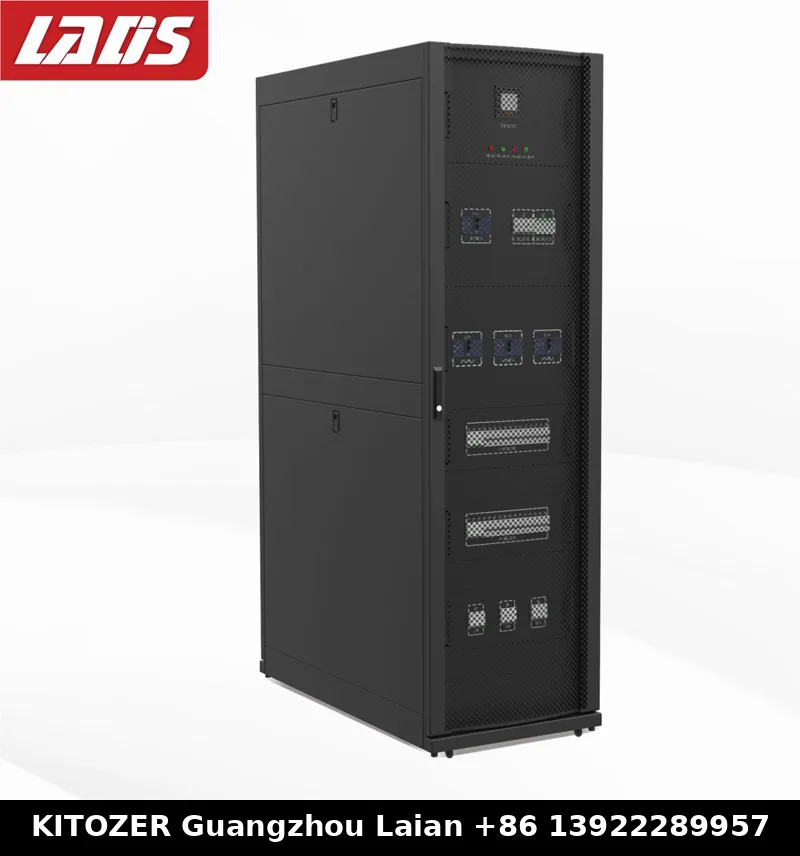
1. Product Overview: What Is a Critical Power Distribution Cabinet
A critical power distribution cabinet (also called a precision power distribution cabinet, intelligent power distribution cabinet or data center power distribution cabinet) is a factory-assembled low-voltage switchgear unit installed at the power end of a data center, between the uninterruptible power supply (UPS) output and the rack-level IT load. Its function is to distribute UPS-grade AC power to individual server racks, protect each branch circuit, and simultaneously measure every main and branch electrical parameter so that operations staff can monitor, alarm on and bill for power consumption at the rack level.
The KITOZER critical power distribution cabinet series covers main incoming current from 63 A to 1600 A, with branch circuits rated 16 A to 63 A. It is a three-phase four-wire system rated at 380 V/220 V, 50 Hz (60 Hz on request), with rated insulation voltage 1000 V. The cabinet combines a main incoming circuit breaker, a multi-route busbar system, branch miniature circuit breakers (MCBs), multi-channel current transformers (CTs), a multi-circuit power monitoring module, a touch-screen human-machine interface (HMI), a communication gateway and dry-contact relay outputs into one vertical, floor-standing enclosure. Branch circuit count can be configured from 12 to 96 ways, and the cabinet is finished in light grey RAL7035 or matte black RAL9005 with IP30 protection as standard.
The defining difference between a critical power distribution cabinet and a traditional power distribution cabinet is measurement density. A traditional cabinet only has one ammeter at the main incoming; operations staff cannot tell which branch is overloaded, which rack is drawing excess power, or where leakage current is developing. The KITOZER cabinet puts a CT and a measurement channel on every single branch, so that voltage, current, active and reactive power, power factor, frequency, energy, harmonics, neutral current and residual current can be read branch by branch on the door HMI and uploaded in real time to the building management (BMS), DCIM or environmental monitoring system over RS485 Modbus-RTU, Ethernet, SNMP or MQTT.
In a modern data center power chain, utility power enters through a transformer, feeds a low-voltage switchgear room, then passes through a UPS input cabinet, the UPS itself, a UPS output cabinet, and finally a critical power distribution cabinet or row (column-head) distribution cabinet before reaching the rack PDU. The KITOZER cabinet sits at the sixth to seventh level of this chain, the last link between the UPS and the server racks. Its measurement accuracy and reliability directly determine whether operations staff can detect branch overload, contact resistance heating, zero-to-ground voltage imbalance or leakage current before they cause an outage.
KITOZER is the data center and intelligent equipment brand of Guangzhou Laian Intelligent System Development Co., Ltd., based in the Chaotian Park of Zhongrun Industrial Zone, Huashan Road, Shilou Town, Panyu District, Guangzhou. The company designs and manufactures precision power distribution cabinets, row distribution cabinets, smart PDUs, UPS systems, battery strings, environmental monitoring, hot/cold aisle containment and micro-module data centers. Cabinets are built to order against the customer’s single-line diagram, and delivered with factory test reports, Modbus point lists and on-site commissioning support.
2. Position in the Data Center Power Chain
To understand the value of a critical power distribution cabinet, it helps to walk the power chain from grid to chip. The grid supplies 10 kV or 35 kV to the data center substation, where a transformer steps it down to 380 V AC. The low-voltage main breaker feeds a busbar, which supplies several feeders: some go to cooling, pumps and lighting, others go through a power-factor correction capacitor bank to the UPS system. The UPS input cabinet contains the utility/bypass ATS and the maintenance bypass switch. Inside the UPS, the rectifier charges the battery and supplies the inverter, which outputs clean, regulated AC through a static bypass. The UPS output cabinet distributes that clean power to one or more downstream bus sections. The KITOZER critical power distribution cabinet takes the UPS output and fans it out to individual rack rows and racks.
At small data centers (under about 30 racks), the UPS output cabinet and the critical power distribution cabinet are combined into one unit that both distributes and meters. At large data centers with micro-modules or hot/cold aisle containment, a row (column-head) cabinet is placed at the head of each rack row, and the critical power distribution cabinet acts as the centralized metering point between the UPS output and the row cabinets. Functionally the two overlap; the difference is location and circuit count. The critical power distribution cabinet is wall-mounted, fed by the UPS output, and has 48 or more circuits. The row cabinet sits next to the rack row, fed by the critical cabinet or a busway, and has one circuit per rack.
For redundancy, data centers typically use 2N or (N+1) architecture. Each server has two power supplies, fed from A-path and B-path independent sources. KITOZER critical cabinets are therefore supplied in matched A/B pairs: cabinet A is fed from UPS-A output bus, cabinet B from UPS-B output bus, installed side by side with blue “A” and red “B” labels. Any single cabinet, UPS or busbar fault leaves the other path carrying the full IT load, which is the basis of continuous availability.
In energy management, the critical power distribution cabinet is the data source for PUE (Power Usage Effectiveness = total data center energy / IT energy). Rack-level cumulative energy from the cabinet feeds PUE calculation, rack power-density mapping, idle-rack identification and green data center reporting. This is why new data center design codes increasingly mandate branch-metered critical distribution cabinets as a matter of course.
3. Internal Structure and Key Components
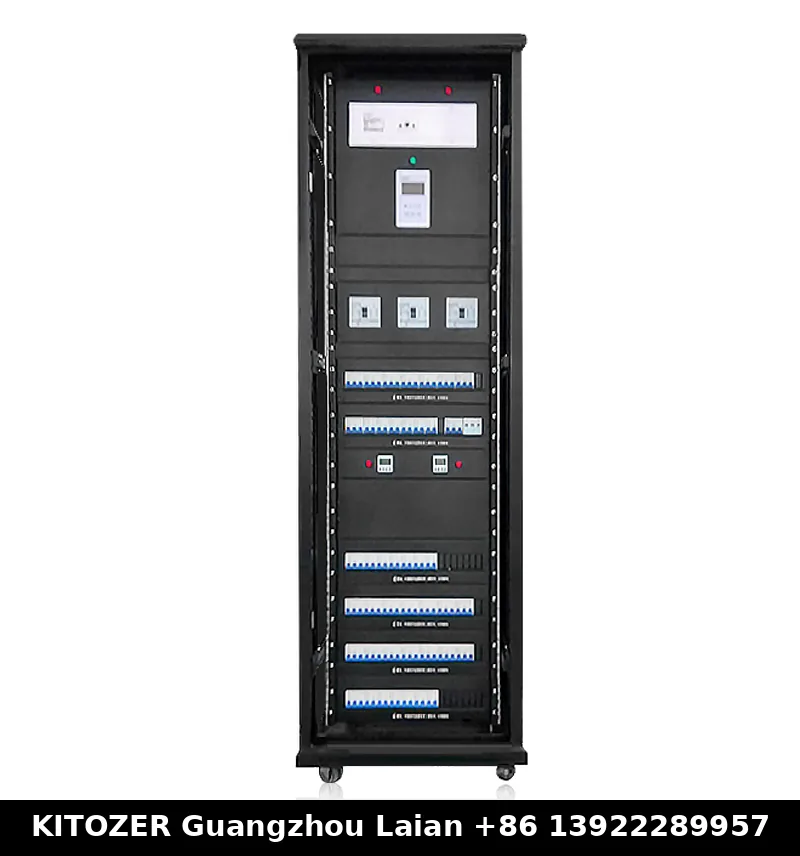
Mechanically, a KITOZER cabinet consists of the enclosure, the busbar system, primary components (breaker, isolator, fuse), secondary components (monitoring module, meter, PLC, gateway), secondary wiring and labelling. The enclosure uses nine-fold or sixteen-fold profile posts on a 25 mm module, bolted and welded, with removable side, top and bottom panels. Internally the cabinet is divided top to bottom into: incoming chamber (main breaker and incoming busbar), main monitoring chamber (multi-function meter and main CTs), branch chamber (drawer or fixed branch breakers and branch CTs), outgoing chamber (cable glands at the bottom) and communication chamber (gateway and terminal blocks, side-mounted or in the door).
The main incoming breaker is either an air circuit breaker (ACB) for 630 A and above, or a molded-case circuit breaker (MCCB) below 630 A. KITOZER can fit Schneider MTZ/NSX, ABB Emax2/Tmax, Siemens 3WL/3VA or domestic brands from Changshu. The long-time, short-time and instantaneous trips are set during design and adjustable on site.
The copper busbar uses high-conductivity electrolytic copper with tin-plated joints, phased A-yellow, B-green, C-red, N-blue and PE green-yellow. Cross-section is chosen by rated current and short-time withstand: 40×4 mm for 400 A, 60×6 mm for 800 A, double 80×10 mm for 1600 A. Busbar supports use epoxy or DMC blocks to meet 12 kV power-frequency withstand and 1 s / 35-50 kA short-time withstand. Every joint is greased and torqued, and 100% of loop resistance is tested at the factory.
Branch breakers and CTs are the nerve endings. Branch breakers are 1P/2P/3P MCBs with C or D curve, 6 A to 63 A. Each branch is fitted with an open or closed CT sized to the branch current (e.g. 50/5 for a 32 A branch), feeding the monitoring module. Branches are phased balanced across A/B/C so that no single phase exceeds the others by more than 15%. Dual-cord servers have their A and B branches on different phases.
The multi-circuit monitoring module is the heart of the cabinet. A single module samples 12/24/36 branch currents against the shared main-side three-phase voltage, and computes per-branch active power, power factor and energy. Optional channels measure THD harmonics up to the 31st and residual (leakage) current. Modules daisy-chain over RS485 to the gateway.
The HMI is a 7-inch or 10-inch color touch screen in the middle of the door, showing main-side parameters, the branch list sorted by circuit number, topology, alarm log and communication status. It has a three-color beacon (green run, yellow warn, red fault) and a buzzer, plus USB export for historical data.
The communication gateway aggregates monitoring data and exports it over RS485 Modbus-RTU, Ethernet Modbus-TCP, SNMP v1/v2c/v3, HTTP or MQTT. It provides 2-4 relay dry-contact outputs (general alarm, branch alarm, comm loss, door contact) and 4-16 digital inputs (breaker state, door state, smoke). It connects to environmental monitoring hosts, DCIM platforms, BMS systems or cloud platforms for remote telemetry, remote signaling, remote control and remote adjustment.
4. Working and Measurement Principles
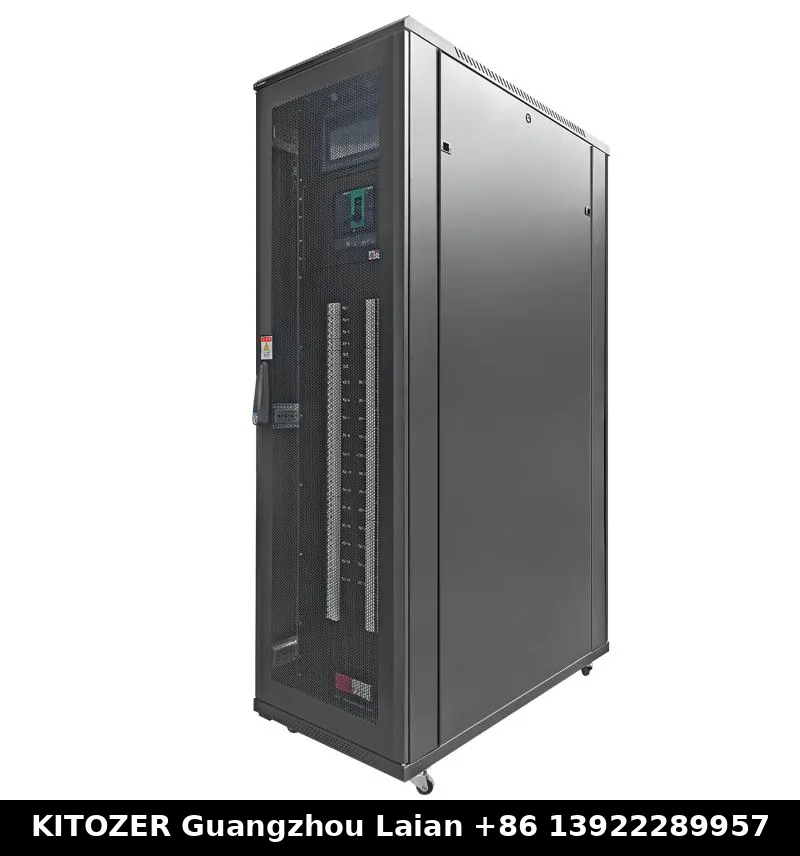
The cabinet works in four stages: power distribution, signal acquisition, data processing and remote upload. Power flows from the UPS output bus through the main breaker into the main busbar, then to each branch breaker and out to the rack PDU. Simultaneously, main and branch CTs scale the primary current to a 5 A or 1 A secondary signal, which the monitoring module samples at 128 points per cycle. A digital signal processor computes RMS values, power, energy and harmonics by Fourier transform. The HMI and gateway present and upload the data; when a parameter exceeds threshold or a breaker changes state, dry contacts and protocol messages trigger local and remote alarms.
Current measurement relies on electromagnetic induction. The CT primary is in series with the phase conductor; the secondary outputs a small current proportional to the primary. The monitoring module uses a precision burden resistor to convert current to voltage, then amplifies and digitizes it. CT accuracy is 0.5 class for measurement, 0.2S for billing. For low-load IT racks (often under 10 A), KITOZER chooses low-ratio CTs and high-resolution modules so that small currents are still resolved.
Voltage measurement taps phase and line voltage directly from the incoming terminals, divided by a resistor network and sampled synchronously on all three phases. This yields phase/line voltage, unbalance, voltage deviation and frequency. Neutral current is measured on the neutral busbar by a separate CT to detect the 3rd-harmonic neutral overload typical of rectifier loads.
Power and energy use the instantaneous power method: p(t)=u(t).i(t), integrated over one cycle to give active power P; apparent power S=U.I; reactive power Q=sqrt(S^2-P^2); power factor PF=P/S. Energy accumulates active power over time, separately for forward/reverse active and inductive/capacitive reactive. Metering accuracy is class 1; a 0.5S billing meter can be added at the main incoming for utility reconciliation.
Harmonics are computed by FFT, decomposing the waveform into the 2nd to 31st (optionally 63rd) harmonics and reporting each harmonic ratio and total distortion THD. Rectifier loads generate mainly 5th, 7th, 11th and 13th harmonics. High harmonics cause transformer heating, neutral overload, breaker nuisance tripping and communication interference. The cabinet’s THD data tells the operations team whether to add an APF active filter or SVG reactive compensator.
Residual current monitoring uses a residual current transformer (RCT) around phase and neutral conductors. In normal operation the vector sum is near zero; insulation degradation, cable damage or equipment leakage raises it to the setpoint (300 mA / 500 mA) and raises an alarm. In data centers the RCM alarms but does not trip, because continuity matters more than instant isolation; it prompts scheduled investigation.
Alarm and event recording uses two-level thresholds (warning at 80% of rating, alarm at 100%) with event latching. All over-limit, breaker-change and comm-loss events are timestamped in non-volatile memory for thousands of entries, and the HMI and cloud show day alarms, 72-hour trend curves and branch load profiles.
5. Technical Specifications
| Item | Typical Rating | Options / Notes |
|---|---|---|
| Rated insulation voltage Ui | AC 1000 V | GB7251.1 / IEC61439 |
| Rated operational voltage Ue | AC 380/220 V, 3-phase 4-wire | 400/480/690 V on request |
| Rated frequency | 50 Hz | 60 Hz on request |
| Main incoming current In | 63/100/160/250/400/630/800/1000/1250/1600 A | sized by load calculation |
| Short-time withstand Icw (1 s) | 35 kA / 50 kA | by system short-circuit level |
| Main breaker | ACB or MCCB | Schneider/ABB/Siemens/Changshu |
| Branch rating | 16/20/25/32/40/63 A | MCB 1P/2P/3P, C/D curve |
| Branch circuits | 12/18/24/36/48/64/80/96 ways | modular expansion |
| Branch current accuracy | 0.5 class | 0.2S at main incoming |
| Energy accuracy | class 1 | 0.5S billing meter optional |
| Harmonic measurement | 2nd-31st THD-U/THD-I | up to 63rd optional |
| Residual current | 30 mA-1 A settable | RCT, alarm no trip |
| Neutral current | separate CT | detects harmonic neutral overload |
| HMI | 7/10-inch color touch | local HMI, beacon+buzzer |
| Upstream comms | RS485 Modbus-RTU / Ethernet | SNMP v1/v2c/v3, MQTT, HTTP |
| Dry contacts | 2-4 relay outputs | general alarm/over-limit/comm/door |
| Digital inputs | 4-16 DI | breaker state/door/smoke |
| Enclosure protection | IP30 | IP40/IP54 upgrade |
| Colour | RAL7035 light grey / RAL9005 black | custom colour |
| Installation | floor-standing / back-to-back | bottom or top cable entry |
| Ambient temperature | -5 to +40 C | storage -25 to +70 C |
| Relative humidity | <=90% non-condensing | altitude <=2000 m |
| Standards | GB7251.1, IEC61439, GB50171, YD/T939 | hipot and loop-resist test at factory |
6. Selection Guide and Calculations
6.1 Load statistics
Start by counting racks, power density per rack (kW/rack) and redundancy factor. Typical density: conventional rack 3-5 kW, general cloud rack 5-8 kW, high-density rack 8-15 kW. Each rack has dual-cord power supplies; in 2N architecture one path carries 100% rack power, in (N+1) each path carries about 50%. For N racks at P kW each, the single-path current I = P_rack_total / (sqrt(3) x 0.38 x PF). For 10 racks at 5 kW, PF 0.95, single-path current is about 80 A, and with a 1.25 margin choose a 100 A main breaker.
6.2 Main breaker setting
The main breaker rating should exceed the calculated current by 1.2-1.5x. The long-time trip is set at 0.8-1.0x the calculated current; the short-time trip at 3-5x with 0.2-0.4 s delay to coordinate selectivity with downstream branches; the instantaneous trip at 8-12x. Adjust upward for inrush from rectifier capacitor charging.
6.3 Branch layout and phasing
Branch count = racks x number of cords per rack (x2 for dual-cord). Each branch is rated by rack single-path current, typically 25 A or 32 A MCB. Distribute branches evenly across A/B/C phases with no phase differing by more than 15%. For dual-cord servers, put A and B branches on different phases. Size CT ratio so that rated current falls in the 50-100% range of the CT scale, balancing light-load resolution and overload margin.
6.4 Communication and host system
Confirm the upstream BMS/DCIM protocol: RS485 Modbus-RTU for typical environmental hosts, Ethernet+SNMP Trap for IP-based alarming, MQTT for cloud platforms. Register map, point names and alarm codes must be aligned with the upstream developer before factory shipment. KITOZER provides standard Modbus templates and SNMP MIB files.
6.5 Cabinet structure and cable entry
Choose cabinet size and entry by the room civil works. New rooms usually use bottom-in/bottom-out under-floor trunking; retrofit rooms use top-in/bottom-out overhead. Leave >=800 mm rear access and >=1500 mm front operation clearance. Parallel cabinets share side panels with inter-cabinet busbar links. Reserve fire-shunt dry contacts, door access and video wiring if required.
7. Installation and Civil Works Requirements
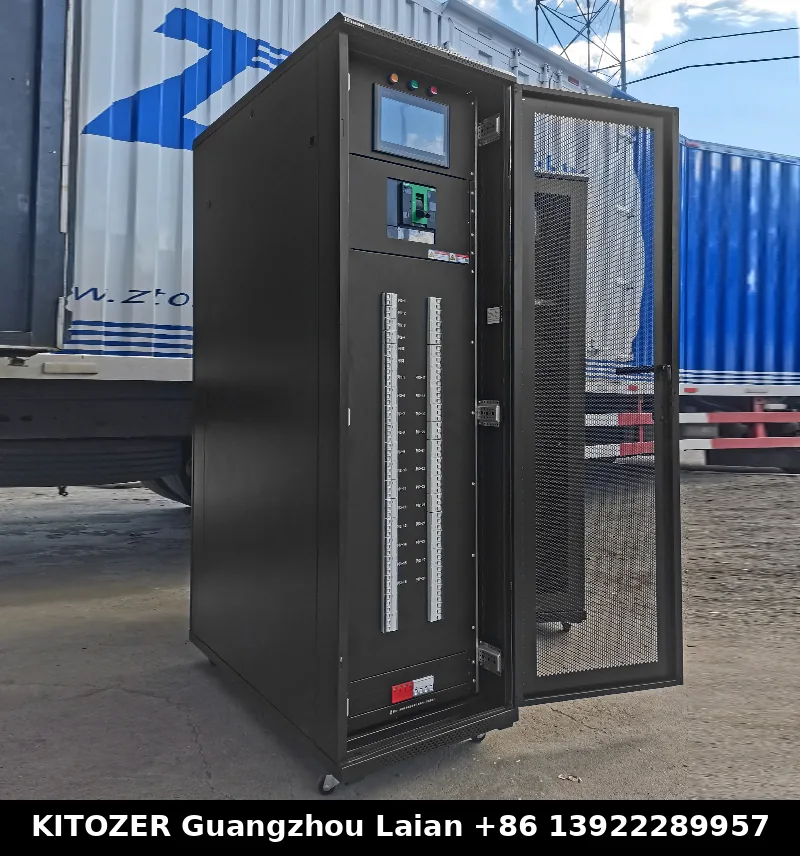
The cabinet is floor-standing and should be installed after the room civil works, flooring, grounding and trunking are complete. Room temperature should be 5-35 C, humidity <=70%, with no conductive dust or corrosive gas. Mount on a level concrete floor or raised floor; floor load must be at least 3x cabinet weight. Use a 10# channel-steel base 50-100 mm above floor, fix the cabinet with M12 expansion bolts or welding, and keep vertical deviation within 1.5 per mille.
Earthing is the safety baseline. The cabinet PE busbar must be connected to the room equipotential copper busbar (>=40×4 mm copper) with a multi-strand copper wire of at least 25 mm2, and the earthing resistance must be <=1 ohm (联合接地 <=1 ohm). The door is bonded to the cabinet by a braided copper strap. The neutral and PE busbars are grounded at one point at the transformer; they are not re-grounded inside the cabinet. All metal enclosures, cable trunking and conduits are bonded into the equipotential network.
Cabling: incoming cable cross-section is chosen by main current (e.g. YJV-3×35+2×16 for 100 A, YJV-3×185+2×95 for 400 A); branch cable by branch current (YJV-3×4+1×2.5 for 32 A). Cables enter through bottom glands and are sealed with fireproof mud. Power and signal cables run in separate trays with >=200 mm parallel spacing, crossing at right angles. Each cable has a numbered tag matching the drawing. CT secondary circuits must never be left open; unused CT secondaries are short-circuited.
Busbar and breaker installation: torque busbar bolts to spec (M10 17.6 N.m, M12 31.4 N.m, M16 78.5 N.m) and mark them. Mount breakers on straight rails with smooth handle operation and correct auxiliary contacts. Draw-out breakers must seat fully with good secondary plugs. After installation, do visual check, mechanical operation test and insulation test (main circuit >=10 MOhm, secondary >=2 MOhm).
Pre-energization check: verify single-line diagram against actual wiring; verify CT ratio against meter range; verify phase sequence with a phase-sequence meter; check all terminals tight and no loose parts; check no tools or swarf left inside; close doors and seal cable holes. Energize with the electrical engineer present: close the main breaker first, confirm voltage, then close branches one by one.
8. Operation and Routine Maintenance
After commissioning, follow the daily/weekly/monthly/quarterly/annual maintenance cycle. Daily: read the HMI, confirm no red alarm, communication online, voltage 380 V +/-5%, balanced currents, no branch near rated. Weekly: record main and key branch current, power and energy; build the energy ledger and watch load growth.
Monthly: use an infrared thermometer on busbar joints, breaker terminals and CT secondary wiring; temperature rise must not exceed 55 K above ambient. Heating at a joint is the early signal of looseness or high contact resistance; de-energize and re-torque when found. Fastening: re-torque all terminals at one month, six months and one year after commissioning, then annually. Cleaning: quarterly, use dry compressed air or a brush to remove dust; never use a wet cloth on live parts.
Annual preventive test: insulation resistance, loop resistance, protection trip test (simulate over-limit to verify alarm), communication link test and control battery check. Archive the test report for asset lifecycle management. ACB main breakers should have their trip unit calibrated every 5 years; MCBs are replaced when reaching their mechanical life.
Alarm handling: on a branch over-current alarm, read the circuit number and current on the HMI, go to the rack and check the load, and decide between real overload and false alarm. For real overload, move load to a spare branch or reduce rack power; for false alarm, check CT wiring and sampling. On a leakage alarm, use a clamp leakage meter to locate the ground fault segment without interrupting business. On a communication-loss alarm, check gateway power, network cable, RS485 120 ohm terminator and daisy-chain wiring.
Outage maintenance procedure: issue a work permit, open the main breaker and hang a “do not close” sign, test for voltage, discharge and apply grounding leads. Rack draw-out breakers in the test position or disconnect secondary plugs. Never hot-swap CT secondary terminals. Restore in reverse order after maintenance: remove grounding leads first, then energize. Two-person operation, one operating and one supervising.
9. Frequently Asked Questions (FAQ)
The core difference is per-branch monitoring. A normal cabinet measures only the main incoming current; the KITOZER cabinet has a CT and channel on every branch, showing per-branch current, power and energy, and can upload to the BMS. The price is about 30-80% higher for the same current rating, but the investment typically pays back in 1-2 years through avoided downtime.
It depends on main current and rack density. For 5 kW/rack, dual-cord, 2N, a 100 A cabinet feeds about 10-12 racks; a 400 A cabinet feeds about 40-50 racks. Always leave 30%+ margin for future growth; do not design at full load.
Data center loads are rectifier and server loads with moderate inrush; the C curve (5-10 In) rides through normal inrush and trips fast on short circuit. The D curve (10-20 In) is for large motor starting and would reduce short-circuit protection sensitivity at the data center end.
Not mandatory, but recommended when transformer capacity is large, rectifier loads dominate, neutral current exceeds phase current, or an APF/SVG needs tuning data. Purely resistive small rooms can skip it.
Data centers need continuity; leakage is an early insulation signal before actual failure. Tripping immediately would interrupt business. It alarms for scheduled investigation; only maintenance sockets use 30 mA RCD tripping.
Theoretically 32 nodes (128 with repeaters), up to 1200 m with shielded twisted pair. Daisy-chain the bus, put a 120 ohm terminator at each end, never star-wire. Assign a unique slave address (1-247) to each cabinet.
Common causes: CT wiring loose or ratio mis-set; branch load below the CT minimum measurable current (<5% In); or a damaged module channel. Use a clamp meter downstream to compare, then check CT secondary wiring and channel configuration.
When the main current exceeds a single-cabinet busbar capacity or the circuit count exceeds a single cabinet. Parallel cabinets must share the same source, phase sequence, voltage and frequency, with interlocks, and never tie different power systems.
The standard IP30 unit is indoor only. For outdoor use choose an IP54 outdoor cabinet with sun shade, anti-condensation heater, temperature/humidity controller and waterproof glands, and put electronics in a climate-controlled compartment.
Yes. The gateway provides standard Modbus-RTU/TCP and SNMP, with point lists and MIB files. Any upstream system supporting these protocols can integrate. For custom protocols, KITOZER can add a protocol converter gateway.
Placement, cabling and wiring take 2-5 working days depending on scale, and commissioning 1-2 days. Schedule after decoration and floor drying to avoid dust and moisture.
It is the ex-works price including 13% VAT, excluding transport, site installation, cables and civil works. On-site installation and commissioning is available within Guangdong province; remote guidance or engineer dispatch is available elsewhere at extra cost.
If the cabinet has reserved spare ways, an MCB can be added in the spare compartment under live conditions by a trained electrician with insulation protection, but CT secondary and monitoring expansion should be done in a power-off window. KITOZER factory-reserves spare ways and channels for this.
In humid southern climates or basement rooms, add a 50-100 W anti-condensation heater with a humidity controller to prevent moisture in plum-rain season. It is an option from KITOZER.
The HMI shows 7-day branch current curves and alarm log. Long-term history is stored on the upstream system or cloud. Local non-volatile memory holds about 10,000 events.
Through the cloud gateway, you can view power status and alarms in a phone app or WeChat public account. The KITOZER cloud supports multi-site monitoring, alarm push and report export.
In typical data center conditions, leading domestic brands and imports have very similar failure rates. Imports lead in mechanical life, electronic trip communication and global service. KITOZER offers two tiers for the customer to choose by budget.
Standard configuration 15-20 working days; custom configuration 25-35 working days. Imported components may have longer lead times. Order early after the electrical design is frozen.
Yes, within Guangdong province on-site; out of province we dispatch engineers or guide the contractor remotely. Commissioning includes wiring verification, energization tests, communication integration and operations handover.
The power chain is: critical power distribution cabinet -> row (column-head) cabinet -> rack PDU. In small rooms the critical cabinet can double as the row cabinet; in large micro-modules the three layers are separate. KITOZER supplies all three for a consistent, protocol-matched package.
10. Typical Application Scenarios
Carrier data centers: mobile and broadband data centers use 2N redundant power; each row is fed by a KITOZER critical cabinet after the UPS output, with per-rack metering and unattended environmental monitoring.
Financial back offices: banks and securities back offices require high continuity; leakage monitoring, branch harmonics and event recording support post-incident analysis, and the cabinet links with APF filters.
Government cloud and e-government rooms: compliance with classified-protection requirements; the cabinet’s door-contact and smoke DI signals link to security and fire systems for integrated power and environment monitoring.
Hospitals and clean rooms: operating theaters, ICUs and lab equipment run on dual-path UPS; the cabinet in the floor electrical room monitors medical power quality to keep life-support equipment running.
Universities and enterprise self-owned rooms: teaching labs and ERP rooms are medium scale; KITOZER provides economical configurations with Modbus-RTU to a simple environmental monitor.
Industrial control rooms and storage/PV: factory central control rooms and storage/converter stations use the cabinet for PLC, SCADA and communications power, with industrial-grade environmental hardening.
11. Redundancy Architecture Deep Dive
Data center reliability is determined by architecture, not just component quality. In a 2N architecture, two fully independent UPS and cabinet groups marked A and B feed dual-cord servers. KITOZER supplies A/B matched pairs with blue “A” and red “B” door labels, physically separated cable trays, so no single fire or maintenance mistake affects both paths. In (N+1), N paralleled UPS units plus one redundant unit carry the load; the cabinet main incoming comes from the paralleled UPS output bus, and important branches still use dual-cord. In distributed redundancy (DR), each micro-module has its own small UPS and distribution, and the fault is contained within that row. KITOZER designs cabinets to all three architectures.
Whichever architecture, the cabinet follows the principles of no capacity ceiling, expandable branches and open communication: the busbar and main breaker are sized for 3-5 year growth; 20-30% spare branches and monitoring channels are reserved; the gateway has headroom for future DCIM/cloud integration. KITOZER confirms the growth curve with the customer at design stage and bakes the margin into the cabinet size and busbar cross-section.
12. Component Brands and Comparison
Primary components (breakers, isolators, CTs) are about 40% of cabinet cost; secondary components (monitoring, HMI, gateway) about 25%; enclosure and busbar about 25%; assembly and testing about 10%. For main ACBs, Schneider MTZ2, ABB Emax2 and Siemens 3WL lead in mechanical life (10,000+ operations), trip communication and paralleling; domestic brands like Changshu CW3 cost about 50-60% and meet most data center needs. For MCCBs, Schneider NSX, ABB Tmax XT and Siemens 3VA lead in breaking capacity and electronic trips; domestic Chint and Delixi are cost-effective for branch circuits. KITOZER recommends imports or leading domestic for the main incoming MCB and leading domestic for branches, and gives customers two configuration tiers.
13. Power Quality and Harmonic Treatment
Rectifier loads inject harmonic current, causing voltage distortion, transformer and neutral overload, capacitor failure and metering errors. Typical harmonics are 5th (20-30%), 7th (10-20%), 11th and 13th. On the neutral, 3rd harmonics add in-phase, so neutral current can reach 1.5-2x phase current. When THDi exceeds 15% or neutral current is persistently high, add an APF active filter that injects reverse current to bring THDi below 5%, or an SVG for reactive compensation. The cabinet’s THD and neutral-current data is the tuning reference. Other measures include PFC server power supplies, 240 V/336 V HVDC, and isolation transformers.
14. Factory and Type Tests
Every cabinet undergoes routine tests: visual and structural check, clearance/creepage check, wiring and wire-number check, insulation resistance (main >=10 MOhm), power-frequency withstand (2.5 kV/1 min no flashover), protective circuit continuity, operation and interlock test, IP check and protection function verification. Type tests are sampled: temperature-rise verification at rated current, short-time withstand (1 s, no damage/deformation), dielectric performance, clearance/creepage and IP. Third-party type-test reports are available. Each cabinet ships with single-line diagram, secondary schematic, layout, BOM, factory test report, certificate, manual, Modbus point list and protocol description.
15. Energy Savings and Green Data Center Value
Under dual-carbon goals, granular power metering is mandatory. KITOZER rack-level energy data feeds PUE calculation, idle-rack identification, abnormal-consumption detection and air-side/electrical optimization. Industry experience shows that branch-level metering, combined with resource consolidation and abnormal-load correction, reduces data center energy by 5-10%; the investment typically pays back in 1-2 years. The cabinet also supports green data center ratings and carbon reporting.
16. Integration with BMS, DCIM and Cloud
The gateway connects to three classes of upstream systems. The environmental monitoring system collects power, cooling, temperature, leakage, fire, access control and video; the cabinet joins via RS485 Modbus-RTU, displaying on a one-line diagram with popup alarms and SMS/WeChat push. DCIM integrates assets, capacity, energy and O&M workflow; the cabinet’s branch energy feeds the rack-level and tenant billing view, important for retail and cloud operators. The cloud platform aggregates multi-site data for a central operations screen with automatic work-order dispatch. Before shipment, confirm protocol, baud rate, slave address, register map, byte order, alarm levels, history storage and NTP time sync.
17. Safety Interlocks, Fire and Emergency
The cabinet has locked doors with magnetic contacts, mechanical interlock between door and main breaker (close only when door is shut, open only when tripped), draw-out breaker with connected/test/disconnected positions, and insulated busbar barriers. It reserves a fire-shunt dry contact: before gas suppression, non-essential load is cut via shunt trip, while fire-fighting and emergency lighting remain. A red mushroom emergency-stop on the door trips the main incoming remotely. Control power (DC24/AC220) is backed by a small UPS or control transformer so the monitoring and gateway report the final state on power loss. All live parts meet IP2X; operations staff wear insulating gloves and use insulated tools on a mat.
18. Common Site Issues and Troubleshooting
Common site issues: reversed phase sequence (verify with a phase-sequence meter before energizing); open CT secondary (always short-circuit unused CT secondaries); N-PE mixing (keep neutral and protective bars separate, single-point ground at transformer); communication failure (check gateway power, RS485 A/B, 120 ohm terminator, baud rate and slave address); branch reading bias (check CT ratio and direction); false alarms (adjust thresholds and check shielding). Commission in three steps: power-off wiring and mechanical check; main energization only with main-side voltage and phase sequence; then close branches one by one and verify downstream racks against the HMI.
19. Lifecycle and After-Sales Service
Design life is at least 20 years. Warranty is 18 months from shipment or 12 months from commissioning, whichever comes first; non-human defects are repaired or replaced free. Beyond warranty, cost-price spares and paid inspections are provided. KITOZER offers 7×12 phone and remote support, on-site response within 24 hours in Guangdong and 48 hours elsewhere, and 10-year spare-parts supply. The modular structure supports later branch addition, gateway swap and HMI upgrade without replacing the whole cabinet. KITOZER recommends an asset register with electronic records and QR-code labels on each cabinet.
20. Standards and Compliance
KITOZER cabinets are designed, built and tested to GB 7251.1, IEC 61439-1/-2, GB 50171, GB 4208 (IP code), GB/T 22764, YD/T 939, GB 50054, GB 50052 and GB 50174. Data center projects also meet the design code requirements for redundancy, harmonics, lightning protection and fire safety, and classified-protection level 2. KITOZER responds clause by clause against the local code and tender documents.
21. Worked Calculation Examples
Example 1 (small room): 8 racks at 4 kW, dual-cord, (N+1) UPS. Single-path per rack is 2 kW, total single-path I = 8×2000/(1.732x380x0.95) = 25.7 A. With 1.25 margin choose 63 A main MCCB; branches 20 A MCB, 16 branches plus spares = 24-way cabinet. Phasing: 6 on A, 5 on B, 5 on C. Reference price about RMB 9,000-12,000.
Example 2 (financial back office): 30 racks at 6 kW, 2N. Single path carries all racks: 180 kW. With PF 0.95, diversity 0.85 and margin 1.2, I = 180000×0.85×1.2/(1.732x380x0.95) = 293 A. Choose 400 A ACB, 60×6 mm busbar; branches 25 A MCB, 30 ways plus spares = 48-way cabinet. A/B pair of 400 A/48-way intelligent units, about RMB 18,000-22,000 each.
Example 3 (cloud micro-module): 40 racks at 8 kW, 2N plus busway. Single path 320 kW, I = 320000/(1.732x380x0.95) = 511 A. Choose 630 A main, 80×6 busbar; branches 32 A MCB, 40 ways plus spares = 64-way cabinet. Add harmonic and neutral monitoring with APF interlock contacts. Reference price about RMB 28,000-33,000.
22. Cable and Busbar Selection Table
| Main current | Copper busbar | Incoming YJV cable | Branch MCB | Branch CT ratio |
|---|---|---|---|---|
| 63 A | 20×3 | 3×16+2×10 | C20/C32 | 20/5 or 30/5 |
| 100 A | 25×3 | 3×35+2×16 | C32 | 30/5 |
| 160 A | 30×4 | 3×70+2×35 | C32/C40 | 40/5 |
| 250 A | 40×4 | 3×120+2×70 | C40/C63 | 50/5 |
| 400 A | 60×6 | 3×185+2×95 | C63 | 75/5 |
| 630 A | 80×6 or 2x40x5 | 2(3×185)+2×95 | C63 | 100/5 |
| 800 A | 2x60x6 | 2(3×240)+2×120 | C63 | 150/5 |
| 1000 A+ | 2x80x8 | multiple parallel or busway | C63 | 200/5+ |
Values are for air, open laying, 35 C ambient. Correct for conduit, burial or high temperature. Neutral cross-section should be at least 1.5x phase in harmonic-rich data centers.
23. Modbus Point List Example
| Register | Parameter | Unit | Scale |
|---|---|---|---|
| 40001 | Phase A voltage | V | 0.1 |
| 40002 | Phase B voltage | V | 0.1 |
| 40003 | Phase C voltage | V | 0.1 |
| 40007 | Total current | A | 0.01 |
| 40010 | Active power | kW | 0.01 |
| 40012 | Power factor | – | 0.001 |
| 40013 | Frequency | Hz | 0.01 |
| 40020 | Forward active energy | kWh | 0.01 |
| 40100+ | Branch 1-96 current | A | 0.01 |
| 41000+ | Branch breaker state | – | bit |
| 42000+ | Alarm word | – | bit |
The full Excel point list ships with the cabinet; register addresses, data types (INT16/UINT16/FLOAT32) and byte order can be adapted to the upstream system. SNMP provides MIB and OID lists; MQTT publishes JSON to a configurable topic at 1-60 s.
24. Preventive Maintenance Checklist
| Cycle | Item | Standard | Action |
|---|---|---|---|
| Daily | HMI display | no red alarm, voltage 380 V +/-5% | log and investigate |
| Daily | Communication | online icon steady | check cable/gateway |
| Weekly | Branch current record | no branch >80% rated | move overload load |
| Monthly | Junction temperature | rise <=55 K | re-torque offline |
| Quarterly | Cabinet dust | no dust, filter clear | dry compressed air |
| Semi-annual | Terminal torque | to spec | re-torque and mark |
| Annual | Insulation resistance | main >=10 MOhm | investigate dampness |
| Annual | Protection trip test | over-limit alarms correctly | calibrate threshold |
| Annual | Earthing resistance | <=1 ohm | add earth rods |
| Every 5 years | ACB trip calibration | matches setting | recalibrate or replace |
25. Fault Quick Reference
| Symptom | Cause | Action |
|---|---|---|
| HMI black | control breaker tripped / screen dead | check control supply, replace screen |
| No main voltage display | voltage sampling loose / fuse blown | power off, check sampling loop |
| Branch current over-range | CT secondary short / channel bad | check CT, swap channel |
| Branch current zero | CT open / loose / light load below resolution | clamp-meter compare, check wiring |
| Communication loss | network cable / gateway hang / baud wrong | reboot gateway, verify params |
| Frequent false alarm | threshold too low / interference / real leakage | adjust threshold, check shield |
| Breaker tripped | overload / short / leakage / nuisance | check load, measure insulation |
| Busbar joint hot | bolt loose / high contact resistance | power off, re-torque, grease |
| Excessive neutral current | harmonic overlap / phase imbalance | measure harmonics, add APF |
| Leakage alarm | insulation drop / cable damage | segment-locate ground fault |
26. Brand and Service Commitment
KITOZER is the data center brand of Guangzhou Laian Intelligent System Development Co., Ltd., with a product line covering precision distribution cabinets, row distribution cabinets, smart PDUs, UPS, batteries, environmental monitoring, hot/cold aisle containment, micro-module data centers, lightning protection and structured cabling. The company has sheet-metal, assembly and electrical-commissioning lines in Guangzhou, offering one-stop design, manufacturing and delivery. KITOZER makes no exaggerated claims, uses no superlatives, reports measured parameters only, and marks all prices as reference prices.
27. The Complete Power Chain from Utility to Rack
To fully appreciate where the critical power distribution cabinet sits, it is worth tracing the electrical path from the city grid all the way to the server power supply module. The city grid delivers power at 10 kilovolts or 35 kilovolts to the data center substation, where a step-down transformer reduces it to three-phase 380 volts. This low-voltage alternating current then enters the low-voltage switchgear room through a main incoming air circuit breaker. The low-voltage switchgear room typically contains several face-to-face panels: the incoming panel, the power-factor correction capacitor panel, and a set of outgoing feeder panels. Some of these feeders supply building loads such as air handling units, chillers, pumps, lighting and socket outlets; others are dedicated feeders to the uninterruptible power supply system. The separation of general building load from IT load is a first design principle, because any disturbance on the general building feeder must never propagate into the IT supply.
The UPS input cabinet is the next element. It contains a double-throw automatic transfer switch that selects between utility power and the standby generator, as well as a maintenance bypass switch. When utility power fails, the generator starts within seconds and the ATS transfers. The maintenance bypass allows the UPS itself to be taken offline for service without interrupting the load, a feature that is essential for data centers that cannot stop for UPS maintenance. Inside the UPS, the rectifier converts alternating current to direct current, charging the battery string and feeding the inverter. The inverter reconstructs a clean, regulated sinusoidal alternating current with tight voltage and frequency tolerance. A static bypass switch sits in parallel, ready to transfer the load to raw utility power in milliseconds if the inverter fails. The UPS output cabinet then distributes this conditioned power to one or more downstream bus sections, each of which may correspond to a floor, a functional zone or a micro-module. It is at this point that the KITOZER critical power distribution cabinet takes over, either as the UPS output cabinet itself or as the downstream centralized distribution and metering node.
After leaving the critical cabinet, power travels through cable trays or a metal busway along the rack rows. At the head of each row, a row distribution cabinet (also called a column-head cabinet) fans the power out to the individual racks in that row. Finally, inside each rack, a rack power distribution unit, or PDU, presents sockets into which the server, storage and network equipment plug. By the time current reaches the server power supply module, it has passed through at least six, and often eight, distinct pieces of switchgear. The critical power distribution cabinet is the sixth and most measurement-dense node, because it is the point at which the broad UPS output is broken into rack-sized pieces and measured piece by piece.
This long chain matters because every link in it must be redundant. Utility failure is covered by the battery and the generator. UPS failure is covered by the static bypass and the maintenance bypass. Busbar failure is covered by dual busbar systems and parallel cabinets. Branch failure is covered by dual-cord servers and a second cabinet on the other path. The critical cabinet’s per-branch measurement is the instrument that tells the operations team exactly which level, and which path, has failed. Without it, the team would be blind to branch-level conditions and would rely on user complaints to discover problems. With it, fault detection moves from hours to minutes, and mean time to repair collapses accordingly.
28. Mechanical Construction and Enclosure Design
The KITOZER enclosure is built from folded steel sheet on a bolted and welded profile frame. The vertical posts use a nine-fold or sixteen-fold profile on a 25-millimeter module, allowing flexible mounting of breaker rails, busbar barriers, meter beams and terminal strips. Side, top and bottom panels are cut from 1.5 to 2.0 millimeter cold-rolled steel, phosphate-treated and electrostatically powder-coated to a coating thickness of 60 to 80 micrometers with grade-one adhesion. The front door can be perforated mesh for ventilation, glazed with tempered glass for instrument observation, or solid sheet, depending on the customer’s preference. The rear door is typically solid. A three-point locking rod with a quality lock cylinder secures the door, which opens beyond 120 degrees for full access.
The cabinet bottom is a removable plinth with cable entry openings fitted with rubber grommets and fireproof putty for sealing. A continuous copper earth bar runs the length of the plinth, at least 40 by 4 millimeters in cross-section, bonded to every side panel and door by braided copper straps. The top of the cabinet can include ventilation louvers with filters for natural convection; for high-current cabinets, roof-mounted fans with a thermostat can be added. When cabinets are paralleled, adjacent units are joined by parallel bolts and busbar links, and a cover plate seals the joint to prevent finger contact.
The standard enclosure protection is IP30, which prevents solid objects larger than 2.5 millimeters from entering and suits clean indoor data center environments. For dusty, damp or drip-prone locations, the cabinet can be upgraded to IP40, which prevents objects larger than one millimeter, or IP54, which is dust-protected and splash-proof. Upgrading protection involves adding a continuous gasket around the door, fitting dust filters and weather louvers to the vents, and sealing cable entries with glands rather than putty. KITOZER designs the protection level to match the actual installation environment.
Thermal management inside the cabinet is not an afterthought. Busbars and breakers heat up under rated current, and sustained high temperature accelerates insulation aging. KITOZER controls temperature rise in four ways: the busbar current density is held at 1.2 to 1.5 amperes per square millimeter, giving margin; busbar joints are tinned to lower contact resistance; the cabinet top has natural ventilation openings with dust filters; and high-current cabinets add forced air cooling with a thermostat. Ambient temperature is kept below 40 degrees Celsius. Factory temperature-rise tests confirm that no internal surface exceeds the standard temperature-rise limit at rated current.
29. Intelligent Edge Computing and Digital Features
A modern critical power distribution cabinet is no longer just an electrical box; it is an intelligent terminal with edge computing capability. The KITOZER intelligent gateway uses a 32-bit ARM processor that runs local data acquisition, over-limit judgment, event logging and simple logic interlocks without depending on an upstream system. The gateway provides a local web page that an engineer can reach by plugging a laptop into the cabinet network port, allowing data viewing, threshold editing and report export without installing proprietary software.
The digital capability runs at three layers. The first layer is data acquisition, sampling electrical parameters every second or every minute and storing seven to thirty days of history locally. The second layer is local analysis, automatically computing load ratio, three-phase unbalance, power factor trend and branch load change rate, and flagging slowly rising abnormal loads. The third layer is remote collaboration, pushing data to the cloud to fuse with data from other rooms and other disciplines such as cooling, heating and security. For example, if a rack’s electrical energy and cooling both deviate simultaneously, the system can suggest a blocked air duct; if a branch current creeps upward with no corresponding business growth, it can suggest aging hardware or an abnormal process.
The KITOZER gateway also supports configuration push and remote upgrade. Engineers at headquarters can remotely adjust alarm thresholds, communication parameters and display settings for a cabinet in the field without traveling. Gateway firmware supports over-the-air upgrades, and new features can be rolled out in batches. These digital features dramatically reduce the labor cost of multi-site operations and are essential for chained data centers and distributed enterprise rooms.
30. Harmonics, Flicker and Voltage Sag
Beyond harmonics, power quality includes voltage fluctuation and flicker, voltage sag, three-phase unbalance and frequency deviation. The KITOZER monitoring module measures the main indicators so the operations team has a complete picture of supply quality. Three-phase unbalance arises when single-phase loads are concentrated or branches are poorly distributed. The unbalance rate is the maximum phase current deviation divided by the three-phase average current, and the national guideline is to keep it under 15 percent. Sustained unbalance raises transformer zero-sequence current and losses. KITOZER balances branch phasing at design and monitors the unbalance rate in operation, alarming when the threshold is exceeded.
Voltage sag is a short dip lasting from half a cycle to a few seconds, usually caused by large motor starting, capacitor switching or a nearby short-circuit fault. Sags reboot sensitive electronic equipment and are a hidden threat to data centers. The UPS bridges sags with its battery, so downstream cabinets normally do not see them; however, when the UPS runs on bypass, sags pass straight through. The cabinet’s voltage transient recording captures sag events for post-incident analysis. Flicker is caused by fluctuating loads such as welders and punch presses; data centers do not usually generate flicker, but neighboring industrial loads can, and the cabinet’s voltage trend curve helps identify such events.
31. Lightning Protection and Overvoltage
Data centers sit inside urban buildings, and lightning mainly enters through the power line by induction. The KITOZER cabinet fits a surge protective device (SPD) on the main incoming, rated as class II with nominal discharge current 20 kiloamperes and maximum 40 kiloamperes, installed after the main breaker. The SPD is modular with a failure indicator window that changes from green to red when degraded, prompting replacement. A back-up circuit breaker, or SCB, is wired ahead of the SPD to isolate a short-circuited SPD and prevent fire. The SPD earth terminal uses the shortest, thickest possible wire, at least 10 square millimeters, bonded to the cabinet earth bar.
For high-lightning areas or rooftop rooms, a class I SPD with 100 kiloamperes maximum should be fitted in the low-voltage incoming panel, a class II SPD in the floor or room feeder, and a class III or II SPD inside the critical cabinet for fine protection. Signal lines such as RS485 and network cables should also be fitted with signal SPDs before entering the cabinet to protect the gateway from induced surges. Switching overvoltages from breaker operation and capacitor switching are suppressed by varistors and RC snubbers inside the cabinet, protecting sensitive electronics.
32. Coordination with Batteries and Generators
The critical cabinet works with the UPS battery string in two ways. First, a battery string monitoring unit can be installed inside or next to the cabinet, measuring each cell’s terminal voltage, internal resistance and temperature, so weak cells are replaced early. Second, the power logic is that the cabinet main incoming comes from the UPS output; when utility fails, the battery feeds the UPS inverter, and the cabinet’s real-time load power is the input to battery runtime calculation. Operations staff can estimate remaining runtime from the current power and decide whether to start the generator or shed load.
KITOZER supplies matching battery monitoring units and battery cabinets that share the same gateway and communication protocol, so battery and power data appear on one screen in the environmental monitoring interface. Generator sizing follows the UPS load plus cooling and lighting, typically 1.2 to 1.5 times the UPS rating. The cabinet’s measured load power is also the basis for verifying that the generator has adequate headroom as the room grows.
33. Project Delivery Workflow
KITOZER follows a standard delivery process: requirements intake (the customer provides the load list, single-line diagram, room drawing and communication protocol requirements), scheme design (engineers produce a one-line diagram, internal layout, component list and reference quotation), commercial confirmation (technical agreement and contract), manufacturing (sheet metal, assembly, secondary wiring), factory testing (routine and sampled type tests), packing and shipping (wooden crate, moisture-proof, fixed), site installation (placement, wiring, energization), commissioning (communication integration, alarm test, operations handover) and close-out (drawing, test report and certificate handover). The standard workflow takes about 20 to 30 working days, and custom configurations about 35 to 45 working days. KITOZER communicates at key milestones and sends progress photos and test reports.
34. Competitive Differentiation
Many suppliers make critical power distribution cabinets. KITOZER differentiates in six ways: customization against the customer’s single-line diagram and brand list, with flexible imported or domestic components; open communication with complete point lists and MIBs, never locking the customer into a proprietary upstream system; integrated supply of cabinets, row cabinets, PDUs and environmental monitoring, avoiding the protocol mismatches that come from piecing together multiple vendors; local service from the Guangzhou factory with fast engineer dispatch; transparent pricing based on a configuration list; and experience across telecom, finance, government, healthcare, industrial and education projects. When evaluating suppliers, customers should ask for factory test reports, open point lists, reference projects, warranty and response terms, and the component brand list. KITOZER provides all of these.
35. Earthing and Equipotential Bonding
Earthing is the foundation of data center electrical safety. The KITOZER cabinet’s earthing system has three meanings: protective earthing bonds the metal enclosure, door and base to the room equipotential copper bar, conducting fault current to earth when insulation fails and protecting personnel; working earthing, the neutral point ground, is done once at the transformer and is not repeated in the cabinet; and signal earthing bonds the monitoring and gateway reference and shield at one end, ensuring stable measurement and communication. The room equipotential network is formed by 30 by 3 or 40 by 4 millimeter copper bars around the perimeter and on columns, connected to the building foundation earth. Combined earthing resistance must not exceed one ohm. The cabinet base earth bar bonds to this network with at least 25 square millimeter multi-strand copper, and the door to the cabinet with at least 6 square millimeter braided strap.
The neutral bar and protective bar are strictly separated, independently insulated, and never shorted inside the cabinet. The neutral conductor is grounded only at the transformer neutral point or the UPS output neutral point; shorting N to the enclosure would divert neutral current through the enclosure and PE, creating stray current and ground potential differences that disturb measurement. KITOZER verifies N and PE independence on every cabinet and labels the bars. The SPD earth terminal bonds directly to the PE bar with a short, straight conductor. Signal cable shields are grounded at one end, the room end, to avoid ground loops, and the RS485 bus uses shielded twisted pair with the shield bonded to the gateway signal earth.
36. Cable Labeling and Maintenance-Friendly Design
Maintenance-friendliness is easily overlooked but matters over the cabinet’s long life. KITOZER follows the principles of visible, reachable and traceable: every busbar phase is color-coded with yellow, green and red heat-shrink; every branch breaker has a label above it showing circuit number, downstream rack number and rated current; every secondary wire has a numbered ferrule at both ends matching the drawing; a laminated one-line diagram is posted inside the cabinet; and the inside of the door carries the secondary schematic and terminal diagram. When a branch alarms, operations staff read the circuit number on the HMI, find the physical branch by the label, and resolve the issue in minutes instead of digging through drawings. The cabinet nameplate carries the model, rated current, serial number, production date and a QR code; scanning the code opens the electronic file with the one-line diagram, manual, test report and maintenance record.
37. Industry-Specific Requirements
Different industries impose different requirements. The financial sector demands high reliability, event recording and integration with the head office BMS, prefers imported components, and uses redundant communication gateways. Telecom carriers require wide temperature, dust resistance and compatibility with unattended base stations and core rooms, with branch counts scaled to the site. Government cloud rooms require classified-protection compliance, access control and fire integration, domestic component lists, and cabinet colors that match the room finish. Hospitals require medical IT isolation, leakage alarm without tripping, and low-emission materials in clean environments. Industrial plants require vibration resistance, dust resistance and wide voltage tolerance in workshop electrical rooms. Universities require cost-effective, training-friendly basic configurations. KITOZER offers differentiated configuration packages for each industry.
38. Common Misconceptions Clarified
Six misconceptions are worth correcting. First, a critical cabinet is not just an expensive cabinet; its essence is per-branch measurement and communication, not thicker copper. Second, a UPS does not remove the need for a critical cabinet; the UPS guarantees continuity but does not tell you which branch is overloaded or leaking. Third, more branches are not always better; over-dense branches hurt cooling and maintenance, so size to actual racks plus 20 percent spare. Fourth, domestic components are not unreliable; leading domestic brands approach imports in routine data center conditions, and importing only the main ACB is sufficient. Fifth, the cabinet is not set-and-forget; temperature measurement, re-torque and annual testing are mandatory. Sixth, the reference price is not the final price; it is a range, and imports, special protection, volume and lead time all move it.
39. Investment Return Analysis
Take a medium room of 30 racks at 6 kilowatts each, with two 400 A / 48-way intelligent cabinets at about 20,000 RMB each, total 40,000 RMB. The return comes from three sources: avoided unplanned downtime, where a single outage at a financial or cloud business can cost hundreds of thousands to millions of RMB, and branch monitoring compresses detection time from hours to minutes; energy savings, where rack-level metering identifies idle and abnormal racks for consolidation, typically cutting IT energy by 5 to 10 percent; and operations efficiency, where remote monitoring halves the need for on-site patrols. At 30 racks, 6 kW each, 8766 hours at 0.65 RMB per kWh, annual power cost is about 680,000 RMB, and 5 percent saving is 34,000 RMB per year. Combined with avoided downtime and staff savings, the cabinet typically pays back within one to two years. Moreover, branch metering is a requirement of Uptime Tier, green data center ratings and classified protection; without it, the room loses points in audits.
40. Selectivity and Cascaded Protection
A core requirement of distribution protection is selectivity: when a fault occurs downstream, only the nearest breaker trips, keeping upstream breakers closed and minimizing the outage. KITOZER achieves selectivity by time and current grading. The main ACB long-time and short-time trips carry a delay of 0.2 to 0.4 seconds, while branch MCBs trip instantaneously, so a branch short-circuit opens the MCB before the main breaker’s short-time delay elapses. Between the main incoming and the upstream low-voltage panel, time grading continues, forming a three-level protection curve of instantaneous branch, short-time outgoing and long-time incoming. KITOZER uses coordination software at design time to verify that selectivity holds at the worst-case short-circuit current. When short-circuit current exceeds breaker breaking capacity, a higher-rated breaker or current-limiting fuse is required. For data centers that cannot tolerate widespread outages, selectivity matters more than raw breaking capacity; blindly over-sizing all breakers can destroy selectivity and cause whole-cabinet trips on a single fault.
41. Temperature Rise and Heat Management
Equipment life is inversely related to operating temperature; insulation life roughly halves for every 8 to 10 degrees above rated temperature. KITOZER controls internal temperature rise through busbar cross-section, breaker selection and ventilation. Busbar current density is kept at 1.2 to 1.5 amperes per square millimeter, and breakers are operated below 80 percent of rating. The cabinet top has natural vents with dust filters, and high-current cabinets add thermostatically controlled fans. The main heating hot spots are busbar joints and breaker terminals; contact resistance rises over time with oxidation and vibration, and temperature rise climbs year by year. This is why annual infrared scanning of these joints is required: a rise above 55 Kelvin triggers offline re-tightening or joint replacement. KITOZER tests loop resistance at every joint at the factory and stores the data as a baseline. Ambient temperature also matters; when the electrical room exceeds 40 degrees in summer, cabinet components age faster, so air conditioning or ventilation should hold the room at 25 to 35 degrees, and an optional internal temperature/humidity sensor can report over-temperature alarms to the BMS.
42. Remote Operations and Digital Twin
As data centers move toward unattended operation, remote operations are standard. After the KITOZER gateway uploads to the cloud, the operations team sees every cabinet’s real-time state, historical curves and alarm log on a monitoring center screen. The system pushes alarms by level: general alarms by WeChat, severe alarms by phone and SMS, and automatically creates a work order assigned to the responsible person. This event-driven model is more efficient and timely than scheduled patrols. Further, digital twin technology digitizes the one-line diagram, recreating the cabinet topology on screen; clicking any branch shows its current, power, energy, downstream rack and history. New staff can perform most patrols and fault localization on screen without walking to the field. Remote operations also cover remote upgrades and diagnosis: the gateway firmware is upgraded over the air, and engineers remotely read fault codes and logs, diagnosing suspected faults and preparing spares and staff in advance. These capabilities are especially valuable for multi-site, cross-region operations.
43. Reference Selection Comparison Table
| Room scale | Racks | Recommended main | Branch ways | Cabinet size | Reference price |
|---|---|---|---|---|---|
| Small | ≤10 | 63-100 A | 12-24 | 600x600x2000 | RMB 8,000-15,000 |
| Medium | 10-30 | 160-400 A | 24-48 | 800x800x2200 | RMB 15,000-25,000 |
| Large | 30-80 | 630-1000 A | 48-80 | 1000x1000x2200 parallel | RMB 25,000-35,000 |
| Hyperscale / micro-module | 80+ | 1250-1600 A | 80-96 plus parallel | multi-cabinet | on request |
This table is a quick reference; actual capacity follows load calculation and long-term planning. KITOZER engineers produce a detailed configuration and reference quotation within one working day once the rack list and UPS configuration are provided.
44. Lightning and Earthing in Practice
Data center lightning protection divides into external and internal. External protection uses air terminals, down conductors and an earth electrode network to divert lightning current to earth. Internal protection uses equipotential bonding, shielding, SPDs and sensible routing to limit surges. The KITOZER cabinet’s main incoming SPD is the last link of internal protection. SPD selection must coordinate with upstream levels: a class I SPD with 12.5 kiloamperes nominal at 10 by 350 microseconds at the transformer low-voltage side, a class II SPD with 20 kiloamperes at the room feeder, and a class II or III SPD in the cabinet for fine protection. Keep at least 10 meters of de-coupling distance between SPD levels, or add a de-coupling inductor, so the devices do not interfere. After an SPD fails, its front-end SCB trips to isolate it without affecting the system. Combined earthing should measure one ohm or less, measured in dry season after earth-grid maintenance; if the resistance is high, add earth rods, backfill resistance-lowering compound or extend the grid. KITOZER measures cabinet earthing continuity and resistance during commissioning as an acceptance item.
45. Busway vs Cable
Large data centers often use busway instead of cables between the UPS output and the row cabinets. A busway is a packed copper bar inside a metal housing, mounted on a tray or hangers along the rack rows, with tap-off boxes that draw power at any point. Compared with cables, busway handles large current, up to 1000 amperes or more, branches conveniently, occupies little space and expands flexibly. When the KITOZER cabinet main incoming feeds a busway, the cabinet top or side must reserve a busway feeder interface, with the cabinet busbar mating to the busway tap-off. Cable solutions suit small-to-medium capacities or complex routing; YJV cables run in trays and enter through the cabinet bottom gland. Cable cross-section is checked by ampacity, voltage drop and short-circuit thermal stability, and runs over 100 meters should verify voltage drop within plus or minus 5 percent. KITOZER designs the main breaker and connection interface to match either busway or cable, and the customer should confirm the route and interface position at design stage so the cabinet entry direction is correct.
46. Electromagnetic Compatibility
Data centers contain both strong power, 380-volt high-current circuits, and weak signal, RS485, network and sensor signals. Electromagnetic compatibility design is essential. Inside the KITOZER cabinet, strong busbars and secondary wiring run separately, with separate cable trays and at least 200 millimeters spacing. CT secondary wires are shielded with the shield grounded at one end. The gateway supply uses an isolating transformer or switched power supply isolated from strong power. Communication lines use shielded twisted pair, kept away from high-current cables. These measures ensure the monitoring module samples accurately in a strong electromagnetic environment and the communication does not lose packets. The cabinet passes anti-interference tests at the factory. If high bit-error rates appear on site, check shield grounding, strong/weak separation and proximity to inverters or APF units.
47. Personnel Safety and Operating Procedures
Electrical operating safety is a red line. The KITOZER installation manual specifies that live work inside the cabinet must be performed by a licensed electrician, with two people, one operating and one supervising; before work, issue a permit, power off, test for voltage, hang earth leads and post a do-not-close sign; never hot-swap CT secondary terminals; never operate switches with wet hands; lay an insulating mat on the maintenance path; use qualified insulated tools. During commissioning, these procedures are explained to the operations team in writing and verbally. In an emergency, the door-mounted mushroom emergency stop trips the main incoming remotely, but the stop is reserved for life- or equipment-threatening situations and is not used for daily operation; before resetting, the site must be inspected and confirmed safe. KITOZER recommends annual electrical safety training and emergency drills so the operations team is fluent in operating and emergency procedures.
48. KITOZER Brand and Service Commitment
KITOZER is the data center brand of Guangzhou Laian Intelligent System Development Co., Ltd., based in the Chaotian Park of Zhongrun Industrial Zone, Huashan Road, Shilou Town, Panyu District, Guangzhou. The product line covers precision power distribution cabinets, row distribution cabinets, smart PDUs, UPS, battery strings, environmental monitoring, hot and cold aisle containment, lightning protection and structured cabling. The company has sheet-metal, assembly and electrical-commissioning lines and delivers design, manufacturing and site installation as one. The brand commits to designing to national and IEC standards, providing a component brand list and traceability, delivering one-line and secondary diagrams plus communication point lists, offering an 18-month warranty and lifetime maintenance, and responding within one working day. KITOZER does not make exaggerated claims, does not use superlatives, reports measured parameters, and marks all prices as reference prices, with the final price governed by the technical agreement and formal quotation.
49. Redundancy Architecture in Practice
Reliability in a data center is engineered at the architecture level rather than bought with premium components. In a 2N design, two fully independent chains of UPS units and distribution cabinets, labeled A and B, feed dual-cord servers. Each server has two power supplies; supply A plugs into path A, supply B into path B. Under normal conditions, each path carries roughly half the load; when one UPS, cabinet or bus is serviced or fails, the other path automatically carries the entire load. KITOZER supplies A and B cabinets as a matched pair, with the A cabinet wearing a blue door label and the B cabinet a red label, and with physically separated cable trays so that no single fire or maintenance mistake takes down both paths. In an (N+1) design, N parallel UPS units share the load with one extra unit as redundancy; any one unit can leave the system and the rest still carry the load. The cabinet main incoming comes from the paralleled UPS output bus, and important branches still use dual-cord. In distributed redundancy, each micro-module has its own small UPS and distribution, so a fault stays within that row. KITOZER designs cabinets for all three architectures and always leaves 20 to 30 percent spare branches and monitoring channels for growth.
50. Component Brands in Detail
Component choice drives both reliability and price. The main air circuit breaker is the protective heart of the cabinet; Schneider MTZ2, ABB Emax2 and Siemens 3WL lead in mechanical life above ten thousand operations, sophisticated electronic trip communication and mature paralleling, while domestic units from Changshu and Tianshui cost roughly half and meet most data center requirements. For molded-case breakers, Schneider NSX, ABB Tmax XT and Siemens 3VA lead in breaking capacity, electronic trip accuracy and accessory completeness; domestic Chint and Delixi are excellent value on branch circuits. For miniature breakers, Schneider iC65, ABB SH200 and Siemens 5SY offer consistent temperature rise, life and breaking behavior, with domestic NXB and DZ47s widely used on data center branches. Current transformers use 0.5-class measurement grade, or 0.2S for billing; for the small currents typical of IT racks, KITOZER chooses low-ratio, high-permeability CTs to preserve light-load resolution. KITOZER recommends imported or leading domestic for the main incoming and leading domestic for branches, and gives customers two configuration tiers.
51. Power Quality and Harmonic Mitigation
Rectifier loads draw non-sinusoidal current and inject harmonics, causing voltage distortion, transformer and neutral overload, capacitor failure, metering error and communication interference. The main harmonic sources are server power supplies, UPS rectifiers, variable-frequency air conditioning and LED lighting; the dominant harmonics are the fifth, about 20 to 30 percent of fundamental, the seventh, about 10 to 20 percent, and the eleventh and thirteenth. On the neutral, third harmonics add in phase, so neutral current can reach 1.5 to 2 times phase current, heating the neutral busbar and cables. When total harmonic distortion exceeds 15 percent or neutral current runs high, an active power filter, or APF, should be added; the APF detects harmonics and injects an opposite cancellation current, bringing THD below 5 percent. A static var generator, or SVG, handles reactive compensation. The KITOZER cabinet’s THD and neutral-current readings are the tuning reference for these devices. Additional source-side measures include PFC server power supplies, 240 or 336 volt high-voltage DC distribution, and isolation transformers on the UPS front end.
52. Factory Test and Type Test
Every KITOZER cabinet is routine-tested before shipment: visual and structural check, clearance and creepage check, wiring and wire-number verification, insulation resistance of at least 10 megohms on the main circuit, power-frequency withstand at 2.5 kilovolts for one minute without flashover, protective circuit continuity, operation and interlock test, IP check and protection function verification. Type tests are sampled and include temperature-rise verification at rated current, short-time withstand with the main busbar surviving one second without damage or deformation, dielectric performance, clearance and creepage, and protection rating. Third-party type test reports are available. Each cabinet ships with a one-line diagram, secondary schematic, internal layout, bill of materials, factory test report, certificate, installation manual, Modbus point list and protocol description, which the customer checks off at acceptance.
53. Green Data Center and Energy Savings
Under dual-carbon goals, data centers face pressure to save energy, and PUE, the ratio of total facility energy to IT energy, is the core metric. Without rack-level metering, PUE can only be estimated. The KITOZER cabinet’s per-rack energy data is the foundation of PUE accounting, idle-rack identification, abnormal-consumption detection and air-side optimization. Industry experience shows that granular metering, combined with resource consolidation and abnormal-load correction, cuts data center energy by 5 to 10 percent. The cabinet also supports green data center ratings and carbon reporting, and its own consumption is low, with monitoring and gateway drawing under 20 watts. The cabinet itself is designed for green operation: recyclable steel, simple packaging, RoHS-compliant materials, and low power draw.
54. Integration with Upstream Systems
The cabinet’s value is realized only when it connects to an upstream system. The environmental monitoring system aggregates power, cooling, temperature, leakage, fire, access and video; the cabinet joins over RS485 Modbus-RTU and displays on a one-line diagram with popup alarms and SMS or WeChat push. DCIM integrates assets, capacity, energy and operations workflow; the cabinet’s branch energy feeds the rack-level and tenant billing view that retail and cloud operators need. The cloud platform aggregates many sites on a single operations screen, pushing alarms and creating work orders. Before shipment, KITOZER confirms the upstream protocol, baud rate, slave address, register map, byte order, alarm levels, history storage and NTP time sync, so that on site only wiring and communication integration remain.
55. Safety Interlocks and Fire Linkage
The cabinet’s safety design includes locked doors with magnetic contacts, mechanical interlock between the door and the main breaker, draw-out breakers with connected, test and disconnected positions, and insulated busbar barriers. It reserves a fire-shunt dry contact: before gas suppression acts, non-essential load is cut via shunt trip, while fire-fighting and emergency lighting remain live. A red mushroom emergency stop on the door trips the main incoming remotely. Control power, at DC24 or AC220, is backed by a small UPS or control transformer so the monitoring and gateway report the final state on power loss. Live parts meet IP2X; operations staff wear insulating gloves, use insulated tools, and stand on an insulating mat. These rules are detailed in the installation manual and explained during site commissioning.
56. Site Issues and Commissioning Steps
Common site issues include reversed phase sequence, which must be verified with a phase-sequence meter before energizing; open CT secondary circuits, which must always be short-circuited when unused; N and PE mixing, where neutral and protective bars stay separate and grounded once at the transformer; communication failure, where the gateway power, RS485 A and B wiring, 120-ohm terminator, baud rate and slave address are checked; branch reading bias, where CT ratio and direction are verified; and false alarms, where thresholds and shielding are adjusted. Commissioning proceeds in three steps: power-off wiring and mechanical check; main energization only to verify main-side voltage and phase sequence without closing branches; then close branches one by one and verify each downstream rack against the HMI. Each step is photographed and recorded into a commissioning report.
57. Lifecycle and After-Sales
The design life is at least 20 years. Warranty is 18 months from shipment or 12 months from commissioning, whichever first, and non-human defects are repaired or replaced free. Beyond warranty, KITOZER supplies cost-price spares and paid inspections, offers 7 by 12 phone and remote support, on-site response within 24 hours in Guangdong and 48 hours elsewhere, and a 10-year spare-parts guarantee. The modular structure supports later branch addition, gateway swap and HMI upgrade without replacing the whole cabinet. KITOZER recommends an asset register recording each cabinet’s number, location, commissioning date, maintenance record and spares list, with QR-code labels so a phone scan opens the cabinet’s drawings, manual and maintenance history.
58. Standards and Compliance
KITOZER cabinets follow GB 7251.1, IEC 61439-1 and -2, GB 50171, GB 4208 for the IP code, GB/T 22764, YD/T 939, GB 50054, GB 50052 and GB 50174. Data center projects also meet the design code requirements for redundancy, harmonics, lightning protection and fire safety, and the classified-protection level-2 requirements for power monitoring and security integration. KITOZER responds clause by clause against local codes and tender documents, ensuring compliant delivery.
59. Worked Examples Recap
Example one, a small room: eight racks at four kilowatts, dual-cord, N+1 UPS. Single path per rack is two kilowatts, total single-path current about 25.7 amperes; with a 1.25 margin choose a 63-ampere main MCCB, 20-ampere branch MCBs, 16 branches plus spares for a 24-way cabinet, phased six on A, five on B and five on C, reference price about 9,000 to 12,000 RMB. Example two, a financial back office: 30 racks at six kilowatts, 2N. Single path carries 180 kilowatts; with power factor 0.95, diversity 0.85 and margin 1.2, current is about 293 amperes, so choose a 400-ampere ACB, 60-by-6 millimeter busbar, 25-ampere branch MCBs, 30 branches plus spares for a 48-way cabinet, an A and B pair at about 18,000 to 22,000 RMB each. Example three, a cloud micro-module: 40 racks at eight kilowatts, 2N plus busway. Single path is 320 kilowatts, current about 511 amperes, so choose a 630-ampere main, 80-by-6 busbar, 32-ampere branch MCBs, 40 branches plus spares for a 64-way cabinet, with harmonic and neutral monitoring and APF interlock contacts, reference price about 28,000 to 33,000 RMB.
60. Customization Options
KITOZER offers a rich option set. Mechanically, customers choose cabinet width from 600 to 1200 millimeters, depth from 600 to 1200, height from 2000 to 2200, color from light grey, matte black or custom, front door style from mesh, glass or solid, cable entry from bottom, top or mixed, paralleling from single or double row, and plinth height from 50, 100 or 200 millimeters. On the primary side, choose the main breaker brand and series, branch MCB brand and pole count, CT accuracy of 0.5 or 0.2S, whether to add an isolator, and whether to add an SPD. On the secondary side, choose HMI size from 7, 10 or 15 inches, monitoring ways from 12 to 96, harmonic analysis, residual current monitoring, neutral current monitoring, communication protocol, dry-contact count, digital-input count, battery monitoring and temperature/humidity monitoring. Accessories include anti-condensation heaters, roof fans, access locks, door contacts, lighting and a secondary-circuit small UPS. KITOZER engineers recommend a configuration at design time.
61. Why Choose KITOZER
Choosing a distribution equipment supplier is choosing a long-term technical and service partner. KITOZER offers a complete product line from distribution cabinets and row cabinets to PDUs, environmental monitoring, micro-modules and lightning protection, so one package avoids the protocol mismatches and responsibility shifts that come from piecing together multiple vendors. The company customizes against the customer’s one-line diagram and brand list rather than pushing a standard product. Communication is open with complete point lists and MIBs, never locking the customer into a proprietary upstream. Local service from the Guangzhou factory means fast engineer dispatch. Pricing is transparent by configuration list. The company has long experience across telecom, finance, healthcare, government, industrial and education projects. KITOZER does not make exaggerated claims, does not use superlatives, reports measured parameters, and marks all prices as reference prices. Customers are welcome to visit the factory, request reference projects and ask for factory test reports.
62. Contact and Next Steps
If you are planning a new data center or retrofitting an existing room, the next steps are simple: gather the rack load list and single-line diagram, then contact the KITOZER engineers. You will receive a configuration recommendation and reference quotation within one working day. Whether the project is new build or retrofit, KITOZER can deliver an end-distribution solution that fits your budget, is compatible with your upstream system, and supports long-term operations. Contact phone and WeChat at plus 86 13922289957 and plus 86 18520668845, WhatsApp at plus 1 906 853 4140, Chinese site www.lain.com.cn, English site www.gdlain.com, or write to Guangzhou Laian Intelligent System Development Co., Ltd., Chaotian Park, Zhongrun Industrial Zone, Huashan Road, Shilou Town, Panyu District, Guangzhou. KITOZER guards the last meter of data center power supply.
63. Data Center Reliability Metrics
Data center power reliability is measured in availability, mean time between failures and mean time to repair. Availability equals mean time between failures divided by the sum of mean time between failures and mean time to repair; five-9s availability corresponds to about five minutes of downtime per year. High availability comes not only from reliable equipment but from redundant architecture and fast fault localization. The KITOZER cabinet’s per-branch monitoring is the key to shrinking mean time to repair: it makes faults discoverable in seconds and locatable in minutes, rather than discovered only after users complain. From the supply chain side, KITOZER chooses long-service-life brand components, uses a simple enclosure with few moving parts, and fits a watchdog on the gateway that auto-recovers from a hang. Customers can ask for comparable equipment run records and failure statistics as part of reliability assessment.
64. Operations Staff Capability
The running quality of the cabinet depends on the operations team. Staff should hold a low-voltage electrician certificate, be able to read the one-line and secondary diagrams, master common instruments such as the multimeter, clamp meter, insulation tester and earth-resistance tester, and understand Modbus basics. KITOZER provides operations training at handover, covering equipment structure, operating procedure, alarm handling, communication integration and safety rules, with an electronic manual. Customers should run periodic refresher training and emergency drills. On the management side, keep an asset register, inspection regime, defect-management process and spare-parts list. Each cabinet gets a numbered file recording commissioning date, maintenance history and part replacements. Follow the inspection checklist and archive results electronically. Manage defects in a closed loop of discover, grade, fix and verify. Keep common spares such as breakers, CTs, modules and the gateway in stock to shorten repair time.
65. The Closing Argument
Electricity is the blood of the data center, the distribution cabinet is the vessel, and monitoring is the nerve. The KITOZER critical power distribution cabinet turns the flow, pressure and composition of that blood into measurable data, giving operations teams full visibility of supply status. Under the trends of digitization, decarbonization and unattended operation, distribution is moving from passive supply to active intelligence. KITOZER wants to work with customers to turn every cabinet into a node of transparent data center power, and to make every power guarantee exceptional. This guide has covered product definition, the power chain, internal structure, measurement principles, technical parameters, selection calculations, installation and commissioning, operations and maintenance, standards, energy savings, safety and lifecycle service. For samples, one-line templates, Modbus point lists or a tailored configuration, contact phone and WeChat plus 86 13922289957 and plus 86 18520668845, WhatsApp plus 1 906 853 4140, Chinese site www.lain.com.cn, English site www.gdlain.com. Provide your single-line diagram and load list and receive a configuration and reference quotation within one working day. KITOZER, the partner you can trust at the end of the power chain.
66. Design Hints for Electrical Engineers
At the drawing stage, KITOZER recommends early engagement so that the following points land in the one-line diagram: the main incoming breaker model and settings; the branch count and MCB rating; the phasing table; the busbar cross-section and insulation class; the CT ratio and monitoring accuracy; the communication gateway protocol and point list; the SPD configuration; the dry contacts for fire linkage; the cabinet dimensions and cable entry. Getting these right at drawing stage avoids on-site rework. KITOZER supplies one-line templates and a design manual to help engineers complete the construction drawings, and recommends reserving 20 percent spare branches and monitoring channels for future growth. The design should also account for interfaces with upstream and downstream equipment: the interface dimensions with the low-voltage panel and UPS output, the route of the downstream busway or cable tray, the parallel-busbar connection, and the wiring and interface for the environmental monitoring. KITOZER provides inter-cabinet interface drawings and cut-sheets to support BIM and coordinated layout. Good early communication is the foundation of smooth delivery, and KITOZER looks forward to long-term cooperation with design institutes and engineering companies.
67. Pre-Purchase Information Checklist
Before requesting a quotation, prepare the following: total rack count and power density per rack; redundancy architecture, whether 2N, N+1 or distributed; UPS capacity and output voltage; main incoming voltage and frequency; expected main incoming current; branch count and per-branch rating; whether harmonic, residual-current and neutral monitoring is required; the upstream BMS or DCIM system and communication protocol; cabinet color and size preference; cable entry method; installation ambient temperature and humidity; delivery location and lead time. KITOZER engineers issue a configuration list and reference quotation within one working day against this information. The same checklist can be used to compare multiple suppliers on a common basis, ensuring each proposal is evaluated on the same assumptions.
68. Final Word
This guide has walked through the KITOZER critical power distribution cabinet from product definition and the power chain through internal structure, measurement principles, technical parameters, selection calculations, installation and commissioning, operations and maintenance, standards, energy savings, safety and lifecycle service. The cabinet turns invisible current into quantifiable, monitorable and alarmable data, moving operations from reactive repair to proactive prediction. KITOZER builds to order against your one-line diagram, tests to standards, and services across the lifecycle. For new data center design or existing-room energy retrofit, KITOZER offers a distribution solution matched to your load, compatible with your upstream system, and aligned to your budget. Contact phone and WeChat plus 86 13922289957 and plus 86 18520668845, WhatsApp plus 1 906 853 4140, Chinese site www.lain.com.cn, English site www.gdlain.com. KITOZER guards the last meter of data center power supply.
69. From Traditional Cabinet to Intelligent Node
The evolution of the power distribution cabinet mirrors the evolution of the data center itself. Early rooms used a plain steel enclosure with a knife switch, a few fuses and an analog ammeter; the operator only knew power was present, not how much was being used. As rooms grew and UPS systems became standard, the cabinet added molded-case breakers, multi-function meters and a door HMI, giving a snapshot of main-side current and voltage. Today, the cabinet must measure every branch, communicate over multiple protocols, alarm on anomalies, integrate with BMS and DCIM, and feed cloud-based multi-site dashboards. KITOZER has ridden this evolution: the cabinet is now an intelligent edge node that samples every second, stores history locally, analyzes trends on board, and pushes data to the cloud. The same physical steel box that once only held breakers now carries CTs, monitoring modules, a touch screen and a gateway, turning passive distribution into active telemetry.
70. The Value of Branch-Level Visibility
Why go to the trouble of measuring every branch? Because the rack is where IT value lives, and the rack is also where unexpected outages start. Without branch visibility, an overloaded rack PDU, a failing power supply, or a cable about to overheat is invisible until something trips or smokes. With branch visibility, the operations team sees a branch current creeping upward weeks before it would trip, sees a neutral current rising above phase current as harmonics build, sees leakage current grow as insulation degrades, and sees a rack consuming more energy than its workload justifies. Each of these signals is a cheap fix when caught early and an expensive incident when caught late. The KITOZER cabinet converts these signals into data that the BMS, DCIM and cloud can trend, alarm and bill against. That is the core business case for branch-level measurement, and it is why modern data center design codes treat it as standard rather than optional.
71. Closing Contact
Thank you for reading this guide to the KITOZER critical power distribution cabinet. KITOZER is the data center brand of Guangzhou Laian Intelligent System Development Co., Ltd., based in Guangzhou, China. We design and build precision distribution cabinets, row distribution cabinets, smart PDUs, UPS, environmental monitoring and micro-module data centers to order. Our reference price for the critical power distribution cabinet is RMB 8,000 to 35,000, about USD 1,100 to 4,900, configured to your load list and single-line diagram. Contact phone and WeChat plus 86 13922289957 and plus 86 18520668845, WhatsApp plus 1 906 853 4140, Chinese site www.lain.com.cn, English site www.gdlain.com. Send your load list and room drawing and receive a tailored configuration and reference quotation within one working day.
72. Why Transparent Power Matters
Data centers are increasingly measured by the reliability and efficiency of the power they deliver to IT load. Yet the power chain is long, and the last few meters between the UPS output and the rack are where most visibility has historically been lost. The KITOZER critical power distribution cabinet closes that gap by placing a measurement channel on every branch and a communication gateway on every cabinet. The result is a transparent power system: the operations team can see the main incoming voltage, the branch current, the rack energy, the neutral current, the leakage current and the harmonics, all in real time and all in the cloud. Transparent power means fewer surprise outages, faster incident response, lower energy waste, and simpler audits and ratings. It is the foundation on which modern data center operations is built, and it is what KITOZER delivers on every cabinet.
73. Start Your Project Today
If your room still runs on a traditional distribution cabinet without branch monitoring, every overload, every leakage event and every abnormal consumption is a hidden risk. The KITOZER critical power distribution cabinet surfaces those risks and lets operations move from reactive to proactive. Start now by compiling your rack load list and single-line diagram, then contact the KITOZER engineers. Within one working day you will receive a tailored configuration and reference quotation. Whether you are designing a new data center or retrofitting an existing room, KITOZER can deliver an end-distribution solution that matches your load, is compatible with your upstream system, and fits your budget. KITOZER, the partner you can trust at the end of the power chain.
74. The KITOZER Difference in One Paragraph
KITOZER designs and builds data center power distribution cabinets in Guangzhou, China, to order against your single-line diagram. We combine main incoming breakers from leading brands with per-branch current transformers, a multi-channel monitoring module, a color touch HMI and a multi-protocol gateway, all in an IP30 steel cabinet rated up to 1600 amperes. The cabinet measures main and branch voltage, current, power, power factor, energy, harmonics and leakage, and uploads to your BMS, DCIM or cloud over Modbus, SNMP or MQTT. Our reference price is RMB 8,000 to 35,000, about USD 1,100 to 4,900, and we ship with factory test reports, Modbus point lists and on-site commissioning support. Contact us at plus 86 13922289957, WhatsApp plus 1 906 853 4140, or visit www.gdlain.com and www.lain.com.cn.
75. Final Note
Thank you for reading the KITOZER critical power distribution cabinet guide. We look forward to supporting your data center power distribution project with a transparent, reliable and well-communicated cabinet built to your load list and single-line diagram. KITOZER, guarding the last meter of data center power supply.
76. Product Highlights Recap
The KITOZER critical power distribution cabinet combines six key highlights into one enclosure. First, per-branch measurement: every branch has a CT and a channel for current, power and energy. Second, multi-parameter monitoring: main and branch voltage, current, power factor, frequency, harmonics, neutral current and leakage. Third, open communication: RS485 Modbus-RTU, Ethernet, SNMP v1/v2c/v3 and MQTT, with dry contacts and digital inputs. Fourth, flexible configuration: 63 to 1600 amperes main, 12 to 96 branches, imported or domestic components. Fifth, factory testing: routine and type tests per GB 7251.1 and IEC 61439, with reports shipped. Sixth, lifecycle service: 18-month warranty, 10-year spares, remote support and on-site response. Together these highlights make the cabinet a reliable, measurable and integrable node at the end of the data center power chain. Reference price RMB 8,000 to 35,000, about USD 1,100 to 4,900.
77. Contact KITOZER
To request a sample, a one-line diagram template, a Modbus point list, or a tailored configuration and reference quotation, contact KITOZER today. Phone and WeChat plus 86 13922289957 and plus 86 18520668845; WhatsApp plus 1 906 853 4140; Chinese site www.lain.com.cn; English site www.gdlain.com; Guangzhou Laian Intelligent System Development Co., Ltd., Chaotian Park, Zhongrun Industrial Zone, Huashan Road, Shilou Town, Panyu District, Guangzhou, China. Send your load list and single-line diagram and receive a response within one working day.
78. Conclusion
The KITOZER critical power distribution cabinet is the last meter between the UPS output and the server rack. It distributes power, protects each branch, measures every parameter, and communicates with your monitoring system. With reference pricing from RMB 8,000 to 35,000, about USD 1,100 to 4,900, and configurations from 63 to 1600 amperes and 12 to 96 branches, KITOZER can match small rooms, financial back offices and cloud micro-modules alike. Built to GB 7251.1 and IEC 61439, factory tested, and backed by an 18-month warranty and 10-year spares supply, the cabinet is a long-term partner for data center power. Contact KITOZER at plus 86 13922289957 or WhatsApp plus 1 906 853 4140, or visit www.gdlain.com and www.lain.com.cn, to receive your tailored configuration within one working day.
79. About KITOZER
KITOZER is the data center brand of Guangzhou Laian Intelligent System Development Co., Ltd., based in Guangzhou, China. We design and build precision power distribution cabinets, row distribution cabinets, smart PDUs, UPS systems, battery strings, environmental monitoring, hot and cold aisle containment and micro-module data centers. Our team delivers design, manufacturing, factory testing and on-site commissioning as one. The critical power distribution cabinet reference price is RMB 8,000 to 35,000, about USD 1,100 to 4,900, configured to your single-line diagram and load list. Contact phone and WeChat plus 86 13922289957 and plus 86 18520668845, WhatsApp plus 1 906 853 4140, Chinese site www.lain.com.cn, English site www.gdlain.com. Thank you for your interest in KITOZER. We look forward to supporting your data center power distribution project with a reliable, measurable and well-communicated cabinet built to your requirements.
KITOZER critical power distribution cabinet, reference price RMB 8,000 to 35,000 (about USD 1,100 to 4,900). Built to your single-line diagram, factory tested, 18-month warranty, 10-year spares. Contact plus 86 13922289957, WhatsApp plus 1 906 853 4140, www.gdlain.com.
KITOZER, the trusted name in data center power distribution. We look forward to your inquiry and to building a long-term partnership based on transparency, quality and service.
Thank you for choosing KITOZER. We are ready to support your project now.
KITOZER. Quality power distribution for your data center.
KITOZER, ready when you are.
KITOZER, today.
KITOZER, now.
KITOZER.
KITOZER.
Address: Chaotian Park, Zhongrun Industrial Zone, Huashan Road, Shilou Town, Panyu District, Guangzhou, China
Phone / WeChat: +86 13922289957 / +86 18520668845 (WeChat same)
WhatsApp: +1 906-853-4140
Chinese site: www.lain.com.cn English site: www.gdlain.com
KITOZER critical power distribution cabinets are built to order against your single-line diagram, with factory test reports, Modbus point lists and on-site commissioning. Send your load list and room drawing and receive a configuration and reference quotation within one working day.
Basic 63-160 A / 12-24 circuits: about RMB 8,000-15,000
Intelligent 250-630 A / 36-48 circuits: about RMB 15,000-25,000
Parallel 800-1600 A / 64-96 circuits: about RMB 25,000-35,000
Ex-works price including 13% VAT, excluding transport, installation and cables. Imported components add 20-40%; bulk and long-term customers negotiated. Final price per technical agreement and formal quotation.