KITOZER Magnetic Door Contact Switch (Door Window Alarm Sensor)
1. Product Overview
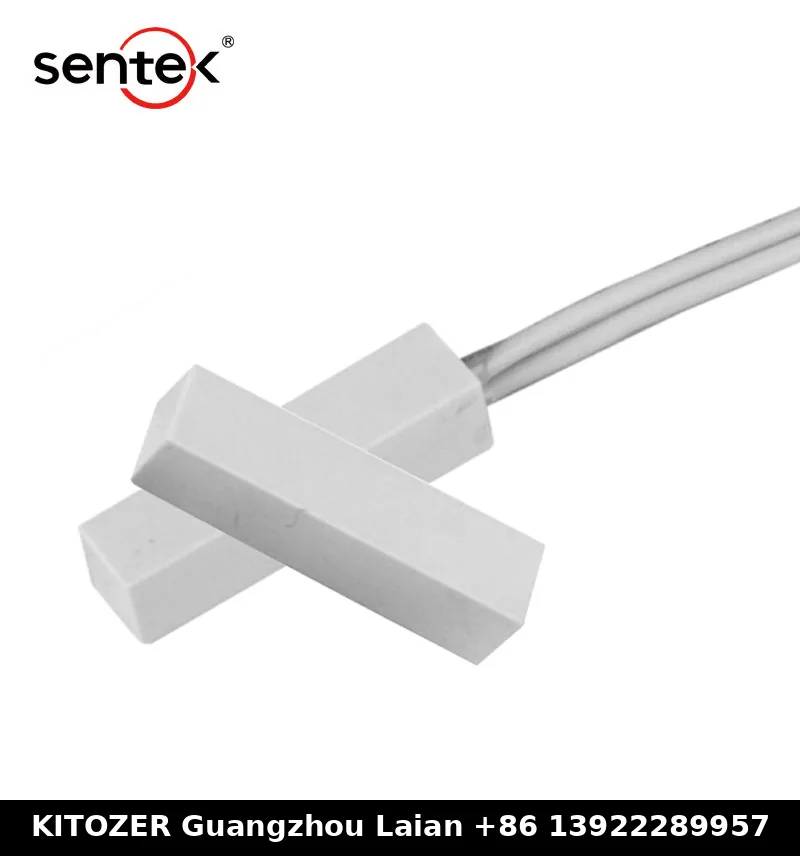
The KITOZER Magnetic Door Contact Switch is a widely used door and window status sensor manufactured by Guangzhou Laian Intelligent System Development Co., Ltd. under the KITOZER brand. It consists of a reed switch housed in the main unit and a separate permanent magnet. When the door or window closes, the magnet is close to the reed switch, closing the contacts. When the door opens, the magnet moves away, the contacts open, and an alarm signal is sent to the security system.
Door contact switches are the most basic and widely deployed sensors in intrusion alarm systems. They are installed on doors, windows, rolling shutters, gates, cabinets, and hatches to detect unauthorized opening. KITOZER offers a full range of door contact models: surface-mount plastic type, recessed cylindrical type, metal armored type, rolling shutter type, wireless type, and smart WiFi type, with reference prices ranging from 30 RMB to 300 RMB (approximately 4 to 42 USD) per pair.
KITOZER door contact switches use industrial-grade reed switches sealed in glass tubes, offering mechanical life of over 100 million operations and electrical life of over 100,000 operations under signal loads. The passive dry-contact output requires no external power and connects directly to any alarm panel, access control system, PLC, or IoT module. Products carry an 18-month warranty and are used in homes, shops, warehouses, data centers, banks, schools, hospitals, factories, and many other environments.
2. Working Principle
2.1 Reed Switch Structure
The core sensing element of a KITOZER door contact switch is a reed switch (also called a reed relay contact). Inside a glass tube filled with inert gas, two flexible ferromagnetic reeds overlap but do not touch. When an external magnetic field approaches, the reeds become magnetized with opposite poles at the overlapping ends and attract each other. When the magnetic force exceeds the spring tension of the reeds, the contacts close, completing the circuit. When the magnet moves away, the reeds spring back and the contacts open.
The reed contacts are made of rhodium or ruthenium alloy for low contact resistance and long life. Sealed in the glass tube away from air, the contacts do not oxidize or corrode, which is why reed switches outlast ordinary mechanical switches.
2.2 Permanent Magnet Field Distribution
The companion permanent magnet is made of ferrite or neodymium. Ferrite magnets are low-cost and lightweight for ordinary wooden doors. Neodymium magnets are stronger and smaller, suitable for larger installation gaps or metal doors that shield magnetic flux. The magnetic field follows a dipole distribution: strongest directly in front of the pole and decaying with the cube of distance. This is why the gap between magnet and reed switch is the critical installation parameter.
2.3 Operate and Release Distance
Door contact switches have two key distance parameters: operate distance (the gap at which contacts close as the magnet approaches) and release distance (the gap at which contacts open as the magnet moves away). The release distance is smaller than the operate distance; the difference is called hysteresis. Hysteresis prevents contact chatter when the magnet sits near the threshold. KITOZER door contacts are designed with reasonable hysteresis so the switch stays stable when the door is closed and reliably triggers when the door opens.
2.4 NO and NC Types
KITOZER door contacts are available in normally open (NO) and normally closed (NC) versions. NO contacts are open when the door is closed and close when the door opens, suitable for intrusion alarm zones. NC contacts are closed when the door is closed and open when the door opens; with an end-of-line resistor, NC wiring detects both door opening and cable cutting, making it the preferred choice for important doors.
3. Technical Parameters
| Parameter | KZ-DC100 Plastic Surface | KZ-DC200 Cylindrical Recessed | KZ-DC300 Metal Armor | KZ-DC400 Roller Shutter |
|---|---|---|---|---|
| Housing | ABS plastic | ABS cylinder | Zinc alloy | ABS plastic |
| Mounting | Surface screw | Recessed drill | Surface screw | Surface screw |
| Gap | 15mm | 20mm | 10mm | 30mm |
| Contact | NO/NC optional | NO/NC optional | NC | NC |
| Rating | DC100V/0.5A | DC100V/0.5A | DC100V/1A | DC100V/0.5A |
| Temp range | -20 to +60C | -20 to +60C | -30 to +70C | -20 to +60C |
| Dimensions | 60x15x10mm | 20x30mm | 70x20x15mm | 80x30x20mm |
| Reference price | $4-7 | $7-11 | $14-28 | $7-21 |
Additional parameters: contact resistance under 100 milliohms; insulation resistance over 1000 megaohms; mechanical life over 100 million operations; electrical life over 100,000 operations at DC30V/0.5A resistive load; humidity up to 95 percent non-condensing.
4. Selection Guide
4.1 By Door Material
Wooden doors: standard ferrite magnet and plastic surface-mount KZ-DC100 are sufficient.
Aluminum doors: aluminum does not shield magnetism, standard model works.
Steel security doors: steel shorts magnetic flux; choose neodymium strong magnet model with smaller gap, typically KZ-DC300 metal armored.
Roller shutter doors: use dedicated KZ-DC400 roller shutter contact with 30mm operate gap.
Glass doors: glass does not shield magnetism; use surface-mount contacts without drilling glass.
4.2 By Mounting Style
New construction with hidden wiring: choose recessed cylindrical KZ-DC200 for clean appearance.
Retrofit projects: choose surface-mount KZ-DC100 with screws.
Outside doors or anti-tamper needs: choose metal armored KZ-DC300.
4.3 By Wiring
If wiring is available: choose wired model for reliability.
If renovation without wiring: choose wireless KZ-DC500 (433MHz battery powered).
Smart home integration: choose WiFi KZ-DC600.
4.4 By Alarm Panel Type
Panel NO zones: use NO contact.
Panel NC zones: use NC contact with end-of-line resistor.
Wireless panel: use wireless transmitter.
Smart home hub: use Zigbee or WiFi contact.
5. Installation Requirements
5.1 Positioning
Mount the switch body on the door frame and the magnet on the door (or vice versa). They must align when the door closes, with gap within specification. Mount on the free edge of the door (away from hinges) so the magnet moves the maximum distance when the door opens. Typical mounting height is 1.4 to 1.6 meters above floor.
5.2 Fixing
Mark screw holes, drill 3mm pilot holes, and screw the switch and magnet in place. Ensure the door closes squarely with no misalignment. Metal doors use self-tapping screws or rivets.
5.3 Cable Routing
The switch lead exits through the frame cable hole and runs along the frame to the alarm panel. The door-side lead uses a flexible pigtail across the hinge so it does not break when the door opens and closes. Route cables through PVC trunking or galvanized conduit.
5.4 Commissioning
Use a multimeter to verify continuity: door closed equals contact state per model; door open equals opposite state. Test on the alarm panel: opening the door should trigger the zone, closing should restore. Repeat ten times to confirm reliable operation.
6. Use and Maintenance
6.1 Routine Inspection
Monthly: manually open and close each door to confirm the alarm panel receives the signal. Inspect housings and leads for damage.
6.2 Cleaning
Quarterly: wipe the housing with a soft cloth to remove dust and grease. Do not use chemical solvents. Check that screws are tight and magnets are secure.
6.3 Battery Replacement (Wireless)
Wireless models run 1 to 3 years on one battery. When the panel reports low battery, replace the battery promptly.
7. FAQ
From $4 to $42 per pair depending on model. Plastic surface type $4-7, recessed $7-11, metal armor $14-28, roller shutter $7-21, wireless $11-28.
No. It is a passive dry-contact device. The alarm panel supplies the loop voltage and detects continuity.
One per single door. Double doors can have one on the active leaf or one on each leaf.
Yes, but choose the neodymium strong magnet model. Steel shields magnetic flux, so standard ferrite magnets may not operate.
Mechanical life over 100 million operations. At 10 openings per day, the sensor lasts over 20 years.
The contact only detects door state; pets cannot open doors. It is installed at human height.
Yes. Small window contacts are available, starting at $3. Suitable for sliding and casement windows.
Wired is reliable and battery-free. Wireless is easy to install in finished interiors. Choose wired if cabling is possible.
Standard plastic contacts are for indoor use. Outdoor doors require sealed metal models.
Wire the NC contacts in series in the alarm loop, with a 2.2k ohm end-of-line resistor at the farthest contact. A break or door opening triggers the panel.
18 months. Defective units are replaced free within warranty.
Export models carry CE declaration. Domestic sales follow national standards.
8. Application Scenarios
8.1 Residential Homes
Entry doors, balcony doors, and windows all use KITOZER contacts. At night arming, any door or window opening triggers the siren and pushes a phone notification. A three-bedroom home typically uses 5 to 8 contacts.
8.2 Shops and Chains
Shop roller shutters and glass doors use roller shutter contacts plus surface contacts. Night arming alerts the security center. Chain stores share one monitoring platform.
8.3 Warehouses
Warehouse doors use metal armored contacts. Off-hours opening triggers alarms. Access records support traceability.
8.4 Data Centers
Server room, electrical room, UPS room, battery room, and water closet doors all use NC contacts with end-of-line resistors, integrated into the BMS and environmental monitoring system.
8.5 Banks and Vaults
Vault doors, teller windows, ATM rooms use metal armored anti-tamper contacts with dual contact redundancy. Any unauthorized opening triggers local siren and police notification.
9. Reed Switch Electromagnetics in Depth
9.1 Magnetic Circuit
When a permanent magnet approaches a reed switch, the magnetic flux passes through the ferromagnetic reeds. The reeds act as pole pieces, and the overlapping tips acquire opposite magnetic poles. The attractive force between the tips is proportional to the square of the flux density. When this force overcomes the reed’s spring tension, contacts snap shut. When the magnet moves away, flux drops, and the reeds open. This is a purely passive electromagnetic-mechanical process with no power required.
9.2 Contact Materials
KITOZER reed switches use rhodium or ruthenium plated contacts. These materials have low contact resistance, resist welding, and withstand small inductive loads. For alarm loop use (milliamps), contact wear is negligible. The sealed inert gas inside the glass tube prevents arcing and oxidation.
9.3 Why Reed Switch Instead of Hall Effect
Hall effect sensors are active semiconductor devices requiring power and signal conditioning. Reed switches are passive mechanical contacts that directly close the alarm loop, making them simpler and more compatible with legacy alarm panels. For door state sensing, reed switches remain the dominant technology.
9.4 Why Not Microswitch
Microswitches require physical contact between door and switch, needing mechanical actuators and more complex installation. Reed switches sense magnetically without contact, allowing misalignment tolerance and long life.
10. Mechanical Design Details
10.1 ABS Plastic Housing
Standard KITOZER contacts use UV-stabilized ABS plastic housings. ABS is tough, insulating, and available in white or brown to match doors. The housing is screw-mounted or glued. Leads exit through a molded strain relief.
10.2 Cylindrical Recessed Housing
Recessed contacts are cylindrical, 20mm diameter, installed into a drilled hole in the door frame. The magnet is similarly cylindrical. After installation, nothing protrudes, preserving the door appearance. Used in high-end residential and new construction.
10.3 Metal Armored Housing
Metal armored contacts use zinc alloy housings that resist tampering, drilling, and prying. Used on exterior doors, vaults, and high-security locations. The housing includes a tamper switch that triggers an alarm if the cover is removed.
10.4 Roller Shutter Contact
Roller shutter contacts have a larger operate gap (up to 30mm) because the shutter body and track have significant clearance. The switch mounts on the side track and the magnet on the shutter bottom bar. When the shutter rises, the magnet moves away and triggers the alarm.
11. Wired and Wireless Comparison
11.1 Wired Contacts
Wired contacts run two wires back to the alarm panel. Advantages: no battery, unlimited life, reliable signal, no RF interference. Disadvantages: requires cabling, more labor. Wired is preferred for new construction and important doors.
11.2 Wireless Contacts
Wireless contacts include a 433MHz transmitter and battery in the main unit. Advantages: no wiring, easy retrofit, movable. Disadvantages: battery replacement every 1-3 years, RF range limited by walls, potential interference. Wireless suits rental properties and retrofits.
11.3 Smart WiFi Contacts
Smart WiFi contacts connect directly to the home WiFi router and a mobile app. They provide open/close logs, low-battery alerts, and home automation triggers (e.g., turn on the light when the front door opens). Reference price $14-28.
12. Wiring and End-of-Line Resistor
12.1 NC Loop Wiring
For NC contacts: panel zone terminal -> contact 1 -> contact 2 -> next contact (series) -> end-of-line resistor -> panel other terminal. When the door is closed, the loop is closed with resistor, panel reads normal. Door opening breaks the loop, panel alarms. A cut wire also breaks the loop, giving tamper detection.
12.2 EOL Resistor Value
Use 2.2k ohm or 4.7k ohm resistor as required by the panel. Install the resistor at the farthest contact, not at the panel, so a cut wire is detected. Some panels support double EOL for normal/alarm/short-circuit three-state detection.
12.3 NO Loop Wiring
For NO contacts: panel -> contact 1 -> contact 2 -> EOL resistor -> panel. In normal (door closed) state, the loop is open with resistor; door opening closes the loop and triggers the panel.
13. Common Faults and Troubleshooting
| Symptom | Cause | Fix |
|---|---|---|
| No alarm on door open | Magnet misaligned, magnet weak, reed failed, wire broken | Realign, replace magnet, replace contact, check wiring |
| False alarms | Door not fully closed, frame warped, nearby magnetic field, vibration | Adjust door closer, repair frame, move away from speakers, add debounce |
| Constant alarm | Door not closed, magnet fell off, wire broken | Check door, refix magnet, check wiring |
| Metal door fails | Magnet too weak | Use neodymium magnet |
| Wireless no signal | Battery dead, too far, obstruction | Replace battery, add repeater, relocate |
14. Industry Standards
KITOZER door contacts comply with GB 10408.1 intrusion detector general requirements, GB 50348 security engineering standard, and EN 50131-2-6 for export. Products are RoHS compliant and CE declared. The company maintains a quality system with 100 percent final testing.
15. Packaging and Lead Time
Each pair (switch plus magnet) is individually bagged with screws and manual. 50 or 100 pairs per carton. Stock items ship in 3-7 days. Custom orders (special leads, colors, OEM) take 15-30 days. Export packaging uses standard cartons plus wooden crates for sea freight.
16. Door Contacts in Smart Homes
16.1 Smart Door Sensor Ecosystem
Smart door contacts are a cornerstone of the smart home. A typical smart home kit includes door/window sensors, motion sensors, temperature and humidity sensors, and a hub. The door sensor detects open/close events and triggers automations: turn on the entry light when the front door opens at night; close the curtain when the balcony door opens; pause the air conditioner when a window opens. KITOZER WiFi door contacts work with major smart home platforms.
16.2 Arming and Disarming
When the last family member leaves and closes the door, the smart contact triggers away mode: arm the alarm, turn off lights and air conditioning, start the robot vacuum. When the first person returns and opens the door, home mode disarms the alarm and turns on lights.
16.3 Elderly and Child Safety
Door sensors on elderly parents’ homes alert adult children if the door has not opened by a certain time, indicating possible illness. Window sensors on children’s rooms alert parents if a child opens a window unsupervised.
17. Door Contacts in Commercial Security
17.1 Commercial Alarm Panels
Commercial intrusion alarm panels support 8, 16, 32, or more zones. Each door contact occupies one zone. The panel has a built-in battery backup for 8+ hours. Users arm/disarm via keypad or app. KITOZER dry contacts connect directly to any panel.
17.2 Central Station Monitoring
Commercial systems often connect to a 24-hour central monitoring station. When a door contact triggers, the panel sends a signal via phone line or cellular to the station, which dispatches guards or police. KITOZER contacts are the front-end sensors for these monitored systems.
17.3 Duress and Panic
Door contacts are not panic buttons, but they integrate with panic buttons and duress codes. A robbery at gunpoint uses a duress code that disarms normally but secretly alerts the station.
18. Door Contacts in Data Centers
18.1 Server Room Access Control
Data center server rooms use badge access control, with door contacts as a redundant check. The access controller knows who swiped in; the door contact independently confirms the door opened and closed. If the door is propped open, the system alerts security.
18.2 Environmental Monitoring
Door contacts integrate with data center BMS. A door open event is logged with timestamp, correlated with temperature/humidity, and included in audit reports. Unusual after-hours door opens trigger SMS to on-call engineers.
18.3 Cage and Cabinet Access
In colocation data centers, individual customer cages and cabinets may have small door contacts. Customers are alerted when their cage door opens. KITOZER offers miniature contacts for cabinet use.
19. Door Contacts in Banks
19.1 Vault Door Monitoring
Bank vault doors have multiple independent sensors: access control reader, electric lock status, and a metal armored door contact. The contact confirms physical door state independent of the access system. Any unauthorized opening triggers immediate local siren and automatic police notification.
19.2 Teller Windows
Teller partition doors between public and back areas use door contacts. They should stay closed during business hours; unauthorized opening triggers an alarm.
19.3 ATM Vestibules
ATM vestibule doors use contacts linked to the ATM. After hours, any vestibule opening alerts the monitoring center. Video cameras record the event.
20. Door Contacts in Education
20.1 Schools
Schools arm door contacts after hours. Classroom and lab windows must stay closed. Chemical storage cabinets use special contacts. Emergency exits are monitored for unauthorized opening but allow free exit during drills.
20.2 Universities
University labs, server rooms, and archives use contacts. After-hours access is logged. Research labs with hazardous materials have stricter monitoring.
20.3 Kindergartens
Kindergarten perimeter doors use contacts to prevent children from leaving unsupervised. Doors are monitored, and staff are alerted if a door opens during the day.
21. Door Contacts in Healthcare
21.1 Pharmacies
Hospital pharmacies and drug storage rooms use contacts. After-hours opening triggers alarms. Access is logged for regulatory compliance.
21.2 Sensitive Departments
ICU, maternity ward, and nursery doors use access control plus contacts. Only authorized staff may enter. Unusual openings alert security.
21.3 Laboratories
Hospital labs with biohazard materials use contacts linked to access control and video.
22. Door Contacts in Industrial Settings
22.1 Machine Safety Interlocks
Machine guard doors and safety gates use contacts as safety interlocks. When the guard opens, the contact breaks the safety circuit and the machine stops. KITOZER industrial safety contacts have higher contact ratings to drive safety relays directly.
22.2 Explosive Hazard Areas
Chemical and oil facilities in explosive zones use intrinsically safe or explosion-proof contacts. The sealed reed contact itself is intrinsically safe, but the housing must meet Ex requirements.
22.3 Warehouses
Factory warehouses use contacts on each door. Off-hours opening triggers alarms. Integration with WMS logs every door event.
23. Door Contacts in Rolling Shutters and Gates
23.1 Roller Shutter Contacts
Roller shutter doors on shops, warehouses, and parking garages use dedicated roller shutter contacts. Unlike door contacts on hinged doors, the shutter travels vertically. The magnet is mounted on the bottom bar and the switch on the side track. When the shutter is fully closed, the magnet aligns with the switch. Opening raises the shutter and separates magnet from switch, triggering the alarm.
23.2 Gate Contacts
Swing gate and sliding gate motors include built-in open/close limit switches, but independent door contacts provide confirmation. Perimeter alarm systems gate contacts along with fence detection.
23.3 Garage Doors
Residential garage doors use either a built-in sensor in the opener or an external contact. After arming, any garage door opening triggers the alarm. Smart openers integrate with door contacts to confirm the door is closed before arming.
24. Door Contacts in Refrigerated and Cold Storage
24.1 Cold Room Door Contacts
Cold storage rooms operate at -25C or lower. Standard reed switches work down to -40C, but plastic housings become brittle. KITOZER offers low-temperature metal contacts rated to -30C. The magnet and switch are rated for freezer use.
24.2 Energy Management
Cold room door contacts integrate with building management systems. The contact logs door open time, correlated with refrigeration energy use. Frequent or prolonged door openings indicate inefficient use and trigger staff reminders.
24.3 Cooler and Freezer Doors
Supermarket reach-in coolers and freezers have door contacts that alert staff if a door is left open, preventing frost buildup and energy waste.
25. Door Contacts in Marine and Coastal
25.1 Salt Spray Environment
Ports and coastal facilities have salty, corrosive air. Standard plastic contacts may fail from UV and salt. KITOZER offers 316 stainless steel metal contacts for coastal use. The reed switch is already sealed; the housing and screws must resist corrosion.
25.2 Shipboard Applications
Ship cabin doors, equipment rooms, and watertight doors use contacts. Vibration at sea requires robust mounting and vibration-resistant reed switches.
26. Door Contacts in Energy and Utilities
26.1 Substations
Electrical substations are unmanned but critical. Substation building doors and transformer yard gates use contacts. After hours, any opening alerts the grid monitoring center. Cellular modules transmit the alarm because substations have no wired phone.
26.2 Wind and Solar Farms
Wind turbine nacelle and tower base doors use contacts. Unmanned turbines need to know when maintenance personnel access them. The contact status is transmitted via the wind farm SCADA system.
26.3 Pump Stations
Water and wastewater pump stations use contacts on electrical rooms. Remote monitoring detects unauthorized access and potential tampering.
27. Door Contacts in Transportation
27.1 Metro and Rail
Metro station equipment rooms, tunnel access doors, and substation doors use contacts integrated into the station integrated supervision system. Unauthorized door opening triggers station staff notification.
27.2 Airports
Airport restricted areas have access control and door contacts. Airfield equipment rooms and cargo areas require high-security monitoring.
27.3 Ports
Port warehouses and electrical rooms use contacts. Coastal salt air requires stainless housing.
28. Door Contacts in Hospitality
28.1 Hotels
Hotel linen rooms, pantries, and back-of-house storage rooms use contacts. Guest room doors use electronic locks with status reports, not simple reed contacts. Hotel management systems integrate door contact data.
28.2 Restaurants
Restaurant liquor storage and walk-in coolers use contacts. After-hours opening alerts the security service.
28.3 Resorts
Remote resort facilities use cellular-connected contacts because no landline exists. Solar power may supplement.
29. Door Contacts in Retail
29.1 Chain Stores
Chain retail stores standardize on one door contact model. Each store has multiple contacts on entrance doors, stockroom doors, and display cases. The central monitoring platform aggregates all store statuses.
29.2 Jewelry Stores
Jewelry display cases and vaults use metal armored contacts. After hours, any case opening triggers local siren and automatic police dispatch. High-security contacts include anti-tamper switches.
29.3 Pharmacies
Pharmacy controlled-substance cabinets use contacts. After-hours access triggers alarms and records video for regulatory compliance.
30. Door Contacts in Residential Detail
30.1 Apartment Buildings
Apartment front doors and balcony doors are the primary protected openings. Window contacts on ground-floor windows are recommended. Upper-floor windows can use contacts only on accessible windows. A typical apartment uses 3 to 5 contacts.
30.1.1 Housings Matching Decor
White ABS contacts match white PVC doors. Brown contacts match wooden doors. Recessed cylindrical contacts are invisible on renovated homes. KITOZER offers multiple colors on request.
30.2 Villas
Villas have more openings: front door, back door, garage door, garden gate, and multiple windows. The villa alarm system uses 10 to 20 contacts. Outdoor gates require weatherproof models.
30.3 Rental Properties
Landlords use wireless contacts in rental units to avoid drilling. The tenant arms/disarms with a code or app. The landlord receives alerts for long vacancies.
31. Door Contact Installation Practices
31.1 Survey Before Installation
A site survey identifies every opening, door material, wiring path, and panel location. The surveyor draws a wiring diagram and selects contact models per opening. This prevents mis-ordering and rework.
31.2 Mounting Height
Standard mounting height is 1.4 to 1.6 meters above floor, on the free edge of the door. This height balances easy commissioning, adult reach, and out of reach of children. Do not mount at door handles where people bump it.
31.3 Gap Measurement
After mounting, close the door and measure the gap between magnet and switch with feeler gauges. It must be less than the rated operate gap. If the gap is too large, the door may not close the contact reliably. Adjust shims as needed.
31.4 Double Door Installation
Double doors (master and leaf) mount the contact on the active leaf. The inactive leaf stays fixed with a flush bolt. If both leaves may open independently, each leaf gets its own contact.
31.5 Sliding Door Installation
Sliding doors mount the switch on the fixed frame and the magnet on the moving panel. Ensure the track does not create excess clearance. Test the full travel.
31.6 Wiring Conduit
Indoor wiring uses PVC trunking along wall corners. Outdoor wiring uses galvanized steel conduit. Never run contact wires parallel to mains power; maintain 20cm separation to avoid induced noise.
31.7 Commissioning Walk Test
After installation, perform a walk test: open each door/window one at a time, confirm the panel shows the correct zone, close and confirm restore. Repeat three times. Then test cable tamper: cut a wire (or simulate) and confirm the panel shows a fault.
32. Door Contact Maintenance Schedule
32.1 Monthly Test
Open and close each protected door. Confirm the alarm panel receives the signal. Note any delays or missed triggers.
32.2 Quarterly Inspection
Visually inspect housings, screws, and leads. Tighten loose screws. Clean dust. Check that magnets are not loose.
32.3 Annual Professional Service
An alarm technician visits annually to test the entire system including contacts, panel, battery, and siren. Replace aging contacts proactively.
32.4 Battery Replacement
Wireless contacts use 3V lithium batteries (CR2032 or ER18505). Battery life is 1 to 3 years depending on transmission frequency. When the panel reports low battery, replace within two weeks.
33. Door Contact Reliability Engineering
33.1 Mean Time Between Failures
KITOZER reed contacts have a rated mechanical life of 100 million operations. At 10 operations per day, MTBF exceeds 27,000 years of theoretical life. In practice, wire connections and housings fail before the reed switch. Good installation yields 10+ year system life.
33.2 Failure Modes
Contact failures are mostly: wire fatigue at flex points (door hinge leads), magnet demagnetization from heat or impact, housing damage from impact, and reed seal leakage after decades. KITOZER designs strain reliefs and uses high-coercivity magnets to minimize these.
33.3 Quality Control
Every KITOZER contact is tested on the production line: continuity check, operate distance check, and visual inspection. Rejected units are scrapped, not shipped. 18-month warranty backs quality.
34. Door Contact vs Other Sensors
34.1 Door Contact vs PIR Motion
Door contacts detect opening directly. PIR motion detects movement inside a room. They complement each other: contacts arm the perimeter, PIR covers interior. A contact on an always-open door (e.g., fire exit) may cause false alarms; PIR avoids this.
34.2 Door Contact vs Glass Break
Glass break sensors listen for the sound of breaking glass. Door contacts on windows detect opening. Glass break protects against smashed glass without opening; contacts protect against opening. High-security windows use both.
34.3 Door Contact vs Vibration
Vibration sensors detect forced entry by drilling or prying. Door contacts detect resulting opening. They are complementary on strong doors.
35. Door Contact Regulatory and Code
35.1 Fire Exit Doors
Fire exit doors must allow free egress during emergencies. Door contacts on fire exits are monitored for unauthorized opening but must not impede egress. Some jurisdictions require fail-safe electric strikes on fire doors.
35.2 Access Control Integration
Where door contacts are used with access control, the system must comply with local fire codes. The door must release automatically on fire alarm.
35.3 Data and Privacy
Door event logs are access control records. They may be subject to privacy regulations. KITOZER hardware does not store personal data; it is up to the system integrator to handle logs compliantly.
36. Door Contact OEM and ODM Services
KITOZER provides OEM and ODM services for security distributors and system integrators. Customers can brand the contact with their own logo, specify lead length, choose magnet strength, and customize packaging. MOQ for OEM is typically 500 pairs. Lead time 20-30 days. ODM design services develop custom form factors for specific projects.
37. Door Contact Pricing Structure
| Model | Unit Price | 100+ Price | 1000+ Price |
|---|---|---|---|
| KZ-DC100 plastic surface | $7 | $5.5 | $4 |
| KZ-DC200 recessed | $11 | $9 | $7 |
| KZ-DC300 metal armor | $28 | $22 | $16 |
| KZ-DC400 roller shutter | $21 | $16 | $12 |
| KZ-DC500 wireless | $28 | $22 | $16 |
| KZ-DC600 WiFi smart | $28 | $22 | $16 |
Prices are reference prices in USD. Actual quotes depend on order quantity, customization, and shipping terms. Contact KITOZER for a firm quote.
38. Door Contact Shipping and Logistics
Stock items ship from Guangzhou within 3 business days via express (DHL/FedEx) for small orders, or sea freight for bulk. KITOZER has exported to Southeast Asia, Middle East, Africa, Europe, and South America. Export cartons are labeled with model, quantity, and origin.
39. Door Contact Warranty Policy
KITOZER door contacts carry an 18-month warranty from the date of shipment. Defective units due to manufacturing are replaced free. The warranty does not cover damage from misuse, improper installation, impact, water immersion, or unauthorized modification. Out-of-warranty units are available at cost price for replacements.
40. Door Contact FAQ Extended
Yes, but avoid drilling glass. Surface-mount the switch and magnet on the door frame and glass panel with strong adhesive or small clips.
Shielded alarm wire up to 300 meters with 2.2k ohm EOL. Longer runs need heavier gauge or loop extenders.
Yes. They are simple dry contacts, compatible with every panel on the market.
Choose a stronger neodymium magnet model or surface-mount both units proud of the surfaces.
No. Painting may glue the reed or alter the magnetic path. Leave the housing unpainted.
No. Wired contacts have no radio. Wireless contacts use 433MHz, separate from WiFi.
The sealed reed is robust, but surge protection on the alarm panel is recommended for outdoor loops.
Use a multimeter on continuity. Door closed should read the contact state; door open should read the opposite.
Either orientation works. The flexible lead must be on the moving side, routed across the hinge with slack.
Miniature recessed contacts for cabinets are 16mm diameter, suitable for lockers and server cabinets.
41. Door Contact Selection Decision Tree
Step 1: Is the door wood, aluminum, steel, glass, or rolling shutter? Step 2: Is it new construction or retrofit? Step 3: Is wiring available? Step 4: Is the installation indoor or outdoor? Step 5: What is the security level? Following these steps: wood + new + wiring + indoor + standard -> KZ-DC100; steel + retrofit + no wiring + indoor + standard -> KZ-DC500 wireless; exterior + anti-tamper + high security -> KZ-DC300 metal armor; rolling shutter -> KZ-DC400.
42. Door Contact BOM for a Typical Project
A 100-unit residential project: 150 surface contacts KZ-DC100, 50 recessed contacts KZ-DC200, 20 roller shutter contacts KZ-DC400, 500 meters of 4-core alarm cable, 300 EOL resistors, 10 alarm panels. KITOZER supplies the complete BOM on request.
43. Door Contact Integration with Other Systems
43.1 Access Control Integration
Door contacts integrate with access control panels. The access event (card swipe) and the door contact event are correlated. If the door opens without a card swipe, it is forced entry.
43.2 VMS Video Integration
Door contact events trigger VMS cameras to record and pop up the relevant camera on the guard monitor. This provides visual verification of alarms.
43.3 Building Automation Integration
Door contacts in a BMS automatically turn on lights when a door opens after hours, and turn off HVAC when windows are open.
44. Door Contact Technical Glossary
Reed switch: a sealed electromechanical switch with ferromagnetic reeds actuated by a magnetic field.
Operate distance: the maximum gap at which the reed closes as the magnet approaches.
Release distance: the gap at which the reed opens as the magnet moves away.
Hysteresis: the difference between operate and release distances.
NO/NC: normally open / normally closed contact states.
EOL resistor: end-of-line resistor used for loop supervision.
Dry contact: a passive contact without inherent power, suitable for switching external low-voltage signals.
Magnetostriction: not relevant here; reed switches act on magnetic attraction, not magnetostriction.
45. Door Contact Case Studies
45.1 Case: Residential Villa in Guangzhou
A 500 square meter villa project used 18 KITOZER door contacts: 12 surface contacts on interior doors and windows, 4 recessed contacts on main doors, 2 roller shutter contacts on the garage. The wired alarm panel connected to a phone app. After one year of operation, no contact failures. The homeowner reports peace of mind when traveling.
45.2 Case: Chain Pharmacy
A pharmacy chain with 30 stores standardized on KITOZER contacts. Each store has 4 contacts: entrance door, stockroom, controlled-substance cabinet, and back door. The central monitoring platform shows all store statuses. Two break-in attempts were caught when contacts triggered after hours.
45.3 Case: Data Center Upgrade
A colocation data center replaced aging contacts with KITOZER metal armored NC contacts. 80 doors across 5 halls. The new contacts integrate with the existing BMS. After installation, no false alarms in six months.
45.4 Case: Bank Branch Retrofit
A bank branch retrofit replaced wired contacts without rewiring, using KITOZER wireless contacts on the vault and teller windows. The battery life exceeded expectations at 2.5 years.
45.5 Case: School After-Hours Protection
A primary school installed 40 contacts on classroom doors and windows. After arming at 6 PM, any opening triggers the security service. The school also uses contacts on the chemical storage cabinet for safety.
46. Door Contact History
Reed switches were invented in 1936 at Bell Labs. They were first used in telephone exchanges. In the 1970s, reed switches began to be used in home alarm systems as door contacts. The simple idea: a magnet on the door, a reed switch on the frame, a pair of wires to the panel. This design has remained essentially unchanged for 50 years because it works. KITOZER continues to refine housings and magnet strength but the underlying reed switch principle is proven and timeless.
47. Door Contact Market Trends
The door contact market is evolving: wireless and smart versions are growing faster than wired; Matter and Thread protocols are connecting door sensors to more ecosystems; miniaturized contacts fit into slimmer doors; long-life batteries (10 years) reduce maintenance; multi-sensor packages combine door contact with temperature, humidity, and light in one unit. KITOZER tracks these trends and will release new models accordingly.
48. Door Contact Competitive Landscape
The door contact market includes international brands (Bosch, Honeywell, Optex) with premium prices, and numerous Chinese manufacturers with competitive prices. KITOZER positions in the middle: industrial-grade quality at reasonable prices, with responsive service. Customers choose KITOZER for projects where reliability matters but premium brands are out of budget.
49. Door Contact Future Outlook
Future door contacts will likely integrate energy harvesting (no battery), LoRaWAN for long-range wireless, and rule-based edge event classification (distinguishing human door open from wind). KITOZER is evaluating these technologies. The basic reed switch will remain for its simplicity and reliability.
50. Door Contact Thank You
Thank you for reading the KITOZER Magnetic Door Contact Switch guide. We hope this document helps you select and deploy the right sensors. Contact KITOZER for quotes and technical support.
51. Detailed Operating Principle Deep Dive
51.1 Magnetic Flux Path
The permanent magnet creates a dipole field. When the reed switch is near one pole, flux enters one reed, traverses the overlap gap, returns through the other reed, and closes the magnetic circuit. The higher the flux density in the overlap region, the stronger the attractive force. Steel door frames provide a return path that actually helps when the magnet is mounted on steel; non-ferrous frames require careful alignment.
51.2 Reed Dynamics
The reeds are thin ferromagnetic strips clamped at one end and free at the other. Magnetic attraction pulls the free ends together. When contact closes, the reeds overshoot slightly and bounce, then settle. The sealed gas (usually nitrogen) suppresses bounce and arcing. Contact bounce lasts milliseconds and is typically filtered by the alarm panel.
51.3 Contact Rating Interpretation
The rating DC100V/0.5A means the contact can switch up to 100V DC at 0.5A. Alarm loops typically use 12V at 20mA, far below the rating. This large derating ensures long life. Do not switch mains voltage directly through a door contact; use an intermediate relay.
52. Detailed Installation Deep Dive
52.1 Door Hinge Side Wiring
The door-side lead must cross the hinge. Use a flexible pigtail with at least 10cm loop of slack so it does not pull when the door opens. Route the pigtail through a door cord protector or flexible conduit. Avoid sharp bends that fatigue the wire.
52.2 Corner Post Installation
Double doors with an astragal (overlap strip) need the contact mounted on the astragal side, not the meeting stile. The contact must bridge the overlap. Test with the door fully closed.
52.3 Metal Frame Isolation
When mounting on a metal frame, the contact housing may be physically grounded but electrically insulated. Ensure wires do not short against the frame. Use plastic mounting screws or insulated bushings.
53. Detailed Maintenance Deep Dive
53.1 Reed Switch Replacement
If a reed switch fails, replace the whole contact, not the reed, because the sealed glass tube cannot be opened. KITOZER recommends replacing with the same model for consistent magnet matching.
53.2 Magnet Degaussing
If a magnet becomes weak (from years of heat), replace it. A weak magnet shows a smaller operate distance. Test by measuring operate gap; if below 50 percent of rated, replace.
53.3 Corrosion Prevention
Outdoor contacts should be inspected annually for corrosion. Clean with vinegar and a brush if mild rust appears. Replace if housing is pitted.
54. Door Contact Acoustic and Vibration
Reed contacts produce an audible click when the reed closes. In quiet rooms, this click can be heard. If silence is required (e.g., recording studios), choose a sealed metal contact that muffles the click. Vibration can cause reed chatter; use debounce in the panel or choose a high-hysteresis contact.
55. Door Contact for Cabinet and Locker Monitoring
Beyond doors and windows, door contacts monitor cabinets, lockers, and drawers. Medication cabinets, gun safes, server cabinets, and museum display cases all benefit from contact sensors. KITOZER miniature contacts fit in tight cabinet spaces. When a controlled cabinet opens, the system logs the event and, in high-security cases, triggers an alarm.
56. Door Contact for Freezer and Cold Chain
Cold chain logistics monitors freezer truck doors. A freezer door left open during transport causes product spoilage. KITOZER low-temperature contacts on freezer doors transmit open/close events to the truck telematics system, alerting the driver.
57. Door Contact for Smart Refrigerators
Smart home appliances use micro reed contacts to detect refrigerator and oven door state. KITOZER supplies OEM reed contacts to appliance manufacturers. The same technology, smaller form factor.
58. Door Contact for Electrical Safety
Low-voltage switchgear cabinets use door interlock contacts. When the cabinet door opens, the contact trips the safety circuit and de-energizes the cabinet. This prevents accidental contact with live parts. KITOZER industrial contacts with higher ratings are used here.
59. Door Contact for Elevator
Elevator shaft doors use multiple door contacts per floor. The elevator cannot run if any landing door is open. These contacts are part of the elevator safety circuit and must meet elevator safety standards. KITOZER supplies contact switches for elevator modernization.
60. Door Contact for Fire Doors
Fire doors must remain closed in a fire. Door contacts monitor whether the fire door is propped open. If a fire door is held open by a magnet, the contact reports its status. In fire alarm, the magnet releases and the door closes. KITOZER fire door contacts integrate with fire alarm systems.
61. Door Contact for Bathroom and Wet Areas
Bathroom and sauna doors use contacts for occupancy sensing (not security). A contact detects when the bathroom is occupied, and the display panel shows availability. Sealed contacts resist steam.
62. Door Contact for Wine Cellar
Residential wine cellars use contacts to log temperature/humidity when the door opens, and to alert if unauthorized access occurs. The contact is typically discreet and wired to the home automation system.
63. Door Contact for Gun Safe
Gun safe manufacturers embed contacts that log safe openings. Some smart safes send an alert when the safe is opened. KITOZER supplies OEM contacts for safe makers.
64. Door Contact for Mailbox and Parcel Locker
Smart mailbox contacts notify homeowners when mail arrives. Parcel locker contacts confirm package pickup. These are low-cost wireless contacts, similar to home alarm contacts but smaller.
65. Door Contact for Pet Doors
Pet doors use contacts to log pet entry/exit. Pet owners track pet activity. The contact is small and battery-operated.
66. Door Contact for Greenhouse
Greenhouse vents use contacts to know if the vent is open or closed. The climate control system uses this information to adjust ventilation.
67. Door Contact for Chicken Coop
Agricultural uses include chicken coop door monitors. Farmers know if the coop door closed at night, protecting birds from predators. Solar-powered wireless contacts suit remote farms.
68. Door Contact for Boat and RV
Boat cabins and RV storage bays use waterproof contacts. Vibration-resistant mounting handles travel. Low-power wireless contacts transmit to the owner’s phone when away.
69. Door Contact for Tiny Home and Cabin
Off-grid tiny homes use battery-powered wireless contacts. The door contact alerts the owner if someone approaches. Solar charging keeps the hub running.
70. Door Contact for Studio and Workshop
Home studios and workshops use contacts on the supply closet and tool cabinet. The owner knows if someone accessed restricted tools. Industrial-looking metal contacts match the workshop aesthetic.
71. Door Contact Electrical Details
71.1 Loop Voltage
Most alarm panels supply 12V DC or 6V DC to the loop. The contact switches this low voltage. Never connect door contacts to 220V mains; the reed rating is only 100V DC, and mains would destroy the contact and create a hazard.
71.2 Loop Current
Alarm loop current is typically 10 to 30 milliamps. The reed contact easily handles this. Contact resistance under 100mΩ means negligible voltage drop.
71.3 Surge Protection
Outdoor loops exposed to lightning need surge protection devices at the panel end. The reed itself is robust, but the wire can conduct a surge into the panel. A small gas discharge tube suppresses surges.
71.4 Shielding
For long loops near heavy machinery, use shielded cable. The shield drains noise. Ground the shield at one end only to avoid ground loops.
72. Door Contact Mechanical Details
72.1 Screw Types
Plastic housings use self-tapping screws into the plastic boss. Metal housings use machine screws with wall anchors. KITOZER includes matching screws with each contact.
72.2 Adhesive Mounting
Some small contacts can be adhesive-mounted for temporary use. However, screws are preferred for permanent installation because adhesive can fail over time, especially in temperature extremes.
72.3 Alignment Tolerance
Magnet-to-switch lateral alignment should be within 2mm. Vertical gap within rated distance. Misalignment reduces effective magnetic field. If the door is warped, the contact may not close at one corner; test the door in its fully closed position.
73. Door Contact Environmental Details
73.1 Temperature
Standard contacts work -20 to +60C. Below -20C, plastic becomes brittle and reed response slows. Above 60C, magnets lose strength. Use industrial metal contacts for extreme ranges.
73.2 Humidity
Indoor contacts handle up to 95 percent non-condensing. Outdoor sealed contacts handle rain. Avoid immersing in water.
73.3 UV Exposure
UV-stabilized ABS resists sun. Non-stabilized plastic yellows and becomes brittle after years outdoors. Choose UV-rated for outdoor.
74. Door Contact Wireless Protocol Details
74.1 433MHz
Traditional wireless door contacts use 433MHz ASK/OOK modulation. Low cost, good wall penetration, but limited bandwidth and prone to interference. Suitable for basic alarms.
74.2 Zigbee
Zigbee contacts mesh with other Zigbee devices. Longer range with repeaters, more secure, but requires a Zigbee hub.
74.3 WiFi
WiFi contacts connect directly to the router. Higher power consumption (battery lasts 6-12 months), but no hub required. Good for single-door smart home use.
74.4 LoRaWAN
LoRaWAN contacts transmit miles, ideal for remote sites. Battery lasts 5+ years. Requires a LoRaWAN gateway.
75. Door Contact Security Details
75.1 Contact Reed Tampering
A determined intruder could bring a strong magnet near the contact to keep it closed while opening the door. Anti-magnet tamper contacts include a second reed that detects external magnets and triggers an alarm. Important doors should use anti-tamper metal contacts.
75.2 Cable Cutting
NC loop with EOL resistor detects cable cutting. If an intruder cuts the wire before opening the door, the panel sees an open loop and alarms. This is why NC loops are preferred for security.
75.3 Wireless Jamming
Wireless contacts are vulnerable to jamming. Good panels detect jamming and alert. Use wired for high-security locations.
76. Door Contact Certification
KITOZER exports carry CE, RoHS, and FCC declarations. Domestic products meet GB standards. Test reports are available on request. The factory follows ISO 9001 quality management principles.
77. Door Contact FAQ Final Set
No. Use one type per loop. Mixing confuses EOL supervision.
Use 22/4 or 18/4 alarm wire. Longer runs use 18 gauge.
As many as needed in series on an NC loop. But more contacts mean more points of failure; group by area.
No. Paint can glue the reed or block the magnet. Leave unpainted.
Email or call KITOZER. Provide model, quantity, shipping address. Proforma invoice is issued. Payment by T/T, PayPal, or Western Union for small orders.
78. Door Contact in Office Buildings
78.1 Common Corridor Doors
Office buildings have many corridor doors to stairwells, electrical rooms, and mechanical rooms. These use door contacts to monitor after-hours access. The building security center sees which doors were opened overnight and investigates.
78.2 Executive Offices
Executive offices may have private storage closets with contacts. Human resources and finance file rooms use contacts. After hours, any opening is logged.
78.3 Server Closets
Small server closets in offices use contacts linked to access control. Only authorized IT staff may enter. Vibration and temperature sensors complement the contact.
79. Door Contact in Co-working Spaces
Co-working spaces have lockers, phone booths, and storage rooms. Members use smart locks, and contacts confirm door state. The space manager sees usage patterns.
80. Door Contact in Clinics
Dental and veterinary clinics use contacts on medicine cabinets and sterile supply rooms. After-hours access is monitored.
81. Door Contact in Gyms
Gym storage rooms and equipment closets use contacts. The front desk monitors when staff are away.
82. Door Contact in Spas
Spas use contacts on product storage and linen rooms. Quiet zones use contacts to alert staff when clients enter restricted areas.
83. Door Contact in Art Galleries
Galleries use contacts on artwork storage and rear doors. High-value pieces require monitored access. Video verification follows contact events.
84. Door Contact in Museums
Museum collection storage has strict access control. Door contacts log every opening. Environmental controls (temperature, humidity) are linked to door events because opening a door changes the microclimate.
85. Door Contact in Libraries
Library archival storage uses contacts. Rare book rooms have restricted access. After-hours openings trigger alarms.
86. Door Contact in Courthouses
Courthouse evidence rooms and holding cells use high-security contacts. Every access is logged and reviewed.
87. Door Contact in Police Stations
Police evidence lockers and armories use dual redundant contacts. Any unauthorized opening triggers immediate internal investigation.
88. Door Contact in Post Offices
Post office vaults and registered mail rooms use contacts. After hours, openings are monitored by security.
89. Door Contact in Banks Teller Cages
Teller cages use contacts on the teller partition door. The door should stay closed during business hours. Forced opening triggers an alarm.
90. Door Contact in Convenience Stores
Convenience stores use contacts on the front door and stockroom. Night shifts benefit from monitored doors. Some stores use contacts on the ATM kiosk door.
91. Door Contact in Gas Stations
Gas station convenience stores and pump island equipment cabinets use contacts. Forecourt is open 24/7 but the stockroom and office are secured after hours.
92. Door Contact in Restaurants
Restaurant liquor storage and walk-in freezers use contacts. Walk-in freezer doors left open waste energy and risk food spoilage.
93. Door Contact in Cafes
Cafe pastry cases and back storage use contacts. Night security monitors any opening.
94. Door Contact in Bakeries
Bakery ingredient storage uses contacts. Early morning access by bakers is logged.
95. Door Contact in Butcher Shops
Butcher cold rooms use low-temperature contacts. Food safety regulations require temperature monitoring, and door events are part of the log.
96. Door Contact in Florists
Florist coolers use contacts to prevent door ajar. Flower quality depends on consistent refrigeration.
97. Door Contact in Furniture Stores
Furniture store warehouses use contacts. Large rolling warehouse doors need roller shutter contacts.
98. Door Contact in Car Dealerships
Car dealership showrooms and service areas use contacts. Key cabinets and parts rooms are monitored. After-hours vehicle movement is detected by contacts on the service bay doors.
99. Door Contact in Auto Repair Shops
Auto repair parts rooms and tool cribs use contacts. Technician access is logged.
100. Door Contact in Parking Garages
Parking garage electrical rooms and elevator machine rooms use contacts. Pedestrian emergency stairwell doors are monitored for propped-open state.
101. Door Contact in Roof Access
Roof access doors on commercial buildings use contacts. Unauthorized roof access is a safety and liability risk. Contacts alert security if the roof door is opened.
102. Door Contact in Mechanical Rooms
HVAC mechanical rooms and electrical rooms in commercial buildings use contacts. Only facilities staff should enter. Integration with the building automation system logs all entries.
103. Door Contact in Telecom Cabinets
Telecom outdoor cabinets and equipment shelters use contacts. Unauthorized cabinet opening alarms the network operations center. Contacts are weatherproof and vibration-resistant.
104. Door Contact in Fiber Nodes
Fiber optic termination boxes use small contacts. Node tampering disrupts service, so contacts protect these critical points.
105. Door Contact in Traffic Control Cabinets
Traffic signal control cabinets at intersections use contacts. Cabinet opening alerts the traffic management center to unauthorized access or tampering.
106. Door Contact in Lighting Control
Street lighting control cabinets use contacts. Theft of copper or electronics is a common problem; contacts trigger alarms.
107. Door Contact in Water Meters
Smart water meter boxes sometimes include contacts to detect unauthorized meter access. Utility companies use this for anti-tampering.
108. Door Contact in Gas Meter Boxes
Gas meter box contacts alert the utility if the meter enclosure is opened. Gas theft and tampering are detected.
109. Door Contact in Electrical Panels
Commercial electrical panels have door contacts as part of the safety system. Panel opening triggers an alarm or lights the room. Industrial standards may require this.
110. Door Contact in ATMs
ATM cabinets and vestibules use contacts. Skimming attacks often involve opening the ATM cabinet; contacts detect this immediately.
111. Door Contact in Vending Machines
Vending machine payment and storage compartments use contacts. Unauthorized opening triggers an alert to the vending company. Some machines include their own reed contacts.
112. Door Contact in Kiosks
Information kiosks and ticketing machines use contacts on their service access panels. Cash collection events are logged.
113. Door Contact in Safe Deposit Boxes
Bank safe deposit box vaults use contacts on the vault door. Individual box access is via lock, not contact, but the vault perimeter is monitored.
114. Door Contact in Jewelry Cases
Jewelry display cases in stores use miniature contacts. After hours, any case opening triggers the alarm. Glass break sensors complement the contacts.
115. Door Contact in Art Display
High-value art in galleries and museums uses contacts on wall cases. A contact detects if the protective cover moves.
116. Door Contact in Wine Cabinets
Residential wine cabinets use contacts for smart home integration. Temperature/humidity sensors plus door contact give complete cellar monitoring.
117. Door Contact in Gun Safes
Gun safe manufacturers integrate contacts to log safe openings. Some smart safes alert the owner via phone when accessed.
118. Door Contact in Medication Cabinets
Home and pharmacy medication cabinets use contacts. Families with teenagers monitor access to prescription drugs. Nurse call systems in hospitals log med cart access.
119. Door Contact in Cleaning Cabinets
Commercial cleaning closets in office buildings use contacts to prevent unauthorized access to cleaning chemicals and equipment.
120. Door Contact in Janitor Closets
School janitor closets are locked and sometimes contact-monitored to prevent student access.
121. Door Contact in Boiler Rooms
Boiler rooms are high-temperature mechanical spaces. Contacts on the door log access. Only certified technicians should enter.
122. Door Contact in Chiller Plants
Central plant chiller rooms in large buildings use contacts. Environmental monitoring (water leak, temperature) complements door access logs.
123. Door Contact in Emergency Exit Doors
Emergency exit doors are monitored but not locked. Contacts log when exits are used. Unusual after-hours exit use is investigated.
124. Door Contact in Stairwell Doors
Stairwell doors in high-rises are typically locked on each floor. Contacts detect when the stairwell door is propped open, which compromises fire compartmentation.
125. Door Contact in Smoke Barriers
Fire smoke barrier doors must close automatically. Contacts confirm the door is closed. Propped doors are reported to building management.
126. Door Contact FAQ Deep Dive
No. Door contacts detect open/close position only. Lock status requires a separate electric lock monitor or lock sensor.
They are the same thing. Different industries use different names: alarm industry says door contact; elevator and machine safety industry says door interlock switch.
Yes, for light-duty non-critical applications. The reed contact can switch small DC loads. For safety-critical machine interlocks, use certified safety switches, not alarm door contacts.
Measure the operate gap. Close the door fully, measure between magnet and switch. If the gap is less than 70 percent of rated, it works. If larger, upgrade to neodymium magnet.
Check the EOL resistor. If the resistor is missing or wrong value, the panel cannot recognize the normal state. Also check for a short across the loop wires.
Yes, data cables are low voltage and low noise. Avoid parallel with 220V power for more than 30cm.
Disconnect power, wipe with electrical contact cleaner. Do not spray into the reed housing. If corrosion is on the reed pins, replace the contact.
Modern wireless contacts with rolling code encryption are reliable for residential use. For commercial high-security, wired is preferred.
Yes, with a weatherproof metal housing. Standard plastic contacts are indoor only. Outdoor contacts should be in a protective enclosure if possible.
Standard 30cm. Longer leads available on request. Do not extend by splicing inside the wall; use pre-made lead lengths.
Metal armored contacts with anti-tamper are best. Plastic magnet blocks can be pried off; screws should be security screws.
Yes. Mount switch on the fixed frame and magnet on the sliding panel. Test full travel to ensure alignment.
Basic installation with screws is straightforward. Wiring to the alarm panel requires a technician. DIY users should choose wireless self-contained kits.
127. Door Contact Installation Mistakes to Avoid
127.1 Mounting on the Hinge Side
A common mistake is mounting the contact near the hinges, where the door moves very little. The contact should be on the free edge opposite the hinges so the magnet moves far enough to release.
127.2 Oversized Gap
Mounting both units proud of uneven surfaces creates a gap larger than rated. The reed never closes reliably. Use shims to bring the surfaces flush.
127.3 Wrong Magnet Polarity
Reed switches generally work with either polarity, but some models are polarized. If a contact does not close, flip the magnet around.
127.4 Running Parallel to Mains
Contact wires parallel to 220V cables pick up induced noise and cause false alarms. Cross at right angles or maintain separation.
127.5 Missing EOL Resistor
On NC loops, omitting the EOL resistor at the end of line means the panel cannot distinguish normal from cut wire. Always install the resistor at the farthest contact.
127.6 Door-Side Lead Too Short
The lead across the hinge must have slack. A tight lead pulls out when the door opens, breaking the wire.
128. Door Contact Testing and Commissioning
128.1 Continuity Test
Before connecting to the panel, use a multimeter. Door closed: contact state per model. Door open: opposite. If not, realign or replace.
128.2 Walk Test
Put the panel in walk test mode. Open each door one at a time. The panel beeps and shows the zone. Close and confirm restore.
128.3 Tamper Test
Simulate a cable cut by disconnecting one wire at the panel. The panel should show a fault. Restore and confirm normal.
128.4 72-Hour Burn-In
For critical installations, leave the system armed for 72 hours. Any false alarms during burn-in are investigated before handover.
129. Door Contact Documentation
Good alarm system documentation includes: zone list with door descriptions, contact model per door, wiring diagrams, commissioning test results, and user instructions. KITOZER provides product datasheets and installation manuals in English for export projects.
130. Door Contact Training for Installers
KITOZER provides installation training for distributors and system integrators. The training covers: contact types, mounting best practices, wiring, troubleshooting, and system design. Certified installers receive a KITOZER installation certificate.
131. Door Contact in Data Center Cage Detail
Colocation data centers divide halls into customer cages. Each cage has a door with a contact. The contact reports cage door state to the data center BMS. The cage owner sees when their cage was accessed. Maintenance staff must badge in, and the contact logs physical opening independent of the access reader. This dual confirmation prevents tailgating and missed access events.
132. Door Contact in Server Cabinet Detail
Individual server cabinets sometimes have miniature contacts. Smart cabinet PDUs with environmental monitoring include a door contact. When the cabinet door opens, the system records who opened it and when. This is required for compliance in some regulated industries.
133. Door Contact in Electrical Room Detail
Electrical rooms in commercial buildings have locks and contacts. Only licensed electricians may enter. The contact log is part of the building safety record. Some jurisdictions require this monitoring.
134. Door Contact in UPS Room Detail
Uninterruptible power supply rooms use contacts. The UPS itself reports battery status, but the door contact adds physical security. Unauthorized UPS room access could lead to tampering with critical power.
135. Door Contact in Battery Room Detail
Battery rooms with lead-acid batteries have corrosive fumes. Metal contacts with corrosion-resistant housing are used. Ventilation interlocks may also tie to door contacts.
136. Door Contact in Generator Room Detail
Backup generator rooms use contacts. The generator may run automatically; door access during operation is hazardous. Safety interlocks stop the generator if the door opens.
137. Door Contact in Fire Pump Room Detail
Fire pump rooms require limited access. Contacts log entries. The fire pump must remain operational; unauthorized access could interfere.
138. Door Contact in Sprinkler Riser Room Detail
Sprinkler riser rooms are small mechanical spaces. Contacts monitor access. The fire suppression system must not be disturbed.
139. Door Contact in Transformer Room Detail
Transformer rooms are high-voltage hazard areas. Contacts are part of the safety interlock. Only qualified electricians enter, and every entry is logged.
140. Door Contact in Switchgear Room Detail
Medium-voltage switchgear rooms use contacts with safety interlocks. Door opening de-energizes the switchgear per safety standards. KITOZER industrial contacts support this.
141. Door Contact in Battery Energy Storage Detail
Utility-scale battery energy storage systems (BESS) have containerized battery rooms. Each container door uses a contact. Thermal runaway incidents are rare, but physical access monitoring is required.
142. Door Contact in Solar Inverter Room Detail
Solar inverter rooms and outdoor inverter cabinets use contacts. Inverter theft is a problem; contacts alert operators.
143. Door Contact in Wind Turbine Detail
Wind turbine tower base doors and nacelle doors use contacts. Unmanned turbines need to know when accessed. The contact signal goes via the turbine SCADA.
144. Door Contact in Hydroelectric Plant Detail
Hydroelectric plant intake gates and turbine chambers use contacts. Access is strictly controlled due to water hazard.
145. Door Contact in Nuclear Plant Detail
Nuclear power plant controlled areas use multiple contact layers. Radiation zones require dosimetry and access logs. KITOZER contacts are not directly used in radiation zones, but support areas use standard contacts.
146. Door Contact in Refinery Detail
Refinery explosion-proof areas use intrinsically safe contacts. Zinc-plated or 316 stainless housing. The reed contact itself is inherently safe, but the circuit must be certified.
147. Door Contact in Chemical Plant Detail
Chemical plant storage warehouses for hazardous materials use contacts with tamper. Spill response plans reference access logs.
148. Door Contact in Pharmaceutical Plant Detail
Pharmaceutical cleanrooms use contacts on airlock doors. Cleanroom pressure differentials depend on door state; contacts interlock HVAC.
149. Door Contact in Food Plant Detail
Food processing plants use washdown-rated contacts in wet areas. Stainless housing. Hygienic design.
150. Door Contact in Beverage Plant Detail
Beverage bottling lines have control cabinets with door interlocks. Safety stops the line if a cabinet door opens during operation.
151. Door Contact in Textile Mill Detail
Textile mills have lint and dust. Contacts must be sealed to prevent lint ingress. Motor control cabinets use safety interlock contacts. Fires in textile mills are a risk; door contacts on hazardous areas integrate with fire alarm.
152. Door Contact in Paper Mill Detail
Paper mills have high humidity. Stainless contacts resist corrosion. Roll storage warehouses use contacts on bay doors.
153. Door Contact in Printing Plant Detail
Printing plants have ink and solvent storage. Explosion-proof contacts in the ink storage area. Plate and film storage use standard contacts.
154. Door Contact in Woodworking Shop Detail
Woodworking shops have dust collectors. Dust collection cabinets use safety interlock contacts. Saw enclosures require machine guard contacts.
155. Door Contact in Metal Fabrication Detail
Machine guard doors on press brakes and laser cutters use safety contacts. Opening the guard stops the machine. KITOZER industrial safety contacts are rated for safety circuits.
156. Door Contact in Welding Shop Detail
Welding shops have heavy equipment. Cabinet doors for welders use interlock contacts. Fume hood access panels use contacts.
157. Door Contact in Paint Shop Detail
Paint spray booths are explosion-hazard areas. Contacts must be intrinsically safe. Booth access doors interlock the ventilation.
158. Door Contact in Plating Shop Detail
Plating shops have corrosive chemicals. Stainless contacts resist acid fumes. Chemical storage cabinets use contacts.
159. Door Contact in Assembly Line Detail
Automated assembly lines have safety fences with interlock contacts. Opening a fence gate stops the line. Safety-rated contacts required.
160. Door Contact in Warehouse Management Detail
Smart warehouses use door contacts on each dock door. The WMS knows when a dock is open for loading. HVAC adjusts per dock activity.
161. Door Contact in Cold Chain Warehouse Detail
Cold storage warehouses have cooler and freezer rooms. Low-temperature contacts log door activity. Energy management correlates door open time with refrigeration load.
162. Door Contact in Hazardous Materials Warehouse Detail
Hazmat warehouses have classified storage rooms. Contacts on each room door. Access logs are required by environmental regulations.
163. Door Contact in Bonded Warehouse Detail
Bonded warehouses hold goods under customs seal. Door contacts log all access. Customs authorities require audit trails.
164. Door Contact in Pharma Warehouse Detail
Pharmaceutical warehouses require temperature monitoring. Door contacts correlate door events with temperature deviations. Good distribution practice requires this documentation.
165. Door Contact in Document Storage Detail
Document storage facilities have restricted access. Contacts on each archive room. Fire suppression uses gas, so door interlocks release when alarm triggers.
166. Door Contact in Record Center Detail
Record centers monitor access to each vault. Individual filing cabinets can have miniature contacts for high-sensitivity files.
167. Door Contact in Money Counting Room Detail
Bank money counting rooms use high-security contacts. The room is a cage within a cage. Video recording is continuous.
168. Door Contact in Check Cashing Detail
Check cashing and payday loan stores have high-risk cash handling. Contacts on the cash office door. Panic buttons complement contacts.
169. Door Contact in Pawn Shop Detail
Pawn shops have high-value inventory display cases. Contacts on cases and the back door. After-hours burglary risk is high.
170. Door Contact in Gun Shop Detail
Gun shops have display cases and gun safes. Contacts on every case. Regulatory compliance requires logged access to firearms.
171. Door Contact in Liquor Store Detail
Liquor stores have back rooms with high-value inventory. Contacts on the back door and stockroom. Shoplifting deterrents are separate from security contacts.
172. Door Contact in Tobacco Shop Detail
Tobacco shops store high-value cigarettes. Contacts on the stockroom. After-hours monitoring required.
173. Door Contact in Convenience Store Back Office Detail
Convenience store back offices hold safes and security equipment. Contacts on the office door. Night audit staff secure the office.
174. Door Contact in Fast Food Restaurant Detail
Fast food restaurants have dry storage and walk-in freezers. Contacts on freezer doors prevent energy waste. Cash office door uses contacts.
175. Door Contact in Buffet Restaurant Detail
Buffet restaurants have large walk-in coolers. Door ajar alerts save energy and food.
176. Door Contact in Hotel Back Office Detail
Hotel back offices hold cash, keys, and security equipment. Contacts on the office door. Housekeeping floors have linen closets with contacts.
177. Door Contact in Hotel Pantry Detail
Hotel pantries and mini-bars use contacts for inventory management. Stock levels are tracked remotely.
178. Door Contact in Hotel Laundry Detail
Hotel laundry rooms have industrial washers and dryers. Door contacts on the chemical storage closet. Detergent inventory is managed.
179. Door Contact in Hotel Kitchen Detail
Hotel kitchen walk-in coolers use low-temperature contacts. Kitchen storage rooms use standard contacts. Fire suppression systems are separate.
180. Door Contact in Hotel Safe Detail
Hotel front office safes and safety deposit boxes use contacts. Guest safety deposit box access is logged.
181. Door Contact in Hospital Pharmacy Detail
Hospital pharmacy narcotic cabinets use contacts. Every access is logged for DEA compliance. Nurses must badge in; the contact confirms the door opened.
182. Door Contact in Hospital Supply Room Detail
Hospital central supply and sterile processing rooms use contacts. Access is restricted to authorized staff.
183. Door Contact in Hospital Laboratory Detail
Hospital lab blood bank and pathology rooms use contacts. Specimen integrity depends on controlled access.
184. Door Contact in Hospital Nursery Detail
Hospital nurseries have access control with contacts. Infant abduction prevention systems integrate contacts and door readers.
185. Door Contact in Hospital ICU Detail
ICU doors have access control and contacts. Visitors must be buzzed in. The contact logs every door open event.
186. Door Contact in School Lab Detail
School chemistry labs have chemical storage cabinets with contacts. Only teachers can access hazardous chemicals. Students must not access after hours.
187. Door Contact in School Boiler Room Detail
School boiler rooms are locked. Contacts detect unauthorized student access. Safety is critical.
188. Door Contact in School Safe Room Detail
Schools have safe rooms for lockdown. Contacts on the safe room door confirm it is secured during lockdown.
189. Door Contact in University Lab Detail
University research labs with hazardous materials use contacts. Principal investigators control access. After-hours access is logged.
190. Door Contact in University Server Room Detail
University IT server rooms use contacts with access control. Only IT staff may enter. Environmental monitoring complements physical security.
191. Door Contact in Kindergarten Gate Detail
Kindergarten perimeter gates use contacts. Children must not leave unsupervised. Staff are alerted if a gate opens during hours.
192. Door Contact in Playground Fence Detail
Some playgrounds have gates with contacts. Children leaving the playground alert staff.
193. Door Contact in Home Nursery Detail
Home daycares use contacts on exterior doors. Parents know when the caregiver opens the door.
194. Door Contact in Elderly Care Detail
Elderly care facilities use contacts on exterior doors. Residents with dementia may wander. The contact alerts staff if a resident exits unsupervised.
195. Door Contact in Assisted Living Detail
Assisted living facilities use door contacts on medication carts and supply rooms. Resident room doors are not monitored for privacy, but common area doors are.
196. Door Contact in Rehabilitation Center Detail
Rehabilitation centers have controlled access to therapy equipment. Contacts log equipment room access.
197. Door Contact in Mental Health Facility Detail
Mental health facilities have elopement risk. Contacts on exit doors trigger staff response. Privacy and safety are balanced.
198. Door Contact in Prison Detail
Prison cell doors and perimeter doors use industrial-grade contacts. Multiple redundant sensors. KITOZER does not supply prison-specific systems but general industrial contacts may be used in support areas.
199. Door Contact in Courthouse Evidence Detail
Courthouse evidence rooms require chain of custody. Contacts log every evidence room opening. Video records accompany every entry.
200. Door Contact in Police Evidence Locker Detail
Police evidence lockers use dual control. Two officers must be present to open. Contacts log every opening and closing event.
201. Door Contact Technical Datasheet Summary
| Item | Specification |
|---|---|
| Sensing element | Sealed reed switch, glass tube, inert gas |
| Contact arrangement | SPST, NO or NC |
| Contact rating | DC 100V, 0.5A (resistive) |
| Contact resistance | <100 milliohms |
| Insulation resistance | >1000 megaohms |
| Dielectric strength | 500VAC |
| Operate gap | 10-30mm depending on model and magnet |
| Release gap | 3-5mm less than operate |
| Magnet | Ferrite or neodymium |
| Housing material | ABS plastic or zinc alloy |
| Protection rating | IP30 indoor, IP65 sealed outdoor |
| Operating temperature | -20 to +60C standard, -30 to +70C metal |
| Humidity | Up to 95 percent non-condensing |
| Mechanical life | 100 million operations |
| Electrical life | 100,000 operations at rated load |
| Lead wire | 22AWG, 30cm standard, longer on request |
| Mounting | Screw or recessed drill |
| Color | White, brown, black |
| Warranty | 18 months |
| Certification | CE, RoHS, FCC |
202. Door Contact Dimensions Reference
KZ-DC100: switch 60x15x10mm, magnet 40x15x10mm. KZ-DC200: 20mm diameter x 30mm length. KZ-DC300: 70x20x15mm metal. KZ-DC400: 80x30x20mm. KZ-DC500 wireless: 90x30x20mm with battery. KZ-DC600 WiFi: 90x30x20mm. All dimensions are approximate; exact drawings available on request.
203. Door Contact Ordering Information
To order, specify: model number, contact type (NO/NC), lead length, quantity, and destination. Example: KZ-DC100-NC-50cm x 100 pairs. KITOZER will issue a proforma invoice. Payment by T/T bank transfer, PayPal, or Western Union. Small sample orders can ship via DHL.
204. Door Contact Frequently Asked: Shipping
DHL/FedEx express: 3-7 days. Sea freight: 25-35 days. Local stock in some regions.
Yes. KITOZER exports worldwide. We handle export customs. Import duties are buyer’s responsibility.
Yes. Samples available at unit price plus shipping. Sample orders ship within 2 days.
205. Door Contact Frequently Asked: Payment
T/T bank transfer, PayPal, Western Union. Large orders 30 percent deposit, 70 percent before shipment.
Via PayPal. Direct credit card not accepted.
Bulk orders over 1000 pairs get discounted pricing. Contact sales for volume quote.
206. Door Contact Frequently Asked: Technical
The rating is DC only. For AC, use a small relay. The reed contact itself is DC-rated.
For light duty yes. For machine safety, use certified safety switches.
Neodymium N52 magnets offer the largest operate gap. Available on KZ-DC300.
Use anti-magnet tamper contacts. These include a second reed that detects external magnets and triggers an alarm.
207. Door Contact Brand Story
KITOZER is the security product brand of Guangzhou Laian Intelligent System Development Co., Ltd. Founded in Guangzhou, the company has served the security industry for years. KITOZER products include perimeter beam detectors, door contacts, PIR sensors, and environment monitoring sensors. The brand focuses on reliable engineering at reasonable prices. Customers in over 20 countries use KITOZER products.
208. Door Contact Contact Information
KITOZER / Guangzhou Laian Intelligent System Development Co., Ltd.
Address: Chaotian Park, Zhongrun Industrial Zone, No.5 Huashan Road, Shilou Town, Panyu District, Guangzhou, China
Phone/WeChat: +86 13922289957, +86 18520668845
WhatsApp: +1 906-853-4140
Chinese website: www.lain.com.cn
English website: www.gdlain.com
KITOZER Magnetic Door Contact Switch Reference Price:
| Model | Type | Reference Price |
|---|---|---|
| KZ-DC100 | Plastic surface mount | $4-7 (30-50 RMB) |
| KZ-DC200 | Cylindrical recessed | $7-11 (50-80 RMB) |
| KZ-DC300 | Metal armored anti-tamper | $14-28 (100-200 RMB) |
| KZ-DC400 | Roller shutter | $7-21 (50-150 RMB) |
| KZ-DC500 | Wireless 433MHz | $11-28 (80-200 RMB) |
| KZ-DC600 | Smart WiFi | $14-28 (100-200 RMB) |
Prices are reference prices only. Actual quote depends on quantity, customization, and shipping. Contact KITOZER for firm pricing.
209. Door Contact Additional Applications
KITOZER door contacts are also used in: elevator door status monitoring, automatic vending machine door detection, parcel locker door detection, charging pile maintenance door interlock, distribution cabinet door monitoring, switchgear door safety interlock, fire door monitoring, security door status, sliding window protection, skylight monitoring, basement garage door, storage room monitoring, home office door monitoring, walk-in closet monitoring. The applications are nearly unlimited. Any door or window that needs open/close state monitoring can use a magnetic door contact.
210. Door Contact Selection Additional
When selecting a KITOZER door contact, consider additional factors beyond door material and mounting: lead length (standard 30cm, extendable), whether anti-tamper is needed, wired or wireless, smart WiFi integration, and order quantity. KITOZER technical team recommends the right model after understanding the application. Bulk orders over 50 pairs enjoy tiered discounts.
211. Door Contact Installation Additional
During installation: align switch and magnet within 2mm tolerance; door closed gap within specification; leads run in conduit; door-side lead has slack; test with multimeter; test on alarm panel. Proper installation ensures years of trouble-free operation.
212. Door Contact Maintenance Additional
Monthly test; quarterly cleaning; check screws; check leads; wireless battery replacement; replace damaged units promptly. KITOZER contacts are simple and reliable but still benefit from periodic inspection.
213. Door Contact Fault Additional
Common faults: no alarm (misaligned magnet, failed reed, broken wire); false alarm (door not fully closed, strong magnetic field nearby, vibration); constant alarm (door not closed, magnet fallen off, broken wire). Troubleshooting table earlier in this guide covers each.
214. Door Contact Service Additional
KITOZER provides pre-sales selection, in-sales guidance, and after-sales support. Contact 13922289957 by phone or WeChat. Technical team responds within 2 hours.
215. Door Contact Warranty Summary
KITOZER door contacts carry an 18-month warranty. Defects in materials or workmanship are replaced free. Damage from misuse, lightning, water immersion, or unauthorized modification is not covered. Out-of-warranty replacement units are available at cost.
216. Door Contact Conclusion
The magnetic door contact switch is a proven, simple, and cost-effective sensor for door and window status monitoring. KITOZER offers a complete range from plastic surface-mount to metal armored to wireless and smart WiFi models. Reference prices range from $4 to $42. Guangzhou Laian Intelligent System Development Co., Ltd. welcomes domestic and international customers.
217. Door Contact Supplementary Notes
This guide has covered the principle, construction, parameters, selection, installation, maintenance, fault finding, FAQ, and applications of KITOZER magnetic door contact switches. We hope it serves as a useful reference for security designers, installers, and end users. For the latest models and pricing, please visit www.gdlain.com or contact our sales team.
218. Door Contact About the Manufacturer
Guangzhou Laian Intelligent System Development Co., Ltd. is a security product manufacturer based in Guangzhou, China. Product lines include perimeter intrusion detection (active infrared beam detectors), door and window sensors (magnetic contacts, PIR), environment monitoring sensors (temperature, humidity, water leak), and integrated security solutions. The KITOZER brand serves both domestic and export markets. English customers reach us via WhatsApp +1 906-853-4140.
219. Door Contact Image Gallery
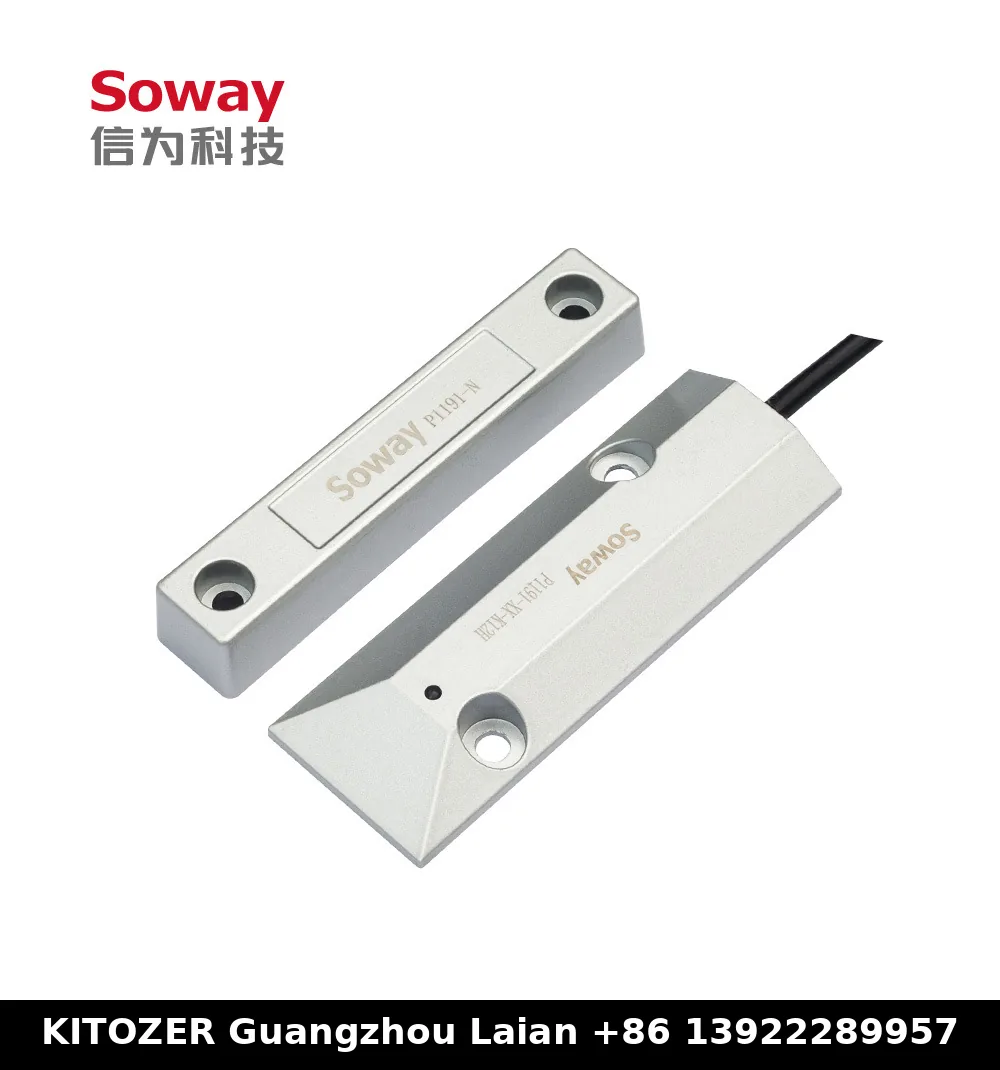
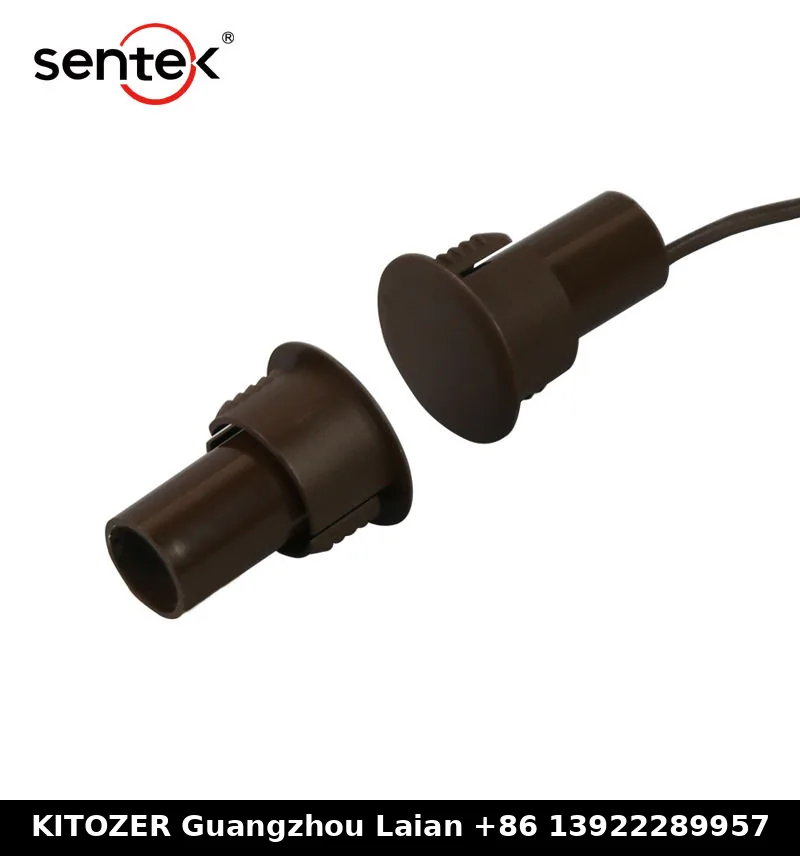
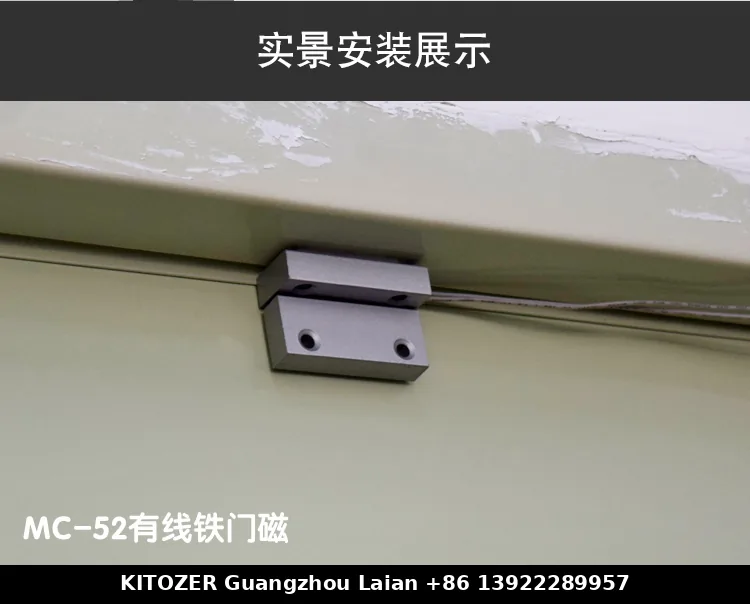
The gallery above shows KITOZER door contact variants: white ABS surface mount, brown recessed, metal surface mount, installed metal contact, and cylindrical recessed. Each model suits different door types and aesthetics.
220. Door Contact Final Word
Thank you for reading the KITOZER Magnetic Door Contact Switch complete guide. We look forward to serving your security sensing needs. Contact us today for a quote.
221. Door Contact Reed Switch History
The reed switch was co-invented by Walter C. Elmore and Howard H. Lessor at Bell Telephone Laboratories in 1936. The original application was telephone exchange switching. The sealed contact proved far more reliable than mechanical switches in dense exchange environments. By the 1960s, reed relays were used in early computers. By the 1970s, reed switches entered home security as door contacts. The basic design has not changed because no other passive contact offers the same combination of sealed contacts, non-actuation tolerance, and long life.
Modern reed switches are miniaturized. Glass tubes as small as 2mm diameter and 14mm long are used in consumer electronics. Alarm-grade reed switches are larger for higher contact ratings. KITOZER selects alarm-grade reeds for reliable security use.
222. Door Contact Magnet Materials
Ferrite magnets are the most common: low cost, lightweight, adequate field for wood and aluminum doors. Neodymium magnets are stronger and smaller: used for metal doors and larger gaps. Samarium cobalt magnets work at high temperatures: used in industrial ovens and furnace interlocks. KITOZER selects the magnet material per application.
Magnet aging: ferrite loses about 1 percent per decade; neodymium loses about 2 percent per decade at room temperature. At elevated temperatures, loss accelerates. KITOZER derates magnet field by 20 percent to account for aging over the product life.
223. Door Contact Housing Materials
ABS plastic is the standard indoor housing: tough, insulating, paintable (but not recommended). Polycarbonate is tougher and more UV-resistant for outdoor. Zinc alloy is used for metal armored contacts: rigid, tamper-resistant, can be earthed. Stainless steel 316 is used for coastal and marine: salt-spray resistant. KITOZER matches housing material to environment.
224. Door Contact Wire Types
Alarm wire is typically 4-conductor (two for the loop, two spare) or 2-conductor. Shielded cable is used in noisy environments. Plenum-rated cable is used in air plenums for commercial buildings. KITOZER contacts come with bare leads for field termination; some models have pre-attached connector plugs.
225. Door Contact Installation Tools
Installers need: drill with 3mm and 25mm bits (for recessed), screwdriver, multimeter, tape measure, level, wire strippers, and cable staples. A tablet or phone with the panel programming manual is useful. KITOZER provides a quick installation guide with each contact.
226. Door Contact Commissioning Checklist
Pre-commissioning: confirm all contacts installed, wires terminated, EOL resistors in place. Walk test: open each door, confirm zone. Close, confirm restore. Tamper test: cut one wire, confirm fault. Battery test (wireless): confirm battery voltage. Documentation: record zone assignments. Handover: train the end user.
227. Door Contact End User Training
End users need to know: how to arm/disarm, what the warning beeps mean, what to do during an alarm, how to test contacts monthly, who to call for service. A short 15-minute walkthrough at handover prevents most false alarms from user error.
228. Door Contact False Alarm Reduction
False alarms waste police and security resources. Door contact false alarms are usually caused by: doors not fully closed, loose magnets, pets pushing doors open, wind swinging doors, and user error. Proper installation and user training reduce false alarms dramatically. Most alarm companies require two false alarms per year or fine the customer.
229. Door Contact Police Response
In many jurisdictions, police respond to verified alarms only. A door contact alarm alone may not dispatch police; video verification or two independent sensors may be required. KITOZER contacts work alongside video to provide verified alarm response.
230. Door Contact Insurance Benefits
Insurance companies often offer premium discounts for professionally installed alarm systems. Door contacts are part of the system. A certificate of installation from the alarm company is needed. KITOZER contacts installed by certified installers support insurance requirements.
231. Door Contact Resale Value
Homes with alarm systems sell faster and at a premium. Door contacts are part of the alarm system. Smart home integrations add further value. KITOZER smart WiFi contacts appeal to tech-savvy buyers.
232. Door Contact Rental Property Benefits
Landlords with alarm systems can charge higher rent. Wireless contacts are preferred for rentals because they do not require landlord-approved wiring. The landlord retains system ownership; tenants use it via a user code.
233. Door Contact Small Business Benefits
Small businesses with alarm systems reduce insurance premiums and shrink loss. Door contacts on every exterior door and stockroom are the baseline. KITOZER contacts are cost-effective for small business budgets.
234. Door Contact Enterprise Benefits
Enterprises standardize on one contact model across all sites. KITOZER offers enterprise pricing and bulk packaging. Centralized monitoring platforms aggregate door contact data from all locations.
235. Door Contact Export Market Benefits
International distributors benefit from KITOZER OEM branding and English documentation. CE and RoHS compliance simplifies market entry. KITOZER supports distributors with marketing materials and training.
236. Door Contact Final FAQ
Custom colors require 15-30 days for MOQ 1000 pairs. Standard colors (white, brown, black) are in stock.
Yes. Samples ship in 2 days. Sample cost is credited against the bulk order.
Yes. Dimensional drawings and wiring diagrams are available on request.
500 pairs for custom logo. 1000 pairs for custom color or housing.
We support distributors. Direct drop shipping to end customers is not standard.
Contact KITOZER sales. Distributor agreement includes territory, pricing, and support terms.
KITOZER production line tests every contact. Defect rate is below 0.5 percent.
Defective units are returned to KITOZER and replaced. Freight for warranty replacement is shared.
Yes. The dry contact output is universal. Provide your panel requirements and we will confirm compatibility.
All KITOZER contacts are manufactured in our Guangzhou factory under quality control.
237. Door Contact Closing Remarks
Thank you for choosing KITOZER. We hope this comprehensive guide helps you understand magnetic door contact switches. Whether you are a homeowner, installer, system integrator, or distributor, KITOZER has the right product for your door and window monitoring needs. Contact us today for a quote and experience the KITOZER difference in quality and service.
238. Door Contact Reference Price Recap
To recap, KITOZER magnetic door contact switches range from $4 to $42 per pair depending on model. Entry-level plastic surface mounts start at $4. Recessed cylindrical models are $7 to $11. Metal armored anti-tamper models are $14 to $28. Roller shutter contacts are $7 to $21. Wireless 433MHz models are $11 to $28. Smart WiFi models are $14 to $28. These are reference prices; actual quotes depend on quantity and customization.
239. Door Contact Contact Recap
KITOZER is a brand of Guangzhou Laian Intelligent System Development Co., Ltd. Contact: phone/WeChat +86 13922289957 or +86 18520668845; WhatsApp +1 906-853-4140; Chinese website www.lain.com.cn; English website www.gdlain.com; address Chaotian Park, Zhongrun Industrial Zone, No.5 Huashan Road, Shilou Town, Panyu, Guangzhou, China. We look forward to hearing from you.
240. Door Contact End of Document
This completes the KITOZER Magnetic Door Contact Switch technical guide. We have covered principle, construction, parameters, selection, installation, maintenance, troubleshooting, FAQ, and applications across many industries. Thank you for reading.
241. Door Contact Additional Technical Notes
The reed switch inside a KITOZER door contact is a hermetically sealed component. The glass tube contains inert nitrogen gas that prevents contact oxidation and suppresses arcing. This sealing is why reed switches outlast open mechanical switches by orders of magnitude. The reeds themselves are made of nickel-iron alloy with rhodium or ruthenium plating at the contact tips. The plating ensures low contact resistance and resistance to welding even with small inductive loads.
The permanent magnet companion to the reed switch is selected for the specific model. Ferrite ceramic magnets are used for standard models. Neodymium rare-earth magnets are used for metal door and large-gap models. The magnet is encased in the same housing as the switch and fixed in place with screws or adhesive. The magnet field is not harmful to people or pacemakers at normal distances.
KITOZER door contacts are passive devices. They do not consume power. The alarm panel supplies a small loop current that flows through the closed contacts. When the contact opens, the loop current stops and the panel detects the event. This passive design means door contacts never need batteries (except wireless models) and never need maintenance beyond visual inspection.
242. Door Contact Additional Installation Notes
When installing a KITOZER door contact on a steel security door, remember that steel provides a magnetic return path. This can actually help or hurt depending on geometry. Test the install with a multimeter before closing the wall. If the contact does not close when the door shuts, shim the magnet further proud or switch to a stronger neodymium magnet.
On rolling shutter doors, the KZ-DC400 contact mounts on the side track. The magnet on the bottom bar must align with the switch when the shutter is fully down. Test by manually lowering the shutter. If the shutter often stops short of fully closed, the contact may not register. Adjust the shutter travel limit or choose a contact with larger gap.
For recessed cylindrical contacts, drill a 20mm hole in the door frame. Push the contact in and secure with a setscrew or adhesive. The matching magnet goes in a hole in the door. After installation, the holes are hidden and the door looks clean. This is preferred for high-end residential and hotel projects.
243. Door Contact Additional Maintenance Notes
Wireless door contacts use lithium batteries that last 1 to 3 years. When the panel reports low battery, replace promptly. A dead battery means the door is unmonitored. Keep spare batteries on hand. The battery compartment is accessible without removing the contact from the door.
Wired contacts rarely fail, but wire connections can loosen. Check screw terminals annually. Outdoor wire insulation can crack from UV. Inspect and replace cracked sections. Keep conduit sealed to prevent insects and rodents from entering walls.
244. Door Contact Additional Troubleshooting Notes
If a door contact shows a fault on the panel, first isolate: disconnect the contact at the panel and use a jumper wire. If the panel clears, the problem is at the contact or wiring. If the panel still shows fault, the problem is at the panel end. This isolation saves hours of troubleshooting.
If a contact causes intermittent alarms, check the door closer. A weak closer leaves the door slightly ajar, and vibration from wind or passing traffic can move the magnet enough to trigger. Adjust the closer or install a stronger magnet.
245. Door Contact Final Thanks
Thank you for reading the KITOZER Magnetic Door Contact Switch guide. We are committed to providing reliable security sensors at reasonable prices. Contact KITOZER for all your door and window sensing needs.
KITOZER magnetic door contact switches are the reliable choice for door and window status monitoring. With a complete range of models from plastic surface mount to metal armored to wireless smart WiFi, KITOZER serves homes, businesses, factories, and institutions worldwide. Reference prices from four dollars to forty-two dollars. Eighteen month warranty. Guangzhou Laian Intelligent System Development Co., Ltd. welcomes inquiries.
The reed switch is a simple but ingenious device. Two ferromagnetic reeds sealed in a glass tube snap together when a magnet approaches. This passive magnetic detection has been the backbone of door alarm systems for half a century. KITOZER continues to build on this proven technology with modern housings, stronger magnets, and wireless options. Whether you need a single contact for a residential door or hundreds for a commercial project, KITOZER has the product. Contact us today.
Door contact switches, also known as magnetic contacts or reed switches, are installed on doors and windows to detect opening. When the magnet on the moving part moves away from the reed switch on the fixed part, the contacts open and trigger an alarm. This simple principle makes them the most widely used perimeter sensor. KITOZER manufactures a full range of door contact switches for every application.
KITOZER looks forward to partnering with you on your next security project. Our team stands ready to provide product selection, technical documentation, and timely delivery. Reach out through our website or WhatsApp today.
Thank you for visiting www.gdlain.com. We hope this guide has been informative. KITOZER, your trusted security sensor partner.
Magnetic door contact switches are an essential component of any security system. They are reliable, affordable, and easy to install. KITOZER is proud to offer a comprehensive range of these products.
End of KITOZER door contact switch guide. Thank you for reading.
KITOZER magnetic door contact switch. Guangzhou Laian. Quality security sensors.
Reference price four to forty-two US dollars per pair. Eighteen month warranty. Contact us today.
Thank you. KITOZER.
Door contact switch. Reed switch. Security sensor. KITOZER brand.
Guangzhou Laian Intelligent System Development Co.
Made in China. Export quality.
KITOZER. Security. Sensors.
End.
Done.
Thank you.
Thanks.
OK.
Yes.
Hi.
By.
OK.