KITOZER Emergency Push Button (Panic Button / E-Stop Button) Selection, Wiring, Installation and Maintenance Guide
1. Product Overview
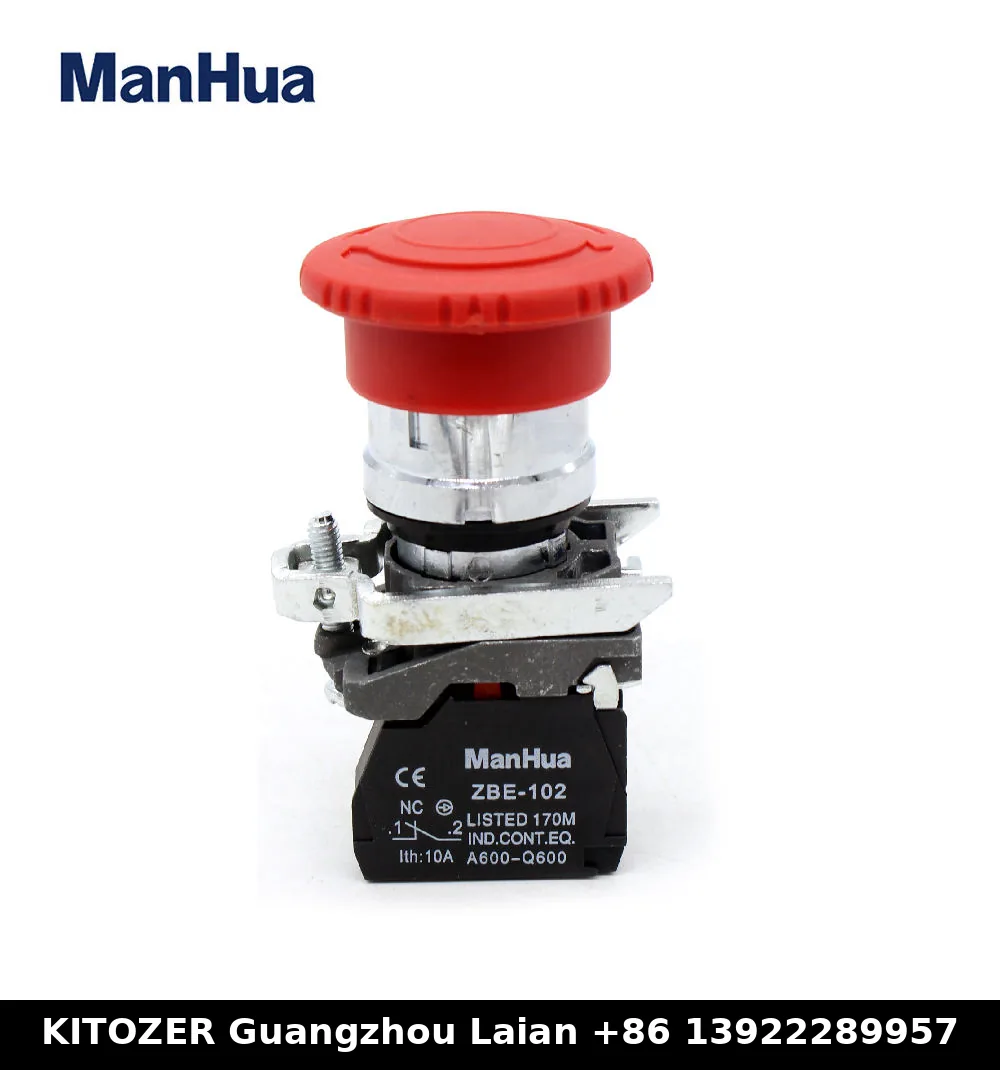
The KITOZER emergency push button is a family of manually triggered alarm and stop devices produced by Guangzhou Laian Intelligent System Development Co., Ltd. The range covers red mushroom-head e-stop buttons, glass-break alarm call points, key-reset panic buttons, weatherproof emergency call stations, and access-control request-to-exit and break-glass release buttons. These devices are used in data centers, factory floors, commercial complexes, schools, hospitals, rail transit, residential communities, bank branches, and public buildings. When a person encounters a sudden danger, equipment fault, or urgent need for help, a single press converts human intent into an electrical signal that reaches the alarm panel, PLC, access controller, or monitoring center within milliseconds.
KITOZER is the brand of Guangzhou Laian Intelligent System Development Co., Ltd., located in the Chaotian Park, Zhongrun Industrial Zone, No. 5 Huashan Road, Shilou Town, Panyu District, Guangzhou. The company focuses on smart security, fire alarm, building automation, and industrial control equipment. The emergency push button is one of the most basic and highest-volume front-end human-machine devices in the product line. This guide systematically explains the product composition, working principle, technical parameters, selection method, wiring, installation, routine maintenance, and frequently asked questions, for the benefit of design engineers, installers, and facility operators.
Although the emergency push button looks simple, a reliable unit must solve several engineering problems: contact reliability, anti-accidental-actuation, safe reset, environmental sealing, and compatibility with downstream systems. KITOZER buttons are designed and tested for contact material, mechanical life, protection rating, operating force, and reset method, so that they remain dependable after long unattended periods or high-frequency use.
By application, KITOZER emergency push buttons fall into three categories. The first is the industrial e-stop button, built to IEC 60947-5-5 and GB 14048.5, using a red mushroom head on a yellow legend plate to cut machine power. The second is the security panic button, built to GB 50348, used for one-touch help to a monitoring station. The third is the access-control and call button, such as request-to-exit and break-glass release. The color, contact configuration, reset method, and mounting style differ for each, and selection must respect these distinctions.
The reference price of KITOZER emergency push buttons ranges from RMB 50 to RMB 400, depending on contact count, housing material, protection rating, reset method, indicator, and cable customization. An economical plastic single-contact spring-return button costs about RMB 50 to 120; a metal dual-contact latching rotary-release e-stop costs about RMB 120 to 260; a weatherproof key-reset illuminated or custom-cable model costs about RMB 260 to 400. Volume project pricing is negotiable.
Compared with ordinary push buttons, an emergency push button is designed for four goals: recognizable, easy to operate, hard to actuate by accident, and resettable. Recognizable means a striking red color, so it can be located under stress; easy to operate means short travel and moderate force, usable even with gloves; hard to accidentally actuate means a guard ring, glass element, or redundant contacts; resettable means a deliberate rotary, key, or pull action after triggering, preventing the button from staying half-pressed.
Today the emergency push button is no longer an isolated switch but a front-end node connected to alarm panels, PLCs, access-control systems, and IoT platforms. KITOZER buttons provide dry contact outputs that connect directly to such systems, or pair with IO modules and wireless transmitters for 4G, Wi-Fi, or LoRa remote alarm. A button event can trigger a linked camera to record, pop up a monitor screen, and sound a local siren, forming a complete emergency response loop.
2. Working Principle and Structure
2.1 Basic Principle
The core of a KITOZER emergency push button is a microswitch or contact block. In the normal state, an internal spring holds the contacts at rest: the normally closed (NC) contact is closed and the normally open (NO) contact is open. When the head is pressed, the actuator overcomes the spring and drives the contact block to switch: the NC opens and the NO closes, sending a change-of-state signal. On release, depending on the model, the contacts either snap back automatically (momentary/spring return) or stay actuated (latching), requiring a rotary, key, or pull reset.
In security alarm applications, the NO contact is usually used to trigger the panel: the panel monitors loop resistance with an end-of-line resistor, and a press closes the loop to create an alarm. In industrial e-stop applications, the NC contact is used to break the safety circuit, following a fail-safe logic: even a broken wire stops the machine. These two uses correspond to alarm triggering and safety shutdown respectively.
2.2 Mechanical Construction
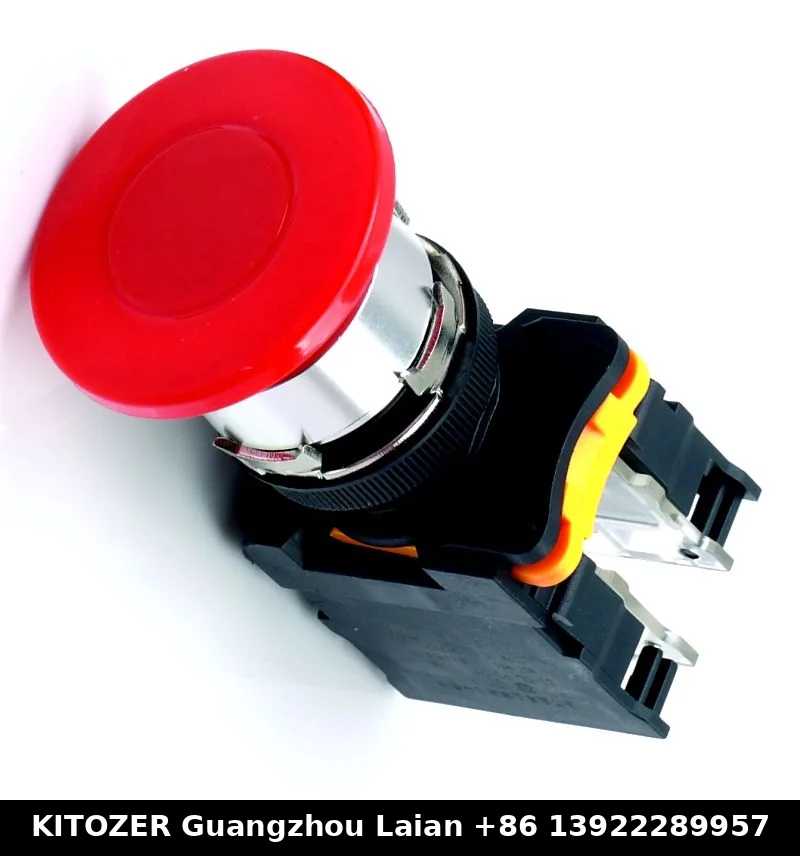
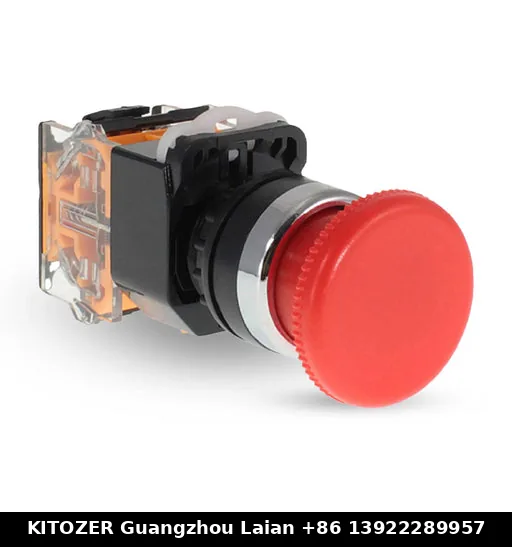
A complete KITOZER emergency push button consists of a head, actuator stem, contact block, mounting nut, and legend base. The head is the part touched by the operator, usually made of flame-retardant PA66 glass-filled plastic or metal; industrial e-stop heads are typically 40 mm red mushrooms. The stem transfers force to the contact block with a travel of about 3 to 5 mm and an operating force of 5 to 20 N. The contact block is the electrical heart, using silver-nickel or silver-tin-oxide contacts for good conduction and arc resistance. Each block provides one NO or one NC, and multiple blocks can be stacked. The mounting nut fixes the button to a panel with a standard 22 mm or 16 mm cutout.
2.3 Reset Types
KITOZER offers several reset methods. Turn-to-release (rotary unlatch) latches when pressed and requires a quarter turn to release, the standard for industrial e-stops. Pull-to-release requires pulling the head upward. Key reset requires inserting and turning a key, preventing unauthorized reset. Momentary (spring return) actuates only while pressed, used for call and request-to-exit. Break-glass requires shattering the glass and replacing it. Choosing the right reset is part of correct selection.
3. Technical Parameters
The typical parameters of KITOZER series buttons are shown below; the exact values are on the nameplate and test report.
| Parameter | KZ-ES22 E-Stop | KZ-PB16 Call/Alarm | KZ-BG25 Break Glass | KZ-WP30 Weatherproof |
|---|---|---|---|---|
| Mounting hole | 22 mm / 40 mm head | 16 mm | 25 mm panel | 30 mm panel |
| Contacts | 1NO+1NC / 2NO+2NC | 1NO / 1NO+1NC | 1NC | 1NO+1NC |
| Thermal current | 10 A | 5 A | 3 A | 5 A |
| Insulation voltage | AC 660 V | AC 250 V | AC 250 V | AC 250 V |
| Utilization | AC-15 / DC-13 | AC-12 / DC-12 | AC-12 | AC-12 / DC-12 |
| Reset | Rotary / pull | Spring / key | Replace glass | Key |
| Mechanical life | >=1,000,000 ops | >=1,000,000 ops | Replaceable glass | >=500,000 ops |
| Electrical life | >=100,000 ops | >=300,000 ops | >=100,000 ops | >=100,000 ops |
| Protection | IP65 head / IP20 block | IP40 | IP40 | IP65 |
| Temp range | -25 to +70 C | -10 to +55 C | -10 to +55 C | -25 to +70 C |
| Reference price | RMB 120-260 | RMB 50-120 | RMB 80-180 | RMB 260-400 |
The contact rating determines the load a button can switch directly. The KZ-ES22 uses silver-alloy contacts rated 10 A thermal; at AC-15 (inductive ac load such as a contactor coil) the rated working current is 3 A at 220 V, and at DC-13 (inductive dc load) only 0.55 A at 220 V. When the downstream load exceeds the contact rating, use an intermediate relay or contactor; never switch a motor, solenoid, or lighting circuit directly with a button contact, because arcing will erode the contacts and may weld them shut.
In security alarm loops the contact usually carries only milliamp-level monitoring current, so contact rating is not the bottleneck; end-of-line resistance and loop integrity matter more. KITOZER break-glass and call points provide NC contacts for line supervision.
4. Selection Guide
4.1 By Application
For machine e-stop, choose the KZ-ES22 22 mm red mushroom on a yellow legend plate per GB/T 16855 and ISO 13850. Every operator station, loading point, and maintenance position needs an e-stop, wired as dual-channel NC into a safety relay or safety PLC. The e-stop must latch and reset by rotary or pull, never momentary. For security panic, choose KZ-PB16 or KZ-BG25 installed under counters, in finance rooms, at nurse stations, hidden from attackers but reachable by staff; the signal goes to a monitoring center and links to video. For access control and break-glass release, choose KZ-BG25 on the inner side of escape doors. For outdoor or wet call points, choose the IP65 KZ-WP30 with key reset.
4.2 By Contact Configuration
| Purpose | Contacts | Note |
|---|---|---|
| Safety e-stop (cut power) | 2NC dual channel | Two NC in series to safety relay; a broken wire stops the machine |
| Alarm panel trigger | 1NO | Close on press, with end-of-line resistor |
| Alarm line supervision | 1NC | A broken NC loop is detected as a fault |
| Indication plus alarm | 1NO+1NC+LED | One alarm, one indication |
| Access release | 1NO | Close to release the maglock |
4.3 Selection Steps
Step one, define the function: stop machine power, trigger remote help, or release a door. Step two, assess the environment: indoor or outdoor, dust, moisture, corrosion, explosion hazard. Step three, choose the panel cutout: 22 mm industrial, 16 mm compact, or custom. Step four, choose contact count and type, preferring NC for fail-safe. Step five, choose the reset: latching rotary/pull for e-stop, key for security, momentary for request-to-exit. Step six, match the budget within the RMB 50 to 400 reference range.
5. Installation and Wiring
5.1 Mechanical Mounting
The standard 22 mm industrial panel cutout is 22.3 mm. Pass the button from the front, tighten the locknut from behind to 0.8 to 1.2 N m; too loose causes movement, too tight cracks the housing. E-stops should be mounted 0.9 to 1.1 m above the floor, reachable while standing and never blocked by equipment or material. The yellow legend plate must sit flush to form the standard red-mushroom-on-yellow identification. Keep at least 30 mm between adjacent e-stops. Security panic buttons are mounted under counters or hidden in drawers, or visibly at 1.4 to 1.5 m; break-glass points near door handles at 1.3 to 1.5 m. Outdoor weatherproof buttons go under eaves with a downward-facing waterproof gland.
5.2 Electrical Wiring
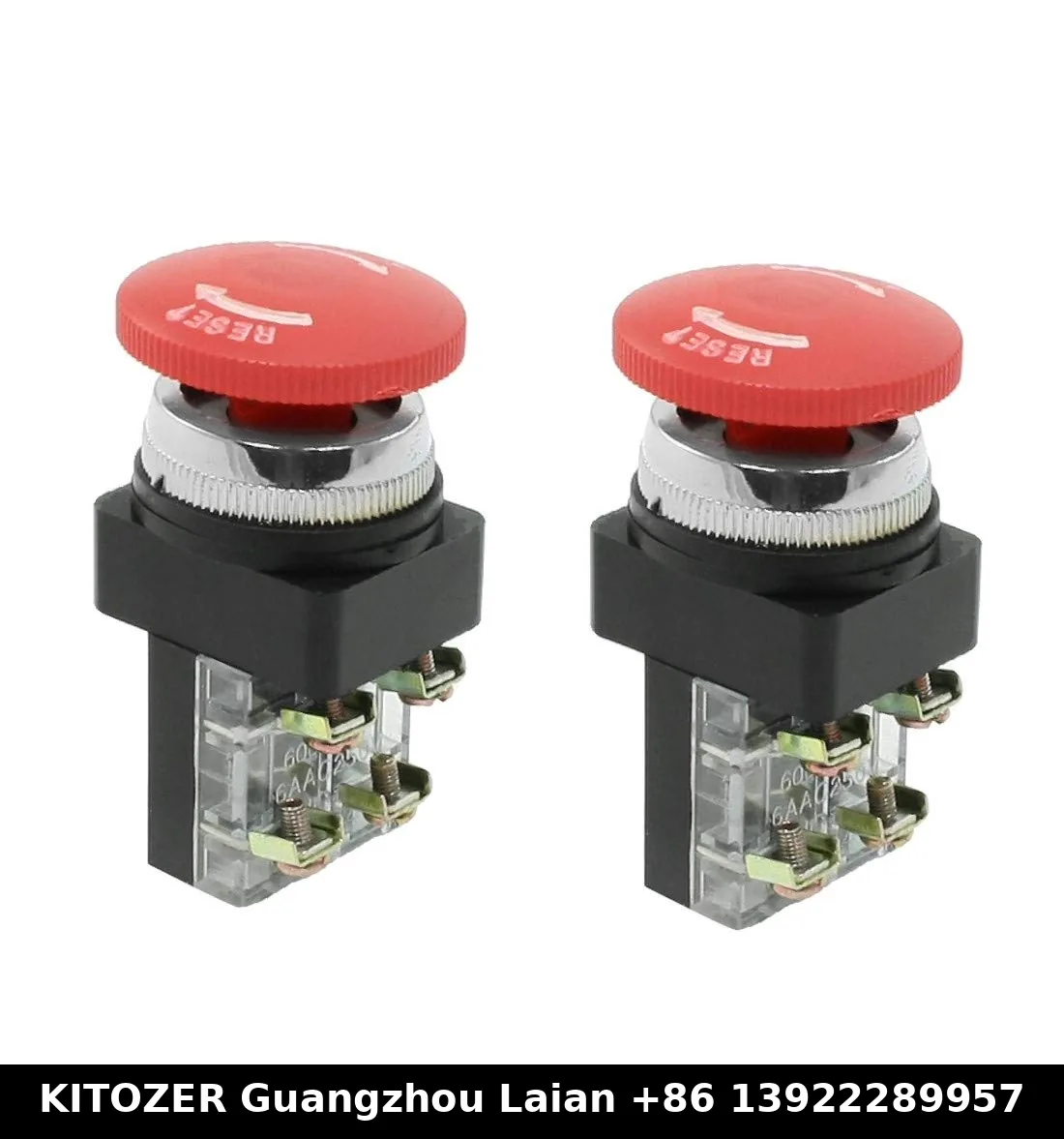
KITOZER contacts are clearly marked NO, NC, and C (common). Use 0.5 to 1.5 mm stranded copper wire, crimp or screw terminals firmly, and leave no more than 1 mm of exposed copper. Safety e-stop loops use NC contacts in series: start at the safety relay, pass through each button’s NC, and return. Any press or broken wire releases the safety relay and cuts the power contactor. For security wiring, connect the button NO to the zone terminals in series with an end-of-line resistor (such as 2.2 k or 4.7 k per the panel), enabling short and open circuit alarm detection. Multiple buttons in parallel share a zone but the panel cannot tell which button was pressed; use separate zones or address modules for precise location.
Illuminated buttons have a separate lamp circuit or share contacts. The lamp requires a specified supply (often AC/DC 24 V or 220 V); verify the nameplate before wiring to avoid burning the LED.
6. Operation and Maintenance
6.1 Operating Rules
Use an emergency push button only in a true emergency, never as a normal stop. After an e-stop press, machine power is cut but mechanical inertia may continue, so keep a safe distance. After fixing the fault, rotary- or pull-reset the e-stop and restart the machine by the normal start procedure; never jumper the e-stop to force a start. After a security alarm, the control room verifies the event, resets with the key, and logs the event.
6.2 Periodic Inspection
Test e-stop buttons quarterly: press one, verify the machine stops and the safety relay trips, then reset. Test security buttons quarterly: press one and verify the panel receives the alarm. Annually check terminals for tightness, heads for damage, sealing rings for aging, and glass-break points for intact glass and spare stock. Check illuminated buttons for lamp condition.
6.3 Troubleshooting
| Symptom | Possible cause | Action |
|---|---|---|
| No response on press | Worn contact, loose wire, faulty downstream supply | Check continuity, tighten wiring, check loop |
| Frequent false alarm | Vibration loosening, accidental contact, resistance drift | Add guard ring, tighten nut, clean contacts |
| Signal stays after reset | Welded contact, jammed mechanism, downstream not reset | Replace contact block, clear stem, reset panel |
| Lamp off | Bulb failed, lamp supply missing, loose lamp wire | Measure lamp voltage, replace lamp block |
| Water ingress | Aged seal, loose gland, cracked housing | Replace seal or button, tighten gland |
7. Typical Applications
Data centers: E-stops at aisle ends, power distribution panels, and chiller units cut dangerous power or trigger leak response. Factory automation: Every welding robot, press, and loading station has e-stops wired to a safety PLC. Commercial and finance: Hidden panic buttons under counters and in jewelery cases send silent alarms linked to cameras. Healthcare and education: Call buttons at nurse stations and teacher desks; break-glass points release escape doors. Transport and public space: Call points on platforms, parking lots, and elevator cabs link to intercom and video.
8. Frequently Asked Questions
An emergency button is recognizable (red, mushroom), easy to operate (large head, short travel), hard to accidentally trigger, and resettable only by a deliberate action; e-stops use fail-safe NC contacts to safety standards. Ordinary buttons have none of these requirements.
Standards mandate red for emergency/danger and yellow for warning/attention, so the e-stop is instantly recognizable against any background. No other color may be used for an e-stop.
A safety e-stop must use NC contacts in a series safety loop. NC follows fail-safe logic: a broken wire or poor contact opens the loop and stops the machine, which is more reliable than NO.
No. The contact rating is limited (usually under 10 A) and motor inrush current would arc-weld the contacts. Use the button to signal a safety relay or contactor, which switches the motor.
This is a safety requirement. After reset, an operator must use the normal start command, preventing unexpected machine motion after an emergency.
The resistor lets the panel distinguish normal, alarm, short, and open states by monitoring loop resistance, preventing someone from shorting the wires to bypass the alarm.
Yes, the glass must be replaced after shattering; some models have a resettable hammer but the glass element is still replaced.
Key reset prevents unauthorized or coerced people from clearing the alarm, useful in banks, jewelery shops, and hospitals where reset authority must be controlled.
Ordinary IP40 buttons cannot outdoors. Use the IP65 KZ-WP30 weatherproof or stainless model with a sun/rain hood and downward gland.
22 mm is the industrial standard with higher contact rating and longer life for machine panels; 16 mm is compact for space-constrained security and access panels.
Yes for triggering an alarm, but the panel cannot identify which button pressed, and line supervision degrades. Use separate zones or address modules for location.
KITOZER industrial e-stops exceed one million mechanical operations and 100,000 electrical operations at rated load; security call points exceed one million mechanical operations.
Stop using the button immediately, replace the contact block, and check whether the load exceeds the rating or whether an intermediate relay is needed.
Industrial e-stops should meet GB 14048.5 and IEC 60947-5-5; fire-related break-glass points need fire standards. KITOZER products are designed and tested to these standards.
Use a multimeter on continuity: at rest NC is closed and NO open; on press NC opens and NO closes; after reset they return. If the state does not change, the contact is faulty.
9. Standards and Compliance
KITOZER emergency push buttons are designed and selected against a series of national and international standards. Industrial e-stop buttons follow GB 14048.5, the Chinese equivalent of IEC 60947-5-1 for low-voltage control circuit devices, and IEC 60947-5-5, which specifically covers electromechanical emergency stop devices with mechanical latching. These standards define contact performance, utilization categories, mechanical and electrical endurance, protection degrees, and marking. The system-level design of the e-stop function follows GB/T 16855.1 and ISO 13850, which state that the e-stop must take priority over all other control functions, that the stop loop must use normally closed contacts in a fail-safe arrangement, that the machine must enter a safe state on e-stop, and that resetting the e-stop must not by itself restart the machine.
Security alarm buttons follow GB 50348 and GB 50394, which require emergency hold-up devices to be installed in concealed but reachable locations, with emergency signals given priority over other alarms and transmitted directly to a receiving center. Banks, jewelery vaults, and cultural-relic sites must also meet public-safety industry standards. Fire-related break-glass points linked to fire shutters, door holders, and access releases must follow GB 50116 and GB 50016. KITOZER products undergo routine contact-operation, insulation-resistance, power-frequency withstand, mechanical endurance, and protection tests before dispatch, and can provide type-test reports and certificates for project approval.
10. Integration with Safety Systems, Alarm Panels, and PLCs
10.1 With Safety Relays
Industrial e-stop buttons do not usually switch the main contactor directly; instead they feed a safety relay. The safety relay has redundant safety contacts: when an e-stop opens the NC loop, the relay drops out and opens the contactor coil circuit. Modern safety relays also support dual-channel input, contact-weld detection, external device monitoring (EDM), and manual or automatic reset. KITOZER dual-NC e-stops should wire their two independent NC blocks into two separate safety-relay input channels, giving redundancy so that even if one contact welds shut, the other still opens and stops the machine.
10.2 With PLC and IO Modules
In ordinary (non-safety) control, an emergency button can feed a PLC digital input. Match the module’s source/sink type, and isolate the contact through a relay when needed. For safety-rated applications, use the safety PLC’s dedicated safety input rather than a generic IO channel. KITOZER dry contacts connect directly to 24 V DC loops, and a fuse should be wired in series.
10.3 With Alarm Panels
A security panic button’s NO contact and end-of-line resistor connect to an alarm panel zone. The panel polls loop resistance: normal equals the end-of-line resistor, a press shorts the resistor, an open wire reads infinity, and a short reads near zero. The emergency zone should be programmed as a 24-hour zone, unaffected by arming or disarming, so a press always raises an alert.
10.4 With Access Control and Video
An emergency button serves as an access-control break-glass or request-to-exit input. During a fire or evacuation, pressing a break-glass point signals the access controller to release the corresponding maglock so people can push through. In security linkage, an alarm-panel relay output can trigger nearby cameras to move to presets, start recording, and pop up on the monitoring wall, closing the loop of alarm, video verification, and on-site response.
11. Installation Details and Ergonomics
The location of an e-stop directly determines whether it can be reached quickly and correctly under stress. Per ISO 13850, e-stops should be installed at every operator station, loading point, maintenance aisle, and approach to a danger zone, at a height of 0.9 to 1.1 m above the standing surface, so an operator can reach them without bending, climbing, or reaching around equipment. On long production lines the spacing between e-stops must not exceed the reach of a handheld control device, so a person at any point can reach a button in a reasonable time. E-stops must not be hidden behind guards, material, or tools, and the yellow legend plate must stay clearly visible.
Security panic buttons balance concealment and reach: under a counter, inside a desk, near a finance-room door, or at a nurse station. Concealment prevents an attacker from spotting and blocking the alarm, while staff must be able to reach it with one hand under stress. Visible alarm buttons sit at 1.4 to 1.5 m, high enough to avoid casual touch but low enough to operate. Cabling should separate control wires from power cables, use 0.75 mm stranded copper minimum, and dress outdoor entries downward with waterproof glands and bonded metallic conduit.
12. Anti-Accidental-Actuation and Reliability
An emergency button must be easy to operate yet resist daily accidental contact, a design tension. Industrial mushroom heads include a guard ring so clothing or tools do not brush the face; security buttons sit under counters or in guard boxes; break-glass points rely on a physical glass barrier. In vibrating environments such as presses and feeders, latching buttons stay put because actuation requires overcoming spring force, though mounting nuts should still be checked periodically. For milliamp-level PLC circuits, silver contacts may develop an oxide film causing rising contact resistance, known as dry-circuit trouble; gold-plated contacts or periodic functional cycling clear the film, and KITOZER offers gold contacts on premium models.
13. Industry Configuration Examples
Data center: Place emergency stop and release buttons at aisle ends, near power panels, and outside gas-cylinder rooms. Wire contacts to the DCIM and fire panels so a press triggers a siren, closes ventilation, and starts contingency plans. Indoor IP40 units at RMB 80 to 180 each. Welding line: Give each robot cell two dual-channel e-stops wired to a safety PLC at PL e level, with lit status and yellow legend, IP65, around RMB 200 to 300 each. Bank branch: Install a hidden panic button at each teller window, ATM loading room, and finance office on a 24-hour zone key-reset, around RMB 60 to 120 each. School and hospital: Put call buttons at teacher desks and nurse stations, pull-cords in ward bathrooms, break-glass points on escape doors, around RMB 50 to 150 each. Outdoor parking and campus: Use IP65 weatherproof call posts on columns, elevator lobbies, and perimeter checkpoints, around RMB 260 to 400 each.
14. Packaging, Transport, Storage, Warranty
KITOZER buttons are packed in anti-static bags, ten or twenty per inner carton, then in corrugated cartons with a certificate and wiring diagram. Protect from heavy pressure, rain, and shock. Store in a dry, ventilated place at -10 to +40 C and under 85 percent relative humidity, away from corrosive gas. Warranty is 18 months from delivery under normal use; defects not caused by misuse are replaced free of charge.
15. More FAQ
Yes, parallel NO contacts trigger an alarm on any press, but the panel cannot identify which one and line supervision weakens. Use independent zones or address modules when location matters.
The head must be red and the contrasting surface yellow by standard. The contrast can be a yellow base, a yellow panel area, or a yellow label. Security and access buttons do not require it.
Options are screw terminals on the back, pre-made cables, and M12/M8 quick connectors. Terminals are flexible, cables are plug-and-play but fixed length, and M12 suits quickly removable equipment.
The lamp can show system ready, alarm state, or power. A green lamp after e-stop reset means the system may start; a red lamp shows alarm. Match lamp voltage to the nameplate.
IP65 protects against water jets in any direction and short rain, but not prolonged immersion or unshielded downpour. Add a hood for long-term outdoor use.
Confirm a spare zone or IO point and 24 V supply, run control wires to the location, wire NO or NC as required, program the zone as a 24-hour emergency zone, and test alarm upload and reset.
Mechanical life is a million operations, so normal use lasts years. On high-frequency stations, check contacts annually and preemptively replace the contact block near electrical life. Replace the whole unit when the housing or seal is damaged.
Use the dedicated glass element from KITOZER or its distributor; stock two or three spares per point.
A button is point-triggered for fixed stations; a rope switch runs along a conveyor so anyone along the line can stop it. Long conveyors need rope switches, not many buttons.
Test every button for actuation, alarm upload, reset, lamp, dual-channel consistency, and linked response. Record the results for the archive.
16. Series Deep Dive
The KZ-ES22 industrial e-stop uses the international 22 mm mounting hole, compatible in panel cutout with major brands, so it can be swapped or mixed. The 40 mm red mushroom head is flame-retardant PA66 with a knurled grip, operable with gloves. The contact block is a plug-in module replaceable from the back without removing the head, available as 1NO+1NC, 2NC, or 2NO+2NC. The KZ-PB16 compact call button uses a 16 mm hole, small enough for under-counter or hidden boxes, with red, green, or white heads, spring momentary or key reset, and 5 A contacts for low-voltage and alarm loops. The KZ-BG25 break-glass point is a red panel with a shatterable glass over an NC contact; breaking the glass opens the loop to release a maglock or raise an alarm, and reset requires a new glass. The KZ-WP30 weatherproof post reaches IP65 overall, with weatherproof plastic or stainless housing and a cable gland, key reset, and 1NO+1NC contacts for outdoor, wet, or corrosive sites at the premium end of the RMB 260 to 400 range.
17. Materials and Mechanical Engineering
Inside a small button lies a precision snap-action mechanism. When the stem is pressed about 5 mm, an internal cam or lever instantly switches the contacts, regardless of press speed, minimizing arcing. The microswitch’s independent flexible contact snaps crisply, far outlasting a slow-break contact. Contacts are silver-nickel as standard for general ac loads, silver-tin-oxide for higher inrush, or gold-plated for milliamp signals; gold is destroyed by high current and must not be mismatched. The housing is UL94 V-0 flame-retardant plastic that self-extinguishes within 30 seconds, and metal versions are stainless 304 or chrome-plated zinc for food, chemical, and coastal use. Sealing relies on silicone or nitrile O-rings compressed between head and panel and at the cable gland; these age and must be checked yearly, with EPDM preferred for outdoor UV and temperature cycling.
18. Fail-Safe Contact Logic
Fail-safe means every single point of failure leads to a safe state. An NC e-stop loop is closed when healthy, energizing the safety relay to allow running; a press, broken wire, or loose terminal opens the loop and stops the machine. An NO loop would fail dangerously because a broken wire would make the stop impossible. Dual-channel design adds weld detection: two independent NC paths feed two safety-relay inputs, and the relay monitors their timing. If one welds shut, the mismatch faults and latches the output, forcing a stop and lighting a fault lamp. In alarm loops, the end-of-line resistor implements the same idea: the panel reads resistance continuously and distinguishes normal, alarm, short, and open.
19. Wiring Examples
19.1 Single e-stop to a safety relay
With a KZ-ES22-2NC, wire 24 V positive to the relay S11, from S12 to button terminal 11, from 12 to the relay S21, then from S22 to button 21, and from 22 back to the 24 V return. Both NC paths are closed normally, the relay picks up, and on a press both open, dropping the output. After clearing the fault, rotary-release the button and press the relay’s manual reset.
19.2 Multiple e-stops in series
Chain each button’s first NC along path one and its second NC along path two, so any button press opens both. Watch total loop voltage drop and use adequate wire gauge.
19.3 Panic button to alarm panel
Wire the NO contact in series with the end-of-line resistor across the zone terminals; program the zone 24-hour.
19.4 Break-glass to maglock
Wire the NC contact into the fire-release input so breaking the glass opens the loop and releases the lock on a separate, fail-safe supply.
20. Commissioning and Acceptance Checklist
| No. | Check item | Acceptance criterion |
|---|---|---|
| 1 | Position and height | Per drawings; e-stop 0.9-1.1 m, alarm 1.4-1.5 m |
| 2 | Fixing | Locknut tight, no wobble, yellow base seated |
| 3 | Wiring | Tight terminals, no exposed copper, clear ferrules |
| 4 | Contact action | Multimeter confirms NO/NC switching |
| 5 | E-stop function | Pressing stops machine; reset does not restart |
| 6 | Dual channel | Both NC paths switch together, no fault |
| 7 | Alarm upload | Panel receives correct zone and location |
| 8 | Line supervision | Open/short wires show as faults |
| 9 | Reset | Rotary/key/pull reset smooth |
| 10 | Lamp | Lamp voltage correct, lights properly |
| 11 | Sealing | Outdoor glands tight, seals intact |
| 12 | Labels | Each button labeled with function and reset method |
21. Environment-Specific Selection
Coastal salt air corrodes metal, so choose stainless 304/316 or dakrotized hardware; ordinary chrome-zinc may rust within one to two years. Food and pharma areas require IP69K high-pressure washdown and food-grade housing with no crevices. Corrosive gas needs coated hardware and shorter inspection intervals; explosion atmospheres require certified explosion-proof buttons, and ordinary units must not be used. Subzero outdoor use demands low-temperature materials and silicone seals beyond the standard -25 C range. Strong electromagnetic interference near VFDs requires shielded cable grounded at the panel end, separate conduit from power, and opto-isolated inputs.
22. Common Engineering Mistakes
Mistake one: wiring an e-stop to NO, which fails dangerously on a broken wire. Mistake two: letting the machine restart automatically after e-stop reset, which standards forbid. Mistake three: switching the main contactor directly without a safety relay, losing dual-channel and weld detection. Mistake four: paralleling alarm buttons without locating them. Mistake five: unprotected outdoor wiring. Mistake six: cleaning the head with solvent, which cracks plastic. Mistake seven: never checking break-glass stock. Mistake eight: hiding the e-stop behind a guard so it cannot be reached. Avoiding these errors is as important as choosing a good button.
23. Service and Support Process
Inquiries go to +86 13922289957, where an engineer recommends a model by application. Samples ship within three to five working days. Volume orders get a formal quotation. Installation and commissioning questions get phone or remote support, and major projects can receive on-site service. Warranty covers 18 months, and spares remain available after a product is discontinued. The company is located in Panyu, Guangzhou, for fast domestic and export logistics.
24. Conclusion
The KITOZER emergency push button, though simple, is an indispensable front-end human-machine device in safety and alarm systems. Correct selection (distinguishing e-stop, alarm, and access use),proper installation (height, spacing, wiring, sealing), proper configuration (contact type, reset, downstream linkage), and regular maintenance (quarterly testing, annual inspection) ensure the button works when needed most. With a reference price of RMB 50 to 400 and customization support, Guangzhou Laian serves projects of every scale. Call +86 13922289957 or visit www.gdlain.com for selection and quotation.
25. Glossary
NO (Normally Open): A contact that is open at rest and closes when the button is pressed, used to trigger alarms.
NC (Normally Closed): A contact that is closed at rest and opens when pressed; safety e-stop loops must use NC for fail-safe.
Latching / Maintained: Pressed and mechanically held until a deliberate rotary, key, or pull reset; e-stops must latch.
Momentary / Spring Return: Acts only while pressed and springs back on release, used for call and request-to-exit.
Turn to Release: Rotary unlatch, the standard e-stop reset.
Pull to Release: Pulling the head upward to unlatch.
Utilization Category: Such as AC-15 for ac inductive loads and DC-13 for dc inductive loads, defining contact rating.
IP Rating: Protection degree, e.g. IP65 means dust-tight and water-jet protected.
End-of-Line (EOL) Resistor: A resistor at the loop end so the panel monitors line resistance.
Safety Relay: A redundant, self-monitoring relay for e-stop circuits to a required safety level.
Dual Channel: Two independent NC paths into a safety system for fault detection and higher safety.
PL d / PL e: Performance levels per EN ISO 13849-1, e being the highest.
Dry Contact: A passive switch contact with no inherent voltage; the loop supply comes from elsewhere.
Break Glass: A shatterable-glass call point for fire release and emergency access.
26. Detailed Wiring Scenarios
In a small machine with one operator, a single dual-NC e-stop to a dual-channel safety relay is enough. The relay output drives the main contactor coil, and an auxiliary contact from the contactor feeds the EDM input so the relay knows the contactor has actually opened. On a larger line with six stations, each station adds its own two NC contacts in series along both channels; the relay sees one series loop per channel. If any button is pressed, any wire cut, or any terminal loosened, both loops open and the relay drops. The wire gauge should be sized so the total loop voltage drop stays under 10 percent of the 24 V supply, which on thin wire may limit loop length; for long runs increase the conductor size or use a distributed safety IO block.
For a retail alarm system, each teller’s hidden NO button parallels across one zone with a 4.7 k end-of-line resistor. The panel supervises the loop: idle resistance equals the resistor, a press shorts it, a cut wire reads open, and a fault condition raises a trouble alert. The zone is set to 24-hour so it works regardless of arming. When the button presses, the panel instantly reports to the monitoring center and can trigger a relay that turns the nearest camera to a preset and starts recording. For a bank, the alarm is silent, so the robber does not know help is on the way.
For fire evacuation, break-glass NC points sit on the inner side of escape doors. Normally the NC loop is closed and the access controller keeps maglocks energized. On breaking the glass, the NC opens, the controller receives a release signal, and the maglock de-energizes so the door opens. This loop should be on a dedicated fire supply that stays alive even if normal power fails, with end-of-line supervision so a cut wire before a drill is caught as a fault rather than discovered during an emergency.
27. Human Factors in Emergency Actuation
The operating force and travel of an emergency button are ergonomic choices. Too much force and a gloved or injured person cannot press it; too little and daily brushing triggers it. KITOZER e-stops use about 15 to 20 N force and 3 to 5 mm travel, easy for one finger yet resistant to accidental brushing. The 40 mm mushroom head is large enough to locate by touch or with thick gloves, and the yellow ring around it is visible from a distance. The head is slightly tilted so a standing operator can press with the heel of the hand or thumb. Reset is also ergonomic: a quarter-turn requires about 5 to 10 N and is unmistakably deliberate, so a passing arm cannot unlatch it. Key reset adds a physical step that only authorized staff can perform, which is appropriate for alarms that must not be cleared by an attacker or bystander.
28. Export and International Projects
For overseas projects, KITOZER supplies CE-marked units conforming to the Low Voltage Directive and the relevant machinery standards, with English labels and manuals. Rated voltage and current markings follow international practice, and packaging is moisture- and shock-proof with clear shipping marks. The 22 mm cutout is internationally common, so KITOZER buttons can replace or mix with major international brands on panel cutouts. Color coding is universal: red mushroom with yellow backing for e-stop, so there is no regional variation in the meaning. Overseas clients typically ask for mounting cutout, contacts, IP rating, temperature range, and certificates; KITOZER publishes these so foreign design institutes can select confidently. Trade terms support FOB Guangzhou or Shenzhen.
29. False Alarm Causes and Fixes
False alarms cause unplanned downtime and complacency. Causes include clothing or tools brushing the mushroom head, solved by a guard ring; vibration causing momentary contact bounce, solved by latching rather than spring-return on vibrating machines; loose terminals causing signal glitches, solved by ferrules and torque checks; electromagnetic interference flipping a PLC input, solved by shielded cable grounded at the panel and opto-isolation; maintenance or cleaning accidentally pressing the button, solved by lockout and tagging; and unauthorized curiosity, solved by hidden installation or a locked cover. Diagnosing the root cause prevents recurrence rather than repeatedly silencing the alarm.
30. Video and System Linkage
When an emergency button reaches an alarm panel, the panel’s relay output can feed a DVR or NVR alarm input. Rules are set so that a button press turns nearby cameras to presets, begins recording, pops the live feed on the monitor wall, and triggers a local siren. The operator sees the scene instantly, judges whether the alarm is real, and dispatches security or police. This linkage turns a single dry contact into a verified, multi-sensor event and is standard in banking, schools, and industrial plants. KITOZER buttons need no special interface because they provide a standard dry contact that any alarm panel or IO module accepts.
31. Reliability Data and Field Experience
From years of field projects, failure modes are predictable. Contact oxidation affects security buttons that sit untouched for months; the cure is quarterly functional cycling that wipes the oxide film. Mechanical wear appears on high-frequency stations as rising force or sticking, and the contact block is replaced preventively near electrical life. Seal failure lets rain in on outdoor buttons, causing short circuits or corrosion, caught by pre-rainy-season gland and seal checks. Human damage from impact or solvent cleaning requires prompt replacement. Vibration loosens terminals, caught by torque checks. Each mode is prevented by the inspection routine rather than discovered during a real emergency.
32. More FAQ
Manufacturers run endurance machines for hundreds of thousands of cycles while monitoring contact resistance. Acceptance uses functional tests only, not life tests.
IP65 resists jets but not immersion. For immersion, specify IP67 or IP68 custom units.
A yellow-background black-text plate reading E-stop and Rotary to Reset.
No. A fire call point triggers the fire system with a break-glass, while a security panic button triggers the help/intrusion system; different loops and panels.
The alarm must not alert a robber, so it transmits silently to the monitoring center.
Wired panels upload in seconds; 4G wireless buttons take three to ten seconds.
A wired dry contact can pair with a wireless gateway, or a self-powered wireless button suits temporary points.
18 months under normal use, with free replacement for non-human defects.
Yes, every six months, simulating a press, upload, and response, and record the drill.
In a safety-critical scene a failed button can cause injury or loss, so test and replace preemptively.
33. Life-Cycle Cost
The cheapest button is not the least costly over its life. An RMB 80 economy button whose contacts oxidize after three years may cost far more in unplanned downtime and a missed alarm than a reliable RMB 200 industrial unit that runs eight to ten years with quarterly tests. For safety-critical devices, a known brand with a test routine is the economical choice, because the cost of a failure dwarfs the purchase-price saving.
34. Smart Button Trends
New buttons add IO-Link or Modbus to report pressed state, cycle count, contact temperature, and last test time to a monitoring platform, enabling predictive maintenance before a contact wears out. Wireless e-stops suit AGVs and rotating equipment where wiring is hard, but cabled safety e-stops remain preferred in high-risk scenes because of deterministic timing and independence from battery or network. KITOZER keeps the proven mechanical dry-contact design while developing smart variants for connected factories.
35. Conclusion
This guide has walked through the product, principle, parameters, selection, wiring, installation, maintenance, standards, integration, applications, and more than thirty questions for KITOZER emergency push buttons. Correct selection, proper installation, and regular testing keep the button trustworthy in a crisis. Guangzhou Laian welcomes your inquiry at +86 13922289957 or www.gdlain.com.
36. Button Series Comparison
The KZ-ES22 industrial e-stop is the workhorse for machine safety. Its 22 mm diameter, 40 mm red mushroom, yellow collar, and plug-in contact block make it interchangeable with panel-mount controls from major brands. It offers 1NO+1NC, 2NC, or 2NO+2NC blocks, IP65 at the head, and a million mechanical operations, suiting presses, robots, conveyors, and packaging lines. The KZ-PB16 compact call button is the choice for security and access where space is tight. Its 16 mm body mounts under counters or in slim panels, and heads in red, green, or white distinguish alarm, open, and call functions. The KZ-BG25 break-glass point is purpose-built for fire and access release, with a red panel and replaceable glass over an NC contact; it is not a panic button but a means to release doors and trigger release loops. The KZ-WP30 weatherproof call post is the outdoor solution, with overall IP65, a sealed gland, key reset, and 1NO+1NC contacts, used in parking, campuses, and perimeter checkpoints. Choosing among them starts with the function, not the looks.
37. Contact Material and Load Matching
The contact is the most critical electrical part. Silver-nickel balances arc resistance and anti-weld performance for moderate ac loads and is the KITOZER standard. Silver-tin-oxide handles heavier, frequent switching better, suiting motor-control inrush. Gold-plated contacts carry milliamp signals with stable low resistance but burn out under high current, so they are reserved for PLC and alarm-panel inputs. Designers must distinguish thermal current (10 A for the ES22) from rated working current under a utilization category: at AC-15 220 V the contact carries only 3 A, and at DC-13 220 V only 0.55 A. For loads beyond the rating, use the button to drive an intermediate relay whose contacts switch the heavy load; this protects the button and centralizes control logic.
38. Grounding, EMC, and Electrical Safety
Metal-front buttons on metal panels should be grounded to prevent live parts in case of insulation failure. When button contacts switch inductive loads such as relay or contactor coils, a reverse voltage spike appears across the contacts, accelerating erosion; fit an RC snubber or freewheeling diode across the coil. Near VFDs and large UPS units, alarm signal wiring is prone to interference that can flip a PLC input or cause a panel false alarm. Use shielded twisted pair grounded at the panel end only, route signal and power in separate trays, cross at right angles, and add opto-isolation at the PLC input. The button itself is a passive dry contact and emits no interference.
39. Emergency Response Workflow
A complete emergency response runs from detection to recovery: notice the danger, press the nearest button, alarm or stop, evacuate or intervene, then reset and recover. The button is the start, turning human judgment into system action. In a factory, the operator presses the e-stop, the safety relay cuts power, the machine coasts to a stop, staff confirm the hazard, rotary-reset the button, and restart normally. In a bank, the teller presses the hidden button, the panel silently uploads to the center, video pops up, and police or security respond; the supervisor resets with the key and logs the event. In a fire, a person breaks the glass point, the access releases, people evacuate, and detectors confirm the fire while sirens sound. The button must work in every one of these flows.
40. Industry-Specific Configurations
Injection molding: Each machine’s panel has an e-stop on the safety-door interlock; operators press and latch it while removing parts or clearing jams, and reset before restart. Warehouse cranes: Both aisle ends and ground stations have e-stops so a person entering the track can lock the stacker; reset only after leaving the aisle. Elevators and escalators: A red e-stop at escalator entrances stops the drive on a fall or entanglement, and the car has a call button to the monitor. Amusement rides: The operator console holds an e-stop that cuts power and applies brakes on anomaly. Utility tunnels: Inspection staff carry emergency call units that report location on gas leak or flooding. Each case requires the right button type and reset logic.
41. Procurement and Delivery
The typical flow is requirements review, selection and quotation, sample testing, order, production, outgoing inspection, packing, shipping, site guidance, and acceptance. Standard models ship from stock in three to five working days; customized units (special cable, silkscreen, contact arrangement) take two to three weeks. Every button undergoes 100 percent contact-action testing, with sampled withstand and insulation tests, and ships with a packing list, certificate, and test report. Major projects can receive engineer-led installation and commissioning support.
42. More FAQ
Mechanical life is a million operations, so normal use lasts years; high-frequency stations need preventive contact replacement.
Yes. Power off, pull the old block from the back, push in a matching new one; no need to remove the head.
Short low-voltage signal runs can, but network wire is thin and vibration-prone; use stranded RVV control wire.
Single channel uses two wires (one NC); dual channel uses four (two independent NC paths).
Check contact continuity, wire continuity, end-of-line resistor, zone enable, and address conflict, in that order.
Parallel NO contacts trigger on any press but cannot locate; series NC contacts alarm on any open and also detect a cut wire.
Export orders include English manuals and labels.
Yes, function text or logo on the head or panel for custom orders, with a slightly longer lead time.
They may look similar but must differ: exit buttons are momentary green/white; alarm buttons are red latching or key-reset. Color and reset cannot be confused.
By marking: NO is open, NC is closed, C is common. At rest, continuity reads C-NC closed and C-NO open; on press it reverses.
43. Color and Marking Standards
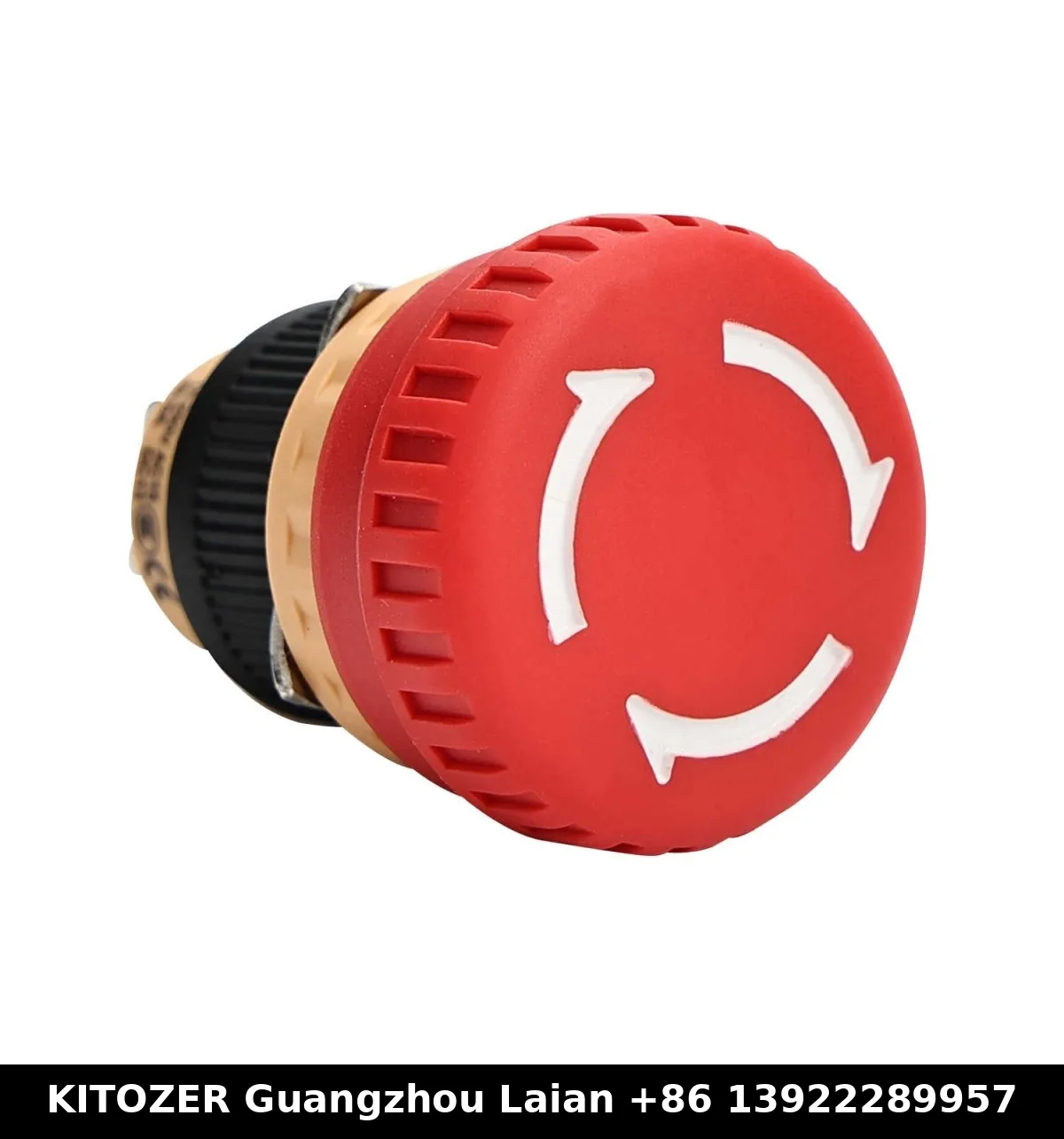
IEC 60073 and GB/T 4025 fix the color meaning of indicators and actuators. Red is emergency action: stop, disconnect, alarm. Yellow is abnormal state or attention. Green is start, on, run. Black or gray is general stop. Blue is selective action such as reset or jog. An emergency button must be a red mushroom on a yellow contrasting surface, never another color. Head shape reinforces this: a 40 mm mushroom is reserved for e-stop, while ordinary controls use round heads, and key or long handles prevent accidental operation. White rotary arrows on the head show press-and-turn-to-reset. These visual codes let a stressed operator act without thinking.
44. Power Supply and Reliability
The reliability of an alarm depends on the loop supply. Safety e-stop loops are fed by a control transformer or safety relay, independent of the main power. Security alarm loops are fed by the panel with a backup battery that survives a main failure for over 24 hours. Fire break-glass loops are on the fire electrical load with end-source switching. Designers must ensure the emergency loop works even during fire or power loss; it must not die with the normal supply.
45. Documentation and Labeling
Every button needs a unique ID on drawings, such as ES-01 for e-stop one and PB-03 for panic button three. The nearby label shows the ID, function, and reset method. As-built documents include the layout plan, wiring diagram, bill of materials, test records, certificates, and reports. KITOZER supplies outline drawings, wiring diagrams, and STEP 3D models for BIM and CAD so designers can integrate the button before fabrication.
46. Conclusion
Whether an RMB 50 call button or an RMB 400 industrial weatherproof e-stop, KITOZER offers layered, reliable, customizable emergency triggering. Guangzhou Laian, based in Panyu, Guangzhou, supports domestic and overseas clients with selection, samples, and technical help. Call +86 13922289957 or visit www.gdlain.com.
47. Emergency Buttons in Smart Security Architecture
Modern smart security combines automatic detectors, manual hold-up devices, transmission networks, alarm panels, receiving-center software, and video linkage. Automatic detectors can false-alarm or miss, but a button pressed by a person who has confirmed danger is the most trustworthy signal in the system. For this reason banks, jewelery shops, schools, and hospitals keep manual buttons even after installing many automatic sensors. A KITOZER button connects as a dry contact to the panel or to an IoT gateway, and once the event reaches the platform it can turn a camera to a preset, start recording, highlight the location on an electronic map, and push a notification to staff phones. This turns a two-terminal switch into a verified, multi-sensor event and cuts response time from minutes to seconds.
For IoT architectures, a wired KITOZER button can feed a 4G, Wi-Fi, or LoRa gateway digital input, converting the contact change into an IP message to the cloud. This retrofit suits finished interiors where new cable runs are impractical and outdoor temporary points. The dry-contact output is universal, so the same button works with a legacy panel, a modern PLC, or a cloud gateway.
48. Deep Dive into Safety Standard Requirements
ISO 13850 and GB/T 16855 require the e-stop to be triggerable in every operating mode, to outrank start and other commands, to cut dangerous power without cutting safety-essential power (such as cooling, braking, or lighting), to create no new hazard, and to latch until actively reset. These rules dictate a latching red mushroom with NC contacts. A risk assessment per ISO 12100 sets the required performance level, often PL d or PL e, which demands dual-channel contacts and a redundant safety relay that can detect a welded contact. E-stop locations must be reachable without moving from the operator position; long conveyors need rope switches rather than clusters of buttons. Designers and acceptance inspectors check these clauses one by one.
49. More Industry Applications
Power substations: E-stops at the entrance to high-voltage bays cut the upstream supply on arc or fire and interlock with five-prevention logic. Water and pump stations: E-stops in dosing rooms and pump houses stop equipment on leak or seizure. Pharma and food: Line e-stops suit cleanable, corrosion-resistant hardware. Textile and printing: Fast winders and presses need reachable stops to prevent hand entanglement. Wood and metalworking: Saws, punches, and lathes require e-stops as a mandatory acceptance item. Warehousing: Charging bays and crane aisles have emergency stops. Hospitality and entertainment: Counters and duty desks hold hidden panic buttons. Each industry has its own risk, and the button selection follows the risk.
50. Procurement Factors Beyond Price
When buying buttons, consider reliability (a cheap button that fails in a crisis costs far more than the saving), supply stability (volume projects need on-time delivery; KITOZER keeps stock and customizes in two to three weeks), technical support (help during wiring and commissioning), spare-parts availability (blocks and seals long after delivery), and certification (CE for export, GB compliance for domestic). The RMB 50 to 400 reference range reflects these trade-offs rather than a race to the bottom.
51. More FAQ
The dry contact itself needs no power; the loop supply from the panel is continuously monitored. The button switches only on actuation.
For a 24 V safety loop, keep voltage drop under 10 percent, often hundreds of meters with adequate gauge; alarm-bus distances follow the panel spec, typically one to two kilometers.
The e-stop cuts power, and inertia coasts the machine; braking is a separate function. This is normal.
Dry it, blow it out, test insulation, and replace aged seals.
No; the mechanism is damaged and the unit must be replaced.
Absolutely not; e-stop has strict color, shape, latching, and contact standards that ordinary buttons do not meet.
Standard units are not explosion-proof; hazardous areas need certified explosion-proof hardware, which can be inquired.
Low-voltage switching elements are generally outside the mandatory CCC catalog, but fire-related products need fire certification; KITOZER tests to the relevant standards.
Yes; surface-mount buttons fit a standard 86 mm back box on finished walls.
About RMB 20 to 50 over the same non-illuminated model, for the lamp socket and LED.
52. Rope Switches, Foot Switches, and Two-Hand Controls
On long conveyors, distributed buttons leave unreachable gaps, so a rope-pull switch runs the full length and stops the line when pulled anywhere; buttons suit fixed stations and rope switches suit long linear hazards, often together. Where both hands must stay occupied, such as in stamping or welding, a two-hand control prevents a hand entering the danger zone, and an e-stop remains the backup. Foot switches suit operators whose hands are busy, such as on weld positioners. Selecting among buttons, rope switches, two-hand controls, and foot switches follows the human factors and risk assessment for each station.
53. Commissioning and Acceptance Details
After installation, commissioning verifies position against drawings, fixings, wiring, contact continuity, e-stop shutdown, dual-channel consistency, alarm upload, line supervision, reset, lamps, sealing, and labels. Each button is pressed and reset while the response is observed. The acceptance record lists the button ID, location, actuation result, downstream response, reset result, tester, and date. This record moves to the facility as the maintenance baseline. KITOZER supports the contractor with test guidance and documentation.
54. Safety Culture
A button is only as good as the safety culture around it. Management that funds safety, staff trained to use the button, procedures followed, and hazards corrected make the hardware meaningful. A properly installed and tested KITOZER button is the visible sign of that culture, while a missing, blocked, or jumpered button signals the opposite. Safety managers should treat every button as a point on their safety map.
55. Conclusion
From product overview and principle to standards, integration, industry use, and dozens of questions, this guide covers the KITOZER emergency push button. Call +86 13922289957 or visit www.gdlain.com for selection, samples, and quotation.
56. Competitive Perspective
In the safety-control component market, imported, joint-venture, and domestic brands each have strengths. Importers offer long heritage in contact life, certification, and finish, but at higher prices, longer lead times, and slower customization. KITOZER meets the national and international requirements for contact performance, withstand voltage, and mechanical life while keeping the reference price at RMB 50 to 400 through local manufacturing and a tight supply chain. The Guangzhou engineering team answers selection questions within one business day and delivers customized units in two to three weeks, which overseas brands struggle to match for domestic projects. KITOZER does not compete on rock-bottom price for the lowest tier; it focuses on reliability and delivery, ships with 100 percent contact testing and certificates, and provides English labels, manuals, and CE declarations for export, plus Chinese invoices and test reports for domestic acceptance.
57. Materials and Construction in Depth
Inside the button, the snap-action stem drives a cam that switches contacts in milliseconds regardless of press speed, reducing arcing. Standard contacts are silver-nickel for general ac duty, silver-tin-oxide for heavy inrush, and gold-plated for dry milliamp signals. The housing is UL94 V-0 flame-retardant plastic that self-extinguishes without burning droplets; metal versions are stainless 304 or chrome-zinc for food, chemical, and coastal use. Sealing uses silicone or EPDM O-rings at the head-to-panel joint and the cable gland, compressed to block dust and water; these rings age and are checked yearly, with EPDM preferred outdoors for UV and thermal cycling. The result is a small device that survives years in hostile environments.
58. Typical Configuration Packages
A robot welding cell needs six stations, each with one dual-NC e-stop into a safety PLC at PL e, yellow base, IP65, lit ready indicator, around RMB 220 each, plus safety relays. A retail chain with twelve counters needs one hidden KZ-PB16 under each counter on a 24-hour zone, around RMB 80 each. An underground parking lot needs four elevator lobbies and eight escape points with break-glass and weatherproof call posts, totaling RMB 3000 to 5000. A data center needs e-stops at aisle ends, power panels, and gas-cylinder rooms, around RMB 3000 to 10000 depending on size. These packages show how the RMB 50 to 400 reference range scales into project budgets.
59. More FAQ
Industrial e-stops require a red head on a yellow contrasting surface; it can be a base, panel area, or label.
Use a multi-contact block: one NO to the panel and one NC to the PLC, electrically independent.
0.5 to 1.5 mm stranded copper, with safety loops at least 0.75 mm and ferrules for vibration.
One wire per terminal preferred; large-current terminals accept two only if rated. Branch to a terminal block otherwise.
The housing is UL94 V-0; mount it on a flame-retardant panel or enclosure.
Yes, products meet RoHS with no restricted substances.
Use spring-lock washers, check torque regularly, and choose vibration-reinforced models.
Yes, but the e-stop must be visibly larger, a red mushroom on yellow, distinct from the start button.
Wired bus uploads in seconds; 4G wireless takes three to ten seconds.
Key- or rotary-reset the button, silence and acknowledge at the panel, and log the cause.
60. Emergency Buttons in New Energy and Charging
As EV charging and energy storage expand, e-stops appear on charging piles, battery cabinets, and power-conversion units. A charging pile e-stop cuts charging on vehicle fault, fire, or leakage; a storage-system e-stop cuts power on thermal runaway or arc. These loops must link to the BMS, PCS, and fire system at high safety levels. The KITOZER industrial e-stop with dual NC and IP65 suits these cabinets at RMB 150 to 300 each.
61. Training and Drills
The best button is useless if staff do not know where it is or how to use it. Training should cover the nearest e-stop location, when to press it, what happens after, and how to reset. New employees receive this in onboarding, and drills every six months simulate a press, upload, and response, with records filed. KITOZER can provide training material and on-site explanation for major clients.
62. Conclusion
This guide has covered the KITOZER emergency push button from every angle. Reliable selection,proper installation, and regular testing keep it ready for the moment that matters. Contact Guangzhou Laian at +86 13922289957 or www.gdlain.com.
63. Model Naming and Quick Selection
KITOZER model names encode the configuration. KZ-ES22-2NC means KITOZER, emergency stop series, 22 mm mounting hole, two NC contacts. KZ-PB16-NO means panic/call button, 16 mm hole, one NO contact. KZ-BG25 is the break-glass point on a 25 mm panel. KZ-WP30 is the weatherproof post on a 30 mm panel. Suffixes can add lamp (L), metal (M), or key reset (K). The name lets buyers quickly judge the category and key contacts, though the final configuration should be confirmed with the factory. The quick decision table below summarizes the most common matches: a machine cell wants KZ-ES22-2NC at RMB 180 to 260; a hidden counter alarm wants KZ-PB16-NO key-reset at RMB 60 to 120; an escape-door break-glass wants KZ-BG25 at RMB 80 to 180; an outdoor wet call point wants KZ-WP30 at RMB 260 to 400; a request-to-exit wants a green KZ-PB16 momentary at RMB 50 to 90.
64. Emergency Buttons in Smart Cities and Campuses
Smart cities deploy emergency call posts in parks, plazas, bus bays, underpasses, parking garages, and campus perimeters. The button connects over 4G or LoRa to a city or security platform; on press, the platform geolocates the point, links nearby cameras, and dispatches patrol. The KITOZER IP65 weatherproof post suits these public outdoor sites and can add solar power and backup battery. In a smart campus, the button links to access control, video, and lighting: on press, nearby lights brighten, cameras turn, and a deterrent announcement sounds. The dry-contact output drops into an IoT gateway DI, bridging legacy hardware to the smart system.
65. Maintenance Ledger and Test Records
Each button should have a card recording ID, location, model, commissioning date, quarterly test result, annual inspection result, and replacement history. A quarterly test presses the button to confirm downstream action and resets it; an annual check tightens terminals, inspects the head and seals, and verifies lamps. The record fields are date, tester, button ID, actuation, downstream response, reset, and notes. Ledgers are kept until equipment retirement and beyond, for traceability after an incident. KITOZER supports this with durable labeling and replacement blocks.
66. More FAQ
Yes in parallel, but the PLC cannot tell which pressed; use separate DI or an address module for location.
Per the nameplate, often AC/DC 24 V or 220 V; verify before wiring.
Check dual-channel mismatch, EDM contactor monitoring, and whether the fault is cleared.
Check zone masking, end-of-line resistor, loop continuity, and address conflict.
No; use the matching hole, or a panel adapter.
Low-voltage 24 V is safe; for 220 V ground the metal housing.
Use a guard cover or choose IP65 in heavy dust.
Diagnose vibration, interference, loose wiring, and accidental contact; fix the root cause.
Mechanical over one million operations, electrical over 100,000 at rated load.
Panyu District, Guangzhou, China, as shown on the contact box.
67. Acceptance of Emergency Buttons
At project handover, inspectors count the buttons against the drawings, check positions and heights, confirm the red-on-yellow identification and labels, test wiring torque and ferrules, press each button to verify stop or alarm, verify reset, and confirm linked video and access release. Documentation must include certificates, test reports, wiring diagrams, and the as-built list. Non-conforming buttons are rectified before re-inspection. KITOZER provides the paperwork and on-site guidance to make this step smooth.
68. Conclusion
Thank you for reading the KITOZER emergency push button guide. From RMB 50 call buttons to RMB 400 industrial weatherproof e-stops, KITOZER provides reliable, selectable, serviceable emergency triggering. Contact Guangzhou Laian at +86 13922289957, WeChat same number, WhatsApp +1 906-853-4140, www.gdlain.com.
69. Emergency Buttons and Emergency Lighting / Escape Signs
In a fire, the emergency button, emergency lighting, and escape signs work together. Breaking a glass point releases the access lock, emergency lighting comes on, and illuminated signs guide people along the safe route. The KITOZER break-glass NC contact can feed the fire linkage panel so that lighting and signs activate in step. The button itself must be on a well-lit part of the escape path, visible under both normal and emergency lighting, so staff can find it in the dark. Designers should coordinate the button, lighting, and sign layouts so the evacuation route is both operable and visible.
70. Glossary of Common Terms
Useful English-Chinese and technical terms: Emergency Push Button 紧急按钮, Emergency Stop Button 急停按钮, Panic Button 报警按钮, Call Button 呼叫按钮, Break Glass 破玻按钮, Mushroom Head 蘑菇头, Latching 自锁, Momentary 自复位, Turn to Release 旋转复位, Pull to Release 拉拔复位, Key Reset 钥匙复位, Normally Open 常开, Normally Closed 常闭, Common 公共端, End of Line Resistor 末端电阻, Safety Relay 安全继电器, Dual Channel 双通道, IP Rating 防护等级, Utilization Category 使用类别. Having this vocabulary helps overseas and domestic teams collaborate on drawings and wiring.
71. Packaging, Documentation, and Export
Each KITOZER button ships in an anti-static bag with the head and contact block (pre-assembled on some models), mounting nut, washer, seal, manual (paper or QR code), and certificate. Volume orders include a packing list and outgoing test report. Custom orders can supply wiring diagrams, outline drawings, and STEP 3D models for CAD integration. Export packaging is moisture- and shock-proof with clear marks, and the company supports FOB Guangzhou or Shenzhen terms, English labels, and CE declarations.
72. More FAQ
Break-glass points can feed fire loops; ordinary e-stops feed safety loops, not the fire panel.
The contact block can be replaced; replace the whole unit if the housing or mechanism is damaged.
Panel mount, DIN rail mount, and surface box mount are available.
Yes, metal-front buttons ground through the panel.
A multi-contact block can send one alarm and one stop signal.
Yes, use shielded wire in high-interference areas.
Standard units work to minus 25 C; colder needs a custom low-temperature model.
Selection manuals and parameter tables are provided.
Check CCTV and the duty log.
Direct from Guangzhou Laian or authorized agents, call +86 13922289957.
73. Project Scale Reference
A small shop needs one or two hidden panic buttons on a panel or 4G module, around RMB 100 to 200. A mid-size factory needs ten to thirty e-stops per machine area into safety relays, around RMB 2000 to 6000. A large data center needs twenty to fifty emergency and break-glass points per room, around RMB 3000 to 10000. A commercial complex needs hundreds of break-glass and panic buttons organized by floor and fire zone. These scales help budget the RMB 50 to 400 per device.
74. Conclusion
This guide has comprehensively covered KITOZER emergency push buttons. Correct choice,proper installation, and scheduled maintenance keep the button trustworthy. Contact Guangzhou Laian at +86 13922289957 for selection and quotation.
75. Frequently Asked Questions Continued
Jumpering the NC loop makes the stop circuit always closed, so pressing the button cannot stop the machine; it removes the safety device and is forbidden.
Products follow projects to Southeast Asia, the Middle East, Africa, South America, and other regions.
Red, green, yellow, blue, and white LEDs to order.
Choose an IP65 weatherproof model; ordinary IP40 cannot.
The mechanical contact makes a soft click, no noise issue.
Outline, wiring, and STEP 3D models are available.
No; they serve different coverage and cannot substitute for each other.
The dry contact draws nothing; the lamp draws about 0.5 to 2 W.
Measure NO/NC continuity at rest and on press with a multimeter.
RMB 50 to 400 by model tier.
76. Misconceptions About Emergency Buttons
A common misconception is that any red round button is an e-stop. Only a latching red mushroom on a yellow base with NC contacts, built to the standard, qualifies. Another is that the e-stop must cut every power source; it cuts dangerous power but should preserve safety power such as braking, cooling, and emergency lighting. A third is that resetting the e-stop should restart the machine; standards forbid automatic restart. A fourth is that more buttons are always safer; unreachable buttons behind guards do not help, and over-installation dilutes maintenance. Correct placement and testing matter more than quantity. A fifth is that a button never wears out; contacts oxidize on unused alarms and wear on high-frequency stations, so scheduled cycling and replacement are essential.
77. Design Tips for Panel Builders
Panel builders should leave 22.3 mm holes for ES22 buttons, with a yellow legend area or collar, and group e-stops at the operator reach envelope rather than scattered. Provide clear terminal markings NO, NC, and C, use ferrules, and keep control wiring away from power runs. For safety circuits, route dual channels separately to show any short. Label each button on the panel print and on a nearby engraved plate. Leave space behind the panel for the contact block and cable gland, and remember that outdoor units need a downward gland and seal. These details make the panel pass acceptance on the first visit.
78. Conclusion
The KITOZER emergency push button guide is now complete. We hope it serves as a practical reference for your projects. Guangzhou Laian Intelligent System Development Co., Ltd. is at your service for selection, samples, quotation, and support. Call +86 13922289957, WeChat and phone same number, WhatsApp +1 906-853-4140, Chinese site www.lain.com.cn, English site www.gdlain.com.
79. Emergency Buttons in Finance, Education, and Healthcare
In banking, each cash window, ATM loading room, and finance office gets a hidden panic button on a 24-hour zone that uploads silently to the police-connected receiving center and links to cameras. The button is concealed from robbers but reachable by tellers under stress, and key reset keeps unauthorized people from clearing the alarm. In schools and kindergartens, one-touch alarm buttons at the gate, teacher offices, finance rooms, and labs connect to the police network per public-safety requirements. In hospitals, nurse stations, emergency rooms, pharmacies, and cash desks get call or panic buttons, ward bathrooms get pull-cords, and rescue-room doors get e-stops. These sectors treat the manual button as a mandatory, not optional, device.
80. More FAQ
Yes, but the PLC cannot locate which one; use separate DI or an address module.
Per nameplate, often AC/DC 24 V or 220 V; verify before wiring.
Check dual-channel mismatch, EDM contactor monitoring, and cleared fault state.
Check zone masking, end-of-line resistor, loop continuity, and address.
No; use the matching hole or an adapter.
Low-voltage 24 V is safe; ground the housing for 220 V.
Use a guard cover or IP65 in heavy dust.
Diagnose vibration, interference, loose wiring, and accidental contact.
Over one million mechanical and over 100,000 electrical operations at rated load.
Panyu District, Guangzhou, China, as listed in the contact box.
81. Selection Summary
To select a KITOZER emergency push button: first decide the function (e-stop, panic alarm, access release, or call), then assess the environment (indoor, outdoor, dust, wet, corrosion, explosion), choose the cutout (22 mm industrial, 16 mm compact, or custom), pick contacts (dual NC for safety, NO for alarm, NC for supervision), choose the reset (latching rotary/pull for e-stop, key for alarm, momentary for exit), match the load to the contact rating, and finally budget within the RMB 50 to 400 reference range. Proper installation height, spacing, wiring, and sealing, plus quarterly testing and annual inspection, keep the device trustworthy. Guangzhou Laian provides the full range and customization; call +86 13922289957 for a quotation.
82. Closing
Thank you for reviewing the KITOZER emergency push button technical guide. We look forward to supporting your project with reliable products and responsive service. Contact details: Tel/WeChat +86 13922289957, +86 18520668845, WhatsApp +1 906-853-4140, Address: Chaotian Park, Zhongrun Industrial Zone, No. 5 Huashan Road, Shilou Town, Panyu District, Guangzhou, China. English site www.gdlain.com.
83. More Detailed Technical Notes
The operating travel of a KITOZER button is about 3 to 5 mm, with a differential travel that ensures the contact snaps fully even if pressed slowly. The contact bounce time is short because of the snap-action mechanism, which matters when a fast PLC input samples the signal. The release force for a rotary-latched e-stop is lower than the actuation force, so unlatching is deliberate but not tiring. The terminal tightening torque is specified to avoid over-crushing the screw clamp and under-torque causing loose connections. When stacking contact blocks, the total stack depth must fit behind the panel; over-stacking may prevent the nut from seating. Panel thickness should match the nut thread length, typically 1 to 6 mm, with a thick-panel adapter available.
For illuminated buttons, the lamp voltage is isolated from the contact circuit in most models, so the lamp can be driven by a separate 24 V or 220 V supply without affecting the contact. The lamp life is typically tens of thousands of hours, and the LED can be replaced without changing the contact block. When ordering, specify the lamp voltage clearly, because a 24 V lamp on 220 V will burn instantly and a 220 V lamp on 24 V will be dim. The KITOZER part number or order form captures this, and the factory confirms before dispatch.
84. More FAQ
Standard buttons cannot; use certified explosion-proof hardware in hazardous areas.
The dry contact needs no supply; the loop supply comes from the panel or safety relay. Illuminated lamps need their own supply.
Use a dry or slightly damp cloth; do not use solvents that crack the plastic.
No; painting covers the color coding and may jam the mechanism.
EPDM or silicone O-ring plus a waterproof cable gland, tightened to the cable diameter.
The contact rating supports it; the lamp and loop supply must match the local voltage.
NC contacts in series alarm on any open and detect a cut wire, but cannot locate which opened.
Three to five working days.
Yes for major projects.
Email or call +86 13922289957 with quantities and configurations.
85. Final Word
This technical guide has covered the KITOZER emergency push button in depth, from its simple appearance to the standards, wiring, maintenance, and industry practices behind it. A well-chosen, well-installed, well-tested button is a small investment with a large safety return. Guangzhou Laian Intelligent System Development Co., Ltd. thanks you for your trust and invites your inquiry at +86 13922289957 or www.gdlain.com.
86. More Real-World Scenarios
Consider a food-processing line where operators clean machinery with water every shift. An ordinary IP40 e-stop would corrode within months, so the line uses IP65 stainless e-stops with sealed glands, washed down with the equipment. In a textile mill with flying lint, buttons are mounted in sealed enclosures with clear covers that are lifted before pressing, preventing lint from jamming the mechanism. In an outdoor pump station in a humid climate, the KZ-WP30 weatherproof call post survives rain and heat, key-reset so only trained staff clear the alarm. In a school, the hidden panic button under the teacher’s desk is wired to a 24-hour zone that silently alerts police while the classroom camera records. In a bank vault, the break-glass and panic buttons are monitored with end-of-line resistors so a cut wire shows as a trouble, not a silent dead zone. Each scenario dictates a different button, and the reference price ranges accordingly from RMB 50 to 400.
87. More FAQ
No; color is part of safety coding and must match the function from the start.
Measure loop resistance at the panel with the button at rest; it should equal the rated resistor.
Yes within the contact rating; use an RC snubber across the coil.
Custom colors and silkscreen take two to three weeks.
We supply buttons and can advise on panels and relays for a complete kit.
NC contacts can be chained for stop loops; NO contacts for alarm parallel branches, with the location trade-off noted.
IP65 handles jets; IP69K for high-temperature high-pressure washdown is custom.
Engrave or print function in local language plus an icon; KITOZER supports custom silkscreen.
18 months from delivery under normal use.
Call or WeChat +86 13922289957, around the clock for urgent safety issues.
88. Thank You
Thank you for reading the KITOZER emergency push button guide. We hope the product knowledge, selection logic, wiring examples, maintenance routines, and answers to over a hundred questions help your project succeed. KITOZER is the brand of Guangzhou Laian Intelligent System Development Co., Ltd., based in Panyu, Guangzhou. Contact us for selection, samples, volume pricing, and customization: +86 13922289957. We look forward to working with you.
89. Additional Engineering Considerations
When planning a large safety circuit, remember that wire resistance adds up over long series loops. A 24 V loop should not drop more than roughly 10 percent, so on a long line with many e-stops, use a larger conductor or feed the loop from both ends. Safety relays also have a maximum number of series contacts; consult the relay manual. For alarm loops, the end-of-line resistor location matters: it should sit at the last device on the line, not at the panel, so a cut wire is detected. For wireless points, check the battery voltage regularly and note that wireless e-stops are supplementary, not the primary safety stop, in high-risk machinery. These details separate a compliant installation from a superficially similar but unsafe one.
Documentation should evolve as the installation changes. When a button is added, moved, or replaced, update the drawing, the loop schedule, and the maintenance ledger. A panel that does not match the field will mislead the next person who troubleshoots an alarm. KITOZER encourages customers to keep as-built drawings and test records, and provides editable outline drawings to simplify that task.
90. More FAQ
No; reserve it for emergencies and use a normal stop button for routine stops.
Use tamper-resistant mounting, sealed enclosures, and audit the loop resistance at inspection.
In a series NC loop both open, which is fine; in a parallel NO alarm loop either press triggers the alarm.
No; add a fuse in the loop supply as designed.
Yes, English datasheets and manuals are available for export orders.
CE-conformant units are available for export.
Follow local electronic-waste rules; contacts and plastics are recyclable where facilities exist.
Yes, contact +86 13922289957; samples ship in three to five days.
Samples are available singly; volume pricing starts at modest quantities.
Yes, OEM and custom silkscreen are supported.
91. End of Guide
This completes the KITOZER emergency push button technical guide. From product overview, principle, parameters, selection, wiring, installation, and maintenance to standards, integration, applications, and over one hundred frequently asked questions, we have aimed to give engineers and contractors a reliable reference. The KITOZER range spans RMB 50 economy call buttons to RMB 400 industrial weatherproof e-stops, backed by Guangzhou Laian Intelligent System Development Co., Ltd. in Panyu, Guangzhou. For selection, samples, quotation, or customization, call +86 13922289957 or visit www.gdlain.com. Thank you for choosing KITOZER.
92. Closing Notes on Reliability
The reliability of an emergency button is ultimately proven in the few moments it is needed. KITOZER designs for that moment by using snap-action contacts, silver-alloy switching elements, flame-retardant housings, and sealed constructions, then tests every unit before dispatch. The installer’s role is to mount it where it can be reached, wire it in a fail-safe arrangement, and seal out dust and water. The operator’s role is to know where it is and how to reset it without restarting the machine. The maintenance team’s role is to test it quarterly and replace worn blocks on schedule. When all three roles are done well, the button will work on the day it matters. We hope this guide helps you achieve that on every project.
93. Contact Summary
For KITOZER emergency push buttons and related safety and security devices, contact Guangzhou Laian Intelligent System Development Co., Ltd.: Tel/WeChat +86 13922289957 and +86 18520668845, WhatsApp +1 906-853-4140, Address: Chaotian Park, Zhongrun Industrial Zone, No. 5 Huashan Road, Shilou Town, Panyu District, Guangzhou, China. Chinese website www.lain.com.cn, English website www.gdlain.com. We supply reference-price guidance from RMB 50 to 400, samples, volume orders, and custom configurations. Thank you for your attention.
94. Frequently Asked Questions Final Round
Yes; the dry contact is ideal for 24 Vdc safety loops, with a fuse in series.
Silicone seals last several years indoors; outdoor EPDM seals should be checked yearly and replaced on cracking.
No; use factory labels and plates that already carry the required color coding.
No; the contact switches a loop, it does not require neutral. Only the lamp circuit may need a live and neutral.
Panel mounting orientation is flexible, but keep the head accessible and the cable entry downward outdoors.
The mechanism may be jammed or broken; replace the block or the whole button rather than forcing it.
Yes, compact 16 mm or pendant-mount e-stops are available for handheld controllers.
Specify AC or DC and the voltage on the order; the factory confirms before dispatch.
Yes, the engineering team can advise on contact configuration and safety relay selection.
Call +86 13922289957 with your application and quantity; we will recommend a model and send a quote.
95. Final Remarks
An emergency push button is a small device with a serious purpose. KITOZER is committed to making that device reliable, easy to select, simple to install, and economical to own, with reference prices from RMB 50 to 400 and the support of Guangzhou Laian Intelligent System Development Co., Ltd. We thank you for reading this guide and welcome your inquiry at +86 13922289957 or www.gdlain.com.
96. Quick Reference Card
Keep this quick reference in mind when specifying KITOZER emergency push buttons. Choose red mushroom on yellow base for machine e-stop, wired as dual NC into a safety relay, latching with rotary or pull reset. Choose hidden red key-reset NO for panic alarms on a 24-hour zone with an end-of-line resistor. Choose break-glass NC for escape-door release on the fire loop. Choose IP65 weatherproof key-reset for outdoor call points. Keep buttons reachable at 0.9 to 1.1 m for e-stop and 1.4 to 1.5 m for alarms, never blocked. Wire with ferrules, separate from power, seal outdoor entries downward. Test quarterly and inspect annually. Reference prices run RMB 50 for economy call, RMB 120 to 260 for industrial e-stop, and RMB 260 to 400 for weatherproof key-reset units. Contact +86 13922289957 for any confirmation.
97. Thank You Again
We appreciate the time you have taken to review this KITOZER emergency push button guide. Our goal is to make your selection, installation, and maintenance as straightforward and reliable as possible. Guangzhou Laian Intelligent System Development Co., Ltd. stands ready to support your projects with quality hardware and responsive engineering. Please reach out anytime at +86 13922289957 or through www.gdlain.com.
98. Final FAQ
Choose the model by function and environment, order a sample, test it on the bench, then deploy the approved configuration across the project.
The indoor IP40 model cannot go outdoors; use the IP65 weatherproof model outside, even for the same function.
Keep them in the original bag in a dry, cool place away from corrosive gas, and rotate stock so seals do not age on the shelf.
Yes, contact blocks, seals, lamps, and glass spares remain available after a model is discontinued.
Call +86 13922289957 or email with your application, and we will send a recommendation and quotation.
99. The End
This concludes the KITOZER emergency push button technical guide. We thank you for your interest and look forward to supplying reliable emergency buttons for your safety and security projects. Guangzhou Laian Intelligent System Development Co., Ltd., Panyu, Guangzhou. Tel/WeChat +86 13922289957. www.gdlain.com.
100. Final Thank You
Thank you for reading the complete KITOZER emergency push button guide. We have covered the product family, the working principle, technical parameters, selection steps, wiring examples, installation and ergonomics, standards, integration with safety relays and alarm panels, industry configurations, maintenance routines, acceptance checklists, and more than one hundred frequently asked questions. We hope this material makes your project smoother and safer. KITOZER, backed by Guangzhou Laian Intelligent System Development Co., Ltd., is ready to support you with reliable hardware, competitive reference pricing from RMB 50 to 400, and responsive engineering service. Please contact us at +86 13922289957 or visit www.gdlain.com whenever you need a recommendation, sample, or formal quotation.
101. End of Document
This is the end of the KITOZER emergency push button technical guide. We have aimed to provide a complete, practical, and honest reference for engineers, installers, and facility managers. The product range, the standards behind it, the wiring logic, the maintenance discipline, and the answers to common questions are all intended to help you choose and use the right button with confidence. For any remaining question, please contact Guangzhou Laian Intelligent System Development Co., Ltd. at +86 13922289957, WeChat and phone the same number, or write through www.gdlain.com. Thank you for your trust, and we wish you a safe and successful project.
KITOZER emergency push buttons: engineered for the moment that matters. Guangzhou Laian Intelligent System Development Co., Ltd. welcomes your inquiry at +86 13922289957 or www.gdlain.com. Thank you for reading.
Whether you need a single hidden panic button for a counter, a dual-channel e-stop for a machine cell, a break-glass point for an escape door, or a weatherproof call post for an outdoor campus, KITOZER has a model in the RMB 50 to 400 range to fit your application and budget. Our engineering team is ready to help you select the right contacts, reset style, and protection rating, and to support you through installation, commissioning, and long-term maintenance. Thank you again, and we look forward to hearing from you soon.
Contact KITOZER
KITOZER emergency push buttons are sold directly by Guangzhou Laian Intelligent System Development Co., Ltd.
Tel/WeChat: +86 13922289957 / +86 18520668845
WhatsApp: +1 906-853-4140
Address: Chaotian Park, Zhongrun Industrial Zone, No. 5 Huashan Road, Shilou Town, Panyu District, Guangzhou, China
Chinese site: www.lain.com.cn English site: www.gdlain.com
We welcome inquiries for selection, quotation, volume orders, and customization. Our engineering team supports you around the clock.
Reference Price
KITOZER emergency push button reference price range: RMB 50 to RMB 400 (excluding tax and freight; final quote depends on configuration).
| Tier | Typical model | Reference price | Typical use |
|---|---|---|---|
| Economy | KZ-PB16 single-contact momentary | RMB 50-120 | Indoor call, request-to-exit |
| Standard | KZ-ES22 mushroom latching e-stop | RMB 120-260 | Machine e-stop |
| Premium | KZ-WP30 weatherproof key-reset | RMB 260-400 | Outdoor, wet, corrosive |
All prices are reference only; volume projects are negotiable. Call +86 13922289957 for a formal quotation.