I. System Introduction
1.1 Definition and Working Principle of High-Frequency UPS
A High-Frequency UPS is an online uninterruptible power supply adopting IGBT high-frequency rectifier and inverter technologies with an operating frequency of no less than 20kHz, far higher than the 50Hz power frequency. It features a dual-conversion (AC-DC-AC) architecture, which optimizes power quality and ensures uninterrupted power supply via high-frequency switching conversion.
Working Principle: When utility power is normal, the input AC power is converted into DC power by the IGBT high-frequency rectifier. Part of the DC power charges the batteries, and the rest is inverted back into pure sinusoidal AC power for output via the IGBT inverter. When utility power fails or operates abnormally, the batteries discharge instantly within ≤2ms to sustain power supply through the inverter with zero switching interruption. The system will automatically revert to normal mode and recharge the batteries once utility power is restored.
1.2 Technical Positioning and Value
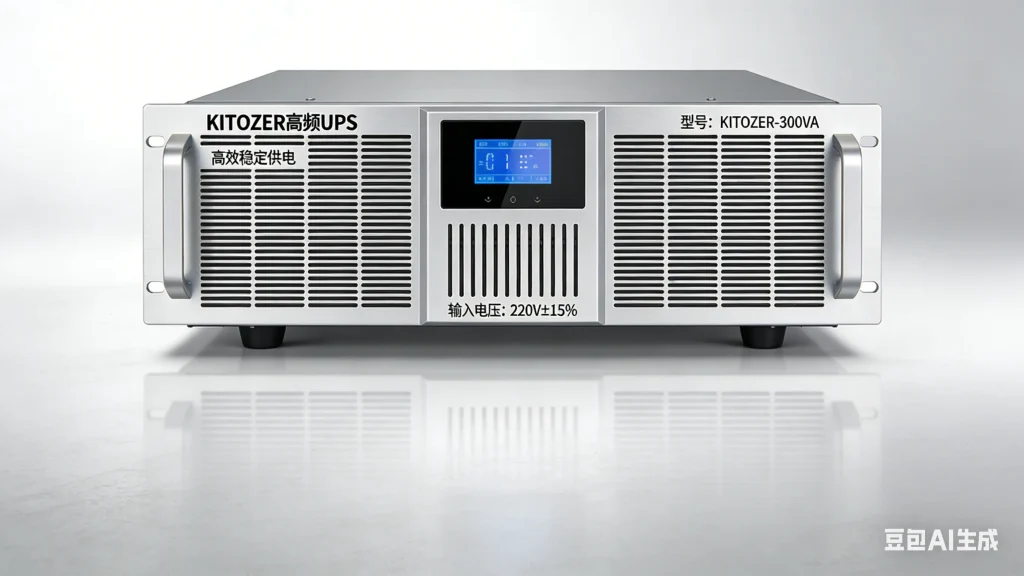
KITOZER high-frequency UPS adopts full digital DSP control technology combined with active power factor correction (PFC) and high-frequency soft switching technology. It achieves an input power factor ≥ 0.99 and total harmonic distortion of input current (THDi) ≤ 3%, complying with green power standards. Boasting remarkable advantages including compact size, light weight, high efficiency (≥ 95%) and low noise, it is an ideal power guarantee device for modern computer rooms and data centers.
II. System Composition
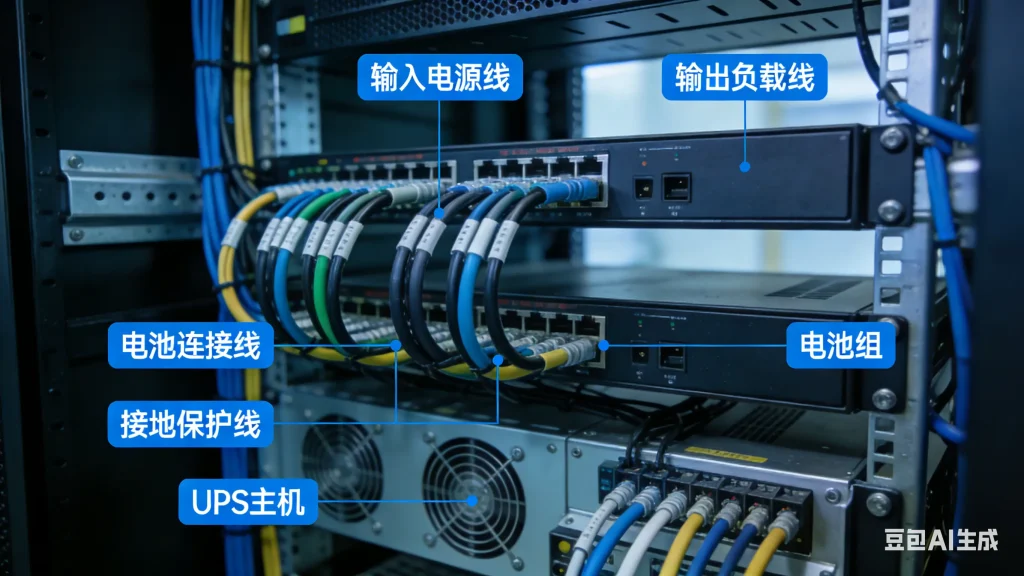
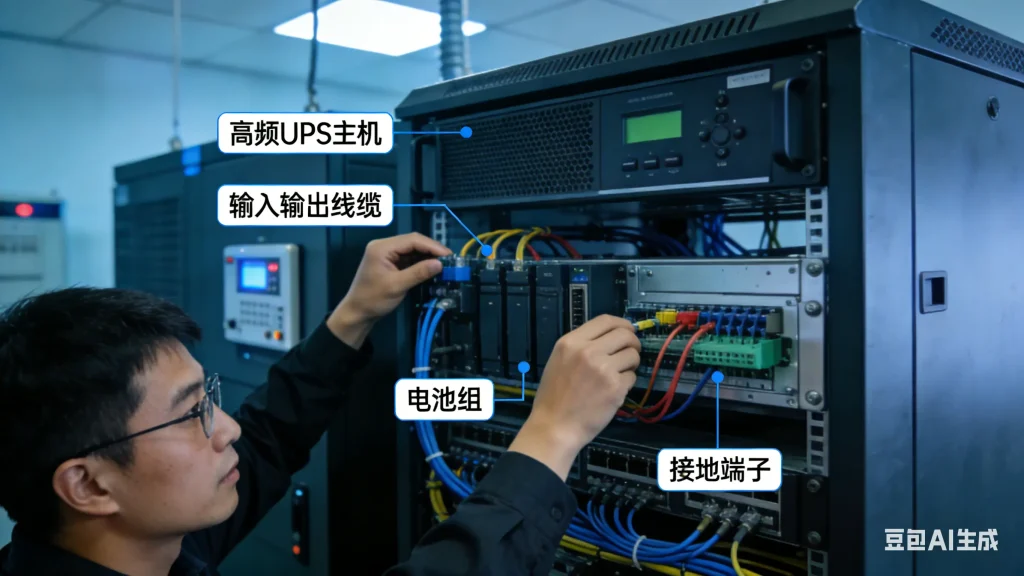
The KITOZER high-frequency UPS system consists of the following core components to form a complete power supply guarantee system:
| Component Name | Function Description | Technical Features |
|---|---|---|
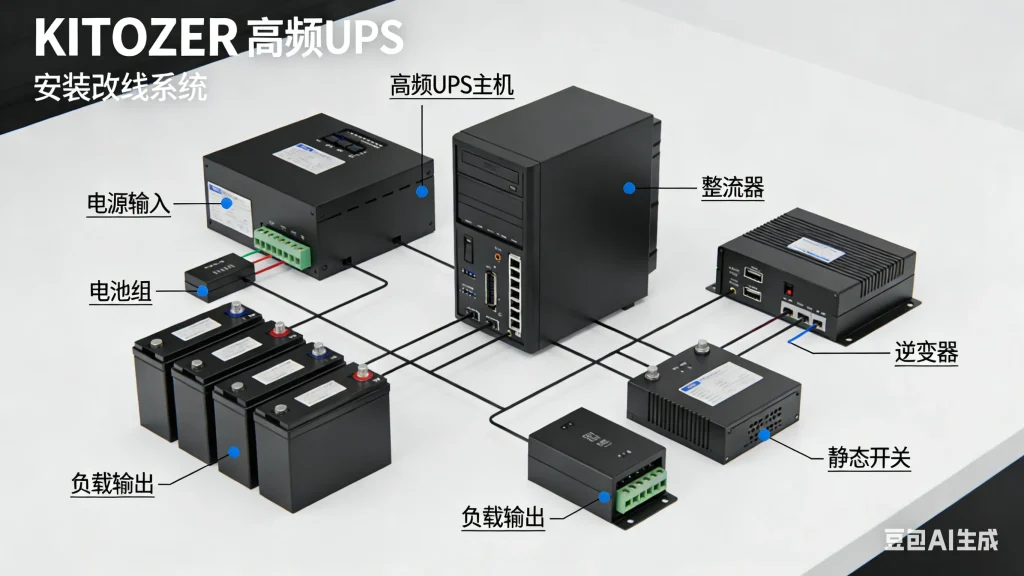
| IGBT High-Frequency Rectifier | Converts utility AC to DC and implements power factor correction | Switching frequency ≥ 20kHz, Boost topology, THDi ≤ 3%, Input power factor ≥ 0.99 |
| IGBT Inverter | Converts DC to pure sinusoidal AC output; loads are continuously powered by the inverter | PWM pulse width modulation, Output THDu ≤ 2% (linear load), Zero switching time |
| Battery Pack | Provides backup power when utility power fails | Valve-Regulated Lead-Acid (VRLA) or gel batteries, Hot-swap support, Built-in Battery Management System (BMS) |
| Static Bypass Switch | Switches to utility power rapidly upon fault or overload to keep loads powered | Switching time ≤ 2ms, with overload, short-circuit and over-temperature protection |
| Maintenance Bypass Switch | Enables on-site UPS maintenance without cutting off load power | Mechanical switch with electronic interlock for operational safety |
| DSP Digital Control System | Core control unit for intelligent management of the entire system | 32-bit DSP processor, multi-mode operation control, fault diagnosis and early warning |
| Monitoring & Management Module | Real-time operating status monitoring and remote management support | Chinese LCD display, RS485/Modbus, SNMP network management, Dry contact alarm |
| Auxiliary Protection Module | Surge suppression, overvoltage/undervoltage/overcurrent/overtemperature/short-circuit protection | Multi-stage EMI filtering, intelligent fault isolation, protects loads and the UPS itself |
III. System Classification
3.1 Classification by Input & Output Phase
| Type | Rating | Application Scenarios |
|---|---|---|
| Single-phase Input / Single-phase Output | 1kVA ~ 10kVA | Small computer rooms, network cabinets, edge computing nodes |
| Three-phase Input / Single-phase Output | 10kVA ~ 20kVA | Medium computer rooms, blade server clusters |
| Three-phase Input / Three-phase Output | 15kVA ~ 800kVA | Large data centers, cloud computing centers, industrial computer rooms |
3.2 Classification by Installation Mode
| Type | Features | Application Scenarios |
|---|---|---|
| Tower | Freestanding installation, no cabinet required | Traditional computer rooms with sufficient space, flexible capacity expansion |
| Rack | Fits standard 19-inch cabinets, 2U/3U/6U height | High-density data centers, space-saving, hot-swap expansion supported |
| Modular | Combined power modules and control modules, N+X redundancy supported | Large data centers meeting Tier III/IV standards, on-site maintenance and expansion available |
3.3 Classification by Redundancy Architecture
| Architecture | Configuration | Reliability Level | Application Scenarios |
|---|---|---|---|
| Standalone | Single UPS unit for power supply | Basic | Small computer rooms, non-critical business systems |
| 1+1 Parallel Redundancy | Two UPS units of equal capacity in parallel; the other takes over automatically if one fails | Medium to High | Medium computer rooms, core business systems |
| N+X Parallel Redundancy | N main UPS units + X standby units (X=1~3) | High | Large data centers complying with Tier III/IV standards, critical business systems |
| 2N Dual Bus | Two independent UPS systems, dual power supply for loads | Highest | Finance, healthcare, military and other key fields requiring zero downtime |
IV. System Configuration List (KITOZER Brand)
4.1 Standard Configuration List (Tower / Rack Type)
| No. | Device Name | Model | Quantity | Technical Specifications |
|---|---|---|---|---|
| 1 | High-Frequency Online UPS Main Unit | KITOZER-KH11 Series (1kVA~10kVA)KITOZER-KH31 Series (15kVA~800kVA) | 1 Set | Input power factor ≥ 0.99, Efficiency ≥ 95%, LCD display, RS485 communication |
| 2 | VRLA Battery | KITOZER-BAT 12V Series | 8~32 Units | 12V/7Ah ~ 12V/100Ah, configured according to backup time |
| 3 | Battery Cabinet | KITOZER-BC Series | 1~2 Sets | Cold-rolled steel, equipped with battery cables and circuit breakers |
| 4 | Input & Output Distribution Cabinet | KITOZER-PD Series | 1 Set | Equipped with disconnector, molded case circuit breaker and SPD |
| 5 | Monitoring Module | KITOZER-MON01 | 1 Set | Supports Web, SNMP and SMS alarm, remote monitoring software |
| 6 | Connecting Cables | KITOZER-CABLE Series | 1 Set | Copper-core cables meeting current-carrying and safety requirements |
| 7 | Installation Accessories | KITOZER-KIT Series | 1 Set | Including fixing brackets, screws, user manual and warranty card |
4.2 Redundant System Configuration List (1+1 Parallel)
| No. | Device Name | Model | Quantity | Technical Specifications |
|---|---|---|---|---|
| 1 | High-Frequency Online UPS Main Unit | KITOZER-KH31 Series (Equal capacity) | 2 Sets | Parallel operation supported, current sharing control, current unbalance ≤ 3% |
| 2 | Parallel Control Module | KITOZER-PAR01 | 1 Set | Enables synchronous operation and automatic fault switching between two UPS units |
| 3 | VRLA Battery | KITOZER-BAT 12V Series | 16~64 Units | Same configuration as standalone system for each group |
| 4 | Battery Cabinet | KITOZER-BC Series | 2~4 Sets | Independent configuration for each battery group |
| 5 | Input & Output Distribution Cabinet | KITOZER-PD-R Series | 1 Set | Equipped with synchronizer, disconnector, circuit breaker and SPD |
| 6 | Monitoring System | KITOZER-MON02 | 1 Set | Centralized monitoring for parallel systems, fault location and alarm |
| 7 | Cables & Accessories | KITOZER-CABLE-PAR Series | 1 Set | Including parallel communication cables, power cables and installation parts |
V. System Schematic Diagram
5.1 Schematic Diagram of Standalone High-Frequency UPS
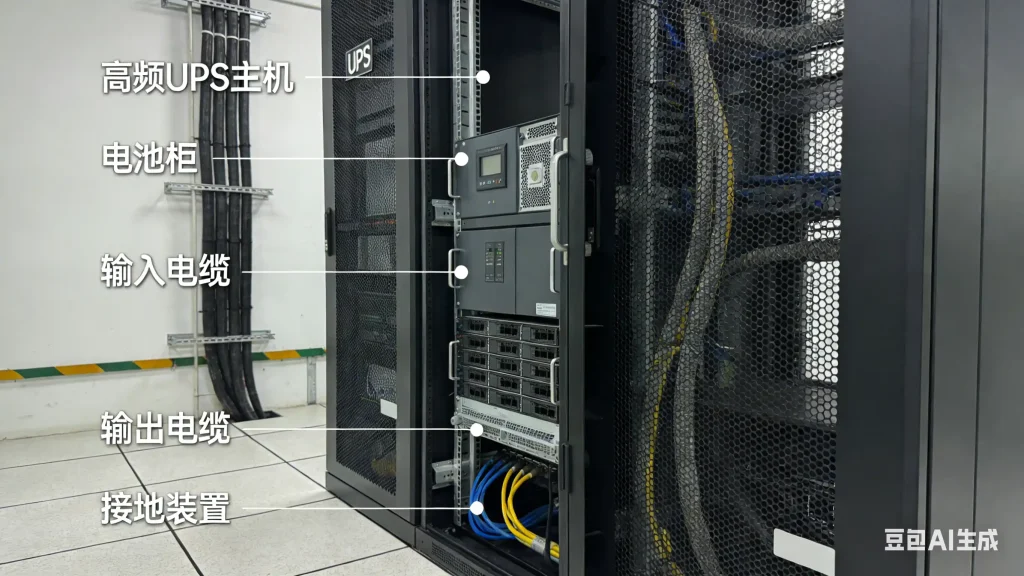
Utility Input → Input EMI Filter → IGBT High-Frequency Rectifier (PFC) → DC Bus
↓
Battery Pack (Charging / Discharging)
↓
DC Bus → IGBT Inverter → Output Filter → Static Bypass Switch → Load
↓
Maintenance Bypass Switch (For maintenance)
↓
Monitoring System (DSP Control + HMI)
5.2 Schematic Diagram of 1+1 Parallel Redundant System
Utility Input → Input Distribution Cabinet → Two KITOZER High-Frequency UPS Units (Parallel Control)
↓
Two Independent Battery Packs
↓
Dual UPS Output → Output Synchronizer → Output Distribution Cabinet → Load
↓
Centralized Monitoring System (Remote Management + Alarm)
5.3 Flow Chart of Dual-Conversion Operation Modes
- Normal Utility Power: Utility Power → Rectification → DC → Inversion → Load (Battery charging simultaneously)
- Abnormal Utility Power: Battery → DC → Inversion → Load (Zero-interruption switching)
- Utility Power Recovery: Utility Power → Rectification → DC → Inversion → Load (Resume battery charging)
- Fault Status: Automatic switch via static bypass → Direct power supply from utility power (Ensure continuous load operation)
VI. Product Technical Parameters
6.1 KITOZER-KH11 Series (Single-phase Input / Single-phase Output)
| Parameter | 1kVA | 3kVA | 6kVA | 10kVA |
|---|---|---|---|---|
| System Features | High-frequency online type, dual-conversion architecture, full DSP digital control | |||
| Input Parameters | ||||
| Input Voltage Range | 110~300VAC | 110~300VAC | 110~300VAC | 110~300VAC |
| Input Frequency Range | 40~70Hz | 40~70Hz | 40~70Hz | 40~70Hz |
| Input Power Factor | ≥ 0.99 | ≥ 0.99 | ≥ 0.99 | ≥ 0.99 |
| Input THDi | ≤ 3% | ≤ 3% | ≤ 3% | ≤ 3% |
| Output Parameters | ||||
| Output Voltage | 220VAC±1% | 220VAC±1% | 220VAC±1% | 220VAC±1% |
| Output Frequency | 50Hz/60Hz±0.1Hz | 50Hz/60Hz±0.1Hz | 50Hz/60Hz±0.1Hz | 50Hz/60Hz±0.1Hz |
| Output Waveform | Pure sinusoidal wave, THDu ≤ 2% (Linear load) | |||
| Output Power Factor | 0.8 (Lagging) | |||
| Overload Capacity | 125% load for 10 minutes; 150% load for 1 minute | |||
| Battery Parameters | ||||
| Battery Voltage | 36V DC | 72V DC | 96V DC | 192V DC |
| Battery Type | VRLA / Gel Battery | |||
| Charging Current | 0~10A Adjustable | 0~20A Adjustable | 0~30A Adjustable | 0~50A Adjustable |
| Performance Parameters | ||||
| Switching Time | 0ms (Zero interruption) | |||
| Efficiency | ≥ 95% (Full load), ≥ 92% (Half load) | |||
| Noise (1m distance) | ≤ 50dB | ≤ 55dB | ≤ 60dB | ≤ 65dB |
| Operating Temperature | 0~40℃ | |||
| Relative Humidity | 20%~90% (Non-condensing) | |||
| Physical Parameters | ||||
| Dimensions (W×D×H) | 430×620×220mm | 480×650×260mm | 550×700×300mm | 600×800×350mm |
| Weight | 25kg | 45kg | 70kg | 100kg |
| Communication Interface | RS485 (Modbus), USB, Dry contact alarm, Optional SNMP card |
6.2 KITOZER-KH31 Series (Three-phase Input / Three-phase Output)
| Parameter | 15kVA | 30kVA | 60kVA | 100kVA | 200kVA | 800kVA |
|---|---|---|---|---|---|---|
| System Features | High-frequency online type, dual-conversion architecture, full DSP digital control, parallel support | |||||
| Input Parameters | ||||||
| Input Voltage | 380/400/415VAC (3-phase 3-wire / 3-phase 4-wire) | |||||
| Input Voltage Range | -45% ~ +25% | |||||
| Input Frequency Range | 40~70Hz | |||||
| Input Power Factor | ≥ 0.99 | |||||
| Input THDi | ≤ 3% | |||||
| Output Parameters | ||||||
| Output Voltage | 380/400/415VAC±1% | |||||
| Output Frequency | 50Hz/60Hz±0.1Hz | |||||
| Output Waveform | Pure sinusoidal wave, THDu ≤ 2% (Linear load), ≤ 4% (Non-linear load) | |||||
| Output Power Factor | 0.8 (Lagging) | |||||
| Overload Capacity | 110% for 60min, 125% for 10min, 150% for 1min | |||||
| Battery Parameters | ||||||
| Battery Voltage | 192V DC | 240V DC | 384V DC | 384V DC | 576V DC | 768V DC |
| Charging Current | 0~80A | 0~120A | 0~200A | 0~250A | 0~300A | 0~500A |
| Performance Parameters | ||||||
| Switching Time | 0ms | |||||
| Efficiency | ≥ 96% (Full load), ≥ 94% (Half load) | |||||
| Noise | ≤ 65dB | ≤ 70dB | ≤ 75dB | ≤ 78dB | ≤ 80dB | ≤ 85dB |
| Parallel Capability | Supports 1~8 units parallel, current unbalance ≤ 3% | |||||
| Physical Parameters | ||||||
| Dimensions (W×D×H) | 600×800×1600mm | 600×800×1800mm | 800×1000×1800mm | 800×1200×2000mm | 1000×1200×2000mm | 1200×1500×2200mm |
| Weight | 200kg | 350kg | 550kg | 800kg | 1200kg | 2500kg |
| Communication Interface | RS485, Ethernet (TCP/IP), SNMP, Dry contact, USB |
VII. Application Scope
KITOZER high-frequency UPS provides reliable power guarantee for the following key scenarios:
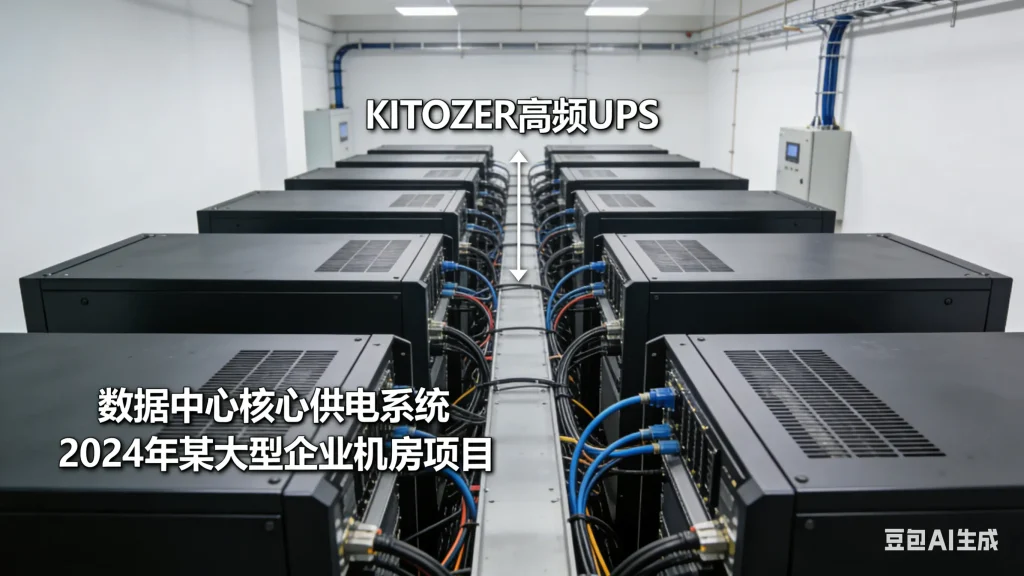
7.1 Data Center & Cloud Computing
- Large-scale data centers (Tier III/IV)
- Cloud computing and edge computing nodes
- Server clusters and storage systems
- Telecommunication computer rooms and IDC hosting centers
7.2 Enterprise & Commercial Applications
- Enterprise core computer rooms and disaster recovery centers
- Data centers of financial institutions (banks, securities, insurance)
- Medical systems (Operating rooms, ICU, medical imaging equipment)
- Government agencies and public service systems (Government cloud, e-government)
7.3 Industry & Energy
- Industrial automatic control systems (PLC, DCS)
- Precision manufacturing equipment (Semiconductor, electronic processing)
- Power dispatching centers and substation automation systems
- Key equipment in petrochemical and mineral industries
7.4 Special Industries
- Military communication and command systems
- Radio, television and media centers
- Scientific research institutions (Laboratory precision instruments)
- Transportation hubs (Airport, high-speed rail, metro signal systems)
VIII. Product Advantages
8.1 Technical Performance
- High Efficiency & Energy Saving: Adopts IGBT high-frequency soft switching technology. Efficiency ≥ 95% for standalone units and ≥ 96% for 3-phase units, reducing energy consumption and meeting green data center standards.
- Optimized Power Quality: Input power factor ≥ 0.99 and THDi ≤ 3% reduce grid pollution; output THDu ≤ 2% delivers pure power to protect precision equipment.
- Zero-interruption Power Supply: Dual-conversion architecture ensures switching time ≤ 2ms between utility power and battery power for continuous stable load operation.
- Full Digital Control: 32-bit DSP processor features fast response and high control precision, supporting intelligent battery management and automatic fault diagnosis.
8.2 Structural Design
- Compact & Lightweight: No output isolation transformer. Size reduced by 40% and weight cut by 50%, saving computer room space.
- Flexible Installation: Available in tower, standard 19-inch rack and modular types to adapt to various room environments.
- Easy Maintenance: Front-access design and modular structure. Key components support hot swap, lowering maintenance difficulty and downtime risks.
- Low Noise Operation: High-frequency conversion and optimized heat dissipation reduce noise by 10~15dB compared with power-frequency UPS, improving on-site working environment.
8.3 Intelligent Management
- Comprehensive Monitoring: Chinese LCD display, compatible with RS485/Modbus, SNMP, Web and SMS for remote monitoring and management.
- Intelligent Battery Management: Supports temperature compensation, overcharge/over-discharge protection, residual capacity calculation and battery health monitoring, extending battery service life by over 30%.
- Fault Early Warning: Real-time system status monitoring predicts potential faults and supports remote diagnosis and guidance.
- Custom Operating Modes: ECO mode (efficiency ≥ 98%) and sleep mode optimize energy consumption for different load conditions.
8.4 Reliability & Expandability
- High Reliability: MTBF ≥ 200,000 hours. Redundant key components and 1+1~N+X parallel operation improve system availability.
- Wide Input Range: Input voltage range -45% ~ +25% and frequency 40~70Hz adapt to harsh grid conditions and generator power supply.
- Strong Overload Resistance: 150% load tolerance for 1 minute and 125% for 10 minutes to cope with load fluctuation.
- Smooth Expansion: Modular design allows on-site capacity expansion to protect initial investment and match business growth.
IX. Bid Control Parameters
9.1 Core Technical Parameters (Mandatory)
- UPS Type: High-frequency online type, dual-conversion architecture, operating frequency ≥ 20kHz, no output isolation transformer, IGBT rectifier and inverter adopted.
- Switching Time: Utility/battery switching time ≤ 2ms for zero-interruption power supply.
- Input Performance: Input power factor ≥ 0.99, THDi ≤ 3%, input voltage range -45% ~ +25%, frequency range 40~70Hz.
- Output Performance: Output voltage accuracy ±1%, THDu ≤ 2% (linear load) / ≤ 4% (non-linear load), frequency accuracy ±0.1Hz.
- Efficiency: ≥ 95% for units below 10kVA; ≥ 96% for units above 15kVA; ECO mode efficiency ≥ 98%.
- Control Mode: 32-bit full digital DSP control, supporting intelligent battery management and automatic fault diagnosis.
9.2 System Functional Parameters (Mandatory)
- Redundancy: Supports 1~8 units parallel operation, current sharing unbalance ≤ 3%, hot swap available.
- Protection: Input overvoltage/undervoltage, output overvoltage/undervoltage/overcurrent/short-circuit, overtemperature, battery overcharge/over-discharge protection.
- Monitoring Interface: Standard RS485 (Modbus), USB and dry contact; optional SNMP card and Ethernet port for remote management.
- Battery Management: Compatible with VRLA and gel batteries, with temperature compensation, charge/discharge management and residual capacity display.
- Installation: Tower and standard 19-inch rack installation available.
- Maintenance: Equipped with static bypass and maintenance bypass for on-site maintenance without power cut.
9.3 Quality & Certification Parameters (Mandatory)
- Certifications: ISO9001, ISO14001, OHSAS18001; products certified by CE, UL, TLC and other authoritative organizations.
- MTBF: Mean Time Between Failures ≥ 200,000 hours with third-party test report provided.
- Warranty: Whole machine warranty ≥ 3 years, battery warranty ≥ 1 year; original manufacturer warranty letter provided.
- Environmental Standard: Compliant with RoHS; noise ≤ 70dB @ 1m for units below 10kVA, meeting green data room requirements.
X. Product Solutions
10.1 Solution for Small Computer Rooms (1kVA ~ 10kVA)
10.1.1 Application Scenarios
- Department-level enterprise computer rooms, network cabinets, edge computing nodes
- Load capacity: ≤ 8kW (10kVA model, power factor 0.8)
- Typical loads: 1~5 servers, network devices, storage equipment, monitoring systems
10.1.2 Recommended Configuration
- UPS Model: KITOZER-KH11 Series (1kVA/3kVA/6kVA/10kVA), tower / rack type
- Redundancy: Standalone (1+1 parallel for critical loads)
- Backup Time: Standard 30 minutes (expandable to 1~8 hours)
- Battery: KITOZER-BAT 12V VRLA battery
- Auxiliary Equipment: Battery cabinet, input & output distribution cabinet, monitoring module
10.1.3 Solution Features
- Compact structure, space-saving and easy installation
- High efficiency and low operating cost
- Full digital control, simple operation and maintenance
- Low investment cost, ideal for small computer rooms with limited budget
10.2 Solution for Medium Computer Rooms (15kVA ~ 100kVA)
10.2.1 Application Scenarios
- Enterprise core computer rooms, medium data centers, branch offices of financial institutions
- Load capacity: 12kW ~ 80kW (power factor 0.8)
- Typical loads: 10~30 server clusters, storage arrays, core network devices, virtualization platforms
10.2.2 Recommended Configuration
- UPS Model: KITOZER-KH31 Series (15kVA/30kVA/60kVA/100kVA), 3-phase input & 3-phase output
- Redundancy: 1+1 parallel redundancy (2N dual bus for core businesses)
- Backup Time: Standard 60 minutes (expandable to 2~12 hours)
- Battery: KITOZER-BAT 12V high-capacity VRLA battery
- Auxiliary Equipment: Dual battery cabinets, distribution cabinet with synchronizer, centralized monitoring system
10.2.3 Solution Features
- High reliability to support 7×24 operation of core businesses
- Smooth expansion to adapt to business growth
- Centralized monitoring for real-time system status viewing
- On-site maintenance capability reduces downtime risks
10.3 Solution for Large Data Centers (200kVA ~ 800kVA)
10.3.1 Application Scenarios
- Large cloud computing data centers, internet enterprises, financial headquarters, government cloud platforms
- Load capacity: 160kW ~ 640kW (power factor 0.8)
- Typical loads: Large-scale server clusters, distributed storage systems, cloud computing platforms, big data analysis centers
10.3.2 Recommended Configuration
- UPS Model: KITOZER-KH31 modular series (200kVA~800kVA), 3-phase input & 3-phase output
- Redundancy: N+1/N+2 parallel redundancy or 2N dual bus, compliant with Tier III/IV standards
- Backup Time: Standard 90 minutes (expandable to 4~24 hours; lithium battery recommended for longer service life)
- Battery System: KITOZER-BAT high-rate VRLA battery or lithium battery pack
- Auxiliary Equipment: Modular battery cabinets, intelligent distribution cabinets, DCIM system
10.3.3 Solution Features
- Highest reliability to meet zero-downtime requirements for critical businesses
- Modular design supports on-site expansion and hot swap for easy maintenance
- Seamless integration with DCIM for refined intelligent operation
- High energy efficiency lowers PUE and meets green data center standards
XI. Application Cases
11.1 Case 1: Provincial Government Cloud Data Center (2N Dual Bus Architecture)
Project Background
Total load: 400kW, Tier III standard, 7×24 non-stop operation. Customer requirements: Zero downtime, high reliability, expandability and low PUE.
Solution
Adopt KITOZER-KH31 400kVA high-frequency UPS with 2N dual bus architecture (4×200kVA UPS divided into two groups). Each group equipped with 2-hour backup batteries for full redundancy. Deploy DCIM monitoring system for remote management and fault warning. Modular design supports future expansion up to 800kW load.
Implementation Effect
System availability reaches 99.999% to satisfy government cloud business demands. Efficiency ≥ 96% cuts energy consumption and reduces PUE below 1.3. On-site maintenance and expansion protect initial investment. Intelligent monitoring realizes fast fault location and shorter recovery time.
11.2 Case 2: Grade A Tertiary Hospital Data Center (1+1 Parallel Redundancy)
Project Background
Load: 80kW, serving HIS, LIS, PACS and ICU medical equipment. Customer requirements: Absolute reliable power supply, zero interruption and high power quality for precision medical devices.
Solution
KITOZER-KH31 100kVA high-frequency UPS with 1+1 parallel redundancy. 1-hour backup battery pack ensures continuous power for key medical devices during grid failure. Isolation transformer installed at output to further improve power quality. Centralized monitoring system for 24-hour real-time monitoring and alarm.
Implementation Effect
Zero-interruption power supply guarantees operation safety and data integrity. Excellent output power quality (THDu ≤ 2%) protects precision imaging devices. Low noise (≤ 70dB) optimizes hospital environment. On-site maintenance will not interfere with medical services.
11.3 Case 3: Edge Computing Nodes of Internet Enterprise (Standalone + Long Backup Time)
Project Background
Total load: 10kW, 5 distributed edge computing nodes. Customer requirements: Cost optimization, 4-hour long backup power and remote management.
Solution
Each node deployed with standalone KITOZER-KH11 10kVA high-frequency UPS and 4-hour backup battery pack to adapt to unstable local power grid. Unified management and remote control via centralized monitoring platform. Rack installation saves space.
Implementation Effect
Investment reduced by 30% compared with traditional power-frequency UPS. Long backup time ensures stable operation of edge nodes. Remote monitoring cuts O&M costs and realizes unattended operation. High efficiency (≥ 95%) lowers daily power consumption.
11.4 Case 4: Clean Workshop of Semiconductor Factory (Industrial Application)
Project Background
Load: 60kW for precision semiconductor processing equipment. Customer requirements: Adapt to industrial grid fluctuation, strong anti-interference and stable power supply.
Solution
KITOZER-KH31 80kVA high-frequency UPS with 1+1 parallel redundancy. Wide input voltage range adapts to industrial grid variation (-45% ~ +25%). Multi-stage EMI filters at input and output enhance anti-interference capability. Matched temperature control system meets clean workshop requirements.
Implementation Effect
Stable power supply keeps processing equipment running normally and reduces product defect rate. Wide input range minimizes switching times under fluctuating grid. Strong anti-interference protects precision devices from grid pollution. High energy efficiency reduces factory power consumption.
XII. Search Keywords, SEO & Tags
12.1 Core Search Keywords
- High-frequency UPS computer room solution
- KITOZER high-frequency UPS
- Online high-frequency UPS
- Computer room uninterruptible power supply system
- Data center UPS redundancy solution
- High-frequency UPS bid control parameters
- Green data center UPS
- Modular high-frequency UPS
12.2 SEO Keywords
- Computer room UPS power supply solution
- Working principle of high-frequency UPS
- KITOZER UPS technical parameters
- Data center UPS selection guide
- Differences between high-frequency UPS and power-frequency UPS
- Design of computer room UPS redundancy architecture
- Long backup time UPS solution
- Green and energy-saving UPS system
12.3 Tags
#HighFrequencyUPS #KITOZER #ComputerRoomUPS #DataCenterPowerSupply #UninterruptiblePowerSupply #DualConversionUPS #RedundancyArchitecture #GreenEnergySaving #OnlineUPS #IntelligentMonitoring