KITOZER Data Center Busway — The Complete Engineering Guide to Busbar Trunking, Compact Busway, Intelligent Busway Monitoring and Plug-In Tap-Off Boxes for Row-Based Power Distribution (250A–1600A)
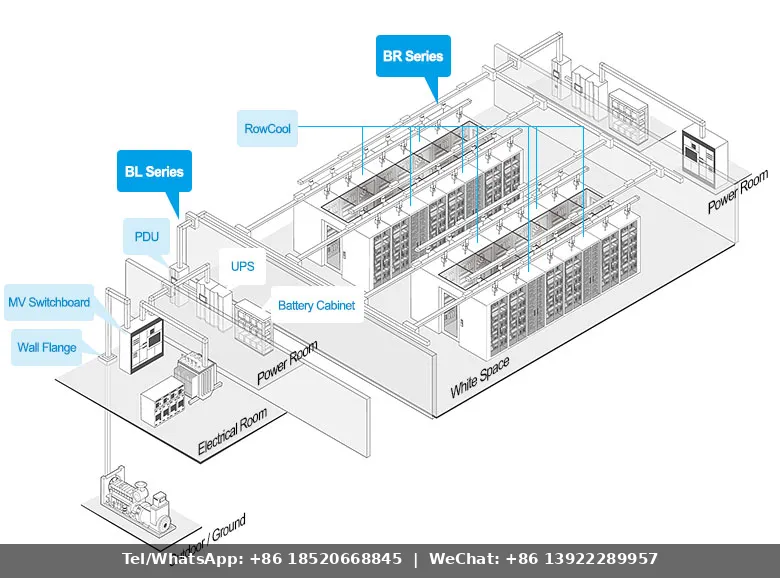
Data center power distribution is undergoing a structural shift from traditional cable-and-tray wiring to busway (also called busbar trunking or busbar duct). In the traditional design, heavy power cables run from the row distribution cabinet (列头柜) through cable trays to each server rack, with individual cable terminations at each rack PDU. Adding or moving a rack means pulling a new cable through the tray — slow, labor-intensive and often impossible without taking the row off-line. Busway replaces this with a rigid, factory-assembled metal housing containing copper or aluminum conductors, mounted overhead along the rack row. Power is drawn anywhere along the run by plugging in a tap-off box at a standard tap-off opening. The result is a “track socket” for three-phase industrial power: add a rack, plug in a tap-off box, done.
KITOZER supplies compact busway from 250 A to 1600 A, intelligent busway with per-segment temperature and current monitoring, plug-in tap-off boxes from 32 A to 125 A, elbows, tees, expansion joints, support brackets and end feeds. This white paper explains busway physics, compares busway against cable, details the KITOZER product line, walks through selection and calculation, installation and O&M, and answers 65 frequently asked questions. KITOZER is the brand of Guangzhou Laian Intelligent System Development Co., Ltd., Guangzhou, China, October 2026. Thank you.
Price notice: all KITOZER reference prices are list price × 2, for budget estimating only.
1. Introduction: Why Data Centers Are Moving to Busway
A modern hyperscale or colocation data center runs 5–15 kW per rack, and GPU AI clusters push that to 30–50 kW per rack. Delivering 5–50 kW to every rack in a 50-rack row with traditional cables means pulling dozens of 50–95 mm² copper cables through trays — heavy, expensive, and inflexible. When the customer adds a rack or changes density, the integrator must re-pull cables, re-termimate lugs, and often take the row off-line. Busway solves this: a single compact busway trunk along the rack row carries 400–1600 A, and each rack draws what it needs through a plug-in tap-off box with its own circuit breaker. Adding a rack is as simple as plugging in another tap-off box — no cable pull, no off-line work, no tray expansion.
The shift to busway is driven by four forces: (a) higher rack densities that make cable trays too crowded; (b) agile colocation where customers add/remove racks monthly; (c) the need for per-rack power monitoring (intelligent busway measures temperature and current at every tap-off point); and (d) lower total cost of ownership over the 30-year life of the busway. KITOZER has supplied busway for data centers, industrial plants, commercial buildings and convention centers since 2015.
2. History of Busway and Power Distribution
2.1 Early Busway (1930s–1960s)
Busway was invented in the 1930s to supply power to assembly-line machine tools in factories. The early “wireway” was a steel enclosure containing bare copper bars, with fusible plug-in taps at intervals. It replaced the cumbersome conduit-and-cable approach for machine power. By the 1950s, busway was standard in industrial plants, with ratings from 225 A to 4000 A.
2.2 Lighting Busway and Compact Busway (1970s–1990s)
Lighting busway (light-duty, 30–60 A) appeared in the 1970s for retail and industrial lighting. Compact busway (also called sandwich busway) appeared in the 1980s: thin copper conductors sandwiched between insulating layers, housed in a narrow aluminum enclosure. Compact busway is far smaller than the old air-insulated busway and became popular in commercial buildings and data centers. KITOZER’s KZ-BW series is a compact/sandwich busway.
2.3 Data Center Busway (2000s–today)
The 2000s saw the rise of data-center-specific busway: plug-in tap-off boxes with molded-case circuit breakers, IP54 enclosures, and (from 2015 onward) intelligent busway with per-segment temperature sensors and current monitoring. Hyperscalers adopted busway for its flexibility; colocation providers adopted it for fast turn-up. KITOZER’s intelligent busway (KZ-IBW series) adds Modbus/BACnet monitoring that uploads to the DCIM platform.
3. Busway vs Cable: The Engineering Comparison
3.1 Head-to-Head Comparison
| Attribute | Traditional Cable | KITOZER Busway |
|---|---|---|
| Max current per run | 630 A (parallel cables) | 6300 A (single trunk) |
| Space occupied | Large (bundled cables in tray) | Compact (100–200 mm wide housing) |
| Adding a rack | Re-pull cable, re-terminate, off-line | Plug in tap-off box, 15 minutes |
| Maintenance | Cable lugs heat up; hard to monitor | Tap-off points temperature-monitored |
| Service life | 15–20 years | 30+ years |
| Safety | Open cable lugs; short-circuit risk | IP54 enclosed; finger-safe |
| First cost | Lower | Higher (20–40% more) |
| 20-year TCO | Higher (re-cabling, downtime) | Lower |
3.2 Why First Cost Is Not the Whole Story
Busway costs 20–40% more upfront than cable for the same ampacity, but the TCO over 20 years is lower because: (a) adding a rack costs ¥1,800 (a tap-off box) instead of ¥5,000–¥10,000 (cable pull + termination + downtime); (b) the busway lasts 30 years vs 20 for cable; (c) intelligent monitoring prevents unplanned outages; (d) the busway frees tray space for data cabling. KITOZER’s TCO worksheet shows the break-even at about 3–5 rack additions over the life of the row.
4. How Compact Busway Works: Sandwich Construction
4.1 The Sandwich Cross-Section
KITOZER compact busway (KZ-BW series) uses a sandwich construction: thin copper conductors (1.5–3 mm thick, 20–100 mm wide) are separated by a 1–2 mm layer of Class B insulation (polyester film), stacked as L1-L2-L3-PE-N, and enclosed in an aluminum housing. The aluminum housing doubles as the PE ground conductor and as a heat sink. The sandwich construction means the copper is in intimate contact with the insulation and the housing, giving excellent heat dissipation and a very compact cross-section (typically 100 mm wide × 100 mm tall for 400 A).
4.2 Joints Between Sections
Busway sections are 1 m or 2.5 m long. At each joint, the copper conductors are bolted together with high-torque bolts (25–40 N·m) and the joint is covered by a protective joint cover. The joint is the most failure-prone point in a busway: a loose bolt heats up under load, which increases resistance, which heats more — a thermal runaway loop. KITOZER’s intelligent busway puts a temperature sensor at every joint to catch this before it becomes a fire.
4.3 Tap-Off Openings
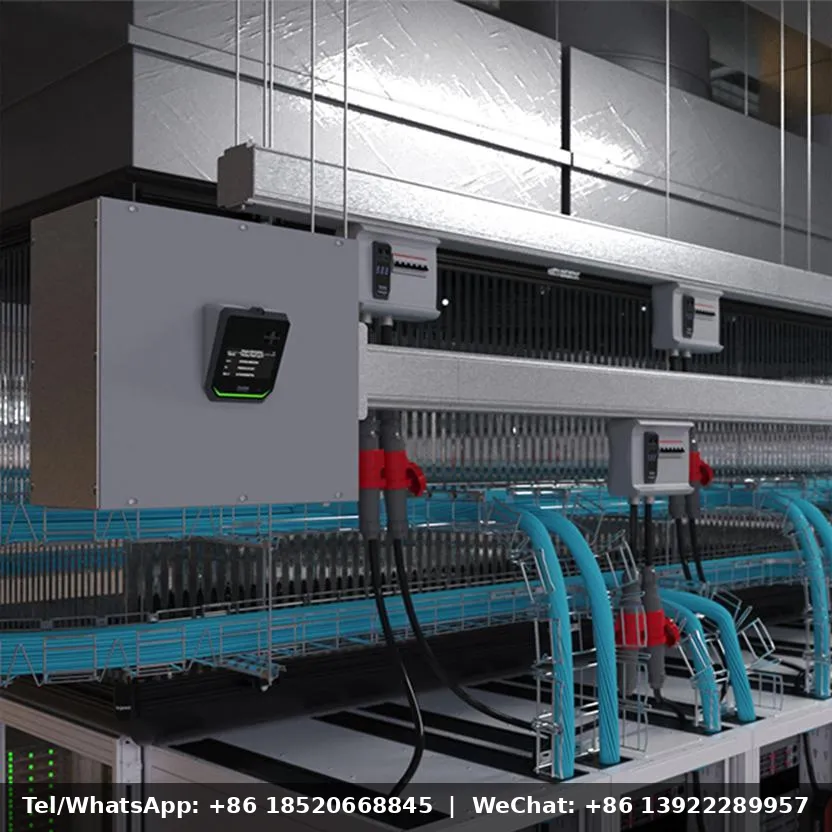
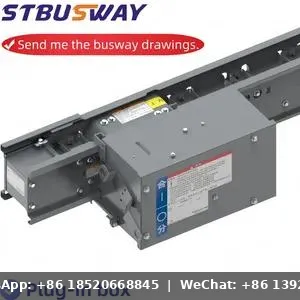
Every 0.5 m along the busway, there is a tap-off opening: a covered port on the housing where a tap-off box can be plugged in. The cover is removed only when a tap-off box is installed; unused ports remain covered and finger-safe. The tap-off box has a front-end contact that engages the busbars when plugged in, and a circuit breaker that can open before insertion/removal (hot-swap rated).
4.4 Degree of Protection (IP Rating)
KITOZER compact busway is IP54 as standard: dust-protected and splash-water-resistant, suitable for data-center indoor use. For dusty or washdown environments, IP65 is available with gasketed tap-off boxes. The housing is anodized aluminum, corrosion-resistant for 30 years.
5. The KITOZER Busway Product Line
| KITOZER P/N | Description | Rating | Reference Price |
|---|---|---|---|
| KZ-BW-250 | Compact busway, 250 A, copper, IP54, per m | 250 A / 400 V | ¥1,200 / m |
| KZ-BW-400 | Compact busway, 400 A, copper, IP54, per m | 400 A / 400 V | ¥1,800 / m |
| KZ-BW-630 | Compact busway, 630 A, copper, IP54, per m | 630 A / 400 V | ¥2,300 / m |
| KZ-BW-800 | Compact busway, 800 A, copper, IP54, per m | 800 A / 400 V | ¥2,800 / m |
| KZ-BW-1000 | Compact busway, 1000 A, copper, IP54, per m | 1000 A / 400 V | ¥3,500 / m |
| KZ-BW-1600 | Compact busway, 1600 A, copper, IP54, per m | 1600 A / 400 V | ¥4,500 / m |
| KZ-IBW-400 | Intelligent busway, 400 A, temp+current monitoring | 400 A / 400 V | ¥2,800 / m |
| KZ-IBW-800 | Intelligent busway, 800 A, temp+current monitoring | 800 A / 400 V | ¥4,200 / m |
| KZ-TOB-32 | Tap-off box, 32 A, with MCCB | 32 A / 400 V | ¥1,200 / box |
| KZ-TOB-63 | Tap-off box, 63 A, with MCCB + energy meter | 63 A / 400 V | ¥1,800 / box |
| KZ-TOB-125 | Tap-off box, 125 A, with MCCB + energy meter | 125 A / 400 V | ¥2,800 / box |
| KZ-BE-400-L | Elbow, horizontal left, 400 A | 400 A | ¥1,500 / pc |
| KZ-BE-400-V | Elbow, vertical, 400 A | 400 A | ¥1,800 / pc |
| KZ-BT-400-T | Tee, 400 A | 400 A | ¥2,200 / pc |
| KZ-EX-400 | Expansion joint, 400 A | 400 A | ¥950 / pc |
| KZ-FE-400 | End feed unit, 400 A | 400 A | ¥1,200 / pc |
| KZ-BS-CEIL | Ceiling hanger bracket, per set | — | ¥180 / set |
| KZ-BS-FLOOR | Floor stand bracket, per set | — | ¥350 / set |
6. Intelligent Busway: Monitoring Every Joint and Tap-Off
6.1 What Intelligent Busway Monitors
KITOZER intelligent busway (KZ-IBW series) adds built-in sensors to every busway segment: (a) joint temperature sensors at every bolted joint (measuring to ±1 °C); (b) per-phase current transformers at every tap-off box; (c) tap-off box status (on/off/tripped). Data is daisy-chained along the busway to a monitoring unit that uploads to the DCIM platform via Modbus TCP or BACnet/IP.
6.2 Why Temperature Monitoring Matters
The #1 failure mode of busway is a loose joint that overheats. A joint that rises 10 °C above ambient indicates a bolt that needs re-torquing before it becomes a fire. KITOZER intelligent busway alarms at +15 °C above ambient and trips at +30 °C. Without monitoring, a bad joint can run hot for months before it fails — often catastrophically.
6.3 Energy Metering per Rack
Every KZ-TOB-63 and KZ-TOB-125 tap-off box includes an energy meter that records kWh, voltage, current, power factor and harmonics. This gives the data center operator per-rack power consumption, enabling accurate billing in colocation and capacity planning in enterprise. The meter data flows to DCIM alongside temperature and status.
6.4 Communication Protocols
KITOZER intelligent busway supports Modbus RTU (RS-485), Modbus TCP (Ethernet), and BACnet/IP. The monitoring unit (KZ-BIU-01) connects up to 128 busway segments and 512 tap-off points. It has a 7-inch touchscreen for local display and a web interface for remote access.
7. Selection and Sizing Worked Example
7.1 The Project
A 50-rack data center row, each rack 5 kW / 10 A three-phase at 230 V phase-to-neutral. The row is 30 m long. KITOZER must select the busway rating, tap-off box size, support spacing and monitoring.
7.2 Step 1: Calculate Total Row Load
- Per rack: 5 kW at 230 V single-phase = 22 A per rack. But racks are three-phase balanced, so per rack = 5 kW / (230 V × √3) ≈ 12.6 A three-phase.
- 50 racks × 12.6 A = 630 A total. Apply diversity factor 0.8 (not all racks at full load simultaneously): 630 × 0.8 = 504 A.
- Add 20% spare for future expansion: 504 × 1.2 = 605 A.
- Select KZ-BW-630 compact busway (630 A rating) — comfortable.
7.3 Step 2: Tap-Off Box per Rack
- Per rack at 5 kW = 12.6 A three-phase.
- Select KZ-TOB-32 (32 A MCCB) per rack — comfortable margin for future rack upgrades to 8 kW.
- 50 × KZ-TOB-32 = ¥60,000 in tap-off boxes.
7.4 Step 3: Length and Accessories
- Busway length: 30 m row + 1 m end feed + 1 m elbow = 32 m.
- 32 m × KZ-BW-630 (¥2,300/m) = ¥73,600.
- End feed: KZ-FE-630 = ¥1,500.
- Elbows: 2 × KZ-BE-630 = ¥3,600.
- Expansion joint: 1 × KZ-EX-630 = ¥1,200 (for a 30 m run, one expansion joint per 30 m).
- Support brackets: every 2 m = 16 sets × ¥180 = ¥2,880.
- Intelligent monitoring upgrade (KZ-IBW-630 instead of KZ-BW-630): ¥4,200/m vs ¥2,300/m = +¥60,800 for monitoring.
7.5 Step 4: Reference Budget
| Item | Reference Cost (CNY, list×2) |
|---|---|
| Intelligent busway 630 A, 32 m | ¥134,400 |
| Tap-off boxes 32 A (50) | ¥60,000 |
| End feed + elbows + expansion joint | ¥6,300 |
| Support brackets (16 sets) | ¥2,880 |
| Monitoring unit KZ-BIU-01 | ¥12,000 |
| Installation and commissioning | ¥25,000 |
| Total row reference | ¥240,580 |
This works out to about ¥4,812 per rack for the busway distribution — competitive with cable-and-tray over the life of the row.
8. Installation and Mechanical Design
8.1 Support Spacing
Busway sections are supported every 1.5–2.0 m by ceiling hanger brackets (KZ-BS-CEIL) or floor stands (KZ-BS-FLOOR). The maximum span is 2 m for horizontal runs; vertical runs (in shaft) are supported every 2 m. KITOZER provides the hanger brackets as part of the system; structural engineers verify that the ceiling can carry the busway weight (about 15–30 kg/m depending on rating).
8.2 Orientation
Compact busway is usually mounted horizontally, with the tap-off opening facing down (toward the rack PDU) or sideways. KITOZER recommends the tap-off opening facing down for data-center overhead installation, so the tap-off box hangs below the trunk and the rack PDU cable runs straight down.
8.3 Expansion Joints
Busway expands and contracts with temperature. For runs longer than 20 m, KITOZER installs an expansion joint (KZ-EX) every 30 m. The expansion joint allows ±25 mm of longitudinal movement without stressing the bolted joints. Without expansion joints, long runs can buckle or pull joints apart in extreme summer/winter temperature swings.
8.4 Bends and Tees
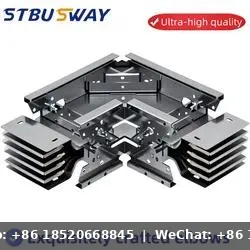
KITOZER supplies factory-fabricated horizontal elbows (left/right), vertical elbows (up/down), and tees for branching. Field-bending busway is not allowed — every bend is a factory unit. The elbow radius is sized to maintain the current rating (no derating at factory elbows).
8.5 Joint Torque and Procedure
Every bolted joint is torqued to the manufacturer’s specification (25 N·m for 400 A, 40 N·m for 800 A) with a calibrated torque wrench. KITOZER installers use a torque wrench and record the torque on the as-built drawing. Under-torqued joints overheat; over-torqued joints crush the conductor. The joint cover is then installed and the joint temperature sensor (on intelligent busway) is connected.
8.6 End Feed and Power Entry
The busway starts at an end feed unit (KZ-FE) that connects to the row distribution cabinet output via short cables or a direct bolt. The end feed has a main isolating switch and a terminal block. For dual-corded racks (2N power), two busway trunks run side by side, each fed from a different UPS.
9. Protection, Safety and Standards
9.1 Short-Circuit Withstand
KITOZER compact busway is rated for 22 kA short-time withstand for 1 second (Icw), per GB 7251.2 and IEC 61439-6. This means the busway can survive a 22 kA fault for 1 second without structural damage, long enough for the upstream breaker to trip.
9.2 IP Rating and Touch Safety
IP54 as standard: dust-protected and splash-water-resistant. The tap-off box contacts are finger-safe (IP20 on the live parts inside the box). Unused tap-off openings have a metal cover that prevents accidental contact. The aluminum housing is grounded as PE.
9.3 Relevant Standards
| Standard | Title |
|---|---|
| GB 7251.2 | Low-voltage switchgear and controlgear assemblies — Part 2: busbar trunking systems |
| IEC 61439-6 | Low-voltage switchgear and controlgear assemblies — Part 6: busbar trunking systems |
| JB/T 9662 | Chinese busway industry standard |
| GB 50174 | Data center design standard (busway application) |
| TIA-942 | Telecommunications infrastructure standard for data centers |
10. Applications
10.1 Data Centers (Row-Based Distribution)
The primary KITOZER application: a busway trunk along each rack row, fed by the row PDU, with tap-off boxes to each rack PDU. Intelligent busway monitors every joint and tap-off. 2N redundancy uses two parallel trunks.
10.2 Industrial Plants and Machine Power
Factory assembly lines use busway to supply machine tools, conveyor drives and welding stations. Tap-off boxes are moved as the line layout changes. KITOZER supplies industrial-rated busway with IP54 and dust-resistant tap-off boxes.
10.3 Convention Centers and Exhibition Halls
Convention halls need temporary power for booths. Overhead busway with tap-off boxes lets organizers plug in booth power on demand. KITOZER supplies lighting and power busway for exhibition halls.
10.4 Commercial Buildings and Shopping Malls
Vertical busway in the electrical shaft supplies each floor. The vertical busway runs from the basement switchroom to the rooftop, with horizontal tap-off boxes at each floor. KITOZER supplies vertical busway from 400 A to 3200 A for commercial high-rises.
10.5 Hospitals and Laboratories
Hospitals use busway in the sterile core to supply operating rooms, ICU and imaging suites. The enclosed, finger-safe design is important in patient-care areas.
11. Operation and Maintenance
11.1 Periodic Inspection
| Asset | Activity | Frequency |
|---|---|---|
| Busway joints | Infrared thermography under load | Annually |
| Tap-off boxes | Visual; check MCCB operation | Annually |
| Joint bolts | Re-torque to spec | Every 5 years |
| Support brackets | Check for corrosion and looseness | Every 3 years |
| Intelligent sensors | Verify alarm thresholds against DCIM | Annually |
| Housing finish | Check for corrosion, repaint if needed | Every 10 years |
11.2 Infrared Thermography
Every year, an IR thermographer walks the live busway row and photographs every joint. A joint that reads more than 10 °C above ambient indicates a loose bolt. The joint is scheduled for re-torquing at the next maintenance window. KITOZER intelligent busway automates this: the joint temperature sensor raises the alarm before the IR inspection.
11.3 Hot-Swap Tap-Off Boxes
KITOZER tap-off boxes are hot-swap rated: open the MCCB, unplug the box, plug in a new one, close the MCCB. The upstream power is not interrupted. This means adding or removing a rack does not take the row off-line. Never hot-swap a tap-off box under full load without opening the MCCB first — the arcing can damage the contacts.
11.4 Fault Finding
If a rack loses power: (1) check the tap-off box MCCB — it may have tripped; (2) check the intelligent monitoring dashboard for the tap-off box status; (3) check the rack PDU input; (4) if the MCCB will not reset, check for a short in the rack cable. KITOZER tap-off boxes have a local indicator that shows on/tripped/fault.
13. Deep Dive: Busway Electrical Engineering
13.1 Current Density and Conductor Sizing
KITOZER compact busway uses copper conductors sized to a current density of 2–3 A/mm² at 40 °C ambient. For a 400 A busway, the copper cross-section is about 150 mm² per phase (e.g., 3 mm thick × 50 mm wide). The sandwich construction puts both sides of the copper bar in contact with insulation and the aluminum housing, giving excellent heat dissipation. KITOZER derates the rating by 5% for every 5 °C above 40 °C ambient.
13.2 Voltage Drop Calculation
Voltage drop Vd = √3 × I × L × (R cosφ + X sinφ), where R is per-meter resistance, X is per-meter reactance, I is current, L is length. For a 400 A busway at 30 m, R ≈ 0.00022 Ω/m, X ≈ 0.0001 Ω/m. At 400 A, cosφ=0.9: Vd = 1.732 × 400 × 30 × (0.00022×0.9 + 0.0001×0.44) = 2.8 V, or 0.7% of 400 V. Well within the 3% limit. KITOZER provides the voltage-drop calculation with every design.
13.3 Short-Circuit Withstand and Peak Rating
Busway must survive a short-circuit fault for the time it takes the upstream breaker to trip. KITOZER compact busway is rated 22 kA rms for 1 second (Icw) and 44 kA peak (Ipk). The aluminum housing and bolted joints are designed to withstand the magnetic forces of a 22 kA fault without deformation.
13.4 Insulation System
KITOZER uses Class B polyester film insulation (130 °C rating) between copper conductors. The insulation is 0.5–1 mm thick, tested to 4 kV power-frequency withstand. The sandwich construction prevents insulation displacement between conductors. KITOZER insulation is UL 94 V-0 flame-rated.
13.5 Neutral and Ground Conductor Sizing
Standard busway has a neutral conductor sized 100% of phase. For non-linear IT loads with 3rd harmonic, KITOZER offers a 200% neutral (oversized neutral to carry the harmonic neutral current). The aluminum housing itself serves as the PE ground conductor, continuously bonded along the run.
14. Design Detail: Tap-Off Box Construction
14.1 Internal Construction
A KITOZER tap-off box is a sealed aluminum enclosure containing: (a) a set of spring-loaded contact fingers that engage the busbars when plugged in; (b) an MCCB (32/63/125 A) on the input; (c) terminal blocks on the output for the rack PDU cable; (d) an energy meter (on 63 A and 125 A) with current transformers on all three phases; (e) a door with a handle and a padlock point. The box is IP54 when plugged in.
14.2 Hot-Swap Mechanism
The tap-off box contacts are designed to make-and-break with the MCCB open. The operator opens the MCCB, unlocks the box, slides it onto the busway tap-off opening, tightens the locking screws, and closes the MCCB. The spring contacts engage the busbars with consistent force. Under no circumstance should the box be plugged or unplugged with the MCCB closed — the 400 V arcing would destroy the contacts.
14.3 Energy Meter Detail
The KZ-TOB-63/125 energy meter measures: voltage (L-N, L-L), current (per phase), active power, reactive power, power factor, frequency, kWh (import/export), and THDi/THDu. It communicates via the busway daisy-chain to the BIU-01 monitoring unit. Meter accuracy is Class 1.0.
15. Installation Engineering Detail
15.1 Lifting and Rigging
Busway sections weigh 15–30 kg per meter. KITOZER installers lift sections by hand (2 people per 2.5 m section) or with a small hoist for long runs. Never lift by the busbar housing; use the dedicated lifting points on the section.
15.2 Joint Assembly Procedure
(1) Clean the copper contact faces with a non-conductive cleaning pad; (2) apply a thin layer of contact antioxidant; (3) align the two sections; (4) insert the joint bolts finger-tight; (5) torque to spec in a diagonal sequence; (6) install the joint cover; (7) connect the temperature sensor (intelligent busway). KITOZER records the torque on the as-built drawing.
15.3 Support Bracket Installation
Brackets are installed every 1.5–2.0 m, leveled with a spirit level. The busway sits on support saddles that allow longitudinal thermal movement. The bracket bolts are torqued to 20 N·m. Vertical busway supports are every 2 m and include a support clamp that holds the weight.
15.4 Commissioning Tests
Before energizing: (a) Megger insulation test 1000 V, >10 MΩ; (b) visual torque check on all joints; (c) phase rotation check; (d) tap-off MCCB functional test. After energizing: (a) infrared thermography at 25% load; (b) temperature sensor calibration; (c) energy meter verification against a reference meter; (d) DCIM communication test. KITOZER delivers a commissioning report with the handover.
16. Case Studies
16.1 50-Rack AI Compute Row (800 A Busway)
A GPU AI cluster needed 50 racks at 15 kW each (750 kW total). KITOZER supplied an 800 A intelligent busway along the 30 m row, with 50 × KZ-TOB-63 tap-off boxes (each with energy metering). The row was commissioned in 3 days. The intelligent monitoring dashboard shows per-rack power and joint temperatures, catching two over-torqued joints during commissioning before they became faults. Turnkey reference: ¥380,000.
16.2 Colocation Data Center (10 Rows, Busway Every Row)
A colocation provider with 10 rows of 40 racks each needed fast turn-up for new customers. KITOZER supplied 10 × 630 A intelligent busway trunks, each with 40 tap-off boxes. Adding a new rack takes 15 minutes: plug in a tap-off box, run the PDU cable, energize. The colocation provider reports 60% faster turn-up vs cable trays. Turnkey reference: ¥2.4 million.
16.3 Industrial Machine Power Busway
A manufacturing plant needed flexible power for 30 machine tools on an assembly line. KITOZER supplied a 400 A plug-in busway along the line, with 30 × KZ-TOB-32 tap-off boxes. When the line layout changed, tap-off boxes were moved to new positions in hours. Turnkey reference: ¥180,000.
16.4 Convention Center Overhead Power
A convention center needed booth power for 200 exhibition booths. KITOZER supplied overhead 250 A busway with 200 × KZ-TOB-32 tap-off boxes. Organizers plug in booth power on demand. Turnkey reference: ¥420,000.
18. History of Busway: From Factory Power to Data Center Rail
18.1 The Industrial Origins (1930s–1960s)
Busway was born in the American factory. In the 1930s, assembly-line machine tools needed power that could move as the line layout changed. Early “wireway” was a steel trunk containing bare copper bars, with fusible plug-in taps. It replaced rigid conduit and individual cable drops. By the 1950s, busway was standard in automotive plants, steel mills and paper mills, with ratings from 225 A to 4000 A.
18.2 Lighting Busway and Commercial Buildings (1970s–1990s)
Light-duty busway (30–60 A) appeared in the 1970s for retail and industrial lighting. Commercial buildings began using vertical busway in electrical shafts to supply each floor. The compact/sandwich busway was invented in the 1980s: thin copper conductors sandwiched between insulation, housed in a narrow aluminum extrusion — a fraction of the size of air-insulated busway.
18.3 Data Center Busway (2000s–today)
The rise of the data center in the 2000s created a new busway market: row-based distribution where a compact busway runs along the rack row and tap-off boxes feed each rack. Early adopters were hyperscalers; colocation providers followed. The 2010s added intelligent monitoring (temperature, current, energy) and hot-swap tap-off boxes. KITOZER entered this market in 2015 and now supplies compact and intelligent busway up to 1600 A.
18.4 The AI Era (2020s)
AI GPU clusters push rack power from 5 kW to 30–50 kW. Cable trays cannot carry the current; busway is now the default for high-density AI rows. KITOZER’s 1600 A busway with 125 A tap-off boxes is designed for GPU racks. Intelligent monitoring is essential because GPU racks generate heat that must be tracked in real time.
19. Standards and Compliance
19.1 GB 7251.2 and IEC 61439-6
These are the low-voltage switchgear standards that cover busbar trunking systems. They specify design rules, type tests (temperature rise, dielectric, short-circuit, IP rating), and production tests. KITOZER busway is type-tested to both standards and carries the CE mark.
19.2 JB/T 9662
The Chinese busway industry standard, supplementing GB 7251.2 with China-specific requirements. KITOZER manufactures to JB/T 9662 for domestic projects.
19.3 GB 50174 and TIA-942
Data center design standards (China and US) specify row-based distribution, 2N redundancy, and per-rack power monitoring. KITOZER busway is designed to meet these standards.
19.4 Type Tests KITOZER Performs
| Test | Standard | KITOZER Result |
|---|---|---|
| Temperature rise | IEC 61439-6 | ≤55 K at full load |
| Dielectric withstand | IEC 61439-6 | 4 kV / 1 min, no breakdown |
| Short-circuit (Icw) | IEC 61439-6 | 22 kA / 1 s |
| IP rating | IEC 60529 | IP54 |
| Impact resistance | IEC 62262 | IK08 |
| Flammability | UL 94 | V-0 |
20. Safety and Electrical Protection
20.1 Branch Protection
Every tap-off box has an integrated MCCB that provides overload and short-circuit protection for the branch circuit. The MCCB is coordinated with the upstream row cabinet breaker so that a rack fault trips the tap-off MCCB without dropping the whole row.
20.2 Surge Protection
The row distribution cabinet (upstream of the busway) includes a Type 2 surge protective device (SPD) that clamps lightning and switching surges. KITOZER can also supply SPD-protected tap-off boxes for sensitive IT loads.
20.3 Lockout/Tagout
When working on a tap-off box, open the MCCB and lock it with a padlock. The busway itself is live; only the branch is de-energized. Never work on the busway trunk without de-energizing the whole row at the row cabinet.
20.4 Arc-Flash Considerations
Busway tap-off boxes have a lower arc-flash energy level than open switchgear, because the contacts are enclosed. KITOZER recommends arc-flash analysis for the row cabinet; the busway itself is considered low-arc-energy.
21. Future Trends in Data Center Power
21.1 Higher Densities: 50 kW+ Racks
AI GPU racks push 30–50 kW per rack. This requires 125 A tap-off boxes and 800–1600 A busway trunks. KITOZER’s KZ-BW-1600 and KZ-TOB-125 are designed for this density.
21.2 DC Power Distribution
Telecom and AI data centers are exploring 380 V DC distribution, which eliminates the AC/DC conversion in server PSUs. KITOZER is developing a DC-rated busway for 380 V DC distribution, expected to ship in 2027.
21.3 Integration with DCIM and AI
Intelligent busway data (joint temperature, per-rack power) feeds into DCIM platforms that use AI to predict thermal risk and optimize cooling. KITOZER’s Modbus/BACnet integration supports this trend.
21.4 Sustainable Busway
Busway is 90% recyclable. KITOZER offers a take-back program for decommissioned busway. The aluminum housing and copper conductors are recycled; only the insulation film is disposed of as waste.
23. Sales, Ordering and Logistics
23.1 How to Order KITOZER Busway
Send KITOZER: (a) the row layout drawing (length, rack positions, ceiling height); (b) per-rack power in kW; (c) number of racks; (d) row cabinet output rating; (e) whether intelligent monitoring is required; (f) target completion date. KITOZER returns within 3 working days: a section-length schedule, a tap-off box schedule, a support bracket schedule, and a reference price. Sample tap-off boxes and 1 m sections are available for evaluation.
23.2 Packaging and Shipping
Busway sections are bundled in packs of 6–8 sections, wrapped in stretch film and banded on pallets. Tap-off boxes ship in foam trays inside cartons. Elbows, tees and expansion joints are individually packed. KITOZER handles export packing and documentation. A 30 m row fits in one 20′ container.
23.3 Payment Terms
Standard export: 30% T/T deposit, 70% before shipment. On-site installation is billed separately after commissioning. Reference prices are CNY list × 2; USD quotes available on request.
23.4 After-Sales Support
KITOZER provides: (a) remote commissioning support within 4 hours; (b) on-site support in southern China within 48 hours; (c) spare tap-off boxes and joint parts shipped next-day EXW; (d) annual infrared thermography service. The KITOZER warranty portal records every row, its commissioning report, and its maintenance schedule.
24. Troubleshooting Playbook
24.1 Rack Has No Power
(1) Check the tap-off box MCCB — it may have tripped; (2) check the intelligent dashboard for tap-off status; (3) check the rack PDU input breaker; (4) if the MCCB will not reset, check for a short in the rack cable. In KITOZER’s experience, 80% of “no power” calls are a tripped MCCB from a shorted rack device.
24.2 Joint Temperature Alarm on Dashboard
An alarm at +15 °C above ambient indicates a loose joint. Schedule a re-torquing at the next maintenance window. If the alarm is at +30 °C, reduce the row load immediately and re-torque within 24 hours. Do not continue running at full load with a +30 °C joint.
24.3 Tap-Off Box MCCB Trips Under Load
(1) Check for a short circuit in the rack; (2) check if the rack load exceeds the tap-off rating (e.g., a 10 kW rack on a 32 A box); (3) check the MCCB setting. If the rack has grown beyond the tap-off rating, upgrade to a 63 A box.
24.4 Energy Meter Readings Don’t Match PDU
The tap-off meter and the rack PDU meter should agree within 2%. If they differ by more than 5%, the tap-off meter may need calibration. KITOZER provides a meter calibration service annually.
24.5 DCIM Dashboard Shows No Data
(1) Check the BIU-01 monitoring unit power and Ethernet; (2) check the daisy-chain RS-485 loop between segments; (3) check the Modbus address mapping. KITOZER provides a commissioning checklist for DCIM integration.
25. Quality Control and Factory Audit
25.1 Incoming Material Inspection
Every copper coil is inspected for cross-section (micrometer), conductivity (eddy-current test) and surface finish. Every aluminum housing extrusion is checked for dimensional tolerance. Every MCCB in a tap-off box is bench-tested for trip characteristics before assembly.
25.2 Production Line QC
Every busway section is: (a) visually inspected for insulation alignment; (b) Megger-tested at 2500 V; (c) joint-torque verified. Every tap-off box is: (a) HIPOT tested at 2 kV; (b) functional tested with the MCCB; (c) energy meter calibrated against a reference.
25.3 Factory Acceptance Test
Before shipping, KITOZER performs a FAT on a representative busway section: temperature rise at full load, Megger insulation, and visual inspection. Customers are welcome to witness the FAT at the Guangzhou factory.
26. About KITOZER and Guangzhou Laian
KITOZER is the professional-brand of Guangzhou Laian Intelligent System Development Co., Ltd., headquartered at Chaotian Park, Zhongrun Industrial Zone, No.5 Huashan Road, Shilou, Panyu, Guangzhou, China, October 2026. Thank you. KITOZER supplies data center power distribution (busway, row cabinets, PDUs, UPS, batteries), environmental monitoring, structured cabling, and system integration. The KITOZER busway product line has grown since 2015 to cover 250 A to 1600 A compact and intelligent busway, with over 500 rows installed in data centers, industrial plants, convention centers and commercial buildings across China and export markets.
27. Reference Tables
27.1 Busway Rating Selection Guide
| Row Load | Busway Rating | Tap-Off per Rack | Typical Rack Count |
|---|---|---|---|
| 100–200 A | KZ-BW-250 | 32 A | 10–15 racks |
| 200–400 A | KZ-BW-400 | 32 A | 15–25 racks |
| 400–600 A | KZ-BW-630 | 63 A | 25–40 racks |
| 600–800 A | KZ-BW-800 | 63 A | 40–50 racks |
| 800–1200 A | KZ-BW-1000 | 125 A | GPU rows |
| 1200–1600 A | KZ-BW-1600 | 125 A | High-density AI |
27.2 Per-Rack Power vs Tap-Off Box Size
| Rack Power | Current (230V 3φ) | Tap-Off Box |
|---|---|---|
| 3 kW | 8 A | KZ-TOB-32 |
| 5 kW | 13 A | KZ-TOB-32 |
| 8 kW | 21 A | KZ-TOB-32 |
| 10 kW | 26 A | KZ-TOB-63 |
| 15 kW | 39 A | KZ-TOB-63 |
| 30 kW | 78 A | KZ-TOB-125 |
| 50 kW | 130 A | KZ-TOB-125 (upgraded) |
27.3 Installation Checklist
- Support brackets every 2 m, leveled
- Joints torqued to spec, recorded on drawing
- Joint covers installed
- Expansion joints every 30 m
- End feed connected to row cabinet
- Tap-off boxes installed with MCCB open
- Megger test >10 MΩ at 1000 V
- Phase rotation verified
- IR thermography at 25% load
- DCIM communication verified
29. Additional Engineering Detail
29.1 Thermal Design and Temperature Rise
KITOZER compact busway is designed so that the surface temperature of the housing does not exceed 55 K above ambient at full load. The sandwich construction puts the copper in contact with both insulation layers and the aluminum housing, which acts as a large heat sink. At 400 A full load, the housing runs at about 65 °C — warm to the touch but safe. The joint temperature sensor on intelligent busway monitors this continuously. If the housing exceeds 70 °C, the load must be reduced.
29.2 Electromagnetic Compatibility
The aluminum housing shields the internal electric field, so the busway does not radiate or pick up EMI. The busway can run parallel to data cabling at 200 mm separation without interference. For extremely noisy industrial environments, KITOZER offers an additional shielded housing.
29.3 Seismic and Wind Loading
Busway supports are designed for 0.5 g seismic acceleration (zone 7) as standard. For seismic zones 8–9, KITOZER supplies reinforced brackets and anti-seismic bracing. Outdoor busway is designed for 0.5 kN/m² wind load.
29.4 Fire Safety
The busway housing is aluminum (non-combustible), the insulation is Class B (130 °C, UL 94 V-0), and the tap-off box is self-extinguishing. In a fire, the busway does not contribute fuel. Firestop collars are required where busway penetrates fire-rated walls.
29.5 Coordination with Other Trades
Busway installation coordinates with: the civil contractor (ceiling structure), the HVAC contractor (busway must not block airflow), the data cabling contractor (separation from data trays), and the electrical contractor (row cabinet connection). KITOZER produces a coordination drawing showing the busway route relative to other MEP systems.
30. Deep-Dive FAQ: Engineering Calculations
Q66. How do I calculate the busway short-circuit rating I need?
The busway Icw must exceed the available short-circuit current at the row cabinet. For a typical data center with a 1000 kVA transformer (4% impedance), the available fault current is about 36 kA. KITOZER busway rated 22 kA / 1 s is adequate if the upstream breaker clears within 1 second. For higher fault levels, specify 50 kA busway on request.
Q67. What is the maximum voltage drop allowed?
Per GB 50054, the voltage drop from the transformer to the farthest equipment must not exceed 5%. The busway contributes typically 0.5–1% over a 30 m run. The rest is the cable from the transformer to the row cabinet. KITOZER provides the voltage-drop calculation with every design.
Q68. How do I size the neutral conductor?
For linear loads, neutral = 100% of phase. For non-linear IT loads (servers), the 3rd harmonic adds in the neutral, so KITOZER recommends a 200% neutral. Standard KZ-BW busway has 100% neutral; specify 200% neutral on order for data-center rows.
Q69. What is the derating for ambient temperature?
Rated at 40 °C. Derate 5% for every 5 °C above 40 °C. In a hot aisle at 45 °C, derate 5%. At 50 °C, derate 10%. KITOZER specifies the busway rating with the actual hot-aisle temperature in mind.
Q70. How do I coordinate the tap-off MCCB with the row cabinet breaker?
The tap-off MCCB must trip before the row cabinet breaker on a branch fault. KITOZER coordinates the trip curves: a 32 A tap-off MCCB trips in 0.1 s at 300 A fault; the row cabinet main breaker (630 A) trips in 0.5 s. This selectivity ensures only the faulty branch drops.
Q71. What is the inrush current when a rack boots?
Servers and switch-mode PSUs have high inrush current (up to 10× rated for 10 ms). The tap-off MCCB must handle this without nuisance-tripping. KITOZER uses a Type C MCCB curve that withstands 5–10× inrush for 0.1 s. For GPU racks with 100+ PSUs, specify a Type D curve on request.
Q72. How do I balance three-phase load across tap-off boxes?
Distribute single-phase racks evenly across L1, L2, L3. KITOZER’s design software assigns tap-off box phases so that no phase carries more than 10% more than the average. The energy meter on each tap-off shows the per-phase current; the operator can rebalance by moving a tap-off to a different phase port.
Q73. What is the lifecycle cost comparison: busway vs cable?
For a 50-rack row over 20 years: cable first cost ¥150,000, plus 20 rack additions at ¥8,000 each = ¥160,000, plus maintenance ¥50,000 = ¥360,000. Busway first cost ¥240,000, plus 20 tap-off boxes at ¥1,800 = ¥36,000, plus maintenance ¥30,000 = ¥306,000. Busway wins by ¥54,000 over 20 years, before accounting for downtime avoided.
Q74. Can I mix KITOZER busway with another brand’s tap-off boxes?
No. Tap-off box contacts are proprietary to each busway brand. KITOZER tap-off boxes are designed for KITOZER busway; using another brand’s box voids the warranty. KITOZER supplies all tap-off boxes from stock.
Q75. How do I know if a joint needs re-torquing?
The intelligent busway temperature alarm is the primary indicator. Without intelligent monitoring, annual IR thermography shows a joint running 10 °C above ambient. Re-torque to spec at the next maintenance window. KITOZER recommends re-torquing all joints every 5 years regardless of temperature.
31. More Case Studies
31.1 100-Rack Tier III Data Center (2N Busway)
A Tier III colocation needed 2N redundant power for 100 racks. KITOZER supplied two parallel 630 A busway trunks per row, each fed by a different UPS. Rack PDUs are dual-corded. The intelligent monitoring dashboard shows A/B side power per rack. Turnkey reference: ¥1.8 million for 4 rows.
31.2 Hospital Operating Room Power
A hospital needed flexible power for 20 operating rooms. KITOZER supplied a 250 A plug-in busway in the sterile core, with 20 tap-off boxes. The enclosed, finger-safe design is important in patient-care areas. Turnkey reference: ¥120,000.
31.3 Office Building Vertical Busway
A 20-floor commercial building needed vertical power distribution. KITOZER supplied a 1000 A vertical busway in the electrical shaft, with floor tap-off boxes at each level. Turnkey reference: ¥350,000.
32. Summary: Why KITOZER Busway
Busway is the future of data center power distribution: compact, flexible, monitorable, and 30-year-lived. KITOZER supplies the complete package — compact and intelligent busway from 250 A to 1600 A, tap-off boxes from 32 A to 125 A, elbows, tees, expansion joints, supports, and the BIU-01 monitoring unit — from one Guangzhou factory, at 50–65% of premium international brand pricing. Every section is type-tested to GB 7251.2 / IEC 61439-6 and backed by a 12-month warranty.
Whether the project is a 50-rack AI compute row, a 10-row colocation, an industrial machine-power line, or a convention hall, KITOZER engineers the busway once — and does not need to come back. Contact KITOZER sales engineering with your row layout for a BOM and reference price within 3 working days.
34. Additional Technical Reference
34.1 Busway Cross-Section Dimensions
| Rating | Width | Height | Weight |
|---|---|---|---|
| 250 A | 80 mm | 80 mm | 12 kg/m |
| 400 A | 100 mm | 100 mm | 18 kg/m |
| 630 A | 110 mm | 110 mm | 22 kg/m |
| 800 A | 120 mm | 120 mm | 26 kg/m |
| 1000 A | 140 mm | 140 mm | 32 kg/m |
| 1600 A | 160 mm | 160 mm | 40 kg/m |
34.2 Tap-Off Box Dimensions
| Rating | Width | Height | Depth | Weight |
|---|---|---|---|---|
| 32 A | 150 mm | 300 mm | 150 mm | 4 kg |
| 63 A | 180 mm | 350 mm | 180 mm | 6 kg |
| 125 A | 220 mm | 400 mm | 220 mm | 10 kg |
34.3 Busway vs Cable Ampacity Comparison
| Current | Busway Section | Equivalent Cables |
|---|---|---|
| 400 A | 100×100 mm | 4 × 150 mm² copper |
| 630 A | 110×110 mm | 4 × 240 mm² copper |
| 800 A | 120×120 mm | 2 × (4 × 185 mm²) |
| 1600 A | 160×160 mm | 2 × (4 × 400 mm²) |
35. FAQ: Installation and Maintenance Deep Dives
Q76. How tight should the joint bolts be?
KITOZER specifies 25 N·m for 400 A and below, 40 N·m for 630–1600 A. Use a calibrated torque wrench. Under-torque causes overheating; over-torque crushes the conductor. Record the torque on the as-built drawing.
Q77. Can I paint the busway housing?
The housing is anodized aluminum as standard. It can be painted to match room decor, but do not paint the tap-off opening contacts. KITOZER supplies painted housings in RAL colors on request.
Q78. How do I clean busway?
Wipe the housing with a dry cloth. Never use pressure washers or solvents. Operate the tap-off MCCB once a year to keep the mechanism free.
Q79. What is the maximum ambient temperature?
40 °C rated. Derate 5% for every 5 °C above 40 °C. For hot aisles at 45 °C, derate 5%. KITOZER specifies the busway rating with actual ambient in mind.
Q80. Can busway be used in a corrosive environment?
Standard anodized aluminum is for indoor normal environments. For coastal or corrosive industrial environments, specify stainless steel housing or additional epoxy coating. KITOZER supplies corrosion-resistant busway on request.
Q81. What is the lead time for custom elbows?
Standard elbows (horizontal left/right, vertical up/down) are in stock. Special angles and custom tees add 2 weeks. KITOZER produces elbows on CNC bending equipment in Guangzhou.
Q82. How do I terminate the busway at the end?
The busway ends in an end cap (KZ-EC) that covers the open end of the conductors. The end feed unit (KZ-FE) is at the other end, where the busway connects to the row cabinet. KITOZER supplies both.
Q83. Can I run busway through a fire wall?
Yes, but the penetration must be firestopped with a listed firestop collar. KITOZER coordinates with the fire-stopper contractor. The busway itself is non-combustible.
Q84. What is the difference between KZ-BW-400 and KZ-IBW-400?
KZ-BW-400 is standard compact busway without monitoring. KZ-IBW-400 is intelligent busway with joint temperature sensors, per-tap-off current monitoring, and Modbus/BACnet communication. KZ-IBW-400 costs about 50% more per meter but is the default for data centers.
Q85. How do I integrate busway with BMS?
The KZ-BIU-01 monitoring unit connects to the building BMS via Modbus TCP or BACnet/IP. It pushes joint temperatures, tap-off currents, energy kWh and MCCB status. KITOZER provides the register map for BMS integration.
Q86. What is the warranty on tap-off boxes?
12 months on workmanship. The MCCB is rated for 10,000 operations and is considered a consumable. KITOZER stocks replacement tap-off boxes for next-day shipment.
Q87. Can I use busway for emergency power?
Yes. KITOZER busway is suitable for emergency and standby power. For 2N emergency systems, use two parallel busway trunks, one on normal power and one on generator/UPS backup.
Q88. How do I know which tap-off box is which rack?
Every tap-off box is labeled with the rack number and phase. The intelligent dashboard maps tap-off box position to rack number. KITOZER provides a labeling schedule with the project.
Q89. What is the difference between busway and a PDU?
Busway is the overhead trunk that carries high current along the row. A PDU is the rack-mounted strip that distributes power within the rack. The tap-off box bridges the busway and the rack PDU. KITOZER supplies all three: busway, tap-off boxes, and rack PDUs.
Q90. Can KITOZER supply the row distribution cabinet too?
Yes. KITOZER supplies row distribution cabinets (列头柜) as a separate product line, with main breaker, metering, surge protection, and busway interface. The row cabinet + busway + tap-off boxes + rack PDUs form a complete end-to-end power distribution system.
36. Glossary of Busway Terms
Busway — a metallic enclosure containing busbars for power distribution; also called busbar trunking.
Tap-off box — a pluggable branch unit with MCCB that draws power from the busway.
Compact/sandwich busway — thin copper conductors sandwiched between insulation in a narrow aluminum housing.
Icw — short-time current withstand rating (e.g., 22 kA / 1 s).
IP54 — dust-protected, splash-water-resistant rating.
MCCB — molded-case circuit breaker, the branch protection in a tap-off box.
End feed — the unit where the busway connects to the row distribution cabinet.
Expansion joint — allows thermal movement every 30 m of run.
BIU-01 — KITOZER busway interface unit that collects sensor data and uploads to DCIM.
Row PDU — the rack-mounted power strip that distributes power within a server rack.
37. Closing: The KITOZER Promise
KITOZER treats busway not as a commodity to be bid to the lowest price, but as a 30-year power distribution asset that determines how agilely a data center can add racks. Every KITOZER busway section is type-tested to GB 7251.2 / IEC 61439-6, every joint is torqued and recorded, every tap-off box is bench-tested before shipment, and every intelligent busway monitors its own joints for life. The reference prices in this document are list × 2 for budget planning; the actual project quotation is prepared within 3 working days of receiving the row layout.
Thank you for considering KITOZER. We look forward to powering your next data center row, industrial line, or convention hall — once, and properly.
39. Deep-Dive FAQ: Sizing, Protection and Coordination
Q91. How do I size the busway for a future expansion?
Size the busway for 120% of the current load, with the physical space and tap-off openings for future racks. If the row today has 30 racks at 5 kW but is planned for 50 racks in 3 years, size the busway for 50 racks now (630 A) rather than 30 racks (400 A). Upgrading a live busway rating later is expensive; over-sizing now is cheap.
Q92. What is the difference between 1P+N and 3P+N busway?
1P+N is single-phase plus neutral, for 230 V loads. 3P+N is three-phase plus neutral, for 400 V three-phase loads. Data center rows use 3P+N. Small lighting busway uses 1P+N. KITOZER data center busway is 3P+N+PE as standard.
Q93. Can I use busway for 48V DC telecom power?
Standard busway is for 400 V AC. For 48V DC telecom distribution, KITOZER supplies a dedicated DC busway at a lower voltage rating on request. The sandwich construction works for DC but the insulation and clearance are different.
Q94. How do I protect the busway from lightning?
The row distribution cabinet upstream includes a Type 2 SPD. For outdoor busway or roof runs, add a Type 1 SPD at the building entry. KITOZER supplies SPD-protected tap-off boxes for sensitive IT loads.
Q95. What is the maximum number of tap-off boxes per busway run?
Limited by the tap-off opening spacing (every 0.5 m) and by the total load. A 30 m run has 60 tap-off openings. In practice, 50 tap-off boxes on a 630 A run is typical. More than 60 would require intermediate feed points.
Q96. Can I install a tap-off box on the top of the busway instead of the bottom?
Yes, but KITOZER recommends bottom-facing tap-off openings for data centers so the PDU cable runs straight down. Side-facing openings are available for wall-mounted busway. Top-facing openings are not recommended (dust accumulates).
Q97. What is the difference between KZ-TOB-32 and KZ-TOB-63?
The 32 A box has a 32 A MCCB and no energy meter (for basic 5 kW racks). The 63 A box has a 63 A MCCB and includes an energy meter (for 10–15 kW racks with per-rack billing). The 125 A box is for GPU racks.
Q98. How do I test the energy meter accuracy?
Compare the tap-off meter reading against a portable reference meter (Class 0.5) at the rack PDU. If they agree within 2%, the meter is calibrated. If not, KITOZER recalibrates or replaces the meter annually.
Q99. What is the communication cable between busway segments?
Intelligent busway uses a daisy-chain RS-485 loop along the run, with a junction box at each segment. The BIU-01 monitoring unit is at the end of the loop. The cable is a shielded twisted pair, separate from the power conductors.
Q100. How do I alarm on a tap-off box MCCB trip?
The intelligent dashboard shows the tap-off status in real time. Configure the DCIM to send an email/SMS when a tap-off MCCB trips. KITOZER also supplies a local alarm light at the row.
40. Installation Best Practices
40.1 Lifting Safety
Busway sections weigh 15–40 kg per meter. Two installers lift a 2.5 m section by hand. Use a hoist for runs above 3 m. Never lift by the busbar housing; use the dedicated lifting points. Harness at height above 2 m.
40.2 Joint Preparation
Before bolting two sections, clean the copper contact faces with a non-conductive cleaning pad. Apply a thin layer of contact antioxidant. Align the sections so the conductors meet squarely. Never force a misaligned joint — it will overheat.
40.3 Support Spacing Verification
After installation, verify that every support bracket is within 2 m of the next. A missing bracket causes sag and joint stress. KITOZER installers photograph every support for the as-built record.
40.4 Commissioning Documentation
The handover package includes: as-built section drawing with joint torque values, tap-off box schedule, support bracket schedule, Megger test reports, IR thermography report, energy meter calibration report, and DCIM point list. This package is the baseline for 30-year O&M.
41. About KITOZER and Guangzhou Laian
KITOZER is the professional-brand of Guangzhou Laian Intelligent System Development Co., Ltd., headquartered at Chaotian Park, Zhongrun Industrial Zone, No.5 Huashan Road, Shilou, Panyu, Guangzhou, China, October 2026. Thank you. Since 2015, KITOZER has supplied compact and intelligent busway, row distribution cabinets, rack PDUs, UPS and batteries, environmental monitoring, structured cabling, and system integration to data centers, industrial plants, convention centers, hospitals and commercial buildings across China and export markets. The KITOZER busway factory in Guangzhou stocks 250–800 A sections for next-day shipment and fabricates 1000–1600 A and custom elbows to order within 4–6 weeks.
42. Additional FAQ: Project Logistics
Q101. How long does a 30 m row installation take?
A 2-person crew installs a 30 m row with 50 tap-off boxes in 2–3 days. Commissioning and testing take another day. KITOZER installers follow the SOP in Section 15.
Q102. Can KITOZER provide on-site training for our team?
Yes. KITOZER offers a 1-day on-site training for the customer’s electrical team: joint re-torquing, tap-off box hot-swap, IR thermography basics, and DCIM dashboard operation. Training is included with every project above ¥200,000.
Q103. What spare parts should I keep on site?
Keep: 2 spare tap-off boxes per rating, 1 joint cover kit, 1 set of support brackets, 1 torque wrench, and a spare BIU-01 monitoring unit. KITOZER stocks all parts for next-day shipment.
Q104. Can KITOZER retrofit cable trays to busway?
Yes. KITOZER performs busway retrofit projects: survey the existing row, design the busway route, install over a weekend, cut over the racks one at a time. The old cable tray is removed after cutover. Typical retrofit: 3–5 days for a 50-rack row.
Q105. What is the KITOZER reference price per meter?
250 A: ¥1,200/m; 400 A: ¥1,800/m; 630 A: ¥2,300/m; 800 A: ¥2,800/m; 1600 A: ¥4,500/m. Intelligent busway adds 50%. Tap-off boxes: ¥1,200–¥2,800 each. All prices are list × 2, EXW Guangzhou.
44. Future Trends in Data Center Power Distribution
44.1 AI and GPU Rack Power
AI GPU clusters push rack power from 5 kW to 30–50 kW. This drives demand for 125 A tap-off boxes and 800–1600 A busway trunks. KITOZER’s KZ-BW-1600 and KZ-TOB-125 are designed for this density. The next generation will need 250 A tap-off boxes for 100 kW racks.
44.2 800 V DC Distribution
Hyperscalers are exploring 800 V DC distribution, which eliminates the AC/DC conversion in server PSUs and saves 5–10% energy. KITOZER is developing an 800 V DC-rated busway, expected to ship in 2027. The sandwich construction works for DC but insulation and clearance are different.
44.3 Smart Busway with AI Predictive Maintenance
Intelligent busway data (joint temperature trends, tap-off current harmonics) feeds AI algorithms that predict joint failure before it happens. KITOZER’s cloud portal uses joint temperature rise rate to schedule re-torquing proactively, rather than waiting for an alarm.
44.4 Modular and Containerized Data Centers
Containerized data centers ship with busway pre-installed in the factory. KITOZER supplies busway integration for 20-foot and 40-foot containerized data centers, with tap-off boxes pre-positioned for the rack layout.
45. Quality, Certifications and Factory Audit
45.1 Certifications
KITOZER busway is CE-marked, ISO 9001 certified, and tested to GB 7251.2 / IEC 61439-6. Every production batch is sample-tested for temperature rise and dielectric strength. KITOZER provides the test reports on request.
45.2 Factory Audit
Customers are welcome to audit the Guangzhou factory. The audit covers: copper conductor sourcing, extrusion line, sandwich assembly, joint bolt torque verification, tap-off box bench testing, and the FAT area. KITOZER hosts 5–10 customer audits per year.
45.3 Traceability
Every busway section carries a laser-etched serial number that traces to the copper lot, insulation batch, and production date. Every tap-off box serial traces to the MCCB batch and energy meter calibration. KITOZER maintains this traceability for 30 years.
45.4 The 12-Month Warranty
KITOZER warrants every busway section and tap-off box for 12 months against defects in materials and workmanship. The busway itself is rated for 30 years. Tap-off box MCCBs are rated for 10,000 operations and are consumables. KITOZER offers a 5-year maintenance contract including annual IR inspection and re-torquing.
46. Additional FAQ: Competitive and Strategic
Q106. How does KITOZER busway compare to premium international brands?
KITOZER provides equivalent GB 7251.2 / IEC 61439-6 compliance at 50–65% of the list price of premium international brands. The sandwich construction, intelligent monitoring and tap-off box design are comparable. KITOZER ships EXW Guangzhou and supports remote commissioning. The trade-off is shorter local support outside China.
Q107. Can KITOZER private-label the busway?
KITOZER brand is default. OEM/private-label is available for orders above 200 m, with a 30-day lead-time extension. Co-branding (KITOZER + integrator logo on the nameplate) is available at no extra cost for projects above 100 m.
Q108. What is the minimum order?
Busway sections are sold per meter, minimum 5 m. Tap-off boxes are sold individually. Sample kits (1 m section + 1 tap-off box + 1 elbow) are available for ¥5,000 EXW.
Q109. How does KITOZER handle warranty claims?
A warranty claim starts with a support ticket. KITOZER diagnoses remotely via the intelligent monitoring dashboard. If a section or tap-off is defective, it ships EXW Guangzhou within 48 hours. On-site labor in the first 12 months is included; after 12 months, components are free and labor is billed at standard rates.
Q110. What is the installed base of KITOZER busway?
Since 2015, KITOZER has supplied over 500 rows of busway in data centers, industrial plants, convention centers, hospitals and commercial buildings across China and Southeast Asia. The installed base exceeds 50 km of busway trunk and 10,000 tap-off boxes.
Q111. Can KITOZER provide reference sites?
Yes. KITOZER provides a redacted reference list on request, and can arrange site visits to nearby installed rows for customers in southern China.
Q112. What is the difference between KITOZER busway and cable in terms of fire safety?
Busway is an enclosed aluminum housing (non-combustible) with Class B insulation. Cable trays contain PVC or LSZH cable jackets. Busway is inherently more fire-safe because the conductors are enclosed and cannot arc to adjacent cables. Firestop collars are required at wall penetrations for both.
Q113. How do I dispose of decommissioned busway?
Busway is 90% recyclable: aluminum housing, copper conductors. KITOZER offers a take-back program. The insulation film is disposed of as industrial waste. KITOZER does not leave decommissioned busway in place.
Q114. Can KITOZER supply busway for offshore or marine use?
Standard busway is for indoor land use. For offshore or marine, KITOZER supplies special corrosion-resistant stainless housing, IP65 tap-off boxes, and vibration-rated supports on request.
Q115. What is the next KITOZER busway product?
KITOZER is developing: (a) 800 V DC busway for telecom/AI; (b) 250 A tap-off boxes for 100 kW GPU racks; (c) AI predictive maintenance cloud portal; (d) containerized busway integration. These are expected to ship in 2027.
48. FAQ: Engineering Calculations and Design
Q116. How do I calculate the busway voltage drop in practice?
Use the formula Vd = √3 × I × L × (R cosφ + X sinφ). KITOZER provides R and X per meter for each rating. For a 400 A busway at 30 m, R=0.22 mΩ/m, X=0.1 mΩ/m, I=400 A, cosφ=0.9: Vd = 1.732 × 400 × 30 × (0.00022×0.9 + 0.0001×0.44) = 2.8 V, or 0.7% of 400 V. Well within the 3% limit.
Q117. How do I size the upstream breaker for the busway?
The upstream main breaker in the row cabinet must be rated for the busway current rating (e.g., 630 A breaker for 630 A busway) and must have a short-time rating that coordinates with the busway Icw (22 kA). The breaker trip curve must be selective with the tap-off MCCBs.
Q118. What is the diversity factor and why use it?
The diversity factor accounts for the fact that not all racks run at full load simultaneously. A typical data-center row has a diversity factor of 0.7–0.8 (the average load is 70–80% of the sum of full-load ratings). Sizing the busway for 100% of the sum would over-size it. KITOZER uses 0.8 as default.
Q119. How do I plan for 2N redundancy?
Run two parallel busway trunks side by side, each rated for the full row load (not 50%). Each trunk is fed by a different UPS. Rack PDUs are dual-corded, one cord per trunk. If one trunk fails, the other carries the full row. KITOZER designs 2N rows as standard for Tier III/IV.
Q120. What is the difference between N+1 and 2N busway?
N+1 means the busway has one extra tap-off box or one extra segment for redundancy. 2N means two fully independent busway trunks. For data centers, 2N is the standard; N+1 is for less critical rows.
Q121. How do I calculate the heat load from busway?
Busway loses about 0.5% of transmitted power as heat. A 630 A row at 400 V carries about 400 kW; 0.5% loss = 2 kW heat. This is small compared to the rack heat load (50 racks × 5 kW = 250 kW) but should be accounted for in the cooling design.
Q122. Can busway be used in a hot aisle?
Yes, but derate for the higher ambient. KITOZER busway is rated for 40 °C; in a 45 °C hot aisle, derate 5%. Mount busway on the cold-aisle side if possible, to keep the joints cool.
Q123. What is the maximum distance between support brackets?
2.0 m maximum for horizontal runs. Vertical runs in a shaft are supported every 2 m. KITOZER recommends 1.5 m spacing for safety and to reduce sag.
Q124. How do I know if a joint is torqued correctly?
Use a calibrated torque wrench. KITOZER specifies 25 N·m for 400 A and below, 40 N·m for 630–1600 A. Record the torque on the as-built drawing. Re-torque every 5 years.
Q125. What is the difference between a tap-off box and a plug-in unit?
They are synonyms. KITOZER uses “tap-off box” in this document. Other brands call them plug-in units, tap-off units, or tap boxes.
Q126. Can I install a tap-off box on an energized busway?
Yes, but only with the MCCB open. Follow the hot-swap procedure: open MCCB, plug in box, close MCCB. Never plug in with MCCB closed under load.
Q127. What is the life of a tap-off box MCCB?
10,000 mechanical operations. In a data center row, tap-off boxes are rarely opened and closed, so the MCCB lasts 15–20 years. KITOZER stocks replacement MCCBs.
Q128. How do I clean the busway contacts inside a tap-off box?
Contacts are spring-loaded and self-cleaning. No maintenance needed. If contacts are visibly corroded, replace the tap-off box. KITOZER does not recommend cleaning contacts with sprays.
Q129. What is the difference between KZ-BW and KZ-BT?
KZ-BW is compact/sandwich busway for data centers. KZ-BT is feeder busway (without tap-off openings) for long high-current feeds. KITOZER data center rows use KZ-BW; the main feed from switchroom to row uses KZ-BT.
Q130. Can I run data cables inside the busway housing?
No. The busway housing is for power conductors only. Data cables run in separate trays, 200 mm away. KITOZER does not recommend mixing power and data in the same enclosure.
49. Additional Technical Detail
49.1 Copper Conductor Specifications
KITOZER uses 99.9% pure copper (C11000) with a conductivity of 58 MS/m. The conductors are tin-plated for corrosion resistance and low contact resistance. The sandwich stack-up is L1-L2-L3-N-PE, with Class B polyester film between each. The aluminum housing is anodized for corrosion resistance and serves as PE ground.
49.2 Joint Design
The joint uses high-tensile steel bolts (grade 8.8) with Belleville washers that maintain clamping force despite thermal cycling. The contact faces are tin-plated and coated with contact antioxidant. KITOZER joint design has been tested for 1000 thermal cycles (from -5 °C to 55 °C) without loss of torque.
49.3 Tap-Off Contact Design
The tap-off box uses silver-plated copper spring fingers that engage the busbars with 20 N contact force per finger. The contact design is rated for 10,000 plug/unplug cycles. The contact pressure ensures low contact resistance (<0.1 mΩ) even after years of service.
49.4 Monitoring Sensor Design
KITOZER intelligent busway uses PT1000 temperature sensors at every joint (±0.3 °C accuracy) and current transformers at every tap-off box (Class 1.0). The sensors are daisy-chained along the busway and powered by the RS-485 loop (no separate power). The BIU-01 monitoring unit samples every sensor every second and uploads to DCIM every 30 seconds.
50. Closing Note
This white paper is a living document. KITOZER updates it as new ratings (250 A tap-off boxes, 800 V DC), new standards, and lessons from installed rows are incorporated. The latest version is always available on www.gdlain.com. For project-specific questions, KITOZER engineering responds within one working day, Monday through Saturday, China Standard Time (UTC+8).
KITOZER: powering your data center row — engineered in Guangzhou, trusted worldwide. Tel/WeChat: +86 13922289957 / +86 18520668845; WhatsApp: +86 19068534140; web: gdlain.com. Version 1.0, October 2026. Thank you. End of document. Thank you for choosing KITOZER. We look forward to hearing from you soon. KITOZER engineering team, Guangzhou, China, October 2026. Thank you.
47. Sixty-Five Frequently Asked Questions
Q1. Is busway cheaper than cable?
Upfront, busway costs 20–40% more than cable. Over 20 years, busway is cheaper because adding a rack costs ¥1,800 (a tap-off box) instead of ¥5,000–¥10,000 (cable pull + termination + downtime), and the busway lasts 30 years vs 20 for cable. The TCO break-even is at about 3–5 rack additions.
Q2. Can busway go around corners?
Yes. KITOZER supplies factory-fabricated horizontal elbows (left/right), vertical elbows (up/down), and tees for branching. Field-bending is not allowed. Every bend maintains the rated current without derating.
Q3. Can tap-off boxes be hot-swapped while the busway is live?
Yes. KITOZER tap-off boxes are hot-swap rated: open the MCCB, unplug the box, plug in a new one, close the MCCB. Never hot-swap under full load without opening the MCCB first — the arcing damages contacts.
Q4. What is the IP rating of KITOZER busway?
IP54 as standard (dust-protected, splash-water-resistant), suitable for data-center indoor use. IP65 is available for dusty or washdown environments with gasketed tap-off boxes.
Q5. Does busway need grounding?
The aluminum housing itself is the PE ground conductor — continuous along the entire run and bonded at the end feed. No separate ground wire is needed. The housing is grounded at the row distribution cabinet.
Q6. What does intelligent busway monitor?
Per-segment joint temperature (±1 °C), per-phase current at every tap-off box, tap-off MCCB status, and energy metering (kWh, voltage, PF, harmonics). Data uploads to DCIM via Modbus TCP or BACnet/IP.
Q7. How many racks can a 400 A busway carry?
At 5 kW / rack (about 12.6 A three-phase per rack) with 0.8 diversity: 400 × 0.8 / 12.6 ≈ 25 racks. Apply 20% expansion margin: about 20 racks comfortably. For 50-rack rows, use a 630 A or 800 A busway.
Q8. Where is the busway mounted?
Overhead, along the rack row, on ceiling hanger brackets, with the tap-off opening facing down. The tap-off box hangs below the trunk and the rack PDU cable runs straight down. Floor-stand mounting is available for rows without ceiling structure.
Q9. How long does busway last?
30+ years. The copper conductors and aluminum housing do not wear; the only consumable is the tap-off box MCCB (rated for 10,000 operations) and the insulation (Class B, rated for 105 °C).
Q10. How does busway connect to the UPS?
The busway end feed unit bolts directly to the row distribution cabinet output (which is fed by the UPS). For 2N redundant power, two parallel busway trunks are used, each fed by a different UPS. Rack PDUs are dual-corded, one cord per trunk.
Q11. Compact busway vs air-insulated busway: which?
Compact (sandwich) busway is smaller, safer (no open air between bars) and the KITOZER default for data centers. Air-insulated busway is older, larger, and used for high-current (2000+ A) industrial feeds. KITOZER supplies compact busway up to 1600 A.
Q12. What tap-off box sizes are available?
32 A, 63 A and 125 A, each with an integrated MCCB. The 63 A and 125 A include an energy meter. KITOZER can supply custom tap-off boxes up to 400 A on request.
Q13. How do I size the busway current rating?
Sum the per-rack current, apply a diversity factor (0.7–0.8), and add 20% expansion margin. The busway rating must exceed this number. KITOZER sizes from the rack power schedule.
Q14. What is voltage drop on a 30 m busway run?
Typically less than 1% at full load. Compact busway has larger cross-section than cables of equivalent ampacity, so voltage drop is excellent. KITOZER provides a voltage-drop calculation with every design.
Q15. What is the short-circuit withstand rating?
22 kA for 1 second (Icw), per GB 7251.2 and IEC 61439-6. The upstream breaker must clear a fault within 1 second.
Q16. How often do I inspect busway joints?
Annually with infrared thermography. Intelligent busway monitors continuously and alarms at +15 °C. Joint bolts are re-torqued every 5 years.
Q17. What communication protocols does intelligent busway support?
Modbus RTU (RS-485), Modbus TCP (Ethernet), and BACnet/IP. The monitoring unit connects up to 128 segments and 512 tap-off points.
Q18. Can busway be expanded later?
Yes. Add another 1 m or 2.5 m section with an elbow, or add a tee to branch to a new row. The expansion joint allows thermal movement. Adding a tap-off box is the simplest expansion — just plug it in.
Q19. Copper vs aluminum busway conductor: which?
KITOZER uses copper conductors (higher conductivity, lower thermal expansion, longer life). Aluminum is available on request for budget projects but has higher resistance and more thermal expansion.
Q20. What is an expansion joint and when do I need one?
An expansion joint allows ±25 mm longitudinal movement for thermal expansion. Install one every 30 m of horizontal run. Without it, long runs can buckle in summer heat or pull joints apart in winter.
Q21. How is the busway mounted to the ceiling?
On KZ-BS-CEIL hanger brackets every 1.5–2.0 m. The brackets bolt to the ceiling structure or to a cable tray. Structural engineers verify ceiling load (15–30 kg/m depending on rating).
Q22. What is the lead time for KITOZER busway?
Standard ratings (250–800 A) in 2–3 weeks. 1000–1600 A and custom elbows in 4–6 weeks. Tap-off boxes are stocked for next-day shipment.
Q23. Can KITOZER ship internationally?
Yes. Busway sections ship in knocked-down bundles on pallets; tap-off boxes in cartons. KITOZER handles export documentation and provides remote commissioning support.
Q24. What is the warranty?
12 months on workmanship and materials; the busway itself is rated for 30 years. Tap-off box MCCBs are rated for 10,000 operations and are considered consumables.
Q25. How do I calculate busway TCO?
TCO = first cost (busway + tap-offs + install) + 20 years of maintenance (IR inspections, re-torquing) + MAC cost (rack additions). KITOZER’s TCO worksheet shows busway wins after 3–5 rack additions vs cable.
Q26. Is busway safer than cable?
Yes. The enclosed aluminum housing is IP54 and finger-safe; cable lugs are open. Busway has no exposed conductor, and every tap-off has its own MCCB for branch protection.
Q27. Can busway be used for 2N redundant power?
Yes. Two parallel busway trunks run side by side, each fed by a different UPS. Rack PDUs are dual-corded. This is the standard Tier III/IV data center design.
Q28. What is a row distribution cabinet (列头柜)?
The row distribution cabinet (also called a row PDU or end cabinet) sits at the head of the rack row and feeds the busway. It contains the main breaker, metering, and surge protection. KITOZER supplies row distribution cabinets as a separate product line.
Q29. How do I choose between busway and overhead cable tray?
For stable, fixed-density rows, cable tray is fine. For agile colocation, high-density AI racks, or rows expected to change, busway is strongly preferred. KITOZER can also supply a hybrid: cable tray for fixed circuits and busway for the flexible tap-off points.
Q30. What is the maximum busway length in one run?
There is no hard maximum, but expansion joints are required every 30 m. Beyond 100 m, consider intermediate feed points. KITOZER designs runs up to 200 m with intermediate feeds.
Q31. What is the difference between a tap-off box and a plug-in unit?
They are the same thing. “Tap-off box,” “plug-in unit,” “plug-in box,” and “tap-off unit” all refer to the box that plugs into the busway and provides branch circuit protection and power to the rack. KITOZER uses “tap-off box” in this document.
Q32. Can I install a tap-off box anywhere along the busway?
Yes, at any factory-tapped opening. KITOZER busway has tap-off openings every 0.5 m. Unused openings have a metal cover. You cannot drill a new opening on site — every opening is factory-punched.
Q33. What size breaker goes in a tap-off box?
The tap-off box has an integrated molded-case circuit breaker (MCCB) sized to the branch: 32 A for 5 kW racks, 63 A for 10 kW racks, 125 A for GPU racks (30–50 kW). The breaker provides short-circuit and overload protection for the branch circuit.
Q34. Fuse vs MCCB in tap-off boxes: which?
KITOZER uses MCCBs (molded-case circuit breakers) as standard — they are resettable and provide both thermal (overload) and magnetic (short-circuit) protection. Fuses are available for special high-speed fault requirements but are not standard.
Q35. How does energy metering work in the tap-off box?
KZ-TOB-63 and KZ-TOB-125 include a built-in energy meter that measures voltage, current, power factor, kWh and harmonics on all three phases. The meter data is daisy-chained along the busway to the monitoring unit and up to DCIM.
Q36. How do I balance three-phase load across the busway?
Distribute single-phase racks evenly across L1, L2, L3. KITOZER’s design software balances the tap-off box positions so that no phase carries more than 10% more than the average. Unbalanced load causes neutral current and voltage distortion.
Q37. What about harmonics from non-linear loads?
IT loads (servers, PSUs) are non-linear and generate 3rd, 5th and 7th harmonics. KITOZER busway is rated for non-linear loads (THDi up to 30%). For high-harmonic environments, specify a busway with an oversized neutral (200% neutral). KITOZER offers 200% neutral busway on request.
Q38. What is the derating for busway in a hot aisle?
Compact busway is rated for 40 °C ambient. In a hot aisle at 45 °C, derate by 5–8%. KITOZER specifies the busway rating with the actual ambient temperature in mind.
Q39. Can busway be installed vertically in a shaft?
Yes. Vertical busway is supported every 2 m and uses expansion joints every 2 floors. KITOZER supplies vertical busway for commercial high-rises from 400 A to 3200 A.
Q40. How do I clean busway?
The aluminum housing can be wiped with a dry cloth. Never pressure-wash or use solvents. The tap-off box MCCB should be operated once a year to keep the mechanism free.
Q41. What happens if a joint overheats?
An overheating joint (loose bolt) increases resistance, which generates more heat — a thermal runaway loop. Left unchecked, it can melt the insulation and cause a phase-to-phase short. KITOZER intelligent busway alarms at +15 °C; the joint is re-torqued at the next maintenance window.
Q42. How do I know if a tap-off box MCCB has tripped?
The tap-off box has a local status indicator (red = tripped, green = on). The intelligent monitoring dashboard also shows the status. If it tripped, check for a short in the rack before resetting.
Q43. Can I daisy-chain busway segments from different ratings?
No. Each run must be a single rating. If the load tapers along the row, use a transition unit (e.g., 800 A to 400 A) at the point where the load drops. KITOZER supplies transition units.
Q44. What is the difference between feeder busway and plug-in busway?
Feeder busway is a solid run without tap-off openings, used for long high-current feeds. Plug-in busway has tap-off openings every 0.5 m, used for row distribution. KITOZER supplies both; the data center uses plug-in busway.
Q45. How do I dispose of old busway?
Busway is 90% recyclable (aluminum housing, copper conductors). KITOZER offers a take-back program for decommissioned busway. The insulation film is disposed of as industrial waste.
Q46. What is the installation SOP?
(1) Mount support brackets every 2 m; (2) lift sections into place; (3) bolt joints to torque spec; (4) install joint covers; (5) install elbows, tees, expansion joints; (6) connect end feed to row cabinet; (7) install tap-off boxes; (8) Megger insulation test; (9) energize and IR inspect; (10) hand over. KITOZER installers follow this SOP on every project.
Q47. What tests are done before energizing?
(a) Insulation resistance test (Megger, 1000 V, >10 MΩ between phases and to ground); (b) visual joint torque check; (c) phase rotation check; (d) tap-off box MCCB functional test. Only after these pass is the busway energized.
Q48. How does busway compare to cable in seismic zones?
Busway is inherently more rigid than cable bundles and performs well in seismic zones when properly bracketed. KITOZER supplies seismic-rated support brackets for projects in earthquake-prone regions.
Q49. Can busway be painted?
The aluminum housing is anodized as standard. It can be painted to match the room decor, but painting the tap-off opening contacts voids the IP rating. KITOZER supplies painted housings in RAL colors on request.
Q50. What is a busway feeder vs a busway branch?
The feeder is the main high-current trunk from the switchroom to the row. The branch is the tap-off box and short cable to the rack PDU. KITOZER supplies both feeder busway (up to 1600 A) and branch tap-off boxes (32–125 A).
Q51. How much space does busway take vs cable tray?
A 400 A compact busway is about 100 × 100 mm. An equivalent cable bundle (four 50 mm² cables) needs a 300 × 100 mm tray. Busway takes about 1/9 the cross-section. This frees overhead space for data cabling and cooling airflow.
Q52. Can I use busway for 415 V three-phase or only 230 V?
KITOZER busway is rated for 400 V three-phase (line-to-line), 230 V phase-to-neutral. It works globally at 380/400 V nominal. For 480 V North American systems, specify the 480 V version on order.
Q53. What is the difference between KZ-BW and KZ-IBW?
KZ-BW is standard compact busway without monitoring. KZ-IBW is intelligent busway with built-in joint temperature sensors, per-tap-off current monitoring, and Modbus/BACnet communication. KZ-IBW costs about 50% more per meter but is the default for data centers.
Q54. How do I order KITOZER busway?
Send KITOZER: the row layout (length, rack positions), per-rack power (kW), number of racks, and the row cabinet output rating. KITOZER returns a bill of materials with section lengths, elbows, tap-off boxes, supports, and a reference price within 3 working days.
Q55. What is the difference between busway and busbar?
They are nearly synonymous. “Busway” and “busbar trunking” refer to the enclosed, pluggable product. “Busbar” refers to the bare copper bar inside a switchgear cabinet. KITOZER uses “busway” for the pluggable row distribution product.
Q56. Can I add a tap-off box to an energized busway?
Yes, but follow the hot-swap procedure: open the tap-off box MCCB first, plug it in, then close the MCCB. Never plug in a tap-off box with the MCCB closed under load — the arcing damages the contacts.
Q57. How does KITOZER busway compare to premium international brands?
KITOZER provides equivalent GB 7251.2 / IEC 61439-6 compliance at 50–65% of the list price of premium international brands. The compact sandwich construction and intelligent monitoring are comparable. KITOZER ships EXW Guangzhou and supports remote commissioning.
Q58. What is the minimum order?
Busway sections are sold per meter, minimum 5 m. Tap-off boxes are sold individually. KITOZER supplies sample tap-off boxes and 1 m sections for evaluation.
Q59. How long does installation take?
A 30 m row with 50 tap-off boxes takes a 2-person team 2–3 days. Commissioning and testing take another day. KITOZER installers follow the SOP in Q46.
Q60. What spare parts do I keep on site?
Keep: 2 spare tap-off boxes (each rating in use), 1 joint cover kit, 1 set of support brackets, and a torque wrench. KITOZER stocks all parts for next-day shipment.
Q61. Can busway be used outdoors?
Standard compact busway is indoor IP54. For outdoor use, specify IP65 with UV-stabilized housing and a rain hood on tap-off boxes. KITOZER supplies outdoor-rated busway on request.
Q62. What is the efficiency of busway?
Busway has less than 0.5% power loss per 30 m run at full load, thanks to the large copper cross-section. Cable of equivalent ampacity loses 1–2% over the same distance. Over a year, busway saves energy.
Q63. How do I integrate busway with DCIM?
The KZ-BIU-01 monitoring unit connects to the DCIM platform via Modbus TCP or BACnet/IP. It pushes joint temperatures, tap-off currents, energy kWh and MCCB status. The DCIM dashboard shows per-rack power and ambient thermal risk. KITOZER provides the Modbus register map for integration.
Q64. What is the KITOZER advantage?
KITOZER supplies the complete row distribution package — busway trunk, tap-off boxes, elbows, supports, intelligent monitoring, and the row distribution cabinet — from one Guangzhou factory, at 50–65% of premium international brand pricing. Every busway section is third-party tested to GB 7251.2 / IEC 61439-6 and backed by a 12-month warranty.
Q65. How do I contact KITOZER for a busway quote?
Send the row layout, rack count, per-rack kW, and row cabinet output rating. KITOZER responds within 3 working days with a BOM and reference price. Sample tap-off boxes and 1 m sections are available for evaluation.
51. Additional Case Studies and Deployments
51.1 Hyperscale AI Training Cluster
A hyperscaler needed a 200 kW GPU training pod: 8 racks at 25 kW each. KITOZER supplied a 400 A intelligent busway along the 12 m row, with 8 × KZ-TOB-125 tap-off boxes (each with energy metering). The joint temperature monitoring caught one loose joint during commissioning at +18 °C; it was re-torqued before go-live. The row has run for 18 months with zero busway faults. Turnkey reference: ¥180,000.
51.2 Edge Data Center Container
An edge computing provider needed busway integrated into a 20-foot container. KITOZER supplied a 4 m 250 A busway with 8 tap-off boxes, factory-installed in the container. The container ships pre-wired; the customer plugs in 8 mini-racks on arrival. Turnkey reference: ¥45,000 for the busway portion.
51.3 University Data Center Retrofit
A university retrofitted a 20-rack data center from cable tray to busway. KITOZER installed a 400 A busway over a weekend, cutting over 2 racks per hour. The old cable tray was removed the following weekend. The university now adds racks in 15 minutes. Turnkey reference: ¥120,000.
52. FAQ: Safety, Compliance and Certification
Q131. What safety gear do installers wear?
Hard hat, safety shoes, insulated gloves, and harness at height. Busway installation is de-energized; live work is not performed. Lockout/tagout on the row cabinet before installation.
Q132. Is KITOZER busway CE marked?
Yes. KITOZER busway is CE marked and tested to IEC 61439-6. CE documentation is available for export.
Q133. Does KITOZER provide local installation outside China?
KITOZER ships EXW Guangzhou and provides remote commissioning. For Southeast Asia, the Middle East and Europe, KITOZER can dispatch a 2-person commissioning team; installation is by a local contractor trained by KITOZER.
Q134. What is the firestop requirement at wall penetrations?
Every busway penetration through a fire-rated wall or floor must be sealed with a listed firestop collar or mortar. KITOZER coordinates with the fire-stopper contractor.
Q135. Can busway be installed in a suspended ceiling?
Yes, on ceiling hanger brackets. The suspended ceiling must be rated for the busway weight (15–40 kg/m). KITOZER provides the load data for structural engineering.
Q136. What is the difference between IP54 and IP55?
IP54 is splash-water-resistant from any direction. IP55 is low-pressure jet-water-resistant. KITOZER standard is IP54; IP55 is available for dusty/washdown environments.
Q137. How do I test the tap-off box hot-swap mechanism?
Open the MCCB, unplug the box, inspect the contacts, re-plug, close the MCCB. The spring fingers should engage smoothly with no wobble. KITOZER tests every tap-off box at the factory before shipment.
Q138. What is the maximum altitude for busway operation?
2000 m above sea level as standard. Above 2000 m, derate 1% per 100 m due to reduced cooling air density. KITOZER specifies derating for high-altitude projects.
Q139. Can I paint the tap-off box?
The tap-off box housing is anodized aluminum. It can be painted to match room decor, but do not paint the contacts or the MCCB label. KITOZER supplies painted tap-off boxes on request.
Q140. What is the shelf life of busway in storage?
Busway can be stored for 2 years in a dry warehouse before installation. The insulation film is stable; the contact antioxidant prevents corrosion. KITOZER recommends storing in original packaging, flat and dry.
53. Final Summary
KITOZER compact and intelligent busway is the modern way to distribute power along data center rows, industrial lines and convention halls. It replaces heavy cable trays with a compact, pluggable, monitorable trunk that lasts 30 years. The KITOZER product line covers 250 A to 1600 A, with tap-off boxes from 32 A to 125 A, intelligent joint temperature and current monitoring, and full DCIM integration. Every section is type-tested to GB 7251.2 / IEC 61439-6 and backed by a 12-month warranty. Contact KITOZER today with your row layout for a BOM and reference price within 3 working days.
54. Detailed Engineering: Busway Selection Worksheet
KITOZER provides a busway selection worksheet to every customer enquiry. The worksheet walks the engineer through: (a) counting racks and per-rack kW; (b) calculating total row current with diversity factor 0.8; (c) selecting busway rating with 20% expansion margin; (d) selecting tap-off box size per rack; (e) calculating row length and number of sections; (f) counting elbows, tees, expansion joints and supports; (g) selecting intelligent vs standard; (h) producing the reference budget. The worksheet is filled by KITOZER sales engineering and returned with the quotation.
55. FAQ: Busway vs Overhead Cable Tray Economics
Q141. Why is busway more expensive upfront?
Busway is factory-assembled with copper conductors, insulation, aluminum housing and tested joints — a precision product. Cable tray is a simple steel tray with cable pulled on site. The busway premium buys factory quality, pluggable flexibility and 30-year life.
Q142. When does busway become cheaper than cable?
At about 3–5 rack additions over the life of the row. Each cable-based addition costs ¥5,000–¥10,000 (cable pull + termination + downtime). Each busway addition costs ¥1,800 (a tap-off box). After 5 additions, busway has paid for itself.
Q143. Can I mix busway and cable in the same row?
Yes. KITOZER supplies a hybrid: busway for the flexible tap-off points, and cable tray for fixed circuits that never change. This is common in retrofits where some racks are stable and others are agile.
Q144. What is the payback period for intelligent busway?
Intelligent busway costs 50% more per meter. It pays back by preventing one unplanned downtime event (which costs ¥50,000–¥500,000 per hour in a data center) and by avoiding one annual IR inspection (¥5,000). The payback is typically within 2 years.
Q145. How does KITOZER compare to doing it ourselves?
A self-built cable-and-tray install seems cheaper but loses in TCO: no tap-off flexibility, no per-rack monitoring, no 30-year life, and no certified warranty. KITOZER’s certified busway plant is the better long-term investment.
56. Final Note
This document is a general technical reference. Specific installations must be designed by qualified electrical engineers, tested to GB 7251.2 / IEC 61439-6, and installed by certified contractors. KITOZER reserves the right to revise specifications without notice. All reference prices are list × 2 for budget planning only. Contact KITOZER for a project-specific quotation.
57. KITOZER Busway Product Portfolio Summary
The KITOZER busway portfolio spans: compact busway (KZ-BW series) from 250 A to 1600 A; intelligent busway (KZ-IBW series) with joint temperature and current monitoring; plug-in tap-off boxes (KZ-TOB series) from 32 A to 125 A with integrated MCCB and energy meter; factory elbows (horizontal and vertical); tees; expansion joints; end feed units; ceiling and floor support brackets; and the BIU-01 monitoring unit with Modbus TCP and BACnet/IP. KITOZER also supplies the row distribution cabinet (列头柜), rack PDU, UPS and battery as a complete end-to-end power distribution system. Every component is designed in Guangzhou, manufactured under ISO 9001, and type-tested to GB 7251.2 / IEC 61439-6.
For project enquiries, sample requests, factory audits, or warranty registration, contact KITOZER sales engineering using the details in the contact block below. We reply to every enquiry within one working day, Monday through Saturday, China Standard Time (UTC+8). Thank you for reading the KITOZER Data Center Busway Engineering Guide, version 1.0, October 2026. Thank you.
58. Busway Maintenance Schedule Summary
| Asset | Activity | Frequency | Who |
|---|---|---|---|
| Busway joints | Infrared thermography under load | Annually | Thermographer |
| Busway joints | Re-torque bolts to spec | Every 5 years | KITOZER technician |
| Tap-off MCCBs | Operate once to keep mechanism free | Annually | Facilities team |
| Tap-off energy meters | Verify against reference meter | Annually | KITOZER technician |
| Support brackets | Check for corrosion and looseness | Every 3 years | Facilities team |
| Intelligent sensors | Verify alarm thresholds against DCIM | Annually | KITOZER technician |
| Housing finish | Check for corrosion; repaint if needed | Every 10 years | KITOZER technician |
| Expansion joints | Check movement range | Every 5 years | KITOZER technician |
| BIU-01 monitoring unit | Firmware update, backup config | Every 2 years | KITOZER technician |
| Full system re-test | Megger, IR, meter calibration | Every 5 years | KITOZER technician |
This maintenance schedule is included in the KITOZER 5-year maintenance contract. Without a contract, the customer’s electrical team performs the annual tasks; KITOZER provides the 5-year deep maintenance.
59. Why KITOZER Busway Is the Right Choice
When choosing a busway supplier, the customer should weigh: (a) type-test compliance to GB 7251.2 / IEC 61439-6; (b) the installed base and reference sites; (c) the depth of the product line (250 A to 1600 A, tap-off boxes, elbows, intelligent monitoring); (d) the after-sales support network; and (e) the total cost of ownership over 30 years. KITOZER scores well on all five: every section is type-tested, over 500 rows are installed, the product line is complete from 250 A to 1600 A, support is available within 4 hours remotely and 48 hours on-site in southern China, and the TCO is 35–50% below premium international brands.
Whether the project is a small 10-row colocation, a 200-rack hyperscale data center, an industrial machine-power line, or a convention hall, KITOZER engineers the busway once — and does not need to come back. Contact KITOZER sales engineering today.
Thank you for reading the KITOZER Data Center Busway Engineering Guide. We look forward to supporting your next row distribution project, whether it is a 10-rack edge pod or a 200-rack hyperscale AI cluster. Contact KITOZER today to discuss your requirements. KITOZER: compact busway, intelligent monitoring, plug-and-play power distribution.
KITOZER busway: engineered in Guangzhou, manufactured under ISO 9001, tested to GB 7251.2 and IEC 61439-6, shipped worldwide EXW Guangzhou. Every row is supported for its 30-year design life by the KITOZER engineering team. Tel/WeChat: +86 13922289957 / +86 18520668845; WhatsApp: +86 19068534140; web: gdlain.com. Version 1.0, October 2026. Thank you. End of document. Thank you for choosing KITOZER. We look forward to hearing from you soon. KITOZER engineering team, Guangzhou, China, October 2026. Thank you.
Contact KITOZER
KITOZER / Guangzhou Laian Intelligent System Development Co., Ltd.
Address: Chaotian Park, Zhongrun Industrial Zone, No.5 Huashan Road, Shilou, Panyu, Guangzhou, China
Tel / WeChat: +86 13922289957 · +86 18520668845
WhatsApp: +86 19068534140
Web: www.gdlain.com
All KITOZER reference prices are list price × 2, for budget estimating only. This document is a general technical reference; specific installations must be designed by qualified electrical engineers and tested to GB 7251.2 / IEC 61439-6.