I. System Introduction
The KITOZER Computer Room Power Distribution System is an integrated power supply and distribution solution specially designed for critical sites such as data centers, computer rooms and telecommunication rooms. Adopting layered architecture, redundant design and intelligent monitoring technologies, it delivers continuous, stable, safe and efficient power supply for loads including IT equipment, air conditioners and lighting systems.
Compliant with national standards including GB 50174-2017 Code for Design of Data Centers and GB 50052 Code for Design of Power Supply and Distribution System, the system supports the construction of Tier II ~ Tier IV data centers. It caters to diverse demands from small and medium-sized computer rooms to large-scale cloud computing data centers, and ensures power supply availability of over 99.999% for mission-critical services.
Core Values
- Power Continuity: A multi-level redundant architecture consisting of dual utility power, ATS, UPS and backup power supply enables millisecond-level fault switching to avoid power outages.
- Intelligent Monitoring & Management: Full-system digital monitoring collects real-time data of voltage, current, power, energy consumption and other parameters, supporting remote management and fault early warning.
- Comprehensive Safety Protection: Equipped with multiple protection functions against overload, short circuit, overvoltage, undervoltage and electric leakage to safeguard equipment and personnel safety.
- Flexible Expansion: Modular design allows seamless capacity expansion to meet the growing power density demands of IT devices.
- Energy Efficiency & Saving: Optimized power distribution routes reduce line losses and improve power utilization, facilitating PUE optimization of data centers.
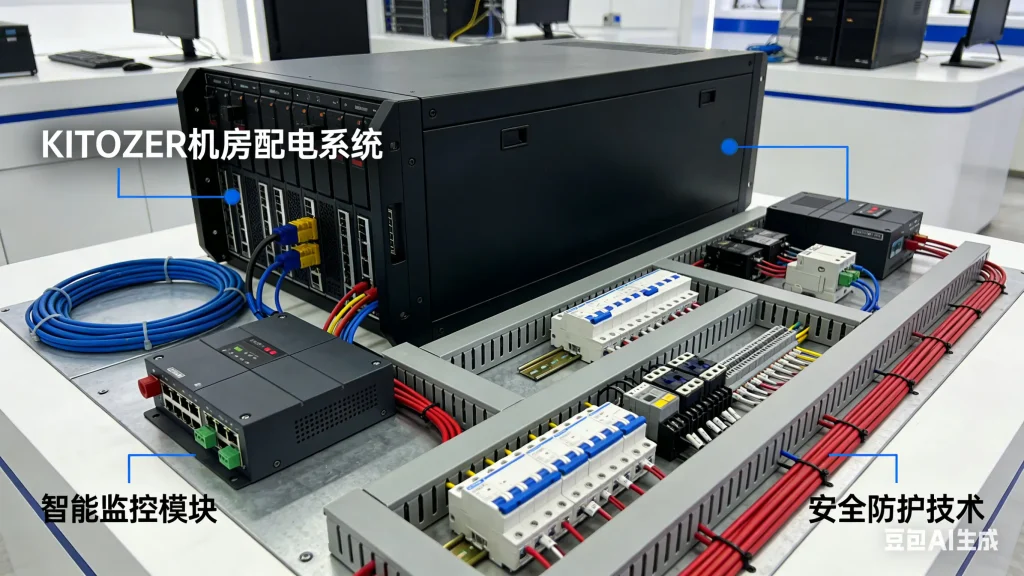
II. System Composition
The KITOZER Computer Room Power Distribution System features a three-tier architecture, namely front-end main distribution layer, intermediate distribution layer and terminal power supply layer. All components work collaboratively to ensure reliable power transmission and precise distribution.
| Tier | Core Equipment | Function |
|---|---|---|
| Front-end Main Distribution Layer | Utility Power Distribution Cabinet, ATS Cabinet, UPS Input & Output Cabinet | Acts as the power inlet of the computer room, responsible for utility power access, power switching and connection with UPS system |
| Intermediate Distribution Layer | Power Cabinet, Lighting Distribution Cabinet | Distribute power from main distribution equipment to auxiliary devices such as air conditioners, fresh air systems, water pumps and lighting systems |
| Terminal Power Supply Layer | Remote Power Panel (RPP), Intelligent PDU | Precisely distribute power to IT devices inside cabinets and realize cabinet-level monitoring and management |
2.1 Detailed Functions of Core Equipment
- Computer Room Utility Power Distribution Cabinet
- Serves as the main power inlet, receiving 380V/220V low-voltage power stepped down from 10kV/35kV high voltage via transformers.
- Implements main power distribution, protection and monitoring, and supports independent access of dual utility power for mutual backup.
- Equipped with main circuit breaker, branch circuit breakers, surge protective device (SPD), energy metering devices and other core components.
- Computer Room ATS Cabinet
- Integrated with Auto Transfer Switch (ATS) to realize automatic switching between main power and backup power (e.g. diesel generator).
- Achieves fast switching within ≤100ms upon utility power failure to guarantee continuous power supply for critical loads.
- Supports manual and automatic switching modes, as well as fault alarm and status indication.
- Computer Room UPS Distribution Cabinet
- Serves as a key link connecting UPS system and downstream loads, divided into UPS input cabinet and UPS output cabinet.
- The UPS input cabinet distributes utility power to UPS hosts and provides overload and short circuit protection.
- The UPS output cabinet receives inverted power from UPS and supplies clean, stable and uninterrupted power to IT loads.
- Computer Room Power Cabinet
- Distributes power to auxiliary power equipment including computer room air conditioners, fresh air units, precision air conditioners, chillers and water pumps.
- Fitted with branch protection devices to realize independent control and protection for each power device.
- Dual-power automatic transfer devices can be configured for key power loads such as precision air conditioners to enhance power supply reliability.
- Computer Room Lighting Distribution Cabinet
- Controls power distribution for general lighting, emergency lighting and evacuation indicator systems in the computer room.
- The emergency lighting circuit has independent power supply and automatically switches to backup power when utility power fails.
- Supports zoned control of lighting circuits and works with intelligent lighting systems for energy-saving management.
- Remote Power Panel (RPP)
- Installed at the head of each cabinet row to provide power distribution, protection and monitoring for all IT devices in the row.
- Built with multiple output circuit breakers (one for each cabinet) to deliver cabinet-level overload and short circuit protection.
- Embedded with intelligent monitoring modules to real-time monitor current, voltage, power and other parameters of each branch, supporting remote management and fault early warning.
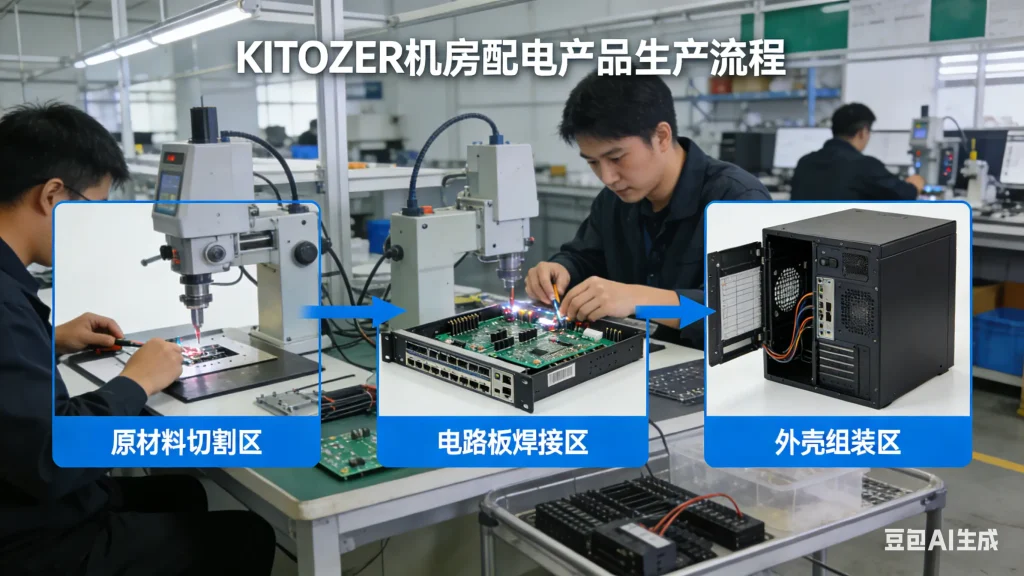
III. System Classification
Classified by computer room scale, grade and application scenarios, the KITOZER Computer Room Power Distribution System is divided into the following categories:
3.1 Classification by Computer Room Tier
| Tier | Power Distribution System Configuration | Application Scenarios |
|---|---|---|
| Tier II | Single utility power + UPS (1N) + Basic Monitoring | Small enterprise computer rooms and branch office computer rooms; planned downtime for maintenance is allowed |
| Tier III | Dual utility power + ATS + UPS (2N or N+1) + Comprehensive Monitoring | Medium-sized data centers and enterprise core computer rooms; requires 99.982% availability and supports online maintenance |
| Tier IV | Dual independent utility power + Dual ATS + UPS (2N) + Backup Generator + Intelligent Management System | Large-scale cloud computing data centers and core computer rooms of financial institutions; requires 99.995% availability with no single point of failure |
3.2 Classification by Power Supply Type
- AC Power Distribution System: The most commonly adopted solution, supplying 380V/220V AC power for traditional IT equipment.
- DC Power Distribution System: Applied to telecommunication equipment and certain storage devices. It reduces AC-DC conversion links to improve efficiency and lower power loss.
- AC/DC Hybrid Power Distribution System: Compatible with both AC and DC loads to meet diversified power demands of computer room devices.
3.3 Classification by Deployment Mode
- Centralized Power Distribution: All power distribution devices are centrally installed in a dedicated power room. Ideal for large data centers for easy management and maintenance.
- Distributed Power Distribution: Power distribution devices are deployed across different areas of the computer room. Suitable for modular data centers and micro-module computer rooms, which shortens power distribution distance and reduces losses.
- Cabinet-mounted Power Distribution: Integrated design of RPP and cabinets. Applied to high-density cabinet areas to improve space utilization.
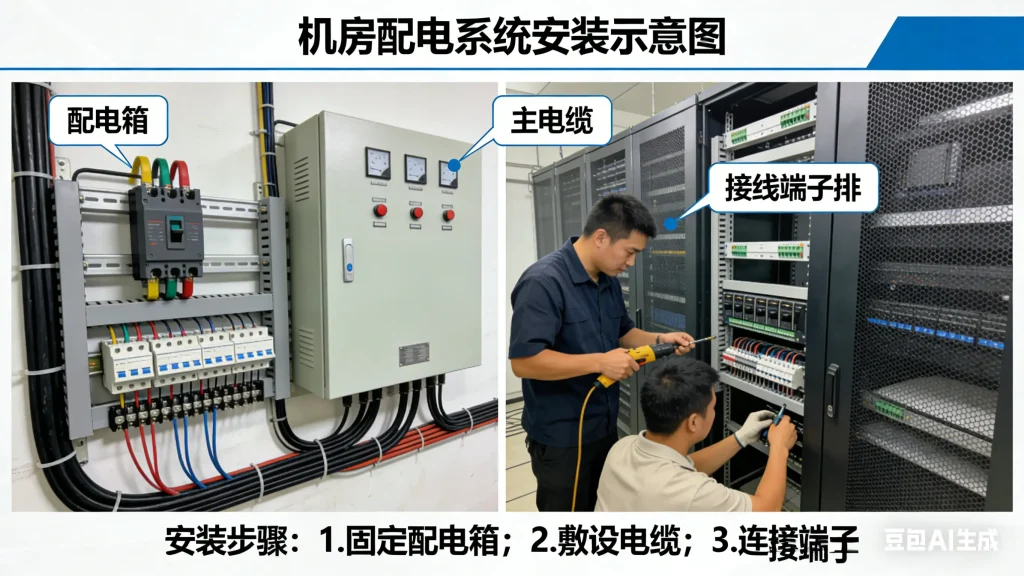
IV. System Configuration List (Brand: KITOZER)
| No. | Equipment Name | Model | Specifications | Quantity | Remarks |
|---|---|---|---|---|---|
| Front-end Main Distribution Equipment | |||||
| 1 | Utility Power Distribution Cabinet | KT-GGD-2A | Rated Current: 1600A, 380V/220V, 50Hz, IP30, 16 output circuits | 1~2 sets | 2 sets for dual utility power configuration |
| 2 | ATS Cabinet | KT-ATS-630 | Rated Current: 630A, Switching Time ≤100ms, supports utility power/generator switching | 1 set | Equipped with intelligent controller and remote monitoring function |
| 3 | UPS Input Cabinet | KT-UPS-IN-800 | Rated Current: 800A, compatible with 400kVA~600kVA UPS | 1 set | With SPD, short-circuit breaking capacity: 50kA |
| 4 | UPS Output Cabinet | KT-UPS-OUT-800 | Rated Current: 800A, 12 output circuits, 63A~250A per circuit | 1 set | Built-in energy metering device for energy consumption monitoring |
| Intermediate Distribution Equipment | |||||
| 5 | Power Distribution Cabinet | KT-PD-400 | Rated Current: 400A, 8 output circuits, for air conditioners and fresh air units | 1~2 sets | Configured according to the number of power loads |
| 6 | Lighting Distribution Cabinet | KT-ZM-200 | Rated Current: 200A, 12 output circuits including emergency lighting circuit | 1 set | Independent power switching device for emergency circuit |
| Terminal Power Supply Equipment | |||||
| 7 | Precision Remote Power Panel | KT-RPP-630 | Rated Current: 630A, 16 output circuits, 32A/3P per circuit, with intelligent monitoring | Configured by row | 1 set per cabinet row, supports hot-swap expansion |
| 8 | Intelligent PDU | KT-PDU-32 | 32A input, 8 outlets, voltage & current monitoring, RS485 communication | Configured by cabinet | 1 set per cabinet, supports remote on/off control |
| Auxiliary Equipment | |||||
| 9 | Surge Protective Device | KT-SPD-40 | 40kA, 380V, 3-phase 4-wire | Multiple units | 1 unit for each main distribution cabinet, ATS cabinet and UPS cabinet |
| 10 | Intelligent Monitoring Module | KT-MON-01 | Supports Modbus-RTU, collects voltage, current, power and other data | Multiple units | 1 unit per distribution cabinet for centralized monitoring |
| 11 | Communication Gateway | KT-GW-01 | RS485 to Ethernet, connects all monitoring modules | 1 set | Enables interconnection between power distribution system and computer room environment monitoring platform |
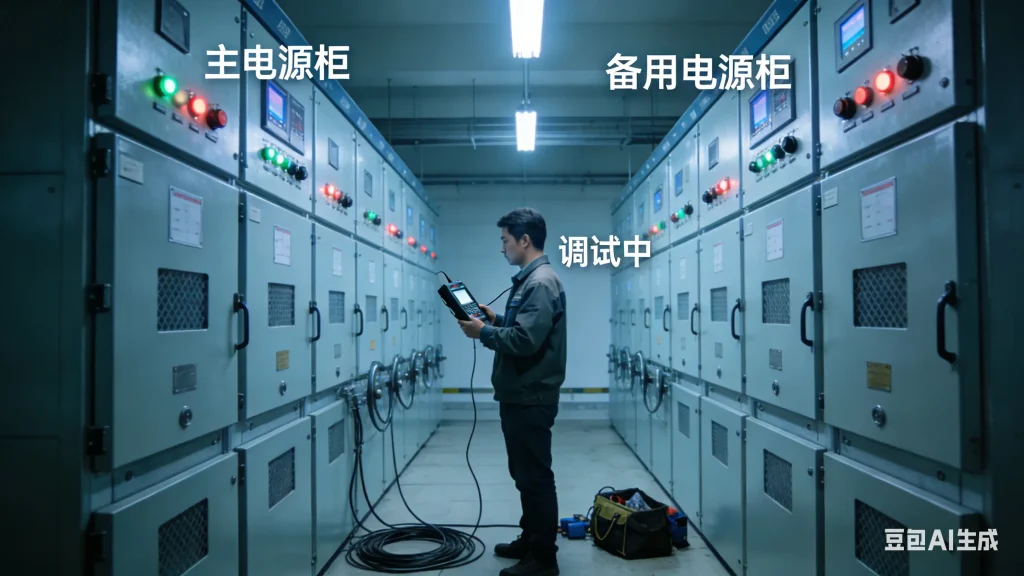
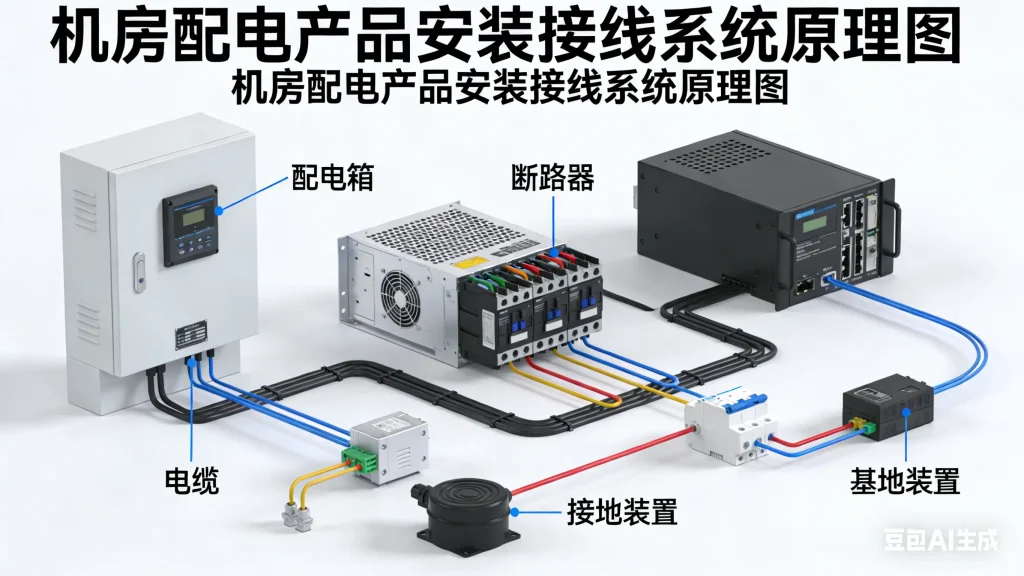
V. System Schematic Diagram
5.1 Typical Architecture of KITOZER Computer Room Power Distribution System (Tier III)
Utility Power A ──────┐
│ KT-GGD-2A Utility Cabinet A ───┐
Utility Power B ──────┘ │
▼
KT-ATS-630 ATS Cabinet
│
┌───────────────────────────────────────────────┴───────────────────────────────────────────────┐
│ │
KT-UPS-IN-800 UPS Input Cabinet Backup Generator
│ │
UPS System (2N Configuration) │
│ │
KT-UPS-OUT-800 UPS Output Cabinet │
│ │
┌─────────┴──────────┐ ┌───────────┴───────────┐ ┌───────────────────┴───────────────────┐
│ │ │ │ │ │
│ KT-PD-400 Power │ │ KT-ZM-200 Lighting │ │ KT-RPP-630 RPP (Multiple Units) │
│ Cabinet │ │ Distribution │ │ │
│ │ │ Cabinet │ │ ┌─────┬─────┬─────┬─────┐ │
│ Air Conditioners, │ │ General & Emergency │ │ │PDU 1│PDU 2│PDU 3│PDU n│ │
│ Fresh Air & Other │ │ Lighting │ │ │Server│Server│Server│Server│ │
│ Auxiliary Devices │ │ │ │ └─────┴─────┴─────┴─────┘ │
└────────────────────┘ └───────────────────────┘ └───────────────────────────────────────┘
│
┌───────────────────────────────────────────────────────────────────────────────────────────────┘
│
Computer Room Environment Monitoring System (with KT-GW-01 Communication Gateway)
5.2 System Operation Description
- Normal Operation Mode: Dual utility power is fed through utility distribution cabinets. The ATS cabinet selects the main utility power to supply power to the UPS system. The UPS output cabinet distributes stable power to RPPs, power cabinets and lighting cabinets, and finally powers IT and auxiliary devices via PDUs.
- Utility Power Failure Mode: When the main utility power is abnormal, the ATS cabinet switches to backup power (generator) within ≤100ms. The UPS system takes over power supply seamlessly to ensure continuous operation of IT devices.
- Maintenance Mode: Manual switch to maintenance status allows inspection and repair of power distribution equipment without interrupting load power supply.
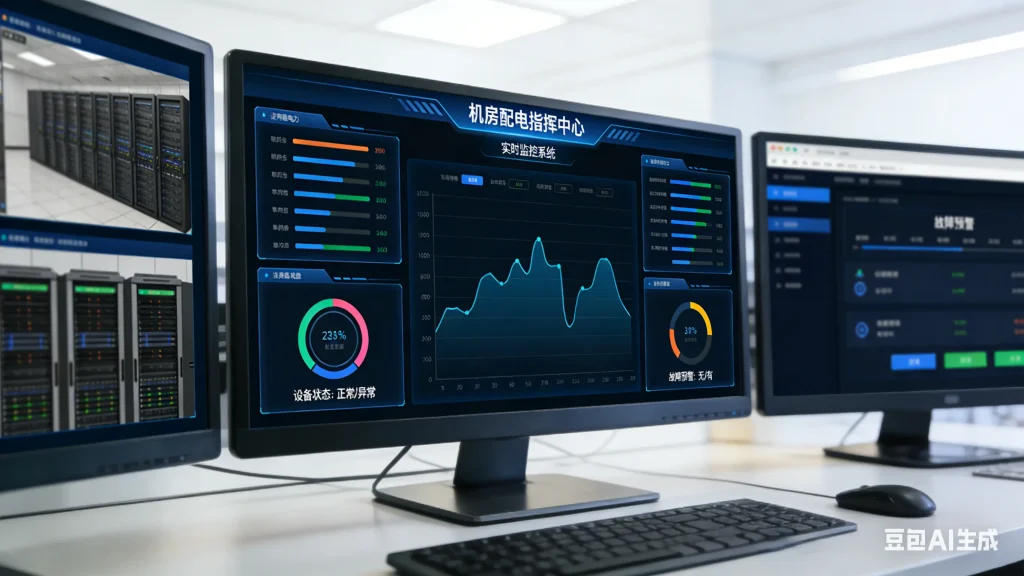
- Monitoring & Management: The whole system conducts real-time monitoring. Data is uploaded to the environment monitoring platform via the communication gateway to realize remote monitoring, fault early warning and energy consumption analysis.
VI. Product Technical Parameters
6.1 Technical Parameters of Core Equipment
KITOZER Utility Power Distribution Cabinet (KT-GGD-2A)
- Rated Voltage: AC 380V/220V, 50Hz
- Rated Current: 1600A
- Protection Grade: IP30
- Output Circuits: 16 circuits, 63A~630A per circuit
- Short-circuit Breaking Capacity: 50kA
- Configuration: Main circuit breaker, branch circuit breakers, SPD, energy meter, intelligent monitoring module
- Communication Interface: RS485 (Modbus-RTU)
KITOZER ATS Cabinet (KT-ATS-630)
- Rated Voltage: AC 380V/220V, 50Hz
- Rated Current: 630A
- Switching Time: ≤100ms
- Switching Mode: Automatic / Manual
- Protection Functions: Overvoltage, undervoltage, phase loss and overload protection
- Communication Interface: RS485, supports remote monitoring and status feedback
- Mechanical Life: ≥ 10,000 switching times
KITOZER UPS Distribution Cabinet (KT-UPS-IN/OUT-800)
- Rated Voltage: AC 380V/220V, 50Hz
- Rated Current: 800A
- Output Circuits: 12 circuits, 63A~250A per circuit
- Protection Grade: IP30
- Configuration: Circuit breakers, SPD, energy metering device, intelligent monitoring module
- Monitored Parameters: Three-phase voltage, current, power, power factor, electric energy, total harmonic distortion
KITOZER Power Cabinet (KT-PD-400)
- Rated Voltage: AC 380V/220V, 50Hz
- Rated Current: 400A
- Output Circuits: 8 circuits for power equipment
- Protection Grade: IP30
- Configuration: Branch circuit breakers, SPD, energy metering device
- Supports dual-power input and automatic switching
KITOZER Lighting Distribution Cabinet (KT-ZM-200)
- Rated Voltage: AC 220V, 50Hz
- Rated Current: 200A
- Output Circuits: 12 circuits including emergency lighting circuit
- Emergency Circuit: Independent power supply, automatic switching time ≤5s
- Configuration: Branch circuit breakers, emergency power switching device, intelligent lighting controller
KITOZER Precision Remote Power Panel (KT-RPP-630)
- Rated Voltage: AC 380V/220V, 50Hz
- Rated Current: 630A
- Output Circuits: 16 circuits, 32A/3P per circuit
- Monitoring Functions: Real-time monitoring of current, voltage, power and electric energy for each branch
- Protection Functions: Overload, short circuit, overvoltage, undervoltage and electric leakage protection
- Communication Interface: RS485, supports remote on/off control
- Mechanical Feature: Modular design, supports hot-swap expansion
KITOZER Intelligent PDU (KT-PDU-32)
- Rated Voltage: AC 220V, 50Hz
- Rated Current: 32A
- Output Ports: 8 × IEC C13/C19
- Monitored Parameters: Total current, voltage, power, electric energy
- Protection Functions: Overload and short circuit protection
- Communication Interface: RS485, supports remote on/off control
- Installation: 19-inch rack mount, 1U height
6.2 Technical Parameters of Intelligent Monitoring System
| Item | Technical Index |
|---|---|
| Monitoring Scope | System-wide voltage, current, power, power factor, electric energy, switch status and fault alarm |
| Communication Protocols | Modbus-RTU, Modbus-TCP, SNMP |
| Data Collection Interval | 1~10 seconds (configurable) |
| Response Time | ≤1 second |
| Storage Capacity | Supports historical data storage for no less than 1 year |
| Alarm Modes | Audible & visual alarm, SMS notification, email notification, platform pop-up alert |
| Management Functions | Remote switch control, load balancing suggestion, energy consumption analysis, report generation |
VII. Application Scope
The KITOZER Computer Room Power Distribution System is applicable to sites with strict requirements for power supply reliability and stability:
- Data Centers: Large-scale cloud data centers, Internet Data Centers (IDC), enterprise private cloud data centers
- Financial Institutions: Head office computer rooms of banks, securities trading centers, insurance data centers (zero outage required)
- Government & Public Sectors: Government cloud computer rooms, public security command centers, emergency management centers
- Telecommunications Industry: Core computer rooms of operators, base station computer rooms, data exchange centers
- Medical Industry: Computer rooms for hospital HIS systems, medical imaging centers, power supply systems for life support equipment
- Energy Industry: Power dispatching centers, petrochemical data computer rooms, new energy monitoring centers
- Education & Research: University computing centers, research institute laboratories, supercomputer centers
- Enterprise Applications: Head office computer rooms of large enterprises, branch computer rooms, disaster recovery centers
VIII. Product Advantages
8.1 Technical Advantages
- High Reliability Design
- Key components adopt world-renowned brands such as ABB and Schneider to ensure system stability.
- Redundant architecture with 2N or N+1 configuration eliminates single point of failure.
- Overall protection grade above IP30, adapting to clean indoor environment of computer rooms.
- High Intelligence Level
- Standard LCD digital controller displays real-time electrical parameters of incoming and outgoing circuits.
- Equipped with RS485 interface for connection with computer room environment monitoring system to realize centralized management.
- Intelligent analysis algorithm provides load balancing suggestions to prevent overload risks.
- Comprehensive Safety Protection
- Multiple protection mechanisms: overload, short circuit, overvoltage, undervoltage, phase loss and electric leakage protection.
- Arc Fault Detection Device (AFDD) prevents electrical fires.
- Insulation monitoring function tracks system insulation status and gives early fault warnings.
8.2 Performance Advantages
- High Efficiency & Energy Saving
- Optimized power distribution routes reduce line losses and improve power utilization.
- Intelligent energy consumption monitoring generates analysis reports to support PUE optimization.
- Low power consumption design cuts down self-energy loss of the system.
- Flexible Expansion
- Modular structure enables seamless capacity expansion to meet rising power density demands.
- RPP supports hot-swap output modules for circuit expansion without power cut.
- Compatible with UPS, generators and other equipment of different brands to reduce system upgrade costs.
- Easy Maintenance
- Drawer-type structure facilitates component replacement and maintenance.
- Full front operation design requires no rear access space and saves floor area.
- Accurate fault location speeds up troubleshooting and shortens downtime.
8.3 Service Advantages
- Professional R&D & Design Team: Provides customized solutions optimized according to computer room scale, load type and tier requirements.
- Comprehensive After-sales Service: 7×24-hour technical support with rapid response.
- Full Lifecycle Management: One-stop services including system design, installation & commissioning, O&M training and upgrading.
- Localized Service Network: Multiple service centers nationwide to ensure timely on-site support.
IX. Bid Specification Parameters
9.1 Core Bid Parameters (For Tender Documents)
| Category | Requirements |
|---|---|
| System Architecture | 1. Shall adopt redundant architecture of dual utility power + ATS + UPS + backup power2. Compatible with Tier III / Tier IV data center construction3. Switching time: ATS ≤100ms, UPS ≤5ms |
| Utility Power Distribution Cabinet | 1. Rated current ≥1600A, short-circuit breaking capacity ≥50kA2. Equipped with main breaker, branch breakers, SPD (≥40kA) and energy metering device3. Protection grade: IP30, full front operation design4. Standard LCD display and RS485 communication for intelligent monitoring |
| ATS Cabinet | 1. Rated current ≥630A, switching time ≤100ms2. Supports automatic switching between utility power and generator, with manual switching function3. Protection against overvoltage, undervoltage, phase loss and overload4. RS485 interface for remote monitoring and status feedback5. Mechanical life ≥10,000 switching times |
| UPS Distribution Cabinet | 1. Rated current ≥800A, output circuits ≥122. Equipped with circuit breakers, SPD (≥40kA) and energy metering device3. Monitors three-phase voltage, current, power, power factor, electric energy and harmonic distortion4. RS485 interface for remote management |
| Remote Power Panel | 1. Rated current ≥630A, output circuits ≥16 (≥32A per circuit)2. Real-time monitoring of current, voltage, power and electric energy for each branch3. Protection against overload, short circuit, overvoltage, undervoltage and electric leakage4. Modular design with hot-swap expansion function5. RS485 interface for remote on/off control |
| Intelligent Monitoring System | 1. Supports Modbus-RTU, Modbus-TCP and SNMP protocols2. Data collection interval ≤10 seconds3. Alarm modes: audible & visual alert, SMS, email and platform pop-up4. Supports historical data storage for no less than 1 year5. Provides load balancing suggestions, energy analysis and report generation |
| Brand Requirements | 1. Power distribution cabinet brand: KITOZER2. Key components: internationally renowned brands such as ABB, Schneider and Siemens3. Manufacturer holds ISO9001 Quality Management System Certificate and ISO14001 Environmental Management System Certificate |
X. Product Solutions
10.1 Solution for Small & Medium-sized Computer Rooms (≤500㎡, Tier II)
Features
- Adopts architecture of single utility power + UPS (1N) + basic monitoring to meet basic operational demands.
- Configures simplified utility cabinet, UPS cabinet, power cabinet, lighting cabinet and RPP.
- Cost-effective design for enterprises with limited budget.
Core Configuration
- 1 × KT-GGD-2A Utility Power Distribution Cabinet
- 2 × KT-UPS-IN/OUT-400 UPS Distribution Cabinet
- 1 × KT-PD-200 Power Cabinet
- 1 × KT-ZM-100 Lighting Distribution Cabinet
- 2~4 × KT-RPP-400 Remote Power Panel
- KT-PDU-32 Intelligent PDU configured by cabinet quantity
10.2 Solution for Medium-sized Data Centers (500-2000㎡, Tier III)
Features
- Architecture of dual utility power + ATS + UPS (2N) + comprehensive monitoring, meeting 99.982% availability requirement and supporting online maintenance.
- Complete set of front-end, intermediate and terminal power distribution equipment.
- Intelligent monitoring system realizes full-link visualized management.
Core Configuration
- 2 × KT-GGD-2A Utility Power Distribution Cabinet (dual power)
- 1 × KT-ATS-630 ATS Cabinet
- 4 × KT-UPS-IN/OUT-800 UPS Distribution Cabinet (2N configuration)
- 2 × KT-PD-400 Power Cabinet
- 1 × KT-ZM-200 Lighting Distribution Cabinet
- 5~10 × KT-RPP-630 Remote Power Panel
- KT-PDU-32 Intelligent PDU configured by cabinet quantity
- 1 × KT-GW-01 Communication Gateway
- 1 set of environment monitoring platform
10.3 Solution for Large-scale Data Centers (≥2000㎡, Tier IV)
Features
- Architecture of dual independent utility power + dual ATS + UPS (2N) + backup generator + intelligent management system, achieving 99.995% availability with no single point of failure.
- Distributed architecture shortens power distribution distance and reduces losses.
- Advanced intelligent monitoring system supports AI predictive maintenance and energy optimization.
Core Configuration
- 4 × KT-GGD-2A Utility Power Distribution Cabinet (dual independent power)
- 2 × KT-ATS-1250 ATS Cabinet
- 8 × KT-UPS-IN/OUT-1250 UPS Distribution Cabinet (2N configuration)
- 4 × KT-PD-630 Power Cabinet
- 2 × KT-ZM-200 Lighting Distribution Cabinet
- 10~20 × KT-RPP-800 Remote Power Panel
- KT-PDU-32 Intelligent PDU configured by cabinet quantity
- 2 × KT-GW-01 Communication Gateway (redundant)
- 1 set of advanced environment monitoring platform (with AI analysis module)
- 1 set of backup generator system (with automatic paralleling device)
XI. Application Cases
Case 1: Cloud Data Center of an Internet Enterprise (Tier III)
Project Background
- Floor area: 1500㎡, 100 standard cabinets deployed, single cabinet power density: 6kW
- Availability requirement: 99.982%, online maintenance supported, PUE ≤1.4
Solution
Adopts architecture of dual utility power + ATS + UPS (2N) + comprehensive monitoring.
Equipped with 2 sets of KT-GGD-2A, 1 set of KT-ATS-630, 4 sets of KT-UPS-IN/OUT-800, 2 sets of KT-PD-400, 1 set of KT-ZM-200, 8 sets of KT-RPP-630 and 100 sets of KT-PDU-32.
Operation Result
- The system has run stably for 3 years with zero fault, fully meeting the 99.982% availability standard.
- Real-time energy monitoring keeps PUE steadily below 1.35.
- Modular design supports smooth expansion; two cabinet expansions have been completed without system reconstruction.
Case 2: Disaster Recovery Center of a Financial Institution (Tier IV)
Project Background
- Floor area: 2000㎡, 150 standard cabinets deployed, single cabinet power density: 8kW
- Availability requirement: 99.995%, no single point of failure, 24×7×365 continuous operation
Solution
Adopts architecture of dual independent utility power + dual ATS + UPS (2N) + backup generator + intelligent management system.
Equipped with 4 sets of KT-GGD-2A, 2 sets of KT-ATS-1250, 8 sets of KT-UPS-IN/OUT-1250, 4 sets of KT-PD-630, 2 sets of KT-ZM-200, 12 sets of KT-RPP-800, 150 sets of KT-PDU-32, 2 sets of KT-GW-01, 1 advanced environment monitoring platform and 1 backup generator system (3 × 800kW parallel generators).
Operation Result
- The system has operated stably for 2 years. The ATS switched to backup power automatically during 3 utility power outages without any service interruption.
- AI predictive maintenance function gave early warnings for 2 potential faults and avoided losses.
- PUE is maintained below 1.3, reaching leading domestic level.
Case 3: Government Cloud Computer Room (Tier II)
Project Background
- Floor area: 500㎡, 30 standard cabinets deployed, single cabinet power density: 4kW
- Availability requirement: 99.9%, limited budget, basic monitoring required
Solution
Adopts architecture of single utility power + UPS (1N) + basic monitoring.
Equipped with 1 set of KT-GGD-2A, 2 sets of KT-UPS-IN/OUT-400, 1 set of KT-PD-200, 1 set of KT-ZM-100, 3 sets of KT-RPP-400 and 30 sets of KT-PDU-32.
Operation Result
- Stable operation for 1 year, complying with 99.9% availability requirement.
- Total investment is well controlled within budget, saving 20% cost compared with similar solutions.
- Basic monitoring system meets daily management demands with remote viewing and fault alarm functions.
XII. Keywords, SEO & Tags
12.1 Search Keywords
Core Keywords
- Computer room power distribution system
- KITOZER computer room distribution cabinet
- Data center power supply and distribution solution
- Remote Power Panel & Intelligent PDU
- ATS automatic transfer cabinet
- UPS distribution cabinet
- Power cabinet & Lighting distribution cabinet
Long-tail Keywords
- Tier III data center power distribution solution
- Dual utility power + ATS + UPS redundant architecture
- Intelligent monitoring computer room power distribution system
- Modular computer room power distribution solution
- High-availability computer room power supply system
- Energy-saving data center power distribution design
- Integrated solution for computer room environment monitoring and power distribution
12.2 SEO Optimization Guidelines
- Title Optimization: Include the core keyword KITOZER Computer Room Power Distribution System Solution to highlight brand and product.
- Content Optimization
- Keep the density of core keywords at 2%~3% and distribute them naturally throughout the text.
- Arrange long-tail keywords in each chapter properly to improve page relevance.
- Use heading tags (H3) for key content to enhance readability.
- Image Optimization: Add Alt attributes containing core keywords for system schematic diagrams.
- Link Optimization: Add internal links to related product pages and external links to authoritative technical documents.
- Mobile Optimization: Adapt content for mobile browsing with clear layout for quick reading.
12.3 Tags
Product Tags: KITOZER, computer room power distribution, distribution cabinet, remote power panel, ATS cabinet, UPS cabinet, power cabinet, lighting cabinet, intelligent PDU
Application Tags: Data center, computer room construction, power supply and distribution system, IT infrastructure, environment monitoring
Technical Tags: Redundant architecture, intelligent monitoring, high availability, energy-saving design, modular design, Data Center Tier
Industry Tags: Internet, Finance, Government, Telecommunications, Medical Care, Energy, Education, Enterprise Application
Regional Tags: Nationwide, South China, East China, North China, Southwest China, Northwest China, Central China