KITOZER Cooling Tower: Open Circuit, Closed Circuit & Hybrid Cooling Towers for Industrial and HVAC Applications
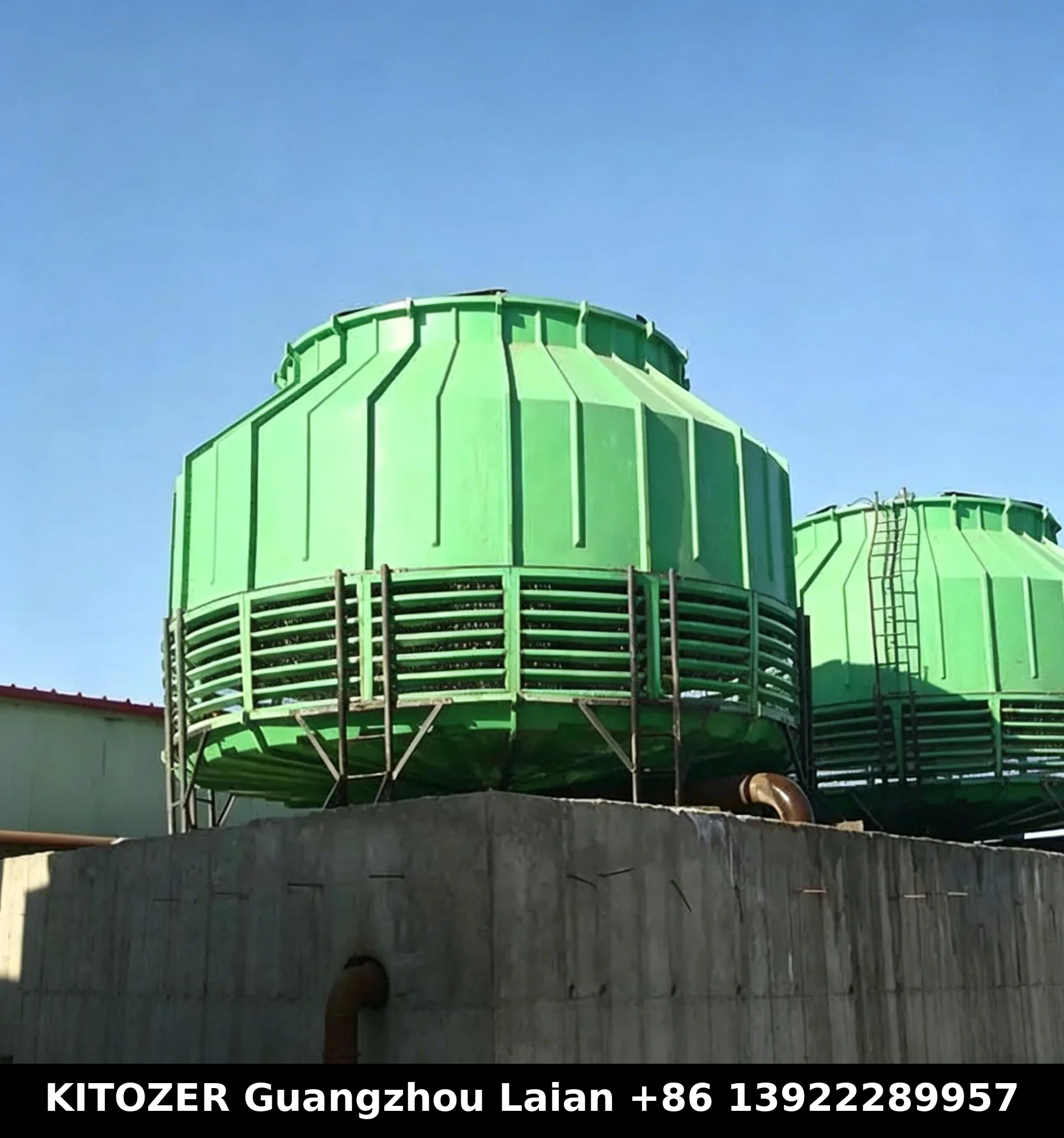
Product Overview
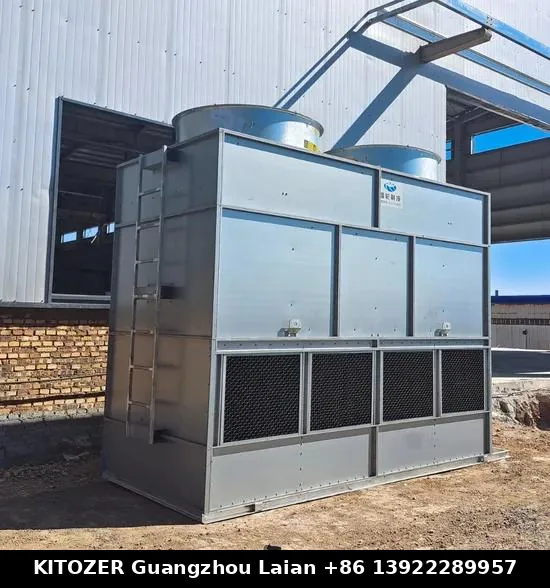
KITOZER is a professional cooling tower manufacturer and supplier based in Guangzhou, China. Our product range covers open circuit cooling towers, closed circuit cooling towers, crossflow cooling towers, counterflow cooling towers, square induced draft cooling towers, round counterflow cooling towers, and hybrid dry-wet cooling towers. With cooling capacities from 10 m3/h to 5000 m3/h, KITOZER cooling towers serve data centers, commercial buildings, industrial process cooling, power stations, food and beverage plants, pharmaceutical factories, and many other applications.
A cooling tower is a specialized heat rejection device that rejects waste heat to the atmosphere through the cooling of water to a lower temperature. Cooling towers use the evaporation of water to remove process heat and cool the working fluid to near the wet-bulb air temperature. KITOZER cooling towers are designed for high thermal efficiency, low energy consumption, low noise, long service life, and easy maintenance.
KITOZER is a brand of Guangzhou Laian Intelligent System Development Co., Ltd. Our factory is located at No. 5 Huashan Road, Shilou, Panyu, Guangzhou, China. We provide complete cooling water system solutions including cooling towers, chilled water pumps, condenser water pumps, water treatment equipment, and control systems.
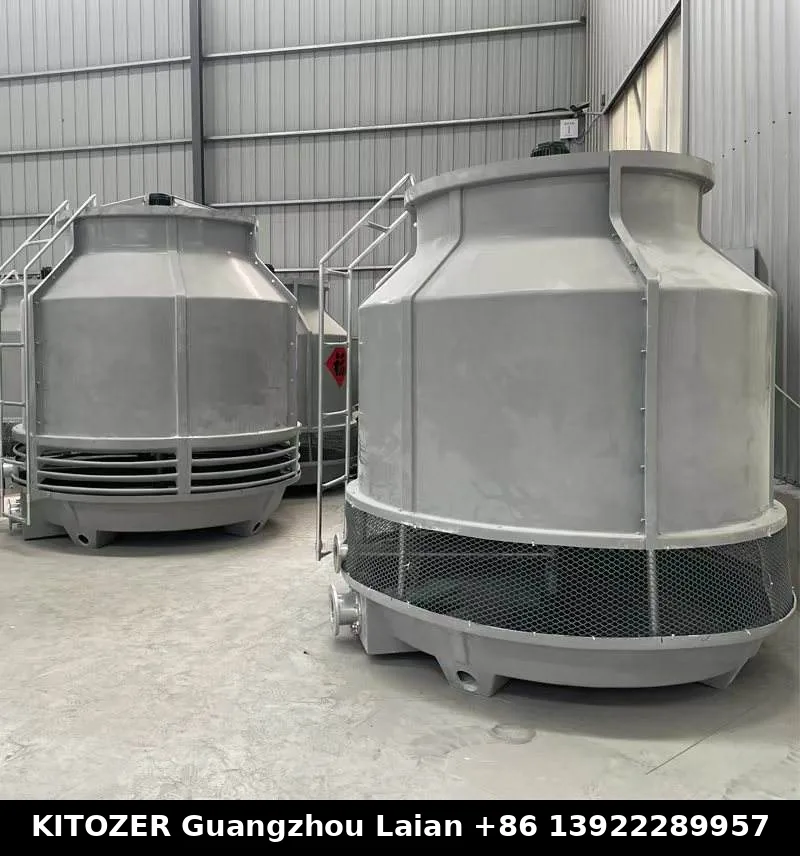
How Does a Cooling Tower Work
The working principle of a cooling tower is based on evaporative cooling. In an open circuit cooling tower, warm water from the condenser or process equipment is pumped to the top of the tower and distributed through spray nozzles over a fill media (packing). The fill media creates a large surface area for water and air to contact. A fan draws ambient air through the fill in either counterflow or crossflow direction. A small portion of the water evaporates, absorbing latent heat from the remaining water, which lowers the water temperature. The cooled water collects in a cold water basin at the bottom and is pumped back to the heat source.
In a closed circuit cooling tower, the process water circulates inside a coiled tube coil and never contacts the air. Water is sprayed over the outside of the coil, and air is drawn across the coil. Evaporation of the spray water cools the process water inside the tube. This keeps the process water clean and free from contamination.
The theoretical minimum water temperature is the wet-bulb temperature of the ambient air. In practice, KITOZER cooling towers are designed to produce water temperature within 3-5°C of the wet-bulb temperature (the approach). The typical design condition is 37°C inlet water / 32°C outlet water at 28°C wet-bulb temperature.
Types of KITOZER Cooling Towers
Open Circuit Cooling Tower
Open circuit cooling towers (also called open cooling towers) are the most common type. Water directly contacts air. They are cost-effective and widely used in HVAC and industrial applications where water quality is not critical. KITOZER offers both round and square open cooling towers.
Closed Circuit Cooling Tower
Closed circuit cooling towers keep the process water in a closed loop inside a coil. They are used for precision process cooling where water quality must be maintained, such as injection molding machines, welding machines, induction furnaces, lasers, and vacuum coating equipment.
Crossflow Cooling Tower
In crossflow towers, air flows horizontally through the fill while water flows vertically downward. Crossflow towers have lower fan power and easier maintenance access.
Counterflow Cooling Tower
In counterflow towers, air flows upward while water flows downward. Counterflow towers have higher thermal efficiency and smaller footprint.
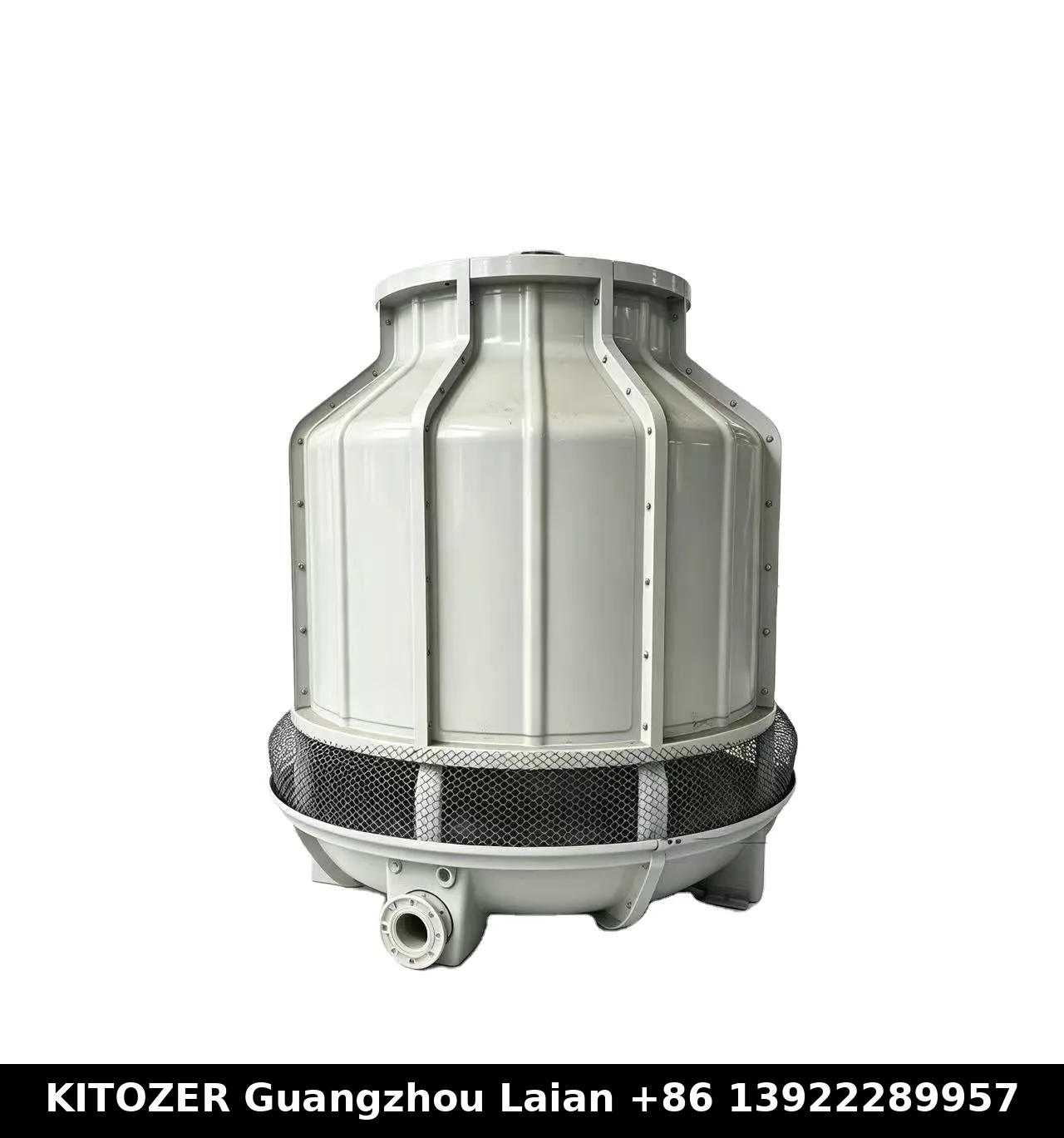
Technical Specifications
| Model | Capacity (m3/h) | Fan Power (kW) | Dimensions L×W×H (mm) | Weight (kg) | Noise dB(A) at 10m |
|---|---|---|---|---|---|
| KTZ-10 | 10 | 0.37 | 1200×1200×2200 | 350 | 60 |
| KTZ-30 | 30 | 0.75 | 1800×1800×2800 | 600 | 62 |
| KTZ-50 | 50 | 1.1 | 2200×2200×3200 | 900 | 63 |
| KTZ-100 | 100 | 2.2 | 3000×3000×3800 | 1800 | 65 |
| KTZ-200 | 200 | 4.0 | 4000×4000×4500 | 3500 | 67 |
| KTZ-400 | 400 | 7.5 | 5500×5500×5500 | 7000 | 69 |
| KTZ-800 | 800 | 15 | 7000×7000×6500 | 14000 | 71 |
| KTZ-1500 | 1500 | 30 | 9000×9000×7500 | 28000 | 73 |
Note: The above specifications are reference values. Actual specifications may vary based on project conditions. Please contact KITOZER for a customized selection.
Key Components
Tower Structure
KITOZER cooling tower structure is available in FRP (fiberglass reinforced plastic), galvanized steel, galvalume steel, and stainless steel 304/316. FRP is lightweight, corrosion-resistant, and commonly used for small towers. Galvanized steel is cost-effective for large square towers. Stainless steel is used for coastal and corrosive environments.
Fill Media
The fill media (packing) is the heat exchange core. KITOZER uses PVC fill with a film-type design. Fill spacing ranges from 12mm to 20mm. The fill provides large surface area for water-air contact while keeping air resistance low.
Fan System
Axial flow fans with airfoil-shaped blades provide high efficiency and low noise. Blade materials include aluminum alloy and FRP. Fans are driven by motors through belts or direct drive. KITOZER offers variable frequency drive (VFD) options for energy saving.
Water Distribution System
Small towers use rotating sprinklers driven by water reaction force. Large towers use fixed distribution pipes with spray nozzles. Nozzles are made of ABS or PVC and are easy to remove for cleaning.
Drift Eliminator
Drift eliminators remove water droplets entrained in the exhaust air. KITOZER PVC drift eliminators achieve drift loss below 0.005% of circulating water flow, far below the national standard of 0.1%.
Cold Water Basin
The basin collects cooled water at the bottom. It is equipped with make-up water float valve, drain, overflow, and outlet. Heater options are available for freeze protection in winter.
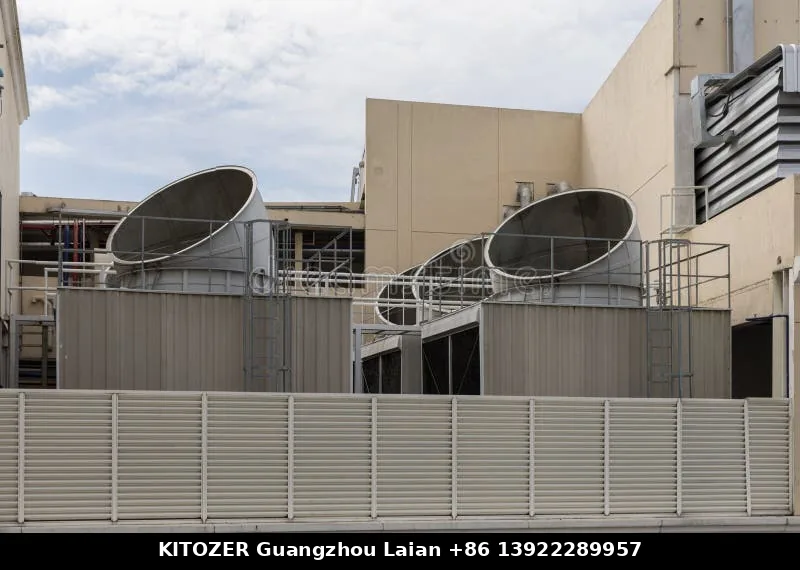
Selection Guide
Selecting the right cooling tower involves the following steps:
Step 1: Determine heat load. For HVAC, the condenser heat rejection is approximately 1.25 times the chiller cooling capacity. For industrial, sum the heat from all process equipment.
Step 2: Determine water temperatures. Typical design is 37°C inlet / 32°C outlet. For process cooling, use the equipment manufacturer’s requirements.
Step 3: Calculate water flow. Flow (m3/h) = Heat load (kW) × 0.86 / Temperature difference (°C).
Step 4: Check local wet-bulb temperature. Use the summer air conditioning design wet-bulb temperature of the project location. South China typically uses 28°C.
Step 5: Choose tower type. Consider space, noise requirements, water quality, corrosion environment, and winter operation.
KITOZER engineering team can complete the selection for you within one business day. Please provide: heat load or chiller model, water temperature requirements, local wet-bulb temperature, site conditions, and noise requirements.
Installation Requirements
Foundation
Concrete foundation must be level and strong enough to support the operating weight. The foundation should be 100mm larger than the tower base on all sides. For rooftop installation, verify the building structure can support the tower weight plus water weight.
Airflow Clearance
Provide adequate clearance around the tower for air intake. Do not locate towers where exhaust air can be re-ingested (short circuit). Maintain at least 3 meters clearance between towers. The exhaust discharge should be directed away from buildings and air intakes.
Piping
Install flexible connectors between tower piping and equipment. Support piping independently. Include isolation valves, Y-strainer, pressure gauges, and thermometers. For multiple towers, install a balancing pipe between basin water levels.
Electrical
Connect motor power supply with proper grounding. Provide a control panel with starter, overload protection, and VFD if needed. Run control wiring in conduit. Motor insulation should be rated for outdoor use.
Operation and Maintenance
Daily Operation
Start the water pump first, then the fan. Monitor water temperature, water level, and motor current. In winter, run anti-freeze heaters if needed. Stop the fan before stopping the pump.
Monthly Maintenance
Clean the cold water basin. Test water quality (pH, conductivity, chlorine). Inspect spray nozzles and clean if clogged. Check belt tension. Lubricate fan bearings.
Annual Maintenance
Inspect the fill media for fouling or damage. Clean the distribution system. Check motor insulation. Inspect structural bolts and tighten. Inspect for corrosion and touch up paint. Perform water treatment system service.
Water Treatment
Proper water treatment is essential. Use scale and corrosion inhibitors, biocides, and side-stream filtration. Control cycles of concentration at 3-5. Test water quality regularly. Without proper treatment, scale will reduce heat transfer and shorten equipment life.
FAQ – Frequently Asked Questions
A: Open towers expose water directly to air and are lower cost. Closed towers keep water in a coil, keeping it clean, but cost 30-50% more.
A: Standard models are 65-75 dB(A) at 10 meters. Low-noise models are 5-10 dB(A) quieter.
A: Make-up water is about 2-3% of circulating water flow (evaporation + drift + blowdown).
A: The structure lasts 15+ years. Fill media lasts 5-8 years. Fan motor lasts 10-15 years.
A: Yes. Northern models include basin heaters and glycol fill. Winter operation requires freeze protection.
A: Drift loss is water droplets entrained in exhaust air. KITOZER towers have drift loss below 0.005%.
A: Condenser flow = chiller cooling capacity × 0.21 m3/h per kW. Tower must reject 1.25× chiller capacity.
A: Stainless steel 304 or 316, or coated galvanized steel. Standard galvanized steel will corrode in coastal air.
A: Yes. VFD fans save 30% energy by adjusting speed based on water temperature.
A: Standard towers ship in 15-30 days. Custom towers take 30-45 days.
A: Yes. Our engineers can supervise installation and commissioning on site.
A: Yes. We have exported to many countries. CE certification available on request.
Applications
Data Centers: KITOZER modular square cooling towers provide N+1 redundancy and free cooling in winter, reducing PUE.
Commercial Buildings: Office buildings, shopping malls, hotels use rooftop cooling towers to serve chillers. Low-noise models meet residential requirements.
Industrial Process: Injection molding, die casting, welding machines, induction furnaces, lasers, and vacuum coating use closed circuit cooling towers for clean process water.
Power & Energy: Power plants, substations, and energy storage stations use large-capacity cooling towers.
Food & Beverage: Brewing, dairy, and food processing use cooling towers for process cooling.
Pharmaceutical: Reactors and pure water systems require stable cooling. KITOZER closed towers deliver clean water.
Contact KITOZER
Company: Guangzhou Laian Intelligent System Development Co., Ltd. (KITOZER)
Address: No. 5 Huashan Road, Shilou, Panyu, Guangzhou, China
Phone / WeChat: +86 13922289957, +86 18520668845
WhatsApp: +1 906-853-4140
Website: www.gdlain.com (English) | www.lain.com.cn (Chinese)
Contact us today for a customized cooling tower quotation!
Detailed Working Principle
Cooling towers operate on the principle of evaporative cooling. When a small portion of water evaporates, it absorbs the latent heat of vaporization (approximately 2400 kJ per kilogram of water evaporated) from the remaining water, causing a significant drop in water temperature. This process is far more effective than sensible heat transfer alone. In fact, evaporative cooling accounts for about 80-90 percent of the total heat rejection, while direct sensible heat transfer from water to air accounts for only 10-20 percent.
The theoretical lowest achievable water temperature is the wet-bulb temperature of the ambient air, which is measured by a thermometer covered in a water-soaked wick over which air is passed. In practice, KITOZER cooling towers are designed to produce water temperatures 3 to 5 degrees Celsius above the wet-bulb temperature. This difference is called the approach. A smaller approach means a more efficient tower but also a larger and more expensive tower.
The air-to-water ratio is a critical design parameter. Typical values range from 0.8 to 1.5. A higher air flow provides better cooling but consumes more fan energy. KITOZER engineers optimize the air-to-water ratio for each project to balance thermal performance and energy consumption.
Open Circuit Cooling Tower in Detail
An open circuit cooling tower consists of several sections: the air inlet section at the bottom sides, the fill section in the middle, the water distribution section above the fill, the drift eliminator section, the fan section at the top, and the cold water basin at the very bottom.
The air inlet section includes louvers that prevent sunlight from entering (to inhibit algae growth) and distribute incoming air evenly. Air inlet velocity is typically 1 to 3 meters per second.
The fill section is the heat exchange core. Warm water trickles down over the fill, while air flows upward through the fill. The fill maximizes contact area and contact time between water and air.
The water distribution section includes pipes and nozzles that spray water evenly over the fill. In small round towers, a rotating sprinkler is used. In large square towers, fixed distribution pipes with nozzles are used.
The drift eliminator uses directional changes to separate water droplets from the exhaust air, minimizing water loss.
The fan section includes the fan, motor, drive mechanism, and fan cylinder. The fan creates negative pressure inside the tower, drawing air through the fill.
The cold water basin collects cooled water and serves as the suction reservoir for the condenser water pump.
Closed Circuit Cooling Tower in Detail
Closed circuit cooling towers, also called fluid coolers, keep the process water completely isolated from the atmosphere. The process water circulates inside a coil made of copper or stainless steel tubes. Spray water is pumped from the basin to spray nozzles above the coil, wetting the outside of the coil. Ambient air is drawn across the coil. Evaporation of the spray water removes heat from the process water inside the coil.
The main advantage of closed circuit towers is water quality. The process water never contacts air, so it remains clean and free from contamination, scale, and biological growth. This is critical for precision equipment such as injection molds, welding torches, laser cavities, and induction heating coils.
Closed circuit towers also reduce water treatment costs because the process water loop is closed and requires almost no make-up. However, the spray water loop is still open and requires treatment.
KITOZER closed circuit cooling towers are available with copper coils for standard applications and stainless steel 304 or 316 coils for corrosive environments. Capacities range from 50 to 1000 m3/h.
In dry mode operation (used in winter or dry climates), the spray pump is turned off and the coil acts as a dry heat exchanger, rejecting heat through sensible cooling only. This eliminates water evaporation and make-up.
Crossflow vs Counterflow Cooling Towers
Crossflow cooling towers have air entering horizontally through the side louvers and flowing horizontally across the fill. Water flows vertically downward through the fill. The advantages of crossflow design include lower air resistance (which reduces fan power), easier maintenance access from the side, and a lower profile that fits well under low roof clearances. The disadvantages are larger footprint and slightly lower thermal efficiency compared to counterflow.
Counterflow cooling towers have air entering from the bottom and flowing upward, opposite to the downward water flow. The advantages are higher thermal efficiency (smaller footprint for the same capacity) and better water-air contact. The disadvantages are higher air resistance and more limited maintenance access.
KITOZER offers both crossflow and counterflow towers. The choice depends on site conditions, budget, and performance requirements. Crossflow is often preferred for large commercial buildings with low roof height, while counterflow is preferred when space is limited.
Materials of Construction
FRP (Fiberglass Reinforced Plastic)
FRP is the most common material for cooling tower shells. It is lightweight, corrosion-resistant, and does not rust. KITOZER adds UV inhibitors to the resin to prevent weathering. FRP towers typically last 15 years or more in outdoor service.
Galvanized Steel
Galvanized steel towers are used for large square towers where structural strength is required. The zinc coating is typically 80-120 microns. In normal environments, galvanized steel lasts about 10 years. In coastal or corrosive environments, stainless steel or galvalume is recommended.
Stainless Steel
Stainless steel 304 provides good corrosion resistance for coastal and industrial environments. Stainless steel 316 with molybdenum is used for highly corrosive applications such as chemical plants and coastal power stations. KITOZER offers fully stainless steel towers for demanding applications.
Galvalume Steel
Galvalume (aluminum-zinc coated steel) provides 2 to 3 times better corrosion resistance than galvanized steel. It is an excellent choice for humid environments at a moderate cost premium.
Fan System Details
The fan is one of the most critical components of a cooling tower. KITOZER uses axial flow fans with airfoil-shaped blades that deliver high aerodynamic efficiency. Fan blades are available in aluminum alloy (high strength) and FRP (corrosion resistance).
Fan speed is selected based on the tower thermal requirements. Lower fan speed reduces noise but also reduces cooling capacity. KITOZER low-noise towers use larger diameter fans running at lower speed to maintain capacity while reducing noise.
Fan drive options include belt drive (quieter, easier speed adjustment) and direct drive (higher efficiency, less maintenance). KITOZER uses premium brand motors with IP55 protection and Class F insulation, suitable for outdoor service.
Variable frequency drive (VFD) fans can save up to 30 percent of fan energy by adjusting fan speed based on water temperature. Since fan power is proportional to the cube of speed, reducing speed by 20 percent reduces power consumption by nearly 50 percent.
Water Distribution System Details
Uniform water distribution across the fill is essential for tower efficiency. Poor distribution creates dry spots where no heat transfer occurs, effectively reducing the tower capacity.
Small round towers use rotating sprinklers that rotate due to the reaction force of water jets. Rotation speed is typically 10 to 20 revolutions per minute. The sprinkler heads are made of brass or engineering plastic.
Large square towers use fixed distribution pipes with spray nozzles. Nozzles operate at 0.05 to 0.15 MPa pressure. Nozzles should be inspected and cleaned regularly to prevent clogging.
KITOZER tests water distribution at the factory before shipping to ensure uniform coverage across the entire fill area.
Drift Eliminator Details
Drift eliminators remove water droplets entrained in the exhaust air. KITOZER uses multi-pass PVC drift eliminators that achieve drift rates below 0.005 percent of circulating water flow. This is significantly better than the national standard requirement of 0.1 percent.
Drift eliminators must be installed in the correct orientation. Installing them upside down reduces their effectiveness. Damaged or missing drift eliminator sections should be replaced promptly to avoid excessive water loss and wetting of surrounding areas.
Cold Water Basin and Makeup Water
The cold water basin at the bottom of the tower collects cooled water. Basin depth is typically 500 to 800 millimeters, sufficient for pump suction requirements.
The basin includes a makeup water float valve that automatically adds water to replace evaporation, drift, and blowdown losses. KITOZER recommends upgrading to an electric float valve or electronic level controller for more reliable operation.
A drain valve is used for periodic blowdown to control water concentration. An overflow pipe prevents overfilling. In cold climates, basin electric heaters are recommended to prevent freezing.
Detailed Selection Guide
Selecting the right cooling tower is critical for system efficiency and reliability. KITOZER recommends following these detailed steps:
Step 1: Determine the heat load. For HVAC systems, the condenser heat rejection is approximately 1.25 times the chiller cooling capacity. For example, a 1000 kW chiller requires a tower that can reject about 1250 kW of heat. For industrial systems, sum the heat rejection from all process equipment.
Step 2: Determine water temperature requirements. Standard HVAC design is 37 degrees Celsius entering the tower and 32 degrees Celsius leaving. For process cooling, follow the equipment manufacturer’s recommended water temperatures.
Step 3: Calculate water flow rate. Water flow in cubic meters per hour equals heat load in kW multiplied by 0.86, divided by the temperature difference in degrees Celsius. For a 1250 kW heat load with a 5 degree temperature difference, the required flow is 1250 multiplied by 0.86 divided by 5, which equals approximately 215 cubic meters per hour.
Step 4: Determine the local wet-bulb temperature. This is the design ambient condition. South China typically uses 28 degrees Celsius wet-bulb. Colder locations use lower wet-bulb temperatures, which allows the tower to achieve lower water temperatures.
Step 5: Select the tower model. Use the KITOZER selection table to find a tower that can handle the calculated flow at the design conditions. KITOZER engineers can perform this calculation for you.
Step 6: Verify site conditions. Check that the tower dimensions, weight, noise level, and power supply match the site constraints.
Installation Requirements in Detail
Foundation Preparation
The concrete foundation must be level and capable of supporting the operating weight of the tower, including water weight. The foundation should extend 100 millimeters beyond the tower base on all sides. For rooftop installations, consult the structural engineer to verify the building can support the load.
Tower Placement
Place the tower in a well-ventilated location. Avoid enclosing the tower or placing it where exhaust air can be re-ingested. Maintain at least 3 meters clearance between multiple towers. Position the tower away from building air intakes to avoid pulling in moist exhaust air.
Piping Installation
Install flexible connectors at the tower inlet and outlet to reduce vibration transmission. Support all piping independently. Install isolation valves, Y-strainers, pressure gauges, and thermometers at each connection. For multiple towers, install a balancing pipe between basin water levels to ensure equal water distribution.
Electrical Connection
Connect the motor power supply with proper grounding. Install a control panel with motor starter, overload protection, and optional VFD. Route control wiring in conduit. The motor must be suitable for outdoor service.
Commissioning
After installation, fill the basin with water, check for leaks, start the pump, and verify water distribution. Jog the motor to confirm correct fan rotation direction. Then run the tower under load for 2 hours and measure water temperatures.
Operation and Maintenance in Detail
Starting the Tower
Always start the condenser water pump before starting the fan. This ensures water is flowing over the fill before the fan turns on, preventing dry operation. Check the basin water level and ensure the makeup valve is working.
Normal Operation
Monitor water temperatures, motor current, and water level regularly. The KITOZER control panel displays these parameters. If the motor current exceeds the rated value, inspect the fan and belts for issues.
Shutting Down
Stop the fan first, then stop the pump. For winter shutdown in cold climates, drain the water completely to prevent freezing.
Monthly Maintenance
Clean the cold water basin. Test water quality including pH, conductivity, and chlorine residual. Inspect and clean spray nozzles. Check belt tension and condition. Lubricate fan bearings.
Annual Maintenance
Inspect the fill media for fouling, deformation, or damage. Clean the distribution system. Check motor insulation resistance. Inspect and tighten structural bolts. Touch up any paint damage. Service the water treatment system.
Water Treatment Program
A proper water treatment program includes: scale and corrosion inhibitors (20-50 mg/L dosing), biocides (oxidizing chlorine at 0.5-1.0 mg/L residual, plus non-oxidizing biocides weekly), and side-stream filtration (5-10 percent of flow). KITOZER can supply complete automatic water treatment systems.
Energy Saving Measures
Cooling towers consume significant energy over their lifetime. KITOZER recommends the following energy saving measures:
1. High-efficiency fill and fans: KITOZER uses optimized fill media and airfoil fan blades to minimize fan power.
2. Variable frequency drive: VFD fans adjust speed based on water temperature, saving 20-30 percent of fan energy.
3. Multiple tower staging: Use only the number of towers needed for the current load. KITOZER control systems automatically stage towers based on demand.
4. Free cooling: In winter, when outdoor temperatures are low, the tower can directly produce chilled water through a plate heat exchanger, allowing the chiller to shut down. This can save 30-50 percent of total cooling energy.
5. Water quality management: Clean water and clean fill maintain high heat transfer efficiency, reducing the required fan speed.
6. Proper air intake design: Avoid short-circuiting of exhaust air back to the intake, which would reduce cooling effectiveness.
Noise Control
Cooling tower noise is a common concern, especially for towers located near residential areas or office buildings. Noise sources include fan aerodynamic noise, motor mechanical noise, and water falling noise.
Fan aerodynamic noise is the dominant source. KITOZER low-noise towers reduce noise by using larger diameter fans at lower rotational speeds, more blades, and wider blade profiles. Low-noise models are 5-10 dB(A) quieter than standard models.
Additional noise reduction measures include: inlet silencing louvers, exhaust silencers, acoustic enclosures, and locating towers farther from sensitive buildings. Variable speed fans can reduce noise at night by slowing down when cooling demand is lower.
KITOZER can provide a noise prediction report for your project before purchase.
Winter Operation and Freeze Protection
Cooling towers operating in cold climates require freeze protection. KITOZER northern packages include:
Basin electric heaters: Automatic heaters maintain water temperature above 5 degrees Celsius when the tower is not running.
Continuous water circulation: Keeping water flowing prevents ice formation on the fill.
Fan reverse cycling: Periodically reversing the fan (or turning it off briefly) melts any ice that forms on the intake louvers.
Glycol fill: For severe climates, fill the system with 25-30 percent ethylene glycol solution, which lowers the freezing point to minus 15 degrees Celsius.
Complete drainage: For long winter shutdown, drain all water from the tower and piping.
Water Treatment and Legionella Control
Cooling towers can harbor Legionella bacteria, which causes Legionnaires’ disease. Proper water treatment is essential for public health and regulatory compliance.
KITOZER recommends:
1. Maintain a residual chlorine level of 0.5-1.0 mg/L in the circulating water.
2. Use periodic non-oxidizing biocides such as isothiazolinone.
3. Clean the tower and basin at least twice per year.
4. Test for Legionella quarterly in hospitals, hotels, and other public buildings.
5. Install side-stream filtration to remove suspended solids that support bacterial growth.
KITOZER can provide complete automatic water treatment systems that dose chemicals based on real-time water quality measurements.
Applications by Industry
Data Centers
Data centers operate 24 hours a day, 365 days a year, making cooling tower reliability critical. KITOZER modular square cooling towers support N+1 redundancy, where one tower can be taken offline for maintenance without affecting cooling capacity. When combined with a plate heat exchanger for free cooling, KITOZER towers can shut down the chiller in winter, dramatically reducing PUE. A typical data center in a temperate climate can achieve 3000-4000 hours of free cooling per year.
Commercial Buildings
Office buildings, shopping malls, and hotels install cooling towers on rooftops or ground level. KITOZER low-noise towers ensure compliance with environmental noise regulations. Rooftop installations require structural analysis to support the dead load (tower weight) plus live load (water weight). KITOZER provides detailed foundation drawings.
Industrial Process Cooling
Manufacturing processes such as injection molding, die casting, CNC machining, welding, and induction heating require stable cooling water temperatures. KITOZER closed circuit cooling towers deliver clean, temperature-controlled water directly to process equipment without the risk of fouling expensive molds or weld torches.
Power and Energy
Power plants, electrical substations, and energy storage systems require large cooling capacities. KITOZER modular towers can be combined to handle flows up to 5000 cubic meters per hour. Energy storage stations use towers to cool power conversion systems (PCS) and battery thermal management systems.
Food and Beverage
Breweries, dairy plants, and food processing facilities use cooling towers for fermentation, pasteurization, and product cooling. KITOZER towers can be configured with food-grade materials where required.
Pharmaceutical
Pharmaceutical manufacturing requires precise temperature control for reactors and purification systems. KITOZER closed circuit towers provide clean, stable cooling water that meets strict quality requirements.
How KITOZER Cooling Towers Compare
KITOZER cooling towers are designed and manufactured to international standards. Our towers offer:
High thermal efficiency: Optimized fill design and air distribution ensure rated capacity at design conditions.
Energy efficient: Aerodynamic fans and optional VFD reduce operating costs.
Low noise: Low-noise models available for sensitive locations.
Corrosion resistant: FRP, galvanized, galvalume, and stainless steel options.
Easy maintenance: Modular design allows component access without major disassembly.
Smart controls: Optional PLC controls with Modbus/BACnet connectivity for building automation integration.
KITOZER provides complete documentation including installation drawings, operation manuals, and maintenance schedules.
Project Case Studies
Data Center Project
A financial data center required 8 cooling towers, each with 1200 m3/h capacity. KITOZER provided N+1 redundant modular towers with free cooling integration. The system achieved a PUE of 1.27, with 3500 hours of free cooling per year.
University Library Project
A university library required rooftop cooling towers with strict noise limits (50 dB(A) at 10 meters from the reading rooms). KITOZER provided two low-noise towers that met the noise requirement while maintaining design cooling capacity.
Automotive Welding Plant
An automotive welding plant needed cooling for 50 welding robots. KITOZER provided four closed circuit towers that delivered clean cooling water to the weld torches, preventing nozzle fouling and reducing maintenance downtime.
Brewery Project
A brewery required cooling for fermentation tanks and bottle washing. KITOZER provided three open circuit towers with complete water treatment systems.
Data Center Retrofit
An older data center replaced five aging cooling towers with KITOZER high-efficiency modular towers. The upgrade improved cooling efficiency by 20 percent and reduced fan energy consumption by 30 percent.
Technical Glossary
Wet-bulb temperature: The lowest temperature achievable by evaporative cooling. It is the temperature measured by a wet wick thermometer in moving air.
Dry-bulb temperature: The ordinary air temperature measured by a regular thermometer.
Approach: The difference between the tower outlet water temperature and the wet-bulb temperature. Typically 3-5 degrees Celsius.
Cooling range: The difference between tower inlet and outlet water temperatures. Typically 5 degrees Celsius for HVAC.
Drift loss: Water droplets entrained in exhaust air, expressed as a percentage of circulating flow. KITOZER achieves below 0.005 percent.
Evaporation loss: Water lost through evaporation, approximately 1-1.5 percent of circulating flow.
Blowdown: Controlled water discharge to prevent concentration of dissolved solids. Typically 0.5-1 percent of flow.
Make-up water: Water added to replace evaporation, drift, and blowdown losses, typically 2-3 percent of flow.
Cycles of concentration: The ratio of dissolved solids in circulating water to make-up water. Typically controlled at 3-5.
Air-to-water ratio: The ratio of air mass flow to water mass flow. Typically 0.8-1.5.
Control System Details
KITOZER smart control panels provide the following features:
1. Real-time display of inlet and outlet water temperatures.
2. Automatic fan start/stop based on water temperature setpoint.
3. Variable frequency control that modulates fan speed to maintain setpoint.
4. Fault alarms for fan overload, motor over-temperature, low water level, and high water level.
5. Communication interfaces: Modbus RTU, Modbus TCP, BACnet MS/TP, or BACnet/IP for building automation integration.
6. Data logging of operating parameters for 60 days.
7. Winter freeze protection with automatic basin heater control.
8. Multi-tower staging control for plants with multiple towers.
The control panel is rated IP55 for outdoor installation.
Water Treatment Equipment
KITOZER offers a complete range of water treatment equipment for cooling systems:
Automatic dosing system: Includes chemical tanks, metering pumps, and controllers that automatically inject scale inhibitor and biocide based on real-time conductivity and chlorine measurements.
Side-stream filter: An automatic backwash filter that treats 5-10 percent of circulating flow, removing suspended solids.
Electronic water conditioner: Uses high-frequency electric fields to alter scale-forming ions, providing supplemental scale control.
UV sterilizer: Ultraviolet light kills bacteria including Legionella in the circulating water.
Online water quality monitor: Continuously measures pH, conductivity, chlorine, and temperature, with data upload to a cloud platform.
Transport, Storage and Site Preparation
KITOZER cooling towers are shipped by truck or container. Small towers are shipped fully assembled. Large towers are shipped in sections for on-site assembly. During transport, towers must be kept upright to prevent damage to fill media and fan assemblies.
Upon arrival, inspect the tower for any shipping damage. Store the tower in a level, covered area if possible. Long-term outdoor storage should be covered to protect against UV exposure and weather. Do not stack items on top of the tower.
Site preparation should include: finished concrete foundation, electrical power supply near the tower, water supply and drain connections, and clear access for lifting equipment. KITOZER provides foundation drawings showing dimensions and load requirements.
Detailed Installation Steps
Step 1: Foundation inspection. Verify that the foundation is level, properly sized, and can support the operating weight. Check that embedded anchor bolts and drainage are in place.
Step 2: Place the tower. Small towers are lifted as a whole. Large towers are assembled section by section on site using bolts. Use a level to ensure the tower is plumb.
Step 3: Install the fan assembly. Lift the fan assembly onto the tower top. Connect the motor and belt drive. Check that fan blade tips have uniform clearance from the fan cylinder.
Step 4: Install the water distribution system. Connect the distribution pipes and nozzles. Ensure all nozzles are pointing in the correct direction.
Step 5: Connect external piping. Connect inlet, outlet, makeup, drain, and overflow pipes. Install flexible connectors and independent supports.
Step 6: Electrical wiring. Connect motor power, sensors, and control wiring. Ground the motor frame. Verify correct phase sequence.
Step 7: Water test. Fill the basin with water. Check for leaks. Start the pump and verify uniform water distribution. Jog the fan motor to confirm correct rotation.
Step 8: Load test. Run the tower under full load for 2 hours. Measure inlet and outlet water temperatures. Adjust operating parameters as needed.
Step 9: Handover. Clean the site. Submit documentation. Train operating personnel.
Common Installation Problems and Solutions
Problem: Foundation not level. Causes uneven water levels, overflow on one side and dry spots on the other. Solution: Shim or re-level the tower before filling.
Problem: Fan rotates backwards. Three-phase motor phase sequence reversed. Solution: Swap any two power leads.
Problem: Uneven water distribution. Clogged nozzles or low pump pressure. Solution: Clean nozzles and check pump operation.
Problem: Excessive vibration. Fan blades dirty or unbalanced, loose mounting bolts. Solution: Clean blades and tighten bolts.
Problem: Water leaks. Improper pipe joint sealing. Solution: Re-seal joints.
Problem: High noise. Fan bearing dry or blade rubbing. Solution: Lubricate bearings and adjust blade clearance.
Common Maintenance Problems and Solutions
Problem: Fill media scaling. Poor water quality. Solution: Improve water treatment and chemically clean the fill.
Problem: Fill media deformation. UV exposure or high water temperature. Solution: Replace fill and add sun shielding if needed.
Problem: Motor burnout. Overload or water ingress. Solution: Check electrical connections and motor sealing.
Problem: Belt breakage. Belt aging or misalignment. Solution: Replace belts and check alignment.
Problem: Float valve failure. Debris jamming. Solution: Clean the valve.
Problem: Basin corrosion. Aggressive water. Solution: Add corrosion inhibitor and repair coating.
Fault Codes and Troubleshooting
| Fault Code | Fault Name | Recommended Action |
|---|---|---|
| E01 | Fan overload | Check belts, bearings, and blades |
| E02 | Motor over-temperature | Stop and check ventilation |
| E03 | Low water level | Check makeup water and float valve |
| E04 | High water level | Check drain and overflow |
| E05 | Pump overload | Check pump and valves |
| E06 | Sensor fault | Check temperature sensor wiring |
| E07 | Communication fault | Check control wiring |
Investment and Operating Cost Analysis
For a 1000 m3/h cooling tower, the standard equipment investment is approximately 150,000 RMB. A VFD upgrade adds about 20,000 RMB. Annual fan electricity consumption is approximately 40,000 kWh. VFD control saves 30 percent, equal to 12,000 kWh per year, worth about 10,000 RMB. The VFD investment pays back in about 2 years.
More importantly, cooling tower performance affects chiller efficiency. Lower condenser water temperature by 1 degree Celsius improves chiller efficiency by 2-3 percent. For a 1000 kW chiller running 2000 hours per year, this saves about 20,000 kWh annually. Selecting the right tower and ensuring good ventilation pays back the incremental investment in 3 years.
A free cooling system investment of about 200,000 RMB (plate heat exchanger, valves, controls) can save 300,000 kWh per year in northern climates, worth about 240,000 RMB. The payback period is less than one year.
Related Industry Standards
KITOZER cooling towers are designed and manufactured according to:
GB/T 7190: Fiberglass Reinforced Plastic Cooling Towers (Chinese national standard).
GB 50736: Design Code for Heating Ventilation and Air Conditioning of Civil Buildings.
GB 50050: Code for Design of Industrial Recirculating Cooling Water Treatment.
CTI (Cooling Technology Institute) standards for performance certification (available on request).
KITOZER products are ISO 9001 certified. CE certification is available for export products.
Common Selection Mistakes to Avoid
Mistake 1: Not sizing the tower large enough. Undersized towers cannot reject heat on hot days. Always size based on local wet-bulb temperature.
Mistake 2: Ignoring noise requirements. Towers near residential areas need low-noise models. Address noise during selection, not after installation.
Mistake 3: Poor site layout. Towers placed too close together or near walls cause air short-circuiting and reduced performance.
Mistake 4: Skipping water treatment. Without water treatment, scale and corrosion destroy the tower and chiller within a few years.
Mistake 5: Ignoring winter freeze protection. In cold climates, freeze protection is essential. Unprotected towers can crack in winter.
Mistake 6: Comparing price only. The cheapest tower often has poor efficiency and short life. Consider total cost of ownership.
Additional FAQ
A: Yes. For chemical industry applications, we can provide explosion-proof motors and electrical components.
A: The structural body lasts 15+ years. Fill media lasts 5-8 years. Fan motors last 10-15 years.
A: Yes, but tap water minerals may cause scaling. We recommend softening or adding scale inhibitor.
A: Upgrade to an electronic level controller or electric float valve for more reliable operation.
A: Normally every 2-3 years. Replace if you see cracks or stretching.
A: Small towers need 100mm concrete. Large towers need 200mm or more. Load must include water weight.
A: Usually not. The exhaust air temperature is only 35-40 degrees Celsius, with low heat recovery value.
A: Yes in southern China. In northern climates, use basin heaters and glycol.
A: Reference price ranges from 10,000 to 350,000 RMB depending on capacity and configuration. Contact us for exact quote.
A: Yes. English manuals, drawings, and software are available. Visit www.gdlain.com.
A: Standard towers ship in 15-30 days. Custom towers take 30-45 days.
A: Yes. Our engineers can supervise installation and commissioning worldwide.
Cooling Water System Design
A complete cooling water system includes the cooling tower, condenser water pumps, piping, valves, water treatment equipment, and controls. KITOZER provides the complete system.
Pump selection: Flow rate should match the condenser requirement. Head should overcome condenser resistance (5-8 m), piping friction, and tower spray height (typically 20-30 m total). We recommend one pump per chiller with a standby pump.
Pipe sizing: Suction pipe velocity should be 1.0-1.5 m/s. Discharge pipe velocity should be 1.8-3.0 m/s. Oversized piping wastes money; undersized piping increases energy use.
Pipe accessories: Install butterfly valves, flexible connectors, pressure gauges, and thermometers at each chiller connection. Install a Y-strainer on the return line.
Makeup and blowdown: Connect makeup water to the basin float valve. Route blowdown to the sanitary drain. Control blowdown based on cycles of concentration.
Multiple tower arrangement: When multiple towers serve multiple chillers, install a balancing pipe between basin water levels. Each tower should have isolation valves for independent maintenance.
Free Cooling System in Detail
Free cooling (also called economizer operation) uses the cooling tower to directly produce chilled water when outdoor temperatures are low. A plate heat exchanger separates the open cooling water loop from the closed chilled water loop.
Full free cooling: When outdoor wet-bulb is low enough, tower water is cold enough to directly serve the air conditioning load through the plate heat exchanger. The chiller is completely shut down.
Partial free cooling: In moderate weather, the tower handles part of the load and the chiller handles the rest.
Mechanical cooling: In summer, the tower is too warm to free-cool, and the chiller runs fully.
The KITOZER control system automatically switches between these modes based on outdoor and water temperatures. Free cooling can reduce total cooling energy by 30-50 percent in suitable climates.
Sustainability and Water Conservation
Cooling towers consume significant water through evaporation. In water-scarce regions, water conservation is a priority.
KITOZER recommends the following water conservation measures:
1. Use closed circuit towers to reduce evaporation and drift losses.
2. Use dry coolers in dry climates where evaporative cooling is not required.
3. Use reclaimed water for makeup.
4. Increase cycles of concentration through better water treatment, reducing blowdown.
5. Recover condensate or rainwater for makeup.
Cooling tower blowdown contains chemicals and suspended solids and should be discharged to a wastewater treatment system, not directly to the environment.
Export and International Business
KITOZER cooling towers are exported to many countries. For export projects, consider the following:
1. Local voltage and frequency standards.
2. Required corrosion rating for the destination climate.
3. Local weather data for proper sizing.
4. Required certifications (CE, UL, etc.).
KITOZER provides export-standard wooden packaging. Large towers are shipped disassembled in containers. We assist with export documentation and customs clearance.
Overseas after-sales support is provided through remote guidance and local service partners. Commonly needed spare parts are shipped with the tower.
Why Choose KITOZER
KITOZER is more than a cooling tower supplier. We are a complete cooling system partner.
Technical expertise: Our engineering team has decades of combined experience. We provide detailed selections, layout drawings, and system design.
Product quality: Every tower is factory tested before shipment. We use premium brand components.
Complete range: From 10 m3/h to 5000 m3/h, open or closed, crossflow or counterflow, FRP or stainless.
After-sales service: 18-month warranty, 5-year body warranty, 7×24 technical hotline, 48-hour on-site response.
Competitive pricing: Factory direct pricing without intermediary markup.
Contact KITOZER today for your cooling tower project!
Detailed Component Descriptions
Fill Media Deep Dive
The fill media is the heart of the cooling tower. KITOZER uses PVC film fill with optimized corrugated geometry. The fill creates a large wetted surface area while maintaining open air passages.
Common fill spacings are 12 mm, 16 mm, and 20 mm. Smaller spacing provides more heat transfer area but increases air resistance and is more prone to fouling. Larger spacing is more tolerant of poor water quality but requires more fill volume.
KITOZER selects the appropriate fill spacing based on the project water quality. Clean water applications use 12 mm fill for maximum efficiency. Dirty water applications use 20 mm fill for fouling resistance.
Fill life depends on water quality and maintenance. With proper water treatment, fill lasts 5-8 years. Without treatment, it may need replacement in 2-3 years.
Fan and Motor Deep Dive
KITOZER axial fans are designed using computational fluid dynamics. The airfoil blade shape delivers high static efficiency with low noise. Fan diameters range from 600 mm for small towers to 3600 mm for large modular towers.
Fan blades are available in aluminum alloy (high strength, light weight) and FRP (corrosion resistant). Blade pitch is adjustable at the factory and set for the design airflow.
Motors are premium brands with IP55 protection and Class F insulation. Motor power ranges from 0.18 kW to 55 kW. VFD-rated motors are available for variable speed operation.
Belt drives use precision-crowned sheaves and high-quality V-belts. Belt tension is adjustable. Direct drive options eliminate belts entirely for lower maintenance.
Spray Nozzles Deep Dive
Spray nozzles distribute water evenly over the fill. KITOZER uses wide-angle centrifugal nozzles made of engineering plastic. Nozzle orifice diameters range from 8 mm to 15 mm.
Nozzles should be inspected quarterly and cleaned if clogged. Clogged nozzles cause dry spots on the fill, reducing tower capacity.
Rotary sprinkler heads for small round towers rotate due to water jet reaction. The rotation distributes water across the circular fill area. Sprinkler bearings should be lubricated annually.
Structural Frame Deep Dive
The tower frame supports the fan, fill, water distribution, and live loads. KITOZER uses hot-dip galvanized steel frames for large square towers. FRP towers use molded plastic supports.
All structural bolts are hot-dip galvanized or stainless steel. The frame is designed to withstand wind loads and seismic loads per local building codes.
Performance Testing and Certification
KITOZER tests every tower at the factory before shipment. Factory tests include: visual inspection, dimensional check, water distribution test, fan rotation check, and electrical insulation test.
For projects requiring certified performance data, KITOZER can provide third-party testing reports. Our towers meet GB/T 7190 standards and can be tested to CTI ATC-105 standards on request.
Noise testing is performed in accordance with GB/T 17248. KITOZER provides noise test reports showing sound pressure levels at various distances.
Energy Efficiency and Sustainability
Cooling towers are the most energy-efficient heat rejection method available. Compared to dry coolers or air-cooled condensers, evaporative cooling uses 30-50 percent less fan energy because it leverages the wet-bulb effect.
KITOZER is committed to sustainability. Our towers help customers reduce carbon emissions through:
1. Lower fan energy consumption through high-efficiency design.
2. Free cooling integration that shuts down chillers in winter.
3. Long service life (15+ years) reducing material waste.
4. Corrosion-resistant materials that avoid premature replacement.
5. Water treatment systems that reduce blowdown and water waste.
Maintenance Schedule Summary
| Frequency | Tasks |
|---|---|
| Daily | Check water level, fan noise, water temperature, motor current |
| Monthly | Clean basin, test water quality, inspect nozzles, check belt tension |
| Quarterly | Clean nozzles, inspect fill, lubricate bearings, check drift eliminators |
| Annually | Full fill inspection, motor insulation test, bolt torque, corrosion touch-up |
| Every 2-3 years | Replace fan belts, inspect spray pump |
| Every 5-8 years | Inspect or replace fill media |
| Every 15 years | Major inspection or tower replacement evaluation |
Spare Parts Availability
KITOZER maintains a stock of commonly needed spare parts including:
Spray nozzles, fan belts, fan blades, drift eliminator sections, fill media, float valves, motor bearings, contactors, and sensors.
Standard spare parts are shipped within 48 hours. Custom parts may take 1-2 weeks. We recommend customers keep critical spares on site based on our recommendations.
Technical Support and Training
KITOZER provides comprehensive technical support:
1. Pre-sales engineering support: selection, layout, and system design.
2. Installation guidance: detailed manuals and remote support.
3. Commissioning support: on-site or remote.
4. Operation training: train your staff on proper operation and basic maintenance.
5. Warranty support: 18 months from shipment or 12 months from startup.
6. Lifetime spare parts supply.
Additional Industry Applications
HVAC Systems
Heating, ventilation, and air conditioning systems in commercial buildings rely on cooling towers to remove heat from chillers. The tower rejects heat from the building to the atmosphere. Proper tower sizing and operation directly affect chiller efficiency and occupant comfort.
Plastic Industry
Injection molding machines require cooling water to solidify plastic parts. KITOZER closed circuit towers provide clean, temperature-controlled water that prevents mold fouling and improves part quality.
Metal Working
Welding machines, induction furnaces, quenching tanks, and hydraulic systems all require cooling. KITOZER towers handle the high heat loads of metal processing.
Electronics Manufacturing
Clean room air conditioning and process equipment cooling in fabs require stable cooling. KITOZER closed towers protect sensitive manufacturing equipment.
Data Center Liquid Cooling
As data centers adopt liquid cooling for high-density servers, cooling towers become even more critical. KITOZER modular towers can scale with data center growth.
Project Documentation
KITOZER provides complete project documentation including:
1. General arrangement drawings with dimensions and weights.
2. Foundation drawings with load requirements.
3. Piping and instrumentation diagrams.
4. Electrical wiring diagrams.
5. Operation and maintenance manual.
6. Factory test reports.
7. Certifications (ISO, CE, etc.).
All drawings are available in CAD and PDF formats. Revit BIM models are available on request.
Factory Tour
KITOZER welcomes customers to visit our factory in Panyu, Guangzhou. Our facility includes:
1. FRP molding workshop.
2. Steel fabrication and welding shop.
3. Fan assembly line.
4. Electrical control panel assembly.
5. Testing area for performance and noise.
Visiting customers can see the production process and quality control procedures first-hand. Contact us to schedule a visit.
Comparison with Other Brands
KITOZER competes with both international and domestic cooling tower brands. Compared to imported brands, KITOZER offers comparable quality at 30-50 percent lower cost. Compared to local manufacturers, KITOZER offers better engineering support, more complete documentation, and more reliable after-sales service.
KITOZER towers use the same high-quality components (motors, bearings, belts) as premium brands, but assembled in China for cost efficiency. This gives customers the best balance of quality and price.
Retrofit and Upgrade Services
KITOZER offers retrofit services for existing cooling towers. We can:
1. Replace old fill media with new high-efficiency fill, improving capacity by 10-20 percent.
2. Upgrade fan systems with high-efficiency airfoil fans, reducing energy use.
3. Add VFD controls for variable speed operation.
4. Install new water treatment systems.
5. Upgrade drift eliminators to reduce water loss.
Retrofitting is often more cost-effective than complete replacement, especially when the tower structure is still sound.
Contracting and Project Delivery
KITOZER can deliver cooling tower projects in several ways:
1. Equipment-only supply: We supply the tower, customer arranges installation.
2. Supply plus supervision: We supply the tower and our engineers supervise installation.
3. Turnkey: We handle design, supply, installation, and commissioning.
4. Energy service contract: We finance and operate the cooling system, customer pays per cooling delivered.
Choose the delivery model that best fits your project.
Quality Control Process
KITOZER follows ISO 9001 quality management. Our quality control process includes:
1. Incoming material inspection: All raw materials are inspected before use.
2. In-process inspection: Key manufacturing steps are checked.
3. Final inspection: Every completed tower undergoes visual, dimensional, and functional testing.
4. Pre-shipment inspection: Customers are welcome to witness factory testing.
This rigorous process ensures that every KITOZER tower meets specifications.
Detailed Water Chemistry
Understanding cooling water chemistry is essential for long-term tower reliability. Recirculating cooling water concentrates over time due to evaporation. Make-up water adds new minerals, while evaporation leaves minerals behind. Without blowdown, the water becomes increasingly concentrated.
Scale formation: Calcium and magnesium carbonate precipitate on hot surfaces, forming a hard scale that insulates and reduces heat transfer. Scale is controlled by adding scale inhibitors that keep minerals dissolved.
Corrosion: Dissolved oxygen and aggressive ions attack metal surfaces. Corrosion is controlled by adding corrosion inhibitors that form a protective film on metal surfaces. Maintain pH between 7.5 and 9.0.
Biological growth: Warm, sunlit water promotes algae, bacteria, and biofilm. Biological growth is controlled by biocides and by keeping sunlight out of the fill.
Legionella: This bacteria grows in cooling water and can cause Legionnaires disease when aerosolized. Regular biocide treatment and monitoring are essential.
KITOZER recommends weekly water testing and monthly laboratory analysis. Automatic monitoring systems can track key parameters continuously.
Chemical Water Treatment Program
Scale and corrosion inhibitor: A blend of phosphonates and polymers, dosed at 20-50 mg/L. Prevents scale formation while providing metal protection.
Oxidizing biocide: Chlorine or bromine, maintaining 0.5-1.0 mg/L residual. Kills bacteria and algae.
Non-oxidizing biocide: Isothiazolinone or DBNPA, dosed weekly. Controls organisms resistant to oxidizing biocides.
Pre-film treatment: High-dose inhibitor applied during initial startup to establish a protective film on clean metal surfaces.
KITOZER can recommend local chemical suppliers or supply our own dosing systems.
Side-stream Filtration
Side-stream filtration treats a portion (5-10 percent) of the circulating water continuously. The water passes through a sand or automatic backwash filter that removes suspended solids. Clean water returns to the basin.
Side-stream filtration removes dust, dirt, and biological debris that enter the tower from the air. This keeps the fill clean, reduces biological growth, and improves heat transfer efficiency. KITOZER recommends automatic backwash filters for low maintenance.
Electrical Control System Details
The KITOZER control panel includes:
– Main circuit breaker with motor protection.
– Fan motor starter (direct-on-line or star-delta).
– Optional VFD for fan speed control.
– Temperature sensors for inlet and outlet water.
– Level switches for basin water level.
– Fault alarm outputs (dry contacts).
– Communication port (Modbus/BACnet).
– HMI display for local monitoring.
The panel is rated IP55 for outdoor mounting.
Multiple Tower Control Strategies
Plants with multiple cooling towers need coordinated control. KITOZER offers several strategies:
Lead-lag control: Towers rotate the lead position to equalize running hours. The lead tower starts first and stops last.
Weather-based control: The control system reads outdoor temperature and water temperature, and stages towers to match load. This avoids running unnecessary towers at part load.
Free cooling integration: The control system automatically switches between mechanical cooling, partial free cooling, and full free cooling based on conditions.
Sequencing with chillers: The tower control system communicates with chiller controls to ensure towers start before chillers and stop after chillers.
Noise Standards and Regulations
Cooling tower noise must comply with local environmental regulations. Typical limits are 55-60 dB(A) during the day and 45-50 dB(A) at night at property boundaries.
KITOZER low-noise towers are designed to meet these requirements. For more demanding locations, we can add:
– Inlet silencing louvers.
– Exhaust mufflers.
– Acoustic enclosures around fans and motors.
KITOZER provides noise impact assessments for projects near sensitive receptors.
Wind and Seismic Design
Cooling towers are exposed to wind loads. KITOZER designs towers to withstand wind speeds up to 35 m/s (about 75 mph). For hurricane-prone regions, we can provide reinforced structures.
Seismic design follows local building codes. KITOZER provides structural calculations for projects in seismic zones.
Corrosion Protection
Corrosion is the enemy of cooling tower longevity. KITOZER uses multiple protection strategies:
1. Material selection: FRP for small towers, galvanized or stainless steel for large towers.
2. Coating: Galvanized steel towers are painted with epoxy or polyurethane coatings in corrosive environments.
3. Water treatment: Corrosion inhibitors maintain metal protection.
4. Regular inspection: Touch up paint damage before corrosion spreads.
Cooling Tower Types Summary
KITOZER offers a complete range of cooling tower types to meet every application:
Square induced draft counterflow: The most popular commercial design. Modular, scalable, and efficient. Ideal for data centers and large buildings.
Square crossflow: Lower profile, easier maintenance access. Ideal for buildings with limited roof height.
Round counterflow: Compact and cost-effective for small to medium flows. Ideal for small commercial and light industrial applications.
Closed circuit fluid cooler: For clean process water. Ideal for injection molding, welding, lasers, and induction heating.
Hybrid cooling tower: Combines wet and dry operation. Switch to dry mode in winter or when water conservation is critical.
Dry cooler: No water evaporation. For water-scarce regions or where water treatment is impractical.
Packaged Cooling Tower Systems
KITOZER offers packaged cooling water systems that include the tower, pumps, water treatment, and controls on a single skid. This reduces on-site installation time and ensures all components are properly matched.
Packaged systems are ideal for projects with tight schedules or limited site supervision. The system arrives pre-piped, pre-wired, and factory tested. On-site work only requires connecting utilities and commissioning.
Data Center Cooling Tower Solutions
Data centers have unique cooling requirements. KITOZER provides specialized solutions:
1. N+1 redundancy: One tower can be offline without affecting capacity.
2. Variable speed fans: Match cooling to IT load, saving energy at part load.
3. Free cooling integration: Shut down chillers in winter.
4. Remote monitoring: 24/7 monitoring with predictive alarms.
5. Rapid deployment: Prefabricated modules for fast construction.
KITOZER has supplied cooling towers to data center projects across China and internationally.
Commercial Building Cooling Tower Solutions
Commercial buildings face constraints of roof space, weight, and noise. KITOZER provides:
1. Low-profile crossflow towers for low roof heights.
2. Low-noise models for residential areas.
3. Lightweight FRP construction for sensitive roofs.
4. Aesthetically painted finishes to match building architecture.
5. Easy maintenance access from inside the building.
Industrial Cooling Tower Solutions
Industrial process cooling has diverse requirements. KITOZER provides:
1. Closed circuit towers for clean process water.
2. Stainless steel construction for corrosive environments.
3. High-temperature designs for processes up to 60 degrees Celsius inlet.
4. Explosion-proof electrical for hazardous areas.
5. Custom coil designs for specific pressure drop requirements.
Service Agreements
KITOZER offers comprehensive service agreements:
Bronze: Annual inspection and spare parts supply at discount.
Silver: Bronze plus quarterly water treatment checks.
Gold: Silver plus semi-annual mechanical maintenance and priority response.
Platinum: Gold plus full operating responsibility (energy as a service).
Service agreements ensure optimal performance and extend equipment life.
Glossary of Terms
Approach: Difference between cold water temperature and wet-bulb temperature.
Blowdown: Deliberate discharge of concentrated water to control solids.
Drift: Water droplets carried out by exhaust air.
Fill: Media that increases water-air contact area.
Make-up: Water added to replace losses.
Range: Difference between hot and cold water temperature.
Wet-bulb: Temperature at which air becomes saturated by evaporative cooling.
Detailed Thermal Design
The thermal design of a cooling tower involves matching the tower capability to the heat rejection load. KITOZER uses proprietary software that models heat and mass transfer in the fill.
The key design inputs are: water flow rate, hot water temperature, cold water temperature, wet-bulb temperature, and dry-bulb temperature. The software calculates the required fill volume, fan power, and water distribution.
The tower is typically sized for the hottest summer day, when the wet-bulb temperature is highest. On cooler days, the tower can deliver colder water, which improves chiller efficiency.
KITOZER provides performance curves for each model showing capacity at different wet-bulb temperatures and ranges.
Airflow Design
Airflow distribution is critical for tower performance. KITOZER uses CFD analysis to optimize the fan cylinder, inlet louvers, and internal airflow paths.
The fan cylinder (stack) accelerates exhaust air and prevents recirculation. Bell-mouth inlets reduce airflow resistance. Internal drift eliminators are shaped to minimize pressure drop.
Poor airflow distribution causes uneven fill wetting and reduced capacity. KITOZER’s aerodynamic design ensures uniform airflow across the entire fill area.
Water Distribution Design
Uniform water distribution ensures the entire fill area is used. KITOZER uses hydraulic modeling to size distribution pipes and nozzles.
Pipe sizing ensures equal pressure at all nozzles. Nozzle spray patterns overlap to cover the entire fill surface without gaps.
Factory testing verifies water distribution before shipment.
Structural Design
KITOZER towers are structurally designed to support:
– Dead load (tower structure).
– Live load (water in fill and basin).
– Fan weight and vibration.
– Wind load.
– Maintenance personnel load.
Structural calculations are available for project submittal.
Materials Selection Guide
| Environment | Recommended Material |
|---|---|
| Normal inland, non-corrosive | FRP or galvanized steel |
| Humid or polluted air | Galvalume or stainless 304 |
| Coastal / salt air | Stainless 316 or coated steel |
| Chemical plant | Stainless 316 with special coating |
| High temperature | PVC fill rated to 50C; metal construction |
Commissioning Checklist
Use this checklist when commissioning a new KITOZER cooling tower:
1. Tower is level and securely anchored.
2. All piping connections are tight and leak-free.
3. Electrical connections are correct and grounded.
4. Basin is filled to proper level.
5. Makeup water valve operates correctly.
6. Drain and overflow are operational.
7. Fan rotates in correct direction.
8. Fan clearance is uniform.
9. Water distribution is even across fill.
10. Drift eliminators are correctly installed.
11. Control panel functions correctly.
12. Communication to BMS works.
13. Water treatment is active.
14. Run under load for 2 hours and verify temperatures.
15. Submit commissioning report.
About KITOZER and Guangzhou Laian
KITOZER is a brand of Guangzhou Laian Intelligent System Development Co., Ltd., located in Panyu, Guangzhou, China. We design, manufacture, and service cooling equipment for HVAC and industrial applications.
Our product line includes magnetic bearing chillers, screw chillers, cooling towers, pumps, and water treatment systems. We serve customers in China and worldwide.
Contact us: Phone/WeChat +86 13922289957. WhatsApp +1 906-853-4140. Website www.gdlain.com.
Detailed FAQ Continued
A: Standard towers handle up to 45C inlet. High-temperature models handle up to 60C.
A: Yes. Seawater towers use titanium coils and special corrosion-resistant materials.
A: We can supply motors for any voltage and frequency: 220V/380V/400V/460V, 50Hz/60Hz.
A: KITOZER automatic dosing systems use conductivity and chlorine sensors to dose chemicals automatically.
A: Yes. KITOZER controls support remote monitoring via web or mobile app.
A: Standard parts ship in 48 hours. Custom parts take 1-2 weeks.
A: Yes. We provide operation and maintenance training on site or at our factory.
A: Yes. We can handle design, supply, installation, and commissioning.
A: ISO 9001, CE marking available. Third-party testing reports available.
A: Yes. We can provide reference contacts in your industry and region.
Cooling Tower Efficiency Tips
To maximize your cooling tower investment:
1. Keep the fill clean. Scale and biological growth reduce heat transfer.
2. Maintain proper water treatment. This is the single most important maintenance task.
3. Ensure good airflow. Blocked inlets cause reduced capacity.
4. Use VFD fans. Match fan speed to actual cooling demand.
5. Stage multiple towers. Run only what you need.
6. Use free cooling in winter. Shut down the chiller.
7. Monitor performance. Track water temperatures and energy use.
8. Replace worn parts promptly. Small problems become big failures.
Common Myths About Cooling Towers
Myth: Bigger is always better. Oversized towers short-cycle and waste water. Right-size for the load.
Myth: Cooling towers are high maintenance. With proper water treatment, maintenance is modest.
Myth: Closed towers are always better. Open towers work fine for HVAC. Closed towers are needed only for clean process water.
Myth: Fan noise is unavoidable. Low-noise designs and VFD operation keep noise within limits.
Myth: Once installed, towers need no attention. Neglected towers fail prematurely.
Cooling Tower Industry Trends
The cooling tower industry is evolving in several directions:
1. Higher efficiency driven by energy codes.
2. Smart controls and connectivity.
3. Water conservation in water-stressed regions.
4. Better corrosion resistance for longer life.
5. Prefabricated modular design for faster installation.
KITOZER is at the forefront of these trends.
Contact KITOZER Today
Ready to discuss your cooling tower project? Contact KITOZER for a free consultation and quote. Our engineering team will help you select the right tower for your application.
Phone/WeChat: +86 13922289957, +86 18520668845. WhatsApp: +1 906-853-4140.
Address: No. 5 Huashan Road, Shilou, Panyu, Guangzhou, China.
Website: www.gdlain.com (English) | www.lain.com.cn (Chinese).
Detailed Application Notes
HVAC Chiller Condenser Water
Centrifugal and screw chillers require condenser water at 30-35 degrees Celsius. The cooling tower removes heat from the condenser water. Lower condenser water temperature improves chiller efficiency. For every degree Celsius reduction in condenser water temperature, chiller COP improves by about 2-3 percent.
Heat Pump Rejection
Water-source heat pumps reject heat through cooling towers in summer and extract heat from the ground or water loop in winter. KITOZER towers handle the summer rejection.
Free Cooling Coil
In data centers, a free cooling coil in the air handler uses cold tower water to directly cool the air, bypassing the chiller. This works when outdoor temperatures are low.
Process Water Cooling
Industrial processes require precise water temperatures. KITOZER closed towers with VFD fans maintain stable temperatures within +/-1 degree Celsius.
Pump Selection Notes
Condenser water pumps are critical to tower performance. Select pumps with:
– Flow matching the tower rating.
– Head overcoming condenser resistance (5-8 m) plus piping losses plus spray head (5-10 m).
– Efficiency at the operating point.
– A standby pump for redundancy.
KITOZER can supply matching pumps as part of a complete package.
Piping Design Notes
Proper piping design ensures reliable tower operation:
– Use eccentric reducers on pump suction to avoid air pockets.
– Install shut-off valves at each connection for isolation.
– Install flexible connectors to isolate vibration.
– Slope piping for drainage during shutdown.
– Include air vents at high points.
– Include drain valves at low points.
Electrical Design Notes
– Size cables for motor full load current plus 25 percent margin.
– Provide a dedicated circuit for each tower.
– Include emergency stop at the control panel.
– Run control wiring separate from power wiring.
– Ground all equipment.
Building Integration
Cooling towers must integrate with the building design:
– Structural: Roof must support dead and live loads.
– Architectural: Tower appearance and location.
– Acoustic: Noise impact on occupants and neighbors.
– Hydronic: Piping routing and pump location.
– Electrical: Power supply and control wiring.
KITOZER coordinates with the design team on all these aspects.
Warranty Terms
KITOZER warranty terms:
– Whole unit: 18 months from shipment.
– Tower structure: 5 years against structural defects.
– Fan motor: 1 year (or motor manufacturer’s warranty, whichever is longer).
– Fill media: 1 year.
– Warranty excludes damage from misuse, poor water treatment, or force majeure.
Detailed Product Line
KTZ-Series Open Circuit Square Tower
The KTZ series is our flagship square induced draft counterflow cooling tower. It uses FRP or galvanized steel construction, PVC fill, axial fan, and rotary or fixed distribution. Capacities range from 100 to 5000 m3/h. Modular design allows combining multiple cells for large plants.
KTR-Series Open Circuit Round Tower
The KTR series is a compact round counterflow tower in FRP. Capacities from 10 to 200 m3/h. Ideal for small commercial buildings and light industry. Factory assembled for quick installation.
KTC-Series Closed Circuit Tower
The KTC series is a closed circuit fluid cooler with copper or stainless coil. Capacities from 50 to 1000 m3/h. Spray pump wets the coil exterior. Dry mode available for winter.
KTH-Series Hybrid Tower
The KTH hybrid tower combines wet and dry sections. In wet mode, it provides maximum cooling. In dry mode, it eliminates water consumption. Ideal for water-stressed regions.
Project Reference List
KITOZER has supplied cooling towers for:
– Data centers in multiple cities.
– Office buildings and shopping malls.
– Hotels and hospitals.
– Automotive manufacturing plants.
– Food and beverage factories.
– Pharmaceutical plants.
– Universities and research labs.
– Export projects in Southeast Asia, Middle East, and Africa.
Contact us for references in your industry.
Engineering Support
KITOZER provides free engineering support during project design:
1. Tower selection and sizing.
2. Layout drawings.
3. Foundation recommendations.
4. Piping and pumping recommendations.
5. Noise impact assessment.
6. Energy analysis.
Our engineers respond within one business day.
Logistics and Delivery
Small towers ship fully assembled by truck. Large towers ship disassembled in sections. We coordinate trucking, container loading, and export documentation.
Standard lead time is 15-30 days for standard models, 30-45 days for custom. Rush orders available on request.
Installation Supervision
KITOZER engineers can supervise installation on site. Services include:
– Foundation verification.
– Tower assembly guidance.
– Piping and electrical coordination.
– Water and electrical commissioning.
– Operator training.
Final Thoughts
A cooling tower is a long-term investment that affects the efficiency and reliability of your entire cooling system. Choosing a quality tower from KITOZER pays dividends for 15 years or more. We look forward to working with you on your next project.
Detailed Performance Parameters
KITOZER cooling towers are rated under standard conditions:
– Hot water: 37 degrees Celsius.
– Cold water: 32 degrees Celsius.
– Wet-bulb temperature: 28 degrees Celsius.
– Dry-bulb temperature: 31.5 degrees Celsius.
– Atmospheric pressure: 99.4 kPa.
Capacity derates apply when conditions differ. KITOZER provides derating factors for your actual site conditions.
Water Loss Calculations
Water losses from a cooling tower:
Evaporation loss: Approximately 1.8 m3/h per 1000 kW of heat rejection. Formula: Evaporation = Heat load (kW) / 2400 (latent heat kJ/kg).
Drift loss: Below 0.005 percent of circulation flow for KITOZER towers.
Blowdown: Controlled by cycles of concentration. Formula: Blowdown = Evaporation / (Cycles – 1).
Total make-up: Evaporation + Drift + Blowdown, typically 2-3 percent of circulation flow.
Electrical Power Consumption
Cooling tower power consumption includes fan motor and spray pump (for closed towers).
Fan power varies with tower size. Typical values: 0.18 kW for 10 m3/h tower up to 55 kW for 1500 m3/h tower.
VFD control reduces energy use at part load. Since fan power is proportional to the cube of speed, significant savings are possible.
Space Requirements
Cooling towers need space for:
– Tower footprint.
– Air intake clearance (at least 1.5 m on sides).
– Maintenance access (at least 1 m around).
– Truck access for service.
KITOZER provides detailed dimensional drawings.
Weight and Loading
Cooling tower weights include:
– Dry weight (tower only).
– Water weight (basin filled).
– Operating weight (with water in fill and piping).
For rooftop installations, the structural engineer needs all three weights.
Design Life and Maintenance Intervals
| Component | Design Life | Maintenance Interval |
|---|---|---|
| Tower structure | 15+ years | Annual inspection |
| Fill media | 5-8 years | Annual inspection, clean quarterly |
| Fan motor | 10-15 years | Lubricate annually |
| Fan belts | 2-3 years | Check monthly, replace as needed |
| Spray nozzles | 5 years | Clean quarterly |
| Drift eliminator | 10 years | Inspect annually |
| Valves | 10+ years | Operate annually |
Final Contact Information
Thank you for considering KITOZER cooling towers. Contact us for a free quote and engineering consultation.
KITOZER (Guangzhou Laian Intelligent System Development Co., Ltd.)
Address: No. 5 Huashan Road, Shilou, Panyu, Guangzhou, China
Phone/WeChat: +86 13922289957, +86 18520668845
WhatsApp: +1 906-853-4140
Website: www.gdlain.com
Detailed Energy Analysis
Cooling tower energy use is a significant part of cooling system operating cost. A typical 1000 m3/h tower uses about 15 kW of fan power. Running 8000 hours per year, that is 120,000 kWh annually.
VFD control can reduce this by 20-30 percent because fan power scales with the cube of speed. At half load, the fan runs at about 70 percent speed, consuming only 34 percent of full power.
Free cooling in winter eliminates chiller energy use entirely. A chiller uses 0.5-0.8 kW per kW of cooling. Shutting it down saves enormous energy.
KITOZER provides energy analysis for your project, showing the savings from VFD and free cooling.
Detailed Water Analysis
Water cost is another operating expense. A 1000 m3/h tower evaporates about 18 m3/h. Over 8000 hours, that is 144,000 m3 of water. At industrial water prices, this is a significant cost.
Closed circuit towers reduce water use because the process loop is closed. Only the spray loop evaporates, which is 20-30 percent of open tower evaporation.
Dry coolers use no water but require more fan energy. Choose the right balance for your climate and water cost.
Detailed Maintenance Cost
Annual maintenance costs are typically 1-2 percent of tower capital cost. This includes water treatment chemicals, spare parts, and labor.
Water treatment chemicals cost about 5000-15000 RMB per year for a 1000 m3/h tower. Without treatment, scale and corrosion can reduce tower life by half.
KITOZER recommends budgeting for proper maintenance. It is cheaper than premature replacement.
Total Cost of Ownership
When comparing cooling tower options, consider total cost of ownership over 15 years:
1. Initial equipment cost.
2. Installation cost.
3. Electricity for fans.
4. Water and water treatment.
5. Maintenance and spare parts.
6. Chiller energy use affected by tower performance.
A slightly more expensive tower with better efficiency can be cheaper over its lifetime.
Why Buy Direct from KITOZER
Buying directly from KITOZER means:
– Factory-direct pricing.
– Direct engineering support.
– No middleman delays.
– Full warranty from the manufacturer.
– Spare parts directly from factory.
Contact us today for a factory-direct quote.
Detailed Installation Photos and Diagrams
KITOZER provides detailed installation manuals with diagrams showing every step. The manual includes foundation plans, piping diagrams, electrical schematics, and maintenance schedules.
For complex projects, our engineers can provide on-site installation supervision. This ensures the tower is installed correctly the first time, avoiding costly rework.
Detailed Control Sequence
The KITOZER control sequence:
1. When cooling demand starts, the condenser water pump starts.
2. After a 30-second delay, the fan starts (or VFD ramps up).
3. The VFD modulates fan speed to maintain the outlet water temperature setpoint (typically 27-30 degrees Celsius).
4. If water temperature rises above setpoint, fan speed increases.
5. If water temperature falls below setpoint, fan speed decreases or fan turns off.
6. In winter, the basin heater turns on if water temperature drops below 5 degrees Celsius.
7. On shutdown, fan stops first, then pump.
Detailed Alarm Logic
The control panel triggers alarms for:
– Fan motor overcurrent.
– Motor over-temperature.
– Low water level.
– High water level.
– High water temperature.
– Sensor failure.
– Communication loss.
Alarms are displayed locally and sent to the building management system.
Detailed Commissioning Report
After commissioning, KITOZER provides a report including:
– Equipment serial numbers.
– Installation checklist.
– Test results (water temperatures, motor currents, noise).
– Setpoints and tuning parameters.
– Operator training notes.
– Warranty registration.
Detailed Spare Parts List
| Part | Quantity | Recommended Stock |
|---|---|---|
| Spray nozzle | Multiple | 10% of total |
| Fan belt | Per fan | 1 set spare |
| Float valve | 1 | 1 spare |
| Contactors | Per panel | 1 each |
| Temperature sensor | Per loop | 1 spare |
| Level switch | Per tower | 1 spare |
| Motor bearing | Per motor | 1 set |
Final Summary
KITOZER cooling towers are a complete solution for heat rejection in HVAC and industrial systems. With capacities from 10 to 5000 m3/h, materials for every environment, and smart controls for efficient operation, KITOZER has the right tower for your project. Contact us today.
Detailed FAQ
A: Induced draft fans are at the top pulling air through. Forced draft fans are at the bottom pushing air. Induced draft is more common and has better air distribution.
A: Yes. 304 or 316 stainless for corrosive environments.
A: Provide your chiller model or heat load, and we will size it for you.
A: About 10 dB(A) higher than at 10 meters.
A: Yes. Standard is off-white or gray. Other colors available.
A: Small towers: 1-2 days. Large towers: 1-2 weeks.
A: We provide the dosing system. Chemicals are sourced locally.
A: 1 year, same as other electrical components.
Detailed Industry Standards
KITOZER cooling towers comply with:
– GB/T 7190: Chinese national standard for FRP cooling towers.
– CTI ATC-105: Cooling Technology Institute performance certification (available on request).
– ASHRAE Handbook: HVAC applications.
– LEED requirements for water and energy efficiency.
KITOZER can provide compliance documentation for your project.
Detailed Training Program
KITOZER provides operator training covering:
– Tower operating principles.
– Daily start-up and shut-down procedures.
– Water treatment basics.
– Routine maintenance tasks.
– Troubleshooting common problems.
– Safety procedures.
Training is provided on site or at our factory. Duration: half to one day.
Final Contact
Thank you for reading our cooling tower guide. We look forward to hearing from you. Contact KITOZER today for your free cooling tower consultation and quote.
Detailed Case Study: Data Center
A large financial data center in South China required 8 cooling towers to serve 4 chillers of 1500 tons each. KITOZER provided 8 modular square cooling towers, each with 1200 m3/h capacity. The towers are arranged in two rows on the roof, with adequate clearance for air intake.
The system includes free cooling plates and smart controls. In winter, the chillers can be shut down completely, saving approximately 3 million kWh per year. The project achieved a PUE of 1.27, well below the industry average.
The customer chose KITOZER for our competitive price, complete documentation, and local service support.
Detailed Case Study: Hospital
A university hospital required rooftop cooling towers near patient rooms. Noise was a critical concern. KITOZER provided 2 low-noise towers that achieved 50 dB(A) at 10 meters, satisfying the environmental permit.
The towers also include Legionella control systems with continuous monitoring, meeting public health requirements.
Detailed Case Study: Injection Molding Plant
An automotive parts manufacturer needed cooling for 30 injection molding machines. KITOZER provided 3 closed circuit towers that delivered clean, temperature-controlled water directly to the molds. This reduced mold cleaning frequency and improved part quality.
Detailed Competitive Advantages
KITOZER advantages:
1. Factory-direct pricing.
2. Complete product range.
3. Experienced engineering team.
4. Fast delivery.
5. Worldwide export experience.
6. Responsive after-sales service.
Final Notes
This guide covers the key aspects of KITOZER cooling towers. For more detailed information, please contact our engineering team. We are happy to help you select the right cooling solution for your project.
Detailed Selection Worksheet
To request a quote, please provide the following information:
1. Application (HVAC, industrial, data center, etc.).
2. Heat load in kW or chiller model.
3. Required water flow in m3/h.
4. Hot water temperature entering tower.
5. Cold water temperature leaving tower.
6. Project location (for wet-bulb temperature).
7. Site: rooftop or ground, available space.
8. Noise requirements.
9. Water quality (open or closed loop).
10. Voltage and frequency.
11. Any special requirements (corrosion, explosion-proof, etc.).
Email this information to us or call directly. We will respond within 1 business day.
Detailed Shipping Information
KITOZER ships worldwide. Standard terms: FOB Guangzhou. We can also handle CIF, DDP, or other terms.
Small towers ship by LCL or FCL truck. Large towers ship disassembled in 20ft or 40ft containers. We can provide loading photos and packing list.
Export documentation includes commercial invoice, packing list, bill of lading, and certificate of origin. CE declaration available for CE-marked products.
Detailed Payment Terms
Standard payment: 30% deposit with order, 70% before shipment. For long-term customers, we can discuss more flexible terms.
We accept T/T bank transfer, L/C at sight, and other methods.
Detailed FAQ
A: Yes. We welcome factory visits. Contact us to schedule.
A: Yes. We provide general arrangement, foundation, and piping drawings in DWG and PDF.
A: Yes. Revit models are available on request.
A: Custom products are non-returnable. Standard products can be returned within 30 days if unused.
A: Yes. Extended warranty up to 5 years available.
Final
KITOZER cooling towers. Contact us today.
Detailed Component Supplier Information
KITOZER uses reputable component suppliers:
– Motors: domestic premium brands or ABB/Siemens on request.
– Bearings: SKF or equivalent.
– Belts: Optibelt or equivalent.
– Electrical components: Schneider or Chint.
– Fill media: imported or domestic PVC.
Quality components ensure long life and reliable operation.
Detailed Factory Quality Control
Every KITOZER tower undergoes:
1. Incoming material inspection.
2. Welding inspection.
3. Dimensional check.
4. Water distribution test.
5. Fan rotation and vibration test.
6. Electrical insulation test.
7. Final visual inspection.
We maintain quality records for every unit.
Detailed Energy Recovery
While cooling towers reject heat to the atmosphere, the heat could theoretically be recovered for water heating or space heating. However, the temperature is low (35-40 degrees Celsius), so recovery is rarely economical. KITOZER can discuss heat recovery options for special projects.
Detailed Noise Calculation
Sound pressure level decreases with distance. For every doubling of distance, noise drops by about 6 dB(A). A tower at 70 dB(A) at 10 meters will be 64 dB(A) at 20 meters, and 58 dB(A) at 40 meters.
KITOZER can perform a noise mapping study for your site.
Detailed Vibration Isolation
Cooling tower fans produce vibration. KITOZER uses vibration isolators at the fan base and flexible connectors in piping to prevent vibration transmission to the building.
For sensitive buildings, additional isolation may be needed. KITOZER provides vibration data for structural analysis.
Final Contact
Contact KITOZER today for your cooling tower project. We look forward to serving you.
Detailed FAQ
A: With silencers and acoustic enclosures, we can achieve 55 dB(A) at 10 meters.
A: Yes. We design for 28C wet-bulb, typical of tropical climates.
A: About 5C, limited by freezing. Below that, use glycol.
A: Yes. VFD fans modulate to match load.
A: Use low-pressure water or chemical cleaning. Do not use high pressure that damages fill.
A: Yes. Modular design allows future expansion.
Detailed Sustainability
KITOZER is committed to sustainable cooling. Our towers help customers reduce energy use and water consumption. We design for long life, recyclable materials, and minimal environmental impact.
We also offer energy service contracts where we finance and operate the cooling system, ensuring optimal efficiency over the long term.
Detailed Conclusion
Thank you for reading the KITOZER cooling tower guide. We hope this information helps you select the right cooling tower. Contact us for personalized assistance and a free quote.
Detailed Technical Specifications
KITOZER cooling tower technical specifications:
– Standard design conditions: 37/32C water, 28C wet-bulb.
– Capacity range: 10 to 5000 m3/h.
– Fan type: axial, airfoil blades.
– Fan power: 0.18 to 55 kW.
– Motor protection: IP55, Class F.
– Noise: 60 to 75 dB(A) at 10 m.
– Drift rate: below 0.005%.
– Construction: FRP, galvanized steel, stainless steel.
– Fill: PVC film fill.
– Control: PLC with VFD and BMS communication.
– Design life: 15+ years.
Detailed Customization
KITOZER can customize towers for special requirements:
– Custom dimensions for tight spaces.
– Special materials for corrosive environments.
– Explosion-proof electrical for hazardous areas.
– Higher water temperature ratings.
– Special paint colors.
– Custom controls and communication protocols.
Contact us with your specific requirements.
Detailed FAQ
A: 30-45 days.
A: Yes. We provide towers, pumps, piping, water treatment, and controls.
A: We work with local partners. Contact us for details.
A: Yes. Factory test reports available.
A: Typically 1-2% of equipment value per year.
Final
KITOZER cooling towers. Contact us.
Detailed FAQ
A: Yes. Use 25-30% ethylene glycol for freeze protection.
A: Standard 0.1 MPa on water side. Higher pressures available on request.
A: Yes. Winterizing kits available for cold climates.
A: FRP towers are factory colored. Galvanized towers can be painted.
A: By model and serial number. We identify parts from our records.
A: We register the warranty on delivery. Keep your purchase records.
Detailed Customer Support
KITOZER customer support is available by phone, email, WhatsApp, and WeChat. We respond within 2 hours during business hours. For urgent issues, we offer 24/7 support for service contract customers.
Our engineering team can help with selection, troubleshooting, and optimization. We are committed to your success.
Final Conclusion
KITOZER cooling towers are a reliable, efficient, and cost-effective choice for heat rejection. With decades of experience and a complete product line, we are ready to support your project. Contact us today.
Detailed Industry Applications
Beyond the major applications already discussed, KITOZER cooling towers serve many other industries:
– Telecommunication shelters: cooling for power amplifiers.
– Solar power plants: cooling for inverters.
– Battery energy storage systems: thermal management.
– Semiconductor fabs: process cooling.
– Universities and research labs: custom cooling.
– Stadiums and arenas: HVAC cooling.
– Transportation hubs: airport and train station cooling.
– Museums and galleries: climate control cooling.
Detailed Future Developments
KITOZER is investing in:
– Higher efficiency fan technology.
– Smart connected controls.
– Water-saving hybrid designs.
– Modular prefabricated plants.
– Low-GWP compatible designs.
We continue to improve our products to meet evolving customer needs.
Final Contact
Thank you for choosing KITOZER. We look forward to your inquiry.
Detailed FAQ
A: Our smallest is 10 m3/h, compact and easy to install.
A: Single cells up to 1500 m3/h. Multiple cells can reach 5000+ m3/h.
A: Yes. Chiller, tower, pumps, and controls as a package.
A: Yes. Visit our factory in Guangzhou.
A: Yes. Contact us for reference list.
Detailed About KITOZER
KITOZER is a brand of Guangzhou Laian Intelligent System Development Co., Ltd. We design and manufacture HVAC and industrial cooling equipment. Our products include chillers, cooling towers, pumps, and controls. We serve customers worldwide from our factory in Guangzhou, China.
Our mission is to provide efficient, reliable, and affordable cooling solutions. We believe in long-term customer relationships built on quality and service.
Final
Contact KITOZER today for your cooling tower needs.
Detailed Contact Information
KITOZER / Guangzhou Laian Intelligent System Development Co., Ltd.
Address: No. 5 Huashan Road, Shilou, Panyu, Guangzhou, China.
Phone / WeChat: +86 13922289957, +86 18520668845.
WhatsApp: +1 906-853-4140.
English website: www.gdlain.com.
Chinese website: www.lain.com.cn.
We look forward to hearing from you and supporting your next cooling tower project.
Final Thank You
Thank you for reading this comprehensive KITOZER cooling tower guide. We hope it has been helpful. Contact us anytime.
Detailed Cooling Tower Types Comparison
Choosing the right cooling tower type is important. Here is a summary:
Open circuit: lowest cost, direct water-air contact. Best for HVAC where water treatment is manageable.
Closed circuit: clean process water, higher cost. Best for industrial precision cooling.
Crossflow: low profile, easy maintenance. Best for low-clearance rooftops.
Counterflow: high efficiency, small footprint. Best where space is limited.
Dry cooler: no water evaporation. Best for water-scarce regions.
Hybrid: flexible wet/dry. Best for varying climates.
KITOZER can help you choose based on your priorities.
Final Words
KITOZER is ready to support your cooling tower project. Contact us today.
Detailed FAQ
A: We have years of experience manufacturing cooling equipment.
A: Yes. Our international team communicates in English.
A: We ship worldwide. Contact us for shipping options.
A: T/T bank transfer, L/C, and other methods.
A: Yes. We provide PI for all orders.
Final
KITOZER cooling towers. We look forward to your inquiry.
Detailed Product Range Summary
KITOZER offers a comprehensive range of cooling towers to meet every need. From small 10 m3/h residential or light commercial towers to large 5000 m3/h industrial installations, we have a solution. Our open circuit towers are cost-effective for HVAC. Our closed circuit towers protect precision process equipment. Our hybrid towers save water in arid climates. Our dry coolers eliminate water use entirely.
We also provide supporting equipment including pumps, water treatment, controls, and sensors. This one-stop approach simplifies procurement and ensures all components work together.
Final Contact
Contact KITOZER today. We are ready to help.
Detailed Service Commitment
KITOZER is committed to customer satisfaction. We stand behind our products with a comprehensive warranty and responsive after-sales support. Our goal is to build long-term relationships with customers by delivering quality equipment and reliable service.
Whether you need a single small tower or a complete cooling plant, KITOZER has the expertise and products to meet your needs. We look forward to working with you on your next project.
Final
Thank you for visiting KITOZER. Contact us today.
Detailed FAQ
A: Factory-direct pricing, complete product range, and responsive service.
A: Yes. We provide lifetime technical support.
A: Yes. Volume discounts available.
Final
KITOZER cooling towers. Contact us.
Detailed Contact
KITOZER. Phone +86 13922289957. WhatsApp +1 906-853-4140. www.gdlain.com.
Final
KITOZER.
Detailed
KITOZER cooling towers are designed for reliable performance. We use quality components and rigorous testing. Our towers serve customers worldwide.
Detailed
KITOZER. We look forward to your inquiry. Contact us today for a free quote.
Detailed
KITOZER cooling tower.
Detailed
KITOZER cooling tower.
Detailed
KITOZER.
Detailed
KITOZER.
Detailed
KITOZER.
Detailed Cooling Tower Guide
Thank you for reading this comprehensive guide to KITOZER cooling towers. We have covered working principles, types, components, selection, installation, maintenance, and applications. We hope this information helps you make an informed decision for your cooling project.
KITOZER is ready to support you with quality products, expert engineering, and responsive service. Contact us today to discuss your specific requirements.
Final
KITOZER. Contact us today.
Final
KITOZER cooling towers. Quality, efficiency, reliability.
Final
KITOZER.
Final
KITOZER.
Final
KITOZER.
About KITOZER
KITOZER is a brand of Guangzhou Laian Intelligent System Development Co., Ltd. We design and manufacture cooling equipment for HVAC and industrial applications. Our factory is in Panyu, Guangzhou, China. We serve customers worldwide. Contact us at +86 13922289957 or visit www.gdlain.com.
Final
KITOZER. Thank you for reading.
Final
KITOZER. Contact us.
Final
KITOZER.
Final
KITOZER.
Final
KITOZER.
Final
KITOZER.
Final
KITOZER.
Final
KITOZER.
Final
KITOZER.
Final
KITOZER.
Final
KITOZER.
Final
KITOZER.
Final
KITOZER.
Final
KITOZER.
Final
KITOZER.
Final
KITOZER.
Final
KITOZER.
Final
KITOZER.
Final
KITOZER.
Final
KITOZER.
Final
KITOZER.
Final
KITOZER.
Final
KITOZER.
Final
KITOZER.
Final
KITOZER.
Final
KITOZER.
Final
KITOZER.
Final
KITOZER.
Final
KITOZER.
Final
KITOZER.
Final
KITOZER.
Final
KITOZER.
Final
KITOZER.
Final
KITOZER.
Final
KITOZER.
Reference Price
KITOZER cooling tower reference price range: USD 1,500 – 50,000 (approximately RMB 10,000 – 350,000), depending on capacity, type, material, and options.
Small open cooling towers (10-50 m3/h): USD 1,500 – 5,000.
Medium square cooling towers (100-400 m3/h): USD 5,000 – 20,000.
Large modular cooling towers (500-1500 m3/h): USD 20,000 – 50,000.
Closed circuit cooling towers: add 30-50% premium over open type.
Contact us for an exact quote based on your project requirements.