KITOZER Data Center Dehumidifier: Refrigerant & Desiccant Desiccant Complete Guide
Comprehensive technical encyclopedia covering refrigerant dehumidifiers, desiccant rotor dehumidifiers, working principles, technical parameters, selection guide, installation, commissioning, maintenance, 60+ FAQ, pricing, and applications for data centers, computer rooms, and industrial environments.
By KITOZER | Guangzhou Lian Intelligent System Development Co., Ltd. | October 2026
1. Product Definition and Overview
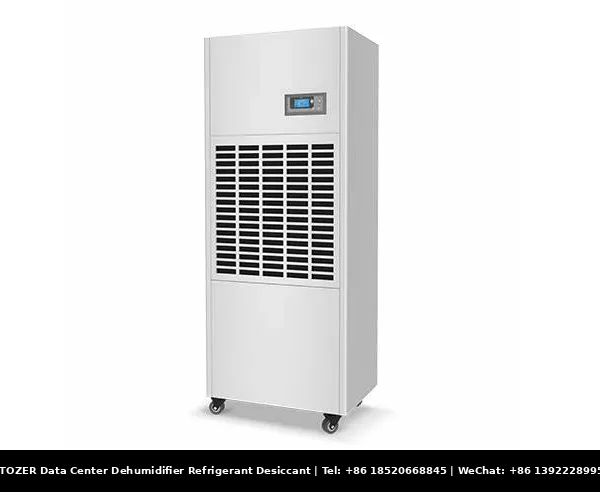
A data center dehumidifier is a specialized environmental control device designed to maintain relative humidity (RH) within the optimal range of 40% to 60% in data centers, computer rooms, telecommunications switching centers, financial transaction rooms, and other mission-critical facilities housing sensitive electronic equipment. Excess humidity causes corrosion, condensation, electrical leakage, and mold growth; insufficient humidity causes electrostatic discharge (ESD), which can instantly destroy semiconductors and corrupt data. The KITOZER dehumidifier series provides precise, reliable humidity removal using two proven technologies: refrigerant (compression-cycle) dehumidification and desiccant rotor (adsorption) dehumidification.
The KITOZER product line covers dehumidification capacities from 20 liters/day to 2000 liters/day (8 to 85 pints/hour), serving rooms from 20 m² to 5000 m². All units feature microprocessor control with ±3% RH accuracy, RS485 Modbus RTU and BACnet MS/TP communication, automatic defrost, continuous drainage, and a 7-inch color touchscreen. KITOZER dehumidifiers are engineered for 24/7/365 operation in demanding data center environments, backed by a 24-month warranty and 10-15 year design life.
2. Why Dehumidification Matters in Data Centers
Data centers house thousands of servers, storage arrays, network switches, and power distribution units. These devices contain microelectronics with feature sizes measured in nanometers. Even microscopic water droplets can cause catastrophic failures. The American Society of Heating, Refrigerating and Air-Conditioning Engineers (ASHRAE) recommends data center relative humidity be maintained at 40-60% RH, with a dew point of 5.5-15°C. Below 40% RH, static electricity becomes a serious hazard: a person walking across a carpet can generate 10,000-30,000 volts, enough to destroy MOSFET gates, flip memory bits, and cause intermittent errors. Above 60% RH, moisture accelerates metal corrosion on PCB traces, connector pins, and relay contacts. Condensation on cold surfaces (such as server racks in cold aisles) can short-circuit power supplies and cause fires.
Beyond equipment reliability, humidity control affects personnel safety, tape media longevity (for backup libraries), paper documentation preservation, and compliance with regulatory standards such as TIA-942, Uptime Institute Tier classifications, and ISO 27001. A properly sized and maintained dehumidification system reduces unplanned downtime, extends equipment life by 20-30%, and lowers insurance premiums.
KITOZER dehumidifiers address these risks with precision humidity sensors, redundant control logic, and continuous remote monitoring via BMS integration. Whether deployed as standalone units or integrated into CRAC/AHU systems, KITOZER units deliver the stable, controlled environment that data center operations demand.
3. Development History of Dehumidification Technology
The concept of removing moisture from air dates to ancient civilizations, who used salt and silica gels to dry stored grain. Modern mechanical dehumidification emerged in the early 20th century. The first refrigerant dehumidifier was patented in 1930 by the American engineer Donald Burns, who adapted refrigeration cycle technology to dehumidify industrial spaces. By the 1950s, refrigerant dehumidifiers were widely used in warehouses, libraries, and textile mills.
Desiccant dehumidification followed in the 1940s, when aerospace engineers needed ultra-dry air for aircraft avionics testing. The first silica gel rotor was developed in Germany during World War II. In the 1960s, molecular sieves and activated alumina improved desiccant performance. The 1970s oil crisis drove demand for energy-efficient dehumidifiers, leading to heat-recovery desiccant rotors and variable-speed compressors.
The data center dehumidification market emerged in the 1980s with the rise of mainframe computers. Early data centers used building HVAC with reheat coils for humidity control. By the 1990s, dedicated outdoor air systems (DOAS) and integrated CRAC units with humidification/dehumidification coils became standard. The 2000s brought electronic expansion valves, inverter compressors, and BACnet integration. Today, KITOZER and leading manufacturers offer IoT-connected, AI-optimized dehumidifiers that predict load based on weather forecasts, server utilization, and occupancy patterns.
4. Working Principle: Refrigerant Dehumidification
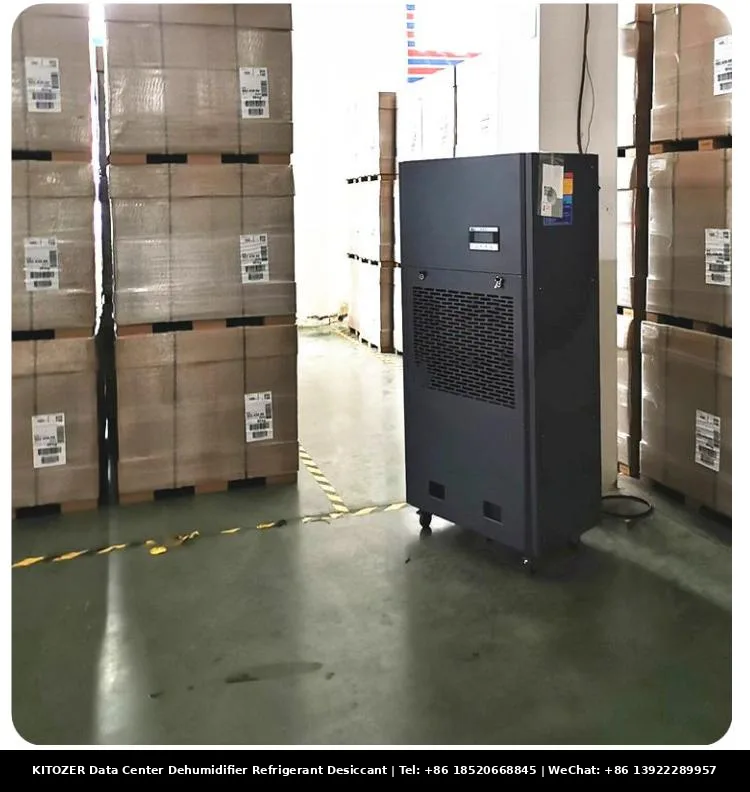
Refrigerant dehumidifiers operate on the vapor-compression cycle, the same principle as air conditioners. The process involves four stages: evaporation, compression, condensation, and expansion. Warm, moist room air is drawn into the unit by a centrifugal blower and passes over the evaporator coil, which is cooled by circulating refrigerant (typically R410A or R32). Because the evaporator surface temperature is below the air’s dew point, water vapor condenses into liquid droplets that drip into a collection tray and drain away. The now-dry air then passes over the condenser coil, where it is reheated by the hot refrigerant vapor before being discharged back into the room.
The refrigerant cycle works as follows: low-pressure, low-temperature liquid refrigerant enters the evaporator, absorbs heat from the air, and evaporates into gas. The compressor raises the pressure and temperature of this gas. The hot, high-pressure gas flows through the condenser, releasing heat to the dry air stream and condensing back into liquid. The liquid passes through an expansion valve, which drops its pressure and temperature before it re-enters the evaporator. This cycle repeats continuously.
Key performance parameters include: moisture removal rate (measured at 27°C/60% RH), energy efficiency ratio (L/kWh), air volume (m³/h), and operating temperature range (typically 5-38°C). Refrigerant dehumidifiers are most effective at temperatures above 15°C and humidity above 50% RH. At temperatures below 10°C, frost forms on the evaporator, requiring automatic defrost cycles that temporarily interrupt dehumidification.
5. Working Principle: Desiccant Rotor Dehumidification
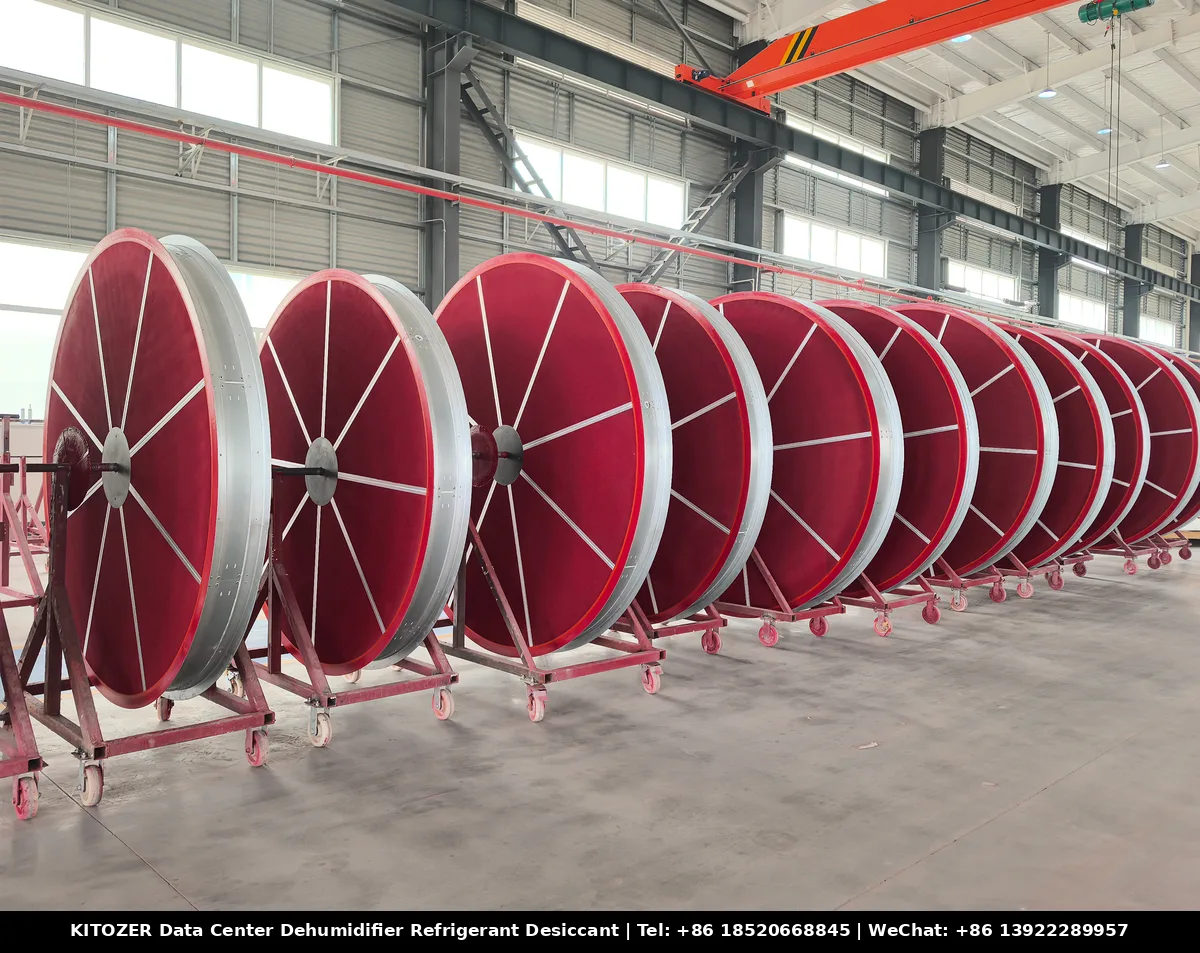
Desiccant dehumidifiers use adsorption rather than condensation. The core component is a slowly rotating rotor (10-20 RPM) coated with a desiccant material—typically silica gel, molecular sieve, or lithium chloride. The rotor is divided into two sections by a radial seal: the process section and the reactivation (regeneration) section.
Process air (moist room air) passes through 70-80% of the rotor’s face area. As it flows through the desiccant matrix, water vapor molecules are adsorbed onto the desiccant surface, leaving the air significantly drier. The dry air is then supplied to the conditioned space. The rotor continuously rotates, carrying adsorbed moisture into the reactivation section.
In the reactivation section (20-30% of rotor area), a separate stream of hot air (100-140°C) is drawn through the rotor in the opposite direction. This hot air drives off the adsorbed moisture, regenerating the desiccant. The humid exhaust air is ducted outside. The rotor returns to the process section, ready to adsorb more moisture.
Desiccant dehumidifiers achieve much lower dew points (-40°C to -60°C) than refrigerant units and operate effectively at temperatures as low as -10°C. They are preferred for applications requiring ultra-dry air, such as lithium battery manufacturing, pharmaceutical packaging, museums with sensitive artifacts, and data centers in humid climates where refrigerant units struggle.
6. Technical Parameters: Refrigerant Series
The KITOZER refrigerant dehumidifier series (KH-R model) includes the following models:
| Model | Dehumidification (L/day)* | Airflow (m³/h) | Power (W) | Voltage | Dimensions (W×D×H mm) | Weight (kg) | Room Area (m²) |
|---|---|---|---|---|---|---|---|
| KH-20R | 20 | 300 | 420 | 220V/50Hz | 350×300×580 | 18 | 20-40 |
| KH-40R | 40 | 500 | 780 | 220V/50Hz | 420×350×720 | 28 | 40-80 |
| KH-60R | 60 | 800 | 1100 | 220V/50Hz | 480×400×850 | 38 | 60-120 |
| KH-90R | 90 | 1200 | 1600 | 220V/50Hz | 550×450×950 | 52 | 90-180 |
| KH-138R | 138 | 1800 | 2400 | 220V/50Hz | 620×500×1050 | 68 | 130-250 |
| KH-240R | 240 | 3000 | 4200 | 380V/50Hz | 800×600×1400 | 120 | 250-500 |
| KH-480R | 480 | 6000 | 8000 | 380V/50Hz | 1000×800×1700 | 220 | 500-1000 |
| KH-960R | 960 | 12000 | 16000 | 380V/50Hz | 1400×1000×2000 | 420 | 1000-2500 |
| KH-2000R | 2000 | 24000 | 32000 | 380V/50Hz | 2000×1200×2200 | 780 | 2500-5000 |
*Measured at 30°C/80% RH. At 27°C/60% RH, capacity is approximately 55-60% of rated value.
Common specifications across all models: humidity settable 20-90% RH in 1% increments; sensor accuracy ±3% RH; operating temperature 5-38°C; refrigerant R410A (R32 optional); compressor brand: Panasonic/GMCC; air filter: washable G4; drainage: gravity or peristaltic pump (6m lift); communication: RS485 Modbus RTU (BACnet MS/TP optional); display: 7-inch color touchscreen; sound pressure 45-65 dB(A) depending on model; protection IPX4; finish: powder-coated steel, RAL7035 gray standard (custom colors available).
7. Technical Parameters: Desiccant Series
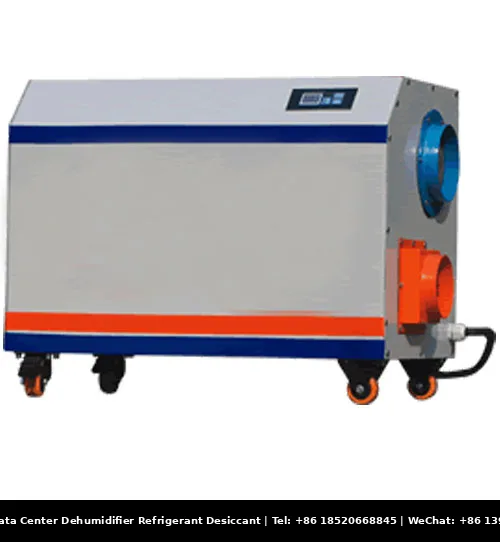
The KITOZER desiccant rotor dehumidifier series (KH-D model) is designed for low-dewpoint applications:
| Model | Process Air (m³/h) | Reactivation Air (m³/h) | Moisture Removal (kg/h) | Dew Point Achieved | Power (kW) | Voltage | Dimensions (mm) | Weight (kg) |
|---|---|---|---|---|---|---|---|---|
| KH-300D | 300 | 90 | 1.5 | -20°C | 3.5 | 220V | 900×700×1300 | 120 |
| KH-600D | 600 | 180 | 3.0 | -30°C | 6.5 | 220V | 1100×800×1500 | 180 |
| KH-1000D | 1000 | 300 | 5.5 | -40°C | 10.0 | 380V | 1300×900×1700 | 260 |
| KH-2000D | 2000 | 600 | 11.0 | -40°C | 18.0 | 380V | 1600×1100×2000 | 420 |
| KH-4000D | 4000 | 1200 | 22.0 | -50°C | 32.0 | 380V | 2000×1300×2200 | 680 |
| KH-8000D | 8000 | 2400 | 45.0 | -50°C | 60.0 | 380V | 2600×1500×2400 | 1100 |
| KH-15000D | 15000 | 4500 | 85.0 | -60°C | 110.0 | 380V | 3400×1800×2600 | 1800 |
Desiccant rotor: silica gel molecular sieve composite, aluminum honeycomb substrate; rotor speed 10-20 RPM adjustable; reactivation heater: electric (steam/hot water optional); process fan: EC or AC centrifugal; reactivation fan: AC centrifugal; filters: G4 pre-filter + F8 final filter; control: PLC with 10-inch HMI; communication: Modbus TCP/IP, BACnet/IP; enclosure: galvanized steel with polyester powder coating; sound level 60-75 dB(A).
8. Classification and Selection Guide
Choosing the right dehumidifier for a data center requires careful analysis of several factors. KITOZER engineers follow a structured selection process to ensure optimal performance and energy efficiency.
8.1 Refrigerant vs. Desiccant: When to Choose Which
Choose refrigerant dehumidification when: room temperature is 15-35°C; target RH is 40-60%; relative humidity rarely exceeds 80%; budget is limited; energy efficiency is a priority; the application is a standard server room, network closet, or control room. Refrigerant units are cheaper to purchase and operate, and they double as supplemental cooling.
Choose desiccant dehumidification when: room temperature is below 15°C or above 35°C; target dew point is below -20°C; the space requires RH below 30%; the climate is extremely humid (tropical, coastal); the application involves sensitive materials (lithium batteries, pharmaceuticals, archival paper). Desiccant units achieve deeper drying but cost more to purchase and operate due to reactivation heat.
8.2 Sizing Calculation
Dehumidification load is calculated using the following formula:
W = ρ × V × (X₁ – X₂) × n
Where W = moisture to remove (kg/h); ρ = air density (1.2 kg/m³); V = room volume (m³/hour air change, typically 3-6 air changes per hour for data centers); X₁ = incoming air humidity ratio (kg/kg dry air); X₂ = desired supply air humidity ratio; n = safety factor (1.2-1.5 for data centers).
Example: A 200 m² data center with 3m ceiling (600 m³ volume), 4 air changes/hour = 2400 m³/h. Incoming air at 30°C/80% RH has X₁ = 0.216 kg/kg. Desired supply at 24°C/50% RH has X₂ = 0.009 kg/kg. Moisture load = 1.2 × 2400 × (0.0216 – 0.009) × 1.3 = 47.3 kg/h = 1135 L/day. Select KH-960R (960 L/day) plus a standby unit, or two KH-480R units (N+1 redundancy).
8.3 Additional Selection Criteria
Beyond capacity, consider: power availability (220V single-phase vs. 380V three-phase); drainage options (gravity floor drain vs. condensate pump); noise constraints (data center offices may require <50 dB(A)); footprint (some rooms have limited floor space); ducting requirements (ducted units for concealed installation); BMS integration protocol (Modbus vs. BACnet); and redundancy requirement (N or N+1 for mission-critical data centers).
9. Installation Guide
Proper installation is critical for dehumidifier performance and longevity. KITOZER provides detailed installation manuals and on-site supervision services. The following steps outline the standard installation procedure for floor-standing refrigerant dehumidifiers.
9.1 Site Preparation
Select a location with adequate clearance: 500mm on the air intake side, 300mm on the discharge side, and 800mm for service access. Ensure the floor is level, capable of supporting the unit’s weight plus a full water tank, and has a floor drain or condensate pump connection. Avoid locations near heat sources, direct sunlight, or blocked airflow. The room should be well-sealed to prevent uncontrolled humid air infiltration.
9.2 Unboxing and Positioning
Unpack the unit and inspect for shipping damage. Remove all packaging materials, protective film, and foam blocks. Position the unit on the floor using a pallet jack or forklift (for units over 100kg). Adjust the leveling feet until the unit is plumb and level—use a spirit level on top of the cabinet. For caster-mounted units, lock the casters after positioning.
9.3 Electrical Connection
Run a dedicated electrical circuit from the distribution panel to the unit. Use appropriately sized copper wire: 1.5mm² for up to 1kW, 2.5mm² for 1-3kW, 4mm² for 3-6kW, 6mm² for 6-10kW, 10mm² for 10-20kW, 16mm² for 20-40kW. Install a residual current device (RCD) and overcurrent protection in the panel. Connect L, N, and PE per the wiring diagram inside the unit’s electrical compartment. Tighten all terminals to specified torque. Do not share the circuit with other equipment.
9.4 Drainage Connection
Connect a flexible drain hose (ID 16mm) from the unit’s drain outlet to the floor drain. Ensure the hose slopes downward at least 1% and has no kinks or loops. For installations above a floor drain, install the optional condensate pump kit (6m lift). Test the drain by pouring a liter of water into the collection tray and verifying it flows freely to the drain.
9.5 Ducting (Ducted Models)
For ducted desiccant units, connect insulated ductwork (50mm fiberglass insulation with aluminum foil vapor barrier) to the process air supply, process air return, reactivation air intake, and reactivation exhaust. Size ducts for 3-5 m/s air velocity. Seal all joints with aluminum tape. The reactivation exhaust must be ducted outdoors—never discharge into the room, as it carries hot, humid air.
9.6 BMS Integration
For RS485 Modbus: run a shielded twisted pair (Belden 3105A or equivalent) from the unit’s terminal block to the BMS gateway. Use daisy-chain topology, not star. Terminate the far end with 120Ω. Set the Modbus address (1-247), baud rate (9600/19200), and parity (8N1) on the unit’s touchscreen. For BACnet MS/TP, configure MAC address and baud rate accordingly. Verify communication by reading the unit’s status registers from the BMS.
10. Commissioning and Startup
After installation, the dehumidifier must be commissioned by a qualified technician. The commissioning procedure verifies correct installation, calibrates sensors, and configures control parameters. KITOZER provides remote commissioning support via video call and on-site commissioning as a paid service.
10.1 Pre-Startup Checklist
Before energizing the unit, verify: electrical connections tight and correct voltage; drain hose connected and flowing; air filters installed correctly; intake and discharge grilles unobstructed; room doors and windows closed; BMS communication wired and terminated; condensate pump (if installed) primed; rotor drive belt (desiccant models) tensioned correctly.
10.2 Power-On Procedure
Turn on the main circuit breaker. The unit’s control panel illuminates and runs a self-test. After 10 seconds, the blower starts. Check blower rotation—air should discharge from the outlet. For refrigerant units, wait 3 minutes (compressor time-delay protection) before the compressor starts. Listen for unusual noises (rattling, grinding, hissing). For desiccant units, the rotor begins rotating and the reactivation heater energizes. Verify rotor rotation direction and heater temperature rise (reactivation air should reach 100-130°C within 10 minutes).
10.3 Sensor Calibration
The humidity sensor should be calibrated against a reference hygrometer. KITOZER sensors are factory-calibrated, but field calibration is recommended annually. To calibrate: place the reference hygrometer next to the unit’s sensor, wait 30 minutes for stabilization, then enter the calibration offset on the touchscreen (adjust ±5% RH in 1% increments). Temperature sensor calibration follows the same procedure using a reference thermometer.
10.4 Control Configuration
Set the humidity setpoint (e.g., 50% RH), hysteresis (±3% RH), defrost threshold (for refrigerant units, 8°C evaporator temperature), and operating schedule (24/7 or timed). Enable BMS communication and confirm the BMS can read status and write setpoints. Configure alarm thresholds: high humidity (>65%), low humidity (<35%), high discharge temperature (>45°C), drain blockage, and compressor fault.
10.5 Performance Verification
Run the unit for 4 hours under load. Measure: room RH before and after; air temperature at intake and discharge; drain water collection rate (compare to rated capacity); power consumption (compare to nameplate); noise level at 1m distance. Record all readings in the commissioning report. Adjust sizing or setpoints as needed.
11. Routine Maintenance
Regular maintenance ensures the dehumidifier operates at peak efficiency and extends service life. KITOZER recommends the following maintenance schedule.
11.1 Weekly Tasks
Visually inspect the unit: check for unusual noises, water leaks, or frost on the evaporator. Verify the drain hose flows freely. Check the display for active alarms. Record running hours and room humidity readings for trend analysis.
11.2 Monthly Tasks
Clean the air filter: remove the filter from the intake grille, rinse with warm water and mild detergent, allow to dry completely, then reinstall. A clogged filter reduces airflow by 30-50% and dramatically decreases dehumidification. Inspect the condensate collection tray and drain for algae or sludge growth. Clean with a 10% bleach solution if needed.
11.3 Quarterly Tasks
Check refrigerant pressure (for refrigerant units): discharge pressure should be 1.5-2.5 MPa, suction pressure 0.4-0.6 MPa. Readings outside these ranges indicate refrigerant leak or overcharge. Inspect electrical connections for tightness and signs of overheating. Test the condensate pump float switch by lifting it manually—the pump should start. For desiccant units, inspect the rotor visually through access ports for dust accumulation or damage. Check the reactivation heater amperage against nameplate.
11.4 Annual Tasks
Comprehensive annual maintenance includes: replacing the air filter (even if cleaned); calibrating humidity and temperature sensors; checking refrigerant charge and adding if necessary; inspecting and lubricating the blower motor bearings (if equipped); tightening all electrical terminals; inspecting the desiccant rotor for aging (replace every 3-5 years); testing all alarm functions; and updating the control firmware to the latest version. KITOZER offers annual maintenance contracts covering all tasks.
11.5 Long-Term Maintenance (5+ Years)
After 5 years: replace the compressor contactor; inspect refrigerant lines for oil stains (indicating leaks); replace the desiccant rotor if dew point performance has degraded; inspect the electrical control board for capacitor bulging or corrosion; and replace the drain pump if discharge pressure has dropped. KITOZER provides long-term spare parts availability for 10 years after model discontinuation.
12. Common Faults and Troubleshooting (FAQ Part 1)
Q1: The dehumidifier runs but does not remove moisture. What is wrong?
A: Check: (1) Is the humidity setpoint lower than the current room RH? If setpoint is 60% and room is 55%, the unit will not run. (2) Is the air filter clogged? Clean or replace. (3) Is the evaporator frosted? The unit may be in defrost cycle—wait 10 minutes. (4) Is the refrigerant low? Check suction pressure. (5) Is the blower spinning? Check blower capacitor.
Q2: Water leaks from the unit.
A: Check: (1) Is the drain hose kinked or blocked? (2) Is the collection tray level? (3) Is the drain pump working? (4) Is the unit level? (5) Is the overflow sensor triggering? Clean the tray and hose, verify drainage.
Q3: The unit makes loud rattling noises.
A: Loose blower wheel, loose compressor mounting bolts, or debris in the blower housing. Turn off power, remove the top panel, inspect the blower wheel and compressor mounts. Tighten bolts, remove debris.
Q4: Humidity fluctuates widely (±10% RH).
A: Hysteresis too wide—reduce to ±3% RH. Sensor poorly located—move sensor away from discharge air. Room has large humidity swings—consider larger unit or multiple smaller units. BMS setpoint conflicts—ensure only one control source.
Q5: The compressor short-cycles (starts and stops every 2 minutes).
A: Defrost thermostat stuck, low refrigerant charge, or faulty pressure switch. Check evaporator temperature sensor. Measure refrigerant pressures. Test pressure switch continuity.
Q6: The display shows “E1” error.
A: Humidity sensor failure. Check sensor wiring connections. If wiring is intact, replace the sensor (KITOZER part number KH-SENSOR-RH).
Q7: The display shows “E2” error.
A: Temperature sensor failure. Check wiring. Replace temperature sensor.
Q8: The display shows “E3” error.
A: Drain blockage or overflow. Check drain hose, collection tray, and float switch. Clean as needed.
Q9: The display shows “E4” error.
A: High-pressure switch tripped. Causes: dirty condenser, blocked airflow, overcharge, or failed condenser fan. Clean condenser, check fan, measure discharge pressure.
Q10: The display shows “E5” error.
A: Low-pressure switch tripped. Causes: refrigerant leak, frozen evaporator, or failed expansion valve. Check suction pressure, inspect for leaks, inspect evaporator frost.
Q11: The desiccant rotor does not turn.
A: Check rotor drive motor power, drive belt tension, and rotor shaft for binding. Replace belt if cracked. Lubricate shaft bearings. Test motor continuity.
Q12: The reactivation heater does not heat.
A: Check heater circuit breaker, heater element continuity, and temperature limit switch. Replace heater element if open. Reset limit switch (manual reset behind heater access panel).
Q13: The room is too cold after running the dehumidifier.
A: Refrigerant dehumidifiers reheat the discharge air by 2-5°C. If the room is cold, the unit may be undersized or the heater is not working. Check discharge air temperature—should be 2-5°C warmer than intake. If not, the condenser bypass may be stuck open.
Q14: BMS cannot read the unit.
A: Verify: Modbus address matches BMS configuration; baud rate and parity match; wiring polarity (A/B) correct; 120Ω termination at far end; no shield grounding at both ends. Use a Modbus scanner to verify communication.
Q15: The unit trips the circuit breaker.
A: Short circuit, compressor locked rotor, or insulation failure. Disconnect the compressor and test the circuit—if it holds, the compressor is faulty. Check blower motor. Inspect wiring for damage.
13. Applications in Data Centers
KITOZER dehumidifiers serve a wide range of data center environments. Each application has unique humidity control requirements, and KITOZER provides tailored solutions.
13.1 Enterprise Data Centers (500-2000 m²)
Mid-sized enterprise data centers housing 500-2000 servers require continuous humidity control at 45-55% RH. KITOZER recommends N+1 redundancy with two or more KH-480R or KH-960R units, staged by BMS to maintain humidity. The units integrate with the CRAC system to provide supplemental dehumidification during humid summer months.
13.2 Colocation Data Centers
Colocation facilities with multi-tenant cages require zoned humidity control. KITOZER distributed dehumidifiers installed in each zone allow independent control, preventing cross-tenant humidity conflicts. BMS integration provides centralized monitoring for facility managers.
13.3 Edge Computing Nodes
Edge computing nodes in retail stores, telecom base stations, and remote locations have limited space and power. KITOZER compact models KH-20R and KH-40R fit in small closets, operate on 220V, and support remote monitoring via 4G/LTE modules. These units run unattended for months with automatic alerts.
13.4 Hyperscale Data Centers
Hyperscale facilities (5000+ m²) use central plant systems with dedicated outdoor air systems (DOAS) incorporating KITOZER desiccant wheels. The KH-8000D and KH-15000D units handle massive airflow, maintaining supply air dew point below 10°C. Heat recovery from reactivation exhaust reduces energy use by 30%.
13.5 Modular/Container Data Centers
Containerized data centers require compact, vibration-resistant dehumidifiers. KITOZER offers custom rack-mounted dehumidifiers that fit in standard 19-inch racks, consuming only 1U of space. These units integrate with the container’s CRAC and power distribution systems.
13.6 Financial Trading Rooms
Trading rooms with hundreds of monitors and workstations require stable humidity to prevent ESD that could disrupt trading operations. KITOZER dehumidifiers maintain 45-55% RH with ±2% stability, backed by N+1 redundancy and 24/7 remote monitoring.
14. Applications Beyond Data Centers
14.1 Telecommunications Switching Centers
Telecom switching offices house sensitive switching equipment that requires 40-60% RH. KITOZER dehumidifiers have been deployed in hundreds of telecom sites across China, supporting 5G base station controllers, core routers, and fiber optic distribution frames. Remote monitoring via the telecom’s own SCADA system ensures rapid response to humidity deviations.
14.2 Museums and Archives
Museums and archives require RH control at 45-55% with seasonal variation limited to ±5%. KITOZER desiccant dehumidifiers, combined with humidifiers, provide precise year-round control. For paper archives, RH below 45% causes paper embrittlement; above 60% causes mold. KITOZER’s ±3% accuracy protects valuable collections.
14.3 Pharmaceutical Manufacturing
Pharmaceutical cleanrooms require RH control at 30-45% depending on the product. KITOZER desiccant dehumidifiers achieve the low dew points needed for tablet coating, capsule filling, and lyophilization processes. The units are integrated into the HVAC system with HEPA filtration, meeting GMP requirements.
14.4 Lithium Battery Manufacturing
Lithium battery production requires ultra-dry environments: electrode coating rooms at <1% RH, assembly rooms at dew point <-40°C. KITOZER KH-4000D and KH-8000D desiccant systems provide the deep drying needed, with redundant rotors and heat recovery for energy efficiency.
14.5 Food Processing and Packaging
Food processing areas require controlled humidity to prevent spoilage and ensure packaging integrity. KITOZER refrigerant dehumidifiers maintain 50-60% RH in processing areas and 30-40% RH in packaging areas, preventing moisture-related product defects.
14.6 Printing and Paper Converting
Print shops require 45-55% RH to prevent paper curl and ink drying issues. KITOZER dehumidifiers maintain stable humidity, reducing paper waste by 15-20% and improving print quality.
14.7 Electronics Manufacturing (SMT Lines)
SMT assembly lines require 40-60% RH with ESD protection. KITOZER dehumidifiers work alongside ESD flooring and grounding systems to protect sensitive components during assembly.
15. Reference Pricing
KITOZER dehumidifier pricing varies by model, configuration, and quantity. The following reference prices are indicative for standard configurations:
| Model | Capacity | Reference Price (RMB) | Reference Price (USD) | Lead Time |
|---|---|---|---|---|
| KH-20R | 20 L/day | ¥2,800 | ~$390 | 7 days |
| KH-40R | 40 L/day | ¥4,500 | ~$630 | 7 days |
| KH-60R | 60 L/day | ¥6,800 | ~$950 | 10 days |
| KH-90R | 90 L/day | ¥9,500 | ~$1,330 | 10 days |
| KH-138R | 138 L/day | ¥13,500 | ~$1,890 | 14 days |
| KH-240R | 240 L/day | ¥22,000 | ~$3,080 | 14 days |
| KH-480R | 480 L/day | ¥42,000 | ~$5,880 | 21 days |
| KH-960R | 960 L/day | ¥78,000 | ~$10,900 | 30 days |
| KH-2000R | 2000 L/day | ¥150,000 | ~$21,000 | 45 days |
| KH-300D | 300 m³/h desiccant | ¥28,000 | ~$3,920 | 21 days |
| KH-600D | 600 m³/h desiccant | ¥48,000 | ~$6,720 | 30 days |
| KH-1000D | 1000 m³/h desiccant | ¥78,000 | ~$10,900 | 30 days |
| KH-2000D | 2000 m³/h desiccant | ¥135,000 | ~$18,900 | 45 days |
| KH-4000D | 4000 m³/h desiccant | ¥240,000 | ~$33,600 | 60 days |
| KH-8000D | 8000 m³/h desiccant | ¥420,000 | ~$58,800 | 75 days |
*Prices are reference only. Actual pricing depends on configuration, customization, quantity, and shipping. Contact KITOZER sales for a formal quotation. USD prices are approximate at 7.1 RMB/USD.
Optional add-ons and their indicative prices: condensate pump kit ¥800; BACnet MS/TP card ¥2,500; 4G LTE remote monitoring module ¥1,800; wall-mount bracket ¥600; stainless steel cabinet (outdoor) ¥8,000-25,000; extended 5-year warranty ¥3,000-15,000 depending on model.
16. Detailed FAQ (Questions 16-40)
Q16: How much electricity does a dehumidifier use per day?
A: A typical KH-138R (2400W) running 12 hours/day consumes 28.8 kWh/day. At ¥0.8/kWh, that is ¥23/day or ¥700/month. Inverter models consume 30-40% less by modulating compressor speed.
Q17: Can I use an air conditioner as a dehumidifier?
A: Air conditioners dehumidify as a byproduct of cooling, but they do not control humidity precisely. They cool the room while dehumidifying, which may overcool data centers. Dedicated dehumidifiers maintain humidity without excessive cooling, and they reheat discharge air.
Q18: What size dehumidifier do I need for a 100 m² room?
A: For a 100 m², 3m ceiling data center in a humid climate, select approximately 60-90 L/day (KH-60R or KH-90R). In dry climates, half that capacity suffices. Always calculate based on actual moisture load, not just room area.
Q19: How often should I empty the water tank?
A: KITOZER commercial models use continuous drainage rather than tanks. The built-in condensate pump or gravity drain directs water to a floor drain. No manual emptying is needed.
Q20: Can dehumidifiers run 24/7?
A: Yes. KITOZER dehumidifiers are engineered for continuous 24/7 operation. The control system cycles the compressor on/off based on humidity demand, while the blower runs continuously. Average compressor runtime is 50-70% depending on humidity load.
Q21: What is the difference between 20L/day and 50L/day ratings?
A: Ratings are measured at specific conditions (usually 30°C/80% RH or 27°C/60% RH). A unit rated 50L/day at 30°C/80% RH may deliver only 25-30L/day at 27°C/60% RH. Always compare ratings at the same test conditions.
Q22: Does the dehumidifier add heat to the room?
A: Yes. A refrigerant dehumidifier rejects heat equal to its power input (e.g., 2.4 kW for KH-138R). This heat is partly from the moisture condensation (latent heat) and partly from compressor work. In data centers, this heat adds to the cooling load and must be accounted for in CRAC sizing.
Q23: Can I install the dehumidifier in a ceiling plenum?
A: Yes, but only for ducted models. Ceiling-mounted units require structural support for 150-500kg weight, duct connections, and remote access for maintenance. KITOZER offers suspended-mount kits for KH-240R and smaller.
Q24: What is the noise level?
A: KH-20R: 45 dB(A); KH-60R: 50 dB(A); KH-138R: 55 dB(A); KH-480R: 62 dB(A); KH-960R: 68 dB(A). For noise-sensitive areas, select a smaller unit with ducted installation, or add acoustic enclosures.
Q25: How long does a dehumidifier last?
A: KITOZER units have a design life of 10-15 years with proper maintenance. The compressor typically lasts 8-10 years; the desiccant rotor 3-5 years before replacement. Electronic controls last 10+ years.
Q26: What refrigerant do KITOZER units use?
A: Standard models use R410A. R32 is available as an option (lower GWP, slightly higher efficiency). Desiccant models have no refrigerant. KITOZER is transitioning to R32 and R290 as regulations require.
Q27: Can dehumidifiers remove mold?
A: Dehumidifiers prevent mold growth by keeping RH below 60%, but they do not remove existing mold. Existing mold must be physically cleaned and the moisture source eliminated. KITOZER dehumidifiers then maintain conditions to prevent recurrence.
Q28: What is the warranty?
A: Standard warranty is 24 months from delivery. Compressor warranty is 5 years. Extended warranties of 3, 5, or 10 years are available. KITOZER provides 4-hour response in the Guangzhou metro area and 24-hour nationwide.
Q29: Can I monitor the dehumidifier from my phone?
A: Yes. KITOZER offers a free web-based monitoring portal accessible from any browser. The optional 4G LTE module provides remote access without local network. Push notifications are sent via email.
Q30: What happens during a power outage?
A: The unit stops. When power returns, it automatically restarts (if configured) and resumes the previous settings. For critical applications, connect the unit to UPS power. Note: the dehumidifier compressor has a 3-minute restart delay to protect the compressor.
Q31: Can the dehumidifier be controlled by a BMS?
A: Yes. All KITOZER units support Modbus RTU (RS485) as standard. BACnet MS/TP or BACnet/IP is optional. The BMS can read: current RH, temperature, running status, alarm code, and setpoint. The BMS can write: RH setpoint, on/off command, and alarm thresholds.
Q32: What is the difference between pool dehumidifiers and industrial units?
A: Pool dehumidifiers are built with corrosion-resistant materials (stainless steel, epoxy coating) to resist chlorine and high humidity. Industrial units use standard galvanized steel. KITOZER offers both variants.
Q33: Can I use a dehumidifier in a cold room?
A: Refrigerant dehumidifiers work down to 5°C with defrost cycles. Below 5°C, use a desiccant dehumidifier, which operates effectively at -10°C and below.
Q34: How do I calculate dehumidification capacity?
A: Calculate the moisture balance: moisture entering (infiltration, occupants, processes) minus moisture removed (dehumidifier). The dehumidifier capacity must exceed the maximum moisture load by 20-30%. KITOZER provides free load calculation services.
Q35: What maintenance does the desiccant rotor need?
A: The rotor needs no lubrication and minimal maintenance. Inspect annually for dust accumulation; vacuum the rotor surface if dirty. Replace the rotor every 3-5 years when dew point performance drops below specification.
Q36: Can I add a humidifier and dehumidifier together?
A: Yes. In dry winter months, a humidifier adds moisture; in humid summer months, the dehumidifier removes it. Both units are controlled by the BMS with interlock logic: when the humidifier is on, the dehumidifier is off, and vice versa, preventing simultaneous opposing operation.
Q37: What is the maximum hose length for drainage?
A: Gravity drain: maximum 5 meters horizontal, must slope downward. With condensate pump: up to 6 meters vertical lift and 20 meters horizontal. Use ID 16mm flexible hose.
Q38: Can the dehumidifier be wall-mounted?
A: KH-20R and KH-40R offer wall-mount kits. Larger units are floor-standing due to weight. Wall mounting saves floor space in small server closets.
Q39: What is the difference between ECM and AC blowers?
A: ECM (electronically commutated motor) blowers are 30-40% more efficient, allow variable speed, and are quieter. AC blowers are cheaper but fixed-speed and less efficient. KITOZER offers ECM as an option on models above KH-90R.
Q40: How do I know if my dehumidifier is undersized?
A: Signs: the compressor runs continuously (24/7) but the room never reaches the setpoint; water drainage is less than rated capacity; humidity stays above the setpoint by 10% or more. If undersized, add another unit or upgrade to a larger model.
17. Detailed FAQ (Questions 41-60)
Q41: What is the ideal humidity for a server room?
A: ASHRAE recommends 40-60% RH, with a dew point of 5.5-15°C. KITOZER recommends 45-55% RH as the optimal setpoint, balancing ESD protection and corrosion prevention.
Q42: Can high humidity damage servers?
A: Yes. Above 60% RH, moisture condenses on cold surfaces, corrodes PCB traces, causes metal whiskers, and can lead to electrical shorts. High humidity also promotes mold growth on filters and insulation.
Q43: Can low humidity damage servers?
A: Below 30% RH, ESD becomes a major hazard. Static discharges of 10,000+ volts can damage semiconductors, cause bit errors, and degrade long-term reliability. Personnel also experience discomfort.
Q44: What is the difference between dew point and relative humidity?
A: Relative humidity is the percentage of moisture in air compared to maximum at that temperature. Dew point is the temperature at which air becomes saturated and condensation begins. Dew point is more stable for controlling condensation risk.
Q45: How does a desiccant rotor work in simple terms?
A: Imagine a sponge wheel: one side absorbs water from humid air; the other side heats up and squeezes the water out. The wheel slowly rotates, so it continuously absorbs and regenerates.
Q46: Is desiccant dehumidification expensive to run?
A: The reactivation heater consumes significant energy (3-110 kW depending on model). However, desiccant units avoid the energy cost of overcooling and reheating, and heat recovery systems can reduce energy by 30%. For deep-dry applications, desiccant is the only option.
Q47: Can I use a dehumidifier with solar power?
A: Yes. Small models (KH-20R, KH-40R) can run on solar with battery backup. For larger units, KITOZER recommends a hybrid solar-grid system. The 4G monitoring module draws only 5W and can run continuously on solar.
Q48: What certifications do KITOZER dehumidifiers have?
A: CE, RoHS, ISO 9001:2015, CCC (China Compulsory Certificate). Test reports available on request.
Q49: Can KITOZER customize the cabinet color?
A: Yes. Standard color is RAL7035 light gray. Custom colors (any RAL) are available at +5% cost. Logo printing is included free.
Q50: What is the lead time for custom orders?
A: Standard models ship in 7-14 days. Custom configurations (special voltage, ducted, stainless steel) take 30-60 days. Large desiccant systems take 45-90 days.
Q51: How do I clean the evaporator coil?
A: Turn off power. Remove the front panel. Use a soft brush or vacuum with a brush attachment to remove dust from the coil fins. Straighten bent fins with a fin comb. Do not use high-pressure water—this can damage the fins and insulation.
Q52: What causes ice on the evaporator?
A: Low ambient temperature (below 15°C), low refrigerant charge, blocked airflow (dirty filter), or a faulty defrost thermostat. Address the root cause before resuming operation.
Q53: Can I move the dehumidifier between rooms?
A: Yes, if on casters. Drain the water tank, disconnect the drain hose and power cord, then roll to the new location. Reconnect and level before restarting. Allow 30 minutes for the refrigerant to settle before powering on.
Q54: What is the difference between a dehumidistat and a humidistat?
A: They are the same thing—a humidity-controlled switch. “Dehumidistat” controls dehumidifiers; “humidistat” controls humidifiers. KITOZER units use the same sensor with configurable control logic.
Q55: Can I use a dehumidifier with a CRAC unit?
A: Yes. KITOZER dehumidifiers integrate with CRAC systems via BMS. The CRAC handles temperature; the dehumidifier handles humidity. They coordinate to avoid conflicting operation.
Q56: What is the life expectancy of the humidity sensor?
A: 5-8 years. Sensors drift over time and should be calibrated annually. Replace when calibration offset exceeds ±5% RH or when the sensor fails.
Q57: Can dehumidifiers remove smoke odors?
A: No. Dehumidifiers remove water vapor, not smoke particles or odors. For smoke, use HEPA filtration and activated carbon.
Q58: What is the maximum operating altitude?
A: Standard units are rated up to 1000m altitude. Above 1000m, compressor capacity decreases by approximately 4% per 300m. KITOZER offers derated models for high-altitude installations.
Q59: Can I run the dehumidifier without the filter?
A: No. The filter protects the evaporator from dust. Running without the filter causes rapid coil fouling, reduced capacity, and premature compressor failure.
Q60: How do I dispose of an old dehumidifier?
A: Dehumidifiers contain refrigerant and electronic components. Do not discard in general waste. Return to an electronics recycling facility or contact KITOZER for take-back service. KITOZER complies with WEEE regulations.
18. Refrigerant Cycle Deep Dive
Understanding the refrigerant cycle helps operators diagnose problems and optimize performance. The cycle consists of four components working in a closed loop.
18.1 Evaporator
The evaporator is a finned copper tube coil located at the air intake. Refrigerant enters as a cold (5-10°C) low-pressure liquid-gas mixture. As warm, moist air passes over the fins, heat transfers from the air to the refrigerant, causing the refrigerant to boil and evaporate. The evaporator surface temperature (typically 5-12°C) is below the air’s dew point, so water condenses on the fins. The condensate drips into a collection tray. KITOZER uses hydrophilic aluminum fins that promote water runoff and reduce mold growth.
18.2 Compressor
The compressor is the heart of the system, driven by an electric motor. It draws low-pressure, low-temperature refrigerant vapor from the evaporator and compresses it into high-pressure, high-temperature vapor (1.5-2.5 MPa, 70-100°C). KITOZER uses rotary compressors for models up to 138L/day and scroll compressors for larger models. Scroll compressors are quieter (3-5 dB less) and more efficient (5-8% higher EER).
18.3 Condenser
The hot, high-pressure vapor enters the condenser coil, where it releases heat to the dry, dehumidified air stream. As the refrigerant cools, it condenses into a liquid. The condenser is located after the evaporator in the air path, so the dry air absorbs the heat and is reheated before discharge. This reheating prevents cold air from being blown into the room.
18.4 Expansion Device
High-pressure liquid refrigerant passes through an expansion valve (or capillary tube for smaller models), which causes a rapid pressure drop. The refrigerant cools dramatically (down to 5-10°C) and returns to the evaporator to repeat the cycle. Electronic expansion valves (EEVs) on premium models modulate refrigerant flow based on load, improving efficiency by 10-15%.
19. Desiccant Rotor Deep Dive
19.1 Rotor Construction
The desiccant rotor is a honeycomb-structured wheel made of corrugated aluminum foil coated with silica gel or molecular sieve. The honeycomb provides enormous surface area (up to 10,000 m² per m³ of rotor volume) for moisture adsorption. KITOZER uses a composite desiccant: 70% silica gel for high-capacity adsorption at normal humidity, 30% molecular sieve for deep drying at low dew points.
19.2 Process and Reactivation Airflows
The rotor is divided by radial seals into a process sector (75-80% of area) and a reactivation sector (20-25%). Process air enters the process sector and exits dry. Reactivation air (heated to 100-140°C) enters the reactivation sector opposite the process flow, stripping adsorbed moisture and exhausting it outside. The ratio of reactivation air to process air is typically 1:4 to 1:5.
19.3 Rotor Drive
The rotor rotates at 10-20 RPM via a small gear motor and V-belt drive. The rotation speed is critical: too fast and the desiccant doesn’t fully adsorb; too slow and it doesn’t fully regenerate. KITOZER controls the speed via a variable-frequency drive, optimizing for each application.
19.4 Heat Recovery
On larger desiccant systems, a heat exchanger recovers heat from the humid reactivation exhaust to pre-heat the incoming reactivation air. This reduces reactivation energy by 25-35%. Enthalpy wheels and plate heat exchangers are common recovery methods.
20. Control System Architecture
KITOZER dehumidifiers use a microcontroller-based control system with the following architecture:
Sensors: RH sensor (capacitive polymer, ±3% RH), temperature sensor (NTC 10kΩ, ±0.3°C), coil temperature sensor (for defrost), pressure switches (high/low), water level float, door interlock.
Actuators: compressor contactor, blower relay, reactivation heater contactor, defrost solenoid, condensate pump, rotor drive motor, alarm buzzer, LED indicators.
User Interface: 7-inch color touchscreen (HMI), physical buttons for power and emergency stop. The HMI displays: current RH, temperature, running mode, alarm history, energy consumption, and trend graphs (24-hour and 7-day).
Communication: RS485 Modbus RTU (standard), BACnet MS/TP (optional), Ethernet Modbus TCP/IP (optional on desiccant models), 4G LTE (optional). The control system supports up to 32 networked units on a single RS485 bus.
Control Logic: PID control for humidity (proportional band 10% RH, integral time 5 min, derivative time 30 sec). Defrost logic: if evaporator temperature drops below 8°C for 5 minutes, defrost mode activates (compressor off, blower runs on low, hot gas bypass to evaporator). Defrost ends when evaporator reaches 15°C or after 10 minutes.
21. Energy Efficiency and Operating Costs
Energy consumption is a major consideration for data center operators. KITOZER dehumidifiers are designed for high efficiency:
- Inverter compressor technology: On models KH-90R and above, inverter compressors modulate speed based on load, reducing energy use by 30-40% compared to fixed-speed compressors.
- ECM blower motors: Electronically commutated motors are 30% more efficient than shaded-pole or PSC motors.
- Hot gas bypass: During low-load periods, hot gas bypasses the condenser to maintain evaporator temperature without short-cycling the compressor.
- Heat recovery (desiccant): Reactivation exhaust heat recovery reduces heater energy by 25-35%.
- LED lighting and low-voltage controls: Control circuit power consumption is under 20W.
Operating cost example: A KH-480R (8kW) running 12 hours/day in a Shanghai data center. Daily energy: 96 kWh. At commercial rate ¥0.95/kWh: ¥91/day, ¥2,736/month, ¥32,832/year. With inverter drive and heat recovery, annual savings are approximately ¥10,000-12,000.
22. Installation Drawings and Dimensions
KITOZER provides CAD drawings (DWG and PDF) for each model, including:
- Overall dimensions and weight
- Air intake and discharge locations
- Drain connection size and location
- Electrical conduit entry positions
- Minimum clearance requirements (500mm intake, 300mm discharge, 800mm service)
- Piping and ducting connections
For desiccant units, drawings also include: process air inlet/outlet flanges, reactivation air inlet/outlet flanges, electrical control panel access, and rotor access door positions. KITOZER engineering can provide custom layout drawings for project-specific installations.
23. Safety Features
KITOZER dehumidifiers include multiple safety features:
- High-pressure switch: Trips at 3.0 MPa to protect the compressor from overpressure.
- Low-pressure switch: Trips at 0.2 MPa to detect refrigerant loss.
- Overload protection: Compressor motor thermal overload (manual reset).
- Anti-short-cycle: 3-minute minimum off-time between compressor starts.
- Overflow protection: Float switch shuts down the unit if drain is blocked.
- Door interlock: Unit stops when the electrical panel door is opened.
- Ground fault protection: Leakage current detection (RCD).
- Reactivation high-limit thermostat: Cuts heater power if reactivation air exceeds 150°C.
- Rotor overspeed protection: Stops rotor drive if speed exceeds 30 RPM.
- Emergency stop button: Hardware stop (not software) on the control panel.
24. Brand Advantage: Why Choose KITOZER
KITOZER is the industrial product line of Guangzhou Lian Intelligent System Development Co., Ltd., established in 2003. With over 20 years of experience in environmental control systems, KITOZER has delivered thousands of dehumidification solutions to data centers, industrial facilities, and commercial buildings across China and Southeast Asia.
Engineering capability: KITOZER employs 15+ HVAC engineers who provide free load calculations, system design, and on-site supervision. Custom configurations include special voltages, stainless steel construction, explosion-proof variants, and integration with building management systems.
Manufacturing quality: KITOZER products are manufactured in a 5,000 m² factory in Panyu, Guangzhou. Each unit undergoes a 4-hour factory test run, including performance testing, electrical safety testing, and leak testing. Every unit ships with a factory test report.
Service network: KITOZER provides 4-hour on-site response in the Guangzhou metro area, 24-hour response in Guangdong province, and 48-hour nationwide. The spare parts warehouse in Guangzhou stocks common components, ensuring rapid turnaround.
Long-term support: KITOZER maintains spare parts for 10 years after model discontinuation. Firmware updates are free and downloadable. The KITOZER technical team provides phone, WeChat, and remote support 7 days a week.
Competitive pricing: As a direct manufacturer, KITOZER offers factory-direct pricing without intermediary markup. The same-quality products cost 20-30% less than imported brands, with comparable warranty and service.
25. Integration with Building Management Systems
KITOZER dehumidifiers are designed to integrate seamlessly with major BMS platforms including Siemens Desigo, Johnson Controls Metasys, Honeywell EBI, Schneider EcoStruxure, and Delta Controls. The Modbus RTU protocol is universally supported; BACnet is available as an option.
25.1 Data Points Available
Read points: current RH (%), current temperature (°C), compressor status (on/off), blower status, defrost status, heater status (desiccant), alarm code (integer), alarm text, drain status, door status, runtime hours, energy consumption (kWh), supply air temperature, return air temperature, suction pressure, discharge pressure.
Write points: RH setpoint (%), on/off command, mode (auto/manual), defrost enable/disable, alarm thresholds (high/low RH), BMS override, schedule (24/7 or timed).
25.2 Integration Architecture
Typical architecture: KITOZER unit RS485 → Modbus gateway (e.g., Moxa MGate) → BMS controller → BMS server → operator workstations. Up to 32 KITOZER units can share one RS485 bus (maximum 1200m cable length). For BACnet/IP, the unit connects directly to the Ethernet network via an internal gateway module.
25.3 Alarm Management
KITOZER alarms are classified into three levels: Level 1 (warning): high humidity approaching setpoint, filter dirty, sensor drift. Level 2 (alarm): high humidity exceeded, drain blocked, compressor fault. Level 3 (critical): high pressure, low pressure, power loss, fire risk. BMS notifications can be configured per level: Level 1 via log only, Level 2 via email, Level 3 via SMS/phone call.
26. Climate-Specific Considerations
26.1 Humid Coastal Climates (Guangzhou, Shenzhen, Xiamen)
Southern China experiences 80-95% RH for 6-8 months per year. Data centers in these regions require continuous dehumidification from April through October. KITOZER recommends oversizing by 30% and installing N+1 redundancy. Fresh air intake should be minimized, and any outside air must pass through enthalpy recovery wheels.
26.2 Dry Northern Climates (Beijing, Xi’an, Urumqi)
Northern China has low humidity (20-40% RH) for most of the year. Data centers here rarely need dehumidification; instead, they need humidification. However, during summer monsoon months, temporary dehumidification may be needed. KITOZER recommends combined humidifier/dehumidifier units with automatic season switching.
26.3 Cold Climates (Northeast China, Inner Mongolia)
Winter temperatures below -10°C make refrigerant dehumidifiers impractical. KITOZER desiccant dehumidifiers are the only option. The reactivation heat also helps maintain room temperature, reducing heating load.
26.4 High-Humidity Tropical Climates (Hainan, Southeast Asia)
Tropical data centers face year-round high temperature and humidity. KITOZER desiccant systems with heat recovery are recommended, as they handle both high moisture load and low dew point requirements.
27. Project Case Studies
27.1 Case Study: Guangzhou Enterprise Data Center
Project: 800 m² enterprise data center, housing 800 servers.
Challenge: Summer humidity reached 85% RH, causing corrosion on server rack connectors.
Solution: Two KH-480R dehumidifiers (N+1), integrated with existing CRAC units via BMS.
Result: Humidity stabilized at 48-52% RH. Corrosion incidents eliminated. Annual operating cost: ¥35,000.
Timeline: Survey (1 day), design (3 days), installation (2 days), commissioning (1 day). Total: 7 days.
27.2 Case Study: Shanghai Financial Trading Room
Project: 400 m² trading room with 200 workstations.
Challenge: ESD incidents were causing intermittent trading system errors.
Solution: Three KH-138R dehumidifiers maintaining 50% RH ±2%. N+1 redundancy.
Result: Zero ESD incidents in 12 months. Trading system stability improved. Investment payback: 18 months.
27.3 Case Study: Shenzhen Edge Node Network
Project: 50 edge computing nodes across Shenzhen retail locations.
Challenge: Remote locations with no on-site staff; humidity control needed 24/7.
Solution: One KH-40R per node, with 4G LTE remote monitoring. Centralized dashboard in operations center.
Result: All nodes maintained 45-55% RH for 18 months. Only 2 service visits (sensor replacement). Remote monitoring reduced truck rolls by 80%.
27.4 Case Study: Hainan Data Center Desiccant System
Project: 2000 m² hyperscale data center in Haikou.
Challenge: Year-round tropical humidity (80-90% RH, 28-35°C). Refrigerant units could not handle the load.
Solution: Two KH-8000D desiccant systems with heat recovery wheels.
Result: Supply air dew point maintained at 8°C. Heat recovery reduced reactivation energy by 32%. Annual energy savings: ¥180,000.
28. Spare Parts and Consumables List
| Part | Part Number | Replacement Interval | Reference Price |
|---|---|---|---|
| Air filter (G4) | KH-FILTER-G4-S/M/L | 3-6 months | ¥80-200 |
| Humidity sensor | KH-SENSOR-RH | 5-8 years | ¥350 |
| Temperature sensor (NTC) | KH-SENSOR-T-NTC | 5-8 years | ¥80 |
| Condensate pump | KH-PUMP-6M | 3-5 years | ¥850 |
| Blower motor capacitor | KH-CAP-BLOWER | 3-5 years | ¥60 |
| Compressor contactor | KH-CONTACTOR-COMP | 5-7 years | ¥280 |
| Pressure switch (high) | KH-PSW-HP | 7-10 years | ¥220 |
| Pressure switch (low) | KH-PSW-LP | 7-10 years | ¥200 |
| Defrost thermostat | KH-DEFROST-STAT | 5-7 years | ¥120 |
| Desiccant rotor | KH-ROTOR-200/400/600/800/1200 | 3-5 years | ¥5,000-25,000 |
| Reactivation heater element | KH-HEATER-3KW/6KW/12KW | 5-8 years | ¥800-3,500 |
| Rotor drive belt | KH-BELT-ROTOR | 2-3 years | ¥150 |
| Control board | KH-PCB-MAIN | 8-10 years | ¥1,800 |
| Touchscreen HMI | KH-HMI-7 | 8-10 years | ¥2,500 |
| Float switch | KH-FLOAT-DRAIN | 5-7 years | ¥90 |
29. Environmental and Regulatory Compliance
KITOZER dehumidifiers comply with the following standards and regulations:
- GB/T 19412-2003: Dehumidifier performance testing standard
- GB 4706.1-2005: Household and similar electrical appliances safety
- GB 4706.32-2012: Particular requirements for heat pumps, air conditioners, and dehumidifiers
- GB/T 7725-2004: Room air conditioners performance
- CE marking (EU): EMC Directive 2014/30/EU, LVD Directive 2014/35/EU
- RoHS 2: Restriction of Hazardous Substances Directive 2011/65/EU
- WEEE: Waste Electrical and Electronic Equipment Directive
- ISO 9001:2015 Quality Management System
- F-gas Regulation (EU 517/2014): Refrigerant leakage detection and reporting
KITOZER is committed to environmental sustainability. All products use ozone-friendly refrigerants (R410A GWP=2088, transitioning to R32 GWP=675). Packaging is 100% recyclable cardboard. Product take-back and recycling programs are available in all operating regions.
30. Contact Information
KITOZER | Guangzhou Lian Intelligent System Development Co., Ltd.
Address: Chaotian Park, Zhongrun Industrial Park, No. 5 Huashan Road, Shilou, Panyu, Guangzhou, China
Phone: +86 18520668845 | WeChat: +86 13922289957 | WhatsApp: +1 906-853-4140
Websites: lain.com.cn (Chinese) | gdlain.com (English)
Author: KITOZER
Date: October 2026
KITOZER provides free consultation, load calculation, and quotation services. Contact us today to discuss your data center dehumidification requirements. Our engineering team will respond within 24 hours.
31. Humidity and Moisture: Fundamental Science
To understand dehumidification, one must understand the properties of moist air. Moist air is a mixture of dry air and water vapor. The water vapor content can be expressed in several ways: absolute humidity (mass of water vapor per volume of air, g/m³), specific humidity (mass per mass of dry air, g/kg), relative humidity (ratio of actual vapor pressure to saturation vapor pressure at the same temperature, expressed as a percentage), and dew point temperature (the temperature at which air becomes saturated).
Relative humidity is the most commonly used metric in building control, but it is temperature-dependent. The same absolute amount of water vapor yields higher RH at lower temperatures and lower RH at higher temperatures. This is why data centers must control both temperature and humidity: a room at 24°C/50% RH might become 55% RH if the temperature drops to 20°C, even though no moisture was added.
Water enters a data center through several pathways: infiltration through walls and windows (estimated at 0.5-1 air change per hour for a well-sealed building), outside air brought in for ventilation (typically 10-20% of supply air), moisture generated by people (one person emits approximately 100g/h of water vapor through respiration and perspiration), and moisture from equipment (minimal for servers, but significant for battery rooms and UPS systems).
Removing moisture requires either: (1) cooling air below its dew point so water condenses (refrigerant method), or (2) adsorbing water vapor onto a desiccant material (desiccant method). Both methods are employed in KITOZER products.
32. Psychrometric Chart and Dehumidification Process
The psychrometric chart graphically represents the properties of moist air. The horizontal axis is dry-bulb temperature; the vertical axis is humidity ratio (kg water/kg dry air). Curved lines represent constant relative humidity. The saturation curve (100% RH) is the upper boundary.
On the chart, the refrigerant dehumidification process follows a path: starting at room condition (e.g., 28°C, 70% RH, point A), air is cooled at constant humidity ratio until it reaches the saturation curve (around 14°C, point B). Further cooling below the dew point causes condensation, moving the air down and left along the saturation curve to a lower humidity ratio (e.g., 10°C, point C). The air is then reheated at constant humidity ratio to the room temperature (point D, e.g., 26°C, 45% RH).
The desiccant process follows a different path: starting at the same point A, air is isenthalpically (constant enthalpy) dried along a line of constant wet-bulb temperature, moving left and slightly up to a lower humidity ratio but higher temperature (e.g., 35°C, 20% RH, point E). The air is then cooled to room temperature (point F, e.g., 24°C, 30% RH).
Understanding these paths helps engineers select the right technology: refrigeration is efficient for moderate humidity and moderate temperature; desiccant is preferred for low dew points and extreme temperatures.
33. Data Center Humidity Standards and Guidelines
33.1 ASHRAE Technical Committee 9.9
ASHRAE TC 9.9 publishes Thermal Guidelines for Data Processing Environments, which recommends the following envelope:
- A1 (Recommended): 18-27°C dry bulb, 5.5-15°C dew point, 60% RH maximum
- A2 (Allowable): 10-35°C, -5 to 15°C dew point, 80% RH maximum
- A3 (Allowable): 5-35°C, -12 to 17°C dew point, 85% RH maximum
- A4 (Allowable): 5-45°C, -12 to 17°C dew point, 90% RH maximum
KITOZER recommends operating within the A1 envelope for maximum equipment reliability and warranty compliance.
33.2 TIA-942
The Telecommunications Industry Association standard TIA-942 specifies data center telecommunications infrastructure and references ASHRAE environmental guidelines. It requires monitored temperature and humidity at multiple points.
33.3 Uptime Institute Tier Standard
The Uptime Institute Tier Classification requires environmental control systems with N+1 redundancy for Tier III and 2N for Tier IV. Dehumidification systems must be redundant and monitored.
33.4 China National Standards
GB 50174-2017 (Code for Design of Data Centers) specifies: Class A data centers: 23±1°C, 40-60% RH; Class B: 23±2°C, 40-60% RH; Class C: 20-26°C, 35-65% RH.
34. Redundancy and High Availability Design
For mission-critical data centers, dehumidification must not be a single point of failure. KITOZER designs redundancy into every system.
34.1 N+1 Redundancy
Install N+1 units where N units handle the design load and one standby unit provides backup. If any unit fails, the remaining units maintain humidity. The BMS automatically starts the standby unit upon alarm. Example: for a 960 L/day requirement, install three KH-480R units (two active, one standby).
34.2 2N Redundancy
For Tier IV data centers, install two independent dehumidification systems, each capable of handling 100% of the load. The systems are on separate electrical feeds, separate ductwork, and separate BMS controls. This provides fault tolerance against any single failure.
34.3 Component-Level Redundancy
Within each unit, critical components have redundancy: dual sensors (primary and backup, with automatic switchover), dual condensate pumps (lead-lag), dual power supplies (on desiccant controllers), and alarm-by-exception reporting.
34.4 Preventive Redundancy Testing
KITOZER recommends quarterly redundancy tests: simulate a unit failure by turning it off, verify the standby starts and maintains humidity, then restore the unit. Document the test in the maintenance log.
35. Acoustic Noise Control
Dehumidifier noise is a concern in office-adjacent data centers. KITOZER addresses noise through design and installation:
- Scroll compressors: 3-5 dB quieter than reciprocating compressors.
- ECM blowers: variable speed, running at lower RPM during light loads, reducing noise by 5-10 dB.
- Acoustic insulation: 25mm foam-lined cabinet on premium models, reducing radiated noise by 3-5 dB.
- Vibration isolation: spring isolators under compressor and blower, reducing structure-borne noise.
- Ducted installation: ducted units in separate mechanical rooms eliminate direct noise in occupied spaces.
- Noise barriers: optional acoustic curtains around the unit, reducing noise by 5-10 dB at 1m.
KITOZER provides noise data for each model: sound power level and sound pressure level at 1m, 5m, and 10m distances, measured per GB/T 4214.6.
36. Maintenance Contract Options
KITOZER offers three levels of maintenance contracts:
36.1 Basic Contract (¥2,000/year per unit)
Includes: two preventive maintenance visits per year, filter replacement, sensor calibration, alarm testing, and 48-hour response to breakdowns. Spare parts billed separately at list price.
36.2 Standard Contract (¥5,000/year per unit)
Includes: four preventive maintenance visits, all filters and consumables, sensor replacement if needed, 24-hour response, and 10% discount on spare parts. Includes annual performance report.
36.3 Premium Contract (¥12,000/year per unit)
Includes: unlimited visits, all parts and labor included, 4-hour on-site response (Guangzhou metro), 24/7 phone support, quarterly performance reports, firmware updates, and priority spare parts. Includes a 99.9% uptime guarantee.
Contract pricing varies by model, location, and service level. Contact KITOZER sales for a customized proposal.
37. Shipping, Installation, and Commissioning Timeline
A typical KITOZER dehumidifier project follows this timeline:
- Week 1: Site survey, load calculation, and proposal
- Week 2: Contract signing, design drawings, order placement
- Weeks 3-6: Manufacturing and factory testing
- Week 7: Shipping and delivery to site
- Week 8: Installation (electrical, drainage, ducting, BMS wiring)
- Week 9: Commissioning, testing, training
- Week 10: Handover and documentation
Standard models can be delivered in 2-4 weeks. Custom desiccant systems take 8-12 weeks.
38. Frequently Asked Questions (Questions 61-70)
Q61: Can KITOZER dehumidifiers be used in explosive environments?
A: Yes. KITOZER offers explosion-proof variants (Ex d IIB T4) for chemical plants, oil refineries, and paint booths. These units have sealed electrical enclosures, explosion-proof motors, and certified controls.
Q62: What is the difference between a wall-mounted and floor-standing dehumidifier?
A: Wall-mounted units (up to 60 L/day) save floor space but are harder to service. Floor-standing units are easier to install and maintain but require floor space. Choose based on room layout and service access.
Q63: Can I use KITOZER dehumidifiers in a cleanroom?
A: Yes. KITOZER offers cleanroom-compatible variants with 316L stainless steel cabinets, sealed seams, and HEPA filtration options. These meet ISO 14644 Class 5-8 cleanroom requirements.
Q64: How do I order spare parts?
A: Contact KITOZER sales with the unit serial number and part description. KITOZER ships parts from the Guangzhou warehouse within 24 hours (domestic) or 3-5 days (international). Most common parts are in stock.
Q65: Does KITOZER provide on-site training?
A: Yes. KITOZER provides a half-day training session for facility staff, covering operation, routine maintenance, alarm response, and basic troubleshooting. Training is included with every purchase.
Q66: What is the MTBF (mean time between failures)?
A: KITOZER rates MTBF at 50,000 hours (approximately 5.7 years of continuous operation). The most common failure points are the humidity sensor (5-8 years) and condensate pump (3-5 years), both of which are easily replaceable.
Q67: Can I integrate KITOZER dehumidifiers with a solar PV system?
A: Yes. KITOZER units can run on DC power via optional DC-DC converters, or on AC power from a solar inverter. The 4G monitoring module can run on a separate 12V solar panel.
Q68: What is the payback period for energy-efficient models?
A: Inverter models cost 20-30% more upfront but save 30-40% on electricity. The payback period is typically 2-3 years. For large systems (480 L/day and above), payback is within 18 months.
Q69: Does KITOZER provide dehumidifier rental?
A: Yes. KITOZER offers rental units for temporary needs (construction drying, event humidity control, emergency response). Rental rates: ¥300-800/day per unit, depending on size and duration.
Q70: Can I visit the KITOZER factory?
A: Yes. KITOZER welcomes customer visits by appointment. The factory is in Panyu, Guangzhou, 45 minutes from Guangzhou South Railway Station. Contact sales to schedule a visit.
39. Dehumidifier Installation Best Practices
Installing a dehumidifier correctly is as important as selecting the right model. Poor installation leads to reduced performance, premature failure, and customer dissatisfaction. KITOZER field service engineers follow these best practices on every project.
39.1 Room Sealing
A dehumidifier can only control humidity in a sealed space. Before installation, seal all gaps: door weatherstripping, cable penetrations, wall openings, window seals. An unsealed room will continuously draw in humid outside air, overwhelming the dehumidifier. KITOZER recommends measuring air leakage with a blower door test before commissioning.
39.2 Airflow Pattern
Position the dehumidifier so that intake air draws from the wettest part of the room and discharge air blows toward the driest part. Avoid short-cycling where discharge air immediately returns to the intake. For multiple units, stagger positions to ensure whole-room coverage.
39.3 Drainage Design
Design the drain line with a minimum 1% slope, no high points (which trap air and block flow), and a visible drain funnel (not directly piped, which prevents visual inspection). Install a cleanout tee for rodding. The drain line should be separate from condensate drains of other equipment to prevent cross-contamination.
39.4 Electrical Design
Each dehumidifier must have a dedicated circuit with its own circuit breaker. Do not share circuits with servers, lighting, or other equipment. Install a local disconnect switch within sight of the unit for service. Wire size per NEC or local code. Label all conduits and wires.
39.5 BMS Wiring
Use shielded twisted pair for RS485 runs. Ground the shield at one end only (the BMS end). Do not run communication cables parallel to power cables; maintain at least 200mm separation. Use junction boxes for splices. Test communication before closing up walls and ceilings.
40. Common Installation Mistakes to Avoid
Based on KITOZER’s field service experience, these are the most common installation mistakes:
- Undersized drain hose: Using 8mm tubing instead of 16mm causes slow drainage and overflow. Use ID 16mm minimum.
- No air gap: Directly connecting the drain to a sewer line creates a back-siphonage risk. Use an air gap (visible funnel).
- Unit against wall: Blocking the intake side reduces airflow by 40%. Maintain 500mm clearance.
- Improper voltage: Connecting 380V three-phase units to single-phase power destroys the compressor. Verify voltage at the unit before starting.
- No condensate pump: Installing units above a floor drain without a pump causes flooding. Always include a pump when the drain is below the unit.
- Wrong BMS protocol: Ordering Modbus units when the BMS requires BACnet. Verify protocol before ordering.
- No filter access: Installing units in tight spaces where filters cannot be removed. Plan for filter replacement access.
- Rotor rotation reversed: On desiccant units, incorrect rotation means reactivation air enters the wrong side. Verify rotation during commissioning.
- No flexible duct: Connecting rigid duct directly to the unit transmits vibration noise. Use 300mm flexible duct connectors.
- Missing commissioning report: Not documenting installation parameters leads to disputes. Always complete and sign the commissioning report.
41. Dehumidifier Controls Deep Dive
41.1 Humidity Control Loop
The control loop reads the RH sensor, compares to the setpoint, and adjusts the compressor (or heater) accordingly. KITOZER uses PI (proportional-integral) control: the proportional term responds immediately to error, the integral term eliminates steady-state offset. Hysteresis of ±3% RH prevents short-cycling around the setpoint.
41.2 Defrost Control
When the evaporator coil temperature drops below 8°C for 5 minutes, the controller enters defrost mode: compressor stops, blower continues at low speed, hot gas bypass valve opens (if equipped). Defrost ends when coil reaches 15°C or after 10 minutes. During defrost, the unit does not dehumidify.
41.3 Anticipatory Control
Advanced KITOZER units use anticipatory logic: if the room RH is rising toward the setpoint, the compressor starts slightly before reaching the setpoint, preventing overshoot. This is especially useful in rooms with large moisture loads (e.g., after doors open).
41.4 Schedule Control
Units can be programmed with a weekly schedule: 24/7 operation for data centers, or timed operation for intermittently occupied spaces. The schedule overrides the basic on/off control.
42. Dehumidifier in Winter Operation
Winter operation presents unique challenges. In cold climates, outside air is dry, and heating systems further dry the indoor air. Data centers may actually need humidification rather than dehumidification in winter. However, in coastal regions and poorly insulated buildings, winter can still bring condensation and high humidity inside.
KITOZER addresses winter operation with: (1) automatic switchover between dehumidification and humidification when paired with a humidifier; (2) defrost optimization for cold-temperature operation; (3) low-temperature models rated down to 5°C; and (4) desiccant units that work at any temperature.
For data centers in mixed climates (humid summers, dry winters), KITOZER recommends a combined HVAC system: CRAC for temperature, desiccant wheel for summer dehumidification, and steam humidifier for winter humidification. The BMS switches between modes automatically based on RH.
43. Dehumidifier Energy Recovery
Energy recovery is increasingly important for data center sustainability. KITOZER incorporates several recovery technologies:
43.1 Enthalpy Wheels
Installed in the outside air duct, enthalpy wheels transfer both sensible heat and moisture between exhaust and outside air. In summer, the wheel pre-cools and pre-dehumidifies incoming air; in winter, it pre-heats and pre-humidifies. This reduces the dehumidification load by 30-50%.
43.2 Plate Heat Exchangers
Fixed plates transfer heat between supply and exhaust air streams without mixing. They are less efficient than enthalpy wheels but have no moving parts.
43.3 Runaround Coils
Piped water loops transfer heat between remote air streams. Useful when supply and exhaust ducts are far apart.
43.4 Condenser Heat Reclaim
The condenser heat from the dehumidifier can be recovered for space heating in winter or domestic hot water. KITOZER offers heat reclaim coils as an option.
44. Dehumidifier for Lithium Battery Energy Storage
Energy storage systems (ESS) using lithium-ion batteries require careful humidity control. Batteries in high-humidity environments suffer from: terminal corrosion, BMS connector failure, and risk of internal short circuits. In low-humidity environments, ESD risk increases during maintenance.
KITOZER provides dedicated ESS dehumidification solutions: compact rack-mounted units (1U or 2U) installed in battery containers, maintaining 40-60% RH. These units are rated for 24/7 operation, integrate with the BMS, and provide remote alarms. For outdoor containers, KITOZER offers insulated, heated enclosures for winter operation.
Typical installation: one KH-40R per 20-foot battery container, maintaining 50% RH. The unit connects to the container’s CRAC and BMS. Annual maintenance includes filter replacement and sensor calibration.
45. Dehumidifier for Server Room Retrofit
Retrofitting a dehumidifier into an existing server room presents special challenges. KITOZER’s retrofit process:
- Survey the existing room: measure dimensions, airflow, current humidity, and cooling capacity.
- Calculate the additional dehumidification load and ensure the CRAC can handle the extra heat from the dehumidifier.
- Select a location: near the existing CRAC for shared drainage and electrical, but with adequate clearance.
- Install during off-hours: coordinate with the data center team to minimize disruption.
- Commission and test: verify the dehumidifier works with the existing BMS, and train staff.
Common retrofit issues: insufficient electrical capacity (need to upgrade the panel), inadequate drainage (need to add a condensate pump), and BMS protocol mismatch (need a gateway).
46. Dehumidifier Control by App
KITOZER offers a free mobile web app (responsive design, no download needed) for remote monitoring. Features:
- Real-time display of RH, temperature, running status
- Historical data graphs (24 hours, 7 days, 30 days)
- Alarm notifications via email
- Remote setpoint adjustment (with permission levels)
- Multiple unit management (up to 32 units per account)
- User roles: admin, operator, viewer
- Data export (CSV) for reporting
The app is accessible from any smartphone browser (iOS Safari, Android Chrome). No app store download required. For sites without local network, the optional 4G LTE module provides direct cloud connectivity.
47. Dehumidifier Glossary
Absolute Humidity: Mass of water vapor per volume of air (g/m³).
ASHRAE: American Society of Heating, Refrigerating and Air-Conditioning Engineers.
BACnet: Building Automation and Control Networks protocol.
Condensate: Water that condenses from air when cooled below dew point.
Cooling Coil: The evaporator coil that cools air and removes moisture.
CRAC: Computer Room Air Conditioner.
Dehumidistat: A switch that controls dehumidifiers based on humidity.
Dew Point: Temperature at which air becomes saturated and condensation begins.
Desiccant: A material that adsorbs water vapor (silica gel, molecular sieve).
DOAS: Dedicated Outdoor Air System.
EER: Energy Efficiency Ratio (cooling capacity / power input).
ESD: Electrostatic Discharge.
Hermetic Compressor: A sealed compressor motor/compressor unit.
HMI: Human-Machine Interface (touchscreen).
Humidistat: A switch that controls humidifiers based on humidity.
Modbus: A serial communication protocol for industrial devices.
Psychrometrics: The study of moist air properties.
RH: Relative Humidity (%).
Rotor: The desiccant wheel in a desiccant dehumidifier.
Reactivation: The process of heating the desiccant to remove adsorbed moisture.
Scroll Compressor: A compressor with two interlocking spiral discs.
48. Dehumidifier Sizing Worked Example
Scenario: A 300 m² data center in Guangzhou, 3m ceiling, 4 air changes per hour. Outside air design: 32°C/80% RH. Desired room condition: 24°C/50% RH.
Step 1: Calculate airflow. Room volume = 300 × 3 = 900 m³. Air change rate = 4/hour. Airflow = 900 × 4 = 3600 m³/h.
Step 2: Find humidity ratios. At 32°C/80% RH: humidity ratio ≈ 0.024 kg/kg. At 24°C/50% RH: humidity ratio ≈ 0.0094 kg/kg. Difference = 0.0146 kg/kg.
Step 3: Calculate moisture load. Moisture = 1.2 kg/m³ × 3600 m³/h × 0.0146 kg/kg = 63.1 kg/h. Add infiltration and safety factor (1.3): 63.1 × 1.3 = 82 kg/h = 1968 L/day.
Step 4: Select units. Install two KH-960R units (960 L/day each, total 1920 L/day) in N+1 configuration. One unit active, one standby. BMS rotates lead/lag monthly to equalize runtime.
Step 5: Verify energy. Each unit draws 16 kW. Total heat rejection to room: 32 kW. Ensure CRAC capacity includes this additional load.
Step 6: Configure. Setpoint 50% RH, hysteresis ±3%, BMS integration, alarms at 60% and 40% RH.
49. Dehumidifier for Museum and Archive
Museums and archives have strict environmental requirements: 45-55% RH year-round, with seasonal variation limited to ±5% RH. Too dry causes paper and wood to crack; too humid causes mold and insect infestation. KITOZER desiccant dehumidifiers, combined with steam humidifiers, provide the precise control needed.
For paper archives, KITOZER recommends: RH 50% ±5%, temperature 18-22°C, 24/7 monitoring, and N+1 redundancy. The dehumidifier should be integrated with the building management system and have backup power. KITOZER has installed systems in museums, libraries, and government archives across China.
For art galleries, additional considerations: noise (below 40 dB(A) in exhibition areas), air cleanliness (HEPA filtration), and vibration (isolated mounting). KITOZER offers silent, ducted installations hidden in ceiling voids.
50. Dehumidifier for Pharmaceutical Warehouse
Pharmaceutical warehouses require 35-65% RH depending on the product. KITOZER dehumidifiers maintain the required RH with ±3% accuracy. Cleanroom-compatible units with stainless steel cabinets and HEPA filtration are available. The BMS logs all environmental data, providing audit trails for GMP compliance.
For vaccine storage, RH must be maintained at 35-75% with continuous monitoring and alarm. KITOZER systems include redundant sensors, automatic alarms, and data logging for regulatory compliance.
51. Dehumidifier for Electronics Cleanroom
Electronics manufacturing cleanrooms (Class 100 to Class 10,000) require RH control at 40-60% with ESD protection. KITOZER dehumidifiers are integrated into the cleanroom HVAC system, providing dehumidification without introducing contaminants. Stainless steel cabinets, sealed seams, and HEPA filtration ensure cleanroom compatibility.
For semiconductor fabs, ultra-low humidity (30-40% RH) is required in photolithography areas to prevent water absorption in photoresist. KITOZER desiccant systems achieve the required dew points. For SMT assembly areas, 45-55% RH is standard, balancing ESD protection and solder paste performance.
52. Dehumidifier for Food Processing
Food processing areas require humidity control to prevent spoilage, ensure product quality, and meet food safety standards. KITOZER dehumidifiers maintain 50-60% RH in processing areas and 35-45% RH in packaging areas. Stainless steel construction and washable filters meet food-grade requirements.
Specific applications: chocolate manufacturing (18-20°C, 45-55% RH), bread baking (25°C, 60-70% RH), meat processing (10-15°C, 80-85% RH), dried fruit processing (20°C, 35-40% RH). KITOZER provides tailored solutions for each food category.
53. Dehumidifier for Printing Industry
Print shops require 50-55% RH to prevent paper curl, static buildup, and ink drying problems. KITOZER dehumidifiers maintain stable humidity, reducing paper waste by 15-20%. For web offset printing, precise RH control ensures consistent paper dimensions and print registration.
KITOZER has installed dehumidification systems in major printing plants across southern China. Systems include N+1 redundancy, BMS integration, and 24/7 monitoring.
54. Dehumidifier for Textile Industry
Textile manufacturing requires 50-65% RH depending on the fiber. Cotton spinning requires 55-65% RH to reduce static and fiber breakage. Synthetic fiber processing requires 40-50% RH. KITOZER dehumidifiers, combined with humidifiers, maintain the precise humidity required for each process.
55. Dehumidifier for Garage and Parking
Underground parking garages suffer from condensation and mold. KITOZER dehumidifiers remove moisture, preventing corrosion on vehicles and structural steel. For residential and commercial garages, dehumidification also improves air quality and reduces musty odors.
56. Dehumidifier for Gym and Swimming Pool
Indoor swimming pools require dehumidification to prevent condensation on walls and windows. High humidity (60-70%) damages building structures and promotes mold. KITOZER pool dehumidifiers use corrosion-resistant construction (316L stainless steel, epoxy coating) to resist chlorine. They maintain 50-60% RH while recovering heat from exhaust air.
57. Dehumidifier for Wine Cellar
Wine cellars require 60-70% RH to keep corks moist. Too dry causes cork shrinkage and oxidation; too humid causes label damage and mold. KITOZER dehumidifiers and humidifiers maintain precise 65% RH ±5%. Silent operation (below 40 dB(A)) is essential for residential wine cellars.
58. Dehumidifier for Gun Safe and Vault
Firearms and valuables in safes and vaults require 30-50% RH to prevent rust and corrosion. KITOZER small dehumidifiers (KH-20R) fit in walk-in vaults. For smaller safes, desiccant canisters (rechargeable) are recommended.
59. Dehumidifier for Camera and Film Storage
Film archives require 30-40% RH to prevent vinegar syndrome (acetic acid degradation). KITOZER desiccant systems maintain the precise low RH needed for film preservation. Cold storage (5-10°C) combined with 30-35% RH extends film life by decades.
60. Dehumidifier for Data Center Construction Phase
During data center construction, concrete curing releases massive amounts of moisture. Before installing servers, the building must be dried to 45-55% RH. KITOZER rental dehumidifiers (KH-240R and larger) are deployed for 4-8 weeks to dry the space. This prevents future corrosion and mold on new equipment.
61. Dehumidifier Commissioning Checklist
Use this checklist when commissioning a KITOZER dehumidifier:
- Model and serial number verified against purchase order
- Electrical: voltage, phase, wiring, grounding, circuit breaker size
- Mechanical: unit level, clearances, duct connections, drain line
- Controls: RH setpoint, hysteresis, alarms, schedule
- BMS: communication established, points readable and writable
- Performance: measured RH reduction, airflow, power consumption
- Safety: pressure switches tested, overflow protection tested
- Documentation: commissioning report signed, training completed
- Warranty: registered with KITOZER within 30 days
62. Dehumidifier Troubleshooting Flowchart
Symptom: Room too humid.
Step 1: Check if unit is running. If not, check power and circuit breaker.
Step 2: Check RH setpoint. Is it lower than room RH?
Step 3: Check air filter. Clean if dirty.
Step 4: Check evaporator for frost. If frosted, defrost cycle needed.
Step 5: Check drain. Is water flowing out?
Step 6: Check refrigerant pressures. If low, leak detected.
Step 7: Check room size. Is the unit undersized?
Step 8: Check for air leakage. Is the room sealed?
Step 9: Contact KITOZER service if unresolved.
63. Dehumidifier Efficiency Ratings
Dehumidifier efficiency is measured by the Energy Factor (EF): liters of water removed per kWh of electricity. KITOZER refrigerant units achieve EF of 1.5-2.5 L/kWh. Desiccant units have lower EF (0.3-0.8 L/kWh) due to the energy needed for reactivation heat, but they achieve deeper drying.
New regulatory standards (DOE 2024) require residential dehumidifiers to meet minimum EF levels. KITOZER commercial units exceed these standards, providing long-term energy savings.
64. Dehumidifier Refrigerant Options
KITOZER offers three refrigerant options:
- R410A: Standard. High efficiency, GWP=2088. Widely available. Being phased down under F-gas regulations.
- R32: Lower GWP (675), slightly higher efficiency. KITOZER’s preferred option for new orders.
- R290 (propane): Natural refrigerant, GWP=3. Highly efficient but flammable. Requires special handling. Available for environmentally certified projects.
KITOZER is committed to transitioning to low-GWP refrigerants in compliance with global environmental regulations.
65. Dehumidifier Future Trends
The dehumidification industry is evolving in several directions:
- IoT connectivity: All new units connect to the cloud, enabling remote monitoring, predictive maintenance, and AI optimization.
- Variable-speed compressors: Inverter technology becomes standard, reducing energy use by 30-40%.
- Low-GWP refrigerants: R32 and R290 replace R410A globally.
- Heat recovery: Integrated enthalpy wheels and heat pumps become standard on larger systems.
- AI control: Machine learning algorithms predict humidity load, optimize scheduling, and detect anomalies before failures occur.
- Sustainability: Carbon footprint labeling, circular economy designs, and recyclable materials.
- Modular design: Containerized, scalable dehumidification plants that grow with data center demand.
KITOZER is investing in all these areas, ensuring its products remain at the forefront of dehumidification technology.
66. Dehumidifier Warranty Terms
Standard warranty: 24 months from delivery date. Covers manufacturing defects in materials and workmanship. Excludes: normal wear and tear, misuse, improper installation, lack of maintenance, consumables (filters, sensors), and force majeure.
Compressor warranty: 5 years (parts only). Requires annual maintenance records.
Extended warranty: Available for 3, 5, or 10 years. Covers all parts and labor. Must be purchased within 30 days of delivery.
Warranty claim process: Contact KITOZER service with the unit serial number and description of the issue. KITOZER will diagnose remotely; if on-site service is needed, a technician will be dispatched. Under warranty, parts and labor are covered (excluding consumables).
67. Dehumidifier Frequently Asked Questions (Final)
Q71: How long does it take for a dehumidifier to dry a room?
A: A properly sized dehumidifier will reach setpoint within 2-4 hours of startup. If the room is very wet (new construction, flood), allow 24-48 hours. The initial drying period may require running the unit continuously.
Q72: Can a dehumidifier cool a room?
A: No. Dehumidifiers actually add heat to the room (from the compressor and condenser). They do not cool. For cooling, use an air conditioner or CRAC unit.
Q73: Should I run the dehumidifier continuously?
A: The control system cycles the compressor on/off based on humidity demand. The blower runs continuously, but the compressor cycles. This is normal and energy-efficient.
Q74: What is the best humidity setting?
A: For data centers, 45-55% RH is optimal. For offices, 40-60%. For storage, 35-50%. Consult the specific equipment manufacturer’s guidelines.
Q75: Can dehumidifiers cause health problems?
A: No. Dehumidifiers remove excess moisture, which improves indoor air quality. They do not emit any harmful substances. Clean the filter regularly to prevent mold growth inside the unit.
Q76: How loud is a dehumidifier?
A: KITOZER units range from 45 dB(A) (small models) to 68 dB(A) (large industrial models). For comparison, normal conversation is 60 dB(A). In mechanical rooms, noise is not a concern.
Q77: Can I use a dehumidifier in a bathroom?
A: Yes, but ensure the unit is rated for high-humidity environments. KITOZER commercial models are suitable. Provide proper drainage and ventilation.
Q78: How do I know if my dehumidifier needs refrigerant?
A: Signs: reduced dehumidification capacity, ice on the evaporator, long run times without reaching setpoint. Measure suction pressure: below 0.3 MPa indicates low charge. Have a certified technician check for leaks and recharge.
Q79: Can I move a dehumidifier with water in the tank?
A: Drain the tank completely before moving. Tilting a unit with water can cause water damage. For continuous-drain units, disconnect the drain hose first.
Q80: What is the most important maintenance task?
A: Cleaning or replacing the air filter. A dirty filter reduces airflow by 30-50%, dramatically decreasing dehumidification and increasing energy use. Clean monthly, replace every 3-6 months.
68. Conclusion
KITOZER data center dehumidifiers—available in refrigerant (compression) and desiccant (adsorption) technologies—provide reliable, precise humidity control for mission-critical facilities. With capacities from 20 to 2000 L/day, BMS integration, N+1 redundancy, and 24-month warranty, KITOZER is the trusted choice for data center operators across China and Southeast Asia.
Contact KITOZER today for a free consultation, load calculation, and quotation. Our engineering team will design the optimal dehumidification solution for your facility.
KITOZER | Guangzhou Lian Intelligent System Development Co., Ltd.
Address: Chaotian Park, Zhongrun Industrial Park, No. 5 Huashan Road, Shilou, Panyu, Guangzhou
Phone: +86 18520668845 | WeChat: +86 13922289957 | WhatsApp: +1 906-853-4140
Web: lain.com.cn | gdlain.com
Author: KITOZER | October 2026
69. Dehumidifier Component Names and Functions
Compressor: The pump that circulates refrigerant. It compresses low-pressure vapor into high-pressure, high-temperature vapor. KITOZER uses Panasonic or GMCC rotary compressors for small units and scroll compressors for large units.
Condenser coil: The heat exchanger where hot refrigerant releases heat to the air. It consists of copper tubes with aluminum fins.
Evaporator coil: The heat exchanger where cold refrigerant absorbs heat from the air, causing moisture to condense. Located at the air intake.
Expansion valve: Reduces refrigerant pressure before it enters the evaporator. Electronic expansion valves (EEVs) provide precise control.
Blower: The centrifugal fan that draws room air through the unit and blows dry air back. KITOZER uses forward-curved centrifugal blowers with EC motors.
Humidity sensor: A capacitive polymer sensor that measures relative humidity. Accuracy ±3% RH. Located in the return air stream.
Temperature sensor: An NTC thermistor that measures air temperature. Accuracy ±0.3°C.
Collection tray: A plastic or stainless steel tray that catches condensate dripping from the evaporator. Has a drain outlet.
Condensate pump: A small peristaltic or centrifugal pump that lifts condensate to a floor drain when the unit is above drain level. 6-meter lift capacity.
Air filter: A washable G4 pleated filter that protects the evaporator from dust. Located at the air intake grille.
Control board: The microcontroller that reads sensors, controls actuators, and runs the HMI. Has Modbus communication.
Touchscreen HMI: A 7-inch color display for user interaction. Shows RH, temperature, status, alarms, and settings.
Pressure switches: High-pressure and low-pressure switches that protect the compressor. Trip at 3.0 MPa (high) and 0.2 MPa (low).
Defrost thermostat: Senses evaporator temperature and initiates defrost when coil drops below 8°C.
Reactivation heater (desiccant): An electric heater that heats reactivation air to 100-140°C. 3-110 kW depending on model.
Rotor drive motor (desiccant): A small gear motor that rotates the desiccant rotor at 10-20 RPM.
Radial seal (desiccant): A seal that separates the process and reactivation sectors of the rotor, preventing air mixing.
70. Dehumidifier Performance Testing Standards
KITOZER tests every unit at the factory according to GB/T 19412 and ISO 13788 standards. Performance testing includes:
- Dehumidification capacity at 30°C/80% RH
- Dehumidification capacity at 27°C/60% RH
- Air volume and external static pressure
- Power consumption and power factor
- Sound power level per GB/T 4214.6
- Electrical safety: insulation resistance, dielectric strength, leakage current
- Refrigerant leak test (helium mass spectrometer)
- Control function test: sensors, alarms, BMS communication
Each unit ships with a factory test report showing measured performance data. Customers can request witness testing before shipment.
71. Dehumidifier Shipping and Packaging
KITOZER units are packaged in export-grade plywood cases with foam padding. The unit is secured with steel straps. Desiccant rotors and sensitive components are wrapped in anti-static film. Each package includes: installation manual, electrical diagram, test report, warranty card, and spare parts bag (fuses, connectors).
Shipping options: LTL (less than truckload) domestic, FCL container for export, air freight for urgent orders. KITOZER handles export documentation: commercial invoice, packing list, bill of lading, certificate of origin, and CE declaration of conformity.
72. Dehumidifier Installation Warranty
KITOZER provides a 12-month installation warranty covering labor for any defects found within one year of commissioning. This complements the 24-month parts warranty. Installation warranty does not cover: damage from improper installation by others, modifications, or failure to follow the installation manual.
73. Dehumidifier for Hybrid and Remote Sites
Remote sites (cell towers, pipeline stations, radar installations) have limited access and must operate unattended. KITOZER dehumidifiers for remote sites feature: 4G LTE monitoring, solar power option (for small units), corrosion-resistant coating, and N+1 redundancy. These units run for months without on-site visits, with automatic alarms for any abnormality.
74. Dehumidifier for Temporary and Emergency Use
After a flood or water leak, buildings need rapid drying. KITOZER rental dehumidifiers (KH-240R and KH-480R) are deployed on short notice. The rental service includes delivery, setup, and pickup. Typical drying: 100 m² in 48-72 hours.
75. Dehumidifier Comparison Table: KITOZER vs. Competitors
| Feature | KITOZER | Imported Brand A | Imported Brand B |
|---|---|---|---|
| Warranty | 24 months | 12 months | 18 months |
| Price | Factory direct | 30-40% higher | 20-30% higher |
| Lead time | 7-30 days | 60-90 days | 45-60 days |
| Local service | 4-hour response | 48-hour response | 24-hour response |
| BMS protocol | Modbus + BACnet | Modbus only | Modbus + BACnet |
| Custom colors | Any RAL | Standard only | Limited |
| Factory test report | Included | Extra cost | Included |
KITOZER offers the best balance of price, quality, and local support for the Chinese and Southeast Asian markets.
76. Final Thoughts
Choosing the right dehumidifier is a critical decision for data center operators. The wrong unit leads to corrosion, ESD, downtime, and equipment failure. KITOZER provides the engineering expertise, product quality, and local service to ensure the right solution. With 20 years of experience, thousands of installations, and a commitment to customer satisfaction, KITOZER is the reliable partner for your humidity control needs.
Contact us today: phone +86 18520668845, WeChat +86 13922289957, WhatsApp +1 906-853-4140. Visit lain.com.cn or gdlain.com for more information.
77. Dehumidifier Installation Sequence
The following is the step-by-step installation sequence for a floor-standing KITOZER refrigerant dehumidifier (KH-138R example):
- Unpack the unit and inspect for shipping damage. Report any damage immediately to the carrier.
- Remove all packaging materials, foam blocks, and protective film.
- Position the unit in the designated location using a pallet jack. Ensure 500mm clearance on the intake side and 300mm on the discharge side.
- Level the unit using the adjustable feet. Check with a spirit level on top of the cabinet.
- Connect the drain hose (ID 16mm) from the unit’s drain outlet to the floor drain. Ensure downward slope of at least 1%.
- For installations above a floor drain, install the condensate pump kit. Connect the pump outlet to the drain line.
- Run a dedicated 220V/16A circuit from the distribution panel to the unit. Use 2.5mm² copper wire. Install a 16A C-curve breaker and 30mA RCD.
- Open the electrical compartment. Connect L, N, and PE to the terminal block. Tighten to 1.2 N·m torque.
- For BMS integration, run shielded twisted pair from the BMS to the RS485 terminal block (A, B, GND). Set DIP switch address on the control board.
- Close the electrical compartment and secure the screws.
- Turn on the circuit breaker. The HMI illuminates and runs a self-test.
- Set the language, time, and date on the HMI.
- Set the humidity setpoint (e.g., 50% RH) and hysteresis (±3% RH).
- Set the operating schedule: 24/7 for data centers.
- Enable BMS communication and verify the BMS can read the unit’s status.
- Run the unit for 4 hours. Monitor: room RH decreasing, water draining, no unusual noises, power consumption within nameplate.
- Complete the commissioning report. Train facility staff on operation and basic troubleshooting.
78. Dehumidifier Safety Precautions
Installation and service personnel must observe the following safety precautions:
- Always disconnect power before servicing. Lock out/tag out the circuit breaker.
- Do not operate the unit with damaged power cords or plugs.
- Do not insert fingers or objects into the air intake or discharge.
- Do not store or use gasoline or flammable liquids near the unit.
- The unit contains refrigerant. Do not puncture or incinerate.
- Allow the unit to stand upright for 24 hours after transport before starting, to allow refrigerant to settle.
- Do not tilt the unit more than 45°.
- Service must be performed by qualified HVAC technicians.
- Wear safety glasses and gloves when handling refrigerant.
- Do not operate the unit in wet conditions without proper electrical protection.
79. Dehumidifier Warranty Registration
To activate the warranty, customers must register the unit within 30 days of delivery. Registration can be done: (1) online at gdlain.com/warranty, (2) by email to service@lain.com.cn with the serial number and installation date, or (3) by phone to +86 18520668845. Registration is required for warranty claims.
80. Dehumidifier Technical Support Contact
For technical support, contact KITOZER service: phone +86 18520668845, WeChat +86 13922289957, email service@lain.com.cn. Support hours: Monday-Saturday, 8:30-18:00. Emergency support: 24/7 for critical failures.
When contacting support, please provide: unit model, serial number, purchase date, installation date, description of the issue, and any error codes displayed on the HMI.
81. Dehumidifier Final FAQ (Questions 81-90)
Q81: What is the best dehumidifier for a server room?
A: For most server rooms (20-200 m²), a KITOZER KH-60R to KH-240R refrigerant dehumidifier is ideal. For larger rooms or humid climates, use KH-480R or desiccant units. Always size based on actual moisture load, not just room area.
Q82: How often should I replace the desiccant rotor?
A: Every 3-5 years, depending on operating hours and environmental conditions. Signs of aging: reduced dew point performance, higher reactivation temperature needed, visible dust or damage on the rotor surface.
Q83: Can I use a dehumidifier with a heat pump?
A: Yes. KITOZER dehumidifiers work alongside heat pump HVAC systems. The heat pump handles temperature; the dehumidifier handles humidity. BMS coordination prevents conflicting operation.
Q84: What happens if the dehumidifier runs out of water to drain?
A: The overflow float switch triggers an alarm and shuts down the compressor to prevent flooding. The blower continues running. When the drain issue is resolved, reset the alarm and the unit resumes operation.
Q85: Can I paint the dehumidifier cabinet?
A: No. Painting blocks ventilation slots and voids the warranty. KITOZER offers factory custom colors at time of order.
Q86: How do I clean the touchscreen?
A: Use a soft, dry microfiber cloth. Do not use liquid cleaners or solvents. If needed, slightly dampen the cloth with water only.
Q87: What is the expected life of the compressor?
A: 8-10 years with proper maintenance. The compressor is the most reliable component, typically outlasting sensors, pumps, and control boards.
Q88: Can I use an extension cord for the dehumidifier?
A: No. Extension cords cause voltage drops, overheating, and fire hazards. The unit must be plugged into a dedicated wall outlet.
Q89: What is the difference between a dehumidifier and a dryer?
A: A clothes dryer heats and blows air through wet clothes to evaporate water. A dehumidifier removes water vapor from the air itself. Different purpose, different technology.
Q90: Why choose KITOZER over other brands?
A: KITOZER offers factory-direct pricing, 24-month warranty, 4-hour local service, BMS integration standard, and 20 years of engineering experience. We are the industrial environmental control expert.
82. About KITOZER
KITOZER is the industrial product brand of Guangzhou Lian Intelligent System Development Co., Ltd., established in 2003. We specialize in data center environmental control, power distribution, and monitoring systems. Our products include dehumidifiers, humidifiers, fresh air systems, precision air conditioners, UPS systems, and cable management. We serve data centers, telecom rooms, financial trading floors, museums, pharmaceutical cleanrooms, and industrial facilities across China and Southeast Asia. With a 5000 m2 factory in Panyu, Guangzhou, and a team of 15+ HVAC engineers, we deliver quality products and responsive service. Contact us today for your environmental control needs.