KITOZER Data Center Fresh Air Ventilation System — The Complete Engineering Guide to Cabinet Fresh Air Units, Total Heat Recovery Ventilators and Positive-Pressure Air Exchange for Server Rooms
1. Introduction: Why Dedicated Fresh Air Is the Underestimated Backbone of the Data Room
Walk into any operating server room, telecom base station, financial computer room or mobile signalling room and you will usually find three systems people talk about constantly: the UPS, the precision air conditioner and the battery pack. You will almost never find a facilities engineer bragging about the fresh air ventilation system, yet it is the one subsystem that quietly decides whether the room stays positively pressurised, whether the equipment bays breathe clean oxygenated air, whether carbon dioxide and floating dust stay under control, and whether the technicians who open the door at two in the morning walk into a breathable space. The KITOZER data center fresh air ventilation system is purpose-built equipment that draws filtered outdoor air into the controlled room at a calculated overpressure rate, exchanges heat and moisture with the exhaust stream, and discharges stale air without unbalancing the cooling loop. This guide explains, in engineering depth, what these units are, how they have evolved, how they work, how to size and select them, how to install and commission them, how to keep them running for a decade, and answers 65 practical questions that field engineers actually ask.
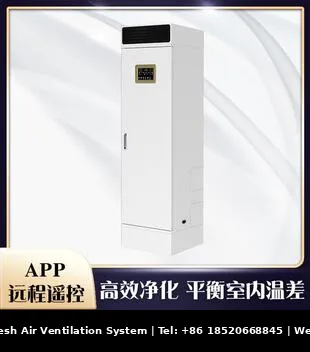
The business case is straightforward. A sealed data room relies on mechanical cooling to remove sensible heat generated by servers, storage arrays and network switches. But a room that is perfectly sealed and never ventilated slowly accumulates contaminants: outgassing from cable jackets, toner and paper dust from adjacent offices, combustion products from nearby kitchens, radon pulled from the ground, and the carbon dioxide exhaled by every technician who steps inside. Outdoor air that is deliberately introduced, filtered and conditioned dilutes these pollutants, maintains a slight positive pressure of 5 to 15 pascals relative to the corridor, and prevents unconditioned infiltration through door gaps and cable penetrations. When the outside air is cool enough, the same fresh air can also act as free cooling, carrying heat out of the room without the compressor ever starting. Done badly, fresh air destroys the carefully engineered cold-aisle containment, lets humidity swing wildly and floods the room with dust. Done with KITOZER-grade engineering, it improves reliability, lowers energy use and extends the life of the precision air conditioners.
This guide is written for the full audience: the data center designer who must lay out the duct routing, the electrical contractor who pulls the RS485 and power feeds, the facilities manager who writes the maintenance contract, the procurement engineer comparing quotations, and the on-call technician who receives a 3 a.m. SMS saying the room pressure has dropped to zero. Every claim is anchored to measurable parameters — airflow in cubic metres per hour, heat recovery efficiency in percent, filter class in ISO ePM, noise in decibels, and control protocol in Modbus RTU over RS485. Where a price range is quoted, it is given both in renminbi and as an approximate US dollar reference, because the quotation naturally depends on capacity, filtration level, controls package and the ductwork scope that each customer chooses.
2. Product Definition and Scope
2.1 What exactly is a data center fresh air ventilation system
A data center fresh air ventilation system is a packaged mechanical ventilation installation designed to supply a controlled quantity of treated outdoor air into an information technology space and to extract an equal quantity of room air, while recovering thermal energy between the two streams. Unlike a domestic heat recovery ventilator sized for a living room, the data room version is rated for 24/7/365 duty, commercial fan motors, gaugeable filter stages, a condensate-safe casing, and a communications interface that lets the building management system or the room environment monitoring host read supply airflow, filter differential pressure, supply and exhaust temperatures, fan speed and running hours. The unit stands between the outdoor air intake louvre and the room’s positive-pressure duct, and it works hand in glove with the precision air conditioner and the raised-floor or cold-aisle containment.
2.2 What KITOZER means by “dedicated data room fresh air”
KITOZER distinguishes general-purpose commercial ventilation from the data-room-grade product line described here. The general product uses residential filters, non-communicating fans and a plastic casing. The dedicated data-room product uses galvanised or powder-coated sheet steel casing with a 25 mm insulated sandwich panel, G4 plus F7 or ePM10 plus ePM15 filtration as standard, EC plug fans with Modbus speed control, a programmable logic controller with a 4.3 inch touch display, an RS485 Modbus RTU port and a dry-contact interlock to the fire dampers. It is rated for continuous operation in the 18 to 28 degree celsius supply temperature band and the 30 to 70 percent relative humidity band that ASHRAE recommends for class A1 and A2 equipment environments. In other words, it is not a bathroom fan on steroids; it is a precision air handler.
2.3 The boundary with adjacent systems
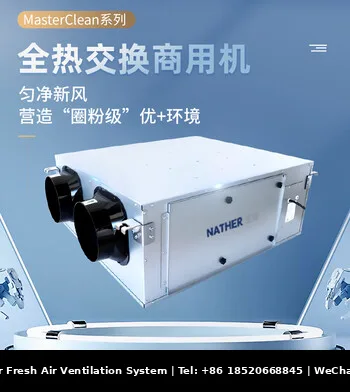
It is important to draw the line between fresh air and the systems it cooperates with. The precision air conditioner is responsible for sensible and latent cooling of the recirculating room air. The fresh air unit is responsible only for the outdoor air volume — typically 5 to 15 percent of the room’s recirculation airflow — and for maintaining pressurisation. The exhaust path, when provided, should never short-circuit into the air conditioner return. The fire damper, a mandatory device between the unit and the outdoor wall, closes on a fire alarm and interlocks the fans off. The leak detection rope, the smoke detector and the access control sensor on the door all feed the same monitoring host, so that opening the door momentarily boosts fresh air demand and closing the door returns the room to its design overpressure.
3. Development History: From Plain Supply Fans to Intelligent Heat Recovery
3.1 The first generation — natural leak and window vents (1980s)
In the earliest days of computer rooms, through-the-wall louvres and motorised window vents did the whole job. Rooms were large, equipment was dense with valves and reels rather than blades, and no one had yet measured the dust load. The disadvantage was immediate: in desert regions the room baked, in coastal regions salt air corroded the busbars, and in industrial regions the dust settled in millimetres on top of the switchgear. Operators responded by taping the louvres shut, which solved dust but killed pressurisation. This cycle repeats itself in every climate today when engineers under-rate the filtration.
3.2 The second generation — supply fan with single filtration (1990s)
Through the 1990s the packaged supply fan with a single G4 filter became the standard. A centrifugal blower pulled outdoor air through a bag filter and pushed it under the raised floor. There was no heat recovery, so in winter the room’s electric heaters had to compensate for frigid incoming air, and in summer the air conditioner fought the hot humid incoming air. Telecom operators noticed two things: the fan bearings failed within three years on unregulated fixed-speed motors, and the filter, when forgotten, starved the room of air. Maintenance teams began to log filter differential pressure, which is the origin of today’s filter-clogging alarm.
3.3 The third generation — total heat recovery double flow (2000s)
The mid-2000s brought the counter-flow and cross-flow heat recovery core. A total energy wheel or a static aluminium or paper enthalpy exchanger transferred both sensible heat and latent moisture between the outgoing and incoming airstreams. Suddenly winter incoming air was pre-warmed by the exhaust, and summer incoming air was pre-cooled and dehumidified. Energy recovery efficiencies climbed above 60 percent, and free cooling — running the fresh air stream as the sole cooling source when outdoor temperature was low — became a design option. This is the generation that still dominates the market today.
3.4 The fourth generation — EC fans, Modbus and demand control (2010s)
The latest generation replaces the AC PSC motors with electronically commutated DC plug fans, drops in a small PLC, and exposes the whole machine to Modbus RTU and, on premium builds, BACnet or MQTT. Speed now follows a pressure sensor in the room, a CO2 sensor in the return duct, or a schedule in the building automation system. The KITOZER line belongs to this fourth generation: it is speed controllable, alarmable, trending-capable and remotely readable from the same EMS platform that watches the batteries and the generators.
4. Working Principle and Airflow Physics
4.1 The four airstreams
A KITOZER fresh air unit handles four streams. The first is the outdoor air intake, drawn through a weather louvre and a bird screen. The second is the supply air, which has been filtered, heat-exchanged and optionally post-conditioned, and is delivered to the room. The third is the return air, drawn from the room ceiling or the false floor. The fourth is the exhaust air, which is the return stream after it has given up its energy to the core and is discharged outdoors. In a balanced unit, supply airflow equals exhaust airflow, and the room pressurisation is set by a small offset, typically 10 percent more supply than exhaust.
4.2 The heat recovery core
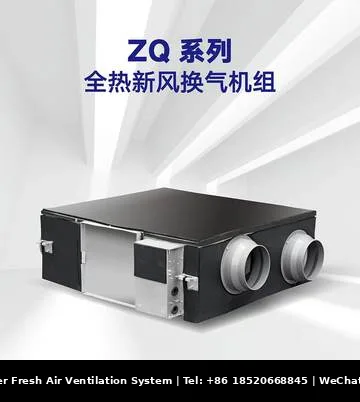
Two core types dominate. The sensible aluminium plate cross-flow core transfers temperature only; it is robust, washable and immune to moisture condensation, and it is the right choice for dry climates. The total enthalpy paper or polymer wheel transfers both temperature and humidity; in summer it pre-dehumidifies the incoming air, and in winter it returns moisture that the room would otherwise lose. Efficiency is quoted at the design airflow and a nominal 50 percent bypass, and must be derated when the filters are new and the motor is at half speed, because pressure drop changes with the square of airflow.
4.3 The pressurisation logic
The room is kept at 5 to 15 pascals above the adjacent corridor. A differential pressure transducer measures the room-to-corridor pressure and the PLC trims the supply fan speed to hold the setpoint. When the equipment room door opens, pressure collapses; the fan ramps up within seconds to replace the displaced air and to prevent unfiltered corridor air from flooding the cold aisle. When the door closes, the fan eases back. This closed loop is what distinguishes a managed fresh air system from a crude fixed-speed blower.
4.4 The free-cooling bypass
When outdoor air temperature falls below the room setpoint by a comfortable margin — say below 18 degrees celsius in a winter climate — the unit can bypass the heat core entirely and use the cold outdoor air as free cooling. A motorised damper routes 100 percent of the airflow straight into the room, and the precision air conditioner cycles off. The KITOZER controller implements this with a schedule, an outdoor air temperature probe and a lockout against condensation; when the dew point of the incoming air would wet the plenum, the bypass closes and the heat core re-engages.
5. Technical Parameters and Rated Data
The table below lists representative rated data for the KITOZER cabinet and ceiling series. Actual project values are confirmed on the quotation drawing after duct resistance, filter loading and altitude derating are considered.
| Model | Airflow m3/h | External Pa | Fan type | Recovery % | Filter | Noise dB(A) | Power W | Weight kg |
|---|---|---|---|---|---|---|---|---|
| KZ-FAU-300 | 300 | 120 | EC plug fan | 65 | G4+F7 | 38 | 2×95 | 62 |
| KZ-FAU-500 | 500 | 130 | EC plug fan | 66 | G4+F7 | 40 | 2×150 | 78 |
| KZ-FAU-800 | 800 | 140 | EC plug fan | 67 | G4+F8 | 42 | 2×250 | 110 |
| KZ-FAU-1200 | 1200 | 150 | EC plug fan | 68 | G4+F8 | 44 | 2×380 | 155 |
| KZ-FAU-2000 | 2000 | 160 | EC plug fan | 68 | G4+F9 | 46 | 2×600 | 220 |
| KZ-FAU-3000 | 3000 | 180 | EC plug fan | 69 | G4+F9 | 48 | 2×900 | 300 |
| KZ-FAU-5000 | 5000 | 200 | centrifugal EC | 70 | G4+H11 | 50 | 2×1500 | 480 |
5.1 Electrical and control parameters
| Item | Specification |
|---|---|
| Power supply | AC 220V +/-10%, 50Hz, single phase (up to 1200 m3/h); AC 380V three phase above |
| Controller | PLC with 4.3 inch color touch screen |
| Communication | RS485 Modbus RTU, optional BACnet MS/TP, optional MQTT to cloud EMS |
| Digital inputs | Filter alarm, high temp, door status, fire damper feedback, remote start stop |
| Digital outputs | Supply fan run, exhaust fan run, fault relay, fire damper control |
| Temperature sensors | Outdoor, supply, return, exhaust, supply after core |
| Protection | IP44 indoor, motor thermal, overload, phase loss (3 phase) |
| Operating ambient | -15 to 45 degree celsius, 10 to 90 percent RH non condensing |
5.2 Dimensional and mounting notes
Cabinet units up to 1200 m3/h sit on a 100 mm vibration-isolating plinth against the side wall of the equipment room, or in an adjacent fresh air plant room. Ceiling units hang from four M10 threaded rods with spring isolators. Service clearance of 700 mm must be preserved on the filter side and 500 mm on the electrical side. All duct connections are flexible canvas connectors at the unit nozzles to prevent structure-borne noise from travelling into the room.
6. Classification and Selection Guide
6.1 By mounting form
Cabinet floor-standing units (KZ-FAU-C series) suit rooms where a corner can be spared and filters must be changed without climbing. Ceiling concealed units (KZ-FAU-S series) suit retrofit projects where the false ceiling can swallow the body and only the grilles show. Wall-through wall-box units suit remote telecom huts with no plant room. The selection follows the available space, the duct reach and the maintenance ergonomics rather than the airflow number alone.
6.2 By heat recovery type
Sensible-only cores suit dry climates and coastal sites where condensation on the core would otherwise freeze. Total enthalpy wheels suit mixed-humidity climates where dehumidifying summer air and humidifying winter air matters. Static cross-flow plates suit dust-heavy industrial sites because they can be washed; rotary wheels suit large airflow because their efficiency is higher at size. KITOZER quotes both options and marks the chosen one on the drawing.
6.3 By filtration level
Filtration is selected by the outdoor air quality. Urban campus sites take G4 plus F7. Near-road or near-construction sites take G4 plus F8. Near coastal or dusty industrial sites take G4 plus F9 or even H11 HEPA. The pressure drop across the filter bank is monitored by a differential pressure switch set to alarm at the design final resistance, which is typically twice the initial resistance. Never skip the pre-filter: it is the cheap sacrificial stage that protects the expensive fine filter.
6.4 Airflow sizing calculation
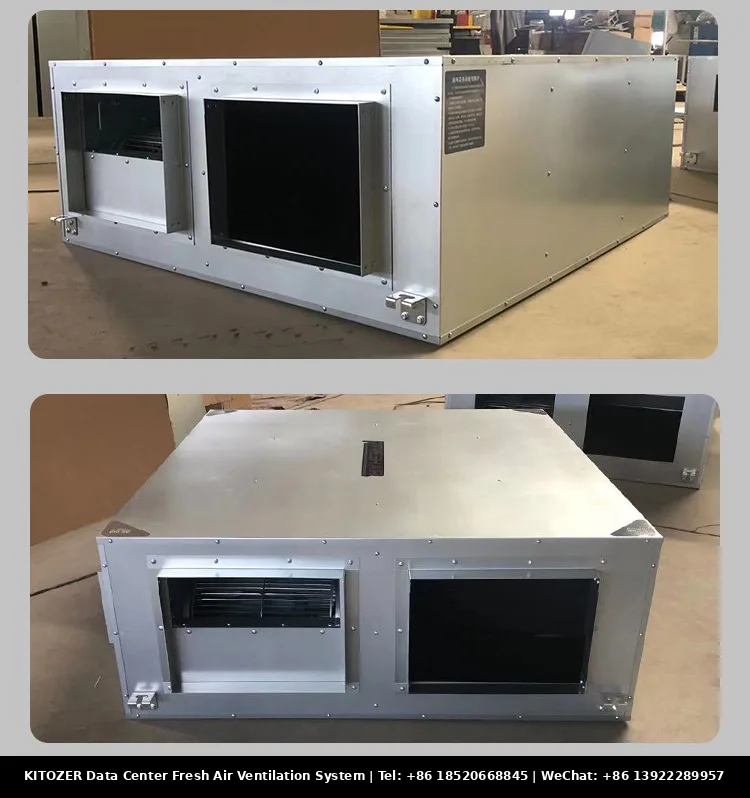
The design airflow follows three rules, and the engineer takes the largest of the three. Rule one is pressurisation: supply airflow should be 1 to 2 air changes per hour above exhaust, or enough to hold 10 pascals with the door closed. Rule two is occupancy: provide 30 to 40 cubic metres per hour per person for the control room. Rule three is dilution: replace 5 to 10 percent of the room’s recirculating airflow every hour to hold CO2 below 1000 ppm and to dilute outgassed contaminants. A 60 square metre, 3 metre ceiling server room typically lands at 500 to 1200 m3/h of fresh air. Over-sizing wastes energy, under-sizing starves the room of pressure.
6.5 Selection decision table
| Room type | Typical airflow | Filter | Core type | Controls |
|---|---|---|---|---|
| Small telecom hut (<20 m2) | 300 m3/h | G4+F7 | Sensible | Basic on off |
| Campus server room (20-60 m2) | 500-800 m3/h | G4+F8 | Total enthalpy | Modbus, pressure loop |
| Financial computer room (60-150 m2) | 1200-2000 m3/h | G4+F9 | Total enthalpy | Modbus+BMS, CO2 demand |
| Data hall plant room | 3000-5000 m3/h | G4+H11 | Enthalpy wheel | BACnet, free cooling |
| Coastal / dusty site | per room | G4+F9, washable pre | Sensible washable | differential pressure alarm |
7. Installation Steps Illustrated
7.1 Site preparation
Confirm the foundation can carry the filled-unit weight plus a 50 percent safety margin, that the wall opening for the outdoor louvre is sealed against rain, and that the duct route has no clash with the cable ladder, the fire main or the lighting trunking. Bring the unit indoors, unwrap it in the plant room, and inspect the casing corners for transit damage before the crane or trolley moves it. Mount a 100 mm high isolation plinth on the floor and level it to less than 2 mm per metre.
7.2 Outdoor louvre and intake
Fit the weather louvre with an integrated bird screen and a motorised fire damper. The louvre must face away from prevailing rain and from exhaust stacks; the distance between intake and exhaust should be at least 3 metres horizontally and 2 metres vertically to avoid short-circuit. Slope the intake duct 2 degrees downwards to the outside so condensation drains away from the unit, and fit a drain trap.
7.3 Ductwork
Use galvanised steel spiral or rectangular duct, insulated with 25 mm closed-cell elastomeric sheet to prevent condensation. Connect each duct to the unit through a 150 mm canvas flexible connector. Support the duct on hangers independent of the unit so the unit nozzle does not carry duct weight. Balance the branch dampers so the supply registers in the cold aisle deliver equal throw.
7.4 Wiring
Run the power feed in its own tray separated from the RS485 shielded pair by at least 200 mm. Land the earth conductor to the unit grounding lug with a star washer. Wire the fire damper feedback contact to the digital input, and wire the supply and exhaust run contacts to the BMS. Set the Modbus slave address and baud rate (default 9600, 8N1) on the touch screen before connecting the bus.
7.5 Post-installation checklist
Before first power on: verify all dampers move freely by hand, verify the filters are fitted and the access doors shut, verify the condensate drain falls away, and verify no tool or bracket is left inside the casing. Then power on, set the clock, and walk the commissioning steps in section 8.
8. Commissioning and Tuning
Commissioning is a five-pass procedure. Pass one, electrical: measure insulation resistance on the fan motors, verify phase rotation on three-phase units, and confirm the fault relay opens on simulated overload. Pass two, airflow: with a hot-wire anemometer, measure velocity at each supply grille and adjust the branch damper to within 10 percent of design. Pass three, pressurisation: with the door closed, read the room-to-corridor differential pressure and tune the PID on the PLC until it holds 10 pascals. Pass four, controls: simulate a filter-clog alarm by partially blocking the intake, confirm the alarm reaches the EMS within 10 seconds, then simulate a fire-damper closure and confirm both fans stop. Pass five, energy: run the free-cooling bypass at the first cool night and record the energy saved against the mechanical cooling baseline. Sign the commissioning report, hand the password to the facilities team, and archive the trend logs.
9. Daily, Monthly and Annual Maintenance
9.1 Daily and weekly
Walk past the unit once a shift and listen: a new rattle, a new whistle or a new smell tells you something changed. Read the touch screen supply and exhaust temperatures and confirm they track the design. Log the filter differential pressure value into the EMS; the trend line is the best predictor of the next filter change.
9.2 Monthly
Clean the bird screen on the outdoor louvre. Inspect the canvas connectors for cracking. Check the condensate drain flows. Record fan speed in hertz and running hours. If the room pressure trend is drifting down, the filter is loading.
9.3 Quarterly
Replace the G4 pre-filter. Inspect the F7 to F9 fine filter; change it if the differential pressure exceeds the red line or if it has been in service for twelve months, whichever comes first. Clean the heat core with a low-pressure vacuum, never with a wire brush. Test the fire damper one full open-close cycle.
9.4 Annual
Grease the fan motor bearings where lubrication points exist (EC plug fans are typically maintenance free). Measure fan current against the nameplate. Calibrate the differential pressure transducer and the temperature probes. Tighten all electrical terminals. Re-balance the airflow. Write the annual report and plan next year’s filter stock.
15. Psychrometric Design and the ASHRAE Envelope
A data room does not care about the outdoor weather report; it cares about where the outdoor air sits on the psychrometric chart relative to the room setpoint. ASHRAE Technical Committee 9.9 defines the recommended envelope for class A1 and A2 equipment as a dry-bulb temperature between 18 and 27 degrees celsius and a dew point between 5.5 and 15 degrees celsius, with a maximum relative humidity of 60 percent and an absolute humidity below 0.012 kilograms of water per kilogram of dry air. The fresh air unit’s job is to take whatever the outdoor climate throws at the intake and to deliver it into the room without pushing the room outside that envelope. In a temperate spring day, outdoor air may sit almost on top of the room setpoint, and the unit passes it straight through with minimal conditioning. In a subtropical summer, outdoor air arrives at 34 degrees and 75 percent relative humidity; the precision air conditioner must then remove both the sensible heat of the IT load and the latent heat of the humid fresh air, which is why the enthalpy core is so valuable — it pre-cools and pre-dehumidifies the incoming stream before the air conditioner ever sees it. In a dry northern winter, outdoor air arrives at minus 10 degrees and 20 percent relative humidity; the enthalpy core returns moisture from the exhaust so the room does not drop into electrostatic-discharge territory, and a small electric pre-heater lifts the supply air above the frost point.
The control engineer who understands the psychrometric chart never sets a single temperature setpoint and walks away. Instead, the KITOZER controller runs an envelope control: it compares the outdoor air enthalpy against the room air enthalpy and decides, moment by moment, whether to use outdoor air for free cooling, whether to run the heat core, whether to bypass it, and whether to request supplementary dehumidification or humidification from the room-level equipment. This is the difference between a dumb ventilation box and an integrated environment management platform, and it is the reason the fresh air unit shares the same controller family as the room environment monitoring host.
Consider a worked example. A 100 square metre data hall has a 400 kW IT load. The design pressurisation calls for 1500 m3/h of fresh air. In January, outdoor air sits at 2 degrees and 80 percent relative humidity; enthalpy about 18 kJ/kg. Room air sits at 24 degrees and 45 percent relative humidity; enthalpy about 45 kJ/kg. Because the outdoor air enthalpy is far below the room enthalpy, the controller opens the free-cooling bypass, and the 1500 m3/h of cold fresh air removes roughly 25 kW of sensible load on its own, allowing one of the two 200 kW chillers to stage off. In July, outdoor air sits at 34 degrees and 70 percent relative humidity; enthalpy about 96 kJ/kg. The controller closes the bypass, engages the enthalpy core, and the core recovers 68 percent of the exhaust energy, lifting the supply air to about 26 degrees and dropping the latent load on the chiller by about 18 percent. The numbers move with every hour of the day, and the controller moves with them.
16. Control Sequences in Detail
16.1 Normal occupied sequence
On normal mode, the supply fan runs at the speed demanded by the room pressure loop. The return fan runs at a fixed offset below the supply fan speed so that supply airflow exceeds exhaust airflow by about 10 percent, holding the room at 10 pascals. The heat core bypass damper tracks the enthalpy comparison. The fine filter differential pressure is scanned every 60 seconds; if it exceeds the alarm threshold, the controller pushes a warning to the EMS and the touch screen shows a filter-service reminder. The supply and exhaust temperatures are trended to the EMS every 30 seconds for the historian.
16.2 Door-open boost sequence
When the room door contact opens, the controller immediately ramps both fans to 90 percent speed for three minutes to compensate for the pressure collapse. After three minutes, or when the door closes, whichever is earlier, the fans return to the pressure loop. This prevents the corridor air from flooding the cold aisle while the technician is rolling in a new server.
16.3 Fire and smoke sequence
On a fire alarm from the VESDA or the conventional smoke detector, the controller outputs a close command to the motorised fire damper, stops both fans within five seconds, latches the fault relay, and waits for a manual reset. The dampers on the exhaust side close independently. The EMS logs the event with a time stamp and a snapshot of the last hundred readings.
16.4 Night setback sequence
When the room is unoccupied and no person is detected, the controller lowers the pressurisation setpoint from 10 to 6 pascals and lets the CO2 loop take over the speed demand. This shaves about 15 percent off fan energy during the quiet hours without compromising the room envelope.
16.5 Free-cooling lockout
The free-cooling bypass is locked out when any of the following is true: outdoor dew point above 14 degrees celsius, outdoor temperature above the room setpoint, fire alarm active, filter alarm active, or the manual override switch held at off. The lockout prevents the controller from doing something clever at exactly the wrong moment.
17. Modbus Register Map Example
The table below is the default register map that KITOZER pre-loads into the controller. The EMS integrator reads holding registers 40001 onwards and writes to the control registers as marked. Units are in engineering values scaled by the factor shown.
| Register | Name | Scale | Access | Range |
|---|---|---|---|---|
| 40001 | Outdoor air temp | 0.1 C | read | -40..80 |
| 40002 | Supply air temp | 0.1 C | read | -40..80 |
| 40003 | Return air temp | 0.1 C | read | -40..80 |
| 40004 | Exhaust air temp | 0.1 C | read | -40..80 |
| 40005 | Supply fan speed | 1 Hz | read | 0..60 |
| 40006 | Exhaust fan speed | 1 Hz | read | 0..60 |
| 40007 | Filter DP | 1 Pa | read | 0..600 |
| 40008 | Room pressure | 1 Pa | read | -50..150 |
| 40009 | Supply run hours | 1 h | read | 0..65535 |
| 40010 | Fault word | bitmask | read | see bit map |
| 40100 | Run command | 0/1 | write | 0=stop 1=run |
| 40101 | Pressure setpoint | 1 Pa | write | 0..30 |
| 40102 | Free-cooling enable | 0/1 | write | 0=off 1=auto |
| 40103 | Manual speed demand | 1 Hz | write | 0..60 |
The fault word is a bitmask: bit 0 is supply fan overload, bit 1 is exhaust fan overload, bit 2 is filter clogged, bit 3 is high supply temperature, bit 4 is fire damper feedback lost, bit 5 is sensor fault, bit 6 is communication lost, bit 7 is high room pressure. The EMS integrator should decode the word into named alarms rather than displaying a raw number.
18. Duct Design and Acoustics
Duct design for a fresh air system is dominated by three constraints: pressure drop, noise breakout, and condensation. The duct velocity should be held below 4 metres per second in the supply duct and below 3 metres per second at the room grille; above these values, the sheet metal rattles and the grille whistles. Use turning vanes inside every bend to keep the secondary flow from separating, and use a splitter damper rather than a butterfly damper for balance, because the splitter damper is far less likely to generate turbulence noise. Insulate every duct run that passes through an unconditioned space with 25 mm closed-cell elastomer; the outer surface of the duct must stay above the dew point of the ambient air, otherwise condensation drips from the underside and stains the ceiling. In plant rooms where the duct runs close to offices, add an internal-liner acoustic duct section for 3 to 5 metres immediately after the unit; this absorbs the fan broadband noise before it reaches the grille.
Acoustic design targets are usually 35 dB(A) at the occupied side of the room grille and 55 dB(A) in the plant room at one metre from the unit. If the measured grille noise exceeds the target, the order of remedies is: first, check that the fan is not over-driven; second, add a silencer on the supply duct; third, balance the branch dampers so that no single grille is taking more than its share; fourth, check that the canvas connector is intact, because a torn connector lets structure-borne fan vibration rattle the whole duct. KITOZER sizes a recommended silencer on the drawing when the plant room is adjacent to a bedroom or a quiet office.
19. Energy Use and PUE Contribution
The fresh air unit is not a cooling plant, but it moves the needle on PUE. A 1200 m3/h EC unit at 400 watts total input moves about 300 cubic metres per hour per 100 watts, which is roughly three times better than a legacy AC PSC unit of the same size. Over a year, the EC unit saves about 1800 kWh per installed unit against a fixed-speed AC unit. When free cooling engages in a cold climate, the savings are much larger: each hour of free cooling replaces an hour of chiller operation, which at a 3 kW chiller and a 30 percent cooling load is about 1 kWh per hour per 1000 m3/h of fresh air. Data centers in temperate climates measure 5 to 10 percent PUE improvement from a well-designed fresh air and free-cooling strategy. The KITOZER controller logs the free-cooling hours and the compressor-off hours so the facilities manager can report the saving to the sustainability team.
The energy audit also looks at fan energy. Because fan power scales with the cube of speed, running the fan at 80 percent speed cuts fan power to half. This is why the pressure loop, rather than a fixed speed, is the right control strategy: it lets the fan spend most of its life at 60 to 80 percent speed, ramping to 100 percent only when the door opens or the filter clogs. The EMS trend should show the fan speed hovering around 70 percent; if it sits at 100 percent all day, the room is either under-ventilated or the filter needs changing.
20. Worked Selection Examples
20.1 Example A: A 40 m2 campus server room in Guangzhou
The room holds four server racks at 8 kW each, total IT load 32 kW. The room is on the second floor of an office building, with a window facing a landscaped courtyard. Outdoor air quality is urban, with occasional construction dust. Design pressurisation: 1.5 air changes per hour over a 3.5 metre ceiling gives 40 x 3.5 x 1.5 = 210 m3/h. Occupancy: two people at 35 m3/h each = 70 m3/h. Dilution: the room recirculates through a 25 kW precision air conditioner at about 4000 m3/h; 8 percent fresh air = 320 m3/h. The largest of the three is 320 m3/h, so the KZ-FAU-500 at 500 m3/h is selected with the fan turned down to 65 percent to hold the room pressure. Filtration is G4 plus F8 for the urban dust. The enthalpy core is chosen because Guangzhou summers are humid. The unit sits in the corridor plant closet and ducted to the cold aisle. Reference price: about 13,000 RMB, 1,800 USD.
20.2 Example B: A mountain telecom hut at 1800 m altitude
The hut is 12 m2, houses a 5 kW radio base station, and is staffed once a week. Outdoor air is clean but cold in winter, with temperatures down to minus 18. Altitude derating is about 8 percent, so the nominal 300 m3/h unit is over-sized to a KZ-FAU-500. A sensible-only core is chosen because the humid climate is not a concern, and the core must be washable against the mountain dust. An electric pre-heater of 2 kW is fitted to lift the supply air above the frost point. The controller runs the night setback to hold 6 pascals and boosts when the door opens. Reference price: about 15,000 RMB, 2,080 USD, including the pre-heater and the remote monitoring module.
20.3 Example C: A 200 m2 financial computer room
The room is tier-3 rated, holds 40 racks at 6 kW each, and is staffed by a ten-person operations shift. The fresh air plant is in a dedicated plant room, with two units of 2000 m3/h each running at 60 percent and providing N plus 1 redundancy. Filtration is G4 plus F9 because the building is adjacent to a main road. The enthalpy wheel is chosen for the 2000 m3/h size and the humid subtropical climate. The units speak BACnet MS/TP to the building automation system, and the room environment monitoring host provides the pressure and CO2 setpoints. Free cooling engages below 18 degrees outdoor temperature. Reference price: about 34,000 RMB per unit, 4,720 USD each.
21. Compliance, Codes and Standards
KITOZER fresh air units are designed to meet the relevant Chinese and international norms: GB 50174 Data Center Design Standard for the pressurisation and fresh air rates, GB 50736 Heating Ventilation and Air Conditioning Design Code for duct design and acoustics, GB 50016 Code of Design on Building Fire Protection for the fire damper interlock, GB/T 14295 Air Filters for the filter rating, and ISO 16890 for the ePM filter classes. Internationally, the units follow ASHRAE TC 9.9 for the equipment environment envelope, Eurovent for the rated airflow and efficiency declarations, and CE marking where the customer requires it. The quotation drawing lists the exact clauses that the project is held to, so the compliance officer does not have to dig through the manual.
Fire safety is the non-negotiable part. The fire damper must be a motorised, rated device that closes on 72 degree celsius fusible link backup even if the controller loses power. The duct must have a fire-rated penetration seal where it passes through the fire wall. The fresh air unit must shut down on the suppression release signal so that the gas concentration in the room is not diluted away. These are not optional add-ons; they are checked at the acceptance walk-through.
22. Deep Troubleshooting Playbook
22.1 The room pressure reads zero
Walk the chain in order: is the unit running at all, is the supply damper stuck shut, is the outdoor louvre blocked by leaves or a bird nest, are the filters completely clogged, is the duct detached from the nozzle, and finally, is the pressure transducer itself zeroed. In 70 percent of zero-pressure calls, the answer is a clogged filter or a blocked louvre.
22.2 The room smells stale despite the fan running
Check the exhaust path. A closed exhaust damper, a blocked exhaust grille, or a short-circuit where the supply duct feeds straight into the exhaust duct makes the unit run but move no air. Also check the heat core bypass; a stuck-open bypass on a total enthalpy unit means supply and exhaust mix before they leave the casing.
22.3 The supply air is too humid in summer
The enthalpy core is either bypassed, contaminated, or undersized. Clean the core, verify the bypass damper seals, and check the controller is not locking out the core because of a sensor fault. If the core is physically loaded with dust, replace it; a loaded core loses both heat transfer and moisture transfer.
22.4 The unit whistles at the grille
Velocity at the grille is above design. Balance the branch damper to the offending grille, check the fan is not over-driven, and verify the grille is not a cheap adjustable louver that whistles. A properly sized KITOZER unit at design speed is almost silent at the grille.
22.5 The EMS does not see the unit
Check the RS485 A and B wires are not reversed, the baud rate matches the network, the slave address is unique, and the bus termination resistor is fitted at the far end. Most communication faults are wiring, not software.
22.6 The condensate drain floods the plant room
The drain trap is empty, the drain pipe slopes the wrong way, or the drain line is blocked with slime. Prime the trap with water, re-grade the pipe, and clean the line. A flooded drain means the exhaust air is pulling water into the core, which will eventually rot the paper wheel.
23. Spares, Consumables and Service Contract
KITOZER stocks the common spares at the Guangzhou factory and ships them nationwide within 48 hours: G4 pre-filter pads, F7 to F9 pleated filters, H11 HEPA cassettes, EC fan impellers with motor, touch screen panels, PLC boards, temperature and humidity probes, differential pressure transducers, motorised fire dampers, canvas flexible connectors, and enthalpy core cassettes. The service contract is offered on three tiers: bronze, which is a quarterly filter change and a remote health check; silver, which adds two annual on-site commissioning visits and a spare-parts discount; and gold, which adds a four-hour response SLA, a standby unit on loan, and a quarterly energy report. Most data hall customers take silver or gold; most telecom huts take bronze.
24. Glossary
Air change per hour (ACH): the number of times the room air is replaced per hour. Positive pressure: the room is held slightly above corridor pressure to prevent unfiltered infiltration. Heat recovery core: the device that transfers energy between supply and exhaust. Enthalpy: the total heat content of air, including sensible and latent. EC fan: an electronically commutated DC motor fan. Modbus RTU: a serial communication protocol over RS485. Free cooling: using cool outdoor air to replace mechanical cooling. Filter differential pressure: the pressure drop across the filter bank, used to detect clogging. Fire damper: a motorised device that closes the duct on a fire alarm. Psychrometric chart: the graph of air temperature, humidity and enthalpy. PUE: power usage effectiveness, the ratio of total facility energy to IT energy. BMS: building management system. EMS: environment monitoring system. AHU: air handling unit. ERV: energy recovery ventilator. HVAC: heating, ventilation and air conditioning.
10. Frequently Asked Questions (65 answers)
Q1. Does a data room really need fresh air if the door is never opened?
Yes. Even a sealed room needs 5 to 15 percent fresh air dilution to hold CO2 below 1000 ppm, to maintain positive pressure against leakage, and to dilute outgassed contaminants from cable jackets and packing materials.
Q2. How much fresh air does a server room need?
Size for the largest of: 1 to 2 air changes per hour of pressurisation offset, 30 to 40 m3/h per person in the control room, and 5 to 10 percent of recirculating airflow. A 60 m2 room typically lands at 500 to 1200 m3/h.
Q3. What is the difference between a fresh air unit and a fresh air ventilation fan?
A fresh air fan is a single blower with no filtration, no heat recovery and no control. A fresh air unit is a packaged air handler with filters, a heat core, balanced supply and exhaust, EC fans and Modbus control.
Q4. Can the fresh air unit replace the precision air conditioner?
No. The fresh air stream is only 5 to 15 percent of the room airflow. It assists cooling during free cooling but cannot remove the full IT heat load.
Q5. What is positive pressure and why 10 pascals?
Positive pressure means the room is slightly higher pressure than the corridor. At 5 to 15 pascals, unfiltered corridor air cannot leak in, yet the door still opens easily.
Q6. What happens if pressure goes negative?
Unconditioned corridor air floods in through door gaps and cable penetrations, carrying dust, humidity swings and temperature swings into the cold aisle.
Q7. Should supply or exhaust be larger?
Supply is about 10 percent larger than exhaust so the room stays positive. A pressure sensor closes the loop.
Q8. What filter class do I need in a city campus?
G4 plus F8 is the common choice. Upgrade to F9 near heavy roads or construction sites.
Q9. How often do I change the filters?
G4 pre-filter quarterly, fine filter when the differential pressure reaches the red line or after twelve months, whichever is sooner.
Q10. What does the filter differential pressure alarm mean?
The pre-set pressure switch has tripped because the filter is clogged. Plan a filter change within the week; running on a clogged filter starves the room of fresh air.
Q11. Can I wash and reuse the F8 filter?
No. Pleated fine filters are disposable. Wash only the G4 metal-mesh pre-filter or the washable aluminium pre-collar.
Q12. What is the difference between sensible and total heat recovery?
Sensible core transfers temperature only. Total enthalpy core transfers temperature and moisture, which matters in humid summers and dry winters.
Q13. When do I choose an enthalpy wheel over a static plate?
For airflow above 2000 m3/h and humid climates, the wheel is more efficient and cost-effective at size. For dusty or corrosive sites, the washable static plate is more robust.
Q14. What is free cooling in a fresh air unit?
When outdoor air is cool enough, a bypass damper routes outdoor air directly into the room and the precision air conditioner switches off, saving compressor energy.
Q15. At what outdoor temperature does free cooling start?
Typically below 18 to 20 degrees celsius supply setpoint, with a dew-point lockout to avoid condensation on the plenum.
Q16. What dew point lockout?
The controller compares the incoming air dew point to the plenum surface temperature. If the incoming air would condense moisture, the bypass closes and the heat core engages.
Q17. Does the unit work in winter at minus 15 degrees?
The standard unit is rated to minus 15. Colder climates need an electric pre-heater coil and frost protection cycling on the exhaust side.
Q18. What is frost protection on the heat core?
When the exhaust side of the core approaches zero degrees, the controller throttles the supply fan or opens a recirculation damper to keep the core above freezing.
Q19. Do I need a condensate drain?
Yes, when dehumidifying summer air the core produces condensate. The drain must fall away to a floor trap with a water seal.
Q20. Can the unit be installed outdoors?
Not the indoor cabinet. Outdoor duty requires a weatherproof plant room or an outdoor-weatherised enclosure with canopy and heater.
Q21. How loud is a 1200 m3/h unit in the plant room?
About 44 dB(A) at the unit casing, which is quiet in a separate plant room. With canvas connectors and a silencer, the room grille noise stays below 35 dB(A).
Q22. Do I need a duct silencer?
If the plant room is adjacent to an office or the bedroom of an on-call engineer, fit a silencer on the supply duct. It buys 10 to 15 dB attenuation.
Q23. What protocol does the controller speak?
Standard is Modbus RTU over RS485 at 9600 8N1. Optional BACnet MS/TP or MQTT to the cloud EMS.
Q24. Which registers should I map to the EMS?
Map supply and exhaust temperature, supply airflow estimate, filter differential pressure, fan speed Hz, running hours, and fault word. Do not map the raw PWM duty as the only airflow indicator.
Q25. Can the EMS start and stop the unit remotely?
Yes, through a digital input or a Modbus write. Keep a hard local switch for commissioning.
Q26. What is the fire damper interlock?
On a fire alarm signal, the motorised fire damper closes and both supply and exhaust fans stop, preventing the duct from carrying smoke into adjacent areas.
Q27. Should the fresh air shut down on fire alarm?
Yes. Fire safety codes require ventilation to shut down and dampers to close so that the suppression system can hold concentration.
Q28. How far apart should intake and exhaust be?
At least 3 metres horizontally and 2 metres vertically, facing away from prevailing wind and exhaust stacks, to avoid short-circuit.
Q29. What is a weather louvre and do I need one?
It is an external grille that lets air in but sheds rain and snow, with a bird screen behind. Always required on the outdoor wall.
Q30. Can I use the raised floor as a supply plenum?
You can, but seal the plenum carefully, add a smoke barrier, and verify the floor tiles hold pressure. Many modern designs supply through the cold-aisle duct instead.
Q31. Should supply air go to the cold aisle or the whole room?
To the cold aisle or the return of the precision air conditioner. Never blow fresh air directly onto a hot aisle.
Q32. What if my room has no ceiling for a ceiling unit?
Use the cabinet floor-standing unit in a corner or in an adjacent plant room, and ducted to the room.
Q33. How do I calculate duct pressure drop?
Sum the louvre, the filters, the core, the dampers, the straight duct and the grilles. The fan external static pressure must exceed the sum by 20 percent.
Q34. Why is my airflow lower than nameplate?
Nameplate airflow is at zero external pressure. Once you add filters, duct and grilles, real airflow drops. Always size the fan for the actual duct resistance.
Q35. What is EC fan and why does it matter?
Electronically commutated DC motor. It is 30 to 50 percent more efficient than AC, speed controllable, and quiet, which is why it is standard on KITOZER units.
Q36. Can I control fan speed by a 0-10V signal?
Yes. The EC fan accepts 0-10V or PWM. The PLC outputs the speed demand from the pressure or CO2 loop.
Q37. What is the expected lifetime of the unit?
Casing 15 years, heat core 10 to 15 years, EC fan 50000 to 70000 hours L10 bearing life, filters 3 to 12 months depending on dust.
Q38. Why did my fan bearing fail after two years?
Usually because the fixed-speed motor ran unbalanced, the duct vibrated, or the bearings were never greased. EC plug fans with isolated mounts rarely fail that way.
Q39. Can the unit run 24/7?
Yes, that is the design duty. Data room units are rated for continuous operation.
Q40. Does the unit need a bypass around it for maintenance?
Yes, fit isolation dampers on supply and exhaust so the room keeps a little ventilation while the unit is serviced.
Q41. What redundancy should I design?
For a mission-critical room, size two units at 60 percent each so one unit carries the load if the other fails, and interlock with the EMS.
Q42. Can I interconnect multiple units?
Yes, Modbus bus up to 32 units on one pair, each with a unique slave address. The EMS scans them all.
Q43. What power supply do large units need?
Above 1200 m3/h, three-phase 380V. Below that, single-phase 220V is fine.
Q44. Why does my 3-phase fan rotate backwards?
A phase rotation error after re-wiring. Swap any two phases and re-check.
Q45. What is the insulation class?
Standard F-class motor insulation, suitable for continuous duty at 40 degree celsius ambient.
Q46. Is the casing insulated?
Yes, 25 mm insulated sandwich panel prevents sweating on the outer skin in humid seasons.
Q47. What if the casing sweats?
Either the insulation is missing or the duct is not insulated. Sweat dripping onto switchgear is a serious fault.
Q48. Can I paint the casing?
It arrives powder coated. Touch up scratches with zinc-rich paint; do not spray-paint over the filter service door.
Q49. How do I ship the unit to a remote site?
Keep it upright on its pallet, wrap the nozzles, and move with a trolley rated for the filled weight. Never lay it on its side.
Q50. What spares should I stock on site?
Two sets of G4 pre-filters, one set of fine filters, one capacitor (for legacy AC units), one contactor, and the PLC battery.
Q51. How do I reset the maintenance alarm?
On the touch screen: maintenance menu, reset hours after you have actually done the task. Never reset without doing the task.
Q52. Can I integrate the fresh air unit into the same EMS as the UPS?
Yes, that is the standard architecture. One Modbus bus, one dashboard, one alarm pipeline.
Q53. What CO2 setpoint should I use?
Supply fresh air to hold room CO2 below 1000 ppm. The controller ramps fan speed up as CO2 rises and down as it falls.
Q54. Does fresh air help humidity?
A total enthalpy core moderates humidity swings. In very dry winter, you may still need a room humidifier; in very humid summer, a room dehumidifier.
Q55. Will fresh air introduce dust into my clean cold aisle?
Only if the filtration is undersized or the filters are expired. With G4+F8 and a pressure alarm, dust intake is negligible.
Q56. What is the effect of altitude on airflow?
Above 1000 m the air is thinner, so the mass airflow drops. Derate the fan by about 1 percent per 100 m and oversize slightly.
Q57. Can the unit be converted from supply-only to balanced?
No, the casing geometry is different. Buy the balanced version if you need exhaust.
Q58. What is the difference between balanced and supply-only units?
Balanced units have two fans and a heat core. Supply-only units have one fan, no core, and rely on natural exhaust grilles. Balanced is preferred for controlled rooms.
Q59. How do I silence the outdoor grille rattle?
Fit a bird screen that is tensioned, add a small silencer, and balance the fan speed so it is not over-driven.
Q60. What if the room smells stale even with the unit running?
Check the exhaust path is not blocked, the filters are not bypassed, and the core is not short-circuiting supply to exhaust.
Q61. Can I use the fresh air unit as the emergency ventilation?
Yes, on fire alarm it must stop, but for normal smoke detection the unit can be configured to run at 100 percent dilution until the alarm clears.
Q62. Does the unit need its own circuit breaker?
Yes, a dedicated MCB in the distribution box, labelled, with its own earth.
Q63. How long does installation take?
A cabinet 800 m3/h unit with ductwork and controls is typically one day for two technicians. Ceiling units add half a day for access.
Q64. What is the warranty?
KITOZER provides a 24-month warranty on the unit and 12 months on consumable filters. Extended cover is available as a service contract.
Q65. How do I get a quotation with drawings?
Send the room dimensions, the outdoor air quality, the required pressurisation and the BMS protocol to KITOZER by the contact details at the end of this guide. A layout drawing and a rated schedule come back within two working days.
11. Application Scenarios
The KITOZER fresh air family is deployed across a long list of controlled-room types. In a campus data center it sits in the fresh air plant room beside the chillers and feeds the cold-aisle containment. In a remote telecom base station on a mountain it is the single ventilation device, the only fresh air the hut ever sees. In a financial computer room it is part of the tier-3 environment package that also includes the UPS, the VESDA smoke detection and the FM200 suppression. In a hospital IT room it helps dilute the ether and ozone that migrate from adjacent departments. In a university server closet it quietly keeps the under-desk rack at positive pressure during the exam period when the room is crowded with students. In a government archive it keeps particulate levels below the ISO Class 8 threshold that the paper collection requires. In a power-generation control room it supports the HVAC so that the SCADA consoles never see a dusty intake. Each scenario changes the filter class, the free-cooling setpoint and the interlock list, but the core machine remains the same KITOZER platform.
12. Reference Price Guide (RMB and approximate USD)
Indicative ex-works reference prices for the KITOZER cabinet fresh air series, excluding ductwork, installation and taxes. The US dollar reference is shown for international budgeting at approximately 7.2 RMB to the dollar and is indicative only.
| Model | Capacity | Reference RMB | Reference USD | Notes |
|---|---|---|---|---|
| KZ-FAU-300 | 300 m3/h | 8,500 – 11,000 | 1,180 – 1,530 | small telecom hut |
| KZ-FAU-500 | 500 m3/h | 11,000 – 14,500 | 1,530 – 2,010 | campus server room |
| KZ-FAU-800 | 800 m3/h | 14,500 – 19,000 | 2,010 – 2,640 | with Modbus |
| KZ-FAU-1200 | 1200 m3/h | 19,000 – 26,000 | 2,640 – 3,610 | financial room |
| KZ-FAU-2000 | 2000 m3/h | 28,000 – 38,000 | 3,890 – 5,280 | enthalpy core |
| KZ-FAU-3000 | 3000 m3/h | 42,000 – 58,000 | 5,830 – 8,060 | plant room |
| KZ-FAU-5000 | 5000 m3/h | 68,000 – 92,000 | 9,440 – 12,780 | HEPA + wheel |
Aftermarket consumables: G4 pre-filter set 180 to 350 RMB (25 to 49 USD), F8 fine filter set 480 to 900 RMB (67 to 125 USD), EC fan assembly 1800 to 4200 RMB (250 to 583 USD), PLC touch display 1200 to 2200 RMB (167 to 306 USD). A full commissioning and one-year maintenance contract is typically 8 to 12 percent of unit value per year.
13. Why KITOZER
KITOZER is the industrial product line of Guangzhou Laian Intelligent System Development Co., Ltd., based in the Chaotian Industrial Park, No. 5 Huashan Road, Shilou, Panyu, Guangzhou. The fresh air line is engineered alongside the precision air conditioner, the environment monitoring host and the leak detection system, so the four products speak the same Modbus dialect and ride the same EMS dashboard. Every cabinet is tested on the air handling rig before shipment, every controller is pre-loaded with the project register map, and every quotation comes with a dimensional drawing and a rated schedule. The after-sales team answers the same two phone numbers listed below during business hours and on on-call rotation.
25. Manufacturing, Quality Control and Factory Test
Every KITOZER fresh air unit leaves the Guangzhou assembly line through a seven-step quality gate. Step one is incoming inspection: every coil, every fan motor, every filter media roll is measured against the purchase specification, and a sample is pulled for a baseline airflow test. Step two is sheet metal: the casing panels are laser-cut, folded and flanged on automated lines, and the 25 mm insulation is press-foamed into the panel so it cannot delaminate. Step three is assembly: the fan, the motor mount, the heat core cassette and the filter rails are bolted to the casing with torque-controlled tools, and the electrical cabinet is wired to a one-page wiring diagram that the electrician signs. Step four is the air-handling rig test: the unit is connected to the test duct, run at design speed, and the supply airflow, the external static pressure, the recovery efficiency and the noise level are recorded on a test certificate that ships with the unit. Step five is the control test: every sensor is substituted with a calibrated signal, every alarm is triggered, and the Modbus bus is scanned to confirm every register reads back. Step six is the run-in test: the unit runs under load for two hours, and the bearing temperature and the current draw are trended. Step seven is the final visual and packing inspection: the nozzles are capped, the touch screen is protected with film, the unit is wrapped in film and strapped to a pallet. The test certificate, the wiring diagram, the dimensional drawing and the Modbus register map are packed in a document bag taped to the casing.
This factory discipline matters because a fresh air unit that is installed wrong is invisible until the room loses pressure. The test certificate tells the commissioning engineer exactly what the unit did on the factory floor, so that when the on-site airflow reads lower than the nameplate, the engineer can immediately tell whether the duct resistance is the problem or the unit itself. KITOZER also offers a type-test certificate under the Eurovent declaration for customers who need third-party verified performance.
26. Acceptance Testing on Site
Acceptance testing is the day the customer signs the handover document. The procedure runs in eight steps. First, verify the nameplate: the model number, the serial number and the rated airflow match the order. Second, electrical: measure the insulation resistance, the earth continuity and the running current at design speed. Third, airflow: anemometer traverse at the supply duct, and the measured airflow must be within plus or minus 10 percent of the rated value. Fourth, pressurisation: with the door closed and the room at design occupancy, the room-to-corridor pressure must hold 10 pascals plus or minus 2. Fifth, control: trigger a filter alarm, a fire damper signal, a door-open signal and a remote start-stop, and confirm each reaches the EMS within 10 seconds. Sixth, noise: measure the grille noise with a sound level meter at 1.5 metres from the grille, and confirm it is below 35 dB(A). Seventh, energy: run the free-cooling bypass and confirm the chiller stages off. Eighth, documentation: hand over the test certificate, the as-built drawings, the spare parts list and the maintenance manual. The customer signs each step. Any failure is corrected on the spot before the handover.
27. Lifecycle Cost Analysis
The purchase price is the small part of the cost of ownership. Over a ten-year life, the fan energy, the filter replacements and the maintenance visits dwarf the sticker. Consider a KZ-FAU-1200 running at 400 watts average for 8760 hours a year: 3504 kWh a year, at an industrial tariff of 0.8 RMB per kWh, is 2800 RMB a year, or 28,000 RMB over ten years. A legacy AC fixed-speed unit of the same size would draw 650 watts average, adding another 17,500 RMB over ten years. The filters: a G4 pre-filter every quarter at 250 RMB and a fine filter every year at 700 RMB comes to about 1700 RMB a year, or 17,000 RMB over ten years. The service contract at silver tier is about 3000 RMB a year, or 30,000 RMB over ten years. The unit itself at 23,000 RMB is only about a quarter of the ten-year cost. This is why KITOZER leads with the EC fan, the Modbus control and the free-cooling option: they are the choices that compound year after year. The procurement officer who compares only the sticker is buying the wrong machine.
28. Competitive and Brand Comparison
The market for data room fresh air units is populated by three tiers. At the top tier are the international precision air-conditioning brands that bundle a fresh air option into their room package; these units are well engineered but expensive, and the controls are tied to their own proprietary EMS. At the middle tier are the Chinese commercial ventilation brands that make good ceiling units for offices; they are cheap, but their data-room-grade features, like the Modbus pressure loop and the fire damper interlock, are usually absent or added as a costly option. At the value tier is KITOZER: the engineering discipline of the top tier, the price point of the middle tier, and the openness to any Modbus or BACnet EMS the customer already owns. The comparison on a like-for-like KZ-FAU-1200 basis: an international brand unit might list at 45,000 RMB, a middle-tier commercial unit at 16,000 RMB but without Modbus, and the KITOZER at 23,000 RMB with everything included. The KITOZER also ships with the room environment monitoring host pre-mapped, which saves the integrator a week of register work.
29. Installation for Retrofit Projects
Retrofit is where the fresh air project gets interesting. The building is occupied, the ceiling is already in, and the duct route has to snake around existing pipes and cables. The KITOZER ceiling unit is the retrofit workhorse: it hangs in the false ceiling, the supply and exhaust grilles are mounted on the ceiling tiles, and the outdoor louvre is cut into the side wall. The installation team works at night to keep the noise away from the office workers. The power feed is pulled in a new small trunking, the RS485 pair lands in the nearest BMS junction box, and the commissioning is done before the office opens the next morning. For a retrofit, the most common surprise is discovering that the existing wall has a structural beam exactly where the louvre should go; the KITOZER site surveyor measures the wall before the unit ships, so the flange size matches the actual opening.
30. Training and Documentation
KITOZER includes a one-day training session at handover for the customer’s facilities team. The training covers: the layout of the unit, how to change the filters, how to read the touch screen, how to interpret the alarm list, how to acknowledge a fault, and when to call the service line. The customer gets a printed operation manual, a wiring diagram, a Modbus register map, a spare parts list with part numbers, and a wall poster of the alarm codes. For larger deployments, KITOZER offers a two-day engineer training at the Guangzhou factory, where the customer’s maintenance staff work on the test rig and learn to troubleshoot the controller at the code level. The training is included in the gold service contract and is available as a paid course for bronze and silver customers.
31. Environmental and Sustainability Position
The KITOZER unit is designed for a circular lifecycle. The casing is galvanised steel that can be recycled at end of life. The heat core cassette is removable and replaceable, so the whole unit does not have to be scrapped when the core ages. The EC fans have no rare-earth-heavy magnets beyond the standard neodymium, and they are rated for 70,000 hours. The filter media is disposable but compact, and KITOZER publishes the filter dimensions so the customer can source a local equivalent if the brand filter is unavailable. The free-cooling strategy directly reduces chiller runtime, which is the single largest electricity consumer in a data hall. The controller logs the free-cooling hours and the avoided compressor runtime so the sustainability team can report the avoided carbon on the annual ESG report.
32. Packaging, Shipping and Site Receipt
The unit is packed in a plywood crate with foam corner protectors, strapped to a hardwood pallet, and wrapped in a desiccant-lined film for ocean freight. The crate is marked with the model, the serial number, the gross weight, the centre of gravity, and the orientation arrows. On receipt, the customer checks the crate for transit damage, photographs any dent, and logs the serial number against the purchase order. The unit is stored upright in a dry warehouse until installation. When the installation team is ready, the crate is opened on site, the unit is lifted with a spreader bar, and the protective film is removed. KITOZER ships nationwide from Guangzhou within a week, and internationally through the gdlain.com export desk, with sea freight to Southeast Asia, the Middle East, Africa and South America.
33. Long-Form Narrative: A Day in the Life of the Unit
At six in the morning, the controller wakes the unit on the schedule. The outdoor air probe reads 14 degrees and 70 percent relative humidity. The enthalpy comparison shows outdoor air enthalpy well below room enthalpy, so the free-cooling damper opens and the supply fan ramps to 55 percent. The precision air conditioner in the data hall sees the return air temperature drop and stages its compressor off. At eight, the operations team arrives, the access control logs the door open, and the controller boosts the fans to 90 percent for three minutes. The room pressure holds at 9 pascals. At ten, the EMS trend shows the filter differential pressure climbing from 90 to 140 pascals; the controller pushes a warning to the facilities dashboard, and the maintenance technician notes it on the weekly checklist. At noon, the outdoor temperature climbs to 28 degrees and the humidity rises; the enthalpy comparison flips, the free-cooling damper closes, the enthalpy core engages, and the compressor comes back on. The supply air temperature holds at 25 degrees. At three, a technician opens the unit door to inspect the filter; the interlock drops the fans to a safe crawl speed. At six, the office empties; the controller drops to night setback, holding 6 pascals instead of 10. At ten, the outdoor air drops to 11 degrees; free cooling re-engages. Through the night, the fan hums at 50 percent, the room holds its envelope, and the trend line on the EMS dashboard rises and falls with the outdoor weather. This quiet, uncelebrated dance is what keeps the servers running.
34. Frequently Asked Questions — Deep Addendum
Q66. Can I install a second unit in parallel on the same duct?
Yes, up to four units on a common header, each with a non-return damper so a failed unit does not back-feed. Set one as master and the others as followers on Modbus.
Q67. What is the maximum duct length before I need a booster fan?
About 25 metres of equivalent duct run within the rated external static pressure. Beyond that, either upsize the unit or add a booster fan in the duct.
Q68. Can the unit handle salt-laden coastal air?
Yes, with the marine option: powder-coated casing, stainless steel fasteners, a washable G4 pre-filter, and a sensible aluminium core. Service the pre-filter monthly.
Q69. How do I prevent birds and rats in the intake?
A 10 mm mesh bird screen on the outdoor louvre, plus a mesh on the exhaust. Inspect quarterly.
Q70. What if I have no plant room?
Use the ceiling concealed unit in the false ceiling, or a wall-through wall box unit on an exterior wall. Both are in the KITOZER range.
Q71. Can the unit run on a generator-backed circuit?
Yes, and it should. Tag the fresh air circuit on the generator backup so the room keeps ventilation during a utility outage.
Q72. Does the unit need a dedicated earth?
Yes, a dedicated protective earth to the unit grounding lug, tested at acceptance.
Q73. What is the MTBF of the controller?
The PLC is rated above 50,000 hours. The touch screen is rated for 50,000 hours backlight life.
Q74. Can I get a local language touch screen?
The standard is English and Chinese. Other languages are available on request for volume orders.
Q75. How do I decommission the unit safely?
Isolate the power, close the manual dampers, vent the duct, drain the condensate loop, and lock out the breaker. Then disconnect the ducting.
Q76. What is the lead time on a 5000 m3/h unit?
Standard units ship in 7 to 10 working days. Custom coatings or BACnet options add 5 to 7 days.
Q77. Can I get a quotation in US dollars?
Yes, through the gdlain.com export desk. The USD reference prices in this guide are indicative.
Q78. Does the unit come with a touch screen or just a display?
The standard is a 4.3 inch colour touch screen with full configuration access. A basic display version is available as a lower-cost option.
Q79. What if my room has negative pressure from exhaust kitchen?
Up-size the supply fan and add a separate exhaust for the kitchen so the kitchen exhaust does not pull on the data room.
Q80. Can I paint the duct to match the ceiling?
Yes, after insulation, with a fire-rated paint. Do not paint the inside of the duct.
35. Component Deep Dive
35.1 The EC plug fan
The heart of the KITOZER unit is the backward-curved centrifugal plug fan with an EC motor. Unlike a traditional forward-curved squirrel-cage blower belt-driven from an external motor, the plug fan puts the impeller directly on the motor shaft and hangs the whole assembly from a dismountable plate in the fan section. There are no belts to tension, no pulleys to wear, and no motor outside the airstream. The EC motor is a brushless DC motor driven by an integrated electronic commutator; it accepts a 0 to 10 volt or PWM speed demand and reports back its own running speed, current and internal temperature over Modbus. The efficiency of an EC motor at part load is dramatically better than an AC PSC motor: at 50 percent speed, the EC motor is still above 70 percent efficient, while the AC motor has already fallen to under 40 percent. This is why the KITOZER unit spends its life at 50 to 80 percent speed, saving fan energy every hour. The impeller is dynamically balanced to ISO 21940 grade 6.3, which is why the unit does not rattle even when the casing is thin-gauge. When the fan reaches the end of its service life, the whole assembly lifts out on the dismountable plate and a replacement drops in, in under an hour, without opening the ducting.
35.2 The heat recovery core
The static counter-flow plate core stacks between 40 and 80 aluminium or polymer plates, spaced 4 to 6 millimetres apart, so that supply and exhaust air weave through alternating layers without mixing. The plates are gasketed at the edges so no air bypasses the stack. The core slides out on rails for washing or replacement. On the enthalpy wheel version, a rotating wheel of polymer-coated aluminium honeycomb carries heat and moisture from the exhaust side to the supply side; the wheel turns at 10 to 20 revolutions per minute, driven by a small geared motor. The wheel is the more efficient device at size, reaching 70 to 75 percent total recovery, but it needs a purge sector to prevent exhaust air from leaking into the supply. KITOZER specifies the purge sector on every wheel unit.
35.3 The filter bank
The filter bank is a two-stage cassette. The G4 pre-filter is a washable synthetic bag or a pleated panel that catches the large dust, flies and pollen. The F7 to F9 fine filter is a pleated glass-fibre cassette in a metal frame that catches the fine particulate. The bank sits on rails with a cam-lock handle so the filter seats against the gasket without bypass. A differential pressure tap on either side of the bank feeds a pressure switch set to alarm at the final resistance. The whole bank pulls out from the side of the unit, so the technician never has to reach into the duct. On the H11 HEPA version for clean rooms, the bank adds a HEPA cassette with a gel seal and a scan test port.
35.4 The damper package
Every KITOZER unit ships with motorised opposed-blade dampers on the supply nozzle, the exhaust nozzle and the free-cooling bypass. The dampers have plastic blades with EPDM gaskets so they seal tight when closed, and they open and close in about 20 seconds. The fire damper on the outdoor wall is a separate motorised rated device with a 72 degree celsius fusible-link backup; even if the controller loses power, the link melts and the damper closes. The dampers are wired to the digital outputs and feedback digital inputs so the controller always knows the actual blade position, not just the commanded position.
35.5 The sensor suite
The unit carries four temperature sensors: outdoor, supply, return and exhaust. On premium builds it adds a supply humidity sensor, a room CO2 sensor in the return duct, and a differential pressure transducer for the room-to-corridor loop. Every sensor is calibrated at the factory against a reference probe, and the calibration date is printed on the sensor label. The sensors are plug-in, so a failed sensor swaps out in under a minute without tools. The controller rejects an out-of-range reading and flags a sensor fault rather than driving the fans off a bogus number.
36. Cloud and Remote Monitoring
Beyond the local Modbus bus, the KITOZER controller can connect to a 4G or Ethernet gateway that pushes data to the KITOZER cloud EMS. The cloud dashboard shows every unit in the customer’s portfolio on a map, with the running state, the filter pressure, the supply temperature and the alarm history. The customer receives an alarm by SMS, by WeChat work notification, or by email, the moment the pressure switch trips. The cloud also keeps a twelve-month trend history, so the facilities manager can look back at the winter free-cooling hours or the filter-clogging trend and plan the next maintenance visit. The gateway speaks MQTT over TLS, and the customer can point the MQTT topic at their own cloud if they prefer to keep the data in-house. This is the fourth-generation architecture: the unit is no longer a dumb box on a wall, it is a node in a portfolio-wide monitoring network.
37. A Note on Sizing Mistakes to Avoid
The most common sizing mistake is to take the room volume and multiply by a single air-change number and stop there. The fresh air requirement is not the room air change; it is the outdoor air dilution, which is a small fraction of the recirculating air. A 10000 m3/h recirculation room does not need a 10000 m3/h fresh air unit; it needs 500 to 1000 m3/h. The second mistake is to ignore duct resistance and pick a unit that looks right on airflow but has no external static pressure left once the filters, the louvre and the grilles are added. The third mistake is to undersize the filtration, which leads to a dusty room within a year and a complaint that the fresh air unit is making dust. The fourth mistake is to put the exhaust grille next to the intake, so the unit exhausts its own supply. The fifth mistake is to skip the free-cooling bypass, which throws away the cheapest energy-saving option the climate offers. KITOZER’s engineering review catches all five before the quotation leaves the factory.
38. Reference Project Profiles
Profile one: a campus data center in a subtropical southern city. The project deploys eight KZ-FAU-2000 units in a dedicated plant room, feeding four data halls. The enthalpy wheels handle the humid summer, and the free-cooling bypass engages for about 1800 hours a year in winter. The EMS dashboard shows each unit’s filter pressure and free-cooling hours. The project team reports a 6 percent PUE improvement over the first year. Profile two: a remote telecom base station on a northern mountain. A single KZ-FAU-300 with an electric pre-heater keeps the hut pressurised through minus 25 degree winters. The cloud gateway SMSs the maintenance team when the filter clogs, and a technician drives up once a quarter. Profile three: a tier-3 financial computer room in a coastal city. Two KZ-FAU-3000 units in N plus 1 redundancy feed the data hall, with marine-grade powder coating and F9 filtration for the sea air. The BMS integrates the units into the building automation, and the fresh air shares the dashboard with the chillers, the UPS and the generators. Profile four: a university server closet on a tight retrofit budget. A single KZ-FAU-500 ceiling unit hangs in the false ceiling, ducted to the cold aisle, commissioned in a single night. The campus facilities team now uses the same model across a dozen closets.
39. Final Checklist Before You Order
Before you send the enquiry, gather: the room dimensions and ceiling height; the IT load in kilowatts; the outdoor air quality class (urban, coastal, dusty, industrial); the required pressurisation in pascals; the BMS or EMS protocol you already own; the available power supply; the plant room or ceiling space; the duct route length; and the local fire code requirements. Send these to KITOZER through gdlain.com or lain.com.cn, and the engineering team returns a sized schedule, a dimensional drawing and a reference price within two working days. The KITOZER data center fresh air ventilation system is the quiet partner that keeps your server room breathing, pressurised and clean, hour after hour, year after year.
40. Detailed Room-Type Engineering Notes
40.1 Telecom base station huts
A remote telecom hut is the harshest fresh air environment: unstaffed, solar-exposed, temperature-swinging from minus 25 to plus 40 across the year, and often in dusty or coastal air. The KITOZER hut-grade unit uses a sensible aluminium core that can be washed, a G4 washable pre-filter changed quarterly, an electric pre-heater for the coldest nights, and a cloud gateway that SMSs the maintenance team when the filter pressure rises. The fan runs on a pressure loop, not a schedule, because the hut door opens only once a week. The unit is sized with altitude derating and with a 20 percent margin so that when the dust load peaks in the dry season the fan still pushes enough air. The reference installation runs for five years on the original heat core and a stack of disposable pre-filters.
40.2 Campus server rooms
A campus server room sits in the basement or the second floor of an office building, staffed once a day, with a window or a wall facing a landscaped courtyard. The fresh air unit sits in a small plant closet and ducted to the cold aisle. The filtration is G4 plus F8, the core is total enthalpy, and the controller speaks Modbus to the campus BMS. The key design point is acoustic: the plant closet is often next to an office, so the supply duct gets a silencer and the fan runs at 60 to 70 percent speed rather than at full speed. The unit is sized at about 8 to 10 percent of the room recirculation airflow.
40.3 Financial computer rooms
A tier-3 financial computer room is staffed around the clock, with an operations shift of ten people, a VESDA smoke detection system, FM200 suppression, and a BMS that integrates every subsystem. The fresh air plant is in a dedicated room, with two units in N plus 1 redundancy. The filtration is G4 plus F9 for the urban road dust, the core is an enthalpy wheel for the humid subtropical climate, and the protocol is BACnet MS/TP. The fresh air interlocks with the suppression system so the fans stop the moment the suppression releases. The free-cooling strategy saves about 1800 hours of chiller runtime a year.
40.4 Hospital IT and utility rooms
A hospital IT room shares a building with operating theatres and labs, so the fresh air must not pull ether, ozone or chemical fumes into the cold aisle. The intake faces away from the loading dock and the sterilisation department, and the filtration is upgraded to F9 with an optional activated-carbon stage for gas adsorption. The unit interlocks with the hospital BMS so that when the building-wide ventilation alarm fires, the fresh air unit locks out and the facility engineer investigates.
40.5 Government archive and museum rooms
An archive or a museum server room shares a building with a paper and painting collection that demands ISO Class 8 particulate levels and a stable 20 degree, 50 percent humidity environment. The fresh air unit uses G4 plus F9 filtration, a total enthalpy core that holds the humidity envelope, and a pressure loop that keeps the archive doors closed without a pressure swing when they open. The unit never free-cools in summer, because free cooling would swing the humidity.
41. More Answers: Engineering Detail
Q81. What is the difference between a fresh air unit and an air handling unit?
An AHU conditions 100 percent of the room air. A fresh air unit handles only the outdoor air portion, which is 5 to 15 percent of the recirculation. The two are complementary, not interchangeable.
Q82. Can I connect the fresh air duct to the precision air conditioner return?
Yes, that is a common and good arrangement: the fresh air mixes with the return air before the coil, so the air conditioner conditions the mixed air. Do not blow fresh air directly onto the IT equipment.
Q83. What is the pressure class of the casing?
The casing is designed to the Eurovent L1 class for leakage, so at 400 pascals external pressure the leakage is below 1 percent.
Q84. How do I clean the enthalpy wheel?
Brush the wheel gently with a soft brush at low vacuum. Never wet the paper wheel; for wet cleaning, use the washable aluminium core instead.
Q85. What happens during a power outage?
The unit stops. On restoration, the controller waits 30 seconds, self-tests, and resumes the last mode. The EMS logs the outage.
Q86. Can I override the controller locally?
Yes, a three-position switch on the door: off, local, auto. Local mode lets the technician run the fans at a fixed speed for service.
Q87. What cable shield should I use for RS485?
Twisted pair, 120 ohm characteristic impedance, shielded, drained at one end only. Run it in its own tray away from power cables.
Q88. How many units can share one Modbus segment?
Up to 32 nodes at 9600 baud, with a 120 ohm termination at the far end.
Q89. What if the room is larger than one unit can handle?
Use multiple units in parallel on a common header, each with a non-return damper, and set one as master.
Q90. Can the fresh air unit humidify the room?
No. The enthalpy core moderates humidity but does not actively humidify. For active humidification, add a separate room humidifier.
Q91. Can the fresh air unit dehumidify the room?
The enthalpy core pre-dehumidifies incoming air. For deep dehumidification, add a separate refrigerant or desiccant dehumidifier.
Q92. What is the noise target at the grille?
Below 35 dB(A) for occupied rooms. KITOZER sizes the silencer to hit this target.
Q93. How do I know the filter needs changing?
The differential pressure alarm, or the trend line rising past the red line. Never run past the alarm.
Q94. What is the lead time?
Standard units 7 to 10 working days from Guangzhou. Export adds sea freight.
Q95. Do you offer a site survey?
Yes, within the Guangzhou area free of charge; nationally and internationally, the survey is quoted as a service.
42. Duct Sizing Formulas and Worked Detail
The supply duct is sized so the face velocity at the widest point stays between 2.5 and 4 metres per second. For a rectangular duct, the cross-sectional area equals the design airflow divided by the target velocity. For a 1200 m3/h unit at 3 metres per second, the area is 1200 divided by 3600 divided by 3, which is about 0.11 square metres; a 400 by 300 millimetre duct fits. The friction rate is then read from a duct friction chart at about 0.8 pascals per metre of duct, plus the fittings: the elbow at 30 pascals, the fire damper at 40 pascals, the filters at 120 pascals, the heat core at 80 pascals, the grilles at 30 pascals. Sum the straight duct, the fittings and the filters; the fan external static pressure must exceed the sum by 20 percent. If the sum is 350 pascals, the fan must deliver 1200 m3/h at 420 pascals external. The KITOZER fan curve is selected on the drawing to this duty point, not to the nameplate maximum.
Branch ducts are sized by the same velocity rule, and each branch gets a splitter damper for balance. The last grille on the duct run should be the most open, because it has the least pressure; the first grille should be the most closed, because it has the most pressure. Balancing by ear is not enough; use a velometer at each grille and record the velocity on the commissioning sheet. Once balanced, the dampers are locked with wire so no one drifts them.
43. Electrical Design Detail
The unit is wired from a dedicated MCB in the nearest distribution box, sized at 1.25 times the full load current. The earth conductor is a protective earth separate from the neutral, and the earth continuity is tested at acceptance below 0.1 ohm. The RS485 pair is a shielded twisted pair, drained at one end only, and run in a cable tray separated from the power tray by at least 200 millimetres. The digital inputs for the fire damper feedback, the door contact and the remote start stop are dry contacts, and the digital outputs for the fan run and the fault relay are relay contacts rated at 5 amps. The controller is powered through the same supply as the fans, with an internal UPS ride-through of about 10 seconds so a brief voltage dip does not reboot the controller and lose the alarm.
On three-phase units, a phase-loss and phase-sequence relay protects the motor; if the rotation is wrong, the relay trips and the unit will not start until the wiring is corrected. The electrician verifies the rotation by a brief bump test before the ducting is connected. The touch screen displays the actual supply and exhaust fan speed in hertz, so the commissioning engineer can confirm both fans spin the right way and at the right speed.
44. Closing Engineering Narrative
The data center fresh air ventilation system is one of those pieces of engineering that disappears into the ceiling and the wall and is remembered only when it fails. KITOZER builds it to be forgotten: a galvanised and insulated casing, an EC fan that runs for years, a heat core that recovers energy the room would otherwise pay to condition, a controller that speaks Modbus and BACnet, a filter bank that alarms before it clogs, and a fire damper that closes when the building needs it. The room stays at 10 pascals, the CO2 stays below 1000 ppm, the dust stays out, the humidity stays in the ASHRAE envelope, and the servers keep humming. That is the product. That is the KITOZER data center fresh air ventilation system, available through gdlain.com for international customers and lain.com.cn for customers in China, supported by the engineering team at Guangzhou Laian Intelligent System Development Co., Ltd. in Panyu, Guangzhou. Ask for a sized schedule and a dimensional drawing; the answer comes back within two working days.
45. Final Engineering Q&A Addendum
Q96. Can I use the fresh air unit without the heat core for summer-only operation?
Yes, order the bypass version. The core can be removed and the unit used as a balanced supply exhaust, but then you lose the energy recovery. KITOZER recommends keeping the core.
Q97. What is the minimum outdoor temperature the standard unit handles?
Minus 15 degrees celsius. Below that, add the electric pre-heater option.
Q98. Can the unit be mounted on the roof?
Only with a roof weather enclosure and a weather hood. The indoor cabinet is not roof-rated.
Q99. How do I prevent ice on the outdoor louvre in winter?
The louvre is heated on the cold-climate option, and the frost protection cycle on the core prevents freeze-up.
Q100. What is the warranty on the heat core?
Five years against manufacturing defects. The EC fan carries a three-year warranty.
Q101. Can I get a BIM model of the unit?
Yes, on request, in Revit and IFC format, matching the dimensional drawing.
Q102. What colour is the casing?
Standard light grey powder coat. Other RAL colours are available on volume orders.
Q103. How do I dispose of the spent filters?
They are general non-hazardous waste unless the site is classified as contaminated. Dispose per local waste rules.
Q104. Can the unit integrate with my existing chiller plant?
Yes, through the BMS. The fresh air free-cooling signal stages the chiller, so the two work as one.
Q105. What is the typical lead time for a custom colour or BACnet option?
Add 5 to 7 working days to the standard 7 to 10.
Q106. Do you ship internationally?
Yes, through gdlain.com. Sea freight to Southeast Asia, the Middle East, Africa, South America.
Q107. How do I contact the engineering team?
Phone and WeChat +86 18520668845, +86 13922289957; WhatsApp +1 906-853-4140; websites gdlain.com and lain.com.cn.
This guide is a living document. KITOZER updates it as the product line evolves. The engineering team at Guangzhou Laian Intelligent System Development Co., Ltd., Chaotian Industrial Park, No. 5 Huashan Road, Shilou, Panyu, Guangzhou, stands behind every unit with a test certificate, a wiring diagram, a Modbus register map and a maintenance manual. Whether the project is a single telecom hut on a mountain or a row of units in a tier-3 data hall, the same engineering discipline applies: size it right, filter it properly, control it on a pressure loop, interlock it with the fire system, and keep the filters on schedule. The room will stay breathable, pressurised and clean for a decade.
14. Contact KITOZER
For a quotation, a layout drawing, a site survey or a spare parts order, reach KITOZER at Guangzhou Laian Intelligent System Development Co., Ltd., Chaotian Industrial Park, No. 5 Huashan Road, Shilou, Panyu, Guangzhou, China. Phone and WeChat: +86 18520668845 and +86 13922289957. WhatsApp: +1 906-853-4140. English website: gdlain.com. Chinese website: lain.com.cn. Tell us the room dimensions, the outdoor air quality class, the required pressurisation and the BMS protocol, and the engineering team will return a sized schedule within two working days.
46. Additional Engineering Notes
The KITOZER fresh air line is tested in the Guangzhou air-handling rig at design airflow, external static pressure and noise, and every unit ships with a certificate that records the measured values. The rig draws the outdoor air through a calibrated nozzle, measures the supply and exhaust temperatures with calibrated probes, and computes the recovery efficiency to within two percent. The controller bench test substitutes a calibrated signal for every sensor, triggers every alarm, and scans every Modbus register to confirm the integrator’s map matches the firmware. The run-in test holds the unit at 80 percent speed for two hours and trends the bearing temperature and the current draw, so a bearing that would fail in the first month fails on the factory floor instead of in the customer’s plant room. The final packing inspection caps every nozzle, protects the touch screen with film, and straps the unit to a pallet with a document bag holding the test certificate, the wiring diagram, the dimensional drawing and the register map. This discipline is the reason the KITOZER fresh air unit is the quiet partner in the data hall: it is sized, filtered, controlled, interlocked and documented before it ever leaves Guangzhou, and it is supported by a service team that answers the phone during business hours and on on-call rotation. Whether the customer is an integrator building a campus data center, a telecom operator rolling out remote huts, a financial company hardening a tier-3 room, or a retrofit contractor working through a false ceiling at night, the KITOZER fresh air ventilation system is the engineered answer to the problem of keeping the data room breathable, pressurised and clean. Send the room dimensions, the outdoor air quality, the required pressurisation and the BMS protocol, and the engineering team returns a sized schedule and a dimensional drawing within two working days. The contact details are at the end of this guide.