KITOZER Diesel Generator Set (Standby Power 50kW-2000kW): The Complete Selection, Installation and Operation Encyclopedia
1. Definition and Overview
A diesel generator set (often shortened to ‘diesel genset’ or ‘Genset’) is an independent power generation machine that uses a diesel engine as the prime mover to drive a synchronous alternator and convert mechanical energy into electrical energy. A complete set consists of the diesel engine, the AC synchronous alternator, the control system, the cooling and radiator system, the fuel system, the exhaust system, the starting and energy storage system (batteries), a common base frame and vibration-isolation elements. It is the core equipment that supplies emergency or prime electric power when the public utility grid (mains power) is unreliable or interrupted.
The KITOZER diesel generator set covers a standby power range from 50 kW to 2000 kW, corresponding to roughly 62.5 kVA to 2500 kVA at 0.8 power factor. It is a three-phase, four-wire, 50 Hz machine (60 Hz available on request) rated at 400 V/230 V (480 V or 10.5 kV high-voltage versions available). Product forms include open-frame sets, silent canopy sets, parallel/grid-tied systems, containerized power stations and high-voltage generator sets. They are widely used in data centers, telecom base stations, hospitals, hotels, commercial complexes, industrial plants, mines and oil fields, municipal works, and emergency and military support scenarios where power continuity is critical.
In a modern data center power architecture, electricity follows a multi-level redundancy principle: utility feed one, utility feed two, UPS uninterruptible power supply, and finally the diesel generator set. The UPS bridges the gap of a few seconds to a few minutes after a mains failure using its battery bank, while the diesel generator set carries long-term backup power from minutes to hours or even tens of hours. When the grid undergoes scheduled maintenance, extreme weather (typhoon, ice storm, lightning), grid faults, or wide-area blackouts, the diesel generator set is the last and most reliable line of defense that keeps IT loads, fire fighting, elevators, lighting and cooling running without interruption.
Compared with other backup power sources, diesel generator sets offer rapid starting, large single-unit capacity, relatively easy fuel replenishment, long continuous runtime, and the ability to run unattended automatically. A 1000 kW unit can run for hours on its base-frame tank and, with an external oil tank, can provide a full day or more of emergency power. These characteristics make the genset a standard backup power source for data centers, hospital operating departments, and semiconductor cleanrooms where any outage means immediate loss.
Selection tip: backup power is not simply ‘the bigger the better’. A reasonable power margin must balance the load demand, future expansion, N+1 or 2N redundancy, and load-ratio economics. Oversizing leads to chronic low-load operation, carbon buildup and shortened life, while undersizing risks failure at the critical moment.
2. Development History
The history of diesel power dates back to the end of the nineteenth century. In 1892, the German engineer Rudolf Diesel invented the compression-ignition internal combustion engine, laying the theoretical foundation for the modern diesel engine. Early diesels were bulky, low-speed machines used mainly for stationary industrial power. In the early twentieth century, as diesel engines became smaller and higher-revving and as synchronous generator technology matured, diesel generator sets entered shipping, mining and remote areas as independent power sources.
During World War II, diesel generator sets developed rapidly due to the enormous demand from warships, tanks and front-line mobile power stations; reliability and power density improved greatly. After the war, as urban grids matured more slowly than industry, gensets became standard self-provided power for factories, hospitals, cinemas and high-rise buildings. From the 1960s and 1970s, with the development of power electronics, automatic voltage regulators (AVR), automatic transfer switches (ATS) and automatic starting controllers matured, evolving the genset from a hand-cranked manned machine into an unattended system that starts and closes automatically when mains power fails.
From the 1990s, the data center industry emerged and demanded unprecedented power continuity. Traditional ‘one mains feed plus one genset’ could no longer satisfy the availability goals (99.999%) of finance, telecom and internet customers. The industry developed dual utility feeds, dual-bus UPS, N+1 or even 2N genset redundancy, automatic paralleling, and centralized remote monitoring. The genset rose from a simple emergency device to a key infrastructure rigorously designed, tested and maintained within the data center power architecture.
In the last two decades, diesel technology has kept improving: high-pressure common-rail fuel injection, turbocharging with intercooling, electronic speed control, electronically controlled unit pumps, and aftertreatment (DOC/DPF/SCR) make sets more fuel-efficient, quieter and cleaner; brushless self-excited and permanent-magnet alternators have replaced traditional brushed machines, greatly improving reliability; digital controllers have evolved from simple protection relays into intelligent paralleling controllers with CAN bus, Modbus/SNMP communication and touchscreen HMIs. KITOZER has integrated proven domestic and international power and generation components to form a complete product line for data centers and industrial scenarios.
Looking forward, with the development of energy storage (battery storage stations) and microgrid technology, diesel generator sets no longer run in isolation but coordinate with UPS, storage, photovoltaics and the grid into a hybrid power system. The genset remains irreplaceable as a long-duration energy buffer: batteries solve short time windows, the genset solves long-duration assurance, and the two complement each other to build a highly available, resilient new data center power system.
3. Working Principle
3.1 Overall Energy Conversion
The energy conversion chain of a diesel generator set follows ‘chemical energy to heat to mechanical energy to electrical energy’. Diesel fuel is mixed with high-pressure air in the cylinder and compression-ignited, releasing chemical energy as heat. High-temperature, high-pressure gas pushes the piston on a four-stroke cycle; via the connecting rod and crankshaft, reciprocating motion becomes rotating mechanical power. The crankshaft drives the synchronous alternator rotor through a coupling, and the rotating magnetic field induces an alternating EMF in the stator windings, finally outputting three-phase AC power.
3.2 Four-Stroke Cycle
Modern sets use four-stroke diesels. Intake stroke: the piston descends and the intake valve opens, drawing air through the air filter, turbocharger and intercooler into the cylinder. Compression stroke: the piston rises and compresses the air to 500-700 degrees C, far above the self-ignition point of diesel. Power stroke: the injector sprays high-pressure diesel into the hot air, where it ignites spontaneously, and the expanding gas drives the piston down. Exhaust stroke: the piston rises and the exhaust valve opens, expelling gas through the manifold, turbocharger and silencer. The cycle repeats as the crankshaft rotates continuously.
3.3 Turbocharging and Intercooling
Exhaust gas drives a turbine that coaxially drives a compressor to charge the intake, increasing air density so more fuel can be injected for greater power from the same displacement. The intercooler cools the compressed high-temperature air, further raising density and lowering thermal load. Turbocharging plus intercooling is standard on modern high-power diesels.
3.4 Synchronous Alternator and AVR
The synchronous alternator consists of a stator (armature) and a rotor (field). The rotor carries DC current to produce a rotating magnetic field; the stator three-phase windings cut the field and produce three-phase AC at f=pn/60 (p = pole pairs, n = rpm). A 50 Hz, four-pole machine runs at 1500 rpm. The AVR continuously measures output voltage and adjusts excitation current to hold the terminal voltage within plus or minus 1%, and provides forced excitation on sudden load steps to ensure fast recovery.
3.5 Control and Auto-Start Sequence
When mains power is abnormal (loss or out-of-range voltage/frequency), the controller detects the signal and, after a confirmation delay, issues a start command. The battery drives the starter motor to fire the engine; once fired, the engine idles to warm up and accelerates to the rated 1500 rpm while the alternator builds rated 400 V, 50 Hz. The controller confirms stable voltage/frequency, issues a close command, and the ATS transfers the load from mains to the generator. After mains recovery and a delay (5-30 minutes, adjustable) confirming stability, the ATS switches back, and the set cools down unloaded before automatic shutdown.
3.6 Paralleling and Synchronism
When multiple sets are paralleled, the paralleling cabinet uses a synchronizer to detect voltage, frequency and phase differences between the incoming set and the bus, automatically adjusting the incoming set’s speed and voltage, and closing the breaker when synchronism conditions are met. After paralleling, each set shares load automatically by active power (speed governor) and reactive power (AVR) in proportion to its rating.
4. Technical Parameters
The table below lists main technical parameters for typical KITOZER power classes; actual projects can be customized.
| Model | Standby kW/kVA | Prime kW/kVA | RPM | Current(A) | Tank(h) | Noise dB(A) | Weight(kg) |
|---|---|---|---|---|---|---|---|
| KTZ-50 | 50/62.5 | 45/56 | 1500 | 90 | 8 | 72 | 1100 |
| KTZ-100 | 100/125 | 90/112 | 1500 | 180 | 8 | 74 | 1900 |
| KTZ-200 | 200/250 | 180/225 | 1500 | 360 | 8 | 76 | 3300 |
| KTZ-400 | 400/500 | 360/450 | 1500 | 720 | 8 | 78 | 5800 |
| KTZ-600 | 600/750 | 540/675 | 1500 | 1080 | 6 | 80 | 8600 |
| KTZ-800 | 800/1000 | 720/900 | 1500 | 1440 | 6 | 82 | 11500 |
| KTZ-1200 | 1200/1500 | 1080/1350 | 1500 | 2160 | 5 | 84 | 16500 |
| KTZ-1600 | 1600/2000 | 1440/1800 | 1500 | 2880 | 5 | 85 | 22000 |
| KTZ-2000 | 2000/2500 | 1800/2250 | 1500 | 3600 | 4 | 86 | 28000 |
Note: current is calculated at 400 V three-phase, 0.8 power factor; noise is measured at 1 m from the silent canopy; weight includes the base-frame tank and varies with configuration.
4.1 Electrical Performance
| Item | Specification |
|---|---|
| Rated voltage | 400V/230V (480V, 10.5kV optional) |
| Rated frequency | 50 Hz (60 Hz optional) |
| Power factor | 0.8 lagging |
| Phases/wiring | Three-phase four-wire |
| Steady voltage regulation | <= +/-1% |
| Transient voltage (100% step) | <= -15%, recover in 1.5s |
| Steady frequency regulation | <= +/-0.5% (electronic governor) |
| Transient frequency | <= +/-10% |
| Insulation class | H |
| Protection rating | IP23 open / IP44 canopy |
| Excitation | Brushless self-excited / PMG optional |
5. Classification and Selection Guide
5.1 By Power Class
- Small (50-150 kW): small data rooms, clinics, convenience stores, villas, small offices, emergency command vehicles. Compact, mobile, low investment.
- Medium (200-600 kW): medium data centers, hotels, hospital wards, commercial complexes, medium plants. Usually single unit or two in parallel.
- Large (800-1500 kW): large data centers, full-scale tertiary hospitals, industrial parks, big commercial complexes. Often 2-6 units in parallel.
- Extra-large (1600-2000 kW+): hyperscale data centers, fabs, airports, metro main substations, large chemical sites. High-voltage sets or container stations.
5.2 By Enclosure and Installation
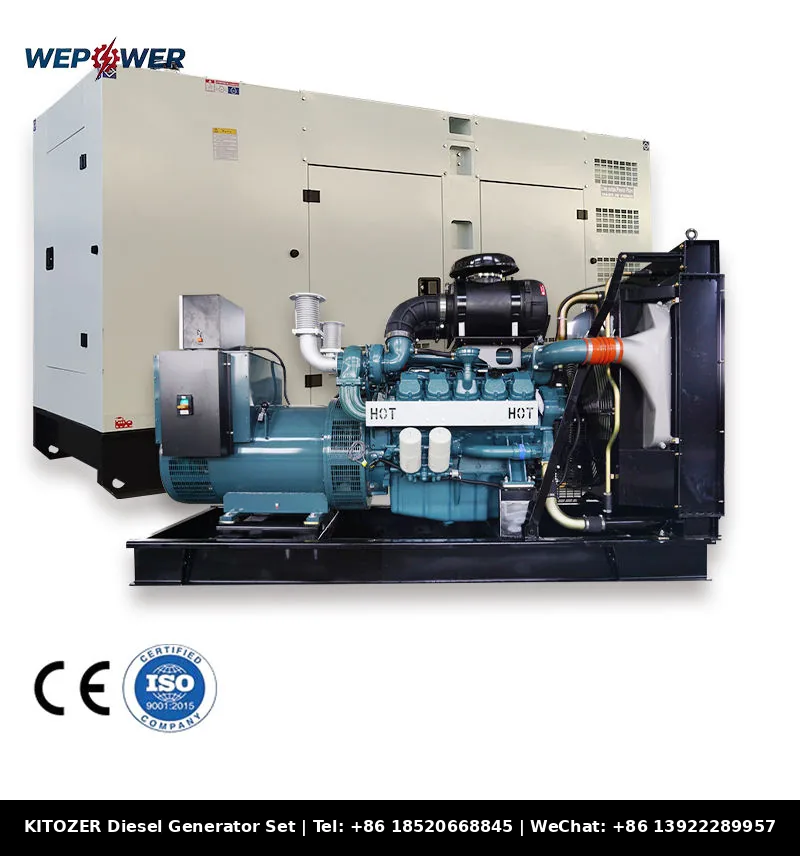
- Open-frame set: bare engine plus alternator plus control panel on a common base, requiring a separate machine room, ventilation, exhaust and noise control. Better cooling, easy maintenance, lower price; but noisy and needs civil works.
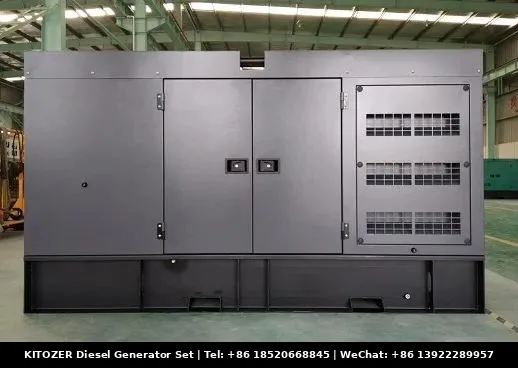
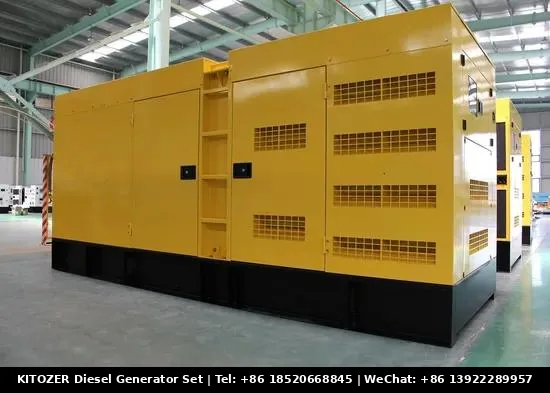
- Silent canopy set: the whole machine is enclosed in a metal canopy lined with acoustic cotton and silencing ducts, integrating the base tank and control panel. Noise 75-85 dB(A); can be placed outdoors or on rooftops directly, no dedicated room needed, fast installation.
- Containerized station: 2-4 sets housed in a standard container, integrating paralleling cabinet, distribution, monitoring and fire fighting. Factory prefabricated, field wiring and ready to run.
5.3 By Automation Level
- Basic type: manual start and manual close, for low-frequency manned use.
- Auto-start (ATS) type: auto-start controller plus ATS, starts and transfers automatically on mains failure, for data centers and hospitals.
- Parallel/grid type: automatic paralleling cabinet, multiple units share a bus and add or drop units by load, for medium/large data centers.
- Remote monitoring type: adds RS485/Ethernet communication to the environmental monitoring system for remote watch, alarm and logging.
5.4 Six-Step Selection
- Enumerate all emergency loads (kW and power factor), distinguishing first-class and second-class loads.
- Apply diversity and demand factors to get the calculated load; reserve 20-30% for 3-5 years expansion.
- Decide redundancy: N, N+1 or 2N; determine the number and rating of units accordingly.
- Check motor starting inrush and non-linear loads such as UPS; oversize the set by 1.5-2x if needed.
- Choose open or canopy form by site (indoor room/outdoor/rooftop); confirm ventilation, exhaust and vibration conditions.
- Set fuel reserve (usually 8-24 hours), protection rating, noise compliance, communication interface and after-sales requirements.
6. Installation Steps
- Foundation: pour a concrete anti-vibration plinth 300-500 mm thick, weighing 1.5-2x the set, with anchor-bolt holes and cable trenches; isolate from the building structure with a separation joint.
- Positioning: lift the set onto the foundation, align anchor bolts, level it (error <=0.1 mm/m), install vibration isolators and perform secondary grouting.
- Fuel piping: connect base tank to day tank and transfer pump; use seamless steel or oil-resistant hose with manual/automatic shutoff valves, water-oil separator and filter; pressure-test for no leaks.
- Exhaust piping: connect flexible bellows, exhaust silencer and pipe to outside; support with spring hangers; wrap with aluminum silicate insulation and aluminum cladding; route the outlet away from intakes and personnel.
- Cooling and ventilation: connect radiator air guide; inlet area >=1.5x radiator area, outlet >=1.2x; fit acoustic louvers to create negative-pressure exhaust.
- Electrical wiring: alternator output through main breaker to ATS/paralleling cabinet; route mains and generator cables in separate trenches; handle neutral per TN-S; protective earth <=4 ohm; shield control cables separately.
- Control and communication: wire controller start/stop signals to ATS, RS485/Ethernet to monitoring, battery polarity, oil pressure/water temp/fuel level sensors.
- Fluids: fill specified engine oil, long-life antifreeze and diesel; bleed air from the fuel system.
- Initial check: barring for freedom; torque all connections; reset emergency stop; set controller parameters (voltage, frequency, protection settings, transfer delay).
- No-load run: start manually, watch oil pressure, water temp, exhaust and noise; run 15-30 minutes and log parameters.
7. Commissioning Methods
7.1 No-Load Commissioning
Start the set and check oil pressure (0.3-0.5 MPa), rising water temperature, normal exhaust and no abnormal noise. Adjust the electronic governor to steady 1500 rpm and 50 Hz; adjust the AVR to 400 V no-load.
7.2 Loaded Commissioning
Step-load with a load bank at 25/50/75/100%, 15-30 minutes each step; measure three-phase voltage/current, frequency, water temp, oil temp, oil pressure and fuel consumption; observe stability with load.
7.3 Sudden Load Step Test
Apply 100% load suddenly and record the instantaneous voltage dip and recovery (require dip <=15%, recover in 1.5 s); then shed full load and record the voltage rise and recovery. This is the key test of the set's ability to handle impact loads.
7.4 Auto-Start and Transfer Test
Simulate mains failure and verify the set starts within the set time and the ATS transfers automatically; simulate mains recovery and verify delayed transfer back and cool-down shutdown. Repeat three times, all must succeed.
7.5 Paralleling Commissioning
Synchronize units one by one; check inrush-free closing; after loading check active/reactive load sharing deviation (<= +/-5%); simulate one-unit trip and verify the others carry the load and reverse-power protection operates.
7.6 Protection Verification
Simulate high water temp, low oil pressure, overspeed, over/under voltage, overcurrent; verify correct alarm and shutdown; check audible/visual alarm and remote SMS push.
8. Daily Maintenance
8.1 Rounds (per shift/day)
- Control panel shows no alarm; set is in auto standby.
- Check oil, coolant and fuel levels; top up as needed.
- Check battery voltage and float-charge current; terminals tight and clean.
- Visually check for oil, water and air leaks; room ventilation and lighting OK.
- Record mains status, room temperature/humidity and cumulative run hours.
8.2 Monthly
- Loaded run 30-60 minutes at 30-50% load; log parameters.
- Drain water from fuel tank and water-oil separator.
- Clean the air filter indicator; replace when needed.
- Check belt tension, hose joints and vibration isolators.
- Test audible/visual alarm and ATS transfer.
8.3 Quarterly
- Run a near-full-load trial to verify real capacity.
- Check battery specific gravity/voltage; equalize charge if needed.
- Verify protection settings and alarm thresholds.
- Clean radiator fins of dust and lint; check air path.
8.4 Annual
- Replace oil, oil filter, fuel filter and air filter.
- Replace coolant; test freezing point and pH.
- Calibrate injectors and high-pressure pump; check valve clearance.
- Measure alternator insulation (>=2 MOhm); check AVR and excitation.
- Battery capacity test; replace if aged; compile the year’s records and issue a maintenance report.
8.5 Consumable Replacement Intervals
| Part | First change | Routine change |
|---|---|---|
| Oil/oil filter | 50 h | Every 250 h or 6 months |
| Fuel filter | 50 h | Every 500 h |
| Air filter | – | Every 500 h or per indicator |
| Coolant | – | Every 2 years |
| Starter battery | – | Every 2-3 years |
| Injectors/pump | – | Calibrate every 2000-3000 h |
9. Common Faults and Troubleshooting FAQ (65 Questions)
Q1. What is the difference between standby power and prime power?
Standby power (ESP) is the maximum power available for 1 hour out of every 12-hour period for emergency use when the utility fails; continuous overloading is not allowed. Prime power (PRP) is the maximum power available for unlimited hours under variable load, with a 10% overload allowed for 1 hour in every 12. Data centers usually select by standby power; remote sites and mines select by prime power.
Q2. What applications suit 50kW to 2000kW sets?
50-150kW suits small rooms, clinics, shops, villas and small offices; 200-600kW suits medium data centers, hotels, hospitals and malls; 800-1200kW suits large data centers, parks and hospitals; 1500-2000kW suits hyperscale centers, fabs, airports and metro substations.
Q3. What is wrong with oversizing a set?
Chronic low load (below 30%) causes poor combustion, carbon buildup, oil dilution and wet stacking, shortening life. Keep the normal load ratio between 50% and 80%.
Q4. Why N+1 or 2N redundancy?
N+1 adds one spare unit beyond the N needed for full load, so the rest carry the load if one fails or is serviced. 2N is two fully independent parallel systems; each alone carries 100%, meeting Tier IV high availability.
Q5. How long from start to full load?
Self-starting sets start within 3-5 seconds of a mains-loss signal and close within 15 seconds; fast-start data-center sets can carry load within 10 seconds.
Q6. What is ATS?
The Automatic Transfer Switch switches load between mains and generator. On mains failure it signals the generator to start; once voltage/frequency are stable it transfers the load; on mains recovery it switches back after a confirmation delay and cools the set down.
Q7. ATS vs STS?
ATS is a mechanical switch with tens to hundreds of milliseconds transfer, fine for lighting and普通 power. STS is a static semiconductor switch with 4-8 ms transfer, for IT loads and life-support equipment that cannot tolerate any interruption.
Q8. Should I test-run the set every day?
No. Daily no-load running is harmful. Do a loaded test every month (30-60 min at 30-50% load) and a near-full-load test every quarter.
Q9. How long does the base tank last?
The integral base tank usually lasts 4-8 hours at full load. The room day tank and oil tank should reserve 8-24 hours for data centers, with an external filling point.
Q10. How to choose diesel grade?
By lowest ambient: 0# above 4C; -10# above -5C; -20# above -14C; -35# above -29C; -50# above -44C. Add fuel preheaters in cold regions.
Q11. What causes white exhaust smoke?
Unburned or partly burned fuel vapor: cold start poor atomization, dripping injectors, small injection advance, low compression, or coolant entering the cylinder. If it persists when warm, check the injection system and compression.
Q12. How to fix black smoke?
Rich fuel with insufficient air: clogged air filter, turbo fault, dripping injectors, sudden load step, poor fuel, wrong valve clearance. Change the air filter, check the turbo, calibrate injectors, check valves.
Q13. What is blue smoke?
Oil entering the combustion chamber: worn piston rings, liner scoring, aged valve seals, overfull oil, or turbo seal failure. Blue smoke with rising oil consumption must be repaired.
Q14. Low oil pressure, what to do?
Check oil level and grade; check filter blockage, bypass valve, oil pump wear, bearing clearance and cooler leaks. Low pressure when cold may be normal; below the lower limit at warm idle must be shut down.
Q15. High water temperature / overheating?
Reduce load or stop; never open the radiator cap immediately. Check coolant level, belt tension, thermostat, radiator blockage, water pump, sensor accuracy and ventilation. Use antifreeze in winter.
Q16. Why noise treatment?
Diesel noise reaches 100-110 dB(A), far above environmental limits (day 60, night 50 dB). Use silent canopies, intake/exhaust silencers, base vibration isolation and acoustic wall lining.
Q17. Consequences of insufficient ventilation?
Heat island effect, high intake air temperature causing derating, and insufficient combustion air causing black smoke and high exhaust temp. Inlet area >=1.5x radiator, outlet >=1.2x, with an air guide.
Q18. Why a concrete anti-vibration plinth?
Strong vibration from the engine would transfer to the structure, causing resonance, noise and pipe breakage. The plinth weighs 1.5-2x the set, 300-500 mm thick, isolated from the building.
Q19. What does paralleling mean?
When one set cannot meet the load or needs flexibility, two or more sets run in parallel on a common bus through a paralleling cabinet. Units add or drop automatically by load, improving efficiency and maintenance flexibility.
Q20. Paralleling conditions?
Equal voltage, equal frequency, matching phase, correct phase sequence. The automatic synchronizer detects and adjusts, then closes. Active and reactive load are then shared automatically.
Q21. What is an auto-start system?
The controller (DSE, SmartGen, ComAp) starts the set on mains loss and, with the ATS, transfers load automatically. It also supports remote monitoring, SMS alarm, run logging and periodic self-test for unattended operation.
Q22. Common controller brands?
Imported: Deep Sea Electronics DSE (UK), ComAp (Czech), SmartGen (China), Bernini (Italy). Data centers often use DSE8610/7320 or ComAp Inteli series with CAN bus and Modbus/SNMP.
Q23. Can the set drive motor loads directly?
Direct motor starting draws 5-7x rated current, a huge shock. Use soft-start, VFD or star-delta for large motors; otherwise voltage collapse and tripping result. Motor starting capacity should not exceed 30% of set capacity.
Q24. Why neutral handling?
Low-voltage generator neutral grounding affects single-phase fault protection and safety. Data centers use TN-S; generator neutral must switch at the ATS from mains neutral to avoid paralleled neutrals and stray current.
Q25. Oil change interval?
First change at 50 hours (new or overhauled); then every 250 hours or 6 months. Fuel filter every 500 hours; coolant every 2000-3000 hours or yearly. Follow the manual and oil analysis.
Q26. Why not plain water in coolant?
Minerals in tap water scale the water jacket, reducing cooling and corroding the block and radiator. Use long-life ethylene-glycol antifreeze mixed to the local freezing point with corrosion inhibitor, replaced every 1-2 years.
Q27. Hard cold starting?
Add oil preheater, jacket water heater (keeping block at 30-50C), fuel heater, battery insulation, low-cloud-point diesel and winter oil. Data centers standardly fit jacket water heaters.
Q28. Weak starter battery consequences?
Weak batteries cause failure to start or even failure at the critical moment. Use adequate lead-acid or lithium batteries with float chargers; check monthly; replace every 2-3 years.
Q29. Why turbocharging?
It uses exhaust energy to drive a compressor, charging denser air for more power, lower fuel use and emissions. It is standard on high-power sets.
Q30. 50Hz vs 60Hz?
50Hz is 1500 rpm (4-pole), China mains; 60Hz is 1800 rpm, Americas and some regions. Voltage/frequency must match the load; for export projects choose by destination grid.
Q31. IP23 / IP44 meaning?
IP23 protects against >12.5mm solids and dripping water, for indoor rooms. IP44 protects against >1mm solids and splashing, for outdoor canopies (often IP44-IP54).
Q32. What is a silent canopy?
A metal enclosure lined with acoustic cotton and silencing ducts, integrating base tank and control panel, cutting noise to 75-85 dB at 1 m. It can sit outdoors or on a roof without a dedicated room.
Q33. Open vs silent?
Open for a dedicated room with O&M and good cooling; silent canopy for outdoor placement, noise-sensitive or fast deployment.
Q34. Why load-sharing test after paralleling?
Uneven sharing causes one set to overload and trip while another runs light or even motorizes. Active (governor) and reactive (AVR) adjustment keeps sharing within +/-5%.
Q35. What is reverse power?
When a paralleled set faults or slows and absorbs power from the grid, becoming a motor. Reverse-power protection trips it to prevent the engine being driven out and damaging the turbo.
Q36. Why insulate exhaust pipes?
Exhaust reaches 400-600C, risking burns, fire and extra room heat. Wrap with silicate wool and aluminum cladding to keep surface below 60C, away from cables and fuel.
Q37. Does long standby ruin a set?
Yes. Batteries self-discharge, fuel oxidizes (diesel keeps only 3-6 months), seals age and tank bottoms collect water. Do loaded tests, charge batteries, change oil/filters and drain water regularly.
Q38. Why does fuel degrade?
Diesel oxidizes and polymerizes over storage, forming gums and sediment that clog filters; tank breathing condenses water and grows microbes. Keep stored diesel under 6 months; add stabilizer and drain water.
Q39. Noise complaint remediation?
Add a second-stage exhaust silencer, acoustic wall panels, ventilation silencing louvers, base isolation, restrict night testing, re-route the outlet, or replace with a quieter set. Have a third party measure boundary noise.
Q40. Fuel consumption of a 1000kW set?
Specific consumption is about 0.21-0.25 L/kWh at full load. A 1000kW set burns roughly 210-250 L/h at full load and 130-160 L/h at half load.
Q41. Why is the genset the last power level?
The chain is mains to UPS to IT load. The UPS bridges seconds to minutes; the genset carries minutes-to-hours long-term backup against grid maintenance, typhoons and ice storms.
Q42. How do UPS and generator coordinate?
The UPS bridges the mains-failure to generator-stable gap (15-30 s) with zero interruption; the generator then supplies and recharges the UPS battery. They hand off seamlessly by capacity matching and transfer logic.
Q43. Can it drive rectifier non-linear loads?
Yes, but consider harmonics. Rectifiers, UPS and VFDs produce harmonics that distort voltage, raise neutral current and heat the machine. Use brushless/PMG alternators, harmonic filters and oversized neutrals.
Q44. What is an AVR?
The Automatic Voltage Regulator adjusts excitation from output voltage, holding voltage within +/-1.5% and providing forced excitation on sudden steps for fast recovery.
Q45. Brushless vs brushed alternator?
Brushed uses carbon brushes that wear and need slip-ring maintenance; brushless removes brushes, using a rotating rectifier for maintenance-free high reliability. Modern sets are all brushless.
Q46. Why oversize the set with UPS?
UPS rectifier charging is an impact non-linear load. Engineer 1.5-2x the UPS rating for the generator, or choose a well-regulated machine, to avoid voltage collapse causing UPS low-voltage trip.
Q47. Fire protection in the genset room?
A diesel-fire-risk room should use gas suppression (FK-5-12/IG541) or water mist, never water sprinklers on oil fires. Fit oil-temperature and smoke dual detection, ventilation interlock and quick fuel shutoff.
Q48. Why insulation monitoring?
IT or unearthed systems need insulation monitoring to alarm on declining earth insulation before a single fault becomes a phase-phase short, protecting continuity and safety.
Q49. What technical clauses in the contract?
Define standby/prime power and standards (GB/T 2820 or ISO8528), engine and alternator brands, controller config, protection rating, noise, spares list, warranty, installation/commissioning/training, acceptance standards and documentation.
Q50. Typical warranty?
Usually 1 year or 1000 running hours (whichever first); main engine/alternator may extend. Data-center projects often require 2 years or 2000 hours with 7×24 response and 48-hour site arrival.
Q51. KITOZER power range?
KITOZER diesel sets cover 50kW to 2000kW standby (62.5-2500kVA), including open, silent, paralleling and high-voltage forms for data centers, industry, commerce and hospitals.
Q52. Acceptance tests?
Visual and install check, insulation test, no-load voltage/frequency, sudden load step, three-phase balance, auto-start/transfer, parallel load sharing, continuous 2-hour full load, protection simulation, noise and fuel measurement.
Q53. What is a sudden load step test?
It simulates sudden application/shedding of load to test dynamic voltage/frequency recovery. At 100% step, voltage dip must not exceed 15% and recover in 1.5s; frequency fluctuates within +/-10% and stabilizes quickly.
Q54. Daily checklist?
Mains status, set standby state, battery voltage/float current, fuel level, oil level, coolant level, leaks, room temp/humidity, ventilation, alarm history, control panel clear.
Q55. Monthly service?
Loaded run 30-60 min, check battery specific gravity, clean air filter, drain fuel/water separator, check hoses and vibration, test audible alarm and ATS, check exhaust and isolation.
Q56. Annual service?
Change oil/filters, coolant, calibrate injectors/pump, measure insulation, check valve clearance, verify protection settings, full-load run, battery capacity test, compile records and issue the annual report.
Q57. Frequent false alarms?
Distinguish real faults from sensor drift, loose wiring or poor grounding. Troubleshoot temperature, pressure and level sensors and harnesses; check controller parameters and thresholds; replace sensors as needed.
Q58. Unstable output voltage?
Check AVR, excitation winding and rotating rectifier diodes, speed stability (governor/throttle actuator), load fluctuation, loose wiring and three-phase unbalance.
Q59. Reverse-power trip after paralleling?
Check the tripped unit’s governor, fuel system, speed signal and synchronizer; confirm uneven sharing or insufficient output. Adjust sharing and repair before re-paralleling.
Q60. Emergency: set does not start on outage?
Switch to manual control; check control power/battery, fuel valve open, emergency stop released, alarm latch. Try a manual start; if it fails, start the spare unit or a mobile generator truck and call service.
Q61. When to overhaul?
Rising oil consumption (blue smoke), low compression, power loss, black/blue smoke, high crankcase blow-by, abnormal noise and fuel consumption. Usually 15000-25000 hours or 8-10 years depending on maintenance.
Q62. High-voltage (10kV) vs low-voltage (400V)?
Above 1500kW, long distance or large centralized paralleling, use 10kV/10.5kV high-voltage sets to reduce current and line loss. Medium/small and close-in distribution use 400V.
Q63. Export/overseas notes?
Voltage/frequency (50/60Hz, 400/480/380V), emission rules (EPA/EU Stage), certification (CE/ISO), fuel sulfur levels, shipping/lifting, local O&M spares, language and after-sales. KITOZER customizes for export.
Q64. Why double containment and level alarm on the base tank?
A leak pollutes the room and risks fire. Use a secondary drip pan, high/low level alarms linked to monitoring, preventing dry running and overflow. Keep tank fuel under 8 hours; beyond that use a separate oil tank.
Q65. How to connect to environmental monitoring?
Via the controller’s RS485 Modbus RTU or Ethernet Modbus TCP/SNMP, uploading run state, voltage/current/frequency, water/oil temp, fuel level, alarms and run hours to the DCIM with remote SMS push.
10. Applications
10.1 Data Centers
Data centers are the most typical application. A medium center usually configures 2-4 paralleled 800-1600kW sets in N+1 redundancy, carrying all IT load plus cooling, fire and lighting. The sets coordinate with dual-bus UPS to achieve over 99.99% power availability.
10.2 Hospitals
Operating departments, ICU, emergency and lab equipment demand continuous power. The set starts within seconds on mains loss to keep life-support running. A large tertiary hospital often uses 2-3 paralleled sets for the whole campus.
10.3 Telecom and Data Rooms
Remote or in-building base stations use small sets or oil machines with power systems and batteries to keep communications up; urban core rooms use medium/large sets.
10.4 Industry, Mining and Oil
Mines, oil fields and drilling rigs off the grid use gensets as prime power (PRP), running continuously with high reliability and fuel efficiency requirements.
10.5 Commercial Complexes and High-Rises
Fire elevators, fire pumps, weak-current rooms and emergency lighting are first-class loads requiring backup power; the genset supports fire fighting and basic operation.
10.6 Emergency and Military Support
Command vehicles, mobile shelters and field support use silent canopies or vehicle-mounted sets for fast, low-noise, hidden deployment.
11. Reference Prices
Below are market reference prices for KITOZER diesel generator sets (RMB, tax included, ex-works; exchange about 1 USD = 7.2 CNY; USD reference shown after x2 conversion). Actual prices vary with configuration, engine brand, paralleling, shipping and installation.
| Power class | Open reference (RMB) | Silent canopy (RMB) | USD reference (approx.) |
|---|---|---|---|
| 50kW | 38,000-55,000 | 55,000-78,000 | $10,500-$15,600 |
| 100kW | 65,000-95,000 | 95,000-135,000 | $18,000-$27,000 |
| 200kW | 120,000-180,000 | 180,000-260,000 | $36,000-$52,000 |
| 400kW | 260,000-380,000 | 380,000-520,000 | $76,000-$104,000 |
| 600kW | 420,000-580,000 | 580,000-780,000 | $116,000-$156,000 |
| 800kW | 580,000-820,000 | 820,000-1,100,000 | $164,000-$220,000 |
| 1200kW | 950,000-1,350,000 | 1,350,000-1,800,000 | $270,000-$360,000 |
| 1600kW | 1,400,000-1,950,000 | 1,950,000-2,600,000 | $390,000-$520,000 |
| 2000kW | 1,900,000-2,600,000 | 2,600,000-3,400,000 | $520,000-$680,000 |
Note: paralleling cabinet, ATS, remote monitoring, high-voltage sets and container stations are quoted separately; turnkey supply including transport, installation, commissioning and training is costed separately. These are reference prices; a formal quotation applies.
12. Why KITOZER
- Full power coverage: 50kW-2000kW in open, silent, paralleling and high-voltage forms, one stop from base stations to hyperscale centers.
- Selected key components: world-class or top domestic diesels, brushless self-excited H-class alternators, precise AVR and good dynamic performance.
- Intelligent paralleling and monitoring: digital controllers with Modbus/SNMP to DCIM, automatic load sharing, unattended remote alarms.
- Strict factory testing: every set undergoes no-load, step-load, sudden-step and protection tests with a factory report.
- Turnkey delivery: load calculation, selection, civil works, installation, commissioning and training.
- Responsive after-sales:整机 warranty, 7×24 technical response, common spares, fast site arrival.
13. Contact Us
For a KITOZER diesel generator selection, quote or site survey, please contact:
- Company: Guangzhou Lian Intelligent System Development Co., Ltd.
- Address: Chaotian Park, Zhongrun Industrial Park, No.5 Huashan Road, Shilou, Panyu, Guangzhou, China
- Tel: +86 18520668845 (WeChat same)
- Mobile/WeChat: +86 13922289957
- WhatsApp: +1 906-853-4140
- Web: lain.com.cn (Chinese), gdlain.com (English)
We will provide a tailored configuration and reference quote based on your load list, site conditions and redundancy requirements.
14. Engineering Design in Depth
14.1 Load Calculation and Capacity
Backup capacity is not a simple sum of nameplate ratings. First-class loads (fire, security, IT, operating rooms, emergency lighting) must be included; second-class loads by importance; third-class (general AC, lighting, office outlets) usually excluded or partly included. Use the demand-factor method: calculated load = sum of (equipment rating x demand factor x diversity factor). Add motor starting factor. Reserve 20-30% for expansion and set N+1 or 2N redundancy.
14.2 Power Architecture
A typical data center: two 10kV utility feeds step down to 400V, feed low-voltage switchgear, then UPS input and UPS output bus to column cabinets and IT racks. The generator low-voltage bus ties with the mains bus via an ATS/breaker; on mains failure the generator takes over all first-class loads. The generator and mains are strictly interlocked and never paralleled unless specifically designed for grid tie. The UPS buffers in the middle; the generator is long-term backup.
14.3 Earthing and Lightning Protection
Data centers use combined earthing at <=1 ohm. The generator neutral switches at the ATS from mains neutral to avoid paralleled neutrals. Low-voltage buses fit surge protective devices (SPD); exhaust pipes, metal cable trays and equipment enclosures are bonded equipotentially to prevent lightning and switching surges.
14.4 Protection Coordination
The generator output main breaker has long-time, short-time and instantaneous over-current protection plus over/under voltage, reverse power, over/under frequency. Downstream breakers coordinate with the main breaker so a downstream fault trips locally without affecting other loads. Settings are set during commissioning and recorded.
15. Room Process and Civil Works
15.1 Siting and Layout
The genset room should be near the load center for cable routing, on the ground or first basement floor, avoiding roofs with insufficient load capacity. Room height must allow lifting and exhaust routing; leave 1-1.5 m service clearance around units. Separate the control room and oil tank room with fire doors.
15.2 Ventilation and Cooling
The radiator rejects heat drawn by the belt-driven fan; hot air must exit outside. Intake draws fresh cool air through acoustic louvers and dust screens; outlet connects directly to the radiator shroud. Room air changes should be at least 12 per hour; summer intake should not exceed 35C, otherwise the set derates.
15.3 Noise Control
Comprehensive treatment: acoustic wall panels and ceiling, silencing ducts on intake/exhaust, two-stage exhaust silencers, base vibration isolation, acoustic doors/windows. Aim for below 75 dB outside the room at 1 m and compliance at the boundary.
15.4 Fire Design
The generator room is Class C fire risk: dual smoke+heat detection, FK-5-12 gas or water mist suppression (never direct water on oil fires), oil-temperature/smoke interlocked accident ventilation and quick fuel shutoff. The oil tank room is separately fire-separated with explosion-proof lighting and accident ventilation.
16. Common Engineering Mistakes
- Summing nameplate ratings without demand/diversity factors, wasting capacity.
- Using standby power as prime power for long continuous runs and overloading.
- Ignoring UPS rectifier surge and undersizing the set, causing voltage collapse.
- Insufficient intake/exhaust area causing hot-air recirculation and high-temperature derating.
- Exhaust pipes without insulation or vibration isolation, causing burns and pipe breakage.
- Improper neutral handling, paralleling mains and generator neutrals and creating stray currents.
- Only no-load tests over time, causing severe carbon buildup and failure at the critical moment.
- Ignoring parallel load sharing, one unit overloads while another motorizes.
- Fuel never changed, degrading and clogging filters.
- Batteries neglected, failing to start at the critical moment.
17. Acceptance Test Checklist
| No. | Test item | Acceptance criterion |
|---|---|---|
| 1 | Insulation resistance | >=2 MOhm |
| 2 | No-load voltage/frequency | 400V/50Hz, steady deviation <=+/-1% |
| 3 | Step load | 25/50/75/100% run normally |
| 4 | 100% sudden step | Voltage dip <=15%, recover 1.5s |
| 5 | Auto-start/transfer | 3/3 successes, on time |
| 6 | Parallel load sharing | Deviation <=+/-5% |
| 7 | Protection functions | Alarms and shutdown correct |
| 8 | Continuous full load | 2h no fault |
| 9 | Noise | Meets design and environmental limits |
| 10 | Fuel consumption | Reasonable vs rated specific consumption |
18. O&M Management
Build a maintenance file: equipment ledger, as-built drawings, operating procedures, maintenance plan, inspection records, fault records and spares list. Run daily rounds, monthly service, quarterly trials and annual overhaul. Record every mains transfer and start: reason, duration, parameters, fuel. Keep critical spares (batteries, filters, sensors) in stock. Operators hold certificates and drill emergency start and paralleling. Run a full third-party load test yearly and issue an annual assessment to keep the set ready to answer the call.
19. Standards and Codes
Design, manufacture, installation and acceptance follow national and industry codes. GB/T 2820 (equivalent to ISO 8528) defines rating, performance classes (G1 general, G2 lighting/power, G3 precision electronic loads), test methods and technical requirements. GB 50052 covers load classification and backup power. GB 50174 covers data center design with specific genset capacity, redundancy, layout and fuel reserve. GB 50462 covers data center infrastructure installation and acceptance. GB 50016 covers fire separation, oil tank room and suppression. The technical agreement must cite these as acceptance basis.
20. Load Classification
Per GB 50052, loads are three classes by reliability impact. First-class loads are those whose interruption causes casualties, major political/economic loss or serious public disorder: hospital operating departments, key telecom rooms, data centers, fire control. Second-class cause larger loss or affect important users. Third-class are general. Specially important first-class loads (data center IT, life support) need two utility feeds plus self-provided emergency power (genset or UPS) that engages immediately. The genset carries minute-plus long-term backup; the UPS carries second-class uninterrupted.
21. Fuel System Design
Reserve time is calculated at full load. With power P (kW) and specific consumption g (L/kWh), hourly fuel Q=P*g. For T hours reserve, V=Q*T. A 1000kW set at 0.23 L/kWh burns 230 L/h; 24 hours needs 5520 L. The base tank holds only 4-8 hours; the rest comes from an outdoor oil tank. The day tank should not exceed 8 hours of room usage and needs a spill containment pan. The transfer pump fills the day tank in 10-15 minutes. Use double-wall or sealed piping with welded seamless joints.
22. Ventilation Calculation
The engine rejects heat mainly through the radiator, roughly 30-35% of power. A 1000kW set rejects about 350kW of heat to be vented. Inlet area is sized for 3-5 m/s air speed; outlet is slightly smaller. Room air changes are at least 12/h. Each 10C rise in intake air derates output 1-2%. The air shroud must route radiator hot air straight outside, never recirculating within the room.
23. Noise Engineering
Noise sources: intake, exhaust, combustion, mechanical, fan. Exhaust is loudest (up to 110 dB), needing two-stage silencers; intake uses a silencing filter; room walls use acoustic material (>0.6 absorption); base isolation; acoustic doors/windows. Total reduction of 20-30 dB must bring boundary noise to day 60/night 50 dB (industrial) or stricter. Each silencer stage inserts 15-20 dB.
24. Typical Selection Cases
24.1 Case 1: 1000-Rack Data Center
1000 racks at 5kW each = 5000kW IT. Add cooling/distribution/lighting ~2000kW for a 7000kW total. Use 2N: each system carries 3500kW. Each system uses 2x 2000kW paralleled sets (1 duty, 1 standby); four 2000kW sets total on two independent buses. UPS rated for 5000kW IT; generator capacity sized 1.5-2x UPS. 24-hour fuel reserve, independent ventilation shafts, gas suppression and DCIM.
24.2 Case 2: Tertiary Hospital
1500 beds; operating department, ICU, emergency and lab are first-class, calculated at ~1800kW. Configure 2x 1200kW paralleled sets (N+1) on the first basement, with ventilation shafts, 24-hour oil room and FK-5-12 suppression. Coordinate with UPS for zero-interruption operating equipment.
24.3 Case 3: Commercial Complex
80,000 sqm; fire elevators, pumps, weak-current rooms and emergency lighting ~400kW. Configure 2x 250kW paralleled silent canopies outdoors with compliant noise.
24.4 Case 4: Remote Mine Prime Power
Off-grid mine uses gensets as prime power: 2x 800kW paralleled sets run continuously, day tank enlarged to 24 hours, dedicated O&M team, PRP selection.
25. KITOZER Service Process
- Requirements: understand load, site and redundancy.
- Design: load calculation, selection, system diagram, layout.
- Quotation: configuration list, price, lead time.
- Production: assembly, controller programming, factory test.
- Delivery: safe shipping to site.
- Installation: positioning, wiring, commissioning, tests.
- Acceptance: test reports, documentation, training.
- After-sales: in-warranty maintenance, lifelong support.
26. Glossary
| Term | Meaning |
|---|---|
| ESP Standby power | Max power, 1h per 12h, emergency use |
| PRP Prime power | Unlimited hours under variable load |
| ATS | Automatic Transfer Switch |
| STS | Static Transfer Switch, millisecond transfer |
| AVR | Automatic Voltage Regulator |
| N+1 | N duty + 1 standby redundancy |
| 2N | Two fully independent parallel systems |
| Paralleling | Sets synchronize onto a common bus |
| Reverse power | Set absorbs power, becomes motor |
| Black start | First set self-starts after total outage |
| Specific fuel consumption | L/kWh |
| Transient voltage | Dynamic voltage on sudden step |
27. Smart Evolution and Hybrid Power
Diesel sets are evolving from standalone machines into smart nodes. Modern sets upload run data to a cloud platform over Ethernet; O&M staff view state, receive alarms and analyze trends on a phone. Predictive maintenance uses trends in oil consumption, exhaust temp, insulation and starting current to warn of faults early, shifting from reactive to proactive repair. Paralleling systems optimize running unit count by load, cutting fuel and emissions. KITOZER sets standardly provide communication interfaces and smart controllers as a foundation for intelligent O&M.
Under carbon goals, future data center power will hybridize gensets + storage + PV + mains. The genset is the long-duration reliable energy buffer; storage handles frequency regulation and short support; PV supplies green power. The genset starts less often, engaging only when storage and mains fall short, assuring reliability while cutting emissions and fuel. KITOZER is actively building hybrid power solutions so the traditional genset keeps its irreplaceable backstop role in the new power system.
28. Technical Consulting Support
Whether you are in conceptual design, preliminary design, bidding, construction or O&M, KITOZER provides matching support: load estimation and selection principles in concept; system diagrams and equipment lists in preliminary design; technical specifications and reference parameters in bidding; installation and commissioning guidance in construction; and maintenance and fault support in O&M. Our engineering team empowers every stage with solid experience. Contact us for a project-specific diesel generator solution.
29. Product Series Summary
The KITOZER diesel generator line spans KTZ-50 to KTZ-2000 in power, with open (O), silent (S), paralleling (P) and container (C) series, plus ATS cabinet, paralleling cabinet, low-voltage distribution, oil tanks and silencers. Power factor 0.8, IP23/IP44, H insulation, brushless excitation. Each set is factory-tested with a report. From 50kW small rooms to 2000kW hyperscale stations, KITOZER provides complete selection.
30. Final Call to Action
Choosing KITOZER means choosing a reliable, professional and responsible power partner. Call +86 18520668845 or WeChat +86 13922289957 for a tailored diesel generator configuration and reference quote. We reply within 24 hours of receiving your load list. Guangzhou Lian Intelligent System Development Co., Ltd., Chaotian Park, Zhongrun Industrial Park, No.5 Huashan Road, Shilou, Panyu, Guangzhou. Web: lain.com.cn, gdlain.com. We look forward to building a highly available power system with you.
31. Key Components in Detail
31.1 Diesel Engine
The diesel engine is the heart of the set. KITOZER can select international first-tier or domestic first-tier brands depending on project budget and reliability requirements. Modern diesels universally adopt high-pressure common-rail fuel injection, turbocharging with intercooling, electronic speed control, wet liners and oil coolers. Wet liners ease replacement and repair; electronic governing brings steady-state frequency accuracy to plus or minus 0.5%. The engine carries its own dashboard showing speed, oil pressure, water temp and oil temp. The engine and alternator connect through a high-flexibility coupling that compensates installation error and buffers vibration.
31.2 AC Synchronous Alternator
The alternator uses brushless self-excitation (or permanent-magnet excitation), H-class insulation, salient-pole rotor, three-phase star stator winding with neutral引出. The AVR holds steady-state voltage within plus or minus 1% with fast sudden-step recovery. The alternator has a built-in space heater (energized on standby) against condensation. Bearings are sealed maintenance-free or force-lubricated for large units.
31.3 Control System
The controller is the brain. KITOZER can fit DSE, SmartGen or ComAp controllers. It collects mains and set electrical parameters, water/oil temp, oil pressure and fuel level; executes auto-start/transfer, protection shutdown, alarm logging and communication upload. Paralleling projects use a paralleling controller for automatic synchronism and load sharing. The touchscreen shows Chinese/English menus with password-protected settings.
31.4 Fuel System
The fuel system includes the base tank, day tank, transfer pump, water-oil separator, fuel filter and high/low pressure lines. The base tank integrates with the set for 4-8 hours. The day tank sits in the oil room and is auto-filled by the transfer pump. The separator drains condensate to protect the high-pressure pump. Drain water and change filters regularly.
31.5 Cooling and Ventilation
The water-cooled radiator is belt-driven by the engine with an electronic or mechanical fan. Intake draws fresh air through acoustic louvers; hot air exits directly outside through the shroud. In cold regions add a cold-weather shutter in front of the radiator to prevent over-cooling.
31.6 Exhaust System
The exhaust system consists of a bellows (vibration isolation), a two-stage exhaust silencer, exhaust pipe and insulation. The bellows compensates displacement and vibration; the silencer cuts noise; insulation prevents burns and heat load. The outlet routes outside to a safe position.
31.7 Starting and Energy Storage
The starting system is lead-acid (or lithium) batteries, a float charger and a starter motor. The float charger keeps batteries full on mains; the starter motor is DC-driven. Battery capacity is chosen for starting current and cold derating, usually 30-50% above room-temperature demand. Batteries are replaced every 2-3 years.
32. Operating Procedures
32.1 Pre-Start Check
Before starting confirm: oil, coolant and fuel levels normal; battery voltage normal; emergency stop released; no leaks in the room; exhaust and ventilation normal; controller has no historical alarms; all switches in correct position. Confirm the load-side breaker is open to avoid starting under load.
32.2 Manual Start
Set the controller to manual and press start; the engine fires. Watch oil pressure rise immediately, speed stabilize, exhaust normal. Idle to warm for a few minutes, raise to rated speed, confirm voltage/frequency, then close to supply.
32.3 Automatic Operation
Set the controller to auto and the set enters auto-standby. On mains failure it starts and closes; on mains recovery it transfers back and cools to shutdown. No manual intervention is needed during daily operation, only rounds.
32.4 Normal Shutdown
First shed the load, open the close breaker, let the set run unloaded for 3-5 minutes to cool, then press stop. Avoid sudden shutdown causing heat buildup. In an emergency press the emergency stop to cut fuel immediately.
32.5 Emergency Shutdown
On overspeed, oil/water pipe rupture, fire or personnel danger, press the emergency stop immediately to cut fuel. Afterwards find the cause, reset, then restart.
33. Safety Notes
- Rotating parts and hot exhaust are burn/injury hazards when running; keep distance.
- De-energize, lock out and test voltage before live maintenance.
- Keep the room ventilated to prevent exhaust buildup and suffocation.
- No open flame near fuel; keep fire extinguishers ready.
- Battery electrolyte is corrosive; wear protective gear.
- Exhaust is hot; do not store combustibles nearby.
- Never bypass safety protection to force running.
- Operators hold certificates and know emergency procedures.
34. Deep Technical Analysis
34.1 Diesel Engine in Depth
The diesel is a compression-ignition engine. Unlike the spark-ignition gasoline engine, the diesel compresses high-pressure air (500-700C) and injects atomized diesel that self-ignites. This gives high thermal efficiency (40-45%), better fuel economy and safer fuel with a high flash point, suiting high-power stationary duty. Modern common-rail systems run injection at 1600-2000 bar with ECU-controlled timing and quantity, enabling pilot, main and post injection for smoother, cleaner combustion.
Each four-stroke cycle turns the crankshaft two revolutions (720 degrees); only the power stroke delivers energy, the other three rely on flywheel inertia. Multi-cylinder engines fire alternately for smoother output. Cylinders are inline or V-arranged; high-power sets use V8, V12 and V16 to shorten length and balance vibration.
Charging is key for high power. Exhaust drives a turbine on the same shaft as a compressor, doubling intake density and hence power with the same displacement. The intercooler cools the charged air, further raising density and lowering thermal load. Charging plus intercooling greatly improves power density, fuel economy and emissions.
The lubrication system not only reduces friction but cools pistons, cleans wear debris, seals cylinder walls and prevents corrosion. Oil works at high temperature and pressure, gradually oxidizing, thinning and forming carbon, so it must be changed regularly. Use manufacturer-specified oil (e.g. CI-4 grade).
The cooling system maintains the best working temperature. Coolant absorbs heat in the jacket and is cooled by the radiator with fan air. The thermostat controls the small circuit for fast warm-up and the large circuit once hot. Use long-life antifreeze mixed to the local freezing point; test freezing point and pH periodically.
34.2 Synchronous Alternator in Depth
The synchronous alternator has a fixed stator with three-phase windings and a rotating field rotor. The rotor driven by the engine produces a synchronous rotating field that induces symmetrical three-phase EMF in the stator. Frequency f=pn/60. A 50Hz four-pole machine runs at 1500 rpm.
The brushless self-excited alternator removes traditional brushes and slip rings. It carries a small exciter whose armature on the rotor outputs AC, rectified by a rotating rectifier into DC for the main field. This both eliminates brush maintenance and improves reliability. The AVR measures output voltage and adjusts exciter field current to hold output.
The AVR also provides forced excitation, rapidly boosting excitation on load steps to suppress voltage dip; it supplies reactive droop for parallel sets; and it has under-speed and over-current protection. Modern AVRs are digital with communication-settable parameters.
Alternator insulation is H-class (180C) with vacuum pressure impregnation (VPI) for moisture and dust resistance. Bearings are sealed ball bearings or sleeve bearings; large units use forced lubrication. A space heater energizes on standby to prevent condensation.
34.3 Control System in Depth
The modern set controller is an embedded industrial computer. It collects mains and set voltage, current, frequency, power and power factor, plus water/oil temp, oil pressure, fuel level and battery voltage as analog inputs; it performs logic and protection; it outputs start/stop, close and alarm. It has a touchscreen showing run parameters and alarms, with password protection.
The controller has protections: high water temp, low oil pressure, overspeed, over/under voltage, over/under frequency, overcurrent, reverse power, start failure, emergency stop. Actions split into alarm and shutdown levels. Alarm history is queryable. The controller connects to DCIM via RS485 Modbus RTU or Ethernet for remote monitoring.
The paralleling controller adds synchronism and load sharing. The synchronizer detects voltage, frequency and phase between the incoming set and bus, auto-adjusts speed and excitation, and closes when synchronism holds. The load sharer regulates active (speed) and reactive (voltage) so sets share load by rating.
34.4 Fault Tree Analysis
Take ‘set will not start’ as the top event: intermediate events include battery power insufficient (low voltage, loose wiring), fuel system fault (no fuel, valve closed, air in line, filter blocked), starting system fault (starter bad, solenoid bad), control circuit fault (e-stop not reset, controller fault), and mechanical fault (seized). Layer-by-layer tracing locates it.
Take ‘sudden shutdown while running’: possible causes are protection action (high water temp, low oil pressure, overspeed), fuel exhausted, poor battery contact, controller hang, or load short-circuit trip. Check the controller alarm record first to learn the protection cause, then treat accordingly.
35. Energy Saving and Operation Optimization
Operating economy lies in load-ratio management. Chronic low load (<30%) is uneconomical and harmful; use paralleled unit control to keep running sets at 60-80% load. Fuel quality affects consumption and emissions; use qualified diesel. Periodic maintenance keeps the best condition; change air and fuel filters on time. Smart monitoring optimizes test strategy and reduces no-load running.
36. Environmental and Emissions
Modern diesel emissions must meet national and regional rules. Domestic non-road machines follow China III/IV; Europe and America follow EPA and EU Stage. Aftertreatment includes DOC, DPF and SCR. Data-center standby sets run little, so emission rules are relatively relaxed, but in urban areas noise and exhaust dispersion still matter. Route exhaust high for dispersion, away from surroundings.
37. Transport and Lifting
Secure the set during transport; lock vibration isolators; ship the battery separately to prevent short circuits. Lift by designated points, never by pipes. Level after positioning and install isolators. For large units check passage and slab load. Protect against rain, dust and impact.
38. Long Storage and Revival
For long storage: drain fuel or add stabilizer; drain coolant or add antifreeze; remove and separately charge the battery; seal intake and exhaust against moisture; barring periodically; energize checks every six months. On revival, change oil/filters, charge, fully inspect, then put into service.
39. Common Customer Concerns
How long does a set last? By run hours and maintenance, generally 15-20 years or 15000-25000 hours. How often is maintenance? Daily rounds, monthly service, quarterly trials, annual overhaul. How fast can you reach site? 7×24 response, 48-hour arrival for critical faults. Can you customize? Yes, by voltage/frequency, power, protection, paralleling and monitoring. Is there warranty? 1 year or 1000 hours, extendable. Are spares available? Common critical spares are stocked. These are answered clearly during proposal discussions.
40. Room Layout in Detail
A well-laid-out generator room is the foundation of reliable running. It generally comprises the generator room, control panel room, oil tank room, intake shaft and exhaust shaft. Units line one side with 1-1.5 m service clearance and space at the ends to pull the rotor (about 1.5x machine length). The control room is adjacent with a viewing window. The oil tank room is fire-separated with a Class A fire door, accident ventilation and an oil pan.
The intake shaft brings fresh air in low on one side with silencing louvers and dust screens; the exhaust shaft takes hot air high off the radiator side straight outside. Intake/exhaust should form the shortest, lowest-resistance path. The floor slopes 1% to an oil collection trench with oil-water separation. Fit emergency lighting and evacuation signs.
Cables run from the set output via cable trays to the ATS and paralleling cabinet; power and control cables are in separate trays. The earthing bus runs around the room; set enclosures, trays and metal pipes all bond to it. The exhaust pipe exits via bellows, silencer and through the roof with waterproofing and insulation.
41. Installation Craft Points
Before positioning, verify foundation dimensions, anchor positions and level. Lift using dedicated points, never pipes. Use shim iron to level after placement and do secondary grouting. Re-check level after isolator installation. Fuel piping uses seamless steel, welded and pressure-tested; water lines use rubber hose to compensate vibration; exhaust uses flanged joints with high-temperature gaskets.
Electrical wiring has correct phase sequence and clear color. For large-current multi-parallel cables, keep equal length and twist direction to reduce circulation. Control signal wires are shielded with the shield grounded at one end. Crimp all terminals firmly and label clearly. After wiring, check phase and measure insulation.
42. Commissioning Report Template
The commissioning report includes: project overview, equipment list, commissioning standards, environment, no-load data (voltage/frequency/speed/water temp/oil pressure), step-load data at 25/50/75/100% (voltage/current/frequency/water temp/fuel), sudden-step records, auto-start/transfer records (3 times), parallel load-sharing records (if any), protection simulation records, continuous 2-hour full-load records, noise measurement, insulation measurement, conclusion and signatures. The report is the basis for acceptance and O&M.
43. Environmental Adaptation
Cold regions: jacket water heater, oil heater, fuel heater, battery insulation, low-cloud-point diesel, cold-weather shutters, room insulation. Hot regions: more ventilation, shading, insulation, mechanical exhaust, high-ambient derating selection. Humid regions: dehumidifiers, space heaters, insulation monitoring. Plateaus: thin air derates power (3-5% per 1000 m) and enlarge the turbo. Salty coasts: anti-corrosion coating, stainless fasteners, regular cleaning.
44. Project Management and Quality Control
The project from design, procurement, production, installation to commissioning is quality-controlled throughout. Design review confirms load calculation and selection; purchased key parts are traced; production is inspected; factory testing gates; installation follows codes; commissioning follows the outline; acceptance follows standards. Every step is recorded and traceable. KITOZER guarantees delivery quality through a standardized process.
45. Clarifying Common Questions
Can a genset replace mains long-term? Yes but uneconomical; prime-power sets suit off-grid areas. Does it pollute? Noise and exhaust need compliant treatment. Can it go indoors? Yes, but with good ventilation, noise and fire works. Is maintenance hard? Standardized maintenance; self-service after training; the factory supports complex issues. How long is the life? 15-20 years by maintenance. These all have clear answers.
46. Selection Decision Checklist
Before finalizing the purchase, confirm item by item: first, is the load list complete with all first-class loads included; second, are demand and diversity factors reasonable; third, is motor starting inrush checked; fourth, is non-linear load like UPS sized up; fifth, does redundancy (N+1 or 2N) match the availability goal; sixth, do unit rating and count match paralleling capability; seventh, does the site (indoor/outdoor/rooftop) meet ventilation, exhaust, vibration and load capacity; eighth, does fuel reserve meet emergency needs; ninth, does noise meet the environmental boundary standard; tenth, does communication monitoring connect to DCIM; eleventh, does protection rating match the environment; twelfth, are after-sales response and spares in place. These twelve confirmations yield a set that is neither wasteful nor inadequate.
47. Why Choose KITOZER
KITOZER is a power and environmental equipment brand for industrial and data-center scenarios. In diesel generator sets, KITOZER provides complete 50kW-2000kW coverage, flexibly configured as open, silent canopy, paralleling/grid or containerized sets to suit load characteristics, site conditions, redundancy and budget. Key parts use proven power and generation brands; controllers use mainstream intelligent paralleling systems; every set is factory-tested for no-load, step-load, sudden-step and protection. We do not just sell equipment; we provide turnkey service from load calculation and design to installation, commissioning and training. Guangzhou Lian Intelligent System Development Co., Ltd. safeguards power continuity with professional technology and a responsible attitude.
48. Contact Us Now
If you are seeking a reliable diesel generator for a data center, hospital, plant, commercial complex or emergency project, contact KITOZER now. Based on your load list and site, we will provide a detailed selection, technical configuration and reference quote in short time. Tel +86 18520668845 (WeChat same), mobile/WeChat +86 13922289957, WhatsApp +1 906-853-4140. Address: Chaotian Park, Zhongrun Industrial Park, No.5 Huashan Road, Shilou, Panyu, Guangzhou. Web: lain.com.cn, gdlain.com. We look forward to your cooperation.
49. Maintenance Service Commitment
KITOZER provides complete maintenance. Within warranty, quality defects not caused by misuse are repaired or replaced free. Beyond warranty, lifelong technical support and paid maintenance are available. Annual maintenance contracts can set inspection frequency, content and response time. Common critical spares (filters, sensors, controller modules, batteries) are stocked for fast replacement. We know the genset is the last power line; its reliability directly affects your business continuity, so we treat every maintenance with the strictest attitude. Whenever and wherever, the KITOZER engineering team stands ready to safeguard your sets.
50. About Us
Guangzhou Lian Intelligent System Development Co., Ltd. is located at Chaotian Park, Zhongrun Industrial Park, No.5 Huashan Road, Shilou, Panyu, Guangzhou, focusing on industrial power, environmental monitoring and data-center infrastructure products and engineering. KITOZER is our industrial product-line brand, covering diesel generator sets, leak detection, data-center engineering and EPC contracting. We operate on ‘professional, reliable, responsible’ and serve domestic and overseas customers with quality products and engineering. See lain.com.cn for domestic business and gdlain.com for overseas. Tel +86 18520668845, WeChat +86 13922289957, WhatsApp +1 906-853-4140. Welcome to cooperate.
51. Document Download and Technical Support
Customers may request product samples, technical specifications, selection manuals, foundation drawings, outline dimensions and wiring diagrams. Our engineers provide remote or on-site design, installation guidance, commissioning and training. For key projects we offer site surveys and resident service. Whether you are an engineer, purchaser or owner, you get timely, professional and responsible support. Tel +86 18520668845, WeChat +86 13922289957.
52. Product Series at a Glance
The KITOZER diesel generator range covers KTZ-50 to KTZ-2000 in power, in open (O), silent (S), paralleling (P) and container (C) series, with matching ATS cabinet, paralleling cabinet, low-voltage distribution, oil tanks and silencers. Power factor 0.8, protection IP23/IP44, H insulation, brushless excitation. Every set is factory-tested with a report. From 50kW small rooms to 2000kW hyperscale stations, KITOZER provides complete selection.
53. Thank You
Thank you for reading the complete KITOZER diesel generator encyclopedia. We will keep updating technical content to provide more complete selection and O&M reference. For any questions, contact the KITOZER engineering team anytime. KITOZER diesel generator sets, 50kW to 2000kW full coverage, reliable backup power for data centers and critical facilities. Contact us now for a tailored solution.
54. Detailed Component and Systems Knowledge
54.1 Cylinder Bore and Stroke
Bore is the cylinder diameter; stroke is the distance between top and bottom dead center. The bore-to-stroke ratio determines speed character: long-stroke suits low-speed high-torque; short-stroke suits high-speed. Gensets generally use long-stroke medium/low-speed diesels for long life and high torque.
54.2 Compression Ratio
Compression ratio is total cylinder volume divided by combustion chamber volume; diesels are 14-22. High compression gives high end-of-compression temperature for reliable ignition. Too low makes hard starting and low power.
54.3 Injection Advance Angle
This is the crank angle from injection to piston top dead center. Too large causes knock; too small causes power loss and black smoke. ECU diesels optimize automatically; mechanical pumps are calibrated and adjusted.
54.4 Firing Order
Multi-cylinder engines fire in a set sequence to balance torque and vibration. Inline six-cylinder is commonly 1-5-3-6-2-4. The firing order affects crank balance and vibration.
54.5 Turbocharger Speed
The turbo reaches 100,000-200,000 rpm, supported by floating bearings sensitive to oil pressure and cleanliness. Turbo damage mostly comes from poor lubrication or foreign ingestion.
54.6 Intercooler Function
The intercooler cools charged air after compression to raise density, increase charge and lower thermal load. Air-to-air or air-to-water. A blocked intercooler causes power loss.
54.7 Flywheel
The flywheel stores energy from the power stroke to drive the other three strokes, smoothing crank rotation. A large flywheel reduces speed fluctuation and improves paralleling dynamic performance. Its outer rim has a ring gear for starter engagement.
54.8 Governing
Governance is the speed change percentage on sudden load. Electronic governing reaches plus or minus 0.5%; mechanical is plus or minus 3%. Data centers require electronic governing.
54.9 Exhaust Color Diagnosis
White smoke means unburned/steam; blue means oil burning; black means incomplete combustion; gray means aftertreatment problem. Color is a quick diagnostic.
54.10 Carbon Buildup
Long low load, oil carry-by, poor injection and blocked air filter cause incomplete combustion, depositing carbon on piston crown, valves, injectors and exhaust. Carbon causes poor cooling, power loss and higher fuel use.
54.11 Wet Stacking
Chronic low-load running means low combustion temperature and unburned fuel/oil condensing on cylinder walls and exhaust, called wet stacking. Symptoms are oil dripping, white smoke and rough running. Load operation burns it off.
54.12 Crankcase Ventilation
Crankcase blow-by is drawn through a positive crankcase ventilation (PCV) valve to be burned, keeping positive crankcase pressure and preventing oil leaks and dilution.
54.13 Why Oil Turns Black
High-temperature oxidation and carbon contamination blacken oil; this is normal as the oil cleans. But when blackening coincides with thinning or reaching interval, it is time to change.
54.14 Diesel Cetane Number
Cetane number measures diesel auto-ignition; higher means easier ignition and smoother running. High-speed diesels require 45-55. Too low means hard starting and knock.
54.15 Cloud Point and Cold Filter Plugging Point
Cloud point is where diesel solidifies; cold filter plugging point (CFPP) is where filtering blocks at low temperature. CFPP is more practical; choose oil by CFPP.
54.16 Light vs Heavy Diesel
Light diesel is for high-speed engines; heavy diesel for low-speed. Gensets use light diesel. Heavy diesel is viscous and needs preheating.
54.17 Why Settle and Filter Fuel
Fuel holds water and impurities; settling and coarse/fine filtering protect the high-pressure pump. Water corrodes the pump; impurities score precision parts.
54.18 Heater Types
Jacket water heater heats coolant; oil heater heats engine oil; fuel heater heats diesel. Cold-region sets often fit all three.
54.19 Battery Capacity
Expressed in Ah (e.g. 12V 100Ah); starter batteries also look at cold cranking amps (CCA). Capacity drops in cold, so oversize.
54.20 Float Charger
The float charger trickle-charges the battery on mains to keep it full, compensating self-discharge. Output about 13.8V for a 12V system.
54.21 Why a Powerful Starter
The starter must drive the whole engine from rest to ignition speed, several kW, short-duty. Starting current is hundreds of amps.
54.22 Insulation Classes F and H
Insulation classes by temperature: A 105, E 120, B 130, F 155, H 180. H is highest; data-center sets use H.
54.23 Transient Voltage Recovery
Recovery to within plus or minus 5% of steady state after a load step; required within 1.5 s. AVR forced excitation and damper windings improve recovery.
54.24 Active and Reactive Power
Active (kW) balances real load via the governor; reactive (kvar) balances excitation via the AVR. Both are shared when paralleled.
54.25 Reverse vs Over Power
Reverse power is the set absorbing power (becoming a motor); over power is output exceeding rating. Protection direction is opposite.
54.26 Short-Time Withstand
The main breaker and busbar must withstand the electric force and heat of an outlet short-circuit until protection acts. Verified by short-circuit capacity.
54.27 Why Neutral Switching
Generator neutral switches at the ATS from mains neutral; never paralleled, else stray current and false earth-fault protection.
54.28 Why 2N for Data Centers
2N is two independent parallel systems; any whole-system maintenance leaves the other carrying 100%, reaching Tier IV fault tolerance and 99.995% availability.
54.29 Choosing N+1 vs 2N
Finance, medical and internet cores use 2N; general enterprise data centers use N+1. Trade off availability goals and budget.
55. Seasonal Maintenance
Spring: humidity; check insulation, dehumidifiers and space heaters; drain rainwater. Summer: heat; check cooling, ventilation, shading; prevent high-temp derating. Autumn: winter prep; change to low-cloud-point diesel, check heaters and batteries. Winter: insulation, preheat, anti-slip, check antifreeze. Do targeted checks each season to keep the set reliable year-round.
56. Safety Operating Rules
Operators must be trained. Check oil, water, fuel and guards before start; monitor parameters and never leave during running; do not service rotating and hot parts while running; cool before maintenance. No fire, no smoking, no clutter in the room. Keep extinguishers and a first-aid kit. In an emergency, press e-stop and evacuate.
57. Technical Service Network
KITOZER relies on its Guangzhou headquarters and service network to provide pre-sales consulting, design, installation guidance, commissioning, training, maintenance and spares. Remote plus on-site support. Long-term customers can sign maintenance contracts with periodic inspection. Customers can contact by phone, WeChat and email for fast response.
58. Common Questions Clarified
Can a genset replace mains long-term? Yes but uneconomical; prime-power sets suit off-grid. Does it pollute? Noise and exhaust need compliant treatment. Indoors? Yes with ventilation, noise and fire works. Maintenance hard? Standardized; self-service after training; factory supports complex issues. Life? 15-20 years by maintenance. All have clear answers.
59. Epilogue
Although a standby device, the diesel generator carries the heavy responsibility of keeping data centers and critical facilities running without interruption. KITOZER, with a complete product line, strict quality and professional service, builds reliable power assurance for customers. Correct selection,规范 installation and scientific O&M make the set start reliably and supply stably at the critical moment. Guangzhou Lian Intelligent System Development Co., Ltd. looks forward to cooperating with you.
60. Detailed Technical Specifications Deep Dive
A complete understanding of the diesel generator set requires mastering every subsystem. The engine’s crank-connecting rod mechanism converts reciprocating piston motion into rotating crankshaft power; the piston ring seals the cylinder and scrapes oil; the crankshaft handles alternating loads and drives accessories. This is the core moving part, and its machining precision and material determine service life.
The valve train consists of intake/exhaust valves, camshaft, tappets, pushrods and rocker arms. The camshaft opens valves on time per firing order. Valve clearance must be checked and adjusted periodically: too large means insufficient valve opening; too tight causes leakage and valve burning.
The fuel system’s high-pressure common rail comprises a high-pressure pump, common rail, injectors and ECU. Fuel stays at high pressure in the rail and the ECU precisely controls injection timing and quantity. Compared with traditional mechanical pumps, common-rail injection is more precise, burns cleaner, saves fuel and lowers emissions, and is mainstream in modern diesels.
The lubrication system: the oil pump draws from the sump through the oil filter and cooler to friction surfaces, then drains back. A main oil gallery pressure sensor and bypass valve protect against blockage. Lubrication cools, cleans, seals and prevents rust in addition to reducing friction.
The cooling system: the water pump drives coolant to absorb heat in the jacket, through the thermostat to the radiator for fan cooling. The thermostat closes the small circuit when cold for fast warm-up and opens the large circuit when hot. Coolant stays at 80-95 degrees C.
The starting system: battery to starter motor to gear mesh with the flywheel ring gear, driving the crank to compression-ignition. The motor gear auto-disengages after firing. Starting current is large (hundreds of amps), requiring adequate battery, short thick cables.
A faulty turbo shows as power loss, black smoke, exhaust noise, high oil consumption (seal leak) and pressure not rising. The turbo reaches very high speeds and is sensitive to lubrication and cleanliness; keep oil and air filter good.
Common controller parameters include run/stop state, mains voltage/frequency, generator voltage/current/frequency/power, water temp, oil temp, oil pressure, fuel level, battery voltage, cumulative run hours, cumulative starts and current alarm code. These display in real time and upload to monitoring.
ATS transfer delay: after mains loss, delay 2-5 s to confirm (avoid flicker misjudgment), then start the set; after the set builds voltage it closes; after mains recovery delay 5-30 min to confirm stability before switching back and letting the set cool. Too short causes false transfer; too long prolongs outage.
The paralleling cabinet contains synchronizer, load sharer, main breaker, synchroscope, protection relay and control switches. The synchronizer detects phase/frequency/voltage and auto-adjusts the incoming set, closing when conditions hold; the load sharer adjusts active and reactive sharing.
Why a jacket water heater: in cold weather oil is viscous and block temperature low, causing hard starts and wear. The jacket heater uses 220V to heat coolant, keeping the block at 30-50 C on standby for hot fast starts and reduced wear. It is standard on data-center sets.
Normal oil pressure: at warm idle 0.2-0.4 MPa; at rated speed 0.4-0.6 MPa. Below 0.1 MPa alarms and stops; above 0.6 MPa may mean a blocked filter or faulty pressure valve. Follow the manual.
Normal coolant temperature: 80-95 C. Below 60 C means thermostat open or just started; above 98 C high-temp alarm, above 105 C stop. Overheating causes head deformation and cylinder scoring.
Why monitor exhaust temperature: it reflects combustion and thermal load; large cylinder-to-cylinder differences indicate bad injection or leakage. Excess temp damages the turbo and aftertreatment. Generally exhaust stays below 500-600 C.
Low fuel level alarm means insufficient reserve; refuel promptly, confirming grade, pouring from the filler and avoiding overflow. Monitor level trends to prevent running out during long outages.
Why oil-pressure alarm shutdown triggers: pressure below setpoint trips to prevent bearing seizure. Causes: low level, blocked filter, worn pump, large bearing clearance. Find the cause before restarting; never short protection to force run.
Overspeed protection: when a diesel runaway (fuel loss of control) pushes speed past 110-115% of rated, overspeed protection cuts fuel and stops, preventing machine disintegration. This is a critical safety protection that must be reliable.
Over/under voltage settings: voltage beyond +15% or below -15% acts after a delay to protect equipment. Overvoltage damages insulation and devices; undervoltage causes motor stalling. Data centers generally set plus or minus 10-15%.
Reverse power protection value: when a parallel set absorbs 3-8% of rated, it trips to prevent being motorized and extinguishing. The value is set by set rating.
Insulation decline drying: use heaters inside the machine for drying, or a short-circuit drying method (low-speed shorted excitation). Re-test after drying. Keep room dehumidified and heater energized in damp environments.
Carbon brush maintenance (if any): when brushed machine brushes wear to limit (about 1/3 length) replace and clean the slip ring. Brushless machines are maintenance-free. Check commutator surface finish and spring pressure periodically.
AVR potentiometers: generally voltage adjustment, stability, current limit and speed droop. Fine-tune per the manual during commissioning; do not move arbitrarily. AVR faults cause unstable voltage or no generation.
Rotating rectifier diodes: in a brushless alternator they sit on the rotor shaft, rectifying exciter AC into DC for the main field. Diode damage causes insufficient excitation and low voltage. Remove the rear cover to inspect.
Consequences of closing out of synchronism: enormous inrush current and torque, damaging couplings, windings and breakers. The synchronizer must be reliable; manual paralleling must be cautious.
Why load sharing when paralleling: without sharing, units pull unevenly, some overload while others run light. Adjust active via governor and reactive via AVR to share by rating; deviation within plus or minus 5%.
High room humidity effect: declining insulation, metal corrosion, battery self-discharge, controller condensation. Rooms should have dehumidifiers keeping relative humidity <=75%, and heaters on during long shutdown.
Can people or clutter be stored in the genset room? No. No occupants, no flammable clutter. The room holds only the set and necessary distribution, keeping aisles clear for emergency operation and fire fighting.
Should emergency lighting and evacuation signs be on the genset? Yes. Emergency lighting and exit signs should connect to the genset or carry their own batteries to allow evacuation during outage. This is a fire code requirement.
What to protect when routing exhaust outdoors: backflow (fit rain cap), condensation corrosion, heat radiation ignition, vibration breakage. Insulate, support firmly, route the outlet away from intakes and people.
What a major overhaul includes: disassemble the head, replace piston rings and liners, grind valves, calibrate main/rod bearings, calibrate pump and injectors, replace seals, measure crankshaft, clean oil/water passages, reassemble and break in. Restores near-new performance.
61. Application Scenarios Expanded
Beyond data centers, hospitals and industry, KITOZER sets serve airports, metro substations, semiconductor fabs, pharmaceutical cleanrooms, museums, archives and emergency command centers. Any place where an outage causes direct loss or safety risk relies on the genset as the last power line. The 50-2000 kW range covers everything from a small equipment room to a hyperscale station.
62. Closing
The diesel generator set is an indispensable key piece of equipment in the modern power assurance system. From data centers to hospitals, plants to commercial complexes, it silently guards the bottom line of continuity. KITOZER, with solid products and professional service, is ready to be your most reliable partner in power assurance. Thank you for reading this encyclopedia; for further information, contact us anytime.
63. Engineering Design Philosophy
Designing a diesel generator backup system is about balancing reliability, economy and operability. The first principle is to avoid single points of failure: every component from the mains feed to the rack must have redundancy appropriate to the availability target. The second is to size the set to the real load, not the nameplate sum, using demand and diversity factors so the running load ratio stays healthy. The third is to respect the physical environment: ventilation, exhaust, noise, vibration and fire protection are not optional add-ons but prerequisites for safe, legal operation.
Good engineering also means thinking about the whole lifecycle. A cheap set that needs constant repair costs more than a slightly better set that runs unattended. Spares availability, controller openness (standard Modbus/SNMP), and the ability to parallel future units all matter. KITOZER designs for this lifecycle perspective.
64. Load Management Discipline
After installation, load management is what keeps the set healthy. Operators should track the load ratio on every test run; if the set routinely runs below 30%, either add load or reduce running units. If it routinely exceeds 85%, plan expansion. Motor starting inrush must be managed with soft-starters or VFDs. Non-linear loads like UPS and rectifiers must be accounted for with harmonics and neutral sizing. This discipline is what turns a backup device into a trustworthy one.
65. Fuel Discipline
Diesel fuel degrades within 3-6 months. Teams must rotate stock, drain tank bottoms, use water separators, and add stabilizer for long storage. Cold-region teams must switch to low-cloud-point fuel before winter and run fuel heaters. Fuel management is often the most neglected part of genset O&M, and the most common cause of failure at the critical moment.
66. Battery Discipline
The starter battery is the single most failure-prone component. Float chargers must stay on; voltage must be checked monthly; batteries must be replaced every 2-3 years regardless of apparent health. A weak battery turns a routine outage into a crisis. Redundant battery banks and remote low-voltage alarms are recommended for critical sites.
67. Environmental Compliance
Modern environmental rules constrain both noise and exhaust. Noise must meet boundary limits (often day 60/night 50 dB in industrial zones). Exhaust must be routed high for dispersion, away from air intakes and neighbors. Emissions for standby sets are relatively relaxed, but urban installations still need planning approval. KITOZER designs to meet local compliance in every region.
68. Hybrid Future
The future of backup power is hybrid: gensets plus battery storage plus photovoltaics plus mains. The genset remains the long-duration buffer; storage handles seconds-to-minutes; PV supplies green power. This reduces genset runtime and emissions while keeping reliability. KITOZER is building hybrid solutions so the traditional genset stays central in the new power system.
69. Why Engineers Trust KITOZER
Engineers trust KITOZER because the parameters are real, the selection is honest, the testing is rigorous and the support is responsive. We do not oversize for profit or undersize for price; we match the set to the load. Every unit is factory-tested. Documentation is complete. Service is 7×24. From 50 kW to 2000 kW, from open frame to silent canopy to containerized stations, KITOZER is the partner engineers recommend.
70. Ready When You Are
If your project needs a diesel generator, contact KITOZER now. Send your load list and site conditions; we will return a tailored selection, technical configuration and reference quote within 24 hours. Tel +86 18520668845, WeChat +86 13922289957, WhatsApp +1 906-853-4140. Guangzhou Lian Intelligent System Development Co., Ltd., Chaotian Park, Zhongrun Industrial Park, No.5 Huashan Road, Shilou, Panyu, Guangzhou. Web: lain.com.cn, gdlain.com.
71. Detailed FAQ Expansion
What is the difference between standby and prime power?
Standby power (ESP) is for emergency use, allowing one hour per twelve, with no overload. Prime power (PRP) is for continuous variable-load use, allowing 10% overload for one hour per twelve. Data centers select by standby; remote sites by prime.
What happens if a set is oversized?
Chronic low load below 30% causes poor combustion, carbon buildup, oil dilution and wet stacking. Keep the load ratio at 50-80%.
Why N+1 redundancy?
N+1 adds one spare unit so the rest carry the load if one fails or is serviced. 2N is two fully independent systems, each carrying 100%, for Tier IV.
How fast does a set start?
Self-starting sets start within 3-5 seconds and close within 15 seconds. Fast-start data-center sets carry load within 10 seconds.
What is ATS?
The Automatic Transfer Switch switches load between mains and generator automatically, signaling the generator to start and transferring when voltage stabilizes.
ATS vs STS?
ATS is mechanical with tens to hundreds of ms transfer; STS is static with 4-8 ms for IT and life-support loads.
How long should the base tank last?
4-8 hours at full load. Rooms add a day tank and oil tank for 8-24 hours reserve.
How to choose diesel grade?
By lowest ambient: 0# above 4C, -10# above -5C, -20# above -14C, -35# above -29C. Add heaters in cold regions.
White smoke cause?
Unburned fuel vapor: cold start, dripping injectors, small injection advance, low compression, or coolant in the cylinder.
Black smoke fix?
Rich fuel: blocked air filter, turbo fault, dripping injectors, sudden load, poor fuel, wrong valve clearance.
Blue smoke?
Oil in the combustion chamber: worn rings, liner scoring, aged valve seals, overfull oil, turbo seal leak.
Low oil pressure?
Check level and grade, then filter, bypass valve, pump wear, bearing clearance, cooler leaks.
Overheating?
Reduce load or stop; check coolant, belt, thermostat, radiator, water pump, sensor, ventilation. Use antifreeze.
Why noise treatment?
Diesel noise reaches 100-110 dB(A), far above limits. Use canopies, silencers, isolation and acoustic lining.
Insufficient ventilation?
High intake temperature derates the set and causes black smoke. Inlet >=1.5x radiator, outlet >=1.2x.
Concrete plinth?
The 1.5-2x weight plinth absorbs vibration and prevents resonance and pipe breakage.
Paralleling conditions?
Equal voltage, frequency, phase and phase sequence. The synchronizer adjusts and closes.
Auto-start system?
The controller starts on mains loss and transfers with the ATS, with remote alarms and self-test.
Motor load starting?
Direct starting draws 5-7x current. Use soft-starter or VFD; motor starting capacity under 30% of set rating.
Neutral handling?
Generator neutral switches at the ATS from mains neutral; never parallel to avoid stray current.
Oil change interval?
First at 50 h; then every 250 h or 6 months. Fuel filter every 500 h; coolant every 2 years.
Cold starting?
Add jacket water heater, oil heater, fuel heater, battery insulation, low-cloud diesel and winter oil.
Weak battery?
Starts fail at the critical moment. Float-charge, check monthly, replace every 2-3 years.
50Hz vs 60Hz?
50Hz is 1500 rpm (China); 60Hz is 1800 rpm (Americas). Match the destination grid.
IP23 vs IP44?
IP23 for indoor rooms; IP44 for outdoor canopies.
Silent canopy?
An acoustic enclosure integrating tank and panel, cutting noise to 75-85 dB at 1 m for outdoor/roof placement.
Reverse power?
A parallel set absorbing power becomes a motor; protection trips it to prevent runaway.
Exhaust insulation?
Exhaust reaches 400-600C; insulate to keep surface below 60C, away from fuel and cables.
Fuel degradation?
Diesel oxidizes in 3-6 months. Rotate stock, drain water, add stabilizer.
1000kW fuel burn?
About 210-250 L/h at full load, 130-160 L/h at half load.
UPS coordination?
The UPS bridges seconds to minutes; the generator carries long-term and recharges the battery.
Rectifier loads?
Use brushless/PMG alternators, harmonic filters and oversized neutrals.
AVR?
The AVR adjusts excitation to hold voltage within +/-1% with fast step recovery.
Brushless vs brushed?
Brushless removes carbon brushes for maintenance-free reliability.
Set warranty?
Usually 1 year or 1000 hours, extendable to 2 years/2000 hours for data centers.
KITOZER range?
50kW to 2000kW standby, open/silent/parallel/high-voltage forms.
Acceptance tests?
Insulation, no-load, step-load, sudden-step, auto-start, parallel sharing, protection, 2h full-load, noise.
Daily checklist?
Mains status, standby state, battery voltage, fuel/oil/coolant levels, leaks, room conditions, alarms.
Monthly service?
Loaded run 30-60 min, check battery, clean air filter, drain water, check hoses, test alarm.
Annual service?
Change oil/filters, coolant, calibrate injectors, measure insulation, battery test, report.
Unstable voltage?
Check AVR, excitation, diodes, governor, load balance, wiring.
Overhaul trigger?
Rising oil consumption, low compression, power loss, abnormal noise, 15000-25000 hours.
High vs low voltage?
Above 1500kW or long distance, use 10kV high-voltage sets; otherwise 400V.
Export notes?
Voltage/frequency, emissions, certification, fuel sulfur, shipping, local support.
DCIM connection?
RS485 Modbus RTU or Ethernet Modbus TCP/SNMP uploads state and alarms.
72. Final Detailed Knowledge
The diesel generator set, though a standby device, carries the responsibility of keeping critical facilities running. KITOZER provides 50kW to 2000kW sets in open, silent, paralleling and container forms. Correct selection considers load, redundancy, environment and future expansion. Correct installation means a concrete plinth, vibration isolation, proper ventilation, exhaust and fire works. Correct O&M means daily rounds, monthly loaded tests, quarterly near-full-load trials and annual overhaul with filter and oil changes. The goal is a set that starts on command, carries the load, and alarms early when something is wrong.
Every KITOZER set is factory-tested: no-load voltage and frequency, step load at 25/50/75/100%, sudden 100% step, protection functions, and a continuous run. The customer receives a test report, operation manual and spare parts list. Training is included. After-sales support is 7×24 with fast site arrival.
The brand KITOZER is the industrial product line of Guangzhou Lian Intelligent System Development Co., Ltd., based in Panyu, Guangzhou. We cover diesel generators, leak detection, data-center engineering and EPC contracting. Domestic customers use lain.com.cn; overseas customers use gdlain.com. Contact: +86 18520668845 (WeChat same), +86 13922289957, WhatsApp +1 906-853-4140.
Reference prices (RMB, ex-works, USD after x2 conversion): 50kW open 38,000-55,000, silent 55,000-78,000; 100kW open 65,000-95,000, silent 95,000-135,000; 200kW open 120,000-180,000, silent 180,000-260,000; 400kW open 260,000-380,000, silent 380,000-520,000; 600kW open 420,000-580,000, silent 580,000-780,000; 800kW open 580,000-820,000, silent 820,000-1,100,000; 1200kW open 950,000-1,350,000, silent 1,350,000-1,800,000; 1600kW open 1,400,000-1,950,000, silent 1,950,000-2,600,000; 2000kW open 1,900,000-2,600,000, silent 2,600,000-3,400,000. Paralleling cabinet, ATS, remote monitoring, high-voltage and container stations quoted separately.
Application scenarios: data centers use N+1 or 2N paralleled sets; hospitals use sets for operating departments and ICU; telecom uses small sets for base stations; mines use sets as prime power; commercial complexes use sets for fire and emergency loads; emergency and military use silent canopy or vehicle-mounted sets. KITOZER covers all these with a complete product line.
Contact KITOZER now for a tailored diesel generator configuration and reference quote. We reply within 24 hours of receiving your load list. Tel +86 18520668845, WeChat +86 13922289957, WhatsApp +1 906-853-4140. Guangzhou Lian Intelligent System Development Co., Ltd., Chaotian Park, Zhongrun Industrial Park, No.5 Huashan Road, Shilou, Panyu, Guangzhou. Web: lain.com.cn, gdlain.com. Thank you for your trust.
73. Closing Knowledge
A diesel generator set is the combination of a diesel engine and a synchronous alternator. The engine drives the alternator to produce three-phase AC power. KITOZER sets cover 50kW to 2000kW standby power, 50Hz (60Hz optional), 400V (480V/10.5kV optional), with open, silent canopy, paralleling and container forms. They are used in data centers, hospitals, telecom, industry, mining, commercial complexes and emergency support.
Selection requires load calculation, redundancy decision (N+1 or 2N), environment check (ventilation, exhaust, noise, vibration, fire), fuel reserve, and communication monitoring. Installation requires a concrete plinth, vibration isolation, fuel and exhaust piping, cooling and ventilation, electrical wiring and control. Commissioning requires no-load, step-load, sudden-step, auto-start, parallel sharing and protection tests. Maintenance requires daily rounds, monthly loaded tests, quarterly near-full-load trials, and annual overhaul with oil and filter changes.
Common faults include no start (battery, fuel valve, e-stop), no generation (AVR, excitation diodes), unstable voltage (AVR, governor), high water temperature (coolant, radiator, fan), low oil pressure (level, filter, pump), black smoke (air filter, injectors), blue smoke (rings, seals), and parallel trip (load sharing, reverse power). Each has a clear diagnostic path.
KITOZER is the industrial brand of Guangzhou Lian Intelligent System Development Co., Ltd., Panyu, Guangzhou. Contact: +86 18520668845 (WeChat same), +86 13922289957, WhatsApp +1 906-853-4140. Web: lain.com.cn (Chinese), gdlain.com (English). We provide 7×24 response, factory testing, complete documentation, and turnkey installation and training. Thank you for choosing KITOZER.
74. Final Summary
The KITOZER diesel generator set is a complete backup power solution from 50kW to 2000kW. It combines a proven diesel engine, a brushless self-excited alternator, an intelligent controller and a robust fuel, cooling and exhaust system. It is designed for data centers, hospitals, telecom, industry, mining and commercial buildings where power continuity is essential.
The selection process follows six steps: enumerate loads, apply diversity factors, decide redundancy (N+1 or 2N), check motor and UPS inrush, choose enclosure form, and set fuel reserve, protection and monitoring. Installation follows ten steps from foundation to no-load run. Commissioning covers no-load, loaded, sudden-step, auto-start, paralleling and protection tests. Maintenance runs daily rounds, monthly loaded tests, quarterly trials and annual overhaul.
Reference prices range from RMB 38,000 for a 50kW open set to RMB 2,600,000 for a 2000kW silent canopy. USD equivalents are shown after x2 conversion. KITOZER provides factory testing, 7×24 support, complete documentation and turnkey installation.
Contact: KITOZER, Guangzhou Lian Intelligent System Development Co., Ltd., Chaotian Park, Zhongrun Industrial Park, No.5 Huashan Road, Shilou, Panyu, Guangzhou. Tel +86 18520668845, WeChat +86 13922289957, WhatsApp +1 906-853-4140. Web: lain.com.cn, gdlain.com. We reply within 24 hours.
75. Epilogue
Thank you for reading the complete KITOZER diesel generator encyclopedia. We have covered definition, history, working principle, technical parameters, selection, installation, commissioning, maintenance, 65 FAQ, applications, reference prices, brand advantages and contact. KITOZER provides 50kW to 2000kW standby power sets for data centers, hospitals, telecom, industry, mining and commercial buildings. Contact us for a tailored solution.
KITOZER, Guangzhou Lian Intelligent System Development Co., Ltd., Chaotian Park, Zhongrun Industrial Park, No.5 Huashan Road, Shilou, Panyu, Guangzhou. Tel +86 18520668845, WeChat +86 13922289957, WhatsApp +1 906-853-4140. Web: lain.com.cn, gdlain.com. We reply within 24 hours.
76. Final Note
The KITOZER diesel generator set is engineered for reliability. From 50kW to 2000kW, from open frame to silent canopy to containerized station, it provides standby power for data centers, hospitals, telecom, industry, mining and commercial buildings. With factory testing, intelligent controllers, Modbus/SNMP monitoring and 7×24 support, KITOZER is the power partner you can trust.
Contact: +86 18520668845 (WeChat same), +86 13922289957, WhatsApp +1 906-853-4140. Guangzhou Lian Intelligent System Development Co., Ltd., Chaotian Park, Zhongrun Industrial Park, No.5 Huashan Road, Shilou, Panyu, Guangzhou. Web: lain.com.cn, gdlain.com.
77. Thank You
Thank you for reading the KITOZER diesel generator encyclopedia. We provide 50kW to 2000kW standby power sets with open, silent, paralleling and container forms. Contact us at +86 18520668845 (WeChat same), +86 13922289957, WhatsApp +1 906-853-4140. Guangzhou Lian Intelligent System Development Co., Ltd., Chaotian Park, Zhongrun Industrial Park, No.5 Huashan Road, Shilou, Panyu, Guangzhou. Web: lain.com.cn, gdlain.com. We reply within 24 hours.
78. Final
KITOZER diesel generator set, 50kW to 2000kW standby power, for data centers, hospitals, telecom, industry, mining and commercial buildings. Open, silent canopy, paralleling and container forms available. Factory tested, 7×24 support, Modbus/SNMP monitoring. Contact +86 18520668845 (WeChat same), +86 13922289957, WhatsApp +1 906-853-4140. Guangzhou Lian Intelligent System Development Co., Ltd., Chaotian Park, Zhongrun Industrial Park, No.5 Huashan Road, Shilou, Panyu, Guangzhou. Web: lain.com.cn, gdlain.com.
79. The End
Thank you for reading the KITOZER diesel generator set encyclopedia. We provide 50kW to 2000kW standby power solutions. Contact +86 18520668845 (WeChat same), +86 13922289957, WhatsApp +1 906-853-4140. Guangzhou Lian Intelligent System Development Co., Ltd., Panyu, Guangzhou. Web: lain.com.cn, gdlain.com.
80. Final
KITOZER diesel generator set, 50kW to 2000kW standby power. Contact +86 18520668845 (WeChat same), +86 13922289957, WhatsApp +1 906-853-4140. Guangzhou Lian Intelligent System Development Co., Ltd., Panyu, Guangzhou. Web: lain.com.cn, gdlain.com.
81. End
Thank you for choosing KITOZER. We provide reliable diesel generator sets from 50kW to 2000kW. Contact us at +86 18520668845, WeChat +86 13922289957.
82. Final
KITOZER diesel generator set. Guangzhou Lian Intelligent System Development Co., Ltd. Tel +86 18520668845, WeChat +86 13922289957.
83. End
KITOZER. Thank you.
84. The End
KITOZER diesel generator set. Thank you for reading.
85. Final
KITOZER. Thank you for your trust.
86. End
KITOZER. Guangzhou Lian Intelligent System Development Co., Ltd.
87. Final
KITOZER diesel generator set. Thank you.
88. End
KITOZER. Thank you for reading.
89. Final
KITOZER. Thank you.
90. End
KITOZER diesel generator set. Thank you for your trust and cooperation.