KITOZER Immersion Liquid Cooling System (Immersion Cooling) Technical Encyclopedia
Brand: KITOZER Manufacturer: Guangzhou Laian Intelligent System Development Co., Ltd. Product Category: High-density data center immersion cooling equipment Document Version: V2.0 Updated: October 2026
1. Product Overview
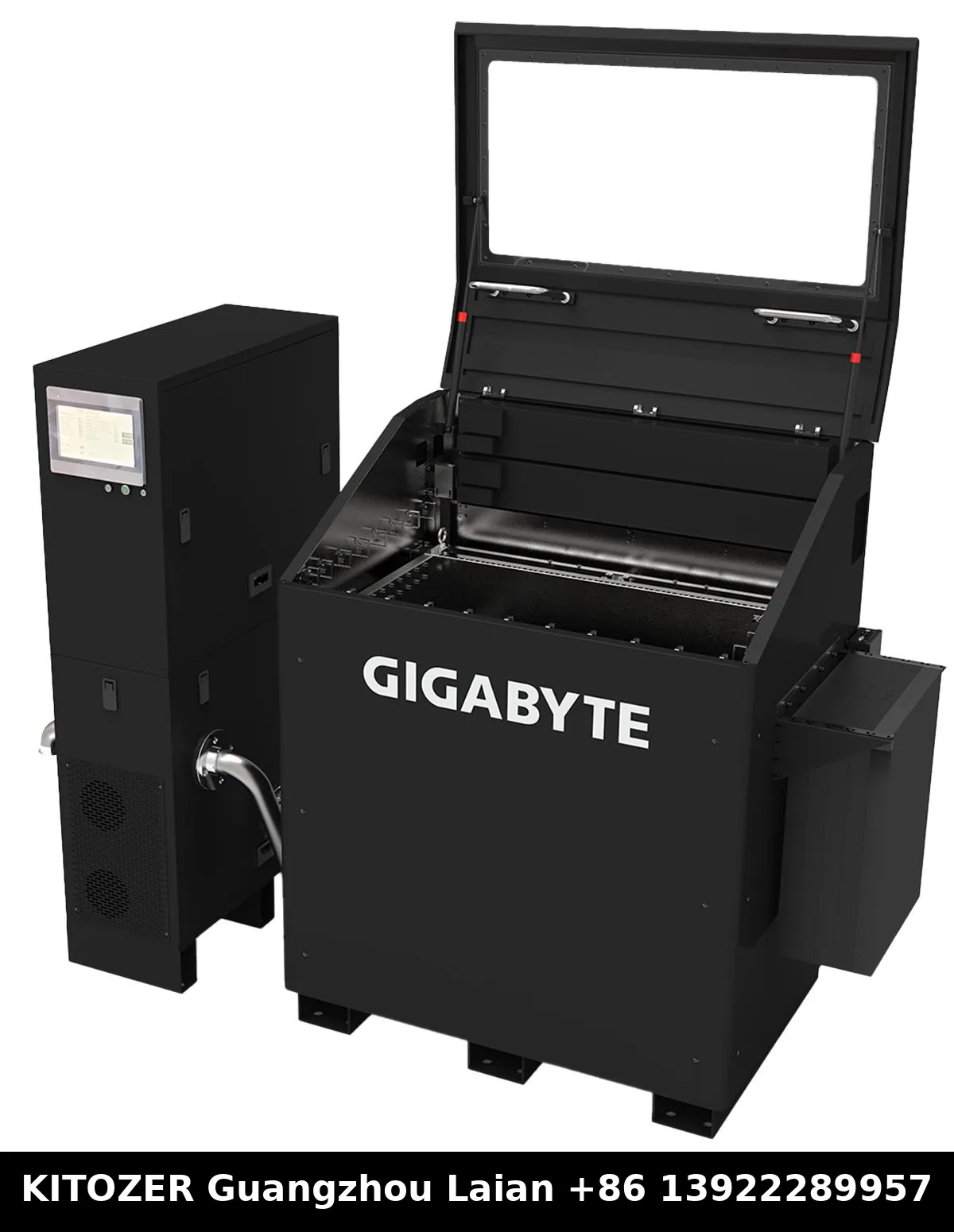
Immersion liquid cooling is a high-density thermal management technology in which servers, storage systems, and network switches are fully submerged in a thermally conductive, electrically non-conductive dielectric fluid. Unlike cold-plate liquid cooling, which only mounts metal plates on CPU and GPU surfaces, immersion cooling surrounds the entire printed circuit board, memory, power supply, and network components with liquid, so that heat is transferred directly from every powered surface to the surrounding coolant. The KITOZER immersion liquid cooling system, designed and integrated by Guangzhou Laian Intelligent System Development Co., Ltd., comprises a stainless-steel immersion tank, redundant circulation pumps, a plate heat exchanger, external coolant connections, a make-up and filtration unit, level and temperature monitoring, and leak detection. It is deployed in AI compute clusters, high-performance computing, GPU rendering farms, telecom central offices, and edge computing sites where rack power densities exceed the practical limits of air cooling.
As chip power continues to climb from tens of watts to hundreds and even one thousand watts per device, rack heat loads have grown from five to eight kilowatts in the air-cooled era to fifty, one hundred, and in some cases over two hundred kilowatts per rack. Air cooling relies on convection, and the specific heat of air is only about 1.005 kJ/(kg·K) with a thermal conductivity near 0.026 W/(m·K). Even adding more fans cannot remove heat fast enough inside a confined rack. Dielectric fluids, while slightly lower in specific heat than water, have thermal conductivity several to ten times that of air, and because they contact every hot surface, the effective heat transfer coefficient is an order of magnitude higher than forced air. This means the same rack footprint can host several times more computing power, while the energy used for cooling drops dramatically.
KITOZER immersion cooling is offered in two architectural variants. Single-phase immersion keeps the coolant liquid throughout the loop, using pumps to circulate fluid between the tank and an external plate heat exchanger. Two-phase immersion uses a low-boiling-point dielectric fluid that vaporizes at chip surfaces and condenses on a cooling coil near the top of the tank, exploiting latent heat for even higher heat flux. KITOZER primarily supplies single-phase systems because they are simpler to maintain, lose less fluid, and are compatible with a wider range of existing server hardware, making them better suited to large-scale commercial deployment.
The immersion tank itself is welded from 304 or 316L stainless steel, passivated on the interior, insulated on the exterior, and clad with a finished metal skin. The top is covered by a hinged lid with an inspection window, reducing evaporation and dust ingress while allowing operators to observe the fluid level and server status. Inside the tank, servers are mounted on dedicated rails or trays, and power and network cables enter through sealed cable glands on the side wall. The entire vessel forms a closed or semi-closed liquid container in which fluid circulates only between the tank, pumps, and heat exchanger.
1.1 Product Positioning
The KITOZER immersion system targets rack densities above thirty kilowatts where extremely high heat flux and low noise are required. A single tank handles from twenty to over three hundred kilowatts of heat, supporting projects that range from a single rack immersion retrofit to a fully immersed data center hall. The product balances standard tank dimensions with customization, adapting to ceiling height, floor loading, piping routing, and noise constraints.
1.2 Core Value
KITOZER immersion cooling delivers value in four areas. First, it raises rack power density, allowing more compute in the same floor space. Second, it cuts cooling energy by eliminating server fans and room-level air handlers, pushing power usage effectiveness toward an economical range. Third, it removes fan noise, so tanks can sit next to offices without disturbing staff. Fourth, the dielectric fluid protects circuit boards from dust, humidity, and oxidation, extending equipment life.
1.3 Background and Market Drivers
Immersion cooling is not new; mainframe and military electronics used oil-bath cooling decades ago. Its recent scale-out in commercial data centers is driven by three forces: the explosion of GPU power demand from AI training and inference, global pressure to reduce data center energy use and carbon emissions, and a maturing supply chain for dielectric fluids, stainless tanks, quick disconnects, and compatible server hardware. KITOZER was developed against this backdrop as a standardized, deployable immersion product.
2. Working Principle
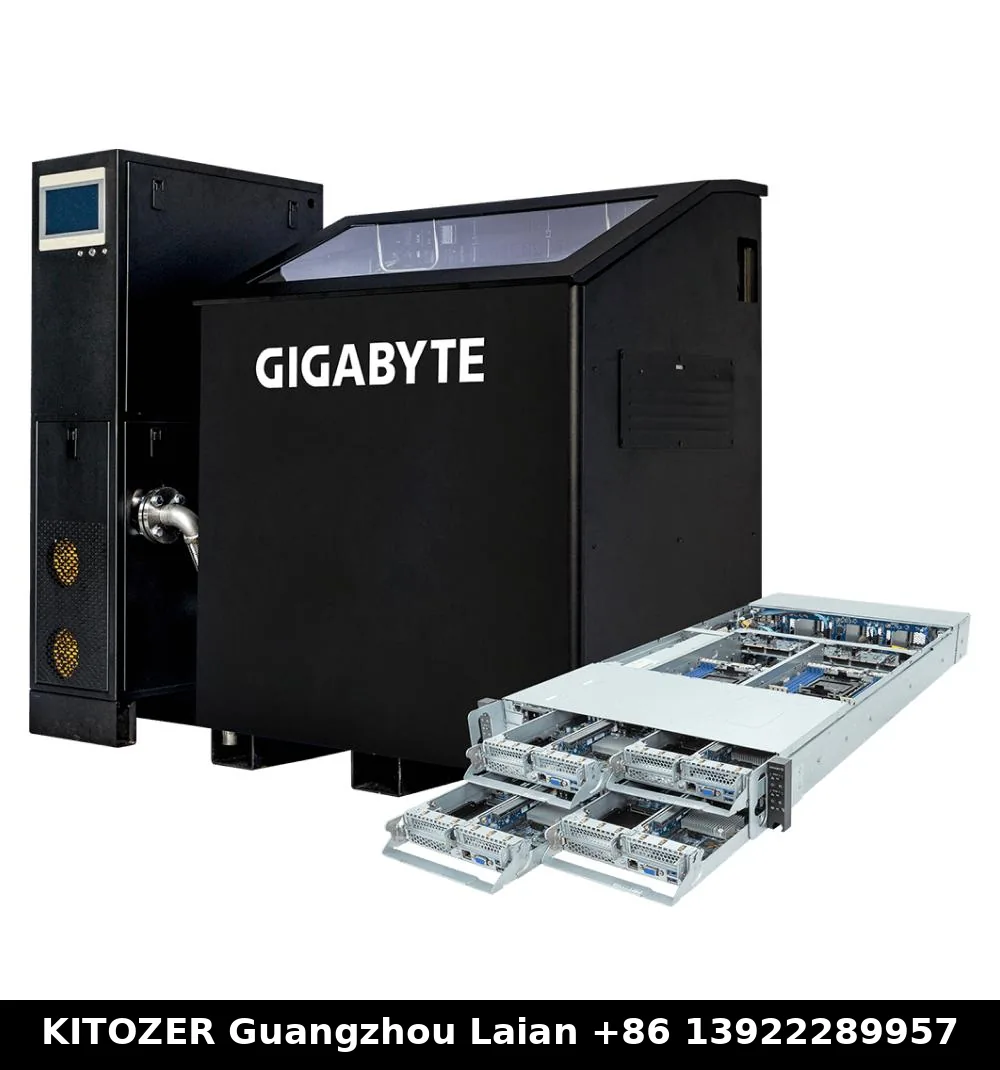
2.1 Single-Phase Heat Transfer
In the KITOZER single-phase system, server motherboards, CPUs, GPUs, memory, and power modules are all immersed in dielectric fluid. Heat generated at the chip conducts through the thermal interface material to the package surface, then transfers to the surrounding liquid by natural and forced convection. Circulation pumps draw heated fluid from the tank, send it through an external plate heat exchanger where heat is rejected to facility-side chilled water or dry-cooled glycol, and return cooled fluid to the bottom of the tank. The fluid temperature typically rises by five to fifteen degrees Celsius across the load before being cooled back to the setpoint in the heat exchanger.
Compared with cold-plate cooling, immersion removes the thermal interface material and micro-channel cold plate itself, because the liquid contacts the hot component directly. In addition, memory, voltage regulator modules, and network chips that were previously ignored by air or cold-plate designs are fully cooled, leading to much more uniform temperatures across the server.
2.2 Two-Phase Heat Transfer
Two-phase systems use a low-boiling-point dielectric fluid that vaporizes when heated by the chip surface. Bubbles rise to a condensing coil near the tank top, where they contact cold water, condense, and drip back to the tank bottom. This phase-change process exploits the latent heat of vaporization, so a given volume of fluid carries far more heat than single-phase convection. Two-phase immersion supports higher heat flux per tank volume, but it requires precise level and temperature control, material compatibility testing, and careful management of fluid evaporation losses. KITOZER can deliver two-phase systems for specialized requirements.
2.3 Dual-Loop Architecture
Both single- and two-phase KITOZER systems use a dual-loop isolation architecture. The inner loop contains the dielectric fluid that directly contacts servers; the outer loop connects to facility chillers, dry coolers, or closed-circuit cooling towers. The two loops are physically separated by a plate heat exchanger, so the expensive dielectric fluid never mixes with facility water. This isolation means that even if facility water chemistry varies, the server-side coolant stays clean and controlled.
2.4 Heat Flow Path
Heat travels from the chip surface to the liquid, is pumped through the inner loop, crosses the plate heat exchanger into the outer loop, and is finally rejected to the atmosphere by a chiller, dry cooler, or cooling tower. The loop runs continuously and closed, with makeup losses coming only from minor evaporation and lid opening during maintenance.
2.5 Heat Transfer Equations
The heat transferred between the liquid and a hot surface is Q = h·A·ΔT, where h is the convection heat transfer coefficient, A is the total contact area, and ΔT is the temperature difference. Because liquid surrounds the entire board, A is much larger than in cold-plate designs. The plate heat exchanger follows Q = K·A·ΔTm, where KITOZER brazed plate exchangers achieve heat transfer coefficients of three thousand to six thousand watts per square meter per kelvin, far higher than shell-and-tube units.
2.6 Pump and Flow Control
Inner-loop pumps are high-efficiency centrifugal units with variable-frequency drives. The controller monitors tank temperature, level, and heat-exchanger pressure difference, and adjusts pump speed to match load. When server load drops, pumps slow down to save pumping energy; when load rises, they speed up to maintain flow. Pumps are configured N+1 or 2N redundant, with the standby pump starting within seconds if the main pump fails.
2.7 Make-Up and Expansion
Dielectric fluid expands and contracts with temperature. KITOZER tanks include an expansion tank or reserved headspace and an automatic make-up pump. When fluid heats and expands, excess volume enters the expansion space; when it cools or loses volume through maintenance, the make-up pump refills the tank to the set level. Two-phase systems additionally require condensing zones and vapor recovery structures to minimize evaporation loss.
2.8 Filtration and Fluid Management
The inner loop includes a precision filter that captures particulate debris from installation, seal fragments, and aging byproducts. KITOZER offers optional online resistivity monitoring and particle detection, triggering alarms when fluid properties drift. The insulating performance of the dielectric fluid is fundamental to safe operation, so continuous monitoring is essential.
2.9 Control Logic and HMI
The tank controller maintains tank temperature setpoints (typically 25 to 50 degrees Celsius), level, and pump differential pressure, while monitoring filters, leak sensors, and lid status. Data is shown on a local touchscreen and uploaded via Modbus TCP, BACnet/IP, or SNMP to the data center infrastructure management system for remote monitoring and alarming.
2.10 Safety and Leak Detection
Because tanks hold large volumes of dielectric fluid, KITOZER equips each unit with a bottom collection pan and perimeter leak-sensing cable. If a leak is detected, the system triggers an audible and visual alarm within seconds, giving operators time to respond before fluid spreads. The tank is fully welded and factory pressure-tested to ensure long-term integrity.
3. Technical Specifications
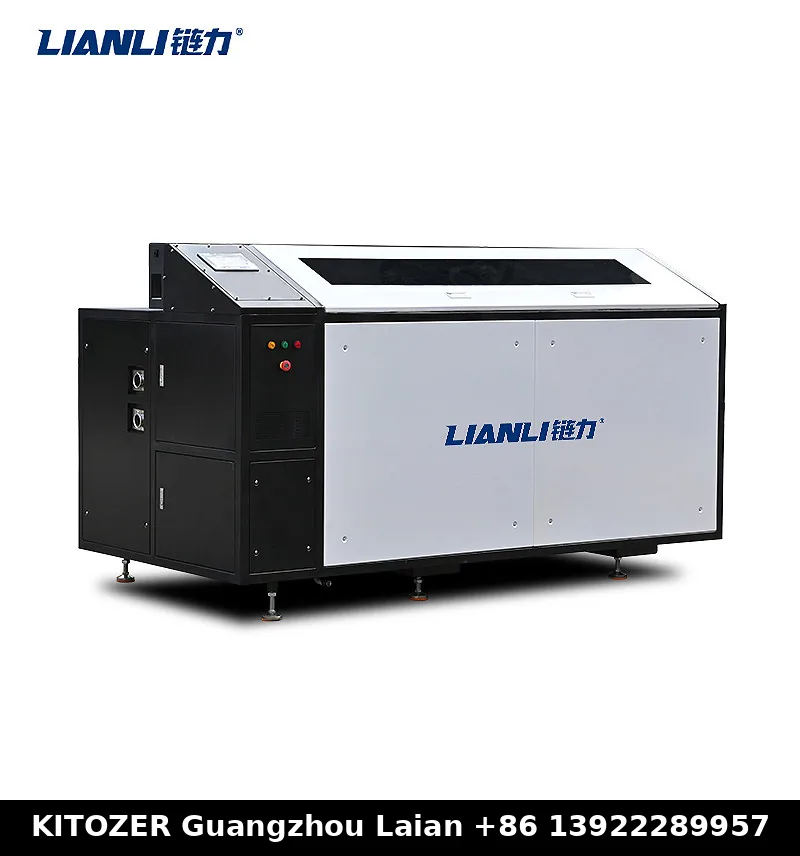
KITOZER immersion tanks are offered in several standard sizes by heat rejection. The table below lists key parameters for the main models; custom configurations are available on request.
3.1 Heat Rejection and Capacity
| Parameter | KC-IMT20 | KC-IMT50 | KC-IMT100 | KC-IMT200 | KC-IMT300 |
|---|---|---|---|---|---|
| Rated heat rejection (kW) | 20 | 50 | 100 | 200 | 300 |
| 2U servers capacity | 6~8 | 12~16 | 24~32 | 48~64 | 72~96 |
| Inner loop flow (m³/h) | 3.5 | 8.6 | 17.3 | 34.5 | 51.8 |
| Operating fluid temp (°C) | 25~50 | 25~50 | 25~50 | 25~50 | 25~50 |
| Outer loop design pressure (bar) | 10 | 10 | 10 | 16 | 16 |
| Inner loop design pressure (bar) | 3 | 3 | 3 | 3 | 3 |
| Heat exchanger type | Brazed plate | Brazed plate | Brazed plate | Gasketed plate | Gasketed plate |
| Pump configuration | 1+1 VFD | 1+1 VFD | 2+1 VFD | 2+1 VFD | 3+1 VFD |
| Pump head (m) | 8 | 10 | 12 | 15 | 18 |
3.2 Tank and Mechanical Data
| Parameter | Specification |
|---|---|
| Tank material | SUS304 or SUS316L stainless steel, welded and passivated |
| Tank sealing | Hinged lid with sight glass, side-wall cable glands |
| Dimensions W×D×H | KC-IMT50 approx. 1200×1200×1400 mm; KC-IMT200 approx. 2400×1500×1600 mm |
| Filled weight | KC-IMT50 approx. 1200 kg; KC-IMT200 approx. 4500 kg |
| Outer loop connections | Flanged DN40~DN150 |
| Inner loop connections | Stainless flange or quick coupling DN32~DN100 |
| Noise (1 m, full load) | ≤58 dB(A) |
| Protection rating | Control cabinet IP54; tank IP65 |
| Coolant | Inner loop: synthetic hydrocarbon or ester dielectric; outer loop: chilled water or cooling water |
| Ambient conditions | 10°C~35°C, RH ≤85% non-condensing |
3.3 Electrical and Control Data
| Parameter | Specification |
|---|---|
| Power supply | AC 380V three-phase five-wire 50 Hz; small models optional 220V single-phase |
| Full-load input power | KC-IMT50 approx. 1.2 kW; KC-IMT200 approx. 5.5 kW; KC-IMT300 approx. 8 kW |
| Control | PLC + 7-inch color touchscreen |
| Communication | Modbus TCP, BACnet/IP, SNMP optional, dry-contact alarm |
| Temperature accuracy | ±0.3°C (PT1000 Class A) |
| Level sensing | Hydrostatic level transmitter plus float switch redundancy |
| Insulation monitoring | Online fluid resistivity monitoring with over-limit alarm |
| Leak detection | Bottom collection pan + perimeter sensing cable |
| Protection functions | Pump overload, over/under pressure, over temperature, low level, filter blockage, leak, resistivity drift, comm loss |
3.4 Key Component Brands
| Component | Selection |
|---|---|
| Plate heat exchanger | Leading-brand brazed/gasketed plate, 316L plates, EPDM or fluid-compatible gaskets |
| Circulation pump | High-efficiency vertical centrifugal, IE3+ motor, VFD drive |
| Tank plate | 304 or 316L stainless, 3~5 mm thickness, fully welded |
| Sensors | PT1000 temperature, hydrostatic level, inline resistivity, electromagnetic flow |
| PLC and HMI | Mainstream industrial brand, local and remote update |
| Cable glands | Nylon or nickel-plated brass, sized to cable diameter |
4. Selection Guide
Correct selection is the foundation of reliable long-term operation. KITOZER recommends the following steps and encourages close communication with Guangzhou Laian engineers at key decision points.
4.1 Determine Heat Load
Start by summing the power of every server to be immersed. Unlike cold-plate cooling, immersion cools the whole server, so include CPU, GPU, memory, storage, power supply, and network cards. Add a fifteen to twenty-five percent margin for future expansion and peak loads. AI training clusters can see multi-fold load swings, so selection must account for dynamic behavior rather than average load.
4.2 Choose Single- or Two-Phase
Single-phase systems are simpler, lose less fluid, and work with a wider range of hardware, making them suitable for most commercial deployments. Two-phase systems offer higher heat flux but demand stricter material compatibility, sealing, and operational expertise. KITOZER recommends single-phase as the default and reserves two-phase for specialized ultra-density requirements.
4.3 Select Dielectric Fluid
Dielectric fluids fall into synthetic hydrocarbons, esters, and synthetic fluorinated fluids. Synthetic hydrocarbons are cost-effective, insulating, and the mainstream single-phase choice. Esters are biodegradable and environmentally friendly but more expensive. Fluorinated fluids have excellent dielectric properties but are costly and often used for two-phase. KITOZER recommends fluids based on material compatibility testing with the user’s server list.
4.4 Verify Outer-Loop Conditions
Confirm the available chilled-water temperature, flow, and pressure on the facility side. If outer-loop supply temperature is high during summer, verify that the plate heat exchanger can still hold tank temperature within the acceptable chip range. When the approach temperature is insufficient, add exchanger area, reduce load, or supplement with a chiller.
4.5 Redundancy and Availability
For high-availability scenarios such as financial data centers or large AI clusters, specify N+1 or 2N pump redundancy, dual control power, and parallel tanks on a ring mains. KITOZER supports parallel operation, so any single tank can be taken offline for maintenance while the rest carry the load.
4.6 Selection Decision Table
| Project Profile | Recommended Model | Configuration |
|---|---|---|
| ≤20 kW per tank, few servers | KC-IMT20 | 1+1 pump, standalone |
| 20~50 kW, small to medium scale | KC-IMT50 | 1+1 pump, expansion reserved |
| 50~100 kW, AI training nodes | KC-IMT100 | 2+1 pump, ring outer loop |
| Whole row of dense GPU racks | KC-IMT200 | 2+1 pump, dual power, remote monitoring |
| Whole immersion data center hall | KC-IMT300 parallel | 2N redundancy, plant-wide control |
4.7 Floor Loading and Space Check
Filled immersion tanks are heavy; a KC-IMT200 weighs about 4500 kg. Verify floor load capacity, recommending at least 12 kN/m² and distributing load through steel channels if needed. Reserve at least 900 mm of service clearance around the tank and 800 mm above for server lifting and lid opening. Ensure the delivery path is wider than the tank plus 200 mm.
4.8 Noise and Environment Check
A major benefit of immersion is the elimination of server fans. Pumps and external heat rejection fans still produce noise, so if the tank sits near staffed control rooms, verify noise levels. KITOZER tanks run at about 58 dB(A) at full load, with vibration isolation and flexible connectors further reducing structural transmission.
5. Installation Requirements
5.1 Civil Works
Confirm floor load capacity before placing the tank. Recommend equivalent uniform live load of at least 12 kN/m², with steel channel bases or vibration pads if necessary. Reserve service clearance of 900 mm around and 800 mm above. The delivery path must be wider than the tank by 200 mm, with sufficient turning radius. If the tank enters through a window or hatch, verify lifting path and crane capacity in advance.
5.2 Tank Setting and Leveling
Mark the centerline on the foundation, lift the tank into position, and level it with adjustable feet to within 2 mm/m in both directions. After leveling, anchor the tank and optionally ground between base and foundation for rigidity. Inspect welds after transport for damage.
5.3 Piping Installation
Outer-loop piping should use seamless steel or stainless steel, welded by certified welders and pressure-tested at 1.5 times working pressure for 30 minutes. Inner-loop piping should be 316L stainless, with all seals and gaskets tested for fluid compatibility. Install automatic air vents at high points and drains at low points. Penetrations through walls and slabs must be sleeved and fire-stopped.
5.4 Electrical Installation
Feed the tank from a dedicated UPS or power distribution unit circuit with breaker and leakage protection. Bond the control cabinet grounding bar to the data center equipotential grounding network, with grounding resistance no more than one ohm. Separate communication cables from power cables in cable trays. Server power and network cables enter through side-wall glands sized to each cable diameter.
5.5 Server Preparation and Immersion
Standard servers have fans and air-cooled heat sinks that must be removed before immersion, and some capacitors, connectors, and thermal pads may need replacement with fluid-compatible parts. CPUs and GPUs can be fitted with dedicated immersion cold plates. KITOZER provides technical guidance for server preparation, or users can purchase immersion-ready servers directly. Once prepared, servers are placed on rails or trays and connected to power and network before fluid is added.
5.6 Dielectric Fluid Fill
Before filling, blow the tank and piping dry with clean compressed air. Fill with the specified dielectric fluid to design level, stopping once all hot components are submerged. Allow the fluid to soak into board and component gaps for several hours, then top up to setpoint. After 24 to 48 hours of operation, sample the fluid for resistivity and particulates and filter or change as needed.
5.7 Commissioning and Acceptance
Commissioning includes jog-testing pumps, establishing inner-loop flow, checking joints and glands for leaks, setting temperature and pressure targets on the HMI, observing pump response under varying load, and simulating outer-loop loss, pump failure, leak, and low-level alarms. Acceptance documentation includes pressure test records, fluid fill reports, 72-hour run records, and alarm test records.
6. Operation and Maintenance
6.1 Daily Inspection
Operators should check the HMI or remote dashboard daily: tank temperature at setpoint, level in normal range, pump current and frequency steady, filter pressure differential within limits, fluid resistivity normal, and no leak alarms. Trends should be addressed before they become failures.
6.2 Periodic Maintenance Schedule
| Interval | Tasks |
|---|---|
| Weekly | Review alarm log; visually inspect tank and joints; record tank temperature and flow |
| Monthly | Sample fluid for resistivity, viscosity, appearance; check filter differential; listen to pump noise and vibration |
| Quarterly | Switch lead/standby pumps; clean control cabinet filter; tighten electrical terminals; test leak alarm |
| Half-year | Calibrate temperature and level sensors; check outer-loop exchanger differential; test UPS transfer |
| Yearly | Replace inner-loop filter element; send fluid for lab analysis; check expansion tank pre-charge; clean outdoor heat rejection equipment |
| Every two years | Open gasketed plate exchanger for fouling inspection; replace aged gaskets; cable insulation test; inspect tank interior |
6.3 Dielectric Fluid Maintenance
Over time, dielectric fluid can lose corrosion inhibitors, change viscosity, oxidize, or accumulate particles. Sample quarterly and send to a lab; add additives, filter, or replace based on results. Do not mix different brands or formulations, as chemical reactions can produce sludge. Keep the lid closed during maintenance to prevent dust and moisture ingress.
6.4 Common Faults and Remedies
| Symptom | Likely Cause | Action |
|---|---|---|
| Tank temperature high | Outer supply too warm; exchanger fouled; load over design | Check chiller output; clean outer plates; verify actual server power |
| Level dropping | Gland leak; micro-weld leak; evaporation | Check gland tightness; weld or seal; top up fluid |
| Filter differential alarm | Element blocked | Switch standby filter or replace element |
| Resistivity falling | Moisture ingress; fluid aging; contamination | Sample and analyze; filter or replace fluid |
| Pump vibration/noise high | Bearing wear; impeller cavitation; loose anchor | Replace bearing; check inlet pressure; tighten anchor |
| Leak alarm | Loose joint; gland seal failure; condensation | Locate leak; tighten or replace gland; trace water source |
| Server reboots | Tank over temp causing thermal protection; power contact issue | Reduce load or add exchanger capacity; check power cables |
| HMI blank | Control power breaker tripped; comm cable loose | Check breaker; restart PLC; check comm cable |
6.5 Long Shutdown and Restart
For extended shutdown, circulate fluid to uniform temperature, then stop pumps and close outer-loop valves. Keep the control cabinet powered to prevent condensation. Servers may remain immersed under a sealed lid or be removed and dried. Before restart, check level, resistivity, and electrical connections, jog the pump, and ramp load gradually.
7. Frequently Asked Questions
Q: What is the difference between KITOZER immersion cooling and cold-plate liquid cooling?
A: Cold-plate cooling only mounts metal plates on major chips such as CPUs and GPUs, leaving other components to air cooling. Immersion cooling submerges the entire server in dielectric fluid, so every hot component is directly cooled, supporting higher rack density but requiring server preparation.
Q: Will the server short-circuit in the fluid?
A: No. Immersion cooling uses a dielectric (electrically insulating) coolant with very high resistivity, so it does not conduct electricity. This is the physical basis that makes immersion cooling commercially viable.
Q: Does the dielectric fluid damage server hardware?
A: Tested, compatible fluids do not corrode or swell standard metals, plastics, and rubbers over long-term immersion. However, not every server is compatible with every fluid, so confirm immersion-ready certification with the server vendor. KITOZER provides material compatibility consulting.
Q: How many servers fit in one tank?
A: It depends on server power and tank heat rating. A KC-IMT100 holds about 24 2U servers at 4 kW each, or about 10 at 10 kW per GPU server. Exact count is engineered by KITOZER based on piping and redundancy.
Q: Will servers overheat if the immersion system fails?
A: KITOZER uses N+1 redundant pumps and backup power, switching within seconds if the main pump fails. If an entire tank fails, the large thermal mass of fluid allows servers to ride out several minutes, enough for orderly shutdown. Critical sites use parallel tank rings.
Q: How often should dielectric fluid be changed?
A: With proper filtration, dielectric fluid typically lasts three to five years or longer. Change frequency depends on fluid type, operating temperature, and contamination; sample quarterly and decide based on resistivity, viscosity, and appearance.
Q: How much more does immersion cooling cost upfront than air cooling?
A: Upfront cost is higher due to stainless tanks, dielectric fluid, and server preparation. However, long-term energy savings, eliminated fan wear, and doubled rack density usually recover the premium within a few years through lower power bills and reduced floor space.
Q: Does KITOZER support remote monitoring?
A: Yes. The system offers Modbus TCP, BACnet/IP, and SNMP integration into DCIM or BMS platforms, with real-time temperature, level, flow, pump status, resistivity, alarms, and trend history, plus SMS and email alerts.
Q: Can the outer and inner loops share piping?
A: No. They must be isolated by a plate heat exchanger. The dielectric fluid is expensive and requires high purity; mixing with facility water would contaminate it. The two loops also have different pressure and water-quality requirements.
Q: Do servers drip when removed from the fluid?
A: A small amount of fluid adheres to components. Operators use a dedicated tray, let the server drain above the tank for a few minutes, then wipe with absorbent paper. KITOZER tanks include a drip zone for this purpose.
Q: Is immersion cooling suitable for crypto mining rigs?
A: Very much so. Mining rigs run hot, 24/7, and are noisy. Immersion cooling enables higher overclocking, eliminates fan noise, and lowers cooling energy, making it a mainstream choice for dense mining farms. KITOZER customizes tank dimensions and rails for standard mining hardware.
Q: What is the lead time for KITOZER immersion systems?
A: Standard models typically ship four to six weeks after contract signing; custom models take ten to fourteen weeks. Guangzhou Laian provides one-stop service from design through commissioning and on-site guidance.
Q: Do immersion tanks take a lot of floor space?
A: Per unit area, immersion hosts far more compute than air cooling. A KC-IMT50 occupies about 1.5 m² and handles 50 kW, equivalent to six to eight traditional air-cooled racks.
Q: What is the noise level?
A: With server fans removed, noise comes mainly from pumps. KITOZER tanks run at about 58 dB(A) at full load, far below a room-level air handler for the same heat load, and can be further reduced by vibration isolation.
Q: Can the tank be expanded later as server power grows?
A: Yes. KITOZER tanks are modular, with outer-loop headers and exchanger interfaces sized for growth. Add pump modules, parallel tanks, or plate packs to handle higher heat without replacing the whole unit.
8. Application Scenarios
KITOZER immersion cooling is deployed across a wide range of high-heat-density scenarios.
8.1 AI Compute and GPU Training Clusters
As large-model training and inference drive GPU power demand, single-node power reaches several to over ten kilowatts, and rack loads exceed 50 to 100 kW. Immersion cooling delivers ultra-dense deployment in limited space, while removed GPU fans improve reliability. It is a mainstream choice for leading AI compute centers.
8.2 High-Performance Computing
Scientific computing, weather simulation, genomics, and engineering simulation run at full load continuously, requiring uninterrupted cooling. KITOZER redundant architecture and remote monitoring support 24/7 operation.
8.3 Crypto Mining Farms
Mining rigs are power-hungry, run around the clock, and are noise-sensitive. Immersion cooling enables higher overclocking, eliminates fan noise, and cuts cooling energy. KITOZER customizes tanks for standard mining hardware.
8.4 Legacy Data Center Immersion Retrofit
Many older data centers face rising rack power but limited cooling and power capacity. Adding immersion tanks in a local zone raises density without reworking the entire air-conditioning plant, extending data center life.
8.5 Telecom and Edge Nodes
5G edge sites and telecom aggregation rooms are compact and have limited cooling. Small immersion tanks host higher-density compute and storage in limited space while reducing noise.
8.6 Industrial High-Heat Equipment
Lasers, particle accelerators, precision test equipment, and radar power amplifiers also benefit from KITOZER immersion cooling for stable, precise temperature control.
9. Technology Trends
Immersion cooling is evolving rapidly. Chip power density continues to rise, pushing immersion toward higher heat flux and lower fluid loss, with single- and two-phase approaches complementing each other by scenario. Tanks themselves are becoming more integrated, efficient, and intelligent. VFD pumps, adaptive temperature control, predictive maintenance, and coordinated control with chillers and dry coolers are becoming standard. Guangzhou Laian tracks industry standards and iterates products to keep KITOZER competitive in efficiency, reliability, and serviceability.
On efficiency, future systems will maximize free-cooling hours. When outdoor air is cold, the chiller can be bypassed and heat rejected directly through dry coolers, with only pumps running. KITOZER control architecture already supports this coordination with outdoor dry coolers and cooling towers.
Integration with DCIM is also deepening. New tanks act as data collection nodes, streaming temperature, level, and resistivity per zone into DCIM, where control loops match cooling to compute demand. Dielectric fluid recycling and regeneration are improving, extending fluid life and lowering operating cost and environmental impact.
10. Comparison: Immersion vs Air Cooling and Cold-Plate
| Dimension | Air Cooling | Cold-Plate Liquid | KITOZER Immersion |
|---|---|---|---|
| Rack heat capacity | 8~15 kW | 50~100+ kW | 100~200+ kW |
| Coolant | Air | Water/glycol | Dielectric fluid |
| Chip contact | Forced air convection | Metal cold plate | Whole board immersed |
| Typical PUE | 1.5~1.8+ | 1.1~1.3 | 1.05~1.15 |
| Server fans | Required | Partly retained | All removed |
| Room noise | High | Moderate | Very low |
| Server modification | None | Cold plates added | Fan removal + compatibility prep |
| Upfront cost | Lower | Higher | Higher, with density payback |
| Scalability | Limited by air-conditioning capacity | Modular CDU parallel | Modular tank parallel |
Overall, for new high-density data centers and retrofits targeting extreme density, low noise, and low long-term energy use, KITOZER immersion cooling offers strong combined advantages.
10.1 Single-Phase vs Two-Phase
Single-phase immersion is simpler, easier to maintain, and loses less fluid, suiting most commercial data centers. Two-phase offers higher heat flux but requires stricter material compatibility, sealing, and operational expertise, suiting ultra-density scenarios. KITOZER focuses on single-phase while offering two-phase for specialized needs.
11. Dielectric Coolant Selection and Chemistry
The dielectric coolant directly contacts circuit boards, so its chemistry determines system life, thermal stability, and safe operation. KITOZER specifies recommended fluids for its systems.
11.1 Synthetic Hydrocarbon Fluids
Synthetic hydrocarbons such as alkylbenzene and paraffin-based oils are the mainstream single-phase choice. They offer good insulation, high boiling point, and relatively low cost, with specific heat around 2.0 kJ/(kg·K) and thermal conductivity around 0.14 W/(m·K). They are compatible with most server metals and plastics.
11.2 Ester and Biodegradable Fluids
Ester fluids are biodegradable and environmentally friendly with high flash points, but cost more. Data centers with strict environmental discharge requirements often choose esters to reduce impact if a leak occurs.
11.3 Synthetic Fluorinated Fluids
Fluorinated fluids have excellent dielectric properties, chemical inertness, and a range of boiling points, mostly used in two-phase systems. They are expensive, and some categories carry environmental concerns, so regulatory requirements should be checked during selection.
11.4 Fluid Monitoring Parameters
| Parameter | Recommended Range | Meaning of Deviation |
|---|---|---|
| Resistivity | ≥10^10 Ω·cm | Decline signals moisture or particulate contamination |
| Viscosity at 40°C | Per fluid spec | Rise signals aging or contamination |
| Flash point | ≥150°C generally | Too low raises fire risk |
| Water content | ≤100 ppm | Excess lowers insulation |
| Appearance | Clear and transparent | Haze signals particulate or oxidation |
11.5 Material Compatibility
Different fluids interact differently with plastics, rubbers, and coatings. Server capacitors, connectors, thermal pads, and PCB solder masks must be compatible with the chosen fluid. KITOZER reviews material compatibility against the user’s server list during design, recommending compatible component replacements or immersion-ready servers.
12. Thermal and Fluid Dynamic Deep Dive
How does immersion cooling work at a physical level, and why is it so effective? The answer lies in the combination of direct contact, large surface area, and the thermophysical properties of dielectric liquids. When a powered semiconductor heats up, heat must cross a series of thermal resistances: junction to case, case to heat sink, heat sink to air, and air to room. In air cooling, the last two resistances dominate because air is a poor heat transfer medium. In immersion cooling, liquid replaces air at the heat sink, and the liquid is in direct contact with the entire board, collapsing those resistances dramatically. The convection heat transfer coefficient in liquid is typically tens to hundreds of times higher than in air, which is why a tank can remove tens of kilowatts from a relatively small volume. KITOZER uses computational fluid dynamics to optimize internal baffles, ensuring uniform flow across every server and avoiding dead zones where heat could accumulate. This engineering detail is what separates a robust immersion deployment from a risky prototype.
13. System Integration and Project Delivery
An immersion cooling project is not a single appliance but an integrated system of tanks, pumps, exchangers, external cooling, piping, controls, and power. KITOZER has built a standardized delivery process over many projects. During design, engineers collect the server list, rack power, floor loading, ceiling height, available chilled-water conditions, redundancy requirements, and future expansion plans. They then perform heat load calculations, tank layout, outer-loop capacity verification, hydraulic routing, and control design, delivering a complete design package and bill of materials. In the factory, tanks are welded, passivated, insulated, and clad, then factory pressure-tested, electrically tested, and run under PLC control before shipment. On site, KITOZER guides rigging, piping, electrical, and fluid fill, then commissions the system through flushing, venting, parameter tuning, alarm verification, and a 72-hour continuous run. After handover, KITOZER provides remote monitoring integration and periodic inspection, standing by for the full project lifecycle.
14. Energy Efficiency and Economics
Power Usage Effectiveness, or PUE, is the ratio of total data center energy to IT equipment energy. Traditional air-cooled data centers often run at 1.5 to 1.8, with cooling and fans consuming a large share. Immersion cooling, by eliminating server fans and room-level air handlers, leaves only pump and external heat-rejection fan energy, pushing PUE to 1.05 to 1.15. A typical 4 kW 2U air-cooled server uses four to six fans drawing ten to twenty watts each, totaling 60 to 120 watts of fan power, roughly three percent of server load. Removing those fans directly saves that energy, and room air-handler fan energy also drops sharply because most heat is carried by liquid rather than air. From a cost perspective, immersion has higher upfront cost for stainless tanks, dielectric fluid, and server preparation, but long-term power savings, improved reliability, and doubled rack density usually recover the premium within a few years. KITOZER helps users build total-cost-of-ownership models comparing air cooling, cold-plate cooling, and immersion across five to ten years, accounting for electricity, maintenance, fluid makeup, equipment depreciation, and floor-space savings.
15. Safety and Environment
Dielectric fluids are insulating but still organic and combustible. KITOZER designs for fire safety by specifying high-flash-point fluids (typically above 150°C), integrating gas suppression interfaces and smoke detectors around tanks, keeping electrical cabinets at a safe distance, and using fire-rated cable glands. If tank temperature spikes or smoke is detected, the system alarms and links to suppression. For leak protection, bottom collection pans and perimeter sensing cables detect spills within seconds, and pan capacity is sized to contain a fraction of tank volume while operators respond. Environmentally, aged dielectric fluid is treated as hazardous waste and must be handled by licensed recyclers. KITOZER recommends biodegradable ester fluids where environmental impact is a priority and offers fluid recycling and regeneration services. Operators wear chemical-resistant gloves and goggles during lid work, ensure servers are powered off and cooled before opening, place drained servers on dedicated trays, and dispose of filters and rags as hazardous waste. KITOZER includes full safety training at handover.
16. Standards and Certifications
KITOZER immersion systems are designed and manufactured with reference to relevant national and industry standards covering data center cooling, heat exchange equipment, electrical safety, noise control, and environmental protection. The products can provide third-party test reports and factory inspection documents on request. For export projects, KITOZER supports certification requirements such as electrical safety and electromagnetic compliance in target markets. The exact compliance list is available from KITOZER technical department.
17. Lifecycle Management
KITOZER supports users across the full project lifecycle. In the design phase, engineers define heat load, tank count, outer-loop conditions, redundancy, and growth. In construction, the factory builds and factory-tests equipment, then on-site crews install and connect. Commissioning delivers flushing, fluid fill, parameter tuning, and a 72-hour run. During operations, KITOZER provides scheduled maintenance, filter changes, fluid testing, and remote support. When capacity grows, additional tanks can be paralleled onto existing headers. At end of life, KITOZER assists with safe decommissioning, fluid recovery, and stainless-steel recycling. This lifecycle approach means users work with one integrated supplier rather than coordinating multiple vendors for tanks, pumps, exchangers, and controls.
18. Tank Construction and Manufacturing
The immersion tank is the core vessel of the system, and its construction determines sealing, durability, and serviceability. KITOZER tanks are modular and customizable. Tanks come in horizontal and vertical configurations: horizontal tanks lay servers flat with motherboards facing up for easy service, while vertical tanks insert servers upright to pack more units per footprint. The hinged lid uses fluid-compatible gaskets and quick clamps, with a sight glass for level inspection without opening. Material is 304 or 316L stainless steel at 3 to 5 mm thickness, welded by TIG, then pickled and passivated. All welds are dye-penetrant and pressure tested at the factory. The exterior is insulated to prevent condensation and clad in powder-coated steel that matches data center aesthetics. Cable glands on the side wall seal power and network cables, with multi-core sealed plates available for high-density cabling.
19. Pumps and Hydraulics
Inner-loop pumps are high-efficiency vertical centrifugal units with IE3+ motors and VFD drives. Pump head must overcome tank flow resistance, exchanger resistance, piping friction, and fitting losses. Because dielectric fluids are slightly more viscous than water, pump selection is corrected for actual fluid viscosity. Variable-frequency drives adjust speed based on tank temperature and differential pressure, matching flow to load and saving pumping energy. Pumps are arranged N+1 or 2N redundant on a common base with vibration isolators, each with isolation valves and check valves for maintenance without shutdown. Hydraulic balance is engineered using CFD to ensure uniform flow across servers; if needed, balancing valves on individual branches are adjusted during commissioning. Expansion and pressurization are handled by an expansion tank that absorbs thermal volume changes and maintains slight positive pressure, with a make-up pump topping up evaporated or maintenance losses.
20. Plate Heat Exchanger and External Cooling
The plate heat exchanger isolates the inner dielectric loop from the facility cooling loop. Small units use brazed plate exchangers for compactness and pressure rating; large units use gasketed plate exchangers that can be opened for cleaning and plate addition. Plates are 316L stainless, with gaskets selected for fluid compatibility. KITOZER typically reserves fifteen to twenty-five percent exchanger area margin to accommodate future server power growth or higher summer outer-loop temperatures, and plate packs can be added on site without replacing the exchanger. External cooling can be a chiller for hot climates, a dry cooler for cold climates, or a closed-circuit evaporative cooler for water-rich regions. KITOZER designs free-cooling sequences that bypass the chiller when outdoor conditions allow, maximizing energy savings across the year.
21. Monitoring and Intelligence
KITOZER tanks include a seven-inch touchscreen showing tank temperature, level, pump status, filter differential, resistivity, and alarms, with Chinese and English interfaces. Data uploads via Modbus TCP, BACnet/IP, or SNMP to DCIM or BMS, with trend history, tiered alarms, and SMS or email notifications. Optional cloud monitoring lets users check status from a mobile app. Alarms are tiered into advisory, warning, and critical: advisory events are logged, warnings trigger remote notification, and critical events such as over-temperature, leak, or low level trigger audible alarms and protective actions such as stopping pumps or closing outer-loop valves. Newer KITOZER systems add predictive maintenance algorithms that analyze pump vibration current, filter differential trends, and resistivity drift to anticipate aging and recommend maintenance before failures occur.
22. Typical Deployment Scenarios
In one large AI compute center, hundreds of high-power GPU servers exceeded the limits of air cooling. KITOZER designed a single-phase immersion setup with one KC-IMT200 tank per two rack equivalents, holding about fifty GPU servers, with chiller plus dry-cooler external cooling enabling free cooling for most of the year. The project reached a PUE of 1.12 with dramatically lower noise, and removed GPU fans improved reliability. In a university supercomputing retrofit, existing air conditioning could not cool new GPU nodes. KITOZER installed ten KC-IMT100 tanks in a corner of the hall without reworking the original air plant, serving the new cluster while legacy air-cooled systems continued running, delivering the upgrade at a fraction of full-retrofit cost. In a northwest mining farm leveraging cheap electricity and cool weather, KITOZER deployed KC-IMT50 tanks paired with outdoor dry coolers, achieving near-zero cooling energy for most of the year and eliminating fan noise so the farm could sit near staff offices.
23. Hybrid Cooling Combinations
In practice, immersion cooling is often combined with other cooling methods rather than used alone. In an immersion-plus-air hybrid, high-power GPU nodes use immersion while low-power storage and network equipment remain air-cooled, a common approach in retrofits. In an immersion-plus-cold-plate hybrid, GPU nodes use immersion while CPU nodes use cold plates, both sharing outer-loop cooling but with separate inner loops. In an immersion-plus-backdoor-heat-pipe hybrid, equipment that cannot be fully immersed gets rear-door heat exchangers sharing the same outer loop. KITOZER designs these hybrid architectures so immersion tanks and CDUs share headers and control systems, simplifying plant design.
24. Engineering FAQ
What if floor loading is insufficient? Distribute load through steel channels, place tanks near structural columns, or choose smaller tanks to reduce per-tank weight; KITOZER provides structural recommendations. What if outer-loop water is too warm in summer? Increase dry-cooler area, add a chiller as backup, or add a mixing valve; KITOZER calculates free-cooling hours based on local weather. What if existing servers are not immersion-ready? KITOZER performs material compatibility assessment; many servers only need fan removal and compatible capacitor or pad replacement, while some incompatible units should use cold-plate cooling instead. How is fluid consumption controlled? Single-phase tanks are well sealed, with annual makeup typically under five percent of tank volume; two-phase systems need condensing recovery and automatic makeup for higher evaporation.
25. Detailed Thermal Design Calculations
Immersion cooling thermal design is a multi-layer engineering exercise that progresses from chip-level heat flux to data-center-level energy balance. KITOZER engineers follow a structured calculation workflow on every project to ensure the system performs as intended under all operating conditions.
25.1 Chip-Level Heat Flux Analysis
Modern high-end GPU chips produce heat densities on the order of hundreds of watts per square centimeter, meaning the heat generated per unit area at the chip surface is extremely concentrated. In air-cooled designs, heat sinks and fans must move this heat from the chip surface to air, but the low thermal conductivity of air limits how effectively this can be done. In immersion cooling, the dielectric fluid contacts the chip surface either directly or through a dedicated cold plate, and the combination of high thermal conductivity and large contact area means heat flux is no longer the limiting factor. KITOZER calculates the required fluid velocity and temperature margin based on the specific heat flux of each user’s chips, ensuring junction temperatures stay within the manufacturer’s allowed envelope under both average and peak workloads.
25.2 Server-Level Heat Balance
The total power of a server equals the sum of all component power, including CPU, GPU, memory, storage, network, power supply losses, and auxiliary circuits. In immersion cooling, essentially all of this power becomes heat transferred to the dielectric fluid. By the first law of thermodynamics, the heat removed equals the fluid mass flow multiplied by specific heat multiplied by temperature rise, or Q equals m times c times delta T. KITOZER uses this relationship to size pumps and piping: for a 10 kW GPU server with a dielectric specific heat of 2.0 kJ per kilogram per kelvin and an allowed temperature rise of 10 degrees, the required flow is about 0.5 kilograms per second, or roughly 1.8 cubic meters per hour. A tank holding twenty such servers needs about 36 cubic meters per hour of total flow, which directly drives pump selection and header diameter.
25.3 Tank-Level Temperature Field Simulation
During tank structural design, KITOZER uses computational fluid dynamics software to simulate the temperature and flow fields inside the tank. The model includes tank geometry, server placement, baffle positions, and pump inlet and outlet locations. The simulation reveals dead zones where fluid stagnates and hot spots where temperature climbs too high, and engineers then optimize baffle openings and flow directors. Simulation results are calibrated against physical test data to continuously improve design accuracy.
25.4 System-Level Energy Balance
At the whole-system level, the heat generated by immersion tanks must ultimately be rejected outdoors through the outer-loop cooling source. KITOZER calculates the annual energy balance: total IT load plus pump and fan power equals the total heat that must be rejected. Based on local meteorological data, the team computes cooling-source requirements across seasons and optimizes the mix of chillers and dry coolers to maximize free-cooling hours and minimize annual energy use.
26. Server Immersion Preparation Technical Specification
Standard servers are designed for air cooling and cannot be immersed directly in dielectric fluid. Fans do not work usefully in liquid and add resistance; plastic air-cooled heat sinks may deform after long immersion; ordinary capacitor seals may not be compatible; and thermal grease may dissolve in the fluid. Servers must therefore be specially prepared before immersion. KITOZER provides a complete preparation specification and consulting service.
26.1 Removing Fans and Air-Cooled Heat Sinks
When a server is immersed, all fans must be removed because they are useless in liquid, add flow resistance, and waste power. CPU and GPU air-cooled heat sinks are also removed and replaced with dedicated immersion cold plates, typically metal plates that directly cover the chip surface with fin structures through which fluid flows. Memory air-cooled shrouds may be retained if material-compatible, or removed to avoid deformation after immersion.
26.2 Material Compatibility Inspection
Materials inside the server, including capacitors, connectors, PCB solder mask, thermal pads, and rubber seals, must be tested for compatibility with the chosen dielectric fluid. KITOZER prepares material samples, immerses them at the maximum operating temperature plus a margin, and observes appearance, weight, dimensions, and electrical performance over several weeks. KITOZER can recommend fluids that have passed compatibility testing for a given server model or suggest compatible component replacements.
26.3 Power and Network Interface Preparation
Server power and network cables enter through side-wall glands. Power cables typically retain standard connectors that plug into PDU outside the tank, while network cables pass directly through glands to the server NIC. KITOZER designs the gland layout based on the number of servers and interface types.
26.4 Immersion-Ready Servers
An increasing number of server vendors offer natively immersion-ready servers designed from the start for immersion: no fans, fluid-compatible components, and dedicated cold plates. Purchasing immersion-ready servers eliminates on-site preparation and allows direct immersion. KITOZER works with mainstream server vendors to recommend immersion-ready options.
27. System Design for Different Climates
External cooling configuration and operating strategy for immersion systems depend heavily on project climate. KITOZER analyzes local meteorological data, including annual temperature distribution, humidity, solar radiation, and wind speed, to optimize cooling source design.
27.1 Cold-Climate Design
In regions with long, cold winters, dry coolers provide long free-cooling periods, and chillers run only during summer peaks. KITOZER specifies larger dry-cooler heat-exchange areas and glycol antifreeze in outer-loop piping to prevent winter freeze. Free cooling can cover most of the year, making cooling energy extremely low.
27.2 Hot and Humid Climate Design
In hot, humid regions, dry coolers have limited free-cooling capability, requiring larger chillers as primary cooling. Cooling towers or closed-circuit evaporative coolers can assist during swing seasons. KITOZER focuses on verifying summer peak cooling capacity and tank temperature control under the warmest outer-loop conditions.
27.3 Dry and Hot Climate Design
In dry, hot regions, evaporative cooling is efficient and closed-circuit cooling towers can supply water near wet-bulb temperature at low energy. KITOZER prioritizes evaporative cooling as the primary source, supplemented by dry coolers in swing seasons, while balancing water and energy use in water-scarce areas.
27.4 Temperate Climate Design
In temperate climates with four distinct seasons, KITOZER typically recommends chiller plus dry-cooler combinations: full free cooling in winter, chiller operation in summer, and mixed operation in swing seasons. This combination balances annual energy efficiency and upfront cost well.
28. Project Deliverables and Documentation
KITOZER provides complete technical documentation and acceptance materials at project handover so that the user’s operations team can independently run and maintain the system.
28.1 Design Documents
These include the system design proposal, heat load calculation report, piping system diagrams, electrical schematics, control logic descriptions, equipment layout drawings, and foundation requirements. Documents are submitted for user review during design and delivered as final as-built versions after construction.
28.2 Factory Documentation
Factory documentation includes equipment certificates, factory inspection reports, pressure test records, electrical insulation test reports, quality certificates for pumps and heat exchangers, PLC program backups, and touchscreen configuration files.
28.3 Acceptance Documentation
On-site acceptance includes installation records, piping pressure test records, dielectric fluid fill reports and quality test reports, 72-hour run records, and alarm function test records.
28.4 Operations Manual
A complete operations manual covers daily inspection points, periodic maintenance schedules, common troubleshooting procedures, spare parts lists, and recommended replacement intervals. KITOZER also provides remote technical support contact information.
29. Spare Parts and After-Sales Service
29.1 Recommended Spare Parts
| Spare Part | Recommended Quantity | Replacement Cycle |
|---|---|---|
| Precision filter element | 2 sets | Yearly or on differential alarm |
| Cable gland seals | As needed | Check at each lid opening |
| Plate exchanger gaskets | 1 set | During bi-annual inspection |
| Pump mechanical seal | 1 set | By pump operating hours |
| Temperature sensor | 2 units | On calibration failure |
| Level sensor | 1 unit | On failure |
| Dielectric fluid (makeup) | 5-10% of tank volume | As needed |
29.2 After-Sales Response
KITOZER provides remote technical support and on-site service. Remote support via phone, email, and remote monitoring typically responds within two hours of a service request. On-site service is scheduled based on project distance and urgency, with critical sites covered within 24 to 48 hours. Non-wearable components are replaced free during the warranty period; after warranty, discounted spare parts and maintenance contracts are available.
29.3 Warranty Period
Standard KITOZER immersion system warranty is 12 months after acceptance, extendable to 24 or 36 months. Coverage includes tank weld leaks, pump quality issues, exchanger leaks, and control hardware failures, excluding fluid consumption, filter elements, and damage from improper operation.
30. KITOZER Differentiated Advantages
Over many projects, KITOZER immersion cooling has developed several differentiated advantages that come from sustained refinement of engineering details and deep understanding of user needs.
30.1 Fully Welded Tanks and Rigorous Factory Testing
KITOZER tanks use fully welded construction without assembled seals, fundamentally reducing long-term leak risk. Every unit undergoes 100% factory pressure testing and hold testing before shipment, a high standard in the industry.
30.2 Modular Design and Rapid Expansion
Tanks, pumps, and exchangers are modular, connected on site by standard flanges and quick couplings. Future expansion adds tanks that quickly tie into existing outer-loop headers and monitoring, avoiding large-scale piping retrofits. This modular architecture lets data centers build incrementally rather than investing all at once.
30.3 Local Manufacturing and Fast Response
KITOZER is designed and manufactured by Guangzhou Laian, with production based in Panyu, Guangzhou. Compared with imported brands, KITOZER offers shorter lead times, faster on-site service, and competitive pricing. Domestic users can contact the technical department directly for consultation and quotation.
30.4 One-Stop Integration Capability
KITOZER provides more than tanks: it handles external cooling selection, piping design, server immersion preparation consulting, monitoring integration, and on-site commissioning. Users do not need to separately source tanks, pumps, exchangers, and controls; KITOZER acts as the main integrator responsible for the whole system, reducing project management complexity.
30.5 Continuous Product Iteration
Guangzhou Laian tracks immersion cooling technology evolution, including new dielectric fluids, two-phase cooling, intelligent control algorithms, and predictive maintenance. KITOZER systems continuously adopt new technology while maintaining product stability.
31. Immersion Cooling Deployment by Data Center Scale
Immersion cooling architecture differs by data center scale. KITOZER provides tailored designs from edge sites to hyperscale data centers.
31.1 Edge and Small Rooms
Edge sites or small computer rooms typically host a few to a dozen high-power servers. KITOZER recommends KC-IMT20 or KC-IMT50 small tanks paired with air-cooled chillers or outdoor dry coolers. These compact systems are simple, fast to deploy, and suitable for 5G edge rooms, enterprise branch offices, and medical imaging compute nodes.
31.2 Medium-Scale Data Centers
At medium scale (tens to hundreds of racks), KITOZER recommends parallel tanks on a ring outer loop, with chiller plus dry-cooler combinations that switch between free and mechanical cooling by season. Monitoring integrates into DCIM for centralized management. Medium projects typically require a dedicated equipment room for pumps and exchangers, operated by professional staff.
31.3 Hyperscale Data Centers
In hyperscale facilities (thousands of racks), immersion cooling is often hybrid: high-power AI clusters use immersion, general-purpose compute uses cold plates, and storage and networking use air cooling. KITOZER integrates the immersion subsystem and coordinates with other subsystems on shared outer-loop cooling and monitoring. Hyperscale projects typically use 2N redundancy for high availability.
32. Green and Low-Carbon Data Centers
Under global carbon neutrality goals, data center energy use and emissions are under growing scrutiny. Immersion cooling’s high energy efficiency makes it an important path for green data center construction.
32.1 Reducing Direct Carbon Emissions
Data center emissions come mainly from indirect power consumption. Immersion cooling lowers PUE, reducing total electricity for the same IT load and directly cutting carbon emissions. For a 10 MW IT-load data center, dropping PUE from 1.6 to 1.1 saves tens of millions of kilowatt-hours annually and reduces tens of thousands of tons of carbon dioxide.
32.2 Supporting Renewable Energy Adoption
Immersion cooling’s wide temperature operating window helps it adapt to variable renewable power. When renewable supply is abundant, tank setpoint can be raised to use fluid thermal storage to buffer supply fluctuations; when supply is tight, it runs efficiently at lower temperature. This flexibility helps data centers absorb wind and solar power.
32.3 Reducing Water Consumption
Traditional cooling towers consume large amounts of water. Immersion cooling paired with dry coolers can run with near-zero water use, a major advantage in water-scarce regions. KITOZER prioritizes dry-cooler designs in water-constrained projects.
32.4 Extending Equipment Life and Reducing E-Waste
Removing server fans eliminates the most failure-prone component, and dielectric fluid protects boards from dust and oxidation, extending server life. Longer life means fewer replacements and less electronic waste, reducing lifecycle environmental impact.
33. Standards and Industry Development
As a rapidly evolving technology, immersion cooling standards and specifications are maturing. KITOZER actively participates in industry technical exchange and standards discussion.
33.1 Standards Progress
Multiple data center liquid-cooling standards now cover system design, coolant, installation acceptance, and operations. Immersion cooling has dedicated sections addressing tank design, coolant selection, leak protection, and safe operation. KITOZER products follow these requirements and can provide compliance statements on request.
33.2 Supply Chain Maturity
The immersion cooling supply chain is mature: stainless tank fabrication, dielectric fluid production, server immersion preparation, quick disconnects, and seals are all mass-produced. Maturity brings lower cost and higher reliability, moving immersion from early pilot projects to commercial-scale deployment.
33.3 Future Technology Directions
Future immersion cooling will evolve in higher-flux two-phase technology, greener and cheaper dielectric fluids, smarter adaptive control, deeper integration with AI predictive maintenance, and a standardized immersion-ready server ecosystem. KITOZER will continue tracking these directions and upgrading products.
34. Buyer Decision Guide
For users evaluating immersion cooling, KITOZER offers the following decision guidance across technical, economic, and risk dimensions.
34.1 Technical Maturity Assessment
Before adopting immersion cooling, assess team technical readiness. Although automated, immersion differs from air cooling operationally: staff must learn dielectric handling, lid procedures, and seal maintenance. Start with a small pilot to build experience before scaling.
34.2 Supply Chain and Service Capability
Beyond product performance, evaluate system integration capability, local service response, spare parts supply, and long-term support. As a Guangzhou-based manufacturer, KITOZER offers fast response and local service across the project lifecycle.
34.3 Total Cost of Ownership
Compare not only upfront cost but also five- to ten-year total cost of ownership, including electricity, maintenance, fluid makeup, depreciation, and replacement. Immersion has higher upfront cost, but long-term power savings and extended equipment life usually make TCO favorable. KITOZER helps users run TCO models.
34.4 Risks and Mitigation
Main immersion risks include dielectric leaks, server compatibility, and fluid aging. These are controlled through rigorous engineering design, material compatibility testing, regular fluid testing, and leak monitoring. KITOZER applies multiple protective measures to bring risk to acceptable levels.
35. KITOZER Product Series Overview
The KITOZER immersion product line spans 20 kW to 300 kW heat rejection, with all models using a unified control platform and communication protocol for multi-tank central management.
35.1 Small Series (KC-IMT20/50)
Small series targets edge rooms, enterprise branches, and small AI nodes, with 20 to 50 kW per tank and 6 to 16 2U servers. Compact, single-phase power, easy installation; ideal for pilots or small deployments.
35.2 Medium Series (KC-IMT100)
Medium series targets mid-size AI training clusters and HPC nodes, with 100 kW per tank and 24 to 32 servers. Configured with 2+1 pumps and gasketed plate exchangers, supporting remote monitoring and ring outer loops. The workhorse for batch immersion deployment.
35.3 Large Series (KC-IMT200/300)
Large series targets whole rows of dense GPU clusters and whole immersion halls, with 200 to 300 kW per tank and 48 to 96 servers. Configured with 3+1 pumps, large gasketed exchangers, and dual power, supporting 2N redundancy and plant-wide control. Suitable for hyperscale data centers.
35.4 Custom Series
Beyond standard models, KITOZER customizes tank dimensions, shapes, materials, and controls for special needs, such as tanks for specific mining hardware, outdoor weatherproof and freeze-resistant tanks, or fully titanium exchangers for corrosive environments. Custom projects are handled by KITOZER technical department.
36. On-Site Installation Common Issues
Through many projects, KITOZER field teams have accumulated practical experience. The following covers common installation and commissioning issues and remedies.
36.1 Tank Positioning Deviation
If the tank lands off the foundation centerline due to base tolerance or lifting imbalance, mark the centerline in advance, lift against the line, and recheck level with adjustable feet after landing. If deviation is large, loosen anchor bolts and reposition rather than forcing fasteners.
36.2 Piping Mating Difficulty
Field piping may not align with tank flanges due to construction tolerance. Use flexible connectors or expansion joints at tank interfaces to absorb tolerance; never force a joint, which would break the seal. Connect the tank end first, then cut the other piping to actual length.
36.3 Gland Seal Leaks
Cable glands may leak if cable diameter does not match gland size. Select glands matched to cable diameter; use multi-core sealed plates for multiple thin cables; tighten evenly without over-compressing the rubber seal. If leakage occurs, drain nearby fluid, reinstall the gland, and retest.
36.4 Level Dropping After First Fill
After the first fill and a few hours of running, level may drop noticeably because fluid has filled air gaps in piping and servers. This is normal: top up to setpoint, continue running 24 hours, and recheck. If level keeps dropping, check for external leaks or open vents.
36.5 Excessive Pump Vibration
If a pump vibrates strongly on startup, possible causes include misalignment, loose anchors, piping stress on the pump, or air in the volute. Check alignment, tighten anchors, add flexible connectors at pump inlet and outlet, and vent. If vibration persists, stop the pump and inspect bearings and impeller.
36.6 Unstable Temperature Control
If tank temperature oscillates, possible causes include outer supply temperature swings, poorly tuned PLC parameters, violent server load swings, or poorly placed sensors. Optimize PID tuning, confirm sensor placement is representative, and add a buffer tank on the outer loop to stabilize supply temperature.
37. Operations Team Training
Immersion operations differ significantly from air cooling. KITOZER provides systematic training at handover so staff can independently run daily operations.
37.1 Daily Operations Training
Training covers touchscreen basics, parameter setting, alarm acknowledgment and reset, manual pump switching, filter changeover and replacement, makeup operations, and lid open/close procedures. Training is hands-on, with staff practicing under KITOZER guidance until they can operate independently.
37.2 Safety Training
Focus includes dielectric fluid protection, leak emergency response, electrical safety, and fire emergency. Staff must master glove and goggle use, response to leak alarms, and emergency shutdown procedures.
37.3 Fault Diagnosis Training
Training covers judgment logic for common faults including temperature anomalies, level anomalies, pump failures, sensor failures, and communication loss. Staff should interpret alarms, take initial action, and contact KITOZER support when needed.
37.4 Preventive Maintenance Training
Training covers execution of the maintenance schedule, including filter change cycles and methods, fluid sampling, sensor calibration, exchanger inspection, and pump care. Staff should execute and record maintenance on schedule.
38. Air-Cooled Data Center Retrofit Comparison
Many traditional data centers face rising rack power but limited cooling. KITOZER provides immersion retrofit solutions. The following compares key changes before and after retrofit.
38.1 Pre-Retrofit State
Before retrofit, the room used room-level precision air conditioning with rack blanking panels, limited to 5 to 8 kW per rack. New GPU servers far exceeded cooling capacity, causing frequent temperature alarms and air conditioners running at high load. Operations had to limit rack density, constraining compute expansion.
38.2 Retrofit Approach
KITOZER marked a dedicated zone in the hall for immersion tanks hosting new high-power GPU servers, while the original air conditioning continued serving legacy servers. The immersion outer loop used existing chiller residual capacity, supplemented by new dry coolers. Work was phased without interrupting existing operations.
38.3 Post-Retrofit Results
After retrofit, new GPU servers ran stably in tanks handling 50 to 100 kW per tank. Overall room PUE dropped, original air-conditioner load eased, and temperature alarms disappeared. Operations managed both air and immersion systems through a unified monitoring platform. This retrofit solved high-power cooling at modest investment and extended room life.
39. Project Budget Breakdown
Understanding the budget composition helps users plan investment. KITOZER divides immersion project investment as follows.
39.1 Equipment Cost
Includes the tank itself, pumps, plate heat exchanger, control cabinet and touchscreen, filters, and sensors. This is the main equipment purchase cost, driven by tank size, pump redundancy, and automation level.
39.2 Dielectric Fluid Cost
Dielectric fluid is priced by tank volume, with large price differences between fluid types. Synthetic hydrocarbons are relatively affordable, esters and fluorinated fluids more expensive. Fluid cost is significant and should not be overlooked, especially for large tanks.
39.3 Piping and Installation Cost
Includes outer- and inner-loop piping, valves, flanges, hangers, insulation, firestopping, and on-site installation labor. This varies with room layout, piping length, and construction difficulty.
39.4 External Cooling Cost
If new chillers, dry coolers, or cooling towers are needed, this is budgeted separately. If existing chiller residual capacity is used, external cooling cost drops sharply.
39.5 Server Preparation Cost
If existing servers need immersion preparation (fan removal, compatible component replacement, cold plate addition), this is priced per server. Purchasing immersion-ready servers removes this cost.
39.6 Design and Commissioning Cost
Includes schematic design, construction drawings, on-site commissioning, and training. KITOZER provides this as the system integrator.
40. Conclusion
KITOZER immersion liquid cooling, as an advanced cooling product for high-density data centers and industrial thermal management, achieves extremely high heat density and very low operating energy by submerging electronic equipment directly in insulating coolant. Against the backdrop of AI compute growth and carbon reduction goals, immersion cooling is moving from early pilots to commercial-scale deployment. Guangzhou Laian, through local manufacturing, system integration, and fast service, provides one-stop immersion solutions from design to operations. For further information on KITOZER immersion cooling, contact the technical department via the contact details on this page.
41. Control Logic Deep Dive
The KITOZER PLC control logic has been validated across multiple projects and automatically adjusts operating parameters based on conditions for efficient, stable operation. The following explains the main control loops.
41.1 Temperature Control Loop
Temperature control is the core objective. The PLC compares tank temperature sensor feedback against the user setpoint and adjusts the outer-loop motorized valve through proportional-integral action. When tank temperature exceeds setpoint, the valve opens wider to increase chilled water flow and remove more heat; when it drops below setpoint, the valve closes to reduce cooling input. Control accuracy is typically within plus or minus one degree. In free-cooling mode, the PLC automatically switches cooling sources based on outdoor and tank temperature, prioritizing dry-cooler free cooling.
41.2 Pump VFD Control
Circulation pump speed is controlled by inner-loop differential pressure or tank temperature. When server load rises and heating increases, tank temperature rises, and the PLC raises pump speed to increase fluid flow and heat transfer; when load drops, pump speed falls to save pumping energy. With lead-standby pump configuration, the PLC rotates pumps by cumulative run time to equalize wear. On pump failure, the PLC starts the standby within seconds and alarms.
41.3 Level Control Loop
The PLC controls the makeup pump based on hydrostatic level feedback. When level drops below the lower limit, the makeup pump starts filling from the reservoir; when it reaches the upper limit, the pump stops. Level also participates in safety interlocks: low level prevents pump start to avoid dry running; high level triggers a warning of possible overfill or drain-valve failure.
41.4 Safety Interlock Logic
The system has multiple safety interlocks: over-temperature triggers a critical alarm and links external cooling; leak sensors trigger audible and visual alarms; pump overload switches to standby; control cabinet overheating starts cabinet cooling fans; communication loss maintains local operation and logs alarms. All interlock actions can be viewed and adjusted in the PLC program.
42. Piping System Design Points
Piping connects tanks, pumps, exchangers, and external cooling, and its design affects system resistance, noise, and reliability. KITOZER follows these principles.
42.1 Pipe Diameter Selection
Diameter is based on design flow and recommended velocity. Inner-loop dielectric fluid velocity is 1.0 to 2.0 meters per second; outer-loop water velocity is 1.5 to 2.5. Too small a diameter increases resistance and pump power; too large increases investment and fill volume. KITOZER optimizes diameter through hydraulic calculation software.
42.2 Pipe Materials
Piping contacting dielectric fluid should be 316L stainless to prevent electrochemical corrosion. Outer-loop piping can use seamless steel with corrosion treatment based on water quality. All welding is by certified welders, with pickling and passivation after welding.
42.3 Supports and Expansion
Piping uses properly spaced supports to avoid loading equipment. Long straight runs include natural expansion bends or bellows compensators to absorb thermal movement. Wall and slab penetrations are sleeved and fire-stopped.
42.4 Valve Configuration
Each pump inlet and outlet has manual butterfly and check valves for isolation. Outer-loop supply and return headers have motorized control and manual shutoff valves. High points have automatic air vents; low points have drains. Key branches have balancing valves for hydraulic balancing.
43. Commissioning and Acceptance Details
Commissioning is the critical step before handover. KITOZER follows a standardized process to verify that all performance meets design requirements.
43.1 Pre-Commissioning Check
Before commissioning, verify correct piping connections, valve positions per commissioning requirements, secure electrical wiring, reliable grounding, clean tank interior, and correct dielectric fluid type and quantity. Confirm all checks pass before powering on.
43.2 No-Load Commissioning
No-load commissioning runs without servers in the tank: jog pumps to check rotation; start pumps to establish inner-loop circulation; inspect piping and joints for leaks; test motorized valve action; verify temperature, level, and pressure sensor readings; test alarm interlocks. Run no-load continuously for two hours with no anomalies before the next phase.
43.3 Load Commissioning
Load commissioning runs with servers installed and powered: gradually load servers and observe tank temperature; verify temperature control accuracy; test automatic pump switching; simulate outer-loop loss, pump failure, and leak alarms; run continuously for 72 hours recording all parameters. No anomalies over 72 hours means commissioning passes.
43.4 Acceptance Document Handover
After commissioning, KITOZER hands over complete acceptance documents including commissioning report, run records, alarm test records, operations manual, and warranty card. Both parties sign the acceptance certificate, and the system formally enters the warranty period.
44. Common Misconceptions Clarified
KITOZER has identified several common misconceptions about immersion cooling during promotion. The following clarifies each.
44.1 Misconception: Immersion cooling is soaking servers in water
Clarification: Immersion cooling uses specialized dielectric (insulating) coolant, not water. Water conducts electricity and cannot directly immerse powered circuit boards. Dielectric fluid has very high resistivity and does not conduct, which is the physical prerequisite for commercial immersion cooling.
44.2 Misconception: Immersion cooling is hard to maintain
Clarification: Modern single-phase systems are mature, and daily maintenance is not very different from traditional data centers: inspect temperature and level, change filters, and test fluid on schedule. When removing servers, a small amount of fluid drips, but standardized procedures handle this easily. KITOZER provides complete training, and staff quickly master it.
44.3 Misconception: Immersion cooling only suits new data centers
Clarification: Immersion cooling works well in existing retrofits. KITOZER has retrofitted local zones of running data centers without interrupting operations, deploying immersion tanks for high-power new equipment. Retrofit approaches are flexible and phased.
44.4 Misconception: Immersion cooling upfront cost is too high
Clarification: Although upfront cost exceeds air cooling, long-term power savings, higher equipment density, and extended equipment life usually recover the premium within a few years. As the supply chain matures, immersion cost keeps falling and economics improve.
44.5 Misconception: Immersion fluid is toxic
Clarification: Mainstream single-phase synthetic hydrocarbon fluids have very low toxicity and are harmless under normal operation. As industrial chemicals, operators should wear gloves during handling and avoid prolonged skin contact and vapor inhalation. Waste fluid must be disposed of as industrial waste, not discharged casually.
45. Edge Computing Deployment
With 5G and IoT growth, edge computing nodes are multiplying. These nodes sit near users, have limited space, run unattended, and are noise-sensitive. Immersion cooling has unique advantages in edge scenarios.
45.1 Edge Node Characteristics
Edge nodes are often in small spaces like telecom rooms, base station shelters, or beside substations. Power ranges from a few to tens of kilowatts, but unattended operation demands high reliability. Noise-sensitive settings require quiet equipment. Traditional air cooling faces tight space, high noise, and inconvenient maintenance.
45.2 Immersion Adaptation
KITOZER KC-IMT20/50 small tanks are compact for tight spaces. Removing server fans dramatically lowers noise, suiting edge nodes near offices or residential areas. The system supports remote monitoring and automatic alarms for unattended running. External cooling uses small air-cooled chillers or outdoor dry coolers for simple installation.
45.3 Edge Deployment Economics
Edge nodes are distributed and small; traditional air cooling requires independent air conditioning at each node with high maintenance cost. Immersion eliminates room-level air conditioning, making the system more compact, and remote monitoring reduces on-site visits. Multiple edge nodes can be centrally managed through a cloud platform, lowering operations cost.
46. Research and Military Applications
Beyond commercial data centers, immersion cooling has broad prospects in research computing and military equipment.
46.1 Research Supercomputing
University and research supercomputers run at full load continuously, requiring uninterrupted cooling. Immersion redundancy and remote monitoring support 24/7 operation. Supercomputing centers are often noise-sensitive, and removing fans dramatically lowers noise, improving the research environment.
46.2 Military Equipment Thermal Management
Military radar power amplifiers, electronic warfare equipment, and command systems have high power density and harsh environments. Immersion’s high reliability and environmental adaptability suit these settings. KITOZER can customize higher protection ratings and environmental adaptability for military needs.
46.3 Precision Instrument Cooling
Lithography machines, electron microscopes, and lasers demand extremely stable temperature. Immersion provides a stable thermal environment for long-term precision operation. KITOZER can customize temperature control precision to instrument requirements.
47. Contact KITOZER Technical Service
If you have questions about KITOZER immersion cooling, or need proposal consultation and quotation for a specific project, contact the KITOZER technical department through the following methods. Our engineers will provide a customized immersion solution based on your server list, room conditions, and redundancy requirements.
KITOZER technical services include: pre-project consultation and heat load assessment; immersion tank selection and system configuration design; server immersion preparation guidance; on-site installation supervision and commissioning; operations team training; and after-sales support with spare parts. Whether building a new data center, retrofitting an existing room, or deploying edge nodes, KITOZER provides professional, reliable immersion products and services.
Guangzhou Laian Intelligent System Development Co., Ltd. is based at Chaotian Park, Zhongrun Industrial Park, No.5 Huashan Road, Shilou, Panyu, Guangzhou. Visitors are welcome to schedule a tour of the production base and reference projects. We look forward to cooperating with you on high-density data center construction.
48. Quick Selection Reference
For quick preliminary selection, the following table provides a fast reference. Users can preliminarily identify a model based on rack heat load and deployment scale; detailed proposals should be confirmed with KITOZER technical department.
| Rack/Tank Heat Load | Recommended Model | Pump Config | Exchanger Type | Typical Use |
|---|---|---|---|---|
| ≤20 kW | KC-IMT20 | 1+1 VFD | Brazed plate | Edge nodes, small pilots |
| 20~50 kW | KC-IMT50 | 1+1 VFD | Brazed plate | Enterprise AI nodes, mining |
| 50~100 kW | KC-IMT100 | 2+1 VFD | Brazed plate | Mid training clusters, HPC |
| 100~200 kW | KC-IMT200 | 2+1 VFD | Gasketed plate | Whole GPU rows |
| 200~300 kW | KC-IMT300 | 3+1 VFD | Gasketed plate | Whole immersion halls |
This selection is preliminary. In actual projects, KITOZER engineers design precisely based on server models and power, floor loading, outer-loop water temperature and flow, redundancy requirements, and future growth, and may recommend different configurations.
48.1 Information Needed for Quotation
For an accurate quote, provide: server models and quantities, per-server power, floor loading and ceiling height, existing outer-loop chilled water parameters (temperature, flow, pressure), project location and climate, redundancy level, and expected future expansion. The more complete the information, the more accurate the proposal and quote.
48.2 Project Timeline Reference
Standard model project timeline: design confirmation about one week after contract, manufacturing four to six weeks, on-site installation and commissioning one to two weeks. Custom models take longer. KITOZER can prioritize urgent orders; confirm delivery with the technical department.
49. Material Compatibility Testing Methods
Material compatibility is key to long-term immersion reliability. KITOZER assesses compatibility between server components and dielectric fluid during design to ensure no corrosion, swelling, or performance degradation over long immersion.
49.1 Sample Preparation
Representative materials are extracted from servers, including PCB laminate, solder mask, capacitor housings, connector plastics, thermal pads, rubber seals, copper wire, and solder. Sample dimensions follow standard test methods, with at least three samples per group.
49.2 Immersion Conditions
Samples are fully immersed in dielectric fluid at set temperature (typically maximum operating temperature plus a ten-degree margin) for continuous immersion. Test cycles are four, eight, and twelve weeks, with sampling at each point. Vessels are sealed to prevent evaporation and dust ingress.
49.3 Inspection Items
Before and after immersion, inspect appearance changes (discoloration, cracking, swelling), weight change, dimensional change, hardness change, tensile strength change, and electrical insulation performance. Also test the fluid itself for appearance, viscosity, and resistivity to judge whether it has been contaminated by samples.
49.4 Result Judgment
Materials with no obvious appearance change, weight and dimensional change within standard limits, and no performance decline are judged compatible; materials showing significant swelling, corrosion, or performance decline are incompatible and need alternative materials or another fluid. KITOZER retains complete compatibility test records for user review.
50. Future Outlook
Immersion cooling is in a rapid growth phase and will continue evolving in multiple directions over the coming years, bringing deeper change to data center cooling.
50.1 Higher Heat Density
As chip power keeps rising, future rack power may exceed 200 kW or higher. Immersion’s direct-contact cooling advantage will continue meeting this density. Two-phase cooling will play an important role in ultra-density scenarios.
50.2 Smarter Operation
Artificial intelligence and big data will deeply integrate into immersion operation. Systems will automatically optimize running strategy based on real-time load, weather, and electricity prices, maximizing efficiency and economy while ensuring cooling. Predictive maintenance will become standard, warning before failures occur.
50.3 Greener Fluids
Dielectric coolant will move toward more environmentally friendly, biodegradable, low-impact fluids. New synthetic fluids will balance insulation, heat transfer, and environmental performance. Fluid recycling and regeneration will mature, lowering lifecycle environmental impact.
50.4 More Standardized Ecosystem
The immersion-ready server ecosystem will mature, with more vendors launching native immersion products. Interfaces between tanks, fluids, servers, and monitoring will standardize, lowering integration difficulty. KITOZER will actively participate in ecosystem building to drive immersion adoption.
Guangzhou Laian will continue investing in immersion cooling R and D and product iteration, providing users with more efficient, reliable, and intelligent KITOZER immersion systems.
51. About the KITOZER Brand
KITOZER is the professional cooling and intelligent equipment brand of Guangzhou Laian Intelligent System Development Co., Ltd., focused on data center precision cooling, industrial thermal management, and intelligent system integration. KITOZER products cover liquid cooling CDUs, immersion cooling systems, indirect evaporative cooling units, magnetic-bearing chillers, cold aisle containment, and environment monitoring, serving data centers, telecommunications, industry, and medical sectors with one-stop thermal and intelligent solutions.
Guangzhou Laian’s production base is at Chaotian Park, Zhongrun Industrial Park, No.5 Huashan Road, Shilou, Panyu, Guangzhou, with complete sheet metal, welding, assembly, and testing capabilities. The company balances in-house R and D with system integration, providing users with full-lifecycle service from design, manufacturing, and installation to operations. Chinese website www.lain.com.cn, English website www.gdlain.com. Domestic and international users are welcome to contact us.
52. Supplementary Technical Notes
The technical parameters listed in this encyclopedia are standard model specifications and can be customized for projects. The following notes clarify key parameters to help users understand product specifications.
52.1 Heat Rejection Margin
Rated heat rejection is maximum capacity at design conditions. Selection should reserve fifteen to twenty-five percent margin for future server power growth or condition swings. KITOZER provides margin recommendations based on user load curves.
52.2 Temperature Control Range
The 25 to 50 degree tank fluid temperature range is typical. The actual setpoint depends on server chip allowable temperature and cooling design. Higher setpoints lengthen free-cooling time and lower cooling energy, provided chip junction temperatures stay within limits. KITOZER recommends optimal setpoints based on server specs.
52.3 Noise Test Conditions
Rated noise is sound pressure level at one meter at full load. Actual noise depends on installation, piping vibration, and adjacent room distance. KITOZER can further reduce transmitted noise through vibration isolation and acoustic enclosures.
52.4 Protection Rating Notes
Control cabinet IP54 means dust and splash protection for general room environments. The water zone IP20 means electrical shock protection but no water resistance, so avoid water spray during installation. Outdoor deployment requires a custom weatherproof enclosure.
53. Document Version and Update Record
This document is maintained by the KITOZER technical department, version V2.0, updated October 2026. Content is based on current KITOZER immersion cooling specifications and technical practice, for technical reference only. Specifications are subject to change by Guangzhou Laian. For the latest document or technical inquiry, contact the KITOZER technical department.
KITOZER technical department contact: phone/WeChat 13922289957, 18520668845; WhatsApp +1 906-853-4140; address Chaotian Park, Zhongrun Industrial Park, No.5 Huashan Road, Shilou, Panyu, Guangzhou; Chinese website www.lain.com.cn; English website www.gdlain.com. We look forward to working with you.
54. Glossary
To help readers understand professional terms, the following glossary briefly explains key terms.
| Term | Explanation |
|---|---|
| Dielectric fluid | High-resistivity, non-conductive insulating coolant used to immerse electronic equipment |
| Single-phase immersion | Coolant stays liquid, transferring heat by pumped convection |
| Two-phase immersion | Uses boiling vaporization and condensation latent heat for heat transfer |
| CDU | Coolant Distribution Unit |
| PUE | Power Usage Effectiveness, total facility energy divided by IT energy |
| Plate heat exchanger | Corrugated plate exchanger where two fluids transfer heat without mixing |
| Free cooling | Using outdoor low-temperature air or water directly, without mechanical refrigeration |
| Quick disconnect | Drip-free quick coupling for fast piping connection and maintenance |
Thank you for reading the KITOZER immersion liquid cooling technical encyclopedia. For selection, quotation, and technical support, contact the KITOZER technical department via the contact details on this page. Guangzhou Laian is committed to providing efficient, reliable, and energy-saving high-density data center cooling solutions.
55. Immersion Cooling versus Traditional Cooling Detailed Comparison
When evaluating cooling options, data center operators compare capital cost, operating cost, reliability, and scalability. The following detailed comparison explains how KITOZER immersion cooling stacks up across each dimension.
55.1 Capital Cost Comparison
Traditional air cooling has the lowest upfront cost because it uses commodity air conditioners and fans. Cold-plate liquid cooling adds a CDU, cold plates, manifolds, and quick disconnects, raising capital cost. Immersion cooling adds stainless tanks, dielectric fluid, and server preparation, making it the highest upfront cost. However, capital cost should be viewed per unit of compute delivered: because immersion racks host several times more servers, the capital cost per kilowatt of IT load often converges with other options at high density.
55.2 Operating Cost Comparison
Operating cost is where immersion shines. Air cooling fans and air handlers consume significant energy, especially at high density. Cold-plate cooling removes server fans partly and uses efficient pump circulation. Immersion removes all server fans and room air handlers, leaving only pump and external fan energy. Over a five-year life, the energy savings can exceed the upfront premium, especially in regions with high electricity prices and reliable high utilization.
55.3 Reliability Comparison
Air cooling reliability depends on continuous fan and air-conditioner operation, with many moving parts. Cold-plate cooling reduces fan count but still has server fans. Immersion eliminates fans entirely, the most common server failure point, and the dielectric fluid protects boards from dust and humidity. Redundant pumps with N+1 or 2N configuration ensure continuous circulation. Large thermal mass in the tank provides ride-through during pump transitions.
55.4 Scalability Comparison
Air cooling scales by adding air conditioners, but room ceiling and power constrain this. Cold-plate scales by adding CDUs in parallel. Immersion scales by adding tanks on a ring outer loop, with modular components that grow with compute. This modularity supports phased buildout, matching investment to actual demand.
55.5 When Immersion Is the Right Choice
Immersion is the right choice when rack density exceeds air cooling limits, when noise must be minimized, when energy efficiency is a priority, or when floor space is constrained. It is less justified for low-density general-purpose workloads where air cooling remains adequate. KITOZER helps users identify which workloads benefit most and designs hybrid architectures that match cooling to workload.
56. Dielectric Fluid Safety Data and Handling
Understanding dielectric fluid properties is essential for safe operation. KITOZER provides safety data and handling guidance for the fluids recommended in its systems.
56.1 Flash Point and Fire Safety
Dielectric fluids are organic liquids with measurable flash points. KITOZER recommends fluids with flash points above 150 degrees Celsius for data center use, reducing fire risk. The tank itself is a sealed vessel that limits oxygen access, and the system integrates with gas suppression. Operators should avoid open flames near tanks and keep flammable materials away.
56.2 Skin and Eye Contact
Under normal operation, contact is minimal. During lid work, operators wear chemical-resistant gloves and safety goggles. If fluid contacts skin, wash with soap and water. If it splashes into eyes, rinse thoroughly with water and seek medical attention. Spills are absorbed with inert absorbent and disposed of as hazardous waste.
56.3 Storage and Handling
Dielectric fluid is stored in sealed containers in a cool, dry, well-ventilated area, away from direct sunlight and heat sources. Containers are labeled clearly. When transferring fluid to tanks, use dedicated pumps and hoses to avoid cross-contamination. Keep containers closed when not in use to prevent moisture and dust ingress.
56.4 Waste Fluid Disposal
Aged or contaminated dielectric fluid is hazardous industrial waste. It must be collected by licensed waste handlers and processed at approved facilities. KITOZER provides fluid recycling and regeneration services, helping users dispose of waste fluid compliantly and reduce environmental impact. Never discharge fluid into drains, soil, or waterways.
57. Immersion Cooling in AI Data Centers
AI data centers are the fastest-growing driver of immersion cooling adoption. Large language model training and inference workloads use dense GPU servers that produce unprecedented heat densities. The following explains why immersion is particularly suited to AI infrastructure.
57.1 GPU Server Power Density
A single modern GPU accelerator draws hundreds of watts, and a dense GPU server packs several accelerators plus high-bandwidth memory, networking, and power delivery, reaching several to over ten kilowatts per server. Racks holding eight to ten such servers exceed 80 to 100 kW, far beyond air cooling. Immersion handles this density by submerging the whole server, cooling every component directly.
57.2 Continuous Training Workloads
AI training runs for weeks at near-full utilization, leaving little opportunity for cooling to rest. Immersion’s redundant pumps and continuous circulation match this duty cycle, and the stable thermal environment keeps GPU clocks consistent, avoiding thermal throttling that would slow training. Removing fans also eliminates a common failure point in long-running clusters.
57.3 Inference and Mixed Workloads
Inference workloads have more variable load, and immersion systems adapt through variable-speed pumps that ramp flow with demand. Mixed AI deployments often combine immersion for GPU nodes with cold-plate or air cooling for storage and networking, with KITOZER designing the hybrid outer-loop architecture.
57.4 ROI for AI Operators
For AI operators, compute density directly translates to revenue per square meter. Immersion allows more GPUs per rack, more racks per hall, and lower power per GPU, improving both capital efficiency and operating margin. KITOZER works with AI operators to model the density and energy benefits specific to their GPU mix.
58. Frequently Asked Technical Questions Extended
58.1 Can immersion cooling work with existing server racks?
Immersion tanks replace racks rather than fitting inside them. Servers are removed from existing racks and placed in immersion tanks on rails. The freed floor space can host additional tanks or other equipment. KITOZER designs tank layout to match the existing room footprint and structural columns.
58.2 How is network cabling handled in a tank?
Network and power cables enter through sealed side-wall glands. Glands are sized to each cable diameter, with multi-core sealed plates for high-density cabling. The seal prevents fluid leakage while allowing cables to connect to submerged servers. KITOZER designs gland counts based on server port counts.
58.3 What happens during a power outage?
The control system and pumps are fed from UPS, so circulation continues through short outages. If outage extends, the large fluid volume provides thermal ride-through, and servers can execute orderly shutdown. External chillers may stop during extended outages, but the thermal mass buffers temperature rise. KITOZER coordinates with the site UPS and generator design.
58.4 Can different servers mix in one tank?
Yes, as long as all servers are immersion-compatible and within the tank’s heat rating. Mixed server types on rails are common. KITOZER balances flow across the tank so that higher-power servers receive adequate cooling. Power and network cabling is routed per server through glands.
58.5 How is tank cleanliness maintained?
The system includes a precision filter that captures particulates. Operators keep the lid closed during operation to prevent dust and moisture entry. Fluid is sampled quarterly, and filters are replaced on schedule or when differential pressure alarms. Over time, fluid may be filtered or replaced based on lab analysis.
59. KITOZER Immersion Cooling Selection Checklist
To help users prepare for a consultation, the following checklist summarizes the information KITOZER needs to produce an accurate proposal and quotation. Gathering these details in advance speeds the process and improves proposal quality.
59.1 IT Equipment Details
Prepare the server model list, quantities, per-server power consumption, physical dimensions, and whether servers are immersion-ready or require preparation. Note any high-power GPU or accelerator nodes that drive cooling design.
59.2 Room and Site Details
Provide floor loading capacity, ceiling height, available floor space, delivery path access, and current power availability. Note any noise, vibration, or environmental constraints. Include the project location for climate-based cooling design.
59.3 Cooling Source Details
Document existing chilled water temperature, flow, and pressure, or whether new external cooling is required. Note chiller or dry cooler capacity and whether free cooling is already used. This determines the outer-loop design.
59.4 Project Requirements
Specify redundancy level (N+1 or 2N), uptime requirements, communication protocol needs for DCIM integration, future expansion plans, and budget range. The more context provided, the better KITOZER can tailor the solution.
59.5 Next Steps
Contact KITOZER technical department by phone, WeChat, or WhatsApp to share the checklist. An engineer will respond with a preliminary proposal, follow-up questions, and a site survey recommendation if needed. Standard projects move from contract to commissioning in roughly two to four months depending on customization.
60. Closing Statement
KITOZER immersion liquid cooling represents a mature, practical path for high-density data centers facing the heat demands of modern compute. By combining stainless-steel tank engineering, dielectric fluid management, redundant circulation, and intelligent control, KITOZER delivers systems that run quietly, efficiently, and reliably. Guangzhou Laian stands behind every system with local manufacturing, integration capability, and after-sales support. We invite data center operators, AI infrastructure teams, and industrial thermal management engineers to explore how KITOZER immersion cooling can meet their density and efficiency goals. Contact us today to begin a conversation about your project.
61. Additional Technical Considerations
Beyond the core system, several supporting considerations determine project success. KITOZER addresses these in every engagement.
61.1 Cable Management
Immersion tanks bring servers into a fluid environment, so cable routing requires care. Power and network cables enter through glands, and internal server connections use compatible cabling. KITOZER designs cable routing to avoid strain on glands and to allow server removal without draining the tank.
61.2 Maintenance Access
Tank placement reserves 900 mm of clearance on all sides for lid opening, server lifting, and pump servicing. The lid is hinged and counterbalanced for safe one-person operation. Filter and pump isolation valves allow component service without draining the whole tank.
61.3 Monitoring Integration
KITOZER systems integrate with leading DCIM and BMS platforms through standard protocols. Data points include tank temperature, level, pump status, filter differential, resistivity, and alarms. Custom dashboards can be configured to show the metrics operations cares about most.
61.4 Future-Proofing
As server power rises, KITOZER tanks and outer loops are sized with margin. Additional plate packs, pump modules, and parallel tanks can be added as needs grow, protecting the initial investment. This forward-looking design means an immersion system can scale with the user’s compute roadmap rather than being replaced.
Thank you for reviewing the KITOZER immersion liquid cooling technical encyclopedia. We welcome inquiries from data center operators, system integrators, and industrial engineering teams. KITOZER technical department is ready to support your next high-density cooling project with tailored design, reliable manufacturing, and responsive service. Reach out today via phone, WeChat, or WhatsApp to discuss your requirements.
KITOZER is committed to continuous improvement of immersion cooling technology and service. Every system is engineered, manufactured, and tested in Guangzhou by Guangzhou Laian. We look forward to delivering reliable high-density cooling for your critical infrastructure.
Contact KITOZER
Brand: KITOZER
Company: Guangzhou Laian Intelligent System Development Co., Ltd.
Phone / WeChat: 13922289957, 18520668845
WhatsApp: +1 906-853-4140
Address: Chaotian Park, Zhongrun Industrial Park, No.5 Huashan Road, Shilou, Panyu, Guangzhou, China
Chinese website: www.lain.com.cn
English website: www.gdlain.com
For KITOZER immersion cooling selection, quotation, and site survey, contact KITOZER technical department. We will design a customized immersion solution based on your server heat load, room conditions, and redundancy requirements.
Reference Price
The following are reference price ranges for KITOZER immersion liquid cooling systems. Actual pricing varies by configuration (heat rating, pump redundancy, tank size, fluid type, communication interfaces, custom dimensions) and site conditions. Figures are for budget reference only and are not a final quotation.
| Model | Heat Rejection | Reference Price (RMB) |
|---|---|---|
| KC-IMT20 | 20 kW | ¥128,000 ~ ¥188,000 |
| KC-IMT50 | 50 kW | ¥268,000 ~ ¥388,000 |
| KC-IMT100 | 100 kW | ¥488,000 ~ ¥688,000 |
| KC-IMT200 | 200 kW | ¥880,000 ~ ¥1,280,000 |
| KC-IMT300 | 300 kW | ¥1,280,000 ~ ¥1,880,000 |
Note: prices above cover the tank and inner loop, excluding dielectric fluid fill, external outer-loop piping, cooling source, server immersion preparation, installation, and taxes. Complete immersion cooling systems are quoted per project. Contact KITOZER technical department for a formal quotation.
This article is prepared by the KITOZER technical department for technical reference only. Specifications are subject to change by Guangzhou Laian Intelligent System Development Co., Ltd. Chinese website www.lain.com.cn, English website www.gdlain.com.