KITOZER Indirect Evaporative Cooling Unit Technical Encyclopedia
Brand: KITOZER Manufacturer: Guangzhou Laian Intelligent System Development Co., Ltd. Product Category: Data center evaporative cooling air handling unit Document Version: V2.0 Updated: October 2026
1. Product Overview
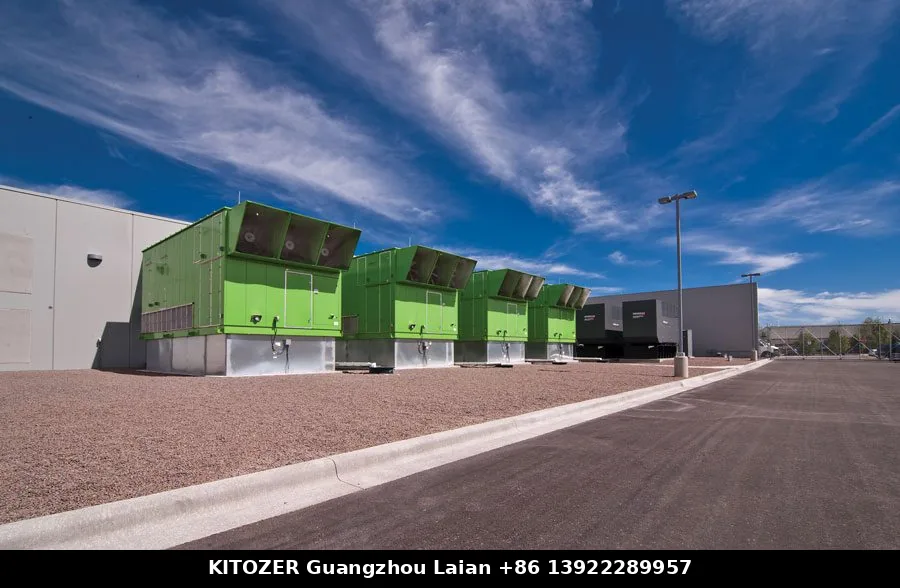
The indirect evaporative cooling unit is a high-efficiency air conditioning device that uses the heat-absorbing principle of water evaporation to cool air. It is widely used in data centers, telecom rooms, industrial plants, and commercial buildings. Unlike traditional vapor-compression air conditioning, indirect evaporative cooling sprays water on heat exchange surfaces, where evaporation absorbs heat and cools the air supplied to the room, using almost no compressor energy and therefore achieving extremely low operating energy consumption. The KITOZER indirect evaporative cooling unit, designed and integrated by Guangzhou Laian Intelligent System Development Co., Ltd., combines direct evaporative cooling, indirect heat exchange, and mechanical refrigeration backup to provide stable, efficient, and economical cooling under various climatic conditions.
The physical basis of evaporative cooling is the latent heat absorbed when water evaporates. When air flows over a wet heat exchange surface, part of the water evaporates and absorbs heat from the air, lowering the air temperature. Indirect evaporative cooling separates the cooled supply air (primary air) from the evaporating spray air (secondary air) through a heat exchange wall, so the supply air does not contact water directly and its humidity does not rise significantly. This feature makes indirect evaporative cooling especially suitable for humidity-sensitive data center environments.
The KITOZER indirect evaporative unit comprises the following components: casing frame and enclosure, primary air filters, indirect heat exchanger (metal or polymer plate heat exchanger), secondary air spray water system, circulating water pump, fill or evaporative coil, fans, makeup water and water treatment unit, control cabinet, and touchscreen. The unit is typically a vertical or horizontal cabinet installed on an outdoor roof, equipment platform, or adjacent space, delivering cooled air to the room through ductwork.
By structure, indirect evaporative cooling is divided into dew-point indirect evaporative cooling (M-Cycle) and ordinary indirect evaporative cooling. Dew-point cooling uses more elaborate air channel design to cool primary air close to or below its wet-bulb temperature, approaching the dew point, thereby expanding the range of climates where evaporative cooling can deliver usable cold air. KITOZER can select ordinary or dew-point indirect evaporative solutions based on local climate and supply air temperature requirements.
1.1 Product Positioning
The KITOZER indirect evaporative unit targets medium and large data centers and industrial ventilation cooling markets pursuing high energy efficiency and low operating cost. A single unit handles supply air from 20,000 to over 150,000 cubic meters per hour, supporting projects from single-rack cooling to whole data center halls. The product combines free cooling and mechanical refrigeration backup, automatically switching modes based on outdoor climate.
1.2 Core Value
KITOZER indirect evaporative cooling delivers value in four areas: first, it dramatically reduces refrigeration energy use because evaporative cooling almost eliminates compressor operation; second, it maximizes use of natural cooling, allowing evaporative operation for most of the year in suitable climates; third, it improves indoor air quality by supplying fresh outside air while cooling; and fourth, it reduces carbon emissions and long-term operating costs, supporting green data center goals.
1.3 Background and Market Drivers
Evaporative cooling has been used in dry regions for decades. Recently, as data center energy efficiency requirements and green low-carbon goals have intensified, indirect evaporative cooling has spread rapidly across global data centers. Drivers include data center energy and carbon pressure, diminishing efficiency gains from vapor compression systems, and a maturing evaporative cooling supply chain with falling costs. KITOZER was developed against this backdrop as a standardized product for data center deployment.
2. Working Principle
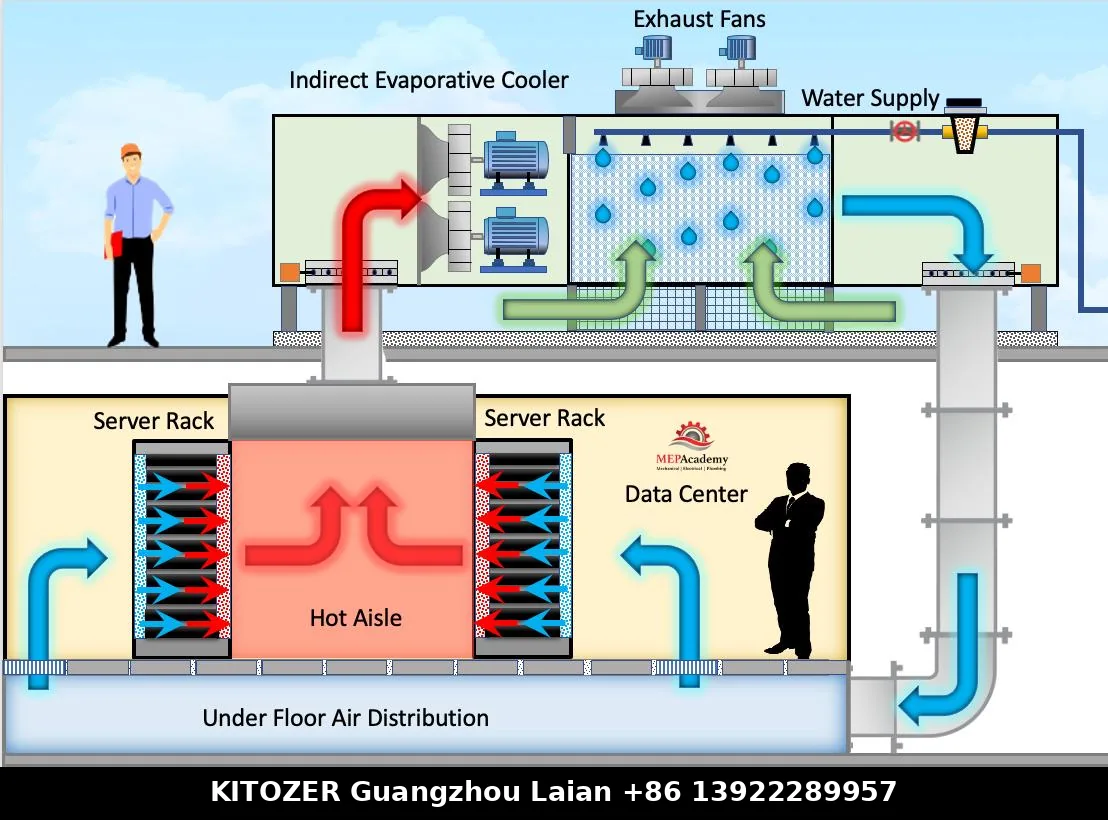
2.1 Direct Evaporative Cooling Basics
Direct evaporative cooling passes air through a wet fill layer, where water evaporation absorbs latent heat and cools the air while increasing its humidity. Direct cooling can approach the air wet-bulb temperature, with cooling efficiency typically 70 to 90 percent. However, because direct cooling raises supply air humidity, it is usually combined with indirect heat exchange to avoid excessive room humidity.
2.2 Indirect Evaporative Cooling Principle
Indirect evaporative cooling separates primary supply air from secondary evaporating air through a heat exchange wall. Secondary-side spray water evaporates on the wall outer surface, absorbing wall heat; primary air flows on the other side, transferring heat through the wall to the secondary side and cooling down without contacting water. Because primary air does not touch water, its moisture content remains essentially unchanged. This approach exploits evaporative cooling’s high efficiency while avoiding supply air humidification.
The supply air temperature in indirect evaporative cooling can approach the secondary air wet-bulb temperature. In dry climates, outdoor wet-bulb temperature is far below dry-bulb temperature, so indirect evaporative cooling can deliver air much cooler than outdoor dry-bulb temperature. Even in humid climates, indirect evaporative cooling still provides some cooling effect, though the magnitude is smaller.
2.3 Dew-Point Indirect Evaporative Cooling (M-Cycle)
Dew-point indirect evaporative cooling is a more efficient form. Through clever air channel design, it splits primary air into multiple streams and uses primary air itself as the evaporating cold source on the secondary side, cooling primary air close to its dew-point temperature rather than just wet-bulb. Because dew-point temperature is lower than wet-bulb, dew-point cooling delivers lower supply air under the same outdoor conditions, expanding the climate range where evaporative cooling works. KITOZER dew-point models use dedicated polymer or metal heat exchange cores with optimized channels.
2.4 Heat and Mass Transfer Thermodynamics
Indirect evaporative cooling involves both sensible heat transfer and evaporative latent heat exchange. Primary air transfers sensible heat through the wall to the secondary side; secondary-side water evaporation absorbs latent heat. The combined effect lowers primary air temperature without changing its humidity. The gap between supply air temperature and secondary wet-bulb temperature is called the approach; a smaller approach means more efficient heat exchange. KITOZER units are designed with a typical approach of 2 to 5 degrees Celsius.
2.5 Multiple Operating Modes
KITOZER indirect evaporative units typically have several operating modes that automatically switch based on outdoor climate:
(1) Free cooling mode: when outdoor air is cool enough, the unit directly brings in outdoor cool air without spray water, with very low fan energy.
(2) Evaporative cooling mode: when outdoor temperature is high but dry, the spray water system starts, using evaporative cooling to lower supply air.
(3) Combined refrigeration mode: in hot humid weather when evaporative cooling cannot reach supply temperature, the unit starts a mechanical refrigeration coil as backup, running jointly.
(4) Full mechanical cooling mode: under extreme conditions, the unit relies mainly on vapor compression refrigeration.
The controller automatically selects the most economical mode based on outdoor temperature, humidity, and room load for year-round high efficiency.
2.6 Fan and Water Systems
Unit fans are high-efficiency centrifugal or axial fans with variable-frequency drives, adjusting supply air based on room load. The water system includes circulating pumps, spray piping, fill, sump, and makeup device. Spray water forms a uniform film on the fill surface, contacting secondary air for evaporation. Unevaporated water falls into the sump and is recirculated by pumps. Makeup water automatically replenishes evaporation and blowdown losses based on sump level.
2.7 Water Treatment and Quality Management
As recirculated water evaporates, calcium and magnesium ions and impurities concentrate, potentially scaling on heat exchange surfaces or growing microbes. KITOZER units configure water treatment including dosing, blowdown control, and water quality monitoring. Periodic blowdown discharges part of the concentrated water and adds fresh water, maintaining quality within range. Corrosion and scale inhibitors plus biocides protect heat exchange surfaces and the water system.
3. Technical Specifications
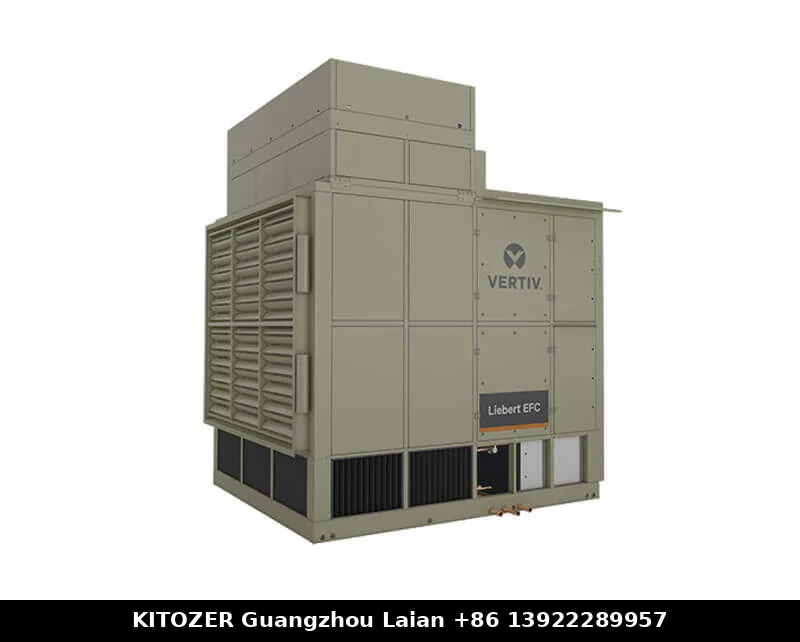
KITOZER indirect evaporative units are offered in several standard models by supply air volume and cooling capacity. The table below lists key parameters for main models; custom configurations are available.
3.1 Air Volume Parameters
| Parameter | KC-IXC30 | KC-IXC60 | KC-IXC100 | KC-IXC150 |
|---|---|---|---|---|
| Rated supply air (m³/h) | 30,000 | 60,000 | 100,000 | 150,000 |
| Rated cooling capacity (kW) | 180 | 360 | 600 | 900 |
| Supply air temp range (°C) | 18~27 | 18~27 | 18~27 | 18~27 |
| Secondary air ratio (%) | 40~50 | 40~50 | 40~50 | 40~50 |
| Design approach (°C) | 3~5 | 3~5 | 3~5 | 3~5 |
| Water system flow (m³/h) | 6 | 12 | 20 | 30 |
| Peak makeup water (m³/h) | 2.5 | 5 | 8.5 | 12 |
3.2 Electrical and Control Data
| Parameter | Specification |
|---|---|
| Power supply | AC 380V three-phase five-wire 50 Hz |
| Fan configuration | High-efficiency centrifugal/axial fan, VFD drive |
| Fan power (full load) | KC-IXC60 about 15 kW; KC-IXC150 about 40 kW |
| Control | PLC + 7-inch color touchscreen |
| Communication | Modbus TCP, BACnet/IP, SNMP optional, dry-contact alarm |
| Operating modes | Free cooling / evaporative / combined / full mechanical auto-switch |
| Protection | Fan overload, pump fault, low water level, filter blockage, over temp, freeze alarm |
3.3 Mechanical and Interface Data
| Parameter | Specification |
|---|---|
| Unit form | Vertical or horizontal outdoor cabinet, color steel or aluminum enclosure |
| Dimensions W×D×H | KC-IXC60 approx. 3500×2200×2800 mm; KC-IXC150 approx. 6000×2500×3000 mm |
| Weight | KC-IXC60 approx. 2800 kg; KC-IXC150 approx. 6500 kg |
| Primary air filter | Pre-filter G4 + optional medium F8 |
| Heat exchange core | Aluminum or polymer plate-fin core |
| Noise (10 m, full load) | ≤75 dB(A) |
| Protection rating | Control cabinet IP54; outdoor cabinet IP55 |
| Ambient conditions | -10°C~45°C (freeze protection for low temp) |
3.4 Key Component Brands
| Component | Selection |
|---|---|
| Fan | High-efficiency centrifugal or axial, IE3+ motor, VFD |
| Heat exchange core | Aluminum or polymer plate-fin, corrosion-resistant |
| Circulation pump | High-efficiency centrifugal, 1+1 standby |
| Filter | Washable G4 pre-filter, optional F8 |
| PLC and HMI | Mainstream industrial brand, local and remote update |
| Water treatment | Dosing + auto blowdown + water quality monitoring |
4. Selection Guide
Correct selection is the foundation of long-term efficient operation. KITOZER recommends the following steps and close communication with Guangzhou Laian engineers.
4.1 Determine Room Heat Load
Start by summing the IT equipment power in the room, plus lighting, UPS losses, and envelope heat transfer to get total room heat load. The evaporative unit cooling capacity must cover total load with 10 to 20 percent margin. Note that evaporative cooling capacity varies with outdoor climate, so selection should verify actual cooling under local summer design conditions.
4.2 Determine Supply Air Volume
Supply air is calculated from heat load and supply air temperature difference: Q equals rho times c times L times delta T. Data centers typically use 10 to 15 degree Celsius supply-to-return temperature difference to derive required air volume. KITOZER units are graded by air volume for easy selection.
4.3 Evaluate Climate Suitability
Evaporative cooling performance depends heavily on local climate. Dry regions (northwest, north China) achieve high efficiency with long evaporative running hours; humid coastal regions have limited evaporative capacity and need more mechanical refrigeration backup. KITOZER calculates annual evaporative running hours and determines mechanical backup capacity based on project meteorological data.
4.4 Select Operating Mode Combination
Based on climate and supply air requirements, decide whether to include mechanical refrigeration coils. Dry regions may choose pure evaporative units without compression; transition climates may include partial mechanical backup; hot humid regions need higher mechanical proportion. KITOZER offers configurations from pure evaporative to full mechanical.
4.5 Selection Decision Table
| Project Profile | Recommended Model | Configuration |
|---|---|---|
| Small room, dry climate | KC-IXC30 | Pure evaporative, single fan |
| Medium data center, transition climate | KC-IXC60 | Evaporative + partial mechanical |
| Large data center | KC-IXC100 | Multi-mode auto-switch, group control |
| Hyperscale data center | KC-IXC150 parallel | 2N redundancy, plant-wide control |
4.6 Water and Water Quality
Selection must verify available makeup water quantity and quality. Evaporative water consumption comes from evaporation and blowdown, with higher peak consumption in dry summer climates. Water-scarce sites need to balance water and energy, possibly using dry coolers as backup or reducing evaporative running time. Hard water requires enhanced treatment.
4.7 Noise and Installation Location
Indirect evaporative units are usually installed outdoors, so fan noise must be assessed for surrounding environments. KITOZER units run at about 75 dB(A) at 10 m; low-speed fans, silencers, and distance from sensitive buildings reduce noise impact. Installation must ensure unobstructed intake and exhaust without air short-circuiting.
5. Installation Requirements
5.1 Foundation and Setting
Units are heavy, so verify foundation load capacity before placement. Use concrete strip foundations or steel bases with level tolerance under 3 mm/m. Reserve at least 1000 mm service clearance around the unit and 800 mm above for maintenance. Level the unit after placement and anchor it.
5.2 Duct Connection
Supply and return ducts use galvanized steel or fiberglass with insulation to prevent condensation. Connect ducts to the unit with flexible connectors for vibration isolation. Keep duct runs short and straight to reduce resistance. Supply outlets should ensure uniform air distribution in the room.
5.3 Water Piping
Connect makeup, blowdown, and overflow pipes per drawings. Install valves and water meters on makeup lines; route blowdown to room drainage. Overflow and blowdown pipes must not be directly sealed; leave an air gap to prevent backflow. After piping, conduct a water test to check spray lines and valves for leaks.
5.4 Electrical Installation
Feed the unit from a dedicated circuit in the room power distribution panel with breaker. Bond the control cabinet grounding bar to the room equipotential grounding network with resistance under one ohm. Route communication cables separately from power cables. Wire fans and pumps per drawings.
5.5 Commissioning and Acceptance
Commissioning includes: jog-test fans and pumps for rotation; check spray water distribution; test operating mode switching; verify temperature and humidity sensor readings; inspect ducts and water piping for leaks; run continuously for 24 hours. Acceptance documents include water test records, run records, and alarm test records.
6. Operation and Maintenance
6.1 Daily Inspection
Operators check the touchscreen or remote dashboard daily: supply temperature at setpoint; fan current and frequency; sump level; filter differential pressure; pump status; spray distribution. Address abnormal trends promptly.
6.2 Periodic Maintenance Schedule
| Interval | Tasks |
|---|---|
| Weekly | Review alarm log; inspect spray and sump; record supply temp and air volume |
| Monthly | Clean pre-filter; check pump noise and vibration; sample water quality |
| Quarterly | Switch lead/standby pumps; clean cabinet filter; tighten electrical terminals; test mode switching |
| Half-year | Calibrate temp/humidity sensors; inspect heat core fouling; check belts and bearings |
| Yearly | Deep-clean heat core and fill; replace water treatment chemicals; inspect insulation and ducts |
| Every two years | Fan bearing service; cable insulation test; pump mechanical seal inspection |
6.3 Common Faults and Remedies
| Symptom | Likely Cause | Action |
|---|---|---|
| Supply temp high | Filter blocked; uneven spray; core fouled; high wet-bulb | Clean filter; adjust spray; start mechanical cooling; clean core |
| Low sump level | Makeup valve fault; excessive blowdown; pipe leak | Check makeup valve; adjust blowdown; trace leak |
| Pump noise | Bearing wear; impeller blockage; cavitation | Replace bearing; clean impeller; check level |
| Fan vibration | Dirty impeller; bearing wear; loose anchor | Clean impeller; replace bearing; tighten anchor |
| High room humidity | Secondary air bypassing to primary; poor sealing | Check secondary-to-primary seal; repair sealing |
| Efficiency drop | Core fouled; filter blocked; nozzles clogged | Clean core and nozzles; replace filter |
6.4 Long Shutdown and Restart
For extended shutdown, drain the sump and piping to prevent winter freezing or microbial growth. Cold-region shutdown requires freeze protection. Before restart, inspect water, electrical, and fans, jog-test, then ramp load gradually.
7. Frequently Asked Questions
Q: What is the difference between indirect and direct evaporative cooling?
A: Direct cooling passes air through wet fill, cooling it but raising humidity; indirect cooling separates supply air from the evaporating side by a wall, so supply air cools without humidifying. Indirect cooling suits humidity-sensitive data centers.
Q: Does evaporative cooling use much water?
A: Water consumption comes from evaporation and blowdown. Dry regions use more water in peak summer, but compared with the cooling energy saved, water use is acceptable. KITOZER calculates annual water use from local meteorological data.
Q: Can indirect evaporative cooling work in humid climates?
A: Yes, but cooling effect is weaker than in dry regions. Humid areas need more mechanical refrigeration backup. KITOZER designs the optimal mode combination based on local climate.
Q: Does evaporative cooling need a compressor?
A: Pure evaporative mode uses no compressor, only fans and pumps. In hot humid conditions, KITOZER units can include mechanical refrigeration coils as backup, auto-switching by condition.
Q: How large a room can one unit cool?
A: A KC-IXC100 at 600 kW cooling serves about 100 to 150 racks at 4 to 6 kW per rack. Exact capacity is calculated from room heat load and supply air delta T.
Q: What is the energy efficiency ratio of evaporative cooling?
A: In evaporative mode, the unit only consumes fan and pump power, giving an EER of 20 to 50 or more, far above vapor compression at 3 to 5. Exact values vary by climate and condition.
Q: Does supply air humidity increase?
A: Indirect evaporative primary air does not contact water directly, so moisture content stays essentially unchanged. This is the main advantage over direct evaporative cooling.
Q: Does KITOZER support remote monitoring?
A: Yes. The unit offers Modbus TCP, BACnet/IP, and SNMP integration into DCIM or BMS, with temperature, humidity, fan status, pump status, alarms, and trend history.
Q: Is the unit installed indoors or outdoors?
A: KITOZER indirect evaporative units are typically outdoor-type, installed on roofs, equipment platforms, or adjacent outdoor space, ducted to the room. Indoor layouts are also possible based on site conditions.
Q: How is winter freeze protection handled?
A: Cold-region units include sump heating, pipe insulation, and dry-mode or shutdown logic at low temperatures. KITOZER designs freeze protection based on project minimum temperature.
Q: Is the upfront cost higher than traditional air conditioning?
A: Upfront cost is comparable to high-efficiency vapor compression or slightly higher, but long-term power bills drop significantly. Considering energy savings, payback is typically a few years.
Q: What is the lead time for KITOZER units?
A: Standard models ship four to six weeks after contract; custom models eight to twelve weeks. Guangzhou Laian provides one-stop service from design to commissioning.
Q: Does evaporative cooling produce visible water mist?
A: Improper operation or poor sealing can cause mist at the exhaust. KITOZER designs proper secondary air exhaust paths and drift eliminators to avoid visible mist and water carryover.
Q: How do I judge if my site suits evaporative cooling?
A: Contact KITOZER technical department with the project location. We calculate evaporative cooling potential, annual running hours, and recommended configuration from local meteorological data.
Q: What about air quality?
A: The unit supplies filtered fresh outdoor air, providing ventilation while cooling. In polluted or odorous areas, optional air quality monitoring can reduce fresh air or enable return air.
8. Application Scenarios
KITOZER indirect evaporative units are deployed across many scenarios.
8.1 Data Center Cooling
Data centers are the most important application. High-density rooms need large cooling and ventilation; evaporative cooling delivers fresh air while lowering PUE. In dry regions, evaporative cooling handles most of the refrigeration load.
8.2 Telecom Rooms and Base Stations
Telecom rooms and base stations are numerous and widely distributed, sensitive to operating cost. Evaporative cooling uses natural cooling to reduce air conditioning energy, suiting operators concerned with power costs.
8.3 Industrial Plant Ventilation
Textile, electronics, and machinery plants need ventilation and cooling. Evaporative units simultaneously ventilate and cool, supplying fresh outdoor air and improving workshop conditions.
8.4 Commercial and Public Buildings
Malls, stadiums, and hospitals can use evaporative cooling as economical ventilation and cooling, providing free cooling in swing seasons and lowering air conditioning energy.
9. Technology Trends
Indirect evaporative cooling continues to evolve in several directions.
9.1 Higher Cooling Efficiency
Dew-point indirect evaporative cooling and new core materials will further reduce approach temperature, expanding the climate range where evaporative cooling works. More efficient cores deliver lower supply air and less energy.
9.2 Intelligent Operation
Combining weather forecasting and load prediction, systems will optimize operating modes in advance, maximizing energy savings while ensuring cooling. AI algorithms will auto-tune control parameters based on historical data.
9.3 Water-Saving Technology
Water consumption is the main limitation of evaporative cooling. Dry cooler assist, condensation recovery, and dry-running modes will reduce water use, expanding evaporative cooling to water-scarce regions.
9.4 Integration with Liquid Cooling
As high-density computing adopts liquid cooling, indirect evaporative cooling can serve as the cooling source for liquid CDUs, forming a hybrid gas-liquid efficient system. This fusion will be the mainstream architecture for future high-density data centers.
10. Psychrometrics and Air Handling Process
Indirect evaporative cooling is fundamentally a heat and mass exchange process between air and water. Understanding its high efficiency requires working with moist air properties and the psychrometric chart. KITOZER engineers design air paths, water systems, and heat exchange cores based on these thermodynamic principles.
10.1 Basic Moist Air Properties
Natural air is a mixture of dry air and water vapor. Key descriptors include dry-bulb temperature, wet-bulb temperature, dew-point temperature, relative humidity, moisture content, and enthalpy. Dry-bulb temperature is what ordinary thermometers measure; wet-bulb temperature is the lowest temperature air can reach through evaporative cooling; dew-point temperature is the temperature at which air becomes saturated when cooled at constant moisture content. In dry regions, wet-bulb temperature is far below dry-bulb, giving evaporative cooling enormous cooling potential.
10.2 Processes on the Psychrometric Chart
On the psychrometric chart, direct evaporative cooling follows approximately a constant-enthalpy line: air contacts water, evaporation absorbs latent heat, air temperature drops but moisture content rises, and total enthalpy stays nearly constant. Indirect evaporative cooling splits into two steps: primary air is cooled through the wall at constant moisture content, moving along a constant-moisture line; secondary air undergoes direct evaporative cooling along a constant-enthalpy line. The two air streams exchange heat through the wall, and primary air temperature drops significantly while humidity stays unchanged.
10.3 Cooling Efficiency and Approach
Evaporative cooling efficiency is expressed as (outdoor dry-bulb minus supply air) divided by (outdoor dry-bulb minus outdoor wet-bulb). High-efficiency indirect evaporative cooling reaches over 80 percent. Approach is the gap between supply air temperature and secondary wet-bulb temperature; smaller approach means better heat exchange core performance. KITOZER units are designed with a typical approach of 2 to 5 degrees Celsius.
10.4 Thermodynamic Advantage of Dew-Point Cooling
Ordinary indirect evaporative cooling can only cool primary air close to secondary wet-bulb temperature; dew-point indirect cooling uses primary air itself as the secondary-side evaporating cold source, cooling primary air close to its dew-point temperature. Because dew-point is below wet-bulb, dew-point cooling delivers lower supply air under the same outdoor conditions, expanding the climate range where evaporative cooling works.
11. Heat Exchange Core Structure and Materials
The heat exchange core is the heart of the indirect evaporative unit, and its performance directly determines cooling efficiency and approach. KITOZER uses several core types for different conditions.
11.1 Plate-Fin Cores
Plate-fin cores are stacked from metal plates and corrugated fins, with primary and secondary air flowing in adjacent channels. The plates are usually aluminum with corrosion protection; fins increase heat transfer area and disturb airflow. Plate-fin cores are compact and efficient, the mainstream choice for indirect evaporative cooling.
11.2 Polymer Cores
Some dew-point indirect evaporative cooling uses polymer composite cores. Polymer is corrosion-resistant, light, and flexible in channel design, suited to long-term wet spray environments. KITOZER selects core material based on project water quality and climate.
11.3 Corrosion Protection and Life
Because the core sits in a wet spray environment long term, corrosion protection is critical. Aluminum cores usually use epoxy coating or anodizing. KITOZER expects core life of 10 to 15 years under proper maintenance. Regular cleaning and water quality management are key to extending core life.
11.4 Drift Elimination and Water Carryover Control
The secondary air exhaust is fitted with drift eliminators that capture entrained droplets, preventing water carryover outside the unit. Drift eliminator design directly affects visible mist and water loss. KITOZER units include high-efficiency eliminators to avoid obvious water carryover under all conditions.
12. Water System and Water Treatment
The water system is a key part of indirect evaporative cooling, and its design and maintenance directly affect cooling efficiency and equipment life.
12.1 Spray Water System
Spray water is pumped to spray pipes at the top of the heat exchange core, distributing uniformly through nozzles to form a thin film on the core surface. Unevaporated water falls to the bottom sump and is recirculated. Nozzles are anti-clog design, with materials selected by water quality.
12.2 Sump and Makeup Water
The sump at the unit bottom collects unevaporated spray water. Makeup water automatically starts and stops based on sump level, replenishing evaporation and blowdown losses. Makeup lines use float valves or electric fill valves with level sensors for automatic control.
12.3 Water Quality and Scaling
As recirculated water evaporates, calcium and magnesium ions concentrate, forming scale on heated or evaporating surfaces. Scale has very low thermal conductivity, and even a thin layer significantly reduces heat exchange efficiency. KITOZER controls scaling through periodic blowdown, scale and corrosion inhibitors, and water quality monitoring.
12.4 Microbes and Legionella Control
Warm, humid water systems easily grow bacteria, algae, and Legionella. KITOZER configures biocide dosing, periodically adding disinfectant, and maintains water quality through blowdown. Regular sump and spray line cleaning is also necessary maintenance.
12.5 Blowdown and Water Balance
When recirculated water concentrates to a certain multiple, blowdown discharges part of the concentrated water and adds fresh water. Concentration cycles are set by makeup hardness, typically 3 to 5. Automatic blowdown valves operate by conductivity or timer, maintaining water quality within range.
13. Fan System and Air Distribution
Fans provide airflow power, and their efficiency and noise directly affect overall unit performance.
13.1 Fan Type Selection
KITOZER units use high-efficiency centrifugal or axial fans. Centrifugal fans provide high static pressure and lower noise, suited to ducted systems with resistance; axial fans are low cost and high flow but limited static pressure. KITOZER selects fan type based on duct resistance and airflow.
13.2 Variable-Frequency Control
Fans have variable-frequency drives that adjust speed based on room load. Data center load varies over time, and VFD fans slow down at low load, saving significant fan energy. The controller modulates fan frequency based on room or supply air temperature.
13.3 Intake and Exhaust Layout
Indirect evaporative units need proper intake and exhaust paths. Primary air intake and secondary air exhaust should be separated to avoid re-ingestion of exhaust. Intakes should be away from pollution sources and exhaust outlets. KITOZER simulates air distribution during design to avoid short-circuiting.
13.4 Noise Control
Fan noise is the main unit noise source. KITOZER controls noise through low-speed fans, inlet and outlet silencers, internal acoustic lining, and vibration-isolated mounting. Units near sensitive buildings also need nighttime noise assessment.
14. Multi-Mode Control Strategy
Automatic operating mode switching is key to indirect evaporative cooling efficiency. The controller selects the most economical mode in real time based on outdoor temperature, humidity, and room load.
14.1 Mode Decision Logic
The PLC collects outdoor temperature and humidity, room return temperature, supply temperature, and unit status. When outdoor temperature is low, it enters free cooling mode, directly bringing in outside air; when temperature is high but dry, it starts evaporative cooling; when evaporative cooling cannot meet supply temperature, it starts the mechanical refrigeration coil. Switching is smooth to avoid temperature swings.
14.2 Swing Season Operation
Swing seasons have mild outdoor temperatures, the high-efficiency period for evaporative and free cooling. KITOZER control prioritizes natural cooling during these periods, minimizing mechanical refrigeration for best annual efficiency.
14.3 Summer Operation
In hot humid summers, evaporative cooling is limited, and the unit relies more on mechanical refrigeration. KITOZER sizes mechanical backup based on local summer design conditions, ensuring supply temperature meets requirements under the worst conditions.
14.4 Winter Operation
Winter outdoor temperature is low, and the unit runs mainly on free cooling. Cold regions need freeze protection: sump heating, pipe insulation, low-temperature shutdown or dry mode. KITOZER designs winter operation strategy based on project minimum temperature.
15. Energy Efficiency and Economics
15.1 EER Calculation
In evaporative mode, the unit only consumes fan and pump power, giving an energy efficiency ratio (cooling output divided by power input) of 20 to 50 or more. Compared with vapor compression at 3 to 5, energy savings are dramatic. KITOZER calculates annual energy use month by month from local meteorological data to evaluate savings.
15.2 Comparison with Traditional Air Conditioning
| Dimension | Vapor Compression AC | KITOZER Indirect Evaporative |
|---|---|---|
| Cooling principle | Vapor compression cycle | Evaporation + free cooling |
| EER | 3~5 | 20~50 (evap mode) |
| Compressor energy | Major share | Only for backup |
| Fresh air | Usually recirculated | 100% fresh air |
| Water use | Cooling tower water | Evaporation + blowdown |
| Suited climate | All regions | Dry regions best |
15.3 Payback Period
Indirect evaporative cooling upfront cost is comparable to or slightly higher than high-efficiency vapor compression, but long-term power bills drop sharply. In regions with high electricity prices and suitable climate, payback is typically 2 to 4 years. Carbon benefits and green data center policy support improve economics further.
15.4 Water vs Energy Trade-off
Evaporative cooling uses water but saves electricity. The trade-off varies by region. In high-electricity-price, low-water-price regions, evaporative cooling economics are strong; in water-scarce regions, the trade-off matters. KITOZER optimizes operating strategy based on local water and electricity prices, balancing water and energy use while ensuring cooling.
16. Project Delivery and Documentation
16.1 Design Documents
Includes system design proposal, heat load calculation, duct layout, water piping diagram, electrical schematic, control logic description, and foundation requirements. Submitted for review during design and as-built after construction.
16.2 Factory Documentation
Equipment certificates, factory inspection reports, fan and pump certificates, PLC program backup, and touchscreen configuration files.
16.3 Acceptance Documentation
Installation acceptance records, water test records, run records, alarm test records, and operations manual.
16.4 After-Sales Service
Remote technical support and on-site service. Non-wearable parts are replaced free during warranty. KITOZER offers spare parts lists and maintenance contract options.
17. Data Center Air Distribution and Supply Design
How the cold air from an indirect evaporative unit reaches the racks directly affects cooling effectiveness and efficiency. Data center air distribution design is a critical part of project success.
17.1 Hot/Cold Aisle Containment
Data centers typically use hot/cold aisle layouts: racks face each other forming a cold aisle, cold air enters the racks and exhausts hot air into the hot aisle. Indirect evaporative supply air delivers cold air to the cold aisle, and warmed return air goes back to the unit or outside. Hot/cold aisle isolation avoids mixing, improving cooling efficiency.
17.2 Supply Air Methods
Common methods include underfloor supply, ducted supply, and rooftop supply. Underfloor supply uses the raised floor plenum, simple but uses ceiling height; ducted supply is flexible and allows precise air distribution; rooftop supply suits large rooms. KITOZER selects the method based on room conditions.
17.3 Return Air Organization
Hot air after absorbing heat exits the hot aisle through return ducts or return space to the unit. Return air temperature is usually 10 to 15 degrees above supply. Proper return air organization avoids short-circuiting, ensuring the unit draws hot return air for efficient heat exchange.
17.4 Rack Blanking Panels and Aisle Containment
Empty rack U positions should have blanking panels to prevent hot air from short-circuiting from rear to front. High-density rooms can use cold-aisle or hot-aisle containment. These measures, combined with indirect evaporative cooling, significantly improve refrigeration efficiency.
18. Evaporative Cooling by Climate Zone
Indirect evaporative cooling performance depends heavily on project climate. KITOZER designs differentiated solutions by climate zone.
18.1 Dry Regions (Northwest, North China)
Dry regions have low outdoor wet-bulb temperature and high evaporative efficiency. KITOZER recommends pure evaporative or evaporative-dominant solutions, with free cooling running most of the year and mechanical refrigeration only as summer backup. This is where evaporative cooling has the strongest advantage.
18.2 Transition Climate Regions (East China, Central China)
Transition climates have four distinct seasons: free cooling in winter, mechanical refrigeration in summer, and automatic switching. KITOZER recommends multi-mode units that auto-switch by season. Swing seasons have high evaporative efficiency, keeping annual PUE excellent.
18.3 Humid Regions (South China Coast)
Humid regions have high outdoor wet-bulb temperature and limited evaporative capacity. KITOZER recommends evaporative plus larger mechanical refrigeration combinations, with evaporative cooling as auxiliary and mechanical refrigeration carrying main load. Even so, evaporative cooling still helps in swing seasons and dry spells, lowering annual energy use.
18.4 Plateau and Cold Regions
Plateau areas have low pressure and dry air, giving high evaporative potential; cold regions have long winters and long free-cooling periods. KITOZER emphasizes winter freeze protection and free cooling strategy, achieving high annual efficiency.
19. Combinations with Other Cooling Methods
In real data centers, indirect evaporative cooling is often combined with other cooling methods rather than used alone.
19.1 Evaporative Cooling + Chillers
Evaporative cooling handles base load, chillers handle peaks and extreme conditions. This combination is common in transition climates, relying on evaporative cooling most of the year and chillers in summer.
19.2 Evaporative Cooling + Liquid Cooling
High-density GPU racks use liquid cooling, and the liquid CDU heat is rejected by the indirect evaporative unit. Evaporative cooling provides cooling water for the liquid loop, forming an efficient hybrid system.
19.3 Evaporative Cooling + Dry Coolers
In winter or dry weather, dry coolers use outdoor air for direct cooling; in summer, evaporative cooling supplements. The combination switches by condition to maximize energy savings.
19.4 Hybrid Plant-Wide Control
When multiple cooling methods combine, a plant-wide control system coordinates operation. KITOZER provides plant-wide control and DCIM integration, scheduling cooling sources by outdoor conditions and load for overall optimal efficiency.
20. On-Site Installation Common Issues
20.1 Uneven Foundation Causing Unit Deformation
Verify foundation level before placement. An uneven foundation can cause long-term casing deformation and duct leaks. Remedy: re-level the foundation, use adjustable feet, and anchor firmly.
20.2 Duct Air Leakage
Poor duct sealing causes cold air leakage or hot air ingress. Remedy: inspect duct flanges and flexible connectors, replace gaskets, tighten bolts. Leakage significantly reduces supply efficiency.
20.3 Uneven Spray Distribution
Clogged nozzles or poor spray pipe layout cause localized dry spots on the core, reducing cooling efficiency. Remedy: clean nozzles, check spray pipe level, adjust nozzle angle.
20.4 Pump Cavitation
Low sump level or blocked suction causes pump cavitation, noise, and vibration. Remedy: check makeup and level, clean suction strainer, ensure pump runs at proper level.
20.5 Freeze Protection Failure
In cold regions, insufficient freeze protection in winter can crack the sump and piping. Remedy: check electric heaters, insulation, and low-temperature protection logic; drain water when needed.
21. Operations Team Training
21.1 Daily Operations Training
Includes touchscreen operation, mode switching, manual pump and fan control, filter replacement, makeup and blowdown inspection. KITOZER provides hands-on training at handover.
21.2 Water Quality Maintenance Training
Trains water sampling, dosing, blowdown management, and common water quality issue diagnosis. Operators should master initial handling of water anomalies.
21.3 Fault Handling Training
Covers diagnosis and handling of temperature anomalies, fan faults, pump faults, filter blockage, and more.
21.4 Safety Training
Includes electrical safety, working at height, water system maintenance safety, and chemical handling. Operators should master emergency shutdown and response.
22. Product Series Overview
The KITOZER indirect evaporative product line covers 30,000 to 150,000 m³/h supply air, meeting projects of all scales.
22.1 Small Series (KC-IXC30)
Targets small rooms and edge nodes, 30,000 m³/h and 180 kW. Compact, installable on outdoor platforms or adjacent space, ideal for evaporative cooling pilots.
22.2 Medium Series (KC-IXC60)
Targets medium data centers, 60,000 m³/h and 360 kW. Configured with multi-mode auto-switch and water treatment, the workhorse for batch deployment.
22.3 Large Series (KC-IXC100/150)
Targets large and hyperscale data centers, 100,000 to 150,000 m³/h and 600 to 900 kW. Supports parallel units, plant-wide control, and 2N redundancy.
22.4 Custom Series
For special project needs, KITOZER customizes unit dimensions, air volume, fan type, control logic, and interfaces, such as enhanced freeze-protection for ultra-cold environments or silent models for noise-sensitive sites.
23. Technology Trends
Indirect evaporative cooling continues to evolve in several directions.
23.1 Higher Cooling Efficiency
Dew-point indirect cooling and new core materials will further reduce approach, expanding the climate range where evaporative cooling works. More efficient cores deliver lower supply air and less energy.
23.2 Intelligent Operation
Combining weather forecasting and load prediction, systems will optimize operating modes in advance, maximizing energy savings while ensuring cooling. AI algorithms will auto-tune control parameters based on historical data.
23.3 Water-Saving Technology
Water consumption is the main limitation of evaporative cooling. Dry cooler assist, condensation recovery, and dry-running modes will reduce water use, expanding evaporative cooling to water-scarce regions.
23.4 Integration with Liquid Cooling
As high-density computing adopts liquid cooling, indirect evaporative cooling can serve as the cooling source for liquid CDUs, forming a hybrid gas-liquid efficient system. This fusion will be the mainstream architecture for future high-density data centers.
24. Common Misconceptions
24.1 Misconception: Evaporative cooling is a cooling tower
Clarification: A cooling tower is an open heat rejection device that does not directly supply air to rooms; an indirect evaporative unit is a complete air handling device that delivers cooled supply air directly to the room while ventilating.
24.2 Misconception: Evaporative cooling only works in deserts
Clarification: Dry regions see the best effect, but transition and humid regions still benefit, just with more mechanical refrigeration backup. KITOZER designs the optimal combination by local climate.
24.3 Misconception: Evaporative cooling is very humid
Clarification: Indirect evaporative supply air does not contact water directly, so humidity stays basically unchanged. Direct evaporative cooling raises humidity. KITOZER uses the indirect form to avoid humidification.
24.4 Misconception: Evaporative cooling is hard to maintain
Clarification: Modern evaporative units are highly automated; daily maintenance is mainly filter cleaning, water inspection, and nozzle cleaning. Compared with precision air conditioning, maintenance is comparable or less.
24.5 Misconception: Evaporative cooling has high upfront cost
Clarification: Upfront cost is comparable to high-efficiency vapor compression, but long-term power bills drop significantly. In suitable climates, payback is usually short.
25. KITOZER Differentiated Advantages
25.1 System Integration Capability
KITOZER provides more than units: heat load calculation, duct and water piping design, control integration, and on-site commissioning. Users do not need to separately source units and supporting systems.
25.2 Local Manufacturing
KITOZER is manufactured by Guangzhou Laian in Panyu, Guangzhou, with short lead times, fast service, and competitive pricing.
25.3 Multi-Mode Optimization
KITOZER units have free cooling, evaporative cooling, and combined refrigeration modes that auto-switch by climate, achieving year-round optimal efficiency.
25.4 Continuous Iteration
Guangzhou Laian tracks evaporative cooling technology evolution, including dew-point cooling, new cores, intelligent control, and water-saving technology, continuously upgrading products.
26. Project Lifecycle Management
26.1 Design Phase
Define heat load, air volume, climate conditions, operating modes, and redundancy. KITOZER engineers coordinate with the user’s architectural, electrical, and HVAC teams.
26.2 Construction Phase
Factory builds and factory-tests equipment, then on-site crews install ducts, water piping, and electrical. KITOZER provides on-site supervision.
26.3 Commissioning Phase
Water flushing, filling, parameter tuning, mode switching testing, and continuous run. Acceptance documents are delivered after testing.
26.4 Operations Phase
Scheduled inspection, filter replacement, and water testing per maintenance plan. KITOZER provides remote monitoring and technical support.
26.5 Expansion and Decommissioning
As load grows, parallel units can be added. At end of life, KITOZER assists with safe dismantling and material recycling.
27. Engineering Design Calculations
27.1 Heat Load Calculation
Room heat load mainly comes from IT equipment power, plus lighting, UPS losses, and envelope heat transfer. The evaporative unit cooling capacity must cover total load with margin.
27.2 Supply Air Calculation
Calculate supply air from heat load and supply air delta T: Q equals rho times c times L times delta T. Data centers typically use 10 to 15 degree Celsius supply-to-return difference.
27.3 Water Consumption Calculation
Evaporation loss is about 0.2 to 0.3 kg/h per kW of cooling, plus blowdown. KITOZER calculates annual water use from local meteorological data.
27.4 Air Resistance Calculation
Duct, filter, and core resistance determine fan static pressure selection. KITOZER optimizes duct design through hydraulic calculation software, reducing fan energy.
28. Standards and Certifications
KITOZER indirect evaporative units are designed and manufactured with reference to relevant national and industry standards covering data center cooling, air conditioning equipment, electrical safety, noise control, and environmental protection. Third-party test reports and factory inspection documents are available on request. For export projects, KITOZER supports electrical safety and electromagnetic compatibility certification in target markets.
29. Buyer Decision Guide
29.1 Technical Maturity Assessment
Evaporative cooling is mature, but operations teams need to learn water quality management and mode switching. Start with a small pilot before scaling.
29.2 Supply Chain and Service
Beyond product performance, evaluate system integration capability, local service response, spare parts supply, and long-term support. As a Guangzhou-based manufacturer, KITOZER offers fast response and local service.
29.3 Total Cost of Ownership
Compare not only upfront cost but also 5- to 10-year TCO including electricity, water, maintenance, fluid makeup, depreciation, and floor space. Evaporative cooling has comparable upfront cost but long-term power savings. KITOZER helps users run TCO models.
29.4 Risks and Mitigation
Main risks include climate mismatch, poor water quality management, and winter freezing. These are controlled through thorough front-end design, water management, and freeze protection. KITOZER applies multiple protective measures to bring risk to acceptable levels.
30. Conclusion
KITOZER indirect evaporative cooling, as a high-efficiency cooling product for data centers and industrial ventilation, uses water evaporation to meet cooling demand while dramatically reducing energy use. Against the backdrop of rising data center efficiency requirements and green low-carbon goals, evaporative cooling is spreading from dry regions to wider climates. Guangzhou Laian, through local manufacturing and system integration, provides one-stop evaporative cooling solutions from design to operations. For further information on KITOZER indirect evaporative cooling, contact the technical department via the contact details on this page.
31. Detailed Airflow Path Description
A clear understanding of airflow paths helps users and installers understand unit operation. KITOZER indirect evaporative units have three main airflow paths: primary supply air path, secondary evaporative air path, and exhaust path.
31.1 Primary Supply Air Path
Primary air is the air finally delivered to the room. It is drawn from outside or return air, passes through the pre-filter, flows through the primary-side channels of the heat exchange core, where it is cooled by heat transfer through the wall, then is pushed by the supply fan through ductwork to the room cold aisle. The primary air does not contact spray water directly, so its humidity stays basically unchanged.
31.2 Secondary Evaporative Air Path
Secondary air is the air used as the evaporative cold source. It is drawn from outside or return air, passes through the secondary-side channels of the core, where spray water evaporates and absorbs heat, cooling the wall. Secondary air absorbs heat and moisture, becoming warm humid air that exits through the exhaust outlet. The secondary air stream does not enter the room.
31.3 Exhaust Path
Warm humid secondary air exits the unit through the exhaust outlet, fitted with drift eliminators to capture droplets. Exhaust should be routed away from intake to avoid short-circuiting. KITOZER designs exhaust height and direction based on building geometry and prevailing wind.
31.4 Air Volume Balance
Primary and secondary air volumes are matched by fan sizing and dampers. Typical secondary air is 40 to 50 percent of primary. Excess secondary air wastes fan energy; insufficient secondary air reduces cooling. KITOZER optimizes the ratio by climate and core design.
32. Spray Water Distribution System
Even spray water distribution is critical to evaporative cooling efficiency. Uneven spray leaves dry spots on the core, reducing effective heat transfer area.
32.1 Spray Pipe Layout
Spray pipes run across the top of the core, with nozzles spaced to cover the full core face. Pipes are stainless or PVC, sized for uniform pressure. Nozzles are cone-spray type with anti-clog design.
32.2 Nozzle Design
Nozzles atomize water into fine droplets, increasing contact area with secondary air. Droplet size is a trade-off: too fine causes drift; too coarse reduces evaporation. KITOZER selects nozzle type based on water quality and core geometry.
32.3 Pump Selection
Circulation pumps provide spray pressure and flow. Pumps are high-efficiency centrifugal, with 1+1 standby for reliability. Pump pressure is matched to nozzle design pressure.
32.4 Sump Design
The sump at the unit bottom collects unevaporated water. Its volume is sized for several minutes of circulation, giving buffer for makeup and blowdown. Sumps are sloped toward drain for easy cleaning.
33. Electrical Control Architecture
33.1 PLC and HMI
The unit uses an industrial PLC as the controller, collecting temperature, humidity, pressure, level, and current signals, and controlling fans, pumps, valves, and mode switching. The HMI is a 7-inch color touchscreen for local monitoring and operation.
33.2 Sensor Configuration
Sensors include outdoor dry-bulb and wet-bulb, supply air temperature and humidity, return air temperature, sump level, water conductivity, filter differential pressure, fan current, and pump status. KITOZER selects industrial-grade sensors for long-term reliability.
33.3 Communication and Integration
Standard Modbus TCP, with optional BACnet/IP, SNMP, or OPC. The unit integrates into the user’s DCIM, BMS, or building automation system. Alarms and operating data are available remotely.
33.4 Safety Interlocks
Includes fan overload, pump fault, low sump level, filter blockage, over-temperature, freeze, and communication loss interlocks. Critical alarms shut down the relevant equipment and notify operators.
34. Installation Layout and Space Planning
34.1 Roof Installation
Roof installation is common for indirect evaporative units. The roof structure must carry the unit’s full weight including water. KITOZER provides foundation loads for structural engineering. Ducts penetrate the roof with waterproofing details.
34.2 Outdoor Platform Installation
When roof space is limited, units can sit on outdoor steel platforms adjacent to the building. Platforms must carry unit weight and provide service clearance.
34.3 Ground Installation
Ground installation is possible but must account for snow, flood, and landscape. The foundation is elevated above ground level, and intake/exhaust paths are protected.
34.4 Service Clearance
Reserve at least 1000 mm clearance on service sides for filter access, pump removal, and maintenance. Top clearance is needed for lifting cores and pumps.
35. Commissioning and Performance Verification
35.1 Pre-Commissioning Checks
Before starting, verify all wiring, duct connections, water piping, valves, and sensors. Fill the sump with clean water. Inspect nozzles and core for shipping damage.
35.2 Water System Flush
Flush spray pipes and sump to remove debris. Start the circulation pump and inspect spray distribution. Check for leaks at all connections.
35.3 Fan and Motor Check
Jog-test fans for rotation direction. Ramp up speed gradually and check current, vibration, and noise. Verify VFD control responds to commands.
35.4 Mode Switching Test
Simulate or wait for different outdoor conditions and test free cooling, evaporative cooling, and combined modes. Verify smooth switching and stable supply temperature.
35.5 Continuous Run and Acceptance
Run the unit continuously for 24 to 48 hours. Record temperatures, airflow, water use, and power. Acceptance is signed after all tests pass.
36. Maintenance Deep Dive
36.1 Filter Replacement
Pre-filters should be cleaned monthly and replaced annually or when differential pressure exceeds threshold. Clogged filters reduce airflow and increase fan energy. Keep spare filters on site.
36.2 Core Cleaning
Inspect the heat core annually for scaling and fouling. Clean with low-pressure water or mild chemical cleaner when needed. Never use high-pressure jets that damage fins.
36.3 Nozzle Maintenance
Inspect nozzles quarterly for clogging. Clogged nozzles cause uneven spray. Soak nozzles in descaler or replace as needed.
36.4 Pump Maintenance
Check pump vibration, noise, and seal leakage quarterly. Replace mechanical seals every 2 to 3 years. Keep a spare pump for redundancy.
36.5 Fan Maintenance
Inspect fan belts (if belt-driven) annually for tension and wear. Lubricate bearings per schedule. Clean fan blades for balanced operation.
36.6 Electrical Maintenance
Tighten electrical terminals annually. Inspect cable insulation. Test grounding resistance. Clean the PLC cabinet filter.
37. Water Treatment Detailed Guidance
37.1 Makeup Water Quality Requirements
Makeup water should meet drinking water standards. Hardness over 200 mg/L needs softening. KITOZER recommends testing makeup water quality before design.
37.2 Recirculating Water Control Limits
Typical control limits: pH 7.0 to 9.0, conductivity under 2000 µS/cm, total hardness under 500 mg/L, and no visible algae. Exceeding limits triggers blowdown and dosing.
37.3 Chemical Dosing
Dose scale and corrosion inhibitor periodically. Add biocide to control microbes. Dosing pumps are automated based on conductivity and timer.
37.4 Blowdown Management
Automatic blowdown opens a valve when conductivity exceeds setpoint, discharging concentrated water. Makeup adds fresh water. KITOZER balances blowdown frequency against water cost and scaling risk.
38. Noise and Acoustic Design
38.1 Noise Sources
Main sources: fan aerodynamic noise, motor electromagnetic noise, pump vibration, and water spray noise. Fan noise dominates at high airflow.
38.2 Noise Control Measures
Use low-speed fans, inlet and outlet silencers, internal acoustic lining, flexible duct connectors, and vibration isolators. KITOZER provides noise estimates at various distances.
38.3 Environmental Noise Assessment
For installations near offices or residential areas, conduct a noise assessment during design. nighttime limits are usually stricter. KITOZER adjusts fan speed and adds silencers as needed.
39. Winter Operation and Freeze Protection
39.1 Winter Cooling Load
Even in winter, data centers need cooling because IT equipment generates heat 24/7. The unit runs in free cooling mode, using outdoor cold air directly.
39.2 Freeze Risks
Spray water in the sump and pipes can freeze in cold weather, cracking components. KITOZER designs freeze protection: sump electric heaters, pipe insulation, low-temperature shutdown, and dry mode at very low temperatures.
39.3 Heater and Drain Strategy
Sump heaters turn on when water temperature drops below setpoint. If outdoor temperature is extremely low, the unit can drain the spray loop and run dry free cooling without water.
39.4 Cold Climate Design
For projects in very cold regions, KITOZER adds enhanced freeze protection, insulated ducts, and heat-traced piping. Winter operation is optimized for long free-cooling hours.
40. Summer Operation Strategy
40.1 Summer Cooling Challenge
Hot humid summers are the hardest period for evaporative cooling. Wet-bulb temperature is high, reducing evaporative effectiveness. Mechanical refrigeration backup becomes important.
40.2 Peak Load Management
During summer peaks, multiple units run in parallel, with mechanical refrigeration coils active. The plant-wide controller balances evaporative and mechanical modes to minimize energy while meeting supply temperature.
40.3 Water Use in Summer
Summer evaporative water use peaks. KITOZER ensures makeup water supply can handle peak demand. Water storage tanks can buffer supply.
40.4 Redundancy in Summer
With N+1 or 2N redundancy, a single unit failure does not disrupt cooling. Summer is when redundancy matters most, because outdoor conditions leave little margin.
41. Project Case Studies
41.1 Dry Region Data Center
A data center in a dry northwest region used KITOZER KC-IXC100 units as primary cooling. Evaporative cooling ran over 90 percent of the year, PUE dropped to about 1.15, and mechanical refrigeration served only as backup. Annual cooling electricity savings were substantial.
41.2 Transition Climate Data Center
A data center in an east China city installed four KC-IXC100 units on the roof, parallel with existing chillers. Free cooling in swing seasons, evaporative cooling in dry spells, and chiller backup in humid summers. PUE improved from 1.65 to 1.3.
41.3 Telecom Base Station Retrofit
An operator piloted small evaporative units at dry-region base stations, replacing some precision air conditioning. Cooling electricity dropped by about 60 percent, and equipment temperatures stayed stable.
41.4 Industrial Plant Ventilation
A textile plant used KITOZER large evaporative units for combined ventilation and cooling. Workshops were cooled, fresh air supplied, and electricity cost was lower than traditional air conditioning.
42. Future Development Roadmap
42.1 Higher-Efficiency Cores
KITOZER is developing next-generation heat exchange cores with lower approach and higher compactness, expanding evaporative cooling to more humid climates.
42.2 AI-Optimized Control
Machine learning models will predict load and weather, optimizing mode switching and fan speed ahead of time, squeezing out further energy savings.
42.3 Water Recovery
Condensation recovery and closed-loop water systems will reduce water consumption, making evaporative cooling viable in water-scarce regions.
42.4 Integrated Liquid Cooling Support
Future KITOZER units will directly support liquid CDU heat rejection, providing cooling water for liquid loops and enabling the gas-liquid hybrid architecture needed for AI and high-density computing.
43. More FAQs
Q: Can indirect evaporative cooling work in underground data centers?
A: Underground data centers have natural cooling but limited ventilation. Evaporative units need outdoor air, so ducts must connect to outdoor intake and exhaust. KITOZER designs based on site conditions.
Q: How often is maintenance required?
A: Daily inspection, monthly filter cleaning, quarterly nozzle and pump checks, and annual core cleaning. Overall maintenance is comparable to precision air conditioning.
Q: How much space does the unit need?
Units are installed outdoors on roof or platform, not inside the data hall. A KC-IXC100 is about 5 by 2.5 by 3 meters.
Q: Can the unit integrate with UPS power?
Control and sensors can connect to UPS for short outages. Large fans run on mains power. KITOZER coordinates with the user’s power design.
Q: Is the unit noisy?
Fan noise is the main source, about 75 dB(A) at 10 m. Silencers and vibration isolation reduce it further. Install away from noise-sensitive areas.
44. Glossary
| Term | Definition |
|---|---|
| Evaporative cooling | Cooling by the heat absorbed when water evaporates |
| Indirect evaporative cooling | Supply air is cooled through a wall, without contacting water |
| Dew-point cooling | Cooling primary air close to dew-point temperature |
| Wet-bulb temperature | The lowest temperature achievable by evaporative cooling |
| Dew-point temperature | Temperature at which air becomes saturated at constant moisture |
| Free cooling | Using outdoor cool air directly, without compressor |
| PUE | Power Usage Effectiveness |
| Approach | Gap between supply air temperature and secondary wet-bulb |
| Group control | Coordinated control of multiple cooling units |
| Psychrometric chart | Chart describing moist air properties |
45. About KITOZER
KITOZER is a professional cooling and intelligent equipment brand of Guangzhou Laian Intelligent System Development Co., Ltd. The company focuses on data center precision cooling, industrial thermal management, and intelligent system integration, with products covering liquid cooling CDUs, immersion cooling, indirect evaporative cooling, magnetic bearing chillers, cold aisle containment, and environment monitoring.
The manufacturing base is in the Chaotian Park, Zhongrun Industrial Park, No.5 Huashan Road, Shilou, Panyu, Guangzhou, with complete sheet metal, welding, assembly, and testing capabilities. KITOZER provides full-lifecycle service from design, manufacturing, installation, commissioning to operations. Chinese website www.lain.com.cn, English website www.gdlain.com. Contact phone/WeChat 13922289957, 18520668845, WhatsApp +1 906-853-4140.
46. Detailed Component Descriptions
Understanding each component helps users maintain and upgrade their KITOZER indirect evaporative units.
46.1 Casing and Frame
The casing is the external shell of the unit, providing structural support and weather protection. KITOZER uses galvanized steel panels with polyester powder coating, or stainless steel for corrosive environments. Panels are insulated with foam or mineral wool to prevent condensation and reduce heat gain.
46.2 Air Filters
Primary air filters protect the heat exchange core and room air quality. Standard G4 pre-filters capture large dust; optional F8 medium filters improve efficiency for cleanroom or sensitive environments. Filters are accessible through side doors for quick replacement.
46.3 Heat Exchange Core
The core is the most critical component. KITOZER uses aluminum plate-fin cores with corrosion-resistant coating, or polymer composite cores for dew-point designs. The core design balances heat transfer area, airflow resistance, and water distribution.
46.4 Spray Water System
Includes spray pipes, nozzles, circulation pumps, sump, makeup valve, and blowdown valve. The system distributes water evenly over the core secondary side for evaporation.
46.5 Fans
Supply and exhaust fans are high-efficiency centrifugal or axial types with IE3 motors and variable-frequency drives. Fans are sized for the specific duct resistance and airflow requirements.
46.6 Control Cabinet
The control cabinet houses the PLC, HMI, breakers, contactors, VFDs, and terminal blocks. It is IP54 rated for indoor or sheltered installation. Wiring is neatly organized and labeled for troubleshooting.
47. Data Center Cooling Requirements
Data centers have unique cooling needs that drive evaporative cooling design decisions.
47.1 Temperature and Humidity Standards
Data center environments typically aim for supply air temperature around 18 to 27 degrees Celsius and relative humidity around 40 to 60 percent. KITOZER units maintain supply temperature within plus or minus 1 degree Celsius of setpoint, without adding humidity to the supply air.
47.2 Redundancy Requirements
Cooling systems must be highly available. KITOZER units support N+1 or 2N redundancy, where multiple units run in parallel and one unit can fail without disrupting cooling. The control system automatically adjusts to load.
47.3 High-Density Cooling
Modern data centers have racks at 10 kW or higher. Evaporative cooling can handle high airflow volumes, but extreme density may require liquid cooling. KITOZER designs gas-liquid hybrid systems for these cases.
47.4 Monitoring and Alarms
Data centers require 24/7 monitoring. KITOZER units provide real-time data via Modbus or BACnet, with alarms for temperature deviations, filter blockage, pump failure, and water quality issues.
48. Energy Savings Calculation Example
Let us illustrate the energy savings potential with a typical data center.
48.1 Baseline Scenario
A 1 MW IT load data center uses traditional precision air conditioning with PUE 1.6. Total facility power is about 1.6 MW, of which cooling uses roughly 0.4 MW. Annual cooling electricity is about 3.5 million kWh.
48.2 Evaporative Cooling Scenario
With KITOZER indirect evaporative cooling, PUE drops to 1.3 in a suitable climate. Cooling power drops to about 0.15 MW, using about 1.3 million kWh annually. Annual electricity savings are about 2.2 million kWh.
48.3 Financial Savings
At an industrial electricity rate of 0.8 RMB per kWh, annual savings are about 1.76 million RMB. Water use adds cost, but net savings remain substantial. Payback on incremental investment is typically 2 to 4 years.
48.4 Carbon Reduction
Reducing 2.2 million kWh annually cuts carbon emissions by roughly 1,500 tons (depending on grid emission factor). This supports corporate carbon reduction goals and green data center certifications.
49. Installation Best Practices
49.1 Duct Design
Keep ducts short and straight to minimize resistance. Use smooth internal surfaces. Size ducts for recommended air velocity. Insulate ducts to prevent condensation. Use flexible connectors at the unit to isolate vibration.
49.2 Water Piping Design
Use corrosion-resistant pipes. Install shutoff valves for maintenance. Include drains at low points. Size makeup and blowdown lines for peak demand. Add a water meter for monitoring.
49.3 Electrical Design
Dedicated circuit for each unit. Proper grounding. Separate power and control conduits. Surge protection for sensitive electronics. Label all cables.
49.4 Commissioning Checklist
Verify all pre-start checks. Flush water system. Test fans and pumps individually. Test mode switching. Run continuous test. Document all readings. Train operations staff. Sign acceptance.
50. Troubleshooting Guide
50.1 Supply Air Too Warm
Possible causes: clogged filters, uneven spray, fouled core, high outdoor wet-bulb, or wrong mode. Check filters, clean nozzles, inspect core, verify outdoor conditions, and ensure the controller is in the right mode.
50.2 High Humidity in Room
Causes: secondary air bypassing to primary side, poor sealing, or direct evaporative mode active. Inspect seals between primary and secondary channels. Ensure the unit is in indirect mode.
50.3 Low Water Level
Causes: makeup valve failure, excessive blowdown, or pipe leaks. Check the makeup valve float or solenoid. Adjust blowdown frequency. Inspect pipes and connections.
50.4 Pump Noise or Vibration
Causes: worn bearings, clogged impeller, cavitation from low level. Inspect and replace bearings. Clean impeller. Ensure proper sump level.
50.5 Fan Vibration
Causes: dirty impeller, worn bearings, loose mounting. Clean impeller. Replace bearings. Tighten mounting bolts.
50.6 Alarm Codes
Refer to the unit’s operation manual for alarm code definitions. Common alarms include high supply temperature, filter blockage, low water level, pump fault, fan overload, and communication loss.
51. Warranty and Support
51.1 Warranty Period
KITOZER provides a standard warranty of 18 months from commissioning or 24 months from shipment, whichever comes first. Extended warranty options are available.
51.2 Warranty Coverage
Covers manufacturing defects in materials and workmanship. Does not cover damage from misuse, improper maintenance, unauthorized modification, or natural disasters.
51.3 Spare Parts
KITOZER recommends keeping critical spare parts on site, including filters, nozzles, pump seals, sensors, and contactors. Guangzhou Laian maintains a spare parts inventory for fast delivery.
51.4 Technical Support
Remote technical support is available via phone, email, and remote monitoring. On-site service is available for complex issues. Response time depends on location and service level agreement.
52. Export and International Projects
52.1 Export Capability
KITOZER units are designed for international projects. The company supports English documentation, metric and imperial units as needed, and compliance with target market electrical standards.
52.2 Shipping and Logistics
Units are packed for sea freight. Large units may be disassembled for shipping and reassembled on site. KITOZER coordinates with freight forwarders for delivery.
52.3 International Support
WhatsApp and email support for international customers. On-site commissioning can be arranged for major projects. English website www.gdlain.com provides product information.
53. Continuous Improvement
KITOZER continuously improves products based on field feedback and technology trends. Recent improvements include more efficient cores, smarter control algorithms, quieter fans, and easier maintenance access. Users benefit from these improvements through product upgrades and technical support.
54. Summary of Advantages
KITOZER indirect evaporative cooling offers: high energy efficiency with EER 20 to 50 in evaporative mode; automatic multi-mode operation adapting to climate; fresh air ventilation improving indoor air quality; reduced carbon emissions supporting green goals; local manufacturing with fast support; and comprehensive service from design to maintenance. These advantages make KITOZER a strong choice for efficient data center cooling.
55. Climate Analysis and Operating Hour Calculation
A key step in evaporative cooling project design is analyzing local climate data to determine how many hours each operating mode can run throughout the year. KITOZER uses typical meteorological year data to simulate unit performance month by month.
55.1 Free Cooling Hours
When outdoor dry-bulb temperature is low enough (typically below 15 to 18 degrees Celsius), the unit can bring in outside air directly without evaporation or compression. In temperate and cold climates, free cooling can cover 40 to 70 percent of annual cooling hours.
55.2 Evaporative Cooling Hours
When outdoor temperature is moderate but wet-bulb is low, evaporative cooling provides the needed cooling. In dry climates, evaporative cooling can cover another 20 to 40 percent of annual hours. In humid climates, this fraction is smaller.
55.3 Mechanical Cooling Hours
When outdoor wet-bulb is high and evaporative cooling cannot meet supply temperature, mechanical refrigeration activates. In hot humid climates, this can be 20 to 40 percent of hours. In dry climates, it may be under 10 percent.
55.4 Annual Energy Breakdown
Combining the three modes, KITOZER calculates annual cooling energy use. In a well-suited climate, evaporative plus free cooling covers 80 to 95 percent of hours, resulting in very low cooling energy and PUE of 1.1 to 1.3.
56. Airflow Balancing and Commissioning
56.1 Supply Air Balancing
After installation, balance dampers to deliver design airflow to each room or cold aisle. Use an anemometer or balometer to measure supply. Adjust dampers until airflow matches design within 10 percent.
56.2 Return Air Balancing
Ensure return air pathways are not obstructed. Return air should flow smoothly from hot aisles back to the unit. Blocked returns cause short-circuiting and reduce efficiency.
56.3 Room Pressure
Data centers should maintain slight positive pressure relative to outside to prevent unfiltered air infiltration. Adjust supply and return balance to achieve positive pressure. Monitor with a differential pressure gauge.
56.4 Temperature Verification
Measure supply air temperature at the unit outlet and at rack inlets. Verify rack inlet temperatures are within design range. Identify hot spots and address airflow issues.
57. Water System Flushing and Treatment Startup
57.1 Pre-Flush
Before adding treatment chemicals, flush the sump, spray pipes, and core with clean water to remove construction debris, oil, and manufacturing residues. Flush until water runs clear.
57.2 Water Quality Test
Test makeup water for pH, hardness, conductivity, and chloride. Based on results, select treatment chemicals and blowdown strategy.
57.3 Chemical Dosing Startup
Add initial dose of scale/corrosion inhibitor and biocide. Set dosing pumps for automatic maintenance. Monitor water quality weekly for the first month, then monthly.
57.4 Blowdown Setup
Set conductivity-based blowdown. The valve opens when conductivity exceeds setpoint, then closes after a timed blowdown. Calibrate the conductivity probe during commissioning.
58. Control System Integration
58.1 BMS Integration
KITOZER units integrate into Building Management Systems via BACnet/IP or Modbus TCP. The BMS monitors unit status, temperatures, fan speeds, pump status, alarms, and energy use.
58.2 DCIM Integration
For data centers, the unit integrates into Data Center Infrastructure Management software. DCIM correlates cooling with IT load, enabling dynamic cooling optimization.
58.3 Alarm Management
Alarms are routed to the monitoring system and can trigger SMS, email, or app notifications. Critical alarms include high supply temperature, fan failure, pump failure, and low water level.
58.4 Remote Access
The unit can be accessed remotely for monitoring and parameter adjustment. Secure VPN or dedicated remote access is recommended. KITOZER supports secure remote diagnostics.
59. Redundancy and Reliability Design
59.1 N+1 Redundancy
In N+1 configuration, N units handle design load and one extra unit provides backup. If any unit fails, the remaining units plus the backup maintain cooling. This is the standard for many data centers.
59.2 2N Redundancy
For high-availability data centers, 2N means two independent cooling plants each capable of handling full load. This provides higher availability but higher cost.
59.3 Component Redundancy
Within a unit, circulation pumps are 1+1 standby. Fans may be dual. Control power is backed by UPS for short outages. Critical sensors are redundant where needed.
59.4 Failure Modes
The control system detects failures and switches to backup equipment. If a fan fails, the unit reduces airflow or alarms. If a pump fails, the standby pump starts. Operators are notified promptly.
60. Fire Safety and Duct Integration
60.1 Fire Dampers
Ducts crossing fire walls or floors must have fire dampers that close automatically in a fire. KITOZER coordinates with the fire protection design.
60.2 Smoke Control
The ventilation system can be integrated with smoke control systems. In a fire, the HVAC system shuts down or switches to smoke exhaust mode as required.
60.3 Electrical Safety
Units meet electrical safety standards. Grounding, overcurrent protection, and emergency stop are included. Control cabinets are locked to prevent unauthorized access.
61. Future-Proofing and Scalability
61.1 Scalable Capacity
As data center load grows, additional KITOZER units can be added in parallel. The plant-wide controller handles additional units without major rework. This phased approach reduces upfront investment.
61.2 Upgradable Controls
The PLC and HMI can be upgraded with new firmware. Communication protocols can be expanded. KITOZER provides upgrade paths as technology evolves.
61.3 Liquid Cooling Ready
Future high-density racks may require liquid cooling. KITOZER units can be configured to also reject heat from liquid CDUs, supporting a smooth transition to hybrid cooling.
61.4 Water and Energy Monitoring
Built-in meters track electricity and water use. Data feeds into sustainability reporting, helping users meet green goals and regulatory requirements.
62. Glossary of Additional Terms
| Term | Definition |
|---|---|
| Latent heat | Heat absorbed or released during phase change, such as water evaporation |
| Sensible heat | Heat that changes temperature without phase change |
| Enthalpy | Total heat content of air, used on psychrometric chart |
| Dry-bulb temperature | Temperature measured by a normal thermometer |
| Wet-bulb temperature | Temperature reached by evaporative cooling |
| Approach | Difference between supply air and wet-bulb temperature |
| Blowdown | Discharging concentrated recirculating water to control quality |
| Drift eliminator | Device that captures water droplets in exhaust air |
| Makeup water | Fresh water added to replace evaporation and blowdown |
| Cooling tower | Open heat rejection device, different from evaporative air handling unit |
63. Final Notes
KITOZER indirect evaporative cooling units are engineered to deliver high efficiency, reliable cooling, and long service life. Guangzhou Laian Intelligent System Development Co., Ltd. stands behind every unit with local manufacturing, system integration expertise, and ongoing support. For projects large or small, contact KITOZER technical department to discuss your cooling needs. We look forward to helping you build efficient, sustainable, and reliable data center cooling.
64. Detailed Selection Workflow
Selecting the right KITOZER indirect evaporative unit involves a structured workflow. KITOZER engineers guide users through each step to ensure the right configuration.
64.1 Step 1: Define Project Parameters
Collect project location, room dimensions, IT load, rack count, supply air temperature requirements, humidity limits, available water quality, power supply, and installation space. This information forms the basis for selection.
64.2 Step 2: Calculate Heat Load
Sum IT equipment power, lighting, UPS losses, and envelope heat gain. Add a safety margin of 10 to 20 percent. The result is the design cooling load.
64.3 Step 3: Determine Air Volume
Calculate required supply air from heat load and design temperature difference. For data centers, a 10 to 15 degree Celsius supply-to-return difference is typical. Select the model whose rated air volume meets the requirement.
64.4 Step 4: Analyze Climate
Retrieve local meteorological data. Calculate annual free cooling, evaporative cooling, and mechanical cooling hours. Determine if pure evaporative, evaporative plus partial mechanical, or full mechanical backup is needed.
64.5 Step 5: Select Configuration
Choose the model, number of units, redundancy level, water treatment package, control features, and communication options. KITOZER provides a detailed quotation with layout drawings.
64.6 Step 6: Review and Finalize
Review the design with the user’s engineering team. Adjust based on feedback. Finalize the contract and proceed to manufacturing.
65. Ductwork and Air Distribution Design
65.1 Duct Sizing
Size supply ducts for recommended air velocity, typically 6 to 10 meters per second for main ducts and 3 to 5 meters per second for branch ducts. Proper sizing balances capital cost and fan energy.
65.2 Duct Insulation
Insulate supply ducts to prevent condensation and heat gain. Use closed-cell insulation with vapor barrier. Thickness depends on climate and duct surface temperature.
65.3 Diffusers and Grilles
Supply air diffusers distribute air evenly across the cold aisle. Return grilles collect hot air from the hot aisle. Select diffusers for the required throw and pattern.
65.4 Dampers
Install volume control dampers on branch ducts for balancing. Fire dampers at fire wall penetrations. Motorized dampers for mode switching where needed.
66. Water Piping Design
66.1 Makeup Water Line
Connect makeup water to the unit’s makeup valve. Install a shutoff valve, strainer, and water meter. Size the line for peak makeup flow.
66.2 Blowdown Line
Route blowdown to the building drain. Include an air gap to prevent backflow. Do not connect blowdown directly to sewer without an air gap.
66.3 Overflow Line
The sump overflow line should discharge to a visible drain. Size it for maximum possible overflow. Do not cap the overflow.
66.4 Drain Line
Provide a drain at the sump bottom for maintenance and winter draining. Include a shutoff valve.
67. Electrical Design Details
67.1 Power Supply
KITOZER units use three-phase 380V 50Hz power (or local equivalent for export). Provide a dedicated circuit breaker. The electrical contractor sizes the cable based on full load current.
67.2 Grounding
Bond the unit control cabinet to the building grounding system. Grounding resistance should be under one ohm. This protects equipment and personnel.
67.3 Control Wiring
Control signals use shielded cable, routed separately from power cables. Shield drain at one end. Sensors are wired per the unit’s wiring diagram.
67.4 Communication Wiring
Modbus or BACnet uses twisted pair cable. Ethernet for TCP/IP. Provide surge protection on communication lines entering the building.
68. Operations Manual Overview
KITOZER delivers a comprehensive operations manual with each unit. The manual includes:
(1) Unit description and component list.
(2) Installation instructions.
(3) Electrical and control wiring diagrams.
(4) Operating procedures for each mode.
(5) Maintenance schedule and tasks.
(6) Troubleshooting guide and alarm codes.
(7) Spare parts list.
(8) Safety instructions.
Operators should read the manual thoroughly before operating the unit. KITOZER provides on-site training at handover.
69. Safety Considerations
69.1 Electrical Safety
Only qualified electricians service electrical components. Lockout/tagout before servicing. Verify power is off before opening the control cabinet.
69.2 Water System Safety
Wet surfaces can be slippery. Use caution around the sump and spray pipes. Chemical dosing requires protective equipment. Follow chemical safety data sheets.
69.3 Working at Height
Roof installation and maintenance require fall protection. Use proper harnesses and anchors. Follow local safety regulations.
69.4 Lockout and Tagout
Before any maintenance, isolate power and water. Apply lockout/tagout. Verify zero energy before working on equipment.
70. Environmental Impact
70.1 Carbon Footprint
By reducing cooling electricity, KITOZER units cut carbon emissions. A typical 1 MW data center can save thousands of tons of CO2 annually compared with traditional cooling.
70.2 Water Use
Evaporative cooling uses water, but the amount is modest compared with the energy saved. Water treatment and blowdown management minimize waste.
70.3 Refrigerant
Pure evaporative mode uses no refrigerant. Units with mechanical backup use standard refrigerants. KITOZER supports low-GWP refrigerant options for environmental compliance.
70.4 Material Recycling
At end of life, unit materials (steel, aluminum, copper) are recyclable. KITOZER assists with decommissioning and recycling guidance.
71. Why Choose KITOZER
KITOZER combines local manufacturing, system integration capability, and deep cooling expertise. The company does not just sell units; it designs complete cooling solutions, supports installation, and provides long-term service. With a focus on energy efficiency and reliability, KITOZER helps users build sustainable data centers. Contact us to discuss your project.
72. Performance Testing and Validation
KITOZER units undergo factory testing before shipment to verify performance and quality.
72.1 Airflow Testing
Factory tests measure supply and exhaust airflow at rated fan speed. Verify that airflow meets the rated specification within tolerance.
72.2 Cooling Performance Testing
In the factory test chamber, KITOZER tests cooling performance under controlled outdoor temperature and humidity. Measure supply air temperature and cooling capacity. Compare against design values.
72.3 Water System Testing
Test spray water distribution, pump operation, makeup valve, blowdown valve, and sump level control. Verify no leaks at all connections.
72.4 Electrical and Control Testing
Test all sensors, control logic, mode switching, alarms, and communication. Verify the HMI displays correct data. Run a complete operating cycle.
72.5 Noise Testing
Measure unit noise at a defined distance. Verify noise levels meet the specification. Adjust fan speed or add silencers if needed.
73. Shipping and Site Preparation
73.1 Packaging
Units are wrapped in protective film and strapped to a wooden crate. Internal components are secured for transport. Sensitive parts may be removed and packed separately.
73.2 Site Preparation
Before delivery, prepare the foundation, duct penetrations, water connections, and electrical connections. Ensure the installation area is accessible for crane or forklift.
73.3 Unloading and Rigging
Use appropriate rigging equipment. Lift at designated lifting points. Do not lift by the casing or duct connections. KITOZER provides rigging guidance.
73.4 Storage Before Installation
If the unit is stored before installation, keep it in a dry, covered area. Drain water from the sump and pipes. Cover electrical components. Rotate fans manually periodically.
74. Commissioning Report
After commissioning, KITOZER provides a commissioning report including:
(1) Unit nameplate and serial number.
(2) Installation date and commissioning date.
(3) Measured supply air temperature, airflow, and cooling capacity.
(4) Water system test results.
(5) Electrical measurements.
(6) Alarm test results.
(7) Operator training record.
(8) Outstanding items and recommendations.
This report is part of the project handover documentation.
75. Long-Term Service Plan
KITOZER offers long-term service plans for ongoing support. Service plans include scheduled preventive maintenance, priority spare parts, remote monitoring, and annual performance review. This helps users maintain optimal performance and extend equipment life.
75.1 Preventive Maintenance Visits
KITOZER service engineers visit on a scheduled basis to inspect, clean, and test the unit. They identify potential issues before they become failures.
75.2 Performance Review
Annually, KITOZER reviews operating data, energy use, and water use. The report identifies optimization opportunities and recommends adjustments.
75.3 Software Updates
Control software updates are provided to improve efficiency and add features. KITOZER notifies users of available updates.
76. Contact KITOZER Today
If you are considering indirect evaporative cooling for your data center, industrial plant, or commercial building, contact KITOZER technical department. We will evaluate your project, provide a tailored solution, and support you from design through operation. Phone/WeChat: 13922289957, 18520668845. WhatsApp: +1 906-853-4140. Chinese website: www.lain.com.cn. English website: www.gdlain.com. Address: Chaotian Park, Zhongrun Industrial Park, No.5 Huashan Road, Shilou, Panyu, Guangzhou, China. We look forward to working with you.
77. Evaporative Cooling vs Other Cooling Technologies
Users often compare evaporative cooling with other data center cooling options. Here is a balanced comparison.
77.1 vs Traditional Precision Air Conditioning
Precision air conditioning uses vapor compression to cool recirculated air. It works in all climates but consumes significant compressor energy. Evaporative cooling uses much less energy in suitable climates but needs water and is most effective when air is dry. KITOZER evaporative units include mechanical backup, so they work in any climate while saving energy where possible.
77.2 vs Chilled Water Systems
Chilled water systems use a central chiller, pumps, and cooling towers. They are common in large data centers. Indirect evaporative units can serve as a free cooling source that supplements or reduces chiller operation. In transition and winter seasons, evaporative cooling can eliminate chiller use entirely, saving energy and water compared with a chiller plus tower system.
77.3 vs Direct Expansion Systems
Direct expansion (DX) systems use refrigerant-based cooling close to the room. They are simple but less efficient at part load and have refrigerant distribution limitations. Evaporative cooling provides central air handling with fresh air and lower energy use.
77.4 vs Liquid Cooling
Liquid cooling directly cools high-density components and is essential for AI and high-density racks. Evaporative cooling is not a replacement for liquid cooling; rather, it can be the outdoor heat rejection source for liquid cooling loops. The combination is efficient for high-density data centers.
77.5 Conclusion
No single technology is best for every project. KITOZER evaluates each project and recommends the optimal combination, often using evaporative cooling as the energy-efficient base with mechanical or liquid cooling for peaks and high density.
78. Data Center PUE Improvement Strategy
Power Usage Effectiveness (PUE) is a key metric for data centers. PUE is total facility power divided by IT equipment power. Cooling is the largest contributor to PUE above 1.0. KITOZER helps users reduce PUE through efficient evaporative cooling.
78.1 Typical PUE Values
Traditional data centers have PUE of 1.6 to 2.0. With efficient design and evaporative cooling, PUE can reach 1.2 to 1.4. In ideal dry climates, PUE can approach 1.1.
78.2 Cooling Contribution
Cooling systems typically contribute 0.3 to 0.6 to PUE. Reducing cooling energy by half saves 0.15 to 0.3 on PUE. For a 1 MW IT load, each 0.1 PUE improvement saves hundreds of thousands of kWh annually.
78.3 Measurement and Verification
KITOZER recommends measuring PUE with dedicated power meters. Track monthly and annual PUE. Use the data to identify optimization opportunities. Evaporative cooling performance varies by season, so annual average PUE is the meaningful metric.
78.4 Green Certification
Low PUE helps data centers meet green building certifications and regulatory requirements. KITOZER units support sustainability goals and reporting.
79. Project Reference Scenarios
79.1 New Data Center Construction
For new construction, KITOZER integrates evaporative cooling into the building design from the start. Duct routes, foundation, and water connections are planned during architectural design. This yields the best efficiency and lowest installation cost.
79.2 Retrofit of Existing Data Center
For existing data centers, KITOZER evaporative units can be added alongside existing air conditioning. The evaporative system handles base load, while existing units handle peaks. Retrofit projects often achieve immediate PUE improvement.
79.3 Edge Computing Sites
Edge data centers are smaller and distributed. KITOZER offers smaller models like KC-IXC30 for edge sites. Remote monitoring reduces on-site maintenance needs.
79.4 Industrial Cooling
Beyond data centers, KITOZER evaporative units cool industrial spaces such as factories, warehouses, and workshops. Fresh air ventilation improves worker comfort and process stability.
80. Final Word
Indirect evaporative cooling is a proven, efficient, and sustainable cooling technology. KITOZER, manufactured by Guangzhou Laian Intelligent System Development Co., Ltd., provides high-quality units with local support. Whether you are building a new data center, retrofitting an existing one, or cooling an industrial space, KITOZER has a solution. Contact us to learn more.
81. Water Conservation and Sustainable Cooling
Water use is often raised as a concern for evaporative cooling. KITOZER addresses this through efficient design and water management strategies.
81.1 Water Use Efficiency
Evaporative cooling uses water to save electricity. The ratio depends on climate and conditions. In dry climates, water evaporation efficiently carries heat away, and water use per kWh saved is modest compared with the water embedded in electricity generation.
81.2 Blowdown Optimization
Blowdown is necessary to control water quality, but excessive blowdown wastes water. KITOZER uses conductivity-based blowdown, discharging only when water quality exceeds limits. This minimizes water waste while protecting the heat exchange core.
81.3 Makeup Water Sources
In addition to municipal water, KITOZER can accommodate rainwater harvesting, reused water, or other sources where available. This supports sustainable water management.
81.4 Dry Mode Operation
When water is constrained, the unit can switch to dry free cooling mode without spray water. This trades some cooling capacity for zero water use. KITOZER controls can schedule dry mode based on water availability.
82. Intelligent Monitoring and Analytics
Modern evaporative cooling systems benefit from digital monitoring and analytics.
82.1 Real-Time Dashboards
Operators see unit status, temperatures, fan speeds, pump status, water level, and alarms on a web dashboard. Multi-unit projects show an overview of all units.
82.2 Historical Data
The system stores years of operating data. Charts show temperature trends, energy use, water use, and mode distribution. This data supports optimization and reporting.
82.3 Predictive Maintenance
Analytics detect abnormal trends, such as gradually rising supply temperature or declining efficiency, before a failure occurs. This enables proactive maintenance and reduces downtime.
82.4 Energy and Water Reporting
Automated reports summarize monthly and annual energy and water use. These reports support sustainability reporting and regulatory compliance.
83. Conclusion and Next Steps
KITOZER indirect evaporative cooling offers a proven path to energy-efficient, reliable cooling for data centers and industrial applications. With local manufacturing, system integration expertise, and comprehensive support, Guangzhou Laian is your partner in efficient cooling.
To move forward, contact KITOZER technical department with your project details. We will provide a preliminary assessment, recommended configuration, and budget estimate. For qualified projects, we proceed to detailed design and quotation. We look forward to helping you build a more efficient and sustainable cooling system.
KITOZER. Cool efficiently. Build sustainably.
84. Frequently Asked Questions Addendum
Q: What maintenance is required for the heat exchange core?
A: Inspect the core annually for scaling or fouling. Clean with low-pressure water or mild chemical cleaner as needed. Do not use high-pressure jets that damage fins. Proper water treatment reduces core cleaning frequency.
Q: Can the unit operate in rainy weather?
A: Yes. Rain actually helps evaporative cooling by lowering outdoor wet-bulb temperature. The unit is weather-sealed for outdoor installation. Ensure drains are clear to prevent water accumulation.
Q: How does the unit handle dusty environments?
A: Primary air filters capture dust. In dusty environments, inspect and clean filters more frequently. Optional higher-efficiency filters are available. The heat core is protected by the filters.
Q: Can I control the unit remotely from my phone?
A: Yes. KITOZER provides web-based monitoring accessible from phone browsers. Alarms can be pushed via email or SMS. Dedicated app integration depends on the monitoring platform.
Q: What is the typical lead time?
A: Standard models ship in four to six weeks. Custom models take eight to twelve weeks. Large orders may require longer scheduling. Contact KITOZER for specific lead times.
Q: Does KITOZER provide installation services?
A: KITOZER provides installation supervision and commissioning. Mechanical installation is typically done by local contractors under KITOZER guidance. Turnkey installation can be arranged for qualified projects.
Q: What happens if power is lost?
A: The unit stops when power is lost. Control power may be backed by UPS for short outages. The data hall has thermal mass that maintains temperature briefly. When power returns, the unit restarts automatically in a controlled sequence.
Q: Can the unit be used in a 24/7 data center?
A: Yes. Evaporative cooling is designed for continuous operation. The control system automatically selects the best mode for current conditions, day or night, year-round.
85. Technical Documentation Set
KITOZER delivers a complete documentation package with each project. This includes design proposals, heat load calculations, layout drawings, electrical schematics, control logic descriptions, operation manuals, maintenance schedules, and as-built drawings. The documentation is provided in both printed and electronic formats, enabling the operations team to understand and maintain the system effectively.
For export projects, KITOZER provides English documentation. The team can also prepare documentation in other languages as needed. Clear documentation reduces learning curve and supports long-term operations.
86. Final Contact Information
Thank you for reviewing the KITOZER indirect evaporative cooling unit technical encyclopedia. For product selection, quotation, technical consultation, or site survey, please contact:
KITOZER Technical Department
Guangzhou Laian Intelligent System Development Co., Ltd.
Address: Chaotian Park, Zhongrun Industrial Park, No.5 Huashan Road, Shilou, Panyu, Guangzhou, China
Phone / WeChat: 13922289957, 18520668845
WhatsApp: +1 906-853-4140
Chinese website: www.lain.com.cn
English website: www.gdlain.com
We look forward to your inquiry and to supporting your efficient cooling project.
87. Additional Technical Considerations
Beyond the core product features, several technical considerations contribute to a successful evaporative cooling project.
87.1 Air Filter Selection
Filter selection depends on indoor air quality requirements. Standard G4 pre-filters are adequate for most data centers. For environments requiring higher air quality, F8 medium filters can be added. KITOZER can configure filter stages based on project needs. Filter differential pressure monitoring indicates when replacement is needed.
87.2 Fan Efficiency Standards
KITOZER uses high-efficiency fans meeting IE3 or higher motor efficiency standards. Variable-frequency drives further improve part-load efficiency. Fan efficiency is a major contributor to overall unit energy performance.
87.3 Material Corrosion Resistance
Units installed in coastal or corrosive environments require enhanced corrosion protection. KITOZER offers stainless steel components, epoxy coatings, and sealed enclosures for such projects.
87.4 Duct Air Leakage Testing
After duct installation, conduct air leakage testing to ensure ducts are sealed to the required class. Leaky ducts waste fan energy and reduce supply effectiveness. Proper sealing saves energy and improves comfort.
87.5 Commissioning Sensitivity
Evaporative cooling commissioning is more involved than standard air conditioning because it includes water systems and multiple operating modes. KITOZER assigns experienced commissioning engineers to ensure the system performs as designed.
88. Document Disclaimer
This article is prepared by the KITOZER technical department for informational purposes. Product specifications, configurations, and performance values are based on current design and may be updated without notice. Actual performance depends on site conditions, installation quality, and maintenance. Guangzhou Laian Intelligent System Development Co., Ltd. reserves the right to make changes. Contact KITOZER for the latest specifications and project-specific recommendations.
89. About the Manufacturer
Guangzhou Laian Intelligent System Development Co., Ltd. is a Guangzhou-based manufacturer specializing in data center cooling and intelligent systems. The KITOZER product line includes immersion cooling, indirect evaporative cooling, liquid cooling CDUs, precision air conditioning, and cold aisle containment. With its own manufacturing facility in Panyu, the company controls quality and lead time. KITOZER serves data centers, telecom rooms, industrial plants, and commercial buildings across China and internationally.
The company provides not just products but complete solutions: heat load analysis, system design, equipment manufacturing, installation supervision, commissioning, and long-term service. This integrated approach ensures the cooling system performs as intended throughout its life. KITOZER welcomes inquiries from around the world.
90. Why Evaporative Cooling Matters
Data center energy demand continues to grow as digital services expand. Cooling accounts for a large share of this energy. Evaporative cooling offers a way to dramatically reduce cooling energy by leveraging nature: the latent heat of water evaporation. By combining free cooling, evaporative cooling, and mechanical backup, KITOZER units deliver year-round efficiency. This matters for energy costs, carbon emissions, and sustainable operations. KITOZER is proud to provide this technology to customers worldwide.
Thank you for reading. We invite you to explore other KITOZER products, including immersion cooling systems, liquid cooling CDUs, and precision air conditioning. Our technical team is ready to answer your questions and support your project.
91. Final Remarks
KITOZER indirect evaporative cooling units are designed for the realities of modern data centers: high reliability, low energy use, fresh air ventilation, and easy integration. The combination of free cooling, evaporative cooling, and mechanical backup ensures comfort and efficiency across seasons and climates. Guangzhou Laian supports every project with engineering expertise and local service. We look forward to partnering with you on your next cooling project.
For inquiries, please reach out via phone, WeChat, WhatsApp, or our websites. Our technical department will respond promptly with tailored recommendations.
KITOZER is committed to continuous product improvement and customer satisfaction. Every unit is tested before shipment. Every project is supported by experienced engineers. We believe efficient cooling is essential for the digital infrastructure of the future. Thank you for your interest in KITOZER.
This article covers the principles, specifications, selection, installation, maintenance, and applications of KITOZER indirect evaporative cooling units. It is intended as a comprehensive reference for engineers, facility managers, and decision makers. For project-specific advice, always consult KITOZER technical department.
Version 2.0. Updated October 2026. Prepared by KITOZER Technical Department. All rights reserved.
For the latest product information, please visit www.gdlain.com or contact KITOZER by phone at 13922289957. We are ready to assist with your cooling project.
Thank you for choosing KITOZER. We appreciate your trust and look forward to serving you.
KITOZER. Efficient cooling. Sustainable future.
End of article.
Contact KITOZER
Brand: KITOZER
Company: Guangzhou Laian Intelligent System Development Co., Ltd.
Phone / WeChat: 13922289957, 18520668845
WhatsApp: +1 906-853-4140
Address: Chaotian Park, Zhongrun Industrial Park, No.5 Huashan Road, Shilou, Panyu, Guangzhou, China
Chinese website: www.lain.com.cn
English website: www.gdlain.com
For KITOZER indirect evaporative cooling selection, quotation, and site survey, contact KITOZER technical department.
Reference Price
The following are reference price ranges for KITOZER indirect evaporative units. Actual pricing varies by configuration (air volume, cooling capacity, mechanical refrigeration backup, water treatment, control features) and site conditions. Figures are for budget reference only.
| Model | Air Volume / Cooling | Reference Price (RMB) |
|---|---|---|
| KC-IXC30 | 30,000 m³/h / 180 kW | ¥188,000 ~ ¥268,000 |
| KC-IXC60 | 60,000 m³/h / 360 kW | ¥328,000 ~ ¥468,000 |
| KC-IXC100 | 100,000 m³/h / 600 kW | ¥568,000 ~ ¥788,000 |
| KC-IXC150 | 150,000 m³/h / 900 kW | ¥880,000 ~ ¥1,280,000 |
Note: prices cover the unit body, excluding ductwork, water piping, installation, and taxes. Complete evaporative cooling systems are quoted per project. Contact KITOZER technical department for a formal quotation.
This article is prepared by the KITOZER technical department for technical reference only. Specifications are subject to change by Guangzhou Laian Intelligent System Development Co., Ltd. Chinese website www.lain.com.cn, English website www.gdlain.com.