KITOZER Modular UPS N+X Redundancy Hot-Swap Online Scalable Data Center Power Solution Reference Price
1. Product Overview and Brand
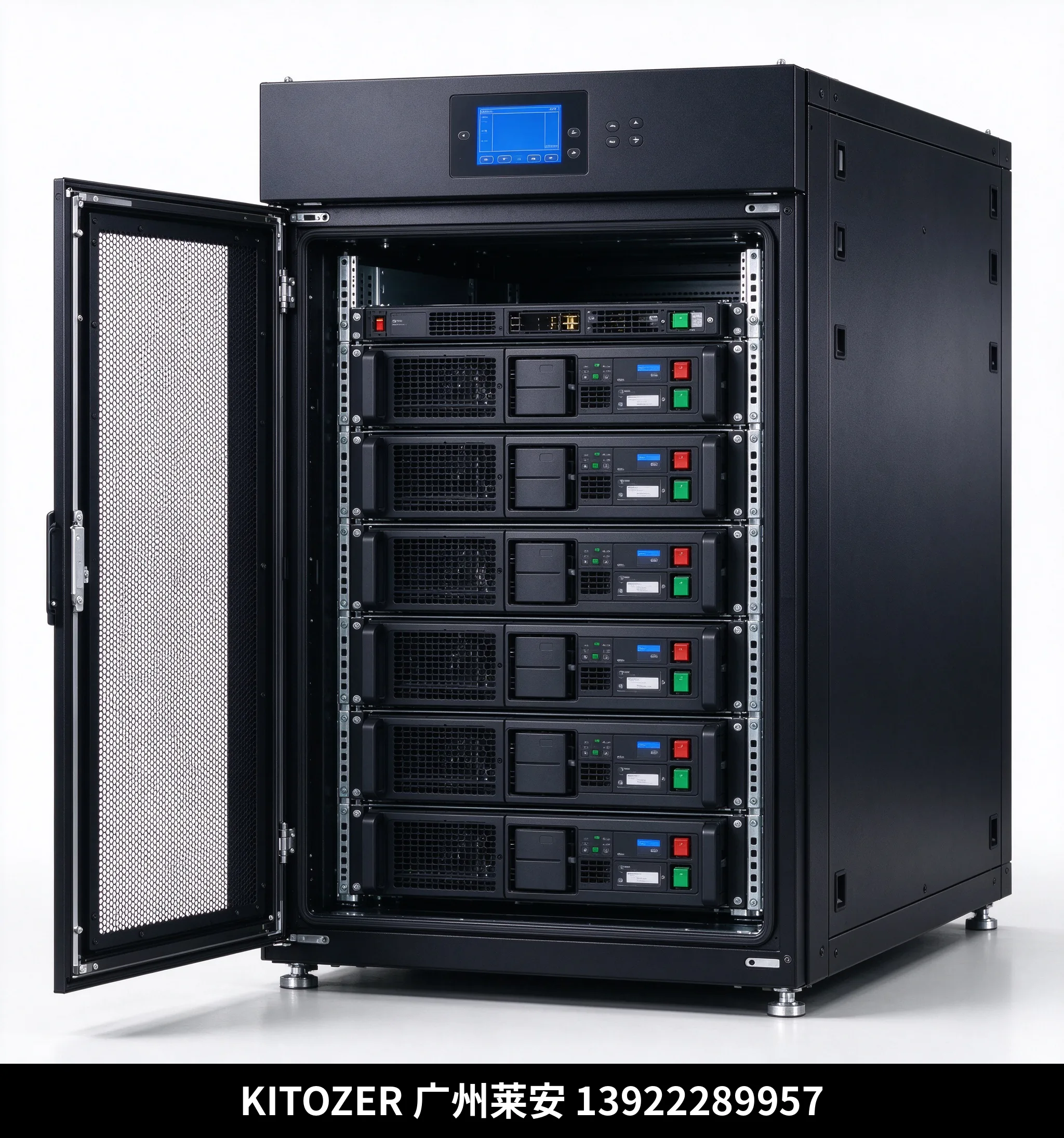
KITOZER Modular UPS Uninterruptible Power Supply is a next-generation high-reliability power protection device independently developed and manufactured by Guangzhou Laian Intelligent System Development Co., Ltd. Designed for modern data centers, financial computing rooms, tertiary hospital IT systems, semiconductor cleanrooms, 5G core sites, and government emergency command centers—scenarios demanding the highest power continuity.
This series covers 10kVA to 500kVA. A single cabinet supports up to 10 parallel power modules; up to 8 cabinets parallel for 4MVA total. Double-conversion efficiency exceeds 96%, ECO mode reaches 99%, reducing data center PUE. Certified to GB/T 7260, IEC 62040-3, CE, and ISO9001. Deployed in over 2000 facilities nationwide.
Guangzhou Laian Intelligent System Development Co., Ltd. (KITOZER brand) is a national high-tech enterprise headquartered at Chaotian Industrial Park, No. 5 Huashan Road, Shilou, Panyu, Guangzhou. With over a decade of data center infrastructure focus, the product portfolio spans UPS, precision cooling, power distribution, battery cabinets, and DCIM monitoring.
2. Working Principle and Technical Architecture
2.1 Double Conversion Online Topology
KITOZER modular UPS uses double conversion online topology. Utility input passes through EMI filter and SPD, then into a three-phase PWM rectifier converting AC to a stable DC bus via high-frequency IGBT switching. The DC bus connects both the battery and the inverter, which regenerates clean sinusoidal AC output through an output filter. The load is always powered by the inverter, completely isolated from grid disturbances.
When utility fails or exceeds ±25% tolerance, the battery seamlessly connects to the DC bus with zero transfer time. On inverter overload or fault, the static bypass transfers the load to utility within 4 milliseconds. This topology ensures the load receives perfectly conditioned power under all grid conditions.
2.2 Modular Parallel Technology
Each power module contains its own three-phase PWM rectifier, inverter, static switch, and DSP controller. Modules connect to cabinet DC and AC buses through backplane connectors. The parallel control system uses average-current automatic load sharing, exchanging real-time current data via dedicated parallel communication cables. Each module fine-tunes its output voltage to balance current, achieving steady-state sharing accuracy within ±3%.
N+X redundancy is the core value proposition. N modules carry the load; X modules serve as hot standby. If any module fails or is removed for maintenance, remaining modules automatically take over the load without interruption. Higher X means greater reliability but higher investment.
2.3 Hot-Swap and Online Expansion
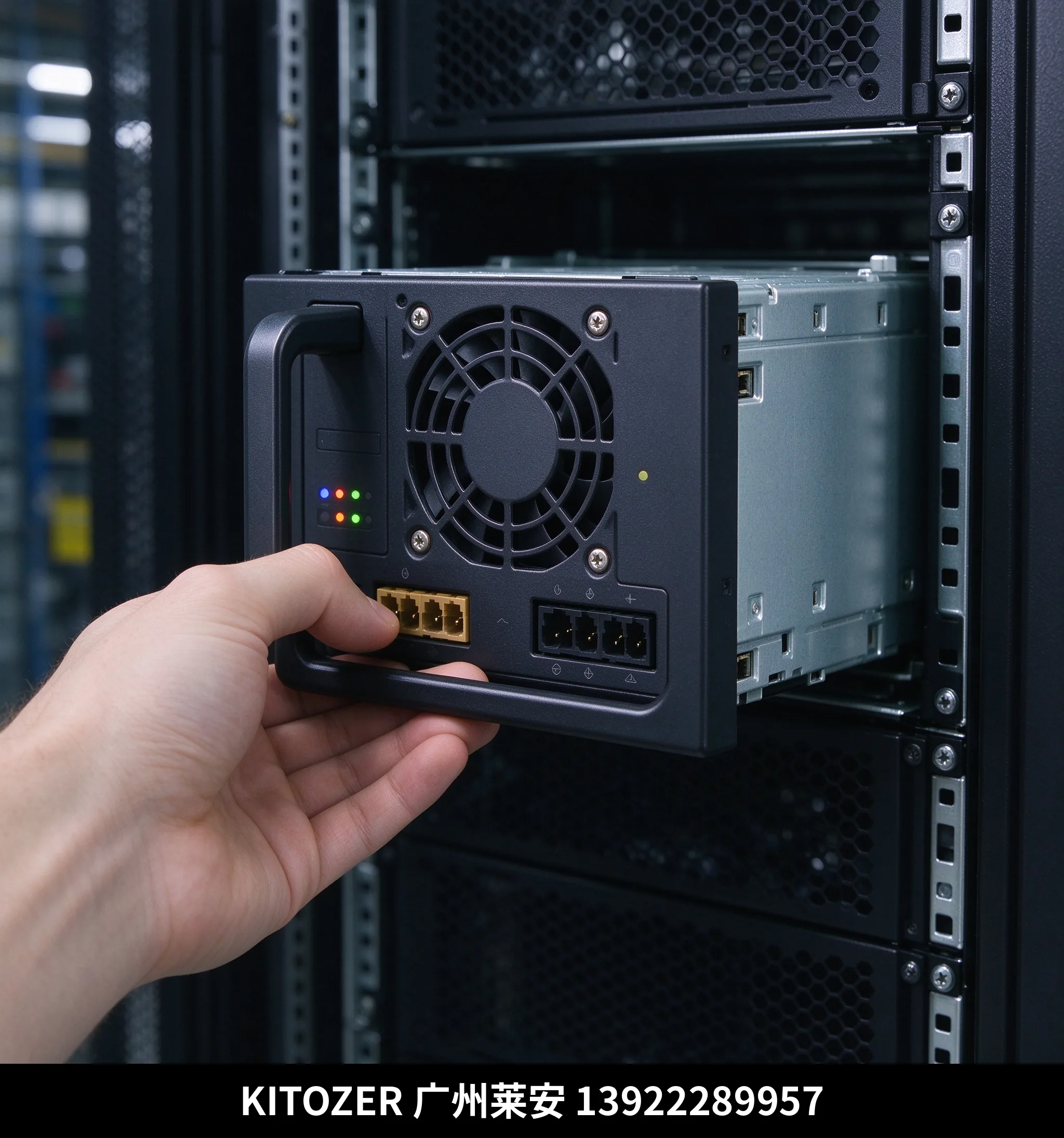
Power modules support live hot-swap—a defining feature versus tower UPS. The multi-pin backplane connector engages ground and signal pins before power pins on insertion; on removal, power disconnects first. The front-panel handle and latch enable single-person replacement in under 5 minutes with no tools.
Online expansion means enterprises start with minimal modules and add capacity as business grows. Empty slots accept new modules without shutdown, re-wiring, or load migration. For example, initial three 20kVA modules (60kVA) can expand to six modules (120kVA) in minutes. This pay-as-you-grow model lowers initial capital requirements.
2.4 ECO Economy Mode
In ECO mode, when utility quality is good, the load receives power directly through the static bypass while the inverter stays on standby. Efficiency reaches 99% versus 96% in double conversion. On utility anomaly (voltage deviation >15%, frequency offset >2Hz, outage), the system transfers to inverter within 2ms. ECO suits grids with stable power and high electricity costs; for ultra-critical loads, disable ECO for pure double-conversion protection.
3. Detailed Technical Specifications
| Category | Specification |
|---|---|
| Capacity | Single cabinet: 10kVA to 250kVA (10 modules) |
| Parallel system: up to 8 cabinets, 4000kVA total | |
| Module sizes: 10/15/20/25/50kVA | |
| Input | Voltage: 3-phase 5-wire 380/400/415V ±25% |
| Frequency: 50/60Hz auto-sensing, 40-70Hz range | |
| Power factor: ≥0.99 at full load | |
| Current THDi: <3% at full load | |
| Output | Voltage: 3-phase 380/400/415V ±1% |
| Frequency: 50/60Hz ±0.1% (battery mode) | |
| Voltage THDv: <1% linear, <2% nonlinear | |
| Overload: 105% continuous, 125% for 10min, 150% for 1min | |
| Efficiency | Double conversion: ≥96% full load |
| ECO mode: ≥99% | |
| Bypass loss: <0.5% | |
| Battery | Type: VRLA or LiFePO4 |
| DC bus: 384V (32×12V series) | |
| Charging: 3-stage smart charging with temp compensation | |
| Communication | Standard: RS232, RS485, 5 dry contacts |
| Optional: SNMP card, GSM SMS, Modbus TCP | |
| Software: Windows/Linux, monitors up to 256 units | |
| Physical | Cabinet: 600W × 1100D × 2000H mm |
| Noise: ≤65dB at 1m | |
| Protection: IP20 |
4. Selection and Configuration Guide
4.1 Load Calculation
Correct UPS sizing begins with accurate load inventory. List each device: name, rated power, power factor, quantity. Total active power in kW divided by 0.9 power factor gives required kVA. A standard 42U rack with 10 dual-power servers at 500W each draws 5kW total (2.5kW per feed). A 20-rack data center totals 100-160kW; choose 150-200kVA UPS with 20-30% headroom.
4.2 Redundancy Levels
N (no redundancy): Non-critical office, test labs. Any module failure transfers to bypass. Lowest cost, lowest reliability.
N+1: Enterprise IT, government systems. One module redundancy. Best cost-reliability balance for most applications.
N+2/N+3: Core financial systems, life-support medical equipment, large data halls. Tolerates 2-3 simultaneous module failures. Achieves 99.999%+ availability. Higher investment justified by massive downtime costs.
4.3 Battery Options
5-15 minutes (rack batteries): Sites with backup generators; UPS bridges generator startup. Rack-mount battery packs save floor space.
30-60 minutes (long-run cabinets): Sites without generators requiring UPS to ride through to utility restoration. Independent battery cabinets.
1-4 hours (LiFePO4 systems): Data center energy storage, peak shaving, extended backup. KITOZER LFP systems offer 6000+ cycle life and 50% smaller footprint than VRLA.
4.4 Parallel Design
When a single cabinet is insufficient: (1) Total parallel capacity = cabinet count × per-cabinet rating; usable capacity = total minus one largest module. (2) Parallel cables under 3 meters. (3) Dedicated parallel communication cards required. (4) For dual-bus, add STS static transfer switches.
5. Installation and Commissioning
5.1 Facility Requirements
Install in dedicated UPS room or data hall. Ambient temperature 20-25°C (max 40°C). Higher temperatures accelerate capacitor and battery aging. RH ≤95% non-condensing. Anti-static raised floor with loading ≥1500kg/m². Clearance: 1200mm front access, 800mm rear, 500mm sides.
5.2 Electrical Wiring
Size input cables for 3A/mm² copper. Example: 200kVA UPS at ~300A input requires YJV-3×185+2×95mm² cable. Output branches with independent breakers per rack. Neutral conductor 1.5× phase size to handle third-harmonic current from nonlinear IT loads. Protective ground resistance ≤1Ω with ≥35mm² ground wire.
5.3 Battery Cabinet Layout
Battery cabinets near UPS with DC cable runs under 5 meters to minimize voltage drop. Battery racks anchored with M12 expansion bolts for seismic resistance. 10mm cell spacing for cooling. Vented top for hydrogen release. LiFePO4 systems can integrate within the UPS cabinet footprint.
5.4 Acceptance Test Procedure
(1) Insulation test: input/output to ground >1MΩ. (2) Phase sequence verification. (3) No-load startup: confirm no alarms, normal voltage/frequency. (4) Step-load to rated capacity observing current sharing. (5) Battery transfer test: disconnect utility. (6) Parallel test: multi-unit load distribution. (7) Alarm simulation: verify monitoring and notifications. Document all results in signed acceptance report.
6. Operations and Maintenance
6.1 Daily Monitoring
Daily check via touchscreen or remote monitoring: three-phase input balance (inter-phase voltage difference <5%), output stability, frequency, load percentage (40-80% ideal), battery float voltage, inverter heatsink temperature, fan status, alarm log. Document any out-of-range parameters.
6.2 Periodic Maintenance
Monthly: Clean cabinet, verify filters, measure battery terminal voltage. Quarterly: Clean/replace filters, inspect fans, perform 30% battery discharge test. Semi-annually: Measure battery internal resistance, torque cable connections, test alarm notifications. Annually: Full load discharge test, harmonic measurement, capacitor inspection, firmware update.
6.3 Power Module Replacement
(1) Identify faulty module number on the monitoring screen. (2) Open front panel, grasp handle. (3) Unlock and slide module out smoothly. (4) Insert new module along guides until click confirms lock. (5) Verify new module recognized and online. Total procedure: 3-5 minutes with zero interruption.
6.4 Battery Care
Batteries are the most failure-prone component. VRLA design life is 5-8 years, affected by temperature and cycling. Maintain 20-25°C (life halves per 10°C rise). Measure cell voltages monthly; replace weak cells (deviation >0.05V). Quarterly capacity tests. After 5 years, replace the entire string rather than individual cells.
7. Frequently Asked Questions
Q: What is the fundamental difference between modular and tower UPS?
A: Tower UPS integrates rectifier, inverter, bypass, and monitoring in one cabinet; failures require shutdown and expansion requires whole-unit replacement. Modular UPS distributes these functions across independent parallel modules; any module failure or maintenance doesn’t affect others. This is an architectural paradigm difference.
Q: What happens if two modules fail in N+1 configuration?
A: N+1 tolerates one failure. If a second fails, remaining N-1 modules cannot carry full load and the system transfers to static bypass. While the load remains on utility, UPS protection is lost. Replace failed modules immediately. For higher reliability, choose N+2 or N+3.
Q: Is ECO mode transfer fast enough on outage?
A: The system continuously monitors utility. On detection, the inverter starts and takes over within 2ms. This is well within IT equipment hold-up time (typically 10-20ms), so servers and networks experience no disruption. For ultra-sensitive equipment, disable ECO.
Q: Why is modular UPS more efficient?
A: Three reasons: (1) High-frequency IGBT rectifiers replace SCR rectifiers with lower switching loss. (2) Transformerless design eliminates transformer copper/iron losses. (3) Modular architecture lets each module operate at its optimal efficiency point. 96% versus 92% saves approximately USD 4,400/year at 100kW load.
Q: How many cabinets can parallel?
A: Up to 8 cabinets for 4MVA total. Requires parallel communication cards and dedicated fiber/shielded cable. Any cabinet can be maintained or fail without affecting the load.
Q: How to calculate backup time?
A: Backup time (hours) = total battery Ah × DC bus voltage × inverter efficiency (0.95) / load power (W). For 100kW load with two 100Ah strings at 384V: 200×384×0.95/100000 = 0.73h ≈ 44 minutes. Apply 0.8 aging factor and temperature correction.
Q: Can different module sizes mix?
A: Yes, within the same series. The system proportionally shares load. However, uniform module sizes within one cabinet provide optimal sharing and simplified spare parts inventory.
Q: What to do first on UPS alarm?
A: Read the touchscreen alarm details. Yellow (minor): log and schedule. Red (critical): investigate immediately—check utility, overload, battery. The alarm history stores 1000 events with codes and timestamps.
Q: Can it integrate with BMS/DCIM systems?
A: Yes. Standard RS485 Modbus RTU integrates with major DCIM platforms. Optional SNMP card enables TCP/IP web monitoring with SNMP v2c/v3. Dry contact outputs connect to traditional PLC systems.
Q: What is the MTBF?
A: KITOZER modular UPS system MTBF exceeds 200,000 hours (~23 years). Power module MTBF exceeds 500,000 hours. This is achieved through modular redundancy: a module failure transfers load to spares while the system keeps running. Traditional tower UPS MTBF is typically 100,000-150,000 hours.
8. Industry Application Cases
8.1 Financial Services
A national joint-stock bank provincial data center deployed two KITOZER 500kVA modular UPS systems in 2N redundancy. Each has ten 50kVA modules (N+1). The two systems feed independent A/B bus distribution to every rack. Over three years of operation, zero UPS-related transaction interruptions have occurred.
8.2 Healthcare
A tertiary hospital’s new outpatient tower deployed two 250kVA modular UPS systems for IT and surgical departments. CT/MRI equipment requires THDv below 3%; KITOZER measured 1.2% THDv, fully satisfying medical standards. Battery backup configured for 2 hours ensuring surgeries and emergency care continue during outages.
8.3 Manufacturing
A semiconductor packaging cleanroom uses three 200kVA modular UPS systems for different production zones. Production line wafer scrap losses from downtime would be catastrophic. KITOZER’s ±25% wide input tolerance and PFC technology effectively resist industrial grid disturbances. ECO mode saves approximately USD 21,000/year.
8.4 Government and Telecom
A provincial government cloud platform deployed 2MVA total (eight 250kVA units) in two phases: four units initially for 600kW load, four added later to reach 1.6MVA. This phased approach saved approximately USD 420,000 in initial investment. 5G core sites also deploy KITOZER modular UPS with optional -48V DC conversion for telecom equipment.
9. Total Cost of Ownership Analysis
9.1 Initial Investment
For 100kVA load requirement over 5 years: traditional 200kVA tower UPS costs approximately USD 28,000 plus battery cabinet USD 7,000 = USD 35,000. KITOZER modular with four 30kVA modules (120kVA, N+1) costs USD 25,000 plus battery USD 7,000 = USD 32,000. Modular requires less initial outlay while providing headroom.
9.2 Electricity Cost
The largest TCO differentiator. At 100kW load, 8760 hours/year, USD 0.12/kWh: traditional UPS loss = 100×(1/0.92-1)×8760×0.12 ≈ USD 11,400/year. Modular loss = 100×(1/0.96-1)×8760×0.12 ≈ USD 5,500/year. Annual saving USD 5,900; 5-year saving USD 29,500.
9.3 Maintenance and Expansion
Tower UPS repairs require shutdown at USD 700-1,400 per event. Modular online module replacement at USD 400-700 with no downtime. Five-year maintenance is approximately 40% lower. Expansion: tower replacement costs USD 14,000 versus modular module additions USD 8,500—a 40% saving.
9.4 Five-Year TCO Summary
| Cost Item | Tower UPS | KITOZER Modular |
|---|---|---|
| Initial investment | USD 35,000 | USD 32,000 |
| 5-year electricity loss | USD 57,000 | USD 27,500 |
| 5-year maintenance | USD 7,000 | USD 4,200 |
| Expansion (if needed) | USD 14,000 | USD 8,500 |
| 5-year TCO total | USD 113,000 | USD 72,200 |
Conclusion: KITOZER modular UPS saves approximately 36% in 5-year TCO despite comparable initial cost. Payback period: under 2.5 years.
10. Product Series
10.1 Low-Power Series 10-60kVA
For small server rooms, telecom closets, branch offices, retail point-of-sale. Compact 600×800×1600mm cabinet supports 1-3 modules. Built-in battery option for 10-minute backup. Standard touchscreen, RS485; optional SNMP. Typical: enterprise branch offices, retail IT, small business networks.
10.2 Medium-Power Series 80-250kVA
For medium data centers, hospital IT departments, bank branches, university computer labs. Single cabinet supports 4-10 25kVA modules up to 250kVA. Parallel up to 4 cabinets for 1MVA. Standard 7-inch touchscreen, RS232/RS485/dry contacts. Optional maintenance bypass, isolation transformer, surge protection. Typical: 100-500 rack data halls.
10.3 High-Power Series 300-500kVA
For large data centers, cloud computing, financial trading floors, industrial critical loads. Single cabinet supports 6-10 50kVA modules up to 500kVA. Parallel up to 8 cabinets for 4MVA. Dual-bus design with dual utility input. Optional integrated lithium battery cabinet, remote monitoring display, parallel fiber cards. Typical: large IDC, government cloud, carrier core sites.
Reference Pricing (USD)
10kVA Modular UPS (1×10kVA module + cabinet): USD 4,900 – 7,700
60kVA (3×20kVA modules, N+1): USD 14,000 – 21,000
120kVA (6×20kVA modules, N+1): USD 28,000 – 42,000
250kVA (10×25kVA modules, N+1): USD 56,000 – 84,000
500kVA (10×50kVA modules, N+1): USD 105,000 – 154,000
LiFePO4 Battery Cabinet 50kWh: USD 11,200 – 16,800
Reference prices only. Detailed quotes depend on project scope, quantity, and delivery terms. Contact us for a custom solution.
11. EMC and Power Quality
11.1 Input Harmonic Mitigation
KITOZER modular UPS uses active power factor correction, fundamentally solving the harmonic pollution problem of traditional UPS. Traditional six-pulse rectifier UPS produces input current THDi as high as 30% at full load. These harmonic currents cause additional losses in distribution transformers and cables, increasing transformer temperature rise and degrading power factor. KITOZER’s three-level PWM rectifier uses high-frequency IGBT switching to make input current track the input voltage sine wave, achieving THDi below 3% and power factor 0.99.
Direct benefits include: reduced upstream generator sizing (generator capacity only 1.5× UPS versus 3× traditionally), lower distribution transformer loading, and improved overall power quality. The injected harmonics are well below IEEE 519 PCC limits of 5% voltage THD.
11.2 Output Voltage Quality
Output voltage quality directly determines load reliability. KITOZER achieves THDv below 1% with linear loads and below 2% with 100% nonlinear loads—excellent performance. Pure sinusoidal output means servers, networking, and storage systems operate optimally with extended lifespan and reduced data errors.
Dynamic response is equally critical. When load steps from 0% to 100% or vice versa, output voltage deviation stays within ±5% and recovers within 20ms. This fast response is enabled by high-bandwidth digital control loops and bulk DC bus capacitors—essential for sensitive equipment like medical imaging and semiconductor testers.
11.3 EMC Design
KITOZER modular UPS passes rigorous EMC testing. Conducted emissions per GB 9254 (CISPR 22) Class A show power port quasi-peak below 79dBμV across 150kHz-30MHz. Radiated emissions at 10 meters measure below 40dBμV (30-230MHz) and 47dBμV (230-1000MHz). These ensure no interference with co-located radio equipment and precision instruments.
Immunity testing: ESD contact ±6kV/air ±8kV, EFT burst ±2kV power/±1kV signal, surge ±2kV line/±4kV ground, conducted RF 10V, power frequency magnetic field 100A/m. These stringent conditions simulate various electromagnetic interferences in data center environments.
12. Thermal and Reliability Design
12.1 Smart Thermal Management
Each power module has independent temperature-controlled fans adjusting speed based on IGBT heatsink temperature. Below 30% load and 30°C ambient, fans run at low speed or stop, producing noise under 50dB. Fans speed up linearly with load and temperature, reaching 65dB at maximum. This intelligent strategy saves 30% energy versus fixed-speed fans and extends fan life beyond 70,000 hours MTBF, with hot-swap fan replacement.
Cabinet airflow is CFD-optimized: cool air enters the lower front, passes through module heatsinks, and exhausts from the upper rear. Hot and cold aisles are physically separated. The design integrates with data center CRAH underfloor supply and overhead return.
12.2 Component Selection
Power devices use Infineon or Semikron IGBT modules rated 1200V. KITOZER selects 7th-generation trench-stop IGBTs with 20% lower switching loss than previous generation. DC bus capacitors use法拉 brand electrolytic caps rated 10,000 hours at 85°C; with derating to actual 45°C operating temperature, they achieve 20+ year life. Control circuits use TI 320F28377D dual-core DSP at 200MHz. All PCBs are conformally coated for moisture and salt mist resistance.
12.3 Reliability Metrics
System MTBF calculated per MIL-HDBK-217F exceeds 200,000 hours (~23 years). Power module MTBF exceeds 500,000 hours. MTTR is under 30 minutes thanks to hot-swap design. System availability = MTBF/(MTBF+MTTR) ≈ 99.9999%.
13. Monitoring and Communication
13.1 Touchscreen Interface
KITOZER features a 7-inch color touchscreen (800×480). The main screen shows a flow diagram: input voltage/frequency, rectifier status, battery voltage, inverter status, output voltage/frequency/load, and bypass status. Parameters refresh every second. The interface supports Chinese and English.
Menu structure includes: runtime data, historical trends (1-year data), alarm log (last 1000 events), parameter settings (with password protection), and maintenance info (firmware version, component temperatures, runtime statistics).
13.2 Remote Monitoring Software
The KITOZER monitoring software runs on Windows and Linux, connecting via RS232/RS485/SNMP and monitoring up to 256 units simultaneously. The dashboard displays a data center topology map: green for normal, yellow for minor alarm, red for critical. Clicking any UPS reveals detailed parameters.
Alerts support popup, audible alarm, email (SMTP auth), SMS (via GSM module), and webhook push to third-party platforms. Historical data exports to CSV/Excel for maintenance reports. Web access enables remote browser monitoring.
13.3 SNMP and Modbus
The optional SNMP card provides TCP/IP monitoring with SNMP v1/v2c/v3 and standard UPS MIB (RFC 1628). It integrates with major DCIM platforms. The RS485 port supports Modbus RTU at 1200-115200 bps (default 9600), with Modbus address 1-247. Dry contacts provide 5 relay outputs and 2 digital inputs.
14. Safety Protection
14.1 Electrical Protection
Multi-level protection: input breaker for short circuit and overload, SPD for surge protection. Rectifier overcurrent protection limits DC bus current at 150% rated. Inverter output short circuit triggers PWM shutdown within half a cycle. Output overvoltage protection trips at 110% rated voltage and transfers to bypass.
14.2 Battery Protection
Battery management includes overcharge cutoff at 105% set voltage, overdischarge shutdown at end voltage, charge current limiting at 0.15C, and NTC temperature monitoring. For LiFePO4, the BMS provides cell overvoltage (3.65V), undervoltage (2.5V), overcurrent, over-temperature (60°C), and low-temperature charge prohibition (below 0°C).
14.3 Mechanical and Personnel Safety
IP20 cabinet prevents finger contact with live parts. Locked cabinet doors restrict access. Power modules have insulated handles. The maintenance bypass switch features mechanical interlocks: bypass must be active before the maintenance switch can be operated, and once engaged, UPS input/output breakers cannot close—preventing backfeed. All exposed metal parts ground reliably at ≤1Ω.
15. Packaging and Shipping
Export-grade wooden crates comply with ISPM-15 phytosanitary standards. The cabinet is wrapped in EPE foam and bubble wrap. Batteries ship separately with orientation, moisture, and fragile labels. Documentation includes: certificate of conformity, installation manual, factory test report, electrical schematic, and spare parts list.
Transport upright with tilt under 15°, away from rain and vibration. Storage environment: -25°C to +70°C, ≤95% RH non-condensing. Batteries require recharge every 6 months during storage. After long storage, inspect and power on for 24 hours before installation.
16. Training and Support
Each project includes free technical training. Basic training (4 hours) on-site covers: operating principle, touchscreen operation, daily inspection, and common alarm handling. Advanced training (8 hours) at our center covers: power module replacement, battery maintenance, communication configuration, and fault diagnosis. Certification issued upon completion.
Standard warranty is 3 years from shipment. Free spare parts and service during warranty. Service offices in major Chinese cities respond within 24 hours and on-site within 48 hours. 24/7 technical hotline. Lifetime cost-price repair after warranty. Annual maintenance contracts cover quarterly inspections, annual overhaul, spare parts stocking, and loaner units.
17. Comparison with Traditional Power Solutions
17.1 vs Dual-Bus (2N) Configuration
Traditional data centers use 2N dual-bus: two independent UPS systems each capable of carrying full load. This achieves very high reliability but doubles investment. Modular UPS N+X redundancy approaches 2N reliability at significantly lower cost. For 100kW load, 2N requires two 200kVA tower UPS at approximately USD 56,000. KITOZER N+2 modular uses six 20kVA modules (120kVA, two redundant) at approximately USD 35,000—a 37.5% saving. Availability is comparable because N+2 tolerates two simultaneous module failures.
17.2 Coordination with Diesel Generators
Most data centers use UPS + diesel generators. UPS covers seconds-to-minutes; generators cover hours. On utility outage, UPS immediately carries the load while signaling generator startup (15-30 seconds). Key coordination points: (1) Generator capacity should be at least 1.5× UPS (thanks to PFC, versus 3× for traditional UPS). (2) Generator voltage THD should be under 15%. (3) UPS input voltage range must match generator output characteristics. (4) An isolation transformer on generator output is recommended.
17.3 vs Utility-Direct Architecture
Some hyperscalers use utility-direct with battery backup units (BBUs), achieving 99%+ efficiency but requiring custom servers with wide-voltage input. For most enterprise data centers, this isn’t practical because standard IT equipment doesn’t support wide input and grid quality is variable. KITOZER modular UPS offers the best balance of efficiency and reliability for mainstream deployments.
18. Industry-Specific Requirements
18.1 Financial Sector
Financial data centers require 99.999%+ availability (under 5 minutes annual downtime), typically achieved through 2N or N+2 modular redundancy. Additional requirements include: certified product safety reports per JR/T 0011 standard, data integrity protection during outages (safe shutdown coordination), centralized monitoring, and 24/7 rapid response. KITOZER modular UPS runs stably at multiple provincial bank data centers.
18.2 Healthcare
Hospital UPS requires: (1) THDv under 3% for CT/MRI image quality. (2) Low noise below 40dB at 3 meters from the UPS room. (3) At least 1-hour battery backup for surgeries. (4) Medical electrical safety certification per GB 9706.1. (5) Separate UPS for IT and surgical departments to isolate disturbances.
18.3 Industrial Environment
Industrial UPS must handle: (1) Ambient temperatures up to 45-50°C requiring derating or cooling. (2) Dust and corrosive gases requiring IP31+ rating and conformal-coated boards. (3) Severe grid fluctuations with wider input range. (4) Vibration and shock requiring reinforced mounting. (5) Complex electromagnetic environment requiring higher EMC immunity.
18.4 Telecommunications
Telecom UPS requirements: (1) Optional -48V DC output for telecom equipment (5-8% higher efficiency than AC-DC-AC). (2) Remote unattended operation requiring very high MTBF and remote diagnostics. (3) Outdoor cabinet range -40°C to +70°C. (4) LiFePO4 batteries for compact wall/rack mounting. (5) Solar/wind hybrid support for green base stations.
19. Energy Efficiency Analysis
19.1 Electricity Savings from Higher Efficiency
For a 1MW IT load data center: traditional UPS at 92% efficiency loses 760,870 kWh/year. KITOZER at 96% loses 365,000 kWh/year—saving 395,870 kWh annually (approximately USD 47,500 at USD 0.12/kWh). In ECO mode at 99%, losses drop to 88,500 kWh, saving 672,370 kWh/year (USD 80,700). Over five years, savings total USD 237,500 (double conversion) or USD 403,500 (ECO).
19.2 PUE Improvement
Each 1% UPS efficiency improvement lowers data center PUE by approximately 0.02-0.03. Moving from 92% to 96% drops PUE from ~1.55 to ~1.43, helping meet Class A requirements (PUE ≤ 1.4). Benefits include: regulatory compliance, green certification (Uptime Institute, LEED), improved ESG ratings, and carbon reduction aligned with dual-carbon goals.
19.3 Pay-as-you-grow Efficiency
Traditional UPS sized for 5-10 year max load operates at 30-40% utilization initially, where efficiency drops to 85-88%. Modular UPS starts matched to current load, keeping module loading at 60-80% (optimal efficiency zone). As business grows, modules are added to maintain optimal loading. At 100kW initial load: traditional 200kVA at 89% efficiency loses approximately USD 12,700/year; KITOZER 120kVA at 95% loses approximately USD 4,400/year—saving USD 8,300/year.
20. Technology Roadmap
20.1 Wide Bandgap Semiconductors
Silicon carbide (SiC) and gallium nitride (GaN) devices will push UPS efficiency from 96% to 97.5-98%. SiC MOSFETs reduce switching losses by 70% and increase switching frequency 3-5×. KITOZER is developing next-gen SiC-based modular UPS targeting 2027 production: 97.5% double-conversion efficiency, 40% higher power density, and 5dB lower noise.
20.2 Deep Lithium Battery Integration
LiFePO4 batteries are rapidly replacing VRLA in UPS applications. Next-gen KITOZER products will feature: (1) Seamless BMS-UPS CAN bus communication. (2) Real-time cell voltage, temperature, and SOH on the UPS touchscreen. (3) AI-based battery life prediction from historical charge/discharge data. (4) Second-life battery reuse for energy storage.
20.3 AI-Driven Predictive Maintenance
Future modular UPS will self-diagnose and predict failures. AI algorithms analyze fan speed trends, capacitor derating, IGBT junction temperature, and battery internal resistance to predict potential failures weeks in advance. For example, if a fan runs 10% slower than normal, the system predicts failure within 3 months and auto-reserves a replacement. This shifts maintenance from reactive to proactive.
20.4 DCIM Integration
Modular UPS will become an organic part of the data center DCIM platform. UPS data converges with cooling, PDU, and environmental data into a unified digital twin model. AI algorithms optimize UPS operation based on predicted workload, electricity price arbitrage, and weather forecasts. KITOZER already offers DCIM interface modules supporting major platforms.
21. Project Implementation Process
21.1 Requirements Survey
KITOZER engineers conduct on-site survey: (1) IT load inventory. (2) Room conditions (area, floor loading, temperature, power distribution). (3) Power quality recording over one week. (4) 3-5 year growth projections. (5) Budget and schedule constraints. Output: site survey report and requirements specification.
21.2 System Design
Based on survey results: (1) UPS capacity and redundancy calculation. (2) Battery backup sizing. (3) Distribution cabinet and PDU configuration. (4) Cable sizing and routing. (5) Monitoring topology. (6) Layout drawings and single-line diagrams. Output: technical proposal with equipment list, parameter comparison, budget estimate, and project schedule.
21.3 Production and Testing
Production follows ISO9001 quality management. Every UPS undergoes 48-hour full-load burn-in testing including: full-load operation, battery transfer, parallel current sharing, and alarm protection verification. The factory test report accompanies each unit before packaging and shipping.
21.4 On-Site Installation
KITOZER engineers supervise installation: (1) Cabinet anchoring with M12 bolts. (2) Input/output and battery cable connections. (3) Monitoring and parallel cables. (4) Insulation and wiring verification. (5) No-load power-on. (6) Step-load test. (7) Battery discharge test. (8) Parallel system commissioning. Typical installation: 2-5 working days depending on system size.
21.5 Acceptance and Handover
Joint acceptance testing follows the contract test plan. All items must pass before signing the acceptance report. KITOZER delivers: as-built drawings, operation and maintenance manuals, training records, and spare parts list. On-site operator training (4 hours) is included. The 3-year warranty begins upon acceptance.
22. Troubleshooting Guide
22.1 Input-Related Faults
Symptom: “Input overvoltage” or “input undervoltage” alarm. Cause: Abnormal utility, tripped input breaker, faulty input contactor. Action: Measure actual input voltage at the UPS terminals. If utility is within 380V±25%, check the input breaker and contactor coil. If voltage is genuinely abnormal, check upstream transformer tap settings.
Symptom: Input phase loss alarm. Cause: One phase lost, blown fuse, loose terminal. Action: Measure three-phase input voltage to identify the missing phase. Check fuses and terminals on that phase. Notify the utility department if upstream distribution is at fault. The UPS runs on battery during this time—monitor battery capacity.
22.2 Output-Related Faults
Symptom: Output overvoltage alarm. Cause: Inverter control board fault, voltage feedback circuit issue. Action: The system automatically transfers to bypass. Check recorded output voltage on the touchscreen. If overvoltage persists, shut down the UPS and contact KITOZER support for control board replacement.
Symptom: Output overload alarm. Cause: Load exceeds UPS capacity, single-phase overloading. Action: Check per-phase load current on the touchscreen. If total load exceeds 105%, shut down non-critical loads. If phase imbalance exceeds 20%, redistribute rack PDU loads. 125% overload runs for 10 minutes, 150% for 1 minute, then transfers to bypass.
22.3 Battery-Related Faults
Symptom: Low battery voltage alarm. Cause: Battery aging, charger fault, loose connections. Action: Measure battery string terminal and per-cell voltage. If charger output is normal (~420V float) but battery voltage is low, batteries are aging and need replacement. If charger has no output, check the charge board and fuse. Verify terminal tightness.
Symptom: Short battery runtime. Cause: Capacity degradation, high ambient temperature, weak cells. Action: Perform a capacity discharge test recording the discharge curve. If capacity falls below 80% rated, replace the entire string. Check battery cabinet temperature (target 20-25°C). Identify weak cells by per-cell voltage during discharge and replace them.
22.4 Module and Parallel Faults
Symptom: Power module fault LED. Cause: Internal IGBT damage, driver board fault, fan failure. Action: Record the module number and fault code. Replace the faulty module using the hot-swap procedure. Verify the new module is recognized on the touchscreen. Return the faulty module to factory for repair.
Symptom: Parallel current sharing anomaly. Cause: Loose parallel communication cable, one module’s output voltage deviating. Action: Check parallel cable connections. Compare per-module output current on the touchscreen. If one module shows significantly lower/higher current, try reseating it. Contact support if the issue persists.
23. Standards and Certifications
23.1 National Standards
KITOZER modular UPS complies with: GB/T 7260 (Uninterruptible Power Systems, equivalent to IEC 62040); GB 7251 (Low-voltage switchgear); GB/T 17626 (EMC testing, equivalent to IEC 61000); GB 9254 (IT equipment radio disturbance limits); GB 4943 (IT equipment safety); GB/T 14715 (General technical conditions for UPS for IT equipment).
23.2 International Standards
International certifications: IEC 62040-3 (Methods of specifying performance and test requirements); IEC 62040-1 (Safety requirements); CE marking (LVD and EMC directives); ISO9001 quality management; ISO14001 environmental management; OHSAS18001 occupational health and safety.
23.3 Industry Approvals
Industry-specific approvals include: China Telecommunication Technology Labs certification (telecom industry access); Ministry of Public Security test report; CQC certification; inclusion in government energy-saving procurement list; telecom equipment network access license. These enable bidding in government, telecom, and financial sector projects.
24. Detailed Specification Comparison
| Parameter | 10kVA | 60kVA | 120kVA | 250kVA | 500kVA |
|---|---|---|---|---|---|
| Modules | 1×10k | 3×20k | 6×20k | 10×25k | 10×50k |
| Redundancy | None | N+1 | N+1 | N+1 | N+1 |
| Input | 220V 1ph | 380V 3ph | 380V 3ph | 380V 3ph | 380V 3ph |
| Output kW | 10kW | 54kW | 108kW | 225kW | 450kW |
| Efficiency | 95% | 96% | 96% | 96.5% | 97% |
| Dimensions mm | 400×600×800 | 600×800×1600 | 600×1100×2000 | 600×1100×2000 | 800×1200×2000 |
| Weight kg | 80 | 280 | 520 | 850 | 1500 |
| Noise dB | 55 | 60 | 62 | 65 | 68 |
| Price USD | 4,900-7,700 | 14,000-21,000 | 28,000-42,000 | 56,000-84,000 | 105,000-154,000 |
25. Cable Sizing Calculation Examples
25.1 Input Cable
For 120kVA UPS: rated input current = 120kVA/(√3×380V×0.99) = 184A. With 1.25× margin, design current = 230A. YJV-0.6/1kV 3×95+2×50mm² copper cable rated at ~255A in free air satisfies this. For cable tray installations with multiple cables, apply 0.8 derating (255×0.8=204A)—still adequate but with smaller margin. Recommended: 3×120+2×70mm².
25.2 Output Cable
Output rated current = 120kVA/(√3×380V) = 182A. With 1.2× margin, design at 218A. Use YJV-3×95+2×50mm². Neutral conductor should be 1.5× phase size (75mm²) for nonlinear-load third harmonics. Ground conductor at least half phase size (50mm²).
25.3 Battery Cable
DC bus = 384V. Max DC current = 108kW/384V = 281A. Use two parallel 95mm² copper cables (each ~255A, combined 510A with ample margin). Keep battery cable runs under 5 meters. Voltage drop = 281A×0.0184Ω/mm×5m×2/95mm² = 0.54V (0.14% of DC voltage, within tolerance).
26. Integration with Other KITOZER Products
26.1 With Precision Air Conditioning
Modular UPS pairs with KITOZER precision cooling to form the complete data center infrastructure. Note: compressor starting current is 5-7× rated, so size UPS with adequate margin. It is recommended to connect AC compressors to utility directly (or through a separate small UPS) to avoid compressor inrush affecting UPS output stability.
26.2 With Power Distribution Cabinets
KITOZER smart rack-mounted power distribution cabinets (rPDUs) at each cold aisle column distribute UPS output to individual rack PDUs. Smart meters monitor per-branch current, voltage, power, and energy in real time via RS485/Modbus to the DCIM system. Communication linking the UPS and PDU enables unified monitoring.
26.3 With DCIM Monitoring
The KITOZER DCIM platform centrally collects data from UPS, cooling, distribution, leak detection, temperature/humidity, and fire systems. The monitoring host connects to the operations center via Ethernet, providing B/S architecture web access. Alerts trigger SMS and email automatically. The modular UPS integrates via RS485 or SNMP as a key component of the overall monitoring system.
27. Common Sizing Mistakes
27.1 Mistake 1: Over-sizing
Many users over-size UPS believing “bigger is safer.” In reality, UPS efficiency drops significantly below 30% load, wasting energy. Over-sizing also means higher capital cost and larger footprint. Correct practice: size to actual load with 20-30% headroom. Modular UPS can expand later, so start right-sized.
27.2 Mistake 2: Ignoring Power Factor
Some users only look at kVA rating, ignoring output power factor. Modern IT equipment has 0.9-1.0 PF. A legacy 0.7 PF UPS rated 100kVA only supports 70kW—wasting 30% capacity. KITOZER modular UPS delivers 0.9-1.0 output PF, matching modern IT equipment without capacity waste.
27.3 Mistake 3: Excessive Battery Runtime
Over-long battery backup means more battery cabinets and much higher cost. If backup generators exist, batteries only need 15-30 minutes to bridge generator startup. Over-sizing to 2+ hours wastes capital and increases maintenance. Right-size based on actual needs.
27.4 Mistake 4: Price-Only Comparison
Cheap UPS often has low efficiency, poor reliability, and weak service. For 100kW load, a 90%-efficient cheap UPS versus 96% KITOZER saves approximately USD 6,300/year in electricity—over USD 31,500 over five years, far exceeding any price difference. Unplanned downtime costs thousands per hour. Choose based on TCO, not purchase price.
28. Installation Space Planning
28.1 Room Space Requirements
Plan for: UPS cabinet (~0.7m² each), battery cabinet (~0.8m² each), distribution cabinet (~0.5m² each), and maintenance aisles (1.2m front, 0.8m rear). For a 120kVA N+1 system: 1 UPS cabinet (0.66m²), 2 battery cabinets (1.6m²), 1 distribution cabinet (0.5m²), aisles (~3m²), totaling ~6m². Battery cabinets often require more floor space than the UPS itself.
28.2 Cable Routing
Modular UPS supports overhead and underfloor cable routing. Overhead suits new data centers (underfloor space for air supply); underfloor suits retrofits. Cable penetrations must be fire-stopped. DC battery cables should be routed separately from AC cables to avoid electromagnetic interference.
28.3 Floor Loading
UPS cabinets weigh 500-1500kg; battery cabinets 1000-2000kg. Typical office floor loading is ~500kg/m², which may be insufficient. Solutions: (1) Place cabinets near load-bearing walls or columns. (2) Distribute load with steel plates. (3) Use LiFePO4 cabinets (50% lighter than VRLA). (4) Consult structural engineers during design phase.
29. Integration with Renewable Energy
29.1 Solar-Storage Integrated Solutions
Under dual-carbon goals, data centers increasingly adopt solar-plus-storage-plus-UPS. Rooftop solar powers IT loads by day, storing excess in lithium batteries. During outages or peak-price periods, batteries power the load through the UPS. KITOZER modular UPS integrates with lithium systems and supports solar inverter DC bus connection—eliminating one conversion stage and boosting efficiency by 5%.
29.2 Peak Shaving
Using time-of-use electricity pricing, data centers charge lithium batteries during low-price (night) and discharge during peak-price (day), reducing costs. KITOZER lithium UPS supports this with intelligent energy management. A 1MWh system at USD 0.10/kWh peak-valley differential saves approximately USD 70/day, or USD 25,500/year.
29.3 Off-Grid Microgrid Operation
In remote areas or grids with unreliable power, data centers operate microgrids: solar + wind + storage + diesel. KITOZER modular UPS acts as the energy router coordinating various sources to maintain stable load power. This is particularly popular in overseas projects (Africa, Southeast Asia) with unreliable grids.
30. Summary and Recommendations
KITOZER modular UPS is an efficient, reliable, and scalable power protection solution. Its modular architecture enables online expansion and N+X redundancy; high-frequency PWM rectification and transformerless design achieve 96%+ efficiency; intelligent monitoring enables remote operations and predictive maintenance.
Recommendations: (1) Small enterprise rooms under 100kW: low-power series 10-60kVA. (2) Medium data centers 100-500kW: medium-power 80-250kVA with N+1. (3) Large data centers 500kW+: high-power parallel with N+2 and dual-bus. (4) Enable ECO mode where grid quality allows. (5) Choose LiFePO4 for long backup requirements.
Guangzhou Laian Intelligent System Development Co., Ltd. provides full-lifecycle service from design through after-sales. Contact +86 139-2228-9957 for detailed proposals and quotations.
31. Extended FAQ (20 Questions)
Q: Can the UPS be placed next to an office? How loud is it?
A: At 50% load, noise is approximately 60dB at 1 meter—similar to normal office conversation. If the UPS room adjoins office space, acoustic treatment (soundproof door, acoustic ceiling) is recommended. In ECO mode with inverter standby, fan noise drops to around 50dB.
Q: Does the UPS need a ground connection? What resistance?
A: Yes, it must be reliably grounded. Grounding resistance should be ≤1Ω (≤4Ω for shared grounding systems). Use ≥35mm² copper wire. Proper grounding ensures personnel safety and is essential for EMC filters to function correctly.
Q: What maximum ambient temperature can the UPS handle?
A: Rated operating range is 0°C to 40°C. Above 40°C, derate output by 1% per °C rise. Optimal room temperature is 20-25°C. Above 45°C, the UPS triggers overtemperature alarm and shuts down.
Q: How many racks can one UPS support?
A: Depends on UPS capacity and per-rack power. For a 120kVA UPS at 5kW per rack, up to 24 racks. Distribution goes through row-level cabinets to rack PDUs with independent miniature breakers per branch. Reserve 20% spare branch circuits.
Q: How to determine when batteries need replacement?
A: Signs include: float voltage imbalance (adjacent cells differing >0.05V), capacity below 80% rated on discharge test, visible swelling/leakage/deformation, or age exceeding 5 years (VRLA) or 8 years (LiFePO4). Replace the entire string—do not mix old and new cells.
Q: How often should UPS fans be replaced?
A: Fan design life is approximately 70,000 hours (~8 years continuous). Actual replacement depends on ambient temperature and dust. Inspect fan speed and noise every 3 years. Replace proactively if speed drops or noise changes. Fans support hot-swap without downtime.
Q: How many UPS cabinets can parallel?
A: Up to 8 cabinets for 4MVA total. Each cabinet needs a parallel communication card; parallel cables under 3 meters. Any cabinet can be maintained or fail without affecting the load.
Q: What is dual-bus power?
A: Dual-bus means two independent UPS systems outputting A and B feeds. Each rack with dual-power supplies connects to both A and B. When one UPS is maintained or fails, the other carries full load. Dual-bus requires STS or server dual-power automatic switching.
Q: What does “bypass” mean on the display?
A: Bypass means the load receives utility power directly through the static switch while the inverter is offline. Possible causes: inverter fault, output overload, or manual bypass selection. In bypass, the UPS provides no regulation or filtering—investigate promptly to restore inverter mode.
Q: How does KITOZER compare to international brands?
A: Technical specifications are equivalent (96% efficiency, THDi<3%, THDv<2%), at 60-70% of the cost. Local service response under 24 hours with ample spare parts. 3-year free warranty with Chinese documentation and local engineer support.
Q: Do DC bus capacitors need periodic replacement?
A: Electrolytic capacitors have a design life of ~10 years at 40°C. KITOZER extends this through derating and smart thermal control. Inspect capacitor appearance every 5 years; measure capacitance every 8 years. Replace when capacitance drops more than 20%.
Q: Can I monitor the UPS via mobile app?
A: Yes. The optional SNMP card connects to the LAN, enabling mobile browser or WeChat mini-program access. Alerts push to WeChat or SMS. Remote monitoring software supports iOS and Android devices.
Q: Does the UPS need 24/7 manned operation?
A: No. With 200,000-hour MTBF, remote monitoring, and automatic alarms, daily inspection once per shift is sufficient. On-site response is only needed when alarms occur.
Q: Can power modules from different batches mix?
A: Same-model modules can mix directly. For different batches or hardware revisions, verify firmware compatibility. KITOZER guarantees backward compatibility within the same series; old modules work in new cabinets, though firmware update is recommended.
Q: Can the UPS connect to solar power systems?
A: Yes. Newer KITOZER models support solar DC bus connection, where the solar inverter feeds DC directly into the UPS bus—eliminating one AC-DC conversion stage. A dedicated solar input module and coordination controller are required. Contact KITOZER technical support for custom designs.
32. Technical Glossary (Chinese-English)
| Chinese | English |
|---|---|
| 不间断电源 | Uninterruptible Power Supply (UPS) |
| 双变换在线式 | Double Conversion Online |
| 功率因数校正 | Power Factor Correction (PFC) |
| 总谐波失真 | Total Harmonic Distortion (THD) |
| 静态旁路开关 | Static Bypass Switch (SBS) |
| 维修旁路 | Maintenance Bypass |
| 热插拔 | Hot Swap / Hot-plug |
| 冗余配置 | Redundancy Configuration |
| 均流技术 | Current Sharing Technology |
| 平均无故障时间 | Mean Time Between Failures (MTBF) |
| 数据中心基础设施管理 | Data Center Infrastructure Management (DCIM) |
| 电能使用效率 | Power Usage Effectiveness (PUE) |
| 绝缘栅双极晶体管 | Insulated Gate Bipolar Transistor (IGBT) |
| 数字信号处理器 | Digital Signal Processor (DSP) |
| 浪涌保护器件 | Surge Protective Device (SPD) |
| 电池管理系统 | Battery Management System (BMS) |
| 静态转换开关 | Static Transfer Switch (STS) |
| 机架式配电单元 | Power Distribution Unit (PDU) |
| 脉宽调制 | Pulse Width Modulation (PWM) |
| 空间矢量调制 | Space Vector Modulation (SVM) |
33. Input/Output Power Distribution Design
33.1 Input Distribution Cabinet
The input side requires a distribution cabinet containing: main input breaker (1.25× rated current), SPD surge protector (Class I or II), energy meter (monitoring voltage/current/PF), and surge status indicator. For dual utility input, an automatic transfer switch (ATS) switches between sources within 100ms, bridging the UPS battery. The input cabinet also integrates the maintenance bypass with electrical interlocks preventing accidental short-circuit.
33.2 Output Distribution Cabinet
The output distribution cabinet splits UPS output into multiple branch circuits for different racks or equipment. Each branch has a miniature circuit breaker (C-curve). Branch count matches rack count with 20% spare. Smart meters monitor per-branch current, voltage, and power via RS485 to the DCIM. For dual-bus systems, each rack has two PDUs connected to A and B output cabinets respectively.
33.3 Row Cabinets and Rack PDUs
Row-level cabinets at each cold aisle column distribute output feeder to rack rows. They feature smart monitoring units displaying per-branch current and breaker status. Rack PDUs at the rear of each rack split row feeder into multiple universal outlets. Smart PDUs support remote on/off control and energy measurement via network.
34. Battery System Deep Dive
34.1 VRLA Lead-Acid Operation
KITOZER modular UPS uses valve-regulated lead-acid (VRLA) batteries. Positive plates are lead dioxide (PbO2), negative plates are sponge lead (Pb), and electrolyte is dilute sulfuric acid. During discharge, both plates convert to lead sulfate (PbSO4) with decreasing electrolyte concentration. Each cell is 2V; a 12V battery consists of 6 cells in series. The UPS battery string typically uses 32×12V batteries for 384V DC bus.
VRLA advantages: mature technology, low cost, high reliability. Disadvantages: low energy density (heavy), short cycle life (500-1000 deep cycles), lead content requiring environmental recycling. VRLA is sealed and maintenance-free but requires ventilation for small hydrogen emissions.
34.2 LiFePO4 Advantages
Lithium iron phosphate (LiFePO4) is the next-generation UPS energy storage. Cell voltage is 3.2V; 16 cells form a 51.2V module; strings are assembled to 384V. LiFePO4 advantages over VRLA: (1) 6000+ cycle life at 80% DOD (6-10× VRLA). (2) 50% smaller volume and weight. (3) Minimal maintenance via BMS. (4) No heavy metals. (5) 95%+ charge/discharge efficiency.
KITOZER LiFePO4 systems include a standard BMS monitoring per-cell voltage, temperature, and current with active balancing. The BMS communicates via CAN bus to the UPS, displaying battery SOC, SOH, and estimated runtime on the touchscreen. Design life exceeds 10 years, with 30-40% lower lifecycle cost than VRLA.
34.3 Battery Sizing Calculation
Formula: Battery Ah = load(W) × runtime(h) / (DC bus(V) × inverter efficiency × depth of discharge). Example: 100kW load, 1 hour backup, 384V DC, 0.95 efficiency, 0.8 DoD. Required Ah = 100,000×1/(384×0.95×0.8) = 342Ah. Two parallel strings of 200Ah (400Ah total) deliver actual runtime = 400×384×0.95×0.8/100,000 = 1.17h (70 minutes). Add 20-30% margin for temperature derating and aging.
35. Communication Protocols
35.1 Modbus RTU
The RS485 port supports standard Modbus RTU over two-wire shielded twisted pair. Default baud rate 9600 (configurable 1200-115200), 8N1 or 8E1 data format. Modbus address 1-247. Holding registers provide measurement data (voltage, current, power, frequency, temperature); input registers provide alarm status; coil registers provide remote control (on/off, battery test). The protocol manual details all register addresses and data formats.
35.2 SNMP Network Management
The SNMP card makes the UPS a network-managed device supporting SNMP v1/v2c/v3 with standard UPS MIB (RFC 1628), integrating with HP OpenView, IBM Tivoli, SolarWinds, and other platforms. The built-in web server enables browser-based access. DHCP or static IP configuration is supported.
35.3 Dry Contact Signals
Five relay dry-contact outputs: (1) Normal operation (NC, opens on fault). (2) On battery (NO, closes in battery mode). (3) Low battery alarm (NO). (4) On bypass (NO). (5) General alarm (NO). Contact rating: 30V DC/1A, directly interfacing with PLC or building automation systems.
36. KITOZER Brand and Service Commitment
KITOZER is the data center infrastructure brand of Guangzhou Laian Intelligent System Development Co., Ltd. The company specializes in data center facilities: UPS, precision cooling, power distribution, battery cabinets, cold aisle containment, and DCIM monitoring. KITOZER’s core values are technological innovation, reliable quality, and rapid service.
Headquartered at Chaotian Industrial Park, No. 5 Huashan Road, Shilou, Panyu, Guangzhou, the company operates modern production facilities and testing equipment. The R&D team consists of engineers with over a decade of UPS design experience, investing 8% of annual revenue in R&D annually. Production is ISO9001 certified with rigorous factory testing for every unit.
The national service network covers major cities with 24/7 hotline support. Standard 3-year warranty covers free replacement of faulty components. Lifetime maintenance after warranty with cost-price spare parts. Annual maintenance contract clients receive priority response and scheduled inspections. Contact KITOZER at +86 139-2228-9957 for partnership opportunities.
37. Energy-Saving and Environmental Features
37.1 Energy-Saving Design Philosophy
KITOZER modular UPS prioritizes energy efficiency as a core design metric. Under China’s dual-carbon strategy (carbon peak by 2030, carbon neutrality by 2060), data centers face significant energy pressure. UPS efficiency directly impacts data center PUE. KITOZER raises double-conversion efficiency from the industry average of 93% to 96%+, with ECO mode reaching 99%.
Specific measures include: high-frequency IGBT rectifiers (40% lower switching loss than SCR), transformerless design (eliminating copper and iron losses), smart temperature-controlled fans (adjusting speed to actual cooling demand), low-loss film capacitors, and optimized air duct design. These measures collectively save over 30% energy compared to traditional products.
37.2 Eco-Friendly Materials and Processes
KITOZER modular UPS complies with RoHS directives restricting lead, mercury, and cadmium. Cabinets use cold-rolled steel with lead-free eco-friendly powder coating. Packaging uses recyclable wooden crates and biodegradable cushioning. At end-of-life: metal cabinet recycling rate exceeds 95%; electronic boards are processed by certified e-waste handlers; batteries (especially VRLA) are recycled per national hazardous waste regulations.
37.3 Carbon Emission Calculation
For a 100kW load over 10 years, using a 0.57 kg CO2/kWh grid factor: traditional 92%-efficient UPS loses 7.54 million kWh, emitting 4,305 tons CO2. KITOZER 96%-efficient UPS loses 3.65 million kWh, emitting 2,080 tons CO2. Over 10 years, KITOZER reduces 2,225 tons of CO2—equivalent to planting approximately 120,000 trees.
38. Configuration by Data Center Size
38.1 Micro Data Center (<20kW)
Enterprise small rooms, branch offices, and retail server closets. Typical: KITOZER 20kVA (2×10kVA modules, N+1), rack batteries for 30-minute backup. Installs beside a standard 19-inch rack in under 1m². Remote monitoring via SNMP for unattended operation. Investment: approximately USD 7,000-11,000.
38.2 Small-Medium Data Center (20-200kW)
20-100 racks under 200kW total. Recommended: KITOZER 120kVA (6×20kVA modules, N+1) with two battery cabinets for 1-hour backup. Single-bus distribution through row cabinets. DCIM-connected monitoring. Investment: approximately USD 42,000-70,000.
38.3 Large Data Center (200-1000kW)
Hundreds of racks at high power density. Recommended: dual-bus with two parallel 250kVA systems per bus (10×25kVA modules each, N+1), totaling 1MVA. Dual-cord rack PDUs. LiFePO4 batteries for 2-hour backup. Centralized DCIM monitoring. Investment: approximately USD 280,000-560,000.
38.4 Hyperscale Data Center (>1MW)
Cloud and internet companies use modular containerized deployment. Each data hall unit deploys four parallel 500kVA systems (N+2) on 2N dual-bus. 240V/336V HVDC directly powers servers, eliminating conversion stages. Solar + storage + diesel hybrid supply. KITOZER provides custom solutions with deep DCIM integration.
39. Project Case Study
39.1 Project Background
A provincial government cloud data center, new 1,000m² data hall with 800kW design IT load in two phases. Phase 1: 400kW; Phase 2: 800kW. Requirements: online expansion, N+X redundancy, remote monitoring, and Tier A (GB50174) compliance. After multiple technical evaluations, the customer selected KITOZER modular UPS.
39.2 Solution Design
Phase 1: Two 250kVA modular UPS (each with eight 30kVA modules, N+1) forming dual-bus. Each UPS on independent utility input. Dual-cord rack PDUs per cabinet. Two 500kWh LiFePO4 battery cabinets for 2-hour backup. SNMP integration with the government cloud DCIM platform.
39.3 Implementation
Production took 4 weeks; installation and commissioning took 2 weeks on-site. Scope included: cabinet placement and anchoring (4 UPS + 4 battery cabinets + 2 distribution cabinets), cable routing, insulation testing, no-load startup, step-load testing, battery discharge test, parallel commissioning, and monitoring integration. All tests passed on first attempt.
39.4 Phase 2 Expansion
Two years later, workload grew to 700kW. Without downtime, additional 250kVA cabinets were paralleled to each bus. Expansion took only 4 hours for module installation and system commissioning. The customer was highly satisfied with the zero-downtime online expansion capability.
40. Technical Comparison Table
| Item | KITOZER Modular | Tower UPS | Avg Modular |
|---|---|---|---|
| Double-conversion eff. | 96-97% | 92-94% | 95% |
| ECO efficiency | 99% | 98% | 98.5% |
| THDi | <3% | <30% | <5% |
| THDv (nonlinear) | <2% | <4% | <3% |
| Online expansion | Hot-swap | Whole-unit replacement | Yes |
| N+X redundancy | N+1 to N+N | Multi-unit parallel | N+1 |
| MTBF | 200,000h | 120,000h | 150,000h |
| Power density | High (transformerless) | Low (with transformer) | Medium |
| Noise | 60-65dB | 65-75dB | 65dB |
| Warranty | 3 years free | 1-2 years | 2 years |
| Price level | 60-70% of international | Low | Medium |
41. Purchase Decision Guide
41.1 When to Choose Modular UPS
Strongly consider modular UPS when: (1) Growth is uncertain and expansion is expected. (2) Power continuity is critical—no downtime for maintenance. (3) Electricity costs are high and efficiency matters. (4) IT load may double within 3 years. (5) Machine room space is limited. (6) Minimal staffing requires remote monitoring and predictive maintenance.
41.2 Recommended Procurement Process
(1) Requirements survey and load inventory. (2) Invite 2-3 brands for design comparison. (3) Evaluate vendor case studies and service capability. (4) Technical review focused on efficiency, redundancy, and expandability. (5) Commercial negotiation based on TCO, not price alone. (6) Contract with clear delivery, warranty, and acceptance terms. (7) Installation and commissioning. (8) O&M training and documentation handover.
41.3 Contact Us for a Custom Solution
If you are planning a data center or replacing UPS equipment, contact the KITOZER technical team for a free design consultation. Based on your load, room conditions, and budget, we provide a customized modular UPS proposal with detailed pricing. Tel/WeChat: +86 139-2228-9957, +86 185-2066-8845. WhatsApp: +1 906-853-4140. Address: Chaotian Industrial Park, No. 5 Huashan Road, Shilou, Panyu, Guangzhou, China. We look forward to partnering with you.
42. Electrical Safety Design
42.1 Insulation and Protection
KITOZER modular UPS is designed per GB 4943 (IT equipment safety). Internal circuits are divided into three isolation classes: primary (mains input), secondary (output and SELV), and protective ground. Reinforced insulation separates primary from secondary, with creepage and clearance satisfying overvoltage category II and pollution degree 2. Protection rating IP20 prevents finger contact with live parts. All accessible metal parts reliably bond to the protective ground terminal with ≤0.1Ω resistance.
42.2 Emergency Shutdown and Interlocks
The UPS provides an Emergency Power Off (EPO) dry-contact input. An external EPO button disconnects inverter output and shuts down the rectifier within 100ms. In data centers, fire alarm systems trigger EPO to prevent electrical fire propagation. Cabinet door opening can optionally disconnect hazardous voltage zones for maintenance safety.
42.3 Fire Protection Design
Internal plastic parts meet UL94 V-0 flame rating. Circuit boards are flame-retardant coated. Battery cabinets include exhaust vents and hydrogen detectors that activate ventilation at 25% of lower explosive limit. DC buses are protected by ultra-fast fuses. Cables use flame-retardant low-smoke zero-halogen (LSZH) insulation. Cable penetrations are fire-stopped to prevent fire spread.
43. Network Management Features
43.1 SNMP Card Details
The KITOZER SNMP card inserts into the UPS communication slot, providing 10/100Mbps Ethernet with TCP/IP, HTTP, SNMP, and Telnet support. The built-in web server provides browser access to real-time data, historical trends, alarm logs, and parameter settings. SNMP v3 with authentication and encryption meets financial and government network security requirements.
The card supports email alerts: configure SMTP server and up to 4 recipients, with selectable alarm severity. DHCP or static IP configuration is supported. Network management platforms read UPS data through the standard MIB.
43.2 Modbus TCP Gateway
The optional Modbus TCP card integrates the UPS into industrial SCADA and PLC systems. Register addresses are consistent with RS485 Modbus RTU, simplifying driver development for system integrators.
43.3 Cloud Remote Monitoring
The KITOZER cloud platform lets users monitor UPS status via mobile app or web from anywhere. The UPS connects via SNMP or 4G module. Features include: real-time dashboard, historical trends, alarm push (WeChat/SMS/app), multi-site management, and equipment health reports. Basic features are free; premium features (API, custom reports) require subscription.
44. Packaging, Shipping, and Storage
44.1 Export Packaging
Export packaging uses ISPM-15 certified fumigated wooden crates. The cabinet is wrapped in EPE foam and bubble wrap. Internal power modules are secured with foam blocks to prevent connector dislodgement during transit. Batteries ship separately with UN38.3 certification and Class 9 dangerous goods labels. Each package is marked with: model, serial number, gross/net weight, dimensions, orientation, moisture, and fragile labels.
44.2 Transportation Notes
Transport upright with tilt under 15°. Use forklift or crane noting the cabinet center of gravity. Avoid severe vibration and impact. Ocean shipments use container strapping. Photograph packaging state before long-distance transport for comparison on arrival. Battery transport complies with IMDG and IATA DGR regulations.
44.3 Storage Requirements
If equipment cannot install immediately, store in a dry ventilated warehouse at -25°C to +70°C, ≤95% RH non-condensing. Keep original packaging; stacking does not exceed package markings. Batteries require recharge every 6 months at 2.30V/cell for 24 hours. Equipment stored over 1 year should be inspected and power-cycled for 24 hours before installation.
45. Warranty and Service Terms
45.1 Standard Warranty
KITOZER modular UPS includes a 3-year free warranty from shipment date, covering material and manufacturing defects. Warranty includes free spare parts and labor during the warranty period. Exclusions: user damage, improper installation, unauthorized modification, force majeure, and battery consumables (2-year battery warranty). Response: phone support within 2 hours, on-site service within 24-48 hours.
45.2 Extended Warranty Options
Extended warranty to 5 or 10 years costs approximately 10-20% of equipment price. Annual maintenance contracts include quarterly on-site inspections, annual full-load testing, priority spare parts, and loaner units during UPS repair.
45.3 Training Services
Each project includes free operational training. Basic training (4 hours) on-site covers: operating principle, touchscreen operation, daily inspection, and common alarm handling. Advanced training (8 hours) at the Guangzhou training center covers: power module replacement, battery maintenance, communication configuration, and fault diagnosis. Certification is issued upon completion.
46. Industry Standards and Compliance
46.1 Data Center Design Code
KITOZER modular UPS complies with GB 50174-2017 Data Center Design Code. The code classifies data centers into A/B/C tiers: Tier A (fault-tolerant) requires 2N or system redundancy with 99.999% availability; Tier B (redundant) requires N+X; Tier C (basic) requires basic power protection. KITOZER N+X satisfies Tier B; 2N dual-bus satisfies Tier A. The code requires a dedicated UPS room with temperature 18-27°C and good ventilation.
46.2 Power Quality Standards
Output power quality complies with GB/T 14549 (public grid harmonics) and IEEE 519. Input THDi<3% is well below the 5% GB limit. Output THDv<2% meets precision equipment requirements. Voltage fluctuation and flicker comply with GB/T 12325. Three-phase voltage imbalance is under 1%.
46.3 Telecommunications Standards
Telecom UPS complies with YD/T 1095: input PF≥0.99, efficiency≥90%, noise≤65dB, EMC per YD/T 983. The telecom-specific KITOZER UPS supports -48V DC output, battery low-voltage alarms, and remote monitoring. Certified by China Telecommunication Technology Labs and deployed in China Mobile, China Unicom, and China Telecom core sites.
47. Common Purchasing Questions
47.1 What Information Is Needed for a Quote?
For an accurate quote, please provide: (1) Required UPS capacity (kVA or kW). (2) Redundancy requirement (N, N+1, N+2). (3) Battery backup time. (4) Battery type preference (VRLA or LiFePO4). (5) Installation location (for shipping and service response). (6) Quantity. (7) Delivery deadline. (8) Whether installation service is needed. The more detail provided, the more accurate the quote.
47.2 What Is the Lead Time?
Standard models: 2-3 weeks. Non-standard configurations (special voltage, communication interface, color): 4-6 weeks. Large orders (10+ units): negotiable. KITOZER maintains stock of popular models (60kVA, 120kVA, 250kVA) for immediate shipment. Battery cabinets ship concurrently with the UPS.
47.3 Do You Provide On-Site Installation?
Yes, KITOZER provides professional on-site installation and commissioning. The installation team consists of trained engineers handling placement, wiring, power-on testing, and acceptance. Installation fees depend on distance and system size. Technical guidance-only installation (customer electrician does wiring) is also available. Full-turnkey installation is recommended to ensure correct setup and acceptance.
47.4 Payment Terms
Standard terms: 30% advance on contract signing, 60% before shipment, 10% retention after acceptance (paid after 1 year). Long-term clients and government projects may negotiate flexible terms. Bank transfer and bank acceptance bills accepted. VAT special invoice issued upon full payment.
48. Summary
KITOZER modular UPS is an advanced, reliable, and well-supported power protection device. Through modular architecture, online expansion, N+X redundancy, high efficiency, and intelligent monitoring, it provides comprehensive power assurance for modern data centers and critical loads. Whether for small enterprise rooms or large cloud facilities, KITOZER offers the right solution.
Guangzhou Laian Intelligent System Development Co., Ltd., as the KITOZER brand owner, provides a full range of data center infrastructure products: modular UPS, precision cooling, smart power distribution, LiFePO4 battery cabinets, cold aisle containment, and DCIM monitoring. We look forward to partnering with more customers to build safe, efficient, and green data centers. Contact us at +86 139-2228-9957 for consultation.
49. UPS-Genset Coordination
49.1 Genset Sizing Principles
Data centers typically combine UPS with diesel generators. UPS covers seconds-to-minutes; gensets cover hours. Genset sizing principle: 1.5-2× UPS capacity. Thanks to KITOZER’s PFC technology, input current is sinusoidal at 0.99 PF, requiring only 1.5× genset capacity. Traditional six-pulse UPS requires 3× due to harmonic heating.
Genset selection: (1) Rated output covers all loads plus UPS losses. (2) Output voltage THD under 15%. (3) Frequency stability ±2%. (4) Auto-start within 15 seconds of UPS signal. (5) Fuel tank for 8+ hours runtime. On utility outage, UPS carries the load while signaling genset startup; once the genset stabilizes, the UPS transfers to genset supply.
49.2 Genset Load Bank Testing
After installation, genset testing includes: (1) No-load start test: 3 consecutive starts at 2-minute intervals. (2) Step-load test: 25% increments every 15 minutes to full load. (3) Step-load dump test: sudden 50% load application and 100% dump observing voltage sag and recovery. (4) Continuous run: full load for 4 hours recording oil, water, and exhaust temperatures. All tests must pass before commissioning.
50. Integration with Building Automation
50.1 BAS Integration
Large data centers and smart buildings deploy Building Automation Systems (BAS) for HVAC, lighting, elevators, and plumbing. KITOZER UPS connects to BAS via RS485 Modbus RTU or dry contacts. The BAS dashboard displays UPS status, input/output parameters, battery state, and alarms. On UPS alarm, the BAS automatically pops up the monitoring center and notifies operators.
50.2 Protocol Conversion
If the BAS uses BACnet or LonWorks, a protocol gateway converts Modbus RTU to BACnet/IP. The gateway reads UPS data over RS485 and exposes BACnet objects (analog and binary values) to the BAS controller. KITOZER provides a standard Modbus register table for easy point mapping. Common points include: UPS status, input voltage, output voltage, load percentage, battery voltage, alarm state, and EPO.
51. Energy Management Features
51.1 Time-of-Use Arbitrage
Under commercial time-of-use tariffs, the KITOZER lithium battery UPS system arbitrages: charge during low-price night periods and discharge during high-price daytime. The energy management system automatically executes charge/discharge strategies based on local tariff schedules. For a 500kWh system at USD 0.10/kWh peak-valley differential, daily revenue is USD 50, or approximately USD 18,250 annually.
51.2 Demand Response
During grid peak demand, grid operators invite large users to reduce load through demand response programs with compensation. The KITOZER storage UPS automatically discharges during DR events, reducing grid draw and earning incentive revenue. This is especially valuable in regions with tight grid capacity, helping the grid shave peaks while creating additional income.
52. KITOZER Service Network and Support
52.1 National Service Network
Guangzhou Laian operates service offices in major Chinese cities: Guangzhou (HQ), Beijing, Shanghai, Chengdu, Wuhan, Xi’an, Shenyang, Urumqi, and others. Each office has trained engineers and local spare parts inventory. On service calls, local engineers respond within 2 hours and arrive within 24 hours. Remote regions receive express parts shipment with remote guidance.
52.2 Technical Support Resources
KITOZER offers multiple support channels: 24/7 technical hotline, email support, remote diagnostics (via SNMP or dial-up), and WeChat support groups. The technical document center provides: product catalogs, installation manuals, operation manuals, communication protocol manuals, and fault code tables. All documents are downloadable from the KITOZER website. Video conference remote guidance is also available.
52.3 Spare Parts Assurance
Spare parts inventory at the Guangzhou HQ and regional offices includes: power modules, control boards, fans, fuses, static switches, sensors, and displays. Common spares satisfy over 95% of repair needs. Less common parts ship from the factory within 3 business days. Discontinued models are supported for 10+ years. Customers may also purchase spare parts packages for critical sites.
53. Conclusion
Thank you for reading about the KITOZER modular UPS. We believe this product provides reliable, efficient, and intelligent power protection for your data center or critical load. KITOZER is the brand of Guangzhou Laian Intelligent System Development Co., Ltd., with over a decade of focus on data center infrastructure. Our products and services are trusted by thousands of customers nationwide.
Whether you are building a new data center, retrofitting an existing room, or expanding UPS capacity, the KITOZER technical team provides professional consultation and solutions. We are committed to technological innovation, product quality, and customer satisfaction. Contact us for a free design consultation and quotation: +86 139-2228-9957 (WeChat same number).
54. Harmonic Analysis and Mitigation
54.1 Harmonic Generation Mechanism
UPS as a nonlinear load generates harmonic currents during rectification. Traditional six-pulse rectifiers produce 5th, 7th, 11th, and 13th characteristic harmonics, with the 5th being largest (20-25%). These harmonics cause transformer overheating, capacitor overload, motor vibration, and relay misoperation. KITOZER modular UPS uses PWM rectification to eliminate harmonics at the source, achieving THDi under 3%.
54.2 Harmonic Mitigation Solutions
For existing sites with traditional UPS or other nonlinear loads causing excessive harmonics: (1) Active Power Filter (APF) connected in parallel, detecting harmonic current and injecting cancellation current. (2) Passive filter with LC tuned circuits for specific harmonics (lower cost but fixed tuning). (3) Replacement with KITOZER modular UPS—eliminating the harmonic source at its origin is the most thorough solution.
54.3 Harmonic Measurement Standards
Per GB/T 14549 and IEEE 519, PCC voltage THD limit is 5% for low-voltage systems. KITOZER modular UPS injects harmonics well below standard limits at full load. It is recommended to measure actual harmonic data with a power quality analyzer after UPS installation as acceptance evidence.
55. EMC Design Details
55.1 Input EMI Filter
The input EMI filter is multi-stage: stage 1 with X-capacitors (line-to-line) and common-mode chokes for differential-mode suppression; stage 2 with Y-capacitors (line-to-ground) and chokes for common-mode suppression. Insertion loss exceeds 40dB across 150kHz-30MHz. The filter meets CISPR 22 Class A industrial radiated emissions.
55.2 Shielding and Grounding
Sensitive control circuits are physically separated from power circuits. Control boards use multi-layer PCB design with complete ground planes and minimized trace lengths. All external communication interfaces (RS232/RS485/SNMP) feature opto-isolation (2500V) and surge protection. The cabinet ground bond connects directly to the data center equipotential ground bar with ≥35mm² wire.
55.3 Immunity Measures
KITOZER modular UPS passes: ESD contact ±6kV/air ±8kV; EFT burst ±2kV power/±1kV signal; surge ±2kV line/±4kV ground; conducted RF 10V; power frequency magnetic field 100A/m; voltage sag and short interruptions. These ensure stable operation in various electromagnetic environments.
56. Firmware Updates and Remote Maintenance
56.1 Firmware Upgrade Process
KITOZER firmware can be upgraded via touchscreen USB or remote network. Before upgrading: (1) Confirm version compatibility with hardware. (2) Ensure UPS is in bypass mode. (3) Back up current parameter settings. The upgrade takes 5-10 minutes with the load on bypass. The UPS auto-restarts with new firmware. Upgrades should be performed under vendor remote guidance.
56.2 Remote Diagnostics
Through the SNMP card or 4G module, KITOZER support can remotely access the UPS for diagnostics: reading runtime data and alarm logs, monitoring component temperatures and load trends, analyzing potential failure risks, and adjusting parameters. This dramatically reduces troubleshooting time without waiting for on-site visits.
56.3 Predictive Maintenance
Next-generation KITOZER UPS features predictive maintenance. The system continuously monitors trends in: fan speed (predicting fan life), DC bus capacitance (predicting capacitor aging), battery internal resistance (predicting cell degradation), and IGBT junction temperature (predicting power device health). When parameters deviate from normal trends, the system warns in advance, scheduling maintenance before failure occurs. This shifts from reactive to proactive maintenance, dramatically improving availability.
57. KITOZER Company and Product Portfolio
Guangzhou Laian Intelligent System Development Co., Ltd., founded in 2010 and headquartered at Chaotian Industrial Park, No. 5 Huashan Road, Shilou, Panyu, Guangzhou, specializes in data center infrastructure. Main products include:
UPS series: Modular UPS (10-500kVA), rack-mount UPS (1-10kVA), industrial UPS (high temp/humidity), DC UPS (-48V/240V). Precision cooling series: Room-level CRAH (5-100kW), in-row coolers, rear-door heat exchangers, indirect evaporative coolers. Power distribution series: Smart row cabinets, rack PDUs, UPS input/output distribution cabinets, low-voltage switchgear. Battery systems: VRLA cabinets, LiFePO4 cabinets, BMS. Monitoring systems: DCIM hosts, sensors, leak detection, DCIM software. Engineered solutions: Cold aisle containment, modular data centers, EMI shielded rooms.
The company holds ISO9001, ISO14001, and OHSAS18001 certifications. Products carry CE, CTTL, and CQC certifications. The service network covers all 31 Chinese provinces. KITOZER—making data center power more reliable.
58. Data Center Tier Requirements
58.1 Tier Classification and UPS Configuration
The Uptime Institute Tier system is the internationally recognized data center classification. Tier I (Basic): single path, no redundancy, 99.671% availability—corresponds to N UPS. Tier II (Redundant Components): redundant UPS/batteries/generators, single path, 99.741%—corresponds to N+1. Tier III (Concurrently Maintainable): dual path, all equipment maintainable online, 99.982%—corresponds to 2N or N+1 dual-bus. Tier IV (Fault Tolerant): any single failure doesn’t affect business, 99.995%—corresponds to 2N with component-level redundancy. KITOZER modular UPS satisfies Tier II through Tier III/IV through N+X and dual-bus configurations.
58.2 GB50174 Class A Requirements
China’s GB 50174-2017 divides data centers into A/B/C tiers. Class A corresponds to Tier III/IV with fault tolerance and redundancy requirements: (1) 2N or system redundancy where any single equipment failure doesn’t affect power. (2) Minimum 15-minute battery backup. (3) Diesel generator backup. (4) Dual utility feeds where feasible. KITOZER modular UPS with 2N dual-bus fully satisfies Class A. Class B requires N+X redundancy; Class C requires basic protection.
58.3 Financial Regulatory Requirements
China’s banking regulator requires: (1) Production center power availability of 99.999%. (2) UPS and diesel generators. (3) Minimum 30-minute battery backup. (4) Annual emergency drills. (5) Critical equipment redundancy. KITOZER modular UPS is deployed at multiple provincial bank data centers meeting these requirements.
59. Intelligent O&M
59.1 Digital Twin Monitoring
The next-generation KITOZER monitoring platform introduces digital twin technology. 3D modeling creates a digital mirror of the UPS and machine room in virtual space, real-time mapping physical equipment states. Operators can: (1) Inspect the UPS cabinet interior at 360°. (2) Click any module for detailed parameters. (3) Simulate failure scenarios for drills. (4) Visualize current flow and thermal distribution. Digital twin makes O&M more intuitive and efficient.
59.2 AI Failure Prediction
Using big data and machine learning, the KITOZER intelligent O&M platform predicts potential UPS failures. The system collects operational data from thousands of UPS units, training AI models to recognize failure precursors. When a unit’s parameters match a failure model, the system warns in advance. Examples: gradually increasing fan current predicts bearing wear; longer capacitor charge time predicts capacitance decay; rising battery internal resistance predicts cell aging. AI predictive maintenance reduces UPS unplanned downtime by over 80%.
59.3 Automated Inspection
The KITOZER DCIM supports automated inspection. The system automatically checks all UPS parameters on a preset schedule (daily/weekly) and generates inspection reports. Abnormal parameters automatically create work orders dispatched to operators. Automated inspection replaces manual rounds, reducing labor costs and human error. Reports include UPS status, battery health, alarm history, and maintenance recommendations, auto-sent to operator email.
60. Contact Us for Consultation
This concludes the KITOZER modular UPS product introduction. If you are interested or have questions, contact us for free design consultation and quotation:
Company: Guangzhou Laian Intelligent System Development Co., Ltd.
Tel/WeChat: +86 139-2228-9957 / +86 185-2066-8845
WhatsApp: +1 906-853-4140
Address: Chaotian Industrial Park, No. 5 Huashan Road, Shilou, Panyu, Guangzhou, China
Chinese website: www.lain.com.cn
English website: www.gdlain.com
Author: KITOZER Technical Department
We provide free site surveys, design consultation, technical exchanges, and product demonstrations. Whether you are building a new data center, retrofitting an existing room, expanding UPS capacity, or comparing vendor proposals, the KITOZER technical team is ready to serve. Thank you for reading. We look forward to partnering with you.
61. Reliability Design Verification
61.1 Environmental Stress Screening
Every KITOZER modular UPS undergoes 48-hour full-load burn-in testing at 40°C before shipment. Any parameter anomaly triggers rework. Burn-in effectively screens early failures, ensuring delivered units are verified products. Additional tests include: temperature cycling (-10°C to +50°C, 5 cycles), vibration testing simulating transit, and humidity testing (40°C/93% RH for 48 hours). All tests comply with IEC 60068.
61.2 Accelerated Life Testing
To verify design life, KITOZER lab performs accelerated life testing. The UPS runs continuously for 6 months at 55°C, equivalent to 5 years at room temperature. Post-test inspection confirms: capacitor capacitance decay under 10%, fan speed drop under 5%, and IGBT parameters within tolerance. Results drive design optimization for a 10+ year design life.
61.3 MTBF Verification
KITOZER calculates system MTBF per MIL-HDBK-217F, summing component failure rates (IGBTs, capacitors, fans, connectors, PCBs) via reliability block diagrams. The calculated system MTBF exceeds 200,000 hours. Field data validates this: across thousands of deployed units, annual failure rate is under 0.5%.
62. Common Installation and Commissioning Issues
62.1 Common Site Issues
From years of project implementation, common site issues include: (1) Insufficient floor loading—old building slabs may not support UPS and battery weight, requiring structural reinforcement. (2) Undersized cables—original design cable cross-section too small causing overheating at full load. (3) Improper grounding—excessive ground resistance or unreliable connection affects UPS operation. (4) Phase sequence errors—reversed input/output phase rotation. (5) Incorrect battery wiring—wrong series order causing incorrect total voltage. We recommend carefully verifying drawings before installation and following commissioning procedures strictly.
62.2 Common Commissioning Alarms
Common alarms and resolution during commissioning: (1) Input phase loss—check input breaker and wiring. (2) Output overload—check for short circuit or overload. (3) Low battery voltage—check battery connections and charging voltage. (4) Parallel communication fault—check parallel cables. (5) Fan fault—verify fan connector seating. Most alarms resolve through simple checks; complex issues contact KITOZER support.
63. KITOZER Customer Success Stories
KITOZER modular UPS serves critical load scenarios across industries. Typical customers include:
Financial: National bank provincial data center (2×500kVA 2N), securities firm trading floor (3×250kVA N+1), insurance company headquarters. Healthcare: Tertiary hospital IT (2×120kVA), children’s hospital CT/MRI, medical imaging center. Government: Provincial government cloud (8×250kVA parallel), municipal emergency command center, public security dispatch system. Manufacturing: Semiconductor packaging fab (3×200kVA), automotive welding line PLC, pharmaceutical cleanroom. Telecom: Carrier 5G core site, colocation data center. Education: University campus data center, library IT systems.
Customers choose KITOZER for: internationally competitive specifications, competitive pricing, rapid local service response, and reliable quality. We continue to serve more customers with quality UPS products and support.
64. Future Development and KITOZER Vision
64.1 Industry Trends
Accelerated digital transformation and AI compute demand drive continued growth in the data center UPS market. Future trends: (1) Higher efficiency—SiC/GaN devices pushing beyond 98%. (2) Higher power density—from 500kVA to 1MVA per cabinet. (3) Lithium adoption—LiFePO4 fully replacing VRLA. (4) DC architecture—240V/336V HVDC reducing conversion stages. (5) Intelligence—AI predictive maintenance and digital twins. (6) Green integration—solar, storage, and genset hybrid. KITOZER tracks these trends, investing 8% of annual revenue in R&D to maintain technological leadership.
64.2 KITOZER Vision
Guangzhou Laian Intelligent System Development Co., Ltd.’s vision is to become China’s leading data center infrastructure supplier. We provide not just UPS equipment but complete power solutions: consulting, design, supply, installation, and O&M throughout the lifecycle. The KITOZER brand is committed to making reliable, advanced, and cost-effective power equipment accessible to Chinese data centers. Our mission: provide dependable power for the digital China buildout.
64.3 Innovation Roadmap
KITOZER R&D is developing: (1) SiC modular UPS prototype targeting 97.5% efficiency. (2) Integrated lithium UPS with deep BMS-UPS fusion. (3) DC modular UPS supporting 240V HVDC output. (4) AI O&M platform using big data for failure prediction. (5) Prefabricated modular data centers, factory-tested and delivered as units. These technologies will enter production over the next 2-3 years.
65. Why Choose KITOZER
Six reasons to choose KITOZER modular UPS:
Reason 1: Advanced technology. 96% efficiency, THDi<3%, N+X redundancy, hot-swap modules—specs matching international tier-one brands. Reason 2: Fair pricing. At 60-70% of international brand pricing, KITOZER delivers outstanding value. Reason 3: Rapid service. National service network with 24-hour response and 48-hour on-site arrival. Reason 4: Reliable quality. ISO9001 certified, 48-hour full-load burn-in per unit, MTBF exceeding 200,000 hours. Reason 5: Flexible customization. Special voltages, communication interfaces, and colors available. Reason 6: Lifecycle service. From design through training, we accompany customers throughout.
KITOZER modular UPS by Guangzhou Laian Intelligent System Development Co., Ltd. Tel: +86 139-2228-9957 for consultation.
66. Installation Acceptance Test Checklist
66.1 Acceptance Test Items
After installation, perform acceptance testing item by item:
Visual inspection: Cabinet intact without scratches, doors operating smoothly, touchscreen display normal, indicator LEDs correct, terminals tight, cable labels clear. Insulation test: Input/output/battery circuits to ground ≥1MΩ. Phase sequence: Input/output phase rotation consistent with load requirements. No-load test: Start UPS without load, measure output voltage (3-phase balanced 380V±1%), frequency (50Hz±0.1%), verify no alarms.
Load test: Step load to 25%, 50%, 75%, 100% for 15 minutes each. Measure output voltage, frequency, efficiency, and load percentage at each step. Verify per-module current sharing within ±3%. Battery transfer test: Disconnect utility, verify seamless battery transfer (0ms). Record battery voltage and backup time. Bypass transfer test: Simulate inverter fault, verify static bypass transfer ≤4ms. Parallel test: Verify load sharing and fault transfer for multi-unit systems. Alarm test: Simulate various alarms (overvoltage, undervoltage, overtemperature, overload), verify touchscreen display and monitoring notification.
66.2 Acceptance Documentation
After acceptance, submit: (1) Installation acceptance report (signed by both parties). (2) Factory test report copy. (3) As-built drawings. (4) Operation and maintenance manual. (5) Battery factory certificate. (6) Test data records. (7) Training records. Two copies, one for each party.
67. About Guangzhou Laian Intelligent System Development Co., Ltd.
Founded in 2010, Guangzhou Laian Intelligent System Development Co., Ltd. is a national high-tech enterprise focused on data center infrastructure. Located at Chaotian Industrial Park, No. 5 Huashan Road, Shilou, Panyu, Guangzhou, the company operates modern production and R&D facilities.
Main products under the KITOZER brand include: modular UPS, precision cooling, smart power distribution, LiFePO4 battery cabinets, cold aisle containment, DCIM monitoring, and EMI shielded rooms. Products serve data centers, finance, healthcare, government, manufacturing, telecom, and education industries. The company holds ISO9001 and ISO14001 certifications, with CE, CTTL, and CQC product certifications.
The company is driven by technological innovation, investing 8% of annual revenue in R&D and holding multiple patents and software copyrights. The service network covers all 31 Chinese provinces and regions, providing rapid local response. Contact Guangzhou Laian at +86 139-2228-9957 for partnership opportunities.
68. Transport and Installation Safety Notes
Modular UPS units weigh hundreds of kilograms. Use a forklift with forks inserted into the bottom pallet openings, lifting smoothly. Anchor cabinets to the floor with M12 expansion bolts to prevent tipping. Multi-person installation requires clear signaling to avoid injury. Electrical wiring is performed by certified electricians only, with lockout/tagout verified before wiring. Use insulated tools for battery connections to avoid short circuits. Clean up tools and packaging after installation.
Commissioning proceeds from no-load to step-loaded. Wear insulated shoes and gloves when working with live equipment. Only trained personnel may open internal panels. Operate the touchscreen with dry hands. Follow work permit procedures for maintenance with two-person operation. KITOZER provides professional installation teams; we recommend vendor-engineered commissioning for safe operation.
69. Common Acronyms Table
| Acronym | Full Name | Meaning |
|---|---|---|
| UPS | Uninterruptible Power Supply | Uninterruptible power system |
| PFC | Power Factor Correction | Input current shaping technology |
| THD | Total Harmonic Distortion | Waveform distortion measure |
| IGBT | Insulated Gate Bipolar Transistor | Power switching device |
| DSP | Digital Signal Processor | Control microprocessor |
| SPD | Surge Protective Device | Lightning/surge protection |
| BMS | Battery Management System | Battery monitoring and control |
| STS | Static Transfer Switch | Dual-feed seamless transfer |
| PDU | Power Distribution Unit | Rack-level power distribution |
| MTBF | Mean Time Between Failures | Reliability metric |
| PUE | Power Usage Effectiveness | Data center efficiency metric |
| DCIM | Data Center Infrastructure Management | Infrastructure monitoring platform |
| EPO | Emergency Power Off | Emergency shutdown interface |
| VRLA | Valve Regulated Lead Acid | Sealed lead-acid battery |
| LiFePO4 | Lithium Iron Phosphate | Lithium battery chemistry |
70. Energy-Saving Certifications
KITOZER modular UPS has passed China Energy-Saving Product Certification and is listed in the government energy-saving procurement catalog. High-efficiency products receive preferential treatment in government and state-owned enterprise procurement. CE certification confirms compliance with EU LVD and EMC directives for European export. RoHS certification restricts hazardous substances. Packaging materials are recyclable. KITOZER actively supports the national dual-carbon strategy, committed to data center energy conservation.
Choosing KITOZER modular UPS means not only selecting reliable power protection but also adopting green operations. High-efficiency UPS saves significant electricity and reduces carbon emissions annually. For a 100kW load, KITOZER’s 96% efficiency versus traditional 92% reduces approximately 36 tons of CO2 annually—equivalent to planting 2,000 trees. Energy conservation starts with choosing KITOZER.
71. Training and Technical Support
KITOZER provides free technical training with every modular UPS purchase. Training has two levels. Basic training (4 hours) on-site covers: operating principle, touchscreen operation, daily inspection, and common alarm handling. Advanced training (8 hours) at the Guangzhou training center covers: power module replacement, battery maintenance, communication configuration, and fault diagnosis. Certification is issued upon successful completion.
For technical support, KITOZER provides a 24/7 service hotline. Customers can call anytime with questions. For complex issues, engineers can remotely access the UPS for diagnostics or arrange on-site service. KITOZER provides detailed technical documentation: product catalog, installation manual, operation manual, communication protocol manual, and fault code table. All documents are downloadable from the KITOZER website. Customers can also get real-time help through the WeChat support group.
72. Conclusion
KITOZER modular UPS is a high-quality power product independently developed by Guangzhou Laian Intelligent System Development Co., Ltd. Built on a modular architecture, it delivers online expansion, hot-swap maintenance, and N+X redundancy. High-efficiency design (96% double conversion, 99% ECO) significantly reduces operating costs. Comprehensive communication and monitoring features support integration with major DCIM and BMS platforms. Rigorous quality control and complete after-sales service provide customers with peace of mind.
This product introduction covers working principles, technical specifications, selection guides, installation standards, O&M procedures, FAQs, industry applications, and TCO analysis. We hope this detailed introduction helps you fully understand KITOZER modular UPS. If you have any questions or need a customized solution, please contact us anytime. Guangzhou Laian Intelligent System Development Co., Ltd., Tel: +86 139-2228-9957. We look forward to partnering with you.
73. Quality Commitment
KITOZER makes the following quality commitments for modular UPS products: products comply with national and industry standards; every unit undergoes full-load burn-in testing before shipment; 3-year free warranty; free replacement of faulty components during warranty; lifetime cost-price repair service; 24/7 technical support hotline; 24-hour response in major Chinese cities. Guangzhou Laian Intelligent System Development Co., Ltd. earns customer trust through quality and creates value through service. Welcome friends from all sectors to visit our company.
74. Installation Manual Overview
The KITOZER modular UPS installation manual provides comprehensive guidance for site preparation, cabinet placement, electrical wiring, battery connection, communication setup, commissioning, and routine maintenance. The manual is available in Chinese and English. It includes detailed diagrams, wiring schematics, parameter tables, and troubleshooting flowcharts. Before installation, read the manual thoroughly and follow all safety instructions. If you have questions, contact KITOZER technical support for clarification.
The commissioning section walks through the power-on sequence step by step. First, verify all wiring is correct and insulation resistance meets requirements. Second, close the input breaker and observe the control board startup sequence. Third, navigate the touchscreen to verify output voltage, frequency, and absence of alarms. Fourth, gradually load the system in 25% increments, verifying current sharing among modules. Fifth, perform battery discharge testing by disconnecting utility power. Sixth, verify all alarm functions by simulating fault conditions. Finally, document all test results in the acceptance report and have both parties sign off.
75. Maintenance Schedule Summary
A comprehensive maintenance schedule ensures long-term UPS reliability. Daily: check the touchscreen display for any alarms, verify input/output parameters are within normal range, and listen for abnormal fan noise. Monthly: inspect the cabinet exterior for cleanliness, check air filters for dust accumulation, and measure battery terminal voltages. Quarterly: clean or replace air filters, verify fan operation, perform a 30% battery discharge test, and inspect cable connections for tightness. Semi-annually: measure battery internal resistance, test alarm notification functions, and verify grounding connections. Annually: perform a full battery capacity discharge test, measure harmonic distortion, inspect DC bus capacitors, update firmware if available, and review the maintenance log for recurring issues.
Keeping a detailed maintenance log is essential. Record all inspections, measurements, repairs, and part replacements with dates and technician names. This log provides valuable historical data for predicting maintenance needs and planning future upgrades. KITOZER monitoring software can automatically generate maintenance reports from collected data, reducing manual paperwork. The software tracks equipment runtime, alarm history, and battery health trends, providing a complete picture of UPS system condition.
76. Additional Resources
For additional information about KITOZER modular UPS, please visit our websites. The Chinese website www.lain.com.cn provides comprehensive product documentation in Chinese. The English website www.gdlain.com serves international customers with product specifications, application notes, and contact information. Both sites feature downloadable product catalogs, technical datasheets, and application case studies.
KITOZER also publishes technical white papers on topics including modular UPS architecture, energy efficiency optimization, battery technology comparison, data center power design best practices, and predictive maintenance strategies. These white papers are available for free download after registration. Our technical blog regularly posts articles about data center infrastructure trends, new product developments, and industry standards updates.
For engineers and procurement professionals evaluating UPS solutions, KITOZER provides a free sizing calculator tool. Input your load requirements, backup time, and redundancy preferences, and the calculator generates a recommended system configuration with estimated pricing. This tool helps you quickly compare different options before contacting our sales team for a detailed proposal.
When preparing a formal RFP or specification, consider including KITOZER as a qualified bidder. Our modular UPS meets all major international standards and has been deployed in thousands of installations worldwide. We can provide reference contacts at similar installations upon request. Our sales engineering team will work with you to develop a solution that meets your technical requirements, budget constraints, and project timeline.
77. Final Remarks
Thank you for taking the time to read this comprehensive product introduction. We hope it has provided valuable insight into KITOZER modular UPS technology, benefits, and applications. Our commitment is to deliver high-quality power protection products backed by responsive local service. Whether you operate a small server room or a large cloud data center, KITOZER has a modular UPS solution tailored to your needs. Contact us today to discuss your project requirements and discover how KITOZER can help you achieve reliable, efficient, and scalable power protection for your critical infrastructure.
78. Customization Services
KITOZER offers customization services for modular UPS to meet industry-specific requirements. Optional customization includes: special input voltages (480V, 440V), special output voltages (220V single-phase), special communication protocols (Profinet, EtherNet/IP), custom cabinet colors, non-standard dimensions, explosion-proof design, and marine-grade conformal coating. Custom projects typically require 4-8 weeks delivery. Contact the KITOZER technical team to discuss your special requirements, and we will work to provide a solution that meets your needs. Guangzhou Laian Intelligent System Development Co., Ltd., Tel: +86 139-2228-9957.
79. Product Warranty Details
The standard warranty period for KITOZER modular UPS is three years from the shipment date. During this period, manufacturing defects in materials and workmanship will be repaired or replaced free of charge. Warranty coverage includes both parts and labor performed by authorized KITOZER service personnel. The customer is responsible for providing reasonable access to the equipment and for packaging and shipping costs to and from the service center for units that must be returned.
Extended warranty options are available for purchase at the time of order. The five-year extended warranty covers the same components and services as the standard three-year warranty, extending coverage for an additional two years. The ten-year extended warranty provides comprehensive long-term protection for mission-critical installations. Extended warranty customers also receive priority response, quarterly preventive maintenance visits, and a guaranteed loaner unit in case of extended downtime.
Battery warranty is separately covered for two years. Battery performance naturally degrades over time; the warranty guarantees that batteries will retain at least 60% of rated capacity during the warranty period under specified operating conditions. LiFePO4 battery systems come with a longer five-year battery warranty due to their extended cycle life.
Warranty exclusions include: damage from accident, misuse, abuse, negligence, improper installation, unauthorized modification, operation outside specified environmental conditions, acts of God (lightning, flood, fire), and consumable items subject to normal wear (filters, fuses). KITOZER reserves the right to inspect equipment before warranty service is rendered. Customers should retain the original purchase receipt as proof of warranty coverage.
80. Final Product Summary
In summary, the KITOZER modular UPS represents a mature, reliable, and efficient power protection solution for modern data centers and critical electrical loads. Its modular architecture enables graceful scalability, N+X redundancy, and hot-swap maintenance. High-frequency PWM rectification and transformerless inverter design achieve 96%+ efficiency. Comprehensive monitoring options integrate with any DCIM or building management platform. Backed by a 3-year warranty and national service network, KITOZER delivers international-grade technology at a competitive price point. We invite you to experience the KITOZER difference for your next power protection project.
81. Energy Efficiency Savings Calculator
To help customers estimate the energy savings from KITOZER modular UPS, we provide a simple calculation tool. Input your load power in kilowatts, your current UPS efficiency, your electricity rate in USD per kilowatt-hour, and annual operating hours. The calculator compares KITOZER’s 96% efficiency against your current system and shows annual savings, five-year savings, and carbon reduction in metric tons. Most customers discover that the efficiency premium pays for itself within 2-3 years, after which all savings are pure profit.
For a typical 100kW IT load at USD 0.12 per kWh with 8760 operating hours: a traditional 92%-efficient UPS loses approximately 76,000 kWh annually, costing USD 9,120. KITOZER at 96% loses approximately 36,500 kWh annually, costing USD 4,380. The annual savings of USD 4,740 translates to USD 23,700 over five years. This calculation excludes the additional savings from ECO mode, which can nearly double efficiency savings when grid quality permits. Modular UPS also eliminates the waste of over-sizing—paying only for the capacity you need today rather than buying maximum capacity upfront.
82. Technical Support Resources
KITOZER maintains a comprehensive knowledge base accessible through the customer portal. Resources include: product datasheets with full specifications, installation manuals with wiring diagrams, operation guides with touchscreen tutorials, communication protocol documents with register maps, fault code references with troubleshooting steps, firmware release notes, and frequently asked questions. Registered customers can download the latest documents and firmware updates at any time.
For complex technical inquiries, the KITOZER engineering team provides design consultation services. Our engineers can review your single-line diagram, evaluate load flow studies, recommend redundancy architecture, and specify battery sizing for your backup time requirement. This service is complimentary for prospective customers evaluating KITOZER solutions. Simply submit your requirements through our website or contact the sales team by phone, and an engineer will be assigned to your project.
Contact Us
Guangzhou Laian Intelligent System Development Co., Ltd.
Tel/WeChat: +86 139-2228-9957 / +86 185-2066-8845
WhatsApp: +1 906-853-4140
Address: Chaotian Industrial Park, No. 5 Huashan Road, Shilou, Panyu, Guangzhou, China
Chinese website: www.lain.com.cn
English website: www.gdlain.com
Author: KITOZER Technical Department