KITOZER Smoke Detector (Photoelectric Fire Smoke Sensor)
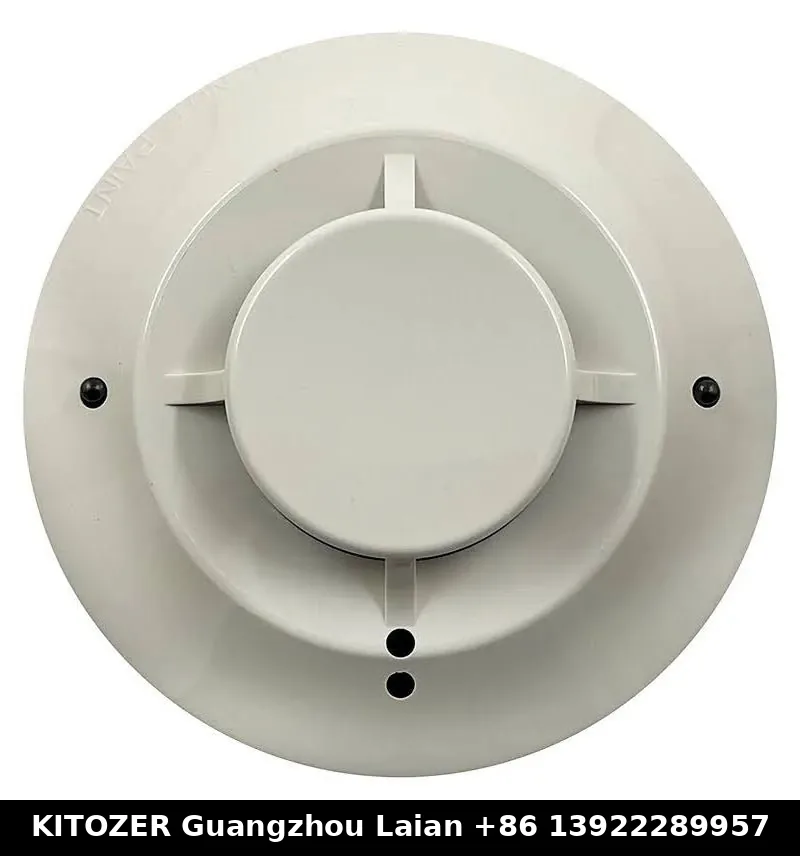
1. Product Overview
The KITOZER Smoke Detector is a point-type photoelectric smoke fire detection device manufactured by Guangzhou Laian Intelligent System Development Co., Ltd. under the KITOZER brand. It integrates optical sensing technology, digital signal processing, and low-power circuit design to provide reliable early fire warning in residential, commercial, industrial, and public buildings.
Designed and manufactured in accordance with the Chinese national standard GB 4715-2005, the KITOZER smoke detector detects smoke particles generated during the smoldering stage of a fire and triggers an audible-visual alarm or transmits a signal to a fire alarm control panel. The product family includes standalone battery-powered units, wired interconnected models with relay outputs, addressable bus-type detectors, and multi-sensor combined units that incorporate smoke, heat, and carbon monoxide detection.
KITOZER smoke detectors are widely used in shopping malls, office buildings, hotels, hospitals, schools, residential apartments, data centers, industrial facilities, warehouses, underground parking garages, subway stations, and utility tunnels. Each detector undergoes rigorous testing before shipment, including smoke sensitivity calibration, high-low temperature testing, electromagnetic compatibility testing, and burn-in testing, ensuring consistent performance in diverse environments.
The reference price range for KITOZER smoke detectors is approximately USD $11 to $70 per unit (equivalent to RMB 80 to 500), depending on the model and feature set. Volume discounts are available for orders of 500 units or more. The brand is committed to providing cost-effective fire detection solutions backed by professional technical support and after-sales service.
The KITOZER product line includes four main series: the KZ-SD01 standalone photoelectric smoke detector (9V battery powered, built-in 85dB alarm), the KZ-SD02 wired interconnected detector (DC 12-24V powered, NO/NC relay output), the KZ-SD03 addressable bus detector (two-wire bus connection to fire alarm control panel), and the KZ-SD04 multi-sensor combined detector (photoelectric + heat + CO, with RS485 Modbus output). An explosion-proof model KZ-EXD01 is available for hazardous environments.
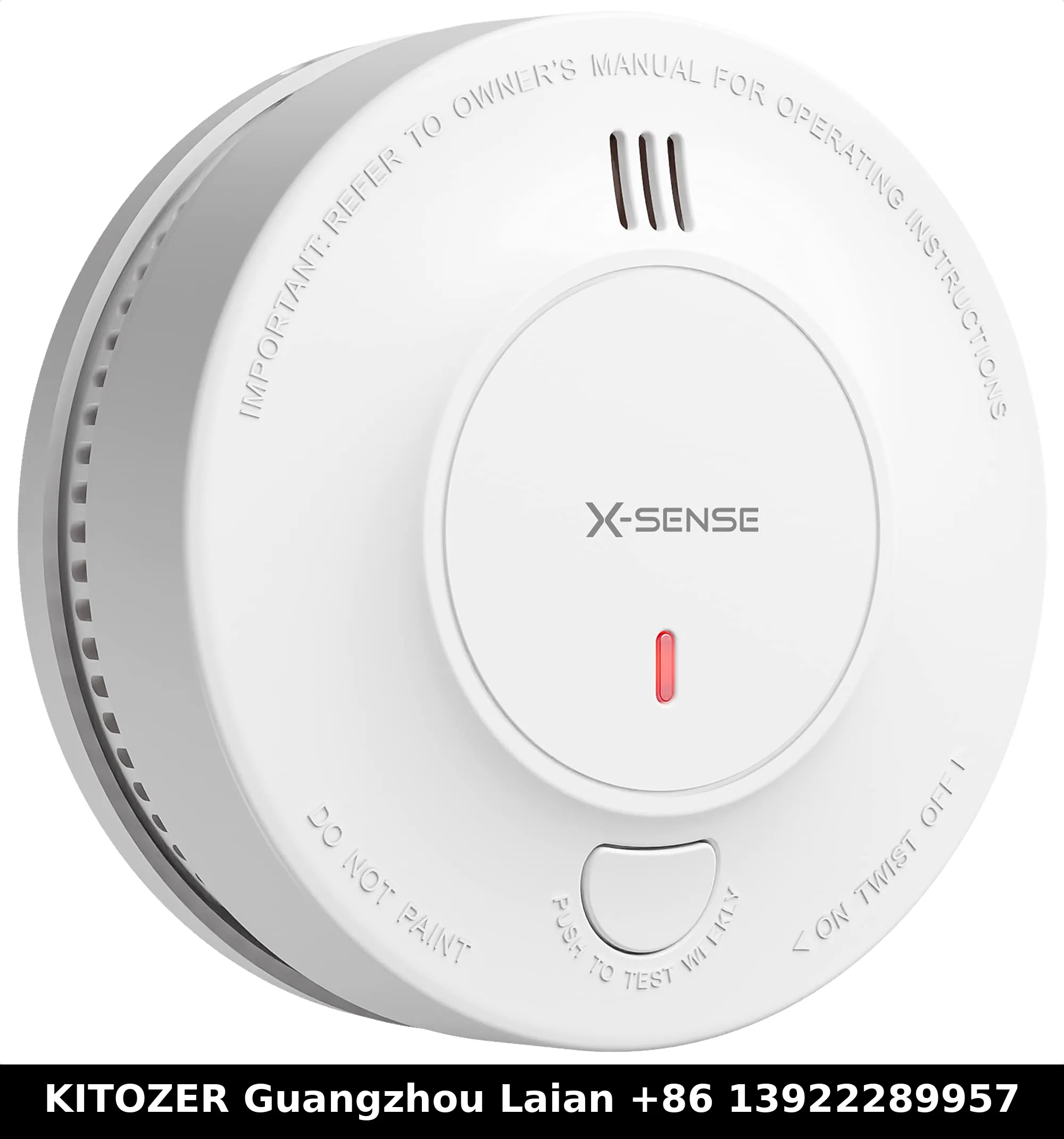
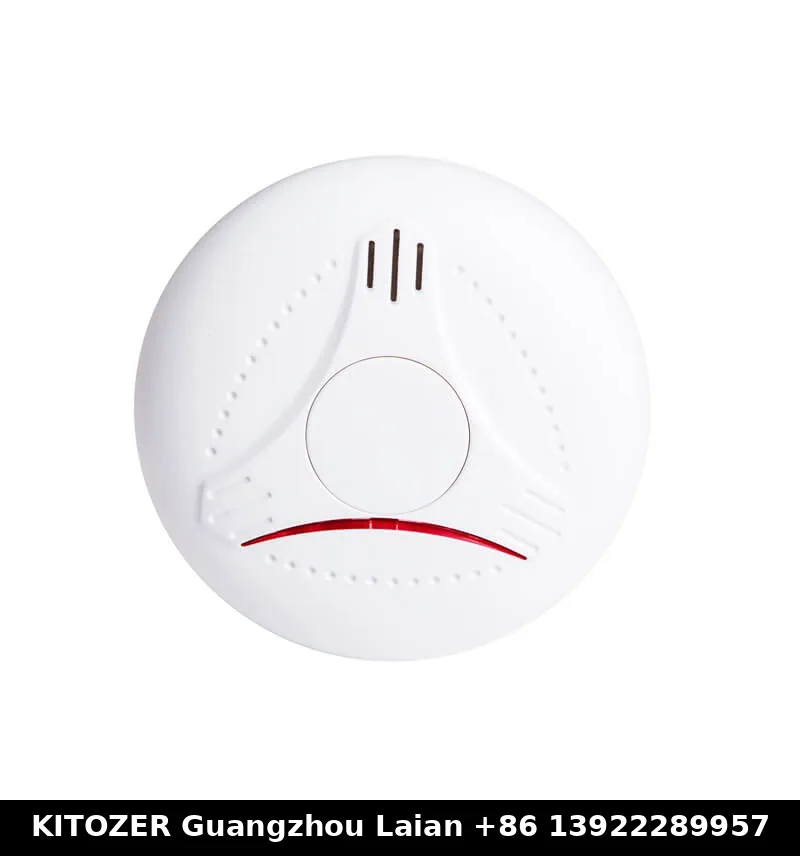
Every KITOZER smoke detector features a white circular flame-retardant ABS housing (UL94 V-0 rated), a red LED status indicator, a built-in test button, and a detachable base for easy installation and maintenance. The optical chamber is designed to maximize smoke entry while blocking ambient light and insects, ensuring accurate and reliable detection.
2. Working Principle
2.1 Photoelectric Scattering Detection
The core sensing element of the KITOZER smoke detector is a precision-designed optical chamber (dark chamber) containing an infrared light-emitting diode (IR LED) and a photodiode receiver. In normal smokeless conditions, the IR LED emits pulsed infrared light along a direct path within the chamber. Due to the chamber’s geometric design, the light beam does not directly strike the photodiode, which remains in a dark state with a stable baseline output.
When smoke particles enter the optical chamber, the infrared light beam collides with suspended smoke particles and undergoes Mie scattering. A portion of the scattered light is redirected toward the photodiode, which converts the light signal into an electrical current. The built-in microcontroller continuously monitors this signal and compares it against the baseline threshold. When the signal exceeds a preconfigured threshold after multiple confirmation samples, the detector enters alarm mode: the red LED illuminates steadily, the built-in buzzer sounds at 85dB or higher, and the output relay activates or the bus transmits an alarm frame.
Photoelectric detectors are particularly sensitive to smoke particles in the 0.3 to 10 micrometer range, which is characteristic of the smoldering stage of most building fires. This makes them highly effective at detecting early-stage fires before open flames develop. For fast-flaming fires that produce very small particles (below 0.1 micrometer), photoelectric detectors respond somewhat more slowly; therefore, it is recommended to combine smoke detectors with heat detectors in environments where fast-flaming fires are a concern.
2.2 Digital Signal Processing Algorithm
The KITOZER smoke detector incorporates a 32-bit low-power microcontroller running advanced signal processing algorithms. The IR LED is driven with short pulses at a fixed frequency, and the photodiode is sampled synchronously during both the on and off phases. This synchronous detection technique effectively rejects ambient infrared interference from sunlight, lighting, and remote controls.
A sliding average filter smooths transient spikes caused by dust particles or insects passing quickly through the chamber. The algorithm analyzes the trend of the signal over a continuous 10-second window, distinguishing between slow environmental drift (dust accumulation) and rapid smoke concentration increases. Slow drift is automatically compensated, while rapid increases trigger the alarm confirmation sequence.
An internal temperature sensor provides environmental compensation for temperature-related variations in LED output and photodiode sensitivity. The detector also performs self-diagnostics at regular intervals, checking LED functionality, receiver response, battery voltage, and memory integrity. Internal faults are indicated by a yellow LED or transmitted via the bus as a trouble signal.
2.3 Alarm Output Methods
The KZ-SD01 standalone model has no external terminals; it relies on its built-in 85dB buzzer and red LED. Optional wireless interconnection (KZ-SD01R) allows multiple detectors to link via 433MHz radio, so that when one alarms, all interconnected units sound simultaneously.
The KZ-SD02 wired model provides a Form-C relay output (NO/NC selectable) rated at 30VDC/0.5A, which can be connected to any third-party security alarm panel, PLC controller, or building automation system. The detector is powered by DC 12-24V through the same terminals.
The KZ-SD03 addressable model communicates over a two-wire, non-polarity bus with the fire alarm control panel. Each detector is assigned a unique address (1-240) via a rotary DIP switch on the base. The panel polls each detector for status and receives alarm/trouble signals with precise location identification.
The KZ-SD04 multi-sensor model combines NO/NC relay output with an RS485 Modbus RTU interface, providing real-time smoke density, temperature, and CO concentration data to a supervisory system. WiFi and 4G versions support cloud platform integration via MQTT protocol.
3. Technical Specifications
| Parameter | KZ-SD01 Standalone | KZ-SD02 Wired | KZ-SD03 Addressable | KZ-SD04 Multi-sensor |
|---|---|---|---|---|
| Detection Principle | Photoelectric scattering | Photoelectric scattering | Photoelectric scattering | Photoelectric + heat + CO |
| Power Supply | 9V DC battery | DC 12-24V | Bus 24V | DC 12-24V |
| Standby Current | ≤10 μA | ≤300 μA | ≤500 μA | ≤800 μA |
| Alarm Current | ≤35 mA | ≤20 mA | ≤5 mA (bus) | ≤30 mA |
| Alarm Sound Level | ≥85dB @ 3m | ≥85dB @ 3m | Panel/sounder | ≥85dB @ 3m |
| Sensitivity Class | Grade 2 | Grade 2/3 selectable | Grade 1/2/3 | Automatic multi-level |
| Response Threshold | 0.10-0.15 dB/m | 0.05-0.20 dB/m | 0.03-0.30 dB/m | 0.03-0.20 dB/m |
| Alarm Output | Built-in sounder | NO/NC relay | Two-wire bus | NO/NC + RS485 |
| LED Indicator | Red (steady on alarm) | Red (steady on alarm) | Red (steady on alarm) | Red/Yellow dual LED |
| Operating Temp | -10°C to +50°C | -10°C to +50°C | -10°C to +50°C | -20°C to +60°C |
| Humidity | ≤95% RH non-condensing | ≤95% RH non-condensing | ≤95% RH non-condensing | ≤95% RH non-condensing |
| Dimensions (Dia×H) | Φ105×42mm | Φ105×42mm | Φ105×48mm | Φ120×52mm |
| Housing Material | Flame-retardant ABS UL94 V-0 | Flame-retardant ABS UL94 V-0 | Flame-retardant ABS UL94 V-0 | Flame-retardant ABS UL94 V-0 |
| Mounting | Ceiling screw mount | Ceiling screw mount | Ceiling screw mount | Ceiling screw mount |
| Recommended Cable | — | RVS 2×1.0mm² | RVS 2×1.5mm² bus | RVS 4×1.0mm² |
| Max Bus Length | — | — | ≤1000 m | RS485 ≤1200 m |
| Max Devices per Bus | — | — | 240 | 32 (Modbus) |
| IP Rating | IP30 | IP30 | IP30 | IP30 |
| Reference Price | $11-21 | $17-35 | $28-49 | $42-70 |
Note: Specifications are typical values. Refer to the individual model datasheet for detailed specifications. Prices are ex-works reference prices excluding tax; volume discounts available.
4. Selection Guide
4.1 By Application Scenario
Residential homes and small shops: Choose the KZ-SD01 standalone detector ($11-21). No wiring required; battery operated with built-in 85dB alarm. Ideal for living rooms, bedrooms, corridors, and small retail spaces. For smart home integration, select the WiFi model KZ-SD01W ($21-31) for smartphone push notifications.
Office buildings and shopping malls: Choose the KZ-SD02 wired model or KZ-SD03 addressable model. For integration with existing security systems, the KZ-SD02 with dry-contact output connects directly to the alarm panel. For new fire alarm systems, the KZ-SD03 addressable model provides precise location identification and central monitoring.
Data centers and server rooms: Choose the KZ-SD04 multi-sensor detector ($42-70), which combines photoelectric smoke detection with heat and CO sensing. Data centers contain dense equipment and battery cabinets where thermal runaway risk requires multi-parameter monitoring. Pair with VESDA aspirating smoke detection for very early warning.
Industrial facilities and warehouses: Use Grade 3 sensitivity detectors (KZ-SD02) in dusty environments. For explosive atmospheres, select the explosion-proof model KZ-EXD01 ($112-210). For high-bay warehouses exceeding 12 meters, use infrared beam detectors or VESDA systems instead of point-type detectors.
Underground parking garages: Use Grade 3 sensitivity detectors combined with CO detectors. Vehicle exhaust particulates may cause false alarms with high-sensitivity photoelectric detectors, so lower sensitivity settings are recommended.
4.2 By System Architecture
Standalone alarm systems: Use KZ-SD01 standalone units. Multiple units can be wirelessly interconnected (KZ-SD01R) for whole-property coverage.
Security alarm integration: Use KZ-SD02 with NO/NC relay contacts connected to the security panel zone inputs.
Addressable fire alarm systems: Use KZ-SD03 detectors on a two-wire bus connected to a fire alarm control panel. Each detector has a unique address for location identification.
IoT/smart fire platforms: Use WiFi (KZ-SD01W) or 4G (KZ-SD04G) models that connect to cloud platforms via MQTT, enabling remote monitoring and push notifications.
4.3 Selection Calculation
The number of smoke detectors required is calculated based on the protected area and the protection area per detector. For rooms with ceiling height under 6 meters, each detector covers approximately 80 square meters (protection radius 6.7 meters). Total detectors = total area / 80 × safety factor (1.1-1.2). For example, a 1000 square meter office requires approximately 13-15 detectors. Final quantities should follow the fire protection design drawings.
5. Installation Requirements
5.1 Mounting Position
Smoke detectors should be mounted at the center of the ceiling, at least 0.5 meters away from walls and beam edges. The horizontal distance from air conditioning supply outlets should be at least 1.5 meters, and from perforated ceiling air diffusers at least 0.5 meters. In corridors narrower than 3 meters, detectors should be centered with spacing not exceeding 15 meters.
Do not install detectors in the following locations: directly above kitchen stoves (steam and grease interference), directly under AC supply outlets, near frequently opened doors (air turbulence), in direct sunlight, or where temperatures may fall below -10°C or exceed 50°C.
5.2 Height and Protection Radius
Point-type smoke detectors are suitable for ceiling heights up to 12 meters. For heights under 6 meters, protection area is 80 m² and radius is 6.7m. For heights between 6-12 meters, protection area decreases. For ceilings above 12 meters (atria, high-bay warehouses), use infrared beam detectors or aspirating smoke detection systems.
5.3 Wiring Instructions
KZ-SD01: Install the 9V battery, screw the base to the ceiling, and twist the detector onto the base. No wiring needed.
KZ-SD02: Connect +V (DC12-24V positive), GND (ground), and ALARM (NO/NC relay output) to the corresponding terminals. Use RVS 2×1.0mm² twisted pair cable in conduit.
KZ-SD03: Connect the two-wire bus (non-polarity) to BUS+ and BUS- terminals. Set the address via the rotary DIP switch. Install a 10kΩ end-of-line resistor at the bus terminus. Maximum bus length is 1000 meters with 1.5mm² cable.
5.4 Installation Steps
(1) Mark the base mounting positions according to the drawings. (2) Drill 6mm holes and insert wall plugs. (3) Screw the base to the ceiling. (4) Connect wiring according to the diagram. (5) Set the detector address (addressable models). (6) Twist the detector onto the base until it clicks. (7) Power on and observe the LED (should flash once every 40 seconds in standby). (8) Test with a smoke test aerosol to confirm alarm activation. (9) Record installation details.
6. Operation and Maintenance
6.1 Routine Inspection
Monthly: Visually inspect each detector. Confirm the red LED flashes approximately once every 40 seconds. Check for physical damage, dust accumulation, or loose mounting.
Quarterly: Functionally test at least 25% of detectors using a smoke aerosol tester. Spray smoke 30cm below the detector; it should alarm within 10 seconds and the control panel should receive the signal. Reset after testing.
Every 6 months: Clean the optical chamber. Remove the detector from its base, gently brush away dust from the chamber entrance with a soft brush, and blow out residual dust with a rubber bulb. Do not use liquids or solvents. Re-test after cleaning.
Annually: Conduct a full system test by a qualified fire safety service provider, covering all detectors, wiring insulation, panel functions, andLinkage (interlocking) functions. Submit the annual test report to the fire authority.
Every 10 years: Replace all detectors. The optical components naturally degrade over 10 years, reducing sensitivity. KITOZER offers trade-in discounts for bulk replacements.
6.2 Battery Replacement
Standalone detectors use a 9V battery with approximately 1-2 year life. When battery voltage drops below threshold, the detector emits a short beep every 40 seconds (low-battery warning) for about 30 days. Replace the battery promptly. Use alkaline batteries (e.g., Duracell, Energizer); do not use carbon-zinc batteries which may leak.
6.3 Troubleshooting Table
| Symptom | Possible Cause | Solution |
|---|---|---|
| LED completely off | Battery dead / wiring loose | Replace battery / check terminals |
| Fast flash + short beep | Low battery warning | Replace battery soon |
| Frequent false alarms | Dust/insects/steam/airflow | Clean chamber / adjust position / lower sensitivity |
| No alarm when tested | Failed sensor / low battery | Replace battery / replace detector |
| Continuous alarm, cannot reset | Panel not reset / relay stuck | Reset panel / replace detector |
| Bus device offline | Broken bus / address conflict / missing EOL resistor | Check wiring / verify addresses / add EOL resistor |
7. Frequently Asked Questions
KITOZER smoke detectors range from approximately $11 to $70 per unit (RMB 80-500), depending on the model. Standalone models cost $11-21, wired models $17-35, addressable models $28-49, and multi-sensor models $42-70. Volume discounts apply for orders of 500+ units.
Photoelectric detectors use light scattering to detect visible smoke particles from smoldering fires. Ionization detectors use a small radioactive source to detect tiny particles from flaming fires, but are being phased out due to radioactive material concerns. KITOZER uses photoelectric technology exclusively, which is safe, eco-friendly, and effective for most building fire scenarios.
For rooms with ceilings under 6 meters, one point-type smoke detector covers approximately 80 square meters with a 6.7-meter radius. A 100m² office typically needs 2 detectors. Final quantities should follow fire protection design drawings per local codes.
Clean the optical chamber every 6 months, or every 3 months in dusty environments. Use a soft brush and rubber bulb; never use water or solvents. Always re-test with smoke aerosol after cleaning.
Approximately 1-2 years in standby mode. When the battery is low, the detector beeps briefly every 40 seconds as a warning. Use high-quality alkaline batteries; avoid carbon-zinc batteries which may leak.
Common causes include dust in the optical chamber, insects entering the chamber, kitchen steam and grease, AC airflow, or construction dust. Solutions: clean the chamber, install an insect screen, move the detector away from kitchens/bathrooms, or reduce sensitivity.
KZ-SD01: built-in alarm only. KZ-SD02: NO/NC relay output. KZ-SD03: two-wire addressable bus. KZ-SD04: RS485 Modbus RTU. WiFi models support MQTT; 4G models support TCP/IP cloud reporting.
Not directly above the cooking area. Kitchen steam and grease will cause frequent false alarms. Use a heat detector (fixed-temperature, e.g., 57°C) in the kitchen, and place smoke detectors in adjacent hallways and dining areas.
KITOZER smoke detectors carry CCC (China Compulsory Certification) for fire products, CE certification (EN 14604), and RoHS compliance. The explosion-proof model carries Ex d IIC T6 Gb certification. Certificates are available upon request.
Photoelectric smoke detectors have a 10-year design life. After 10 years, the IR LED and photodiode degrade, reducing sensitivity. Replace all detectors every 10 years. KITOZER offers trade-in discounts for bulk replacements.
Each detector on a two-wire bus has a unique address (1-240) set by a DIP switch. The fire alarm control panel polls each detector and displays its address and location when an alarm occurs. Up to 240 detectors can share one bus loop.
The KZ-SD02 with dry-contact output works with any alarm panel. The KZ-SD03 uses a standard two-wire protocol compatible with major Chinese fire panel brands. Please contact sales for specific compatibility inquiries.
8. Application Scenarios
8.1 Commercial Buildings
Shopping malls, supermarkets, and office buildings require comprehensive smoke detection coverage. KITOZER addressable detectors connect to a central fire alarm control room, enabling rapid location identification and coordinated evacuation. Each shop unit, corridor, elevator lobby, and equipment room is equipped according to code requirements.
8.2 Data Centers
Data centers demand the highest level of fire detection reliability. KITOZER multi-sensor detectors (smoke + heat + CO) are deployed alongside VESDA aspirating systems for very early warning. Multi-level protection ensures that electrical fires and battery thermal runaway are detected at the earliest possible stage.
8.3 Industrial and Warehousing
Industrial facilities use grade-appropriate detectors: grade 1 for clean rooms, grade 2 for general production areas, grade 3 for dusty workshops. Explosion-proof models are required in chemical and hazardous material storage areas. High-bay warehouses use infrared beam detectors spanning the aisle between racks.
8.4 Residential and Community
Residential apartments, rental units, and dormitories benefit from standalone KITOZER detectors that require no wiring. WiFi-connected models send alerts to both residents and property management, creating a community-wide fire safety network.
8.5 Transportation Infrastructure
Subway stations, railway platforms, underground parking, and utility tunnels use addressable smoke detectors integrated with the building’s fire system. These systems interlock with ventilation, platform screen doors, emergency lighting, and public announcement systems for coordinated emergency response.
8.6 Education and Healthcare
Schools, hospitals, and libraries require early warning to protect vulnerable occupants. Smoke detectors cover classrooms, dormitories, patient rooms, operating theaters, and archive rooms. The system connects to manual call points, sounders, and emergency lighting for comprehensive protection.
9. Quality Assurance and Certification
KITOZER smoke detectors are manufactured under ISO 9001 quality management systems. Every unit passes through a multi-stage testing process: visual inspection, electrical testing, smoke sensitivity calibration in a standardized test chamber, high-low temperature cycling, EMC testing, and 48-hour burn-in. Only units passing all tests are packaged for shipment.
Certifications include: CCC fire product certification (China), CE (EN 14604, Europe), RoHS environmental compliance, and ISO 9001 quality management. The explosion-proof model KZ-EXD01 carries Ex d IIC T6 Gb certification for use in hazardous locations.
The KITOZER warranty period is 18 months from the shipment date. Manufacturing defects are repaired or replaced free of charge. The warranty does not cover accidental damage, unauthorized modification, or natural aging beyond the design life.
10. Detailed Technical Insights
10.1 Optical Chamber Design
The optical chamber is the heart of the photoelectric smoke detector. KITOZER designs the chamber geometry using optical simulation software to maximize smoke entry while minimizing ambient light penetration. The chamber entrance features multi-layer light baffles that create a tortuous path for light, effectively absorbing stray light through repeated reflections. A stainless steel insect screen (1mm mesh) blocks insects without impeding smoke particle entry.
The inner surfaces are coated with matte black paint with over 99% light absorption. The IR LED (940nm wavelength, 20-degree beam angle) and photodiode with band-pass filter are positioned at an optimal scattering angle to detect the characteristic light scatter pattern produced by smoke particles.
10.2 Low-Power Design
Battery-powered detectors must operate for 1-2 years on a single 9V battery. KITOZER achieves this through: a low-power microcontroller in sleep mode (waking every 2 seconds for sampling), pulsed IR LED driving (microsecond pulses), high-impedance receiver circuitry (single-digit microamp current), and efficient power management. Total standby current is under 10μA, enabling up to 2 years of battery life.
10.3 IoT and Smart Fire Platform
KITOZER offers a cloud-based fire management platform accessible via web browser and mobile app. Features include: real-time device status monitoring, alarm push notifications (app push, SMS, WeChat), inspection scheduling and management, work order dispatch, statistical reporting (online rate, alarm frequency, false alarm rate), and multi-level organizational management (group-region-building-floor).
The platform supports MQTT protocol for device connectivity, TLS encryption for data transmission, and role-based access control. It is suitable for property management companies, smart community management, and regulatory oversight of small businesses (“nine smallFieldLocation”).
10.4 Fire Alarm System Integration
KITOZER smoke detectors are typically part of a comprehensive fire alarm system that includes: smoke/heat detectors (trigger devices), manual call points, fire alarm control panel (FACP), sounders and strobes, and interlocking control modules for ventilation, fire shutters, emergency lighting, elevators, and door access. The detector’s alarm signal triggers the full interlocking sequence according to the designed logic.
KITOZER also supplies complementary fire system components: heat detectors, manual call points, sounder strobes, input/output modules, and fire alarm control panels, enabling customers to source a complete fire detection solution from a single supplier.
11. Standards and Compliance
KITOZER smoke detectors are designed and manufactured in accordance with the following standards:
GB 4715-2005: Point-type smoke detectors using scattered light, transmitted light, or ionization. Specifies technical requirements, test methods, and marking.
GB 50116-2013: Fire alarm system design code. Governs detector selection, placement, spacing, and interlocking control design.
GB 50166-2019: Fire alarm system installation and acceptance standard.
GB 25201-2010: Building fire facilities maintenance management. Specifies inspection and testing intervals.
EN 14604:2005: Stand-alone smoke alarm devices (European standard).
UL 217: Smoke detectors standard (US UL safety standard). Available on request for custom export projects.
Reference Price List
| Model | Type | Reference Unit Price |
|---|---|---|
| KZ-SD01 | Standalone photoelectric smoke detector (9V battery) | $11 – $21 |
| KZ-SD01W | WiFi-connected standalone smoke detector | $21 – $31 |
| KZ-SD02 | Wired interconnected (NO/NC relay output) | $17 – $35 |
| KZ-SD03 | Addressable bus-type detector | $28 – $49 |
| KZ-SD04 | Photoelectric + heat + CO multi-sensor | $42 – $70 |
| KZ-EXD01 | Explosion-proof smoke detector | $112 – $210 |
Ex-works reference prices excluding tax. Volume discounts for 500+ units. For project pricing including installation, please contact sales.
Contact Us
Brand: KITOZER
Company: Guangzhou Laian Intelligent System Development Co., Ltd.
Address: Chasha Industrial Park, No. 5 Huashan Road, Shilou Town, Panyu District, Guangzhou, China
Tel/WeChat: +86 13922289957 / +86 18520668845
WhatsApp: +1 906-853-4140
English Website: www.gdlain.com
Chinese Website: www.lain.com.cn
For product selection, pricing, technical support, or installation guidance, please contact us. We provide professional fire detection solutions tailored to your project requirements.
12. Project Implementation Workflow
12.1 Design Phase
During project design, the fire protection engineer determines detector types, quantities, and placement based on architectural drawings and applicable codes. KITOZER’s technical team supports designers by providing product specifications, selection recommendations, and system architecture diagrams. Key decisions include: protection class (special/grade 1/grade 2), detector sensitivity level, system architecture (zone/central control), and interlocking logic.
12.2 Procurement and Delivery
After the design is finalized, the customer places a purchase order. Standard models ship within 3-5 business days. Custom models require 10-15 business days. Each shipment includes a packing list, quality certificate, and CCC certification copy. Large projects can be delivered in batches to match construction schedules.
12.3 Installation and Commissioning
Installation follows GB 50166 standards. KITOZER provides installation manuals and video tutorials. For large projects, on-site technical guidance is available. After installation, the system undergoes: wiring insulation testing (≥20MΩ), address verification, 100% functional smoke testing, and interlocking function testing. A commissioning report is signed by the contractor, supervisor, and owner.
12.4 Fire Authority Acceptance
The local fire rescue authority conducts acceptance testing, verifying product certificates, detector placement, alarm functionality, and interlocking performance. KITOZER provides complete certification documentation to support smooth acceptance. Our technical team can assist with pre-acceptance reviews and corrective action.
12.5 Long-term Maintenance
Post-acceptance, the building owner maintains the fire system per GB 25201 requirements: monthly visual inspections, quarterly functional tests, semi-annual cleaning, annual full-system testing, and 10-year detector replacement. KITOZER offers annual maintenance contracts covering inspection, repair, and replacement services.
13. Advantages of KITOZER Brand
13.1 Reliability Through Testing
Every KITOZER smoke detector is tested for smoke sensitivity, electrical parameters, environmental endurance, and electromagnetic compatibility before leaving the factory. This 100% testing approach ensures that every unit delivers consistent performance. The company’s quality management system is certified to ISO 9001 standards.
13.2 Cost-Effective Pricing
Compared to international brands that charge $80-200+ per detector, KITOZER offers comparable performance at $11-70 per unit. This cost advantage makes professional-grade fire detection accessible to a wider range of projects without compromising on quality or certification.
13.3 Comprehensive Product Line
KITOZER provides not just smoke detectors but a full range of fire safety equipment: heat detectors, manual call points, sounder strobes, control modules, and fire alarm control panels. This one-stop sourcing simplifies project procurement and ensures system compatibility.
13.4 Responsive Service
KITOZER provides 7×24 technical support via phone and WeChat. On-site service is available within 48 hours in Guangdong province and 72 hours in other major Chinese cities. Our team understands the urgency of fire system issues and prioritizes rapid response.
13.5 Customization Capability
For bulk orders (500+ units), KITOZER offers customization: custom housing colors, printed logos, special communication interfaces, tailored sensitivity ranges, and custom packaging. Our engineering team can develop custom solutions for unique project requirements.
14. Understanding Fire Detection Technology
14.1 How Fire Develops
A typical building fire progresses through several stages: (1) Incipient stage – invisible combustion gases and ultra-fine particles are generated; (2) Smoldering stage – visible smoke appears as materials glow and smolder; (3) Flame stage – open flames develop, temperatures rise rapidly; (4) Fully developed stage – the entire space is involved in fire; (5) Decay stage – fuel is consumed and temperatures drop.
Photoelectric smoke detectors are most effective at stage 2 (smoldering), providing critical early warning before open flames develop. VESDA aspirating systems can detect stage 1 (incipient), while heat detectors respond at stage 3 (flame). A layered approach using multiple detection technologies provides the earliest and most reliable protection.
14.2 Smoke Particle Physics
Smoke consists of tiny airborne particles generated by incomplete combustion. Particle sizes range from 0.01 micrometers (from flaming combustion) to 10 micrometers or more (from smoldering materials). Photoelectric detectors are optimized to scatter light from particles in the 0.3-10 micrometer range, which corresponds to the visible smoke produced by smoldering fires.
14.3 False Alarm Reduction
False alarms are a significant challenge in fire detection. KITOZER reduces false alarms through: (1) Signal trend analysis – distinguishing rapid smoke increases from slow environmental drift; (2) Multi-sensor confirmation – requiring both smoke and heat/CO signals for high-confidence alarms; (3) Environmental compensation – adjusting sensitivity based on temperature and humidity; (4) Proper installation guidance – avoiding kitchens, bathrooms, and air vents.
14.4 The Importance of Early Warning
Research shows that the time between first visible smoke and flashover (the sudden involvement of an entire room in fire) can be as little as 3-5 minutes. In residential fires, the majority of fatalities occur from smoke inhalation, not burns. An early warning from a smoke detector gives occupants precious minutes to escape. This is why building codes mandate smoke detectors in virtually all new construction.
15. Packaging, Shipping, and Storage
Each KITOZER smoke detector is packaged in an individual cardboard box with a foam insert, containing the detector, base, mounting hardware, and instruction manual. Twenty units are packed in one corrugated carton (approximately 350×250×200mm, 5kg gross weight). Export packaging can be customized to customer requirements.
Domestic shipments in China are handled by SF Express or JD Logistics, typically delivering within 1-3 business days. International shipping is available FOB Shenzhen/Guangzhou or CIF destination port. The product is classified as ordinary electronic equipment (non-hazardous), so there are no shipping restrictions.
Storage conditions: temperature -10°C to +40°C, relative humidity ≤75%, well-ventilated warehouse free of corrosive gases. Stack no more than 5 cartons high. Battery-powered models should be used within 2 years of production date.
16. About the Manufacturer
Guangzhou Laian Intelligent System Development Co., Ltd. is a high-tech enterprise based in Guangzhou, China, specializing in smart fire safety, security surveillance, and building automation systems. The company’s manufacturing facility is located in the Panyu District industrial park, equipped with production lines, testing laboratories, and a product demonstration center.
The KITOZER brand covers fire detection, perimeter security, video surveillance, and environmental monitoring products. The company serves customers across China and in international markets, providing both standard products and customized solutions. With a team of experienced engineers and a commitment to quality, KITOZER has built a reputation for reliable products and professional service.
The company’s address is: Chasha Industrial Park, No. 5 Huashan Road, Shilou Town, Panyu District, Guangzhou, China. Contact: +86 13922289957 (phone/WeChat), WhatsApp +1 906-853-4140. Websites: www.lain.com.cn (Chinese) and www.gdlain.com (English).
17. Ordering Information
To order KITOZER smoke detectors, please provide: (1) Model number(s) (e.g., KZ-SD02); (2) Quantity required; (3) Delivery destination; (4) Invoice details (if a VAT invoice is needed); (5) Contact person and phone number. We will confirm stock and arrange shipment within 3-5 business days for standard models.
Payment terms: Domestic customers pay by bank transfer. First-time customers: 30% deposit, balance before shipment. Long-term customers can arrange monthly settlement. International customers: T/T wire transfer, L/C, or PayPal. Detailed terms are available upon request.
Sample orders are welcome. Sample fees are deductible against subsequent bulk orders. Contact sales at +86 13922289957 or WeChat +86 18520668845 to place an order or request a quote.
18. Detailed Product Series Comparison
18.1 KZ-SD01 Standalone Series
The KZ-SD01 is the entry-level model in the KITOZER smoke detector family. It operates on a standard 9V alkaline battery, making it completely wireless and installation-free. The detector features a white circular housing with a diameter of 105mm and height of 42mm. On the front face, a red LED indicator flashes once every 40 seconds to indicate normal operation. A built-in test button on the front allows users to manually test the detector’s alarm function.
The built-in piezoelectric buzzer produces an alarm sound level of at least 85 decibels at a distance of 3 meters, which is sufficient to wake sleeping occupants in a residential room. The detector operates at a Grade 2 sensitivity level, which is the default for general-purpose residential and commercial applications. The low-battery warning function emits a short beep every 40 seconds when the battery voltage drops below approximately 6.8 volts, giving users about 30 days of advance notice before the battery is completely depleted.
An optional WiFi version (KZ-SD01W) adds wireless connectivity to a home WiFi network. When an alarm occurs, the detector sends a push notification to the user’s smartphone via the KITOZER mobile app, even when the user is away from home. This provides peace of mind for homeowners who want remote monitoring of their property. The WiFi model also reports battery status and detector health to the cloud platform.
For multi-unit installations, the KZ-SD01R wireless interconnection version allows up to 32 detectors to link via 433MHz radio frequency. When one detector alarms, all interconnected units in the network sound simultaneously, ensuring that occupants anywhere in the home are alerted. This is particularly valuable in larger homes where a fire in one wing might otherwise go unnoticed by occupants in another wing.
18.2 KZ-SD02 Wired Series
The KZ-SD02 is designed for permanent installation in commercial and residential buildings where wired power is available. It operates on DC 12-24 volts, drawing approximately 300 microamps in standby and 20 milliamps during alarm. The detector base includes a three-terminal wiring block: +V for power positive, GND for power ground, and ALARM for the relay output contact.
The alarm output is a Form-C relay contact that can be configured as normally open (NO) or normally closed (NC), depending on the connected system’s requirements. The contact rating is 30VDC at 0.5 amps, which is sufficient to directly drive a small relay or connect to a security alarm panel’s zone input. This dry-contact interface makes the KZ-SD02 universally compatible with virtually any third-party alarm system on the market.
The KZ-SD02 supports selectable sensitivity levels (Grade 2 or Grade 3), allowing installers to adapt the detector to the specific environment. In dusty environments like warehouses or workshops, Grade 3 sensitivity reduces false alarms. In clean environments like offices or hotels, Grade 2 provides faster response. The sensitivity is configured via a jumper or DIP switch on the detector base.
Typical applications for the KZ-SD02 include: office buildings connected to security systems, hotel rooms connected to the property management center, retail stores connected to central monitoring, and residential buildings with existing alarm infrastructure. The detector is also commonly used in integration with PLC controllers in industrial settings, where smoke detection triggers process shutdown or ventilation activation.
18.3 KZ-SD03 Addressable Series
The KZ-SD03 is the professional-grade addressable detector designed for use in larger fire alarm systems. It connects to a fire alarm control panel (FACP) via a two-wire, non-polarity communication bus. Up to 240 detectors can share a single bus loop, with a maximum bus length of 1000 meters using 1.5mm² twisted pair cable.
Each detector is assigned a unique address from 1 to 240 using a rotary DIP switch on the detector base. The control panel polls each detector in sequence, checking its status (normal, alarm, trouble, or low battery). When a detector enters alarm, the panel immediately displays its address number and the corresponding location (pre-programmed in the panel’s address-location table). This precise location identification is essential for large buildings where rapid response depends on knowing exactly where the fire is located.
The KZ-SD03 supports three sensitivity levels (Grade 1, 2, or 3), which can be set individually for each detector from the control panel without physically accessing the device. This remote sensitivity adjustment is invaluable during system commissioning, as installers can fine-tune each detector’s response based on environmental test results.
Additional features of the KZ-SD03 include: remote reset from the panel, remote trouble diagnosis, automatic drift compensation, and event logging. The panel can also perform a remote smoke test command that briefly activates the detector’s alarm circuit for verification without introducing smoke.
18.4 KZ-SD04 Multi-Sensor Series
The KZ-SD04 represents the most advanced detection technology in the KITOZER lineup. It combines three sensing elements in a single device: a photoelectric smoke chamber, a thermistor-based heat sensor, and an electrochemical carbon monoxide (CO) sensor. This multi-sensor approach provides superior detection accuracy and significantly reduces false alarms compared to single-sensor detectors.
The smoke sensor uses the same photoelectric scattering principle as other KITOZER models. The heat sensor measures ambient temperature and detects both fixed-temperature thresholds (57°C, 70°C, or 90°C selectable) and rate-of-rise (temperature increase exceeding 10°C per minute). The CO sensor detects carbon monoxide concentration from incomplete combustion, providing an additional layer of early warning.
The KZ-SD04 uses an intelligent algorithm that combines readings from all three sensors to make fire judgments. For example, if only smoke is detected but temperature and CO levels are normal, the detector may issue a pre-alert (yellow LED) rather than a full alarm. If smoke and temperature both rise, or if CO concentration becomes abnormal, the detector confirms a fire and triggers a full alarm. This multi-dimensional analysis dramatically reduces nuisance alarms.
Output options include: NO/NC relay contacts (same as KZ-SD02), RS485 Modbus RTU communication (at 9600 bps default, configurable up to 115200 bps), and optional WiFi or 4G modules for cloud connectivity. The Modbus interface provides real-time analog data: smoke density in dB/m, temperature in °C, and CO concentration in ppm. This data can be integrated into building management systems (BMS) for comprehensive environmental monitoring.
The KZ-SD04 is the recommended choice for data centers, server rooms, battery rooms, and other critical infrastructure where both fire detection accuracy and false alarm immunity are essential. Its wider operating temperature range (-20°C to +60°C) also makes it suitable for industrial and outdoor semi-enclosed environments.
19. Installation Best Practices
19.1 Ceiling Preparation and Mounting
Before installing detectors, ensure the ceiling surface is clean and flat. For suspended ceilings (mineral fiber tiles or aluminum panels), mark the center of the tile and cut a 60mm diameter hole using a hole saw. The detector base should be secured to the ceiling grid using self-tapping screws, not to the tile itself, to ensure structural stability. If the grid spacing is too wide, add a reinforcement backing plate.
For gypsum board ceilings, use 6mm wall plugs with self-tapping screws. Pre-drill pilot holes to avoid cracking the gypsum. Ensure the base sits flush against the ceiling surface with no gap. A tilted or loose base can affect smoke entry and create false alarms.
19.2 Conduit and Cable Management
Fire alarm system cables should be routed through galvanized steel conduit or flame-retardant PVC conduit. The conduit should be securely fastened to ceiling or wall structures. Separate fire alarm cables from power cables by at least 300mm horizontally to prevent electromagnetic interference. Where crossings are unavoidable, maintain at least 100mm vertical separation.
Use RVS-type twisted pair cable (copper conductor, PVC insulation, twisted pair) for bus circuits, with a minimum cross-section of 1.5mm². For non-bus circuits, use RVV-type sheathed cable with a minimum of 1.0mm². All cable splices must be made in junction boxes, never inside conduit. Label both ends of every cable with the circuit number for future maintenance.
19.3 Address Programming
For addressable systems (KZ-SD03), program each detector’s address before installation. Use the two-digit rotary DIP switch on the base: the left dial sets the tens digit, the right dial sets the ones digit. For address 025, set the tens dial to 2 and the ones dial to 5. Maintain a written address map recording each detector’s address number and its physical location on the floor plan.
After installation, verify each address by checking the control panel’s device list. The panel should show the correct number of online devices. Walk-test each detector with smoke aerosol and confirm the panel displays the correct address and corresponding location. Correct any discrepancies before commissioning.
19.4 Pre-Commissioning Testing
Before energizing the system, perform insulation testing on all bus circuits using a 500V megohmmeter. Insulation resistance should be at least 20 megohms between conductors and between conductors and ground. Repair any faults before applying power.
When first powering up, observe the control panel’s self-test sequence. The panel should display no fault messages. Gradually connect one bus loop at a time, verifying that the panel detects the expected number of devices on each loop. If a loop shows zero devices or fewer than expected, troubleshoot that loop before proceeding.
Functional testing involves activating every detector with smoke aerosol and verifying the panel’s response. Test at least 100% of detectors in a new installation. Also test the interlocking functions: when a detector alarms, confirm that exhaust fans start, fire shutters close, emergency lighting activates, the public announcement system plays evacuation messages, and elevators return to the ground floor.
19.5 As-Built Documentation
After commissioning, prepare as-built documentation including: final detector layout floor plans with address numbers, system wiring diagrams, device list with addresses and locations, commissioning test records, and product certificates. This documentation is essential for future maintenance and for fire authority acceptance inspections.
20. Maintenance and Service Procedures
20.1 Monthly Inspection Checklist
Every month, perform a visual inspection of all smoke detectors. Check the following items: (1) The red LED indicator flashes approximately once every 40 seconds (normal standby); (2) The detector housing is intact with no cracks, discoloration, or deformation; (3) The detector is securely mounted with no wobbling; (4) There is no significant dust or cobweb accumulation on the surface; (5) The control panel displays no active trouble or fault messages; (6) Any status indicators on zone displays or remote annunciators are normal. Document the inspection results in a maintenance log.
20.2 Quarterly Functional Testing
Each quarter, functionally test at least 25% of the detector population (rotating which detectors are tested each quarter so that every detector is tested at least once per year). Use a certified smoke aerosol tester (e.g., Home Snooper or similar). Hold the nozzle 30cm below the detector and spray for 3-5 seconds. The detector should enter alarm within 10 seconds: red LED steady on, buzzer sounding, and panel displaying the alarm.
Inform the control room operator and building occupants before testing to prevent unnecessary panic. After testing, reset the system from the control panel. If any detector fails to alarm, mark it for replacement and schedule a replacement within 48 hours.
20.3 Semi-Annual Cleaning Procedure
Every six months, clean all detectors. First, place the detector on maintenance bypass in the control panel to prevent nuisance alarms during cleaning. Twist the detector counterclockwise to remove it from the base. Use a soft, dry brush (such as a camera lens brush) to gently remove dust from the optical chamber entrance. Use a rubber bulb blower to expel dust from inside the chamber. Do not use compressed air cans, as the high pressure may damage the optical components. Do not use water, alcohol, or any liquid cleaner.
Inspect the insect screen for damage or clogging. Replace the screen if torn. Wipe the outer housing with a dry soft cloth. Reinstall the detector on its base, remove the maintenance bypass, and perform a smoke test to confirm proper operation.
20.4 Annual Full System Test
Once per year, engage a qualified fire protection service company to perform a comprehensive system test. The annual test includes: 100% functional testing of all detectors, wiring insulation resistance testing, control panel functional testing (self-test, reset, trouble alarm, fire alarm), interlocking function testing (at least 20% of controlled devices), backup power capacity testing (disconnect main power, verify battery backup lasts at least 3 hours), fire telephone system testing, and emergency broadcast audio quality testing. The service company issues an annual test report that must be filed with the local fire authority.
20.5 Battery Management
For standalone battery-powered detectors, establish a battery replacement schedule. Replace all 9V batteries every 1-2 years, even if no low-battery warning has appeared. Use premium alkaline batteries (Duracell, Energizer, or equivalent). Record the battery replacement date on a label attached to each detector. For unattended locations (basements, storage rooms), replace batteries every 6 months proactively to prevent leakage.
For wired detectors with backup batteries in the control panel, test the backup battery annually by disconnecting the main power supply and verifying the system operates on battery power for at least 3 hours. Replace control panel batteries every 3-5 years.
20.6 End-of-Life Replacement
After 10 years of service, all photoelectric smoke detectors should be replaced. The IR LED output diminishes over time, and the photodiode sensitivity decreases, leading to slower response or failure to alarm. KITOZER offers trade-in discounts for bulk detector replacements. When replacing, inspect the base for corrosion or damage and replace the base if necessary. Update the as-built documentation with new detector installation dates.
21. False Alarm Management
21.1 Common False Alarm Sources
False alarms are the most common operational issue with smoke detection systems. The leading causes include: (1) Dust accumulation in the optical chamber over time; (2) Insects entering the chamber and crossing the light path; (3) Kitchen steam and cooking fumes; (4) Bathroom steam from hot showers; (5) Air conditioning airflow blowing dust into the chamber; (6) Construction dust during renovations; (7) High humidity causing condensation; (8) Aerosol sprays (hairspray, air fresheners, cleaning sprays).
21.2 False Alarm Prevention
Prevent false alarms through proper design and installation: (1) Never place smoke detectors in kitchens; use heat detectors instead. (2) Keep detectors at least 1.5 meters from air conditioning supply outlets. (3) Install insect screens on all detectors. (4) Select the appropriate sensitivity level for the environment (Grade 3 for dusty locations). (5) Clean detectors regularly (every 6 months). (6) During renovation or construction, temporarily bypass affected detectors and cover them with plastic bags. (7) In bathrooms, use heat detectors instead of smoke detectors. (8) Ensure proper ventilation in humid areas.
21.3 Responding to False Alarms
When a false alarm occurs, follow this procedure: (1) Do not immediately disable the detector; first verify whether there is a real fire. (2) If no fire is found, identify the cause of the alarm (look for steam, dust, insects, etc.). (3) Reset the system from the control panel. (4) If the same detector repeatedly false-alarms, inspect and clean it; if the problem persists, replace the detector. (5) Document all false alarm events in the maintenance log, including time, location, suspected cause, and corrective action. (6) Review false alarm patterns quarterly to identify systemic issues.
21.4 Sensitivity Optimization
For addressable systems, use the control panel’s sensitivity adjustment to optimize each detector’s response. During commissioning, test each detector’s response with calibrated smoke and adjust the sensitivity level to provide adequate response without being overly sensitive. In environments with known nuisance sources, slightly reducing sensitivity (moving from Grade 1 to Grade 2, or Grade 2 to Grade 3) can significantly reduce false alarms while maintaining acceptable fire detection performance.
22. Applications in Detail
22.1 Office Building Protection
A typical mid-rise office building requires smoke detectors in every enclosed office, open-plan work areas, corridors, stairwells, elevator lobbies, restrooms, mechanical rooms, electrical rooms, and storage rooms. For a 1000m² floor plate, approximately 15-20 detectors are needed. The addressable KZ-SD03 model is recommended for buildings of this size, connected to a central fire alarm panel in the building management office.
Office buildings face specific fire risks: overloaded power strips under desks, server closets, printers and copiers that overheat, and kitchens in break rooms. Smoke detectors provide early warning of electrical fires before they develop into major incidents. The system should interlock with the building’s HVAC system to shut down air conditioning in the event of a fire, preventing smoke spread through ductwork.
22.2 Hotel and Hospitality Protection
Hotels require smoke detectors in every guest room, corridor, meeting room, restaurant, kitchen (heat detectors only), laundry room, boiler room, and storage areas. Guest room detectors connect to the front office management system, ensuring that staff are immediately notified of any alarm. The hotel’s fire control room is staffed 24/7.
Hotel guests may be unfamiliar with evacuation routes, so the system must include clear emergency lighting, illuminated exit signs, and a public announcement system that broadcasts evacuation instructions in multiple languages. Interlocking with door access systems ensures that fire doors unlock during an alarm, allowing guests to evacuate freely.
22.3 Hospital and Healthcare Protection
Hospitals present unique fire safety challenges because many patients have limited mobility. Smoke detectors are required in every patient room, corridor, operating room, ICU, pharmacy, laboratory, and utility room. The fire system must interlock with the hospital’s nurse call system, immediately alerting staff when an alarm occurs so they can begin patient evacuation.
Special care is needed in areas with medical equipment that generates heat or aerosols. Laboratories handling chemicals may require explosion-proof detectors. Kitchens and dietary areas use heat detectors rather than smoke detectors. The hospital should conduct regular fire drills to ensure staff can safely evacuate patients in an emergency.
22.4 School and University Protection
Schools, universities, and dormitories require smoke detectors in classrooms, laboratories, dorm rooms, hallways, cafeterias, libraries, and gymnasiums. Students may be asleep during nighttime hours, so audible alarms must be loud enough to wake sleeping occupants. In dormitories, interconnected smoke detectors ensure that an alarm in one room alerts the entire floor.
Laboratories containing chemicals or electrical equipment may require specialized detection. Kitchens in cafeterias use heat detectors. The fire system should be tested regularly, and students should participate in fire drill training to ensure they know evacuation procedures.
22.5 Data Center Protection
Data centers are among the most demanding environments for fire detection. The combination of high-value equipment, continuous power requirements, and the risk of battery thermal runaway requires multi-layered protection. KITOZER recommends a three-tier approach: (1) VESDA aspirating smoke detection for incipient-stage warning (invisible smoke particles); (2) KZ-SD04 multi-sensor detectors for visible smoke and heat confirmation; (3) Clean-agent gas suppression (FM-200 or Novec 1230) for automatic fire suppression without water damage.
The smoke detection system must integrate with the building management system (BMS), providing real-time environmental data including temperature, humidity, smoke density, and CO concentration. Remote monitoring via cloud platform allows data center operators to receive instant alerts on their smartphones, enabling rapid response even when off-site.
22.6 Industrial Facility Protection
Industrial facilities present varied fire risks depending on the manufacturing process. Clean rooms in electronics manufacturing require Grade 1 sensitivity detectors. General production floors use Grade 2. Dusty workshops (woodworking, textiles) use Grade 3 or heat detectors. Chemical storage areas require explosion-proof detectors (KZ-EXD01). High-bay warehouses use infrared beam detectors spanning the aisles between racking.
Industrial fire systems must also integrate with process control systems: when a smoke alarm activates, the PLC can shut down production equipment, close gas valves, and activate emergency ventilation. KZ-SD02 wired detectors with relay outputs are ideal for this integration, providing a simple dry-contact interface to the PLC system.
22.7 Residential and Community Protection
Residential fire safety is critical because most fire fatalities occur in the home. KITOZER standalone smoke detectors (KZ-SD01) provide affordable, easy-to-install protection for homes. The recommended placement is: one detector in each bedroom, one in the living room, and one in the hallway outside bedrooms. For multi-story homes, place a detector on each level.
For smart communities, WiFi-connected detectors (KZ-SD01W) send alerts to both residents and property management, creating a networked safety system. This is particularly valuable for rental properties and elderly residents who may need assistance during an emergency.
22.8 Underground and Transit Protection
Subway stations, underground parking garages, and utility tunnels present challenging environments: limited ventilation, long evacuation distances, and high occupancy during peak hours. Addressable smoke detectors (KZ-SD03) are integrated with the transit authority’s central fire control system, interlocking with ventilation fans, platform screen doors, emergency lighting, and public address systems.
Underground parking garages require special consideration: vehicle exhaust contains particulates that can cause false alarms with high-sensitivity photoelectric detectors. Use Grade 3 sensitivity or multi-sensor detectors (KZ-SD04) that combine smoke detection with CO sensing to reduce false alarms. The system should also monitor CO concentration and activate ventilation when levels exceed safe thresholds.
23. Technical Standards Reference
23.1 Chinese National Standards
KITOZER smoke detectors comply with the following Chinese national standards: GB 4715-2005 (Point-type smoke detectors using scattered light, transmitted light, or ionization); GB 50116-2013 (Fire alarm system design code); GB 50166-2019 (Fire alarm system installation and acceptance); GB 25201-2010 (Building fire facilities maintenance management); GB 4717-2005 (Fire alarm control units); GB 16806-2006 (Fire interlocking control systems).
These standards define the technical requirements for detectors, the design parameters for fire alarm systems, installation and acceptance procedures, and ongoing maintenance requirements. Compliance with these standards is mandatory for fire safety products sold and installed in China.
23.2 International Standards
For export markets, KITOZER detectors meet: EN 14604:2005 (Stand-alone smoke alarm devices, European standard); UL 217 (Smoke detectors, United States UL safety standard); ISO 7240-7 (Fire detection and alarm systems – Part 7: Point-type smoke detectors using scattered light, transmitted light, or ionization). CE marking indicates conformity with applicable European directives. RoHS compliance restricts the use of hazardous substances in electronic products.
23.3 Certification Bodies
In China, fire products are certified by the China Fire Products Certification Centre under the mandatory CCC product certification scheme. Certificates are verifiable on the national fire product information website. Internationally, CE certification is issued by notified bodies across the European Union. UL certification is managed by Underwriters Laboratories in the United States.
24. Frequently Asked Questions (Extended)
No. Painting the detector blocks the smoke entry vents and can contaminate the optical chamber. Always remove detectors before painting and reinstall them after the paint has fully dried.
Keep detectors at least 0.5 meters from windows. Open windows can create drafts that disperse smoke before it reaches the detector, delaying alarm activation.
Smoke detectors must be mounted with the smoke entry vents facing downward (toward the room). Installing them upside down prevents smoke from entering the optical chamber and renders the detector ineffective.
No. Photoelectric detectors are best for smoldering fires producing visible smoke. For fast-flaming fires or high-temperature environments, pair smoke detectors with heat detectors or flame detectors for complete coverage.
At minimum: one in each bedroom, one in the hallway outside bedrooms, and one on each level of the home. For a typical two-bedroom apartment, 3-5 detectors provide adequate coverage.
The KZ-SD01 is battery-powered and wireless (no wires needed). The KZ-SD01W adds WiFi connectivity. The KZ-SD01R supports 433MHz wireless interconnection between multiple units. Wired models (KZ-SD02, KZ-SD03) require wiring to a power source or control panel.
KITOZER provides an 18-month warranty from the date of shipment. Manufacturing defects are repaired or replaced free of charge. The warranty does not cover accidental damage, misuse, or normal wear beyond the 10-year design life.
Yes. We provide paid samples for testing. Sample costs can be deducted from subsequent bulk orders. Contact sales at +86 13922289957 to request samples.
Yes. We provide installation manuals, datasheets, dimension drawings, wiring diagrams, and certification certificates. All documents are available in both Chinese and English.
Domestic: bank transfer. International: T/T wire transfer, L/C, PayPal. First-time customers require 30% deposit with balance before shipment. Long-term customers can arrange monthly settlement.
25. About KITOZER and the Manufacturer
25.1 Company Profile
KITOZER is a brand of Guangzhou Laian Intelligent System Development Co., Ltd., a high-tech enterprise based in Guangzhou, China. The company specializes in the research, development, manufacturing, and integration of smart fire safety, security surveillance, and building automation systems. Our manufacturing facility is located in the Panyu District industrial park, equipped with modern production lines, environmental testing chambers, EMC testing equipment, and a dedicated quality control laboratory.
25.2 Product Categories
Beyond smoke detectors, the KITOZER product portfolio includes: point-type heat detectors, manual call points, sounder strobes, fire alarm control panels, input/output control modules, infrared beam detectors, aspirating smoke detection systems (VESDA-compatible), perimeter intrusion detectors, and environmental monitoring sensors. This comprehensive product range allows us to deliver complete fire and security solutions from a single supplier.
25.3 Quality and Service Commitment
We are committed to delivering products that meet the highest quality standards, backed by responsive technical support and after-sales service. Every KITOZER product undergoes 100% factory testing before shipment. Our service team provides 7×24 technical support via phone, WeChat, and WhatsApp. On-site service is available within 48 hours in the Guangzhou area and 72 hours in other major Chinese cities.
25.4 Contact Information
Address: Chasha Industrial Park, No. 5 Huashan Road, Shilou Town, Panyu District, Guangzhou, China. Phone/WeChat: +86 13922289957 / +86 18520668845. WhatsApp: +1 906-853-4140. English website: www.gdlain.com. Chinese website: www.lain.com.cn.
26. Technical Deep Dive: Optical Chamber Engineering
26.1 Chamber Geometry and Light Path Design
The optical chamber is the most critical component of a photoelectric smoke detector. KITOZER engineers use optical simulation software to design the chamber geometry, optimizing the balance between smoke entry efficiency and ambient light rejection. The chamber consists of an upper light shield, a lower base, the IR LED, and the photodiode receiver. The LED and receiver are positioned at an angle of approximately 120 degrees to each other, creating a light path that does not intersect under normal conditions.
The chamber entrance features a series of concentric baffles that create a tortuous path for incoming light. Ambient light entering from below passes through multiple reflections off the matte black interior surfaces, with each reflection absorbing approximately 99% of the light energy. After just 2-3 reflections, virtually all ambient light is absorbed, while smoke particles — which are microscopic and suspended in the air — freely enter the chamber interior.
The design also incorporates a precision-machined insect screen with 1mm diameter perforations. This screen blocks insects and spiders (which are a notorious source of false alarms) while allowing smoke particles as large as 10 micrometers to pass unimpeded. The screen is removable for cleaning or replacement.
26.2 IR LED and Photodiode Selection
KITOZER selects infrared emitters with a peak wavelength of 940 nanometers, which is optimal for scattering by smoke particles in the 0.3-10 micrometer range. The LED is driven with short current pulses (approximately 50 microseconds) at a repetition rate of about 2Hz. This pulsed drive scheme minimizes average power consumption while providing sufficient light intensity for reliable detection.
The photodiode receiver is paired with a narrow-band optical filter centered at 940nm with a bandwidth of ±30nm. This filter blocks visible light and out-of-band infrared, ensuring that the receiver responds only to light emitted by the detector’s own LED. The receiver circuit uses a transimpedance amplifier with a low-noise design, converting the photodiode’s microampere-level current output into a measurable voltage signal.
26.3 Signal Processing Pipeline
The analog signal from the receiver amplifier enters a 12-bit analog-to-digital converter inside the microcontroller. The digital signal passes through a cascade of processing stages: (1) Synchronous demodulation — subtracting the receiver signal during LED-off from LED-on to eliminate ambient light interference; (2) Low-pass filtering — a digital filter smooths high-frequency noise while preserving slow smoke concentration changes; (3) Baseline tracking — a slow-adapting algorithm tracks the zero-smoke baseline and compensates for gradual drift; (4) Trend analysis — the system calculates the rate of signal change over a 10-second window to distinguish true smoke from transient disturbances.
When the processed signal exceeds a configurable threshold for a sustained period (typically 3 consecutive samples over 3 seconds), the detector confirms an alarm. This confirmation logic prevents momentary disturbances — such as a dust particle passing through the chamber or a fly crossing the light path — from triggering false alarms.
27. System Integration Considerations
27.1 Power Supply Design
Wired detectors require a stable DC power supply. For a typical addressable system with 240 detectors on one loop, the total standby current is approximately 240 × 0.5mA = 120mA, with an additional 240 × 5mA = 1.2A during simultaneous alarm conditions. The control panel’s power supply must be sized to handle both standby and alarm loads with a 30% safety margin. A backup battery (typically sealed lead-acid) must provide at least 3 hours of standby operation after main power failure.
For wired non-addressable systems (KZ-SD02), each detector draws 300μA standby and 20mA alarm. A 50-detector system draws 15mA standby and up to 1A during simultaneous alarms. The power supply and wiring must be sized accordingly.
27.2 Cable Shielding and Grounding
In environments with high electromagnetic interference (near large motors, variable frequency drives, or radio transmitters), shielded twisted pair cable is recommended for bus circuits. The shield should be grounded at one end only (typically at the control panel end) to avoid ground loops. The control panel should be connected to a dedicated earth electrode with resistance not exceeding 4 ohms (or 1 ohm for a shared grounding system).
27.3 Surge Protection
For outdoor or semi-outdoor installations, install surge protection devices (SPDs) on the bus lines at the building entrance and at exposed cable runs. SPDs protect the detectors and control panel from voltage transients caused by lightning or switching surges. This is particularly important for perimeter detectors and outdoor enclosures.
28. IoT Fire Platform Detailed Features
28.1 Device Management
The KITOZER cloud platform provides a comprehensive device management interface. Users can batch-import device lists via Excel spreadsheet, automatically generating an equipment ledger. Each device record includes: device ID, model, installation location, installation date, warranty expiration date, and maintenance history. Devices can be displayed on an interactive floor plan map, with color-coded indicators showing online (green), offline (gray), alarm (red), and trouble (yellow) status.
28.2 Real-time Monitoring and Alerts
The platform continuously monitors each device’s operating parameters: smoke density (dB/m), temperature (°C), CO concentration (ppm), battery voltage (mV), and communication status. Threshold alarms are triggered when parameters exceed configured limits. Alert notifications are pushed through multiple channels: mobile app push notifications, SMS text messages, WeChat messages, and email. Escalation rules can be configured: if the first recipient does not acknowledge within 5 minutes, the alert is escalated to the next-level supervisor.
28.3 Inspection and Maintenance Management
The platform supports scheduled inspection management: define inspection plans (daily, weekly, monthly, quarterly, annually), and the system automatically generates inspection tasks and sends reminders to assigned personnel. Inspectors can use the mobile app to scan QR codes on devices, record inspection results, upload photos, and report issues. Abnormal findings automatically generate maintenance work orders that are dispatched to maintenance personnel. The system tracks work order status from creation to closure, ensuring all issues are resolved.
28.4 Analytics and Reporting
The platform provides statistical dashboards showing: device online rate, alarm frequency by location, false alarm rate, inspection completion rate, and maintenance response time. Monthly, quarterly, and annual reports can be generated automatically in PDF format. These reports help property managers identify problem areas, optimize maintenance resources, and demonstrate compliance to safety regulators.
28.5 Multi-level Organization Structure
The platform supports a hierarchical organization structure: Group → Region → Project → Building → Floor → Zone. Different user roles (administrator, manager, inspector, maintenance worker) have different access permissions. A property management company can manage all its projects from one dashboard, while individual building managers see only their assigned buildings.
29. Industry Trends and Future Directions
29.1 Smart Fire Safety Transformation
The fire safety industry is undergoing a digital transformation driven by IoT, big data, and artificial intelligence. Traditional fire detection systems are evolving from standalone alarm devices into networked, data-rich platforms. Modern smoke detectors are no longer just alarm triggers — they are environmental sensors that continuously collect and transmit data to the cloud, enabling predictive maintenance and risk-based management.
29.2 Multi-Sensor Fusion
Future fire detectors will integrate an expanding array of sensors: photoelectric smoke, heat, CO, VOC (volatile organic compounds), gas sensors, and even acoustic sensors that detect the popping sounds of flaming combustion. Advanced fusion algorithms will combine data from multiple sensors to achieve near-zero false alarm rates while detecting fires at the earliest possible stage.
29.3 Low-Power Wireless Technology
Battery-powered wireless detectors are gaining market share, particularly in retrofit applications. Technologies like NB-IoT, LoRa, and Bluetooth Low Energy enable 5-10 year battery life on a single cell. These wireless solutions eliminate the cost and disruption of rewiring existing buildings, making smart fire safety accessible to older structures that would otherwise remain unprotected.
29.4 Standards Interoperability
The industry is moving toward standardized communication protocols that allow devices from different manufacturers to interoperate on a common platform. KITOZER supports open protocols like Modbus RTU and MQTT, ensuring that our devices can integrate with third-party building management systems and cloud platforms without proprietary lock-in.
30. KITOZER Customer Success Stories
30.1 Commercial Office Tower Project
A 30-story office tower in southern China installed over 800 KITOZER KZ-SD03 addressable smoke detectors across all floors. The system is connected to a central fire control room staffed 24/7. During a routine test, the system demonstrated rapid response: detectors alarmed within 8 seconds, the control panel displayed the exact location within 2 seconds, and interlocking functions (ventilation shutdown, emergency lighting, elevator recall) activated within 5 seconds. The project passed fire authority acceptance on the first attempt.
30.2 Data Center Retrofit Project
A data center operator retrofitted its facility with KITOZER KZ-SD04 multi-sensor detectors alongside existing VESDA aspirating systems. The multi-sensor detectors provide a second layer of confirmation, reducing false alarms from the highly sensitive VESDA system. Integration with the BMS via Modbus allows the facility management team to monitor all environmental parameters from a single dashboard. Cloud-based alerting ensures that the on-call engineer receives instant notifications on their smartphone, even outside business hours.
30.3 Residential Community Smart Fire Safety
A residential community with 1,200 apartments installed KZ-SD01W WiFi-connected smoke detectors in all units. The property management company monitors the cloud platform, receiving alerts for any detector alarm or low-battery condition. This proactive approach has reduced response time to fire events from minutes to seconds, and the property management team can proactively replace batteries before they fail, eliminating nuisance low-battery beeping complaints from residents.
30.4 Industrial Warehouse Project
A large logistics warehouse installed KITOZER KZ-SD02 detectors with relay outputs connected to the warehouse PLC system. When a smoke alarm triggers, the PLC automatically shuts down conveyor belts, activates exhaust fans, and triggers audible alarms throughout the facility. The integration provides a coordinated response that protects both personnel and inventory. The Grade 3 sensitivity setting has eliminated false alarms from normal warehouse dust levels.
31. Ordering and Contact Information
To order KITOZER smoke detectors or request a quote, please contact our sales team: Phone/WeChat: +86 13922289957 / +86 18520668845. WhatsApp: +1 906-853-4140. English website: www.gdlain.com. Chinese website: www.lain.com.cn. Address: Chasha Industrial Park, No. 5 Huashan Road, Shilou Town, Panyu District, Guangzhou, China.
When contacting us, please provide: (1) Product model(s) of interest; (2) Required quantity; (3) Project location; (4) Any specific requirements (certification, custom features, etc.). We will respond within 24 hours with a detailed quotation and technical recommendations.
KITOZER — Your trusted partner in fire safety detection. We look forward to serving your project needs.
32. Wiring Diagrams and Connection Details
32.1 KZ-SD02 Wired Model Wiring
The KZ-SD02 detector base has three screw terminals labeled +V, GND, and ALARM. Connect the DC 12-24V power supply positive to +V, and the power ground to GND. The ALARM terminal provides a Form-C relay contact (common, normally open, and normally closed). Connect the NO and COM terminals to the security alarm panel’s zone input for normally-open operation, or NC and COM for normally-closed operation. Use a 10kΩ end-of-line resistor if required by the alarm panel.
Cable specification: RVS 2×1.0mm² twisted pair for power, plus RVS 2×1.0mm² for the alarm relay circuit (4 conductors total). Run cables through galvanized steel conduit. Maximum cable length depends on wire gauge and total current draw; consult the wire sizing chart for your specific installation.
32.2 KZ-SD03 Addressable Bus Wiring
The KZ-SD03 connects to the fire alarm control panel via a two-wire bus (BUS+ and BUS-). The bus is non-polarity, meaning the two wires can be connected in either order. All detectors on the same loop are connected in parallel across the bus. At the far end of the bus loop, install a 10kΩ end-of-line resistor (some control panels have built-in EOL resistors that can be enabled via DIP switch).
Cable specification: RVS 2×1.5mm² twisted pair. Maximum bus length: 1000 meters. Maximum devices per loop: 240. The bus should be daisy-chained from one detector to the next, not branched in star configuration. If branching is necessary, use a junction box and keep branch lengths short.
32.3 KZ-SD04 Multi-Sensor RS485 Wiring
The KZ-SD04 with RS485 Modbus interface has four terminals: A (RS485+), B (RS485-), GND, and +V. Connect A to A and B to B on the Modbus master (BMS or PLC). The GND wire provides signal reference ground. Use twisted pair cable for the RS485 bus. Maximum bus length: 1200 meters at 9600 bps. Maximum devices: 32 per RS485 segment. Set each detector’s Modbus address (1-247) via DIP switch. Default baud rate: 9600, 8N1.
33. Commissioning Checklist
Use this checklist when commissioning a KITOZER smoke detector system:
| # | Task | Pass Criteria |
|---|---|---|
| 1 | Visual inspection of all detectors | No physical damage, correct mounting orientation |
| 2 | Wiring insulation test (500V megohmmeter) | ≥20 MΩ between all conductors |
| 3 | Bus voltage measurement at farthest detector | Within 24V ±15% of nominal |
| 4 | Control panel self-test | No fault or trouble messages |
| 5 | Device count verification | Panel shows correct number of online devices |
| 6 | Address-to-location mapping | Every address corresponds to correct physical location |
| 7 | 100% smoke functional test | Each detector alarms within 10 seconds |
| 8 | Alarm location display | Panel shows correct address and location text |
| 9 | Reset function test | System resets to normal standby within 10 seconds |
| 10 | Interlocking test (sample 20%) | Ventilation, dampers, lighting, elevator act correctly |
| 11 | Backup power test | System runs on battery for 3+ hours |
| 12 | Documentation completion | As-built drawings, test records, certificates filed |
34. Common Installation Mistakes to Avoid
34.1 Positioning Errors
Mistake: Installing the detector directly above the kitchen stove, where cooking steam and grease cause daily false alarms. Correction: Use a heat detector in the kitchen; place smoke detectors at least 3 meters away from the kitchen entrance.
Mistake: Installing the detector within 0.5 meters of a wall or beam, creating an airflow dead zone where smoke cannot reach. Correction: Center the detector in the room or corridor, maintaining at least 0.5m clearance from walls and beams.
Mistake: Installing under an air conditioning vent, where constant airflow disperses smoke before it enters the chamber. Correction: Maintain at least 1.5m distance from supply air outlets.
34.2 Wiring Errors
Mistake: Reversing the power polarity on wired detectors, damaging the internal circuitry. Correction: Always verify voltage and polarity with a multimeter before connecting the detector. The KZ-SD03 bus is non-polarity, but KZ-SD02 and KZ-SD04 require correct polarity.
Mistake: Omitting the end-of-line resistor on addressable bus loops, causing communication instability. Correction: Install a 10kΩ EOL resistor at the far end of each bus loop.
Mistake: Running fire alarm cables in the same conduit as power cables, causing electromagnetic interference and false alarms. Correction: Maintain at least 30cm separation between fire alarm and power conduits.
34.3 Commissioning Errors
Mistake: Skipping the 100% smoke test and relying on a sample test. Correction: Test every detector individually — a single untested detector could be dead on arrival. Commissioning errors discovered after acceptance are far more expensive to fix.
Mistake: Not verifying the address-to-location mapping, leading to the panel showing the wrong location when an alarm occurs. Correction: Walk-test every detector and confirm the panel displays the correct location text.
35. Product Care and Handling
Handle KITOZER smoke detectors with care during installation. Avoid dropping, striking, or applying excessive force to the detector housing. Do not paint over the detector — paint blocks the smoke entry vents and can contaminate the optical chamber. Do not use solvents, abrasive cleaners, or chemical detergents on the housing. Use a dry, soft cloth for exterior cleaning.
Store spare detectors in their original packaging in a dry, temperature-controlled environment (-10°C to +40°C, ≤75% RH). Keep away from corrosive gases, direct sunlight, and dust. Battery-powered detectors should have their batteries removed during long-term storage to prevent leakage.
36. Regulatory Compliance Notes
Building codes in most jurisdictions require smoke detectors in all new residential and commercial construction. The International Building Code (IBC), National Fire Protection Association (NFPA) standards, and local fire codes typically mandate: smoke detectors in every sleeping room, outside each sleeping area, and on every level of a dwelling unit. Commercial buildings require smoke detectors in all occupiable spaces, corridors, storage rooms, and mechanical rooms, connected to a central fire alarm system.
KITOZER smoke detectors are designed to meet these code requirements. However, specific code requirements vary by jurisdiction. Always consult the local fire marshal or authority having jurisdiction (AHJ) to ensure compliance with applicable codes. KITOZER provides documentation and certification support to help projects achieve code compliance and pass fire inspection.
37. Why Choose KITOZER?
KITOZER combines international-grade engineering with competitive pricing and responsive local support. Our smoke detectors are certified to CCC, CE, and RoHS standards, manufactured under ISO 9001 quality management, and tested 100% before shipment. We offer a complete product family — from simple battery-powered standalone detectors to advanced multi-sensor units with RS485 and cloud connectivity — backed by a 7×24 technical support team.
Whether you are a system integrator, property manager, building owner, or distributor, KITOZER provides the products, documentation, and support you need for a successful fire safety project. Contact us today to discuss your requirements and receive a customized quotation.
38. Understanding Smoke Detection Technology
38.1 The Science of Smoke
Smoke is a complex aerosol consisting of solid and liquid particles suspended in air, generated by the incomplete combustion of organic materials. The composition and particle size distribution of smoke depend on the fuel type, combustion temperature, and oxygen availability. Smoldering combustion (low-temperature, oxygen-limited) produces large particles (0.3-10 micrometers) rich in tars and particulates. Flaming combustion (high-temperature, oxygen-rich) produces smaller particles (0.01-0.3 micrometers) consisting primarily of carbon soot.
Photoelectric smoke detectors are optimized to detect the larger particles produced by smoldering fires, which are the most common early-stage fire signature in buildings. Materials like upholstered furniture, mattresses, curtains, and electrical insulation all undergo a smoldering phase before igniting into open flame. Detecting smoke at this stage provides critical minutes of early warning.
38.2 Fire Growth Dynamics
Once a fire transitions from smoldering to flaming, it grows rapidly. The heat release rate increases exponentially, temperatures can exceed 600°C within minutes, and smoke fills the upper layer of the room. Flashover — the sudden simultaneous ignition of all combustible surfaces in a room — can occur as quickly as 3-5 minutes after ignition. This is why early smoke detection is so critical: every second of early warning increases the probability of successful evacuation.
Modern fire safety engineering uses computational fluid dynamics (CFD) modeling to predict smoke movement and tenability conditions during a fire. This information informs detector placement design, ensuring detectors are located where smoke will arrive first and fastest.
38.3 Why Photoelectric Over Ionization
Ionization smoke detectors contain a tiny amount of radioactive americium-241, which ionizes air in a sensing chamber. When smoke particles enter the chamber, they attach to ions, reducing the current and triggering an alarm. While ionization detectors respond slightly faster to fast-flaming fires, they contain radioactive material that requires special disposal. Photoelectric detectors are safer, more environmentally friendly, and better at detecting smoldering fires — the type that causes the majority of residential fire fatalities. KITOZER exclusively uses photoelectric technology for these reasons.
39. Installation Environment Considerations
39.1 High-Humidity Environments
In bathrooms, kitchens, swimming pools, and humid climates, moisture can condense inside the optical chamber, causing false alarms. KITOZER detectors are rated for up to 95% RH non-condensing. In consistently humid environments, select the multi-sensor KZ-SD04 which has temperature compensation that distinguishes humidity-related signals from actual smoke. Ensure proper ventilation to reduce condensation.
39.2 High-Dust Environments
Woodworking shops, textile mills, construction areas, and warehouses with dry powders generate significant airborne dust. Use Grade 3 sensitivity detectors and clean the optical chamber more frequently (every 3 months). In extreme dust environments, consider heat detectors instead of smoke detectors. Install dust guards during construction and remove them after cleanup.
39.3 Low-Temperature Environments
Standard KITOZER detectors operate down to -10°C. In unheated buildings, warehouses, or outdoor semi-enclosed areas in cold climates, use the KZ-SD04 rated for -20°C. Battery-powered detectors in cold environments should use lithium batteries rather than alkaline, as alkaline battery performance degrades significantly below 0°C.
39.4 Corrosive Environments
In coastal areas with salt air, swimming pool areas with chlorine, or industrial areas with chemical vapors, the circuit board is protected by a conformal coating that resists corrosion. For particularly aggressive environments, consult KITOZER technical support for special protection options.
40. Frequently Asked Questions (Complete)
The design life is 10 years. After 10 years, the optical components degrade and detection performance declines. Replace all detectors at the 10-year mark.
Use a certified smoke aerosol tester, not real smoke from a fire or candle. Real smoke contains particulates and heat that can damage the detector or create a fire hazard.
A flash once every 40 seconds indicates normal standby operation. A steady red LED means alarm. Rapid flashing may indicate a fault or low battery condition — consult the manual.
The KZ-SD01R supports 433MHz wireless interconnection of up to 32 detectors. Wired models can be interconnected through the fire alarm control panel.
Battery-powered detectors (KZ-SD01) continue working during power outages. Wired detectors with a control panel backup battery also continue working. The control panel battery typically provides 3+ hours of backup operation.
Remove the detector from its base, gently brush the chamber entrance with a soft dry brush, and blow out dust with a rubber bulb. Do not use liquids or compressed air.
Grade 1 is most sensitive (for clean rooms, data centers, museums). Grade 2 is standard (offices, hotels, homes). Grade 3 is least sensitive (kitchens, garages, dusty warehouses).
Yes. CE and RoHS certifications are available. UL certification can be provided for custom orders. Please specify your target market when ordering.
Minimum order is 10 units. Samples are available for testing. Volume discounts apply for orders of 500+ units.
Call +86 13922289957 (phone/WeChat), or WhatsApp +1 906-853-4140. Our technical team responds within 24 hours.
41. KITOZER Smoke Detector — Complete Reference
41.1 Product Family at a Glance
| Model | Type | Power | Output | Price (USD) | Best For |
|---|---|---|---|---|---|
| KZ-SD01 | Standalone photoelectric | 9V battery | Built-in siren | $11-21 | Homes, small shops |
| KZ-SD01W | WiFi standalone | 9V battery | Siren + WiFi | $21-31 | Smart homes |
| KZ-SD01R | Wireless interconnection | 9V battery | Siren + 433MHz | $25-35 | Multi-room homes |
| KZ-SD02 | Wired interconnected | DC12-24V | NO/NC relay | $17-35 | Offices, hotels |
| KZ-SD03 | Addressable bus | Bus 24V | Two-wire bus | $28-49 | Large buildings |
| KZ-SD04 | Multi-sensor (smoke+heat+CO) | DC12-24V | Relay + RS485 | $42-70 | Data centers |
| KZ-EXD01 | Explosion-proof | DC24V | Bus | $112-210 | Hazardous areas |
41.2 Key Specifications Summary
Detection principle: Photoelectric scattering (IR 940nm). Sensitivity: Grade 1/2/3 (adjustable on addressable models). Operating temperature: -10°C to +50°C (KZ-SD04: -20°C to +60°C). Humidity: ≤95% RH non-condensing. Housing: Flame-retardant ABS, UL94 V-0. Alarm sound: ≥85dB at 3 meters. LED indicator: Red (steady on alarm). Dimensions: Φ105×42mm (standard), Φ120×52mm (multi-sensor). Weight: ~120g. Mounting: Ceiling screw mount. Certification: CCC, CE (EN 14604), RoHS. Warranty: 18 months. Design life: 10 years.
41.3 Support and Resources
KITOZER provides comprehensive product support: installation manuals in Chinese and English, product datasheets, CAD installation drawings, wiring diagrams, certification certificates, and commissioning checklists. Our technical support team is available 7×24 via phone (+86 13922289957), WeChat (+86 18520668845), and WhatsApp (+1 906-853-4140). For international customers, the English website www.gdlain.com provides product information and inquiry forms.
41.4 Final Notes
KITOZER smoke detectors represent a cost-effective, reliable solution for fire early warning in a wide range of building types. With a product family spanning standalone battery units to addressable multi-sensor detectors, KITOZER can meet the needs of projects from single apartments to large commercial complexes. All products are certified to applicable national and international standards, backed by an 18-month warranty and 10-year design life. We invite you to experience the KITOZER difference in quality, performance, and service.
Thank you for considering KITOZER. Contact us today for pricing, technical consultation, or sample requests.
42. Extended Technical Discussion
42.1 Detector Spacing and Coverage Calculations
The spacing requirements for point-type smoke detectors are defined in fire safety codes such as GB 50116 and NFPA 72. For a standard room with a ceiling height of less than 6 meters, a flat ceiling (slope less than 15 degrees), and no interfering obstacles, one detector covers approximately 80 square meters with a protection radius of 6.7 meters. In practice, the actual number of detectors must account for room geometry, beam obstructions, corridor configurations, and ceiling height.
To calculate the number of detectors for a given space: (1) Determine the protected area in square meters. (2) Divide by the protection area per detector (80m² for standard conditions). (3) Multiply by a safety factor of 1.1 to 1.2 to account for corners, corridors, and irregular shapes. (4) Verify that no point in the protected area is farther than the protection radius (6.7m) from the nearest detector. (5) Add additional detectors for stairwells, elevator shafts, mechanical rooms, and storage areas.
For example, a 1000m² open-plan office: 1000 ÷ 80 = 12.5, rounded up to 13 detectors. With a safety factor of 1.15, the final count is approximately 15 detectors. Corridors require additional detectors spaced no more than 15 meters apart. Separate rooms each require at least one detector regardless of size.
42.2 Beam Detectors for Large Spaces
For large open spaces where point-type detectors are impractical — such as atriums, exhibition halls, airplane hangars, or high-bay warehouses exceeding 12 meters in height — infrared beam smoke detectors are the preferred solution. A beam detector consists of a transmitter and receiver pair mounted across the protected space. The transmitter emits an invisible infrared beam across the room; when smoke particles obscure the beam, the receiver detects the reduction in light intensity and triggers an alarm.
KITOZER offers beam detectors (KZ-BEAM series) with maximum ranges of 5 to 100 meters. Beam detectors are installed at ceiling height or at the recommended mounting height specified in the installation manual. They are particularly effective in large warehouses where smoke rises and spreads horizontally near the ceiling before descending to point-type detector level.
42.3 Aspirating Smoke Detection
For the highest level of early warning, aspirating smoke detection systems (ASD, also known as VESDA — Very Early Smoke Detection Apparatus) actively draw air samples through a network of sampling pipes installed near the ceiling. The air is drawn into a central detection unit where it is analyzed using highly sensitive laser scattering technology. ASD can detect smoke at concentrations as low as 0.005% dB/m — far earlier than point-type detectors, often before smoke is visible to the human eye.
ASD systems are typically installed in mission-critical environments: data centers, server rooms, telecommunications facilities, museums, archives, and clean rooms. KITOZER recommends combining ASD with point-type detectors for layered protection: ASD provides incipient-stage warning, while point-type detectors provide confirmation and redundancy.
42.4 Flame Detection
For environments where rapid-flaming fires are a risk — such as chemical storage, oil and gas facilities, or industrial processes — flame detectors provide the fastest response. Flame detectors detect the ultraviolet (UV) or infrared (IR) radiation emitted by open combustion. Unlike smoke detectors, which wait for smoke to reach the sensing chamber, flame detectors respond within seconds of flame ignition.
KITOZER offers UV/IR flame detectors for specialized industrial applications. These are typically used in conjunction with smoke and heat detectors to provide comprehensive coverage for all fire types.
42.5 Gas Detection Integration
In environments where combustible gases may accumulate (chemical plants, battery rooms, kitchens), gas detectors provide an additional layer of safety. The KZ-SD04 multi-sensor includes an electrochemical CO sensor that detects carbon monoxide from incomplete combustion. For natural gas, propane, or hydrogen detection, specialized gas detectors are available from the KITOZER product line and can be integrated into the same fire alarm control system.
43. Project Documentation Requirements
43.1 As-Built Drawings
After installation, contractors must provide as-built drawings showing the actual location of every detector, with address numbers marked on floor plans. These drawings are critical for emergency response: when the fire panel shows an alarm address, responders can immediately locate the device on the as-built plan.
43.2 Test and Acceptance Records
Commissioning records must document: insulation resistance readings, device count verification, individual detector smoke test results, interlocking function test results, and backup power test results. These records are signed by the installing contractor, the project supervisor, and the building owner.
43.3 Product Certificates
The fire authority will require copies of product certificates for all installed devices: CCC certificates for fire detectors, CE certificates for export projects, and test reports from accredited laboratories. KITOZER provides these documents with every shipment and can supply additional copies as needed.
43.4 Operation and Maintenance Manuals
Building owners receive operation manuals covering: system overview, normal operating procedures, alarm response procedures, troubleshooting guide, and maintenance schedule. Training should be provided to building staff responsible for fire system monitoring.
44. Service and Support Commitment
44.1 Pre-Sales Support
Our engineering team provides free pre-sales consultation: reviewing project drawings, recommending appropriate detector models, calculating required quantities, and preparing system architecture diagrams. We help you select the right combination of detectors for your specific building type, environment, and budget. Contact us with your project requirements and receive a detailed recommendation within 2 business days.
44.2 Installation Support
We provide detailed installation manuals with step-by-step instructions, wiring diagrams, and dimension drawings. For large or complex projects, on-site technical guidance is available. Our technicians can supervise installation, train your installation team, and assist with system commissioning.
44.3 After-Sales Service
Our 18-month warranty covers manufacturing defects. We provide 7×24 technical support via phone, WeChat, and WhatsApp. On-site service is available within 48 hours in Guangdong province and 72 hours in other major Chinese cities. For international customers, we provide remote technical support and can arrange local service partners as needed.
44.4 Training
For bulk customers, we provide on-site or factory training covering: product principles, installation procedures, commissioning and testing, routine maintenance, and troubleshooting. Training sessions combine theoretical instruction with hands-on practice.
45. Contact Information Summary
KITOZER — a brand of Guangzhou Laian Intelligent System Development Co., Ltd.
Address: Chasha Industrial Park, No. 5 Huashan Road, Shilou Town, Panyu District, Guangzhou, China
Phone/WeChat: +86 13922289957 / +86 18520668845
WhatsApp: +1 906-853-4140
English website: www.gdlain.com
Chinese website: www.lain.com.cn
Reference price range: $11 – $70 per unit (depending on model). Volume discounts available for 500+ units. CE, CCC, and RoHS certified. 18-month warranty. 10-year design life.
Thank you for your interest in KITOZER smoke detectors. We look forward to working with you on your next fire safety project.
46. Additional Technical Resources
46.1 Understanding Alarm Sensitivity Grades
KITOZER addressable detectors support three sensitivity grades, configurable from the control panel. Grade 1 (highest sensitivity, response threshold 0.05-0.10 dB/m) is recommended for clean environments where early warning is critical: data centers, server rooms, museums, libraries, and archival storage. Grade 2 (medium sensitivity, 0.10-0.20 dB/m) is the standard setting for general commercial and residential environments: offices, hotels, shopping malls, apartments, and schools. Grade 3 (lower sensitivity, 0.20-0.30 dB/m) is used in environments prone to nuisance alarms: kitchens, garages, workshops, and dusty warehouses.
Selecting the correct sensitivity grade is essential for balancing early warning capability against false alarm frequency. Too sensitive, and the detector will nuisance-alarm from dust, insects, or steam. Not sensitive enough, and it may delay detection of a real fire. During commissioning, test each detector with calibrated smoke and adjust the grade to achieve the right balance for the specific environment.
46.2 Battery Life Optimization
Battery-powered KITOZER detectors are designed for maximum battery life. The microcontroller spends 99.9% of its time in deep sleep mode, waking only every 2 seconds to take a smoke reading. The IR LED emits a pulse of less than 100 microseconds per reading, minimizing energy consumption. The result is a 9V alkaline battery lasting 1-2 years in normal use.
To maximize battery life: install the detector in a temperature-stable environment (extreme temperatures reduce battery life), use premium alkaline batteries (avoid carbon-zinc), and avoid frequent test button presses (each test activates the buzzer and LED, consuming extra power). When the low-battery chirp begins, replace the battery within 30 days to avoid service interruption.
46.3 End-of-Life Indication
After 10 years of service, the detector enters end-of-life mode. The red LED will flash a special pattern (three short flashes followed by a pause) and the buzzer will chirp periodically, indicating that the detector should be replaced. This feature ensures that aging detectors do not remain in service past their reliable life expectancy. Replace all detectors at this point, not just those showing the end-of-life indication.
47. Closing Statement
KITOZER smoke detectors represent the culmination of years of engineering experience in fire safety detection. From the entry-level standalone KZ-SD01 to the advanced multi-sensor KZ-SD04, every model is designed, manufactured, and tested to provide reliable, early fire warning in diverse building environments. With reference pricing from $11 to $70, CCC and CE certification, an 18-month warranty, and a 10-year design life, KITOZER offers a compelling value proposition for any fire safety project.
Our commitment extends beyond product delivery: we provide pre-sales engineering consultation, installation guidance, commissioning support, and ongoing maintenance services. The KITOZER technical team is available 7×24 to answer questions and resolve issues. We invite you to experience the KITOZER difference — reliable products, fair pricing, and genuine service. Contact us today at +86 13922289957 (phone/WeChat) or WhatsApp +1 906-853-4140, or visit www.gdlain.com to learn more.
48. About This Document
This product reference document has been prepared by KITOZER / Guangzhou Laian Intelligent System Development Co., Ltd. to provide comprehensive technical information about the KITOZER smoke detector product family. It covers product overview, working principles, technical specifications, selection guidance, installation requirements, operation and maintenance, frequently asked questions, application scenarios, quality assurance, and ordering information. The content is intended for engineers, contractors, system integrators, and building owners who specify or install fire detection equipment.
All specifications are subject to change without notice as products are improved. Please consult the latest product datasheet or contact KITOZER technical support for the most current information. KITOZER is a trademark of Guangzhou Laian Intelligent System Development Co., Ltd. All other brand names are the property of their respective owners.
For product inquiries, sample requests, quotation requests, or technical support, please contact KITOZER at: Phone/WeChat +86 13922289957, WhatsApp +1 906-853-4140, website www.gdlain.com. Our address is Chasha Industrial Park, No. 5 Huashan Road, Shilou Town, Panyu District, Guangzhou, China. We look forward to serving your fire detection and safety project needs.
KITOZER — Reliable fire detection for safer buildings. Thank you for choosing our products and services. We are committed to continuous improvement and welcome your feedback.
Every KITOZER detector is backed by our quality guarantee and dedicated technical support team. Contact us today to discuss your project requirements and receive a customized solution.