KITOZER Temperature and Humidity Transmitter: Industrial Environment Monitoring Guide
Product Overview
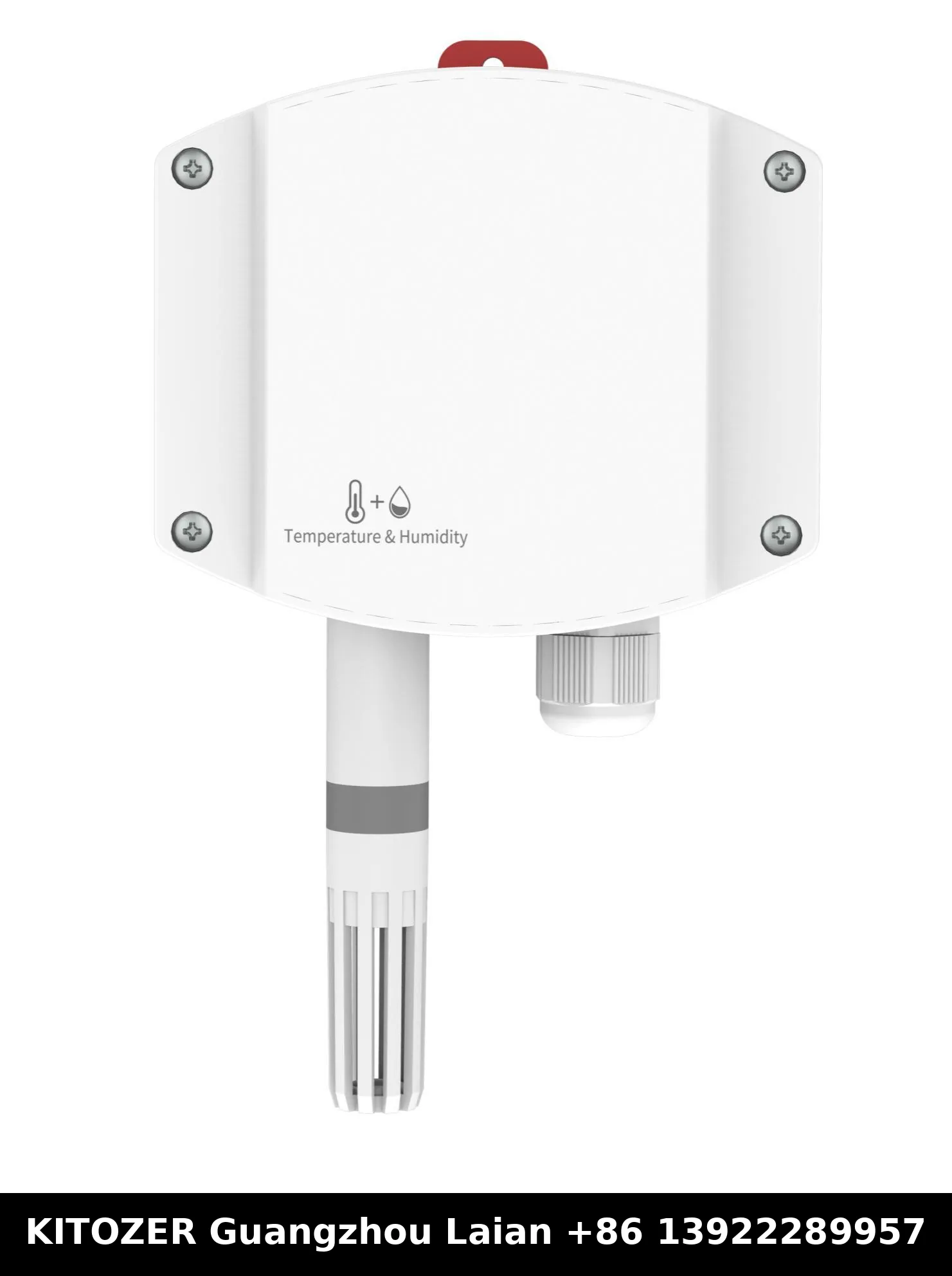
The KITOZER Temperature and Humidity Transmitter is a series of industrial sensing products developed by Guangzhou Laian Intelligent System Development Co., Ltd. for environmental monitoring applications. Built around a high-precision combined temperature and humidity sensing element, paired with an industrial microprocessor, signal conditioning circuitry, and standardized communication interfaces, the transmitter converts physical temperature and relative humidity values of ambient air into electrical or digital signals that control systems can directly acquire. KITOZER transmitters are widely deployed in data centers, telecommunications base stations, industrial plants, agricultural greenhouses, pharmaceutical warehouses, museum storage, underground utility corridors, clean rooms, and other facilities requiring continuous environmental monitoring. As the front-end sensing node of an environmental monitoring system, it plays the critical role of translating physical world changes into data that the digital world can process, forming an indispensable foundation of every remote environment monitoring, smart building, smart agriculture, and industrial internet-of-things system.
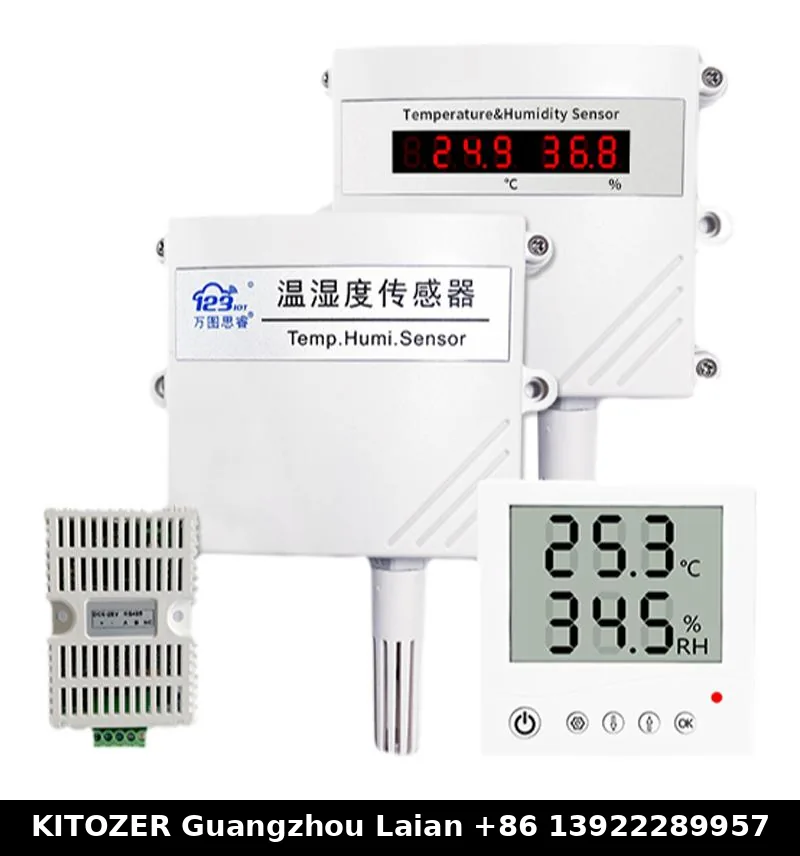
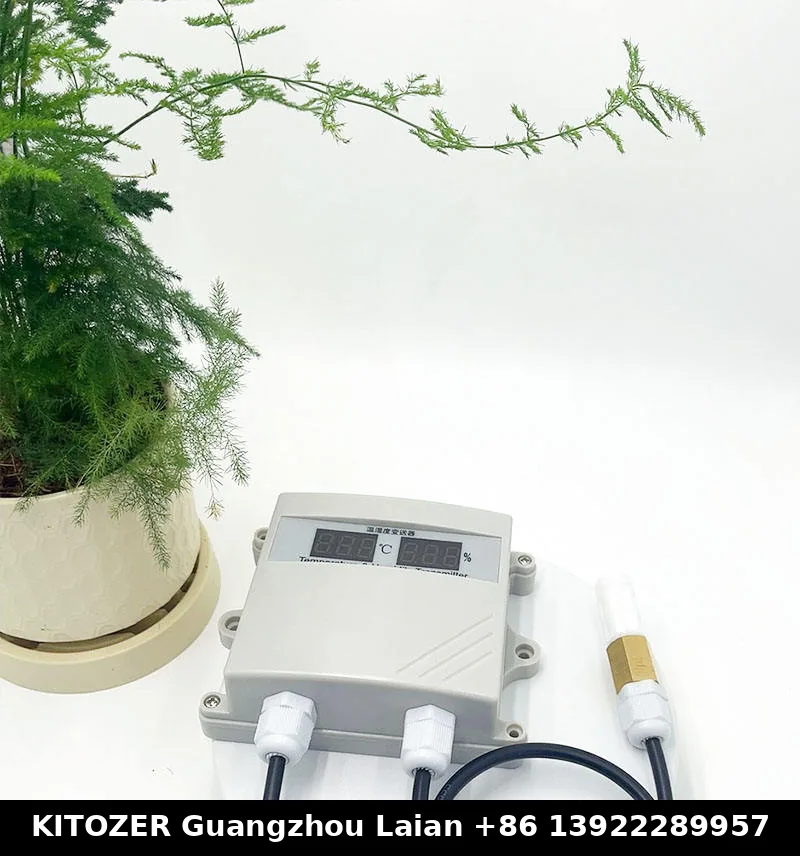
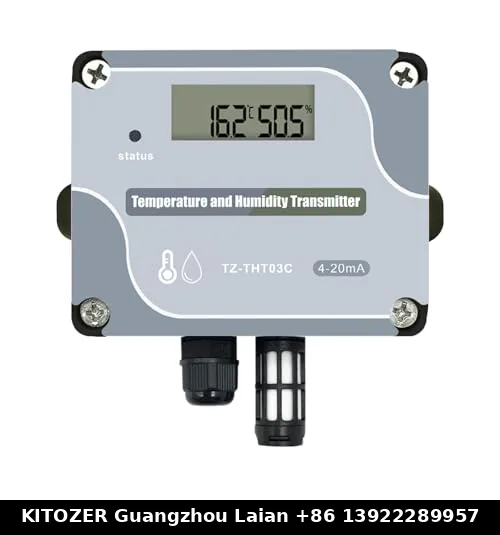
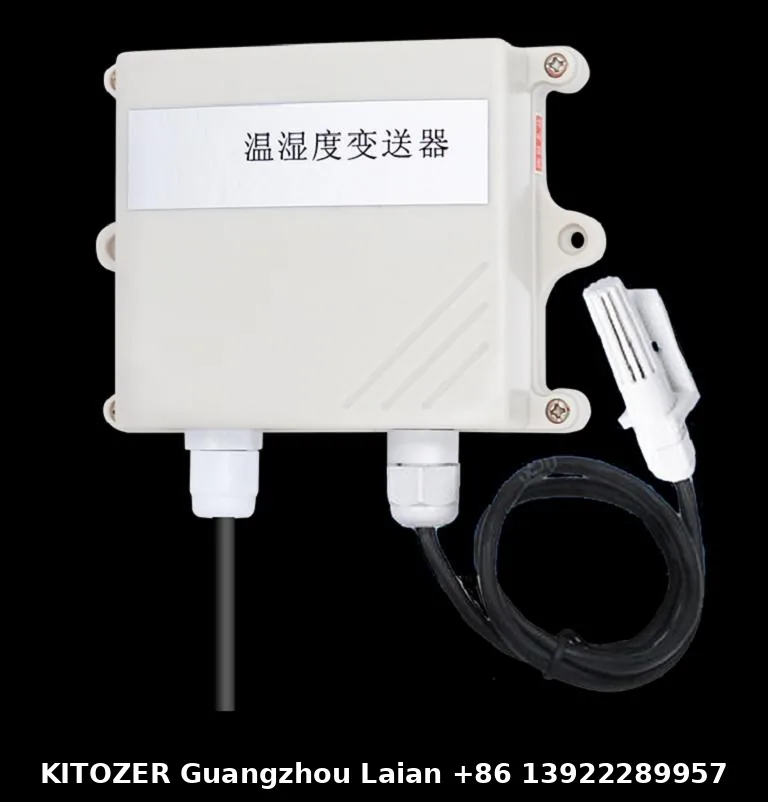
In terms of form factor, the KITOZER transmitter range covers wall-mount integrated units, wall-mount units with local display, duct-mount probes, remote-probe split models, and insertion-style duct probes. Users can flexibly select the appropriate model based on installation space, measured medium temperature range, local readout requirements, and remote cable needs. For output signals, the product family simultaneously offers RS485 Modbus RTU bus, 4-20mA current loop, 0-5V/0-10V voltage output, and relay contact output, enabling direct integration with PLC, DDC, environment monitoring hosts, IoT gateways, SCADA software, and third-party systems. This multi-form, multi-interface matrix allows the KITOZER transmitter to address applications ranging from single-point monitoring in small equipment rooms to distributed networking across complex industrial sites, avoiding the spare-parts and maintenance complexity that comes with mixing multiple sensor brands across different projects.
KITOZER transmitters are designed for continuous long-term operation in industrial environments. The enclosure is made of flame-retardant engineering plastic or ABS+PC alloy; wall-mount models achieve IP65 protection, resisting dust and water splashes in dusty, humid workshops and warehouses. The sensing probe is fitted with a PE polymer breathable filter and nylon outer mesh, ensuring smooth gas exchange while blocking dust, fibers, and water droplets from directly impacting the sensitive element. Circuit boards are conformally coated to resist moisture, mold, and salt spray, making the units suitable for southern rainy seasons, coastal high-salt atmospheres, and high-humidity storage environments. The internal power module supports wide-voltage input, reverse-polarity protection, over-voltage protection, and surge absorption, withstanding common field voltage fluctuations and electromagnetic spikes without failure.
In terms of measurement performance, standard KITOZER models cover a temperature range of -40C to +80C and relative humidity of 0% to 100% RH (non-condensing). Typical temperature accuracy reaches +/-0.3C, and humidity accuracy reaches +/-2% RH within 20-80% RH. High-precision models use capacitive humidity elements with temperature compensation to maintain linear output across the full range. After power-up, the unit completes self-test within 30 seconds and enters stable measurement, with response time under 15 seconds under typical airflow. Digital filtering algorithms can be adjusted by the user based on field interference intensity, balancing fast response to real environmental changes with immunity to electromagnetic-induced false readings.
A KITOZER transmitter is not merely a single-point meter but a front-end sensing node of a complete environmental monitoring system. By distributing multiple transmitters along data center cold aisles, hot aisles, shelf levels, greenhouse cultivation zones, and pipeline nodes, the monitoring center can draw a complete temperature-humidity heat map, providing data for precision air conditioning scheduling, fresh air system start-stop, dehumidification/humidification linkage, and fire early warning. When a zone overheats or humidity drops, the system automatically generates alarm events, notifies duty personnel via sound/light, SMS, email, or voice call, and links related equipment for intervention. This closed loop from sensing to decision to execution is why KITOZER is recognized in remote environment monitoring, smart buildings, and smart agriculture.
Every KITOZER transmitter is calibrated at multiple points in a standard temperature-humidity chamber before shipment and accompanied by calibration records. Users can contact the technical support team by phone, WeChat, or WhatsApp for selection, installation, commissioning, and after-sales service. The company also provides one-stop service from sensors, acquisition hosts, monitoring software to engineering implementation, and can develop custom ranges, protocols, or enclosures for specific user needs.
Working Principle
The working principle of a KITOZER transmitter can be divided into three layers: sensing, signal conditioning, and output/communication. Understanding these layers helps engineers with correct selection, wiring, and troubleshooting.
Temperature Sensing
Temperature is measured using a PT100 platinum resistance or NTC thermistor. The PT100 reads 100 ohms at 0C and increases approximately linearly with temperature at 0.3851 ohms/C. NTC has a negative temperature coefficient. KITOZER wall-mount integrated models commonly use NTC for moderate cost and fast response; duct-insert and high-temperature models use PT100 for higher accuracy and long-term stability. The sensitive element is encapsulated in a metal probe or breathable filter and thermally coupled to the measured air. To eliminate lead-wire resistance effects, PT100 models use three-wire or four-wire connections.
Humidity Sensing
Humidity is measured using a capacitive polymer thin-film element. Interdigitated electrodes on a ceramic substrate are covered by a humidity-sensitive polymer film. Water molecules adsorb or desorb through the film, changing its dielectric constant and the capacitance between electrodes. The capacitance change is approximately proportional to relative humidity. A dedicated chip converts capacitance to digital or voltage signal and applies temperature compensation. KITOZER-selected imported humidity elements recover well after short-term condensation. Note that humidity elements are sensitive to chemical vapors, alcohol, and oil mist; in corrosive-gas or solvent environments, an activated-carbon filter or special corrosion-resistant model is required.
Signal Conditioning and ADC
Raw signals from the temperature resistance and humidity capacitor are very weak and require instrumentation amplifiers, filtering, and precision references. KITOZER uses a 24-bit Sigma-Delta ADC to sample analog signals into digital values, which the microprocessor then linearizes, temperature-compensates, and filters. Software combines moving-average and median filtering to suppress electromagnetic noise while preserving real response. Users can adjust filtering strength, reporting interval, and address via configuration software. Calibration parameters are stored in non-volatile memory and survive power cycles.
Output and Communication
Digital models communicate via RS485 using Modbus RTU. The master sends a read request by slave address, and the transmitter returns temperature and humidity registers. The bus supports up to 32 nodes without repeaters, using shielded twisted pair, with a maximum distance of 1200 meters. Analog models map processed values to 4-20mA current or 0-5V/0-10V voltage. 4mA corresponds to the range lower limit and 20mA to the upper limit; current loops are immune to interference in environments with inverters and welders. Relay models include two relay contacts for local sound/light alarm or air conditioning/humidifier linkage. Wireless models upload data encrypted to cloud platforms via built-in cellular or LoRa modules without on-site wiring.
Power and Power Management
Standard supply is DC 12-24V wide-range, with some models supporting AC 24V. Operating current is about 30mA for RS485 and loop-powered for 4-20mA. Low-power 4G/NB-IoT models run on batteries with microampere-level sleep current for remote or mobile sites. Reverse-polarity and over-voltage protection prevent damage from field wiring errors. The power input includes TVS transient suppressors and common-mode chokes for surge and ripple immunity. Wireless models draw up to 200mA during transmission, so battery capacity and reporting frequency must be balanced.
Error Sources and Compensation
Measurement error comes from three sources: intrinsic sensor error, temperature drift, and installation error. Intrinsic error is minimized through per-unit multi-point calibration. Temperature drift is compensated by an internal temperature sensor. Installation error depends on user practice, such as mounting near heat sources, blocked probes, or parallel runs with power cables. KITOZER documentation details each error source and prevention measure to help users avoid common issues during design.
Technical Specifications
The table below lists typical specifications for mainstream KITOZER transmitter models. Refer to the factory datasheet and contract technical agreement for final ordering.
| Parameter | Wall Integrated | Wall w/ Display | Duct Insert | Remote Probe |
|---|---|---|---|---|
| Temperature Range | -40C to +80C | -40C to +80C | -40C to +120C | -40C to +80C |
| Temperature Accuracy | +/-0.5C | +/-0.3C | +/-0.2C PT100 | +/-0.3C |
| Humidity Range | 0-100% RH | 0-100% RH | 0-100% RH | 0-100% RH |
| Humidity Accuracy | +/-3% RH | +/-2% RH | +/-2% RH | +/-2% RH |
| Output | RS485/4-20mA | RS485/4-20mA/0-10V | RS485/4-20mA | RS485/4-20mA |
| Supply | DC 12-24V | DC 12-24V | DC 24V | DC 12-24V |
| Current | less than 30mA | less than 50mA | less than 40mA | less than 30mA |
| Display | None | LCD dual line | None | Host optional |
| Protection | IP65 | IP65 | IP65 probe IP67 | Host IP65 |
| Probe Cable | Integrated | Integrated | Thread insert | 1m standard up to 20m |
| Mounting | Wall | Wall | Duct flange/thread | Host wall + probe lead |
| Enclosure | ABS+PC flame retardant | ABS+PC flame retardant | Aluminum + plastic | ABS+PC flame retardant |
| Protocol | Modbus RTU | Modbus RTU | Modbus RTU | Modbus RTU |
| Response Time | less than 15s | less than 15s | less than 30s duct | less than 20s |
Beyond mainstream models, KITOZER offers intrinsically safe explosion-proof models (Ex ia IIB T4 Ga) for chemical plants and oil/gas stations; high-temperature models (-40C to +200C) for drying ovens; low-dew-point models (down to -60C dew point) for lithium battery drying rooms and chip cleanrooms; outdoor models with sun/rain shields for weather stations and rooftop PV sites; wireless IoT models (4G/NB-IoT/LoRa) for remote sites; and duct probes with lengths from 200 to 1000 mm for HVAC and clean-air systems. For electrical parameters, the RS485 interface is isolated to 1500VAC, the 4-20mA loop supports up to 500 ohm load at 24V, and relay contacts switch 5A/250VAC. The design MTBF exceeds 50,000 hours.
Selection Guide
Correct selection is the prerequisite for long-term reliable operation. Based on field experience, KITOZER recommends the following decision path.
Step 1: Confirm Medium and Range
Most KITOZER transmitters measure air relative humidity. For duct air, oven hot air, or clean-room circulation, choose a duct-insert model with a suitable probe length based on duct wall thickness. For room air in equipment rooms, warehouses, and offices, the wall-integrated model suffices. The temperature range should cover field extremes with 10-20% margin. Drying ovens require PT100 high-temperature models; do not extend a standard wall probe into a hot duct. For drying rooms concerned only with low humidity, a custom-offset range can be requested.
Step 2: Determine Output Signal
Output choice is driven by the back-end acquisition device. For PLC, DDC, or remote environment hosts with long distances and many nodes, prefer RS485 Modbus RTU: one bus carries many transmitters with low wiring cost and easy fault localization. For analog acquisition modules with single-point measurement, 4-20mA is the most robust choice. For devices expecting a voltage setpoint, choose 0-10V. For local alarm without a host, choose relay-contact models. For wireless IoT, choose 4G/NB-IoT models that connect directly to the cloud.
Step 3: Decide on Local Display
An LCD simplifies commissioning and inspection, letting maintenance staff read values on site without a laptop. However, displays increase power consumption and shorten life under direct sunlight or high heat. If the mounting position is high and not routinely read, a no-display model lowers cost. For duty rooms or electrical rooms, a display is recommended. Some models offer three-color backlight (green normal, yellow warning, red alarm) for at-a-glance status in unattended corridors.
Step 4: Choose Mounting and Probe Configuration
Wall mounting suits flat walls in equipment rooms, warehouses, and offices. Remote-probe split models suit cases where the host must sit inside a control cabinet while the probe reaches the measured space, such as a host in a power distribution cabinet and a probe routed to the ceiling or duct. Duct-insert models require a hole in the duct wall, fixed by thread or flange. Outdoor units must have sun shields and downward cable entries. Ceiling-mount suction models are available for plenum installation.
Step 5: Evaluate Environmental Conditions
Dusty sites (feed mills, flour mills, wood shops) require PE filter covers and periodic blow-down. High-humidity condensation sites (basements, wash rooms) need condensation-resistant probes. Coastal or chemical plants need corrosion-coated enclosures. Explosive atmospheres require explosion-proof models installed by certified contractors. Unmanned remote sites benefit from 4G/NB-IoT wireless models that skip wiring. High electromagnetic interference environments (substations, inverter rooms) need isolated models or isolated repeaters on the bus.
Step 6: Budget and Quantity Planning
KITOZER transmitters reference price ranges from RMB 200 to 1500 (about USD 28 to 210). No-display wall RS485 models cost about RMB 200-400; display 4-20mA models about RMB 400-700; duct PT100 models about RMB 600-1000; explosion-proof and wireless models about RMB 1000-1500. Volume orders qualify for tiered pricing. Budget 10-15% spare units for later replacement. In large projects, also account for wire, conduit, power supplies, acquisition hosts, and software; sensors typically represent only 15-25% of the total monitoring system budget.
Step 7: Confirm Compliance and Certification
Export projects or foreign-owned facilities may require CE, FCC, or RoHS. Pharmaceutical GSP/GMP projects require metrology approval or calibration capability. Fire-linked projects require fire-electronics compliance. KITOZER can provide corresponding certificates and test reports based on project requirements. Before final order, send the technical agreement and certification requirements to the sales engineer for confirmation.
Installation Requirements
Correct installation directly affects measurement accuracy and equipment life. KITOZER recommends strict adherence to the following.
Mounting Location
The transmitter should represent the average environment of the measured space. Avoid direct positions under air-conditioner outlets, near doors/windows, sunlit walls, or heat sources (radiators, lights, motors). For data centers, mount in the middle of cold or hot aisles at 1.5-2.0 m height, at least 30 cm from cabinets. For warehouses, mount above aisle space between shelves, not against goods. For greenhouses, mount 0.5 m above crop canopy, away from spray heads. For offices, mount in return-air shafts or corridors, not on window walls.
Mechanical Installation
Wall units are fixed with two M4 expansion screws. Confirm wall load capacity to avoid falling under long-term vibration. Cable entries must face down or sideways, never up, to prevent rain or condensate from entering the enclosure. Duct-insert probes must penetrate at least one-third of the duct cross-section, with the sensing portion at the duct center. Seal threaded joints with PTFE tape. Outdoor units require sun shields to prevent solar radiation from heating the enclosure above ambient.
Electrical Wiring
RS485 uses shielded twisted pair of at least 0.5 mm2. Connect A to A and B to B, with GND to signal ground. Place 120 ohm terminating resistors at both bus ends. 4-20mA two-wire units are in series in the loop, powered by the acquisition module at 24V. Route signal wires in separate conduits from 380V power and inverter outputs, at least 20 cm apart. Use waterproof glands on all cable entries. Ground the shield at one end only (typically the host side) to avoid ground loops. Measure supply voltage with a multimeter before power-up.
Power-on Commissioning
After wiring, verify supply voltage and polarity before closing the breaker. For display models, confirm the LCD lights and values look reasonable. For RS485 models, use commissioning software to search the slave address (default 1 or 247, baud 9600). Compare readings against a standard thermometer/hygrometer and offset-calibrate via software if needed. Record address and baud rate on the device label for later maintenance. In multi-unit networks, number addresses sequentially from 1 and label each unit by location.
Common Installation Errors
Frequent field errors include: mounting under an air-conditioner outlet causing low readings; mounting on a sunlit west wall causing high readings; probes blocked by cardboard or insulation; signal wires sharing conduit with power cables; upward cable entries; duplicate RS485 addresses; missing terminating resistors; insufficient power supply; and bare wire terminations without ferrules. KITOZER recommends having an experienced engineer guide the first unit installation to avoid these issues.
Operation and Maintenance
KITOZER transmitters are designed for maintenance-free continuous operation, but regular inspection in industrial environments significantly extends life and preserves accuracy.
Routine Inspection
Visually inspect units quarterly: enclosure integrity, cable condition, display status, probe filter dust. In dusty workshops, shorten the interval to monthly. Blow off surface dust with a soft brush or compressed air at no more than 0.2 MPa; never wash the sensing element with alcohol or water. During inspection, record a reading and compare it with the monitoring platform to catch deviations early.
Periodic Calibration
Annually compare the transmitter against a standard temperature-humidity chamber. Place the unit and a reference sensor together in a sealed chamber at 25C and 60% RH for 2 hours, then read. If deviation exceeds tolerance, perform zero and span calibration via software, or return the unit to the factory. For pharmaceutical and food industries requiring metrology certification, send units to a CNAS-accredited lab and retain calibration certificates for quality-system audits.
Common Faults
Readings stuck at -40C or 125C usually indicate a broken temperature element or loose connection; check the probe cable. Readings stuck at 0% or 100% RH usually indicate a failed humidity element or prolonged condensation; replace the probe. RS485 communication failure: check A/B polarity, baud rate, address, and terminating resistor. 4-20mA stuck at 0 or 20 mA: check supply and loop continuity. Flickering or dead display: check supply voltage and LCD ribbon. Wireless units offline: check antenna, SIM credit, and signal strength.
Replacement and Storage
When replacing a unit, power off first and record wiring positions. After installing the new unit, retest communication and accuracy. Store spares at -10C to +40C and 20-70% RH away from sunlight and corrosive gases. Units stored over one year should be recalibrated before use. Dispose of retired units as electronic waste; the polymer humidity element is general industrial waste and can be handled with normal electronic scrap.
Frequently Asked Questions
A: Digital models standardly support RS485 Modbus RTU and integrate with most PLC, DDC, and environment hosts. Custom models can support Modbus TCP, BACnet, or M-Bus. Wireless models support 4G Cat.1, NB-IoT, and LoRa. For private protocols or specific controller integration, inform the sales engineer before ordering.
A: For a temperature range of -40C to +80C, 4mA corresponds to -40C and 20mA to +80C. Formula: temperature = (current mA – 4) / 16 x range span + lower limit. Humidity follows the same pattern: 4mA = 0% RH, 20mA = 100% RH. If the acquisition module only accepts 0-5V, choose a 0-5V output model or add a current-to-voltage converter.
A: Without repeaters, a standard RS485 bus supports up to 32 nodes. Low-power transceivers can extend to 128 or 256. Beyond 32, add RS485 repeaters or use a hub to split groups. For distances over 1200 m, repeaters are also required. In large data centers, buses are typically grouped by floor or zone and aggregated to a building acquisition host.
A: Standard wall models are not recommended for direct outdoor exposure. For outdoor use, choose the outdoor enclosure with sun/rain shield and downward cable entries. The probe should avoid direct rain and sun. KITOZER can provide custom outdoor shields. In severe cold, consider enclosure heating to prevent internal condensation.
A: Power off, remove the probe, and let it dry naturally in a dry environment for 24-48 hours. Do not use a heat gun or hair dryer, which can damage the polymer film. If readings do not recover after drying, replace the probe. In high-humidity environments, plan annual probe replacement as preventive maintenance. KITOZER sells spare probes for user self-replacement without returning the whole unit.
A: Standard models accept DC 12-24V, compatible with common 24V industrial supplies. Some models support AC 24V. Two-wire 4-20mA models are loop-powered by the acquisition module. Confirm the supply specification when ordering. For remote sites without power, a solar panel plus lithium battery wireless kit can run independently for years.
A: Standard models offer one output only. For combined digital and analog signals, choose the KITOZER multi-output custom model integrating RS485 and two 4-20mA channels (temperature and humidity). This suits cases where both a PLC digital module and a recorder analog module need the data. Custom lead time is typically 5-10 working days.
A: The unit self-tests and starts output within 30 seconds of power-up, but stable readings are recommended after 15 minutes as sensors and circuits reach thermal equilibrium. In cold winter environments, extend warm-up to 30 minutes. For systems that cycle power daily, keeping the unit continuously powered provides best accuracy and longest life.
A: Remote-probe models come with 1 m standard cable and can extend to 20 m. Use shielded twisted pair and ground the shield at one end. Beyond 20 m, use a signal amplifier or mount the host directly. Do not break the probe-head seal when extending, as this affects the protection rating. For longer leads, order a factory-terminated cable.
A: KITOZER offers intrinsically safe models certified to Ex ia IIB T4 Ga for chemical plants, oil/gas stations, and pharmaceutical areas with explosive gases. Explosion-proof units must be used with safety barriers and installed/maintained by certified personnel. The explosion-proof enclosure is aluminum with anti-static coating. Provide the hazardous-area classification drawing when ordering for proper selection.
A: Use a standard Modbus RTU master tool (Modbus Poll, KingView, ForceControl, etc.) with serial port, baud 9600, data bits 8, stop bits 1, no parity. Read holding registers at the start address and count shown in the communication protocol. Temperature is a signed integer in 0.1C; humidity is an unsigned integer in 0.1% RH. The host must parse this format.
A: KITOZER transmitters carry a one-year whole-unit warranty; the humidity probe is a consumable with a six-month warranty. Non-human-caused defects during warranty are repaired or replaced free. Out-of-warranty repair and calibration are available for a fee. Extended warranties of 2 or 3 years are available. KITOZER provides long-term technical support and stocks spare parts for at least 5 years after a model is discontinued.
Application Scenarios
Data Centers
In data centers and telecom base stations, KITOZER transmitters are deployed in cold aisles, hot aisles, beside power distribution cabinets, and in battery rooms. When temperature exceeds 28C or humidity exceeds 60% RH, the remote environment system links precision air conditioners and humidifiers to protect IT equipment. For high-density cabinets, micro transmitters at each cabinet inlet monitor rack-level temperature to prevent local hot spots.
Pharmaceutical and Food Storage
GSP/GMP requires continuous temperature-humidity recording in cold and cool drug warehouses. KITOZER units connect to monitoring systems with over-limit sound/light alarms and SMS notifications, storing data for over three years to satisfy regulatory inspections. Vaccine and blood banks require +/-0.5C accuracy; KITOZER high-precision models meet these needs.
Agricultural Greenhouses and Mushroom Houses
Greenhouse crops are sensitive to temperature and humidity. KITOZER units link roller shutters, wet-curtain fans, and grow lights for automatic ventilation, cooling, and dehumidification. Mushroom houses need high humidity; transmitters control humidifiers to maintain 85-95% RH. Livestock houses also monitor ammonia and hydrogen sulfide; KITOZER offers multi-parameter sensor solutions.
Industrial Plants and Clean Rooms
Electronics, printing, and textile workshops require strict temperature and humidity. KITOZER units connect to building automation systems, linking air conditioning and fresh air to hold 22C +/-2C and 55% +/-10% RH, improving yield. SMT workshops need at least 40% RH to prevent ESD damage.
Museums and Archives
Cultural relics and archives are extremely sensitive to temperature and humidity. KITOZER high-precision units in storage and exhibition rooms link constant-humidity air conditioning to hold 20C +/-2C and 55% +/-5% RH, slowing deterioration. Paper archives require annual humidity variation under 5% RH; KITOZER long-term stability meets this.
Underground Corridors and Tunnels
Underground spaces are poorly ventilated, humid, and prone to condensation that corrodes equipment. KITOZER condensation-resistant units are distributed along corridors, linking drainage pumps and dehumidifiers to protect cables and monitoring equipment. Cable trenches and electrical rooms especially need combined water-leak and temperature-humidity monitoring; KITOZER provides integrated solutions.
Energy Storage and PV Stations
Lithium battery storage cabins require uniform temperature; uneven temperatures accelerate degradation. KITOZER units are deployed between battery clusters and at cabin returns, linking liquid cooling and air conditioning to hold 25C +/-3C. PV inverter rooms also monitor humidity to prevent insulation degradation.
Parking Garages and Building Automation
Underground parking garages condense easily, affecting vehicles and equipment. KITOZER units link exhaust fans and dehumidifiers to keep humidity below 70% RH. In smart buildings, temperature and humidity feed the BACnet system to optimize air conditioning and fresh air for energy savings.
System Integration and Networking
KITOZER temperature and humidity transmitters are rarely used alone in practice; they typically work with acquisition hosts, monitoring software, and alarm equipment to form a complete environmental monitoring system. This section describes common networking schemes for system integrators and end users.
RS485 Bus Networking
For small and medium equipment rooms or buildings, the most common scheme is to daisy-chain dozens of KITOZER transmitters onto one RS485 bus, which ends at a remote environment monitoring host or an RS485-to-Ethernet gateway. The gateway converts Modbus RTU to Modbus TCP or MQTT and uploads data to the central platform. This scheme offers simple wiring, low cost, and high reliability. A bus should not exceed 1200 m or 32 nodes without a repeater. When nodes exceed 32, split into multiple buses aggregated through a gateway. Use shielded twisted pair, grounded at the host side only, and keep the bus away from high-voltage trays with at least 20 cm separation from 380V power cables.
Analog Centralized Acquisition
For sites already equipped with PLC or DDC controllers, the 4-20mA output of KITOZER units connects directly to analog acquisition modules. Each transmitter occupies two AI channels (one for temperature, one for humidity). This scheme integrates seamlessly with existing control systems without additional monitoring software. The downside is higher wiring cost: each transmitter needs an independent run, and analog signals are prone to interference over long distances. Prefer analog acquisition only within 200 m of the module; beyond that, RS485 is preferred.
Wireless IoT Networking
For sites without wiring infrastructure, such as leased warehouses, historic buildings, or outdoor sites, KITOZER wireless units use 4G Cat.1 or NB-IoT to connect directly to the cloud. Each device reports independently without a gateway. Users view data, set thresholds, and receive push notifications via a mobile app or web portal. Benefits include zero wiring, fast deployment, and annual data-plan billing. The trade-off is slightly higher data latency (typically 1-5 minute reporting) and ongoing IoT card fees. For real-time alarm needs, configure event-triggered reporting that sends immediately when temperature or humidity crosses a threshold.
Multi-Sensor Fusion
In complex scenarios such as data centers and energy storage stations, temperature and humidity alone are insufficient; water leak, smoke, access, and current/voltage must also be monitored. KITOZER offers integrated acquisition hosts that combine temperature/humidity transmitters with water leak sensors, smoke detectors, infrared beams, and current transformers onto a single platform for unified monitoring and alarms. This approach is widely used in data center remote environment projects, where users manage all environmental and power parameters through one software suite.
Technology Trends
After decades of development, temperature and humidity sensing has evolved from glass mercury thermometers and hair hygrometers to today’s capacitive digital sensing. Several trends are worth watching.
Higher Precision and Miniaturization
Advances in MEMS processing continue to shrink sensing elements while improving accuracy. New-generation sensors maintain +/-0.1C temperature accuracy and +/-1.5% RH humidity accuracy across -40C to +125C in a package the size of a postage stamp. This enables KITOZER to produce smaller enclosures for tight spaces such as inside cabinets, duct walls, and equipment gaps.
Low Power and Energy Harvesting
IoT applications demand ultra-long battery life. New transmitters use energy harvesting from temperature differentials, photovoltaics, or vibration to achieve maintenance-free operation. While harvested power is still limited, combined with low-power designs (microampere sleep current), it already supports low-frequency reporting monitoring needs. KITOZER’s in-development self-powered transmitter targets 10-year maintenance-free life.
Smart Edge Computing
Traditional transmitters only acquire and transmit, with all computation centralized. New units embed more powerful microprocessors that perform local filtering, anomaly detection, and trend prediction, even learning normal patterns from historical data to identify abnormal events. This edge capability reduces bandwidth dependence and speeds alarm response.
Multi-Parameter Fusion
A single temperature/humidity parameter is increasingly insufficient for complex scenarios. KITOZER is developing combined transmitters integrating temperature, humidity, dew point, atmospheric pressure, CO2, VOC, and PM2.5. One device can monitor all key indoor air quality indicators, greatly reducing installation count and wiring cost.
Comparison with Competitors
The market offers many temperature and humidity transmitter brands, making selection difficult. As a domestic brand, KITOZER has closed the gap with international leaders in core performance while offering advantages in price, lead time, and local service. The following comparison is objective.
Accuracy and Stability
KITOZER standard models achieve +/-0.3C and +/-2% RH, comparable to mid-tier international products. High-precision models use imported sensing elements and multi-point calibration to reach +/-0.1C and +/-1.5% RH, matching international high-end units. Long-term stability is specified at under +/-0.5C and +/-2% RH annual drift, on par with international brands.
Communication Compatibility
KITOZER supports RS485 Modbus RTU, 4-20mA, 0-10V, and relay outputs, integrating with most mainstream PLC and environment hosts. For special protocols such as BACnet, Profinet, or EtherNet/IP, KITOZER provides gateway conversion. International brands offer richer native protocol support but at higher prices.
Price and Delivery
KITOZER standard models cost RMB 200-1500, while equivalent international products typically range from RMB 1000 to 5000. KITOZER standard models are in stock and custom units ship in 5-10 working days. International brands usually require 4-8 weeks. For domestic projects, KITOZER has clear advantages in price and delivery.
Service and Support
KITOZER provides Chinese technical documentation, Chinese customer service, and on-site commissioning support. Users reach engineers by phone or WeChat with response typically within 2 hours during business hours. International brands usually require contact through distributors, leading to longer response cycles.
Field Implementation Essentials
This section summarizes lessons learned across hundreds of field projects, listing implementation details that are easily overlooked but affect system reliability.
Bus Topology and Branches
The RS485 bus should use daisy-chain topology, not star wiring. Each branch should not exceed 5 m, and total branches should not exceed three. Star wiring causes signal reflection and unstable communication. If field conditions force branching, use an RS485 hub to bring each branch out independently.
Grounding and Shielding
The shield of shielded twisted pair must be grounded at one end only, typically at the host cabinet protection ground. Grounding at both ends creates a ground loop that introduces 50 Hz interference. Connect signal ground and protection ground through an equipotential bar in the cabinet to avoid potential differences.
Power Capacity Calculation
For centralized power, the supply module rated current should be 1.5 times the total operating current. For example, 20 transmitters at 30 mA each draw 600 mA, so choose a 1A or larger supply. Mount the supply in a well-ventilated location to avoid shortened life from continuous full-load operation.
Lightning and Surge Protection
For outdoor installations or sites near lightning rods, install signal surge protectors on the RS485 bus and power input. The surge protector ground wire should be at least 6 mm2 with ground resistance under 4 ohms. Although KITOZER transmitters include internal TVS protection, external surge protectors are the first line of defense against direct and induced lightning.
Labeling and Documentation
After installation, label each transmitter with its device number, location, RS485 address, and baud rate. Maintain an electronic ledger recording model, purchase date, calibration date, and responsible person. This documentation is invaluable for later maintenance, troubleshooting, and audits.
Environmental Compliance
KITOZER transmitters are designed and manufactured with environmental protection in mind. Products comply with the RoHS directive, free of lead, mercury, cadmium, and other hazardous substances. Packaging uses recyclable pulp and corn-starch cushioning to reduce plastic. After the end of life, users can return units to KITOZER for recycling through professional e-waste channels. For electromagnetic compatibility, KITOZER units pass GB/T 17626 tests for ESD, RF electromagnetic fields, electrical fast transient bursts, and surge, suitable for industrial environments. The enclosure flame rating reaches UL94 V-0 and will not spread fire. These certifications support project acceptance.
Detailed Application Case Studies
Medium Data Center Project
A medium data center of about 800 square meters hosts 60 server cabinets across four cold-aisle zones. The project deployed 24 KITOZER wall-mount display transmitters, one between every two cabinets, on RS485 buses to the remote environment host. The system configured high-temperature alarms at 28C, high-humidity at 60% RH, and low-temperature at 18C. Over one year of operation, it successfully warned of multiple air-conditioner failures, preventing server overheating. Maintenance staff review data remotely monthly and compare readings on site quarterly, with zero equipment failures.
Pharmaceutical Cool Warehouse Project
A pharmaceutical company’s 300-square-meter cool warehouse requires temperature below 20C and humidity 35-75% RH per GSP. The project deployed six KITOZER RS485 transmitters at the corners and center, connected to a monitoring host with sound/light alarm and SMS modem. Data records every 30 minutes and stores locally for three years. During regulatory inspections, historical curves and real-time data fully satisfied requirements. KITOZER units are sent to an accredited lab annually for calibration with issued certificates.
Agricultural Greenhouse Project
An agricultural science park built 10 greenhouses for tomatoes and cucumbers. Each greenhouse needs air temperature/humidity, soil temperature/humidity, and light monitoring. The project deployed 10 KITOZER wall transmitters, one per greenhouse, uploading via 4G to a cloud platform. Farmers view conditions on a mobile app. When temperature exceeds 35C or humidity drops below 50% RH, the system automatically opens wet-curtain fans. This system increased tomato yield by 15% and saved 20% on water and power.
Industrial Cleanroom Project
An electronic component cleanroom of 500 square meters requires 22C +/-2C, 55% +/-10% RH, and particle compliance. The project installed eight KITOZER high-precision transmitters at return air outlets, connecting to the building automation system. The system links air handling units and fresh air systems to adjust supply air conditions. Continuous data show the temperature/humidity compliance rate improved from 85% to 99%, and product yield rose accordingly.
Museum Storage Project
A museum’s painting storage holds hundreds of ancient artworks, requiring 20C +/-2C and 55% +/-5% RH with 24-hour monitoring. The project deployed four KITOZER high-precision transmitters at the corners, connected to a constant-humidity air conditioning control system. Data feeds the museum security platform, linked with fire and access control. KITOZER long-term stability ensures a reliable preservation environment for cultural relics.
Packaging, Shipping, and Storage
KITOZER transmitters are rigorously packed before shipment. Each unit is individually bagged in anti-static material and placed in a carton with foam lining. Cartons are printed with product name, model, quantity, production date, and fragile handling marks. Multiple cartons are packed into corrugated boxes with strapping. Shipments use professional logistics to avoid exposure to sun and rain. On receipt, inspect the outer packaging for damage and photograph any defects before contacting the shipper. Unpack and verify the model, quantity, certificate, and accessories. Spare units should be stored at -10C to +40C and 20-70% RH away from corrosive gases and strong electromagnetic radiation. Power-check stored units every six months, especially wireless models to monitor battery health.
Technical Support and Service System
KITOZER has built a complete technical support and service system covering pre-sales, in-sales, and after-sales. In pre-sales, sales engineers provide selection advice, technical proposals, and quotes based on user needs. The technical team offers site surveys to help determine optimal mounting locations and wiring plans. In-sales, production follows orders with strict quality control, full inspection, and aging testing before shipment. After-sales offers 7×12 phone support. Remote assistance or on-site service is available for complex issues. Non-human-caused defects during warranty are repaired or replaced free. Out-of-warranty repair and calibration are available for a fee. KITOZER also provides training on product principles, installation, commissioning, maintenance, and troubleshooting, either at the user site or in Guangzhou. Long-term partners receive periodic follow-up visits to review equipment operation and collect improvement feedback.
Safety Precautions
To protect personnel and equipment, observe the following when using KITOZER transmitters. Disconnect relevant power before installation or maintenance. Do not open the enclosure in explosive atmospheres (except certified explosion-proof units, and only by qualified personnel). Do not immerse the device in water. Do not touch internal elements with sharp objects. Confirm supply voltage matches the device specification before wiring. Dispose of retired units as electronic waste. For outdoor work, follow high-altitude safety rules and wear harnesses. Near electrical cabinets, follow electrical safety procedures and use insulated tools. KITOZER documentation includes complete safety precautions; read them carefully before use.
Glossary
Relative humidity (RH): the ratio of actual water vapor partial pressure to saturation vapor pressure at the same temperature, expressed as a percentage. Dew point: the temperature at which air becomes saturated and condensation begins at constant pressure. PT100: a platinum resistance temperature sensor reading 100 ohms at 0C. NTC: a negative temperature coefficient thermistor. RS485: a serial physical layer standard supporting multi-drop differential communication. Modbus RTU: an application-layer protocol over RS485. 4-20mA: an analog current standard where 4mA represents zero and 20mA represents full scale. IP65: a protection rating meaning complete dust protection and water-jet resistance. MTBF: mean time between failures. EMC: electromagnetic compatibility.
Selection Checklist Template
To help organize procurement needs, KITOZER provides the following selection checklist. Complete each item and send it to the sales engineer for a quote.
| No. | Item | Fill in |
|---|---|---|
| 1 | Application site | e.g. equipment room / warehouse / greenhouse / plant |
| 2 | Temperature range | e.g. -10C to +40C |
| 3 | Humidity range | e.g. 20% to 80% RH |
| 4 | Required accuracy | e.g. +/-0.5C, +/-3% RH |
| 5 | Output signal | RS485 / 4-20mA / 0-10V / relay / wireless |
| 6 | Display needed | Yes / No |
| 7 | Mounting method | Wall / duct / remote / ceiling |
| 8 | Power supply | DC24V / AC24V / battery / solar |
| 9 | Quantity | units |
| 10 | Special requirements | Explosion-proof / corrosion / waterproof / wireless |
Send the completed checklist to KITOZER sales for a tailored quote and technical proposal.
About the KITOZER Brand
KITOZER is the environmental monitoring and smart IoT brand of Guangzhou Laian Intelligent System Development Co., Ltd. The company has focused on data center remote environment monitoring, smart building environmental sensing, smart agriculture IoT, and industrial environment monitoring. The KITOZER product line covers temperature/humidity sensors, water leak sensors, smoke detectors, access controllers, current/voltage sensors, remote environment hosts, and monitoring software. Located in Panyu District, Guangzhou, the company has a research center, production line, and after-sales team. KITOZER products are sold across China and exported to Southeast Asia, the Middle East, and Europe. The company upholds a philosophy of quality first and service foremost, continuously providing reliable environmental monitoring products and solutions to users.
Deep Dive into Key Specifications
To help engineers understand the meaning and engineering impact of KITOZER transmitter specifications, this section explains each key parameter in detail. Understanding these parameters during design prevents wrong decisions.
Temperature Range vs Accuracy
The temperature range defines the upper and lower limits the transmitter can measure, while accuracy is the maximum deviation between measured and true values. When selecting a range, cover field extremes with 10-20% margin. For a site with summer highs of 35C and winter lows of -10C, choosing -40C to +80C is reasonable. An overly wide range degrades low-end accuracy; an overly narrow range causes overflow alarms in extremes. KITOZER standard models guarantee +/-0.5C across the full range; high-precision models reach +/-0.2C within 20-60C.
Humidity Accuracy and Temperature Compensation
Humidity accuracy is strongly affected by ambient temperature. The same humidity element calibrated at 25C may deviate 2-3% at 0C or 60C. KITOZER transmitters include an internal temperature sensor and compensation algorithm to correct humidity readings across the temperature range. Users in low-temperature environments should check accuracy at that temperature point rather than the 25C nominal. For dew point measurement, both temperature and humidity are needed by the host to calculate dew point.
Response Time Engineering Implications
Response time is the time for the output to reach 90% of its final value after a step change. Wall models typically respond in 15 seconds; duct probes take about 30 seconds due to thermal mass. In rapidly changing environments such as door openings, too fast a response causes frequent alarms, and software filtering can extend it. In applications needing fast response, such as fire-HVAC linkage, choose a fast model.
What Protection Rating Means in Practice
IP65 means dust-tight and water-jet resistant. IP67 means short-term immersion. KITOZER wall models are IP65; probes can reach IP67. In practice, IP65 suffices for equipment rooms and warehouses. In wash rooms or car washes with direct water spray, choose IP67 or higher. Note that protection depends on intact seals; inspect sealing rings periodically.
Electrical Isolation and Noise Immunity
KITOZER RS485 interfaces provide 1500VAC isolation between field and acquisition sides, preventing ground loops and common-mode interference. In inverter rooms and substations, isolation is essential. The 4-20mA output is itself an isolated current loop and outperforms voltage outputs for noise immunity. The power input includes TVS and common-mode chokes to suppress surges.
Cabling Engineering Details
This section gives detailed cabling standards. Wiring quality directly affects long-term system stability and must be followed strictly.
Cable Selection
For RS485 buses, use shielded twisted pair of 0.5-0.75 mm2 with 120 ohm characteristic impedance, such as RVSP 2×0.5 or STP CAT5e. For 4-20mA loops, use two-core shielded cable of at least 0.75 mm2. For power, use RVV 2×1.0 or 2×1.5. Choose flame-retardant cables (ZR-RVSP) to meet fire codes. For outdoor runs, use galvanized steel or PVC flame-retardant conduit with inner diameter at least twice the cable cross-section.
Wiring Craft
Thread cables through conduits using a pull tape; do not force them. Keep cable bending radius at least six times the outer diameter. Crimp cold-press terminals on all ends; never land bare wire on terminal blocks. Ground the shield at the host side only, leaving the field device side floating. Seal fire walls and floor penetrations with firestop mortar. Label both ends of every cable with its purpose and number.
Power Schemes
Centralized power installs a 24V industrial supply in the cabinet, feeding all transmitters over the bus. Size the supply at 1.5 times total current. Distributed power draws local supply near each transmitter. Centralized power is recommended for unified management. For long runs over 100 m, consider voltage drop by raising supply voltage or using thicker wire.
Grounding System
The cabinet protection ground bar should have ground resistance under 4 ohms. Connect signal ground and protection ground at a single point in the cabinet. Outdoor surge grounding shares the protection ground electrode but requires under 1 ohm. Never connect signal shields to lightning rod ground electrodes. A good grounding system is the foundation of stable operation.
Commissioning and Acceptance
After installation, follow a structured commissioning and acceptance process to ensure the system meets design requirements.
Unit Commissioning
Check each transmitter’s supply voltage, display reading, and communication response. Compare readings against a standard thermometer/hygrometer; units within tolerance pass. Record each unit’s address, baud rate, and reading. Replace any unit that fails.
System Integration Test
After all unit tests pass, perform system integration. Verify that all transmitter data refreshes correctly on the monitoring platform. Simulate temperature/humidity over-limit events and check whether alarms trigger, SMS/email sends, and linked devices act. Continuously observe for 72 hours, recording data stability and any anomalies.
Acceptance Documentation
Acceptance should deliver: as-built drawings (equipment layout, wiring diagrams), equipment list and certificates, calibration records, commissioning reports, and operation/maintenance manuals. These documents are essential for later operations and must be fully archived.
Maintenance Schedule Template
To help users build a formal maintenance program, KITOZER offers the following schedule template. Adjust intervals based on site conditions.
| Interval | Maintenance Task | Responsible |
|---|---|---|
| Monthly | Visual check of enclosure, cable, display; remote data review | Duty staff |
| Quarterly | Blow probe filter; tighten terminals; compare readings | Maintenance engineer |
| Every 6 months | Check seals and glands; test alarm; back up data | Maintenance engineer |
| Annually | Field calibration with standard chamber; replace humidity probe in high-humidity sites; issue calibration record | Metrology engineer |
| Every 3 years | Inspect power modules and relay contacts; assess aging | Technical lead |
Adjust the schedule based on environment severity. Dusty, humid, or extreme-temperature sites need shorter intervals; clean and stable equipment rooms can extend. KITOZER can customize maintenance plans and inspection forms to fit the user’s management system.
Deep Answers to Common Questions
Beyond the FAQ, this section addresses complex questions frequently raised in projects.
Why Control Data Center Temperature and Humidity in Specific Ranges?
IT equipment is sensitive. Temperature above 27C shortens chip life and may trigger thermal protection. Too low temperature can freeze hard disk grease and disrupt LCD displays. High humidity oxidizes contacts and causes condensation short circuits. Low humidity generates static electricity that can damage chips. Thus data centers typically target 22C +/-2C and 40-60% RH. KITOZER transmitters are designed for this monitoring need.
How Do Transmitters Link with Air Conditioning?
Common linkage logic: when temperature rises above the upper setpoint, start precision air conditioning cooling; when below the lower setpoint, start heating or stop. When humidity exceeds the upper limit, start dehumidification; below the lower limit, start humidification. Linkage can be implemented in PLC programs or configured in the environment host. KITOZER transmitters provide RS485 data or relay contacts as the input to linkage control.
What if Multiple Transmitters Read Inconsistently?
First confirm whether mounting positions differ. Two units in cold and hot aisles naturally show different values. If two units in the same position disagree, use a standard reference hygrometer as the baseline and calibrate the deviating unit. Replace probes that repeatedly deviate.
What to Do When Wireless Units Have Poor Signal?
4G/NB-IoT units depend on cellular signal strength. In basements or metal cabinets, signal may be weak. Solutions: route the antenna outside the window or above the ceiling using a signal booster antenna; or switch to a LoRa gateway that networks locally and backhauls over wired Ethernet. KITOZER recommends the most suitable wireless scheme after on-site signal testing.
How to Choose an Acquisition Host?
The host choice depends on node count, data storage needs, local display requirements, and third-party platform integration. KITOZER offers hosts from 8 to 128 channels with local touchscreen display, data storage, SMS alarm, and Ethernet/4G upload. Choose based on project scale.
Model Naming Convention
KITOZER uses a unified model naming convention for easy ordering and identification. The structure is: KITOZER-THT-[Structure]-[Output]-[Display]-[Special]. For example, KITOZER-THT-W-RD-D means wall-mount, RS485 output, with display, standard model. See the product selection manual for the full naming convention. When ordering, users only need to provide application and output requirements; the sales engineer confirms the complete model. On the product label, the model, serial number, calibration date, supply specification, and output parameters are printed. Verify the label against the order on receipt. The serial number is the basis for after-sales service; keep it safe. Each unit ships with a certificate, calibration record, and quick installation guide.
Temperature and Humidity Monitoring in Data Centers
Data centers are one of the densest application scenarios for temperature and humidity transmitters. A medium data center may deploy dozens or hundreds of transmitters across cold aisles, hot aisles, power distribution cabinets, battery rooms, gas cylinder rooms, and fresh air shafts. These transmitters form the neural network of environmental perception, providing data for precision air conditioning group control, energy management, and capacity planning. KITOZER has extensive project experience in data center remote environment monitoring and can recommend sensor density and point placement based on room tier, cabinet density, and airflow design.
In traditional cold-aisle containment, typically one transmitter at each end of the cold aisle monitors supply air temperature. In hot-aisle containment, transmitters inside the hot aisle monitor return temperature. For high-density cabinets over 10 kW per rack, micro temperature sensors at cabinet inlets monitor inlet temperature to prevent local hot spots. KITOZER offers wall, embedded, and probe form factors to fit different mounting positions. All sensors connect over RS485 to the environment host, reporting every 30 seconds.
Data centers follow ASHRAE guidelines: recommended temperature 18-27C and humidity 40-60% RH. KITOZER transmitters offer best accuracy in this range with proven long-term stability. When temperature exceeds 27C or humidity exceeds 60% RH, the system issues a warning; above 32C or 70% RH, an emergency alarm triggers and links air conditioning. Tiered alarms allow staff to intervene before problems escalate.
Pharmaceutical Cold Chain and GSP Compliance
Pharmaceutical cold chain is another major application. Under China’s Good Supply Practice (GSP), drug distributors must continuously monitor temperature and humidity in cold stores, cool stores, ambient warehouses, refrigerated trucks, and insulated boxes. The monitoring system must provide real-time monitoring, over-limit alarms, data storage, and data export. KITOZER transmitters are widely used in pharmaceutical cold stores, cool stores, and refrigerated trucks to help companies meet GSP compliance.
Pharmaceutical cold stores typically require 2-8C; cool stores require no more than 20C; ambient warehouses require 0-30C. KITOZER high-precision units deliver +/-0.3C in the 2-8C range, fully satisfying cold store monitoring. The system records data every five minutes and triggers alarms via SMS, phone call, and email. Data stores locally for three years and backs up to the cloud. During regulatory inspections, historical data and alarm records can be exported on demand.
In refrigerated trucks and insulated boxes, KITOZER offers compact temperature and humidity loggers. The logger has a built-in battery for over 30 days, with data exported over USB or Bluetooth. During transport, the logger continuously monitors cargo compartment temperature and records events when over-limit. On arrival, the receiver scans a QR code to view the full journey temperature curve, verifying whether the product remained within the cold chain. This system is widely used for vaccines, biologics, and insulin transport.
Smart Agriculture Applications
Modern agriculture is shifting from experience-based to data-based cultivation. Temperature and humidity are the most important environmental factors determining crop growth. KITOZER transmitters are widely used in greenhouses, livestock houses, mushroom rooms, and aquaculture. By continuously monitoring air and soil conditions and linking automatic control equipment, farmers create optimal growth environments that improve yield and quality.
In greenhouses, KITOZER units sample every 10 seconds and upload to the cloud. Based on crop variety and growth stage, the system automatically controls roller shutters, wet-curtain fans, roof vents, grow lights, and drip irrigation. For example, tomatoes require 25-28C daytime, 15-18C night, and 60-70% RH. When temperature exceeds 30C, the system opens wet-curtain fans; when humidity drops below 50%, it starts misting. This automated control is more precise than manual management and saves over 30% labor.
In livestock houses, temperature and humidity monitoring combines with ammonia and hydrogen sulfide sensing. KITOZER multi-parameter transmitters monitor temperature, humidity, CO2, and NH3 simultaneously for comfortable livestock environments. Chicken house temperature requirements vary by age: chicks need 32-35C, adults drop to 20-25C. Excess humidity triggers coccidiosis; low humidity causes dust. Fine control allows 20% higher stocking density and 5% better feed conversion.
Industrial Process Monitoring
In industrial production, temperature and humidity often directly affect product quality. Printing requires 23C +/-2C and 55% +/-5% RH, or paper expands and contracts causing misregistration. Textile mills need about 65% RH to prevent static-induced yarn breakage. Electronics SMT workshops require 40-60% RH to prevent ESD chip damage. Tobacco, food, and chemical industries all have strict environmental requirements.
KITOZER transmitters in these workshops are deployed at return air outlets, operator stations, and key equipment, connecting to building automation or workshop environment monitoring. The system links air conditioning and fresh air units to hold conditions within process specifications. Through long-term data accumulation, companies can correlate environment parameters with product yield and continuously optimize processes.
For high-temperature equipment such as drying ovens and injection molding machines, KITOZER offers PT100 high-temperature models up to 200C. For cold storage and freezers, low-temperature models go down to -40C. These special models cover extreme temperature needs across industrial sites.
Museum and Archive Preservation
Cultural heritage preservation has extremely strict environmental requirements. Paper artifacts, textiles, and paintings are sensitive to temperature and humidity fluctuations. High temperature accelerates paper acidification; high humidity grows mold; low humidity causes embrittlement. The International Council of Museums recommends painting storage at 20C +/-2C and 55% +/-5% RH, with daily variation under 2C and 5% RH. KITOZER high-precision transmitters in storage rooms and exhibition halls link constant-humidity air conditioning to provide stable preservation environments.
Beyond temperature and humidity, museums also monitor light, ultraviolet, formaldehyde, and VOC. KITOZER offers multi-parameter monitoring solutions covering all key preservation indicators in one system. Data feeds the museum security platform, linked with fire and access control. Any environmental anomaly immediately notifies conservation staff.
Calibration and Metrology
Calibration is essential to ensure accurate readings. For industries with metrology certification requirements, such as pharmaceuticals, food, medical, and defense, transmitters must be periodically sent to accredited labs. KITOZER can assist with calibration services or provide calibration certificates. Calibration is performed at key humidity points (e.g., 30% RH, 60% RH, 80% RH) and temperature points (e.g., 0C, 25C, 50C), comparing transmitter readings against reference instruments. If deviation exceeds tolerance, zero and span can be adjusted via software.
Without a standard lab, users can perform simple on-site comparison. Purchase a calibrated handheld hygrometer as reference, place the transmitter and reference in the same environment for 30 minutes, and read. If deviation is within tolerance, continue use; if large, contact the manufacturer. This simple comparison cannot replace formal calibration but catches obvious failures early. KITOZER recommends quarterly on-site comparison and annual formal calibration.
KITOZER transmitters store calibration parameters internally; users can view calibration date and values via configuration software. The device label also notes the calibration date. Maintain a calibration ledger recording each unit’s calibration time, result, and next due date. This ledger is required for management system audits and product certification.
Lightning and EMC Design
Outdoor or industrial transmitters face lightning and electromagnetic interference risks. KITOZER uses multiple protection measures. The power input includes a resettable fuse and a TVS suppressor across the lines to absorb surge voltage. The RS485 interface uses isolated transceivers with 1500VAC isolation and TVS on A/B lines. The enclosure shield connects to internal circuit ground through an RC network to discharge static. These measures allow KITOZER units to withstand industrial-grade ESD (contact 8kV, air 15kV) and electrical fast transient bursts (2kV).
In practice, external lightning protection is still necessary. Outdoor transmitters should have signal and power surge protectors installed on their lines. The surge protector ground should be under 4 ohms. Building-mounted units should connect to the building lightning protection network. Although the device has internal protection, external surge protection is the first line of defense against direct lightning and cannot be omitted. KITOZER supplies compatible signal and power surge protectors.
Common Error Codes and Handling
Display models show error codes on the screen during faults. Common codes and remedies: E01 indicates an open temperature sensor circuit; check the temperature element wiring. E02 indicates a shorted temperature sensor; check the element. E03 indicates a humidity sensor failure; replace the humidity probe. E04 indicates internal memory error; contact the factory. E05 indicates communication failure; check wiring and parameters. E06 indicates abnormal supply voltage; check power. For unrecognized codes, take a photo and contact technical support.
On no-display models, faults manifest through communication issues: no data, stuck values, or violent fluctuations. Use substitution for fast troubleshooting: replace the field unit with a known-good one. If the system recovers, the original unit is faulty; if not, check the wiring and acquisition host. This method is effective for rapid on-site diagnosis.
Large Project Management
In large projects, hundreds of transmitters may require procurement, installation, commissioning, and maintenance. KITOZER recommends establishing a complete equipment ledger at project start. Assign a unique number to each unit, recording mounting location, communication address, wiring method, and commissioning date. During commissioning, test and record each unit by number. During maintenance, trace history by number. This standardized management dramatically improves later maintenance efficiency.
KITOZER can provide custom labels and dedicated packaging for volume orders. Labels print the device number, QR code, and mounting location description. Scanning the QR code opens technical documentation and maintenance history for that unit. This digital management suits large data centers, chain warehouses, and agricultural parks with multiple sites.
Why Choose KITOZER
The market offers temperature and humidity transmitter brands at prices from tens to thousands of dollars. KITOZER positions in the industrial mid-range, offering near international-brand performance at reasonable prices. Our strengths: first, core sensors use imported components to ensure accuracy and stability; second, industrial-grade circuit design for harsh environments; third, a complete product line meeting multiple needs under one brand; fourth, localized technical support with fast response; fifth, reasonable pricing and lead times.
KITOZER does not pursue the lowest price but rather reasonable value. In environmental monitoring, reliability matters more than price. A single missed or false alarm can cause losses far exceeding the sensor cost. Choosing KITOZER means choosing long-term reliable environmental monitoring.
Data Analysis and Utilization
Collecting temperature and humidity data is only the first step; deriving value from data is the key. KITOZER’s companion monitoring platform offers rich analysis. Trend curves show changes over the last 24 hours, 7 days, 30 days, or a year. Through long-term accumulation, users discover periodic patterns such as weekday vs weekend differences, summer vs winter differences, and air conditioning cycling effects. These insights guide air conditioning optimization, energy savings, and predictive maintenance.
In data centers, temperature-humidity heat maps reveal uneven cooling between cabinets, allowing adjustment of air supply direction and volume. In pharmaceutical warehouses, over-limit event frequency evaluates whether the air conditioning system needs service. In greenhouses, correlating temperature/humidity with yield reveals optimal growth parameters. Data-driven decisions are more scientific and precise than experience-based management.
The KITOZER cloud platform supports exporting data in standard formats for use in the user’s own BI system. The API integrates data into enterprise management platforms. For users with big data capabilities, KITOZER provides raw data interfaces supporting custom algorithm models. This open architecture ensures user data ownership.
Integration with Building Automation
In smart buildings, temperature and humidity transmitters are typically front-end sensors for the Building Automation System (BAS). KITOZER supports standard Modbus and integrates with mainstream building controllers. For BACnet projects, an RS485-to-BACnet gateway provides conversion. Point list includes: temperature measured value, humidity measured value, device status, and communication status. After configuring the point list in the BA system, staff can monitor all temperature/humidity data in the central control room.
The BA system uses temperature/humidity data to link air handling units, fresh air units, and fan coils. For example: when return air temperature exceeds setpoint, open the chilled water valve; when humidity exceeds setpoint, start the dehumidification coil. This closed-loop control keeps building environments comfortable. The accuracy and response time of KITOZER transmitters directly affect BA control quality. Choosing reliable sensors is a prerequisite for stable BA operation.
Explosion Protection and Safety Barriers
In explosive atmospheres such as petrochemical, chemical, and oil/gas facilities, explosion-proof transmitters are mandatory. KITOZER explosion-proof models are intrinsically safe (Ex ia), meaning the energy generated under normal and fault conditions cannot ignite explosive gas. Explosion-proof units must be paired with safety barriers. The barrier, installed in the safe area, limits energy entering the hazardous area. KITOZER supplies compatible Zener or isolated safety barriers.
Selection and installation of explosion-proof units must follow national explosion protection standards. Users should provide the hazardous area classification drawing (Zone 1, Zone 2, Zone 20, Zone 21, Zone 22), and a qualified engineer confirms selection. After installation, explosion-proof equipment must not be modified or have components substituted. Maintenance requires power-off and confirmation of no flammable gas on site. KITOZER provides explosion-proof training and technical support.
Quality Assurance System
KITOZER’s production facility maintains a complete quality management system. Components are sampled on incoming inspection; PCB boards undergo AOI optical inspection and ICT testing. After assembly, each transmitter passes functional testing, aging testing, and precision calibration. Aging runs at 40C for 72 hours to eliminate early failures. Precision calibration occurs in a standard temperature-humidity chamber at multiple points, with data recorded. Every unit’s calibration data is traceable.
The company is certified to ISO 9001 quality management. Products comply with CE and RoHS directives. In the domestic market, products meet relevant national standards. KITOZER stands behind every shipped unit; quality defects during warranty are repaired or replaced free. We believe strict quality control is our commitment to users and the foundation of long-term brand development.
Product Roadmap
The KITOZER R&D team is planning next-generation transmitters. Over the next two years, expect the following products. First, NB-IoT low-power transmitters with a 5-year battery life, built-in eSIM, and plug-and-play operation. Second, multi-parameter combined transmitters monitoring temperature, humidity, CO2, VOC, PM2.5, and barometric pressure. Third, wired-wireless dual-mode units that normally run on RS485 and automatically switch to 4G upload when the network drops. Fourth, smart transmitters with edge computing and built-in anomaly detection. Fifth, Matter-protocol smart home units that directly connect to mainstream home platforms. These new products will further expand the KITOZER environmental monitoring portfolio.
Why Environmental Monitoring Matters
Temperature and humidity seem like simple physical quantities, yet they play a critical role in nearly every industrial and civilian scenario. In data centers, every 10C rise doubles semiconductor chip failure rates. In pharmaceutical storage, a 2C deviation can invalidate vaccines. In agriculture, poor humidity control triggers disease outbreaks. In museums, large annual environmental fluctuations cause irreversible damage to precious artifacts. The KITOZER temperature and humidity transmitter is the front-end device that secures these environments. While it does not directly produce visible value, its data drives all environmental control decisions and serves as the first line of defense against major losses.
From a macro perspective, the value of monitoring can be measured in risk avoidance. An air conditioning failure causing data center overheating, without early detection, could cause millions in server damage and business interruption. Deploying KITOZER transmitters, the system alarms at the first over-limit event, allowing staff to intervene before escalation. This preventive value is often hundreds of times the sensor cost. Similarly, a pharmaceutical warehouse loss from temperature/humidity non-compliance may cost ten times the entire monitoring system investment. Thus, sensor reliability is a risk management issue, not a cost issue.
Power and Cabling Pitfalls
In engineering practice, power and wiring issues account for a large proportion of transmitter failures. This section lists common pitfalls.
Pitfall one: sharing power with high-power loads. Transmitter supplies should be separate from inverters and welders to avoid voltage fluctuations. Pitfall two: signal wires in the same conduit as power cables. RS485 wires must run separately from 380V power lines, otherwise interference is introduced. Pitfall three: grounding the shield at both ends. This creates a ground loop that actually introduces interference; ground one end only. Pitfall four: insufficient power supply. For centralized power, size the supply at 1.5 times total current. Pitfall five: upward cable entries. They must face down or sideways to prevent water ingress. Pitfall six: missing terminating resistors. Long buses need 120 ohm resistors at both ends. Pitfall seven: duplicate device addresses. Each address must be unique. Pitfall eight: bare-wire terminations. Always crimp cold-press terminals to prevent loosening.
Avoiding these pitfalls requires no deep technology, only careful construction. KITOZER provides wiring guides at project delivery and technical briefing for contractors. Good wiring habits are the foundation of long-term stable operation.
Energy Storage and Power Applications
With rapid growth in new energy, energy storage stations have increased dramatically. Lithium batteries are extremely temperature sensitive; uneven temperatures cause inconsistent degradation and shorten pack life. KITOZER transmitters in storage battery cabins are deployed between each cluster, at cabin return air, and at air conditioning supply outlets to monitor temperature distribution. The system links liquid cooling or air conditioning to hold cabin temperature at 25C +/-3C with rack-to-rack difference under 5C. Humidity is also monitored to prevent insulation degradation. KITOZER units work with the battery management system (BMS) to ensure station safety.
Storage stations are typically unmanned, with environmental data uploaded over 4G to the cloud. When temperature rises abnormally, the system immediately pushes an alarm to maintenance staff and links the fire system. KITOZER wireless units require no wiring and install quickly, suiting rapidly deployed storage projects. In outdoor container storage cabins, units must handle large day-night temperature swings and solar radiation; KITOZER outdoor enclosures adapt to these conditions.
In the power industry, substations, switch stations, and distribution rooms need temperature/humidity monitoring to prevent condensation that reduces insulation. KITOZER units in outdoor switch stations, underground distribution rooms, and cable trenches link dehumidifiers or heater strips when humidity exceeds 70% RH. Abnormal temperature rise may indicate overload or loose contacts, triggering alarms. In smart substations, KITOZER units integrate into the integrated automation system as auxiliary environmental monitoring.
Converter stations, storage stations, and PV inverter rooms also need monitoring. High PV inverter room temperatures reduce conversion efficiency; KITOZER units link exhaust systems. Converter valve halls require strict cleanliness and temperature; KITOZER high-precision units provide reliable data. In power projects, equipment must meet power industry standards; KITOZER can provide corresponding test reports.
Underground Corridors and Parking
Urban underground utility corridors carry power, communications, water, and gas pipelines. The corridors are poorly ventilated and humid, requiring continuous temperature/humidity and water leak monitoring. KITOZER units are distributed along corridors every 50-100 m, connecting to the corridor monitoring center. When humidity exceeds 80% RH, the system links drainage pumps and dehumidifiers. Abnormal temperature triggers ventilation. These readings protect in-corridor cables and equipment.
Underground parking garages condense easily, affecting vehicles and equipment. KITOZER units link exhaust fans and dehumidifiers to hold humidity below 70% RH. In smart buildings, temperature/humidity data feeds the BACnet system to optimize air conditioning and fresh air for energy savings.
Cleanrooms and Precision Manufacturing
Chip manufacturing, optical instruments, and precision bearings require extremely strict temperature, humidity, and cleanliness. KITOZER high-precision units in cleanrooms are deployed at return air outlets and key equipment, monitoring the environment. Cleanroom temperature is held at 22C +/-1C and humidity at 50% +/-5% RH. KITOZER’s +/-0.2C and +/-2% RH precision fully satisfies these precision manufacturing needs. In rooms requiring micro-positive pressure, temperature/humidity data works with differential pressure sensors to maintain a clean environment.
Cold Chain Logistics
Fresh food, vaccines, and biologics must remain cold during transport. KITOZER temperature/humidity loggers continuously monitor truck compartment temperature. The logger integrates GPS and 4G, uploading location and temperature in real time. Drivers and dispatchers view compartment temperature on a mobile app. When temperature over-ranges, alarms trigger immediately. On arrival, receivers view the full temperature curve to verify product integrity. This system is widely used in cold chain logistics, ensuring food safety and drug efficacy.
Reliability and Service Life
KITOZER transmitters are designed for over 10 years of service life. The design MTBF exceeds 50,000 hours. Consumable parts (humidity probes) should be replaced every 2-3 years. Power modules and relay contacts may age after long use and should be inspected after 5 years. In normal industrial environments, units can run continuously for over 5 years without repair. KITOZER commits to 5-year spare parts supply; even after a model is discontinued, spares remain available for 5 years.
Equipment life depends on the operating environment. High temperature, high humidity, and strong corrosion shorten life. KITOZER recommends tailoring maintenance plans to field conditions and replacing aging parts on time. Regular maintenance significantly extends actual equipment life.
Common Misconceptions
During technical support, we encounter common misconceptions. First, believing higher accuracy is always better. In reality, accuracy should match the application. Equipment rooms need only +/-0.5C; pharmaceutical cold stores require +/-0.2C. Excessive accuracy costs more without practical value. Second, believing one unit represents an entire room. Large spaces have uneven distributions; multiple points are needed. Third, believing digital always beats analog. For short-distance single-point use, 4-20mA analog is simpler and more reliable. Fourth, believing wireless always costs more. For multi-point long-distance projects, wireless saves wiring and lowers total cost. Fifth, believing sensors run forever after installation. Sensors need periodic calibration and maintenance; otherwise data drifts.
Clarifying these misconceptions helps users select and use KITOZER products more rationally. We encourage users to communicate fully with the technical team during selection, clarifying actual needs to avoid over- or under-specification.
Documentation and Resources
KITOZER provides complete technical documentation, including product manuals, communication protocols, installation guides, calibration procedures, and FAQs. These documents are downloadable from the website or available from sales engineers. We also provide video tutorials demonstrating installation, wiring, and configuration. For system integrators, we offer development kits and API documentation for fast integration.
The KITOZER technical team regularly publishes technical articles and application cases, sharing industry knowledge and project experience. Users can follow our WeChat official account and website blog for the latest content. We also welcome user-submitted case studies to share best practices and advance the industry together.
About Guangzhou Laian
Guangzhou Laian Intelligent System Development Co., Ltd. is located at the Chaoshan Park, Zhongrun Industrial Park, No. 5 Huashan Road, Shilou Town, Panyu District, Guangzhou. It is a high-tech enterprise focused on environmental monitoring and smart IoT. Under the KITOZER brand, the company offers temperature/humidity transmitters, water leak sensors, smoke detectors, remote environment hosts, and monitoring software. Products serve data centers, pharmaceuticals, agriculture, industry, museums, and other fields. The company upholds a philosophy of quality and service, continuously creating value for users. We welcome partners from all sectors to visit, exchange ideas, and cooperate.
Contact Technical Support
If you encounter any issues selecting, installing, or using KITOZER transmitters, please contact the technical support team. We offer phone, WeChat, email, and WhatsApp channels. For urgent failures, call the service line to reach the on-duty engineer directly. For complex projects, on-site technical service can be arranged. KITOZER commits to a response within 2 hours during business hours and a solution within 48 hours.
We also welcome user feedback on experience and improvement suggestions. Every piece of feedback enters our product improvement process, helping us build better products. KITOZER is not just a product supplier but your long-term partner in environmental monitoring.
IoT Platform Integration
With the growth of IoT technology, KITOZER transmitters are no longer just local monitoring devices but sensing nodes in smart IoT systems. KITOZER wireless units support MQTT and connect directly to mainstream IoT cloud platforms. Through a mobile app or web portal, users can view real-time data, receive alarms, and export reports from anywhere. Device status is monitored online; offline events trigger alarms immediately. Data is encrypted in transit for information security.
On the IoT platform, users configure geofences, data sharing, and scheduled reports for each device. For example, an automatic daily temperature/humidity report can be sent at 8 a.m. summarizing the previous day. Devices are grouped by region, floor, or customer. Multiple users collaborate with different permission levels. These capabilities upgrade KITOZER transmitters from single-point meters to intelligent monitoring terminals.
More Application Verticals
Beyond the industries covered above, KITOZER transmitters serve many niche scenarios. In cigar humidors, precise control at 18-20C and 65-70% RH protects cigars during aging. In wine cellars, stable temperature and humidity are essential. In art storage and private collections, KITOZER micro transmitters run silently without affecting the environment. In basement wine cellars, walk-in closets, and art shipping crates, KITOZER has tailored solutions.
In marine and offshore engineering, ship compartments face salt spray and high humidity; KITOZER corrosion-resistant units adapt. In rail transit, subway stations, depots, and tunnels require monitoring. In airports and terminals, departure hall temperature/humidity links air conditioning. In large convention centers, exhibition hall monitoring supports exhibition quality. These niche scenarios may be small in scale but demand the same sensor reliability. KITOZER applies uniform quality standards across all verticals.
PUE and Data Center Efficiency
PUE (Power Usage Effectiveness) is a key metric for data center efficiency. Raising supply air temperature and using free cooling can significantly reduce PUE. But raising temperature must be backed by reliable monitoring. KITOZER transmitters provide precise environmental data that helps operations teams optimize air conditioning while protecting IT equipment. Practice shows raising supply temperature from 22C to 26C saves 10-15% energy. But this requires monitoring every cabinet inlet to avoid local overheating. KITOZER transmitters are the foundation of this monitoring network.
Environmental Responsibility
KITOZER products follow eco-design principles. They are RoHS compliant, free of lead, mercury, and cadmium. Packaging uses recyclable materials. At end of life, users can return units to KITOZER for recycling through professional e-waste partners. Humidity probe polymer is general industrial waste; circuit boards and metal enclosures are recyclable. We encourage users to return old units when replacing equipment for responsible disposal.
Selection Quick Reference
For fast selection, KITOZER summarizes the following quick reference. Match the application directly to a recommended model. For data center remote environment monitoring, choose wall display RS485. For pharmaceutical cool storage, choose high-precision wall RS485. For greenhouses, choose 4G wireless. For ducts and air handlers, choose duct PT100. For chemical plants, choose intrinsically safe. For basements, choose condensation-resistant remote probe. For outdoor sites, choose solar wireless. For cleanrooms, choose high-precision. Confirm the exact model with the sales engineer.
Common Installation Errors Illustrated
Frequent field errors include: mounting under an air-conditioner outlet causing low readings; mounting on a sunlit west wall causing high readings; probes blocked by cardboard or insulation; signal wires sharing conduit with power cables; upward cable entries; duplicate addresses; missing terminating resistors; and insufficient power. KITOZER engineers encounter these repeatedly during field service. We recommend that during the first unit installation, a KITOZER engineer guides the process to ensure correct installation. A good start is the foundation of stable long-term operation.
End-to-End Service
KITOZER provides end-to-end service across the product lifecycle. From pre-sales selection consultation and design, to production delivery and installation guidance, to later maintenance, calibration, and upgrade replacement, we accompany users throughout. We maintain a customer archive recording each unit’s sales and maintenance history. When users need replacement or expansion, we quickly retrieve historical data and offer targeted advice. This long-term service model removes user concerns.
Partnership Opportunities
KITOZER welcomes long-term relationships with system integrators, engineering firms, and design institutes. We offer distributor authorization, technical training, and project support. For projects with special needs, we can co-develop custom products. We believe open cooperation delivers more complete solutions to users. If you are interested in partnership, please contact our business development team.
Final Notes
All technical parameters, prices, and application descriptions in this article are for reference. Final product specifications follow the factory datasheet; prices follow the purchase contract. KITOZER reserves the right to improve products without prior notice. Read the included manual before use. Contact technical support with questions. Thank you for your understanding and cooperation.
Thank You
Thank you for reading this detailed article on KITOZER temperature and humidity transmitters. We hope this document helps you make informed decisions for your environmental monitoring projects. The KITOZER team is ready to provide technical support and products. Please contact us through the channels provided. We look forward to working with you.
Modbus Register Details
KITOZER transmitters default to Modbus RTU. Temperature data is typically held in register 40001 (or 0x0000) and humidity in 40002 (or 0x0001). Temperature is a signed integer in 0.1C; a reading of 256 means 25.6C. Humidity is an unsigned integer in 0.1% RH; a reading of 550 means 55.0% RH. Use Modbus Poll or similar tools to read. Exact register addresses and data formats may vary by model; refer to the communication protocol shipped with the unit.
Default communication parameters: baud 9600, data bits 8, stop bits 1, no parity (9600 8N1). Default slave address is 1, configurable to 1-247 via software. In multi-device networks, number addresses sequentially from 1. Changes take effect after power cycle. KITOZER provides free Windows configuration software connected via a USB-to-RS485 converter to modify address, baud rate, range, and filtering.
Alarm Threshold Configuration
The transmitter itself does not store alarm logic; alarm decisions happen in the monitoring host or cloud platform. Users configure high/low temperature and high/low humidity thresholds for each device. When data crosses a threshold, the platform triggers the alarm. Some transmitter models include two built-in relays with local threshold settings for direct contact output, suitable for simple alarm applications without a host.
Data Storage and Historical Trends
The monitoring platform should store at least one year of historical data and support query by time and device. KITOZER companion software provides data tables, trend curves, and report export. Data can be exported to Excel for quality management use. For pharmaceutical GSP and similar compliance scenarios, data must be retained for at least five years with tamper protection.
Purchasing Notes
When purchasing KITOZER transmitters, note the following. First, confirm model and specifications including range, output, supply, display, and mounting. Second, confirm quantity and lead time. Third, confirm whether calibration certificates are required. Fourth, confirm after-sales terms. Fifth, retain the purchase contract and certificate. Sixth, inspect goods promptly on arrival. Seventh, build a device archive. These steps seem trivial but matter greatly in later maintenance and audits.
Product Series Summary
The KITOZER transmitter family includes wall integrated, wall with display, duct insert, remote probe, intrinsically safe, wireless IoT, outdoor, and high-precision subcategories. Each subcategory forms a complete matrix by output (RS485, 4-20mA, 0-10V, relay, wireless). Users can flexibly select for specific scenarios. KITOZER offers sample trials: purchase samples first to test performance, then order in volume. We believe KITOZER transmitters, with industrial-grade quality, fair pricing, and local service, will be a reliable partner for your environmental monitoring projects.
Final Statement
Thank you for your time reading this detailed technical document on the KITOZER temperature and humidity transmitter. We hope it helps you understand the product, solve problems, and make decisions. The KITOZER team is always ready to serve you. Please contact us with any questions or procurement needs. We look forward to working with you.
Additional Technical Clarifications
Temperature drift refers to zero-point shift caused by ambient temperature changes. KITOZER compensates this to within +/-0.1C. Annual humidity drift is under +/-2% RH in normal environments. Long-term stability is under +/-0.5C and +/-2% RH per year. Load resistance for 4-20mA output is up to 500 ohms at 24V supply. Insulation resistance exceeds 100 megaohms at 500VDC. Common-mode rejection exceeds 120 dB. These parameters together ensure reliable KITOZER performance in complex industrial environments.
Regarding operating environment, KITOZER units work long-term in environments free of corrosive gas, explosive dust, and strong electromagnetic radiation. If the use environment exceeds these conditions, state this when ordering to select special protection models. Outdoor use requires an additional shield. Coastal or chemical plant sites should choose corrosion-coated models.
Product Consultation
If you are interested in KITOZER transmitters or need further technical materials, quotes, or sample testing, contact us through the channels below. Our sales engineer will reply within one business day. For large projects, we can arrange an on-site technical meeting. KITOZER supports both small sample orders and volume supply to meet needs at every stage. We look forward to building a long-term relationship with you and advancing the environmental monitoring industry together.
Disclaimer
This article is for general information. KITOZER reserves the right to improve products without prior notice. Please refer to the latest product manual and quotation. Thank you for your understanding. KITOZER is a registered brand of Guangzhou Laian Intelligent System Development Co., Ltd. All rights reserved.
Humidity Measurement Challenges
Humidity measurement is more complex than temperature because the sensor is prone to contamination, aging, and condensation. KITOZER has accumulated deep experience in humidity measurement. First, the humidity sensing element naturally ages over time. The polymer film gradually loses adsorption capacity after long exposure, causing low readings. Typical humidity element life is 2-3 years, shorter in high humidity. KITOZER recommends replacing the humidity probe every 2-3 years as preventive maintenance. Second, the element is sensitive to chemical vapors. Alcohol, ammonia, and hydrogen sulfide permanently damage the polymer film. In corrosive gas environments, install an activated-carbon filter or choose a special corrosion-resistant model. Third, condensation causes false readings. In prolonged high humidity, a water film may form on the element surface, locking the reading at 100% RH. The probe must then dry, and severe cases require replacement.
KITOZER-selected capacitive humidity elements offer good long-term stability and condensation resistance. In normal industrial environments, annual drift is under 2% RH. Even after short-term condensation, performance recovers after drying. However, in extreme environments, periodic inspection and replacement are still required. Users can purchase KITOZER spare humidity probes and replace them on site without returning the whole unit.
Contact Summary
For all inquiries regarding the KITOZER temperature and humidity transmitter, reach us at phone or WeChat at +86 13922289957 or +86 18520668845, WhatsApp at +1 906-853-4140, Chinese website www.lain.com.cn, and English website www.gdlain.com. We are located at the Chaoshan Park, Zhongrun Industrial Park, No. 5 Huashan Road, Shilou Town, Panyu District, Guangzhou, China. Business hours are Monday to Friday, 9:00 to 18:00. Emergency failure support is available 7×12 hours. We look forward to your contact.
Wrapping Up
The KITOZER temperature and humidity transmitter is a foundational device for environmental monitoring. Although individually inexpensive, its reliability directly determines the data quality of the entire monitoring system. Choosing a transmitter with appropriate accuracy, matched interfaces, sufficient protection, and dependable service is the responsibility of every project engineer. KITOZER will continue to invest in industrial-grade quality, fair pricing, and localized service, delivering trustworthy environmental monitoring products. For further product details or custom proposals, please contact the KITOZER technical team through the channels in this article. We welcome your inquiry and look forward to a successful partnership.
Final Thank You
Once more, thank you for taking the time to read this comprehensive guide to the KITOZER temperature and humidity transmitter. We have covered product overview, working principle, technical specifications, selection guidance, installation requirements, operation and maintenance, frequently asked questions, application scenarios, system integration, industry case studies, and more. It is our sincere hope that this document serves as a practical reference for your environmental monitoring projects. The KITOZER team remains committed to delivering reliable products and professional service. No matter where you are, we can communicate by phone, WeChat, email, or video call. We look forward to collaborating with you and building together a smarter, safer, and more efficient environmental monitoring future.
Article End
This completes our detailed presentation of the KITOZER temperature and humidity transmitter. Should you require any further information, customization, or a no-obligation quotation, please do not hesitate to reach out. The KITOZER brand stands for dependable industrial sensing, fair pricing, and responsive local support. We are ready to assist your project from initial design through long-term operation. Thank you for choosing KITOZER.
Final
KITOZER temperature and humidity transmitter: a trusted choice for industrial environmental monitoring. We look forward to serving you. Contact us today to discuss your project requirements.
Thank You for Reading
We sincerely appreciate your time in reviewing this technical article about the KITOZER temperature and humidity transmitter. Should you have any questions, require additional specifications, or wish to request a quotation, please reach out to the KITOZER sales and engineering team without delay. We are ready to support your project with reliable hardware, clear documentation, and responsive after-sales service. Thank you once again for your trust in KITOZER.
Conclusion
KITOZER temperature and humidity transmitter. Reliable sensing for every environment. We are here to help.
End
KITOZER. Quality sensing. Professional service. Contact us today.
Thanks
Thank you for choosing KITOZER temperature and humidity transmitter. We look forward to serving your project.
Final Word
KITOZER. Thank you. We are ready.
Price Reference
KITOZER temperature and humidity transmitter reference price range: RMB 200 to 1500 (approximately USD 28 to 210). Exact pricing depends on model, output, probe length, display, and explosion-proof requirements. Volume orders qualify for tiered discounts. Prices are for reference only; final pricing is governed by the signed purchase contract.
- Wall integrated RS485 no display: reference RMB 200-400
- Wall with display 4-20mA: reference RMB 400-700
- Duct insert PT100: reference RMB 600-1000
- Intrinsically safe explosion-proof: reference RMB 1000-1500
- 4G wireless IoT: reference RMB 800-1200
Contact Us
Brand: KITOZER (Guangzhou Laian Intelligent System Development Co., Ltd.)
Address: Chaoshan Park, Zhongrun Industrial Park, No. 5 Huashan Road, Shilou Town, Panyu District, Guangzhou, China
Phone/WeChat: +86 13922289957 / +86 18520668845
WhatsApp: +1 906-853-4140
Chinese website: www.lain.com.cn
English website: www.gdlain.com
For selection help, technical proposals, quotes, or on-site service, please contact the KITOZER technical support team. We will reply promptly during business hours.