KITOZER Video Wall Decoder / Splicing Screen Controller Complete Technical Encyclopedia
1. Product Overview
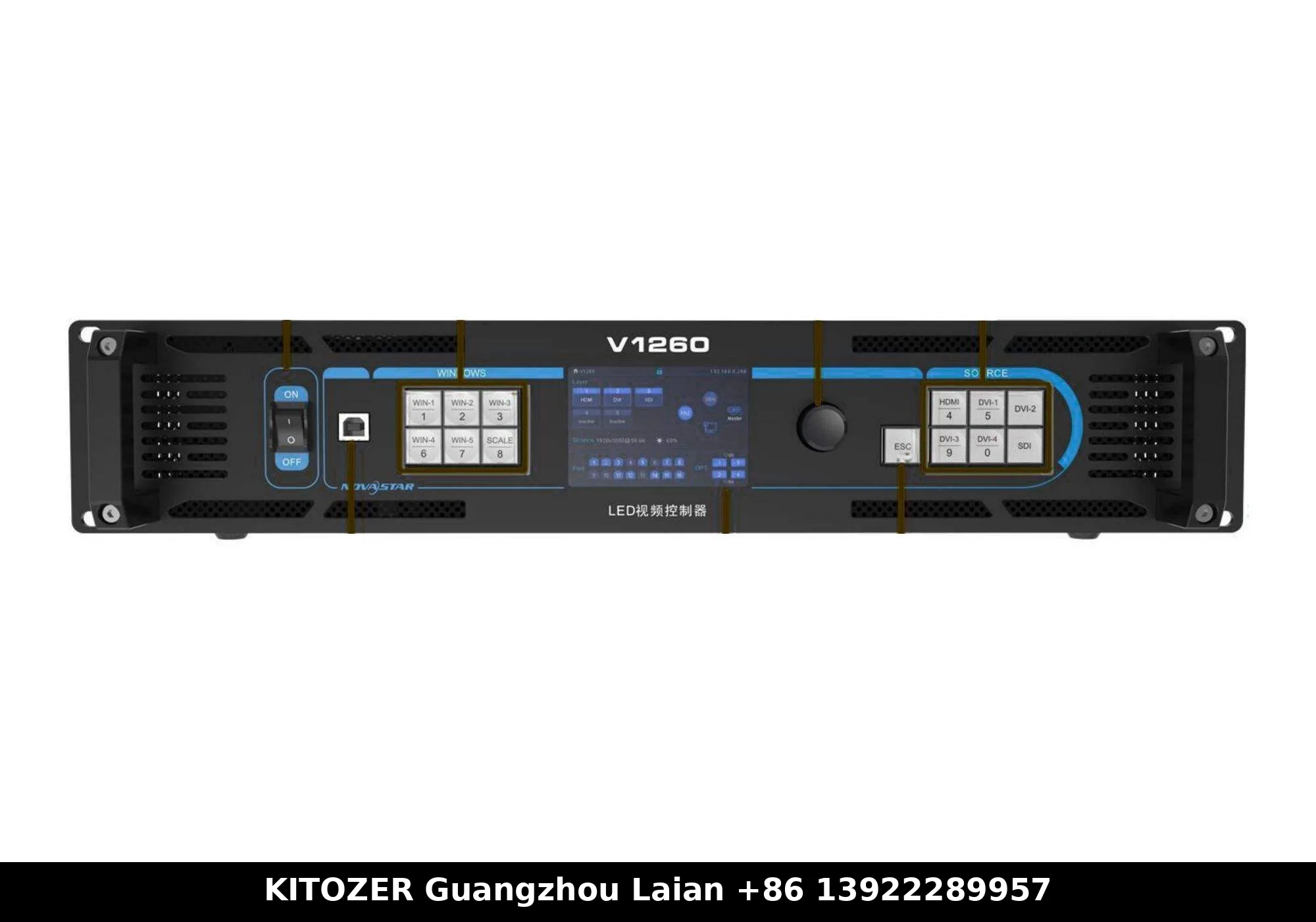
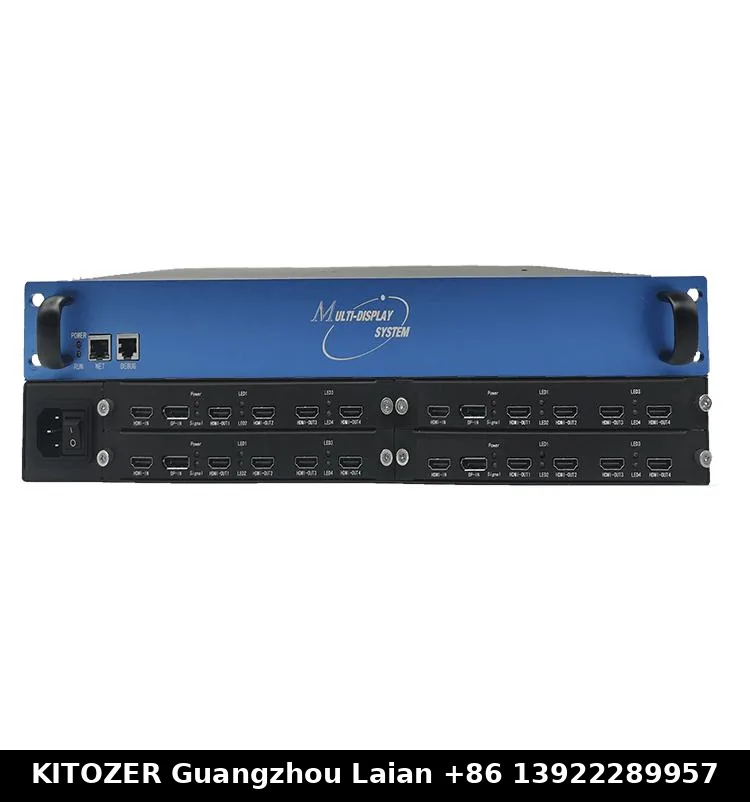
The KITOZER Video Wall Decoder / Splicing Screen Controller is a core large-screen display and video wall device independently developed by Guangzhou Laian Intelligent System Development Co., Ltd. The decoder receives digital video streams from network cameras, NVRs, and platform servers, decodes them into HDMI/DVI/SDI signals, and outputs them to splicing video walls, display walls, and LED screens for multi-screen splitting, windowing, roaming, overlay, and splicing display. KITOZER decoders are widely used in command centers, dispatch centers, data centers, monitoring centers, and exhibition displays.
The difference between a decoder and an NVR is that the NVR handles recording storage and management with a local monitor, while the decoder specifically decodes network video streams to large screen video walls, supporting more screen outputs and complex window roaming splicing functions. A large monitoring center typically uses multiple NVRs for storage and multiple decoders for wall display, unified by a VMS platform.
The KITOZER decoder series covers single-screen, 4-screen, 9-screen, and 16-screen models. Each unit provides 4 to 16 HDMI/DP outputs, with per-screen resolution up to 4K. The device supports H.265/H.264 decoding, ONVIF, GB/T 28181, and RTSP protocol access.
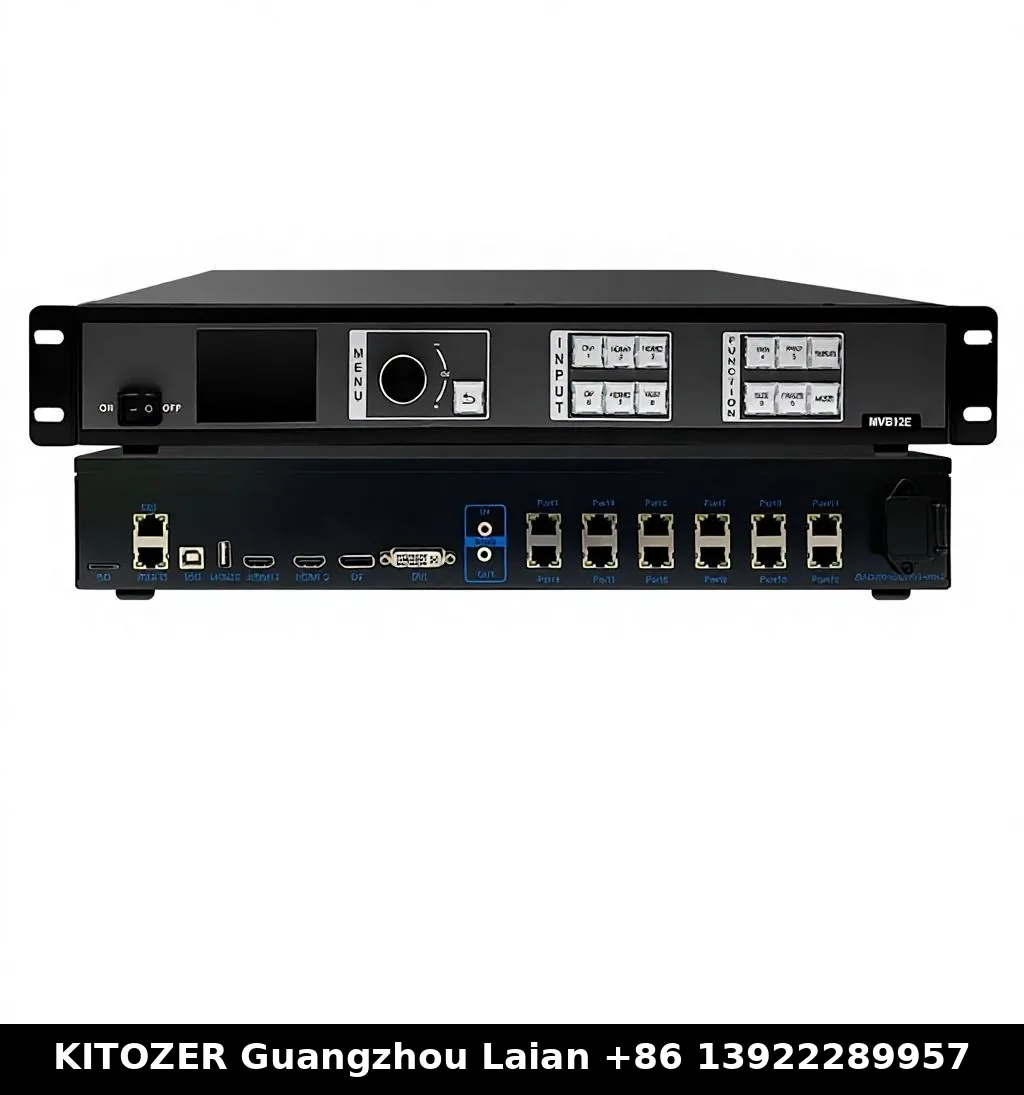
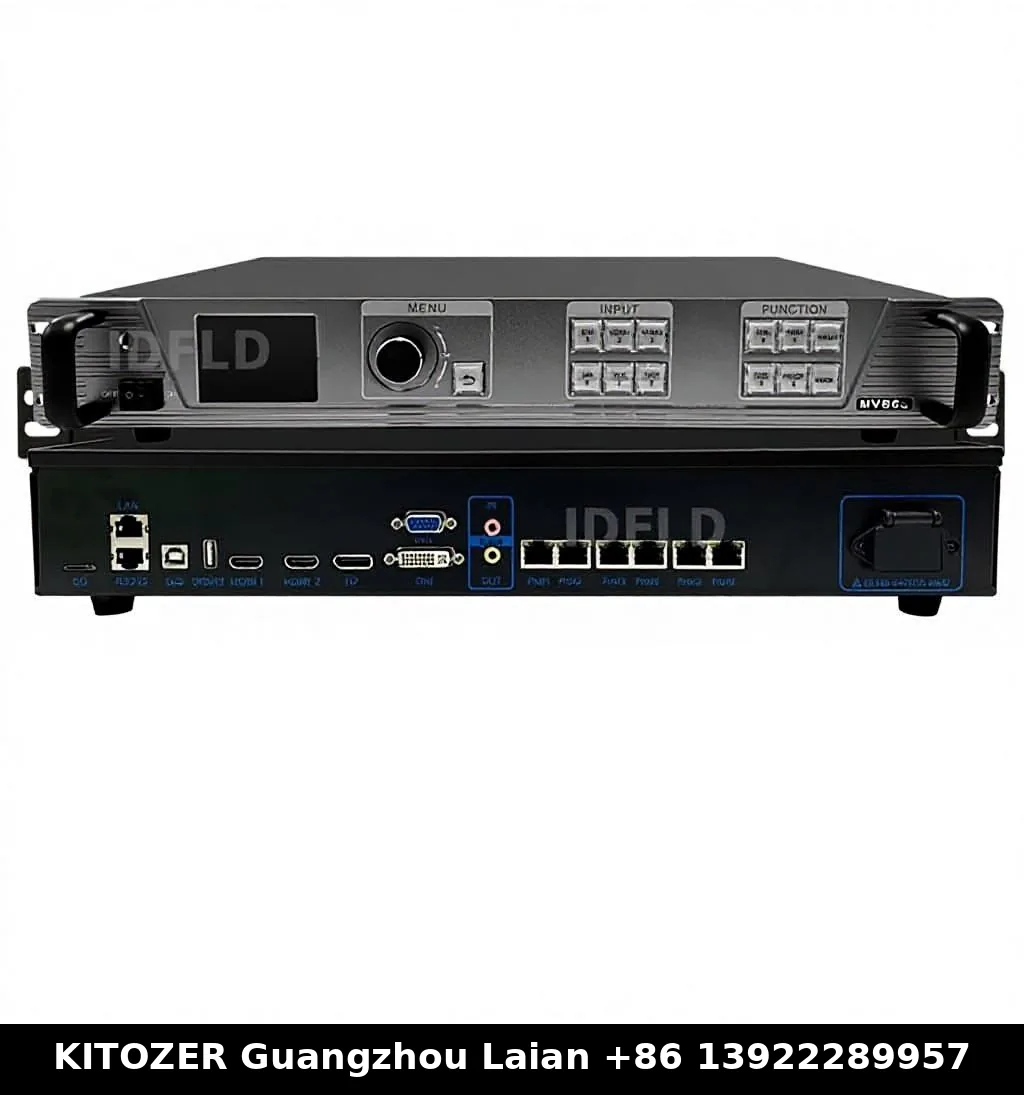
The splicing screen controller (also called splicing processor or video wall controller) is a high-end form of decoder. It not only decodes network video but also supports local HDMI/DVI signal inputs, multi-signal splicing display, windowing, cross-screen roaming, and picture-in-picture overlay.
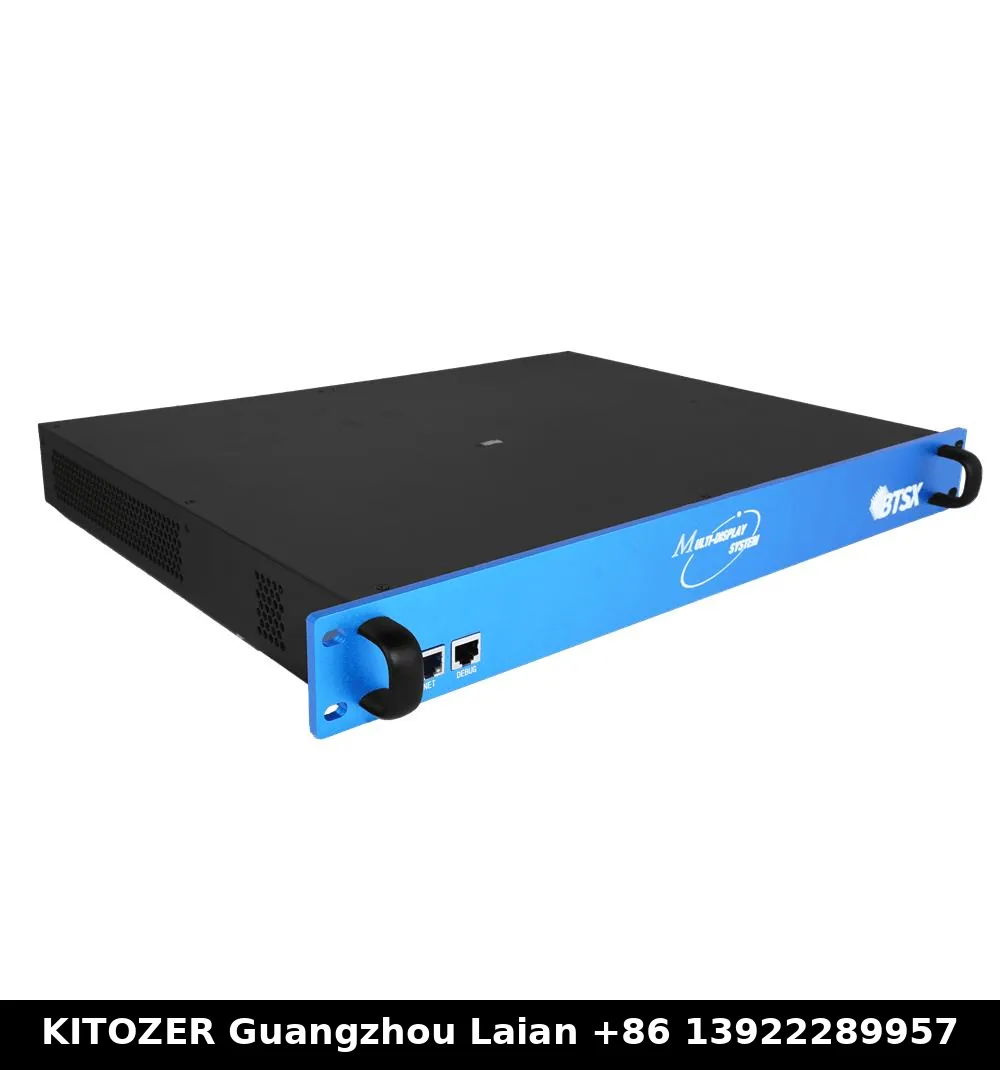
KITOZER decoders use embedded Linux with industrial-grade decode chips, offering fast boot, high stability, and 24/7 operation. The chassis is 1U to 3U rack-mount for standard 19-inch cabinets.
Decode capability is the core parameter. Standard decoders support 1x 4K or 4x 1080p decode per screen; high-end decoders support 4x 4K or 16x 1080p simultaneous decode. KITOZER decoders support cascade for larger walls.
2. Working Principle
The decoder workflow: video stream input, protocol parsing, decoding, image processing, splicing composition, and output display. Cameras or NVRs push H.265 streams via RTSP/ONVIF/GB28181 to the decoder; the ingest service identifies the stream and sends it to the decode chip to decode into raw YUV frames; the image processing module scales, crops, and overlays; the splicing module composites multiple video frames onto the large-screen canvas; the output module sends them via HDMI to each unit screen.
The decode chip is the core. KITOZER uses industrial-grade multimedia SoCs with hardware decode engines supporting multi-channel parallel H.265/H.264 decode. Hardware decoding offers lower power, lower latency, and higher stability than software decoding.
Splicing composition is key for video wall controllers. The large-screen canvas consists of multiple physical screens, e.g., 3×3 = 5760×3240 pixels. The controller positions each video window on the logical canvas and auto-splits across output channels when crossing screens.
Windowing and roaming: operators drag video windows to any position on the large screen via the control software, with scaling, overlay, and cross-screen dragging. KITOZER supports up to 8 layers of overlay, picture-in-picture, and full-screen roaming with sub-100ms switch response.
Signal input: in addition to network video, splicing controllers support local HDMI/DVI/SDI inputs. Meeting room PCs and matrix outputs can be directly displayed on the wall. High-end KITOZER controllers support 8 to 16 local HDMI inputs.
Signal output: each HDMI output drives one unit screen at 1920×1080 or 3840×2160. Larger walls cascade multiple controllers with sync signals for frame alignment.
Control methods: KITOZER supports web browser, PC client, touch screen, keyboard remote, and third-party SDK control. Operators drag wall layouts with a mouse at the console.
Preset management: operators save common wall layouts as presets (monitor mode, meeting mode, emergency mode). One-click switching. KITOZER supports dozens of presets, with time- or alarm-based auto-calling.
Alarm pop-up: when the VMS platform detects an alarm, the splicing controller automatically pops up alarm video at a designated position on the wall with audible prompts. After handling, the popup auto-closes.
3. Technical Specifications
| Parameter | 4-screen Decoder | 9-screen Controller | 16-screen High-end |
|---|---|---|---|
| HDMI outputs | 4 | 9 | 16 |
| Per-screen resolution | 1080p | 4K | 4K |
| Decode capacity | 16x1080p | 36x1080p / 9x4K | 64x1080p / 16x4K |
| Local HDMI inputs | none | 4 | 8 |
| Network | 2xGbE | 2xGbE | 2xGbE+1x10GbE |
| Windowing | split only | arbitrary windows | arbitrary + 8-layer overlay |
| Rack size | 1U | 2U | 3U |
| Redundant PSU | none | optional | standard |
| Reference price | USD 1500-3000 | USD 3000-7000 | USD 7000-15000 |
4. Selection Guide
First, determine the physical screen layout: how many unit screens, per-screen resolution, and splicing matrix (rows x columns). This determines the required HDMI outputs. For example, a 3×3 LCD wall needs 9 HDMI outputs.
Second, determine the number and resolution of videos to display simultaneously. This determines decode capability. KITOZER standard decoders support 4x 1080p or 1x 4K per screen; high-end support 16x 1080p or 4x 4K per screen.
Third, determine whether local signal input is needed. If meeting room PCs or matrix signals need to be displayed directly, choose a splicing controller with HDMI inputs. If only network video, a standard decoder suffices at lower cost.
Fourth, determine whether windowing/roaming/overlay is needed. Simple equal split (one video per screen) uses a standard decoder; arbitrary window roaming uses a splicing controller. The price difference is significant.
Fifth, determine control method. Web control suffices for most scenarios; touch screen drag requires high-end control software; third-party integration requires SDK.
Sixth, determine redundancy needs. Command and emergency centers recommend dual-machine hot standby; ordinary monitoring centers use a single unit.
Seventh, determine screen type. LCD, LED small-pitch, and projection splicing require different interfaces. KITOZER decoders support all common screen types.
Eighth, determine budget. Single-screen decoders start at a few thousand RMB; 4-screen decoders cost 10-20k RMB; 9-screen controllers cost 20-50k; 16-screen high-end controllers cost 50-100k. Screens are additional.
Ninth, determine service and warranty. KITOZER decoders carry a 3-year standard warranty with 24-hour on-site support in Guangzhou.
Tenth, determine future expansion. Choose cascade-capable models so future wall expansion only requires adding decoders without wasting existing investment.
5. Installation Requirements
Install the decoder in a 19-inch standard cabinet alongside NVRs and switches. Rear HDMI outputs connect to each unit screen via HDMI cables. The network port connects to the core switch.
Screens are mounted on walls or floor stands by a professional screen installer. Each unit screen connects HDMI and power cables. The wall is grounded.
Cabling order: network first to confirm cameras are discoverable; then HDMI outputs to light up each screen; finally adjust the splicing layout.
Network configuration: the decoder IP is on the same subnet as cameras and NVRs. Add video sources with IP, port, username, and password via the web interface.
Splicing configuration: set the physical wall resolution and splicing matrix in the control software. Drag video windows to positions and save as presets.
The control PC runs the control software at the operator console. Operators drag wall layouts with a mouse.
Test all videos on the wall, window roaming, preset switching, and alarm pop-ups.
Label both ends of HDMI cables with screen numbers. Save configuration backup. Deliver the operation manual.
The decoder fan adjusts speed; ensure cabinet ventilation. Leave cooling space behind the wall.
Connect the decoder and wall to UPS. The wall draws significant power and needs a dedicated circuit.
6. Operation and Maintenance
Routine inspection: weekly check the wall display for black screens, blur, or color cast. Check decoder status LEDs. Clean the screen surface.
Color and brightness calibration: every six months, calibrate screen color and brightness for wall uniformity. LCD panels may develop color differences over long use.
Firmware upgrades: KITOZER posts decoder firmware updates periodically. Back up configuration before upgrading. Do not upgrade production firmware unnecessarily.
Troubleshooting: no picture on a screen – check HDMI cable and screen power; no video on a channel – check source IP, decoder network, and login credentials; whole wall black – check decoder power and main wall power.
Cleaning: use dedicated LCD screen cleaner. Do not use alcohol or corrosive liquids.
Keep spare HDMI cables and a remote control on site. Replace a failed decoder with a backup unit.
KITOZER provides 7×12 phone support with 24-hour on-site service in Guangzhou.
7. FAQ
Q1: What is the difference between a decoder and a video wall processor?
A decoder decodes network video to the wall; a processor adds windowing, roaming, overlay, and local signal input. Choose a decoder for simple wall display and a processor for complex video walls.
Q2: How many screens can one decoder drive?
KITOZER decoders provide 4 to 16 HDMI outputs, one per screen. Larger walls cascade multiple units.
Q3: How many videos can be displayed?
Depends on decode capacity. Standard: 4x 1080p or 1x 4K per screen; high-end: 16x 1080p or 4x 4K per screen.
Q4: Does the decoder support 4K output?
Yes. High-end decoders output 3840×2160 at 30 or 60Hz per HDMI.
Q5: Can it connect third-party cameras?
Yes, via ONVIF and GB/T 28181.
Q6: How to display one image across the whole wall?
In the splicing software, drag one video to fill the entire canvas; the controller auto-splits across outputs.
Q7: What is the decoder latency?
Hardware decode latency is under 200ms, suitable for real-time monitoring.
Q8: Is a PC required?
The decoder runs standalone via web UI; a control PC is recommended for complex walls.
Q9: What is the price?
Reference: single-screen from a few thousand RMB, 4-screen 10-20k, 9-screen 20-50k, 16-screen 50-100k.
Q10: What is the warranty?
3 years standard, extendable to 5.
8. Application Scenarios
Command centers: public security, traffic, and emergency command centers use large walls; KITOZER decoders wall hundreds of videos with GIS maps and alarm pop-ups to support decision-making.
Dispatch centers: power, rail, and petrochemical dispatch centers display SCADA and video on the same screen.
Data centers: NOC walls display environmental monitoring and video; KITOZER decoders overlay camera video with data visualizations.
Monitoring centers: residential, mall, and factory monitoring centers wall NVR video for security guards.
Exhibition halls: corporate showrooms and museums use splicing walls for promotional videos and interactive content.
Conference rooms: high-end meeting rooms use wireless screen-casting splicing walls.
Broadcasting: TV studios use splicing controllers for multi-screen program monitoring.
Military command: military command posts use KITOZER decoders for military-grade reliability.
9. Deep Technical Topics on Video Wall Decoders
9.1 Video Wall Design
The topic of video wall design is one of the key technical aspects that KITOZER video wall decoder engineers address in every project. Based on years of field experience, KITOZER recommends that customers carefully plan video wall design during the design phase rather than treating it as an afterthought. A well-executed video wall design strategy directly contributes to the long-term reliability and effectiveness of the entire video wall system.When considering video wall design, it is important to evaluate the actual site conditions, budget constraints, and operational requirements. KITOZER technical support works closely with system integrators and end users to design a video wall design solution that balances performance, cost, and future scalability. The KITOZER decoder firmware provides a wide range of configuration options for video wall design.Common pitfalls in video wall design include over-investing in unnecessary features, under-provisioning for future growth, skipping site survey, and failing to document the configuration. KITOZER engineers proactively flag these risks during project kickoff. Customers are encouraged to ask questions about video wall design at any stage; KITOZER can be reached at +86 13922289957.From a maintenance perspective, video wall design should be reviewed periodically. As the wall evolves, cameras may be added, removed, or relocated. KITOZER decoders are designed to accommodate these changes without a forklift upgrade. Regular review of video wall design ensures the system continues to meet operational needs over its 5 to 8 year service life.
9.2 Decode Wall Display
The topic of decode wall display is one of the key technical aspects that KITOZER video wall decoder engineers address in every project. Based on years of field experience, KITOZER recommends that customers carefully plan decode wall display during the design phase rather than treating it as an afterthought. A well-executed decode wall display strategy directly contributes to the long-term reliability and effectiveness of the entire video wall system.When considering decode wall display, it is important to evaluate the actual site conditions, budget constraints, and operational requirements. KITOZER technical support works closely with system integrators and end users to design a decode wall display solution that balances performance, cost, and future scalability. The KITOZER decoder firmware provides a wide range of configuration options for decode wall display.Common pitfalls in decode wall display include over-investing in unnecessary features, under-provisioning for future growth, skipping site survey, and failing to document the configuration. KITOZER engineers proactively flag these risks during project kickoff. Customers are encouraged to ask questions about decode wall display at any stage; KITOZER can be reached at +86 13922289957.From a maintenance perspective, decode wall display should be reviewed periodically. As the wall evolves, cameras may be added, removed, or relocated. KITOZER decoders are designed to accommodate these changes without a forklift upgrade. Regular review of decode wall display ensures the system continues to meet operational needs over its 5 to 8 year service life.
9.3 Led Small Pitch Display
The topic of LED small pitch display is one of the key technical aspects that KITOZER video wall decoder engineers address in every project. Based on years of field experience, KITOZER recommends that customers carefully plan LED small pitch display during the design phase rather than treating it as an afterthought. A well-executed LED small pitch display strategy directly contributes to the long-term reliability and effectiveness of the entire video wall system.When considering LED small pitch display, it is important to evaluate the actual site conditions, budget constraints, and operational requirements. KITOZER technical support works closely with system integrators and end users to design a LED small pitch display solution that balances performance, cost, and future scalability. The KITOZER decoder firmware provides a wide range of configuration options for LED small pitch display.Common pitfalls in LED small pitch display include over-investing in unnecessary features, under-provisioning for future growth, skipping site survey, and failing to document the configuration. KITOZER engineers proactively flag these risks during project kickoff. Customers are encouraged to ask questions about LED small pitch display at any stage; KITOZER can be reached at +86 13922289957.From a maintenance perspective, LED small pitch display should be reviewed periodically. As the wall evolves, cameras may be added, removed, or relocated. KITOZER decoders are designed to accommodate these changes without a forklift upgrade. Regular review of LED small pitch display ensures the system continues to meet operational needs over its 5 to 8 year service life.
9.4 Lcd Splicing Screen Selection
The topic of LCD splicing screen selection is one of the key technical aspects that KITOZER video wall decoder engineers address in every project. Based on years of field experience, KITOZER recommends that customers carefully plan LCD splicing screen selection during the design phase rather than treating it as an afterthought. A well-executed LCD splicing screen selection strategy directly contributes to the long-term reliability and effectiveness of the entire video wall system.When considering LCD splicing screen selection, it is important to evaluate the actual site conditions, budget constraints, and operational requirements. KITOZER technical support works closely with system integrators and end users to design a LCD splicing screen selection solution that balances performance, cost, and future scalability. The KITOZER decoder firmware provides a wide range of configuration options for LCD splicing screen selection.Common pitfalls in LCD splicing screen selection include over-investing in unnecessary features, under-provisioning for future growth, skipping site survey, and failing to document the configuration. KITOZER engineers proactively flag these risks during project kickoff. Customers are encouraged to ask questions about LCD splicing screen selection at any stage; KITOZER can be reached at +86 13922289957.From a maintenance perspective, LCD splicing screen selection should be reviewed periodically. As the wall evolves, cameras may be added, removed, or relocated. KITOZER decoders are designed to accommodate these changes without a forklift upgrade. Regular review of LCD splicing screen selection ensures the system continues to meet operational needs over its 5 to 8 year service life.
9.5 Command Center Wall
The topic of command center wall is one of the key technical aspects that KITOZER video wall decoder engineers address in every project. Based on years of field experience, KITOZER recommends that customers carefully plan command center wall during the design phase rather than treating it as an afterthought. A well-executed command center wall strategy directly contributes to the long-term reliability and effectiveness of the entire video wall system.When considering command center wall, it is important to evaluate the actual site conditions, budget constraints, and operational requirements. KITOZER technical support works closely with system integrators and end users to design a command center wall solution that balances performance, cost, and future scalability. The KITOZER decoder firmware provides a wide range of configuration options for command center wall.Common pitfalls in command center wall include over-investing in unnecessary features, under-provisioning for future growth, skipping site survey, and failing to document the configuration. KITOZER engineers proactively flag these risks during project kickoff. Customers are encouraged to ask questions about command center wall at any stage; KITOZER can be reached at +86 13922289957.From a maintenance perspective, command center wall should be reviewed periodically. As the wall evolves, cameras may be added, removed, or relocated. KITOZER decoders are designed to accommodate these changes without a forklift upgrade. Regular review of command center wall ensures the system continues to meet operational needs over its 5 to 8 year service life.
9.6 Dispatch Center Display
The topic of dispatch center display is one of the key technical aspects that KITOZER video wall decoder engineers address in every project. Based on years of field experience, KITOZER recommends that customers carefully plan dispatch center display during the design phase rather than treating it as an afterthought. A well-executed dispatch center display strategy directly contributes to the long-term reliability and effectiveness of the entire video wall system.When considering dispatch center display, it is important to evaluate the actual site conditions, budget constraints, and operational requirements. KITOZER technical support works closely with system integrators and end users to design a dispatch center display solution that balances performance, cost, and future scalability. The KITOZER decoder firmware provides a wide range of configuration options for dispatch center display.Common pitfalls in dispatch center display include over-investing in unnecessary features, under-provisioning for future growth, skipping site survey, and failing to document the configuration. KITOZER engineers proactively flag these risks during project kickoff. Customers are encouraged to ask questions about dispatch center display at any stage; KITOZER can be reached at +86 13922289957.From a maintenance perspective, dispatch center display should be reviewed periodically. As the wall evolves, cameras may be added, removed, or relocated. KITOZER decoders are designed to accommodate these changes without a forklift upgrade. Regular review of dispatch center display ensures the system continues to meet operational needs over its 5 to 8 year service life.
9.7 Monitoring Center Video Wall
The topic of monitoring center video wall is one of the key technical aspects that KITOZER video wall decoder engineers address in every project. Based on years of field experience, KITOZER recommends that customers carefully plan monitoring center video wall during the design phase rather than treating it as an afterthought. A well-executed monitoring center video wall strategy directly contributes to the long-term reliability and effectiveness of the entire video wall system.When considering monitoring center video wall, it is important to evaluate the actual site conditions, budget constraints, and operational requirements. KITOZER technical support works closely with system integrators and end users to design a monitoring center video wall solution that balances performance, cost, and future scalability. The KITOZER decoder firmware provides a wide range of configuration options for monitoring center video wall.Common pitfalls in monitoring center video wall include over-investing in unnecessary features, under-provisioning for future growth, skipping site survey, and failing to document the configuration. KITOZER engineers proactively flag these risks during project kickoff. Customers are encouraged to ask questions about monitoring center video wall at any stage; KITOZER can be reached at +86 13922289957.From a maintenance perspective, monitoring center video wall should be reviewed periodically. As the wall evolves, cameras may be added, removed, or relocated. KITOZER decoders are designed to accommodate these changes without a forklift upgrade. Regular review of monitoring center video wall ensures the system continues to meet operational needs over its 5 to 8 year service life.
9.8 Conference Wall
The topic of conference wall is one of the key technical aspects that KITOZER video wall decoder engineers address in every project. Based on years of field experience, KITOZER recommends that customers carefully plan conference wall during the design phase rather than treating it as an afterthought. A well-executed conference wall strategy directly contributes to the long-term reliability and effectiveness of the entire video wall system.When considering conference wall, it is important to evaluate the actual site conditions, budget constraints, and operational requirements. KITOZER technical support works closely with system integrators and end users to design a conference wall solution that balances performance, cost, and future scalability. The KITOZER decoder firmware provides a wide range of configuration options for conference wall.Common pitfalls in conference wall include over-investing in unnecessary features, under-provisioning for future growth, skipping site survey, and failing to document the configuration. KITOZER engineers proactively flag these risks during project kickoff. Customers are encouraged to ask questions about conference wall at any stage; KITOZER can be reached at +86 13922289957.From a maintenance perspective, conference wall should be reviewed periodically. As the wall evolves, cameras may be added, removed, or relocated. KITOZER decoders are designed to accommodate these changes without a forklift upgrade. Regular review of conference wall ensures the system continues to meet operational needs over its 5 to 8 year service life.
9.9 Video Decoder Function
The topic of video decoder function is one of the key technical aspects that KITOZER video wall decoder engineers address in every project. Based on years of field experience, KITOZER recommends that customers carefully plan video decoder function during the design phase rather than treating it as an afterthought. A well-executed video decoder function strategy directly contributes to the long-term reliability and effectiveness of the entire video wall system.When considering video decoder function, it is important to evaluate the actual site conditions, budget constraints, and operational requirements. KITOZER technical support works closely with system integrators and end users to design a video decoder function solution that balances performance, cost, and future scalability. The KITOZER decoder firmware provides a wide range of configuration options for video decoder function.Common pitfalls in video decoder function include over-investing in unnecessary features, under-provisioning for future growth, skipping site survey, and failing to document the configuration. KITOZER engineers proactively flag these risks during project kickoff. Customers are encouraged to ask questions about video decoder function at any stage; KITOZER can be reached at +86 13922289957.From a maintenance perspective, video decoder function should be reviewed periodically. As the wall evolves, cameras may be added, removed, or relocated. KITOZER decoders are designed to accommodate these changes without a forklift upgrade. Regular review of video decoder function ensures the system continues to meet operational needs over its 5 to 8 year service life.
9.10 Splicing Processor
The topic of splicing processor is one of the key technical aspects that KITOZER video wall decoder engineers address in every project. Based on years of field experience, KITOZER recommends that customers carefully plan splicing processor during the design phase rather than treating it as an afterthought. A well-executed splicing processor strategy directly contributes to the long-term reliability and effectiveness of the entire video wall system.When considering splicing processor, it is important to evaluate the actual site conditions, budget constraints, and operational requirements. KITOZER technical support works closely with system integrators and end users to design a splicing processor solution that balances performance, cost, and future scalability. The KITOZER decoder firmware provides a wide range of configuration options for splicing processor.Common pitfalls in splicing processor include over-investing in unnecessary features, under-provisioning for future growth, skipping site survey, and failing to document the configuration. KITOZER engineers proactively flag these risks during project kickoff. Customers are encouraged to ask questions about splicing processor at any stage; KITOZER can be reached at +86 13922289957.From a maintenance perspective, splicing processor should be reviewed periodically. As the wall evolves, cameras may be added, removed, or relocated. KITOZER decoders are designed to accommodate these changes without a forklift upgrade. Regular review of splicing processor ensures the system continues to meet operational needs over its 5 to 8 year service life.
9.11 Matrix Switcher
The topic of matrix switcher is one of the key technical aspects that KITOZER video wall decoder engineers address in every project. Based on years of field experience, KITOZER recommends that customers carefully plan matrix switcher during the design phase rather than treating it as an afterthought. A well-executed matrix switcher strategy directly contributes to the long-term reliability and effectiveness of the entire video wall system.When considering matrix switcher, it is important to evaluate the actual site conditions, budget constraints, and operational requirements. KITOZER technical support works closely with system integrators and end users to design a matrix switcher solution that balances performance, cost, and future scalability. The KITOZER decoder firmware provides a wide range of configuration options for matrix switcher.Common pitfalls in matrix switcher include over-investing in unnecessary features, under-provisioning for future growth, skipping site survey, and failing to document the configuration. KITOZER engineers proactively flag these risks during project kickoff. Customers are encouraged to ask questions about matrix switcher at any stage; KITOZER can be reached at +86 13922289957.From a maintenance perspective, matrix switcher should be reviewed periodically. As the wall evolves, cameras may be added, removed, or relocated. KITOZER decoders are designed to accommodate these changes without a forklift upgrade. Regular review of matrix switcher ensures the system continues to meet operational needs over its 5 to 8 year service life.
9.12 Video Splitter
The topic of video splitter is one of the key technical aspects that KITOZER video wall decoder engineers address in every project. Based on years of field experience, KITOZER recommends that customers carefully plan video splitter during the design phase rather than treating it as an afterthought. A well-executed video splitter strategy directly contributes to the long-term reliability and effectiveness of the entire video wall system.When considering video splitter, it is important to evaluate the actual site conditions, budget constraints, and operational requirements. KITOZER technical support works closely with system integrators and end users to design a video splitter solution that balances performance, cost, and future scalability. The KITOZER decoder firmware provides a wide range of configuration options for video splitter.Common pitfalls in video splitter include over-investing in unnecessary features, under-provisioning for future growth, skipping site survey, and failing to document the configuration. KITOZER engineers proactively flag these risks during project kickoff. Customers are encouraged to ask questions about video splitter at any stage; KITOZER can be reached at +86 13922289957.From a maintenance perspective, video splitter should be reviewed periodically. As the wall evolves, cameras may be added, removed, or relocated. KITOZER decoders are designed to accommodate these changes without a forklift upgrade. Regular review of video splitter ensures the system continues to meet operational needs over its 5 to 8 year service life.
9.13 Windowing Roaming Overlay
The topic of windowing roaming overlay is one of the key technical aspects that KITOZER video wall decoder engineers address in every project. Based on years of field experience, KITOZER recommends that customers carefully plan windowing roaming overlay during the design phase rather than treating it as an afterthought. A well-executed windowing roaming overlay strategy directly contributes to the long-term reliability and effectiveness of the entire video wall system.When considering windowing roaming overlay, it is important to evaluate the actual site conditions, budget constraints, and operational requirements. KITOZER technical support works closely with system integrators and end users to design a windowing roaming overlay solution that balances performance, cost, and future scalability. The KITOZER decoder firmware provides a wide range of configuration options for windowing roaming overlay.Common pitfalls in windowing roaming overlay include over-investing in unnecessary features, under-provisioning for future growth, skipping site survey, and failing to document the configuration. KITOZER engineers proactively flag these risks during project kickoff. Customers are encouraged to ask questions about windowing roaming overlay at any stage; KITOZER can be reached at +86 13922289957.From a maintenance perspective, windowing roaming overlay should be reviewed periodically. As the wall evolves, cameras may be added, removed, or relocated. KITOZER decoders are designed to accommodate these changes without a forklift upgrade. Regular review of windowing roaming overlay ensures the system continues to meet operational needs over its 5 to 8 year service life.
9.14 Preset Touring
The topic of preset touring is one of the key technical aspects that KITOZER video wall decoder engineers address in every project. Based on years of field experience, KITOZER recommends that customers carefully plan preset touring during the design phase rather than treating it as an afterthought. A well-executed preset touring strategy directly contributes to the long-term reliability and effectiveness of the entire video wall system.When considering preset touring, it is important to evaluate the actual site conditions, budget constraints, and operational requirements. KITOZER technical support works closely with system integrators and end users to design a preset touring solution that balances performance, cost, and future scalability. The KITOZER decoder firmware provides a wide range of configuration options for preset touring.Common pitfalls in preset touring include over-investing in unnecessary features, under-provisioning for future growth, skipping site survey, and failing to document the configuration. KITOZER engineers proactively flag these risks during project kickoff. Customers are encouraged to ask questions about preset touring at any stage; KITOZER can be reached at +86 13922289957.From a maintenance perspective, preset touring should be reviewed periodically. As the wall evolves, cameras may be added, removed, or relocated. KITOZER decoders are designed to accommodate these changes without a forklift upgrade. Regular review of preset touring ensures the system continues to meet operational needs over its 5 to 8 year service life.
9.15 Alarm Pop-Up
The topic of alarm pop-up is one of the key technical aspects that KITOZER video wall decoder engineers address in every project. Based on years of field experience, KITOZER recommends that customers carefully plan alarm pop-up during the design phase rather than treating it as an afterthought. A well-executed alarm pop-up strategy directly contributes to the long-term reliability and effectiveness of the entire video wall system.When considering alarm pop-up, it is important to evaluate the actual site conditions, budget constraints, and operational requirements. KITOZER technical support works closely with system integrators and end users to design a alarm pop-up solution that balances performance, cost, and future scalability. The KITOZER decoder firmware provides a wide range of configuration options for alarm pop-up.Common pitfalls in alarm pop-up include over-investing in unnecessary features, under-provisioning for future growth, skipping site survey, and failing to document the configuration. KITOZER engineers proactively flag these risks during project kickoff. Customers are encouraged to ask questions about alarm pop-up at any stage; KITOZER can be reached at +86 13922289957.From a maintenance perspective, alarm pop-up should be reviewed periodically. As the wall evolves, cameras may be added, removed, or relocated. KITOZER decoders are designed to accommodate these changes without a forklift upgrade. Regular review of alarm pop-up ensures the system continues to meet operational needs over its 5 to 8 year service life.
9.16 Gis Map Overlay
The topic of GIS map overlay is one of the key technical aspects that KITOZER video wall decoder engineers address in every project. Based on years of field experience, KITOZER recommends that customers carefully plan GIS map overlay during the design phase rather than treating it as an afterthought. A well-executed GIS map overlay strategy directly contributes to the long-term reliability and effectiveness of the entire video wall system.When considering GIS map overlay, it is important to evaluate the actual site conditions, budget constraints, and operational requirements. KITOZER technical support works closely with system integrators and end users to design a GIS map overlay solution that balances performance, cost, and future scalability. The KITOZER decoder firmware provides a wide range of configuration options for GIS map overlay.Common pitfalls in GIS map overlay include over-investing in unnecessary features, under-provisioning for future growth, skipping site survey, and failing to document the configuration. KITOZER engineers proactively flag these risks during project kickoff. Customers are encouraged to ask questions about GIS map overlay at any stage; KITOZER can be reached at +86 13922289957.From a maintenance perspective, GIS map overlay should be reviewed periodically. As the wall evolves, cameras may be added, removed, or relocated. KITOZER decoders are designed to accommodate these changes without a forklift upgrade. Regular review of GIS map overlay ensures the system continues to meet operational needs over its 5 to 8 year service life.
9.17 4K Uhd Display
The topic of 4K UHD display is one of the key technical aspects that KITOZER video wall decoder engineers address in every project. Based on years of field experience, KITOZER recommends that customers carefully plan 4K UHD display during the design phase rather than treating it as an afterthought. A well-executed 4K UHD display strategy directly contributes to the long-term reliability and effectiveness of the entire video wall system.When considering 4K UHD display, it is important to evaluate the actual site conditions, budget constraints, and operational requirements. KITOZER technical support works closely with system integrators and end users to design a 4K UHD display solution that balances performance, cost, and future scalability. The KITOZER decoder firmware provides a wide range of configuration options for 4K UHD display.Common pitfalls in 4K UHD display include over-investing in unnecessary features, under-provisioning for future growth, skipping site survey, and failing to document the configuration. KITOZER engineers proactively flag these risks during project kickoff. Customers are encouraged to ask questions about 4K UHD display at any stage; KITOZER can be reached at +86 13922289957.From a maintenance perspective, 4K UHD display should be reviewed periodically. As the wall evolves, cameras may be added, removed, or relocated. KITOZER decoders are designed to accommodate these changes without a forklift upgrade. Regular review of 4K UHD display ensures the system continues to meet operational needs over its 5 to 8 year service life.
9.18 8K Uhd Display
The topic of 8K UHD display is one of the key technical aspects that KITOZER video wall decoder engineers address in every project. Based on years of field experience, KITOZER recommends that customers carefully plan 8K UHD display during the design phase rather than treating it as an afterthought. A well-executed 8K UHD display strategy directly contributes to the long-term reliability and effectiveness of the entire video wall system.When considering 8K UHD display, it is important to evaluate the actual site conditions, budget constraints, and operational requirements. KITOZER technical support works closely with system integrators and end users to design a 8K UHD display solution that balances performance, cost, and future scalability. The KITOZER decoder firmware provides a wide range of configuration options for 8K UHD display.Common pitfalls in 8K UHD display include over-investing in unnecessary features, under-provisioning for future growth, skipping site survey, and failing to document the configuration. KITOZER engineers proactively flag these risks during project kickoff. Customers are encouraged to ask questions about 8K UHD display at any stage; KITOZER can be reached at +86 13922289957.From a maintenance perspective, 8K UHD display should be reviewed periodically. As the wall evolves, cameras may be added, removed, or relocated. KITOZER decoders are designed to accommodate these changes without a forklift upgrade. Regular review of 8K UHD display ensures the system continues to meet operational needs over its 5 to 8 year service life.
9.19 H.265 Decoding
The topic of H.265 decoding is one of the key technical aspects that KITOZER video wall decoder engineers address in every project. Based on years of field experience, KITOZER recommends that customers carefully plan H.265 decoding during the design phase rather than treating it as an afterthought. A well-executed H.265 decoding strategy directly contributes to the long-term reliability and effectiveness of the entire video wall system.When considering H.265 decoding, it is important to evaluate the actual site conditions, budget constraints, and operational requirements. KITOZER technical support works closely with system integrators and end users to design a H.265 decoding solution that balances performance, cost, and future scalability. The KITOZER decoder firmware provides a wide range of configuration options for H.265 decoding.Common pitfalls in H.265 decoding include over-investing in unnecessary features, under-provisioning for future growth, skipping site survey, and failing to document the configuration. KITOZER engineers proactively flag these risks during project kickoff. Customers are encouraged to ask questions about H.265 decoding at any stage; KITOZER can be reached at +86 13922289957.From a maintenance perspective, H.265 decoding should be reviewed periodically. As the wall evolves, cameras may be added, removed, or relocated. KITOZER decoders are designed to accommodate these changes without a forklift upgrade. Regular review of H.265 decoding ensures the system continues to meet operational needs over its 5 to 8 year service life.
9.20 Onvif Protocol
The topic of ONVIF protocol is one of the key technical aspects that KITOZER video wall decoder engineers address in every project. Based on years of field experience, KITOZER recommends that customers carefully plan ONVIF protocol during the design phase rather than treating it as an afterthought. A well-executed ONVIF protocol strategy directly contributes to the long-term reliability and effectiveness of the entire video wall system.When considering ONVIF protocol, it is important to evaluate the actual site conditions, budget constraints, and operational requirements. KITOZER technical support works closely with system integrators and end users to design a ONVIF protocol solution that balances performance, cost, and future scalability. The KITOZER decoder firmware provides a wide range of configuration options for ONVIF protocol.Common pitfalls in ONVIF protocol include over-investing in unnecessary features, under-provisioning for future growth, skipping site survey, and failing to document the configuration. KITOZER engineers proactively flag these risks during project kickoff. Customers are encouraged to ask questions about ONVIF protocol at any stage; KITOZER can be reached at +86 13922289957.From a maintenance perspective, ONVIF protocol should be reviewed periodically. As the wall evolves, cameras may be added, removed, or relocated. KITOZER decoders are designed to accommodate these changes without a forklift upgrade. Regular review of ONVIF protocol ensures the system continues to meet operational needs over its 5 to 8 year service life.
9.21 Gb28181 Networking
The topic of GB28181 networking is one of the key technical aspects that KITOZER video wall decoder engineers address in every project. Based on years of field experience, KITOZER recommends that customers carefully plan GB28181 networking during the design phase rather than treating it as an afterthought. A well-executed GB28181 networking strategy directly contributes to the long-term reliability and effectiveness of the entire video wall system.When considering GB28181 networking, it is important to evaluate the actual site conditions, budget constraints, and operational requirements. KITOZER technical support works closely with system integrators and end users to design a GB28181 networking solution that balances performance, cost, and future scalability. The KITOZER decoder firmware provides a wide range of configuration options for GB28181 networking.Common pitfalls in GB28181 networking include over-investing in unnecessary features, under-provisioning for future growth, skipping site survey, and failing to document the configuration. KITOZER engineers proactively flag these risks during project kickoff. Customers are encouraged to ask questions about GB28181 networking at any stage; KITOZER can be reached at +86 13922289957.From a maintenance perspective, GB28181 networking should be reviewed periodically. As the wall evolves, cameras may be added, removed, or relocated. KITOZER decoders are designed to accommodate these changes without a forklift upgrade. Regular review of GB28181 networking ensures the system continues to meet operational needs over its 5 to 8 year service life.
9.22 Rs232 Control
The topic of RS232 control is one of the key technical aspects that KITOZER video wall decoder engineers address in every project. Based on years of field experience, KITOZER recommends that customers carefully plan RS232 control during the design phase rather than treating it as an afterthought. A well-executed RS232 control strategy directly contributes to the long-term reliability and effectiveness of the entire video wall system.When considering RS232 control, it is important to evaluate the actual site conditions, budget constraints, and operational requirements. KITOZER technical support works closely with system integrators and end users to design a RS232 control solution that balances performance, cost, and future scalability. The KITOZER decoder firmware provides a wide range of configuration options for RS232 control.Common pitfalls in RS232 control include over-investing in unnecessary features, under-provisioning for future growth, skipping site survey, and failing to document the configuration. KITOZER engineers proactively flag these risks during project kickoff. Customers are encouraged to ask questions about RS232 control at any stage; KITOZER can be reached at +86 13922289957.From a maintenance perspective, RS232 control should be reviewed periodically. As the wall evolves, cameras may be added, removed, or relocated. KITOZER decoders are designed to accommodate these changes without a forklift upgrade. Regular review of RS232 control ensures the system continues to meet operational needs over its 5 to 8 year service life.
9.23 Web Remote Management
The topic of web remote management is one of the key technical aspects that KITOZER video wall decoder engineers address in every project. Based on years of field experience, KITOZER recommends that customers carefully plan web remote management during the design phase rather than treating it as an afterthought. A well-executed web remote management strategy directly contributes to the long-term reliability and effectiveness of the entire video wall system.When considering web remote management, it is important to evaluate the actual site conditions, budget constraints, and operational requirements. KITOZER technical support works closely with system integrators and end users to design a web remote management solution that balances performance, cost, and future scalability. The KITOZER decoder firmware provides a wide range of configuration options for web remote management.Common pitfalls in web remote management include over-investing in unnecessary features, under-provisioning for future growth, skipping site survey, and failing to document the configuration. KITOZER engineers proactively flag these risks during project kickoff. Customers are encouraged to ask questions about web remote management at any stage; KITOZER can be reached at +86 13922289957.From a maintenance perspective, web remote management should be reviewed periodically. As the wall evolves, cameras may be added, removed, or relocated. KITOZER decoders are designed to accommodate these changes without a forklift upgrade. Regular review of web remote management ensures the system continues to meet operational needs over its 5 to 8 year service life.
9.24 Dual Hot Standby
The topic of dual hot standby is one of the key technical aspects that KITOZER video wall decoder engineers address in every project. Based on years of field experience, KITOZER recommends that customers carefully plan dual hot standby during the design phase rather than treating it as an afterthought. A well-executed dual hot standby strategy directly contributes to the long-term reliability and effectiveness of the entire video wall system.When considering dual hot standby, it is important to evaluate the actual site conditions, budget constraints, and operational requirements. KITOZER technical support works closely with system integrators and end users to design a dual hot standby solution that balances performance, cost, and future scalability. The KITOZER decoder firmware provides a wide range of configuration options for dual hot standby.Common pitfalls in dual hot standby include over-investing in unnecessary features, under-provisioning for future growth, skipping site survey, and failing to document the configuration. KITOZER engineers proactively flag these risks during project kickoff. Customers are encouraged to ask questions about dual hot standby at any stage; KITOZER can be reached at +86 13922289957.From a maintenance perspective, dual hot standby should be reviewed periodically. As the wall evolves, cameras may be added, removed, or relocated. KITOZER decoders are designed to accommodate these changes without a forklift upgrade. Regular review of dual hot standby ensures the system continues to meet operational needs over its 5 to 8 year service life.
9.25 Redundant Power Supply
The topic of redundant power supply is one of the key technical aspects that KITOZER video wall decoder engineers address in every project. Based on years of field experience, KITOZER recommends that customers carefully plan redundant power supply during the design phase rather than treating it as an afterthought. A well-executed redundant power supply strategy directly contributes to the long-term reliability and effectiveness of the entire video wall system.When considering redundant power supply, it is important to evaluate the actual site conditions, budget constraints, and operational requirements. KITOZER technical support works closely with system integrators and end users to design a redundant power supply solution that balances performance, cost, and future scalability. The KITOZER decoder firmware provides a wide range of configuration options for redundant power supply.Common pitfalls in redundant power supply include over-investing in unnecessary features, under-provisioning for future growth, skipping site survey, and failing to document the configuration. KITOZER engineers proactively flag these risks during project kickoff. Customers are encouraged to ask questions about redundant power supply at any stage; KITOZER can be reached at +86 13922289957.From a maintenance perspective, redundant power supply should be reviewed periodically. As the wall evolves, cameras may be added, removed, or relocated. KITOZER decoders are designed to accommodate these changes without a forklift upgrade. Regular review of redundant power supply ensures the system continues to meet operational needs over its 5 to 8 year service life.
9.26 Fiber Hdmi Extension
The topic of fiber HDMI extension is one of the key technical aspects that KITOZER video wall decoder engineers address in every project. Based on years of field experience, KITOZER recommends that customers carefully plan fiber HDMI extension during the design phase rather than treating it as an afterthought. A well-executed fiber HDMI extension strategy directly contributes to the long-term reliability and effectiveness of the entire video wall system.When considering fiber HDMI extension, it is important to evaluate the actual site conditions, budget constraints, and operational requirements. KITOZER technical support works closely with system integrators and end users to design a fiber HDMI extension solution that balances performance, cost, and future scalability. The KITOZER decoder firmware provides a wide range of configuration options for fiber HDMI extension.Common pitfalls in fiber HDMI extension include over-investing in unnecessary features, under-provisioning for future growth, skipping site survey, and failing to document the configuration. KITOZER engineers proactively flag these risks during project kickoff. Customers are encouraged to ask questions about fiber HDMI extension at any stage; KITOZER can be reached at +86 13922289957.From a maintenance perspective, fiber HDMI extension should be reviewed periodically. As the wall evolves, cameras may be added, removed, or relocated. KITOZER decoders are designed to accommodate these changes without a forklift upgrade. Regular review of fiber HDMI extension ensures the system continues to meet operational needs over its 5 to 8 year service life.
9.27 Network Cable Transmission
The topic of network cable transmission is one of the key technical aspects that KITOZER video wall decoder engineers address in every project. Based on years of field experience, KITOZER recommends that customers carefully plan network cable transmission during the design phase rather than treating it as an afterthought. A well-executed network cable transmission strategy directly contributes to the long-term reliability and effectiveness of the entire video wall system.When considering network cable transmission, it is important to evaluate the actual site conditions, budget constraints, and operational requirements. KITOZER technical support works closely with system integrators and end users to design a network cable transmission solution that balances performance, cost, and future scalability. The KITOZER decoder firmware provides a wide range of configuration options for network cable transmission.Common pitfalls in network cable transmission include over-investing in unnecessary features, under-provisioning for future growth, skipping site survey, and failing to document the configuration. KITOZER engineers proactively flag these risks during project kickoff. Customers are encouraged to ask questions about network cable transmission at any stage; KITOZER can be reached at +86 13922289957.From a maintenance perspective, network cable transmission should be reviewed periodically. As the wall evolves, cameras may be added, removed, or relocated. KITOZER decoders are designed to accommodate these changes without a forklift upgrade. Regular review of network cable transmission ensures the system continues to meet operational needs over its 5 to 8 year service life.
9.28 Rack Installation
The topic of rack installation is one of the key technical aspects that KITOZER video wall decoder engineers address in every project. Based on years of field experience, KITOZER recommends that customers carefully plan rack installation during the design phase rather than treating it as an afterthought. A well-executed rack installation strategy directly contributes to the long-term reliability and effectiveness of the entire video wall system.When considering rack installation, it is important to evaluate the actual site conditions, budget constraints, and operational requirements. KITOZER technical support works closely with system integrators and end users to design a rack installation solution that balances performance, cost, and future scalability. The KITOZER decoder firmware provides a wide range of configuration options for rack installation.Common pitfalls in rack installation include over-investing in unnecessary features, under-provisioning for future growth, skipping site survey, and failing to document the configuration. KITOZER engineers proactively flag these risks during project kickoff. Customers are encouraged to ask questions about rack installation at any stage; KITOZER can be reached at +86 13922289957.From a maintenance perspective, rack installation should be reviewed periodically. As the wall evolves, cameras may be added, removed, or relocated. KITOZER decoders are designed to accommodate these changes without a forklift upgrade. Regular review of rack installation ensures the system continues to meet operational needs over its 5 to 8 year service life.
9.29 Wall Steel Structure
The topic of wall steel structure is one of the key technical aspects that KITOZER video wall decoder engineers address in every project. Based on years of field experience, KITOZER recommends that customers carefully plan wall steel structure during the design phase rather than treating it as an afterthought. A well-executed wall steel structure strategy directly contributes to the long-term reliability and effectiveness of the entire video wall system.When considering wall steel structure, it is important to evaluate the actual site conditions, budget constraints, and operational requirements. KITOZER technical support works closely with system integrators and end users to design a wall steel structure solution that balances performance, cost, and future scalability. The KITOZER decoder firmware provides a wide range of configuration options for wall steel structure.Common pitfalls in wall steel structure include over-investing in unnecessary features, under-provisioning for future growth, skipping site survey, and failing to document the configuration. KITOZER engineers proactively flag these risks during project kickoff. Customers are encouraged to ask questions about wall steel structure at any stage; KITOZER can be reached at +86 13922289957.From a maintenance perspective, wall steel structure should be reviewed periodically. As the wall evolves, cameras may be added, removed, or relocated. KITOZER decoders are designed to accommodate these changes without a forklift upgrade. Regular review of wall steel structure ensures the system continues to meet operational needs over its 5 to 8 year service life.
9.30 Wall Cooling
The topic of wall cooling is one of the key technical aspects that KITOZER video wall decoder engineers address in every project. Based on years of field experience, KITOZER recommends that customers carefully plan wall cooling during the design phase rather than treating it as an afterthought. A well-executed wall cooling strategy directly contributes to the long-term reliability and effectiveness of the entire video wall system.When considering wall cooling, it is important to evaluate the actual site conditions, budget constraints, and operational requirements. KITOZER technical support works closely with system integrators and end users to design a wall cooling solution that balances performance, cost, and future scalability. The KITOZER decoder firmware provides a wide range of configuration options for wall cooling.Common pitfalls in wall cooling include over-investing in unnecessary features, under-provisioning for future growth, skipping site survey, and failing to document the configuration. KITOZER engineers proactively flag these risks during project kickoff. Customers are encouraged to ask questions about wall cooling at any stage; KITOZER can be reached at +86 13922289957.From a maintenance perspective, wall cooling should be reviewed periodically. As the wall evolves, cameras may be added, removed, or relocated. KITOZER decoders are designed to accommodate these changes without a forklift upgrade. Regular review of wall cooling ensures the system continues to meet operational needs over its 5 to 8 year service life.
9.31 Wall Brightness Calibration
The topic of wall brightness calibration is one of the key technical aspects that KITOZER video wall decoder engineers address in every project. Based on years of field experience, KITOZER recommends that customers carefully plan wall brightness calibration during the design phase rather than treating it as an afterthought. A well-executed wall brightness calibration strategy directly contributes to the long-term reliability and effectiveness of the entire video wall system.When considering wall brightness calibration, it is important to evaluate the actual site conditions, budget constraints, and operational requirements. KITOZER technical support works closely with system integrators and end users to design a wall brightness calibration solution that balances performance, cost, and future scalability. The KITOZER decoder firmware provides a wide range of configuration options for wall brightness calibration.Common pitfalls in wall brightness calibration include over-investing in unnecessary features, under-provisioning for future growth, skipping site survey, and failing to document the configuration. KITOZER engineers proactively flag these risks during project kickoff. Customers are encouraged to ask questions about wall brightness calibration at any stage; KITOZER can be reached at +86 13922289957.From a maintenance perspective, wall brightness calibration should be reviewed periodically. As the wall evolves, cameras may be added, removed, or relocated. KITOZER decoders are designed to accommodate these changes without a forklift upgrade. Regular review of wall brightness calibration ensures the system continues to meet operational needs over its 5 to 8 year service life.
9.32 Wall Color Calibration
The topic of wall color calibration is one of the key technical aspects that KITOZER video wall decoder engineers address in every project. Based on years of field experience, KITOZER recommends that customers carefully plan wall color calibration during the design phase rather than treating it as an afterthought. A well-executed wall color calibration strategy directly contributes to the long-term reliability and effectiveness of the entire video wall system.When considering wall color calibration, it is important to evaluate the actual site conditions, budget constraints, and operational requirements. KITOZER technical support works closely with system integrators and end users to design a wall color calibration solution that balances performance, cost, and future scalability. The KITOZER decoder firmware provides a wide range of configuration options for wall color calibration.Common pitfalls in wall color calibration include over-investing in unnecessary features, under-provisioning for future growth, skipping site survey, and failing to document the configuration. KITOZER engineers proactively flag these risks during project kickoff. Customers are encouraged to ask questions about wall color calibration at any stage; KITOZER can be reached at +86 13922289957.From a maintenance perspective, wall color calibration should be reviewed periodically. As the wall evolves, cameras may be added, removed, or relocated. KITOZER decoders are designed to accommodate these changes without a forklift upgrade. Regular review of wall color calibration ensures the system continues to meet operational needs over its 5 to 8 year service life.
9.33 Viewing Distance Calculation
The topic of viewing distance calculation is one of the key technical aspects that KITOZER video wall decoder engineers address in every project. Based on years of field experience, KITOZER recommends that customers carefully plan viewing distance calculation during the design phase rather than treating it as an afterthought. A well-executed viewing distance calculation strategy directly contributes to the long-term reliability and effectiveness of the entire video wall system.When considering viewing distance calculation, it is important to evaluate the actual site conditions, budget constraints, and operational requirements. KITOZER technical support works closely with system integrators and end users to design a viewing distance calculation solution that balances performance, cost, and future scalability. The KITOZER decoder firmware provides a wide range of configuration options for viewing distance calculation.Common pitfalls in viewing distance calculation include over-investing in unnecessary features, under-provisioning for future growth, skipping site survey, and failing to document the configuration. KITOZER engineers proactively flag these risks during project kickoff. Customers are encouraged to ask questions about viewing distance calculation at any stage; KITOZER can be reached at +86 13922289957.From a maintenance perspective, viewing distance calculation should be reviewed periodically. As the wall evolves, cameras may be added, removed, or relocated. KITOZER decoders are designed to accommodate these changes without a forklift upgrade. Regular review of viewing distance calculation ensures the system continues to meet operational needs over its 5 to 8 year service life.
9.34 Wall Size Calculation
The topic of wall size calculation is one of the key technical aspects that KITOZER video wall decoder engineers address in every project. Based on years of field experience, KITOZER recommends that customers carefully plan wall size calculation during the design phase rather than treating it as an afterthought. A well-executed wall size calculation strategy directly contributes to the long-term reliability and effectiveness of the entire video wall system.When considering wall size calculation, it is important to evaluate the actual site conditions, budget constraints, and operational requirements. KITOZER technical support works closely with system integrators and end users to design a wall size calculation solution that balances performance, cost, and future scalability. The KITOZER decoder firmware provides a wide range of configuration options for wall size calculation.Common pitfalls in wall size calculation include over-investing in unnecessary features, under-provisioning for future growth, skipping site survey, and failing to document the configuration. KITOZER engineers proactively flag these risks during project kickoff. Customers are encouraged to ask questions about wall size calculation at any stage; KITOZER can be reached at +86 13922289957.From a maintenance perspective, wall size calculation should be reviewed periodically. As the wall evolves, cameras may be added, removed, or relocated. KITOZER decoders are designed to accommodate these changes without a forklift upgrade. Regular review of wall size calculation ensures the system continues to meet operational needs over its 5 to 8 year service life.
9.35 Ambient Light Control
The topic of ambient light control is one of the key technical aspects that KITOZER video wall decoder engineers address in every project. Based on years of field experience, KITOZER recommends that customers carefully plan ambient light control during the design phase rather than treating it as an afterthought. A well-executed ambient light control strategy directly contributes to the long-term reliability and effectiveness of the entire video wall system.When considering ambient light control, it is important to evaluate the actual site conditions, budget constraints, and operational requirements. KITOZER technical support works closely with system integrators and end users to design a ambient light control solution that balances performance, cost, and future scalability. The KITOZER decoder firmware provides a wide range of configuration options for ambient light control.Common pitfalls in ambient light control include over-investing in unnecessary features, under-provisioning for future growth, skipping site survey, and failing to document the configuration. KITOZER engineers proactively flag these risks during project kickoff. Customers are encouraged to ask questions about ambient light control at any stage; KITOZER can be reached at +86 13922289957.From a maintenance perspective, ambient light control should be reviewed periodically. As the wall evolves, cameras may be added, removed, or relocated. KITOZER decoders are designed to accommodate these changes without a forklift upgrade. Regular review of ambient light control ensures the system continues to meet operational needs over its 5 to 8 year service life.
9.36 Seat Collaboration
The topic of seat collaboration is one of the key technical aspects that KITOZER video wall decoder engineers address in every project. Based on years of field experience, KITOZER recommends that customers carefully plan seat collaboration during the design phase rather than treating it as an afterthought. A well-executed seat collaboration strategy directly contributes to the long-term reliability and effectiveness of the entire video wall system.When considering seat collaboration, it is important to evaluate the actual site conditions, budget constraints, and operational requirements. KITOZER technical support works closely with system integrators and end users to design a seat collaboration solution that balances performance, cost, and future scalability. The KITOZER decoder firmware provides a wide range of configuration options for seat collaboration.Common pitfalls in seat collaboration include over-investing in unnecessary features, under-provisioning for future growth, skipping site survey, and failing to document the configuration. KITOZER engineers proactively flag these risks during project kickoff. Customers are encouraged to ask questions about seat collaboration at any stage; KITOZER can be reached at +86 13922289957.From a maintenance perspective, seat collaboration should be reviewed periodically. As the wall evolves, cameras may be added, removed, or relocated. KITOZER decoders are designed to accommodate these changes without a forklift upgrade. Regular review of seat collaboration ensures the system continues to meet operational needs over its 5 to 8 year service life.
9.37 Kvm Seat System
The topic of KVM seat system is one of the key technical aspects that KITOZER video wall decoder engineers address in every project. Based on years of field experience, KITOZER recommends that customers carefully plan KVM seat system during the design phase rather than treating it as an afterthought. A well-executed KVM seat system strategy directly contributes to the long-term reliability and effectiveness of the entire video wall system.When considering KVM seat system, it is important to evaluate the actual site conditions, budget constraints, and operational requirements. KITOZER technical support works closely with system integrators and end users to design a KVM seat system solution that balances performance, cost, and future scalability. The KITOZER decoder firmware provides a wide range of configuration options for KVM seat system.Common pitfalls in KVM seat system include over-investing in unnecessary features, under-provisioning for future growth, skipping site survey, and failing to document the configuration. KITOZER engineers proactively flag these risks during project kickoff. Customers are encouraged to ask questions about KVM seat system at any stage; KITOZER can be reached at +86 13922289957.From a maintenance perspective, KVM seat system should be reviewed periodically. As the wall evolves, cameras may be added, removed, or relocated. KITOZER decoders are designed to accommodate these changes without a forklift upgrade. Regular review of KVM seat system ensures the system continues to meet operational needs over its 5 to 8 year service life.
9.38 Distributed Splicing
The topic of distributed splicing is one of the key technical aspects that KITOZER video wall decoder engineers address in every project. Based on years of field experience, KITOZER recommends that customers carefully plan distributed splicing during the design phase rather than treating it as an afterthought. A well-executed distributed splicing strategy directly contributes to the long-term reliability and effectiveness of the entire video wall system.When considering distributed splicing, it is important to evaluate the actual site conditions, budget constraints, and operational requirements. KITOZER technical support works closely with system integrators and end users to design a distributed splicing solution that balances performance, cost, and future scalability. The KITOZER decoder firmware provides a wide range of configuration options for distributed splicing.Common pitfalls in distributed splicing include over-investing in unnecessary features, under-provisioning for future growth, skipping site survey, and failing to document the configuration. KITOZER engineers proactively flag these risks during project kickoff. Customers are encouraged to ask questions about distributed splicing at any stage; KITOZER can be reached at +86 13922289957.From a maintenance perspective, distributed splicing should be reviewed periodically. As the wall evolves, cameras may be added, removed, or relocated. KITOZER decoders are designed to accommodate these changes without a forklift upgrade. Regular review of distributed splicing ensures the system continues to meet operational needs over its 5 to 8 year service life.
9.39 Cascade Networking
The topic of cascade networking is one of the key technical aspects that KITOZER video wall decoder engineers address in every project. Based on years of field experience, KITOZER recommends that customers carefully plan cascade networking during the design phase rather than treating it as an afterthought. A well-executed cascade networking strategy directly contributes to the long-term reliability and effectiveness of the entire video wall system.When considering cascade networking, it is important to evaluate the actual site conditions, budget constraints, and operational requirements. KITOZER technical support works closely with system integrators and end users to design a cascade networking solution that balances performance, cost, and future scalability. The KITOZER decoder firmware provides a wide range of configuration options for cascade networking.Common pitfalls in cascade networking include over-investing in unnecessary features, under-provisioning for future growth, skipping site survey, and failing to document the configuration. KITOZER engineers proactively flag these risks during project kickoff. Customers are encouraged to ask questions about cascade networking at any stage; KITOZER can be reached at +86 13922289957.From a maintenance perspective, cascade networking should be reviewed periodically. As the wall evolves, cameras may be added, removed, or relocated. KITOZER decoders are designed to accommodate these changes without a forklift upgrade. Regular review of cascade networking ensures the system continues to meet operational needs over its 5 to 8 year service life.
9.40 Multi-Screen Output
The topic of multi-screen output is one of the key technical aspects that KITOZER video wall decoder engineers address in every project. Based on years of field experience, KITOZER recommends that customers carefully plan multi-screen output during the design phase rather than treating it as an afterthought. A well-executed multi-screen output strategy directly contributes to the long-term reliability and effectiveness of the entire video wall system.When considering multi-screen output, it is important to evaluate the actual site conditions, budget constraints, and operational requirements. KITOZER technical support works closely with system integrators and end users to design a multi-screen output solution that balances performance, cost, and future scalability. The KITOZER decoder firmware provides a wide range of configuration options for multi-screen output.Common pitfalls in multi-screen output include over-investing in unnecessary features, under-provisioning for future growth, skipping site survey, and failing to document the configuration. KITOZER engineers proactively flag these risks during project kickoff. Customers are encouraged to ask questions about multi-screen output at any stage; KITOZER can be reached at +86 13922289957.From a maintenance perspective, multi-screen output should be reviewed periodically. As the wall evolves, cameras may be added, removed, or relocated. KITOZER decoders are designed to accommodate these changes without a forklift upgrade. Regular review of multi-screen output ensures the system continues to meet operational needs over its 5 to 8 year service life.
9.41 Video Stream Decode
The topic of video stream decode is one of the key technical aspects that KITOZER video wall decoder engineers address in every project. Based on years of field experience, KITOZER recommends that customers carefully plan video stream decode during the design phase rather than treating it as an afterthought. A well-executed video stream decode strategy directly contributes to the long-term reliability and effectiveness of the entire video wall system.When considering video stream decode, it is important to evaluate the actual site conditions, budget constraints, and operational requirements. KITOZER technical support works closely with system integrators and end users to design a video stream decode solution that balances performance, cost, and future scalability. The KITOZER decoder firmware provides a wide range of configuration options for video stream decode.Common pitfalls in video stream decode include over-investing in unnecessary features, under-provisioning for future growth, skipping site survey, and failing to document the configuration. KITOZER engineers proactively flag these risks during project kickoff. Customers are encouraged to ask questions about video stream decode at any stage; KITOZER can be reached at +86 13922289957.From a maintenance perspective, video stream decode should be reviewed periodically. As the wall evolves, cameras may be added, removed, or relocated. KITOZER decoders are designed to accommodate these changes without a forklift upgrade. Regular review of video stream decode ensures the system continues to meet operational needs over its 5 to 8 year service life.
9.42 Streaming Media Forwarding
The topic of streaming media forwarding is one of the key technical aspects that KITOZER video wall decoder engineers address in every project. Based on years of field experience, KITOZER recommends that customers carefully plan streaming media forwarding during the design phase rather than treating it as an afterthought. A well-executed streaming media forwarding strategy directly contributes to the long-term reliability and effectiveness of the entire video wall system.When considering streaming media forwarding, it is important to evaluate the actual site conditions, budget constraints, and operational requirements. KITOZER technical support works closely with system integrators and end users to design a streaming media forwarding solution that balances performance, cost, and future scalability. The KITOZER decoder firmware provides a wide range of configuration options for streaming media forwarding.Common pitfalls in streaming media forwarding include over-investing in unnecessary features, under-provisioning for future growth, skipping site survey, and failing to document the configuration. KITOZER engineers proactively flag these risks during project kickoff. Customers are encouraged to ask questions about streaming media forwarding at any stage; KITOZER can be reached at +86 13922289957.From a maintenance perspective, streaming media forwarding should be reviewed periodically. As the wall evolves, cameras may be added, removed, or relocated. KITOZER decoders are designed to accommodate these changes without a forklift upgrade. Regular review of streaming media forwarding ensures the system continues to meet operational needs over its 5 to 8 year service life.
9.43 Vms Platform
The topic of VMS platform is one of the key technical aspects that KITOZER video wall decoder engineers address in every project. Based on years of field experience, KITOZER recommends that customers carefully plan VMS platform during the design phase rather than treating it as an afterthought. A well-executed VMS platform strategy directly contributes to the long-term reliability and effectiveness of the entire video wall system.When considering VMS platform, it is important to evaluate the actual site conditions, budget constraints, and operational requirements. KITOZER technical support works closely with system integrators and end users to design a VMS platform solution that balances performance, cost, and future scalability. The KITOZER decoder firmware provides a wide range of configuration options for VMS platform.Common pitfalls in VMS platform include over-investing in unnecessary features, under-provisioning for future growth, skipping site survey, and failing to document the configuration. KITOZER engineers proactively flag these risks during project kickoff. Customers are encouraged to ask questions about VMS platform at any stage; KITOZER can be reached at +86 13922289957.From a maintenance perspective, VMS platform should be reviewed periodically. As the wall evolves, cameras may be added, removed, or relocated. KITOZER decoders are designed to accommodate these changes without a forklift upgrade. Regular review of VMS platform ensures the system continues to meet operational needs over its 5 to 8 year service life.
9.44 Sdk Integration
The topic of SDK integration is one of the key technical aspects that KITOZER video wall decoder engineers address in every project. Based on years of field experience, KITOZER recommends that customers carefully plan SDK integration during the design phase rather than treating it as an afterthought. A well-executed SDK integration strategy directly contributes to the long-term reliability and effectiveness of the entire video wall system.When considering SDK integration, it is important to evaluate the actual site conditions, budget constraints, and operational requirements. KITOZER technical support works closely with system integrators and end users to design a SDK integration solution that balances performance, cost, and future scalability. The KITOZER decoder firmware provides a wide range of configuration options for SDK integration.Common pitfalls in SDK integration include over-investing in unnecessary features, under-provisioning for future growth, skipping site survey, and failing to document the configuration. KITOZER engineers proactively flag these risks during project kickoff. Customers are encouraged to ask questions about SDK integration at any stage; KITOZER can be reached at +86 13922289957.From a maintenance perspective, SDK integration should be reviewed periodically. As the wall evolves, cameras may be added, removed, or relocated. KITOZER decoders are designed to accommodate these changes without a forklift upgrade. Regular review of SDK integration ensures the system continues to meet operational needs over its 5 to 8 year service life.
9.45 Wall Splicing Control
The topic of wall splicing control is one of the key technical aspects that KITOZER video wall decoder engineers address in every project. Based on years of field experience, KITOZER recommends that customers carefully plan wall splicing control during the design phase rather than treating it as an afterthought. A well-executed wall splicing control strategy directly contributes to the long-term reliability and effectiveness of the entire video wall system.When considering wall splicing control, it is important to evaluate the actual site conditions, budget constraints, and operational requirements. KITOZER technical support works closely with system integrators and end users to design a wall splicing control solution that balances performance, cost, and future scalability. The KITOZER decoder firmware provides a wide range of configuration options for wall splicing control.Common pitfalls in wall splicing control include over-investing in unnecessary features, under-provisioning for future growth, skipping site survey, and failing to document the configuration. KITOZER engineers proactively flag these risks during project kickoff. Customers are encouraged to ask questions about wall splicing control at any stage; KITOZER can be reached at +86 13922289957.From a maintenance perspective, wall splicing control should be reviewed periodically. As the wall evolves, cameras may be added, removed, or relocated. KITOZER decoders are designed to accommodate these changes without a forklift upgrade. Regular review of wall splicing control ensures the system continues to meet operational needs over its 5 to 8 year service life.
9.46 Image Processor
The topic of image processor is one of the key technical aspects that KITOZER video wall decoder engineers address in every project. Based on years of field experience, KITOZER recommends that customers carefully plan image processor during the design phase rather than treating it as an afterthought. A well-executed image processor strategy directly contributes to the long-term reliability and effectiveness of the entire video wall system.When considering image processor, it is important to evaluate the actual site conditions, budget constraints, and operational requirements. KITOZER technical support works closely with system integrators and end users to design a image processor solution that balances performance, cost, and future scalability. The KITOZER decoder firmware provides a wide range of configuration options for image processor.Common pitfalls in image processor include over-investing in unnecessary features, under-provisioning for future growth, skipping site survey, and failing to document the configuration. KITOZER engineers proactively flag these risks during project kickoff. Customers are encouraged to ask questions about image processor at any stage; KITOZER can be reached at +86 13922289957.From a maintenance perspective, image processor should be reviewed periodically. As the wall evolves, cameras may be added, removed, or relocated. KITOZER decoders are designed to accommodate these changes without a forklift upgrade. Regular review of image processor ensures the system continues to meet operational needs over its 5 to 8 year service life.
9.47 Projection Fusion
The topic of projection fusion is one of the key technical aspects that KITOZER video wall decoder engineers address in every project. Based on years of field experience, KITOZER recommends that customers carefully plan projection fusion during the design phase rather than treating it as an afterthought. A well-executed projection fusion strategy directly contributes to the long-term reliability and effectiveness of the entire video wall system.When considering projection fusion, it is important to evaluate the actual site conditions, budget constraints, and operational requirements. KITOZER technical support works closely with system integrators and end users to design a projection fusion solution that balances performance, cost, and future scalability. The KITOZER decoder firmware provides a wide range of configuration options for projection fusion.Common pitfalls in projection fusion include over-investing in unnecessary features, under-provisioning for future growth, skipping site survey, and failing to document the configuration. KITOZER engineers proactively flag these risks during project kickoff. Customers are encouraged to ask questions about projection fusion at any stage; KITOZER can be reached at +86 13922289957.From a maintenance perspective, projection fusion should be reviewed periodically. As the wall evolves, cameras may be added, removed, or relocated. KITOZER decoders are designed to accommodate these changes without a forklift upgrade. Regular review of projection fusion ensures the system continues to meet operational needs over its 5 to 8 year service life.
9.48 Oled Splicing
The topic of OLED splicing is one of the key technical aspects that KITOZER video wall decoder engineers address in every project. Based on years of field experience, KITOZER recommends that customers carefully plan OLED splicing during the design phase rather than treating it as an afterthought. A well-executed OLED splicing strategy directly contributes to the long-term reliability and effectiveness of the entire video wall system.When considering OLED splicing, it is important to evaluate the actual site conditions, budget constraints, and operational requirements. KITOZER technical support works closely with system integrators and end users to design a OLED splicing solution that balances performance, cost, and future scalability. The KITOZER decoder firmware provides a wide range of configuration options for OLED splicing.Common pitfalls in OLED splicing include over-investing in unnecessary features, under-provisioning for future growth, skipping site survey, and failing to document the configuration. KITOZER engineers proactively flag these risks during project kickoff. Customers are encouraged to ask questions about OLED splicing at any stage; KITOZER can be reached at +86 13922289957.From a maintenance perspective, OLED splicing should be reviewed periodically. As the wall evolves, cameras may be added, removed, or relocated. KITOZER decoders are designed to accommodate these changes without a forklift upgrade. Regular review of OLED splicing ensures the system continues to meet operational needs over its 5 to 8 year service life.
10. Industry Applications of KITOZER Video Wall Decoders
10.1 Command Center Visualization
The command center visualization is a typical application scenario for KITOZER video wall decoders. In the command center visualization, the large screen is the visual core of information aggregation and command decision-making. KITOZER decoders wall multiple videos, data, and maps to help staff make efficient decisions.KITOZER provides tailored decode and splicing solutions for the command center visualization. The command center visualization demands high display quality, reliability, and response speed. KITOZER products are proven in multiple command center visualization projects with stable operation.In command center visualization projects, KITOZER works closely with system integrators from design through installation and commissioning. After acceptance, KITOZER provides long-term maintenance. Customers highly rate KITOZER performance in the command center visualization.If you are planning a command center visualization project, contact KITOZER for a professional solution at +86 13922289957. KITOZER looks forward to serving your command center visualization project.
10.2 Emergency Command Wall
The emergency command wall is a typical application scenario for KITOZER video wall decoders. In the emergency command wall, the large screen is the visual core of information aggregation and command decision-making. KITOZER decoders wall multiple videos, data, and maps to help staff make efficient decisions.KITOZER provides tailored decode and splicing solutions for the emergency command wall. The emergency command wall demands high display quality, reliability, and response speed. KITOZER products are proven in multiple emergency command wall projects with stable operation.In emergency command wall projects, KITOZER works closely with system integrators from design through installation and commissioning. After acceptance, KITOZER provides long-term maintenance. Customers highly rate KITOZER performance in the emergency command wall.If you are planning a emergency command wall project, contact KITOZER for a professional solution at +86 13922289957. KITOZER looks forward to serving your emergency command wall project.
10.3 Public Security Wall
The public security wall is a typical application scenario for KITOZER video wall decoders. In the public security wall, the large screen is the visual core of information aggregation and command decision-making. KITOZER decoders wall multiple videos, data, and maps to help staff make efficient decisions.KITOZER provides tailored decode and splicing solutions for the public security wall. The public security wall demands high display quality, reliability, and response speed. KITOZER products are proven in multiple public security wall projects with stable operation.In public security wall projects, KITOZER works closely with system integrators from design through installation and commissioning. After acceptance, KITOZER provides long-term maintenance. Customers highly rate KITOZER performance in the public security wall.If you are planning a public security wall project, contact KITOZER for a professional solution at +86 13922289957. KITOZER looks forward to serving your public security wall project.
10.4 Traffic Command Wall
The traffic command wall is a typical application scenario for KITOZER video wall decoders. In the traffic command wall, the large screen is the visual core of information aggregation and command decision-making. KITOZER decoders wall multiple videos, data, and maps to help staff make efficient decisions.KITOZER provides tailored decode and splicing solutions for the traffic command wall. The traffic command wall demands high display quality, reliability, and response speed. KITOZER products are proven in multiple traffic command wall projects with stable operation.In traffic command wall projects, KITOZER works closely with system integrators from design through installation and commissioning. After acceptance, KITOZER provides long-term maintenance. Customers highly rate KITOZER performance in the traffic command wall.If you are planning a traffic command wall project, contact KITOZER for a professional solution at +86 13922289957. KITOZER looks forward to serving your traffic command wall project.
10.5 Power Dispatch Wall
The power dispatch wall is a typical application scenario for KITOZER video wall decoders. In the power dispatch wall, the large screen is the visual core of information aggregation and command decision-making. KITOZER decoders wall multiple videos, data, and maps to help staff make efficient decisions.KITOZER provides tailored decode and splicing solutions for the power dispatch wall. The power dispatch wall demands high display quality, reliability, and response speed. KITOZER products are proven in multiple power dispatch wall projects with stable operation.In power dispatch wall projects, KITOZER works closely with system integrators from design through installation and commissioning. After acceptance, KITOZER provides long-term maintenance. Customers highly rate KITOZER performance in the power dispatch wall.If you are planning a power dispatch wall project, contact KITOZER for a professional solution at +86 13922289957. KITOZER looks forward to serving your power dispatch wall project.
10.6 Rail Transit Wall
The rail transit wall is a typical application scenario for KITOZER video wall decoders. In the rail transit wall, the large screen is the visual core of information aggregation and command decision-making. KITOZER decoders wall multiple videos, data, and maps to help staff make efficient decisions.KITOZER provides tailored decode and splicing solutions for the rail transit wall. The rail transit wall demands high display quality, reliability, and response speed. KITOZER products are proven in multiple rail transit wall projects with stable operation.In rail transit wall projects, KITOZER works closely with system integrators from design through installation and commissioning. After acceptance, KITOZER provides long-term maintenance. Customers highly rate KITOZER performance in the rail transit wall.If you are planning a rail transit wall project, contact KITOZER for a professional solution at +86 13922289957. KITOZER looks forward to serving your rail transit wall project.
10.7 Petrochemical Wall
The petrochemical wall is a typical application scenario for KITOZER video wall decoders. In the petrochemical wall, the large screen is the visual core of information aggregation and command decision-making. KITOZER decoders wall multiple videos, data, and maps to help staff make efficient decisions.KITOZER provides tailored decode and splicing solutions for the petrochemical wall. The petrochemical wall demands high display quality, reliability, and response speed. KITOZER products are proven in multiple petrochemical wall projects with stable operation.In petrochemical wall projects, KITOZER works closely with system integrators from design through installation and commissioning. After acceptance, KITOZER provides long-term maintenance. Customers highly rate KITOZER performance in the petrochemical wall.If you are planning a petrochemical wall project, contact KITOZER for a professional solution at +86 13922289957. KITOZER looks forward to serving your petrochemical wall project.
10.8 Data Center Wall
The data center wall is a typical application scenario for KITOZER video wall decoders. In the data center wall, the large screen is the visual core of information aggregation and command decision-making. KITOZER decoders wall multiple videos, data, and maps to help staff make efficient decisions.KITOZER provides tailored decode and splicing solutions for the data center wall. The data center wall demands high display quality, reliability, and response speed. KITOZER products are proven in multiple data center wall projects with stable operation.In data center wall projects, KITOZER works closely with system integrators from design through installation and commissioning. After acceptance, KITOZER provides long-term maintenance. Customers highly rate KITOZER performance in the data center wall.If you are planning a data center wall project, contact KITOZER for a professional solution at +86 13922289957. KITOZER looks forward to serving your data center wall project.
10.9 Smart Campus Wall
The smart campus wall is a typical application scenario for KITOZER video wall decoders. In the smart campus wall, the large screen is the visual core of information aggregation and command decision-making. KITOZER decoders wall multiple videos, data, and maps to help staff make efficient decisions.KITOZER provides tailored decode and splicing solutions for the smart campus wall. The smart campus wall demands high display quality, reliability, and response speed. KITOZER products are proven in multiple smart campus wall projects with stable operation.In smart campus wall projects, KITOZER works closely with system integrators from design through installation and commissioning. After acceptance, KITOZER provides long-term maintenance. Customers highly rate KITOZER performance in the smart campus wall.If you are planning a smart campus wall project, contact KITOZER for a professional solution at +86 13922289957. KITOZER looks forward to serving your smart campus wall project.
10.10 Smart Hospital Wall
The smart hospital wall is a typical application scenario for KITOZER video wall decoders. In the smart hospital wall, the large screen is the visual core of information aggregation and command decision-making. KITOZER decoders wall multiple videos, data, and maps to help staff make efficient decisions.KITOZER provides tailored decode and splicing solutions for the smart hospital wall. The smart hospital wall demands high display quality, reliability, and response speed. KITOZER products are proven in multiple smart hospital wall projects with stable operation.In smart hospital wall projects, KITOZER works closely with system integrators from design through installation and commissioning. After acceptance, KITOZER provides long-term maintenance. Customers highly rate KITOZER performance in the smart hospital wall.If you are planning a smart hospital wall project, contact KITOZER for a professional solution at +86 13922289957. KITOZER looks forward to serving your smart hospital wall project.
10.11 Smart Banking Wall
The smart banking wall is a typical application scenario for KITOZER video wall decoders. In the smart banking wall, the large screen is the visual core of information aggregation and command decision-making. KITOZER decoders wall multiple videos, data, and maps to help staff make efficient decisions.KITOZER provides tailored decode and splicing solutions for the smart banking wall. The smart banking wall demands high display quality, reliability, and response speed. KITOZER products are proven in multiple smart banking wall projects with stable operation.In smart banking wall projects, KITOZER works closely with system integrators from design through installation and commissioning. After acceptance, KITOZER provides long-term maintenance. Customers highly rate KITOZER performance in the smart banking wall.If you are planning a smart banking wall project, contact KITOZER for a professional solution at +86 13922289957. KITOZER looks forward to serving your smart banking wall project.
10.12 Mining Safety Wall
The mining safety wall is a typical application scenario for KITOZER video wall decoders. In the mining safety wall, the large screen is the visual core of information aggregation and command decision-making. KITOZER decoders wall multiple videos, data, and maps to help staff make efficient decisions.KITOZER provides tailored decode and splicing solutions for the mining safety wall. The mining safety wall demands high display quality, reliability, and response speed. KITOZER products are proven in multiple mining safety wall projects with stable operation.In mining safety wall projects, KITOZER works closely with system integrators from design through installation and commissioning. After acceptance, KITOZER provides long-term maintenance. Customers highly rate KITOZER performance in the mining safety wall.If you are planning a mining safety wall project, contact KITOZER for a professional solution at +86 13922289957. KITOZER looks forward to serving your mining safety wall project.
10.13 Water Conservancy Wall
The water conservancy wall is a typical application scenario for KITOZER video wall decoders. In the water conservancy wall, the large screen is the visual core of information aggregation and command decision-making. KITOZER decoders wall multiple videos, data, and maps to help staff make efficient decisions.KITOZER provides tailored decode and splicing solutions for the water conservancy wall. The water conservancy wall demands high display quality, reliability, and response speed. KITOZER products are proven in multiple water conservancy wall projects with stable operation.In water conservancy wall projects, KITOZER works closely with system integrators from design through installation and commissioning. After acceptance, KITOZER provides long-term maintenance. Customers highly rate KITOZER performance in the water conservancy wall.If you are planning a water conservancy wall project, contact KITOZER for a professional solution at +86 13922289957. KITOZER looks forward to serving your water conservancy wall project.
10.14 Weather Warning Wall
The weather warning wall is a typical application scenario for KITOZER video wall decoders. In the weather warning wall, the large screen is the visual core of information aggregation and command decision-making. KITOZER decoders wall multiple videos, data, and maps to help staff make efficient decisions.KITOZER provides tailored decode and splicing solutions for the weather warning wall. The weather warning wall demands high display quality, reliability, and response speed. KITOZER products are proven in multiple weather warning wall projects with stable operation.In weather warning wall projects, KITOZER works closely with system integrators from design through installation and commissioning. After acceptance, KITOZER provides long-term maintenance. Customers highly rate KITOZER performance in the weather warning wall.If you are planning a weather warning wall project, contact KITOZER for a professional solution at +86 13922289957. KITOZER looks forward to serving your weather warning wall project.
10.15 Environmental Monitoring Wall
The environmental monitoring wall is a typical application scenario for KITOZER video wall decoders. In the environmental monitoring wall, the large screen is the visual core of information aggregation and command decision-making. KITOZER decoders wall multiple videos, data, and maps to help staff make efficient decisions.KITOZER provides tailored decode and splicing solutions for the environmental monitoring wall. The environmental monitoring wall demands high display quality, reliability, and response speed. KITOZER products are proven in multiple environmental monitoring wall projects with stable operation.In environmental monitoring wall projects, KITOZER works closely with system integrators from design through installation and commissioning. After acceptance, KITOZER provides long-term maintenance. Customers highly rate KITOZER performance in the environmental monitoring wall.If you are planning a environmental monitoring wall project, contact KITOZER for a professional solution at +86 13922289957. KITOZER looks forward to serving your environmental monitoring wall project.
10.16 Urban Management Wall
The urban management wall is a typical application scenario for KITOZER video wall decoders. In the urban management wall, the large screen is the visual core of information aggregation and command decision-making. KITOZER decoders wall multiple videos, data, and maps to help staff make efficient decisions.KITOZER provides tailored decode and splicing solutions for the urban management wall. The urban management wall demands high display quality, reliability, and response speed. KITOZER products are proven in multiple urban management wall projects with stable operation.In urban management wall projects, KITOZER works closely with system integrators from design through installation and commissioning. After acceptance, KITOZER provides long-term maintenance. Customers highly rate KITOZER performance in the urban management wall.If you are planning a urban management wall project, contact KITOZER for a professional solution at +86 13922289957. KITOZER looks forward to serving your urban management wall project.
10.17 Airport Command Wall
The airport command wall is a typical application scenario for KITOZER video wall decoders. In the airport command wall, the large screen is the visual core of information aggregation and command decision-making. KITOZER decoders wall multiple videos, data, and maps to help staff make efficient decisions.KITOZER provides tailored decode and splicing solutions for the airport command wall. The airport command wall demands high display quality, reliability, and response speed. KITOZER products are proven in multiple airport command wall projects with stable operation.In airport command wall projects, KITOZER works closely with system integrators from design through installation and commissioning. After acceptance, KITOZER provides long-term maintenance. Customers highly rate KITOZER performance in the airport command wall.If you are planning a airport command wall project, contact KITOZER for a professional solution at +86 13922289957. KITOZER looks forward to serving your airport command wall project.
10.18 Port Dispatch Wall
The port dispatch wall is a typical application scenario for KITOZER video wall decoders. In the port dispatch wall, the large screen is the visual core of information aggregation and command decision-making. KITOZER decoders wall multiple videos, data, and maps to help staff make efficient decisions.KITOZER provides tailored decode and splicing solutions for the port dispatch wall. The port dispatch wall demands high display quality, reliability, and response speed. KITOZER products are proven in multiple port dispatch wall projects with stable operation.In port dispatch wall projects, KITOZER works closely with system integrators from design through installation and commissioning. After acceptance, KITOZER provides long-term maintenance. Customers highly rate KITOZER performance in the port dispatch wall.If you are planning a port dispatch wall project, contact KITOZER for a professional solution at +86 13922289957. KITOZER looks forward to serving your port dispatch wall project.
10.19 Logistics Warehouse Wall
The logistics warehouse wall is a typical application scenario for KITOZER video wall decoders. In the logistics warehouse wall, the large screen is the visual core of information aggregation and command decision-making. KITOZER decoders wall multiple videos, data, and maps to help staff make efficient decisions.KITOZER provides tailored decode and splicing solutions for the logistics warehouse wall. The logistics warehouse wall demands high display quality, reliability, and response speed. KITOZER products are proven in multiple logistics warehouse wall projects with stable operation.In logistics warehouse wall projects, KITOZER works closely with system integrators from design through installation and commissioning. After acceptance, KITOZER provides long-term maintenance. Customers highly rate KITOZER performance in the logistics warehouse wall.If you are planning a logistics warehouse wall project, contact KITOZER for a professional solution at +86 13922289957. KITOZER looks forward to serving your logistics warehouse wall project.
10.20 Manufacturing Plant Wall
The manufacturing plant wall is a typical application scenario for KITOZER video wall decoders. In the manufacturing plant wall, the large screen is the visual core of information aggregation and command decision-making. KITOZER decoders wall multiple videos, data, and maps to help staff make efficient decisions.KITOZER provides tailored decode and splicing solutions for the manufacturing plant wall. The manufacturing plant wall demands high display quality, reliability, and response speed. KITOZER products are proven in multiple manufacturing plant wall projects with stable operation.In manufacturing plant wall projects, KITOZER works closely with system integrators from design through installation and commissioning. After acceptance, KITOZER provides long-term maintenance. Customers highly rate KITOZER performance in the manufacturing plant wall.If you are planning a manufacturing plant wall project, contact KITOZER for a professional solution at +86 13922289957. KITOZER looks forward to serving your manufacturing plant wall project.
10.21 Shopping Mall Wall
The shopping mall wall is a typical application scenario for KITOZER video wall decoders. In the shopping mall wall, the large screen is the visual core of information aggregation and command decision-making. KITOZER decoders wall multiple videos, data, and maps to help staff make efficient decisions.KITOZER provides tailored decode and splicing solutions for the shopping mall wall. The shopping mall wall demands high display quality, reliability, and response speed. KITOZER products are proven in multiple shopping mall wall projects with stable operation.In shopping mall wall projects, KITOZER works closely with system integrators from design through installation and commissioning. After acceptance, KITOZER provides long-term maintenance. Customers highly rate KITOZER performance in the shopping mall wall.If you are planning a shopping mall wall project, contact KITOZER for a professional solution at +86 13922289957. KITOZER looks forward to serving your shopping mall wall project.
10.22 Office Lobby Wall
The office lobby wall is a typical application scenario for KITOZER video wall decoders. In the office lobby wall, the large screen is the visual core of information aggregation and command decision-making. KITOZER decoders wall multiple videos, data, and maps to help staff make efficient decisions.KITOZER provides tailored decode and splicing solutions for the office lobby wall. The office lobby wall demands high display quality, reliability, and response speed. KITOZER products are proven in multiple office lobby wall projects with stable operation.In office lobby wall projects, KITOZER works closely with system integrators from design through installation and commissioning. After acceptance, KITOZER provides long-term maintenance. Customers highly rate KITOZER performance in the office lobby wall.If you are planning a office lobby wall project, contact KITOZER for a professional solution at +86 13922289957. KITOZER looks forward to serving your office lobby wall project.
10.23 Hotel Ballroom Wall
The hotel ballroom wall is a typical application scenario for KITOZER video wall decoders. In the hotel ballroom wall, the large screen is the visual core of information aggregation and command decision-making. KITOZER decoders wall multiple videos, data, and maps to help staff make efficient decisions.KITOZER provides tailored decode and splicing solutions for the hotel ballroom wall. The hotel ballroom wall demands high display quality, reliability, and response speed. KITOZER products are proven in multiple hotel ballroom wall projects with stable operation.In hotel ballroom wall projects, KITOZER works closely with system integrators from design through installation and commissioning. After acceptance, KITOZER provides long-term maintenance. Customers highly rate KITOZER performance in the hotel ballroom wall.If you are planning a hotel ballroom wall project, contact KITOZER for a professional solution at +86 13922289957. KITOZER looks forward to serving your hotel ballroom wall project.
10.24 Museum Display Wall
The museum display wall is a typical application scenario for KITOZER video wall decoders. In the museum display wall, the large screen is the visual core of information aggregation and command decision-making. KITOZER decoders wall multiple videos, data, and maps to help staff make efficient decisions.KITOZER provides tailored decode and splicing solutions for the museum display wall. The museum display wall demands high display quality, reliability, and response speed. KITOZER products are proven in multiple museum display wall projects with stable operation.In museum display wall projects, KITOZER works closely with system integrators from design through installation and commissioning. After acceptance, KITOZER provides long-term maintenance. Customers highly rate KITOZER performance in the museum display wall.If you are planning a museum display wall project, contact KITOZER for a professional solution at +86 13922289957. KITOZER looks forward to serving your museum display wall project.
10.25 Science Museum Wall
The science museum wall is a typical application scenario for KITOZER video wall decoders. In the science museum wall, the large screen is the visual core of information aggregation and command decision-making. KITOZER decoders wall multiple videos, data, and maps to help staff make efficient decisions.KITOZER provides tailored decode and splicing solutions for the science museum wall. The science museum wall demands high display quality, reliability, and response speed. KITOZER products are proven in multiple science museum wall projects with stable operation.In science museum wall projects, KITOZER works closely with system integrators from design through installation and commissioning. After acceptance, KITOZER provides long-term maintenance. Customers highly rate KITOZER performance in the science museum wall.If you are planning a science museum wall project, contact KITOZER for a professional solution at +86 13922289957. KITOZER looks forward to serving your science museum wall project.
10.26 Corporate Showroom Wall
The corporate showroom wall is a typical application scenario for KITOZER video wall decoders. In the corporate showroom wall, the large screen is the visual core of information aggregation and command decision-making. KITOZER decoders wall multiple videos, data, and maps to help staff make efficient decisions.KITOZER provides tailored decode and splicing solutions for the corporate showroom wall. The corporate showroom wall demands high display quality, reliability, and response speed. KITOZER products are proven in multiple corporate showroom wall projects with stable operation.In corporate showroom wall projects, KITOZER works closely with system integrators from design through installation and commissioning. After acceptance, KITOZER provides long-term maintenance. Customers highly rate KITOZER performance in the corporate showroom wall.If you are planning a corporate showroom wall project, contact KITOZER for a professional solution at +86 13922289957. KITOZER looks forward to serving your corporate showroom wall project.
10.27 Press Conference Hall Wall
The press conference hall wall is a typical application scenario for KITOZER video wall decoders. In the press conference hall wall, the large screen is the visual core of information aggregation and command decision-making. KITOZER decoders wall multiple videos, data, and maps to help staff make efficient decisions.KITOZER provides tailored decode and splicing solutions for the press conference hall wall. The press conference hall wall demands high display quality, reliability, and response speed. KITOZER products are proven in multiple press conference hall wall projects with stable operation.In press conference hall wall projects, KITOZER works closely with system integrators from design through installation and commissioning. After acceptance, KITOZER provides long-term maintenance. Customers highly rate KITOZER performance in the press conference hall wall.If you are planning a press conference hall wall project, contact KITOZER for a professional solution at +86 13922289957. KITOZER looks forward to serving your press conference hall wall project.
10.28 Tv Studio Wall
The TV studio wall is a typical application scenario for KITOZER video wall decoders. In the TV studio wall, the large screen is the visual core of information aggregation and command decision-making. KITOZER decoders wall multiple videos, data, and maps to help staff make efficient decisions.KITOZER provides tailored decode and splicing solutions for the TV studio wall. The TV studio wall demands high display quality, reliability, and response speed. KITOZER products are proven in multiple TV studio wall projects with stable operation.In TV studio wall projects, KITOZER works closely with system integrators from design through installation and commissioning. After acceptance, KITOZER provides long-term maintenance. Customers highly rate KITOZER performance in the TV studio wall.If you are planning a TV studio wall project, contact KITOZER for a professional solution at +86 13922289957. KITOZER looks forward to serving your TV studio wall project.
KITOZER Decoder Reference Price
The following are reference prices; actual prices depend on outputs, decode capacity, local inputs, redundancy, and order quantity. Phone/WeChat: +86 13922289957, +86 18520668847; WhatsApp: +1 906-853-4140.
| Model | Reference price (RMB) | Use case |
|---|---|---|
| Single-screen decoder | from a few thousand | Single monitor wall |
| 4-screen decoder | 10,000-20,000 | Small monitoring center |
| 9-screen splicing controller | 20,000-50,000 | Mid command center |
| 16-screen high-end controller | 50,000-100,000 | Large command center |
| LCD unit panel | a few thousand each | Splicing wall |
Contact KITOZER – Guangzhou Laian Intelligent System Development Co., Ltd.
Brand: KITOZER
Company: Guangzhou Laian Intelligent System Development Co., Ltd.
Address: Chaotian Park, Zhongrun Industrial Park, No. 5 Huashan Road, Shilou, Panyu, Guangzhou, China
Phone/WeChat: +86 13922289957, +86 18520668847
WhatsApp: +1 906-853-4140
Chinese website: www.lain.com.cn
English website: www.gdlain.com