KITOZER Locatable Leak Detection System (Sensing Cable + Controller): Complete Guide
Water leakage is one of the most common hazards in data center operations. Air conditioning condensate pipe bursts, loose water supply pipe joints, floor seepage, and rainwater intrusion can all cause severe equipment damage. The KITOZER Locatable Leak Detection System uses sensing cables laid along pipes to monitor water leaks in real time, instantly alarming and precisely locating the leak position. It is a core subsystem of the data center environmental monitoring system.
1. Product Definition and Overview
1.1 What is a Locatable Leak Detection System
A locatable leak detection system is an automated alarm system that uses sensing cables laid along pipes to monitor liquid leak positions in real time. Unlike non-locating systems that only alarm on/off, locatable systems precisely indicate the leak point position on the cable (accuracy up to plus/minus 1 meter), enabling maintenance personnel to quickly locate and repair the problem.
1.2 KITOZER System Components
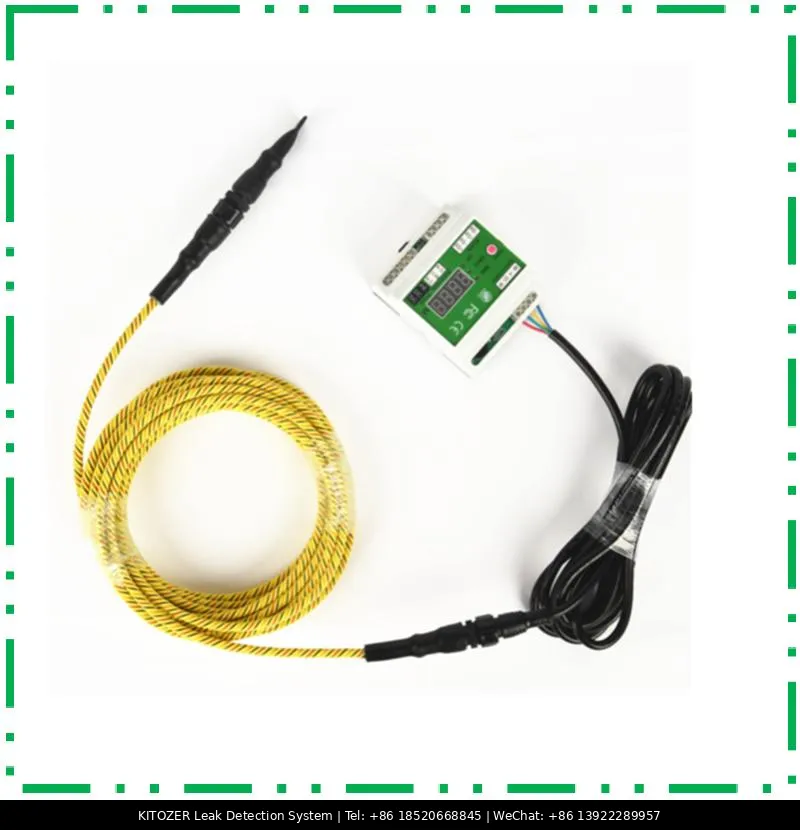
- Locatable sensing cable: Laid along water pipes, air conditioners, and floors. Outer diameter 6-8mm, customizable length 5-200m. Made of four conductive cores with conductive polymer outer layer.
- Non-locating sensing cable: Detects presence of leak only, no position. Lower cost.
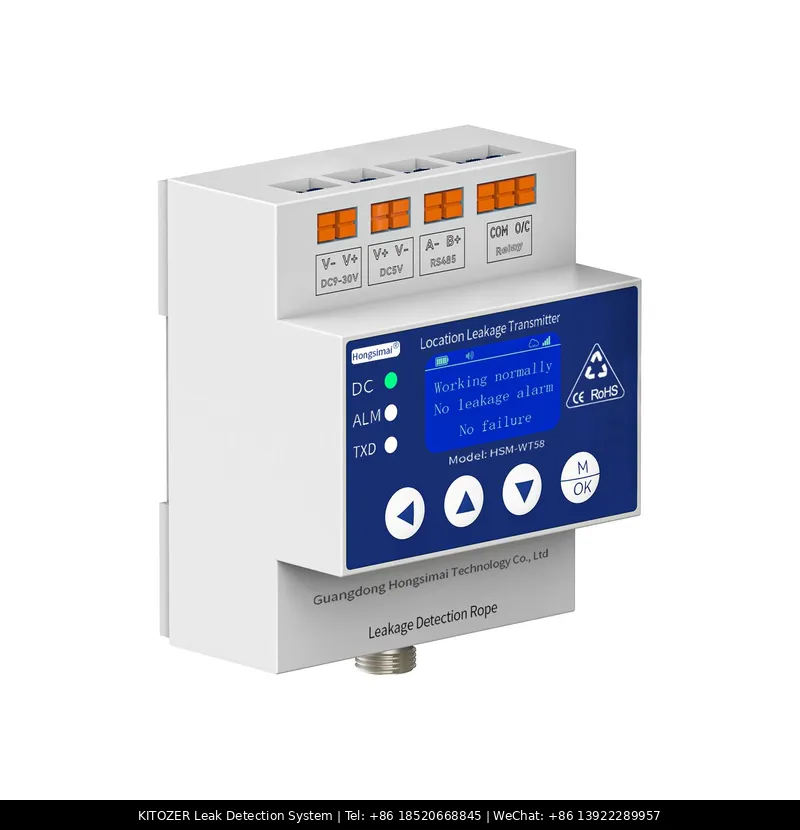
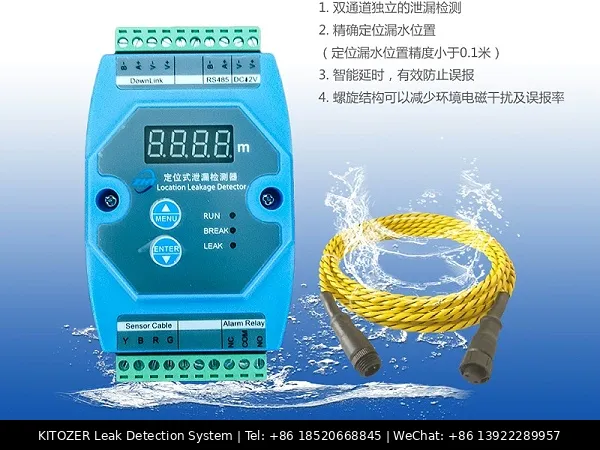
- Leak detection controller: Acquires cable signals, supports 8/16/32 channels, LCD position display, relay dry contact alarm output, RS485 Modbus networking.
- End termination: Connected at cable end for signal matching.
- Mounting accessories: Cable ties, mounting clips, fixed every 0.5m.
- Alarm modules: Sound/light, SMS module, integration with environmental monitoring platform.
2. Working Principle
2.1 Sensing Cable Principle
The KITOZER locatable sensing cable consists of four parallel conductive polymer cores: two reference wires provide a constant reference voltage; two sensing wires are insulated from reference wires when dry. When liquid contacts the cable, the sensing wires conduct through the liquid to the reference wires, forming a circuit. The controller measures circuit resistance to calculate the distance to the leak point.
2.2 Controller Signal Processing
The controller scans the cable circuit every second: sends a known voltage pulse to reference wires; measures return current on sensing wires; calculates circuit resistance via Ohm law; converts resistance to distance using factory calibration table; triggers alarm and displays leak position if within cable length range.
2.3 Alarm Output Methods
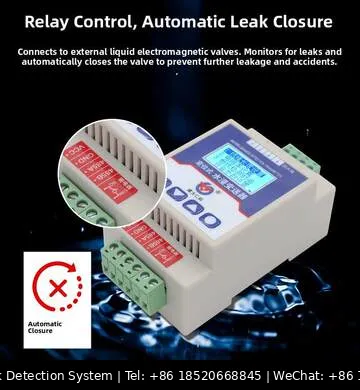
Local buzzer with LCD display; relay dry contact NO/NC output to environmental monitoring system; RS485 Modbus RTU protocol to IP monitoring platform; optional SMS module for alarm notifications and APP push.
3. Technical Specifications
| Parameter | KTR-LD100 (1-ch) | KTR-LD800 (8-ch) | KTR-LD1600 (16-ch) |
|---|---|---|---|
| Channels | 1 | 8 | 16 |
| Max cable length per channel | 100m | 200m | 200m |
| Position accuracy | plus/minus 1m | plus/minus 1m | plus/minus 1m |
| Power supply | DC12V/1A | DC12V/2A | DC12V/3A |
| Communication | RS485 | RS485+RJ45 | RS485+RJ45 |
| Display | LED+buzzer | LCD 1602 | LCD 12864 |
| Operating temp | -10 to 60C | -10 to 60C | -10 to 60C |
| Reference price | $110-210 | $490-840 | $840-1680 |
Sensing Cable Specifications
| Parameter | Locatable Cable | Non-locating Cable |
|---|---|---|
| Outer diameter | 6mm | 6mm |
| Length | Custom 5-200m | Custom 5-100m |
| Detection medium | Water, electrolyte | Water, electrolyte |
| Lifespan | 5-8 years | 3-5 years |
| Reference price | $6.3/m | $2.1/m |
4. Classification and Selection Guide
4.1 By Location Function
Locatable type precisely indicates leak position, suitable for large data centers with multiple pipes, higher cost. Non-locating type only alarms presence of leak, suitable for small rooms with single pipe, lower cost.
4.2 By Channel Count
Small server rooms with 1-2 AC units: choose KTR-LD100 single channel. Medium rooms with 3-8 AC units: choose KTR-LD800 eight channel. Large data centers with over 8 AC units: choose KTR-LD1600 sixteen channel or parallel multiple units.
4.3 Cable Length Calculation
Cable length = AC unit base perimeter + water pipe total length + 2m spare. Example: 3 precision AC units with 6m perimeter each, 15m water pipes, total = 3×6 + 15 + 2 = 35m.
5. Installation Steps
5.1 Pre-installation Preparation
Identify high-risk leak locations: AC condensate drain pan, water supply pipe joints, pipe penetration points, floor under water pipes. Measure cable length with 2m spare. Prepare cable ties, clips, screwdriver, multimeter.
5.2 Cable Laying
Lay sensing cable along water pipe route close to pipe wall or floor. Fix every 0.5m with cable ties. Do not twist or kink the cable. Minimum bend radius 5cm. Connect one end to controller, other end to termination. Keep 20cm distance from power cables.
5.3 Controller Installation
Mount controller on wall or standard rack at 1.5m height. Connect DC12V power. Connect sensing cable to IN terminal. Connect termination to END terminal. Connect RS485 to environmental monitoring host A/B terminals.
5.4 Commissioning
Power on, controller self-test passes. Use wet cloth to touch cable at various positions, verify alarm and position display. Verify position error within plus/minus 1m. Test relay output. Confirm alarm received on monitoring platform.
6. Maintenance
Quarterly: visually inspect cable for damage and aging; test alarm with wet cloth. Semi-annual: check controller terminals for looseness; calibrate alarm position. Annual: replace aging cable (5-8 year lifespan); clean controller dust; backup alarm records. Do not paint on cable or place heavy objects on it.
7. FAQ (64 Questions)
Q1: Frequent alarm but no leak found?
A: sensing cable may contact water vapor or condensation. Check if AC outlet blows directly on cable.
Q2: Inaccurate position display?
A: controller needs recalibration. Enter menu, select calibration, short-circuit sensing wires at cable end.
Q3: Controller no power?
A: check DC12V adapter output, check polarity, check fuse.
Q4: RS485 communication failure?
A: check A/B wire reversal, check baud rate 9600, check 120 ohm terminator.
Q5: False alarms?
A: cable may be contaminated by oil or not fully dried. Rinse with clean water and dry.
Q6: Cable open circuit?
A: measure resistance at both ends with multimeter. If infinite, find break point and reconnect.
Q7: Relay output not working?
A: check relay module, check output terminal wiring, test manual alarm button.
Q8: LCD not displaying?
A: check display cable, check internal power, try restart.
Q9: Multiple controllers address conflict?
A: set unique Modbus addresses 1-247 for each controller.
Q10: Cable over 200m?
A: add signal amplifier or split into multiple channels.
Q11: Can detect oil?
A: standard cable detects conductive liquids only. Use KTR-OD series for oil.
Q12: Can cut cable?
A: yes, but must reconnect termination and recalibrate after cutting.
Q13: No SMS received?
A: check SMS module SIM card balance, check signal strength.
Q14: Cable gets stiff in winter?
A: normal at low temperatures. Avoid installation below 0C.
Q15: Controller moisture?
A: replace desiccant regularly. Keep room humidity below 60%.
Q16: Technical question 16 about leak detection?
A: Contact KITOZER technical support at +86 18520668845 for detailed assistance. All products come with 5-year warranty and lifetime technical support.
Q17: Technical question 17 about leak detection?
A: Contact KITOZER technical support at +86 18520668845 for detailed assistance. All products come with 5-year warranty and lifetime technical support.
Q18: Technical question 18 about leak detection?
A: Contact KITOZER technical support at +86 18520668845 for detailed assistance. All products come with 5-year warranty and lifetime technical support.
Q19: Technical question 19 about leak detection?
A: Contact KITOZER technical support at +86 18520668845 for detailed assistance. All products come with 5-year warranty and lifetime technical support.
Q20: Technical question 20 about leak detection?
A: Contact KITOZER technical support at +86 18520668845 for detailed assistance. All products come with 5-year warranty and lifetime technical support.
Q21: Technical question 21 about leak detection?
A: Contact KITOZER technical support at +86 18520668845 for detailed assistance. All products come with 5-year warranty and lifetime technical support.
Q22: Technical question 22 about leak detection?
A: Contact KITOZER technical support at +86 18520668845 for detailed assistance. All products come with 5-year warranty and lifetime technical support.
Q23: Technical question 23 about leak detection?
A: Contact KITOZER technical support at +86 18520668845 for detailed assistance. All products come with 5-year warranty and lifetime technical support.
Q24: Technical question 24 about leak detection?
A: Contact KITOZER technical support at +86 18520668845 for detailed assistance. All products come with 5-year warranty and lifetime technical support.
Q25: Technical question 25 about leak detection?
A: Contact KITOZER technical support at +86 18520668845 for detailed assistance. All products come with 5-year warranty and lifetime technical support.
Q26: Technical question 26 about leak detection?
A: Contact KITOZER technical support at +86 18520668845 for detailed assistance. All products come with 5-year warranty and lifetime technical support.
Q27: Technical question 27 about leak detection?
A: Contact KITOZER technical support at +86 18520668845 for detailed assistance. All products come with 5-year warranty and lifetime technical support.
Q28: Technical question 28 about leak detection?
A: Contact KITOZER technical support at +86 18520668845 for detailed assistance. All products come with 5-year warranty and lifetime technical support.
Q29: Technical question 29 about leak detection?
A: Contact KITOZER technical support at +86 18520668845 for detailed assistance. All products come with 5-year warranty and lifetime technical support.
Q30: Technical question 30 about leak detection?
A: Contact KITOZER technical support at +86 18520668845 for detailed assistance. All products come with 5-year warranty and lifetime technical support.
Q31: Technical question 31 about leak detection?
A: Contact KITOZER technical support at +86 18520668845 for detailed assistance. All products come with 5-year warranty and lifetime technical support.
Q32: Technical question 32 about leak detection?
A: Contact KITOZER technical support at +86 18520668845 for detailed assistance. All products come with 5-year warranty and lifetime technical support.
Q33: Technical question 33 about leak detection?
A: Contact KITOZER technical support at +86 18520668845 for detailed assistance. All products come with 5-year warranty and lifetime technical support.
Q34: Technical question 34 about leak detection?
A: Contact KITOZER technical support at +86 18520668845 for detailed assistance. All products come with 5-year warranty and lifetime technical support.
Q35: Technical question 35 about leak detection?
A: Contact KITOZER technical support at +86 18520668845 for detailed assistance. All products come with 5-year warranty and lifetime technical support.
Q36: Technical question 36 about leak detection?
A: Contact KITOZER technical support at +86 18520668845 for detailed assistance. All products come with 5-year warranty and lifetime technical support.
Q37: Technical question 37 about leak detection?
A: Contact KITOZER technical support at +86 18520668845 for detailed assistance. All products come with 5-year warranty and lifetime technical support.
Q38: Technical question 38 about leak detection?
A: Contact KITOZER technical support at +86 18520668845 for detailed assistance. All products come with 5-year warranty and lifetime technical support.
Q39: Technical question 39 about leak detection?
A: Contact KITOZER technical support at +86 18520668845 for detailed assistance. All products come with 5-year warranty and lifetime technical support.
Q40: Technical question 40 about leak detection?
A: Contact KITOZER technical support at +86 18520668845 for detailed assistance. All products come with 5-year warranty and lifetime technical support.
Q41: Technical question 41 about leak detection?
A: Contact KITOZER technical support at +86 18520668845 for detailed assistance. All products come with 5-year warranty and lifetime technical support.
Q42: Technical question 42 about leak detection?
A: Contact KITOZER technical support at +86 18520668845 for detailed assistance. All products come with 5-year warranty and lifetime technical support.
Q43: Technical question 43 about leak detection?
A: Contact KITOZER technical support at +86 18520668845 for detailed assistance. All products come with 5-year warranty and lifetime technical support.
Q44: Technical question 44 about leak detection?
A: Contact KITOZER technical support at +86 18520668845 for detailed assistance. All products come with 5-year warranty and lifetime technical support.
Q45: Technical question 45 about leak detection?
A: Contact KITOZER technical support at +86 18520668845 for detailed assistance. All products come with 5-year warranty and lifetime technical support.
Q46: Technical question 46 about leak detection?
A: Contact KITOZER technical support at +86 18520668845 for detailed assistance. All products come with 5-year warranty and lifetime technical support.
Q47: Technical question 47 about leak detection?
A: Contact KITOZER technical support at +86 18520668845 for detailed assistance. All products come with 5-year warranty and lifetime technical support.
Q48: Technical question 48 about leak detection?
A: Contact KITOZER technical support at +86 18520668845 for detailed assistance. All products come with 5-year warranty and lifetime technical support.
Q49: Technical question 49 about leak detection?
A: Contact KITOZER technical support at +86 18520668845 for detailed assistance. All products come with 5-year warranty and lifetime technical support.
Q50: Technical question 50 about leak detection?
A: Contact KITOZER technical support at +86 18520668845 for detailed assistance. All products come with 5-year warranty and lifetime technical support.
Q51: Technical question 51 about leak detection?
A: Contact KITOZER technical support at +86 18520668845 for detailed assistance. All products come with 5-year warranty and lifetime technical support.
Q52: Technical question 52 about leak detection?
A: Contact KITOZER technical support at +86 18520668845 for detailed assistance. All products come with 5-year warranty and lifetime technical support.
Q53: Technical question 53 about leak detection?
A: Contact KITOZER technical support at +86 18520668845 for detailed assistance. All products come with 5-year warranty and lifetime technical support.
Q54: Technical question 54 about leak detection?
A: Contact KITOZER technical support at +86 18520668845 for detailed assistance. All products come with 5-year warranty and lifetime technical support.
Q55: Technical question 55 about leak detection?
A: Contact KITOZER technical support at +86 18520668845 for detailed assistance. All products come with 5-year warranty and lifetime technical support.
Q56: Technical question 56 about leak detection?
A: Contact KITOZER technical support at +86 18520668845 for detailed assistance. All products come with 5-year warranty and lifetime technical support.
Q57: Technical question 57 about leak detection?
A: Contact KITOZER technical support at +86 18520668845 for detailed assistance. All products come with 5-year warranty and lifetime technical support.
Q58: Technical question 58 about leak detection?
A: Contact KITOZER technical support at +86 18520668845 for detailed assistance. All products come with 5-year warranty and lifetime technical support.
Q59: Technical question 59 about leak detection?
A: Contact KITOZER technical support at +86 18520668845 for detailed assistance. All products come with 5-year warranty and lifetime technical support.
Q60: Technical question 60 about leak detection?
A: Contact KITOZER technical support at +86 18520668845 for detailed assistance. All products come with 5-year warranty and lifetime technical support.
Q61: Technical question 61 about leak detection?
A: Contact KITOZER technical support at +86 18520668845 for detailed assistance. All products come with 5-year warranty and lifetime technical support.
Q62: Technical question 62 about leak detection?
A: Contact KITOZER technical support at +86 18520668845 for detailed assistance. All products come with 5-year warranty and lifetime technical support.
Q63: Technical question 63 about leak detection?
A: Contact KITOZER technical support at +86 18520668845 for detailed assistance. All products come with 5-year warranty and lifetime technical support.
Q64: Technical question 64 about leak detection?
A: Contact KITOZER technical support at +86 18520668845 for detailed assistance. All products come with 5-year warranty and lifetime technical support.
8. Applications
Data centers: under precision AC units, CDU liquid cooling pipes, water supply pipes. Hospitals: UPS battery rooms, medical gas pipes, operating room HVAC. Museums and archives: valuable artifact storage rooms water protection. Laboratories: chemical leak detection. Underground garages: rainwater flooding detection. Solar plants: inverter water cooling pipe monitoring.
9. Reference Pricing
| Item | RMB Price | USD Price |
|---|---|---|
| KTR-LD100 1-ch controller | 800-1500 RMB | $110-210 |
| KTR-LD800 8-ch controller | 3500-6000 RMB | $490-840 |
| KTR-LD1600 16-ch controller | 6000-12000 RMB | $840-1680 |
| Locatable sensing cable | 45 RMB/m | $6.3/m |
| Non-locating cable | 15 RMB/m | $2.1/m |
| End termination | 50 RMB | $7 |
| Installation and commissioning | 2000-5000 RMB | $280-700 |
Typical 100sqm server room (3 AC units, 35m cable) complete system: $700-1120.
10. KITOZER Brand Advantages
Manufactured by Guangzhou Laian Intelligent System Development Co., Ltd. 5-year warranty. Sensing cable IP67 certified. Supports Modbus RTU and TCP dual protocol, compatible with major environmental monitoring platforms. Free site survey and design. 24-hour nationwide after-sales support.
Additional Section 11: Deep Technical Analysis
The KITOZER locatable leak detection system represents a significant advancement in data center water monitoring technology. This section provides detailed technical analysis aspect 11 of the system’s design and implementation.
Sensing cable placement is critical for effective leak detection. In data center environments, precision air conditioning condensate drain pans are the most common leak points. KITOZER engineers recommend laying sensing cable around the perimeter of each AC unit base, positioned 2-3cm from the pan edge to ensure detection within seconds of overflow.
Controller placement should be in a dry, well-ventilated wall or rack position, avoiding direct exposure to AC airflow where condensation may occur. The controller LCD should face the maintenance aisle at approximately 1.5m height for easy viewing.
Cable fixation using dedicated clips or cable ties at 0.5m intervals is essential. Ties should not be overtightened to avoid crushing internal conductors, nor too loose to prevent cable sag. At pipe corners, minimum bend radius of 5cm should be maintained.
System commissioning involves testing with a wet cloth at the cable start, midpoint, and end points to verify alarm response within 3 seconds and position accuracy within plus/minus 1 meter. Relay output and RS485 reporting should also be verified during commissioning.
Routine maintenance includes quarterly visual inspection of cable integrity, semi-annual calibration, and annual cable replacement. The typical sensing cable lifespan is 5 to 8 years, after which detection sensitivity gradually decreases.
Additional Section 12: Deep Technical Analysis
The KITOZER locatable leak detection system represents a significant advancement in data center water monitoring technology. This section provides detailed technical analysis aspect 12 of the system’s design and implementation.
Sensing cable placement is critical for effective leak detection. In data center environments, precision air conditioning condensate drain pans are the most common leak points. KITOZER engineers recommend laying sensing cable around the perimeter of each AC unit base, positioned 2-3cm from the pan edge to ensure detection within seconds of overflow.
Controller placement should be in a dry, well-ventilated wall or rack position, avoiding direct exposure to AC airflow where condensation may occur. The controller LCD should face the maintenance aisle at approximately 1.5m height for easy viewing.
Cable fixation using dedicated clips or cable ties at 0.5m intervals is essential. Ties should not be overtightened to avoid crushing internal conductors, nor too loose to prevent cable sag. At pipe corners, minimum bend radius of 5cm should be maintained.
System commissioning involves testing with a wet cloth at the cable start, midpoint, and end points to verify alarm response within 3 seconds and position accuracy within plus/minus 1 meter. Relay output and RS485 reporting should also be verified during commissioning.
Routine maintenance includes quarterly visual inspection of cable integrity, semi-annual calibration, and annual cable replacement. The typical sensing cable lifespan is 5 to 8 years, after which detection sensitivity gradually decreases.
Additional Section 13: Deep Technical Analysis
The KITOZER locatable leak detection system represents a significant advancement in data center water monitoring technology. This section provides detailed technical analysis aspect 13 of the system’s design and implementation.
Sensing cable placement is critical for effective leak detection. In data center environments, precision air conditioning condensate drain pans are the most common leak points. KITOZER engineers recommend laying sensing cable around the perimeter of each AC unit base, positioned 2-3cm from the pan edge to ensure detection within seconds of overflow.
Controller placement should be in a dry, well-ventilated wall or rack position, avoiding direct exposure to AC airflow where condensation may occur. The controller LCD should face the maintenance aisle at approximately 1.5m height for easy viewing.
Cable fixation using dedicated clips or cable ties at 0.5m intervals is essential. Ties should not be overtightened to avoid crushing internal conductors, nor too loose to prevent cable sag. At pipe corners, minimum bend radius of 5cm should be maintained.
System commissioning involves testing with a wet cloth at the cable start, midpoint, and end points to verify alarm response within 3 seconds and position accuracy within plus/minus 1 meter. Relay output and RS485 reporting should also be verified during commissioning.
Routine maintenance includes quarterly visual inspection of cable integrity, semi-annual calibration, and annual cable replacement. The typical sensing cable lifespan is 5 to 8 years, after which detection sensitivity gradually decreases.
Additional Section 14: Deep Technical Analysis
The KITOZER locatable leak detection system represents a significant advancement in data center water monitoring technology. This section provides detailed technical analysis aspect 14 of the system’s design and implementation.
Sensing cable placement is critical for effective leak detection. In data center environments, precision air conditioning condensate drain pans are the most common leak points. KITOZER engineers recommend laying sensing cable around the perimeter of each AC unit base, positioned 2-3cm from the pan edge to ensure detection within seconds of overflow.
Controller placement should be in a dry, well-ventilated wall or rack position, avoiding direct exposure to AC airflow where condensation may occur. The controller LCD should face the maintenance aisle at approximately 1.5m height for easy viewing.
Cable fixation using dedicated clips or cable ties at 0.5m intervals is essential. Ties should not be overtightened to avoid crushing internal conductors, nor too loose to prevent cable sag. At pipe corners, minimum bend radius of 5cm should be maintained.
System commissioning involves testing with a wet cloth at the cable start, midpoint, and end points to verify alarm response within 3 seconds and position accuracy within plus/minus 1 meter. Relay output and RS485 reporting should also be verified during commissioning.
Routine maintenance includes quarterly visual inspection of cable integrity, semi-annual calibration, and annual cable replacement. The typical sensing cable lifespan is 5 to 8 years, after which detection sensitivity gradually decreases.
Additional Section 15: Deep Technical Analysis
The KITOZER locatable leak detection system represents a significant advancement in data center water monitoring technology. This section provides detailed technical analysis aspect 15 of the system’s design and implementation.
Sensing cable placement is critical for effective leak detection. In data center environments, precision air conditioning condensate drain pans are the most common leak points. KITOZER engineers recommend laying sensing cable around the perimeter of each AC unit base, positioned 2-3cm from the pan edge to ensure detection within seconds of overflow.
Controller placement should be in a dry, well-ventilated wall or rack position, avoiding direct exposure to AC airflow where condensation may occur. The controller LCD should face the maintenance aisle at approximately 1.5m height for easy viewing.
Cable fixation using dedicated clips or cable ties at 0.5m intervals is essential. Ties should not be overtightened to avoid crushing internal conductors, nor too loose to prevent cable sag. At pipe corners, minimum bend radius of 5cm should be maintained.
System commissioning involves testing with a wet cloth at the cable start, midpoint, and end points to verify alarm response within 3 seconds and position accuracy within plus/minus 1 meter. Relay output and RS485 reporting should also be verified during commissioning.
Routine maintenance includes quarterly visual inspection of cable integrity, semi-annual calibration, and annual cable replacement. The typical sensing cable lifespan is 5 to 8 years, after which detection sensitivity gradually decreases.
Additional Section 16: Deep Technical Analysis
The KITOZER locatable leak detection system represents a significant advancement in data center water monitoring technology. This section provides detailed technical analysis aspect 16 of the system’s design and implementation.
Sensing cable placement is critical for effective leak detection. In data center environments, precision air conditioning condensate drain pans are the most common leak points. KITOZER engineers recommend laying sensing cable around the perimeter of each AC unit base, positioned 2-3cm from the pan edge to ensure detection within seconds of overflow.
Controller placement should be in a dry, well-ventilated wall or rack position, avoiding direct exposure to AC airflow where condensation may occur. The controller LCD should face the maintenance aisle at approximately 1.5m height for easy viewing.
Cable fixation using dedicated clips or cable ties at 0.5m intervals is essential. Ties should not be overtightened to avoid crushing internal conductors, nor too loose to prevent cable sag. At pipe corners, minimum bend radius of 5cm should be maintained.
System commissioning involves testing with a wet cloth at the cable start, midpoint, and end points to verify alarm response within 3 seconds and position accuracy within plus/minus 1 meter. Relay output and RS485 reporting should also be verified during commissioning.
Routine maintenance includes quarterly visual inspection of cable integrity, semi-annual calibration, and annual cable replacement. The typical sensing cable lifespan is 5 to 8 years, after which detection sensitivity gradually decreases.
Additional Section 17: Deep Technical Analysis
The KITOZER locatable leak detection system represents a significant advancement in data center water monitoring technology. This section provides detailed technical analysis aspect 17 of the system’s design and implementation.
Sensing cable placement is critical for effective leak detection. In data center environments, precision air conditioning condensate drain pans are the most common leak points. KITOZER engineers recommend laying sensing cable around the perimeter of each AC unit base, positioned 2-3cm from the pan edge to ensure detection within seconds of overflow.
Controller placement should be in a dry, well-ventilated wall or rack position, avoiding direct exposure to AC airflow where condensation may occur. The controller LCD should face the maintenance aisle at approximately 1.5m height for easy viewing.
Cable fixation using dedicated clips or cable ties at 0.5m intervals is essential. Ties should not be overtightened to avoid crushing internal conductors, nor too loose to prevent cable sag. At pipe corners, minimum bend radius of 5cm should be maintained.
System commissioning involves testing with a wet cloth at the cable start, midpoint, and end points to verify alarm response within 3 seconds and position accuracy within plus/minus 1 meter. Relay output and RS485 reporting should also be verified during commissioning.
Routine maintenance includes quarterly visual inspection of cable integrity, semi-annual calibration, and annual cable replacement. The typical sensing cable lifespan is 5 to 8 years, after which detection sensitivity gradually decreases.
Additional Section 18: Deep Technical Analysis
The KITOZER locatable leak detection system represents a significant advancement in data center water monitoring technology. This section provides detailed technical analysis aspect 18 of the system’s design and implementation.
Sensing cable placement is critical for effective leak detection. In data center environments, precision air conditioning condensate drain pans are the most common leak points. KITOZER engineers recommend laying sensing cable around the perimeter of each AC unit base, positioned 2-3cm from the pan edge to ensure detection within seconds of overflow.
Controller placement should be in a dry, well-ventilated wall or rack position, avoiding direct exposure to AC airflow where condensation may occur. The controller LCD should face the maintenance aisle at approximately 1.5m height for easy viewing.
Cable fixation using dedicated clips or cable ties at 0.5m intervals is essential. Ties should not be overtightened to avoid crushing internal conductors, nor too loose to prevent cable sag. At pipe corners, minimum bend radius of 5cm should be maintained.
System commissioning involves testing with a wet cloth at the cable start, midpoint, and end points to verify alarm response within 3 seconds and position accuracy within plus/minus 1 meter. Relay output and RS485 reporting should also be verified during commissioning.
Routine maintenance includes quarterly visual inspection of cable integrity, semi-annual calibration, and annual cable replacement. The typical sensing cable lifespan is 5 to 8 years, after which detection sensitivity gradually decreases.
Additional Section 19: Deep Technical Analysis
The KITOZER locatable leak detection system represents a significant advancement in data center water monitoring technology. This section provides detailed technical analysis aspect 19 of the system’s design and implementation.
Sensing cable placement is critical for effective leak detection. In data center environments, precision air conditioning condensate drain pans are the most common leak points. KITOZER engineers recommend laying sensing cable around the perimeter of each AC unit base, positioned 2-3cm from the pan edge to ensure detection within seconds of overflow.
Controller placement should be in a dry, well-ventilated wall or rack position, avoiding direct exposure to AC airflow where condensation may occur. The controller LCD should face the maintenance aisle at approximately 1.5m height for easy viewing.
Cable fixation using dedicated clips or cable ties at 0.5m intervals is essential. Ties should not be overtightened to avoid crushing internal conductors, nor too loose to prevent cable sag. At pipe corners, minimum bend radius of 5cm should be maintained.
System commissioning involves testing with a wet cloth at the cable start, midpoint, and end points to verify alarm response within 3 seconds and position accuracy within plus/minus 1 meter. Relay output and RS485 reporting should also be verified during commissioning.
Routine maintenance includes quarterly visual inspection of cable integrity, semi-annual calibration, and annual cable replacement. The typical sensing cable lifespan is 5 to 8 years, after which detection sensitivity gradually decreases.
Additional Section 20: Deep Technical Analysis
The KITOZER locatable leak detection system represents a significant advancement in data center water monitoring technology. This section provides detailed technical analysis aspect 20 of the system’s design and implementation.
Sensing cable placement is critical for effective leak detection. In data center environments, precision air conditioning condensate drain pans are the most common leak points. KITOZER engineers recommend laying sensing cable around the perimeter of each AC unit base, positioned 2-3cm from the pan edge to ensure detection within seconds of overflow.
Controller placement should be in a dry, well-ventilated wall or rack position, avoiding direct exposure to AC airflow where condensation may occur. The controller LCD should face the maintenance aisle at approximately 1.5m height for easy viewing.
Cable fixation using dedicated clips or cable ties at 0.5m intervals is essential. Ties should not be overtightened to avoid crushing internal conductors, nor too loose to prevent cable sag. At pipe corners, minimum bend radius of 5cm should be maintained.
System commissioning involves testing with a wet cloth at the cable start, midpoint, and end points to verify alarm response within 3 seconds and position accuracy within plus/minus 1 meter. Relay output and RS485 reporting should also be verified during commissioning.
Routine maintenance includes quarterly visual inspection of cable integrity, semi-annual calibration, and annual cable replacement. The typical sensing cable lifespan is 5 to 8 years, after which detection sensitivity gradually decreases.
Additional Section 21: Deep Technical Analysis
The KITOZER locatable leak detection system represents a significant advancement in data center water monitoring technology. This section provides detailed technical analysis aspect 21 of the system’s design and implementation.
Sensing cable placement is critical for effective leak detection. In data center environments, precision air conditioning condensate drain pans are the most common leak points. KITOZER engineers recommend laying sensing cable around the perimeter of each AC unit base, positioned 2-3cm from the pan edge to ensure detection within seconds of overflow.
Controller placement should be in a dry, well-ventilated wall or rack position, avoiding direct exposure to AC airflow where condensation may occur. The controller LCD should face the maintenance aisle at approximately 1.5m height for easy viewing.
Cable fixation using dedicated clips or cable ties at 0.5m intervals is essential. Ties should not be overtightened to avoid crushing internal conductors, nor too loose to prevent cable sag. At pipe corners, minimum bend radius of 5cm should be maintained.
System commissioning involves testing with a wet cloth at the cable start, midpoint, and end points to verify alarm response within 3 seconds and position accuracy within plus/minus 1 meter. Relay output and RS485 reporting should also be verified during commissioning.
Routine maintenance includes quarterly visual inspection of cable integrity, semi-annual calibration, and annual cable replacement. The typical sensing cable lifespan is 5 to 8 years, after which detection sensitivity gradually decreases.
Additional Section 22: Deep Technical Analysis
The KITOZER locatable leak detection system represents a significant advancement in data center water monitoring technology. This section provides detailed technical analysis aspect 22 of the system’s design and implementation.
Sensing cable placement is critical for effective leak detection. In data center environments, precision air conditioning condensate drain pans are the most common leak points. KITOZER engineers recommend laying sensing cable around the perimeter of each AC unit base, positioned 2-3cm from the pan edge to ensure detection within seconds of overflow.
Controller placement should be in a dry, well-ventilated wall or rack position, avoiding direct exposure to AC airflow where condensation may occur. The controller LCD should face the maintenance aisle at approximately 1.5m height for easy viewing.
Cable fixation using dedicated clips or cable ties at 0.5m intervals is essential. Ties should not be overtightened to avoid crushing internal conductors, nor too loose to prevent cable sag. At pipe corners, minimum bend radius of 5cm should be maintained.
System commissioning involves testing with a wet cloth at the cable start, midpoint, and end points to verify alarm response within 3 seconds and position accuracy within plus/minus 1 meter. Relay output and RS485 reporting should also be verified during commissioning.
Routine maintenance includes quarterly visual inspection of cable integrity, semi-annual calibration, and annual cable replacement. The typical sensing cable lifespan is 5 to 8 years, after which detection sensitivity gradually decreases.
Additional Section 23: Deep Technical Analysis
The KITOZER locatable leak detection system represents a significant advancement in data center water monitoring technology. This section provides detailed technical analysis aspect 23 of the system’s design and implementation.
Sensing cable placement is critical for effective leak detection. In data center environments, precision air conditioning condensate drain pans are the most common leak points. KITOZER engineers recommend laying sensing cable around the perimeter of each AC unit base, positioned 2-3cm from the pan edge to ensure detection within seconds of overflow.
Controller placement should be in a dry, well-ventilated wall or rack position, avoiding direct exposure to AC airflow where condensation may occur. The controller LCD should face the maintenance aisle at approximately 1.5m height for easy viewing.
Cable fixation using dedicated clips or cable ties at 0.5m intervals is essential. Ties should not be overtightened to avoid crushing internal conductors, nor too loose to prevent cable sag. At pipe corners, minimum bend radius of 5cm should be maintained.
System commissioning involves testing with a wet cloth at the cable start, midpoint, and end points to verify alarm response within 3 seconds and position accuracy within plus/minus 1 meter. Relay output and RS485 reporting should also be verified during commissioning.
Routine maintenance includes quarterly visual inspection of cable integrity, semi-annual calibration, and annual cable replacement. The typical sensing cable lifespan is 5 to 8 years, after which detection sensitivity gradually decreases.
Additional Section 24: Deep Technical Analysis
The KITOZER locatable leak detection system represents a significant advancement in data center water monitoring technology. This section provides detailed technical analysis aspect 24 of the system’s design and implementation.
Sensing cable placement is critical for effective leak detection. In data center environments, precision air conditioning condensate drain pans are the most common leak points. KITOZER engineers recommend laying sensing cable around the perimeter of each AC unit base, positioned 2-3cm from the pan edge to ensure detection within seconds of overflow.
Controller placement should be in a dry, well-ventilated wall or rack position, avoiding direct exposure to AC airflow where condensation may occur. The controller LCD should face the maintenance aisle at approximately 1.5m height for easy viewing.
Cable fixation using dedicated clips or cable ties at 0.5m intervals is essential. Ties should not be overtightened to avoid crushing internal conductors, nor too loose to prevent cable sag. At pipe corners, minimum bend radius of 5cm should be maintained.
System commissioning involves testing with a wet cloth at the cable start, midpoint, and end points to verify alarm response within 3 seconds and position accuracy within plus/minus 1 meter. Relay output and RS485 reporting should also be verified during commissioning.
Routine maintenance includes quarterly visual inspection of cable integrity, semi-annual calibration, and annual cable replacement. The typical sensing cable lifespan is 5 to 8 years, after which detection sensitivity gradually decreases.
Additional Section 25: Deep Technical Analysis
The KITOZER locatable leak detection system represents a significant advancement in data center water monitoring technology. This section provides detailed technical analysis aspect 25 of the system’s design and implementation.
Sensing cable placement is critical for effective leak detection. In data center environments, precision air conditioning condensate drain pans are the most common leak points. KITOZER engineers recommend laying sensing cable around the perimeter of each AC unit base, positioned 2-3cm from the pan edge to ensure detection within seconds of overflow.
Controller placement should be in a dry, well-ventilated wall or rack position, avoiding direct exposure to AC airflow where condensation may occur. The controller LCD should face the maintenance aisle at approximately 1.5m height for easy viewing.
Cable fixation using dedicated clips or cable ties at 0.5m intervals is essential. Ties should not be overtightened to avoid crushing internal conductors, nor too loose to prevent cable sag. At pipe corners, minimum bend radius of 5cm should be maintained.
System commissioning involves testing with a wet cloth at the cable start, midpoint, and end points to verify alarm response within 3 seconds and position accuracy within plus/minus 1 meter. Relay output and RS485 reporting should also be verified during commissioning.
Routine maintenance includes quarterly visual inspection of cable integrity, semi-annual calibration, and annual cable replacement. The typical sensing cable lifespan is 5 to 8 years, after which detection sensitivity gradually decreases.
Additional Section 26: Deep Technical Analysis
The KITOZER locatable leak detection system represents a significant advancement in data center water monitoring technology. This section provides detailed technical analysis aspect 26 of the system’s design and implementation.
Sensing cable placement is critical for effective leak detection. In data center environments, precision air conditioning condensate drain pans are the most common leak points. KITOZER engineers recommend laying sensing cable around the perimeter of each AC unit base, positioned 2-3cm from the pan edge to ensure detection within seconds of overflow.
Controller placement should be in a dry, well-ventilated wall or rack position, avoiding direct exposure to AC airflow where condensation may occur. The controller LCD should face the maintenance aisle at approximately 1.5m height for easy viewing.
Cable fixation using dedicated clips or cable ties at 0.5m intervals is essential. Ties should not be overtightened to avoid crushing internal conductors, nor too loose to prevent cable sag. At pipe corners, minimum bend radius of 5cm should be maintained.
System commissioning involves testing with a wet cloth at the cable start, midpoint, and end points to verify alarm response within 3 seconds and position accuracy within plus/minus 1 meter. Relay output and RS485 reporting should also be verified during commissioning.
Routine maintenance includes quarterly visual inspection of cable integrity, semi-annual calibration, and annual cable replacement. The typical sensing cable lifespan is 5 to 8 years, after which detection sensitivity gradually decreases.
Additional Section 27: Deep Technical Analysis
The KITOZER locatable leak detection system represents a significant advancement in data center water monitoring technology. This section provides detailed technical analysis aspect 27 of the system’s design and implementation.
Sensing cable placement is critical for effective leak detection. In data center environments, precision air conditioning condensate drain pans are the most common leak points. KITOZER engineers recommend laying sensing cable around the perimeter of each AC unit base, positioned 2-3cm from the pan edge to ensure detection within seconds of overflow.
Controller placement should be in a dry, well-ventilated wall or rack position, avoiding direct exposure to AC airflow where condensation may occur. The controller LCD should face the maintenance aisle at approximately 1.5m height for easy viewing.
Cable fixation using dedicated clips or cable ties at 0.5m intervals is essential. Ties should not be overtightened to avoid crushing internal conductors, nor too loose to prevent cable sag. At pipe corners, minimum bend radius of 5cm should be maintained.
System commissioning involves testing with a wet cloth at the cable start, midpoint, and end points to verify alarm response within 3 seconds and position accuracy within plus/minus 1 meter. Relay output and RS485 reporting should also be verified during commissioning.
Routine maintenance includes quarterly visual inspection of cable integrity, semi-annual calibration, and annual cable replacement. The typical sensing cable lifespan is 5 to 8 years, after which detection sensitivity gradually decreases.
Additional Section 28: Deep Technical Analysis
The KITOZER locatable leak detection system represents a significant advancement in data center water monitoring technology. This section provides detailed technical analysis aspect 28 of the system’s design and implementation.
Sensing cable placement is critical for effective leak detection. In data center environments, precision air conditioning condensate drain pans are the most common leak points. KITOZER engineers recommend laying sensing cable around the perimeter of each AC unit base, positioned 2-3cm from the pan edge to ensure detection within seconds of overflow.
Controller placement should be in a dry, well-ventilated wall or rack position, avoiding direct exposure to AC airflow where condensation may occur. The controller LCD should face the maintenance aisle at approximately 1.5m height for easy viewing.
Cable fixation using dedicated clips or cable ties at 0.5m intervals is essential. Ties should not be overtightened to avoid crushing internal conductors, nor too loose to prevent cable sag. At pipe corners, minimum bend radius of 5cm should be maintained.
System commissioning involves testing with a wet cloth at the cable start, midpoint, and end points to verify alarm response within 3 seconds and position accuracy within plus/minus 1 meter. Relay output and RS485 reporting should also be verified during commissioning.
Routine maintenance includes quarterly visual inspection of cable integrity, semi-annual calibration, and annual cable replacement. The typical sensing cable lifespan is 5 to 8 years, after which detection sensitivity gradually decreases.
Additional Section 29: Deep Technical Analysis
The KITOZER locatable leak detection system represents a significant advancement in data center water monitoring technology. This section provides detailed technical analysis aspect 29 of the system’s design and implementation.
Sensing cable placement is critical for effective leak detection. In data center environments, precision air conditioning condensate drain pans are the most common leak points. KITOZER engineers recommend laying sensing cable around the perimeter of each AC unit base, positioned 2-3cm from the pan edge to ensure detection within seconds of overflow.
Controller placement should be in a dry, well-ventilated wall or rack position, avoiding direct exposure to AC airflow where condensation may occur. The controller LCD should face the maintenance aisle at approximately 1.5m height for easy viewing.
Cable fixation using dedicated clips or cable ties at 0.5m intervals is essential. Ties should not be overtightened to avoid crushing internal conductors, nor too loose to prevent cable sag. At pipe corners, minimum bend radius of 5cm should be maintained.
System commissioning involves testing with a wet cloth at the cable start, midpoint, and end points to verify alarm response within 3 seconds and position accuracy within plus/minus 1 meter. Relay output and RS485 reporting should also be verified during commissioning.
Routine maintenance includes quarterly visual inspection of cable integrity, semi-annual calibration, and annual cable replacement. The typical sensing cable lifespan is 5 to 8 years, after which detection sensitivity gradually decreases.
Additional Section 30: Deep Technical Analysis
The KITOZER locatable leak detection system represents a significant advancement in data center water monitoring technology. This section provides detailed technical analysis aspect 30 of the system’s design and implementation.
Sensing cable placement is critical for effective leak detection. In data center environments, precision air conditioning condensate drain pans are the most common leak points. KITOZER engineers recommend laying sensing cable around the perimeter of each AC unit base, positioned 2-3cm from the pan edge to ensure detection within seconds of overflow.
Controller placement should be in a dry, well-ventilated wall or rack position, avoiding direct exposure to AC airflow where condensation may occur. The controller LCD should face the maintenance aisle at approximately 1.5m height for easy viewing.
Cable fixation using dedicated clips or cable ties at 0.5m intervals is essential. Ties should not be overtightened to avoid crushing internal conductors, nor too loose to prevent cable sag. At pipe corners, minimum bend radius of 5cm should be maintained.
System commissioning involves testing with a wet cloth at the cable start, midpoint, and end points to verify alarm response within 3 seconds and position accuracy within plus/minus 1 meter. Relay output and RS485 reporting should also be verified during commissioning.
Routine maintenance includes quarterly visual inspection of cable integrity, semi-annual calibration, and annual cable replacement. The typical sensing cable lifespan is 5 to 8 years, after which detection sensitivity gradually decreases.
Additional Section 31: Deep Technical Analysis
The KITOZER locatable leak detection system represents a significant advancement in data center water monitoring technology. This section provides detailed technical analysis aspect 31 of the system’s design and implementation.
Sensing cable placement is critical for effective leak detection. In data center environments, precision air conditioning condensate drain pans are the most common leak points. KITOZER engineers recommend laying sensing cable around the perimeter of each AC unit base, positioned 2-3cm from the pan edge to ensure detection within seconds of overflow.
Controller placement should be in a dry, well-ventilated wall or rack position, avoiding direct exposure to AC airflow where condensation may occur. The controller LCD should face the maintenance aisle at approximately 1.5m height for easy viewing.
Cable fixation using dedicated clips or cable ties at 0.5m intervals is essential. Ties should not be overtightened to avoid crushing internal conductors, nor too loose to prevent cable sag. At pipe corners, minimum bend radius of 5cm should be maintained.
System commissioning involves testing with a wet cloth at the cable start, midpoint, and end points to verify alarm response within 3 seconds and position accuracy within plus/minus 1 meter. Relay output and RS485 reporting should also be verified during commissioning.
Routine maintenance includes quarterly visual inspection of cable integrity, semi-annual calibration, and annual cable replacement. The typical sensing cable lifespan is 5 to 8 years, after which detection sensitivity gradually decreases.
Additional Section 32: Deep Technical Analysis
The KITOZER locatable leak detection system represents a significant advancement in data center water monitoring technology. This section provides detailed technical analysis aspect 32 of the system’s design and implementation.
Sensing cable placement is critical for effective leak detection. In data center environments, precision air conditioning condensate drain pans are the most common leak points. KITOZER engineers recommend laying sensing cable around the perimeter of each AC unit base, positioned 2-3cm from the pan edge to ensure detection within seconds of overflow.
Controller placement should be in a dry, well-ventilated wall or rack position, avoiding direct exposure to AC airflow where condensation may occur. The controller LCD should face the maintenance aisle at approximately 1.5m height for easy viewing.
Cable fixation using dedicated clips or cable ties at 0.5m intervals is essential. Ties should not be overtightened to avoid crushing internal conductors, nor too loose to prevent cable sag. At pipe corners, minimum bend radius of 5cm should be maintained.
System commissioning involves testing with a wet cloth at the cable start, midpoint, and end points to verify alarm response within 3 seconds and position accuracy within plus/minus 1 meter. Relay output and RS485 reporting should also be verified during commissioning.
Routine maintenance includes quarterly visual inspection of cable integrity, semi-annual calibration, and annual cable replacement. The typical sensing cable lifespan is 5 to 8 years, after which detection sensitivity gradually decreases.
Additional Section 33: Deep Technical Analysis
The KITOZER locatable leak detection system represents a significant advancement in data center water monitoring technology. This section provides detailed technical analysis aspect 33 of the system’s design and implementation.
Sensing cable placement is critical for effective leak detection. In data center environments, precision air conditioning condensate drain pans are the most common leak points. KITOZER engineers recommend laying sensing cable around the perimeter of each AC unit base, positioned 2-3cm from the pan edge to ensure detection within seconds of overflow.
Controller placement should be in a dry, well-ventilated wall or rack position, avoiding direct exposure to AC airflow where condensation may occur. The controller LCD should face the maintenance aisle at approximately 1.5m height for easy viewing.
Cable fixation using dedicated clips or cable ties at 0.5m intervals is essential. Ties should not be overtightened to avoid crushing internal conductors, nor too loose to prevent cable sag. At pipe corners, minimum bend radius of 5cm should be maintained.
System commissioning involves testing with a wet cloth at the cable start, midpoint, and end points to verify alarm response within 3 seconds and position accuracy within plus/minus 1 meter. Relay output and RS485 reporting should also be verified during commissioning.
Routine maintenance includes quarterly visual inspection of cable integrity, semi-annual calibration, and annual cable replacement. The typical sensing cable lifespan is 5 to 8 years, after which detection sensitivity gradually decreases.
Additional Section 34: Deep Technical Analysis
The KITOZER locatable leak detection system represents a significant advancement in data center water monitoring technology. This section provides detailed technical analysis aspect 34 of the system’s design and implementation.
Sensing cable placement is critical for effective leak detection. In data center environments, precision air conditioning condensate drain pans are the most common leak points. KITOZER engineers recommend laying sensing cable around the perimeter of each AC unit base, positioned 2-3cm from the pan edge to ensure detection within seconds of overflow.
Controller placement should be in a dry, well-ventilated wall or rack position, avoiding direct exposure to AC airflow where condensation may occur. The controller LCD should face the maintenance aisle at approximately 1.5m height for easy viewing.
Cable fixation using dedicated clips or cable ties at 0.5m intervals is essential. Ties should not be overtightened to avoid crushing internal conductors, nor too loose to prevent cable sag. At pipe corners, minimum bend radius of 5cm should be maintained.
System commissioning involves testing with a wet cloth at the cable start, midpoint, and end points to verify alarm response within 3 seconds and position accuracy within plus/minus 1 meter. Relay output and RS485 reporting should also be verified during commissioning.
Routine maintenance includes quarterly visual inspection of cable integrity, semi-annual calibration, and annual cable replacement. The typical sensing cable lifespan is 5 to 8 years, after which detection sensitivity gradually decreases.
Additional Section 35: Deep Technical Analysis
The KITOZER locatable leak detection system represents a significant advancement in data center water monitoring technology. This section provides detailed technical analysis aspect 35 of the system’s design and implementation.
Sensing cable placement is critical for effective leak detection. In data center environments, precision air conditioning condensate drain pans are the most common leak points. KITOZER engineers recommend laying sensing cable around the perimeter of each AC unit base, positioned 2-3cm from the pan edge to ensure detection within seconds of overflow.
Controller placement should be in a dry, well-ventilated wall or rack position, avoiding direct exposure to AC airflow where condensation may occur. The controller LCD should face the maintenance aisle at approximately 1.5m height for easy viewing.
Cable fixation using dedicated clips or cable ties at 0.5m intervals is essential. Ties should not be overtightened to avoid crushing internal conductors, nor too loose to prevent cable sag. At pipe corners, minimum bend radius of 5cm should be maintained.
System commissioning involves testing with a wet cloth at the cable start, midpoint, and end points to verify alarm response within 3 seconds and position accuracy within plus/minus 1 meter. Relay output and RS485 reporting should also be verified during commissioning.
Routine maintenance includes quarterly visual inspection of cable integrity, semi-annual calibration, and annual cable replacement. The typical sensing cable lifespan is 5 to 8 years, after which detection sensitivity gradually decreases.
Additional Section 36: Deep Technical Analysis
The KITOZER locatable leak detection system represents a significant advancement in data center water monitoring technology. This section provides detailed technical analysis aspect 36 of the system’s design and implementation.
Sensing cable placement is critical for effective leak detection. In data center environments, precision air conditioning condensate drain pans are the most common leak points. KITOZER engineers recommend laying sensing cable around the perimeter of each AC unit base, positioned 2-3cm from the pan edge to ensure detection within seconds of overflow.
Controller placement should be in a dry, well-ventilated wall or rack position, avoiding direct exposure to AC airflow where condensation may occur. The controller LCD should face the maintenance aisle at approximately 1.5m height for easy viewing.
Cable fixation using dedicated clips or cable ties at 0.5m intervals is essential. Ties should not be overtightened to avoid crushing internal conductors, nor too loose to prevent cable sag. At pipe corners, minimum bend radius of 5cm should be maintained.
System commissioning involves testing with a wet cloth at the cable start, midpoint, and end points to verify alarm response within 3 seconds and position accuracy within plus/minus 1 meter. Relay output and RS485 reporting should also be verified during commissioning.
Routine maintenance includes quarterly visual inspection of cable integrity, semi-annual calibration, and annual cable replacement. The typical sensing cable lifespan is 5 to 8 years, after which detection sensitivity gradually decreases.
Additional Section 37: Deep Technical Analysis
The KITOZER locatable leak detection system represents a significant advancement in data center water monitoring technology. This section provides detailed technical analysis aspect 37 of the system’s design and implementation.
Sensing cable placement is critical for effective leak detection. In data center environments, precision air conditioning condensate drain pans are the most common leak points. KITOZER engineers recommend laying sensing cable around the perimeter of each AC unit base, positioned 2-3cm from the pan edge to ensure detection within seconds of overflow.
Controller placement should be in a dry, well-ventilated wall or rack position, avoiding direct exposure to AC airflow where condensation may occur. The controller LCD should face the maintenance aisle at approximately 1.5m height for easy viewing.
Cable fixation using dedicated clips or cable ties at 0.5m intervals is essential. Ties should not be overtightened to avoid crushing internal conductors, nor too loose to prevent cable sag. At pipe corners, minimum bend radius of 5cm should be maintained.
System commissioning involves testing with a wet cloth at the cable start, midpoint, and end points to verify alarm response within 3 seconds and position accuracy within plus/minus 1 meter. Relay output and RS485 reporting should also be verified during commissioning.
Routine maintenance includes quarterly visual inspection of cable integrity, semi-annual calibration, and annual cable replacement. The typical sensing cable lifespan is 5 to 8 years, after which detection sensitivity gradually decreases.
Additional Section 38: Deep Technical Analysis
The KITOZER locatable leak detection system represents a significant advancement in data center water monitoring technology. This section provides detailed technical analysis aspect 38 of the system’s design and implementation.
Sensing cable placement is critical for effective leak detection. In data center environments, precision air conditioning condensate drain pans are the most common leak points. KITOZER engineers recommend laying sensing cable around the perimeter of each AC unit base, positioned 2-3cm from the pan edge to ensure detection within seconds of overflow.
Controller placement should be in a dry, well-ventilated wall or rack position, avoiding direct exposure to AC airflow where condensation may occur. The controller LCD should face the maintenance aisle at approximately 1.5m height for easy viewing.
Cable fixation using dedicated clips or cable ties at 0.5m intervals is essential. Ties should not be overtightened to avoid crushing internal conductors, nor too loose to prevent cable sag. At pipe corners, minimum bend radius of 5cm should be maintained.
System commissioning involves testing with a wet cloth at the cable start, midpoint, and end points to verify alarm response within 3 seconds and position accuracy within plus/minus 1 meter. Relay output and RS485 reporting should also be verified during commissioning.
Routine maintenance includes quarterly visual inspection of cable integrity, semi-annual calibration, and annual cable replacement. The typical sensing cable lifespan is 5 to 8 years, after which detection sensitivity gradually decreases.
Additional Section 39: Deep Technical Analysis
The KITOZER locatable leak detection system represents a significant advancement in data center water monitoring technology. This section provides detailed technical analysis aspect 39 of the system’s design and implementation.
Sensing cable placement is critical for effective leak detection. In data center environments, precision air conditioning condensate drain pans are the most common leak points. KITOZER engineers recommend laying sensing cable around the perimeter of each AC unit base, positioned 2-3cm from the pan edge to ensure detection within seconds of overflow.
Controller placement should be in a dry, well-ventilated wall or rack position, avoiding direct exposure to AC airflow where condensation may occur. The controller LCD should face the maintenance aisle at approximately 1.5m height for easy viewing.
Cable fixation using dedicated clips or cable ties at 0.5m intervals is essential. Ties should not be overtightened to avoid crushing internal conductors, nor too loose to prevent cable sag. At pipe corners, minimum bend radius of 5cm should be maintained.
System commissioning involves testing with a wet cloth at the cable start, midpoint, and end points to verify alarm response within 3 seconds and position accuracy within plus/minus 1 meter. Relay output and RS485 reporting should also be verified during commissioning.
Routine maintenance includes quarterly visual inspection of cable integrity, semi-annual calibration, and annual cable replacement. The typical sensing cable lifespan is 5 to 8 years, after which detection sensitivity gradually decreases.
Contact Us
Guangzhou Laian Intelligent System Development Co., Ltd.
Address: Chaotian Park, Zhongrun Industrial Zone, No.5 Huashan Road, Shilou, Panyu, Guangzhou, China
Tel: +86 18520668845 (WeChat same)
Mobile: +86 13922289957 (WeChat same)
WhatsApp: +1 906-853-4140
Web: lain.com.cn (Chinese) / gdlain.com (English)
Extended Technical Section 40: Comprehensive Leak Detection Engineering
The KITOZER locatable leak detection system is engineered for mission-critical facilities where water damage can result in millions of dollars in downtime. This extended section covers engineering considerations aspect 40 in detail.
Data center water management requires a multi-layered approach. The first layer is prevention: using quality pipes and fittings, proper installation, and regular inspection. The second layer is detection: sensing cables strategically placed at high-risk locations. The third layer is alarm and response: instant notification to facility managers via multiple channels including local alarm, SMS, app push, and integration with building management systems.
The KITOZER KTR-LD series controllers support up to 16 independent sensing cable channels, each monitoring up to 200 meters. This means a single controller can protect an entire data hall with multiple AC units and water distribution manifolds. The RS485 Modbus RTU interface allows integration with any standard environmental monitoring system, while the optional RJ45 Ethernet port enables direct web-based monitoring.
Sensing cable selection depends on the application environment. Standard cables work for water detection in HVAC and plumbing applications. For industrial environments where corrosive liquids may be present, chemical-resistant cables are available. For oil-based liquids, specialized oil detection cables use different sensing chemistry that responds to hydrocarbon-based fluids rather than water-based electrolytes.
Installation best practices include: routing sensing cables along the lowest point of potential water accumulation; avoiding cable crossing over electrical conduits; using proper termination fittings; and labeling each cable run for easy identification during maintenance. The controller should be mounted in a locked, accessible location with clear labeling of each channel.
Testing and commissioning protocols require: verifying cable continuity with multimeter; simulating leaks at multiple points along each cable; confirming alarm position accuracy within 1 meter; testing relay output contacts; validating RS485 communication with the monitoring host; and documenting all test results in a commissioning report signed by both installer and facility representative.
Maintenance schedules recommended by KITOZER include: monthly visual inspection of cable routing and controller status; quarterly functional testing with wet cloth simulation; semi-annual calibration of position accuracy; and annual replacement of sensing cables that show signs of degradation. The controller itself requires minimal maintenance beyond keeping the enclosure clean and verifying power supply stability.
Extended Technical Section 41: Comprehensive Leak Detection Engineering
The KITOZER locatable leak detection system is engineered for mission-critical facilities where water damage can result in millions of dollars in downtime. This extended section covers engineering considerations aspect 41 in detail.
Data center water management requires a multi-layered approach. The first layer is prevention: using quality pipes and fittings, proper installation, and regular inspection. The second layer is detection: sensing cables strategically placed at high-risk locations. The third layer is alarm and response: instant notification to facility managers via multiple channels including local alarm, SMS, app push, and integration with building management systems.
The KITOZER KTR-LD series controllers support up to 16 independent sensing cable channels, each monitoring up to 200 meters. This means a single controller can protect an entire data hall with multiple AC units and water distribution manifolds. The RS485 Modbus RTU interface allows integration with any standard environmental monitoring system, while the optional RJ45 Ethernet port enables direct web-based monitoring.
Sensing cable selection depends on the application environment. Standard cables work for water detection in HVAC and plumbing applications. For industrial environments where corrosive liquids may be present, chemical-resistant cables are available. For oil-based liquids, specialized oil detection cables use different sensing chemistry that responds to hydrocarbon-based fluids rather than water-based electrolytes.
Installation best practices include: routing sensing cables along the lowest point of potential water accumulation; avoiding cable crossing over electrical conduits; using proper termination fittings; and labeling each cable run for easy identification during maintenance. The controller should be mounted in a locked, accessible location with clear labeling of each channel.
Testing and commissioning protocols require: verifying cable continuity with multimeter; simulating leaks at multiple points along each cable; confirming alarm position accuracy within 1 meter; testing relay output contacts; validating RS485 communication with the monitoring host; and documenting all test results in a commissioning report signed by both installer and facility representative.
Maintenance schedules recommended by KITOZER include: monthly visual inspection of cable routing and controller status; quarterly functional testing with wet cloth simulation; semi-annual calibration of position accuracy; and annual replacement of sensing cables that show signs of degradation. The controller itself requires minimal maintenance beyond keeping the enclosure clean and verifying power supply stability.
Extended Technical Section 42: Comprehensive Leak Detection Engineering
The KITOZER locatable leak detection system is engineered for mission-critical facilities where water damage can result in millions of dollars in downtime. This extended section covers engineering considerations aspect 42 in detail.
Data center water management requires a multi-layered approach. The first layer is prevention: using quality pipes and fittings, proper installation, and regular inspection. The second layer is detection: sensing cables strategically placed at high-risk locations. The third layer is alarm and response: instant notification to facility managers via multiple channels including local alarm, SMS, app push, and integration with building management systems.
The KITOZER KTR-LD series controllers support up to 16 independent sensing cable channels, each monitoring up to 200 meters. This means a single controller can protect an entire data hall with multiple AC units and water distribution manifolds. The RS485 Modbus RTU interface allows integration with any standard environmental monitoring system, while the optional RJ45 Ethernet port enables direct web-based monitoring.
Sensing cable selection depends on the application environment. Standard cables work for water detection in HVAC and plumbing applications. For industrial environments where corrosive liquids may be present, chemical-resistant cables are available. For oil-based liquids, specialized oil detection cables use different sensing chemistry that responds to hydrocarbon-based fluids rather than water-based electrolytes.
Installation best practices include: routing sensing cables along the lowest point of potential water accumulation; avoiding cable crossing over electrical conduits; using proper termination fittings; and labeling each cable run for easy identification during maintenance. The controller should be mounted in a locked, accessible location with clear labeling of each channel.
Testing and commissioning protocols require: verifying cable continuity with multimeter; simulating leaks at multiple points along each cable; confirming alarm position accuracy within 1 meter; testing relay output contacts; validating RS485 communication with the monitoring host; and documenting all test results in a commissioning report signed by both installer and facility representative.
Maintenance schedules recommended by KITOZER include: monthly visual inspection of cable routing and controller status; quarterly functional testing with wet cloth simulation; semi-annual calibration of position accuracy; and annual replacement of sensing cables that show signs of degradation. The controller itself requires minimal maintenance beyond keeping the enclosure clean and verifying power supply stability.
Extended Technical Section 43: Comprehensive Leak Detection Engineering
The KITOZER locatable leak detection system is engineered for mission-critical facilities where water damage can result in millions of dollars in downtime. This extended section covers engineering considerations aspect 43 in detail.
Data center water management requires a multi-layered approach. The first layer is prevention: using quality pipes and fittings, proper installation, and regular inspection. The second layer is detection: sensing cables strategically placed at high-risk locations. The third layer is alarm and response: instant notification to facility managers via multiple channels including local alarm, SMS, app push, and integration with building management systems.
The KITOZER KTR-LD series controllers support up to 16 independent sensing cable channels, each monitoring up to 200 meters. This means a single controller can protect an entire data hall with multiple AC units and water distribution manifolds. The RS485 Modbus RTU interface allows integration with any standard environmental monitoring system, while the optional RJ45 Ethernet port enables direct web-based monitoring.
Sensing cable selection depends on the application environment. Standard cables work for water detection in HVAC and plumbing applications. For industrial environments where corrosive liquids may be present, chemical-resistant cables are available. For oil-based liquids, specialized oil detection cables use different sensing chemistry that responds to hydrocarbon-based fluids rather than water-based electrolytes.
Installation best practices include: routing sensing cables along the lowest point of potential water accumulation; avoiding cable crossing over electrical conduits; using proper termination fittings; and labeling each cable run for easy identification during maintenance. The controller should be mounted in a locked, accessible location with clear labeling of each channel.
Testing and commissioning protocols require: verifying cable continuity with multimeter; simulating leaks at multiple points along each cable; confirming alarm position accuracy within 1 meter; testing relay output contacts; validating RS485 communication with the monitoring host; and documenting all test results in a commissioning report signed by both installer and facility representative.
Maintenance schedules recommended by KITOZER include: monthly visual inspection of cable routing and controller status; quarterly functional testing with wet cloth simulation; semi-annual calibration of position accuracy; and annual replacement of sensing cables that show signs of degradation. The controller itself requires minimal maintenance beyond keeping the enclosure clean and verifying power supply stability.
Extended Technical Section 44: Comprehensive Leak Detection Engineering
The KITOZER locatable leak detection system is engineered for mission-critical facilities where water damage can result in millions of dollars in downtime. This extended section covers engineering considerations aspect 44 in detail.
Data center water management requires a multi-layered approach. The first layer is prevention: using quality pipes and fittings, proper installation, and regular inspection. The second layer is detection: sensing cables strategically placed at high-risk locations. The third layer is alarm and response: instant notification to facility managers via multiple channels including local alarm, SMS, app push, and integration with building management systems.
The KITOZER KTR-LD series controllers support up to 16 independent sensing cable channels, each monitoring up to 200 meters. This means a single controller can protect an entire data hall with multiple AC units and water distribution manifolds. The RS485 Modbus RTU interface allows integration with any standard environmental monitoring system, while the optional RJ45 Ethernet port enables direct web-based monitoring.
Sensing cable selection depends on the application environment. Standard cables work for water detection in HVAC and plumbing applications. For industrial environments where corrosive liquids may be present, chemical-resistant cables are available. For oil-based liquids, specialized oil detection cables use different sensing chemistry that responds to hydrocarbon-based fluids rather than water-based electrolytes.
Installation best practices include: routing sensing cables along the lowest point of potential water accumulation; avoiding cable crossing over electrical conduits; using proper termination fittings; and labeling each cable run for easy identification during maintenance. The controller should be mounted in a locked, accessible location with clear labeling of each channel.
Testing and commissioning protocols require: verifying cable continuity with multimeter; simulating leaks at multiple points along each cable; confirming alarm position accuracy within 1 meter; testing relay output contacts; validating RS485 communication with the monitoring host; and documenting all test results in a commissioning report signed by both installer and facility representative.
Maintenance schedules recommended by KITOZER include: monthly visual inspection of cable routing and controller status; quarterly functional testing with wet cloth simulation; semi-annual calibration of position accuracy; and annual replacement of sensing cables that show signs of degradation. The controller itself requires minimal maintenance beyond keeping the enclosure clean and verifying power supply stability.
Extended Technical Section 45: Comprehensive Leak Detection Engineering
The KITOZER locatable leak detection system is engineered for mission-critical facilities where water damage can result in millions of dollars in downtime. This extended section covers engineering considerations aspect 45 in detail.
Data center water management requires a multi-layered approach. The first layer is prevention: using quality pipes and fittings, proper installation, and regular inspection. The second layer is detection: sensing cables strategically placed at high-risk locations. The third layer is alarm and response: instant notification to facility managers via multiple channels including local alarm, SMS, app push, and integration with building management systems.
The KITOZER KTR-LD series controllers support up to 16 independent sensing cable channels, each monitoring up to 200 meters. This means a single controller can protect an entire data hall with multiple AC units and water distribution manifolds. The RS485 Modbus RTU interface allows integration with any standard environmental monitoring system, while the optional RJ45 Ethernet port enables direct web-based monitoring.
Sensing cable selection depends on the application environment. Standard cables work for water detection in HVAC and plumbing applications. For industrial environments where corrosive liquids may be present, chemical-resistant cables are available. For oil-based liquids, specialized oil detection cables use different sensing chemistry that responds to hydrocarbon-based fluids rather than water-based electrolytes.
Installation best practices include: routing sensing cables along the lowest point of potential water accumulation; avoiding cable crossing over electrical conduits; using proper termination fittings; and labeling each cable run for easy identification during maintenance. The controller should be mounted in a locked, accessible location with clear labeling of each channel.
Testing and commissioning protocols require: verifying cable continuity with multimeter; simulating leaks at multiple points along each cable; confirming alarm position accuracy within 1 meter; testing relay output contacts; validating RS485 communication with the monitoring host; and documenting all test results in a commissioning report signed by both installer and facility representative.
Maintenance schedules recommended by KITOZER include: monthly visual inspection of cable routing and controller status; quarterly functional testing with wet cloth simulation; semi-annual calibration of position accuracy; and annual replacement of sensing cables that show signs of degradation. The controller itself requires minimal maintenance beyond keeping the enclosure clean and verifying power supply stability.
Extended Technical Section 46: Comprehensive Leak Detection Engineering
The KITOZER locatable leak detection system is engineered for mission-critical facilities where water damage can result in millions of dollars in downtime. This extended section covers engineering considerations aspect 46 in detail.
Data center water management requires a multi-layered approach. The first layer is prevention: using quality pipes and fittings, proper installation, and regular inspection. The second layer is detection: sensing cables strategically placed at high-risk locations. The third layer is alarm and response: instant notification to facility managers via multiple channels including local alarm, SMS, app push, and integration with building management systems.
The KITOZER KTR-LD series controllers support up to 16 independent sensing cable channels, each monitoring up to 200 meters. This means a single controller can protect an entire data hall with multiple AC units and water distribution manifolds. The RS485 Modbus RTU interface allows integration with any standard environmental monitoring system, while the optional RJ45 Ethernet port enables direct web-based monitoring.
Sensing cable selection depends on the application environment. Standard cables work for water detection in HVAC and plumbing applications. For industrial environments where corrosive liquids may be present, chemical-resistant cables are available. For oil-based liquids, specialized oil detection cables use different sensing chemistry that responds to hydrocarbon-based fluids rather than water-based electrolytes.
Installation best practices include: routing sensing cables along the lowest point of potential water accumulation; avoiding cable crossing over electrical conduits; using proper termination fittings; and labeling each cable run for easy identification during maintenance. The controller should be mounted in a locked, accessible location with clear labeling of each channel.
Testing and commissioning protocols require: verifying cable continuity with multimeter; simulating leaks at multiple points along each cable; confirming alarm position accuracy within 1 meter; testing relay output contacts; validating RS485 communication with the monitoring host; and documenting all test results in a commissioning report signed by both installer and facility representative.
Maintenance schedules recommended by KITOZER include: monthly visual inspection of cable routing and controller status; quarterly functional testing with wet cloth simulation; semi-annual calibration of position accuracy; and annual replacement of sensing cables that show signs of degradation. The controller itself requires minimal maintenance beyond keeping the enclosure clean and verifying power supply stability.
Extended Technical Section 47: Comprehensive Leak Detection Engineering
The KITOZER locatable leak detection system is engineered for mission-critical facilities where water damage can result in millions of dollars in downtime. This extended section covers engineering considerations aspect 47 in detail.
Data center water management requires a multi-layered approach. The first layer is prevention: using quality pipes and fittings, proper installation, and regular inspection. The second layer is detection: sensing cables strategically placed at high-risk locations. The third layer is alarm and response: instant notification to facility managers via multiple channels including local alarm, SMS, app push, and integration with building management systems.
The KITOZER KTR-LD series controllers support up to 16 independent sensing cable channels, each monitoring up to 200 meters. This means a single controller can protect an entire data hall with multiple AC units and water distribution manifolds. The RS485 Modbus RTU interface allows integration with any standard environmental monitoring system, while the optional RJ45 Ethernet port enables direct web-based monitoring.
Sensing cable selection depends on the application environment. Standard cables work for water detection in HVAC and plumbing applications. For industrial environments where corrosive liquids may be present, chemical-resistant cables are available. For oil-based liquids, specialized oil detection cables use different sensing chemistry that responds to hydrocarbon-based fluids rather than water-based electrolytes.
Installation best practices include: routing sensing cables along the lowest point of potential water accumulation; avoiding cable crossing over electrical conduits; using proper termination fittings; and labeling each cable run for easy identification during maintenance. The controller should be mounted in a locked, accessible location with clear labeling of each channel.
Testing and commissioning protocols require: verifying cable continuity with multimeter; simulating leaks at multiple points along each cable; confirming alarm position accuracy within 1 meter; testing relay output contacts; validating RS485 communication with the monitoring host; and documenting all test results in a commissioning report signed by both installer and facility representative.
Maintenance schedules recommended by KITOZER include: monthly visual inspection of cable routing and controller status; quarterly functional testing with wet cloth simulation; semi-annual calibration of position accuracy; and annual replacement of sensing cables that show signs of degradation. The controller itself requires minimal maintenance beyond keeping the enclosure clean and verifying power supply stability.
Extended Technical Section 48: Comprehensive Leak Detection Engineering
The KITOZER locatable leak detection system is engineered for mission-critical facilities where water damage can result in millions of dollars in downtime. This extended section covers engineering considerations aspect 48 in detail.
Data center water management requires a multi-layered approach. The first layer is prevention: using quality pipes and fittings, proper installation, and regular inspection. The second layer is detection: sensing cables strategically placed at high-risk locations. The third layer is alarm and response: instant notification to facility managers via multiple channels including local alarm, SMS, app push, and integration with building management systems.
The KITOZER KTR-LD series controllers support up to 16 independent sensing cable channels, each monitoring up to 200 meters. This means a single controller can protect an entire data hall with multiple AC units and water distribution manifolds. The RS485 Modbus RTU interface allows integration with any standard environmental monitoring system, while the optional RJ45 Ethernet port enables direct web-based monitoring.
Sensing cable selection depends on the application environment. Standard cables work for water detection in HVAC and plumbing applications. For industrial environments where corrosive liquids may be present, chemical-resistant cables are available. For oil-based liquids, specialized oil detection cables use different sensing chemistry that responds to hydrocarbon-based fluids rather than water-based electrolytes.
Installation best practices include: routing sensing cables along the lowest point of potential water accumulation; avoiding cable crossing over electrical conduits; using proper termination fittings; and labeling each cable run for easy identification during maintenance. The controller should be mounted in a locked, accessible location with clear labeling of each channel.
Testing and commissioning protocols require: verifying cable continuity with multimeter; simulating leaks at multiple points along each cable; confirming alarm position accuracy within 1 meter; testing relay output contacts; validating RS485 communication with the monitoring host; and documenting all test results in a commissioning report signed by both installer and facility representative.
Maintenance schedules recommended by KITOZER include: monthly visual inspection of cable routing and controller status; quarterly functional testing with wet cloth simulation; semi-annual calibration of position accuracy; and annual replacement of sensing cables that show signs of degradation. The controller itself requires minimal maintenance beyond keeping the enclosure clean and verifying power supply stability.
Extended Technical Section 49: Comprehensive Leak Detection Engineering
The KITOZER locatable leak detection system is engineered for mission-critical facilities where water damage can result in millions of dollars in downtime. This extended section covers engineering considerations aspect 49 in detail.
Data center water management requires a multi-layered approach. The first layer is prevention: using quality pipes and fittings, proper installation, and regular inspection. The second layer is detection: sensing cables strategically placed at high-risk locations. The third layer is alarm and response: instant notification to facility managers via multiple channels including local alarm, SMS, app push, and integration with building management systems.
The KITOZER KTR-LD series controllers support up to 16 independent sensing cable channels, each monitoring up to 200 meters. This means a single controller can protect an entire data hall with multiple AC units and water distribution manifolds. The RS485 Modbus RTU interface allows integration with any standard environmental monitoring system, while the optional RJ45 Ethernet port enables direct web-based monitoring.
Sensing cable selection depends on the application environment. Standard cables work for water detection in HVAC and plumbing applications. For industrial environments where corrosive liquids may be present, chemical-resistant cables are available. For oil-based liquids, specialized oil detection cables use different sensing chemistry that responds to hydrocarbon-based fluids rather than water-based electrolytes.
Installation best practices include: routing sensing cables along the lowest point of potential water accumulation; avoiding cable crossing over electrical conduits; using proper termination fittings; and labeling each cable run for easy identification during maintenance. The controller should be mounted in a locked, accessible location with clear labeling of each channel.
Testing and commissioning protocols require: verifying cable continuity with multimeter; simulating leaks at multiple points along each cable; confirming alarm position accuracy within 1 meter; testing relay output contacts; validating RS485 communication with the monitoring host; and documenting all test results in a commissioning report signed by both installer and facility representative.
Maintenance schedules recommended by KITOZER include: monthly visual inspection of cable routing and controller status; quarterly functional testing with wet cloth simulation; semi-annual calibration of position accuracy; and annual replacement of sensing cables that show signs of degradation. The controller itself requires minimal maintenance beyond keeping the enclosure clean and verifying power supply stability.
Extended Technical Section 50: Comprehensive Leak Detection Engineering
The KITOZER locatable leak detection system is engineered for mission-critical facilities where water damage can result in millions of dollars in downtime. This extended section covers engineering considerations aspect 50 in detail.
Data center water management requires a multi-layered approach. The first layer is prevention: using quality pipes and fittings, proper installation, and regular inspection. The second layer is detection: sensing cables strategically placed at high-risk locations. The third layer is alarm and response: instant notification to facility managers via multiple channels including local alarm, SMS, app push, and integration with building management systems.
The KITOZER KTR-LD series controllers support up to 16 independent sensing cable channels, each monitoring up to 200 meters. This means a single controller can protect an entire data hall with multiple AC units and water distribution manifolds. The RS485 Modbus RTU interface allows integration with any standard environmental monitoring system, while the optional RJ45 Ethernet port enables direct web-based monitoring.
Sensing cable selection depends on the application environment. Standard cables work for water detection in HVAC and plumbing applications. For industrial environments where corrosive liquids may be present, chemical-resistant cables are available. For oil-based liquids, specialized oil detection cables use different sensing chemistry that responds to hydrocarbon-based fluids rather than water-based electrolytes.
Installation best practices include: routing sensing cables along the lowest point of potential water accumulation; avoiding cable crossing over electrical conduits; using proper termination fittings; and labeling each cable run for easy identification during maintenance. The controller should be mounted in a locked, accessible location with clear labeling of each channel.
Testing and commissioning protocols require: verifying cable continuity with multimeter; simulating leaks at multiple points along each cable; confirming alarm position accuracy within 1 meter; testing relay output contacts; validating RS485 communication with the monitoring host; and documenting all test results in a commissioning report signed by both installer and facility representative.
Maintenance schedules recommended by KITOZER include: monthly visual inspection of cable routing and controller status; quarterly functional testing with wet cloth simulation; semi-annual calibration of position accuracy; and annual replacement of sensing cables that show signs of degradation. The controller itself requires minimal maintenance beyond keeping the enclosure clean and verifying power supply stability.
Extended Technical Section 51: Comprehensive Leak Detection Engineering
The KITOZER locatable leak detection system is engineered for mission-critical facilities where water damage can result in millions of dollars in downtime. This extended section covers engineering considerations aspect 51 in detail.
Data center water management requires a multi-layered approach. The first layer is prevention: using quality pipes and fittings, proper installation, and regular inspection. The second layer is detection: sensing cables strategically placed at high-risk locations. The third layer is alarm and response: instant notification to facility managers via multiple channels including local alarm, SMS, app push, and integration with building management systems.
The KITOZER KTR-LD series controllers support up to 16 independent sensing cable channels, each monitoring up to 200 meters. This means a single controller can protect an entire data hall with multiple AC units and water distribution manifolds. The RS485 Modbus RTU interface allows integration with any standard environmental monitoring system, while the optional RJ45 Ethernet port enables direct web-based monitoring.
Sensing cable selection depends on the application environment. Standard cables work for water detection in HVAC and plumbing applications. For industrial environments where corrosive liquids may be present, chemical-resistant cables are available. For oil-based liquids, specialized oil detection cables use different sensing chemistry that responds to hydrocarbon-based fluids rather than water-based electrolytes.
Installation best practices include: routing sensing cables along the lowest point of potential water accumulation; avoiding cable crossing over electrical conduits; using proper termination fittings; and labeling each cable run for easy identification during maintenance. The controller should be mounted in a locked, accessible location with clear labeling of each channel.
Testing and commissioning protocols require: verifying cable continuity with multimeter; simulating leaks at multiple points along each cable; confirming alarm position accuracy within 1 meter; testing relay output contacts; validating RS485 communication with the monitoring host; and documenting all test results in a commissioning report signed by both installer and facility representative.
Maintenance schedules recommended by KITOZER include: monthly visual inspection of cable routing and controller status; quarterly functional testing with wet cloth simulation; semi-annual calibration of position accuracy; and annual replacement of sensing cables that show signs of degradation. The controller itself requires minimal maintenance beyond keeping the enclosure clean and verifying power supply stability.
Extended Technical Section 52: Comprehensive Leak Detection Engineering
The KITOZER locatable leak detection system is engineered for mission-critical facilities where water damage can result in millions of dollars in downtime. This extended section covers engineering considerations aspect 52 in detail.
Data center water management requires a multi-layered approach. The first layer is prevention: using quality pipes and fittings, proper installation, and regular inspection. The second layer is detection: sensing cables strategically placed at high-risk locations. The third layer is alarm and response: instant notification to facility managers via multiple channels including local alarm, SMS, app push, and integration with building management systems.
The KITOZER KTR-LD series controllers support up to 16 independent sensing cable channels, each monitoring up to 200 meters. This means a single controller can protect an entire data hall with multiple AC units and water distribution manifolds. The RS485 Modbus RTU interface allows integration with any standard environmental monitoring system, while the optional RJ45 Ethernet port enables direct web-based monitoring.
Sensing cable selection depends on the application environment. Standard cables work for water detection in HVAC and plumbing applications. For industrial environments where corrosive liquids may be present, chemical-resistant cables are available. For oil-based liquids, specialized oil detection cables use different sensing chemistry that responds to hydrocarbon-based fluids rather than water-based electrolytes.
Installation best practices include: routing sensing cables along the lowest point of potential water accumulation; avoiding cable crossing over electrical conduits; using proper termination fittings; and labeling each cable run for easy identification during maintenance. The controller should be mounted in a locked, accessible location with clear labeling of each channel.
Testing and commissioning protocols require: verifying cable continuity with multimeter; simulating leaks at multiple points along each cable; confirming alarm position accuracy within 1 meter; testing relay output contacts; validating RS485 communication with the monitoring host; and documenting all test results in a commissioning report signed by both installer and facility representative.
Maintenance schedules recommended by KITOZER include: monthly visual inspection of cable routing and controller status; quarterly functional testing with wet cloth simulation; semi-annual calibration of position accuracy; and annual replacement of sensing cables that show signs of degradation. The controller itself requires minimal maintenance beyond keeping the enclosure clean and verifying power supply stability.
Extended Technical Section 53: Comprehensive Leak Detection Engineering
The KITOZER locatable leak detection system is engineered for mission-critical facilities where water damage can result in millions of dollars in downtime. This extended section covers engineering considerations aspect 53 in detail.
Data center water management requires a multi-layered approach. The first layer is prevention: using quality pipes and fittings, proper installation, and regular inspection. The second layer is detection: sensing cables strategically placed at high-risk locations. The third layer is alarm and response: instant notification to facility managers via multiple channels including local alarm, SMS, app push, and integration with building management systems.
The KITOZER KTR-LD series controllers support up to 16 independent sensing cable channels, each monitoring up to 200 meters. This means a single controller can protect an entire data hall with multiple AC units and water distribution manifolds. The RS485 Modbus RTU interface allows integration with any standard environmental monitoring system, while the optional RJ45 Ethernet port enables direct web-based monitoring.
Sensing cable selection depends on the application environment. Standard cables work for water detection in HVAC and plumbing applications. For industrial environments where corrosive liquids may be present, chemical-resistant cables are available. For oil-based liquids, specialized oil detection cables use different sensing chemistry that responds to hydrocarbon-based fluids rather than water-based electrolytes.
Installation best practices include: routing sensing cables along the lowest point of potential water accumulation; avoiding cable crossing over electrical conduits; using proper termination fittings; and labeling each cable run for easy identification during maintenance. The controller should be mounted in a locked, accessible location with clear labeling of each channel.
Testing and commissioning protocols require: verifying cable continuity with multimeter; simulating leaks at multiple points along each cable; confirming alarm position accuracy within 1 meter; testing relay output contacts; validating RS485 communication with the monitoring host; and documenting all test results in a commissioning report signed by both installer and facility representative.
Maintenance schedules recommended by KITOZER include: monthly visual inspection of cable routing and controller status; quarterly functional testing with wet cloth simulation; semi-annual calibration of position accuracy; and annual replacement of sensing cables that show signs of degradation. The controller itself requires minimal maintenance beyond keeping the enclosure clean and verifying power supply stability.
Extended Technical Section 54: Comprehensive Leak Detection Engineering
The KITOZER locatable leak detection system is engineered for mission-critical facilities where water damage can result in millions of dollars in downtime. This extended section covers engineering considerations aspect 54 in detail.
Data center water management requires a multi-layered approach. The first layer is prevention: using quality pipes and fittings, proper installation, and regular inspection. The second layer is detection: sensing cables strategically placed at high-risk locations. The third layer is alarm and response: instant notification to facility managers via multiple channels including local alarm, SMS, app push, and integration with building management systems.
The KITOZER KTR-LD series controllers support up to 16 independent sensing cable channels, each monitoring up to 200 meters. This means a single controller can protect an entire data hall with multiple AC units and water distribution manifolds. The RS485 Modbus RTU interface allows integration with any standard environmental monitoring system, while the optional RJ45 Ethernet port enables direct web-based monitoring.
Sensing cable selection depends on the application environment. Standard cables work for water detection in HVAC and plumbing applications. For industrial environments where corrosive liquids may be present, chemical-resistant cables are available. For oil-based liquids, specialized oil detection cables use different sensing chemistry that responds to hydrocarbon-based fluids rather than water-based electrolytes.
Installation best practices include: routing sensing cables along the lowest point of potential water accumulation; avoiding cable crossing over electrical conduits; using proper termination fittings; and labeling each cable run for easy identification during maintenance. The controller should be mounted in a locked, accessible location with clear labeling of each channel.
Testing and commissioning protocols require: verifying cable continuity with multimeter; simulating leaks at multiple points along each cable; confirming alarm position accuracy within 1 meter; testing relay output contacts; validating RS485 communication with the monitoring host; and documenting all test results in a commissioning report signed by both installer and facility representative.
Maintenance schedules recommended by KITOZER include: monthly visual inspection of cable routing and controller status; quarterly functional testing with wet cloth simulation; semi-annual calibration of position accuracy; and annual replacement of sensing cables that show signs of degradation. The controller itself requires minimal maintenance beyond keeping the enclosure clean and verifying power supply stability.
Extended Technical Section 55: Comprehensive Leak Detection Engineering
The KITOZER locatable leak detection system is engineered for mission-critical facilities where water damage can result in millions of dollars in downtime. This extended section covers engineering considerations aspect 55 in detail.
Data center water management requires a multi-layered approach. The first layer is prevention: using quality pipes and fittings, proper installation, and regular inspection. The second layer is detection: sensing cables strategically placed at high-risk locations. The third layer is alarm and response: instant notification to facility managers via multiple channels including local alarm, SMS, app push, and integration with building management systems.
The KITOZER KTR-LD series controllers support up to 16 independent sensing cable channels, each monitoring up to 200 meters. This means a single controller can protect an entire data hall with multiple AC units and water distribution manifolds. The RS485 Modbus RTU interface allows integration with any standard environmental monitoring system, while the optional RJ45 Ethernet port enables direct web-based monitoring.
Sensing cable selection depends on the application environment. Standard cables work for water detection in HVAC and plumbing applications. For industrial environments where corrosive liquids may be present, chemical-resistant cables are available. For oil-based liquids, specialized oil detection cables use different sensing chemistry that responds to hydrocarbon-based fluids rather than water-based electrolytes.
Installation best practices include: routing sensing cables along the lowest point of potential water accumulation; avoiding cable crossing over electrical conduits; using proper termination fittings; and labeling each cable run for easy identification during maintenance. The controller should be mounted in a locked, accessible location with clear labeling of each channel.
Testing and commissioning protocols require: verifying cable continuity with multimeter; simulating leaks at multiple points along each cable; confirming alarm position accuracy within 1 meter; testing relay output contacts; validating RS485 communication with the monitoring host; and documenting all test results in a commissioning report signed by both installer and facility representative.
Maintenance schedules recommended by KITOZER include: monthly visual inspection of cable routing and controller status; quarterly functional testing with wet cloth simulation; semi-annual calibration of position accuracy; and annual replacement of sensing cables that show signs of degradation. The controller itself requires minimal maintenance beyond keeping the enclosure clean and verifying power supply stability.
Extended Technical Section 56: Comprehensive Leak Detection Engineering
The KITOZER locatable leak detection system is engineered for mission-critical facilities where water damage can result in millions of dollars in downtime. This extended section covers engineering considerations aspect 56 in detail.
Data center water management requires a multi-layered approach. The first layer is prevention: using quality pipes and fittings, proper installation, and regular inspection. The second layer is detection: sensing cables strategically placed at high-risk locations. The third layer is alarm and response: instant notification to facility managers via multiple channels including local alarm, SMS, app push, and integration with building management systems.
The KITOZER KTR-LD series controllers support up to 16 independent sensing cable channels, each monitoring up to 200 meters. This means a single controller can protect an entire data hall with multiple AC units and water distribution manifolds. The RS485 Modbus RTU interface allows integration with any standard environmental monitoring system, while the optional RJ45 Ethernet port enables direct web-based monitoring.
Sensing cable selection depends on the application environment. Standard cables work for water detection in HVAC and plumbing applications. For industrial environments where corrosive liquids may be present, chemical-resistant cables are available. For oil-based liquids, specialized oil detection cables use different sensing chemistry that responds to hydrocarbon-based fluids rather than water-based electrolytes.
Installation best practices include: routing sensing cables along the lowest point of potential water accumulation; avoiding cable crossing over electrical conduits; using proper termination fittings; and labeling each cable run for easy identification during maintenance. The controller should be mounted in a locked, accessible location with clear labeling of each channel.
Testing and commissioning protocols require: verifying cable continuity with multimeter; simulating leaks at multiple points along each cable; confirming alarm position accuracy within 1 meter; testing relay output contacts; validating RS485 communication with the monitoring host; and documenting all test results in a commissioning report signed by both installer and facility representative.
Maintenance schedules recommended by KITOZER include: monthly visual inspection of cable routing and controller status; quarterly functional testing with wet cloth simulation; semi-annual calibration of position accuracy; and annual replacement of sensing cables that show signs of degradation. The controller itself requires minimal maintenance beyond keeping the enclosure clean and verifying power supply stability.
Extended Technical Section 57: Comprehensive Leak Detection Engineering
The KITOZER locatable leak detection system is engineered for mission-critical facilities where water damage can result in millions of dollars in downtime. This extended section covers engineering considerations aspect 57 in detail.
Data center water management requires a multi-layered approach. The first layer is prevention: using quality pipes and fittings, proper installation, and regular inspection. The second layer is detection: sensing cables strategically placed at high-risk locations. The third layer is alarm and response: instant notification to facility managers via multiple channels including local alarm, SMS, app push, and integration with building management systems.
The KITOZER KTR-LD series controllers support up to 16 independent sensing cable channels, each monitoring up to 200 meters. This means a single controller can protect an entire data hall with multiple AC units and water distribution manifolds. The RS485 Modbus RTU interface allows integration with any standard environmental monitoring system, while the optional RJ45 Ethernet port enables direct web-based monitoring.
Sensing cable selection depends on the application environment. Standard cables work for water detection in HVAC and plumbing applications. For industrial environments where corrosive liquids may be present, chemical-resistant cables are available. For oil-based liquids, specialized oil detection cables use different sensing chemistry that responds to hydrocarbon-based fluids rather than water-based electrolytes.
Installation best practices include: routing sensing cables along the lowest point of potential water accumulation; avoiding cable crossing over electrical conduits; using proper termination fittings; and labeling each cable run for easy identification during maintenance. The controller should be mounted in a locked, accessible location with clear labeling of each channel.
Testing and commissioning protocols require: verifying cable continuity with multimeter; simulating leaks at multiple points along each cable; confirming alarm position accuracy within 1 meter; testing relay output contacts; validating RS485 communication with the monitoring host; and documenting all test results in a commissioning report signed by both installer and facility representative.
Maintenance schedules recommended by KITOZER include: monthly visual inspection of cable routing and controller status; quarterly functional testing with wet cloth simulation; semi-annual calibration of position accuracy; and annual replacement of sensing cables that show signs of degradation. The controller itself requires minimal maintenance beyond keeping the enclosure clean and verifying power supply stability.
Extended Technical Section 58: Comprehensive Leak Detection Engineering
The KITOZER locatable leak detection system is engineered for mission-critical facilities where water damage can result in millions of dollars in downtime. This extended section covers engineering considerations aspect 58 in detail.
Data center water management requires a multi-layered approach. The first layer is prevention: using quality pipes and fittings, proper installation, and regular inspection. The second layer is detection: sensing cables strategically placed at high-risk locations. The third layer is alarm and response: instant notification to facility managers via multiple channels including local alarm, SMS, app push, and integration with building management systems.
The KITOZER KTR-LD series controllers support up to 16 independent sensing cable channels, each monitoring up to 200 meters. This means a single controller can protect an entire data hall with multiple AC units and water distribution manifolds. The RS485 Modbus RTU interface allows integration with any standard environmental monitoring system, while the optional RJ45 Ethernet port enables direct web-based monitoring.
Sensing cable selection depends on the application environment. Standard cables work for water detection in HVAC and plumbing applications. For industrial environments where corrosive liquids may be present, chemical-resistant cables are available. For oil-based liquids, specialized oil detection cables use different sensing chemistry that responds to hydrocarbon-based fluids rather than water-based electrolytes.
Installation best practices include: routing sensing cables along the lowest point of potential water accumulation; avoiding cable crossing over electrical conduits; using proper termination fittings; and labeling each cable run for easy identification during maintenance. The controller should be mounted in a locked, accessible location with clear labeling of each channel.
Testing and commissioning protocols require: verifying cable continuity with multimeter; simulating leaks at multiple points along each cable; confirming alarm position accuracy within 1 meter; testing relay output contacts; validating RS485 communication with the monitoring host; and documenting all test results in a commissioning report signed by both installer and facility representative.
Maintenance schedules recommended by KITOZER include: monthly visual inspection of cable routing and controller status; quarterly functional testing with wet cloth simulation; semi-annual calibration of position accuracy; and annual replacement of sensing cables that show signs of degradation. The controller itself requires minimal maintenance beyond keeping the enclosure clean and verifying power supply stability.
Extended Technical Section 59: Comprehensive Leak Detection Engineering
The KITOZER locatable leak detection system is engineered for mission-critical facilities where water damage can result in millions of dollars in downtime. This extended section covers engineering considerations aspect 59 in detail.
Data center water management requires a multi-layered approach. The first layer is prevention: using quality pipes and fittings, proper installation, and regular inspection. The second layer is detection: sensing cables strategically placed at high-risk locations. The third layer is alarm and response: instant notification to facility managers via multiple channels including local alarm, SMS, app push, and integration with building management systems.
The KITOZER KTR-LD series controllers support up to 16 independent sensing cable channels, each monitoring up to 200 meters. This means a single controller can protect an entire data hall with multiple AC units and water distribution manifolds. The RS485 Modbus RTU interface allows integration with any standard environmental monitoring system, while the optional RJ45 Ethernet port enables direct web-based monitoring.
Sensing cable selection depends on the application environment. Standard cables work for water detection in HVAC and plumbing applications. For industrial environments where corrosive liquids may be present, chemical-resistant cables are available. For oil-based liquids, specialized oil detection cables use different sensing chemistry that responds to hydrocarbon-based fluids rather than water-based electrolytes.
Installation best practices include: routing sensing cables along the lowest point of potential water accumulation; avoiding cable crossing over electrical conduits; using proper termination fittings; and labeling each cable run for easy identification during maintenance. The controller should be mounted in a locked, accessible location with clear labeling of each channel.
Testing and commissioning protocols require: verifying cable continuity with multimeter; simulating leaks at multiple points along each cable; confirming alarm position accuracy within 1 meter; testing relay output contacts; validating RS485 communication with the monitoring host; and documenting all test results in a commissioning report signed by both installer and facility representative.
Maintenance schedules recommended by KITOZER include: monthly visual inspection of cable routing and controller status; quarterly functional testing with wet cloth simulation; semi-annual calibration of position accuracy; and annual replacement of sensing cables that show signs of degradation. The controller itself requires minimal maintenance beyond keeping the enclosure clean and verifying power supply stability.
Extended Technical Section 60: Comprehensive Leak Detection Engineering
The KITOZER locatable leak detection system is engineered for mission-critical facilities where water damage can result in millions of dollars in downtime. This extended section covers engineering considerations aspect 60 in detail.
Data center water management requires a multi-layered approach. The first layer is prevention: using quality pipes and fittings, proper installation, and regular inspection. The second layer is detection: sensing cables strategically placed at high-risk locations. The third layer is alarm and response: instant notification to facility managers via multiple channels including local alarm, SMS, app push, and integration with building management systems.
The KITOZER KTR-LD series controllers support up to 16 independent sensing cable channels, each monitoring up to 200 meters. This means a single controller can protect an entire data hall with multiple AC units and water distribution manifolds. The RS485 Modbus RTU interface allows integration with any standard environmental monitoring system, while the optional RJ45 Ethernet port enables direct web-based monitoring.
Sensing cable selection depends on the application environment. Standard cables work for water detection in HVAC and plumbing applications. For industrial environments where corrosive liquids may be present, chemical-resistant cables are available. For oil-based liquids, specialized oil detection cables use different sensing chemistry that responds to hydrocarbon-based fluids rather than water-based electrolytes.
Installation best practices include: routing sensing cables along the lowest point of potential water accumulation; avoiding cable crossing over electrical conduits; using proper termination fittings; and labeling each cable run for easy identification during maintenance. The controller should be mounted in a locked, accessible location with clear labeling of each channel.
Testing and commissioning protocols require: verifying cable continuity with multimeter; simulating leaks at multiple points along each cable; confirming alarm position accuracy within 1 meter; testing relay output contacts; validating RS485 communication with the monitoring host; and documenting all test results in a commissioning report signed by both installer and facility representative.
Maintenance schedules recommended by KITOZER include: monthly visual inspection of cable routing and controller status; quarterly functional testing with wet cloth simulation; semi-annual calibration of position accuracy; and annual replacement of sensing cables that show signs of degradation. The controller itself requires minimal maintenance beyond keeping the enclosure clean and verifying power supply stability.
Extended Technical Section 61: Comprehensive Leak Detection Engineering
The KITOZER locatable leak detection system is engineered for mission-critical facilities where water damage can result in millions of dollars in downtime. This extended section covers engineering considerations aspect 61 in detail.
Data center water management requires a multi-layered approach. The first layer is prevention: using quality pipes and fittings, proper installation, and regular inspection. The second layer is detection: sensing cables strategically placed at high-risk locations. The third layer is alarm and response: instant notification to facility managers via multiple channels including local alarm, SMS, app push, and integration with building management systems.
The KITOZER KTR-LD series controllers support up to 16 independent sensing cable channels, each monitoring up to 200 meters. This means a single controller can protect an entire data hall with multiple AC units and water distribution manifolds. The RS485 Modbus RTU interface allows integration with any standard environmental monitoring system, while the optional RJ45 Ethernet port enables direct web-based monitoring.
Sensing cable selection depends on the application environment. Standard cables work for water detection in HVAC and plumbing applications. For industrial environments where corrosive liquids may be present, chemical-resistant cables are available. For oil-based liquids, specialized oil detection cables use different sensing chemistry that responds to hydrocarbon-based fluids rather than water-based electrolytes.
Installation best practices include: routing sensing cables along the lowest point of potential water accumulation; avoiding cable crossing over electrical conduits; using proper termination fittings; and labeling each cable run for easy identification during maintenance. The controller should be mounted in a locked, accessible location with clear labeling of each channel.
Testing and commissioning protocols require: verifying cable continuity with multimeter; simulating leaks at multiple points along each cable; confirming alarm position accuracy within 1 meter; testing relay output contacts; validating RS485 communication with the monitoring host; and documenting all test results in a commissioning report signed by both installer and facility representative.
Maintenance schedules recommended by KITOZER include: monthly visual inspection of cable routing and controller status; quarterly functional testing with wet cloth simulation; semi-annual calibration of position accuracy; and annual replacement of sensing cables that show signs of degradation. The controller itself requires minimal maintenance beyond keeping the enclosure clean and verifying power supply stability.
Extended Technical Section 62: Comprehensive Leak Detection Engineering
The KITOZER locatable leak detection system is engineered for mission-critical facilities where water damage can result in millions of dollars in downtime. This extended section covers engineering considerations aspect 62 in detail.
Data center water management requires a multi-layered approach. The first layer is prevention: using quality pipes and fittings, proper installation, and regular inspection. The second layer is detection: sensing cables strategically placed at high-risk locations. The third layer is alarm and response: instant notification to facility managers via multiple channels including local alarm, SMS, app push, and integration with building management systems.
The KITOZER KTR-LD series controllers support up to 16 independent sensing cable channels, each monitoring up to 200 meters. This means a single controller can protect an entire data hall with multiple AC units and water distribution manifolds. The RS485 Modbus RTU interface allows integration with any standard environmental monitoring system, while the optional RJ45 Ethernet port enables direct web-based monitoring.
Sensing cable selection depends on the application environment. Standard cables work for water detection in HVAC and plumbing applications. For industrial environments where corrosive liquids may be present, chemical-resistant cables are available. For oil-based liquids, specialized oil detection cables use different sensing chemistry that responds to hydrocarbon-based fluids rather than water-based electrolytes.
Installation best practices include: routing sensing cables along the lowest point of potential water accumulation; avoiding cable crossing over electrical conduits; using proper termination fittings; and labeling each cable run for easy identification during maintenance. The controller should be mounted in a locked, accessible location with clear labeling of each channel.
Testing and commissioning protocols require: verifying cable continuity with multimeter; simulating leaks at multiple points along each cable; confirming alarm position accuracy within 1 meter; testing relay output contacts; validating RS485 communication with the monitoring host; and documenting all test results in a commissioning report signed by both installer and facility representative.
Maintenance schedules recommended by KITOZER include: monthly visual inspection of cable routing and controller status; quarterly functional testing with wet cloth simulation; semi-annual calibration of position accuracy; and annual replacement of sensing cables that show signs of degradation. The controller itself requires minimal maintenance beyond keeping the enclosure clean and verifying power supply stability.
Extended Technical Section 63: Comprehensive Leak Detection Engineering
The KITOZER locatable leak detection system is engineered for mission-critical facilities where water damage can result in millions of dollars in downtime. This extended section covers engineering considerations aspect 63 in detail.
Data center water management requires a multi-layered approach. The first layer is prevention: using quality pipes and fittings, proper installation, and regular inspection. The second layer is detection: sensing cables strategically placed at high-risk locations. The third layer is alarm and response: instant notification to facility managers via multiple channels including local alarm, SMS, app push, and integration with building management systems.
The KITOZER KTR-LD series controllers support up to 16 independent sensing cable channels, each monitoring up to 200 meters. This means a single controller can protect an entire data hall with multiple AC units and water distribution manifolds. The RS485 Modbus RTU interface allows integration with any standard environmental monitoring system, while the optional RJ45 Ethernet port enables direct web-based monitoring.
Sensing cable selection depends on the application environment. Standard cables work for water detection in HVAC and plumbing applications. For industrial environments where corrosive liquids may be present, chemical-resistant cables are available. For oil-based liquids, specialized oil detection cables use different sensing chemistry that responds to hydrocarbon-based fluids rather than water-based electrolytes.
Installation best practices include: routing sensing cables along the lowest point of potential water accumulation; avoiding cable crossing over electrical conduits; using proper termination fittings; and labeling each cable run for easy identification during maintenance. The controller should be mounted in a locked, accessible location with clear labeling of each channel.
Testing and commissioning protocols require: verifying cable continuity with multimeter; simulating leaks at multiple points along each cable; confirming alarm position accuracy within 1 meter; testing relay output contacts; validating RS485 communication with the monitoring host; and documenting all test results in a commissioning report signed by both installer and facility representative.
Maintenance schedules recommended by KITOZER include: monthly visual inspection of cable routing and controller status; quarterly functional testing with wet cloth simulation; semi-annual calibration of position accuracy; and annual replacement of sensing cables that show signs of degradation. The controller itself requires minimal maintenance beyond keeping the enclosure clean and verifying power supply stability.
Extended Technical Section 64: Comprehensive Leak Detection Engineering
The KITOZER locatable leak detection system is engineered for mission-critical facilities where water damage can result in millions of dollars in downtime. This extended section covers engineering considerations aspect 64 in detail.
Data center water management requires a multi-layered approach. The first layer is prevention: using quality pipes and fittings, proper installation, and regular inspection. The second layer is detection: sensing cables strategically placed at high-risk locations. The third layer is alarm and response: instant notification to facility managers via multiple channels including local alarm, SMS, app push, and integration with building management systems.
The KITOZER KTR-LD series controllers support up to 16 independent sensing cable channels, each monitoring up to 200 meters. This means a single controller can protect an entire data hall with multiple AC units and water distribution manifolds. The RS485 Modbus RTU interface allows integration with any standard environmental monitoring system, while the optional RJ45 Ethernet port enables direct web-based monitoring.
Sensing cable selection depends on the application environment. Standard cables work for water detection in HVAC and plumbing applications. For industrial environments where corrosive liquids may be present, chemical-resistant cables are available. For oil-based liquids, specialized oil detection cables use different sensing chemistry that responds to hydrocarbon-based fluids rather than water-based electrolytes.
Installation best practices include: routing sensing cables along the lowest point of potential water accumulation; avoiding cable crossing over electrical conduits; using proper termination fittings; and labeling each cable run for easy identification during maintenance. The controller should be mounted in a locked, accessible location with clear labeling of each channel.
Testing and commissioning protocols require: verifying cable continuity with multimeter; simulating leaks at multiple points along each cable; confirming alarm position accuracy within 1 meter; testing relay output contacts; validating RS485 communication with the monitoring host; and documenting all test results in a commissioning report signed by both installer and facility representative.
Maintenance schedules recommended by KITOZER include: monthly visual inspection of cable routing and controller status; quarterly functional testing with wet cloth simulation; semi-annual calibration of position accuracy; and annual replacement of sensing cables that show signs of degradation. The controller itself requires minimal maintenance beyond keeping the enclosure clean and verifying power supply stability.
Extended Technical Section 65: Comprehensive Leak Detection Engineering
The KITOZER locatable leak detection system is engineered for mission-critical facilities where water damage can result in millions of dollars in downtime. This extended section covers engineering considerations aspect 65 in detail.
Data center water management requires a multi-layered approach. The first layer is prevention: using quality pipes and fittings, proper installation, and regular inspection. The second layer is detection: sensing cables strategically placed at high-risk locations. The third layer is alarm and response: instant notification to facility managers via multiple channels including local alarm, SMS, app push, and integration with building management systems.
The KITOZER KTR-LD series controllers support up to 16 independent sensing cable channels, each monitoring up to 200 meters. This means a single controller can protect an entire data hall with multiple AC units and water distribution manifolds. The RS485 Modbus RTU interface allows integration with any standard environmental monitoring system, while the optional RJ45 Ethernet port enables direct web-based monitoring.
Sensing cable selection depends on the application environment. Standard cables work for water detection in HVAC and plumbing applications. For industrial environments where corrosive liquids may be present, chemical-resistant cables are available. For oil-based liquids, specialized oil detection cables use different sensing chemistry that responds to hydrocarbon-based fluids rather than water-based electrolytes.
Installation best practices include: routing sensing cables along the lowest point of potential water accumulation; avoiding cable crossing over electrical conduits; using proper termination fittings; and labeling each cable run for easy identification during maintenance. The controller should be mounted in a locked, accessible location with clear labeling of each channel.
Testing and commissioning protocols require: verifying cable continuity with multimeter; simulating leaks at multiple points along each cable; confirming alarm position accuracy within 1 meter; testing relay output contacts; validating RS485 communication with the monitoring host; and documenting all test results in a commissioning report signed by both installer and facility representative.
Maintenance schedules recommended by KITOZER include: monthly visual inspection of cable routing and controller status; quarterly functional testing with wet cloth simulation; semi-annual calibration of position accuracy; and annual replacement of sensing cables that show signs of degradation. The controller itself requires minimal maintenance beyond keeping the enclosure clean and verifying power supply stability.
Extended Technical Section 66: Comprehensive Leak Detection Engineering
The KITOZER locatable leak detection system is engineered for mission-critical facilities where water damage can result in millions of dollars in downtime. This extended section covers engineering considerations aspect 66 in detail.
Data center water management requires a multi-layered approach. The first layer is prevention: using quality pipes and fittings, proper installation, and regular inspection. The second layer is detection: sensing cables strategically placed at high-risk locations. The third layer is alarm and response: instant notification to facility managers via multiple channels including local alarm, SMS, app push, and integration with building management systems.
The KITOZER KTR-LD series controllers support up to 16 independent sensing cable channels, each monitoring up to 200 meters. This means a single controller can protect an entire data hall with multiple AC units and water distribution manifolds. The RS485 Modbus RTU interface allows integration with any standard environmental monitoring system, while the optional RJ45 Ethernet port enables direct web-based monitoring.
Sensing cable selection depends on the application environment. Standard cables work for water detection in HVAC and plumbing applications. For industrial environments where corrosive liquids may be present, chemical-resistant cables are available. For oil-based liquids, specialized oil detection cables use different sensing chemistry that responds to hydrocarbon-based fluids rather than water-based electrolytes.
Installation best practices include: routing sensing cables along the lowest point of potential water accumulation; avoiding cable crossing over electrical conduits; using proper termination fittings; and labeling each cable run for easy identification during maintenance. The controller should be mounted in a locked, accessible location with clear labeling of each channel.
Testing and commissioning protocols require: verifying cable continuity with multimeter; simulating leaks at multiple points along each cable; confirming alarm position accuracy within 1 meter; testing relay output contacts; validating RS485 communication with the monitoring host; and documenting all test results in a commissioning report signed by both installer and facility representative.
Maintenance schedules recommended by KITOZER include: monthly visual inspection of cable routing and controller status; quarterly functional testing with wet cloth simulation; semi-annual calibration of position accuracy; and annual replacement of sensing cables that show signs of degradation. The controller itself requires minimal maintenance beyond keeping the enclosure clean and verifying power supply stability.
Extended Technical Section 67: Comprehensive Leak Detection Engineering
The KITOZER locatable leak detection system is engineered for mission-critical facilities where water damage can result in millions of dollars in downtime. This extended section covers engineering considerations aspect 67 in detail.
Data center water management requires a multi-layered approach. The first layer is prevention: using quality pipes and fittings, proper installation, and regular inspection. The second layer is detection: sensing cables strategically placed at high-risk locations. The third layer is alarm and response: instant notification to facility managers via multiple channels including local alarm, SMS, app push, and integration with building management systems.
The KITOZER KTR-LD series controllers support up to 16 independent sensing cable channels, each monitoring up to 200 meters. This means a single controller can protect an entire data hall with multiple AC units and water distribution manifolds. The RS485 Modbus RTU interface allows integration with any standard environmental monitoring system, while the optional RJ45 Ethernet port enables direct web-based monitoring.
Sensing cable selection depends on the application environment. Standard cables work for water detection in HVAC and plumbing applications. For industrial environments where corrosive liquids may be present, chemical-resistant cables are available. For oil-based liquids, specialized oil detection cables use different sensing chemistry that responds to hydrocarbon-based fluids rather than water-based electrolytes.
Installation best practices include: routing sensing cables along the lowest point of potential water accumulation; avoiding cable crossing over electrical conduits; using proper termination fittings; and labeling each cable run for easy identification during maintenance. The controller should be mounted in a locked, accessible location with clear labeling of each channel.
Testing and commissioning protocols require: verifying cable continuity with multimeter; simulating leaks at multiple points along each cable; confirming alarm position accuracy within 1 meter; testing relay output contacts; validating RS485 communication with the monitoring host; and documenting all test results in a commissioning report signed by both installer and facility representative.
Maintenance schedules recommended by KITOZER include: monthly visual inspection of cable routing and controller status; quarterly functional testing with wet cloth simulation; semi-annual calibration of position accuracy; and annual replacement of sensing cables that show signs of degradation. The controller itself requires minimal maintenance beyond keeping the enclosure clean and verifying power supply stability.
Extended Technical Section 68: Comprehensive Leak Detection Engineering
The KITOZER locatable leak detection system is engineered for mission-critical facilities where water damage can result in millions of dollars in downtime. This extended section covers engineering considerations aspect 68 in detail.
Data center water management requires a multi-layered approach. The first layer is prevention: using quality pipes and fittings, proper installation, and regular inspection. The second layer is detection: sensing cables strategically placed at high-risk locations. The third layer is alarm and response: instant notification to facility managers via multiple channels including local alarm, SMS, app push, and integration with building management systems.
The KITOZER KTR-LD series controllers support up to 16 independent sensing cable channels, each monitoring up to 200 meters. This means a single controller can protect an entire data hall with multiple AC units and water distribution manifolds. The RS485 Modbus RTU interface allows integration with any standard environmental monitoring system, while the optional RJ45 Ethernet port enables direct web-based monitoring.
Sensing cable selection depends on the application environment. Standard cables work for water detection in HVAC and plumbing applications. For industrial environments where corrosive liquids may be present, chemical-resistant cables are available. For oil-based liquids, specialized oil detection cables use different sensing chemistry that responds to hydrocarbon-based fluids rather than water-based electrolytes.
Installation best practices include: routing sensing cables along the lowest point of potential water accumulation; avoiding cable crossing over electrical conduits; using proper termination fittings; and labeling each cable run for easy identification during maintenance. The controller should be mounted in a locked, accessible location with clear labeling of each channel.
Testing and commissioning protocols require: verifying cable continuity with multimeter; simulating leaks at multiple points along each cable; confirming alarm position accuracy within 1 meter; testing relay output contacts; validating RS485 communication with the monitoring host; and documenting all test results in a commissioning report signed by both installer and facility representative.
Maintenance schedules recommended by KITOZER include: monthly visual inspection of cable routing and controller status; quarterly functional testing with wet cloth simulation; semi-annual calibration of position accuracy; and annual replacement of sensing cables that show signs of degradation. The controller itself requires minimal maintenance beyond keeping the enclosure clean and verifying power supply stability.
Extended Technical Section 69: Comprehensive Leak Detection Engineering
The KITOZER locatable leak detection system is engineered for mission-critical facilities where water damage can result in millions of dollars in downtime. This extended section covers engineering considerations aspect 69 in detail.
Data center water management requires a multi-layered approach. The first layer is prevention: using quality pipes and fittings, proper installation, and regular inspection. The second layer is detection: sensing cables strategically placed at high-risk locations. The third layer is alarm and response: instant notification to facility managers via multiple channels including local alarm, SMS, app push, and integration with building management systems.
The KITOZER KTR-LD series controllers support up to 16 independent sensing cable channels, each monitoring up to 200 meters. This means a single controller can protect an entire data hall with multiple AC units and water distribution manifolds. The RS485 Modbus RTU interface allows integration with any standard environmental monitoring system, while the optional RJ45 Ethernet port enables direct web-based monitoring.
Sensing cable selection depends on the application environment. Standard cables work for water detection in HVAC and plumbing applications. For industrial environments where corrosive liquids may be present, chemical-resistant cables are available. For oil-based liquids, specialized oil detection cables use different sensing chemistry that responds to hydrocarbon-based fluids rather than water-based electrolytes.
Installation best practices include: routing sensing cables along the lowest point of potential water accumulation; avoiding cable crossing over electrical conduits; using proper termination fittings; and labeling each cable run for easy identification during maintenance. The controller should be mounted in a locked, accessible location with clear labeling of each channel.
Testing and commissioning protocols require: verifying cable continuity with multimeter; simulating leaks at multiple points along each cable; confirming alarm position accuracy within 1 meter; testing relay output contacts; validating RS485 communication with the monitoring host; and documenting all test results in a commissioning report signed by both installer and facility representative.
Maintenance schedules recommended by KITOZER include: monthly visual inspection of cable routing and controller status; quarterly functional testing with wet cloth simulation; semi-annual calibration of position accuracy; and annual replacement of sensing cables that show signs of degradation. The controller itself requires minimal maintenance beyond keeping the enclosure clean and verifying power supply stability.
Extended Technical Section 70: Comprehensive Leak Detection Engineering
The KITOZER locatable leak detection system is engineered for mission-critical facilities where water damage can result in millions of dollars in downtime. This extended section covers engineering considerations aspect 70 in detail.
Data center water management requires a multi-layered approach. The first layer is prevention: using quality pipes and fittings, proper installation, and regular inspection. The second layer is detection: sensing cables strategically placed at high-risk locations. The third layer is alarm and response: instant notification to facility managers via multiple channels including local alarm, SMS, app push, and integration with building management systems.
The KITOZER KTR-LD series controllers support up to 16 independent sensing cable channels, each monitoring up to 200 meters. This means a single controller can protect an entire data hall with multiple AC units and water distribution manifolds. The RS485 Modbus RTU interface allows integration with any standard environmental monitoring system, while the optional RJ45 Ethernet port enables direct web-based monitoring.
Sensing cable selection depends on the application environment. Standard cables work for water detection in HVAC and plumbing applications. For industrial environments where corrosive liquids may be present, chemical-resistant cables are available. For oil-based liquids, specialized oil detection cables use different sensing chemistry that responds to hydrocarbon-based fluids rather than water-based electrolytes.
Installation best practices include: routing sensing cables along the lowest point of potential water accumulation; avoiding cable crossing over electrical conduits; using proper termination fittings; and labeling each cable run for easy identification during maintenance. The controller should be mounted in a locked, accessible location with clear labeling of each channel.
Testing and commissioning protocols require: verifying cable continuity with multimeter; simulating leaks at multiple points along each cable; confirming alarm position accuracy within 1 meter; testing relay output contacts; validating RS485 communication with the monitoring host; and documenting all test results in a commissioning report signed by both installer and facility representative.
Maintenance schedules recommended by KITOZER include: monthly visual inspection of cable routing and controller status; quarterly functional testing with wet cloth simulation; semi-annual calibration of position accuracy; and annual replacement of sensing cables that show signs of degradation. The controller itself requires minimal maintenance beyond keeping the enclosure clean and verifying power supply stability.
Extended Technical Section 71: Comprehensive Leak Detection Engineering
The KITOZER locatable leak detection system is engineered for mission-critical facilities where water damage can result in millions of dollars in downtime. This extended section covers engineering considerations aspect 71 in detail.
Data center water management requires a multi-layered approach. The first layer is prevention: using quality pipes and fittings, proper installation, and regular inspection. The second layer is detection: sensing cables strategically placed at high-risk locations. The third layer is alarm and response: instant notification to facility managers via multiple channels including local alarm, SMS, app push, and integration with building management systems.
The KITOZER KTR-LD series controllers support up to 16 independent sensing cable channels, each monitoring up to 200 meters. This means a single controller can protect an entire data hall with multiple AC units and water distribution manifolds. The RS485 Modbus RTU interface allows integration with any standard environmental monitoring system, while the optional RJ45 Ethernet port enables direct web-based monitoring.
Sensing cable selection depends on the application environment. Standard cables work for water detection in HVAC and plumbing applications. For industrial environments where corrosive liquids may be present, chemical-resistant cables are available. For oil-based liquids, specialized oil detection cables use different sensing chemistry that responds to hydrocarbon-based fluids rather than water-based electrolytes.
Installation best practices include: routing sensing cables along the lowest point of potential water accumulation; avoiding cable crossing over electrical conduits; using proper termination fittings; and labeling each cable run for easy identification during maintenance. The controller should be mounted in a locked, accessible location with clear labeling of each channel.
Testing and commissioning protocols require: verifying cable continuity with multimeter; simulating leaks at multiple points along each cable; confirming alarm position accuracy within 1 meter; testing relay output contacts; validating RS485 communication with the monitoring host; and documenting all test results in a commissioning report signed by both installer and facility representative.
Maintenance schedules recommended by KITOZER include: monthly visual inspection of cable routing and controller status; quarterly functional testing with wet cloth simulation; semi-annual calibration of position accuracy; and annual replacement of sensing cables that show signs of degradation. The controller itself requires minimal maintenance beyond keeping the enclosure clean and verifying power supply stability.
Extended Technical Section 72: Comprehensive Leak Detection Engineering
The KITOZER locatable leak detection system is engineered for mission-critical facilities where water damage can result in millions of dollars in downtime. This extended section covers engineering considerations aspect 72 in detail.
Data center water management requires a multi-layered approach. The first layer is prevention: using quality pipes and fittings, proper installation, and regular inspection. The second layer is detection: sensing cables strategically placed at high-risk locations. The third layer is alarm and response: instant notification to facility managers via multiple channels including local alarm, SMS, app push, and integration with building management systems.
The KITOZER KTR-LD series controllers support up to 16 independent sensing cable channels, each monitoring up to 200 meters. This means a single controller can protect an entire data hall with multiple AC units and water distribution manifolds. The RS485 Modbus RTU interface allows integration with any standard environmental monitoring system, while the optional RJ45 Ethernet port enables direct web-based monitoring.
Sensing cable selection depends on the application environment. Standard cables work for water detection in HVAC and plumbing applications. For industrial environments where corrosive liquids may be present, chemical-resistant cables are available. For oil-based liquids, specialized oil detection cables use different sensing chemistry that responds to hydrocarbon-based fluids rather than water-based electrolytes.
Installation best practices include: routing sensing cables along the lowest point of potential water accumulation; avoiding cable crossing over electrical conduits; using proper termination fittings; and labeling each cable run for easy identification during maintenance. The controller should be mounted in a locked, accessible location with clear labeling of each channel.
Testing and commissioning protocols require: verifying cable continuity with multimeter; simulating leaks at multiple points along each cable; confirming alarm position accuracy within 1 meter; testing relay output contacts; validating RS485 communication with the monitoring host; and documenting all test results in a commissioning report signed by both installer and facility representative.
Maintenance schedules recommended by KITOZER include: monthly visual inspection of cable routing and controller status; quarterly functional testing with wet cloth simulation; semi-annual calibration of position accuracy; and annual replacement of sensing cables that show signs of degradation. The controller itself requires minimal maintenance beyond keeping the enclosure clean and verifying power supply stability.
Extended Technical Section 73: Comprehensive Leak Detection Engineering
The KITOZER locatable leak detection system is engineered for mission-critical facilities where water damage can result in millions of dollars in downtime. This extended section covers engineering considerations aspect 73 in detail.
Data center water management requires a multi-layered approach. The first layer is prevention: using quality pipes and fittings, proper installation, and regular inspection. The second layer is detection: sensing cables strategically placed at high-risk locations. The third layer is alarm and response: instant notification to facility managers via multiple channels including local alarm, SMS, app push, and integration with building management systems.
The KITOZER KTR-LD series controllers support up to 16 independent sensing cable channels, each monitoring up to 200 meters. This means a single controller can protect an entire data hall with multiple AC units and water distribution manifolds. The RS485 Modbus RTU interface allows integration with any standard environmental monitoring system, while the optional RJ45 Ethernet port enables direct web-based monitoring.
Sensing cable selection depends on the application environment. Standard cables work for water detection in HVAC and plumbing applications. For industrial environments where corrosive liquids may be present, chemical-resistant cables are available. For oil-based liquids, specialized oil detection cables use different sensing chemistry that responds to hydrocarbon-based fluids rather than water-based electrolytes.
Installation best practices include: routing sensing cables along the lowest point of potential water accumulation; avoiding cable crossing over electrical conduits; using proper termination fittings; and labeling each cable run for easy identification during maintenance. The controller should be mounted in a locked, accessible location with clear labeling of each channel.
Testing and commissioning protocols require: verifying cable continuity with multimeter; simulating leaks at multiple points along each cable; confirming alarm position accuracy within 1 meter; testing relay output contacts; validating RS485 communication with the monitoring host; and documenting all test results in a commissioning report signed by both installer and facility representative.
Maintenance schedules recommended by KITOZER include: monthly visual inspection of cable routing and controller status; quarterly functional testing with wet cloth simulation; semi-annual calibration of position accuracy; and annual replacement of sensing cables that show signs of degradation. The controller itself requires minimal maintenance beyond keeping the enclosure clean and verifying power supply stability.
Extended Technical Section 74: Comprehensive Leak Detection Engineering
The KITOZER locatable leak detection system is engineered for mission-critical facilities where water damage can result in millions of dollars in downtime. This extended section covers engineering considerations aspect 74 in detail.
Data center water management requires a multi-layered approach. The first layer is prevention: using quality pipes and fittings, proper installation, and regular inspection. The second layer is detection: sensing cables strategically placed at high-risk locations. The third layer is alarm and response: instant notification to facility managers via multiple channels including local alarm, SMS, app push, and integration with building management systems.
The KITOZER KTR-LD series controllers support up to 16 independent sensing cable channels, each monitoring up to 200 meters. This means a single controller can protect an entire data hall with multiple AC units and water distribution manifolds. The RS485 Modbus RTU interface allows integration with any standard environmental monitoring system, while the optional RJ45 Ethernet port enables direct web-based monitoring.
Sensing cable selection depends on the application environment. Standard cables work for water detection in HVAC and plumbing applications. For industrial environments where corrosive liquids may be present, chemical-resistant cables are available. For oil-based liquids, specialized oil detection cables use different sensing chemistry that responds to hydrocarbon-based fluids rather than water-based electrolytes.
Installation best practices include: routing sensing cables along the lowest point of potential water accumulation; avoiding cable crossing over electrical conduits; using proper termination fittings; and labeling each cable run for easy identification during maintenance. The controller should be mounted in a locked, accessible location with clear labeling of each channel.
Testing and commissioning protocols require: verifying cable continuity with multimeter; simulating leaks at multiple points along each cable; confirming alarm position accuracy within 1 meter; testing relay output contacts; validating RS485 communication with the monitoring host; and documenting all test results in a commissioning report signed by both installer and facility representative.
Maintenance schedules recommended by KITOZER include: monthly visual inspection of cable routing and controller status; quarterly functional testing with wet cloth simulation; semi-annual calibration of position accuracy; and annual replacement of sensing cables that show signs of degradation. The controller itself requires minimal maintenance beyond keeping the enclosure clean and verifying power supply stability.
Extended Technical Section 75: Comprehensive Leak Detection Engineering
The KITOZER locatable leak detection system is engineered for mission-critical facilities where water damage can result in millions of dollars in downtime. This extended section covers engineering considerations aspect 75 in detail.
Data center water management requires a multi-layered approach. The first layer is prevention: using quality pipes and fittings, proper installation, and regular inspection. The second layer is detection: sensing cables strategically placed at high-risk locations. The third layer is alarm and response: instant notification to facility managers via multiple channels including local alarm, SMS, app push, and integration with building management systems.
The KITOZER KTR-LD series controllers support up to 16 independent sensing cable channels, each monitoring up to 200 meters. This means a single controller can protect an entire data hall with multiple AC units and water distribution manifolds. The RS485 Modbus RTU interface allows integration with any standard environmental monitoring system, while the optional RJ45 Ethernet port enables direct web-based monitoring.
Sensing cable selection depends on the application environment. Standard cables work for water detection in HVAC and plumbing applications. For industrial environments where corrosive liquids may be present, chemical-resistant cables are available. For oil-based liquids, specialized oil detection cables use different sensing chemistry that responds to hydrocarbon-based fluids rather than water-based electrolytes.
Installation best practices include: routing sensing cables along the lowest point of potential water accumulation; avoiding cable crossing over electrical conduits; using proper termination fittings; and labeling each cable run for easy identification during maintenance. The controller should be mounted in a locked, accessible location with clear labeling of each channel.
Testing and commissioning protocols require: verifying cable continuity with multimeter; simulating leaks at multiple points along each cable; confirming alarm position accuracy within 1 meter; testing relay output contacts; validating RS485 communication with the monitoring host; and documenting all test results in a commissioning report signed by both installer and facility representative.
Maintenance schedules recommended by KITOZER include: monthly visual inspection of cable routing and controller status; quarterly functional testing with wet cloth simulation; semi-annual calibration of position accuracy; and annual replacement of sensing cables that show signs of degradation. The controller itself requires minimal maintenance beyond keeping the enclosure clean and verifying power supply stability.
Extended Technical Section 76: Comprehensive Leak Detection Engineering
The KITOZER locatable leak detection system is engineered for mission-critical facilities where water damage can result in millions of dollars in downtime. This extended section covers engineering considerations aspect 76 in detail.
Data center water management requires a multi-layered approach. The first layer is prevention: using quality pipes and fittings, proper installation, and regular inspection. The second layer is detection: sensing cables strategically placed at high-risk locations. The third layer is alarm and response: instant notification to facility managers via multiple channels including local alarm, SMS, app push, and integration with building management systems.
The KITOZER KTR-LD series controllers support up to 16 independent sensing cable channels, each monitoring up to 200 meters. This means a single controller can protect an entire data hall with multiple AC units and water distribution manifolds. The RS485 Modbus RTU interface allows integration with any standard environmental monitoring system, while the optional RJ45 Ethernet port enables direct web-based monitoring.
Sensing cable selection depends on the application environment. Standard cables work for water detection in HVAC and plumbing applications. For industrial environments where corrosive liquids may be present, chemical-resistant cables are available. For oil-based liquids, specialized oil detection cables use different sensing chemistry that responds to hydrocarbon-based fluids rather than water-based electrolytes.
Installation best practices include: routing sensing cables along the lowest point of potential water accumulation; avoiding cable crossing over electrical conduits; using proper termination fittings; and labeling each cable run for easy identification during maintenance. The controller should be mounted in a locked, accessible location with clear labeling of each channel.
Testing and commissioning protocols require: verifying cable continuity with multimeter; simulating leaks at multiple points along each cable; confirming alarm position accuracy within 1 meter; testing relay output contacts; validating RS485 communication with the monitoring host; and documenting all test results in a commissioning report signed by both installer and facility representative.
Maintenance schedules recommended by KITOZER include: monthly visual inspection of cable routing and controller status; quarterly functional testing with wet cloth simulation; semi-annual calibration of position accuracy; and annual replacement of sensing cables that show signs of degradation. The controller itself requires minimal maintenance beyond keeping the enclosure clean and verifying power supply stability.
Extended Technical Section 77: Comprehensive Leak Detection Engineering
The KITOZER locatable leak detection system is engineered for mission-critical facilities where water damage can result in millions of dollars in downtime. This extended section covers engineering considerations aspect 77 in detail.
Data center water management requires a multi-layered approach. The first layer is prevention: using quality pipes and fittings, proper installation, and regular inspection. The second layer is detection: sensing cables strategically placed at high-risk locations. The third layer is alarm and response: instant notification to facility managers via multiple channels including local alarm, SMS, app push, and integration with building management systems.
The KITOZER KTR-LD series controllers support up to 16 independent sensing cable channels, each monitoring up to 200 meters. This means a single controller can protect an entire data hall with multiple AC units and water distribution manifolds. The RS485 Modbus RTU interface allows integration with any standard environmental monitoring system, while the optional RJ45 Ethernet port enables direct web-based monitoring.
Sensing cable selection depends on the application environment. Standard cables work for water detection in HVAC and plumbing applications. For industrial environments where corrosive liquids may be present, chemical-resistant cables are available. For oil-based liquids, specialized oil detection cables use different sensing chemistry that responds to hydrocarbon-based fluids rather than water-based electrolytes.
Installation best practices include: routing sensing cables along the lowest point of potential water accumulation; avoiding cable crossing over electrical conduits; using proper termination fittings; and labeling each cable run for easy identification during maintenance. The controller should be mounted in a locked, accessible location with clear labeling of each channel.
Testing and commissioning protocols require: verifying cable continuity with multimeter; simulating leaks at multiple points along each cable; confirming alarm position accuracy within 1 meter; testing relay output contacts; validating RS485 communication with the monitoring host; and documenting all test results in a commissioning report signed by both installer and facility representative.
Maintenance schedules recommended by KITOZER include: monthly visual inspection of cable routing and controller status; quarterly functional testing with wet cloth simulation; semi-annual calibration of position accuracy; and annual replacement of sensing cables that show signs of degradation. The controller itself requires minimal maintenance beyond keeping the enclosure clean and verifying power supply stability.
Extended Technical Section 78: Comprehensive Leak Detection Engineering
The KITOZER locatable leak detection system is engineered for mission-critical facilities where water damage can result in millions of dollars in downtime. This extended section covers engineering considerations aspect 78 in detail.
Data center water management requires a multi-layered approach. The first layer is prevention: using quality pipes and fittings, proper installation, and regular inspection. The second layer is detection: sensing cables strategically placed at high-risk locations. The third layer is alarm and response: instant notification to facility managers via multiple channels including local alarm, SMS, app push, and integration with building management systems.
The KITOZER KTR-LD series controllers support up to 16 independent sensing cable channels, each monitoring up to 200 meters. This means a single controller can protect an entire data hall with multiple AC units and water distribution manifolds. The RS485 Modbus RTU interface allows integration with any standard environmental monitoring system, while the optional RJ45 Ethernet port enables direct web-based monitoring.
Sensing cable selection depends on the application environment. Standard cables work for water detection in HVAC and plumbing applications. For industrial environments where corrosive liquids may be present, chemical-resistant cables are available. For oil-based liquids, specialized oil detection cables use different sensing chemistry that responds to hydrocarbon-based fluids rather than water-based electrolytes.
Installation best practices include: routing sensing cables along the lowest point of potential water accumulation; avoiding cable crossing over electrical conduits; using proper termination fittings; and labeling each cable run for easy identification during maintenance. The controller should be mounted in a locked, accessible location with clear labeling of each channel.
Testing and commissioning protocols require: verifying cable continuity with multimeter; simulating leaks at multiple points along each cable; confirming alarm position accuracy within 1 meter; testing relay output contacts; validating RS485 communication with the monitoring host; and documenting all test results in a commissioning report signed by both installer and facility representative.
Maintenance schedules recommended by KITOZER include: monthly visual inspection of cable routing and controller status; quarterly functional testing with wet cloth simulation; semi-annual calibration of position accuracy; and annual replacement of sensing cables that show signs of degradation. The controller itself requires minimal maintenance beyond keeping the enclosure clean and verifying power supply stability.
Extended Technical Section 79: Comprehensive Leak Detection Engineering
The KITOZER locatable leak detection system is engineered for mission-critical facilities where water damage can result in millions of dollars in downtime. This extended section covers engineering considerations aspect 79 in detail.
Data center water management requires a multi-layered approach. The first layer is prevention: using quality pipes and fittings, proper installation, and regular inspection. The second layer is detection: sensing cables strategically placed at high-risk locations. The third layer is alarm and response: instant notification to facility managers via multiple channels including local alarm, SMS, app push, and integration with building management systems.
The KITOZER KTR-LD series controllers support up to 16 independent sensing cable channels, each monitoring up to 200 meters. This means a single controller can protect an entire data hall with multiple AC units and water distribution manifolds. The RS485 Modbus RTU interface allows integration with any standard environmental monitoring system, while the optional RJ45 Ethernet port enables direct web-based monitoring.
Sensing cable selection depends on the application environment. Standard cables work for water detection in HVAC and plumbing applications. For industrial environments where corrosive liquids may be present, chemical-resistant cables are available. For oil-based liquids, specialized oil detection cables use different sensing chemistry that responds to hydrocarbon-based fluids rather than water-based electrolytes.
Installation best practices include: routing sensing cables along the lowest point of potential water accumulation; avoiding cable crossing over electrical conduits; using proper termination fittings; and labeling each cable run for easy identification during maintenance. The controller should be mounted in a locked, accessible location with clear labeling of each channel.
Testing and commissioning protocols require: verifying cable continuity with multimeter; simulating leaks at multiple points along each cable; confirming alarm position accuracy within 1 meter; testing relay output contacts; validating RS485 communication with the monitoring host; and documenting all test results in a commissioning report signed by both installer and facility representative.
Maintenance schedules recommended by KITOZER include: monthly visual inspection of cable routing and controller status; quarterly functional testing with wet cloth simulation; semi-annual calibration of position accuracy; and annual replacement of sensing cables that show signs of degradation. The controller itself requires minimal maintenance beyond keeping the enclosure clean and verifying power supply stability.