I. System Introduction
1.1 Definition & Core Working Principle of Modular UPS
A modular UPS is an uninterruptible power supply system that modularizes functional units of conventional UPS, including power, control and bypass components. Each module operates independently and supports hot swapping. It is specially designed for critical power supply scenarios such as computer rooms and data centers. Based on the online double-conversion architecture, it delivers continuous, stable and clean power to loads via two stages of power conversion: AC-DC-AC.
Compared with traditional tower UPS, modular UPS adopts a distributed parallel structure. All power modules are independently controlled with current-sharing output. The system capacity can be flexibly configured and expanded according to actual demands. Featuring high availability, strong scalability and easy maintenance, it has become the preferred power supply solution for modern computer rooms.
1.2 System Operating Modes
| Operating Mode | Working Principle | Application Scenarios |
|---|---|---|
| Online Double-Conversion Mode | Utility power → Rectifier → Inverter → Load; batteries are charged simultaneously | Normal power supply, optimal power quality required |
| Battery Mode | Batteries → Inverter → Load | Utility power failure, keep critical loads running |
| Bypass Mode | Utility power → Static Bypass → Load | UPS fault or overload, seamless switch to mains |
| Maintenance Bypass Mode | Utility power → Maintenance Bypass → Load | UPS system maintenance, uninterrupted power for loads |
| Parallel Redundancy Mode | Multiple modules work simultaneously with balanced load; faulty modules exit automatically | Critical loads requiring availability above 99.999% |
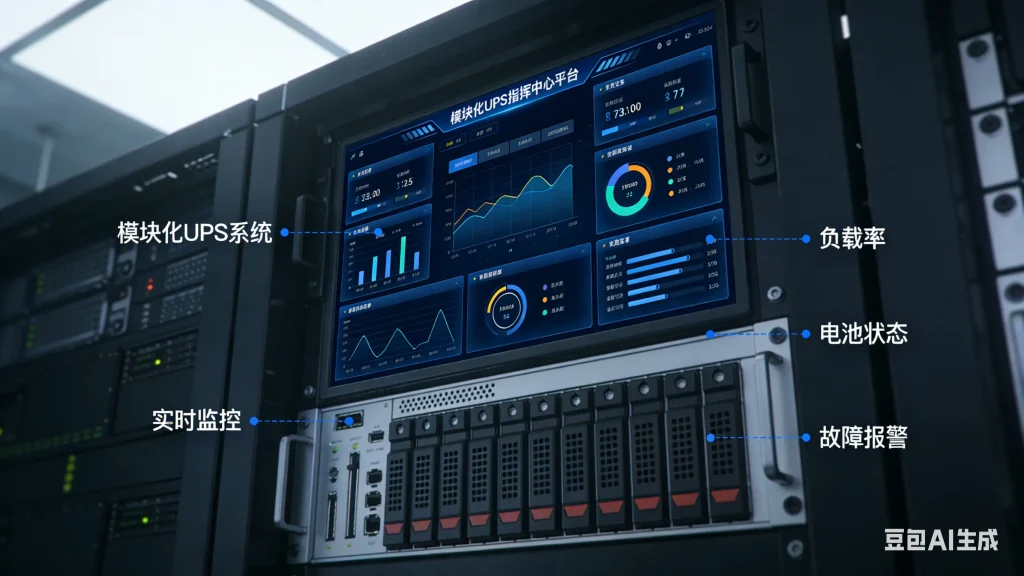
II. System Composition
The modular UPS system for computer rooms consists of the following core units, which work collaboratively to form a complete uninterruptible power supply solution.
2.1 Basic Hardware Units
| Unit Name | Function Description | Core Components |
|---|---|---|
| System Cabinet | Standard 19-inch rack, provides installation space and physical protection | Cabinet frame, heat dissipation system, cable management, door lock |
| Power Module | Core power conversion unit for AC-DC-AC conversion | Rectifier, inverter, PFC circuit, charging module |
| Static Bypass Module | Enables seamless switching between utility power and UPS output | Static switch, thyristor, control circuit |
| System Control Module | System core for overall control and management | Main control board, display panel, communication interfaces |
| Battery System | Energy storage unit, provides power when mains fail | Battery modules, Battery Management System (BMS) |
| Power Distribution Unit | Load connection and protection | Circuit breakers, fuses, surge protectors, PDU |
| Monitoring Module | Real-time operating status monitoring | Sensors, data collectors, communication modules |
2.2 Software Management Units
- Intelligent Monitoring System: Real-time monitoring of voltage, current, frequency, load rate, battery status and other parameters; supports local and remote management.
- Battery Management System (BMS): Precisely monitors battery conditions, extends service life and prevents overcharging and overdischarging.
- Event Log System: Records alarms, operation logs and fault history for traceability and analysis.
- Remote Management Platform: Supports Web, APP, SNMP and other management methods to realize unattended operation and maintenance.
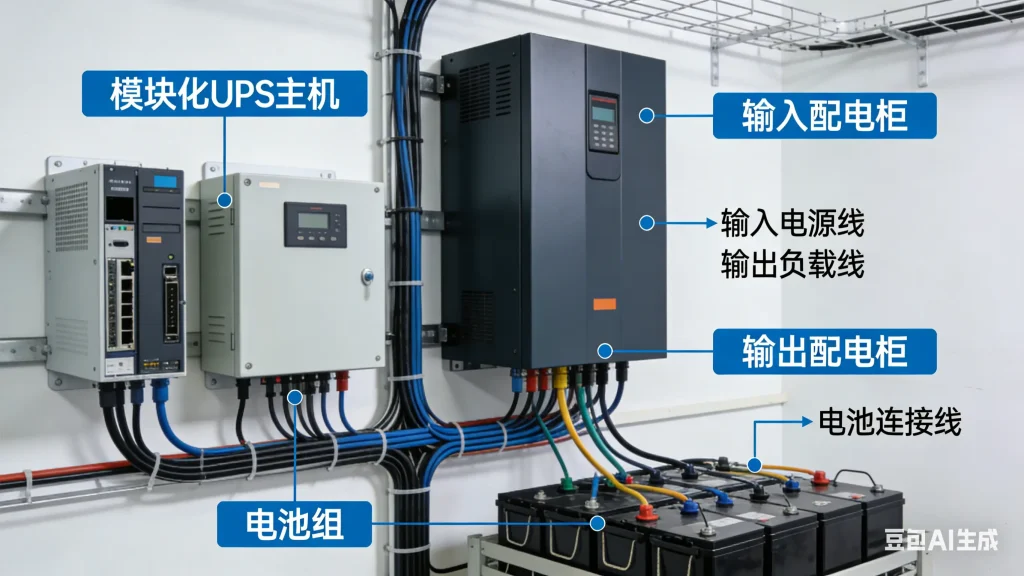
III. System Classification
3.1 Classification by Power Rating
| Power Rating | Typical Capacity Range | Application Scenarios |
|---|---|---|
| Small Modular UPS | 10–60kVA | Small computer rooms, edge computing nodes, branch offices |
| Medium Modular UPS | 60–200kVA | Small & medium data centers, enterprise computer rooms, core business systems |
| Large Modular UPS | 200kVA–1000kVA and above | Large data centers, cloud computing centers, supercomputer centers |
3.2 Classification by Topology
- Power-Modular UPS: Modular power units; static bypass and monitoring share the same cabinet. Cost-effective and widely applied.
- Fully Modular UPS: All functional units (power, bypass, control, battery) are modularized. Highest flexibility with relatively higher cost.
- Distributed Modular UPS: Deployed across multiple cabinets and supports cross-cabinet parallel connection. Ideal for large data centers.
3.3 Classification by Redundancy Mode
| Redundancy Mode | Configuration Description | Availability | Application Scenarios |
|---|---|---|---|
| N+1 Redundancy | N modules carry loads, 1 standby module | 99.999% | Enterprise core computer rooms, small & medium data centers |
| 2N Redundancy | Two independent systems serve as mutual backups | 99.9999% | Finance, telecommunications, healthcare and other key industries |
| 2(N+1) Redundancy | Two sets of N+1 systems for dual protection | 99.99999% | National-level data centers, supercomputer centers |
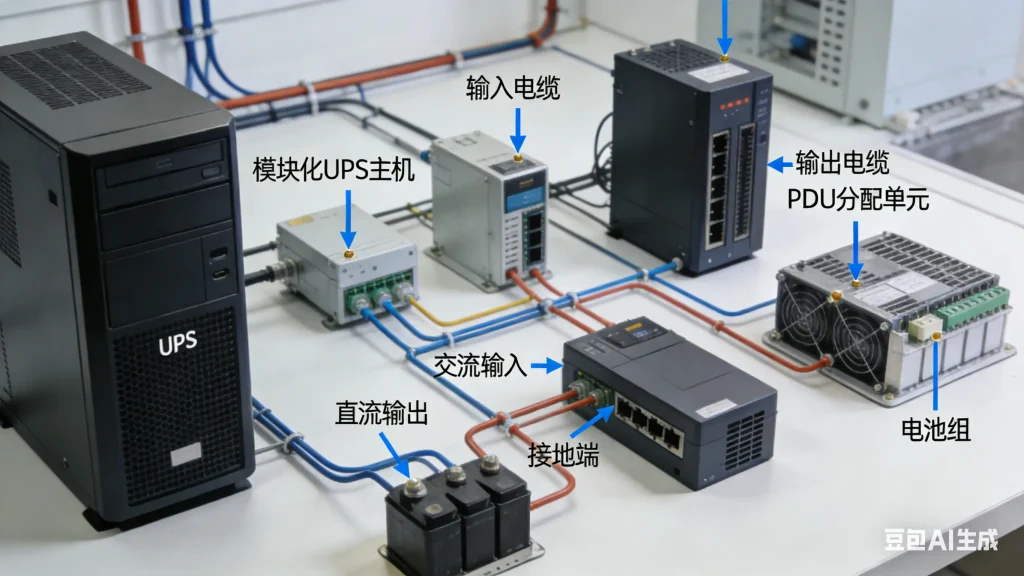
IV. System Configuration List (Brand: KITOZER)
4.1 Standard Configuration List (30kVA System, N+1 Redundancy)
| No. | Device Name | Model | Brand | Qty | Unit | Remarks |
|---|---|---|---|---|---|---|
| I. UPS Main System | ||||||
| 1 | Modular UPS Cabinet | KITOZER-MC60 | KITOZER | 1 | Set | 60kVA capacity, supports six 10kVA modules |
| 2 | Power Module | KITOZER-PM10 | KITOZER | 4 | Pcs | 10kVA per module, 3+1 N+1 redundancy |
| 3 | Static Bypass Module | KITOZER-SB60 | KITOZER | 1 | Pc | 60kVA capacity, built-in maintenance bypass |
| 4 | System Control Module | KITOZER-SCM | KITOZER | 1 | Pc | Equipped with 7-inch color touch screen |
| 5 | Monitoring Module | KITOZER-MON | KITOZER | 1 | Pc | Supports remote monitoring |
| II. Battery System | ||||||
| 6 | Lithium Battery Module | KITOZER-LB100 | KITOZER | 8 | Pcs | 100Ah per module, 48V system |
| 7 | Battery Management System | KITOZER-BMS | KITOZER | 1 | Set | Real-time battery status monitoring |
| 8 | Battery Cabinet | KITOZER-BC8 | KITOZER | 1 | Set | Holds 8 battery modules |
| III. Power Distribution System | ||||||
| 9 | Input Distribution Cabinet | KITOZER-PDU-IN | KITOZER | 1 | Set | Built-in surge protection and circuit breakers |
| 10 | Output Distribution Cabinet | KITOZER-PDU-OUT | KITOZER | 1 | Set | Branch breakers and power metering |
| 11 | Battery Switch Box | KITOZER-BSB | KITOZER | 1 | Set | Battery circuit protection |
| IV. Monitoring & Management System | ||||||
| 12 | Central Monitoring Host | KITOZER-MCU | KITOZER | 1 | Set | Web management supported |
| 13 | Environment Monitoring Module | KITOZER-EM | KITOZER | 1 | Set | Temperature, humidity, smoke and water leakage detection |
| 14 | Communication Cables | Custom | KITOZER | 1 | Batch | RS485, network cables and control wires |
| V. Accessories & Tools | ||||||
| 15 | Installation Accessories | Custom | KITOZER | 1 | Set | Guide rails, screws, cable ties |
| 16 | Operation Manual | Electronic + Hard Copy | KITOZER | 1 | Set | Installation, operation and maintenance guides |
| 17 | Special Tools | Custom | KITOZER | 1 | Set | For module replacement and maintenance |
4.2 Extended Configuration Options
| Configuration Name | Model | Function Description | Application Scenarios |
|---|---|---|---|
| Parallel Module | KITOZER-PAR | Enables multi-cabinet parallel connection for capacity expansion | Capacity exceeds the maximum rating of single cabinet |
| Synchronization Module | KITOZER-SYN | Realizes synchronous operation of multiple systems | 2N or 2(N+1) redundant architecture |
| Diesel Generator Interface | KITOZER-GI | Seamless switching between UPS and generator | Areas with unstable or no utility power |
| Remote Management Card | KITOZER-RMC | 4G/5G remote management support | Unattended computer rooms |
| Energy Consumption Analysis Module | KITOZER-EAM | Real-time energy monitoring and energy-saving suggestions | Green data centers requiring PUE optimization |
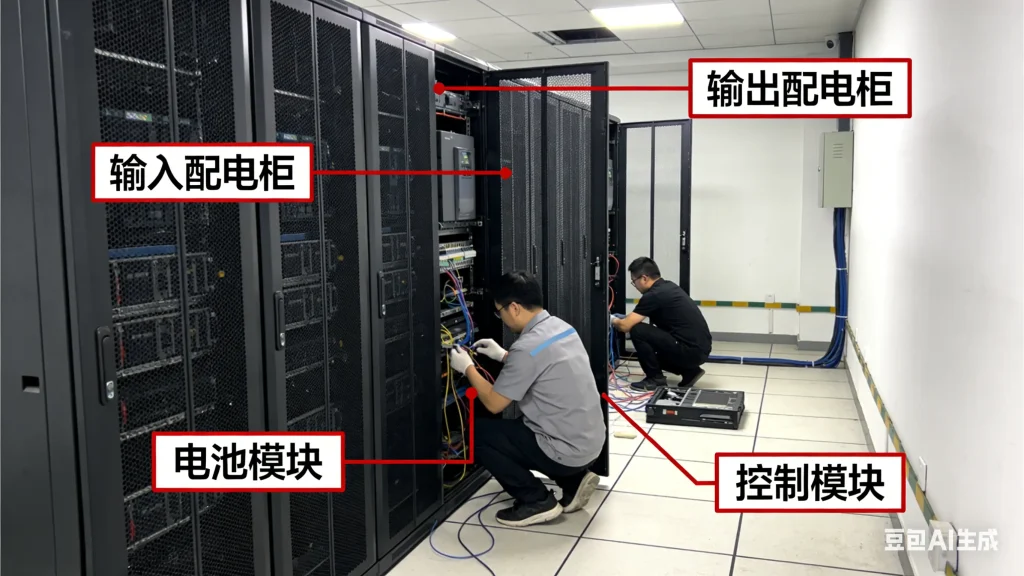
V. System Schematic Diagram
5.1 Block Diagram of Single-Module System
Utility Input → Input Switch → Surge Protection → Power Module (Rectifier → DC Bus → Inverter) → Output Switch → Load
↑ ↓
└────────── Static Bypass ──────────┘
↓
Battery System
↓
System Control Module → Monitoring System → Remote Management Platform
5.2 Block Diagram of N+1 Redundant System
Utility Input → Input Distribution Cabinet → ┌── Power Module 1 ──┐
├── Power Module 2 ──┤ → Output Bus → Output Distribution Cabinet → Load
├── Power Module 3 ──┤
└── Power Module 4 ──┘ (N+1: 3 working, 1 standby)
↓
Static Bypass
↓
Battery Pack
↓
System Control Center → Monitoring Network
5.3 Block Diagram of Dual-Bus Redundant System
Utility Input → Input Distribution Cabinet → System A (N+1) → Output Bus A → Dual-Power Load
↓
System B (N+1) → Output Bus B → Dual-Power Load
↓
Battery System A / B
↓
Centralized Monitoring System
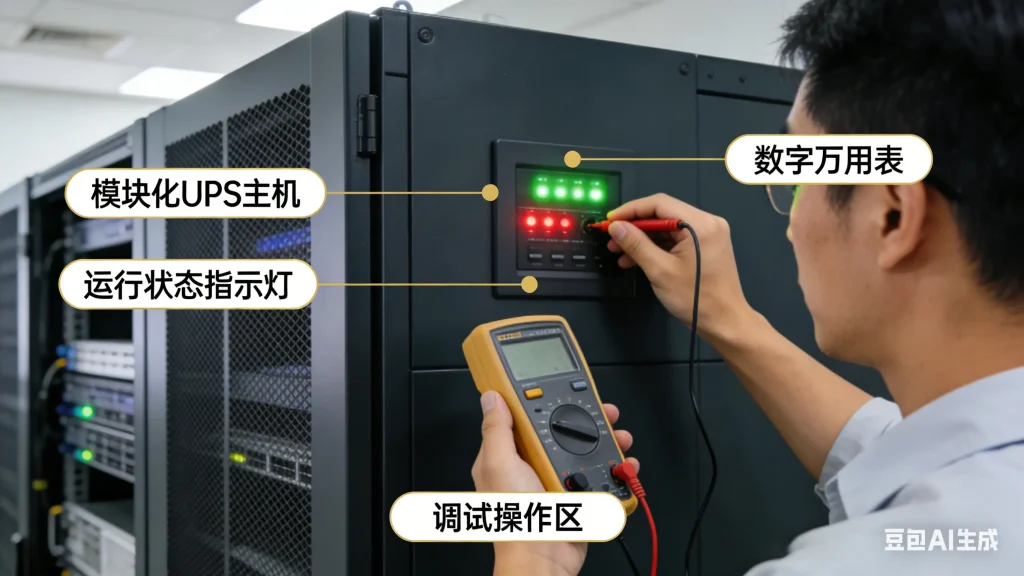
VI. Product Technical Parameters (KITOZER Modular UPS Series)
6.1 Core Parameters of Power Modules
| Parameter | KITOZER-PM10 (10kVA) | KITOZER-PM20 (20kVA) | KITOZER-PM30 (30kVA) |
|---|---|---|---|
| Rated Capacity | 10kVA/10kW (PF=1) | 20kVA/20kW (PF=1) | 30kVA/30kW (PF=1) |
| Input Parameters | |||
| Input Voltage Range | 380/400/415V ±25% (3-phase) | 380/400/415V ±25% (3-phase) | 380/400/415V ±25% (3-phase) |
| Input Frequency Range | 50/60Hz ±5% | 50/60Hz ±5% | 50/60Hz ±5% |
| Power Factor | ≥ 0.99 | ≥ 0.99 | ≥ 0.99 |
| Total Harmonic Distortion | ≤ 3% | ≤ 3% | ≤ 3% |
| Output Parameters | |||
| Output Voltage | 380/400/415V ±1% (3-phase) | 380/400/415V ±1% (3-phase) | 380/400/415V ±1% (3-phase) |
| Output Frequency | 50/60Hz ±0.1Hz | 50/60Hz ±0.1Hz | 50/60Hz ±0.1Hz |
| Output Power Factor | 1.0 (Full Load) | 1.0 (Full Load) | 1.0 (Full Load) |
| Output THD | ≤ 2% (Linear Load), ≤ 5% (Non-linear Load) | ≤ 2% (Linear Load), ≤ 5% (Non-linear Load) | ≤ 2% (Linear Load), ≤ 5% (Non-linear Load) |
| Dynamic Response | ≤ 5ms (100% Load Step Change) | ≤ 5ms (100% Load Step Change) | ≤ 5ms (100% Load Step Change) |
| Efficiency | |||
| Efficiency at Rated Load | ≥ 96% | ≥ 96.5% | ≥ 97% |
| Efficiency at 30% Light Load | ≥ 95% | ≥ 95.5% | ≥ 96% |
| Physical Characteristics | |||
| Dimensions (W×D×H) | 482×800×132mm (3U) | 482×800×132mm (3U) | 482×800×264mm (6U) |
| Weight | 35kg | 40kg | 65kg |
| Heat Dissipation | Intelligent temperature-controlled fans | Intelligent temperature-controlled fans | Intelligent temperature-controlled fans |
| Protection Functions | Overvoltage, undervoltage, overcurrent, short circuit, overtemperature, battery overcharge & overdischarge protection |
6.2 Overall System Parameters
| Parameter | Technical Specifications |
|---|---|
| System Capacity Range | 10kVA–600kVA; Max. 60kVA per cabinet, multi-cabinet parallel supported |
| Input Voltage | 380/400/415V AC, 3-phase 4-wire + Earth |
| Input Frequency | 50/60Hz (Auto-detection) |
| Input Power Factor | ≥ 0.99 (Rated Load) |
| Input Current THD | ≤ 3% (Rated Load) |
| Output Voltage Accuracy | ±1% |
| Output Frequency Accuracy | ±0.1Hz |
| Switching Time | 0ms (Mains ↔ Battery) |
| Overload Capacity | 110%: Long-term operation125%: 10 minutes150%: 1 minute200%: 10 seconds |
| Battery Voltage | 48V/96V/192V/240V (Auto-adaptive by system capacity) |
| Operating Temperature | 0℃ ~ 40℃ |
| Storage Temperature | -25℃ ~ 55℃ |
| Relative Humidity | 0% ~ 95% (Non-condensing) |
| Altitude | ≤ 1000m (Derating required above 1000m) |
| Noise | ≤ 70dB @ 1m (Rated Load) |
| MTBF | ≥ 200,000 Hours |
| MTTR | ≤ 15 Minutes (Module replacement) |
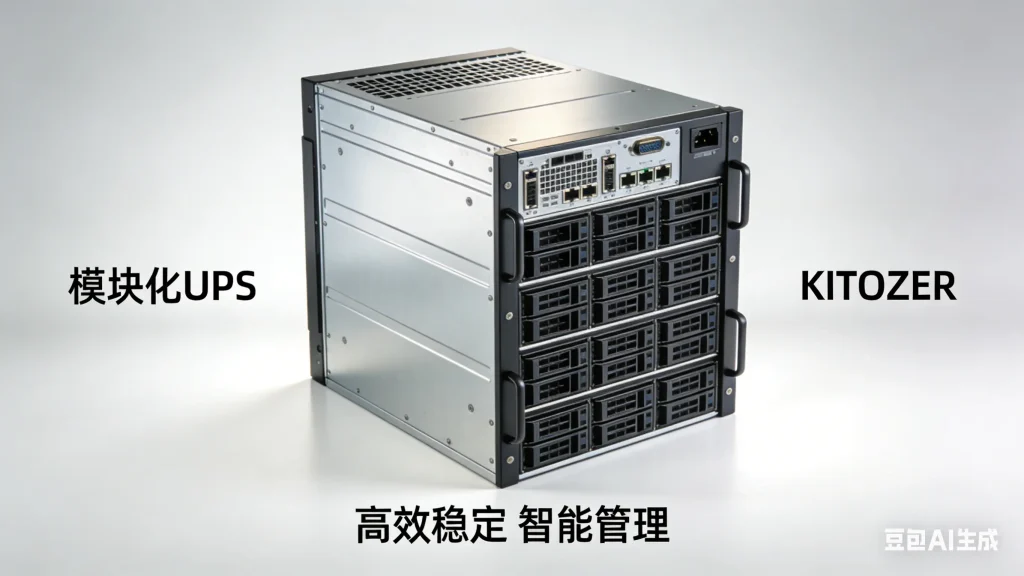
VII. Application Scope
KITOZER modular UPS is applied to the following critical power supply scenarios, meeting demands for high availability and reliability across industries.
7.1 Data Center & IT Infrastructure
| Scenario Type | Typical Applications | Core Requirements | Recommended Configuration |
|---|---|---|---|
| Enterprise Data Center | Servers, storage, network devices | 99.999% availability, scalability | N+1 / 2N redundancy, online expansion |
| Edge Computing Node | Distributed servers, IoT gateways | Compact size, easy maintenance, remote management | 10–30kVA, single cabinet |
| Cloud Computing Center | Large server clusters | High density, high reliability, low PUE | 2N redundancy, high-efficiency modules, intelligent management |
| Disaster Recovery Center | Backup servers, data storage | High reliability, remote monitoring | 2N redundancy, remote O&M supported |
7.2 Key Industry Applications
| Industry | Typical Scenarios | Application Features | Recommended Solution |
|---|---|---|---|
| Finance | Bank data centers, securities trading systems, ATM networks | Zero downtime, 7×24 operation | 2N redundancy, dual-bus architecture, real-time monitoring |
| Telecommunications | Mobile base stations, core network rooms, data centers | High reliability, remote management | N+1 redundancy, 4G/5G remote monitoring |
| Government & Public Services | Government cloud, e-government, emergency command centers | High security & stability | 2N redundancy, dual power input, surge protection |
| Healthcare | Hospital HIS, imaging equipment, life support systems | Zero interruption, high reliability | 2N redundancy, medical-grade EMC certification |
| Industrial Automation | Production line control, PLC, industrial robots | Anti-interference, wide voltage range | N+1 redundancy, industrial protection for harsh environments |
| Energy | Power dispatching, substation automation, new energy monitoring | High reliability, anti-grid fluctuation | 2N redundancy, generator linkage supported |
| Transportation | Airport dispatching, rail transit control, intelligent transport | Zero interruption, wide temperature range | N+1 redundancy, vibration-resistant design |
7.3 Special Application Scenarios
- Green Data Centers: Prioritize PUE optimization and energy saving. Recommended: High-efficiency modules + lithium battery system.
- High-Density Computer Rooms: Cabinet power density ≥ 8kW. Recommended: 30kVA/6U high-density modules.
- Renovation Projects: Existing room expansion without service interruption. Recommended: Modular solution with online expansion.
- Global Deployment: Multinational enterprises adapting to various grid standards. Recommended: Wide input voltage + globally certified products.
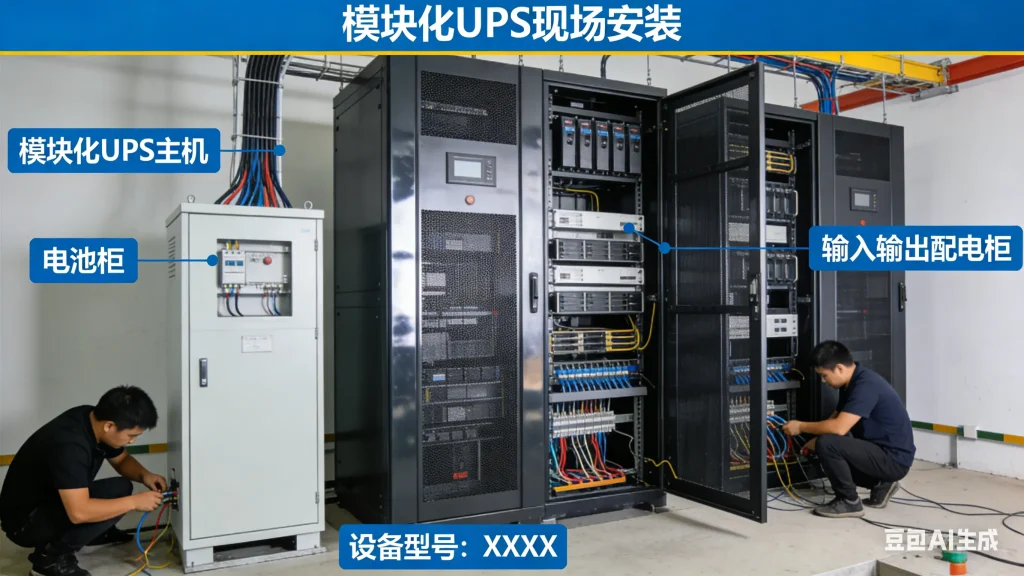
VIII. Product Advantages
Compared with traditional UPS and peer products, KITOZER modular UPS owns core competitive strengths as below.
8.1 High Availability & Reliability
- N+1 Redundancy: Module-level redundancy; faulty modules exit automatically without system outage. Availability over 99.999%.
- Hot Swapping: All modules support online replacement; MTTR ≤ 15 minutes, greatly reducing downtime risks.
- Zero Switching Time: Seamless transition between mains and battery to avoid load impact.
- Multi-Protection Mechanisms: Comprehensive protection against overvoltage, undervoltage, overcurrent, short circuit and overtemperature for safe operation.
- Long MTBF: MTBF ≥ 200,000 hours, far above industry average.
8.2 Strong Scalability & Flexibility
- Capacity Expansion on Demand: Expand from 10kVA up to 600kVA step by step to avoid upfront investment waste.
- Smooth Upgrade: Online expansion without shutdown or service interruption.
- Multiple Architectures: Supports standalone, N+1, 2N and dual-bus modes for diverse scenarios.
- Module Compatibility: New and old modules are fully compatible to protect investment and cut upgrade costs.
8.3 High Efficiency & Environmental Friendliness
- Superior Efficiency: ≥ 97% at rated load and ≥ 95% at light load to reduce energy consumption and operating costs.
- Intelligent Sleep Mode: Redundant modules sleep automatically under light load to boost efficiency and lower noise.
- High Power Factor: Input PF ≥ 0.99 reduces grid harmonic pollution and improves power utilization.
- Lithium Battery Compatibility: Lithium batteries feature long service life and zero pollution to lower total cost of ownership (TCO).
8.4 Easy Management & Maintenance
- Intelligent Monitoring: 7-inch color touch screen displays system status intuitively; local and remote management available.
- Rich Interfaces: RS485, USB, Ethernet, dry contacts; compatible with Modbus, SNMP and other protocols.
- Remote Management: Web, APP and SMS alarm enable unattended O&M.
- Fault Early Warning: Real-time status monitoring predicts potential faults to reduce maintenance costs.
- Rapid Maintenance: Hot-swappable modules ensure replacement within 15 minutes.
8.5 High Safety & Adaptability
- Full-Range Protection: Input/output surge protection, over/under voltage, short circuit and overtemperature protection.
- Wide Input Voltage Range: ±25% voltage tolerance adapts to grid fluctuation and reduces battery discharge times.
- Wide Temperature Adaptation: 0℃ ~ 40℃ operating temperature fits various computer room environments.
- Strong Anti-Interference: Complies with IEC61000-4 EMC standards for industrial environments.
IX. Comparative Advantages
9.1 vs. Traditional Tower UPS
| Comparison Item | KITOZER Modular UPS | Traditional Tower UPS | Advantage Description |
|---|---|---|---|
| Availability | 99.999%+ (N+1 Redundancy) | 99.99% (Standalone) | Module redundancy ensures no service interruption upon faults |
| Scalability | Expand on demand, online upgrade | Fixed capacity, full unit replacement for expansion | Avoid upfront waste, adapt to business growth |
| Maintainability | Hot swap, MTTR ≤ 15 mins | Shutdown maintenance, MTTR ≥ 4 hrs | Lower maintenance cost and service outage duration |
| Efficiency | ≥ 97% (Rated), ≥ 95% (Light Load) | ≥ 92% (Rated), ≤ 85% (Light Load) | Over 30% energy saving, lower operating cost |
| Space Utilization | High (3U/10kVA) | Low (Over 12U/10kVA) | Save room space and improve cabinet density |
| Investment Flexibility | Phased investment, gradual expansion | One-time investment, fixed capacity | Optimize cash flow and reduce financial risks |
| Lifecycle Cost | Low, simple maintenance, long lifespan | High, complex maintenance, short lifespan | Over 40% TCO reduction |
9.2 vs. Modular UPS of Other Brands
- Full Digital Control: Dual DSP + FPGA architecture delivers faster response, higher precision and 30% improved system stability.
- High-Efficiency Power Modules: Self-developed topology brings 1–2% higher efficiency than industry average, saving tens of thousands of RMB in annual electricity bills.
- Smart Battery Management: Patented BMS extends battery life by 50% and reduces replacement frequency.
- Full Hot-Swap Design: Power, bypass and control modules all support hot swapping for easier maintenance.
- Strong Compatibility: Seamlessly integrated with generators, air conditioners and monitoring systems of different brands for complex environments.
- Long Lifespan Design: Industrial-grade key components double the service life; MTBF ≥ 200,000 hours.
- Comprehensive Services: 7×24 technical support and 200+ service outlets nationwide for fast response.
X. Bid Control Parameters
The following parameters are formulated for bidding and technical specifications to guarantee product compliance.
10.1 Core Technical Parameters (Mandatory)
- System Architecture: Modular design with hot swap support. Power module, static bypass module and control module are independently replaceable within 15 minutes.
- Power Module: Single module capacity ≥ 10kVA, 3U height, efficiency ≥ 96% (rated load), input PF ≥ 0.99, input THD ≤ 3%.
- System Capacity: Flexible configuration from 10kVA to 600kVA; max. capacity per cabinet ≥ 60kVA, multi-cabinet parallel supported.
- Switching Time: 0ms transition between mains and battery for uninterrupted power.
- Output Performance: Voltage accuracy ≤ ±1%, frequency accuracy ≤ ±0.1%, THD ≤ 2% (linear load).
- Redundancy: Supports N+1, 2N and dual-bus architectures to meet different availability requirements.
- Protection: Full protection against overvoltage, undervoltage, overcurrent, short circuit, overtemperature and battery overcharge/overdischarge.
- Monitoring: Local touch screen, remote Web & APP management; equipped with RS485, USB and Ethernet interfaces.
- Reliability: MTBF ≥ 200,000 hours, MTTR ≤ 15 minutes.
- Certifications: CE, UL, TUV, ISO9001, ISO14001 and other international certifications, complying with national standards.
10.2 Commercial & Service Requirements (Mandatory)
- Manufacturing Qualification: Independent R&D and production capability for modular UPS; no less than 10 related patents.
- After-Sales Service: Minimum 3-year full machine warranty, 7×24 technical support; fault response ≤ 2 hours, problem resolution within 48 hours.
- Local Service: Local branch or authorized service center at project site for rapid on-site service.
- Training: Free technical training to ensure users master operation and maintenance.
- Spare Parts: Domestic spare parts center to ensure key components delivery within 24 hours.
- Project Experience: Over 5 years of modular UPS R&D and production experience; no less than 100 similar project cases.
10.3 Bonus Parameters (Preferred)
- Efficiency: ≥ 97% at rated load, ≥ 95% at 30% light load.
- Battery Compatibility: Supports lead-acid and lithium batteries with intelligent BMS for longer service life.
- Energy-Saving Functions: Intelligent sleep and dynamic efficiency optimization, compliant with green data center standards.
- Remote Management: 4G/5G remote management for unattended rooms.
- Parallel Capability: Supports parallel of 8+ cabinets, max. system capacity ≥ 600kVA.
- Anti-Interference: Complies with IEC61000-4-5 Surge Immunity Level 4 for harsh grid environments.
XI. Product Solutions
Targeted solutions for different computer room scales and demands.
11.1 Solution for Small Computer Rooms (10kVA–30kVA)
11.1.1 Application Scenarios
- Enterprise branch rooms, small data centers, edge computing nodes
- Load: 10kW–25kW
- Availability Requirement: 99.99%
- Budget-sensitive, cost-performance prioritized
11.1.2 Recommended Configuration
- UPS System: KITOZER-MC60 cabinet + three 10kVA power modules (2+1 redundancy) + static bypass + control module
- Battery System: 6 × KITOZER-LB100 lithium modules, backup time ≥ 15 mins
- Power Distribution: 1 set of input & output cabinets with surge protection, breakers and power metering
- Monitoring: Local monitoring + remote Web management, SMS alarm supported
11.1.3 Solution Advantages
- Cost-effective with low initial investment and phased expansion available.
- Easy maintenance via hot-swappable modules, no professional technicians required.
- High efficiency reduces operating costs.
- Remote management realizes unattended operation and cuts O&M expenses.
11.2 Solution for Medium Computer Rooms (30kVA–100kVA)
11.2.1 Application Scenarios
- Enterprise data centers, cloud computing centers, financial institution rooms
- Load: 30kW–80kW
- Availability Requirement: 99.999%
- High reliability and expandability required for business growth
11.2.2 Recommended Configuration
- UPS System: 2 × KITOZER-MC60 cabinets, 4 × 10kVA modules per cabinet (3+1 redundancy), dual-bus architecture
- Battery System: 16 × KITOZER-LB100 lithium modules, backup time ≥ 30 mins
- Power Distribution: Dual input & output cabinets with ATS automatic transfer switch
- Monitoring: Central monitoring platform + 4G remote management, energy analysis and fault warning
11.2.3 Solution Advantages
- High reliability via dual-bus and 2N redundancy to ensure zero interruption.
- Online expansion adapts to business growth.
- Intelligent monitoring for real-time energy tracking and optimization suggestions.
- Fast maintenance with module hot swap, MTTR ≤ 15 mins.
11.3 Solution for Large Computer Rooms (100kVA–600kVA)
11.3.1 Application Scenarios
- Large data centers, supercomputer centers, national government cloud platforms
- Load: 100kW–500kW
- Availability Requirement: 99.9999%
- High reliability, scalability and manageability required
11.3.2 Recommended Configuration
- UPS System: 4–10 × KITOZER-MC60 cabinets, 5 × 10kVA modules per cabinet (4+1 redundancy), dual-bus + synchronization module
- Battery System: 40 × KITOZER-LB200 lithium modules, backup time ≥ 30 mins, hot-swappable
- Power Distribution: Dual input & output cabinets + row cabinets with ATS, STS and power metering
- Monitoring: Central platform + AI analysis, AI fault prediction and PUE optimization suggestions
- Optional: Diesel generator interface for seamless UPS-generator switching
11.3.3 Solution Advantages
- Ultra-high reliability: Dual-bus + N+1 redundancy, availability ≥ 99.9999%.
- Unlimited expansion via multi-cabinet parallel, max. capacity up to 600kVA.
- AI intelligent monitoring and fault prediction reduce maintenance costs.
- Energy-saving design: Efficiency ≥ 97%, PUE ≤ 1.4.
- All modules support hot swap, MTTR ≤ 15 mins.
11.4 Dual-Bus Redundancy Solution (10kVA–600kVA)
11.4.1 Application Scenarios
- Core business systems, financial trading platforms, medical life support systems
- Availability Requirement: 99.9999%+
- Zero tolerance for downtime, absolute reliability demanded
11.4.2 Recommended Configuration
- UPS System: Two independent KITOZER modular UPS systems (each N+1 redundant), dual-bus via synchronization module
- Battery System: Two independent battery banks, backup time ≥ 30 mins
- Power Distribution: Dual input + dual output + STS static transfer switch for automatic switchover upon single-path failure
- Monitoring: Central monitoring + remote management + 24-hour technical support
11.4.3 Solution Advantages
- Zero interruption: Load switches automatically to the healthy path when one system fails.
- Dual protection: Two independent systems operate without mutual interference.
- Ultra-high availability ≥ 99.9999% for critical businesses.
- Online maintenance for either system without affecting loads.
XII. Application Cases
12.1 Case 1: Data Center Renovation for a Financial Institution
12.1.1 Project Background
- Client: Provincial branch of a state-owned bank
- Room Scale: 200㎡, Load: 60kW
- Existing Issues: Aging traditional tower UPS, low efficiency (≤85%), difficult maintenance and frequent faults
- Renovation Demands: Raise availability to 99.999%, reduce energy consumption, support phased expansion
12.1.2 Solution
- UPS: 2 × KITOZER-MC60 cabinets, 4 × 10kVA modules per cabinet (3+1 redundancy), dual-bus architecture
- Battery: 16 × KITOZER-LB100 lithium modules, 30-minute backup
- Monitoring: Central platform + 4G remote management with fault warning
12.1.3 Implementation Results
- Availability improved from 99.9% to 99.999%, zero fault operation all year round.
- Efficiency increased to 96.5%, saving about 120,000 RMB on electricity annually.
- Maintenance time shortened from 4 hours to 15 minutes via hot swap.
- Flexible phased expansion meets growing business demands.
12.2 Case 2: Cloud Computing Center Construction for an Internet Enterprise
12.2.1 Project Background
- Client: Well-known internet company
- Room Scale: 1000㎡, Load: 500kW
- Construction Goals: Green data center with PUE ≤ 1.4, high reliability and rapid expandability
- Sufficient budget, high performance pursued
12.2.2 Solution
- UPS: 10 × KITOZER-MC60 cabinets, 5 × 10kVA modules per cabinet (4+1 redundancy), dual-bus architecture
- Battery: 80 × KITOZER-LB200 lithium modules, 15-minute backup
- Power Distribution: Dual input & output + row cabinets with ATS, STS and intelligent PDU
- Monitoring: AI intelligent platform for energy analysis, fault prediction and remote O&M
12.2.3 Implementation Results
- PUE reduced from 1.6 to 1.38, saving around 800,000 RMB on electricity per year.
- Dual-bus + N+1 redundancy ensures availability ≥ 99.9999%.
- Online expansion supports rapid business growth.
- AI monitoring achieves over 95% fault prediction accuracy and cuts maintenance costs.
12.3 Case 3: New Hospital Computer Room Project
12.3.1 Project Background
- Client: Grade A Tertiary Hospital
- Room Scale: 300㎡, Load: 80kW
- Special Requirements: Zero interruption, adapt to medical loads, remote monitoring
- Compliance: Meet medical industry standards and pass EMC certification
12.3.2 Solution
- UPS: 2 × KITOZER-MC60 cabinets, 4 × 10kVA modules per cabinet (3+1 redundancy), dual-bus architecture
- Battery: 12 × KITOZER-LB100 lithium modules, 30-minute backup
- Power Distribution: Medical-grade cabinets with isolation transformers for special medical loads
- Monitoring: Local + remote Web management, SMS & phone alarm
12.3.3 Implementation Results
- Zero outage throughout the year; seamless switchover during 3 grid fluctuations.
- Perfect compatibility with medical devices without any operational issues.
- Remote monitoring enables unattended operation and reduces O&M costs.
- Passed medical EMC certification and fully complies with industry standards.
XIII. Search Keywords, SEO & Tags
13.1 Search Keywords
| Category | Keywords |
|---|---|
| Core Keywords | Computer room modular UPS, Modular UPS, KITOZER modular UPS, Computer room UPS solution |
| Application Scenarios | Data center UPS, Computer room power supply system, Uninterruptible power supply, Dual-bus UPS, N+1 redundant UPS |
| Technical Features | Hot-swap UPS, High-efficiency UPS, Lithium battery UPS, Intelligent UPS, Remote monitoring UPS |
| Industry Applications | UPS for finance, UPS for healthcare, Cloud computing UPS, Edge computing UPS, Green data center |
| Solutions | Computer room power supply solution, Data center UPS solution, Modular UPS system design |
13.2 SEO Optimization Keywords
- Design & selection guide for computer room modular UPS systems
- KITOZER Modular UPS: High-availability power solution for data centers
- Modular UPS vs traditional tower UPS: Why choose KITOZER?
- Green data center UPS solution: High efficiency and energy saving of KITOZER modular UPS
- Computer room UPS expansion: Online upgrade without shutdown via KITOZER modular UPS
- Bid parameters and technical specifications of modular UPS for project procurement
- KITOZER modular UPS application cases: Practices in finance, healthcare and internet industries
13.3 Tags
#ComputerRoomModularUPS #KITOZER #DataCenterUPS #UninterruptiblePowerSupply #DualBusRedundancy #HotSwapUPS #HighEfficiencyUPS #LithiumBatteryUPS #ComputerRoomPowerSolution #ModularUPSBidParameters #GreenDataCenter #RemoteMonitoringUPS #N+1RedundantUPS #UPSExpansionSolution #CriticalLoadPowerSupply