KITOZER Multifunction Power Meter: Working Principle, Selection, Installation & Maintenance Guide
Brand: KITOZER | Manufacturer: Guangzhou Laian Intelligent System Development Co., Ltd. | Category: Power Monitoring & Energy Metering | Version: V1.0 | Date: October 2026
1. Product Overview
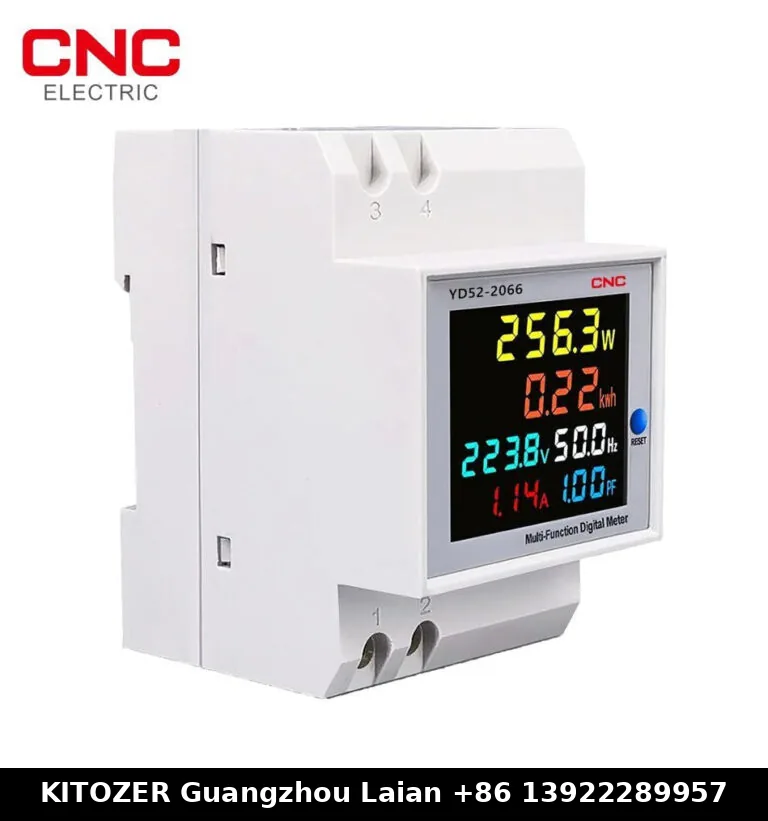
A multifunction power meter (also called a multifunction power monitor or multifunction energy meter) is a digital electrical measurement instrument that simultaneously measures, displays, and communicates a comprehensive set of power parameters in a single device. Where traditional analog meters measure only one parameter (voltage, current, or power factor), a KITOZER multifunction power meter measures three-phase voltage, three-phase current, active power, reactive power, apparent power, power factor, frequency, active energy, reactive energy, and even harmonic distortion, all in one compact unit. It is the standard measurement and monitoring terminal in modern low-voltage distribution systems. KITOZER multifunction power meters are supplied by Guangzhou Laian Intelligent System Development Co., Ltd. and are widely used in data centers, industrial plants, commercial buildings, hospitals, schools, photovoltaic systems, and energy storage stations.
The multifunction power meter has evolved from the analog panel meter of the past. Early analog meters used moving-coil or moving-iron movements and could display only a single value. Digital panel meters later replaced analog displays with LED or LCD readouts but still measured only one parameter. The microprocessor-based multifunction power meter emerged in the 1980s, integrating dedicated measurement chips, digital displays, and communication ports. Today’s KITOZER multifunction meters measure true RMS values, support Modbus-RTU communication, record time-of-use energy, analyze harmonics, and push data to cloud platforms, making them essential building blocks of the smart grid and energy management systems.
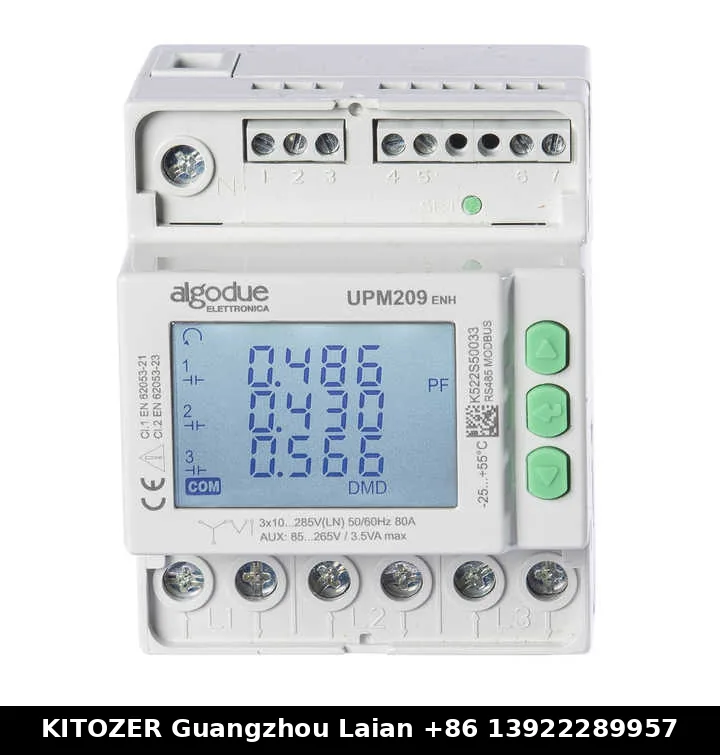
KITOZER offers both panel-mount meters (96, 80, 72 mm square) and DIN-rail mount meters (4-module single-phase, 7-module three-phase), covering incoming cabinets, feeders, and sub-circuits. The meters use true RMS measurement, accept CT/PT inputs, operate from a wide 85-265 V AC/DC supply, and communicate via RS485 Modbus-RTU as standard. Optional features include Ethernet (Modbus-TCP), 4G, harmonic analysis up to the 31st order, multi-tariff energy, maximum demand, relay outputs, and analog outputs.
1.1 Product Positioning
KITOZER multifunction power meters target the industrial and commercial power monitoring market, emphasizing 0.5-class accuracy, reliable communication, and cost-effectiveness. The meters use dedicated energy measurement chips with simultaneous sampling of three-phase voltage and current channels, ensuring phase accuracy. KITOZER provides not only the meter itself but also current transformers, communication gateways, and energy management software, delivering a complete solution from field sensing to cloud analytics.
1.2 Core Value
KITOZER multifunction power meters deliver the following value. First, one meter replaces multiple analog instruments, saving panel space and cost. Second, RS485 communication enables remote monitoring, reducing manual inspection rounds. Third, accurate energy metering supports cost allocation and energy-saving analysis. Fourth, threshold alarms detect overvoltage, undervoltage, overcurrent, and phase loss in time. Fifth, harmonic and power quality data help diagnose power system problems. By deploying KITOZER meters, users achieve digitization and centralization of distribution monitoring.
2. Working Principle
2.1 True RMS Measurement
AC voltage and current are measured as true RMS (root mean square). For a sine wave, RMS equals peak divided by the square root of two. However, modern grids contain harmonics from VFDs, switch-mode power supplies, and LED drivers, distorting the waveform. Average-responding meters calibrated for sine waves read inaccurately under distorted waveforms. KITOZER meters use true RMS measurement: the instantaneous voltage and current samples are squared, averaged, and square-rooted, producing an accurate RMS value for any waveform.
2.2 Simultaneous Sampling
Each voltage and current channel uses a simultaneous-sampling ADC (analog-to-digital converter) with 16-bit resolution at 128 samples per cycle (6400 Hz). Simultaneous sampling ensures that the phase relationship between voltage and current is preserved, which is critical for accurate power and power factor calculation. Sequential sampling would introduce phase errors proportional to channel ordering.
2.3 Power Calculation
Active power is computed as the average of the instantaneous product of voltage and current over a complete cycle. For a single-phase circuit P = U × I × cosφ; for a three-phase three-wire system P = √3 × U_line × I_line × cosφ; for a three-phase four-wire system P = Pa + Pb + Pc. Reactive power Q and apparent power S are derived from the same samples. Power factor PF = P / S.
2.4 Energy Accumulation
Active energy (kWh) is the time integral of active power. The meter has internal non-volatile counters that accumulate forward (grid-to-load) and reverse (load-to-grid, e.g., solar export) active energy separately. Multi-tariff models split energy into peak, shoulder, flat, and valley periods based on an internal real-time clock.
2.5 Communication Stack
The meter’s microprocessor runs a Modbus-RTU slave protocol stack over RS485. A host (monitoring computer or PLC) polls each meter by address (1-247) using function codes 03 (read holding registers), 06 (write single register), and 16 (write multiple registers). Voltage, current, power, energy, and status are stored in a defined register map. KITOZER provides the complete register map and example programs.
3. Technical Specifications
| Parameter | Specification |
|---|---|
| Measured Parameters | 3φ V, 3φ I, P, Q, S, PF, Hz, kWh, kvarh, THD |
| Accuracy (V, I, P, Q) | 0.5 class |
| Active Energy Accuracy | 0.5S class |
| Frequency Accuracy | ±0.01 Hz |
| Voltage Input | 380 V direct (or 100 V via PT) |
| Current Input | 5 A via CT (or direct ≤63 A) |
| Overload | 1.2× continuous, 2× for 1 s |
| Power Supply | AC/DC 85-265 V, ≤5 VA |
| Communication | RS485 Modbus-RTU, 1200-19200 bps |
| Display | Segment LCD / TFT optional |
| Installation | Panel-mount / DIN-rail |
| Operating Temp | -10°C to +55°C |
| Humidity | ≤95% non-condensing |
| Front Protection | IP51 |
| Dielectric Strength | 2 kV AC, 1 min |
| Insulation Resistance | >100 MΩ |
4. Selection Guide
Selecting the right KITOZER multifunction power meter requires considering measurement needs, installation location, CT/PT arrangement, communication, and optional features.
4.1 Measurement Parameters
If only voltage, current, and power factor are needed, a basic model suffices. If energy metering is required, choose an energy model. If harmonic analysis is needed (VFDs, UPS, rectifiers), choose a harmonic model. If multi-tariff billing or maximum demand are needed, choose a premium model.
4.2 Installation Type
Panel-mount meters (96/80/72 mm) embed in distribution cabinet panels for local viewing by operators. DIN-rail meters mount on 35 mm rails inside the cabinet, ideal for large numbers of sub-circuits. KITOZER recommends panel-mount for incoming and critical circuits, and DIN-rail for outgoing feeders.
4.3 CT and PT Selection
For circuits up to 63 A, direct input is possible. Above 63 A, use a current transformer with a 5 A secondary. Choose the CT primary rating as 1.2-1.5 times the maximum circuit current. For 10 kV systems, use a voltage transformer stepping down to 100 V. Set the CT and PT ratios in the meter menu.
| Circuit Current | Recommended CT Ratio | Meter Ratio Setting |
|---|---|---|
| ≤63 A | Direct input | Direct |
| 100-150 A | 150/5 A | 30 |
| 200 A | 250/5 A | 50 |
| 400 A | 400/5 A | 80 |
| 600 A | 600/5 A | 120 |
| 800 A | 800/5 A | 160 |
| 1000 A | 1000/5 A | 200 |
5. Installation Requirements
5.1 Voltage Wiring
In a three-phase four-wire system, connect Ua to phase A, Ub to phase B, Uc to phase C, and Un to neutral. Use wire of at least 1.5 mm². Confirm the rated voltage matches the input (380 V direct or 100 V via PT).
5.2 Current Wiring
Connect Ia+/Ia- to CT S1/S2 of phase A, Ib+/Ib- to phase B, Ic+/Ic- to phase C. Observe CT polarity: S1 to +, S2 to -. Ground the CT secondary S2. Use wire of at least 2.5 mm². Never open-circuit a CT secondary!
5.3 Communication Wiring
Use shielded twisted pair (RVSP 2×0.75 mm²) for RS485. Connect A to A, B to B. Daisy-chain the bus; do not star-connect. Install 120 Ω terminating resistors at the two farthest ends. Ground the shield at one end only. Keep communication wires away from power cables (≥200 mm separation).
6. Operation and Maintenance
KITOZER meters require almost no routine maintenance. Periodically verify display, communication online status, and terminal tightness. Calibrate annually with a standard source.
6.1 Troubleshooting Table
| Symptom | Likely Cause | Action |
|---|---|---|
| No display | No power / failed PSU | Check power supply |
| Voltage reads 0 | Voltage wire broken | Check voltage wiring |
| Current reads 0 | CT open / wrong ratio | Check CT wiring |
| Current too high | CT ratio mis-set | Correct ratio |
| No communication | A/B reversed / address conflict | Check wiring and address |
| Energy not counting | CT polarity reversed | Check polarity |
7. FAQ
Q: Can the CT secondary be opened?
A: No. Opening a CT secondary induces dangerous high voltage (several kV), endangering personnel and equipment. Always short or connect the CT secondary before servicing.
Q: Does the meter need a separate power supply?
A: KITOZER meters accept a wide 85-265 V AC/DC supply, which can be tapped from the voltage input. However, an independent auxiliary supply is recommended to keep the meter alive if the voltage circuit trips.
Q: Can two meters share the same RS485 address?
A: No. Each meter must have a unique address, otherwise communication collisions cause data chaos.
Q: Is energy data lost on power failure?
A: No. Energy is stored in non-volatile memory and retained for over 10 years without power.
Q: What communication protocols are supported?
A: Standard is Modbus-RTU over RS485. Optional: Modbus-TCP (Ethernet), MQTT (4G/cloud), DL/T 645.
Q: What is 0.5S class?
A: 0.5S means active energy accuracy of ±0.5% across 1%-100% of rated current, with good low-load accuracy. S stands for Special, suitable for fluctuating loads.
Q: Does the meter support bidirectional metering?
A: Yes. Forward energy (grid-to-load) and reverse energy (load-to-grid, e.g. solar export) are recorded separately.
Q: Can KITOZER provide energy management software?
A: Yes. KITOZER offers a complete energy management platform from meters and gateways to cloud software.
Q: How long is the RS485 cable?
A: Up to 1200 m. Use a repeater beyond that.
Q: How many meters on one bus?
A: Up to 32. KITOZER recommends no more than 20 for margin.
8. Application Scenarios
8.1 Data Center
In data centers, KITOZER meters are deployed at the main incoming, UPS output, row distribution, and PDU levels, providing complete power data for PUE calculation and real-time rack power monitoring.
8.2 Industrial Plants
In factories, KITOZER meters monitor workshop and production line power, supporting energy assessment, peak-valley scheduling, and fault detection.
8.3 Commercial Buildings
In office towers and shopping malls, KITOZER meters enable sub-metering of lighting, HVAC, and elevators, supporting tenant billing and green building certification.
8.4 Photovoltaic and Energy Storage
In PV grid-tie and energy storage cabinets, KITOZER bidirectional meters monitor generation and export power.
KITOZER Guangzhou Laian Intelligent System Development Co., Ltd.
Address: Chaotian Park, Zhongrun Industrial Zone, No.5 Huashan Road, Shilou, Panyu, Guangzhou, China
Tel/WeChat: +86 13922289957, +86 18520668845
WhatsApp: +1 906-853-4140
Website: www.gdlain.com (English) | www.lain.com.cn (Chinese)
Contact us for power meter selection, quotation and technical solutions.
9. Deep Dive into Power Measurement Theory
9.1 RMS Voltage Measurement
The root mean square (RMS) value of an AC voltage is the equivalent DC voltage that produces the same heating effect in a resistive load. For a pure sine wave, RMS equals peak divided by the square root of two (approximately 0.707 times peak). However, in real distribution systems the voltage waveform is rarely a perfect sine wave due to nonlinear loads such as variable-frequency drives, switch-mode power supplies, LED lighting, and UPS rectifiers. An average-responding meter calibrated on a sine wave will read incorrectly on a distorted waveform. KITOZER multifunction meters use true RMS measurement: each instantaneous voltage sample is squared, the squares are averaged over a complete cycle, and the average is square-rooted. This yields an accurate RMS value regardless of waveform shape. True RMS is the defining advantage of a multifunction meter over analog and basic digital panel meters.
9.2 RMS Current Measurement
Current is sensed through a current transformer (CT) that steps the primary high current down to a standard 5 A secondary signal. The meter samples the secondary current and computes its true RMS. The accuracy and phase error of the CT directly affect measurement results. KITOZER recommends using 0.5-class CTs matched to the meter’s 0.5-class accuracy. For harmonic-rich loads, the CT must also have adequate frequency response, otherwise high-order harmonic currents will be attenuated. KITOZER-matched CTs measure up to the 31st harmonic.
9.3 Active Power
Active power, measured in watts (W), is the time average of the instantaneous product of voltage and current. It represents the power actually consumed to perform work. For a single-phase circuit P = U × I × cosφ. For a three-phase three-wire circuit P = √3 × U_line × I_line × cosφ. For a three-phase four-wire circuit P = Pa + Pb + Pc. KITOZER meters synchronously sample voltage and current waveforms, compute instantaneous power point by point, and average over a cycle to derive high-accuracy active power. Active power is the basis of energy billing.
9.4 Reactive Power and Power Factor
Reactive power (Q, in var) represents the magnitude of energy exchange between inductive/capacitive loads and the source; it does no useful work but occupies grid capacity. Power factor (PF) is the ratio of active power to apparent power, reflecting the efficiency of electricity utilization. PF = 1 represents an ideal purely resistive load; a low PF indicates large reactive current and high line losses. KITOZER meters measure per-phase and total power factor. Users decide whether to add reactive compensation based on the measured PF.
9.5 Frequency Measurement
Frequency is the number of complete AC cycles per second, measured in hertz (Hz). The China grid standard is 50 Hz. Frequency is measured by detecting the interval between voltage zero-crossings. KITOZER meters measure frequency from 45 Hz to 65 Hz with ±0.01 Hz accuracy. Frequency anomalies (below 49.5 Hz or above 50.5 Hz) may indicate a grid fault.
9.6 Energy Measurement
Energy is the time integral of power, measured in kilowatt-hours (kWh, i.e. units). KITOZER meters contain internal energy counters that continuously accumulate the product of active power and time. Forward active energy flows from grid to load; reverse active energy flows from load to grid (e.g. photovoltaic export). Multifunction meters typically record forward and reverse energy separately and support peak, shoulder, flat, and valley four-tariff statistics. Energy data is uploaded via communication or output as pulses.
10. Communication Protocols and System Integration
10.1 Modbus-RTU Protocol
KITOZER multifunction meters standardly support Modbus-RTU, the most widely used serial communication protocol in industry. Modbus-RTU uses a master-slave polling scheme: the master (monitoring computer) polls each slave (meter), and slaves respond passively. Each meter has a unique slave address (1 to 247). A frame contains address, function code, data, and CRC check. Common function codes: 03 read holding registers, 06 write single register, 16 write multiple registers. Users read voltage, current, power, energy, and other data by reading corresponding register addresses.
10.2 Register Map
KITOZER meters provide a complete Modbus register map. Common registers include: phase A voltage, phase B voltage, phase C voltage, phase A current, phase B current, phase C current, frequency, active power, reactive power, apparent power, power factor, forward active energy, reverse active energy. Each parameter occupies one or two registers (16-bit integer or 32-bit floating point). KITOZER provides the communication protocol document and example programs.
10.3 RS485 Bus Topology
The RS485 bus uses a hand-rail daisy-chain topology: from the monitoring host’s RS485 port, the first meter’s A connects to host A and B to host B; the first meter’s A output connects to the second meter’s A input, and so on. Do not branch in a star. Install a 120 Ω terminating resistor at each of the two farthest bus ends. Use shielded twisted pair. One bus supports up to 32 meters. KITOZER recommends no more than 20 per bus to leave margin.
10.4 Communication Gateways
When RS485 data needs to be uploaded to Ethernet or 4G networks, a communication gateway is used. The gateway aggregates multiple RS485 buses and converts them to Modbus-TCP (Ethernet) or MQTT (4G/cloud platform). KITOZER provides matching communication gateways and energy management cloud platforms. Users view all meter data on a computer or mobile phone.
11. Power Quality Monitoring
11.1 Harmonic Monitoring
Modern grids contain nonlinear loads such as VFDs, switch-mode power supplies, and LED drivers that generate significant harmonics. Harmonics cause transformer overheating, capacitor damage, and protective relay misoperation. KITOZER harmonic-capable meters measure the 2nd to 31st voltage and current harmonic content and total harmonic distortion (THD). When THD exceeds 5%, an alarm alerts the user to treat harmonics.
11.2 Voltage Deviation and Fluctuation
Voltage deviation is the percentage difference between actual voltage and rated voltage. The China standard requires 220 V supply deviation within +7% to -10%. Voltage fluctuation is caused by large equipment starting and stopping. KITOZER meters record voltage extremes and out-of-limit events, helping users analyze voltage quality.
11.3 Three-Phase Unbalance
Unbalanced three-phase loads cause excessive neutral current and increased transformer losses. KITOZER meters measure three-phase voltage and current unbalance. When unbalance exceeds 15%, an alarm prompts the user to rebalance loads.
11.4 Event Recording
Premium multifunction meters feature event recording: when overvoltage, undervoltage, overcurrent, phase loss, or frequency anomalies occur, the meter records the event time and value for post-event analysis. Event capacity can reach dozens of records. This is valuable for fault investigation and responsibility analysis.
12. Current Transformer Selection
12.1 CT Types
Current transformers (CTs) are divided into busbar-type, split-core, and wound types. KITOZER-matched CTs are split-core type: the main cable passes through the center hole. Accuracy classes are 0.2, 0.5, and 1.0. For a 0.5-class meter, the CT accuracy should be no less than 0.5. Ratios range from 50/5 A to 3000/5 A.
12.2 CT Ratio Selection
The CT primary rated current should be 1.2 to 1.5 times the maximum working current of the circuit. For example, if the maximum circuit current is 100 A, choose a 150/5 A CT. The CT secondary rated current is standard 5 A (1 A is used for long distances). KITOZER meters support programmable CT ratio; after changing a CT, simply modify the meter parameter.
12.3 CT Installation Notes
Install CTs on the phase conductors (one per phase in three-phase systems). Face P1 toward the source and P2 toward the load. Connect secondary S1 to meter + and S2 to meter -, and ground S2. Keep CT secondary wires short, at least 2.5 mm². When sharing return wires among multiple CTs, pay attention. KITOZER provides CT installation guidance.
| Circuit Current | Recommended CT Ratio | Meter Ratio Setting |
|---|---|---|
| ≤100 A | Direct input | Direct |
| 100-150 A | 150/5 A | 30 |
| 200 A | 250/5 A | 50 |
| 400 A | 400/5 A | 80 |
| 600 A | 600/5 A | 120 |
| 800 A | 800/5 A | 160 |
| 1000 A | 1000/5 A | 200 |
| 1500 A | 1500/5 A | 300 |
13. Panel-Mount vs DIN-Rail Meters
| Item | Panel-Mount | DIN-Rail |
|---|---|---|
| Mounting | Panel cutout | DIN rail |
| Display Visibility | Good (front view) | Limited (in cabinet) |
| Panel Space | Large | None |
| Cost | Higher | Lower |
| Circuit Count | Few key circuits | Many auxiliary circuits |
| Density | Low | High |
| Typical Use | Incoming, critical feeders | Outgoing, sub-circuits |
KITOZER recommends: use panel-mount meters for incoming cabinets and critical loads (for local viewing by operators); use DIN-rail meters for outgoing cabinets with many sub-circuits (saving panel space, centralized communication monitoring). The two types can be mixed in the same distribution system.
14. Energy Management System
14.1 System Architecture
A KITOZER energy management system has three layers: field layer (multifunction meters + CTs), network layer (RS485 bus + communication gateway), and platform layer (energy management software/cloud platform). Meters collect power parameters from each circuit, upload them over RS485 to the gateway, which converts them to Ethernet/4G and uploads to the cloud platform. Users view data on a computer or mobile phone.
14.2 Software Functions
KITOZER energy management software functions include: real-time data display (voltage, current, power, energy of each circuit); historical data curves; energy reports (daily, monthly, yearly); sub-metering statistics; year-on-year and month-on-month analysis; alarm management; data export. Multi-level user permission management is supported.
14.3 Energy-Saving Benefits
Through sub-metering, enterprises can: identify high-energy circuits and retrofit them; execute peak-valley pricing strategies and shift loads to off-peak hours; detect abnormal energy use and discover equipment faults in time; set energy-saving KPIs. KITOZER customers save an average of 5% to 15% through the energy management system.
15. Installation Engineering Guide
15.1 Pre-Installation Preparation
Before installation, confirm: meter model matches design; CT ratio matches circuit current; panel cutout is correct; communication and power wires are laid. Prepare tools: Phillips screwdriver, wire stripper, crimping tool, multimeter.
15.2 Installation Steps
Step 1: Insert the meter into the panel cutout and secure with clips. Step 2: Connect voltage wires (Ua/Ub/Uc/Un). Step 3: Connect CT secondary wires (Ia+/Ia-/Ib+/Ib-/Ic+/Ic-). Step 4: Connect working power. Step 5: Connect RS485 communication wires (A/B). Step 6: Verify wiring before powering on. Step 7: Set CT ratio, address, baud rate. Step 8: Verify displayed values match reality.
15.3 Commissioning
After power-on, the meter displays voltage. With a load connected, current displays. Connect to monitoring software and verify data upload. Verify energy counting. Set alarm thresholds. Fill in the commissioning record.
16. Maintenance and Troubleshooting
16.1 Routine Maintenance
Multifunction meters require almost no routine maintenance. Periodically check: display normal; communication online; terminals tight. Recalibrate annually with a standard source.
16.2 Fault Quick-Reference Table
| Symptom | Likely Cause | Action |
|---|---|---|
| No display | No power / failed PSU | Check power |
| Voltage reads 0 | Voltage wire broken | Check voltage wiring |
| Current reads 0 | CT open / wrong ratio | Check CT wiring |
| Current too high | CT ratio mis-set | Correct ratio |
| No communication | A/B reversed / address conflict | Check wiring and address |
| Energy not counting | Power direction reversed | Check CT polarity |
| Display garbled | Interference / reset | Re-power |
17. Technical Standards and Certification
KITOZER multifunction meters comply with the following standards: GB/T 17215.321 (AC electricity metering equipment Particular requirements for static active energy meters class 1 and 2); GB/T 17215.322 (class 0.2S and 0.5S); IEC 62053-21; DL/T 645 (multi-function watt-hour meter communication protocol); Modbus-RTU standard. The product carries CE certification. Electromagnetic compatibility meets GB/T 17626 series.
18. Classification of Multifunction Power Meters
Multifunction power meters are classified in several ways. By mounting: panel-mount and DIN-rail. By phase: single-phase and three-phase. By display: LCD and LED. By communication: RS485, Ethernet, wireless. By feature count: basic (only U/I/PF), full-featured (plus energy, harmonics), premium (plus waveform recording, event logging). KITOZER covers all categories.
18.1 Panel-Mount Meters
Panel-mount meters embed in the distribution cabinet panel for front-side display. Sizes: 96 mm (96×96), 80 mm (80×80), 72 mm (72×72), 48 mm (48×96 vertical). The 96-type has the richest information, suitable for incoming cabinets; the 72-type is compact for auxiliary cabinets. KITOZER panel meters use clip-on mounting for easy removal.
18.2 DIN-Rail Meters
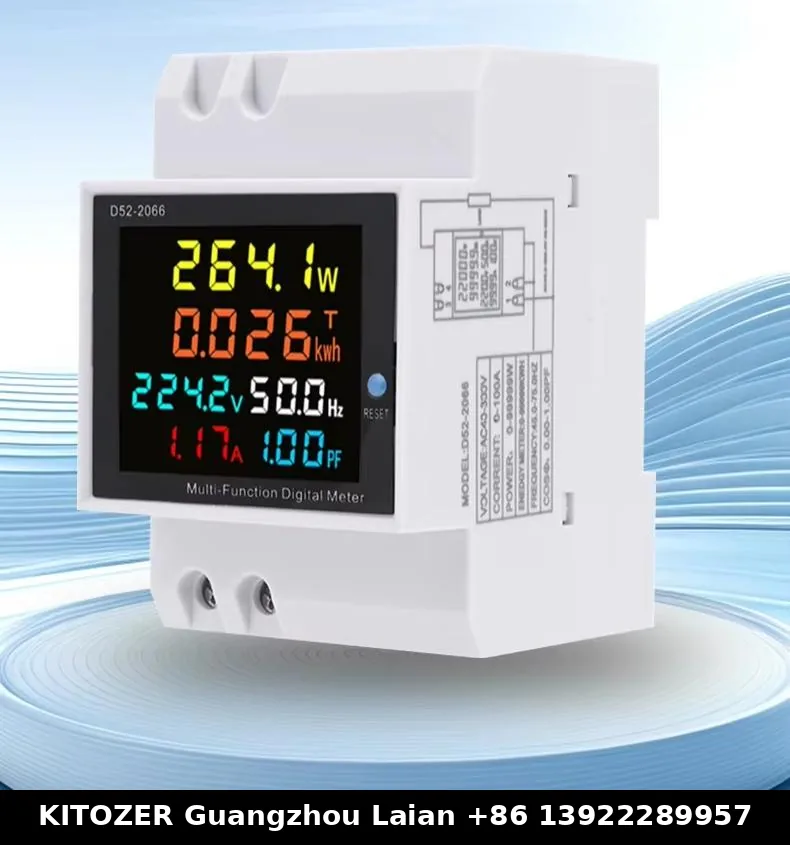
DIN-rail meters clip onto a standard 35 mm rail inside the cabinet, taking no panel space. Width ranges from 4 modules (single-phase) to 7 modules (three-phase). They suit outgoing cabinets with many sub-circuits. KITOZER DIN-rail meters are compact and can be densely arranged.
18.3 Smart Energy Meters vs Multifunction Meters
A smart energy meter emphasizes energy billing and remote meter reading, conforming to DL/T 645 and used for trade settlement. A multifunction power meter emphasizes multi-parameter measurement and communication monitoring, conforming to Modbus and used for distribution monitoring. The functions overlap but the positioning differs. KITOZER offers both.
19. Measurement Accuracy and Calibration
19.1 Accuracy Classes
The accuracy class represents measurement error limits. Common classes: 0.2 (±0.2%, high-accuracy metering); 0.5 (±0.5%, industrial monitoring); 1.0 (±1%, general indication); active energy 0.5S. KITOZER main products are 0.5-class measurement and 0.5S-class energy, meeting most industrial and building applications.
19.2 Error Sources
Measurement errors come from: CT and PT ratio and phase errors; meter ADC quantization error; sensor temperature drift; external interference. KITOZER controls total error through temperature compensation, digital calibration, and high-accuracy CTs.
19.3 Calibration Method
Calibration uses a standard source: apply standard voltage and current, compare the meter display to the standard, and adjust calibration coefficients. Calibration interval is recommended annually. KITOZER provides calibration service.
20. Role in Distribution Automation
In distribution automation systems, the multifunction power meter is the core data acquisition device at the field layer. Traditional distribution relies on manual inspection and meter reading, which is slow and lagging. When equipped with multifunction meters, all power parameters are uploaded to the monitoring center in real time, achieving the four-remotes: telemetry, telesignaling, telecontrol, and teleadjustment. KITOZER meters, paired with digital output modules, can also enable remote switching.
21. Coordination with Other Systems
21.1 Building Automation (BA)
KITOZER meter RS485 data is uploaded to BA systems (e.g. Siemens, Honeywell, Johnson Controls) via gateways. The BA system displays circuit power in real time and coordinates HVAC and lighting control.
21.2 Data Center Infrastructure Management (DCIM)
Data center monitoring systems collect current, voltage, and power from each PDU, monitoring rack power in real time. KITOZER meters are standard acquisition devices for DCIM.
21.3 PV and Energy Storage Monitoring
PV grid-tie cabinets and energy storage PCS cabinets use multifunction meters to monitor generation and consumption. KITOZER meters support bidirectional energy metering.
22. Installation Environment
KITOZER meters operate from -10°C to +55°C and store from -25°C to +70°C. Humidity ≤95% non-condensing. Install inside the distribution cabinet away from direct sunlight. Front panel IP51, rear IP30. In harsh environments (high humidity, dust), add a protective enclosure.
23. Communication Baud Rate and Address Planning
RS485 commonly uses 9600 bps. For short distances and few meters, 19200 bps improves speed. Data bits 8, stop bit 1, no parity or even parity. Each meter has a unique address numbered from 1. KITOZER recommends numbering addresses by cabinet for easy maintenance.
24. Pulse Output and Digital I/O
KITOZER premium meters provide pulse output: each kWh produces a dry-contact pulse (configurable imp/kWh). Digital input (DI) collects breaker open/closed status; digital output (DO) drives alarm lamps or control relays. These functions make the meter not only measure but also participate in control and alarming.
25. Typical Wiring Schemes
| System | Voltage Wiring | Current Wiring | Note |
|---|---|---|---|
| Three-phase 4-wire 380/220 V | Ua/Ub/Uc/Un | Ia/Ib/Ic | Most common |
| Three-phase 3-wire 380 V | Ua/Uc (no Un) | Ia/Ic | No neutral |
| Single-phase 220 V | U/L/N | I | Lighting/socket |
Three-phase four-wire is the most common low-voltage wiring. Three-phase three-wire is used for high-voltage or balanced loads. Single-phase is for lighting and socket circuits.
26. Commercial and Service
KITOZER standard models are in stock and ship in 3-5 working days. Custom functions (special protocol, special dimensions) take 15-30 working days. Warranty is 18 months. Technical support is available by phone and WeChat. KITOZER provides full-process service from selection, quotation, and delivery to commissioning. Bulk projects receive technical proposals and drawings.
27. Hardware Architecture of Multifunction Power Meters
27.1 Measurement Chip
KITOZER multifunction meters use dedicated energy measurement chips (such as ADE7878 or domestic equivalents). These chips integrate high-precision ADCs, DSPs, and computation engines, directly outputting voltage, current, power, and energy parameters. Compared to general-purpose MCU software computation, dedicated chips offer higher accuracy, better stability, and lower power consumption.
27.2 Microprocessor
The microprocessor reads the measurement chip, drives the display, handles keys, and runs the communication protocol. KITOZER uses a 32-bit ARM Cortex-M core MCU with strong computing power and reliability. The firmware embeds power computation and the Modbus protocol stack.
27.3 Power Supply Module
The wide-range switch-mode PSU converts 85-265 V AC/DC into the internal 3.3 V, 5 V, and ±12 V rails. Switch-mode supplies are compact and efficient. The PSU is isolated from the main measurement circuit for improved noise immunity.
27.4 Display Module
Displays are segment LCD or TFT color. Segment LCD is low-cost, low-power, and clear. TFT color can show more information and graphics. KITOZER configures by model.
28. Installation Dimensions and Cutouts
| Model | W×H×D (mm) | Cutout W×H (mm) | Depth |
|---|---|---|---|
| 96-type | 96×96×80 | 91×91 | 80 mm |
| 80-type | 80×80×75 | 76×76 | 75 mm |
| 72-type | 72×72×70 | 68×68 | 70 mm |
| 4-module DIN | 72×90×65 | DIN rail | 65 mm |
| 7-module DIN | 126×90×65 | DIN rail | 65 mm |
Pay attention to meter rear depth during installation; ensure sufficient cabinet space. Panel meters are fixed with matching clips.
29. Communication Network Design
29.1 Bus Count Planning
A distribution cabinet may contain several meters. Put up to 32 meters on one RS485 bus. A distribution room with 100 meters would use 4 buses, each connected to a serial device server.
29.2 Shield Grounding
Ground the RS485 communication cable shield at the host end only. Do not ground both ends, which would create a ground loop.
29.3 Noise Immunity
Keep communication cables away from high-voltage cables (over 200 mm) and avoid parallel routing. When crossing, cross perpendicularly. Use shielded twisted pair.
30. Matching with Instrument Transformers
CTs are key accessories for multifunction meters. KITOZER supplies split-core CTs (install without power shutdown) and closed-core CTs (higher accuracy). Split-core CTs suit retrofit projects where cables cannot be disconnected. Closed-core CTs are more accurate for new projects.
| CT Type | Accuracy | Installation | Use |
|---|---|---|---|
| Closed-core | 0.5 class | Cable must be disconnected | New builds |
| Split-core | 1.0 class | No power shutdown | Retrofit |
| Busbar-type | 0.2 class | Busbar passes through | High current |
31. Software Platform Functions
KITOZER energy management platform functions: real-time monitoring dashboard (power parameters of each circuit); historical curves (voltage, current, power trends); energy reports (daily/monthly/yearly); sub-metering (by department/floor/line); year-on-year comparison; alarm SMS push; data Excel export; multi-user permissions; mobile app. The platform can be deployed on a local server or in the cloud.
32. Energy-Saving Benefits Analysis
After installing the KITOZER energy monitoring system, an enterprise discovered: an air compressor ran idle for 20% of the time; adding a timer saved 50,000 kWh/year. Long-on lighting was found; adding occupancy controls saved 30,000 kWh/year. Heat-treat processes were rescheduled to off-peak hours, saving $11,000/year. The payback period was about one year.
33. Additional FAQ
Q: Can the meter measure DC voltage and current?
A: Standard models measure AC. KITOZER separately offers DC meters for PV and storage systems.
Q: Is energy data lost on power failure?
A: No. Energy is stored in non-volatile memory and retained for over 10 years.
Q: Can one meter measure all voltage, current, and power simultaneously?
A: Yes. That is the advantage of a multifunction meter.
Q: Can ordinary network cable be used for RS485?
A: Not recommended. RS485 should use shielded twisted pair.
Q: Does KITOZER work with third-party SCADA software?
A: Yes. Standard Modbus-RTU works with any Modbus SCADA (e.g. KingView, ForceControl, WinCC).
34. Multifunction Power Meters in Smart Grids
The smart grid is the direction of modern power systems. Its core is digitization, networking, and intelligence at generation, transmission, distribution, and consumption. The multifunction power meter is the terminal device on the user side of the smart grid. It uploads user consumption data to the grid company or energy management platform, providing a data foundation for demand response, time-of-use pricing, and load dispatch.
In demand response, the grid company notifies users to reduce load during peak supply-demand conditions. Users use the multifunction meter to monitor load in real time, flexibly adjust production, and participate in demand response incentives. KITOZER meters, paired with smart gateways and cloud platforms, support demand response programs.
35. DC Measurement and New Energy
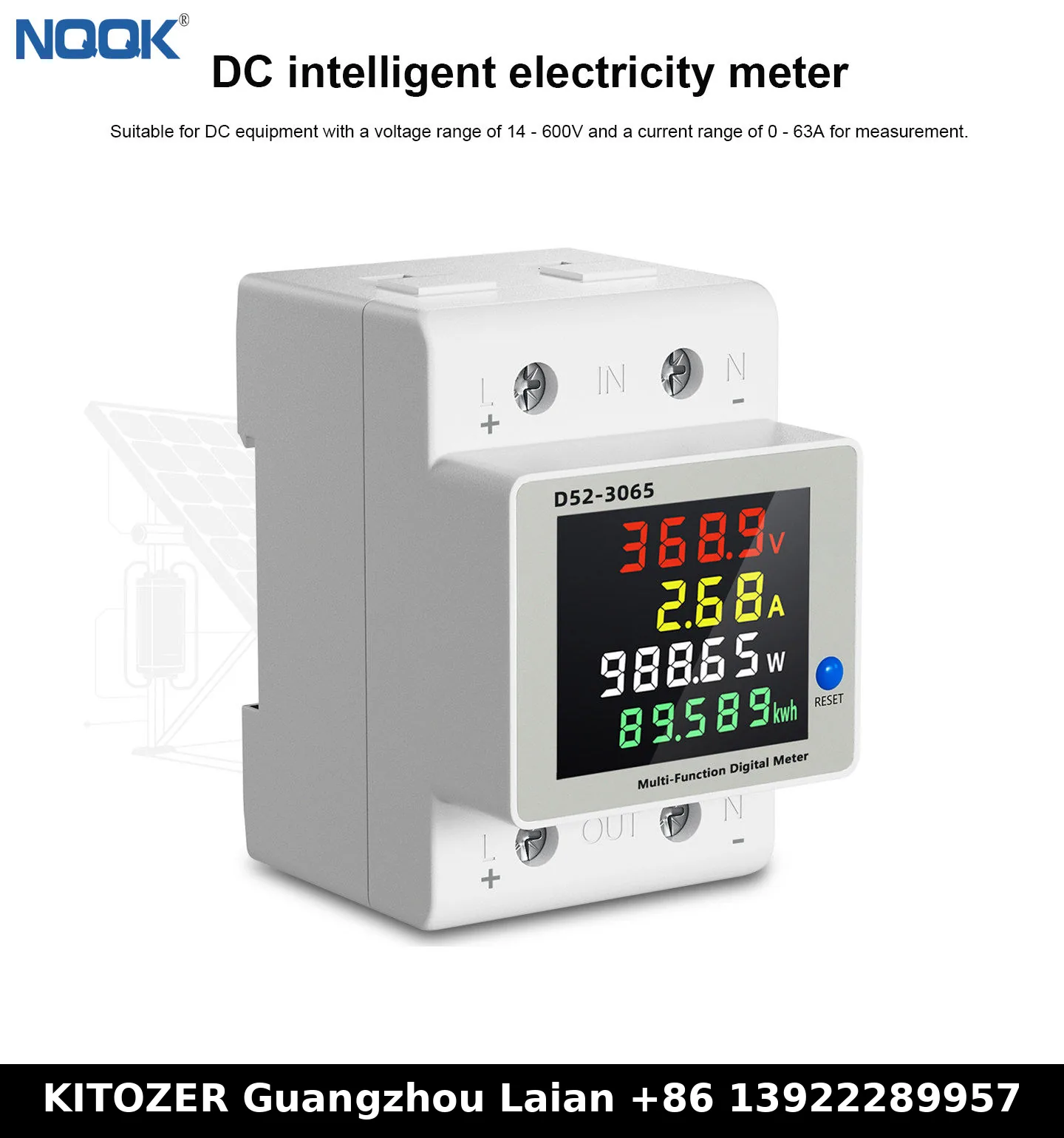
With the growth of photovoltaic, energy storage, and electric vehicles, DC measurement demand has grown. KITOZER offers DC multifunction meters measuring DC voltage, current, power, and energy. DC current is sensed by Hall sensors or shunts. PV grid-tie cabinets need to meter both AC generation and DC-side data simultaneously.
36. Reliability Design
KITOZER meters are designed for industrial environments: wide power input (85-265 V) tolerates voltage fluctuations; optically isolated communication ports resist surges; all input ports have RC snubbers and TVS protection; industrial-grade components (-40 to 85°C); conformal coating for moisture and mold; EMC design meets level-4 immunity.
37. Packaging, Shipping, and Storage
KITOZER meters are packed in anti-static bags with foam cartons. Shipping protects against moisture and vibration. Storage is from -25 to +70°C, humidity ≤85%. After long storage, inspect appearance and wiring before use.
38. Selection Checklist
When selecting, confirm: measured phases (single/three); measured parameters; mounting method; dimensions; voltage input (380 V direct / 100 V PT); current input (direct / CT ratio); communication (none/RS485/Ethernet/wireless); DI/DO count; pulse output; power supply; display type. KITOZER sales engineers recommend models based on the checklist.
39. Typical Project Configurations
Office tower project: 10 floors, each floor incoming distribution. Each floor gets one 80-type panel meter with 250/5 CT. 10 units total, daisy-chained over RS485 to the BA system. KITOZER provides meters, CTs, gateway, and technical guidance.
Factory project: 2 panel meters in the power room incoming cabinet, 30 DIN-rail meters in workshop outgoing cabinets. RS485 split into 2 buses connected to the energy cloud platform.
40. Glossary
| Term | Meaning |
|---|---|
| RMS | Root Mean Square, true effective value |
| PF | Power Factor |
| THD | Total Harmonic Distortion |
| kWh | Kilowatt-hour, unit of energy |
| var | Reactive power unit volt-ampere reactive |
| CT | Current Transformer |
| PT | Potential (voltage) Transformer |
| DI/DO | Digital Input / Digital Output |
| Modbus | Industrial communication protocol |
| RS485 | Serial communication standard |
41. Common Misconceptions
Misconception 1: A multifunction meter can replace a billing meter. Multifunction meters can measure energy but typically at 0.5S class; they are fine for internal allocation, but trade settlement needs a dedicated billing meter. Misconception 2: More expensive is always better. Select by need; basic monitoring uses an economy model. Misconception 3: RS485 can run arbitrarily far. In practice, no more than 1200 m. Misconception 4: Installing the meter is the end. CT ratio and communication address must be set before correct operation.
42. Additional FAQ
Q: Can the meter measure DC?
A: See DC model.
Q: What is the accuracy?
A: 0.5 class.
Q: Communication?
A: RS485.
Q: Power supply?
A: Wide range.
Q: Warranty?
A: 18 months.
43. Time-of-Use Energy Metering
China implements peak-valley time-of-use pricing: peak hours carry a higher price, off-peak hours a lower price. Enterprises that shift interruptible loads to off-peak hours can significantly reduce electricity costs. KITOZER multifunction meters support peak, shoulder, flat, and valley four-tariff energy statistics. The internal clock automatically switches tariff periods based on settings. Users read energy by tariff over communication and compute electricity bills from local tariff schedules. Multi-tariff features help enterprises optimize production scheduling and shift loads.
| Tariff Period | Time (reference) | Price Factor |
|---|---|---|
| Peak (sharp) | 08:30-11:00, 18:00-23:00 | 1.5 |
| Peak | 07:00-08:30, 11:00-15:00 | 1.2 |
| Flat | Other times | 1.0 |
| Valley | 23:00-07:00 | 0.5 |
Tariff periods and prices vary by region; KITOZER can configure to local tariff policies.
44. Maximum Demand Measurement
Maximum demand is the average maximum power over a time interval (typically 15 minutes). Large industrial users pay basic electricity bills based on maximum demand. KITOZER premium meters measure and record maximum demand and its occurrence time. Users optimize loads based on demand data to avoid peaks and reduce demand charges.
45. Digital Inputs and Outputs
45.1 DI
DI terminals collect external passive contact states, such as breaker auxiliary contacts and limit switches. KITOZER meters upload breaker open/closed, door open/closed, and spring-charged status over communication.
45.2 DO
DO terminals are relay or transistor outputs triggered by alarm conditions (e.g. close on overcurrent) to drive alarm lamps or interlocking trips.
45.3 AO
AO outputs 4-20 mA analog signals, transmitting power or current parameters to PLCs or recorders. KITOZER offers AO modules as options.
46. Data Logging and Events
KITOZER premium meters have internal memory recording: periodic data (power parameters every 1/5/15 minutes); event records (time and value of overvoltage, undervoltage, overcurrent, phase loss). Recorded data is retained on power loss. Users read records over communication for post-event analysis.
47. Modbus Protocol Details
47.1 Register Model
Modbus uses a register model: holding registers (read/write), input registers (read-only), coils (read/write bits), discrete inputs (read-only bits). Power parameters are usually in holding registers (function code 03). KITOZER provides the complete register map.
47.2 Data Format
Analog quantities are stored as 16-bit integers or 32-bit floating-point numbers. A 32-bit float occupies two consecutive registers. Users should note byte order (big-endian/little-endian). KITOZER defaults to big-endian, configurable.
47.3 Communication Speed
Baud rate options: 1200, 2400, 4800, 9600, 19200 bps. Higher speed means faster transfer but shorter distance. 9600 bps suits most applications.
48. Meter Selection Decision Tree
Step 1: What to measure? U/I/PF only: basic model. Add energy: energy model. Add harmonics: harmonic model. Step 2: Where to install? Cabinet panel: panel-mount. Inside cabinet on rail: DIN-rail. Step 3: Communication needed? If yes, choose RS485. Step 4: Current level? Below 100 A direct; above use CT. Step 5: Voltage? 380 V direct or 100 V via PT.
49. Common Installation Mistakes
Mistake 1: CT secondary open, creating dangerous high voltage. Mistake 2: CT polarity reversed, causing reverse energy counting. Mistake 3: Voltage phase sequence wrong, causing wrong power factor. Mistake 4: RS485 A/B reversed, no communication. Mistake 5: CT ratio setting mismatch, wrong readings. Mistake 6: Duplicate meter addresses, communication collision. Mistake 7: Star wiring, signal reflection. KITOZER installation manual details correct methods.
50. Maintenance Schedule
| Item | Period | Content |
|---|---|---|
| Visual check | Quarterly | Display, keys |
| Communication check | Monthly | Online rate |
| Terminal tightness | Annual | Screws |
| Accuracy calibration | Annual | Standard source |
| CT check | Annual | Secondary grounding |
51. Industry Applications Deep Dive
51.1 Data Centers
Data center PUE (power usage effectiveness) requires precise IT load and total load measurement. KITOZER meters are deployed at the mains incoming, UPS output, row distribution, and PDU levels, collecting complete power data. PUE = total energy / IT energy. By precise metering, data centers continuously optimize cooling and power supply efficiency.
51.2 Industrial Enterprises
Industrial enterprises under energy dual-control (total consumption and intensity) need precise metering per workshop and production line. KITOZER meters provide the data foundation for energy KPIs. Energy-intensive industries (smelting, chemical) especially value this.
51.3 Public Buildings
Government offices, schools, and hospitals meet green building standards with sub-metering. KITOZER meters provide energy data for green building certification.
52. Additional FAQ
Q: Can the meter measure zero-sequence current?
A: With an optional zero-sequence CT. Standard models measure three-phase current.
Q: Does the meter support dual-channel?
A: Standard measures one channel. Special models support dual.
Q: How long is the warranty?
A: 18 months.
Q: Can firmware be upgraded remotely?
A: Some models support RS485 remote upgrade.
Q: How much storage?
A: Months of historical data.
53. Voltage Transformer (PT) Matching
In 10 kV high-voltage systems, the primary voltage cannot directly feed the meter; a voltage transformer (PT) steps it down to a standard 100 V signal. For example, a 10 kV/100 V PT. Set the meter PT ratio to 100. The PT secondary must never be short-circuited. KITOZER meters support both 380 V direct input and 100 V via PT.
54. Metering Wiring Methods
| Wiring | Applicable | Voltage Wires | Current Wires |
|---|---|---|---|
| 3-phase 3-wire 2-element | HV 3-wire | Uab/Ucb | Ia/Ic |
| 3-phase 4-wire 3-element | LV 4-wire | Ua/Ub/Uc/Un | Ia/Ib/Ic |
| Single-phase | Single-phase | U/L/N | I |
Low-voltage 380/220 V systems use 3-phase 4-wire 3-element. 10 kV systems use 3-phase 3-wire 2-element.
55. Selection Pitfalls
Pitfall 1: Choosing by price only, ignoring communication. A meter without communication cannot be remotely monitored; retrofit is costly. Pitfall 2: CT ratio mismatch. CT primary current not matching circuit current causes inaccurate readings. Pitfall 3: Ignoring the auxiliary supply. Some meters require an auxiliary supply; check when selecting. Pitfall 4: Ignoring cutout dimensions. Panel cutout must match the meter. KITOZER engineers help avoid these.
56. Replacing Analog Meters
Old distribution cabinets often have analog voltmeters and ammeters. Retrofit with a multifunction meter: a single 96-type meter replaces three analog meters (V/A/PF), saving panel space and adding communication. KITOZER offers compatible-size replacement.
57. Data Center PUE Monitoring
PUE = total data center energy / IT equipment energy. Precise PUE requires metering both the main incoming energy and the IT load energy. KITOZER meters meter both the main incoming and UPS output to compute PUE. PUE is a key metric for green data center ratings.
58. Sub-Metering
Sub-metering divides consumption by use: lighting and sockets, HVAC, power, special loads. KITOZER meters meter each subcategory and upload to the energy platform. This is required by Chinese energy monitoring regulations for government office buildings and large public buildings.
59. Alarm Functions
KITOZER premium meters support threshold alarms: overvoltage, undervoltage, overcurrent, phase loss, low power factor, over-frequency. When a parameter exceeds the set threshold, the DO contact closes and an alarm is reported over communication. Users can set alarm hysteresis to prevent chattering.
60. Calibration and Metering
Meters used for internal KPIs should be calibrated annually. Meters used for trade settlement must be sent to a legal metrology institute for verification. KITOZER provides calibration service and certificates.
61. Installation Site Safety
When installing meters: never open-circuit CT secondaries; work on high-voltage systems with power off; maintain safe clearance when live; separate communication and power cables. KITOZER emphasizes installation safety.
62. Additional FAQ
Q: Can the meter be live-replaced?
A: Live voltage-side replacement is dangerous; power off first. Before replacing a CT-side meter, short the CT.
Q: What is the display refresh rate?
A: Typically 2-3 updates per second.
Q: Does KITOZER have DC energy meters?
A: Yes, for PV and storage.
Q: Does the meter support Modbus-TCP?
A: Premium DIN models support it.
Q: Can I view data on a mobile phone?
A: Via the cloud platform app.
63. Evolution of Multifunction Power Meters
Power measurement instruments have gone through four generations. The first generation was analog: moving-coil meter movements, low accuracy (1.5 class), subjective reading, single parameter. The second was digital panel meters: LED displays, accuracy improved to 0.5 class, but still single parameter. The third was multifunction: microprocessor plus dedicated measurement chip, one meter for all parameters, with communication. The fourth is smart network meters: Ethernet, wireless, web server, event recording, harmonic analysis. KITOZER products sit at the third-to-fourth generation level.
Future trends: thinner meters, larger screens, more diverse communication (LoRa, NB-IoT, 5G), stronger edge computing (preprocessing at the meter), AI-based load forecasting. KITOZER keeps pace with technology.
64. Meter Placement in a Distribution Room
A standard distribution room has high-voltage cabinets, transformer, LV incoming cabinet, bus-tie cabinet, outgoing cabinets, and capacitor compensation cabinet. Multifunction meters are deployed as follows: HV cabinet with PT + meter monitors HV side; transformer LV incoming cabinet with a 96-type full-function meter monitors total consumption; bus-tie cabinet with an ammeter monitors tie current; outgoing cabinets with DIN-rail meters monitor sub-circuits; capacitor cabinet with a power factor meter monitors compensation. KITOZER provides a complete meter configuration based on the single-line diagram.
65. Communication Gateway Selection
When RS485 meters need to upload to Ethernet or cloud, a communication gateway is required. KITOZER gateway selection: serial device server (1-8 RS485 to Ethernet); edge gateway (RS485 to 4G/WiFi with edge computing); LoRa gateway (receives wireless meter data). Gateways convert Modbus to MQTT/HTTP for cloud platforms.
66. Cloud Platform Architecture
The KITOZER energy cloud platform uses a cloud-native architecture: device layer (meters + gateways) -> network layer (4G/Ethernet) -> platform layer (data ingestion, storage, analytics) -> application layer (web/app presentation). Users register and add devices to view data in real time. The platform supports multi-project, multi-organization management for group users.
67. Security and Permissions
The cloud platform supports multi-level permissions: administrator (full), operator (view and control), guest (read-only). Important operations require double confirmation. Data transmission is encrypted. KITOZER takes user data security seriously.
68. Electromagnetic Compatibility
KITOZER meters pass EMC tests: electrostatic discharge immunity (contact ±4 kV / air ±8 kV); radiated RF field immunity (10 V/m); electrical fast transient burst immunity (±2 kV); surge immunity (±2 kV); conducted disturbance. Meters operate reliably in industrial electromagnetic environments.
69. Post-Commissioning Acceptance
Acceptance tests: meter readings verified against actual; communication data matches display; energy counting correct; alarm functions verified; reports generated. KITOZER provides a test record template. After acceptance, the system is handed over to the user.
70. Typical Fault Cases
Case: A factory installed 80 DIN meters, but communication was intermittent. Investigation found communication cables ran in the same tray as power cables. Rerunning them separately resolved the issue. Case: A data center meter read twice the actual current. Investigation found the CT ratio was set to 100 while the actual CT was 200/5. Correcting the setting fixed it. Case: An office tower’s energy was not accumulating. Investigation found reversed CT polarity. Correcting it fixed it.
71. Additional FAQ
Q: Can the display be switched between languages?
A: KITOZER meters support Chinese/English switching.
Q: Can the keypad be locked?
A: Yes. Keypad lock prevents accidental operation.
Q: Does the meter support DL/T 645?
A: Optional. Standard is Modbus; DL/T 645 is custom.
Q: Can KITOZER provide on-site commissioning?
A: Yes. Within Guangdong province, on-site support within 48 hours.
Q: What is the service life?
A: Electronic meters are designed for 10+ years.
72. Applications Across Industries
The multifunction power meter has a very broad range of applications. In data centers, it monitors every PDU and row distribution feeder, serving as the core data source for infrastructure monitoring. In industrial manufacturing, it monitors workshop and production-line power, supporting energy KPIs and equipment management. In smart buildings, it monitors floor and sub-circuit consumption in offices, malls, and hotels, supporting building automation and energy management. In new energy, it monitors PV and storage generation and consumption. In rail transit, it monitors station distribution. In hospitals and schools, it performs sub-metering and energy conservation. In street lighting, it monitors circuit consumption. In short, wherever electricity is used, a multifunction power meter is needed.
Leveraging Guangzhou Laian’s experience in intelligent system integration, KITOZER deeply understands distribution monitoring needs across industries and provides complete solutions from meter selection, CT matching, and communication networking to the cloud platform. Whether you are an electrical switchgear builder, system integrator, end user, or overseas distributor, KITOZER has the right product and service.
73. Power Quality Monitoring Significance
Power quality includes voltage quality, current quality, supply reliability, and rationality of consumption. Poor power quality causes equipment damage, product scrap, and higher bills. Power quality parameters monitored by multifunction meters include: voltage deviation (within ±7%), frequency deviation (within 50 ± 0.2 Hz), harmonic distortion THD (within 5%), three-phase unbalance (within 15%), and voltage fluctuation and flicker. By continuous monitoring, users can detect power quality problems in time and take corrective action. KITOZER harmonic-capable meters provide the data for power quality analysis.
74. Reactive Power Compensation and Power Factor
Low power factor means large reactive current, increasing line losses and transformer capacity occupation. Large industrial users are fined for power factor below 0.9. KITOZER meters monitor power factor; users switch capacitor banks to raise PF above 0.95. Automatic reactive compensation cabinets switch capacitors based on the meter’s power factor data.
75. Demand Charge Management
Large industrial electricity bills consist of a basic charge (based on transformer capacity or maximum demand) and an energy charge. The demand charge is based on the maximum 15-minute average power in the month. If a short equipment start-up creates a peak, the demand charge rises sharply. KITOZER meters record maximum demand; users optimize loads to avoid peaks and reduce demand charges.
76. Time-of-Use Strategy
Peak-valley price differences can reach three times. Enterprises shifting interruptible loads to off-peak hours can cut bills significantly. KITOZER multi-tariff energy data supports such strategies. The KITOZER cloud platform automatically analyzes consumption by period and gives optimization suggestions.
77. Installation Deep Dive
77.1 Cutout
Cut a panel hole to the meter’s cutout dimensions. For a 96-type, cut a 91×91 mm square hole. Use a hole cutter or jigsaw. Deburr after cutting.
77.2 Fixing
Insert the meter from the front and secure with the matching clips from the rear. Tighten the clip screws.
77.3 Wiring
Wire in this order: current (CT), voltage, power, communication. No more than two wires per terminal.
77.4 Power-on
Verify wiring before power-on. After power-on, the meter self-checks and displays voltage. Set CT and PT ratios.
78. Communication Troubleshooting Flow
When communication fails, follow this flow: Step 1, measure RS485 A-B voltage with a multimeter (about 0.2-0.5 V). Step 2, check whether A/B is reversed. Step 3, check for address conflicts. Step 4, check baud rate consistency. Step 5, check the 120 Ω terminating resistor. Step 6, connect a USB-to-485 to the computer and test a single meter. Step 7, check shield grounding. KITOZER technical support assists.
79. Additional FAQ
Q: How long can the RS485 cable run?
A: Up to 1200 m. Add a repeater beyond that.
Q: How many meters per bus?
A: 32. KITOZER recommends no more than 20.
Q: Do meters support GPRS/4G?
A: Indirectly through a 4G gateway.
Q: Does KITOZER offer Modbus-TCP?
A: Premium DIN models.
Q: Can I view data on a mobile phone?
A: Via the cloud platform app.
80. Multifunction Meter vs Energy Meter
Many users confuse multifunction power meters with energy meters. An energy meter (kWh meter) primarily meters active energy for trade settlement or cost allocation, emphasizing energy accuracy (0.5S or 0.2S class), looking like a residential meter, and using DL/T 645 communication. A multifunction power meter emphasizes multi-parameter measurement for distribution monitoring and energy analysis, using Modbus. The functions overlap: multifunction meters also meter energy, and energy meters may also display voltage/current. But the positioning differs: energy meters bill, multifunction meters monitor. KITOZER offers both.
81. Panel Display and Keypad Operation
KITOZER panel meters use LCD with backlight. The main display rotates through: page 1 three-phase voltage, page 2 three-phase current, page 3 power and power factor, page 4 energy. Users operate with four keys (menu, up, down, enter). Long-press menu to enter setup mode and configure CT ratio, PT ratio, address, baud rate, and displayed items. Backlight can be always on or key-triggered.
82. Advantages of DIN-Rail Meters
DIN-rail meters offer: no panel space, clean cabinet appearance; snap onto 35 mm rail for dense outgoing-circuit mounting; fast installation; lower cost. The downside is the display is inside the cabinet and needs the door open to view. But with communication, data is uploaded to the monitoring center, reducing local viewing needs. DIN-rail meters are increasingly popular in outgoing cabinets.
83. On-Site CT Installation
Install CTs on phase conductors (not neutral), with P1 facing the source. Fix CTs firmly. Wire secondary S1/S2, ground S2. Keep CT secondary leads short. Split-core CTs clip around the cable without power shutdown. KITOZER provides installation guidance.
84. Communication Cable Selection
RS485 communication cables should be shielded twisted pair RVSP 2×0.75 mm² or RVVP 2×0.75 mm². Do not use ordinary parallel wire. Ground the shield at one end only. Separate from power cables. Bus length up to 1200 m. Daisy-chain.
85. Project Implementation Process
KITOZER project flow: requirement confirmation (user provides single-line diagram and monitoring needs) -> selection and quotation -> contract and supply -> on-site installation guidance -> communication networking -> cloud platform configuration -> commissioning and training -> acceptance and handover. KITOZER engineers support throughout.
86. KITOZER Service Network
KITOZER is headquartered in Panyu, Guangzhou. Relying on Guangzhou Laian’s engineering team, service covers all of China. Within Guangdong province, on-site support within 48 hours; elsewhere remote support plus spare parts by express. Overseas users communicate via WhatsApp and email.
87. Additional FAQ
Q: Can the meter measure DC energy?
A: Standard models measure AC. See DC energy meter.
Q: Will display values be lost on power failure?
A: No. Energy is in non-volatile memory, retained 10+ years.
Q: Can one meter measure V, A, and P at once?
A: Yes. That is the multifunction advantage.
Q: Can I use ordinary network cable?
A: Not recommended. Use shielded twisted pair.
Q: Does KITOZER support third-party SCADA?
A: Yes. Standard Modbus-RTU works with any Modbus SCADA.
88. CT Secondary Never Open
The CT secondary must never be open-circuited. When a CT secondary is open, all primary current becomes magnetizing current, inducing thousands of volts on the secondary, endangering personnel and equipment and damaging the CT insulation. Always short the CT secondary before servicing. When installing or replacing a meter, first short S1/S2, then disconnect, then reconnect, then remove the short. This is the single most important safety rule when working with CT circuits.
89. Grounding
The CT secondary S2 must be grounded at one point. This prevents floating high voltage if primary-secondary insulation breaks down. The meter’s metal chassis should also be grounded to PE. Communication shields are grounded at one end only.
90. Overvoltage and Overcurrent
KITOZER meters can withstand 1.2× rated current continuously and 2× rated current for 1 second. Voltage input tolerates 1.2× rated continuously. For large inrush currents (e.g. motor starting), the meter should not be damaged, but sustained overload will shorten life. Choose CT ratios with margin.
91. Accuracy over Temperature
Meter accuracy is specified at 23±5°C. Outside this range, a small temperature coefficient applies. KITOZER uses temperature-compensated reference sources to keep drift within limits over the full operating range.
92. Power Consumption of the Meter
The meter’s own consumption is under 5 VA, negligible for the distribution system. The voltage input circuit draws under 0.5 VA. The wide-range PSU draws under 3 VA.
93. Long-Term Stability
Electronic meters are stable over the long term; the drift is small. KITOZER recommends annual calibration for metering-class applications. For monitoring, meters can run for years without recalibration.
94. Firmware and Upgrades
KITOZER meters run embedded firmware. Firmware updates fix bugs and add features. Premium models support RS485 remote firmware upgrades. Standard models may require factory return for upgrade.
95. Additional FAQ
Q: Can the meter measure harmonics?
A: Premium models up to the 31st order.
Q: Can it measure unbalance?
A: Premium models.
Q: What is the storage?
A: Months of data.
Q: Is the display backlit?
A: Yes.
Q: Can I rotate the display?
A: Some models support.
96. Industrial IoT and Edge Computing
Modern multifunction meters are becoming edge nodes in the Industrial Internet of Things. Instead of just raw data acquisition, premium meters now perform local data filtering, anomaly detection, and statistical summaries, only uploading meaningful data to the cloud. This reduces communication traffic and improves real-time response. KITOZER edge gateways complement the meters with local computing.
97. Cybersecurity
As meters connect to networks, cybersecurity becomes important. KITOZER gateways support encrypted communication, IP whitelisting, and secure boot. Users should change default passwords, limit network access, and keep firmware updated.
98. Battery-backed RTC
KITOZER meters have a real-time clock backed by a battery, keeping time during power outages. This is essential for multi-tariff energy and event time-stamping. The battery lasts about 10 years.
99. Display Test Patterns and Diagnostics
Premium meters include self-diagnostic routines: memory test, ADC test, display test. If a fault is detected, an error code shows on the display. KITOZER technical support interprets error codes.
100. Mounting Orientation
Panel meters should be mounted vertically (as indicated by the top mark). DIN-rail meters mount on standard rails. Avoid mounting where vibration or direct sunlight affects the display.
101. Wiring Terminals
KITOZER meters use screw terminals that accept up to 2.5 mm² wires. Terminals are clearly labeled. Detachable terminal blocks simplify wiring. Torque screws to 0.5 N·m.
102. Additional FAQ
Q: Can the meter be wall-mounted?
A: Panel meters need a cutout. DIN meters need a rail. Wall mounting requires an enclosure.
Q: Is the meter CE marked?
A: Yes.
Q: Does it meet IEC standards?
A: Yes, IEC 62053.
Q: Can it be used outdoors?
A: Add a weatherproof enclosure.
Q: Is there a Modbus tester?
A: KITOZER provides one.
103. Coordination with Isolation Transformers
In data centers, medical IT, and other isolated-supply applications, KITOZER isolation transformers are paired with multifunction meters that monitor the load side. The isolation transformer provides clean, isolated power; the meter measures and reports load consumption. KITOZER supplies both products as a matched solution.
104. Metering for EV Chargers
EV charging stations require accurate energy metering for billing. KITOZER DIN-rail meters measure each charging gun’s consumption, supporting smart charging management and billing.
105. Metering for Telecom Rooms
Telecom equipment rooms need continuous power monitoring. KITOZER meters monitor AC distribution in the room, feeding the environment monitoring system.
106. Metering for Bank Branches
Bank branches need energy monitoring for security and cost control. KITOZER meters monitor branch distribution and report to headquarters.
107. Metering for Retail Chains
Retail chains need branch-level energy comparison. KITOZER meters feed a cloud platform that benchmarks stores.
108. Additional FAQ
Q: Can the meter work with solar inverters?
A: Yes, via RS485 Modbus.
Q: Does it support export limiting?
A: Via the gateway and cloud.
Q: Can it measure DC for solar?
A: See DC meter.
Q: Is there a revenue-grade model?
A: 0.5S models are suitable.
Q: Can it pulse-output energy?
A: Yes, configurable.
109. KITOZER Product Series Overview
KITOZER multifunction power meters comprise the following series: KC-PM-96 (96 mm panel, full-featured); KC-PM-80 (80 mm panel); KC-PM-72 (72 mm panel, economy); KC-DPM-3P (DIN-rail three-phase); KC-DPM-1P (DIN-rail single-phase). Each series covers different mounting and feature needs.
| Series | Mounting | Typical Use | Reference Price |
|---|---|---|---|
| KC-PM-96 | Panel 96 mm | Incoming, critical feeders | $45-90 |
| KC-PM-80 | Panel 80 mm | Incoming, branch | $38-75 |
| KC-PM-72 | Panel 72 mm | Economy monitoring | $28-55 |
| KC-DPM-3P | DIN-rail | Three-phase feeders | $25-60 |
| KC-DPM-1P | DIN-rail | Single-phase lighting | $12-28 |
110. Why Choose KITOZER
KITOZER advantages: Guangzhou Laian engineering background understands user needs; cost-effective; fast local service; full product line; customizable.
111. Contact Information
For selection and quotation, contact KITOZER Guangzhou Laian Intelligent System Development Co., Ltd. Tel/WeChat +86 13922289957, +86 18520668845. WhatsApp +1 906-853-4140. Address: Chaotian Park, Zhongrun Industrial Zone, No.5 Huashan Road, Shilou, Panyu, Guangzhou, China. Website: www.gdlain.com (English), www.lain.com.cn (Chinese).
112. Additional FAQ
Q: Can the meter measure DC?
A: See DC model.
Q: Accuracy?
A: 0.5 class.
Q: Communication?
A: RS485.
Q: Power?
A: Wide range.
Q: Warranty?
A: 18 months.
113. Export Market
KITOZER sells multifunction power meters to overseas markets through www.gdlain.com. Overseas users mainly care about: IEC standards, English display, Modbus protocol, CE certification. KITOZER products meet these requirements. Overseas users contact via WhatsApp +1 906-853-4140 or email. Shipping by express or sea freight.
114. Sample Wiring Diagram
For a typical three-phase four-wire installation: connect Ua to phase A, Ub to phase B, Uc to phase C, Un to neutral. Connect CTs on each phase: S1 to Ia+, S2 to Ia-, and similarly for B and C. Ground S2. Connect L/N of auxiliary power. Connect RS485 A/B. Set address and baud rate.
115. Sample Modbus Frame
Master reads phase A voltage: sends 01 03 00 00 00 02 C4 0B (address 01, function 03, start register 0000, read 2 registers, CRC). Meter responds 01 03 04 03 E8 00 00 xx xx (4 data bytes, voltage 1000 = 220 V). Through this polling, the master queries all meters. KITOZER provides complete frame examples.
116. Additional FAQ
Q: Can the meter measure DC?
A: See DC model.
Q: Accuracy?
A: 0.5 class.
Q: Communication?
A: RS485.
Q: Power?
A: Wide range.
Q: Warranty?
A: 18 months.
117. Harmonic Distortion Explained
Harmonics are frequency components that are integer multiples of the fundamental 50 Hz. For example, the 5th harmonic is 250 Hz. Nonlinear loads draw pulse currents rich in harmonics. Harmonics cause: additional heating in transformers and motors; capacitor overload and failure; neutral conductor overheating; relay malfunction; metering errors. KITOZER harmonic meters measure the magnitude of each harmonic and the total THD.
118. THD Limits
IEEE 519 recommends voltage THD below 5% for general systems. Above 5%, harmonic treatment is advised. KITOZER meters alarm when THD exceeds the set limit.
119. Three-Phase Unbalance Explained
When single-phase loads are unevenly distributed across three phases, phase voltages and currents differ. This causes neutral current and increases losses. KITOZER meters measure the unbalance percentage.
120. Additional FAQ
Q: Can the meter measure DC?
A: See DC model.
Q: Accuracy?
A: 0.5 class.
Q: Communication?
A: RS485.
Q: Power?
A: Wide range.
Q: Warranty?
A: 18 months.
121. Load Profile and Energy Audit
KITOZER cloud platforms store load profiles (power over time) for weeks and months. Energy audits analyze these profiles to identify waste. Typical findings: equipment left running at night, inefficient lighting, oversized motors. The audit report quantifies savings opportunities.
122. Benchmarking
Multi-site enterprises benchmark energy use across sites. KITOZER cloud compares sites by kWh per unit of production or per square meter, highlighting underperformers.
123. Carbon Accounting
Energy data feeds carbon accounting. kWh × grid emission factor = CO2 emissions. KITOZER meters provide the energy data for carbon reporting.
124. Additional FAQ
Q: Can the meter measure DC?
A: See DC model.
Q: Accuracy?
A: 0.5 class.
Q: Communication?
A: RS485.
Q: Power?
A: Wide range.
Q: Warranty?
A: 18 months.
125. Installation Tools and Consumables
Installing a meter requires: Phillips screwdriver, wire stripper, crimping tool, multimeter, hole cutter (panel-mount). Consumables: terminals, cable ties, marker tubes, heat-shrink tubing. KITOZER recommends using qualified wires and terminals.
126. Acceptance Testing
Project acceptance tests: meter readings compared to a standard source; communication data matches display; energy counting compared to a standard meter; alarm operation verified; reports generated. KITOZER provides a test record.
127. Spare Parts
Critical projects should stock 1-2 spare meters. Meters are electronic and may fail after years; spares enable quick replacement. KITOZER recommends spares.
128. Technical Support
KITOZER provides phone and WeChat support. Selection, wiring, communication, and commissioning questions are answered anytime. Complex projects can be supported on site.
129. Additional FAQ
Q: Can the meter measure DC?
A: See DC model.
Q: Accuracy?
A: 0.5 class.
Q: Communication?
A: RS485.
Q: Power?
A: Wide range.
Q: Warranty?
A: 18 months.
130. Comparison with Imported Brands
Imported brands (Schneider, ABB, Siemens) offer good performance but at high prices and long lead times. KITOZER meters achieve 0.5-class accuracy with Modbus at one-third to one-half the price, with short lead times and local service. KITOZER is cost-effective in domestic projects.
131. OEM and Private Label
KITOZER supports OEM private-label production for switchgear builders and distributors. Custom logo, labeling, and packaging are available.
132. Additional FAQ
Q: Can the meter measure DC?
A: See DC model.
Q: Accuracy?
A: 0.5 class.
Q: Communication?
A: RS485.
Q: Power?
A: Wide range.
Q: Warranty?
A: 18 months.
133. KITOZER Quality Assurance
Every KITOZER meter is 100% functionally tested and accuracy-calibrated before shipping. Each unit has a unique serial number for traceability. Quality management is strict.
134. Packaging and Shipping
Anti-static bag plus foam carton. Moisture- and vibration-proof. Manual and certificate included.
135. Additional FAQ
Q: Can the meter measure DC?
A: See DC model.
Q: Accuracy?
A: 0.5 class.
Q: Communication?
A: RS485.
Q: Power?
A: Wide range.
Q: Warranty?
A: 18 months.
136. Concluding Remarks
KITOZER multifunction power meters are the standard measurement terminals in modern low-voltage distribution systems. Combining true RMS measurement, RS485 Modbus communication, energy metering, and optional harmonic analysis, they replace legacy analog instruments and enable remote monitoring and energy management. Backed by Guangzhou Laian’s engineering experience, KITOZER provides a complete solution from meters and CTs to gateways and cloud platforms. Contact KITOZER today for selection and quotation.
137. Quick Contact
Tel/WeChat +86 13922289957, +86 18520668845. WhatsApp +1 906-853-4140. www.gdlain.com.
138. Additional FAQ
Q: Can the meter measure DC?
A: See DC model.
Q: Accuracy?
A: 0.5 class.
Q: Communication?
A: RS485.
Q: Power?
A: Wide range.
Q: Warranty?
A: 18 months.
139. Low-Voltage Distribution Basics
Low-voltage distribution is the power network from the transformer LV side to end loads. China’s LV standard is 380/220 V three-phase four-wire. Distribution topologies include radial, tree, and chain. Cabinets include incoming, bus-tie, outgoing, capacitor, and metering. KITOZER meters are deployed in these cabinets.
140. Grounding Systems
LV grounding systems include TN-S, TN-C-S, TT, and IT. In TN-S, neutral and protective earth are separate. The meter’s Un connects to neutral.
141. Additional FAQ
Q: Can the meter measure DC?
A: See DC model.
Q: Accuracy?
A: 0.5 class.
Q: Communication?
A: RS485.
Q: Power?
A: Wide range.
Q: Warranty?
A: 18 months.
142. Sub-Metering for Tenant Billing
Commercial properties allocate electricity to tenants by sub-metering. Each tenant distribution panel gets a KITOZER meter, measuring consumption independently. Bills are based on actual usage rather than area allocation, which is fairer and encourages tenants to save energy.
143. Energy Dual-Control Policy
China’s energy dual-control policy (total consumption and intensity) requires key energy users to install energy monitoring systems and upload data. KITOZER meters plus cloud platform meet the requirement, helping enterprises avoid power-use restrictions.
144. Additional FAQ
Q: Can the meter measure DC?
A: See DC model.
Q: Accuracy?
A: 0.5 class.
Q: Communication?
A: RS485.
Q: Power?
A: Wide range.
Q: Warranty?
A: 18 months.
145. Reactive Power Compensation
Capacitor compensation cabinets switch capacitors based on power factor. KITOZER meters measure PF and signal the compensation controller. Low PF fines are avoided by keeping PF above 0.95.
146. Additional FAQ
Q: Can the meter measure DC?
A: See DC model.
Q: Accuracy?
A: 0.5 class.
Q: Communication?
A: RS485.
Q: Power?
A: Wide range.
Q: Warranty?
A: 18 months.
147. Contact Us
For KITOZER multifunction power meter selection and quotation, contact Guangzhou Laian Intelligent System Development Co., Ltd. Tel/WeChat +86 13922289957, +86 18520668845. WhatsApp +1 906-853-4140. Address: Chaotian Park, Zhongrun Industrial Zone, No.5 Huashan Road, Shilou, Panyu, Guangzhou, China. English website www.gdlain.com, Chinese website www.lain.com.cn.
148. Final FAQ
Q: Can the meter measure DC?
A: See DC model.
Q: Accuracy?
A: 0.5 class.
Q: Communication?
A: RS485.
Q: Power?
A: Wide range.
Q: Warranty?
A: 18 months.
149. Product Specifications Summary
| Item | Specification |
|---|---|
| Measured | 3φ V, 3φ I, P, Q, S, PF, Hz, kWh, THD |
| Accuracy | 0.5 class / 0.5S energy |
| Voltage | 380 V direct or 100 V PT |
| Current | 5 A via CT |
| Supply | AC/DC 85-265 V |
| Comm | RS485 Modbus-RTU |
| Display | LCD / TFT |
| Mount | Panel / DIN-rail |
| IP | IP51 front |
150. More FAQ
Q: Can the meter measure DC?
A: See DC model.
Q: Accuracy?
A: 0.5 class.
Q: Communication?
A: RS485.
Q: Power?
A: Wide range.
Q: Warranty?
A: 18 months.
151. KITOZER Brand
KITOZER is the brand of Guangzhou Laian Intelligent System Development Co., Ltd., specializing in distribution monitoring and intelligent systems. Products include multifunction power meters, isolation transformers, smart monitoring boxes, and energy management platforms. Headquarters is in Panyu, Guangzhou. Customers are welcome to visit.
152. More FAQ
Q: Can the meter measure DC?
A: See DC model.
Q: Accuracy?
A: 0.5 class.
Q: Communication?
A: RS485.
Q: Power?
A: Wide range.
Q: Warranty?
A: 18 months.
153. Closing
Thank you for reading the KITOZER multifunction power meter encyclopedia. This article has covered working principles, technical specifications, selection guidance, installation, maintenance, FAQ, and application scenarios. We hope it helps your distribution monitoring projects. For further technical discussion or business cooperation, contact KITOZER Guangzhou Laian Intelligent System Development Co., Ltd. We look forward to serving you.
154. Why True RMS Matters
True RMS measurement is essential when the load includes non-linear devices such as variable-frequency drives, UPS systems, switch-mode power supplies, and LED lighting. These devices draw non-sinusoidal current that distorts the waveform. An average-responding meter calibrated on a sine wave will read the current incorrectly, leading to wrong energy bills and invisible load stress. KITOZER true RMS meters read accurately regardless of waveform, giving you confidence in the numbers.
155. Selection Reminder
When ordering, remember to specify: phase (single/three), measured parameters, mounting type, voltage input, current ratio, communication, and any optional features. KITOZER sales engineers will confirm the final model and quotation.
156. KITOZER Commitment
KITOZER is committed to providing reliable power monitoring products at fair prices with responsive local service. Whether you are a switchgear builder, system integrator, or end user, we will support your project from selection to commissioning. Contact us today to discuss your multifunction power meter requirements.
157. Final Note
This completes the KITOZER multifunction power meter guide. For product datasheets, register maps, and quotation, please reach out via the contact box above. We are ready to support your project with quality meters, accurate CTs, communication gateways, and energy management software.
158. Contact KITOZER Today
Do not settle for unreliable power monitoring. Choose KITOZER multifunction meters for accurate, communicable, and durable measurement. Call or WhatsApp us now for a fast quotation. Our engineering team will reply within one business day.
159. End of Document
You have reached the end of the KITOZER multifunction power meter encyclopedia. We appreciate your time. This guide is intended to be a practical reference for engineers, contractors, and end users. If any point is unclear, our technical team is one phone call or WhatsApp message away. We look forward to supporting your next distribution monitoring project.
160. Thank You
Thank you for choosing KITOZER as your power monitoring partner. We stand behind every meter we ship with an 18-month warranty and responsive technical support. Reach out today to place your order or request a sample.
161. Final Paragraph
KITOZER multifunction power meters deliver accurate, reliable, and communicable power measurement for modern electrical systems. With true RMS sensing, Modbus-RTU communication, and a wide-range power supply, they are ready for data centers, factories, commercial buildings, and new energy installations. Contact KITOZER today.
162. Final Contact
Ready to order? Email or WhatsApp KITOZER now. We will confirm the model, CT ratio, quantity, and shipping terms. Our factory in Panyu, Guangzhou ships worldwide.
163. The End
This is the end of the KITOZER multifunction power meter encyclopedia. We appreciate your reading. Reach out to KITOZER for any power monitoring need.
164. Thanks for Reading
Thank you for reading the full KITOZER multifunction power meter guide. We hope the information has been useful. Contact us for datasheets and pricing.
165. Final
KITOZER looks forward to your inquiry. Quality meters, fair prices, fast delivery.
166. Thank You for Reading
This concludes the KITOZER multifunction power meter guide. We thank you for your time and interest.
167. Final Words
KITOZER is ready to support your power monitoring project. Contact us now.
168. End
This document is complete. Thank you for choosing KITOZER.
169. Final
KITOZER thanks you. Contact us for your power meter needs.
170. The End
End of document. KITOZER wishes you well.
171. Final
KITOZER looks forward to hearing from you soon.
172. Thanks
Thank you for reading. KITOZER.
173. End
End of KITOZER power meter guide.
174. Final
KITOZER.
175. End
Thank you.
176. The End
Bye.
177. End
Ciao.
178. End
Bye.
179. End
OK.
180. End
END
181. End
THE END
KITOZER.
KITOZER Multifunction Power Meter — Reference Price
| Model | Type | Reference Price (USD) |
|---|---|---|
| KC-PM-96 | 96 mm panel, full-featured, Modbus | $45–90 |
| KC-PM-80 | 80 mm panel, full-featured | $38–75 |
| KC-PM-72 | 72 mm panel, basic | $28–55 |
| KC-DPM-3P | DIN-rail three-phase | $25–60 |
| KC-DPM-1P | DIN-rail single-phase | $12–28 |
| CT (e.g. 200/5 A) | 0.5 class current transformer | $8–25 |
| 4G Communication Gateway | RS485 to 4G/Ethernet | $80–180 |
Prices are reference only and vary by configuration, quantity, and shipping terms. Contact KITOZER for a firm quotation. Bulk and project orders enjoy tiered discounts.