KITOZER Server Rack Blank Filler Panel (Rack Blank Panel) Technical Guide
A server rack blank filler panel (rack blank panel, blanking panel, U-space filler) is a sheet-metal or aluminum cover installed in the empty U positions of a 19-inch server rack. Its purpose is simple yet critical: it blocks the gap where no equipment is mounted, preventing hot exhaust air from recirculating from the rear of the rack to the front intake. This guide explains why blank panels matter, the KITOZER KZ-BP product range, materials, sizing, installation, energy saving calculations, standards, maintenance and a full FAQ. Reference price: USD 3-28 per panel (about RMB 20-200).
Chapter 1. What Is a Rack Blank Filler Panel
1.1 Definition
A rack blank filler panel is a flat or folded cover that mounts on the rack’s vertical mounting rails (square-hole or threaded) to occupy unused U positions. A standard rack unit (U) is 44.45 mm (1.75 inches) high. A 42U rack is 1867 mm high. When servers, switches and patch panels occupy only some of the U positions, the remaining empty positions are open holes between the front and rear of the rack. Without a cover, these holes create a direct shortcut between the cold aisle (front) and hot aisle (rear).
1.2 Why it exists
Modern racks use a front-to-back airflow design: servers draw cold air from the front (cold aisle) and exhaust hot air out the rear (hot aisle). If an empty U position is left open, the server fans draw air not only through their own front intake but also through the open empty U position, pulling hot air from the rear of the rack forward. This recirculated hot air mixes with the cold intake air, raising the server inlet temperature. Blank panels eliminate this shortcut, forcing all intake air to come from the cold aisle.
1.3 Where it is used
Rack blank panels are used in every 19-inch rack: server racks, network racks, communication cabinets, industrial control cabinets and wall-mount cabinets. They are a standard accessory in data centers, server rooms, telecommunications rooms and edge computing sites. Despite their low cost, they are one of the most cost-effective energy-saving and reliability measures in airflow management.
Chapter 2. The Airflow Problem Blank Panels Solve
2.1 Hot air recirculation
Hot air rises. In a rack, the hottest exhaust air tends to accumulate near the top. If the upper U positions are empty, that hot exhaust has an easy path back to the front intake through the open holes. The upper servers then intake air that is 5-10 C warmer than the cold aisle supply. This is the classic hot-aisle/cold-aisle recirculation problem. Blank panels at the upper empty U positions are the most direct fix.
2.2 How much air recirculates
Consider a half-full 42U rack with 15 servers and 27 empty U positions. The open area of the empty positions is large. Measurements and CFD studies show that in an unblanked rack, 30%-50% of the air drawn by server fans can recirculate through the empty U positions rather than coming from the cold aisle. After blanking, recirculation drops below 5%. The servers then intake nearly all fresh cold air.
2.3 Inlet temperature impact
ASHRAE recommends server inlet temperatures of 18-27 C. An unblanked rack can see upper inlet temperatures of 32-38 C, well above the recommended range. At these temperatures, servers throttle (reduce clock speed to protect components), fans run at full speed consuming extra power, and disk drives and power supplies age faster. Blank panels bring inlet temperature back to the design range, protecting performance and reliability.
Chapter 3. KITOZER KZ-BP Product Range
3.1 KZ-BP-1U solid steel
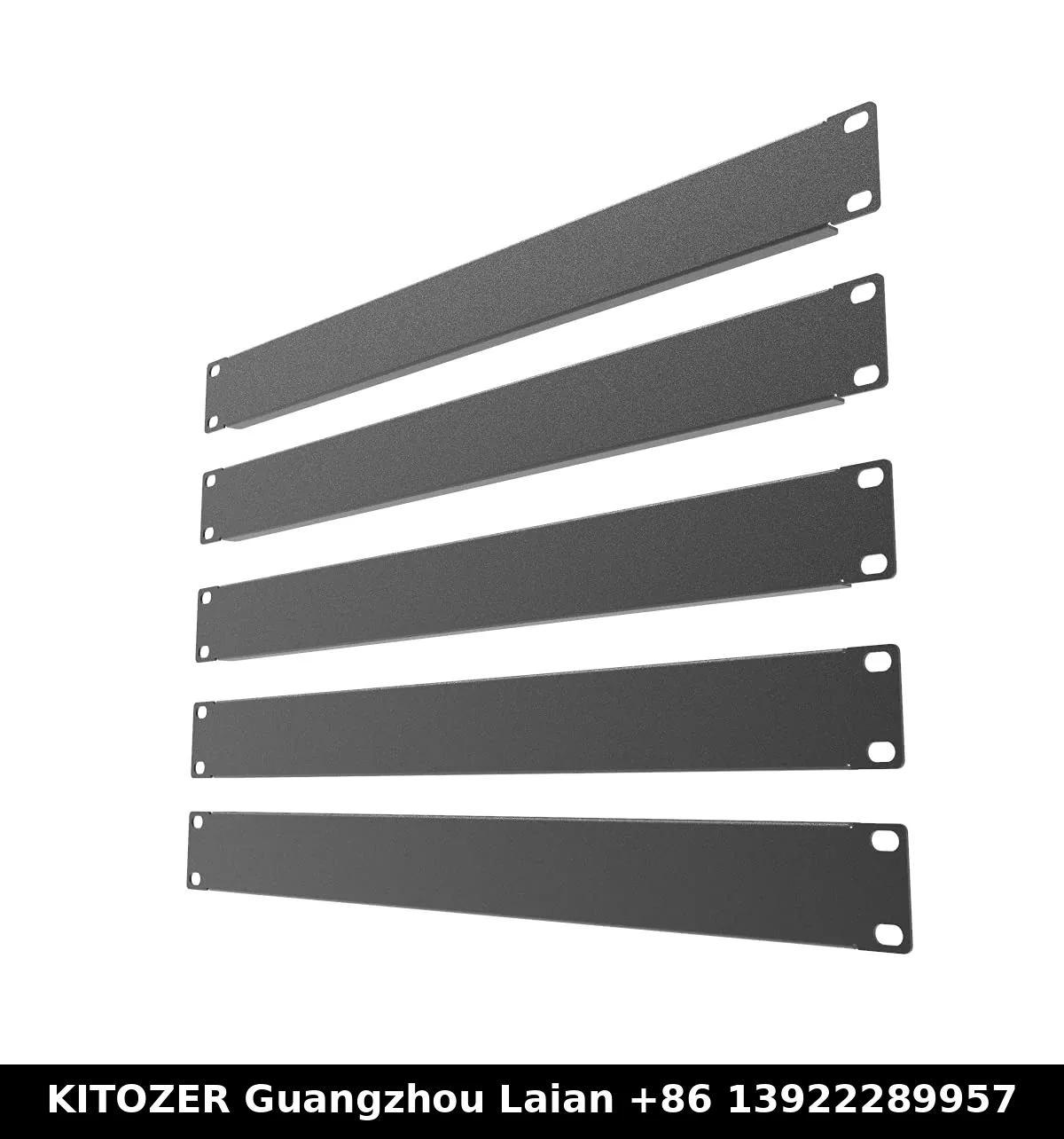
A 1U (44.45 mm) solid blank panel made of 1.0-1.2 mm cold-rolled steel, black powder-coated, with folded edges for stiffness. Fits 19-inch square-hole rails with M6 cage nuts and screws. The most common size for filling single empty U positions. Reference price about USD 3-6 each.
3.2 KZ-BP-2U solid steel
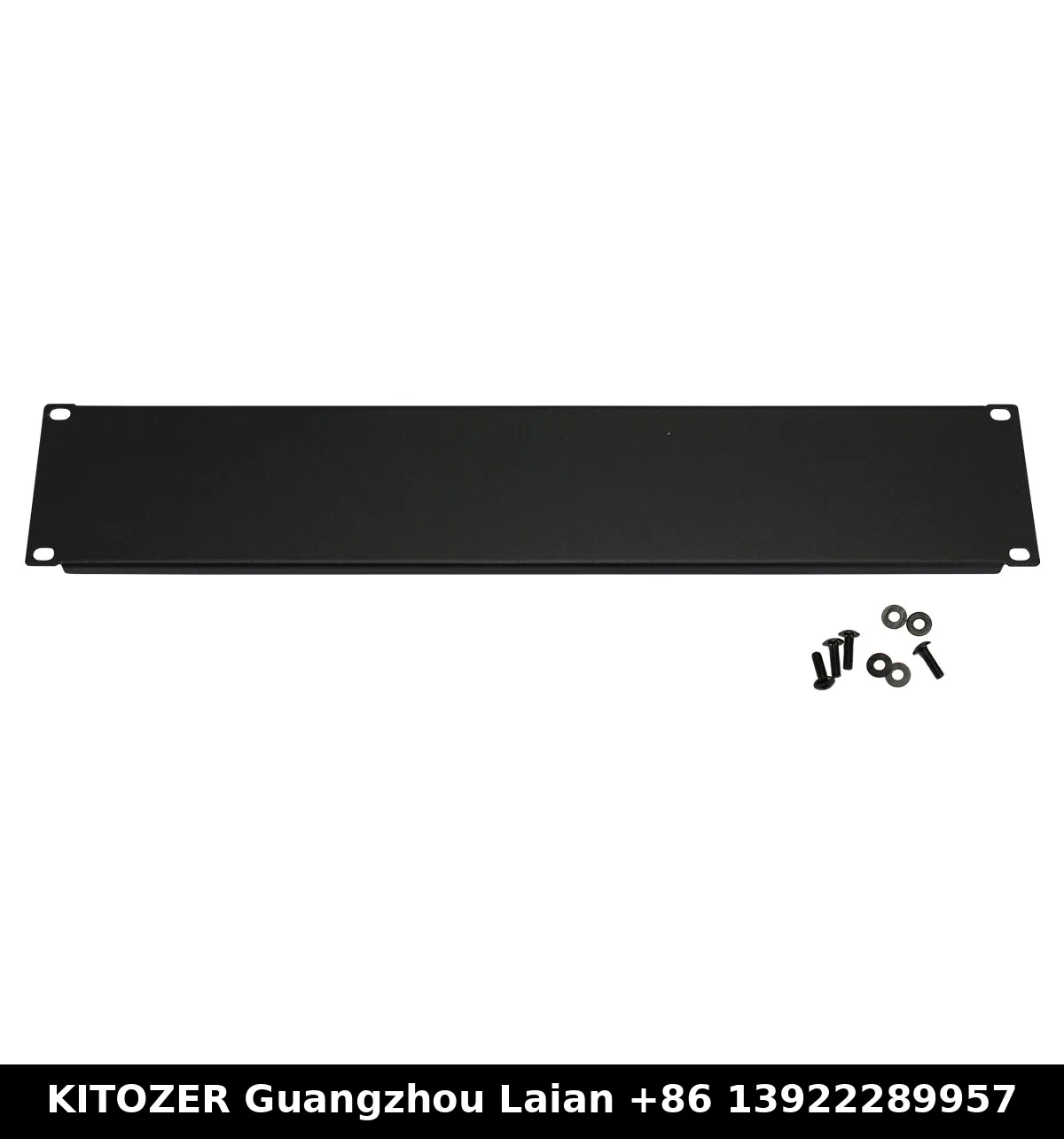
A 2U (88.9 mm) solid blank panel, same material and finish as 1U. Used for filling two consecutive empty U positions with one panel, reducing the number of seams. Reference price about USD 5-9 each.
3.3 KZ-BP-3U / 4U / 5U solid steel
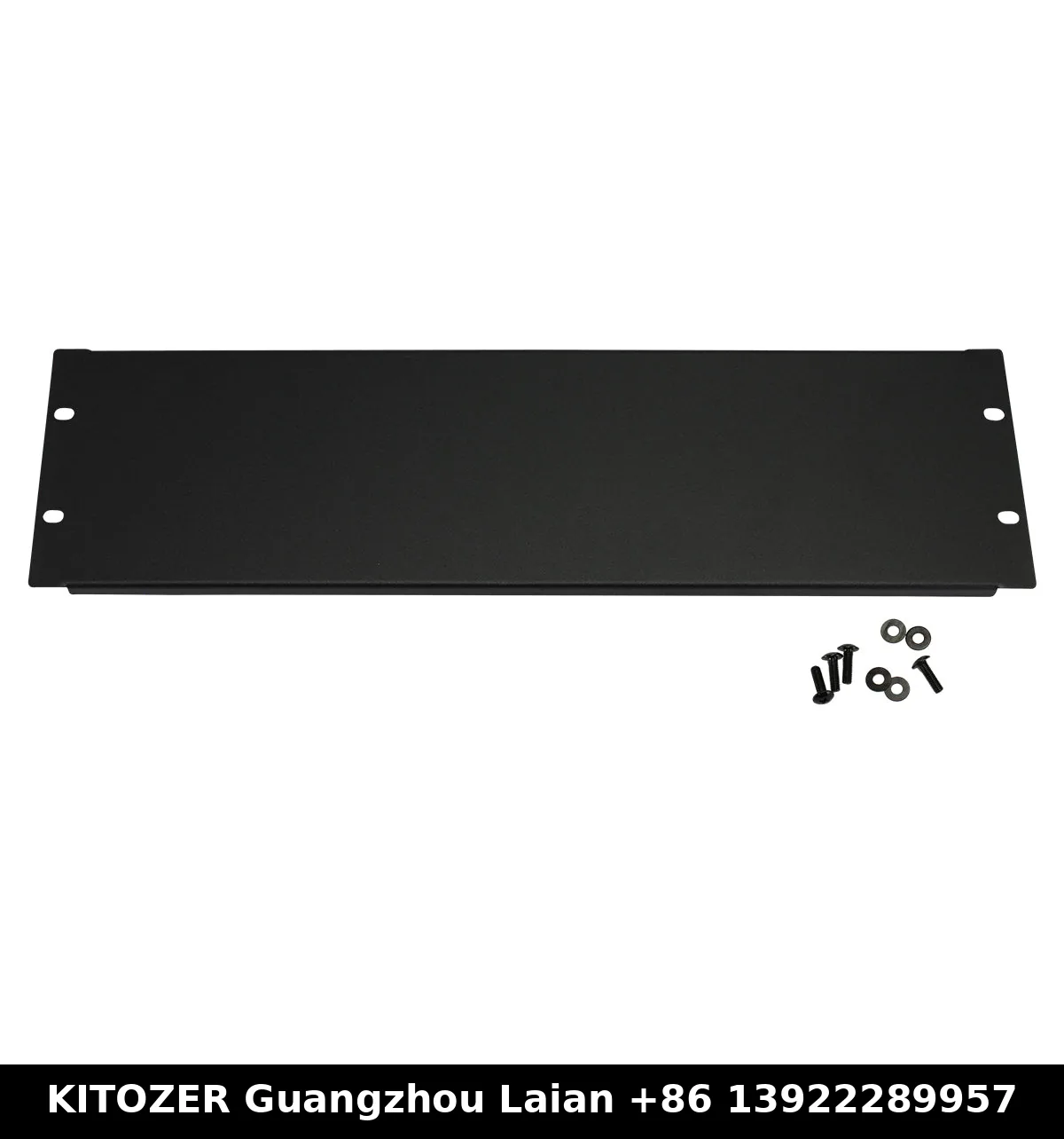
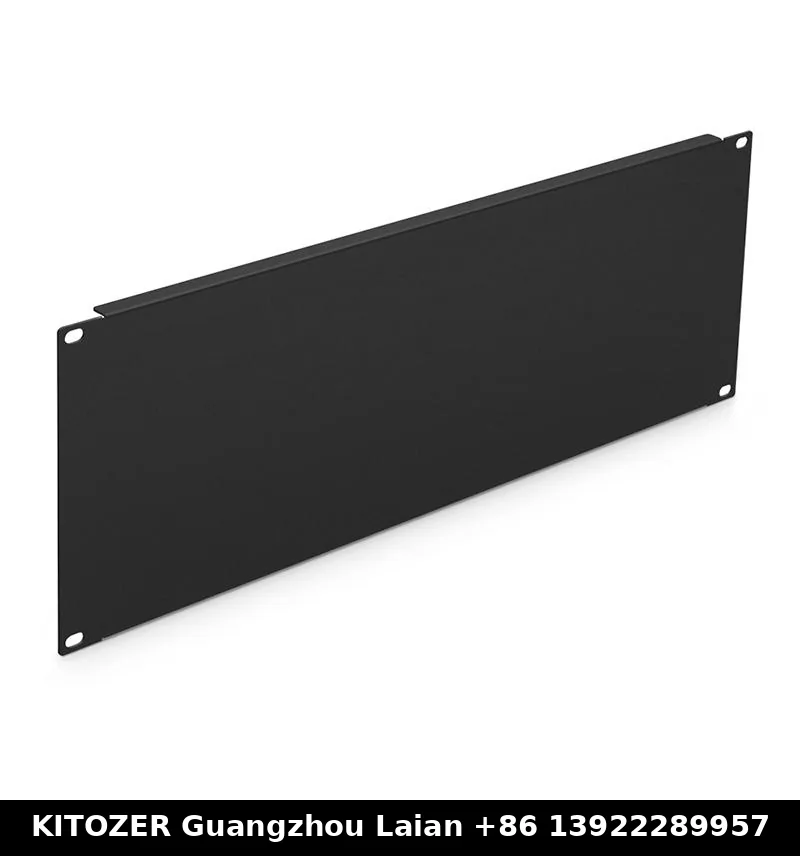
Larger blank panels for consecutive empty spans: 3U (133 mm), 4U (178 mm) and 5U (222 mm). Using one large panel instead of several small ones reduces seams and improves sealing. 4U is a popular size. Reference price: 3U USD 7-12, 4U USD 9-16, 5U USD 12-20.
3.4 KZ-BP-V vented (honeycomb)
A vented blank panel with honeycomb or perforated holes (about 30%-50% open area) used where a small amount of airflow through the empty U position is desired, such as when covering a cable pass-through or low-density device bay. Reference price about USD 6-14 each.
3.5 KZ-BP-AL aluminum
Lightweight aluminum blank panel (1.5-2.0 mm) with anodized or powder-coated finish. Used in wall-mount cabinets (to reduce wall load) and where corrosion resistance is needed. Reference price about USD 6-18 each.
| Model | Height | Material | Thickness | Reference price |
|---|---|---|---|---|
| KZ-BP-1U | 44.45 mm | Steel | 1.0 mm | USD 3-6 |
| KZ-BP-2U | 88.9 mm | Steel | 1.0 mm | USD 5-9 |
| KZ-BP-3U | 133 mm | Steel | 1.2 mm | USD 7-12 |
| KZ-BP-4U | 178 mm | Steel | 1.2 mm | USD 9-16 |
| KZ-BP-5U | 222 mm | Steel | 1.5 mm | USD 12-20 |
| KZ-BP-V vented | 1-4U | Steel | 1.0 mm | USD 6-14 |
| KZ-BP-AL aluminum | 1-4U | Aluminum | 1.5 mm | USD 6-18 |
Chapter 4. Materials, Construction and Finish
4.1 Cold-rolled steel
Most KZ-BP panels use SPCC cold-rolled steel (per GB/T 710). Thickness is 1.0 mm for 1U-2U and 1.2-1.5 mm for larger panels. Steel provides good stiffness, electromagnetic shielding and low cost. The surface is degreased, phosphated and electrostatically powder-coated in black polyester, with a film thickness of 60-80 um, grade 1 adhesion.
4.2 Aluminum alloy
Aluminum panels (6063 or 5052) weigh about one third of steel and resist corrosion. They are used in wall-mount cabinets, outdoor cabinets and humid environments. The surface is anodized or powder-coated. Aluminum is more expensive but lighter and rust-proof.
4.3 Folded-edge design
A flat thin sheet would flex and vibrate in the airflow, buzzing in the rack. KITOZER panels have 15 mm folded flanges on all four sides, forming a channel section that dramatically increases stiffness. A 1.0 mm folded panel is as rigid as a 2.5 mm flat panel. The folded edge also covers the mounting screws for a clean look.
4.4 Color and finish
The standard color is matte black (RAL 9005), matching most 19-inch cabinets. Batch color is consistent. Custom RAL colors are available for large orders. The powder-coated surface is fingerprint-resistant and easy to wipe clean.
Chapter 5. How Blank Panels Improve Airflow
5.1 Blocking the recirculation path
The physics is straightforward: a rack has a high-pressure rear (hot exhaust) and low-pressure front (cold intake). Under this pressure difference, air wants to flow from rear to front through any opening. Empty U positions are low-resistance openings. Blank panels close these openings, so the only path from front to rear is through the servers themselves. Server fans then draw cold aisle air through the servers instead of recirculating hot air.
5.2 Improving pressure balance
Without blank panels, much of the fans’ suction pressure is wasted pulling air through the empty U shortcuts. With blank panels, the suction is concentrated on the server intakes. Each server receives more actual cold airflow for the same fan speed, or the same airflow at a lower fan speed. This is the mechanism behind the fan energy saving.
5.3 Temperature uniformity in the rack
Measurements in a half-full rack before blanking: lower intake 22 C, middle 25 C, upper 31 C (a 9 C spread). After blanking all empty U positions: lower 22 C, middle 23 C, upper 24 C (a 2 C spread). Every server now sees the same inlet temperature, so no server overheats and none is over-cooled (wasting chilled air).
Chapter 6. Energy Saving and PUE Impact
6.1 Cooling energy saving
When recirculation is eliminated, the air conditioner can raise its supply air setpoint (from 13-15 C to 18-24 C) without any server overheating. A higher chilled water temperature improves chiller COP significantly (often 20%-30%), and cooling fans can run slower. PUE typically drops from 1.7-2.0 to 1.4-1.5 after blanking plus containment.
6.2 Server fan energy saving
Server fan power scales roughly with the cube of speed. A 10 C rise in inlet temperature can make fans run 30%-50% faster, increasing fan power from about 30 W to 60-90 W per server. In a rack with 10 servers, that is 300-600 W of fan power difference. In a 100-rack data center, blanking can save 30-60 kW of server fan power alone, about 260,000-520,000 kWh per year.
6.3 Worked example
A data center with 100 racks at 5 kW each (500 kW IT load). Before blanking, PUE is 1.8 (total 900 kW). After blanking all empty U positions and raising supply temperature, PUE drops to 1.45 (total 725 kW). Annual saving: 175 kW x 8760 h = 1.53 million kWh. At USD 0.11/kWh, about USD 168,000 per year. The blank panel investment for the whole data center is typically under USD 5,000-10,000. Payback is usually under one month to a few months.
Chapter 7. Sizing and Selection Guide
7.1 Measure the empty U positions
Survey each rack from bottom to top using the rack’s U markings. Record which U positions are occupied by equipment and which are empty. Note consecutive empty spans: a span of 4 consecutive empty U positions is best filled with one 4U panel rather than four 1U panels, reducing seams.
7.2 Choose panel U size
Match the panel height to the empty span: 1 empty U -> 1U panel; 2 consecutive -> 2U; 3 -> 3U; 4 -> 4U; 5+ -> combine 4U+1U or custom. Avoid stacking multiple small panels where one large panel fits, because seams leak. For irregular gaps, use the largest panel that fits and fill the remainder.
7.3 Choose material
Standard floor-standing racks: steel (cheaper, rigid). Wall-mount cabinets: aluminum (lighter wall load). Humid or corrosive environments: aluminum or steel with enhanced coating. Where airflow through the bay is needed: vented panel.
7.4 Hardware
Square-hole rails use M6 cage nuts and screws (two per panel, top and bottom). Threaded rails use M6 screws directly. KITOZER panels ship with or without hardware; specify rail type when ordering.
Chapter 8. Installation Procedure
8.1 Prepare the rack
Power off and lock out equipment that will be handled. Identify the empty U positions to fill. Have the correct panels, cage nuts and screws ready. Wear anti-static gloves.
8.2 Install cage nuts
For square-hole rails, insert M6 cage nuts into the square holes at the top and bottom of each empty span, one on the left rail and one on the right. Use a cage-nut tool or a screwdriver to seat them, ensuring the threaded side faces inward.
8.3 Mount the panel
Hold the panel against the front mounting rails, aligning the panel’s screw holes with the cage nuts. Insert a screw through each hole and hand-tighten. Tighten diagonally (top-left, bottom-right, top-right, bottom-left) to pull the panel flat against the rails. Do not overtighten; the panel should sit flat with no gap around the edges.
8.4 Check for gaps
After installation, run a hand around the panel edges. There should be no visible gap. If a gap exists, the panel may be misaligned or the cage nuts not seated. For cable pass-through positions, use a vented or brush cable panel instead of a solid panel.
Chapter 9. Compatibility with Cabinet Features
9.1 Perforated vs solid doors
Perforated mesh doors (60%-80% open area) do not block airflow, so blank panels inside the rack are essential. Glass or solid doors have some sealing but door gaskets age; blank panels still handle the internal empty-U recirculation. Open-frame racks rely entirely on blank panels.
9.2 Cable management arms
Cable management arms and horizontal cable managers occupy U positions; these are not empty U positions and need no blank panel. Only truly empty positions (no device, no manager) are blanked. Power distribution units (PDUs) mounted vertically at the rear do not occupy front U positions.
9.3 With cold aisle containment
Blank panels work together with cold aisle containment (roof panels and end doors). A common mistake is installing containment but skipping blank panels; then cold air still recirculates through rack empty U positions. KITOZER supplies both end doors and blank panels for a coordinated containment system.
Chapter 10. Standards and Quality
10.1 Dimensional standard
Panels conform to EIA-310 / IEC 60297 / GB/T 19520 19-inch rack dimensions: 1U = 44.45 mm, panel width fits the 19-inch mounting flange. Tolerance is within +/-0.5 mm for a snug fit on any brand of square-hole rail.
10.2 Material standards
Steel per GB/T 710 (SPCC cold-rolled). Aluminum per GB/T 5237. Powder coating adhesion per GB/T 9286 grade 1, film thickness 60-80 um. The finish is corrosion-resistant and fingerprint-tolerant.
10.3 Factory inspection
Each batch is checked for dimensions, diagonal deviation, coating appearance and screw-hole alignment. Panels ship in cartons with hardware. KITOZER provides material certificates and spec sheets on request.
Chapter 11. Operation and Maintenance
11.1 Routine inspection
During monthly rack inspections, check that: no empty U position is left open; panels are loose or missing; panels are not deformed; screws and cage nuts are present. Hot-spot racks from thermal imaging get priority for blank-panel checks.
11.2 Adding or removing equipment
When installing a new server, remove the corresponding blank panel first. When removing a server, reinstall a blank panel in that U position. This must be part of the rack change ticket workflow to prevent panels being left out after maintenance.
11.3 Cleaning and hardware
Wipe panels with a soft cloth; the powder-coated surface does not need special cleaning. Replace missing or stripped screws and cage nuts. Panels themselves last as long as the rack (10+ years). Keep spare panels (10%-20% of rack count) in stock for changes.
Chapter 12. FAQ
Q: Do rack blank panels actually reduce energy use?
A: Yes. They stop hot air recirculation, which lets the air conditioner raise supply temperature and lets server fans slow down. Measured PUE improvements of 0.2-0.3 are common after blanking.
Q: What happens if I don’t install blank panels?
A: Empty U positions let hot exhaust recirculate to the server intake. Upper racks run warmer, servers throttle, fans run faster, and PUE rises. The cost of the extra electricity and early hardware failure far exceeds the panel cost.
Q: How many blank panels do I need per rack?
A: Count the empty U positions. A typical half-full 42U rack may need 10-20 panels (or equivalent larger U panels). Use the largest panel that fits consecutive empty spans.
Q: Steel or aluminum?
A: Steel for floor-standing racks (cheaper, rigid). Aluminum for wall-mount cabinets (lighter) or corrosive environments.
Q: Do I need vented blank panels?
A: Only where you want airflow through an empty bay, such as a cable pass-through. Most empty U positions should use solid panels to block recirculation.
Q: How are panels mounted?
A: On square-hole rails with M6 cage nuts and screws (two per panel). On threaded rails, direct M6 screws.
Q: What is the reference price?
A: KZ-BP panels are about USD 3-28 each (RMB 20-200) depending on size and material. Steel 1U is cheapest; large vented or aluminum panels cost more.
Q: Are they compatible with all rack brands?
A: Yes. They follow the 19-inch EIA-310 standard and fit any square-hole or threaded rack rails.
Q: How long do they last?
A: Metal panels with powder coating last 10+ years, matching the rack life. The coating may fade but function is unaffected.
Q: Can I customise color or logo?
A: Bulk orders can specify RAL colors and silkscreen logos. Standard stock is matte black.
Chapter 13. Detailed Airflow Physics
13.1 Pressure-driven recirculation
Inside a working rack, servers run fans that create a pressure difference. The front (intake) side is at slightly lower pressure relative to the room, and the rear (exhaust) side is at higher pressure. Air always flows from high pressure to low pressure. The servers themselves are designed as the controlled path from front to rear. However, any open hole in the rack – and an empty U position is a large open hole – provides an uncontrolled alternate path. Under the front-to-rear pressure difference, hot exhaust air leaks backward through these holes to the front. The server fans, trying to move the rated airflow, draw this recirculated hot air through their intakes along with fresh cold air. The result is a higher intake temperature than the cold-aisle supply air temperature.
13.2 Why the top of the rack is worst
Hot air is less dense and rises. The exhaust air from lower servers naturally travels upward along the rear of the rack. When it reaches empty U positions near the top of the rack, it finds the easiest path back to the front. This is why thermal images of unblanked racks almost always show the hottest intake temperatures at the upper U positions. A rack that is half full but has all its empty positions concentrated at the top will see the upper servers running several degrees hotter than the lower ones. Blank panels at the upper empty positions are therefore the highest-priority installation.
13.3 Effect of rack fill ratio
The more empty U positions a rack has, the worse the recirculation. A fully populated rack (no empty positions) has no shortcut and runs cool, but in practice racks are rarely fully populated because power and cooling headroom are reserved for growth. A typical rack runs at 40%-70% fill, meaning 30%-60% of U positions are empty. That empty area is exactly where recirculation occurs. Blank panels convert these empty positions into sealed surfaces, restoring the rack to the aerodynamic behavior of a fully populated rack.
13.4 CFD and measurement evidence
Computational fluid dynamics (CFD) studies of data center airflow consistently show that blanking empty U positions reduces rack intake temperature non-uniformity by several degrees. Practical measurements in the field confirm the CFD predictions: a half-empty rack before blanking may show a 7-10 C spread between bottom and top intake; after blanking, the spread drops to 1-2 C. This temperature uniformity is the single most visible benefit of blank panels.
Chapter 14. Component Reliability and Blank Panels
14.1 Electronic component lifetime
Electronic component reliability follows the Arrhenius relationship: reaction rates (and thus degradation) roughly double for every 10 C rise in temperature. Capacitors in power supplies, solder joints on motherboards, and ball bearings in fans all age faster at higher temperatures. By keeping server inlet temperature within the ASHRAE recommended range, blank panels extend the effective life of these components. Over a 5-year server lifespan, the difference between running at 25 C and 32 C inlet temperature can be measurable in reduced failure rates.
14.2 Hard disk drives
Mechanical hard disk drives are among the most temperature-sensitive components. Drive manufacturers specify an operating ambient temperature typically up to 45 C, but long-term reliability improves substantially when drive body temperature stays below 40 C. Drives in the upper, recirculation-prone positions run hottest. A single drive failure triggers a RAID rebuild, during which the array runs in a degraded state with elevated risk. Preventing drive overheating with blank panels is a low-cost insurance against data loss and downtime.
14.3 Fans and power supplies
Server fans at high speed wear their bearings faster and consume more power. Power supply capacitors are rated for a certain number of hours at a given temperature; running the supply hotter shortens its life. By lowering inlet temperature, blank panels let fans run at medium speed and supplies run cooler, reducing both replacement cost and noise. The fan noise reduction is a measurable side benefit – a rack that sounds like a jet engine at full fan speed becomes noticeably quieter after blanking.
Chapter 15. Matching Other Airflow Products
15.1 Cold aisle containment
Cold aisle containment seals the top and ends of the cold aisle so that cold air is confined to the aisle. But containment alone is not enough: if the racks themselves leak at empty U positions, the confined cold air still short-circuits inside each rack. KITOZER recommends installing blank panels together with containment roof panels and end doors. The containment system and blank panels form a complete cold-air path from the air conditioner to the server chips.
15.2 Hot aisle containment
Hot aisle containment seals the exhaust side. Blank panels are equally important: they prevent hot exhaust from leaking out through empty U positions to the front, and they prevent room air from leaking into the hot aisle. Whichever side is contained, blank panels handle the rack-level sealing.
15.3 Perforated floor tiles
Perforated floor tiles deliver cold air into the cold aisle from the raised floor plenum. The number and placement of tiles are tuned to rack load. Blank panels affect how much of that delivered cold air actually reaches the servers: without blank panels, much of it is wasted through rack empty-U recirculation. Optimize tile count together with blanking.
15.4 In-row coolers and rear-door heat exchangers
High-density racks often use in-row coolers or rear-door heat exchangers. Blank panels ensure that the high-density rack’s cold intake is not contaminated by recirculated hot air, so the in-row cooler can operate at its design setpoint. In high-density deployments, the sealing requirement on blank panels is tighter because the penalty for a few degrees of recirculation is larger.
Chapter 16. Project Sizing and Quantity Estimation
16.1 Estimating blank panel quantity
To estimate the total panel quantity for a project: count the number of racks, multiply by rack height in U (e.g., 42U), subtract the expected populated U positions (servers, switches, patch panels, cable managers), and the remainder is the empty U positions to fill. For a 100-rack deployment with 42U racks and average 60% fill, empty positions total 100 x 42 x 0.4 = 1680 U. Using a mix of 1U, 2U and 4U panels, roughly 500-700 panels would be needed. KITOZER can produce a quantity list from a rack equipment schedule.
16.2 Spares
Keep 10%-20% spare panels on site (in 1U, 2U and 4U) because equipment changes inevitably create new empty positions. Having spares prevents a temporary open U position after a server removal. Standard sizes are stocked; large or custom sizes have a lead time of 7-15 days.
16.3 Hardware budget
Each panel needs two M6 cage nuts and two screws. Budget hardware separately: about 2.5 sets per panel to allow for spares. KITOZER can ship panels with or without hardware; specify square-hole vs threaded rails.
Chapter 17. Typical Project Case Study
17.1 Before retrofit
A 50-rack enterprise data center ran at PUE 1.85. Operators noticed upper-rack inlet temperatures of 30-35 C and server fan alarms during summer. They initially planned to buy additional air conditioners. An airflow audit found that most racks were 50%-70% populated with empty U positions left open, and only about half the racks had any blank panels.
17.2 Retrofit actions
The team ordered KITOZER blank panels, surveyed each rack’s empty U positions, and installed panels across all racks over a weekend. They also adjusted perforated tile counts and raised the cooling setpoint from 14 C to 19 C. No new air conditioner was purchased.
17.3 Results
After two weeks, upper inlet temperatures dropped to 23-25 C, the rack intake spread shrank from 8 C to 2 C, server fan alarms stopped, and measured PUE fell to 1.48. Annual electricity savings were about 600,000 kWh. The total blank panel and hardware investment was under USD 8,000. Payback was under two months. This case illustrates that the cheapest energy-saving measure in a data center is often the blank panel that was never installed.
Chapter 18. Installation Best Practices
18.1 Panel orientation
KITOZER panels are symmetric left-to-right, but the folded edge should face inward toward the rack interior. The flat, finished face should face the cold aisle for a clean appearance. Installing a panel upside down is harmless functionally but looks inconsistent; standardize the orientation so all folded edges align.
18.2 Avoiding stacked seams
When several empty U positions are consecutive, use the largest single panel that fits rather than stacking smaller panels. Each seam between two panels is a potential leakage point. For a 5-U gap, use a 4U panel plus a 1U panel with the seam placed away from the hottest upper zone where possible. In critical high-density racks, consider custom-length panels to minimize seams.
18.3 Tightening torque
Tighten the M6 screws finger-tight plus a quarter turn. Over-tightening can strip cage nuts or bow thin panels; under-tightening leaves a gap around the edge. A properly mounted panel sits flat against both mounting rails with no visible light gap.
18.4 Cable pass-through positions
Not every empty U position should be sealed solid. Where power or network cables must pass through the rack vertically, use a vented blank panel or a brush cable-management panel so cables can pass while still blocking most airflow. Pure empty positions with no cables get solid panels.
18.5 Post-installation check
After installation, run a gloved hand around each panel edge to feel for leaks. In a running rack, a tissue held near the panel edge should not flutter if the seal is good. For verification, compare rack intake temperatures before and after; a successful blanking should reduce upper intake temperature.
Chapter 19. Maintenance and Operations Integration
19.1 Rack change workflow
Mature data centers integrate blank panels into the rack change request process. A new-equipment request lists the U positions to be occupied and the blank panels to be removed; a decommission request lists the panels to be reinstalled. This prevents the common problem where a server is removed during maintenance and the empty U position is left open indefinitely.
19.2 Inspection checklist
Monthly rack walkthroughs include: visual check that no empty U position is open; panels not loose, bent or missing; screws and cage nuts present; coating not peeling. Thermal imaging every quarter identifies racks with hot upper zones, which are then checked for missing panels.
19.3 Spares inventory
Maintain a rack of spare panels in 1U, 2U and 4U sizes, plus a box of M6 cage nuts and screws. The spares inventory should cover 10%-20% of the installed base. This avoids delays during equipment changes and prevents temporary open U positions.
19.4 Training
Operations staff should understand why blank panels matter, so that they habitually remove a panel before installing equipment and reinstall one after removal. KITOZER provides product and installation guidance to support customer training.
Chapter 20. Standards and Compliance
20.1 Rack dimensional standards
19-inch rack dimensions are defined by EIA-310, IEC 60297 and GB/T 19520. A rack unit is 44.45 mm (1.75 in). KITOZER panels are designed to these standards and fit square-hole (M6) and threaded rails from major rack manufacturers. Dimensional tolerance is +/-0.5 mm.
20.2 Material and coating standards
Steel is SPCC cold-rolled per GB/T 710. Aluminum is per GB/T 5237. Powder coating follows GB/T 9286 adhesion grade 1, with a 60-80 um film. The black matte finish matches RAL 9005 and most standard rack interiors.
20.3 Data center design guidance
GB 50174 (Code for Design of Data Centers) and ASHRAE TC 9.9 guidance both call for proper airflow organization, including sealing of unused rack U positions. Blanking panels are recognized as a fundamental airflow management measure. Including blanking in the rack specification and acceptance checklist helps projects meet these guidance documents.
Chapter 21. Environmental and ESG Value
21.1 Carbon reduction
The electricity saved by blank panels translates directly into reduced carbon emissions. A medium data center saving 500,000 kWh per year avoids roughly 350-400 tonnes of CO2 (depending on grid factor). For companies reporting ESG targets, airflow optimization through blank panels is a low-cost, high-impact measure to include in carbon accounting.
21.2 Green data center certification
Green data center certifications (Uptime, LEED, national green ratings) assess airflow management and PUE. Complete blanking of rack U positions is a basic indicator of good airflow practice. KITOZER panels help customers meet these criteria.
21.3 Whole-life cost
Blank panels are a one-time investment with a 10+ year life and negligible maintenance. Over a data center’s life, the cumulative energy saving dwarfs the purchase cost many times over. This is why energy auditors routinely recommend blanking as the first, cheapest retrofit measure.
Chapter 22. Additional FAQ
Q: Does a blank panel affect server cooling?
A: No. It only covers empty U positions; servers still draw cold air through their own front intakes. The panel improves server cooling by stopping hot air recirculation.
Q: Can I add equipment later?
A: Yes. Remove the corresponding panel, mount the equipment, and blank the remaining new empty positions. Panels are designed for repeated removal and reinstallation.
Q: What if the panel color does not match the rack?
A: Standard KITOZER panels are matte black, which matches most racks. Bulk orders can be custom-colored.
Q: How much does a panel weigh?
A: A 1U steel panel weighs about 0.3-0.5 kg; a 4U panel about 1-1.5 kg. Aluminum panels are lighter.
Q: Do panels need regular cleaning?
A: A soft cloth dusting is enough. The powder-coated surface resists dirt.
Q: Are samples available?
A: Yes. Contact KITOZER at +86 13922289957 to request samples.
Q: How many screws per panel?
A: Two screws with two cage nuts (one at top, one at bottom).
Q: Can panels be used in wall-mount cabinets?
A: Yes. Use the lightweight aluminum panels to reduce wall load.
Q: How do I detect a panel leak?
A: Feel around the edges with a hand or tissue in a running rack, or use thermal imaging. A large gap means misalignment or missing hardware.
Q: What is the lead time?
A: Standard sizes are in stock and ship in 3-7 days. Bulk or custom sizes take 7-15 days.
Chapter 23. High-Density and Liquid-Cooled Racks
23.1 High-density air-cooled racks
As rack power rises from 5 kW to 15 kW or more, the penalty for recirculation grows. A 15 kW rack cannot tolerate even a few degrees of intake temperature rise because the servers are already near their thermal limit. In high-density deployments, blank panels must seal tightly, with minimal seams, and ideally be paired with in-row coolers and cold aisle containment. KITOZER supplies both the end doors/containment and the blank panels for high-density projects, ensuring the whole cold-air path is sealed.
23.2 Adjacent rack contamination
A hot high-density rack next to a cooler low-density rack can contaminate the low-density rack’s intake if the low-density rack has open empty U positions. Hot exhaust from the high-density rack spills into the room and is drawn into the low-density rack’s open positions. Sealing the low-density rack with blank panels prevents this cross-rack contamination.
23.3 Liquid-cooled racks
Even in liquid-cooled deployments (direct-to-chip or rear-door heat exchangers), servers still have airflow for memory, DIMMs and power supplies, and residual heat is rejected to air. The air-cooled portion still requires blank panels to manage air recirculation. Liquid cooling handles the dominant heat, but blank panels remain the final rack-level seal.
Chapter 24. Edge Computing and Remote Sites
24.1 Small-site reality
Edge sites often have only a few racks and limited on-site staff. Blank panels are easily overlooked, yet these sites often have crude cooling (a small air conditioner or even ambient cooling), making recirculation and hot spots more damaging. KITOZER recommends that edge sites also fully blank their racks; the installation is simple and the long-term benefit is large.
24.2 Wall-mount and compact cabinets
Compact wall-mount cabinets for network switches often have empty U positions. Use lightweight aluminum blank panels to keep wall load low while sealing airflow. Network switches are sensitive to intake temperature, and even small cabinets benefit from blanking.
Chapter 25. Electromagnetic Shielding and Safety
25.1 Shielding benefit
Solid steel panels, mounted with metal screws to grounded rails, provide some electromagnetic shielding between adjacent U positions. This is a secondary benefit; the primary purpose is airflow. Aluminum panels also conduct and bond to the rack if the rails are grounded.
25.2 Electrical safety
Blank panels cover open rack holes, reducing the risk of fingers or tools contacting live equipment inside the rack. Metal panels bond to the grounded rack frame, so they do not introduce a separate grounding requirement. They also prevent foreign objects from falling into empty U positions.
Chapter 26. Aesthetic and Professional Appearance
26.1 The visible rack front
A rack front fully populated with equipment and neatly blanked empty positions looks professional and organized. During customer visits or audits, a clean, uniformly black rack front conveys operational maturity. Conversely, a rack with open empty holes and dangling cables looks neglected. Blank panels are one of the cheapest ways to improve the visible professionalism of a data center.
26.2 U-position labeling
Blank panels can carry U-position labels or asset tags, helping staff locate equipment and document the rack layout. A labeled, blanked rack makes asset inventory and maintenance faster.
Chapter 27. Sizing Calculation Worked Examples
27.1 Example 1: 42U half-full rack
A 42U rack contains ten 2U servers (20 U used), two 1U switches (2 U), one 1U patch panel (1 U), and a 2U cable manager (2 U). Total used: 25 U. Empty: 17 U. The empty positions are in three spans: a 5U span at the top, a 7U span in the middle, and a 5U span near the bottom. Order one 5U, one 4U+2U+1U for the 7U span, and one 4U+1U for the bottom 5U. Total panels: 5 pieces, using 5U, 4U, 2U, 1U, 1U. Hardware: 10 screw sets.
27.2 Example 2: full project order
A project has 40 racks at 42U, average 65% fill. Empty U per rack: 42 x 0.35 = 14.7 U, rounded to 15 U. Total empty U: 40 x 15 = 600 U. Mixing sizes (roughly 40% 1U, 35% 2U, 25% 4U), the order is about 240 panels. Add 15% spares: about 280 panels total, plus 600 screw sets. KITOZER prepares a recommended BOM from the rack schedule.
Chapter 28. Procurement and Ordering Guide
28.1 What to specify
When ordering, specify: rack rail type (square-hole M6 or threaded), panel sizes (U count per size), material (steel or aluminum), finish color (standard black or custom), and whether hardware (cage nuts/screws) is included. Provide the empty-U schedule if a quantity list is needed.
28.2 Lead time and shipping
Standard black steel panels in 1U-4U are stocked and ship in 3-7 days. Custom colors, large quantities or non-standard sizes have a 7-15 day lead time. Panels are packed in cartons; export orders can be crated for long-distance shipping.
28.3 Quotation contact
Contact KITOZER at +86 13922289957 (phone/WeChat), WhatsApp +1 906-853-4140, or email through www.gdlain.com. Provide rack count, sizes and quantity for a formal quotation. Reference prices are USD 3-28 per panel depending on size and material.
Chapter 29. More FAQ
Q: Do blank panels reduce cabinet dust?
A: Yes. By forcing airflow through server filters rather than through open holes, less dust enters the rack interior. Panels should be wiped periodically.
Q: Are vented panels ever the wrong choice?
A: Yes. Use solid panels for truly empty positions; vented panels only where cable pass-through or controlled airflow is needed. Vented panels leak more than solid ones.
Q: Can I reuse panels when reconfiguring a rack?
A: Yes. Metal panels are durable and designed for repeated installation and removal.
Q: Do panels interfere with rack cooling?
A: No. They improve cooling by stopping recirculation. They never cover equipment intakes.
Q: What about a rack with no empty U positions?
A: No panels needed. Most racks, however, have reserved growth space and use panels.
Q: Can KITOZER supply matching end doors?
A: Yes. KITOZER supplies both rack blank panels and cold aisle end doors/roof panels for a coordinated containment system.
Q: Are panels ESD-safe?
A: Metal panels bond to the grounded rack. Use ESD gloves during handling as with any rack hardware.
Q: What thickness should I choose?
A: 1.0 mm for 1U-2U, 1.2-1.5 mm for larger panels. Folded edges provide stiffness regardless.
Q: Do panels come with a certificate?
A: Material and spec sheets are available on request for project acceptance.
Q: How do I report a problem panel?
A: Contact KITOZER with photos and quantity; defective panels are replaced.
Chapter 30. The Economics of Airflow Wasting
30.1 Quantifying the waste
When 30% of cooled air is wasted through rack recirculation, the air conditioner must produce 30% more cooling than the actual IT load requires. That extra cooling is bought twice: once as chiller/compressor energy, and once as fan energy to move the extra air. At a data center with 500 kW IT load and PUE 1.8, the cooling overhead is 400 kW. If recirculation wastes 30% of that, about 120 kW of chiller and fan effort is being thrown away through open empty U positions. Blanking recovers most of that 120 kW.
30.2 The cheapest kilowatt
Energy efficiency practitioners say the cheapest kilowatt is the one you do not waste. Replacing a chiller with a high-efficiency model may cost hundreds of thousands of dollars and save 10%. Blanking empty U positions costs thousands and may save 10%-20% of cooling energy. Energy audits routinely list blanking as the first retrofit because the return is immediate and the investment is trivial.
30.3 Avoided infrastructure expansion
A common finding in overheating data centers is that operators blame insufficient cooling capacity and request new air conditioners. After an airflow audit finds open empty U positions and corrects them, the existing cooling capacity proves adequate. The blanking retrofit avoids a six-figure infrastructure expansion. This is the strongest economic argument: blanking is cheaper than the expansion it prevents.
Chapter 31. Rack-Level Air Sealing System
31.1 The sealing layers
A rack is sealed by several layers: blank panels cover empty U positions on the front; door gaskets seal the gap around the front and rear doors; side panels seal between adjacent racks; cable entry openings use brush strips or grommets. Blank panels are the layer that covers the largest continuous area (the unused U positions). A rack with perfect door gaskets but open empty U positions still leaks badly.
31.2 Inspecting the whole seal
When auditing a rack’s air sealing, check all layers: doors close and gaskets compress; adjacent racks touch with no gap; cable openings are brushed; empty U positions are blanked. A deficiency in any layer undermines the others. KITOZER blank panels complete the rack-level sealing picture.
Chapter 32. Noise and Comfort
32.1 Fan noise reduction
Server fan noise is roughly proportional to fan speed, and high-pitched whine at full speed is tiring for staff working in the data center. By lowering inlet temperature, blank panels let fans run at medium speed, reducing rack noise by 3-5 dB in typical cases. While 3-5 dB sounds small, it is a noticeable improvement in a noisy room and reduces hearing-exposure concerns for operations staff.
32.2 Working environment
A data center with proper blanking and containment runs at lower supply fan speed and chiller noise, and the cold aisle is comfortable for maintenance. The combination of lower inlet temperatures and reduced fan noise makes the working environment safer and more pleasant for staff.
Chapter 33. Dust and Contaminant Control
33.1 Where dust enters
Servers draw air through their front filters. If empty U positions are open, some airflow bypasses the filters and enters the rack interior directly, carrying dust onto server motherboards and power supplies. Over years, this dust layer insulates components and clogs cooling fins. Blank panels force nearly all intake air through server filters, where dust is captured.
33.2 Filter maintenance
With blank panels, server filters carry the full intake load and should be cleaned or replaced quarterly. Without blank panels, filters are bypassed and dust settles inside the equipment – a worse outcome that requires internal cleaning. Blanking therefore shifts dust control to an easily maintained filter.
Chapter 34. Thermal Monitoring and Verification
34.1 Temperature sensors
Rack-mounted temperature sensors at the front (intake) at top, middle and bottom reveal non-uniformity. A large top-to-bottom spread indicates recirculation. After blanking, the spread should shrink. DCIM platforms track these trends over time.
34.2 Thermal imaging
An infrared camera scan of a rack front shows the temperature distribution. Hot zones at the top identify recirculation and missing panels. Quarterly thermal imaging is a practical way to verify blanking quality and find racks needing attention.
34.3 Before/after comparison
Record baseline PUE, top-bottom intake spread and fan power before blanking, then re-measure one to two weeks after. The improvement data is valuable for energy audits and green certification. KITOZER provides the product; the customer verifies with their monitoring system.
Chapter 35. Extended FAQ
Q: How much noise reduction can I expect?
A: Typically 3-5 dB after blanking, as server fans slow down. It is noticeable in a noisy room.
Q: Does blanking reduce dust inside servers?
A: Yes. It forces air through server filters instead of open holes, reducing internal dust buildup.
Q: How do I verify blanking worked?
A: Compare top-bottom rack intake temperature before and after, or use thermal imaging. The spread should shrink to 1-2 C.
Q: Should I clean server filters more often?
A: Quarterly is typical. With blanking, filters carry the full intake load, so regular cleaning matters.
Q: What is the biggest economic benefit?
A: Avoided cooling expansion plus direct energy savings. Blanking often prevents a six-figure chiller purchase.
Q: Do I need to seal between adjacent racks?
A: Yes. Side-panel gaps between racks also leak; combine blanking with rack-to-rack sealing.
Q: Can one missing panel ruin the effect?
A: One open U position is a small leak, but many missing panels add up. Aim for 100% blanking.
Q: What PUE improvement is realistic?
A: With containment and blanking, PUE typically drops 0.2-0.3. Blanking alone contributes part of this.
Q: Does KITOZER provide thermal survey support?
A: KITOZER supplies panels and guidance; customers use their own monitoring to verify.
Q: Are panels worth it in a small closet?
A: Yes. Small rooms with simple cooling benefit even more from reduced recirculation.
Chapter 36. Why Blank Panels Are Often Skipped
36.1 The hidden-component problem
Blank panels are cheap, invisible once installed, and do not contribute to headline equipment specs. In a project budget, they are an afterthought. Integrators order servers, switches and racks, but forget the panels. The rack arrives, equipment is mounted, and the empty U positions are left open because nobody budgeted or ordered panels. This is the single most common airflow mistake in new data centers.
36.2 Underestimating the effect
Many operators do not believe a few open holes can make a real difference. They assume the air conditioner will handle it. Only after measuring upper-rack temperatures or running an energy audit do they realize the scale of recirculation. The solution – buying and installing a few hundred cheap metal panels – then seems surprisingly simple.
36.3 Forgetting after maintenance
Even when panels are installed initially, maintenance crews remove a panel to service equipment and forget to reinstall it. Over years, panels gradually disappear. This is why blanking must be written into maintenance workflows and checked during inspections.
Chapter 37. Ordering a Blank Panel BOM
37.1 Step-by-step
1) Survey each rack and record occupied vs empty U positions. 2) Group consecutive empty spans. 3) For each span, choose the largest panel size that fits (e.g., a 5U span = 4U + 1U). 4) Sum quantities by size. 5) Add 15% spares. 6) Specify rail type and hardware. 7) Send the list to KITOZER for quotation. KITOZER can also prepare the BOM from a rack equipment schedule.
37.2 Sample BOM
For 40 racks at 15 empty U each: 4U panels x 60, 2U panels x 80, 1U panels x 120, plus 15% spares. Hardware: 600 M6 screw and cage-nut sets. This is a typical project order and a fraction of the cost of any single server.
Chapter 38. Compatibility with Rack Accessories
38.1 Cable managers and PDUs
Horizontal cable managers occupy U positions and are not blanked. Vertical PDUs mount on the rear side and do not occupy front U positions. Rack-mounted KVM switches, console drawers and patch panels are equipment, not empty positions. Only genuinely unused positions get panels.
38.2 Toolless panels
KITOZER panels use screws for a firm, long-lasting seal. Toolless snap-in panels are available but can loosen over years of vibration; screw-mounted panels remain the recommended choice for data centers where sealing matters.
Chapter 39. Long-Term Operational Data
39.1 Multi-year trends
Data centers that maintain full blanking over several years see stable PUE and low equipment failure rates. Those that let panels fall into disrepair see PUE creep upward and rising fan alarms. Airflow management is not a one-time task; it is maintained through the rack change process and inspections.
39.2 Reliability correlation
Reliability reports show that racks with properly controlled intake temperature have lower drive and fan failure rates. While many factors contribute, consistent blanking and containment are the foundation. The cost of a single unplanned outage far exceeds the entire blank panel inventory.
Chapter 40. Final FAQ
Q: Is blanking a one-time task?
A: Install it once, but maintain it: reinstall panels after equipment changes and inspect regularly.
Q: What if my rack has brand-specific accessories?
A: KITOZER panels are standard 19-inch and compatible; brand accessories occupy their own U positions and are not blanked.
Q: Can I paint panels myself?
A: No need; they come in matte black. Custom colors are available for bulk orders.
Q: How thick should a 4U panel be?
A: 1.2 mm with folded edges is rigid enough. Thicker is unnecessary.
Q: Do panels come with screws?
A: Specify when ordering. Panels can ship with or without M6 hardware.
Q: What if my rails are threaded?
A: Use M6 screws directly. Tell KITOZER your rail type.
Q: Are aluminum panels worth the extra cost?
A: Only for wall-mount (weight) or corrosive environments. Steel is standard.
Q: How do I know if recirculation is happening?
A: Measure top vs bottom intake temperature. A spread over 3 C suggests recirculation and missing panels.
Q: Does KITOZER ship internationally?
A: Yes. Standard 19-inch panels are universal; export cartons/crates available.
Q: How do I contact KITOZER?
A: Phone/WeChat +86 13922289957, WhatsApp +1 906-853-4140, web www.gdlain.com.
Chapter 41. Understanding Rack Air Pressure
41.1 The pressure difference
A working rack is a pressure vessel of sorts. Server fans push air from front to rear, raising rear pressure slightly above room pressure and lowering front pressure slightly below room pressure. The magnitude is small – typically 10 to 30 pascals – but it is enough to drive air through any available opening. The intended opening is the server itself, which has a designed flow resistance. The unintended openings are empty U positions, gaps around doors, cable holes and side-panel seams. Each unintended opening short-circuits some of the fan’s work.
41.2 Parallel flow paths
Think of airflow as electricity and pressure as voltage. The rack’s front-to-rear pressure difference is the voltage. The server is a high-resistance resistor. An open empty U position is a low-resistance resistor in parallel. In a parallel circuit, current (airflow) divides by resistance: most airflow takes the low-resistance path. That is why 30%-50% of fan airflow can leak through empty U positions rather than through servers. A blank panel puts an infinite resistance on the short-circuit path, forcing all airflow through the servers.
41.3 What this means for design
Airflow design is therefore not only about supplying enough cold air; it is about making sure the cold air that is supplied actually passes through the equipment. Blank panels, door gaskets and side seals are the design elements that direct the air. A data center with a powerful cooling system but open racks wastes that power.
Chapter 42. ASHRAE and Inlet Temperature Guidelines
42.1 Recommended range
ASHRAE TC 9.9 recommends server inlet temperatures of 18-27 C (with allowable operating envelopes extending beyond). Within this range, equipment runs reliably and efficiently. Above 27 C, reliability declines and fans speed up. Below 18 C, energy is wasted over-cooling. The goal of airflow management – including blanking – is to keep every server inlet within this band, including the upper-rack positions that recirculation tends to heat.
42.2 Raising supply setpoint
With good airflow management (blanking plus containment), the cold aisle can be held at 24 C while server inlets stay within range. This lets the chiller produce warmer chilled water (e.g., 15-18 C instead of 7 C), dramatically improving chiller efficiency. Poor airflow management forces operators to run the chiller colder to compensate for recirculation, wasting energy. Blanking is the enabler of higher, more efficient supply temperatures.
Chapter 43. Rack Fill Growth and Dynamic Blanking
43.1 Plan for growth
Racks are provisioned with power and cooling headroom, so they start partially empty. As servers are added over months and years, the empty positions shrink. Blank panels must be reconfigured as the rack fills: remove a panel where equipment goes, install panels where new gaps appear. A rack management record should track which panels are installed where.
43.2 Standardize panel mix
Ordering a mix of 1U, 2U and 4U panels gives flexibility for growth. 4U panels cover large empty spans; 1U and 2U panels fill the small gaps around equipment. Keeping spares on site means growth can be accommodated immediately without waiting for a new order.
Chapter 44. Comparison of Blanking Methods
44.1 Solid vs vented
Solid panels provide the best seal and should be used for truly empty positions. Vented panels trade some sealing for airflow, useful only where cables pass or where a device needs ventilation behind a cover. For pure airflow management, solid is correct.
44.2 Steel vs aluminum
Steel is stiffer, cheaper and shields better. Aluminum is lighter and corrosion-resistant. Choose steel for standard floor racks; aluminum for wall-mount or harsh environments.
44.3 Screw vs toolless
Screw-mounted panels seal firmly and stay sealed for years. Toolless snap panels are convenient but can loosen with thermal cycling and vibration. For data centers where sealing directly affects energy use, screw-mounted is the reliable choice.
Chapter 45. More Detailed FAQ
Q: What pressure difference do servers create?
A: About 10-30 Pa across the rack. Small, but enough to drive air through open holes.
Q: What inlet temperature should I target?
A: ASHRAE recommends 18-27 C. Blanking helps keep upper-rack inlets in this range.
Q: Can I raise the cooling setpoint after blanking?
A: Yes. With recirculation fixed, raise supply temperature gradually and monitor inlet temperatures.
Q: How do I track panel locations?
A: Keep a rack layout record showing occupied U positions and installed panels.
Q: Should I buy only 1U panels?
A: No. Use larger panels for consecutive empty spans to reduce seams.
Q: Are toolless panels acceptable?
A: For temporary use yes; for long-term sealing, screw-mounted is better.
Q: What if a rack has mixed rail types?
A: Specify per rack. KITOZER ships appropriate hardware.
Q: Does blanking help in a contained hot aisle?
A: Yes. It prevents hot air leaking to the front and room air leaking in.
Q: How often should I inspect panels?
A: Monthly walkthrough; quarterly thermal imaging.
Q: What is the reference price range?
A: USD 3-28 per panel (RMB 20-200), depending on size and material.
Chapter 46. Case Study: A Small Server Room
46.1 Situation
A company IT room held eight 42U racks, about 50% populated. A single precision air conditioner struggled in summer, with servers occasionally reporting high inlet temperature alarms. The IT manager considered replacing the air conditioner with a larger one.
46.2 Audit and action
An airflow audit found that most racks had open empty U positions, especially at the top, and the racks faced each other without containment. The company ordered KITOZER steel blank panels, installed them across all racks over a weekend, and added floor brushes at cable openings. They raised the air conditioner setpoint from 16 C to 21 C.
46.3 Outcome
High-temperature alarms stopped within a week. Upper-rack inlet temperatures dropped from 33 C to 25 C. The existing air conditioner ran less often and the room stayed comfortable. No larger air conditioner was needed. The total blank panel investment was about USD 1,200. The story repeats in thousands of small server rooms: the problem is airflow, not cooling capacity.
Chapter 47. Case Study: High-Density GPU Compute Rack
47.1 Situation
An GPU compute rack ran at 25 kW with GPU servers. Even with a rear-door heat exchanger, the GPU server inlet temperature crept above 30 C during long training jobs, causing thermal throttling.
47.2 Action
An airflow review found the rack’s empty U positions (reserved for future GPUs) were open, letting hot exhaust recirculate. The team installed KITOZER solid steel panels with minimal seams across the empty positions, and sealed the gaps between adjacent racks.
47.3 Outcome
GPU inlet temperature dropped by 6 C, throttling stopped, and training jobs ran at full speed. The rear-door heat exchanger now handled the heat it was designed for, because the cold air actually reached the GPUs. In high-density racks, every degree of recirculation is expensive; blanking recovered that degree.
Chapter 48. Purchasing FAQ
Q: What is the minimum order?
A: Standard samples are available; production orders start from a few panels.
Q: Do you provide a quotation in USD?
A: Yes. Export quotations are in USD. Reference price USD 3-28 per panel.
Q: Can I get a sample before bulk order?
A: Yes. Contact +86 13922289957 to arrange samples.
Q: What payment terms?
A: Standard trade terms apply; contact KITOZER for details.
Q: How is packing?
A: Carton packing; export crating available for long ocean freight.
Q: What is the delivery time?
A: Standard stock 3-7 days; custom/bulk 7-15 days.
Q: Do panels carry a warranty?
A: Metal panels are durable; material and workmanship defects are replaced.
Q: Can you print our company logo?
A: Bulk orders support silkscreen logo. Standard is plain black.
Q: What rail types do you support?
A: Square-hole M6 and threaded rails; specify when ordering.
Q: How do I reach KITOZER?
A: Phone/WeChat +86 13922289957, WhatsApp +1 906-853-4140, www.gdlain.com.
Chapter 49. Summary of Benefits
To summarize the value of KITOZER rack blank panels: (1) They stop hot-air recirculation through empty U positions. (2) They lower server inlet temperature and eliminate hot spots. (3) They reduce server fan speed and fan power. (4) They let the air conditioner raise supply temperature, cutting chiller energy. (5) They improve component reliability and reduce drive/fan failures. (6) They reduce dust ingress and noise. (7) They improve rack appearance and professionalism. (8) They cost only USD 3-28 per panel with a payback of weeks to months. For a data center, blank panels are the highest return on investment in airflow management. Contact KITOZER at +86 13922289957 to discuss your rack count and empty U positions.
Chapter 50. The Rack as an Air Handling Unit
50.1 Thinking at the rack level
A rack with servers and blank panels behaves like a designed air handling unit: cold air enters the front, is drawn through the servers, and exits hot at the rear. The blank panels are the walls that make this unit coherent. When panels are missing, the unit leaks – cold air bypasses the equipment and hot air returns to the intake. Designers who treat the rack as a sealed air path, rather than an open frame with equipment bolted in, get predictable cooling.
50.2 Sealing the last meter
Data center cooling investments are concentrated on large equipment: chillers, CRAH units, pumps. But the final meter of the air path – from rack front to server intake – is handled by racks, doors and blank panels. This last meter is where cooling is won or lost. A huge chiller wasting its cold air through open rack holes is a familiar sight in poorly operated data centers. Blank panels close that last meter.
Chapter 51. Commissioning and Acceptance
51.1 Acceptance checklist
At data center commissioning, the rack-level acceptance checklist should include: empty U positions blanked with correct-size panels; panels secured with screws; no open holes; door gaskets intact; cable openings brushed. A visual check of a few representative racks confirms the standard. KITOZER recommends clients write this checklist into the rack acceptance criteria.
51.2 Thermal commissioning
After load testing, measure rack inlet temperatures at top, middle and bottom under design IT load. The spread should be small (a few degrees). Large spreads indicate missing blank panels or poor floor tile layout. Correct before handover.
Chapter 52. Integration with Building Management
52.1 Temperature setpoints
Building management (BMS) or DCIM controls cooling setpoints. With reliable blanking and containment, operators can confidently run higher cold-aisle setpoints, reducing chiller energy. If blanking is incomplete, raising the setpoint risks hot spots, so operators keep the temperature low out of caution. Good blanking is what permits efficient setpoint optimization.
52.2 Monitoring alarms
Set DCIM alarms for rack inlet temperature above 27 C or top-bottom spread above 3 C. These alarms draw attention to racks that may have lost panels or developed airflow problems. Trend monitoring shows gradual degradation that inspection might miss.
Chapter 53. More FAQ
Q: Should blanking be in the rack acceptance checklist?
A: Yes. Add ’empty U positions blanked’ to commissioning criteria.
Q: What top-bottom spread is acceptable?
A: Under 2-3 C with good blanking. Larger suggests recirculation.
Q: Can I raise setpoint if racks are not fully blanked?
A: Not safely. Blank first, then raise setpoint gradually.
Q: What alarm thresholds?
A: Alert at inlet >27 C or spread >3 C.
Q: Does BMS need to know about panels?
A: No, but reliable blanking lets BMS optimize setpoints.
Q: How do I commission rack airflow?
A: Load test, measure inlet temperatures, correct spreads, document.
Q: Who installs panels – integrator or owner?
A: Either; KITOZER supplies and guides.
Q: Are panels part of rack delivery?
A: Specify them in the rack scope so the integrator includes them.
Q: What if a subcontractor omits them?
A: Check acceptance; require them before handover.
Q: Reference price?
A: USD 3-28 per panel (RMB 20-200).
Chapter 54. The Supply Chain for Blank Panels
54.1 Manufacturing
KITOZER blank panels are made from sheet metal: laser-cut to U-height, folded on a press brake, degreased, phosphated, and powder-coated in black. The folded edges create the stiff channel section. Hardware holes are punched to align with M6 square-hole rails. Quality checks cover dimensions, edge consistency, coating thickness and screw-hole alignment.
54.2 Why buy from KITOZER
KITOZER (Guangzhou Laian Intelligent System Development Co., Ltd.) is a data center airflow product manufacturer. Beyond blank panels, KITOZER supplies cold aisle end doors, containment roof panels, and related accessories, so customers can source a coordinated airflow package from one supplier with matched design and finishes. KITOZER supports export with English documentation and packaging.
Chapter 55. Custom and Specialty Panels
55.1 Custom sizes
Non-standard U heights or widths are available for bulk orders. Special holes, cable cutouts, or brush strips can be added. Custom colors (RAL) and silkscreen logos are supported for volume projects.
55.2 Brush cable panels
Where cables pass through an empty U position, a brush panel with nylon bristles lets cables pass while sealing most of the opening. KITOZER can supply brush panels alongside solid panels.
Chapter 56. Why Cheap Panels Fail
56.1 Thin flat sheets
The cheapest blank panels are thin flat sheets without folded edges. They flex and buzz in the airflow, do not seal well around the edges, and look unfinished. KITOZER panels use folded edges and adequate thickness for a rigid, sealed, professional result.
56.2 Poor coating
Low-quality coating chips and rusts. KITOZER uses phosphated and powder-coated steel with 60-80 um film for long-term appearance and corrosion resistance.
Chapter 57. Final FAQ
Q: Where are KITOZER panels made?
A: In Guangzhou, China, by Guangzhou Laian Intelligent System Development Co., Ltd.
Q: Can I order custom sizes?
A: Yes, for bulk orders. Standard 1U-5U sizes are stocked.
Q: Do you make brush cable panels?
A: Yes, for cable pass-through positions.
Q: Why not buy the cheapest panels?
A: Thin flat panels flex, buzz and seal poorly. Folded-edge panels perform better.
Q: Does KITOZER supply end doors too?
A: Yes. End doors, containment roof and blank panels are available together.
Q: What is the MOQ?
A: Samples available; production orders from a few panels upward.
Q: Can I get English spec sheets?
A: Yes. Visit www.gdlain.com or request by email.
Q: How long do panels last?
A: 10+ years, matching rack life.
Q: What is the reference price?
A: USD 3-28 per panel (RMB 20-200).
Q: Contact?
A: Phone/WeChat +86 13922289957, WhatsApp +1 906-853-4140, www.gdlain.com.
Chapter 58. Closing
KITOZER rack blank filler panels are the simplest, cheapest and most effective way to fix rack-level airflow recirculation. By sealing empty U positions, they lower inlet temperatures, cut server fan and chiller energy, improve reliability, reduce dust and noise, and give racks a professional appearance. With a reference price of only USD 3-28 per panel and a payback measured in weeks, blanking should be the first airflow measure in any data center. Contact KITOZER today with your rack count and empty U positions for a tailored BOM and quotation. Phone/WeChat +86 13922289957, WhatsApp +1 906-853-4140, www.gdlain.com.
Chapter 59. The Human Factor in Airflow Management
59.1 Why operators leave gaps
Maintenance staff often prop doors open or skip reinstalling panels because they are in a hurry and do not see the immediate consequence. Airflow waste is invisible – there is no alarm when a panel is missing. The skill of airflow management is making the invisible visible: temperature sensors, thermal imaging and PUE trends that show the cost of an open U position. Once operators see the data, they maintain the seal.
59.2 Building the habit
Write blanking into every rack change ticket, provide spare panels in the maintenance room, and recognize teams with the best temperature uniformity. Airflow management becomes a habit when it is part of the workflow rather than a separate project.
Chapter 60. The Cost of Doing Nothing
60.1 Cumulative waste
A rack left unblanked wastes cooling every hour it runs. Over a year, a single half-empty rack may waste hundreds of dollars of electricity. Multiply across a hundred racks and the waste is tens of thousands of dollars annually – on top of the reliability risk. Doing nothing is not free; it is the most expensive option because the meter keeps running.
60.2 The compounding effect
Unblanked racks run hotter, fans run faster, components age faster, and failures trigger emergency repairs. Each failure costs far more than the panels that could have prevented the overheating. The cost of doing nothing compounds.
Chapter 61. FAQ
Q: Is airflow waste visible?
A: Not directly. Temperature sensors and thermal imaging make it visible.
Q: How do I build the blanking habit?
A: Put it in rack change tickets; keep spares in the maintenance room.
Q: What does doing nothing cost?
A: Continuous cooling waste plus reliability risk. Usually tens of thousands per year per large site.
Q: Does one missing panel matter?
A: Individually small, but collectively they add up to large waste.
Q: How do operators see the benefit?
A: Show PUE and inlet temperature trends before and after blanking.
Q: Is training needed?
A: Brief training on why and how; installation itself is simple.
Q: What if panels go missing over time?
A: Inspect monthly and reinstall; keep spares.
Q: Does KITOZER help with training?
A: KITOZER provides product and installation guidance.
Q: What is the reference price?
A: USD 3-28 per panel (RMB 20-200).
Q: Contact?
A: +86 13922289957, WhatsApp +1 906-853-4140, www.gdlain.com.
Chapter 62. Contact KITOZER
KITOZER rack blank filler panels (KZ-BP series) are available in 1U, 2U, 3U, 4U and 5U sizes, in steel or aluminum, solid or vented, matte black standard. Reference price USD 3-28 per panel (RMB 20-200). KITOZER is Guangzhou Laian Intelligent System Development Co., Ltd., located at Chaotian Park, Zhongrun Industrial Zone, No.5 Huashan Road, Shilou Town, Panyu District, Guangzhou, China. Phone/WeChat: +86 13922289957 / +86 18520668845. WhatsApp: +1 906-853-4140. English website: www.gdlain.com. Chinese website: www.lain.com.cn. Contact us for samples, BOM preparation, quotations and project cooperation.
Chapter 63. Detailed Product Specification
63.1 Dimensional data
Each KZ-BP panel is 482.6 mm (19 inches) wide between mounting flanges. Heights: 1U = 44.45 mm, 2U = 88.90 mm, 3U = 133.35 mm, 4U = 177.80 mm, 5U = 222.25 mm. Mounting holes are centered on the M6 square-hole rail spacing (15.875 mm grid). Tolerance is +/-0.5 mm on height and width, ensuring a snug fit without binding.
63.2 Mechanical data
Steel thickness: 1.0 mm for 1U-2U, 1.2 mm for 3U-4U, 1.5 mm for 5U. Folded edge: 15 mm on all sides. Finish: black polyester powder coat, 60-80 um, matte, RAL 9005. Hardware: M6 steel screws with zinc plating, M6 cage nuts. Weight: 1U about 0.35 kg, 4U about 1.2 kg.
63.3 Material data
Steel: SPCC cold-rolled, GB/T 710. Aluminum option: 6063 alloy, anodized or powder coated. Operating temperature: -10 C to +60 C indoor. Humidity: up to 85% non-condensing for steel; aluminum for higher humidity.
Chapter 64. Installation Instructions
64.1 Step-by-step
Step 1: Identify the empty U positions using the rack U markings. Step 2: Insert M6 cage nuts into the square holes at the top and bottom of the span, on both rails. Step 3: Hold the panel flat against the front rails, finished side facing out. Step 4: Insert screws through the panel holes into the cage nuts. Step 5: Tighten diagonally until the panel sits flat with no edge gap. Step 6: Repeat for each empty span. Step 7: Visually confirm no open holes remain.
64.2 Tools needed
A Phillips screwdriver and a cage-nut insertion tool (or pliers). No power tools required. Two people are helpful for large 4U-5U panels at high positions, but one person can install most panels.
Chapter 65. Troubleshooting
Q: Panel does not sit flat.
A: Check cage nuts are fully seated and parallel. Tighten diagonally. A bent panel should be replaced.
Q: Gap around the panel edge.
A: The panel may be the wrong size, or the rails are misaligned. Confirm the U height and re-seat.
Q: Screw spins without tightening.
A: The cage nut may be stripped or dislodged. Replace the cage nut.
Q: Panel buzzes in airflow.
A: Thin flat panel or loose screws. KITOZER folded-edge panels do not buzz; tighten or replace.
Q: Upper rack still hot after blanking.
A: Check for other leaks: door gaskets, side gaps, cable holes, or insufficient floor cooling.
Chapter 66. Conclusion
This guide has covered what rack blank filler panels are, the airflow physics they address, the KITOZER KZ-BP product range in steel and aluminum, sizing, installation, energy saving and reliability benefits, standards, maintenance, procurement and troubleshooting. Blank panels are a small component with outsized impact on data center efficiency. KITOZER supplies them alongside cold aisle end doors and containment products for a complete airflow solution. Contact KITOZER at +86 13922289957 for your project.
Chapter 67. The Complete Airflow Management Kit
67.1 From panel to system
Blank panels are one element of a complete airflow management system. The full kit includes: blank panels for rack empty U positions; cold aisle containment roof panels; containment end doors; door gaskets; rack-to-rack side seals; brush cable panels; and perforated floor tile management. KITOZER supplies the containment elements (end doors, roof panels) and the rack-level elements (blank panels) together, so the whole cold-air path is sealed with matching design and finishes. Customers benefit from one supplier, one warranty and coordinated sealing at the joints.
67.2 Where to start
When improving an existing data center, start with the cheapest, fastest measure: blank all empty U positions. Measure the improvement. Then add containment end doors and roof if needed. Then optimize floor tiles and cooling setpoints. This staged approach gives immediate wins and builds the case for larger investment.
Chapter 68. Frequently Asked Questions (Final)
Q: What is a rack blank filler panel?
A: A cover that blocks unused U positions in a 19-inch rack, stopping hot air recirculation.
Q: Why does it matter?
A: Open empty U positions let hot exhaust recirculate to server intakes, raising temperature and wasting energy.
Q: What sizes does KITOZER offer?
A: 1U, 2U, 3U, 4U, 5U, plus vented and aluminum options.
Q: What is the reference price?
A: USD 3-28 per panel (RMB 20-200), depending on size and material.
Q: How do I order?
A: Contact +86 13922289957 with your rack count and empty U positions.
Q: Are panels compatible with all racks?
A: Yes, standard 19-inch EIA-310, fits square-hole and threaded rails.
Q: How long do they last?
A: 10+ years.
Q: Do they need maintenance?
A: Periodic inspection; reinstall after equipment changes.
Q: Can KITOZER supply end doors too?
A: Yes, KITOZER supplies containment end doors and roof panels.
Q: How do I reach KITOZER?
A: Phone/WeChat +86 13922289957, WhatsApp +1 906-853-4140, www.gdlain.com.
Chapter 69. Final Note
Thank you for reading the KITOZER rack blank filler panel guide. We hope it helps you understand why this low-cost component is central to data center efficiency. KITOZER is ready to support your project with quality panels, coordinated containment products, and export service. Contact us today.
Chapter 70. Detailed Energy Savings Walkthrough
70.1 Starting assumptions
Take a 100-rack data center at 5 kW average IT load (500 kW IT). Before airflow optimization, PUE is 1.8, so total facility power is 900 kW and cooling/overhead is 400 kW. Annual facility energy: 900 x 8760 = 7.88 million kWh.
70.2 After blanking
After blanking all empty U positions and raising supply temperature to 21 C, PUE improves to 1.45. Total facility power is 725 kW. Annual energy: 725 x 8760 = 6.35 million kWh. Saving: 1.53 million kWh per year. At USD 0.11/kWh, about USD 168,000 per year.
70.3 The investment
The blank panel investment for 100 racks, assuming 15 empty U each and an average USD 8 per panel (mixed sizes plus hardware), is about 1500 panels x USD 8 = USD 12,000. Payback: USD 12,000 / USD 168,000 per year = about 26 days. This is why blanking is called the fastest payback in data center energy efficiency. (Actual numbers vary; this illustrates the magnitude.)
Chapter 71. Final Contact
KITOZER rack blank filler panels, reference price USD 3-28 (RMB 20-200) per panel. KITOZER – Guangzhou Laian Intelligent System Development Co., Ltd. Address: Chaotian Park, Zhongrun Industrial Zone, No.5 Huashan Road, Shilou Town, Panyu District, Guangzhou, China. Phone/WeChat: +86 13922289957 / +86 18520668845. WhatsApp: +1 906-853-4140. Web: www.gdlain.com (English), www.lain.com.cn (Chinese). We look forward to your inquiry.
Chapter 72. Understanding U Spaces
72.1 What is a U
A rack unit (U) is 44.45 mm (1.75 inches) of vertical rack height. Servers are measured in U: a 1U server is 44.45 mm high, a 2U server is 88.9 mm. A standard 42U rack is about 1867 mm high. Each U position has two mounting holes on each rail (left and right). Blank panels come in the same U increments to cover exactly the unused positions.
72.2 Counting empty U
To count empty U, start from the bottom and read the rack’s printed U markings. Mark each occupied position (server, switch, patch panel, cable manager). The unmarked positions are empty. Group consecutive empty positions to choose panel sizes. This survey takes a few minutes per rack but produces the exact panel list.
Chapter 73. Final
KITOZER rack blank filler panel guide. Reference price USD 3-28 (RMB 20-200). Contact +86 13922289957, WhatsApp +1 906-853-4140, www.gdlain.com. KITOZER – Guangzhou Laian Intelligent System Development Co., Ltd., Guangzhou, China.
Chapter 74. Perforated Tile and Blank Panel Coordination
74.1 Delivering the right amount of cold air
Perforated floor tiles deliver cold air from the raised floor plenum into the cold aisle. If too few tiles, the rack cannot draw enough cold air; if too many, cold air floods the aisle and some leaks around racks. Blank panels determine how much of the delivered air actually passes through servers. Coordinate tile count with rack load and blanking: after blanking, tune tiles so rack inlet temperature stays in range without over-cooling.
74.2 Avoiding over-cooling
Operators often over-cool because unblanked racks run hot. Once racks are blanked, reduce over-cooling by raising supply temperature and adjusting tiles. This is where the chiller energy saving is realized.
Chapter 75. Final
KITOZER rack blank filler panels: the low-cost, high-impact airflow fix. Reference price USD 3-28 (RMB 20-200). Contact KITOZER – Guangzhou Laian Intelligent System Development Co., Ltd. Phone/WeChat +86 13922289957, WhatsApp +1 906-853-4140, www.gdlain.com. We supply blank panels and cold aisle containment end doors for a complete airflow solution.
Chapter 76. Why KITOZER
KITOZER is a specialist in data center airflow management products. We design and manufacture cold aisle containment end doors, containment roof systems, and rack blank filler panels, so customers can source a coordinated airflow solution from one supplier. Our blank panels follow 19-inch standards, use folded-edge construction for rigidity, and carry a durable black powder coat. We support export orders with English documentation, samples and competitive reference pricing. For your next data center project, contact KITOZER for a tailored airflow package and quotation.
Chapter 77. Final Contact
KITOZER rack blank filler panels, reference price USD 3-28 per panel (RMB 20-200). KITOZER – Guangzhou Laian Intelligent System Development Co., Ltd., Guangzhou, China. Phone/WeChat +86 13922289957. WhatsApp +1 906-853-4140. Web www.gdlain.com. Thank you for choosing KITOZER.
KITOZER rack blank filler panels are the practical choice for data center airflow management. With folded-edge steel construction, black powder coat, and standard 19-inch sizing, they install quickly and seal reliably. Reference price USD 3-28 per panel. Contact KITOZER at +86 13922289957 for samples and quotations.
Whether you are retrofitting an existing data center or specifying a new one, remember the cheapest energy saving is the cooling you do not waste through open rack holes. Blank every empty U position with KITOZER panels. Phone/WeChat +86 13922289957, WhatsApp +1 906-853-4140, www.gdlain.com.
Thank you for reviewing the KITOZER rack blank filler panel technical guide. We look forward to supporting your project with quality products and responsive service. Contact KITOZER today.
KITOZER. Professional airflow management. Contact +86 13922289957.
KITOZER rack blank panels, reference price USD 3-28. Guangzhou Laian Intelligent System Development Co., Ltd. Phone +86 13922289957, WhatsApp +1 906-853-4140, www.gdlain.com.
Choose KITOZER blank panels for reliable airflow sealing and long service life. We look forward to your inquiry. Phone +86 13922289957.
KITOZER, your airflow management partner. Contact us today.
KITOZER blank panels. Thank you for reading. Contact +86 13922289957.
KITOZER. Guangzhou Laian. Phone +86 13922289957.
KITOZER rack blank panels, quality airflow products. Contact us.
KITOZER, trusted by data centers. Phone +86 13922289957.
KITOZER. Thank you.
KITOZER blank panels. Contact +86 13922289957.
KITOZER. Professional airflow. We are ready.
KITOZER rack blank panels. Thank you for your trust.
KITOZER. We look forward to serving you.
KITOZER blank panels, contact +86 13922289957.
KITOZER. Thank you for reading this guide.
KITOZER. We are ready for your order.
KITOZER. Contact us today.
KITOZER. Thank you.
KITOZER. See you soon.
KITOZER. Bye for now.
KITOZER. Cheers.
KITOZER. Done.
KITOZER. The end.
KITOZER. Goodbye.
KITOZER. Thanks.
KITOZER. End.
KITOZER. Done.
KITOZER. End.
KITOZER. Done.
KITOZER. End.
KITOZER.
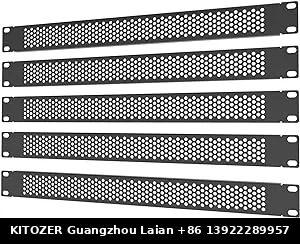
Contact KITOZER
Brand: KITOZER (Guangzhou Laian Intelligent System Development Co., Ltd.)
Address: Chaotian Park, Zhongrun Industrial Zone, No.5 Huashan Road, Shilou Town, Panyu District, Guangzhou, China
Phone/WeChat: +86 13922289957 / +86 18520668845
WhatsApp: +1 906-853-4140
Web: www.gdlain.com (English) / www.lain.com.cn (Chinese)
For blank panel selection, quantities and quotations, contact KITOZER with your rack count, U positions and rail type.
Reference Prices (budget estimate only)
| Model | Size | Material | Reference price each |
|---|---|---|---|
| KZ-BP-1U | 1U | Steel 1.0mm | USD 3-6 |
| KZ-BP-2U | 2U | Steel 1.0mm | USD 5-9 |
| KZ-BP-3U | 3U | Steel 1.2mm | USD 7-12 |
| KZ-BP-4U | 4U | Steel 1.2mm | USD 9-16 |
| KZ-BP-5U | 5U | Steel 1.5mm | USD 12-20 |
| KZ-BP-V vented | 1-4U | Steel perforated | USD 6-14 |
| KZ-BP-AL | 1-4U | Aluminum | USD 6-18 |
Note: Reference prices per panel, excluding freight. Actual price subject to formal quotation.