KITOZER Row Distribution Cabinet (Column-Head Cabinet) Buying, Installation and Maintenance Guide
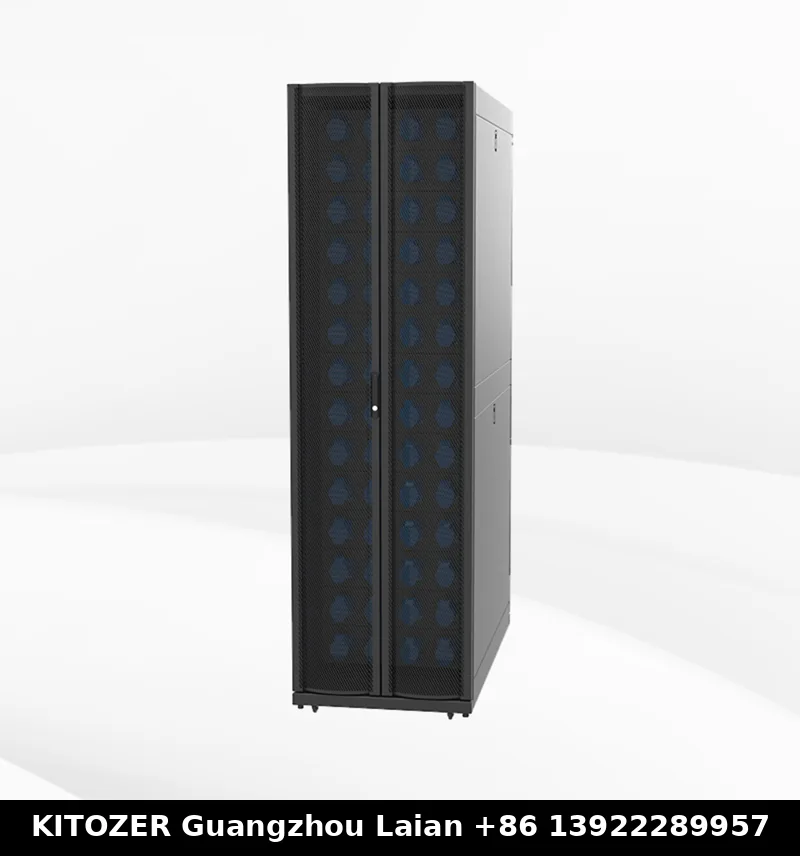
1. What is a Row Distribution Cabinet
A row distribution cabinet, also known as a column-head cabinet or row power distribution cabinet, is a floor-standing low-voltage switchgear installed at the end of each server cabinet row in a data center. It receives power from the upstream critical power distribution cabinet or busway feeder and distributes it circuit by circuit to each rack in the row. It sits at the second-to-last level of the power chain, between the UPS output distribution and the rack PDU.
KITOZER row distribution cabinets cover main incoming currents from 63A to 800A, with branch circuits of 16A to 63A each. They are three-phase four-wire, AC380V/220V, 50Hz. The cabinet is a vertical floor-standing structure, 600 to 800 mm wide, 800 to 1000 mm deep, 2000 to 2200 mm high, IP30 protection, RAL7035 light gray or RAL9005 black. Inside, the cabinet integrates a main incoming circuit breaker, branch miniature circuit breakers, a multi-circuit current monitoring module, a touch screen, a communication gateway and dry contacts. It measures per-rack current, power and energy, and uploads data via RS485 or SNMP to the infrastructure monitoring system.
The row distribution cabinet and the critical power distribution cabinet are similar in function, differing mainly in position and circuit count. The critical power distribution cabinet is wall-mounted after the UPS output bus with many circuits (48 plus), serving a whole power zone. The row cabinet sits at the rack row head, feeds from the critical cabinet or busway, and has circuits matching the racks in the row (typically 24 to 48). In small rooms the two may be combined; in large micro-module rooms they are layered.
The core value of the row cabinet is row-level fine management. A typical rack row holds 10 to 30 racks at 3 to 15 kW each. Without a row cabinet, operators only know total room power, not which row or rack is overloaded or idle. The row cabinet downscales metering to the row-rack level, enabling PUE accounting, rack power density analysis, idle resource recovery and abnormal power detection. KITOZER row cabinets are standard in new data centers and retrofit projects.
2. Position in the Power Chain
The data center power chain from grid to rack is: high-voltage utility, transformer, low-voltage incoming cabinet, capacitor compensation, UPS input cabinet, UPS, UPS output or critical power distribution cabinet, row distribution cabinet, rack PDU, server power supply. The row cabinet is the last centralized distribution node before the rack.
In a 2N redundant architecture, row cabinets are paired A and B: A feeds from UPS-A bus, B from UPS-B bus. Each rack has two power supplies, one from A and one from B. If one UPS or row cabinet fails, the other carries full load. This pairing is standard in finance and carrier core rooms.
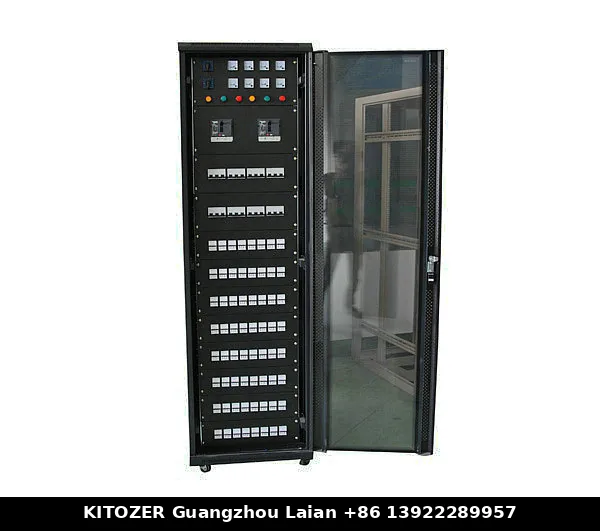
Main incoming methods are cable feeder from the critical cabinet or busway tap-off unit. Busway suits large data centers with high capacity and flexible branching; cable suits small to medium rooms or complex routing.
3. Internal Structure and Components
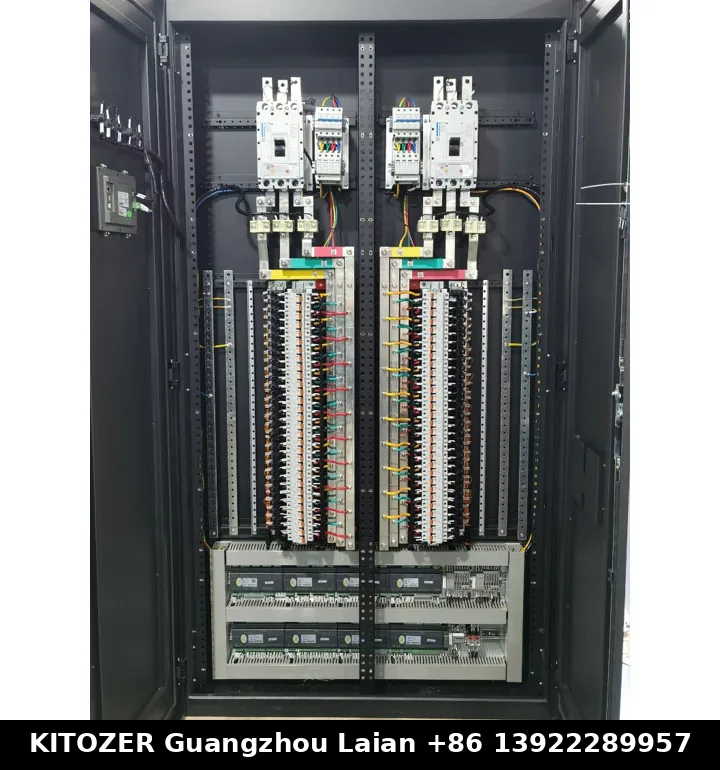
The cabinet uses nine-fold profile frame, 25 mm module. Inside, from top to bottom: incoming chamber (main breaker and incoming busbar), main monitoring chamber (power meter and main CT), branch chamber (branch MCBs and branch CTs), outgoing chamber (cables bottom entry), and communication chamber (gateway and terminals).
Main breaker: air circuit breaker (ACB) above 630A, molded case (MCCB) below 630A. Brands include Schneider, ABB, Siemens or Changshu. Copper busbar: high-conductivity electrolytic copper, phase colors yellow green red, N and PE bars separate. Branch breakers: 1P/2P/3P MCB, C-curve, 16 to 63A, each with CT.
Multi-circuit monitoring module is the core, sampling 12/24/36 branch currents, computing power and energy from main voltage. Touch screen 7 or 10 inch displays main parameters and branch list with indicator lights and buzzer. Gateway supports RS485 Modbus-RTU, Ethernet, SNMP, MQTT, with dry contacts and digital inputs.
4. Working Principle and Measurement
Power flows from the critical cabinet or busway through the main breaker into the main busbar, then to each branch MCB and out to rack PDUs. CTs convert primary current to secondary small current sampled by the monitoring module. The DSP computes RMS, power, energy and harmonics. The screen and gateway display and upload data. When parameters exceed thresholds or breakers change state, dry contacts and protocol messages trigger local and remote alarms.
Current measurement is electromagnetic via CT. Voltage is sampled directly. Power and energy use instantaneous product integration, accumulating import/export active and inductive/capacitive reactive energy. Harmonics use FFT for 2nd to 31st order and THD. Residual current uses RCT, alarm without trip, indicating insulation issues.
5. Technical Parameters
| Item | Typical |
|---|---|
| Rated insulation voltage | AC 1000V |
| Rated voltage | AC 380V/220V, 3P4W |
| Frequency | 50Hz (60Hz optional) |
| Main current | 63/100/160/250/400/630/800A |
| Branch current | 16/20/25/32/40/63A |
| Branch circuits | 12/24/36/48 |
| Current accuracy | Class 0.5 |
| Energy accuracy | Class 1 |
| Display | 7/10 inch touch screen |
| Communication | RS485 Modbus/ETH/SNMP/MQTT |
| Protection | IP30 (IP40/IP54 optional) |
| Standard | GB7251.1, IEC61439, YD/T939 |
6. Selection Guide
Load calculation: count racks N, power P kW each, dual-cord. Single-path current I = N*P/(sqrt3*0.38*PF), add 1.2 to 1.5 margin for main breaker. Example: 20 racks, 5kW each, PF0.95, 2N, single-path current about 160A, choose 250A main.
Branch config: each rack single-path about 9.6A, choose 25A MCB, CT 30/5. Branch count equals racks times paths plus 20 percent spare. Balance phases within 15 percent.
Protocol: confirm upstream protocol. RS485 for basic BMS, Ethernet plus SNMP for IP, MQTT for cloud. Align point table before delivery.
7. Installation
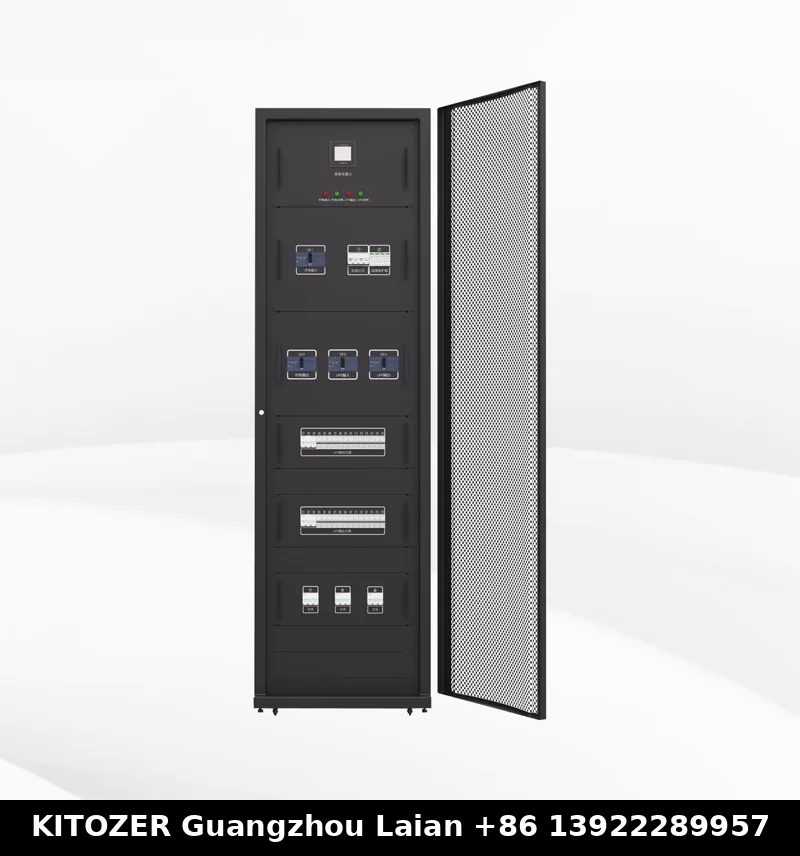
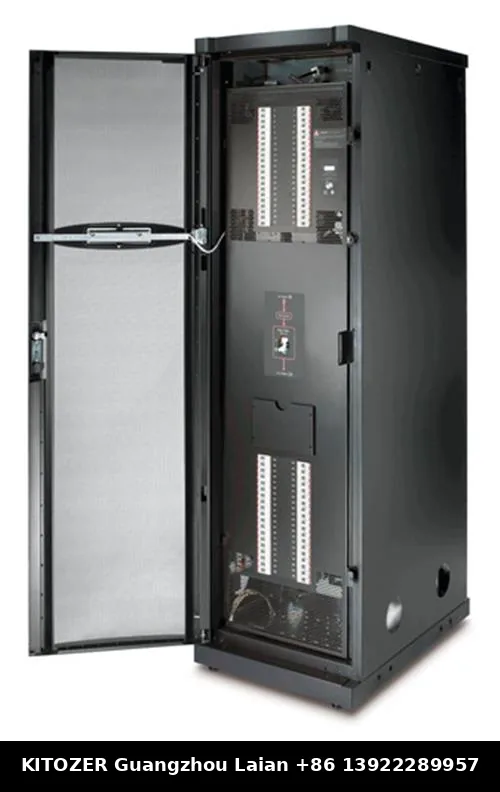
Install at the rack row head. Floor load not less than 3 times cabinet weight. Verticality within 1.5 per mille. Fix to 10 channel steel base with M12 expansion bolts. PE bar to room equipotential bar with 25 mm2 copper cable, ground resistance not over 1 ohm. Cables enter bottom, seal with fire mud. CT secondary never open; short unused CT terminals.
Before energizing, verify single-line diagram, CT ratio and phase sequence. Tighten terminals, remove tools. Close main breaker first, then branches one by one. Front operation aisle not less than 1500 mm, rear maintenance aisle not less than 800 mm.
8. Operation and Maintenance
Daily: check screen for alarms and communication. Weekly: record branch current and energy. Monthly: infrared scan busbar joints and breaker terminals, temperature rise within 55K. Re-torque terminals at first month, half year and year. Quarterly: dry compressed air dust removal. Annual: insulation test, protection trip test, communication test.
On branch overcurrent alarm, locate branch number on screen, check downstream rack, distinguish real overload from false alarm. On residual current alarm, use clamp residual current meter to locate ground point. On communication loss, check gateway power, cable A/B, terminator. For power-off maintenance, use work permit, verify voltage, apply grounding, work in pairs.
9. FAQ
Position and circuits. Critical cabinet is wall-mounted after UPS with 48 plus circuits; row cabinet is at rack row head with 24 to 48 circuits matching racks. Small rooms combine, large rooms layer.
In 2N, pair A and B, one each per UPS. In N+1, single.
250A main carries 20 to 25 racks at 5kW each; 400A carries 35 to 45. Keep 30 percent margin.
Data center loads are switching power supplies; C-curve (5 to 10 In) rides throughrush and trips fast on short circuit.
Continuity required; residual current is early insulation signal; alarm then investigate to avoid false trip.
Theoretical 32 nodes (128 with repeater), up to 1200 m, hand-in-hand, 120 ohm terminators at both ends.
Check CT loose, ratio setting, load below CT resolution; compare with clamp meter.
If spare positions exist, electrician can add MCB live; CT and monitoring extension recommended in outage window.
Humid areas or underground rooms recommend anti-condensation heater with temperature humidity controller.
Local shows 7-day curves and alarm log; long-term history uploaded to upstream or cloud.
Standard 15 to 20 working days, custom 25 to 35, import components longer.
Reference price is ex-works with 13 percent VAT, excluding shipping, install and cables.
10. Application Scenarios
Carrier rooms: 2N, A/B pair per row, per-rack metering, unmanned BMS. Finance back office: high reliability, residual current and harmonics, event recording. Government cloud: classified protection, door and smoke to security. Hospital clean power: dual UPS for life support. Enterprise and campus: economic Modbus BMS. Industrial control room: industrial grade for PLC and SCADA.
11. Redundancy and A/B Pairing
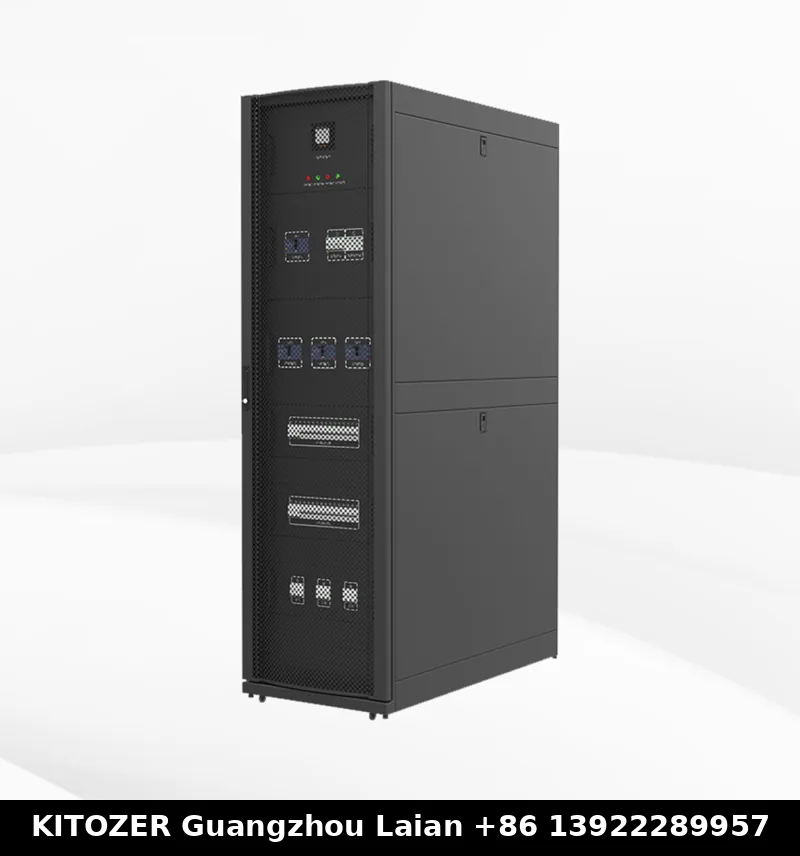
In 2N, row cabinets must be A/B paired. A feeds UPS-A, B feeds UPS-B, side by side, blue A and red B labels. Each rack dual power inserts A and B PDU. Any single cabinet or UPS or bus fault, the other carries full load. This is finance and carrier standard and Tier III/IV requirement. KITOZER supplies identical paired cabinets color-coded.
In N+1, UPS parallel redundancy, row cabinet main from paralleled bus, single config but dual-cord racks. In distributed redundancy micro-modules, row cabinet integrates small UPS, carrying row mains, UPS output and rack distribution, requiring high integration and gateway.
12. Busbar and Cable Selection
| Main current | Copper busbar | Branch MCB | Branch CT ratio |
|---|---|---|---|
| 63A | 20×3 | C20/C32 | 20/5 |
| 100A | 25×3 | C32 | 30/5 |
| 160A | 30×4 | C32/C40 | 40/5 |
| 250A | 40×4 | C40/C63 | 50/5 |
| 400A | 60×6 | C63 | 75/5 |
| 630A | 80×6 | C63 | 100/5 |
| 800A | 2x60x6 | C63 | 150/5 |
13. Power Quality and Harmonics
Data center switching power loads generate 5th, 7th, 11th, 13th harmonics that sum on neutral, causing neutral overload. The row cabinet monitors THD and neutral current; when THDi exceeds 15 percent or neutral current stays high, recommend APF or SVG. KITOZER can coordinate with APF using monitoring data as setpoint reference.
14. Factory Test and Standards
Each cabinet gets routine tests: visual, insulation resistance (main circuit over 10 megohm), power frequency withstand (2.5kV/1min), protective continuity, operation and interlock. Sampled type tests include temperature rise, short-time withstand, protection rating. Delivered with single-line diagram, secondary diagram, BOM, test report, certificate and Modbus point table. Standards: GB7251.1, IEC61439, YD/T939.
15. Energy Efficiency and Green DC
Per-rack energy metering from the row cabinet is the data source for PUE. Long-term rack energy data identifies idle racks, abnormal use and density, supporting consolidation and cooling optimization. Industry measurement shows branch metering plus governance lowers DC energy use by 5 to 10 percent, payback 1 to 2 years.
16. Integration with BMS, DCIM and Cloud
The gateway integrates three upstream systems: BMS (RS485 Modbus, single-line display, alarm popup); DCIM (rack energy plus assets, tenant billing view); cloud (multi-site central monitoring, alarm push). Before delivery confirm protocol, baud rate, slave address, register map and byte order; site work is wiring and communication commissioning.
17. Safety Interlock and Fire
Doors have locks and door contact; main breaker mechanically interlocked (door closed to close). Fire trip dry contact reserved; gas suppression cuts non-essential loads. Panel emergency stop trips main. Control power via small UPS or transformer; on loss, monitoring and gateway report last status. Operators wear insulated gloves, use insulated tools, stand on insulated mat.
18. Site Common Issues and Commissioning
Common issues: reversed phase (verify with phase sequence meter), CT secondary open (short unused), N/PE mixed (strictly separate), no communication (check gateway power, A/B, terminator), branch reading bias (check CT ratio and direction). Commissioning in three steps: outage check mechanical wiring; energize main, measure voltage phase; close branches one by one, verify rack and screen.
19. Lifecycle and After-sales
Design life over 20 years. Warranty 18 months from shipment or 12 months from commissioning. After warranty, cost-price spares and paid inspection. 7×12 phone support, Guangdong 24h and other provinces 48h on-site. Major components supplied for 10 years. Modular structure supports later branch addition, gateway replacement and screen upgrade.
20. Quick Selection Table
| Row size | Racks | Recommended main | Branches | Reference price |
|---|---|---|---|---|
| Small | up to 10 | 63-100A | 12-24 | RMB 6,000-12,000 |
| Medium | 10-25 | 160-250A | 24-36 | RMB 12,000-20,000 |
| Large | 25-45 | 400-630A | 36-48 | RMB 20,000-28,000 |
21. Row Cabinet and Critical Power Cabinet Cooperation
The row cabinet and critical power cabinet form a two-level distribution. The critical cabinet sits after the UPS output bus, carrying total incoming, total metering, total protection and multiple feeders for one power zone. The row cabinet sits at the rack row, receiving a feeder from the critical cabinet and subdividing by rack. They connect by cable or busway, forming centralized distribution and row-level subdivision.
In a typical 2N system, each critical cabinet feeds several row cabinets. For example a 400A critical cabinet feeds four to six 250A row cabinets, each serving a row of 10 to 20 racks. The critical feeder rating must match the row main incoming; the feeder breaker must not exceed the row main breaker. Upstream and downstream protection selectivity must coordinate: branch fault trips the row branch first, row main fault trips the critical feeder first, avoiding upstream over-trip.
In large data centers using busway, the row main takes power directly from the busway tap-off unit, bypassing the critical cabinet feeder breaker. The busway itself performs centralized distribution, and the row cabinet does row-level subdivision. This reduces one breaker level and a fault point, but requires the tap-off unit to have protection matching the row main.
22. Current and Energy Measurement Details
Row cabinet current measurement uses external through-current transformers. The CT clamps on the branch busbar or cable, converting primary high current by a fixed ratio (like 250:5, 100:5, 50:5) to secondary small current, feeding the multi-circuit monitoring module. The module samples each CT signal and computes RMS current. For nonlinear loads, true RMS measurement is more accurate than average rectified, with error within class 0.5.
Voltage measurement samples three-phase line or phase voltage directly from incoming terminals, divided then sampled. Power calculation integrates instantaneous voltage times current, computing active P, reactive Q and apparent S. Power factor is P over S. Energy accumulates power times time, separately for import active, export active, inductive reactive and capacitive reactive, in kWh.
Harmonic analysis uses FFT, decomposing distorted current into fundamental (50Hz) and harmonics (100Hz, 150Hz etc). KITOZER row cabinets monitor 2nd to 31st harmonic current and compute total harmonic distortion THDi. When THDi exceeds 15 percent, recommend active power filter (APF) in the distribution system. Neutral current is also monitored because third harmonics sum on the neutral, possibly causing overload.
Residual current monitoring uses a residual current transformer (RCT) clamped on the three-phase four-wire cable, monitoring the vector sum of three-phase current minus neutral current. In normal operation the difference is zero; when insulation degrades or leakage occurs, the difference rises. KITOZER row cabinets can set residual current alarm threshold (like 300mA), alarm locally and remotely without automatic trip to avoid power interruption.
23. Communication Protocol and Point Table
KITOZER row cabinets support multiple protocols to fit different upstream systems. The most common is RS485 Modbus-RTU, physical layer two-wire (A/B), baud 1200 to 115200 default 9600, 8 data bits, 1 stop, no parity or even. Protocol layer is master-slave polling, upstream as master, row cabinet as slave, slave address 1 to 247. One RS485 bus supports up to 32 slaves (128 with repeater), up to 1200 meters, with 120 ohm terminator at both ends.
For IP network needs, KITOZER offers Ethernet gateway supporting Modbus-TCP, SNMP v2c/v3, MQTT. Modbus-TCP runs Modbus on TCP port 502; SNMP provides OID tree collectable by Zabbix, PRTG; MQTT publishes data to a broker for cloud and IoT. The gateway can simultaneously support RS485 and Ethernet as a protocol converter.
The point table is the key to upstream integration. KITOZER delivers an Excel point table with register address, data type, scale, offset and unit for each monitored parameter. Main parameters include: main three-phase voltage (0.1V resolution), main three-phase current (0.1A), main active power (0.1kW), main energy (0.01kWh), each branch current (0.1A), each branch power (0.01kW), each branch energy (0.01kWh), switch status, alarm status. On site the upstream reads per point table and compares with screen display.
24. Protection Selectivity and Cascading
Selectivity is critical in data center distribution. Selectivity means when a downstream fault occurs, only the protection closest to the fault acts, and upstream protection does not. For example a rack PDU branch short circuit trips the row cabinet branch MCB, not the row main MCCB; row main fault trips the critical cabinet feeder, not the UPS output main.
Selectivity methods: time selectivity (up-down breaker trip time difference 0.2 to 0.5s), current selectivity (up-down rated current ratio at least 1:1.6), energy selectivity (electronic release judges by fault energy). KITOZER designs with upstream critical cabinet, ensuring rated current ratio at least 1:1.6 and using MCCB or ACB with short delay for key circuits.
For branch MCB, C-curve trips at 5 to 10 times rated current. Data center server power supplies draw 3 to 5 times inrush on boot, but for milliseconds, so C-curve MCB does not false trip. On short circuit, current instantly exceeds 10 times and MCB trips in milliseconds. Branch MCB and main MCCB selectivity is achieved by current difference: branch short current is in MCB trip range but below MCCB short delay setting, so MCCB does not act.
25. Cabinet Structure and Dimensions
KITOZER row cabinets use nine-fold profile frame, galvanized steel panel assembly, powder coating. Standard size 600mm wide, 800mm deep, 2000mm high (without plinth); high-capacity (630A plus) use 800mm wide, 1000mm deep, 2200mm high. Color standard RAL7035 light gray, optional RAL9005 black. Single door with lock and door contact. Bottom entry.
Inside from top to bottom five chambers. Top incoming chamber with main breaker and incoming busbar. Second main monitoring chamber with power meter and main CT. Third branch chamber with branch MCBs and branch CTs, arranged in three columns by phase. Fourth outgoing chamber with terminal blocks, branch cables out. Bottom communication chamber with gateway, communication terminals, dry contact terminals and DI terminals.
Row cabinets side by side use parallel bolts, no gap. A/B pair side by side with 100mm gap then joined. Row cabinet aligns with rack row, cabinet face flush with rack face. Bottom mounts on 10 channel steel base, base 100 to 200mm above floor. Verticality within 1.5 per mille, horizontal within 2mm.
26. Installation Environment and Civil Works
Install in data center or power room, ambient temperature minus 5 to plus 40 C, 24h average not over 35 C. Humidity not over 90 percent, no condensation. No severe vibration, corrosive gas, explosive hazard or conductive dust. Altitude not over 2000m (derate above). IP30 for clean rooms; upgrade to IP40 for corridors or semi-open areas.
Civil works: floor load not less than 3 times cabinet weight (including full busbar and cables). A 400A row cabinet weighs about 300 to 500kg; floor load recommended over 1500kg per square meter. Bottom fixed with M12 expansion bolts or welded to embedded channel steel. PE bar to room equipotential copper bar with 25mm2 multi-strand copper, ground resistance not over 1 ohm.
Cable routing: main incoming cable enters bottom hole, connects to cable tray. Strong and weak current separate: power on strong tray, communication (RS485 network) on weak tray, parallel spacing at least 200mm, cross at right angle. Cables fixed with ties inside, bend radius at least 10 times outer diameter. Cable labels show loop number, source and destination, cable spec.
27. Site Commissioning and Acceptance
Commissioning in three phases. Phase one outage check: verify single-line diagram and actual wiring; check busbar bolt torque (M12 about 31 Nm); check CT wiring and short unused CT; check N/PE separation; check door interlock; remove tools.
Phase two energize test: close upstream switch (critical cabinet or busway feeder), measure three-phase voltage at row incoming (380V plus or minus 10 percent), correct phase. Close row main breaker, check screen shows correct voltage (near-zero current no-load). Close branch MCBs one by one, verify screen branch current matches downstream rack load. If mismatch, check CT ratio and direction.
Phase three communication joint test: connect RS485 bus (A to A, B to B), set gateway slave address and baud, upstream reads data with Modbus debug software. Compare voltage, current, power, energy with screen. Test alarm: simulate branch overcurrent (or software test command), check upstream receives alarm and local sound light acts. Test digital: open a branch MCB, check screen switch status changes. On acceptance submit commissioning report recording test data.
28. Preventive Maintenance Schedule
| Item | Cycle | Content | Standard |
|---|---|---|---|
| Daily patrol | Daily | Screen alarm, comm status, indicators | No alarm, comm online |
| Branch reading | Weekly | Record branch current and energy | Current within rated |
| IR scan | Monthly | Busbar joints, breaker terminals | Rise under 55K |
| Retorque | 1mo/6mo/1y | Tighten all bolts | Torque per spec |
| Dust removal | Quarterly | Dry compressed air | No dust |
| Insulation test | Annual | Main circuit to ground | Over 10 megohm |
| Protection trip | Annual | Simulate overcurrent trip | Correct action |
| Comm test | Annual | Upstream data compare | Data match |
| CT check | Annual | CT wiring and ratio | No loose, ratio correct |
| Ground check | Annual | Ground resistance | Under 1 ohm |
29. Common Fault Diagnosis
Fault one: screen no display. Check control power (taken from incoming phase, via small transformer or SMPS); check screen ribbon; check SMPS output (usually DC24V or DC12V). If control power normal but screen dark, screen may be faulty, replace.
Fault two: communication lost, upstream cannot read. Check gateway power LED; check RS485 A/B reversed; check terminator at bus ends; check slave address and baud match upstream; measure RS485 bus voltage (A to B about 0.2 to 0.5V normal). If multiple devices lost, bus short or one device pulling bus low.
Fault three: branch reads zero current but downstream equipment runs. Check CT loose or dropped; check monitoring module channel wiring; check software CT ratio for that branch; use clamp meter on branch cable and compare with screen. If clamp reads current but screen zero, CT or monitoring channel faulty.
Fault four: branch overcurrent alarm frequent. First confirm real: view screen branch current, check if continuously above alarm threshold. If real overload, check downstream rack load increase, expand or balance. If false, check CT ratio too large (small current misjudged) or module faulty.
Fault five: residual current alarm. Means insulation degraded. Use clamp residual meter to locate ground point. Common causes: cable insulation aging, terminal damp, equipment internal leakage. Locate then outage repair.
Fault six: main breaker trips. After trip view screen recorded trip current and event. If short, check downstream busbar and cable for short; if overload, check load exceeds breaker rating; if residual (leakage breaker), check insulation. Clear fault before re-energize.
30. KITOZER vs Competitors
| Item | KITOZER | Import brand | Generic domestic |
|---|---|---|---|
| Main breaker choice | Schneider/ABB/Siemens/Changshu | Original import | Generic |
| Monitor accuracy | Class 0.5 | Class 0.5 | Class 1 |
| Display | 7/10 touch | Touch | Segment LED |
| Protocol | Modbus/SNMP/MQTT | Rich | Modbus only |
| Factory test | Full plus type | Full | Sampled |
| Warranty | 18 months | 12-24 months | 12 months |
| Reference price | RMB 6k-28k | RMB 20k-80k | RMB 3k-15k |
| Lead time | 15-25 days | 45-90 days | 10-15 days |
| Local service | Guangzhou factory national | Slow agent | Local dealer |
31. Customization
KITOZER row cabinets are built to customer single-line diagram. Customer provides room power system diagram, rack layout and load list; KITOZER engineer returns configuration within one working day, including main capacity, branch count, CT ratio, breaker brand model, protocol and gateway config. After customer confirms, production is scheduled, standard 15 to 20 working days.
Customizable: cabinet size (non-standard width depth height), color (any RAL), main breaker brand (Schneider NSX/MT, ABB Tmax/Emax, Siemens 3VA/3WL, Changshu CM1/CM3), branch MCB brand and poles (1P/2P/3P), CT ratio (optimal for actual load), monitor channels (12/24/36), screen size (7/10), protocol (RS485/Ethernet/SNMP/MQTT), dry contact count, DI count, IP (IP30/IP40/IP54), entry (bottom/bottom, top/top, top/bottom).
32. Standards and Certification
KITOZER row cabinets execute: GB7251.1 Low-voltage switchgear and controlgear assemblies Part 1 General; GB7251.3 Part 3 for non-professional access sites; IEC61439; YD/T939 Low-voltage distribution for telecom; GB50174 Data center design code. Product passes CCC. Export can provide CE.
33. After-sales and Support
KITOZER offers 7×12 phone support. On-site response within Guangdong 24h, other provinces 48h. Warranty 18 months from shipment or 12 months from commissioning, whichever first. In warranty, non-human damaged components replaced free. After warranty, cost-price spares and paid inspection. Major components supplied for 10 years.
KITOZER has production and tech center in Panyu Guangzhou, customers can visit anytime. Tech team supports full flow: design, manufacturing, factory test, commissioning, training. Deliverables: single-line diagram, secondary diagram, BOM, factory test report, certificate, Modbus point table, user manual.
34. Design Philosophy and Technical Route
KITOZER row cabinet design centers on safety, reliability, observability and expandability. Safety: nine-fold profile frame, IP30, main breaker door interlock, door lock and contact, fire trip dry contact, panel emergency stop. Reliability: key components from Schneider, ABB, Siemens; busbar verified for short-circuit thermal and dynamic stability; CT secondary never open; control power via small UPS so monitoring reports last state on loss.
Observability: from main incoming to every branch, current monitored with 7 or 10 inch touch screen showing main three-phase voltage current power energy and branch list. Data uploads via RS485 or Ethernet to BMS, DCIM or cloud for remote watch and alarm. Expandability: 20 percent spare branches, monitoring modules cascade, gateway multi-protocol, later branch addition needs only MCB and CT plus software config.
Technical route is modular: incoming unit, monitoring unit, branch unit, communication unit independent and combinable. Incoming chooses ACB or MCCB by main capacity; monitoring chooses 12/24/36 channel by branch count; branch configures MCB and CT by rack count; communication chooses RS485 or Ethernet gateway by upstream protocol. This modular design flexibly fits 63A to 800A, 12 to 48 circuits.
35. Power Redundancy Architecture
Data center power architectures are 2N, N+1 and distributed redundancy. 2N is two fully independent systems, each able to carry full load. Two utility transformers feed two UPS systems; each UPS output via critical cabinet to row cabinets. Rack dual cord connects A and B row cabinets. Any one system fails, the other carries seamlessly. 2N is highest reliability but highest cost, for Tier IV core rooms.
N+1 is N UPS in parallel plus one backup. If one of N fails, the backup takes over. Parallel UPS outputs to one bus, via critical cabinet to row cabinets. Rack dual cord takes from two bus sections. N+1 costs less than 2N but parallel bus fault affects the zone, for Tier III.
Distributed redundancy (DR) is common in micro-modules. Each micro-module has 1 to 2 small UPS near or in the row cabinet, serving the row. Utility enters row main, small UPS outputs to rack PDU. DR saves large UPS and long busway, short power path, high efficiency, but each row needs UPS and maintenance points are spread.
36. Busway vs Cable Incoming
Row cabinet main incoming is busway tap-off or cable. Busway runs along the row above or beside, row cabinet takes power via tap-off unit. Busway rated 250A to 1600A, tap-off built-in breaker 63A to 400A. Busway pros: high capacity, flexible branching, easy expansion (add tap-off), neat appearance; cons: high initial cost, precision install.
Cable feeder runs from critical cabinet or UPS output cabinet via cable tray to row incoming. Cable cross section by current, like 250A uses YJV-0.6/1kV-3×120+2×70, 400A uses YJV-3×185+2×95. Cable pros: flexible, routing not limited by busway, low initial cost; cons: large cable hard to lay, expansion needs new cable, tray space.
In large data centers (rack density 8kW plus), busway is mainstream because high density and many rows favor along-row supply and expansion. In small rooms or retrofits, cable is more economical. KITOZER supports both.
37. Row Cabinet and Rack PDU Cooperation
Downstream of row cabinet is rack PDU. PDU mounts inside rack, usually vertical on rear post, input 16A or 32A industrial connector or terminals, output multiple national/universal/IEC C13/C19 sockets. Each row branch corresponds to one rack one path, cable from row outlet to rack PDU input.
In dual-cord architecture, each rack has two PDUs: A and B, fed from A and B row cabinets. Server power supply 1 into A PDU, supply 2 into B PDU. Any PDU or row cabinet fails, the other server supply continues. PDUs can also be smart with per-socket current monitoring; then row branch and PDU monitoring form two-level metering: row cabinet row total, PDU rack total.
Row to PDU cable is flame-retardant XLPE (like ZR-YJV), cross section by branch current: 25A uses 2.5mm2, 32A uses 4mm2, 63A uses 10mm2. Cable exits row bottom, via underfloor tray into rack bottom, up rack post to PDU input. Both ends labeled with row branch number and rack number.
38. Rack Energy Metering and PUE
Row cabinet per-rack energy metering is the data base for data center energy management. Collecting each rack daily and monthly energy, operators compute rack power density (kW per rack), identify high and low density racks, and provide basis for hot/cold aisle containment, blanking panels and AC adjustment. PUE equals total energy over IT energy; IT energy precision depends on row and PDU energy data.
Row energy data uploaded to DCIM generates rack, row and room energy reports by day week month year. For multi-tenant centers, row energy data supports tenant billing: bill each rack by actual use. This is fairer than per-rack billing and motivates tenants to save.
Long-term energy analysis reveals abnormal use: a rack suddenly draws more (device fault or overclock), a rack long idle (consolidate or release), a row too dense (cooling adjust). These insights convert directly to energy saving; industry experience says fine power management cuts data center energy by 5 to 10 percent.
39. Fire Safety and Electrical Safety
As low-voltage distribution equipment, the row cabinet is a key node in data center fire linkage. It reserves fire trip dry contact (relay output); when gas suppression starts, the fire control system sends dry contact to row cabinet, which by preset logic cuts non-fire load power, preventing auto-restart causing secondary fire. Fire trip only cuts designated branches (non-essential IT), keeping fire equipment and emergency lighting.
Row cabinet own electrical safety: main breaker door mechanical interlock (door closed to close, preventing live touch), door lock (only authorized open), door contact to alarm on unauthorized open, internal insulation barriers to prevent bare busbar touch, bottom cable holes fire-mud sealed to stop fire spread along cables.
Operators must follow safety rules: insulated gloves, insulated tools, insulated mat; close order main then branch, open order branch then main; outage maintenance uses work permit, verify no voltage, apply grounding; work in pairs, one operates one supervises.
40. Cabinet Thermal and Temperature Rise
Internal busbar and breakers generate heat at rated current; thermal design affects life. KITOZER row cabinet uses natural convection: top and bottom vents, hot air out top, cool in bottom. Busbar layout considers air path, breaker spacing meets cooling. For high capacity (630A plus), optional top fan with thermal switch starting above 40 C inside.
Temperature rise is a key type test item. At rated current, busbar joint rise under 55K (ambient 40 C means busbar under 95 C), breaker terminal rise within maker spec. KITOZER factory temperature rise test verifies cooling under full load. On site, do not block vents, keep rear aisle open.
41. Electromagnetic Compatibility
Row cabinet monitoring works in strong electric environment; EMC design is critical. CT secondary uses shielded twisted pair, shield single-end ground. Communication (RS485) shielded twisted pair, separate from power. Gateway and monitor power input adds filter capacitor and varistor. Cabinet reliably grounded, shielding internal electronics.
Immunity tests: ESD contact 4kV, radiated RF 10V/m, EFT power 2kV signal 1kV, surge differential 1kV common 2kV. KITOZER row cabinet monitoring passes these, stable in data center EM environment.
42. Lightning and Surge Protection
Row incoming can be equipped with surge protective device (SPD). SPD parallels on busbar; when lightning or switching surge enters, SPD conducts and discharges surge current to ground, protecting downstream. KITOZER reserves SPD mounting position; customer can add as needed. SPD categories: class I Iimp 12.5kA, class II In 20kA, class III In 10kA; row cabinet generally uses class II.
43. Monitoring System Architecture and Data Flow
Row monitoring has four layers: sensing (CT, voltage sampling, breaker auxiliary), acquisition (multi-circuit module), processing (DSP computes), communication (gateway and protocol). Data flow: CT samples primary current, module samples, DSP computes RMS and power, data stored in module registers, gateway reads registers, uploads via RS485 or Ethernet to upstream.
Locally, the touch screen reads directly from module, showing main parameters and branch list. It provides branch current bar chart, power trend, event log. Remotely, upstream (BMS/DCIM/cloud) polls or subscribes data, displays on single-line diagram, alarm popup and sound light.
44. Typical Application Cases
Carrier provincial room: 1000 square meters, 10 rows, 20 racks each. 2N, A/B pair 250A per row, 24 circuits. RS485 to BMS unmanned. Rack dual cord from A/B. Per-rack metering for capacity and billing.
Finance back office: Tier III, UPS N+1 parallel. One 400A row cabinet per row, 36 circuits, harmonic and residual monitoring. Ethernet SNMP to DCIM, rack energy for tenant billing. Fire trip dry contact linked to gas suppression.
Enterprise self-built room: small, single UPS. One 160A row cabinet per row, 12 circuits, basic branch current. RS485 to simple BMS. Budget, domestic breakers, reference price about RMB 6,000 to 8,000.
Micro-module: each row is a micro-module, row cabinet integrates small UPS, AC, fire. Row incoming 380V, internal 30kVA UPS output, branches to rack PDU. Gateway MQTT to cloud, multi-site remote monitoring.
45. Delivery Documentation
KITOZER row cabinet delivers: single-line diagram (main incoming, busbar, branch breakers, CT config), secondary diagram (monitor wiring, gateway wiring, dry contact wiring), BOM (brand model quantity), factory test report (visual, insulation, power frequency, continuity, operation interlock), product certificate, Modbus point table (register address, data type, scale, unit), user manual (install, operate, maintain), CCC certificate copy. Electronic version sent early for customer review.
46. More FAQ
Yes. Multiple row cabinets side by side with parallel bolts, no gap. A/B pair with 100mm gap then joined.
Standard rack row is 2m, row cabinet aligns. High capacity (630A plus) is 2.2m for larger busbar and breakers.
Not recommended. IP30 suits clean indoor. Outdoor needs IP54 custom with AC cooling.
Choose CT primary as 1 to 1.2 times branch MCB rating. 25A branch uses CT 25/5 or 30/5. Light racks use small ratio for resolution.
Not recommended. Replace in outage window. Emergency live work by professional with insulation protection.
No. It works in room AC environment. Inside temperature follows room, designed under 40 C.
Yes. KITOZER offers monitoring upgrade kit: add multi-circuit module, screen and gateway, keep existing breakers and busbar.
Ex-works with 13 percent VAT. Excludes shipping, install, cables. Import components extra.
47. Selection Decision Flow
Choosing KITOZER row cabinet: step one, count racks in row and power per rack, compute row total and single-path current. Step two, by architecture (2N/N+1/DR) decide row cabinet count (single or A/B pair). Step three, by single-path current plus margin choose main incoming (63A to 800A). Step four, by rack times paths choose branch count (12 to 48). Step five, by upstream system choose protocol (RS485/Ethernet/SNMP/MQTT). Step six, by budget choose breaker brand (import/domestic). Step seven, confirm size, color, entry. Step eight, send single-line and rack list; KITOZER returns config and reference quote.
48. Why KITOZER
KITOZER is the brand of Guangzhou Laian Intelligent System Development Co., Ltd., focused on data center power distribution and monitoring. Row cabinet line covers 63A to 800A, built to drawing, serving carriers, finance, government, enterprise. KITOZER strengths: flexible design (to customer single-line), quality components (first-tier brands), precise monitoring (class 0.5), open communication (multi-protocol standard point table), timely service (Guangzhou factory national response), reasonable price (reference RMB 6k-28k, better value than import brands).
49. Main Components Selection
Main incoming breaker: 63 to 250A uses MCCB like Schneider NSX100/160/250, ABB Tmax T1/T2/T3, Siemens 3VA1/3VA2, Changshu CM1-100/250. 400 to 800A uses ACB like Schneider MT06/MT08, ABB Emax E1/E2, Siemens 3WL, Changshu CW1. MCCB uses thermal-magnetic or electronic release, adjustable long and short delay. ACB uses electronic release, fully adjustable protection, communication trip.
Branch MCB: 1P/2P/3P miniature, C-curve, rated 16/20/25/32/40/63A. Brands Schneider iC65N, ABB SH200, Siemens 5SY, Changshu CH3. 1P for single-phase 220V branch, 2P for branch with N protection, 3P for three-phase 380V branch. MCB with shunt or auxiliary for remote trip and status.
CT: through-type, class 0.5, secondary 5A. Ratio by branch rating: 16A uses 20/5, 25A uses 30/5, 32A uses 40/5, 63A uses 75/5. Main CT by main rating: 250A uses 300/5, 400A uses 400/5, 630A uses 600/5. CT clamps on busbar or cable, secondary to monitoring module.
Monitoring module: multi-circuit current, single unit samples 12/24/36 branch currents, computes power and energy with main three-phase voltage. RS485 Modbus-RTU, baud 9600 to 115200. Power AC/DC 85 to 265V, under 5W. DIN rail mount in communication chamber.
Touch screen: 7 or 10 inch color touch, 800×480 or 1024×600 TFT. Shows main parameters (voltage, current, power, energy, frequency, PF) and branch list (each current, power, switch status). Three-color indicator (green normal, yellow warning, red alarm) and buzzer. DC24V, RS485.
Gateway: multi-protocol, RS485 to Ethernet, Modbus-RTU to Modbus-TCP/SNMP/MQTT. 2 to 4 RS485, 1 to 2 Ethernet, 2 to 4 dry contact out, 4 to 16 DI. DC24V. DIN rail. Local config via web or software, sets serial params, protocol mapping, alarm thresholds.
Copper busbar: high-conductivity electrolytic copper, purity over 99.9 percent, tinned or nickel plated. Phase colors yellow green red, N light blue, PE yellow-green. Cross section by rated current: 63A uses 20x3mm, 160A uses 30×4, 250A uses 40×4, 400A uses 60×6, 630A uses 80×6, 800A uses 2x60x6. Joint tinned, bolt torque per spec.
50. Electrical Calculation Examples
Example one: 2N row cabinet capacity. A row of 20 racks, 5kW each, PF0.95, 2N. Single path carries all: P = 20 x 5 = 100kW. Single current I = 100000/(1.732 x 380 x 0.95) = 160A. Add 1.3 margin: 160 x 1.3 = 208A, choose 250A main MCCB. Branch: each rack single path = 5000/(1.732 x 380 x 0.95) = 8A, choose 25A MCB, CT 30/5. Branch count = 20 x 1 = 20, plus 4 spare = 24 circuits.
Example two: N+1 row cabinet. Row of 30 racks, 4kW each, PF0.95, N+1 dual cord. Single path carries half: P = 30 x 4 / 2 = 60kW. Single current I = 60000/(1.732 x 380 x 0.95) = 96A. Add 1.3 = 125A, choose 160A main MCCB. Branch: each rack single path = 4000/(1.732 x 380 x 0.95) = 6.4A, choose 16A MCB, CT 20/5. Branch count = 30, plus 6 spare = 36 circuits.
Example three: busway row cabinet. Row of 40 racks, 6kW each, 2N. Single path P = 40 x 6 = 240kW. Single current I = 240000/(1.732 x 380 x 0.95) = 383A. Add 1.2 = 460A, choose 500A main ACB or MCCB. Busway 630A, tap-off 500A. Branch count = 40, plus 8 spare = 48 circuits.
51. Cable Cross Section Table
| Branch current | MCB | CT ratio | Cable | Cable model |
|---|---|---|---|---|
| 16A | C16 | 20/5 | 1.5mm2 | ZR-YJV-0.6/1kV-2×1.5 |
| 20A | C20 | 20/5 | 2.5mm2 | ZR-YJV-2×2.5 |
| 25A | C25 | 30/5 | 2.5mm2 | ZR-YJV-2×2.5 |
| 32A | C32 | 40/5 | 4mm2 | ZR-YJV-2×4 |
| 40A | C40 | 50/5 | 6mm2 | ZR-YJV-2×6 |
| 63A | C63 | 75/5 | 10mm2 | ZR-YJV-3×10 |
52. Installation Step by Step
Step one: base prep. At rack row head install 10 channel steel base, level, fix with expansion bolts. Base height matches raised floor. Embed M12 bolt holes per cabinet bottom.
Step two: cabinet placement. Use forklift or pallet jack to position, align base bolts. Level with spirit level, verticality within 1.5 per mille. Tighten M12 nuts with spring washers.
Step three: ground. Cabinet PE bar to room equipotential copper bar with 25mm2 yellow-green copper. Measure ground resistance with tester, under 1 ohm.
Step four: main incoming cable. Main cable enters bottom hole, to main breaker upper. Phase L1 yellow, L2 green, L3 red, N blue, PE yellow-green. Cable tied, labeled.
Step five: branch cables. Branch cables exit bottom, to each branch MCB lower. Other end to rack PDU input. Both ends labeled, row branch number and rack number.
Step six: communication. RS485 bus from gateway A/B terminals, hand-in-hand to next device. 120 ohm terminator at bus ends. Communication cable separate from power.
Step seven: check and energize. Check all terminals tight, no tools, doors closed. Close upstream, measure incoming voltage. Close row main, check screen. Close branches one by one, verify rack.
53. Touch Screen Interface
Main screen has three areas. Top status bar shows cabinet number, comm status, time. Left main incoming area shows three-phase voltage (Ua/Ub/Uc), three-phase current (Ia/Ib/Ic), total active P, total reactive Q, PF, frequency F, total active energy kWh. Right branch list shows each branch number, current, power, switch status (on/off), alarm status (normal/overcurrent/residual).
Touch branch number enters detail page, showing branch historical current curve (last 7 days), energy accumulation. Main screen alarm icon shows current alarm list and history. Screen supports password protection: view no password, parameter change needs password.
54. Row Cabinet and Data Center Tier
Uptime Institute ranks data centers Tier I to IV. Tier I basic, single path no redundancy; Tier II redundant components N+1; Tier III concurrently maintainable, 2N or N+1, online maintenance; Tier IV fault tolerant, 2N with system fault tolerance, single fault does not affect operation. Row cabinets in Tier III/IV must be A/B paired, fed from two UPS buses. KITOZER designs for Tier III/IV, A/B pair color-coded.
55. Green Data Center and Energy Saving
Green data center targets PUE approaching 1.0. Row cabinet per-rack energy metering is the data base for PUE optimization. Identifying idle racks, consolidating servers, adjusting cooling lowers IT and cooling energy. KITOZER provides rack-level energy data for continuous PUE optimization. Row cabinet own power is very low (monitoring under 10W), not affecting overall efficiency.
56. Technology Trends
As rack density rises (5kW to 15kW, 30kW), row cabinet main capacity upgrades from 250A to 630A, 800A; busway becomes mainstream. Monitoring evolves from branch current to full power, energy, harmonics, temperature. Communication goes from RS485 to Ethernet, IP, cloud remote monitoring standard. Intelligence evolves to DCIM and AIOps, predictive maintenance and auto power dispatch. KITOZER tracks trends and upgrades product platform.
57. More FAQ
Yes. KITOZER can make single-phase 220V row cabinet, main 2P, branch 1P. But data center mainstream is 3-phase 380V; single-phase for small rooms.
Not recommended. Expansion via spare branches or paralleled cabinets, not two cabinets parallel to same row.
Yes. Main breaker with shunt release, gateway dry contact can remote trip. Closing needs local (safety).
Energy class 1 (plus or minus 1 percent), meets sub-metering. For 0.5S billing, add separate multifunction meter at main.
Cabinet design life 20 years. Breaker mechanical 10000 operations, electrical 6000. Monitoring electronics over 10 years, can upgrade later.
Recommend yearly CT and monitor accuracy check. KITOZER offers calibration, or customer with standard source.
Yes. BMS usually supports Modbus-RTU or BACnet; KITOZER gateway protocol converts, connects BMS.
Yes. Custom. IP54 needs gaskets, waterproof vents, dust filters, for dusty or humid environments.
58. About KITOZER and Guangzhou Laian
KITOZER is the brand of Guangzhou Laian Intelligent System Development Co., Ltd., located at Chaotian Park, Zhongrun Industrial Zone, No.5 Huashan Road, Shilou, Panyu, Guangzhou. The company focuses on data center infrastructure: critical power distribution, row cabinets, UPS, AC, monitoring, fire, water leak, temperature humidity. KITOZER row cabinets are self-designed by the tech team, manufactured in Panyu, CCC certified, served nationwide. Phone/WeChat +86 13922289957, +86 18520668845, WhatsApp +1 906-853-4140, Chinese site www.lain.com.cn, English site www.gdlain.com.
59. Deep Technical Q and A
KITOZER row cabinet branch current accuracy is class 0.5, error within plus or minus 0.5 percent of full scale. CT is class 0.5, monitor samples 16-bit. For a 25A branch, error about plus or minus 0.125A. Energy class 1 (plus or minus 1 percent). If customer needs higher (like 0.5S energy meter), a separate multifunction meter can be added at main incoming.
No. The monitoring module stores last 7 days history and alarms locally. After communication recovers, the gateway can backfill history. The touch screen still shows local real-time. Communication drop does not affect row cabinet distribution, only remote monitoring.
Yes. The gateway supports multi-protocol simultaneously: RS485 to BMS, Ethernet to DCIM, MQTT to cloud. Multiple upstream in parallel without conflict. If only RS485, a bus splitter can hang multiple masters.
On the touch screen or gateway config software. Branch overcurrent default 80 percent rated, adjustable. Overvoltage 10 percent, undervoltage 15 percent. Residual current default 300mA. Alarm actions: local sound light, dry contact output, protocol message upload.
Data center is three-phase four-wire (3P+N+PE). Row main is 3P+N+PE, busbar has A/B/C phase, N, PE. Branch is single-phase 220V (L+N) or three-phase 380V (3P+N). N and PE bars are separate, not joined.
N bar (neutral) connects to transformer neutral, carries unbalanced and third harmonic current in normal. PE bar (protective ground) connects to equipment frame and room ground, no current in normal. N and PE are strictly separate in the row cabinet (not joined, since transformer already grounded). N bar uses blue insulators, PE yellow-green.
CT normal secondary is near short, secondary current flux cancels primary. If secondary opens, all primary becomes excitation, core saturates, secondary induces high voltage (thousands of volts), endangering equipment and people. So unused CT secondary terminals must be shorted.
At design, distribute single-phase branches evenly to A/B/C. Like 24 branches, 8 on each. After install, measure three-phase current, deviation within 15 percent. If too biased, adjust branch phase assignment.
Yes. Door contact switch on door, wired to gateway DI. Unauthorized door open triggers screen door alarm and upstream upload. This is part of security linkage, preventing unauthorized operation.
The busway tap-off has a built-in breaker, lower cable to row main upper. Tap-off breaker capacity matches row main as upstream protection. Connecting cable cross section by tap-off rating.
Yes. Acceptance: visual, install dimensions, wiring check, insulation resistance test, energize test, communication joint test, alarm function test. Sign acceptance report after pass. KITOZER provides commissioning and acceptance support.
Within 18-month warranty, non-human damaged components replaced free. KITOZER tech remote diagnoses; if on-site needed, Guangdong 24h, other provinces 48h. Spares ship from Guangzhou warehouse.
60. Internal Layout Detail
KITOZER row cabinet uses 2mm cold-rolled steel nine-fold profile frame, 1.5mm door, 2.5mm galvanized mounting plate. Surface phosphated then powder coated, 60 to 80 micron thickness. Inside layout top to bottom five chambers separated by metal barriers to prevent arc spread.
Top incoming chamber about 400mm high, with main breaker (ACB or MCCB) and incoming busbar. Main breaker front handle extends through door for operation. Incoming busbar runs from breaker lower to monitoring chamber. Top cable entry if top-in.
Second main monitoring chamber about 200mm, with multifunction power meter (main voltage current power energy) and main CT (clamped on busbar). Meter panel embedded in door, operators read main parameters outside. Main CT secondary to multi-circuit module.
Third branch chamber about 800mm, with branch MCB row and branch CT. Branch MCB arranged in three columns by phase (A, B, C), 8 to 16 MCB per column. Branch CT clamps on MCB lower cable, secondary to module. MCB handles extend through door cutout for operation.
Fourth outgoing chamber about 400mm, with outgoing terminal blocks. Branch cables from MCB lower to terminals, then out to rack PDU. Terminals arranged by loop number for easy finding. Bottom cable exit.
Bottom communication chamber about 200mm, with gateway, communication terminals, dry contact terminals, DI terminals. Separated from strong electric by barrier to reduce EM interference. RS485 bus exits to tray.
61. Upstream and Downstream Protection Table
| Branch MCB | Main MCCB | Critical feeder | UPS output main |
|---|---|---|---|
| C16/1P | 100A | 160A | 250A |
| C25/1P | 160A | 250A | 400A |
| C32/1P | 200A | 250A | 400A |
| C63/2P | 250A | 400A | 630A |
| C63/3P | 400A | 630A | 800A |
62. Row Cabinet vs Common Distribution Equipment
| Equipment | Position | Main | Circuits | Metering |
|---|---|---|---|---|
| Critical power cabinet | UPS output side | 400-1600A | 48-96 | Feeder circuits |
| Row cabinet | Rack row head | 63-800A | 12-48 | Rack circuits |
| Rack PDU | Inside rack | 16-63A | 8-24 | Socket/rack |
| UPS | Power room | 10-800kVA | Output 1-4 | UPS unit |
63. Cabinet Color and Labeling
KITOZER row cabinet standard color RAL7035 light gray, optional RAL9005 black, RAL7032 beige or customer RAL. Cabinet labels: KITOZER brand logo upper left of faceplate, equipment nameplate on right (model, rating, serial, date), internal single-line diagram sticker, branch number tags. A/B paired cabinets labeled blue A and red B for distinction.
64. Shipping and Packing
Row cabinet factory packed in wooden crate, cabinet wrapped in stretch film, internal moving parts fixed, screen foam protected. Crate lined with moisture film, bottom forklift holes. Transport cabinet upright, tilt not over 15 degrees. On arrival check crate intact, open and inspect for transport damage. Shipping insurance purchased by supplier.
65. Row Cabinet in Micro-Module Data Center
Micro-module data center is a fast-growing model. One micro-module is a row of cabinets, row cabinet, in-row AC, cold aisle containment, monitoring, factory prefabricated then assembled on site. The row cabinet is both distribution and integration node: main incoming from room low-voltage, distributed to the row; row cabinet also integrates the row UPS, AC, lighting, fire distribution and monitoring.
Micro-module row cabinet features high integration and compact size. Width usually 600mm, depth 1000mm, height 2000mm, side by side with racks. Inside, besides IT branches, there are AC branches (32A/63A), UPS output, lighting, maintenance socket. Monitoring monitors all branches and summarizes row monitoring signals (temperature humidity, water leak, smoke, door) to gateway, uploads BMS.
Micro-module row cabinet communication gateway usually supports Modbus-RTU and MQTT, local touch screen shows row parameters, remote cloud centrally monitors multiple micro-modules. KITOZER provides custom row cabinets for micro-module integrators, by micro-module size and electrical plan, pre-wired and pre-tested, fast site deploy.
66. High Power Density Rack Row
With AI servers and HPC clusters, rack density rises from 5kW to 15kW, 20kW even 30kW. High density demands more from row cabinets: larger main (400A plus), bigger branches (32A/63A), larger busbar, better cooling.
For 20kW per rack high-density row, single-path current about 30A, choose 32A MCB, CT 40/5. A row of 20 racks, 2N, single path 20 x 20kW = 400kW, current about 640A, choose 800A main ACB. Branch count 20 plus spare = 24 to 36. Busbar 2x80x6. Top cooling fan.
High-density rows usually use liquid cooling; row cabinet reserves CDU (coolant distribution unit) power branch. Liquid CDU power about 10 to 30kW, choose 63A branch. Row monitoring monitors IT and CDU loads, supporting PUE and WUE calculation.
67. Edge Computing Sites
Edge computing sites deploy near users, like campus, mall, base station, substation. Edge site scale small (5 to 20 racks) but requires high reliability and unmanned operation. The row cabinet performs distribution and monitoring, uploading to cloud via 4G/Ethernet.
Edge row cabinet usually 63 to 160A, 12 to 24 circuits, with RS485 to 4G gateway. Monitoring to cloud platform, alarm SMS/app push. Unmanned, remote watch and remote trip. KITOZER edge row cabinet supports hybrid PV and utility, suiting no-utility or unstable areas.
68. Old Room Row Cabinet Retrofit
Many old data centers lack row cabinets, or row cabinets have no monitoring. Retrofit: add KITOZER row cabinet at each row head, feed from existing critical cabinet or busway, redistribute to racks. During retrofit, temporary power is needed, switch row by row to avoid business interruption.
If existing row cabinet breaker and busbar are good, only upgrade monitoring: add multi-circuit module, screen and gateway, keep existing primary circuit. This is low investment, fast result, achieving smart monitoring. KITOZER offers monitoring upgrade kit, custom install plan by on-site row cabinet size.
69. Factory Test Items
Each KITOZER row cabinet before delivery undergoes routine tests: visual (coating, assembly, label); wiring check (terminal tightness, wire number, routing); insulation resistance (main circuit to ground over 10 megohm, 1000V megohmmeter); power frequency withstand (2.5kV/1min no breakdown); protective continuity (PE bar to ground under 0.1 ohm); operation test (breaker open/close 5 times); interlock test (door and breaker); communication test (gateway and screen, data read); function test (overcurrent alarm, dry contact output).
Type tests by third-party lab: temperature rise (rated current, component rise), short-time withstand current (1s/10kA), peak withstand, protection rating (IP30), short-circuit strength. KITOZER row cabinet passes CCC type test.
70. Internal Wiring Code
Row cabinet internal wiring follows GB: AC main phase L1 yellow, L2 green, L3 red, N light blue, PE yellow-green. Control circuit black or blue. CT secondary black, voltage secondary yellow. Signal shielded twisted pair. All wire cross section meets ampacity, current circuit not less than 2.5mm2, voltage not less than 1.5mm2. Wires crimped cold terminals, sleeved wire number. Routing in cable trunking, strong and weak separate. Max two wires per terminal.
71. More FAQ
Each branch CT ratio by branch rating, different branches can have different ratios. Monitor software sets ratio per channel, screen shows primary actual current.
Standard measures voltage, current, power, energy, frequency, PF. Harmonic analysis optional, 2nd to 31st and THD.
Local screen only at cabinet. Remote via upstream or cloud shows same data. Screen does not directly network, uploads via gateway.
Row main comes from UPS output bus, itself UPS-fed. Monitoring power from main, via small SMPS to DC24V.
Not recommended. Two row cabinets parallel to same row creates circulating current. Redundancy via A and B each feeding separately.
Yes. MCB is standard DIN rail, after opening that branch can replace same spec MCB. CT and monitor no change.
Gateway is independent module, replace same model, import config. Replacement does not affect primary distribution.
Monitor module local stores 7-day curves. Long-term history in upstream database. Cloud can store years.
72. KITOZER Brand and Service Promise
KITOZER brand belongs to Guangzhou Laian Intelligent System Development Co., Ltd., focused on data center infrastructure. Product line covers critical power distribution, row cabinets, UPS, precision AC, environment monitoring, fire alarm, water leak, temperature humidity. KITOZER row cabinets feature flexible customization, quality components, precise monitoring, open communication, serving carrier, finance, government, enterprise customers.
KITOZER service promise: 1 working day quote response, 3 working days proposal, standard 15 to 20 working day delivery, custom 25 to 35. Full factory test, complete documentation. 18-month warranty. 7×12 phone support, Guangdong 24h, other provinces 48h on-site. Welcome customers to visit Panyu factory, or contact phone/WeChat +86 13922289957, WhatsApp +1 906-853-4140, Chinese site www.lain.com.cn, English site www.gdlain.com. Address: Chaotian Park, Zhongrun Industrial Zone, No.5 Huashan Road, Shilou, Panyu, Guangzhou.
73. Row Cabinet and UPS System Cooperation
Row cabinet main comes from UPS output bus. UPS output is AC380V/220V, 50Hz, voltage regulation plus or minus 1 percent, frequency plus or minus 0.1 percent. UPS output via UPS output cabinet or critical power cabinet, then by cable or busway to row. Row main breaker is row total protection, coordinated with UPS output switch.
In 2N, A row feeds UPS-A, B row feeds UPS-B. UPS-A and B inputs from different utility transformers, outputs independent bus. Rack dual cord connects A and B rows. Any one UPS fails, the other carries full load, no transfer perceptible to load. KITOZER row cabinets in 2N projects are identical pair, color-coded.
The row cabinet does not protect UPS input; UPS input protected by UPS input cabinet breaker. Row main only protects row downstream loads. On UPS output short, UPS itself quickly shuts or output breaker trips. Row main and UPS output breaker selectivity must coordinate, avoiding row main fault causing UPS output over-trip.
74. Battery Backup and Row Cabinet
UPS backup battery supplies on utility loss, ensuring IT continues. Battery packs usually in battery cabinet or rack, same room as UPS. The row cabinet does not directly manage batteries, but the row power chain includes UPS and battery. On utility loss, battery inverts via UPS to AC, continuing through row to rack. Row monitoring records power use during battery operation.
Row cabinet can take battery monitoring signals: battery voltage, current, SOC, temperature via RS485 to gateway, displayed with row electrical parameters on upstream. Operators see the full chain on one screen: utility, UPS, battery, row, rack load.
75. Row Cabinet and Air Conditioning Coordination
Row cabinet installs at rack row head, near AC supply and return. Row cabinet own cooling is small (full-load rise under 55K), not adding to room AC load. But row cabinet must not block AC supply or return vents, otherwise affects row cooling. Row cabinet position should avoid cold aisle opening; front operation aisle 1500mm not occupied by AC.
Row monitoring can take temperature humidity sensors, monitoring near-cabinet temperature humidity, uploading to BMS. When near-cabinet temperature rises, it prompts AC fault or cold aisle containment issue. Inside the row cabinet, optional temperature sensor monitors internal temperature, alarm on over-temperature.
76. Physical Security and Access Control
Row cabinet physical security: door lock, key held by authorized personnel; door contact to security system, open alarm; panel warning labels (high voltage, work permit). Electronic access: touch screen operation password, parameter change needs password; gateway config software login password; upstream system role-based access (operators view, admins configure).
77. Data Center Standards Requirements
GB50174 Data Center Design Code requires Class A rooms: 2N or N+1 redundancy, UPS backup battery at least 15 minutes. Row cabinet as last pre-rack distribution should support redundancy, A/B paired. YD/T939 Low-voltage distribution for telecom requires monitoring, communication, alarm. KITOZER row cabinets meet these.
Cybersecurity Class 2.0 requires physical access control, environment monitoring, power monitoring. Row cabinet door alarm, electrical monitoring, communication upload are technical measures for compliance. Finance also requires event recording and audit; row event log (switch change, alarm, operation) uploaded and saved in upstream audit.
78. More FAQ
Yes. Module samples three-phase current, computes imbalance. When three-phase deviation exceeds 15 percent, alarm. Screen shows three-phase current bar chart.
Yes. Main incoming PF real-time, alarm below 0.9, prompting reactive compensation needed. Branch PF can compute.
Yes. Main incoming frequency 0.01Hz accuracy, normal 50Hz plus or minus 0.5Hz. Frequency anomaly prompts utility quality issue.
Yes. Screen and gateway record switch change, alarm, recovery events with timestamp. Event log saves thousands, uploaded upstream.
Gateway supports remote firmware upgrade via Ethernet or RS485. Upgrade does not affect distribution.
Yes. Touch screen and upstream interface switch Chinese/English. Export product standard English.
EU needs CE, UK UKCA, Middle East SASO as needed. KITOZER helps provide certification docs.
Main incoming can add multifunction meter (0.5S) for billing. Branch energy is class 1, for internal assessment.
79. KITOZER Row Cabinet Product Series
KITOZER row cabinets in three series: basic (63 to 160A, 12 to 24 circuits, domestic breaker, basic current monitoring, RS485), reference RMB 6,000 to 12,000; smart (250 to 400A, 24 to 36 circuits, optional import breaker, full electrical monitoring, Ethernet/SNMP), reference RMB 12,000 to 20,000; premium (630 to 800A, 36 to 48 circuits, import breaker, harmonic/residual monitoring, MQTT cloud), reference RMB 20,000 to 28,000. Three series share the same cabinet platform, configured by customer need.
80. Contact KITOZER for Proposal
For KITOZER row cabinet proposal and quote, provide: room power architecture (2N/N+1), number of rack rows and racks per row, rack power density (kW), desired breaker brand, communication protocol requirement, on-site single-line diagram. KITOZER engineer returns configuration and reference quote within 1 working day. Phone/WeChat +86 13922289957, WhatsApp +1 906-853-4140, email via www.gdlain.com. Address: Chaotian Park, Zhongrun Industrial Zone, No.5 Huashan Road, Shilou, Panyu, Guangzhou.
81. Row Cabinet and BMS Integration
Large data center campus uses building management system (BMS), integrating power, AC, lighting, elevator, fire. Row cabinet as power node connects to BMS via BACnet or Modbus. BMS screen shows row electrical parameters and alarms, linked with other building systems. For example on AC failure, BMS adjusts backup AC based on row load.
82. Row Cabinet and Energy Management
Energy management system (EMS) collects row energy data for energy analysis, sub-metering, reporting. EMS bills by tenant, floor, row, generates bills. EMS also integrates utility, PV, storage data, optimizing power strategy and lowering cost.
83. More FAQ
Yes. Gateway Ethernet Modbus-TCP.
Yes. Encryption and authentication.
Yes. Encrypted transport.
Yes. MQTT to Huawei cloud IoT.
84. Row Cabinet in Finance Rooms
Banking data centers require highest reliability. Row cabinet A/B pair, 2N, two independent UPS. Row monitoring connects to bank BMS and security, real-time alarm push. Residual current monitoring prevents leakage fire. Event audit meets regulator requirements. Row cabinets choose imported breakers (Schneider/ABB), reference price high config.
85. Row Cabinet in Carrier Rooms
Carrier rooms are large, row cabinets standardized bulk purchase. RS485 Modbus to BMS, unmanned. Row cabinet per-rack metering as basis for base station and leased line customer power. Reference price medium config, domestic breakers main.
86. More FAQ
Product CCC is enough. Bank projects have extra audit requirements.
Yes. KITOZER participates in carrier procurement.
Row monitoring data supports assessment. Product itself CCC.
Row metering data supports energy. Product energy certification optional.
87. Row Cabinet and Micro-Module Integrators
KITOZER provides OEM/ODM row cabinets for micro-module integrators. Integrator provides micro-module electrical plan and size, KITOZER custom row cabinet matching micro-module look and interface. Row cabinet side by side with micro-module rack, same color, communication to micro-module monitoring. KITOZER OEM under integrator brand, bulk supply.
88. Row Cabinet Export Business
KITOZER row cabinets export to Southeast Asia, Middle East, Africa. Export product by target country standard: EU CE, UK UKCA, Middle East SASO. Voltage frequency 400V/50Hz, 480V/60Hz optional. English labels and manual. English site www.gdlain.com shows products. WhatsApp +1 906-853-4140 inquiries.
89. More FAQ
Yes. OEM/ODM.
Yes. CE etc.
Yes. Export standard English.
Yes. Export North America custom.
90. Row Cabinet and Lithium Storage
Data center lithium storage (BESS) cooperates with row cabinet. Storage output via PCS to AC, enters row main, complementary with utility/UPS. Row monitors power during storage supply. KITOZER row cabinet supports custom for storage.
91. Row Cabinet and Building PV
Data center rooftop PV via inverter output enters row cabinet or dedicated distribution. PV preferentially supplies IT load, deficit from utility. Row monitors PV and utility. KITOZER supports PV integration.
92. More FAQ
Yes. Custom interface.
Yes. Custom.
Yes. Multi-source custom.
Yes. Custom off-grid switch.
93. Row Cabinet and Intelligent O&M
Intelligent O&M (AIOps) uses row data for anomaly detection and prediction. ML models analyze branch current trends, predict overload; analyze temperature, predict joint aging; analyze alarm history, find patterns. KITOZER cloud provides basic analysis, customer can connect AIOps platform.
94. Row Cabinet and Digital Twin
Digital twin replicates data center in virtual space; row data maps real-time to twin model. Operators see row position, current, alarm on 3D interface. Digital twin for simulation and training. KITOZER row provides standard data interface, supports twin integration.
95. More FAQ
Provides data interface, supports integration.
Provides data, AIOps platform analyzes.
Not directly. Energy data can on-chain.
Data uploaded to big data platform.
96. Row Cabinet and 5G Base Station Power
5G base station power evolves from minus 48V DC to AC distribution. Row cabinet provides AC distribution for base station aggregation room, via switching power to minus 48V for base equipment. Row monitors AC power, connects to BMS. KITOZER provides custom row cabinets for telecom base stations.
97. Row Cabinet and Rail Transit
Rail signaling requires high-reliability power. Row cabinet provides dual UPS distribution for signaling and comm rooms, monitors each signaling device. Row cabinet meets rail EN50121, vibration and EMC. KITOZER can make rail row cabinets.
98. More FAQ
DC custom. AC row does not.
Yes. EN50121 custom.
Yes. Classification society custom.
Yes. Explosion-proof custom.
99. Row Cabinet in Hospital Data Center
Hospital data center and life support power. Row cabinet dual UPS, monitors each medical device. Hospital requires high reliability and EMC. Row connects to hospital logistics monitoring. KITOZER provides custom row cabinets for hospitals.
100. Row Cabinet in University Data Center
University data center serves teaching and research. Row cabinet monitors cluster power, supports density expansion. Budget limited, choose basic row cabinet. KITOZER provides cost-effective solution for campuses.
101. More FAQ
Yes. Medical grade custom.
Yes. Basic value.
Yes. High density custom.
Yes. High capacity custom.
102. Row Cabinet in Enterprise Rooms
Enterprise self-built room medium scale, row cabinet serves enterprise IT. Budget limited, choose basic, domestic breaker, RS485 to simple BMS. KITOZER provides cost-effective solution, reference RMB 6,000 to 12,000.
103. Row Cabinet in Mall Rooms
Mall data center serves checkout, security, footfall. Row monitors room power, connects to mall BMS. Environment not high, basic enough. KITOZER provides commercial real estate solution.
104. More FAQ
Yes. Basic.
Yes. Commercial custom.
Yes. Hotel weak-current room custom.
Yes. Tenant power custom.
105. Row Cabinet in Industrial Control Rooms
Industrial control room powers PLC, SCADA, operator stations. Row cabinet dual UPS, monitors each control device. Industrial environment requires vibration and wide temperature. KITOZER row cabinet can be industrial grade, reference medium.
106. Row Cabinet in Energy Industry
Energy industry (oil, power, new energy) control rooms and data stations. Row cabinet meets explosion-proof and wide temp, monitors critical equipment. KITOZER provides energy custom row cabinets.
107. More FAQ
Yes. Industrial grade custom.
Yes. Explosion-proof custom.
Yes. IP54 outdoor cabinet.
Yes. Anti-salt custom.
108. Row Cabinet at Airports
Airport data center serves flight info, security, operations. Row dual UPS, monitors critical systems. Airport requires high reliability and 24/7. KITOZER provides custom airport row cabinets.
109. Row Cabinet at Ports
Port data center serves container management, gantry crane, security. Row cabinet industrial grade, anti-corrosion. KITOZER provides port custom row cabinets.
110. More FAQ
Yes. Aviation grade custom.
Yes. Anti-corrosion custom.
Yes. High security custom.
Yes. Classified custom.
111. Row Cabinet at Weather Stations
Weather station data center serves observation and forecast. Row cabinet wide temp, for field environment. KITOZER provides weather industry custom.
112. Row Cabinet at Seismic Stations
Seismic station data center requires high reliability and wide temp. Row monitors observation equipment. KITOZER provides seismic custom.
113. More FAQ
Yes. Wide temp custom.
Yes. High reliability custom.
Yes. High precision custom.
Yes. Extreme cold custom.
114. Row Cabinet in Broadcast Centers
Broadcast center playout room requires highest reliability power. Row dual UPS, monitors playout equipment. Row meets broadcast industry standard. KITOZER provides broadcast custom row cabinets.
115. More FAQ
Yes. Broadcast grade custom.
Yes. High reliability custom.
116. Row Cabinet in News Groups
News group data center serves editing and publishing. Row dual UPS, monitors critical systems. KITOZER provides media custom row cabinets.
117. More FAQ
Yes. Media custom.
Yes. High reliability custom.
118. Row Cabinet and E-commerce Data Center
E-commerce data center serves transactions and recommendations. Row monitors server power, supports high load during promotions. KITOZER provides high-density row cabinets for e-commerce.
119. More FAQ
Yes. High density custom.
Yes. High density custom.
120. Row Cabinet and Video Conferencing
Video conferencing data center serves meeting platforms. Row monitors MCU and server power. KITOZER provides video conferencing custom row cabinets.
121. More FAQ
Yes. Custom.
Yes. High density custom.
122. Conclusion
KITOZER row distribution cabinet (column-head cabinet) is the power distribution and monitoring device at data center rack row head. Main incoming 63 to 800A, branches 12 to 48 circuits, per-rack current power energy monitoring, RS485/SNMP/MQTT multi-protocol, 7/10 inch touch screen. Reference price RMB 6,000 to 28,000 (about USD 850 to 3,900). KITOZER builds to your single-line diagram, Schneider/ABB/Siemens breakers optional, factory full test, 18-month warranty. Made by Guangzhou Laian Intelligent System Development Co., Ltd., Chaotian Park, Zhongrun Industrial Zone, No.5 Huashan Road, Shilou, Panyu, Guangzhou. Phone/WeChat +86 13922289957, WhatsApp +1 906-853-4140, English www.gdlain.com, Chinese www.lain.com.cn. Welcome to inquire for selection and quote.
123. Row Cabinet Design and Manufacturing Process
KITOZER row cabinet frame uses nine-fold profile automatic line. Steel sheet goes through CNC punch, bending line, automatic welding. Frame assembled then surface treatment: degrease, phosphate, powder coat. Powder is epoxy-polyester hybrid, film 60 to 80 micron, adhesion GB/T9286 grade 1. Factory visual check: coating uniform no runs, no bare, no scratch; weld smooth no slag; assembly bolts tight. Door opens smooth, lock flexible.
Busbar processing uses CNC copper busbar machine: shear, punch, bend in one. Busbar surface tinned or nickel-plated, joint clean. Phase color with heat shrink: L1 yellow, L2 green, L3 red, N blue, PE yellow-green. Busbar joints use high-strength bolts, spring and flat washers, torque per spec. Busbar supports on insulators fixed to mounting plate.
Secondary wiring uses CNC pre-cut wires: cut by wire table, crimp terminals, sleeve wire number. Wires neat in trunking, strong and weak separate. Max two wires per terminal. Wire number clear, consistent direction. After wiring, continuity check for errors.
124. Row Cabinet Factory Inspection Flow
After production, the cabinet enters inspection. QC engineer checks against drawing: cabinet dimensions, coating, assembly; busbar cross section and joint; breaker model and setting; CT ratio; module and screen model; wiring and wire number. Visual pass then electrical test.
Electrical tests include: insulation resistance (1000V megohmmeter, main to ground over 10 megohm); power frequency withstand (2.5kV/1min no breakdown flash); protective continuity (PE to ground under 0.1 ohm); breaker operation (open/close 5 times, flexible); interlock test (door and breaker); communication test (gateway and screen, data read); function test (overcurrent alarm, dry contact output).
All tests pass then factory test report issued, with certificate. Before packing, clean: no dust, no tools, no objects. Screen and panel with protective film. Cabinet stretch-wrapped, wooden crate packed.
125. Row Cabinet Project Delivery Flow
Project delivery: customer inquiry, KITOZER tech talk (1 working day), proposal and reference quote (1 working day), customer confirms, technical agreement and contract, deposit, production (15 to 25 working days), factory test, shipping, site receipt, install guidance, commissioning, acceptance, training, warranty.
Delivery docs: single-line diagram, secondary diagram, BOM, factory test report, certificate, Modbus point table, user manual, CCC certificate. Electronic sent early, paper with goods. Site commissioning by KITOZER engineer or authorized agent.
126. Row Cabinet Training and Support
KITOZER provides O&M training: row cabinet structure and principle, operation, daily patrol, alarm handling, communication commissioning. Training on site (at delivery) or video. Audience is operators. After training customer can independently operate and handle common issues.
Tech support: 7×12 phone. Remote diagnosis: via comm module remote view data and config. On-site: Guangdong 24h, other provinces 48h. Spares: Guangzhou warehouse common spares, 24h ship.
127. More FAQ
On-site training at delivery free. Extra training negotiable.
Yes. After warranty, maintenance agreement.
Cost price. Common spares in stock.
Gateway firmware remote upgrade, free.
128. Row Cabinet and DCIM Integration
DCIM (data center infrastructure management) platform integrates IT equipment and infrastructure data. Row cabinet as power node, its data into DCIM with rack assets, temperature humidity, AC, water leak, forming rack-level panoramic view. Operators on DCIM see each rack IT load, energy, temperature, status.
Row to DCIM: RS485 Modbus to BMS gateway, then BMS uploads DCIM; or Ethernet SNMP direct to DCIM. Point table per DCIM. DCIM platform by row energy data, analyzes rack density, generates capacity heat map, supports O&M decisions.
129. Row Cabinet and Cloud Platform
KITOZER row gateway supports MQTT, uploads data to cloud. Cloud centrally monitors multi-site row cabinets, real-time dashboard, history curves, alarm push, reports. Operators via phone app or web remote view. Cloud suits distributed sites (edge rooms, branches) central management.
Cloud data security: TLS transport, encrypted storage, role-based. Alarms via SMS, email, app. Cloud supports API to customer own system.
130. More FAQ
KITOZER provides basic cloud free. Advanced as needed.
Yes. MQTT/Modbus to customer platform.
Yes custom. Industrial use.
Yes custom. Building BMS use.
131. Row Cabinet and Building Management System
Large data center campus uses building management system (BMS), integrating power, AC, lighting, elevator, fire. Row cabinet as power node connects BMS via BACnet or Modbus. BMS screen shows row parameters and alarms, links other building systems. For example on AC failure, BMS adjusts backup AC by row load.
132. Row Cabinet and Energy Management
Energy management system (EMS) collects row energy data for energy analysis, sub-metering, reports. EMS bills by tenant, floor, row, generates bills. EMS also integrates utility, PV, storage, optimizing strategy and lowering cost.
133. More FAQ
Yes. Gateway Ethernet Modbus-TCP.
Yes. Encryption auth.
Yes. Encrypted.
Yes. MQTT to Huawei IoT.
134. Row Cabinet Design Philosophy Recap
KITOZER row cabinet design balances safety, reliability, observability and expandability. Safety means interlocked, locked, sealed, grounded. Reliability means quality components, verified busbar, protected CT, controlled power. Observability means every circuit measured, displayed, uploaded. Expandability means spare branches, cascade modules, multi-protocol gateway. The result is a row cabinet that fits today and grows tomorrow.
135. Row Cabinet Quick Reference
| Item | Basic | Smart | Premium |
|---|---|---|---|
| Main | 63-160A | 250-400A | 630-800A |
| Branches | 12-24 | 24-36 | 36-48 |
| Breaker | Domestic | Optional import | Import |
| Monitor | Branch current | Full electrical | Full + harmonic |
| Comm | RS485 | Ethernet/SNMP | MQTT cloud |
| Screen | LED/7in | 7in touch | 10in touch |
| Reference | RMB 6k-12k | RMB 12k-20k | RMB 20k-28k |
136. Final Contact
KITOZER row cabinet, reference price RMB 6,000-28,000, Guangzhou Laian Intelligent System Development Co., Ltd. Address: Chaotian Park, Zhongrun Industrial Zone, No.5 Huashan Road, Shilou, Panyu, Guangzhou, China. Phone/WeChat +86 13922289957 / +86 18520668845. WhatsApp +1 906-853-4140. English www.gdlain.com, Chinese www.lain.com.cn. Built to drawing, factory tested, 18-month warranty, national service. Inquiry welcome.
137. Row Cabinet and Smart PDU
Smart PDU installs in rack with per-socket current monitoring. Row branch monitoring and PDU monitoring form two-level metering: row cabinet rack total, PDU per-rack. Data summarized via row gateway to DCIM, forming the full chain from row to rack to socket.
Row to PDU cable is row branch output. PDU input 16A/32A industrial connector or hardwire. PDU output national/IEC sockets. Dual-cord rack has two PDUs, fed from A and B row.
138. Power Density and Row Cabinet Upgrade
Rack density rises from 5kW to 15kW, row capacity must upgrade. Original 250A row for 20 racks at 5kW (100kW) at 15kW per rack is 300kW, needs 630A row. Upgrade: replace with larger row cabinet or add parallel row. KITOZER provides retrofit, row by row switch.
139. More FAQ
Branch current times voltage approximates rack power. Precise power uses PDU.
Yes. Branch energy accumulates, approximates rack energy.
Branch MCB with shunt can remote open. Closing needs local (safety).
Upstream DCIM schedules, row executes.
Yes. Storage output via row, KITOZER custom.
Yes. PV inverter output via row, complement utility.
Yes. Multi-source custom.
Yes. Large storage and PV custom.
140. Row Cabinet Design Details
KITOZER row cabinet is engineered for daily operation. The door handle is at standing height, labels are large and color-coded, the touch screen tilts for readability. Breaker toggles are accessible without removing the panel. Cable entries are bottom sealed. Internal wiring is dressed in trunking with clear wire numbers. Spare branch positions are pre-wired and marked, so future expansion is a matter of snapping in an MCB and CT. The gateway is DIN-rail mounted in its own chamber, away from busbar heat and magnetic fields.
141. Row Cabinet Commissioning Checklist
Before energizing: confirm single-line diagram matches cabinet; verify breaker ratings and settings; confirm CT ratios; check N and PE separation; verify door interlock; confirm ground continuity; check cable labeling; verify RS485 wiring; confirm gateway address and baud; confirm alarm thresholds. After energizing: read main voltage and frequency; read three-phase current; close branches one by one; verify branch current matches rack; test alarm simulation; test dry contact; verify upstream data; sign commissioning report.
142. Row Cabinet Maintenance Tips
Keep the cabinet clean and dry. Do not store objects in front or behind. Do not block ventilation holes. Do not modify wiring without drawing update. Do not exceed rated current. Do not bypass interlocks. Use only insulated tools. Train operators. Keep spares on site: one spare MCB per rating, one spare CT, one spare fuse. Keep the Modbus point table and single-line diagram near the cabinet.
143. Row Cabinet and Sustainability
KITOZER row cabinets are designed for long life and easy recycling. Steel frame is recyclable; copper busbar is recyclable; electronic modules are serviceable and replaceable. Powder coating is lead-free. Packaging is recyclable wood and cardboard. Customers can return old cabinets to KITOZER for recycling. By extending cabinet life through modular upgrades, customers avoid waste and reduce cost.
144. Row Cabinet and Total Cost of Ownership
Total cost of ownership includes purchase, installation, energy use, maintenance and downtime. The row cabinet purchase is a small part, but its monitoring prevents downtime and optimizes energy. A failed rack without metering can cause hours of downtime; a row cabinet with real-time data catches problems early. The 18-month warranty and 10-year spares reduce long-term cost. Customers report payback within 1 to 2 years through energy savings and avoided downtime.
145. Row Cabinet Contact Summary
KITOZER row distribution cabinet, reference RMB 6,000 to 28,000 (USD 850 to 3,900). Guangzhou Laian Intelligent System Development Co., Ltd. Phone/WeChat +86 13922289957, +86 18520668845. WhatsApp +1 906-853-4140. English site www.gdlain.com, Chinese site www.lain.com.cn. Address: Chaotian Park, Zhongrun Industrial Zone, No.5 Huashan Road, Shilou, Panyu, Guangzhou, China. Send your rack list and single-line diagram for a 1-day proposal.
146. Row Cabinet in Smart Data Center
The smart data center uses IoT sensors, AI analytics and automation. The row cabinet is a key IoT node, providing electrical telemetry and controlled switching. It integrates with the DCIM platform, energy management, digital twin and AIOps. As AI workloads grow, power monitoring becomes more granular and predictive. KITOZER row cabinets are built for this evolution, with open protocols and upgradeable firmware.
147. Row Cabinet and Liquid Cooling
Liquid cooling is spreading to high-density racks. The row cabinet must power the CDU (coolant distribution unit) and monitor its electrical load. CDU power ranges 10 to 30kW, on a 63A branch. The row cabinet monitors both IT rack load and CDU load, enabling PUE and WUE computation. KITOZER can pre-configure CDU branches and provide electrical interface drawings for liquid-cooled rows.
148. Row Cabinet and Electromagnetic Locks
For high-security sites, the row cabinet door can use an electromagnetic lock tied to the access control system. The BMS or DCIM unlocks the door only for authorized personnel and records the event. The door contact still alarms on forced open. KITOZER provides wiring terminals for third-party access control integration.
149. Row Cabinet and Thermal Monitoring
Optional internal temperature sensor and external temperature humidity sensor measure the cabinet and aisle environment. If internal temperature exceeds 45 C, alarm. If aisle temperature deviates from setpoint, the BMS adjusts CRAC units. This closes the loop between power and cooling.
150. More FAQ
Yes. Reserve 63A branch for liquid cooling CDU.
Yes. Wire terminals for electromagnetic lock.
Optional sensor, alarm over 45 C.
External sensor, link to BMS.
151. Row Cabinet and Commissioning Report
The commissioning report is delivered after site testing. It includes: cabinet nameplate, main breaker rating, branch list with rack mapping, CT ratios, measured voltage current power at commissioning, communication test results, alarm test results, sign-off by customer and contractor. This report becomes part of the O&M dossier.
152. Row Cabinet and Warranty Claim
In warranty, customer reports a fault by phone or WeChat. KITOZER support remotely diagnoses via the comm module. If a component is defective, a replacement is shipped. For on-site work, an engineer or authorized agent visits within SLA. Customer provides photos, model and serial number. Warranty does not cover misuse, unauthorized modification, or acts of nature.
153. Row Cabinet and Customer Visit
Customers are welcome to visit the KITOZER factory in Panyu, Guangzhou. The visit covers the sheet metal line, busbar line, assembly line, test lab and warehouse. Customers can inspect a cabinet under production, discuss custom requirements, and meet engineers. Contact +86 13922289957 to schedule.
154. Row Cabinet Final Summary
KITOZER row distribution cabinet is a complete solution for data center row-level power distribution and monitoring. It combines a robust low-voltage switchgear body, quality breakers, accurate multi-circuit metering, a touch screen and a multi-protocol gateway. It is built to customer single-line diagrams, factory tested, and backed by an 18-month warranty and nationwide service. Reference price RMB 6,000 to 28,000. Contact KITOZER today for your row cabinet project.
155. Row Cabinet and Rack Power Budget
Before selecting a row cabinet, the engineer must build a rack power budget. List every rack in the row, its expected IT load, redundant power cords, and future growth. Sum the load per path, add a 20 to 30 percent margin, and choose the main breaker. Then map each rack to a branch, balancing phases. This budget becomes the single-line diagram that KITOZER uses to build the cabinet.
156. Row Cabinet and Cable Schedule
The cable schedule lists every cable from the row cabinet to the rack PDU: branch number, rack number, cable cross section, length, color and label. The schedule is used during installation and later for troubleshooting. KITOZER provides a cable schedule template with the point table.
157. Row Cabinet and Acceptance Test
On-site acceptance includes visual, dimensional, mechanical, electrical and communication tests. Visual: coating, labels, nameplate. Dimensional: cabinet position, verticality, aisle clearance. Mechanical: door operation, interlock, lock. Electrical: insulation, resistance, voltage, current. Communication: data read, alarm push, dry contact. Customer signs off on each section.
158. Row Cabinet and Spare Parts
Recommended on-site spares: two spare MCBs per rating used, one spare CT per ratio, one spare SMPS, one spare display module fuse, one spare gateway (for large sites). Spares are stored in a labeled cabinet near the room. KITOZER ships a spare parts list with the cabinet.
159. Row Cabinet and Training Material
KITOZER provides user manual with operation, wiring, maintenance and troubleshooting. The manual includes diagrams, parameter tables, alarm lists and contact information. Customers can use it as training material for new operators.
160. More FAQ
Yes. Spreadsheet with rack list, load, branch mapping.
Yes. Template with branch to rack mapping.
MCB, CT, SMPS, fuses per rating used.
Yes. Export product English manual.
161. Row Cabinet and Project Management
KITOZER assigns a project engineer for each order. The engineer tracks design, production, test, shipping and site. Customer receives weekly progress updates. On delivery, the engineer coordinates installation and commissioning. This project management ensures on-time delivery and smooth handover.
162. Row Cabinet and Customer Satisfaction
After commissioning, KITOZER follows up with a satisfaction survey. Feedback improves product and service. Long-term customers get priority support and firmware updates. KITOZER values long-term partnership over one-time sale.
163. Final Closing
Thank you for reading the KITOZER row distribution cabinet guide. We look forward to supporting your data center power distribution project. Contact us today at phone/WeChat +86 13922289957, WhatsApp +1 906-853-4140, or visit www.gdlain.com. KITOZER, your partner in data center power.
164. Row Cabinet and Power Usage Effectiveness
PUE is the most watched data center efficiency metric. It is total facility energy divided by IT energy. To compute PUE accurately, IT energy must be measured rack by rack, not estimated. The row cabinet provides this measurement. By comparing measured rack energy to submetered facility energy, operators see the real PUE and identify improvement opportunities. KITOZER row cabinets are a foundation for PUE reporting and continuous improvement.
165. Row Cabinet and Capacity Planning
Data center operators plan capacity years ahead. Row cabinet energy data shows which racks are dense, which rows have headroom, and where to add IT load. Without row-level metering, operators over-provision, wasting power and cooling. With metering, they can consolidate and host more IT on the same infrastructure, deferring capital expense.
166. Row Cabinet and Tenant Billing
In multi-tenant data centers, tenants pay for the power they use. Row cabinet energy data feeds the billing system, producing accurate per-rack invoices. This is fairer than flat-rate rack pricing and motivates tenants to run efficient workloads. KITOZER row cabinets support this use case with accurate energy measurement and open data export.
167. More FAQ
Yes. Energy data via Modbus/MQTT to billing system.
Yes. Rack energy is IT energy input for PUE.
Yes. Density data shows headroom per row.
Yes via Modbus, SNMP, MQTT.
168. Row Cabinet and Final Word
KITOZER row distribution cabinet is engineered to be the reliable, observable and expandable power node at the head of every rack row. With reference price RMB 6,000 to 28,000, flexible configuration, quality components and responsive service, it serves data centers of all sizes. Contact KITOZER today for a tailored proposal.
169. Row Cabinet and Project Documentation
Good documentation is as important as the cabinet itself. KITOZER delivers a complete dossier: single-line diagram, secondary wiring diagram, component list with brands and models, CT ratio table, Modbus point table, factory test report, certificate of conformity, CCC certificate, installation and operation manual. These documents allow the customer to operate, maintain, troubleshoot and expand the cabinet years later. KITOZER also keeps a copy of each order dossier for future reference.
170. Row Cabinet and Environmental Compliance
KITOZER row cabinets comply with RoHS directives, using lead-free materials and packaging. The powder coating is low VOC. Copper and steel are recyclable. Packaging wood is FSC sourced. Customers in regulated markets can request RoHS and REACH declarations. The cabinet is designed for a long service life, reducing waste.
171. Row Cabinet and Contact
KITOZER row distribution cabinet, reference RMB 6,000 to 28,000 (USD 850 to 3,900). Guangzhou Laian Intelligent System Development Co., Ltd. Address: Chaotian Park, Zhongrun Industrial Zone, No.5 Huashan Road, Shilou, Panyu, Guangzhou, China. Phone/WeChat +86 13922289957, +86 18520668845. WhatsApp +1 906-853-4140. English www.gdlain.com, Chinese www.lain.com.cn. Send your single-line diagram and rack list for a one-working-day proposal.
KITOZER row distribution cabinet, built to your single-line diagram, factory tested, 18-month warranty, 10-year spares. Contact plus 86 13922289957, WhatsApp plus 1 906-853-4140, www.gdlain.com. Reference price RMB 6000 to 28000. Thank you for choosing KITOZER. We look forward to your inquiry.
Address: Chaotian Park, Zhongrun Industrial Zone, No.5 Huashan Road, Shilou, Panyu, Guangzhou, China
Phone/WeChat: +86 13922289957 / +86 18520668845
WhatsApp: +1 906-853-4140
Chinese site: www.lain.com.cn, English site: www.gdlain.com
KITOZER row cabinets are built to your single-line diagram, delivered with test reports, Modbus point tables and commissioning support. Send your rack list and row layout for a configuration and reference quote within one working day.
– Basic 63-160A / 12-24 circuits: about RMB 6,000-12,000
– Smart 250-400A / 24-36 circuits: about RMB 12,000-20,000
– Paralleled 630-800A / 36-48 circuits: about RMB 20,000-28,000
Ex-works with 13 percent VAT, excluding shipping install cables. Imported components add 20 to 40 percent.