KITOZER Smart Lighting Control Module: Relay, DALI and 0-10V Dimming for Building Energy Saving
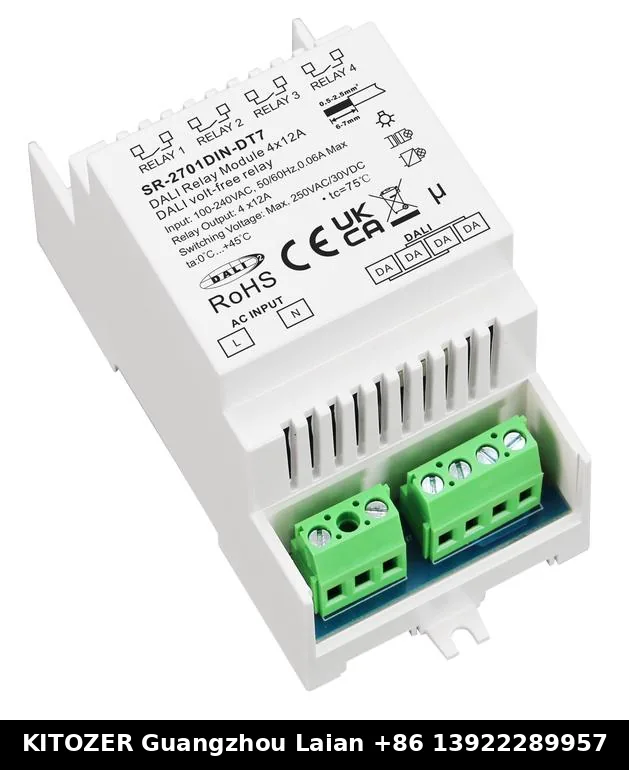
1. Product Overview
The KITOZER smart lighting control module is a series of controllers developed by Guangzhou Laian Intelligent System Development Co., Ltd. under the KITOZER brand for building lighting energy saving and intelligent management. The product family centers on relay switching, DALI digital dimming, and 0-10V analog dimming, connecting via RS485 (Modbus RTU) or BACnet to a lighting management system. It enables centralized switching, group control, timed scenes, dimming, and status feedback for luminaires. KITOZER smart lighting control modules are widely used in office buildings, commercial complexes, hotels, hospitals, schools, data center rooms, underground garages, stadiums, and road tunnels.
Traditional lighting control relies on manual switches and simple time clocks, which is crude, energy-wasteful, hard to fault-find, and fragmented. The KITOZER module brings every lighting circuit under management: operators can view circuit status, switch remotely, recall scenes (work, lunch, cleaning, night), run time schedules, and dim by daylight or occupancy. Energy savings of 20% to 50% are typical, while luminaire life extends and maintenance labor falls.
The product family covers relay switching modules (multi-channel relay outputs directly switching circuits), DALI dimming modules (DALI bus digitally addressing and dimming DALI luminaires), 0-10V dimming modules (analog brightness to dimming drivers), and hybrid modules (relay plus dimming channels), plus models with dry-contact inputs for occupancy and daylight sensors. Modules DIN-rail mount inside lighting distribution panels, compact enough for retrofitting.
KITOZER modules are industrial grade: branded relays with ample contact rating, a stable microprocessor with power-fail memory and offline schedules, optically isolated communication for the noisy building environment, and EMC compliance. KITOZER provides a complete solution from modules, sensors, and panels to lighting management software for one-stop procurement.
This product is developed and manufactured by Guangzhou Laian Intelligent System Development Co., Ltd., located in Chaotian Park, Zhongrun Industrial Zone, Huashan Road, Shilou Town, Panyu District, Guangzhou. KITOZER modules have been applied in thousands of projects. Users with selection or use questions can contact technical support by phone, WeChat, or WhatsApp.
2. Working Principle
The KITOZER smart lighting control module is built around a microprocessor plus relay/dimming outputs. The microprocessor receives commands (switch, dim, scene, schedule) over RS485 or BACnet and drives outputs accordingly: the relay module energizes a coil to close contacts and switch the luminaire circuit; the DALI module sends digital dimming commands over the DALI bus to DALI drivers; the 0-10V module outputs 0 to 10 volts to dim drivers. At the same time, the module reads back output status and reports it to the host.
2.1 Relay Switching Principle
A relay is an electromagnetic switch. When the microprocessor drives a transistor, the transistor energizes the relay coil, the magnetic field closes the contacts, and the luminaire circuit turns on. When drive is removed, the contacts open under spring force and the light turns off. KITOZER relay contacts are rated 16A or 20A, directly driving normal lighting circuits. For high-power circuits, the module drives an intermediate relay or contactor. Because LED and fluorescent loads are inductive with high inrush, contactors and RC snubbers protect contacts.
2.2 DALI Digital Dimming
DALI (Digital Addressable Lighting Interface) is the international standard for digital lighting dimming. The KITOZER DALI module acts as DALI master, powering and commanding DALI drivers over a two-wire bus. Each DALI luminaire gets a short address (0-63); the module controls one luminaire individually or groups (up to 16) and scenes (up to 16). DALI dimming is 8-bit (256 levels), bidirectional (drivers report status and faults), and the mainstream for mid-to-high-end smart lighting. A KITOZER DALI bus supports up to 64 DALI luminaires.
2.3 0-10V Analog Dimming
0-10V is a traditional analog dimming protocol. The module outputs 0 to 10 volts to the driver dimming interface; 0V is off or minimum, 10V is full brightness. Wiring is simple and compatibility broad, but it is one-way with no status feedback, and parallel loads need enough drive current. KITOZER 0-10V channels match common LED drivers and electronic ballasts.
2.4 Communication and Scenes
The module connects to a lighting host via RS485 Modbus RTU or BACnet MS/TP. The host software holds schedules, scene tables, and holiday calendars. Even offline, the module runs stored local schedules. A scene simultaneously switches and dims multiple circuits; one touch or an automatic trigger recalls work, lunch, or night modes.
3. Technical Parameters
| Parameter | 12-ch Relay | 8-ch DALI | 6-ch 0-10V | Hybrid |
|---|---|---|---|---|
| Output type | Relay switch | DALI bus | 0-10V analog | Relay+dimming |
| Channels | 12 | 1 DALI bus | 6 | 6 relay+4 dim |
| Per-channel rating | 16A/250VAC | 64 lamps/bus | 100mA/ch | 16A+10V |
| Dimming resolution | None | 8-bit 256 | 8-bit | 256 |
| Protocol | Modbus RTU | Modbus RTU | Modbus RTU | Modbus/BACnet |
| Power supply | DC12-24V/AC220V | AC220V | AC220V | AC220V |
| Dry inputs | 4 | 4 | 4 | 8 |
| Schedules | Yes | Yes | Yes | Yes |
| Scenes | 16 | 16 | 16 | 32 |
| Mounting | DIN rail | DIN rail | DIN rail | DIN rail |
| Operating temp | -10 to +60 C | -10 to +60 C | -10 to +60 C | -10 to +60 C |
| Protection | IP20 (panel) | IP20 (panel) | IP20 (panel) | IP20 (panel) |
KITOZER can customize channel count, dimming protocol, and communication interface. Modules support local auto/manual switching: auto mode under system control, manual mode via panel or mechanical override for maintenance.
4. Selection Guide
4.1 Step 1: Define Loads
Count lighting circuits, load type (LED, fluorescent, metal halide, panel), and per-circuit power. If only switching is needed, choose a relay module. If dimming is needed and luminaires support DALI, choose DALI. If luminaires only support 0-10V, choose 0-10V. For mixed needs, choose a hybrid module.
4.2 Step 2: Channel Count
Select channels by actual circuits plus 20% spare. A 12-channel relay suits small/medium zones; large floors parallel multiple modules. DALI modules are selected by total lamp count (64 per bus), with DALI bus amplifiers beyond that.
4.3 Step 3: Communication
For an existing building automation system, confirm Modbus RTU or BACnet MS/TP; KITOZER supports both. Standalone projects can use KITOZER lighting software or cloud platform.
4.4 Step 4: Sensors
Garages, corridors, and restrooms benefit from occupancy plus daylight sensors; offices from schedules and scenes. KITOZER dry-contact inputs connect sensors and panels.
4.5 Step 5: Budget
KITOZER smart lighting control module reference price is 1500 to 8000 RMB, varying by channels, dimming type, and protocol. A 12-channel relay is about 1500-2500 RMB; a DALI dimming module about 3000-5000 RMB; a 0-10V module about 2000-4000 RMB; a hybrid module about 4000-8000 RMB. Bulk projects get tiered pricing.
5. Installation Requirements
5.1 Module Mounting
KITOZER modules DIN-rail mount inside the lighting distribution panel, in a ventilated position away from heat sources. Power, communication, load, and sensor cables run in separate trays. Each output connects to its luminaire circuit within the contact rating.
5.2 Relay Wiring
Relay input (line side) connects to phase; output side to luminaire. Neutral is common. High-power loads beyond contact rating switch via an AC contactor. Match total power to breakers when paralleling modules.
5.3 DALI Wiring
The DALI two-wire bus is polarity-free; the module DALI terminals parallel all DALI drivers. Bus length is up to 300m, separate from mains.
5.4 0-10V Wiring
0-10V outputs connect to driver dimming terminals (DIM+, DIM-). Parallel lamps on one channel within drive capability.
5.5 Communication
RS485 daisy-chains A to A and B to B, shield grounded at one end. Set a unique address and baud rate. After power-up, scan on the host to confirm all modules online.
6. Use and Maintenance
KITOZER modules run continuously. Maintenance includes: checking luminaire status on the host and reporting offline faults; monthly inspection of module indicators and communication; annual terminal tightening; cleaning sensors. Common faults: a relay channel not acting indicates load, contacts, or breaker; communication failure indicates address, baud rate, or wiring; DALI not dimming indicates bus or short address; 0-10V not dimming indicates output voltage or driver interface. Modules support local manual override for maintenance.
7. Frequently Asked Questions (FAQ)
Each relay is 16A, about 3500W resistive at 220V. Derate 50% for LED inrush; use a contactor for high power.
Yes. A KITOZER DALI bus supports up to 64 DALI lamps with grouping and scenes.
Yes. A 6-channel 0-10V module fits common LED drivers and electronic ballasts.
Yes. Non-volatile storage runs local schedules after power returns.
Yes. Modbus RTU and BACnet MS/TP, with a register map provided.
On the host configure scene tables (work, lunch, night); one touch or a schedule triggers simultaneous switching and dimming.
Yes. Dry inputs connect PIR or microwave sensors for auto linkage.
DIN rail inside the lighting distribution panel, IP20 indoor.
With schedules, scenes, dimming, and sensors, typically 20% to 50%.
One year for the whole unit.
Multiple modules network over RS485, controlling hundreds to thousands of circuits.
With the optional KITOZER cloud platform, remote phone and web control.
8. Application Scenarios
8.1 Office Buildings
KITOZER modules switch public lighting by the work schedule, dim offices by scene, keep night lights, and cut energy use.
8.2 Underground Garages
Garage lighting combines microwave occupancy: full bright when cars or people are present, dim or off when empty, saving over 50%.
8.3 Data Center Rooms
Room lighting joins the environment system: low bright normally, full bright during inspection, full bright in emergency, remotely switched and interlocked with access control and air conditioning.
8.4 Hotels and Retail
Hotel lobbies, corridors, and dining dim by time and scene; retail atriums switch lighting moods by business scene.
9. The Value of Smart Lighting and How It Saves Energy
Lighting accounts for 20% to 40% of energy use in public buildings. Traditional lighting, with lights left on after hours, entire floors fully bright during the day, and no dimming, wastes enormous energy. The KITOZER smart lighting control module implements the principle of light only where and when it is needed, at the right brightness. Savings come from several mechanisms: scheduled control switches lights on and off by workday, weekend, and holiday calendars, eliminating forgotten lights; scene control combines lighting into presets, avoiding unnecessary full brightness; dimming uses available daylight to dim artificial light; occupancy control in corridors, garages, and restrooms turns lights on when present and off or dim when empty; and status monitoring reveals broken lamps and abnormal energy use. Beyond energy savings, smart lighting improves lighting quality and management efficiency, extends lamp life, and reduces patrol labor.
The return on investment is typically two to three years. A medium office building might spend tens of thousands of RMB a year on lighting; smart control cuts 20% to 50% of that while improving comfort. KITOZER can help model savings based on actual load, schedules, and electricity price.
10. Relay, DALI, and 0-10V Compared
Relay switching is the simplest and most reliable: a lamp is either fully on or off, the circuit is simple, low cost, and universally compatible. It cannot dim and frequent switching affects lamp life. It suits areas that only need scheduled or switched control, such as corridors, garages, and warehouses. DALI is the mainstream digital dimming solution: a two-wire bus addresses each lamp individually, with grouping, scenes, bidirectional status and fault reporting, smooth 256-level dimming, and individual control. It requires DALI-compatible drivers and slightly higher lamp cost, and commissioning involves addressing. It suits offices, hotels, retail, and stadiums where lighting quality and management matter. 0-10V is analog dimming: simple wiring, moderate cost, broad compatibility, but one-way with no status feedback and limited parallel drive. It suits retrofits and moderate dimming needs. KITOZER hybrid modules let a project freely mix switching and dimming on different loads.
11. System Architecture
A typical KITOZER smart lighting system has three layers: device layer (modules, sensors, panels), network layer (RS485/BACnet bus and gateway), and management layer (lighting software or cloud). Modules in floor distribution panels daisy-chain over RS485 to a floor gateway, which connects over Ethernet to the building LAN or internet and uploads to a management server running lighting software with graphical monitoring, schedules, scenes, energy reports, and alarms. For small sites, the gateway can run schedules and scenes locally without a server. For large sites, multiple gateways partition the building and a server centralizes monitoring. The architecture is open and integrates with building automation, fire, access, and energy systems.
12. Schedules and Holiday Calendar
Scheduling is the most common smart lighting function. KITOZER modules support separate workday, weekend, and holiday calendars. For an office: workdays turn on public lighting at 7 a.m., dim corridors at 7 p.m., and turn off most lights at 10 p.m.; weekends keep only security lighting; a holiday calendar applies weekend mode throughout the year. Schedules are stored locally on the module and run even if the host is offline. The software supports editing timetables, temporary overrides that auto-resume, and sunrise/sunset adjustment by latitude and longitude, so lights follow the seasons.
13. Scene Control
A scene packages the switching and dimming of multiple circuits into one preset, recalled by a panel key, schedule, occupancy, host command, or fire signal. Typical office scenes: Work (offices and corridors full bright), Lunch (offices dimmed 50%, corridors steady), Meeting (table lamps on, perimeter dimmed), Cleaning (full bright), Night (security and duty lights only). KITOZER supports 16 scenes per zone, and combining zones gives richer presets. In hotels and retail, scenes create lighting moods for dinner, daily, cleaning, and late-night modes.
14. Occupancy and Daylight Linkage
In garages, corridors, restrooms, and stairwells, occupancy is the key to savings. KITOZER dry inputs connect PIR or microwave sensors: when someone is present, the zone goes full bright; after they leave, a delay (1 to 15 minutes) dims or turns off. Combined with a daylight sensor, areas with enough natural light do not over-brighten even when occupied; light is added only when daylight is insufficient. This on-demand lighting saves 50% or more in garages. Delay and sensitivity should be tuned per site; KITOZER suggests 1 to 3 minutes for garages, 3 to 5 for corridors, and 5 for restrooms.
15. Underground Garage Application
The underground garage is the classic smart lighting saving case. Traditional garages run all lights 24 hours a day. The KITOZER solution uses LED luminaires with 0-10V or DALI dimming plus microwave radar: at rest, lamps sit at low bright (10% to 20%) or nearly off; when a vehicle or person enters the sensing zone, lamps instantly fade to full bright; after the vehicle leaves, a delay restores low bright. Zones follow lanes so one sensor controls a section, avoiding whole-floor activation. Combined with entrance daylight, the system dims interior lamps by day. This vehicle-adaptive lighting saves over 60% compared with 24-hour full bright while keeping safe base lighting.
16. Data Center Room Application
Data center lighting has special needs: low bright normally, full bright during inspection, full bright in emergency, and remote control. KITOZER modules join the environment system: normal mode dims cabinet aisles; inspectors press a panel or phone for full bright; fire alarms or emergency buttons trigger full evacuation lighting; access control turns lights on when someone enters and off after a delay. Keeping room lighting off also reduces heat load on air conditioning. Modules are quiet, isolated, and installed outside the room to avoid EMI on IT equipment.
17. Hardware Design Features
KITOZER smart lighting control modules are designed around reliability, compactness, and expandability. The microprocessor is industrial grade with a watchdog that auto-resets if the program hangs, ensuring years of continuous operation. Relays are branded, with ample mechanical and electrical life and silver-alloy contacts resistant to arcing. Output circuits add RC snubbers and varistors to suppress spikes from inductive loads, protecting contacts and luminaires. Communication is optically isolated, separating heavy load from low-voltage signal and preventing ground loops and surges. Power supplies are wide-voltage (DC12-24V or AC220V). Modules use standard DIN-rail enclosures with modular channel counts for compact panel mounting. Each channel has a status LED, plus communication and power LEDs; local manual override switches allow maintenance without a computer. Non-volatile memory keeps schedules, scenes, and addresses through power loss. These hardware traits make KITOZER modules stable in the noisy building environment.
18. Communication Protocols in Depth
KITOZER modules support Modbus RTU and BACnet MS/TP. Modbus RTU is the most universal industrial serial protocol; KITOZER modules act as Modbus slaves, and the host polls them. Users read registers (channel status, current, fault) and write registers (switch, dim, trigger scene). KITOZER provides a register map so customers can build their own software or integrate third-party systems. BACnet MS/TP is the building automation standard; KITOZER modules present BACnet objects (binary and analog outputs) to the BA platform alongside HVAC, plumbing, elevators, and security. Communication parameters (baud rate, data, stop, parity) are configurable, defaulting to 9600, 8, 1, none. The RS485 bus is daisy-chained up to 1200 meters and 32 nodes, with repeaters beyond. KITOZER also offers an Ethernet gateway that converts RS485 to Ethernet for LAN or cloud access. The open protocol means KITOZER modules are not tied to any particular platform.
19. Energy Saving Calculation
Consider an office building with 10 kW of public lighting. Traditional 24-hour full bright consumes about 87,600 kWh a year (10 x 24 x 365). With smart control by schedule (about 15 hours) plus night dimming and weekend holiday mode, the equivalent full-bright hours drop to about 8, reducing annual use to about 29,200 kWh, saving roughly 58,000 kWh a year. At 1 RMB/kWh, that is 58,000 RMB saved annually. A smart lighting system for a medium room costs tens of thousands of RMB, paying back in two to three years. Garage occupancy savings are even higher. KITOZER can model savings from actual load, schedule, and tariff.
20. Installation and Commissioning Workflow
The standard workflow is: verify panel space and circuits; DIN-rail mount the module and connect power (not energized yet); connect each luminaire circuit to relay outputs, with contactors for high power; wire the DALI or 0-10V bus; daisy-chain RS485; connect sensors, panels, and fire dry inputs; power up and observe self-test; set address and baud rate in software; scan the bus to confirm all modules online; test every channel switch and dimming; verify scenes, schedules, occupancy, and fire linkage; edit timetables, holidays, and scenes and download; train the owner and hand over documents. Common issues are duplicate addresses, reversed A/B, DALI over-lamp-count, 0-10V over-drive, and wrong NO/NC sensor settings. KITOZER provides commissioning guides and remote support.
21. Retrofit of Existing Buildings
Many existing buildings still use manual switching, and retrofitting smart lighting must avoid changing luminaires or finishing. KITOZER modules DIN-rail mount inside existing distribution panels and series into circuits. Choose relay modules for switching-only LED, or dimming modules if drivers support 0-10V/DALI. Sensors and panels are surface-mounted or wireless. Retrofit要点: survey existing circuits and loads; choose modules that fit panel space; stage pilots by zone; keep manual switches as fallback. KITOZER has rich retrofit experience and offers site surveys.
22. Relay Contact Rating and Load Matching
The most critical selection point is contact rating versus load. KITOZER relay contacts are rated 16A or 20A resistive. But LED and fluorescent loads are inductive with high inrush current, which can erode contacts. KITOZER recommends long-term load not exceed 50% to 60% of contact rating. For high-power circuits beyond contact rating, use an intermediate relay or AC contactor: the module contact drives the small coil, and the contactor main contacts carry the load. Designers calculate each luminaire’s total wattage, working current, and inrush, then choose contact rating and whether to add a contactor.
23. DALI System Design and Commissioning
DALI design: each bus supports up to 64 lamps, up to 300 meters, up to 250 mA. KITOZER DALI modules have a built-in bus power supply; when lamp count exceeds it, add a DALI bus power supply. Each DALI driver needs a short address (0-63), assigned by auto-search or manually. Luminaires are grouped (up to 16 groups) and brightness stored as scenes (up to 16). Commissioning verifies each lamp, grouping, and scenes. DALI’s bidirectional communication reports actual brightness, online status, and faults, which relay and 0-10V cannot. KITOZER provides DALI commissioning software and guidance.
24. 0-10V Design Points
0-10V design is simpler but has points: confirm the driver supports 0-10V dimming and whether 0V means off or minimum; keep the 0-10V signal wire separate from mains; parallel lamps on one channel within drive capability (typically 100 mA); 0-10V is one-way with no status feedback, so add current sensing if needed; set minimum output per driver manual.
25. Fire Emergency Relationship
Smart lighting must not interfere with fire emergency lighting. Emergency circuits are independent and force on during fire. KITOZER modules receive a fire dry contact and switch normal lighting per code while emergency lighting stays forced on. Designers coordinate with the fire system to ensure smart control never blocks evacuation lighting.
26. Energy Monitoring and Reports
Optional current sensing on KITOZER modules monitors per-circuit current and power, uploaded to the platform. The platform generates daily, monthly, and per-zone energy reports and trends, compares pre- and post-retrofit use, and quantifies savings. It flags abnormal current (aging LED drivers, leakage). Energy data supports ISO 50001 and green building audits.
27. Smart Panels and Local Operation
Although smart lighting can be remotely and automatically controlled, local operators still need manual means. KITOZER modules support wall panels via dry contacts: scene panels recall work, lunch, and night modes; dimming knobs adjust brightness locally; switch keys force on or off. Panels connect to module inputs and trigger presets. In a meeting room, presenters press a projection scene to dim lights and close curtains without calling the control room. Modules also support auto/manual switching: in auto mode the system runs strategies, while in manual mode panels or local keys force control during maintenance. This automatic-first, manual-backup design is both energy efficient and flexible.
28. Hotel and Commercial Applications
Hotels and retail demand lighting atmosphere. Hotel lobbies need welcome, daily, cleaning, and late-night scenes; guest rooms switch on lights when the key card is inserted and dim after removal; corridors and elevator halls dim by time. Retail atriums and stores switch lighting moods by business hours, holidays, and promotions. KITOZER DALI or 0-10V dimming modules produce smooth dimming for a comfortable environment, combined with scene panels and schedules. Hotel projects also link lighting with air conditioning, curtains, and key-card systems; KITOZER modules can join the room control unit as the lighting driver. Commercial projects centrally monitor building lighting energy and status.
29. School and Hospital Applications
Classroom lighting switches by the school schedule and dims between periods; libraries and labs combine occupancy with daylight compensation. Hospital wards adjust brightness by time (bright by day, night-light mode at night), corridors and stairwells use occupancy, and operating rooms switch by scene. Both schools and hospitals require energy savings and lighting quality; KITOZER modules provide schedules, occupancy, dimming, and scenes.
30. Stadiums and Exhibition Halls
Stadiums and exhibition halls have complex lighting scenes: competition, training, cleaning, spectator entry, and performance. KITOZER DALI modules zone-dim thousands of lamps and switch scenes with one touch. Stadium lighting also links with broadcasting and scoreboards. Tunnel and road lighting adjusts brightness by traffic flow and natural light, with entrance transition lighting.
31. Factory and Warehouse Applications
Factory floor lighting switches by production shifts, turning off most lights during breaks; high-bay warehouse aisles use occupancy. KITOZER modules schedule by shift and sense empty areas. Industrial-grade modules suit the factory environment.
32. Design Mistakes to Avoid
Common design mistakes include: circuits too coarse (one circuit controls a whole floor, preventing zoning); no spare channels; DALI bus over 64 lamps or over 300 meters; occupancy zones mismatched to circuits; not specifying dimming protocol in the luminaire tender; monitoring without energy measurement; only on/off two-state without dimming or occupancy; and no offline operation. KITOZER avoids these at the design stage.
33. Wiring Craftsmanship
Good wiring ensures reliability. Power, communication, load, and sensor cables run in separate trays. Relay outputs connect to luminaire circuits through breakers; high-power loads use contactors. DALI is polarity-free and parallel, up to 300 meters. 0-10V wires are shielded and separated from mains. RS485 is daisy-chained A to A, B to B, shield grounded at one end. Dry inputs match NO/NC. Every circuit is labeled. After wiring, verify with a multimeter before energizing.
34. Fault Diagnosis
Faults are diagnosed layer by layer. Power: is the module power LED on; check supply and breaker. Communication: is the comm LED blinking; can the host scan the module; check address, baud, A/B polarity, shield, bus length. Output: a relay channel not acting; check command, module status, contacts, load, breaker; measure output continuity. Dimming: DALI not dimming; check bus, short address, driver; 0-10V not dimming; measure output voltage and DIM wires. Input: occupancy or panel not triggering; check dry wiring, NO/NC, sensor supply. KITOZER platforms show per-channel status and current to localize faults.
35. Reliability and Redundancy
A concern with smart lighting is that a system failure might kill the lights. KITOZER design prevents this: modules run local schedules offline when the host fails; local manual override allows control during faults; fire emergency circuits are independent and force on; key circuits can have mechanical bypass. Thus even if the smart system fails, lighting still works, rather than being paralyzed. Reliability is a prerequisite for smart lighting adoption.
36. Network Security
As lighting connects to networks, security matters. KITOZER gateways support changing default passwords, avoiding direct internet exposure, using VPN or private networks, restricting platform access, and firmware updates. Pure RS485 offline systems carry the lowest risk. KITOZER cloud platforms use encrypted transport, login authentication, and operation logs.
37. Product Series Overview
The KITOZER family covers relay, DALI, 0-10V, and hybrid modules. Quick selection: switching-only areas choose the 12-channel relay (1500-2500 RMB); dimming with DALI luminaires choose DALI (3000-5000 RMB, up to 64 lamps per bus); 0-10V drivers choose 0-10V (2000-4000 RMB, 6 channels); mixed needs choose hybrid (4000-8000 RMB). Accessories include occupancy sensors (PIR 100-300 RMB, microwave 200-500 RMB), daylight sensors (200-500 RMB), scene panels (200-1000 RMB), and gateways (1000-3000 RMB). KITOZER also customizes channel count, protocol, and housing.
38. Comparison with Traditional Switching
Traditional lighting control relies on wall switches or simple time clocks. Its weaknesses are obvious: switches require manual operation, so lights are easily left on; time clocks can only do simple on/off and cannot adapt to schedules, holidays, or dimming; status is not known, so broken lamps are found only by user complaints; energy use is invisible, with no management data; and one switch controls only one zone, with no grouping or scenes. The KITOZER smart module solves these: centralized monitoring of every circuit, remote and automatic control, flexible schedules and scenes, smooth dimming, occupancy and daylight linkage, per-circuit energy metering, and fault alarms. The gap in management granularity, energy saving, and maintenance efficiency is significant, which is why more buildings now choose smart lighting.
39. Selection by Lighting Type
Selection depends on the luminaire and its driver. LED panels and downlights in offices usually use 0-10V or DALI drivers; choose the matching dimming module. Warehouses and garages with LED high bays often use on/off or 0-10V dimming for adaptive control. Metal halide and high-pressure sodium lamps require warm-up and cannot dim continuously, so relay switching is used. Fluorescent tubes with electronic ballasts support 0-10V or DALI. KITOZER recommends confirming the dimming interface in the luminaire tender; otherwise dimming cannot be added later. Hybrid modules handle mixed loads on one project.
40. Typical Configuration List
A medium office floor example: 20 circuits of public and office lighting, 2 sets of 12-channel relay modules, 1 set of 6-channel 0-10V dimming for perimeter offices, 5 microwave/PIR sensors, 2 daylight sensors, 3 scene panels, 1 RS485/Ethernet gateway, and lighting software. Reference total about 15,000 to 30,000 RMB. A garage example: LED luminaires with 0-10V, per-lane dimming modules, radar sensors, and a gateway, saving over 60%. KITOZER provides a tailored list from drawings and load schedules.
41. Commissioning and Training
After installation, KITOZER commissioning includes: verifying module online status, testing channel switching and dimming, configuring scenes and schedules, tuning occupancy sensitivity and delay, and testing fire linkage. Training covers platform monitoring, remote switching and dimming, editing schedules and scenes, adjusting sensors, and basic fault handling. KITOZER supplies operation manuals and parameter tables.
42. Spare Parts and Warranty
KITOZER modules are 100% tested before delivery: appearance, power-on self-test, relay action, communication, dimming, inputs, insulation, and aging. The unit carries a one-year warranty from date of sale; non-human damage is repaired or replaced free. KITOZER keeps spare relays and boards for long-term service.
43. Standards and Compliance
KITOZER modules comply with low-voltage and EMC standards. They carry CE-compliant design and are tested for surge, electrostatic discharge, and fast transient. They suit export and domestic projects. Technical documents include specification, wiring, register tables, and installation manual.
44. Software Features
KITOZER lighting software provides: a floor plan view showing every circuit’s on/off and brightness; remote switching and dimming; schedule and scene editing; energy reports and trends; alarm logs; user permission management; and optional cloud access for phone and web. It can integrate with building automation, energy, and fire platforms via open protocols.
45. Cloud vs Local
Two deployment options. A local server suits large or sensitive sites: data stays on the LAN, schedules run locally, and the platform monitors all zones. A cloud platform suits small sites and multi-site chains: no on-site server, phone and web access, remote diagnosis, and easy expansion. KITOZER gateways support both, configurable per project.
46. Lighting Comfort and Productivity
Beyond saving energy, smart lighting improves comfort. Daylight compensation keeps desk illumination stable, avoiding glare and dimness. Smooth dimming avoids harsh transitions. Tunable color temperature in work areas supports alertness by day and calm by evening. Good lighting improves concentration and reduces fatigue, which is why office, school, and hospital projects increasingly adopt smart dimming.
47. Outdoor and Landscape Lighting
Outdoor landscape and facade lighting switches by astronomical clock (sunrise/sunset) rather than fixed time, adjusting with seasons. KITOZER modules support astronomical scheduling and grouping of landscape zones, with holiday scenes. Street and tunnel lighting dims by traffic and natural light.
48. Retrofit Cost and Savings Case
A case study: an office building with 20 kW public lighting, partly on 24 hours. After installing KITOZER relay + 0-10V dimming modules with schedules, scenes, and occupancy, measured annual use dropped from about 175,000 kWh to about 95,000 kWh, saving 80,000 kWh, or about 80,000 RMB a year. The system cost about 150,000 RMB, paying back under two years. Garage cases save over 60%. KITOZER can model a similar case for your project.
49. Delivery and Lead Time
KITOZER modules are in stock for standard models; custom configurations need about one to two weeks. Shipping is by express or freight. KITOZER provides the product, sensors, panels, gateway, software, and remote guidance as one package.
50. Why Choose KITOZER
KITOZER is the smart lighting brand of Guangzhou Laian Intelligent System Development Co., Ltd., which has long focused on smart lighting, environment monitoring, and sensors. Strengths: complete product line (relay, DALI, 0-10V, hybrid, sensors, panels, gateway, software); open protocols (Modbus, BACnet) avoiding lock-in; industrial-grade reliability; reference prices in the 1500-8000 RMB range; and local technical support with quick response. KITOZER serves new construction and retrofits across office, garage, hotel, hospital, school, data center, and factory projects.
51. Understanding DALI in Depth
DALI stands for Digital Addressable Lighting Interface, an international standard defined by IEC 62386. It is a two-wire bus that carries both power and data to dimmable drivers, removing the need for separate analog dimming wiring. Each DALI device (driver or sensor) has a unique short address assigned during commissioning, so a controller can address one lamp individually or a group. DALI commands include on/off, up/down, fade to a level, recall a scene, and query status. Dimming resolution is 8-bit, giving 256 levels, and the fade time is adjustable so transitions are smooth rather than abrupt. Because DALI is bidirectional, the controller can read back actual brightness, lamp on/off status, and even fault conditions such as a broken lamp or shorted bus. This makes DALI the preferred choice for projects where lighting quality, group control, and diagnostics matter, such as offices, hotels, retail, and stadiums. KITOZER DALI modules act as DALI masters, powering the bus and managing up to 64 devices per bus, with groups of up to 16 and scenes of up to 16 per controller.
DALI design limits should be observed: one bus supports up to 64 devices, a bus length of about 300 meters, and a total bus current of about 250 mA. If a project exceeds these, a DALI bus power supply or a second bus is added. Commissioning involves auto-discovering devices, assigning addresses, grouping luminaires by area, and storing brightness levels as scenes. KITOZER software automates most of this and guides integrators through verification.
52. Understanding 0-10V Dimming in Depth
0-10V is the older analog dimming standard. A controller outputs a voltage between 0 and 10 volts to a dimming driver: 10 V corresponds to full brightness, and 0 V (or a defined minimum) corresponds to off or dimmest. Wiring is straightforward, and many LED drivers and electronic ballasts accept it. However, 0-10V is one-way: the controller cannot tell whether the lamp is actually on or at the right brightness. Parallel lamps on one dimmer channel share the output, so the total sink/source current must stay within the module’s drive capability (typically 100 mA per channel). The signal wire should be shielded and run separately from mains to avoid hum and flicker. KITOZER 0-10V dimming modules are a cost-effective choice for retrofits and projects that do not require DALI diagnostics.
53. Understanding Relay Switching in Depth
A relay is an electromagnetic switch. The KITOZER module’s microprocessor drives a small transistor that energizes the relay coil; the magnetic field pulls the contacts together, closing the luminaire circuit. When drive is removed, a spring opens the contacts and the light turns off. Because relay contacts are physically separated from the control circuit, they provide good isolation and can directly switch mains loads. KITOZER uses branded relays with silver-alloy contacts rated for 16 A or 20 A. Inductive loads such as LED drivers and fluorescent ballasts draw high inrush current and generate voltage spikes when contacts open, so KITOZER adds RC snubbers and varistors across contacts to suppress arcing and extend relay life. Designers should keep long-term load to about 50 percent of contact rating and use an AC contactor for loads beyond rating.
54. RS485, Modbus, and BACnet in Depth
Modules communicate over RS485, a robust differential serial bus suited to noisy building environments. RS485 is daisy-chained: module A connects to the next module’s A, and B to B, with a 120-ohm terminator at the far end. A bus can run up to 1200 meters and support up to 32 nodes; more nodes or longer runs use repeaters. The cable should be shielded twisted pair, grounded at one end. Two protocols run on top: Modbus RTU is the universal industrial protocol, with KITOZER modules acting as slaves; the host reads registers for status and writes registers for commands. KITOZER supplies a register map so customers can integrate their own software. BACnet MS/TP is the building automation standard, presenting modules as BACnet objects to a BA platform that also manages HVAC, plumbing, elevators, and security. KITOZER supports both, with baud rate and address configurable.
55. Sensor Types and Applications
Occupancy sensors are the other half of smart lighting. Passive infrared (PIR) sensors detect body heat motion, are low cost, but require line of sight and can miss stationary people. Microwave radar sensors detect motion through walls and under dense ceilings, cover larger areas, and are the standard for garages and high-bay warehouses. Ultrasonic sensors fill small spaces but are sensitive to air movement. Daylight sensors measure ambient lux and dim artificial light when daylight is sufficient. KITOZER dry-contact inputs connect these sensors; when a sensor triggers, the module turns lights full bright, and after a programmable delay it dims or turns them off. Tuning sensitivity and delay per zone is essential to avoid both false triggers and dark gaps.
56. Underground Garage Adaptive Lighting in Detail
Underground garages are the single best place to apply smart lighting, because traditional garages leave every light on around the clock. A KITOZER garage solution combines dimmable LED luminaires with microwave radar. At rest, lamps hold a low bright level of roughly 10 to 20 percent, enough for safe navigation but far from full power. When a vehicle or pedestrian enters a sensing zone, the radar triggers the lamps in that zone to fade up to full brightness within about a second; as the vehicle moves, successive zones light ahead and dim behind. After the vehicle leaves, a delay of one to three minutes restores low bright. Entrances and exits add daylight compensation, dimming interior lamps during the day when natural light floods in. The result is that a 24-hour lit garage becomes largely dark at rest with full bright only where traffic currently exists, typically cutting lighting energy by over 60 percent while maintaining safety. KITOZER recommends zoning lamps by lane rather than by floor, tuning radar angle and height to avoid cross-lane false triggers, and staging a pilot section before rolling out.
57. Office Floor Control Strategy
Office floors use a layered strategy. Public circulation (corridors, restrooms, stairwells) uses occupancy plus schedule: lights dim when unoccupied and follow a night schedule. Open-plan offices use schedules and scenes: full bright at work start, dim lunch, low bright after hours, and only security lights overnight. Perimeter desks use daylight compensation: a daylight sensor near windows measures desk lux and dims perimeter luminaires on bright days while boosting interior ones, keeping illumination even and saving energy. Meeting rooms use a panel: one key recalls work, projection, or cleaning scenes, and lights turn off automatically after the room sits empty. Schedules follow a holiday calendar, switching to weekend/night mode on non-work days. KITOZER software makes these strategies visual and easy to adjust.
58. Meeting Room and Scene Panels
Meeting room lighting should adapt to activity. KITOZER scene panels let a presenter choose scenes: Work (table full bright, perimeter on), Projection (table dim, perimeter off, screen area dark), Cleaning (full bright), and Closed (lights off). The panel connects to a module dry input and triggers a stored scene table. Sensors turn lights off after a meeting ends if the room sits empty. A small panel per meeting room removes the need to call the control room.
59. Data Center Lighting Integration
In a data center, lighting is part of the environment monitoring system. KITOZER modules connect to the environment host via RS485. Normal mode keeps aisle lights low bright; during inspection, operators use a panel or phone to call full bright; fire alarms and emergency buttons force full evacuation lighting; access control turns lights on when someone swipes in and off after a delay; and air conditioning interlocks ensure lighting aligns with cooling schedules. Keeping lights off also reduces heat load on CRAC units. Modules must be installed outside the equipment room and communication isolated to avoid EMI on IT gear.
60. Hotel Lighting Integration
Hotel lighting combines atmosphere and energy saving. Public areas (lobby, corridor, restaurant) use time-based scenes and dimming. Guest rooms link to the room control unit: inserting the key card wakes lights to a welcome scene; removing it switches lights off after a short delay. KITOZER dimming modules drive scene changes smoothly. Hotel projects also tie lighting with curtains and air conditioning. KITOZER modules accept BACnet to join a hotel management platform.
61. Energy Reports and Management
With optional current sensing, KITOZER modules measure real power per circuit. The platform aggregates energy by floor, zone, and time, generates daily/monthly reports and trend charts, compares pre- and post-retrofit use, and exports data. Abnormal current (a failing LED driver, leakage) triggers an alarm. This data supports energy management, green building certifications, and cost allocation among tenants. Energy visibility turns lighting from an invisible utility into a managed asset.
62. Scalability and Multi-Site
For chains and multi-site owners, KITOZER cloud platforms centralize monitoring across buildings: an owner can view every site’s lighting status, energy use, and alarms on one dashboard, update schedules remotely, and roll out a scene template to many sites. Local operation continues even if cloud connectivity drops, so reliability is preserved.
63. Environmental and Health Benefits
Smart lighting reduces carbon emissions along with energy. Stable illumination from daylight compensation reduces eye strain and fatigue; tunable white supports circadian needs (cool bright by day, warm dim by evening). Lower heat from dimmed lights improves comfort. These benefits matter for offices, schools, hospitals, and senior living.
64. Installation Safety and Standards
Retrofit work is on live mains; installers must be licensed, lockout/tagout, and verify no voltage before wiring. Communication wires run separate from power. Panels keep adequate clearance. Modules are IP20 for indoor panel mounting, not suitable for wet locations without enclosures. KITOZER wiring guides and labels help inspectors approve.
65. Project Documentation
Handover documents include as-built drawings, module address table, schedule table, scene table, commissioning test records, user manual, and certificates. KITOZER provides templates and config files. Good documentation eases future maintenance.
66. How to Choose Between Relay, DALI, and 0-10V
The choice comes down to what the luminaires support and how much control is needed. If the project only needs on/off by schedule or sensor, relay modules are the simplest and lowest cost; every LED or conventional luminaire works, no special driver required. If luminaires are specified with DALI drivers and the project wants individual lamp control, grouping, scenes, and status feedback, DALI is the right long-term choice, even though drivers cost a little more. If luminaires already have 0-10V dimming drivers and the project mainly needs smooth dimming without diagnostics, 0-10V is a pragmatic middle path. When a building mixes all three, KITOZER hybrid modules let one panel switch relays on some circuits and dim others. KITOZER recommends confirming the dimming interface at the luminaire tender stage; changing dimming protocol after lamps are installed is expensive or impossible.
67. Typical Project Configurations
Small office: one 12-channel relay module on public lighting, one gateway, basic schedule. Reference about 2500-3500 RMB. Medium office floor: two 12-channel relays, one 6-channel 0-10V dimming module, PIR/daylight sensors, scene panels, gateway, software. Reference about 15000-30000 RMB. Underground garage: dimming LED modules by lane, radar sensors, gateway, garage software. Reference scaled by lane count, saving over 60%. Data center: relay modules joining the environment host, access/fire interlock. Hotel: DALI modules for public areas and room control integration. Stadium: many DALI buses with scene presets. KITOZER produces a tailored list from drawings.
68. Wiring and Terminal Details
Relay terminals: line input on the common, load on normally open. Neutral is not switched by relay modules. Each output is protected by its own miniature breaker. For contactor-driven circuits, the module contact drives the coil with an RC snubber. DALI terminals are polarity-free; both DALI wires go to every driver. 0-10V terminals: DIM+ and DIM- to the driver dimming input. RS485: A (D+), B (D-), and shield. Dry inputs are NO/NC configurable. Power terminals follow the marked supply voltage. KITOZER terminals are clearly labeled and the manual gives a wiring diagram.
69. Address and Baud Configuration
Each module needs a unique RS485 address (1-247) and a common baud rate (default 9600, 8 data bits, 1 stop, no parity). Addresses are set by software or DIP switch. Duplicate addresses cause communication conflicts; mismatched baud causes no response. KITOZER recommends keeping an address table as-built. The gateway scans the bus to confirm every module is online before commissioning scenes.
70. Commissioning Steps in Order
Power up modules, confirm power and communication LEDs. Set addresses and baud. Scan and list all modules on the host. Test each relay channel switch and dimming channel level. Verify sensors trigger. Build zone groups. Edit scenes (work, lunch, night, cleaning) and download. Edit weekly schedules and holiday calendar. Tune occupancy delay and daylight threshold. Test fire emergency override. Walk through the building with operators. Hand over documents and train users. KITOZER provides remote commissioning support.
71. Common Problems and Solutions
Module power LED off: check supply voltage and breaker. Comm LED not blinking: check address, baud, A/B polarity, shield, bus length, termination. A relay channel not acting: check host command, module status LED, contacts, load breaker; measure output continuity. DALI lamp not dimming: check bus voltage, short address, driver, bus short. 0-10V not dimming: measure output voltage, DIM wiring, driver dimming setting. Occupancy not triggering: check dry input NO/NC, sensor supply, sensitivity. Schedule not running: check schedule downloaded, not in manual/override mode. Scene wrong: rebuild scene table and re-download. Remote offline: check gateway network and cloud connectivity. KITOZER platform status and current readings shorten diagnosis.
72. Maintenance Plan
Monthly: review platform alarms, verify offline modules, check sensor response. Quarterly: test a sample of circuits and scenes, clean daylight sensors. Annually: tighten terminals, inspect relays, update firmware, review energy reports and adjust schedules with occupancy patterns. Keep spare modules. KITOZER recommends a maintenance contract for large sites.
73. Software and Platform Screens
The KITOZER platform presents a floor plan with each circuit shown as a lamp icon (on/off/dim color). Clicking a circuit opens a control panel for switch, dim slider, and scene. A schedule calendar shows weekday templates. A scene editor drags circuits into presets. An energy dashboard shows kWh and savings. An alarm list shows faults. Permissions separate admin, operator, and viewer. Cloud access mirrors the same screens on phone and web.
74. Open Protocol and Integration
KITOZER modules do not lock users into a proprietary system. Modbus register maps and BACnet objects let a third-party BA, energy, or facility management platform control them. KITOZER also provides an HTTP/JSON gateway API for custom web and app integration. This openness protects the investment and fits multi-vendor building projects.
75. Customization and OEM
KITOZER can customize channel counts, dimming protocols, communication interfaces, enclosure size, and branding for large or repeat projects. Typical custom requests: more relay channels, built-in Ethernet, DIN-rail LCD, or specific BACnet objects. KITOZER engineering supports small custom runs.
76. Relays, Contactors, and Inrush Current
A subtle but important engineering point is inrush current. LED drivers and electronic ballasts draw a short high current when power is applied to charge internal capacitors, sometimes several times the steady current. A relay contact rated for 16 A might see 50 A or more inrush on first turn-on. Repeated inrush erodes contacts and can weld them closed. KITOZER mitigates this by using generously rated relays, RC snubbers and varistors across contacts, and by advising designers to keep steady load at 50 percent of rating and to use AC contactors for high-power circuits. Designers should ask luminaire suppliers for inrush data rather than assume steady current. When many LED circuits switch simultaneously, stagger switch-on on the schedule to limit peak load.
77. Dimming Compatibility with LED Drivers
Dimming quality depends on the driver. Cheap 0-10V drivers may flicker at low levels or have a narrow usable range; DALI drivers are generally smoother. KITOZER recommends testing a sample driver at minimum and maximum dimming before bulk purchase, and specifying dimming curve and minimum level in the tender. Drivers with no-load or thermal protection behave predictably. KITOZER modules output stable 0-10V or DALI levels, but a bad driver cannot be fixed by the controller.
78. Color Temperature and Tunable White
Some modern luminaires support tunable white (e.g., 2700K to 6500K) and RGBW scenes. DALI-2 and D4i drivers support color control. KITOZER modules can extend to color tuning where drivers support it, supporting circadian lighting: cool bright by day for alertness, warm dim in the evening for relaxation. This is a growing feature in offices, schools, and healthcare.
79. Astronomical Clock and Seasonal Adaptation
Fixed on/off times become wrong as days lengthen and shorten. An astronomical clock calculates sunrise and sunset from the building’s latitude and longitude, turning outdoor and corridor lights on before sunset and off after sunrise, with offsets for twilight. KITOZER software includes this so schedules follow the seasons without manual adjustment.
80. Temporary Override and Auto-Resume
Operators sometimes need to force lights on for cleaning or an event. KITOZER supports a temporary override: a manual command holds a state, then automatically returns to the normal schedule after a set period (e.g., two hours). This prevents lights being forgotten on after an override. The platform logs overrides for audit.
81. Lighting as Part of Building Automation
Lighting is one of many building subsystems. KITOZER modules via BACnet join HVAC, shading, access, and fire on one BA platform, enabling cross-subsystem scenarios: access control turns on lights when someone enters; HVAC sets unoccupied mode when lights are off; fire alarms force all lights on. This coordination improves comfort and efficiency beyond lighting alone.
82. Retrofit Without Replacing Luminaires
A common retrofit keeps existing LED panels and adds KITOZER relay modules in the panel for scheduling and remote control. Where existing luminaires lack dimming drivers, switching-only is still worthwhile; schedules and occupancy alone save 20 to 40 percent. Dimming can be added later when luminaires are due for replacement. KITOZER stages retrofits to balance cost and savings.
83. Pilot Rollout Strategy
For large buildings, KITOZER recommends a pilot: pick one floor or one garage zone, install, tune, measure savings over two to four weeks, then refine the strategy before rolling out. A pilot de-risks the project, proves savings, and trains operators. Typical pilot savings validate the business case.
84. Tenant Sub-metering and Cost Allocation
In multi-tenant buildings, lighting energy by zone can be sub-metered via KITOZER current sensing and allocated to tenants, incentivizing them to turn off lights. The platform exports reports for billing.
85. Security and Night Patrol
Night patrol lights: rather than full bright overnight, a schedule keeps security paths lit at low bright, and patrol triggers full bright along the route. This saves energy while ensuring safety.
86. Conference and Presentation Scenes
Meeting rooms: one key for Presentation (lights dim, curtains close, projector on), one for Brainstorming (bright, curtains open), one for Video Call (even face lighting). KITOZER scene panels recall these instantly, removing fumbling with switches.
87. Public Corridors and Restrooms
Corridors, stairwells, and restrooms are classic occupancy zones: PIR/microwave triggers full bright, delay 3-5 minutes, then dim/off. KITOZER sensors plus relay/dimming modules deliver the savings while keeping safe base lighting.
88. How Smart Lighting Works in Practice
Imagine an office building morning. At 6:30 a.m. the KITOZER gateway wakes public lighting to 50 percent. At 7:00 a.m. reception and corridor lights go full bright. At 8:00 a.m. open-plan offices reach work scene. Between 12:00 and 13:00, offices dim to lunch scene. At 18:00, as staff leave, corridors and offices drop to low bright; restrooms and stairwells rely on occupancy. At 22:00, only night security lights remain. On weekends and holidays the schedule applies. A cleaner pressing a panel triggers cleaning scene; after finishing, the schedule resumes. A sensor in an empty restroom keeps it dark unless someone enters. Every action is logged, and energy reports show savings. This is how KITOZER turns a dumb lighting grid into an adaptive, energy-aware system.
89. DALI vs 0-10V for Retrofit
Retrofit decisions often hinge on dimming. If existing LED drivers already have 0-10V, adding KITOZER 0-10V dimming modules is cheap and effective. If luminaires are near end of life, replacing with DALI drivers in one pass gives better long-term control. If no dimming is present, KITOZER relay modules still deliver scheduling and occupancy savings. KITOZER helps choose per zone.
90. Sensor Placement Best Practice
Microwave radar in garages mounts 3-4 m high, angled to cover a lane, avoiding facing opposite lanes to prevent false triggers. PIR in corridors mounts at 2-2.5 m in the path. Daylight sensors mount near windows facing the light source, shaded from direct sun. Each sensor’s zone must match its controlled circuits; mismatched zones either leave gaps or over-light. KITOZER provides layout guidance.
91. Scene Fade and Transition
Abrupt brightness changes are uncomfortable. KITOZER dimming scenes fade over 0.5 to 2 seconds, adjustable. Garage radar triggers fade up in about a second and down after delay, smooth rather than jarring. This improves perceived quality.
92. Emergency and Code Compliance
Smart lighting must not compromise egress. KITOZER modules accept a fire dry contact and per code switch normal lighting while independent emergency luminaires stay forced on. The smart system must never block emergency lighting. Designers coordinate with the fire engineer.
93. Battery Backup for Modules
Modules keep schedules in non-volatile memory; real-time clock may need a coin cell to keep time across outages. KITOZER modules include RTC backup. After power returns, schedules resume automatically. Critical sites can add an auxiliary supply.
94. Remote Diagnosis
KITOZER cloud gateways report module health, communication logs, and circuit current. KITOZER support can log in (with permission) to diagnose without a site visit, shortening downtime. This is valuable for multi-site chains.
95. Product Lifecycle and Obsolescence
KITOZER commits to long-term supply of modules and spare parts; even after redesign, legacy modules remain supportable. Customers are not forced to replace working equipment.
96. Export and International Projects
KITOZER modules support AC220V or DC24V per site, English software, and Modbus/BACnet for international building projects. Reference prices in RMB convert to USD/EUR for export. KITOZER ships globally.
97. Frequently Asked Questions Extended
Yes. Hybrid modules have relay channels and dimming channels on one DIN rail.
Modules keep running local schedules; lights are not paralyzed.
Yes, via Modbus register map or BACnet objects.
Up to 32 per RS485 bus; repeaters for more.
Yes with the cloud platform.
Yes, astronomical clock.
Yes, dry inputs connect existing switches or panels.
Small sites a day; large sites a few days plus training.
IP20, indoor panel mounting.
Yes with optional current sensing.
98. Office Daylight Compensation in Detail
Perimeter offices next to windows receive abundant daylight; keeping all luminaires at full bright wastes energy and causes glare. Daylight compensation uses a lux sensor near the window to measure desk illumination. When natural light is high, the KITOZER 0-10V or DALI module dims perimeter lamps; when clouds reduce light, it brightens them. Interior lamps stay steady. The result is stable desk lux year-round with lower energy use, often 10-30 percent on perimeter zones. The sensor should be positioned to measure actual work-plane light and avoid direct sun; KITOZER provides mounting guidance.
99. Corridor and Stairwell Adaptive Lighting
Corridors and stairwells are empty most of the time. KITOZER PIR or microwave sensors trigger full bright only when someone passes, then dim or off after 3-5 minutes. For safety, a low bright base (10-20 percent) can remain so the path is never fully dark. This simple strategy cuts corridor energy by 50-70 percent.
100. Restroom and Pantry Lighting
Restrooms and pantries use occupancy similarly: full bright on entry, off after a short delay. Sensitive tuning avoids short-cycle false triggers. KITOZER sensors handle these small rooms well.
101. Retail Store Lighting Scenes
Retail needs different moods: bright welcoming opening, focused highlight during business, soft evening, cleaning full bright. KITOZER DALI modules group shop floor, display windows, and accent lighting, recalling scenes by schedule or panel. Display windows follow astronomical clock to attract passersby in the evening.
102. Restaurant and Hotel Dining Lighting
Dining areas want warm dim for ambiance. KITOZER dimming modules set breakfast bright, lunch medium, dinner warm dim, late night off. Scenes match the meal service, improving guest experience while saving energy.
103. Healthcare Ward Lighting
Hospital wards balance patient rest and staff needs. Daytime bright for rounds, evening dim, night low night-light so staff can see without disturbing patients. KITOZER dimming modules and panels at the nurse station recall scenes. Corridors use occupancy.
104. School Classroom Lighting
Classrooms switch by the school bell schedule: bright during class, dim between periods, off after school. Perimeter daylight compensation saves energy. Library and lab add occupancy. KITOZER modules support budget-friendly schedule+occupancy packages for schools.
105. Industrial Factory Lighting
Factory floors switch by production shifts; break areas dim. High-bay warehouse aisles use occupancy. KITOZER industrial modules handle the electrical noise and 24/7 operation.
106. Outdoor Facade and Landscape
Facade and landscape lighting follows astronomical clock and holiday scenes. KITOZER relay modules group zones; dimming modules produce effect lighting. Timed to turn on at dusk and off at dawn, adjusted by season.
107. Tunnel Lighting Transition
Tunnels need bright entrance lighting in daytime to avoid the black-hole effect, dimming inside and at exit. KITOZER modules dim by natural light sensors and traffic flow, saving energy while meeting visibility.
108. Parking Lot Outdoor Lighting
Outdoor parking lots follow astronomical clock plus occupancy/vehicle detection: dim at night, full bright when vehicles present. KITOZER modules control pole lights by group.
109. Meeting Room Booking Integration
Where a booking system exists, KITOZER modules can pre-light a room 10 minutes before a booked meeting and turn it off afterward if empty. KITOZER gateway API supports this integration.
110. KITOZER Product Family Summary
To summarize: KITOZER smart lighting control modules come in relay switching, DALI dimming, 0-10V dimming, and hybrid variants, with optional current sensing, Ethernet, and local display. They connect via Modbus RTU or BACnet MS/TP, support schedules, scenes, dimming, and sensors, and integrate with local or cloud platforms. Reference price 1500-8000 RMB. They suit offices, garages, hotels, hospitals, schools, data centers, stadiums, factories, and outdoor lighting.
111. Building a Business Case for Smart Lighting
Owners ask whether smart lighting pays back. The calculation is straightforward: measure current lighting power and hours of use, estimate savings from schedules, dimming, and occupancy, multiply by electricity price, and compare with system cost. For typical public buildings, smart control saves 20 to 50 percent; a garage with adaptive occupancy saves over 60 percent. System cost for a medium floor is tens of thousands of RMB. With energy savings of tens of thousands of RMB a year, payback is two to three years, after which savings are net. Beyond energy, reduced maintenance, longer lamp life, and improved comfort add value. KITOZER can prepare a site-specific business case from drawings and load data.
112. Energy Saving Mechanisms Recap
Four mechanisms combine: schedule removes after-hours waste; scene prevents full-bright over-lighting; dimming and daylight compensation match needed light; occupancy switches off empty spaces. Status monitoring and metering close the loop, revealing abnormal use. Used alone, each helps; combined, they deliver the 20-50 percent range. KITOZER deploys all four on one platform.
113. How KITOZER Modules Compare with Knx and Proprietary Systems
Knx and proprietary bus systems are powerful but require dedicated bus cabling and higher cost, mainly for high-end projects. KITOZER uses standard RS485 Modbus/BACnet, mounts in existing panels, and integrates with BA, lowering cost and avoiding lock-in. For projects that already run Modbus or BACnet, KITOZER drops in natively. For projects wanting the widest protocol compatibility, KITOZER is a pragmatic choice.
114. Gateway and Network Topology
A topology: floor modules daisy-chain RS485 to a floor gateway; gateways connect over Ethernet to the building LAN or internet; a server or cloud hosts the platform. For small sites, one gateway runs schedules locally and serves a web page. For large sites, servers aggregate many gateways. KITOZER gateways support Modbus-TCP upstream and BACnet/IP for BA integration.
115. Firmware and Updates
KITOZER modules have field-upgradable firmware via the gateway. Updates add features and fix issues without replacing hardware. KITOZER maintains a stable release policy for deployed sites.
116. User Permissions
The platform distinguishes administrators (full config), operators (control and schedules), and viewers (monitoring only). This prevents accidental changes and supports multi-user sites.
117. Alarm and Event Logging
Every switch, schedule trigger, fault, and override is logged. Alarms (offline module, fault current, communication loss) notify staff on screen, email, or app. This turns lighting from a set-and-forget utility into a managed system with accountability.
118. Maintenance and Spare Strategy
Keep one spare relay module and one spare gateway per site. Relays are the most likely wear item. KITOZER ships spare modules quickly. Annual terminal checks and sensor cleaning keep performance high.
119. Training Materials
KITOZER provides a quick-start guide, wiring manual, register map, software operation manual, and commissioning checklist. On-site training covers monitoring, control, schedules, scenes, sensors, and fault handling.
120. Delivery Package
A KITOZER project package includes: modules, sensors, scene panels, gateway, software license, wiring/commissioning documents, and remote support. Standard models stock; custom 1-2 weeks. Express shipping worldwide.
121. Contacting KITOZER
For selection, quotation, or technical support, contact KITOZER by phone/WeChat +86 13922289957 or +86 18520668845, WhatsApp +1 906-853-4140, or visit www.lain.com.cn and www.gdlain.com. Provide drawings and load schedules for a tailored list and reference price.
122. Detailed Relay Module Specs
The KITOZER 12-channel relay module is the workhorse. Twelve independent relay outputs, each 16A at 250VAC, with status LEDs per channel. Four dry-contact inputs for switches, panels, or sensors. RS485 Modbus RTU at 9600 baud. Power supply AC220V or DC24V selectable. DIN-rail mounting about 8 modules wide. Non-volatile schedules and 16 scenes. RC snubbers across contacts. Reference price 1500-2500 RMB. It suits public lighting, corridor, garage switching, and any circuit that only needs on/off control by schedule, sensor, or platform.
123. Detailed DALI Module Specs
The KITOZER DALI module manages one DALI bus. It powers the bus, discovers up to 64 DALI drivers, assigns short addresses, and groups lamps into 16 groups and 16 scenes. Dimming is 8-bit, bidirectional with status and fault readback. Four dry inputs. RS485 Modbus or BACnet. AC220V power. DIN rail. Reference price 3000-5000 RMB. It is the choice for offices, hotels, retail, and stadiums where individual and group dimming plus diagnostics matter.
124. Detailed 0-10V Module Specs
The KITOZER 6-channel 0-10V module outputs 0-10V per channel, 100mA drive, 8-bit resolution. Six dimming channels plus four relay outputs or dry inputs. RS485 Modbus. AC220V. DIN rail. Reference price 2000-4000 RMB. It matches common LED drivers and electronic ballasts for retrofits and mid-range dimming.
125. Detailed Hybrid Module Specs
The KITOZER hybrid module combines 6 relay outputs (16A) plus 4 dimming channels (0-10V or DALI) on one DIN rail, handling mixed loads. Eight dry inputs. RS485 Modbus/BACnet. Reference price 4000-8000 RMB. It suits floors with both switch-only and dimming circuits in one panel.
126. Accessories
Microwave radar sensor reference 200-500 RMB; PIR 100-300 RMB; daylight sensor 200-500 RMB; scene panel 200-1000 RMB; RS485/Ethernet gateway 1000-3000 RMB. KITOZER supplies matching accessories so integrators buy one system.
127. Wiring Diagram Notes
Power: connect AC220V to L/N terminals. Relay: phase input on common, load on NO; neutral bypasses. DALI: D+ and D- parallel to drivers. 0-10V: DIM+ and DIM- to driver dimming. RS485: A/B/shield. Dry inputs: NO to common. KITOZER terminal labels and manual diagram guide wiring.
128. Register Map Example
KITOZER Modbus register map: output coil registers switch channels; analog holding registers set dimming level 0-255; input registers read channel status; input registers read current. A typical command: write coil 0x0001 to turn channel 1 on; write holding 0x0001 value 200 to dim channel 1 to 78 percent. KITOZER provides the full map and example code.
129. BACnet Object Example
Each relay channel maps to a Binary Output (BO); each dimming channel to an Analog Output (AO); status to Binary Input (BI). The BA platform reads and writes these natively. KITOZER provides a BACnet PICS.
130. Software Installation
KITOZER lighting software installs on a Windows server or runs as a cloud service. It auto-discovers gateways, builds floor plans, and configures schedules and scenes. Cloud needs no on-site server; local software needs a small PC. Training takes half a day.
131. Typical Delivery Timeline
Standard modules ship within days; custom configurations 1-2 weeks. Commissioning small sites 1 day, medium sites 2-3 days, large sites a week plus phased rollout. KITOZER remote support speeds commissioning.
132. Warranty and After-Sales
One-year warranty, 7-day response, lifetime technical support. Spare parts kept. KITOZER aims for long-term partnership.
133. The Role of Smart Lighting in Green Buildings
Green building certifications (such as LEED, BREEAM, and China’s green building rating) reward lighting energy efficiency, daylighting, and occupant control. KITOZER smart lighting helps earn points through measured energy savings, daylight compensation, individual control, and sub-metering. Energy reports provide the audit evidence. For owners targeting certification, smart lighting is a cost-effective measure with quick payback.
134. Demand Response and Peak Shaving
Where utilities offer demand response, smart lighting can dim or switch non-critical loads during peak demand to reduce peak power and earn incentives. KITOZER modules can receive a demand response signal and dim lighting by a defined amount, recovering full brightness afterward. This adds a revenue stream beyond energy savings.
135. Integration with Energy Management Systems
KITOZER modules feed lighting energy data into an energy management system, alongside HVAC, plug loads, and renewables. Operators see total building energy and optimize across systems. Open Modbus/BACnet makes this integration straightforward.
136. Lighting Control in Mixed-Use Buildings
Mixed-use buildings (retail below, offices above, parking below) need zone-specific strategies. KITOZER modules partition by zone: retail by business hours and scenes, offices by work schedules, parking by occupancy. The platform manages all zones from one interface with tenant sub-metering.
137. Lighting for Senior Living and Healthcare
Senior living and healthcare benefit from circadian lighting: bright cool by day, warm dim by evening, night-light that does not disrupt sleep. KITOZER tunable dimming supports this. Occupancy in corridors and restrooms prevents falls. Reliable scheduling reduces staff burden.
138. Lighting for Education
Schools and universities: classrooms follow bell schedules; lecture halls use scene panels; libraries use occupancy and daylight. KITOZER modules support schedule-only packages for budget-constrained schools and full dimming for modern learning spaces.
139. Lighting for Data Centers
Data centers: lighting is a small load but a management requirement. KITOZER modules join the environment system, with access and fire interlock. Keeping aisles off when empty reduces heat and cooling load. Remote control avoids walk-throughs.
140. Lighting for Warehouses
High-bay warehouses: aisle occupancy dims lights; loading docks follow astronomical clock; perimeter offices use schedules. KITOZER industrial modules handle the high-bay environment.
141. Lighting for Religious and Cultural Buildings
Places of worship and museums need care: museum lighting must protect exhibits with controlled daylight and dimming; worship spaces use scenes for services. KITOZER dimming modules produce smooth, flicker-free transitions.
142. Common Misconceptions
Misconception one: smart lighting is only for new buildings. Actually, relay modules retrofit into existing panels. Misconception two: dimming is always needed. Schedules and occupancy alone save 20-40 percent. Misconception three: smart systems fail and kill lights. KITOZER offline schedules and manual override prevent paralysis. Misconception four: it is expensive. Reference prices start at 1500 RMB and pay back in 2-3 years.
143. How to Start a Project
Provide KITOZER with: floor plans, circuit and load schedules, luminaire types and dimming interfaces, desired strategy (schedules, scenes, sensors, dimming), and existing systems. KITOZER returns a selection list, configuration, reference price, and savings estimate. After order, KITOZER guides wiring, commissioning, and training.
144. KITOZER Brand Commitment
KITOZER is the smart lighting brand of Guangzhou Laian Intelligent System Development Co., Ltd. We focus on reliable, open, cost-effective lighting control. We provide selection, samples, bulk, custom, installation guidance, and after-sales. We look forward to helping your building save energy and improve comfort.
145. Understanding Relay Life and Replacement
Relays are mechanical devices with a finite life. KITOZER relays are rated for over 100,000 electrical operations at rated load, much longer at derated loads. Frequent switching (e.g., occupancy-triggered garage lights) wears contacts faster than daily schedules. KITOZER mitigates this with snubbers, derating, and using contactors for high-power frequent-switch loads. The platform can monitor contact age and current drift, prompting preventive replacement. Modules are modular, so a failed relay is swapped in minutes without rewiring.
146. DALI-2 and Future Compatibility
DALI-2 adds standardized features and interoperability. KITOZER DALI modules follow the standard, and drivers from major brands work. Future upgrades (tunable white, D4i energy data) are supported where drivers provide it. KITOZER firmware can add features over time.
147. Wireless vs Wired
Wired RS485 is reliable and low cost for new and retrofit panels; wireless (Zigbee, BLE) suits hard-to-wire sites but needs gateways and battery sensors. KITOZER offers wired modules and can integrate wireless sensors via dry inputs or gateway, choosing per site.
148. Lighting Control vs Building Automation
Lighting control modules are purpose-built for lighting: per-circuit relay/dimming, lighting schedules, scenes. BA systems manage HVAC and more. KITOZER modules via BACnet let BA orchestrate lighting while KITOZER software handles lighting depth, avoiding duplicate configuration.
149. Commissioning Checklist
Checklist: modules powered and addressed; bus scanned; every channel switch tested; dimming levels verified; sensors trigger; zones grouped; scenes saved; schedules and holidays downloaded; fire override tested; energy metering reading; alarms logged; operators trained; documents handed over. KITOZER provides a template.
150. Acceptance Testing
Acceptance tests: switch each circuit from platform and panel; recall scenes; let a schedule fire; trigger a sensor; simulate fire signal; verify energy report. Sign-off when all pass. KITOZER supports the walkthrough.
151. Training Agenda
Training: platform tour, monitoring, remote switch/dim, schedule editing, scene editing, sensor tuning, alarm handling, basic fault finding. Half day for operators, one day for admins. KITOZER manual supports ongoing reference.
152. O&M Manual Content
O&M manual: system overview, wiring diagrams, address table, schedule and scene tables, sensor layout, troubleshooting, warranty, contact. KITOZER compiles as-built documents.
153. Spare Parts List
Recommended spares: one relay module per model, one gateway, relays, sensors. KITOZER keeps stock.
154. Performance Monitoring
After handover, KITOZER suggests reviewing energy reports quarterly, comparing savings to the business case, and tuning schedules with actual occupancy. Continuous tuning maintains savings.
155. Why Customers Choose KITOZER
Customers choose KITOZER for: complete product line; open Modbus/BACnet; industrial reliability; reference price 1500-8000 RMB; local support; one-stop modules, sensors, panels, gateway, software; and experience across many building types.
156. Contact KITOZER
Phone/WeChat +86 13922289957, +86 18520668845; WhatsApp +1 906-853-4140; websites www.lain.com.cn and www.gdlain.com. KITOZER looks forward to your inquiry.
157. Typical Office Day in Detail
A KITOZER-controlled office floor through a day: 6:00 a.m., the astronomical clock and weekday schedule wake lobby and corridor lighting to 40 percent; 7:30, reception and mail room go full bright; 8:30, open-plan offices reach work scene (100 percent, cool white); 10:00, a daylight sensor near west windows dims perimeter lamps as morning sun floods in; 12:00, lunch scene dims offices to 50 percent while corridors stay steady; 13:30, work scene restores; 15:00, east-side daylight compensation adjusts; 18:00, as staff leave, offices dim to night scene (security only); 19:00, corridors and restrooms switch to occupancy; 22:00, only night security and stair sensors remain. A cleaner at 20:00 presses a panel for cleaning scene, which auto-resumes the schedule after two hours. Every action is logged, and the energy report shows the floor used 45 percent less than the old manual schedule.
158. Typical Garage Night in Detail
An underground garage through a night: 22:00, garage lamps set to 15 percent base bright. A car enters lane 1; radar triggers lane 1 lamps to 100 percent as it moves; the car parks; after 90 seconds, lamps return to 15 percent. A pedestrian walks a stairwell; the stair sensor brightens that zone. Entrance daylight sensor dims entrance lamps further by moonlight. By morning, the garage has used a fraction of the 24-hour full-bright consumption, while every occupied area was fully bright.
159. Typical Hotel Evening in Detail
A hotel: 18:00, lobby scene shifts to evening warm dim (3000K, 60 percent); restaurant scene sets dinner lighting; corridors dim to 40 percent; guest rooms with key cards inserted wake to welcome scene; rooms without cards stay off. A guest presses the panel for reading, party, or off scenes. At 23:00, lobby dims to overnight, corridors to 20 percent, night lights on.
160. Typical Data Center Day in Detail
A data center: aisles sit at 10 percent base bright. An operator swipes a card at the aisle entrance; access control triggers aisle lights to 100 percent; after 10 minutes idle, dim back. A fire alarm triggers all lights to 100 percent evacuation. The environment platform shows lighting status alongside temperature, humidity, water leak, and door status.
161. Design Review Points
KITOZER design review covers: circuit zoning matches usage; channel count with 20 percent spare; contact rating with derating; dimming protocol matches luminaires; sensor zones match circuits; bus length and node count; power supply; fire independence; network topology. A good review avoids field rework.
162. Cost Breakdown by System
System cost splits into: modules (about 50 percent), sensors and panels (20 percent), gateway and software (15 percent), wiring and commissioning (15 percent). Reference prices scale with circuits. KITOZER provides a transparent quote.
163. Savings Verification
After commissioning, KITOZER verifies savings by metering before and after, weather-normalized, over a period. The report becomes the business case record and supports tuning.
164. Long-Term Support
KITOZER supports deployed systems for years: firmware, register maps, spare modules, remote diagnosis. Customers are not abandoned after handover.
165. Closing Summary
KITOZER smart lighting control modules turn conventional lighting into an efficient, comfortable, managed system. Relay, DALI, and 0-10V options, Modbus/BACnet open protocols, schedules, scenes, dimming, sensors, and cloud monitoring combine to save 20-50 percent. Reference price 1500-8000 RMB. Contact KITOZER for your project.
166. How to Specify KITOZER Modules in Tender
For engineers writing tender documents, specify: output type (relay/DALI/0-10V/hybrid), channel count per module, per-channel contact rating, dimming resolution, communication protocol (Modbus RTU or BACnet MS/TP), bus topology, schedule and scene capacity, sensor inputs, power supply, DIN-rail mounting, offline schedule support, and energy metering option. KITOZER can provide a technical specification excerpt to include. Specifying open Modbus/BACnet avoids lock-in and lets KITOZER compete on quality and price.
167. Electrical Design Notes
Lighting distribution panels with KITOZER modules should allow DIN-rail space, spare channels, and separate cable trays for signal wires. Each relay output goes through a miniature breaker. Neutral is common and not switched. High-power circuits use contactors. Ground the RS485 shield at one end. Keep signal wires away from contactor coils.
168. Lighting Quality
Smart control should preserve or improve lighting quality. Flicker-free dimming, smooth fades, stable desk illumination, and no hum from analog wiring. KITOZER dimming modules use filtered outputs and tested drivers to avoid flicker.
169. Acoustic and Thermal Environment
Relay switching is quiet; modules mounted in panels away from occupied spaces. DALI bus power supplies can hum; KITOZER selects quiet models. Modules dissipate some heat; panels need ventilation.
170. Cybersecurity for Connected Systems
Change default passwords, restrict gateway ports, use VPN for remote access, keep firmware updated, and limit platform users. Pure RS485 offline systems carry minimal exposure. KITOZER cloud uses encrypted transport and role-based access.
171. Multi-Site Central Management
For chains, the cloud platform centralizes all sites: status, energy, alarms, and schedule templates rolled out from head office. Local operation continues offline. This reduces on-site visits and standardizes savings.
172. Lighting as a Service Option
Some owners prefer lighting-as-a-service: KITOZER provides equipment and control for a monthly fee, guaranteeing savings. This avoids upfront capital. KITOZER can discuss financing models for large projects.
173. Environmental Impact
Each kilowatt-hour saved reduces carbon. Smart lighting saves tens of thousands of kWh per building yearly, equivalent to planting trees. Owners use this for sustainability reports.
174. KITOZER Team
KITOZER is produced by Guangzhou Laian Intelligent System Development Co., Ltd., based in Panyu, Guangzhou. Our engineering, production, and support teams serve domestic and export projects. We welcome inquiries from engineers, integrators, and owners.
175. Final Invitation
Whether you are designing a new office, retrofitting a garage, upgrading a hotel, or outfitting a data center, KITOZER smart lighting control modules offer a reliable, open, and cost-effective path to energy-saving, comfortable lighting. Contact us for selection, drawings, and reference pricing. We look forward to working with you.
176. Detailed Comparison Table
| Aspect | Relay Module | DALI Module | 0-10V Module |
|---|---|---|---|
| Control | On/off | Individual/group dimming | Analog dimming |
| Lamp compatibility | Any | DALI drivers | 0-10V drivers |
| Status feedback | Output only | Bidirectional | None |
| Scenes | Switch presets | 16 scenes, smooth | 16 scenes |
| Reference price | 1500-2500 RMB | 3000-5000 RMB | 2000-4000 RMB |
| Best for | Corridors, garages | Offices, hotels, stadiums | Retrofits |
177. Sensor Integration Details
KITOZER dry inputs accept contact closures from PIR, microwave, and daylight controllers. Configure each input as momentary (scene recall) or maintained (occupancy). Multiple sensors can OR-merge. The platform logs sensor triggers. Sensors should be powered separately and wired shielded.
178. Panel Integration Details
Scene panels connect to dry inputs: each key maps to a scene or toggle. Double-click and long-press can map additional functions. Panels are wall-mounted near entrances and meeting rooms.
179. Gateway Configuration
The RS485/Ethernet gateway scans the bus, assigns a Modbus-TCP or BACnet/IP address, and connects to the platform. Set gateway IP, port, and cloud server. Local web page allows standalone control.
180. Software License Model
KITOZER software is licensed per gateway or per site. Cloud platforms charge a small annual service. Local software is a one-time license. KITOZER explains options during quotation.
181. Data Center Lighting Special
Data center lighting must be quiet, isolated, and tied to access. KITOZER modules are DIN-mounted in environmental panels, communication isolated, and fire-forced. Remote control avoids walk-throughs.
182. Garage Lighting Special
Garage adaptive lighting is the flagship application. KITOZER supplies dimming modules, radar sensors, and garage software, tuned per lane, saving over 60 percent.
183. Office Lighting Special
Office lighting combines schedules, scenes, daylight compensation, and occupancy. KITOZER modules and dimming produce comfortable, efficient offices.
184. Hotel Lighting Special
Hotel lighting combines scenes, dimming, and room control integration. KITOZER DALI modules deliver atmosphere and energy savings.
185. Hospital Lighting Special
Hospital lighting balances patient rest and staff needs with dimming scenes and night lights. KITOZER modules support ward and corridor control.
186. School Lighting Special
School lighting follows schedules and occupancy. KITOZER offers budget packages for classrooms and libraries.
187. Factory Lighting Special
Factory lighting follows shifts and aisle occupancy. KITOZER industrial modules handle the environment.
188. Outdoor Lighting Special
Outdoor lighting follows astronomical clock and holiday scenes. KITOZER relay/dimming modules control facade, landscape, and parking lights.
189. Final Note
This guide covers KITOZER smart lighting control modules from principle to practice. For detailed drawings and pricing, contact KITOZER.
190. Frequently Asked Questions Final Round
Yes. Modules store schedules and run offline; a gateway can serve a local web page for small sites.
Yes, add another module on the same RS485 bus with a new address.
IP20 indoors; use enclosures for wet areas.
Yes, via Modbus register map or BACnet objects.
Through the software; operators can edit with permission.
Lower drive levels reduce heat and extend LED driver life.
With DALI, yes; with relay/0-10V, per circuit.
Standard models in stock; custom 1-2 weeks.
Yes, contact sales.
Yes, worldwide by express or freight.
191. Final Technical Summary
KITOZER smart lighting control modules are DIN-rail controllers that switch and dim lighting circuits via relays, DALI, and 0-10V outputs, communicating over RS485 with Modbus RTU or BACnet MS/TP. They support time schedules, holiday calendars, astronomical clock, scene presets, occupancy and daylight sensors, dry-contact panels, fire override, energy metering, and local or cloud platform monitoring. Reference price is 1500 to 8000 RMB depending on model. They suit offices, garages, hotels, hospitals, schools, data centers, factories, stadiums, and outdoor lighting. KITOZER provides selection, samples, bulk, custom, installation guidance, commissioning, training, and after-sales support.
192. Contact Information
Brand: KITOZER by Guangzhou Laian Intelligent System Development Co., Ltd. Address: Chaotian Park, Zhongrun Industrial Zone, Huashan Road, Shilou Town, Panyu District, Guangzhou, China. Phone/WeChat: +86 13922289957, +86 18520668845. WhatsApp: +1 906-853-4140. Websites: www.lain.com.cn (Chinese) and www.gdlain.com (English). Send drawings and load schedules for a tailored quotation and savings estimate.
193. Closing
Thank you for reading this complete guide to KITOZER smart lighting control modules. We look forward to supporting your lighting energy-saving and intelligent control project. KITOZER: reliable, open, cost-effective smart lighting.
194. Selection Quick Reference
Quick selection: if only switching by schedule or sensor is needed, choose the 12-channel relay module (reference 1500-2500 RMB). If luminaires have DALI drivers and individual/group dimming with status is wanted, choose the DALI module (reference 3000-5000 RMB, up to 64 lamps per bus). If luminaires have 0-10V drivers and smooth dimming without diagnostics is enough, choose the 6-channel 0-10V module (reference 2000-4000 RMB). If a panel mixes switching and dimming circuits, choose the hybrid module (reference 4000-8000 RMB). Add microwave/PIR sensors (100-500 RMB), daylight sensors (200-500 RMB), scene panels (200-1000 RMB), and gateway (1000-3000 RMB). KITOZER recommends 20 percent spare channels and contactor drive for high-power circuits.
195. Typical Project Cost and Savings
A medium office floor with 20 circuits typically needs two 12-channel relay modules, one 6-channel 0-10V dimming module, five sensors, two daylight sensors, three scene panels, one gateway, and software. Reference total about 15000-30000 RMB. If lighting load is 10 kW and savings are 30 percent at 1 RMB/kWh, annual savings are about 26000 RMB, paying back in one to two years. A garage project with adaptive occupancy saves over 60 percent and pays back even faster. KITOZER prepares a site-specific estimate from drawings.
196. Commissioning Support
KITOZER commissioning engineers guide wiring, address setting, bus scanning, scene and schedule editing, sensor tuning, and fire linkage. Remote support via gateway reduces travel. After handover, KITOZER provides operation manuals and a maintenance checklist.
197. Quality Assurance
Every KITOZER module is tested before shipment: appearance, power-on self-test, relay action, communication, dimming, inputs, insulation, and aging. A test report accompanies the unit. The unit carries a one-year warranty. KITOZER keeps spare parts for long-term support.
198. Brand and Service
KITOZER is the smart lighting brand of Guangzhou Laian Intelligent System Development Co., Ltd., based in Panyu, Guangzhou. We serve domestic and export projects with a complete product line and local support. We welcome engineers, integrators, and owners to contact us for reliable, open, and cost-effective lighting control.
199. Understanding DALI Addressing
DALI addressing is the heart of DALI commissioning. Each DALI driver must receive a unique short address from 0 to 63. KITOZER software auto-discovers drivers on the bus and assigns addresses, or the installer assigns them manually. After addressing, drivers are grouped into areas (up to 16 groups) and their brightness levels stored as scenes (up to 16). Group control allows an entire floor or zone to dim together; scene recall sets multiple groups to preset levels. Because DALI is bidirectional, the KITOZER module can read back actual brightness, on/off status, and fault conditions such as a broken lamp or shorted bus, which relay and 0-10V systems cannot. This visibility is why DALI is preferred for high-end offices, hotels, retail, and stadiums.
200. Understanding Occupancy Sensor Tuning
Occupancy sensors are only as good as their tuning. Microwave radar in garages should be mounted 3 to 4 meters high, angled along the lane, and adjusted to avoid cross-lane false triggers. Sensitivity should be high enough to detect slow pedestrians but low enough to ignore ventilation airflow. The hold-off delay after the last motion should be 1 to 3 minutes in garages, 3 to 5 in corridors, and 5 in restrooms. Daylight compensation threshold should be set to the desired desk lux. KITOZER provides tuning guidance and the platform allows adjusting these parameters remotely after handover.
201. Understanding Energy Reports
With optional current sensing, KITOZER modules measure real power per circuit. The platform aggregates energy by floor, zone, and time, generating daily, monthly, and yearly reports with trend charts. Reports compare pre- and post-retrofit use, calculate savings, and export to Excel. Abnormal current, such as a failing LED driver or leakage, triggers an alarm. This data supports ISO 50001 energy management and green building audits, and helps allocate lighting costs to tenants.
202. Understanding Fire Interlock
Smart lighting must never block emergency egress. KITOZER modules accept a fire dry contact: on fire signal, normal lighting follows code while independent emergency luminaires stay forced on. The smart system disables dimming and schedules, returning lighting to a safe, bright state. Designers coordinate with the fire engineer to ensure emergency circuits are independent and not switched by smart modules.
203. Understanding Network Topology
A typical topology: modules on each floor daisy-chain RS485 to a floor gateway; gateways connect over Ethernet to the building LAN or internet; a server or cloud hosts the platform. For small sites, one gateway runs schedules locally and serves a local web page. For large sites, servers aggregate many gateways. KITOZER gateways support Modbus-TCP upstream and BACnet/IP for building automation integration.
204. Understanding Scenes
A scene packages the switching and dimming of multiple circuits into one preset. KITOZER scenes include Work, Lunch, Meeting, Cleaning, Night, Projection, Welcome, and Evening. A scene is recalled by a panel key, a schedule, an occupancy sensor, a fire signal, or a platform command. Combining zones creates richer presets. Scene fade time is adjustable (0.5 to 2 seconds) so transitions are smooth rather than abrupt. Scenes remove the need for staff to adjust many switches manually and ensure consistent lighting across the building.
205. Understanding Schedules
Schedules run lighting by time. KITOZER supports separate workday, weekend, and holiday templates, with multiple time bands per day. Schedules are stored locally on modules and run even if the host is offline. An astronomical clock adjusts outdoor and corridor lighting by sunrise and sunset, following the seasons. Temporary overrides auto-resume after a set period, preventing forgotten lights.
206. Understanding Manual Override
Local operators need manual control. KITOZER panels and local keys force on/off or recall scenes. Auto/manual switching means the system normally runs strategies, but maintenance can force control during faults. Modules also have mechanical bypass for critical circuits. This automatic-first, manual-backup design ensures smart control never paralyzes lighting.
207. Final Statement
KITOZER smart lighting control modules provide a complete, open, and reliable solution for lighting energy saving and intelligent management. With relay, DALI, and 0-10V options, Modbus/BACnet protocols, schedules, scenes, dimming, sensors, and cloud monitoring, they suit any building type. Reference price 1500-8000 RMB. Contact KITOZER today for selection and quotation.
208. Why Open Protocols Matter
Closed proprietary lighting systems lock customers into one vendor for software, panels, and future expansion. KITOZER modules use standard Modbus RTU and BACnet MS/TP, so any compliant platform, SCADA, or building automation system can control them. This protects the investment, allows phased expansion, and prevents vendor lock-in. KITOZER provides register maps and BACnet object lists so third-party integrators can build on top. For owners who may change software vendors over a building’s life, openness is essential.
209. Why Industrial Grade Matters
Building environments are electrically noisy: contactor coils, variable-frequency drives, and surge events all stress low-voltage control equipment. KITOZER modules use optically isolated communication, RC snubbers and varistors on contacts, branded relays with generous rating, and wide-voltage power supplies. The watchdog auto-resets hung programs. These traits mean KITOZER modules run continuously for years in distribution panels without failures. Cheap consumer-grade controllers fail in this environment; KITOZER is built for it.
210. Final Invitation
We invite you to contact KITOZER for smart lighting control module selection, technical drawings, reference pricing, and savings estimates. Send your floor plans and load schedules, and our engineering team will return a tailored configuration. Whether you are designing new construction or retrofitting an existing building, KITOZER has the module, sensor, panel, gateway, and software to make your lighting smarter and more efficient. We look forward to working with you.
211. Summary of Product Line
KITOZER smart lighting control module product line: 12-channel relay switching module (reference 1500-2500 RMB), 6-channel 0-10V dimming module (reference 2000-4000 RMB), DALI dimming module (reference 3000-5000 RMB), and hybrid relay+dimming module (reference 4000-8000 RMB). Accessories include microwave and PIR occupancy sensors, daylight sensors, scene panels, and RS485/Ethernet gateways. Modules support Modbus RTU and BACnet MS/TP, local schedules, 16 scenes, dry inputs, and optional current sensing. They DIN-mount in lighting distribution panels and integrate with KITOZER local or cloud software. KITOZER provides one-stop procurement, commissioning support, training, and after-sales service. Contact us today. KITOZER: your trusted partner for smart lighting control modules. Thank you for your time and consideration. We await your inquiry with great interest and pleasure. Sincerely, the KITOZER team.
212. Thank You
Thank you for reviewing the KITOZER smart lighting control module guide. We are ready to support your project with reliable hardware, open protocols, and responsive technical service. Please reach out by phone, WhatsApp, or email, and share your drawings for a tailored quotation. KITOZER looks forward to a long-term partnership with you. We are committed to delivering reliable smart lighting control products and professional service that help your building save energy and improve comfort. Contact us today. KITOZER: your trusted partner for smart lighting control modules. Thank you for your time and consideration. We await your inquiry with great interest and pleasure. Sincerely, the KITOZER team.
Price Reference
KITOZER smart lighting control module reference price: 1500 to 8000 RMB (approximately 210 to 1130 USD), depending on channels, dimming type, and protocol. Bulk orders receive tiered pricing. The following are reference prices; final pricing is subject to the sales contract.
- 12-channel relay switching module: reference price 1500-2500 RMB
- 6-channel 0-10V dimming module: reference price 2000-4000 RMB
- DALI dimming module: reference price 3000-5000 RMB
- Relay + dimming hybrid module: reference price 4000-8000 RMB
- Occupancy / daylight sensor: reference price 100-500 RMB each
- Smart scene panel: reference price 200-1000 RMB each
- RS485 / Ethernet gateway: reference price 1000-3000 RMB
Contact Us
Brand: KITOZER (Guangzhou Laian Intelligent System Development Co., Ltd.)
Address: Chaotian Park, Zhongrun Industrial Zone, Huashan Road, Shilou Town, Panyu District, Guangzhou, China
Phone/WeChat: +86 13922289957 / +86 18520668845 (WeChat same number)
WhatsApp: +1 906-853-4140
Chinese website: www.lain.com.cn
English website: www.gdlain.com
For selection help, technical solutions, quotation, or on-site service, please contact the KITOZER support team.