Outdoor Control Cabinet | KITOZER
Used in smart cities, industrial IoT and other scenarios to protect outdoor control equipment such as PLCs and communication modules.

Outdoor Integrated Server Rack
I. Overview of Outdoor Integrated Server Racks
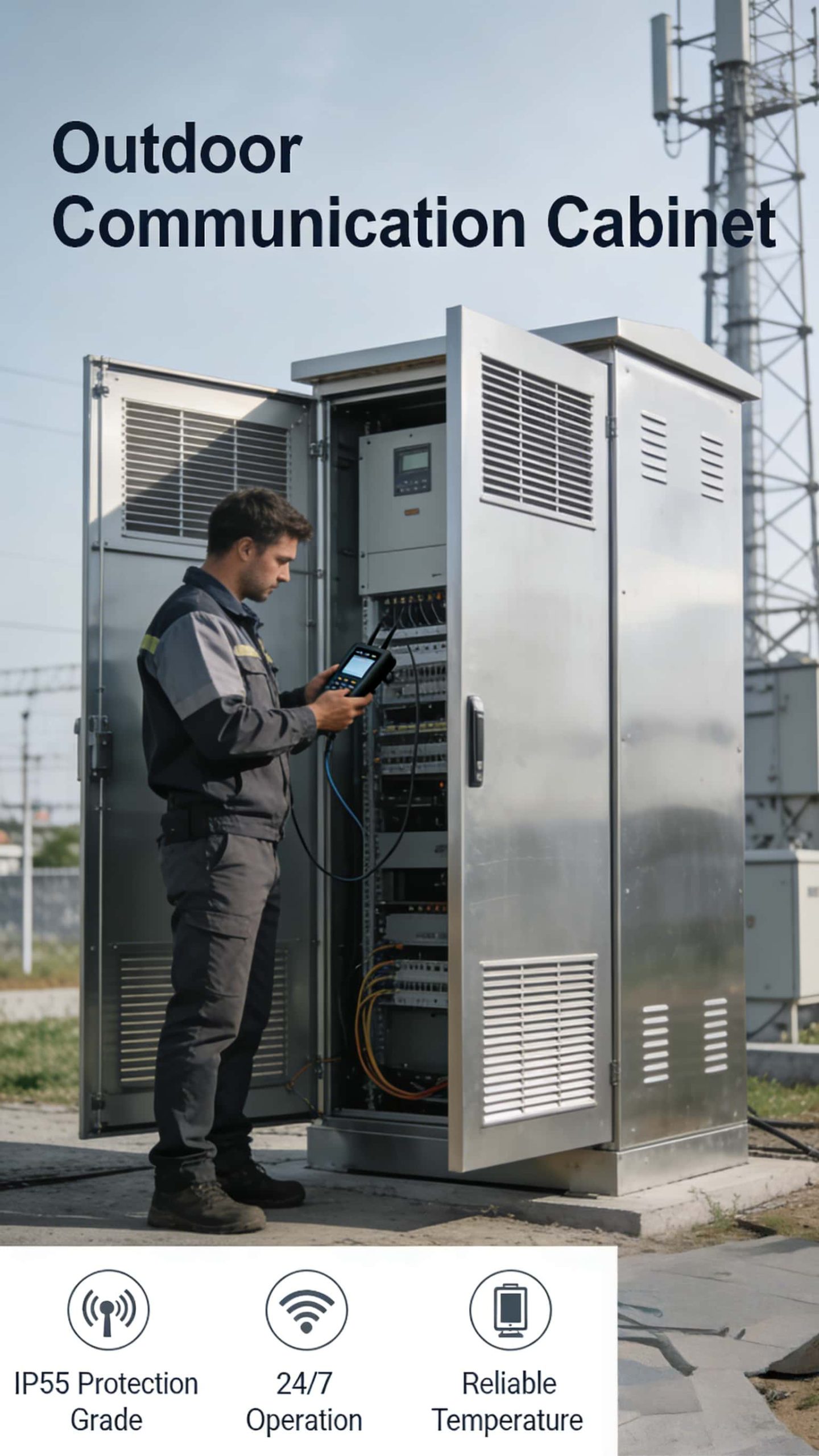
The outdoor integrated server rack is a safe, reliable, and highly anti-theft product with low noise, good heat dissipation, and a small footprint. Another feature is its ability to facilitate rapid site setup. After delivering the product to the site and installing the three compartments, simply connect the power cables to the pre-reserved terminals, and the power supply, heat exchanger, air conditioner, and other equipment are ready to use without on-site wiring. The integrated server rack is suitable for outdoor environments such as roadsides, parks, mountainous areas, and flat terrain. It can accommodate base station equipment, power supply equipment, batteries, temperature control equipment, transmission equipment, and other supporting equipment, or provide installation space and heat exchange capacity for these devices. It provides reliable mechanical and environmental protection for the normal operation of the internal equipment. The integrated server rack consists of a battery cabinet, a power supply cabinet, and an equipment cabinet, making full use of the available space within each cabinet. When selecting a site for the outdoor server rack, choose a well-ventilated area, preferably an open area or a rooftop. Avoid installing it in residential corridors or rooms to prevent affecting ventilation and heat dissipation, as well as causing noise pollution during equipment operation. Installation must be performed on a reliable channel steel base or cement pier, away from low-lying areas and high-dust zones, and with a qualified grounding busbar.
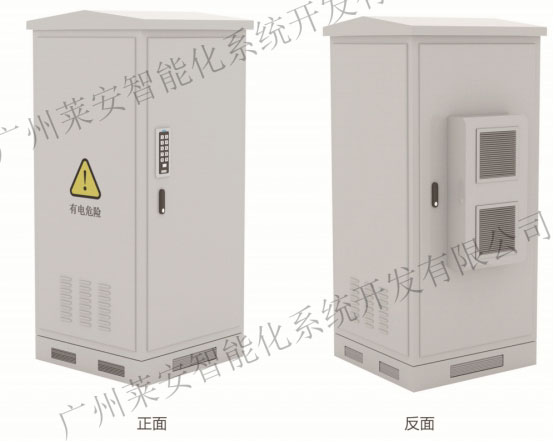
II. Composition of Outdoor Integrated Cabinet The outdoor integrated cabinet consists of hardware and software equipment.
(I) Hardware Equipment Composition The hardware equipment of the outdoor integrated cabinet mainly includes the equipment compartment, battery compartment, door, and lock.
1. Equipment Compartment: The equipment compartment is located on the right side of the cabinet and is separated from the battery compartment by a partition for heat insulation of the equipment space.
2. Battery Compartment: Used to install batteries. The external panels of the cabinet are lined with insulation cotton for heat preservation. The battery cabinet is also equipped with a sunshade for sun and water protection. The cabinet has an exhaust system to release harmful gases generated by the batteries.
3. Door and Lock: The cabinet door adopts an embedded structure with tight gaps. The door opening angle is >110°. The cabinet door contains a limiting structure, and the door limiting device has a limiting function when the door is in the “open” state. The door lock uses a three-point structure with a pull rod and locking plate, and a padlock can be added. The structure is robust and offers strong anti-theft capabilities. Each cabinet door is equipped with a door opening alarm sensor for environmental monitoring.
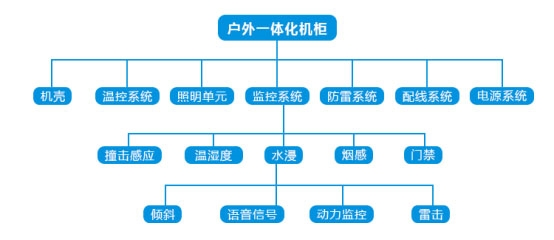
(II) Software Equipment Composition
The software equipment of the outdoor integrated cabinet mainly consists of the chassis, temperature control system, lighting unit, monitoring system, surge protection system, wiring system, and power supply system.
1. Chassis
It can accommodate equipment with external dimensions of 650mm(W) x 700mm(D) x 1200mm(H) (excluding base and sunshade height). It uses heat exchange to dissipate heat from the equipment inside the cabinet and mainly houses DC power distribution, transmission, DDF, BBU, and other equipment. The cabinet supports 19-inch (IEC297) standard racks and various equipment that meets the 19-inch (IEC297) size installation space requirements (such as power supply equipment, base station equipment, transmission equipment, temperature control equipment, batteries, surge protection equipment, and other supporting equipment). 2. Outdoor Integrated Cabinet Temperature Control System
The electronic equipment in the outdoor cabinet generates a significant amount of heat during operation, leading to elevated internal temperatures. This reduces the lifespan of electronic components and can even cause equipment malfunction. Therefore, temperature control equipment is essential to regulate the cabinet temperature, ensuring the normal operation of communication equipment and improving its lifespan and reliability.
The outdoor cabinet temperature control equipment utilizes advanced refrigeration technology, high-efficiency heat exchangers, and intelligent control schemes to ensure energy-saving and reliable operation. The product features an integrated anti-theft design while maintaining internal and external isolation of the cabinet, enhancing its dust and water resistance.
Comparison of Three Heat Dissipation Methods in the Temperature Control System:
3. Lighting Unit
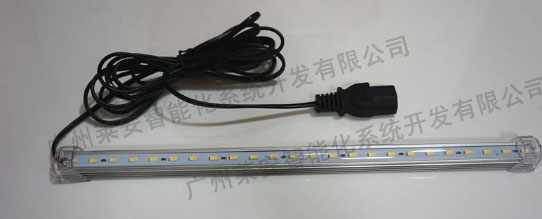
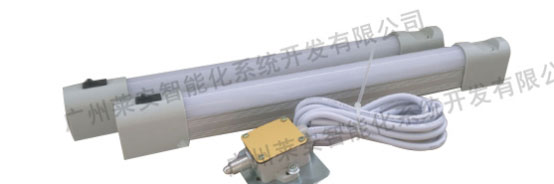
Each independent compartment is equipped with a set of 48V/220V LED lights, which activate when the cabinet door is opened.
48V DC Lighting
220V AC Lighting
4. Monitoring System
(1) The cabinet air conditioner has an RS232 or RS485 communication interface. This interface allows adjustment of the temperature setpoint of the temperature control unit and the temperature alarm setpoint, and can send out internal and external temperature parameters and various fault alarm information.
(2) Telemetry: Internal cabinet temperature, external cabinet temperature.
(3) Telesignal: Power supply fault alarm, temperature probe status (fault/normal), temperature control unit status (fault/normal), cabinet door status (open/closed), high-pressure alarm, low-pressure alarm, continuous high-pressure alarm, continuous low-pressure alarm, internal high-temperature alarm, internal low-temperature alarm, external high-temperature alarm, external low-temperature alarm, power frequency deviation alarm, and custom alarm (smoke alarm).
(4) Remote Control: Enables remote setting of air conditioner parameters or remote on/off operation.
5. Lightning Protection System
The AC side of the outdoor integrated cabinet is equipped with a Class B+C lightning protection device. The cabinet is equipped with a grounding busbar. All metal parts of the cabinet are interconnected and connected to the grounding busbar. The grounding wire of the surge protector must have good conductivity. It has a dual-power supply (mains/generator) manual switching device, with the switching method using two mechanically interlocked switches for manual operation.
6. Wiring System The integrated cabinet’s cable management area has sufficient space to meet the requirements of a fully equipped cabinet. The wiring between cabinets is provided by the manufacturer, including power lines, signal lines, etc. Cables must be properly bundled.
7. Power System
(1) Battery Compartment
1) The battery compartment should have a ventilation device to release harmful gases produced by the batteries.
2) The battery compartment structure should facilitate battery installation, inspection, and replacement, and should facilitate battery wiring operations.
3) Water accumulation is not allowed inside the battery compartment.
4) Electromechanical equipment or control components that may cause sparks are prohibited in the battery compartment.
5) The battery compartment should have devices to prevent the intrusion of insects, rodents, and other rodents. 6) The battery compartment should provide sufficient installation space and load-bearing capacity for the battery pack, and should not obstruct cable routing. The location of the battery compartment within the outdoor integrated cabinet should be reasonable and compatible with the cabinet’s installation method, dimensions, and internal structure.
7) The compartment should ideally be equipped with a temperature-sensing thermostat to ensure the battery compartment’s operating temperature is between 0°C and 40°C. 8. It should meet the relevant requirements of the power supply section of this specification.
(2) Outdoor Battery Cabinet Used to provide DC power to outdoor equipment. The cabinet has a double-layer structure, with the main body made of magnesium-aluminum alloy (or stainless steel, galvanized steel plate), using professional outdoor powder coating. It integrates a temperature control system, AC and DC power distribution systems, environmental and power monitoring systems, wiring systems, etc.
Main Features:
1) The cabinet can be customized according to actual requirements.
2) The cabinet can accommodate backup batteries. It forms an uninterruptible power supply system with the DC rectifier module.
3) Three temperature control methods: air conditioning, heat exchanger, and fan. The appropriate option can be selected based on the actual installation environment.
4) The cooling system can eliminate 800W of heat generated by the equipment and maintain the internal temperature of each electronic enclosure below 55°C.
5) The reasonable air duct design ensures that the temperature throughout the enclosure meets the usage requirements.
6) Each compartment has its own independent security door, using a special outdoor lock (three-point lock), providing a high level of protection and good anti-theft performance.
7) Electrical wiring and AC/DC power distribution system.
8) Integrated environmental power centralized monitoring system. Full-duplex remote signaling and telemetry.
III. Parameter Introduction of Related Accessories
1. Lithium Iron Phosphate Battery Pack
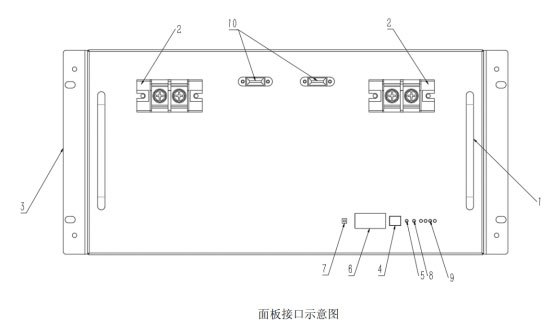
1. Rated Capacity: ≥90Ah
2. Rated Voltage: 51.2V
3. Rated Energy: 4608Wh
4. Charging Voltage: 56.4V
5. Discharging Voltage: 43.2V
6. Standard Charging Current: 0.1C
7. Standard Discharging Current: 0.33C
8. Continuous Charging Current: 0.33C
9. Continuous Discharging Current: 0.5C
10. Cycle Life: >400 cycles
11. Weight (approx.): ≤55Kg
12. Operating Temperature:
Charging, 0~45℃
Discharging, -10~55℃
13. Storage Temperature:
-20~45℃ ≤1 month
-20~35℃ ≤3 months
-20~25℃ ≤12 months
0~25℃ >12 months Months
2. UPS
1) The UPS provides uninterrupted power supply for the modular data center. In the event of an emergency power outage from the mains/generator, power is supplied via batteries, meeting the power requirements of a single server rack with a power output of 9kW.
2) 380V Voltage Standard: The modular data center is equipped with a 360kVA modular UPS, consisting of three 120kVA UPS units. It can be flexibly configured within a capacity range of 20kVA to 360kVA, meeting the needs of a single server rack with power outputs of 3kW, 6kW, and 9kW.
3) 480V Voltage Standard: The modular data center is equipped with a 400kVA modular UPS, consisting of two 200kVA UPS units. It can be flexibly configured within a capacity range of 125kVA to 400kVA, meeting the needs of a single server rack with power outputs of 3kW, 6kW, and 9kW.
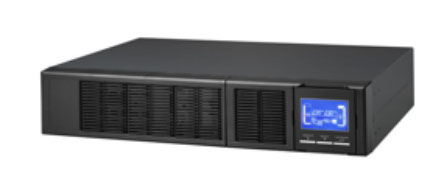
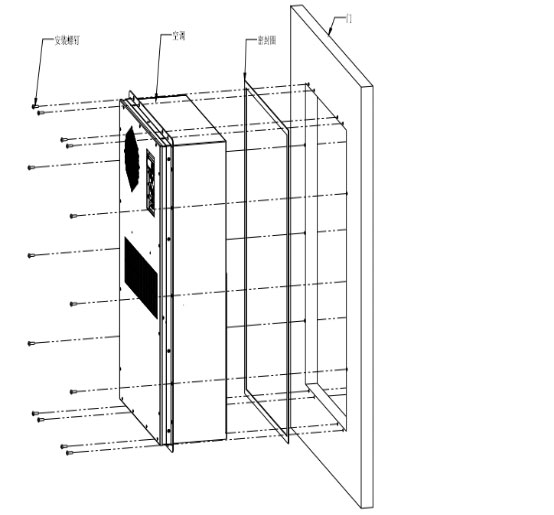
3. Precision Air Conditioning Precision air conditioning provides real-time cooling for the outdoor integrated server rack, preventing losses caused by excessively high temperatures inside the rack.
(1) Operating ambient temperature: -40 to +55℃
(2) Rated AC input power: 220±15%VAC~50Hz
(3) Cooling capacity: 800W
(4) Rated AC input power: 300W
(5) Rated current: 1.4A
(6) Cabinet dimensions (height*width*depth): 550*320*170mm
(7) Dimensions including flange (height*width*depth): 582*352*170mm
(8) Weight: 17KG
(9) Installation method: Door-mounted embedded 35mm
(10) Sound pressure level: 60dB(A)
(11) Refrigerant: R134a Installation diagram
IV. Classification of Outdoor Integrated Cabinets Outdoor integrated cabinets are classified into single-compartment, double-compartment, and triple-compartment outdoor integrated cabinets. 1. Single-Compartment Outdoor Integrated Cabinet: The cabinet is divided into different functional compartments, consisting of an equipment compartment and a battery compartment. Typically, the equipment compartment uses heat exchange or air cooling, while the battery compartment can use direct ventilation, semiconductor cooling, or air conditioning, depending on the climate conditions of the actual usage location.
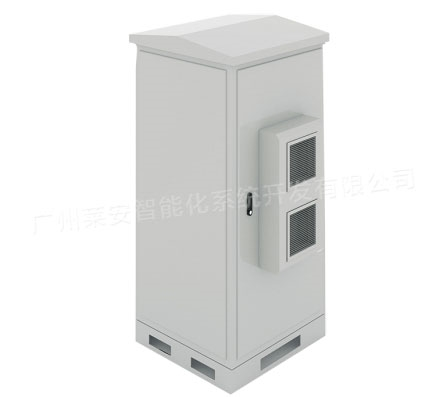
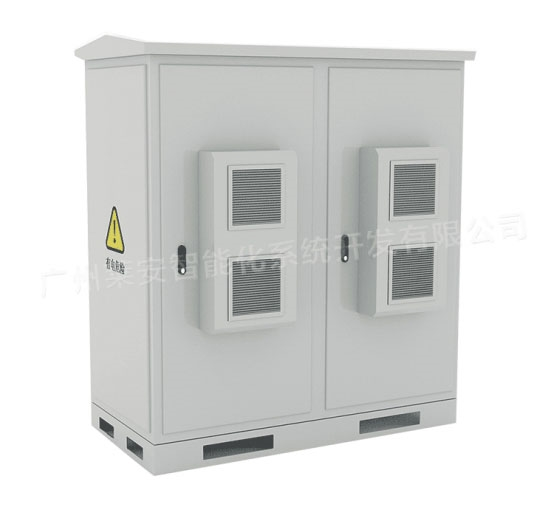
2. Dual-Compartment Outdoor Integrated Cabinet: This cabinet consists of two interconnected compartments. One compartment contains an equipment compartment and a battery compartment, while the other is a BBU (Battery Unit) cabinet. The equipment compartment generally uses heat exchange or air cooling (air conditioning may also be used depending on the equipment used), and the BBU can use either air cooling or heat exchange.
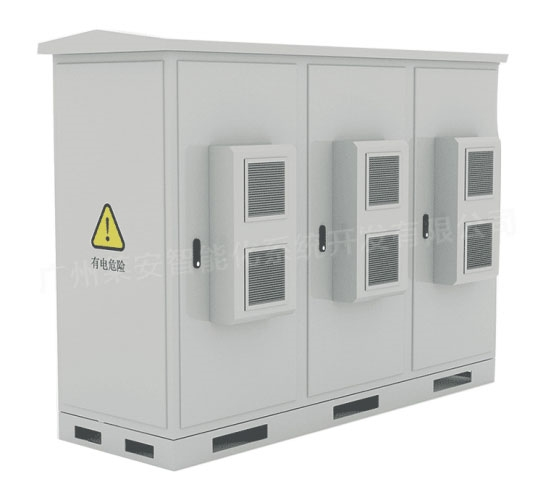
3. Three-Compartment Outdoor Integrated Cabinet: For dual-network shared base stations or sites such as GSM and 4G networks, due to the large site capacity, a three-combination cabinet approach is generally used. It typically consists of Equipment Cabinet 1 + Equipment Cabinet 2 + Battery Cabinet. The equipment compartment generally uses heat exchange or air cooling, while the battery compartment uses semiconductor cooling or air conditioning.
V. Functions of the Outdoor Integrated Cabinet
(I) Intelligent Power Distribution Unit
The intelligent power distribution unit primarily implements intelligent power distribution functions, providing intelligent capacity configuration, remote power-on/off and overcurrent/short-circuit protection, and monitoring and indicating power output status; it also provides RS485 serial communication and fault alarm reporting functions, making site power distribution management more convenient and efficient.
(II) Intelligent Anti-theft Camera
An anti-theft camera is provided as an optional accessory to improve the site’s anti-theft level. The anti-theft camera communicates with the electronic door lock. When the cabinet is illegally opened, it will initiate continuous shooting to record the scene. The continuous photos are stored in the local storage and transmitted to the network management center in real time, providing important evidence for operators to recover asset losses.
(III) Site Energy Efficiency Management
Site energy efficiency (SIEE) supports statistics on AC input and solar input power consumption, and supports independent statistics on the power consumption of DC distribution side main equipment. Based on real-time collected operating parameters, the controller calculates the site’s real-time energy efficiency level and reports the results to the network management system (NetEco). The network management system can statistically display site energy efficiency data according to different dimensions, enabling statistical analysis of site energy efficiency levels and providing management improvement assistance. This provides a measurement tool for improving the overall network energy efficiency level.
(IV) Mobile APP Management The system provides network management functionality based on a smartphone APP, allowing customers to access real-time network environmental status anytime, anywhere. Users can connect to the network management center via mobile network or connect to the WiFi module in the cabinet near the site to learn about site information. The mobile APP displays a wealth of content, including alarms, site lists, GIS maps, environmental information, and site energy efficiency information.
(V) Multi-Energy Input/Output The system supports multiple energy input and output standards to improve its adaptability to site environments and applicability to various electrical devices. It supports the access of multiple energy sources, including mains power, generators, solar energy, and high-voltage DC. After system conversion, the energy is output in multiple energy standards, including 48V DC, 220V AC, and high-voltage DC remote supply, etc. (VI) Centralized Display and Control: Environmental monitoring, video, power consumption, and other data within the cabinet are displayed on an industrial screen, allowing users to view real-time data and understand the current status of the cabinet. This makes monitoring more convenient, efficient, and intelligent.
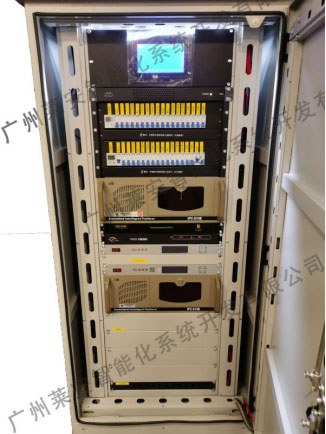
VI. Main Equipment
1. Industrial Touch Screen
2. ODF Patch Panel
3. DDF Patch Panel
4. Server
5. Communication Equipment
6. UPS Main Unit
7. Inverter
8. High-Frequency Switching Power Supply Unit
9. Battery Pack
10. Power Distribution Unit
VII. Product Features
1. Remotely authorizes unlocking permissions, monitors and records door lock status, lock opening and closing times, and unlocker information.
2. Equipped with an internal backup battery, the smart lock can remain in standby mode for one month during a power outage, during which time it can still be unlocked normally.
3. Large capacity, multi-door structure for easy installation and maintenance of internal equipment.
4. Includes an external emergency power supply interface, allowing power to be supplied to internal equipment via an external power system during a power outage.
5. The enclosure is dustproof, sunproof, and rainproof, making it suitable for various outdoor environments.
6. Employs a combination of AC air conditioning, heat exchange, semiconductor air conditioning, and direct ventilation for cooling to achieve a constant cabinet temperature.
7. Standard configuration includes AC or DC power distribution unit (optional).
8. Each cabinet is equipped with 48V DC lighting.
9. Features power and environmental monitoring functions, capable of generating and uploading alarms for power failure, power malfunction, access control, temperature and humidity, smoke, water immersion, and battery voltage. 10. The layout is rational, facilitating cable entry, fixing, and grounding, and simplifying maintenance. The cabinet uses bottom-entry cabling, with independent entry holes for power cables, signal cables, and fiber optic cables to prevent interference.
11. All cables, insulation strips, and thermal insulation materials used are flame-retardant.
12. Can be assembled using welding or splicing methods.
13. Utilizes a standard 19-inch rack.
14. A simpler and more efficient outdoor power supply solution.
15. Intelligent operation and maintenance, supporting comprehensive intelligent network energy monitoring and a mobile app, making the operation and maintenance support system more intelligent.
16. Easy upgrades, with a fully modular design for power distribution, power, and cooling, simplifying future upgrades.
17. High-efficiency operation, equipped with industry-leading high-efficiency rectifier modules from KITOZER, temperature control design, and site-level energy efficiency analysis and management, resulting in more efficient operation.
VIII. Product Advantages
1. Compared to traditional server racks and server rooms, outdoor integrated server racks have a smaller footprint, shorter construction cycles, fewer single-path failure points between functional modules, and significantly improved system compatibility. They also increase the space utilization of user server rooms, providing users with a more consistent, highly integrated, manageable, and scalable small intelligent server room system.
2. Outdoor integrated server racks are mainly used for wireless communication base stations, power distribution, urban transportation, next-generation 4G, system communication, integrated network service access, transmission and switching stations, and emergency communication transmission. They are constructed using hot-dip galvanized steel sheets thicker than 1.5mm and consist of an outer casing, internal metal components, and accessories. The interior is functionally divided into equipment compartments and battery compartments. The rack has a compact structure, is easy to install, has excellent sealing performance, and features remote centralized management capabilities.
IX. Differences between Traditional Outdoor Cabinets and Integrated Outdoor Cabinets
1. Traditional outdoor cabinets generate significant heat during operation, leading to elevated internal temperatures. This reduces the lifespan of electronic components and can even cause equipment malfunction. Therefore, temperature control equipment is essential to maintain proper function and improve the lifespan and reliability of the electronic equipment.
2. Integrated outdoor cabinets utilize advanced refrigeration technology, high-efficiency heat exchangers, and intelligent control schemes to ensure energy-efficient and reliable operation. The product features an integrated anti-theft design while maintaining internal and external insulation, enhancing dust and water resistance.
X. Cabinet Parameter Introduction
XI. Installation of Integrated Outdoor Cabinets
1. Installation Location
Depending on network planning needs, integrated cabinets can be installed on the ground, rooftops, roadsides, hillsides, etc. They can be installed close to the ground or overhead. When installed in flood-prone areas, flood prevention requirements must be considered.
2. Assembly Methods
Integrated cabinets support both fully assembled (fully assembled and hoisted on-site) and modular (disassembled parts and assembled on-site) assembly methods.
(1) Fully Assembled: As needed, fully assembled integrated cabinets are integrated and installed in the production plant or warehouse. They are suitable for land, sea, or air transport, meeting the requirements for handling bumps, vibrations, and lifting during transportation.
(2) Modular: As needed, the components of the integrated cabinet can be transported to the site for standardized assembly.
XII. Application Scope
Outdoor integrated cabinets are widely used in mobile communication sites of telecommunications operators, outdoor small modular units, railway electrical control cabinets, electronic police systems, communication base stations, outdoor air quality monitoring stations, high-speed card reader control cabinets, etc. XIII. Project Cases
1. Communication Base Station Equipment Warehouse – Cabinet AC Air Conditioning
2. PM2.5 Monitoring System – Cabinet AC Air Conditioning
3. Highway Automatic Card Issuing Machine – Cabinet AC Air Conditioning
4. Small and Medium-Sized Computer Rooms, UPS Rooms
5. Outdoor Base Station Computer Rooms for Telecom Operators
6. Bank ATM Cash Exchange Rooms
7. Outdoor Integrated Communication Cabinet Battery Compartment
8. Outdoor Communication Cabinets
9. Outdoor Power Supply Cabinets for Communication Base Station Photovoltaic Power Supply Systems
10. Outdoor Power Cabinets
Etc.
XIV. Configuration List
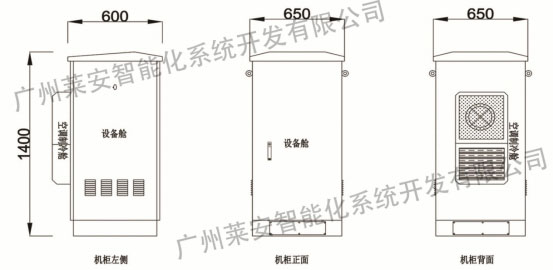
XV. Design drawings for outdoor integrated cabinet
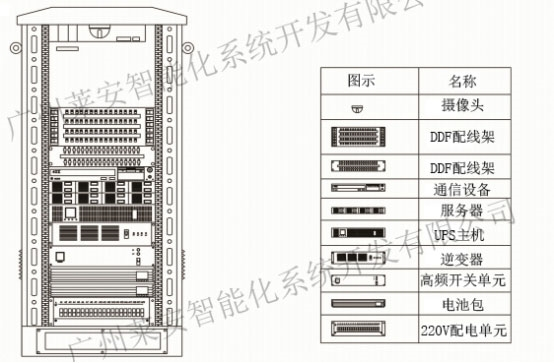
XVI. Conclusion KITOZER focuses on green and intelligent technologies in its R&D, leveraging various channels such as agents, distributors, and e-commerce to create industry-leading intelligent outdoor integrated server racks. We support outdoor server rack projects with energy-conscious cabinet design. KITOZER supplies customized outdoor cabinet configurations from design to production, based on each project’s requirements. Support scope is confirmed on the quotation.
Related Products
| Brand | KITOZER |
|---|---|
| Product Type | Outdoor control cabinet |
| Application Environment | Outdoor |
Only logged in customers who have purchased this product may leave a review.
Reviews
There are no reviews yet.